
(The Soul’s Adventure)
There’s a particular quality that belongs to hope after devastation, to light discovered in the deepest darkness, to the recognition that what looked like irredeemable failure was actually the beginning of the most important journey. Not the shallow hope that nothing bad will happen, but the profound hope that even when everything falls apart, even when you’ve made catastrophic mistakes, even when you’re lost in chaos of your own making, there’s still a path home. And more than that: the very falling was necessary, the mistakes were part of the design, the chaos itself is where transformation happens.
This is Sophia’s gift.
Sophia is one of the most famous characters in the Gnostic saga. Her myths vary depending on the source, but most agree she was the youngest Aeon, a capacity or attribute of the Invisible Spirit, who transgresses against the divine order and is cast into Chaos. In some prominent stories, Sophia’s anguish and negative emotions give birth to matter itself and the fierce Demiurge who rules it. In some way or another, she must rectify her error and confront her son and his archons, often with the help of her consort, the Aeon Christ.
The Book of Sirach speaks of her with awe: “The first human being never finished comprehending Wisdom, nor will the last succeed in fathoming her. For deeper than the sea are her thoughts, and her counsels than the great abyss.”
From her appearance in the Book of Enoch to her rescue operation in the Secret Book of John, Sophia’s story is our story: the soul’s adventure through the spheres and the return home by becoming fully whole with wisdom. She represents every soul that has fallen from grace, made irreversible mistakes, created chaos from the best intentions, and still found the courage to begin the long journey back to wholeness.
Today, Sophia arrives as our nineteenth companion, following Thunder’s teaching about speaking from totality. Where Thunder taught us to claim all contradictions as aspects of wholeness, Sophia teaches us what happens when that wholeness experiences catastrophic fragmentation and must undertake the patient, difficult, necessary work of restoration. She is the star precisely because she fell so far and still found light.
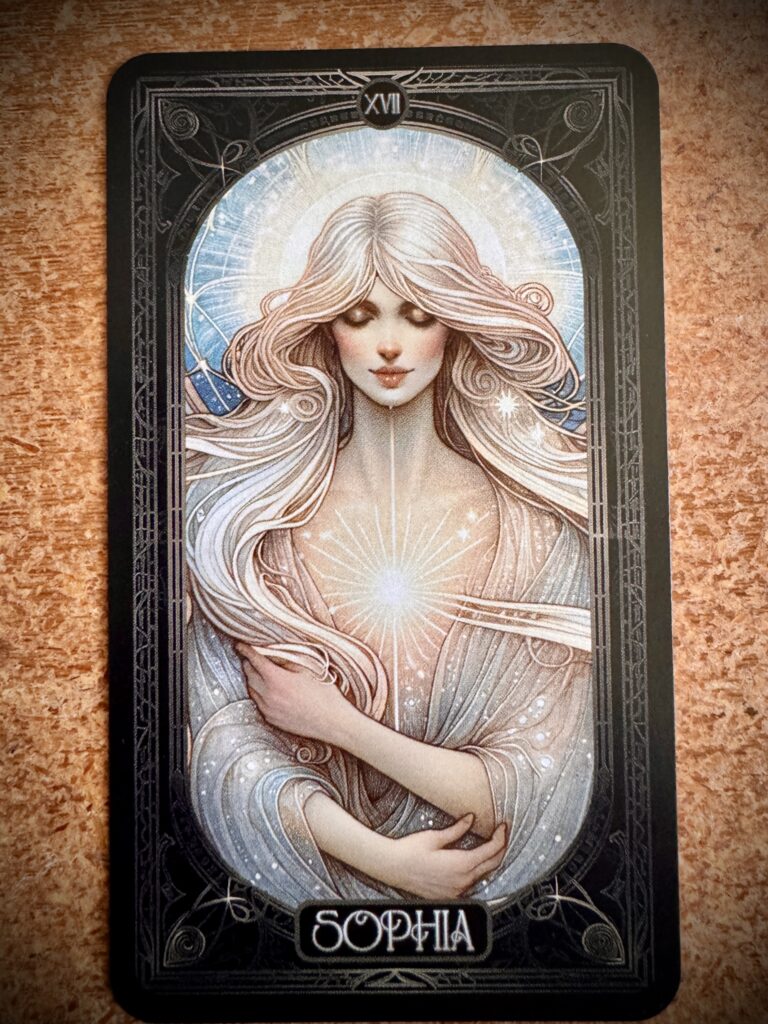
The Advent Companion Appears
Sophia doesn’t arrive triumphant or fully restored. She appears as someone in the middle of the great work, as the quality of hope that persists through ongoing transformation, as the light that doesn’t wait until everything is fixed to begin shining. You feel her first as the recognition that your own falling, your own failures, and your own chaos-creating weren’t diversions from your spiritual path but essential parts of it.
She cradles light against her heart because she’s learned something crucial: the light she seeks isn’t somewhere else. It’s within her, has always been within her, and was there even in the deepest chaos. The journey isn’t about finding external salvation but about remembering and reclaiming the divine spark that never left, even when she was cast out of the Pleroma.
The mandala behind her represents both wound and wholeness. It’s the Pleroma she transgressed against and was expelled from. It’s also the pattern she’s working to restore, not by returning to how things were but by bringing everything she learned in the falling, the chaos, and the material world back into divine consciousness. Her restoration isn’t erasure of the fall. It’s the integration of everything that happened because of it.
In the Secret Book of John, Sophia’s transgression is described as wanting to create without her consort, wanting to express her creative power independently. Different traditions interpret this differently. Some see it as pride, as overreach. Others see it as curiosity, as a creative impulse, as the necessary experiment that brings about material reality and therefore the possibility of souls incarnating, learning, evolving through matter.
But here’s what matters: even in traditions that see her action as transgression, as mistake, as the cosmic catastrophe that creates the whole mess of material existence under the Demiurge’s control, she’s never portrayed as irredeemable. She’s portrayed as working to restore what was broken, as enlisting help (Christ, Barbelo, redeemed Sabaoth), as patient and determined in her rescue operation.
She represents the Aeon, the divine attribute, that falls into matter so completely that matter itself becomes the classroom for transformation. Every soul that incarnates is participating in Sophia’s story. Every person who falls from grace, makes catastrophic mistakes, creates unintended chaos from good intentions, and still finds the courage to work toward restoration is living Sophia’s pattern.
The star quality isn’t perfection. It’s persistence. It’s the light that keeps shining through ongoing transformation. It’s the hope that remains even when the work is far from complete.
As Sophia appears beside you today, cradling light against her heart, still in process, still working on restoration that won’t complete in any single lifetime, her teaching arrives as both comfort and commission:
“What if your falling was necessary? What if the mistakes that feel irredeemable are actually the beginning of your most important work? What if the light you seek has been within you all along, waiting for you to stop seeking it elsewhere and start tending it here?”
Teaching for the Day
We live in a culture that treats mistakes as failures, falling as disqualification, creating chaos as evidence you shouldn’t have tried. There’s no redemption arc that doesn’t begin with denial that you really fell, minimization of how bad it was, or quick resolution that erases the consequences. Real falling, catastrophic mistakes, chaos that births monsters—these are supposed to disqualify you from spiritual legitimacy.
Sophia teaches something radically different. She fell completely. Her distress and anguish literally gave birth to the Demiurge and material reality. You can’t get more catastrophic than that. And yet she’s not disqualified. She’s the protagonist of the cosmic restoration story. Her work to rectify what happened, to rescue the divine sparks trapped in matter, to restore wholeness—this is the central drama of Gnostic cosmology.
This matters because you’ve fallen too. Maybe not from the Pleroma into Chaos, but from grace into shame, from confidence into self-doubt, from clarity into confusion. You’ve made mistakes that can’t be undone. Created consequences that can’t be erased. Birthed monsters from good intentions. And the culture tells you this disqualifies you, proves you were never legitimate, means you should apologize for taking up space.
Sophia says: the falling is part of the pattern. The mistakes are part of the teaching. The chaos you created is the material you’ll work with for the rest of your journey. This isn’t punishment. This is the curriculum.
“The first human being never finished comprehending Wisdom, nor will the last succeed in fathoming her. For deeper than the sea are her thoughts, and her counsels than the great abyss.”
Sophia is unfathomable not because she’s perfect but because she contains such depth, such complexity, such paradox. She is simultaneously the one who transgressed and the one working toward restoration. She is both cause of the problem and architect of the solution. She is fallen and rising at the same time.
The archons benefit from shame about falling. They want you believing your mistakes disqualify you, that creating chaos proves you’re not spiritual, that falling means you can’t be trusted with power. Because if you believe that, you’ll spend your life apologizing instead of working, hiding instead of shining, trying to prove your legitimacy instead of doing your actual work.
But Sophia’s story reveals: spiritual authority often comes through falling, wisdom through mistakes, power through learning to work with the chaos you’ve created. The star shines brightest not from those who never fell but from those who fell completely and still found light, who made catastrophic errors and still began the work of restoration.
The traditional Star card in tarot represents hope, inspiration, connection to something larger. Sophia as Star embodies this perfectly, but with crucial addition: her hope isn’t naive. It’s earned through experience. Her inspiration isn’t untested. It’s forged through chaos. Her connection to the divine isn’t because she never left it. It’s because she fell away completely and found her way back to it through the long work of restoration.
This teaching today isn’t permission to make reckless mistakes. It’s recognition that the mistakes you’ve already made, the chaos you’ve already created, the falling you’ve already experienced—these aren’t disqualifications. They’re your material. They’re what you have to work with. And the work isn’t erasing them. It’s integrating them into your ongoing restoration.
Sophia’s rescue operation isn’t complete. In most Gnostic texts, it’s ongoing. She’s still working to bring back all the divine sparks, still helping souls remember their origin, still confronting her son the Demiurge and his archons. The star quality is that she keeps working even though the work isn’t done, keeps shining even though restoration is incomplete, keeps hoping even though the journey home is long.
Journaling Invocation
“What falling in my life have I been treating as disqualification rather than curriculum? What chaos have I created that might actually be the material I’m meant to work with? What if the light I’m seeking has been within me all along, even through the falling?”
This question invites you to reframe your relationship with your own mistakes, your own falling, your own chaos-creating. Not to excuse them or minimize their consequences, but to recognize them as part of your pattern rather than deviation from it.
Maybe you’ve made relational mistakes that created lasting harm. Maybe you’ve pursued paths that led to catastrophic consequences. Maybe you’ve hurt people from good intentions. Maybe you’ve fallen from grace in ways that feel irredeemable.
Sophia would ask: what if these aren’t proof that you’re disqualified but evidence that you’re participating in the pattern? What if the falling was how you learned what you most needed to know? What if the chaos you created is the classroom where transformation happens?
This isn’t about avoiding responsibility or denying harm. It’s about recognizing that responsibility includes learning from the falling, that acknowledging harm includes working toward restoration, that the mistakes themselves become part of your wisdom if you’re willing to work with them honestly.
Write about your falling. Not to justify it or explain it away, but to see it clearly. What did you learn through falling that you couldn’t have learned any other way? What wisdom did the chaos teach you? What light did you discover in the darkness that you might never have found in the light?
And then ask: what’s the work of restoration calling you toward now? Not erasing what happened, but integrating it, learning from it, using it as material for building something more whole than what existed before the falling.
Sophia’s star quality is this: she keeps shining through the work, keeps radiating hope even though restoration is incomplete, keeps tending the light within her even as she works to rescue all the other lights trapped in matter.
What becomes possible when you stop treating your falling as disqualification and start treating it as the beginning of your most important work?
Small Embodied Practice
Sit or stand in a comfortable position. Place both hands over your heart, one hand over the other.
Close your eyes. Take a few deep breaths.
Now think of something you’ve done that feels irredeemable. A mistake you can’t undo. Chaos you created. Falling you experienced. Feel it in your body. Feel the shame, the regret, the wish you could go back and do it differently.
Stay with this feeling for a moment. Don’t push it away. This is the material Sophia works with.
Now, keeping your hands on your heart, imagine a small light there. Not a light that erases what happened or pretends it didn’t. A light that persists despite what happened. A light that was there even in the deepest chaos. A light that’s still there now.
With each breath, let that light grow slightly brighter. Not through denying what happened but through recognizing that the divine spark within you survived even the worst of what you’ve done or experienced.
Say internally: “I fell and the light remained. I created chaos and the light remained. I made irreversible mistakes and the light remained. Now I work with what is, tending this light while I work toward restoration.”
Stay with this for several minutes. Feel the difference between shame that collapses you and responsibility that galvanizes you. Sophia’s star quality is the second: acknowledging what happened while still tending the light, still working toward restoration, still hoping even when the work is incomplete.
When you’re ready, take three deep breaths and open your eyes.
This is Sophia’s teaching embodied: the light within you doesn’t depend on your perfection. It persists through falling, through mistakes, through chaos. Your work is to tend it while you work toward restoration, to keep shining even though the work isn’t done.
You just practiced being the star.
Not because you never fell.
Because you fell completely and still found the light.
Still began the work.
Still keep shining through the long journey home.
The caravan moves together toward restoration. If today’s companion touched something in you, if Sophia’s persistent light helped you recognize that your falling might be curriculum rather than disqualification, let us know in the comments. Your light lights the path for others working toward wholeness beside you. ⭐
Tomorrow: Norea arrives, the one who breathes fire, who requires no male consort, who stands as savior in her own right and teacher of mysteries that will bring the Demiurge’s doom.
[…] […]
[…] The Gnostic Caravan Day 20: Norea, The Moon – soulcruzer says: […] […] […]
[…] Reading the Apocryphon of John – soulcruzer says: […] The Gnostic Caravan Day 20: Norea, The Moon – soulcruzer… […]