
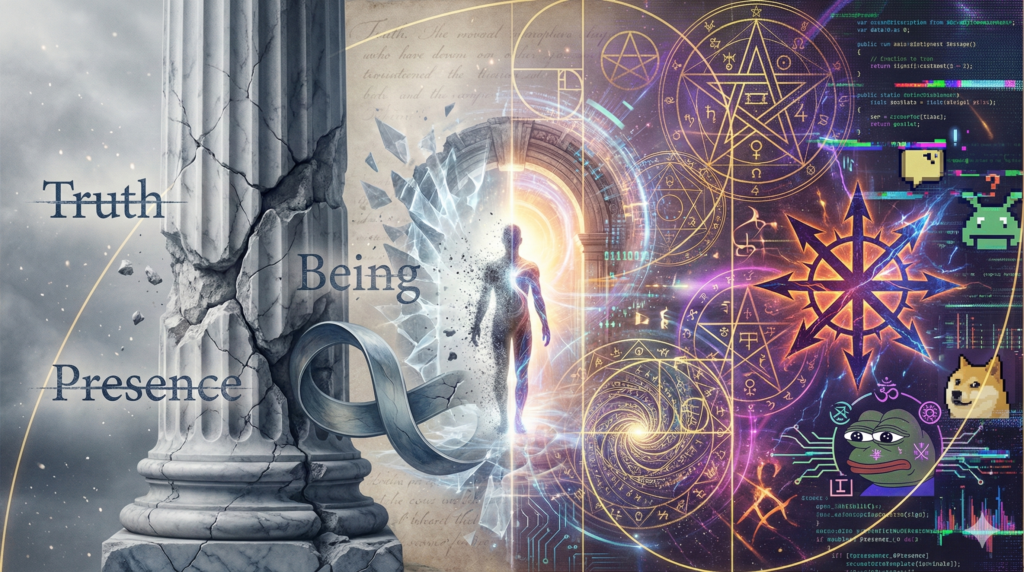
Deconstructing Truth, Constructing Reality: Where Philosophy Meets Chaos Magick
This visual essay maps one of the most compelling parallels in consciousness work: how academic philosophy and occult practice arrived at identical conclusions through completely different paths.
What you’re looking at is the collapse of certainty itself.
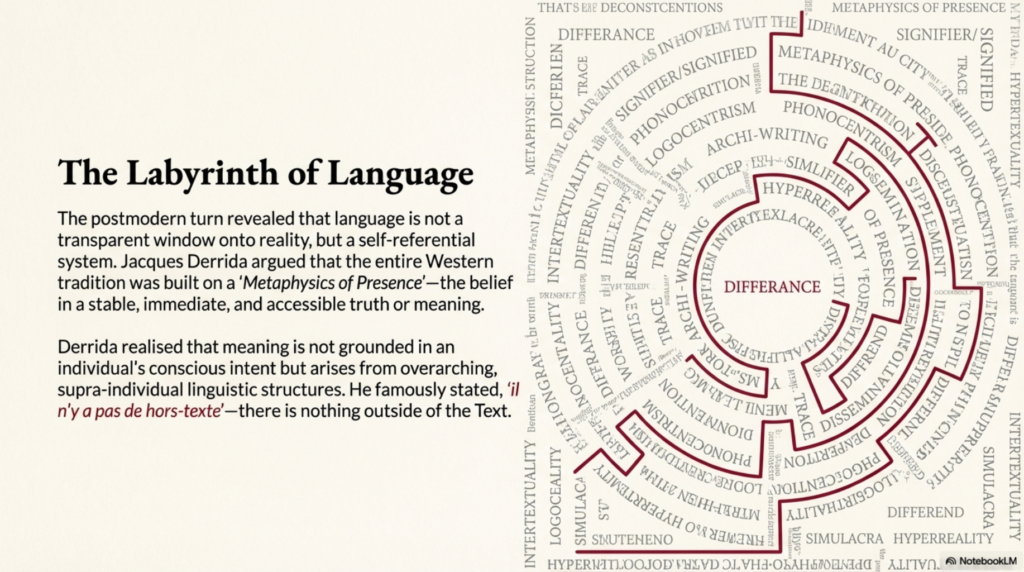
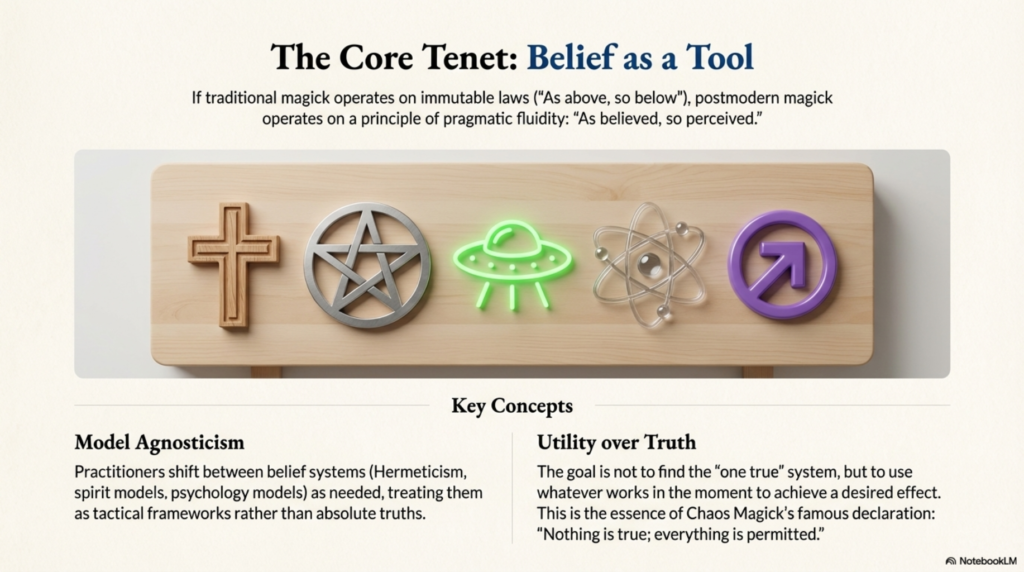
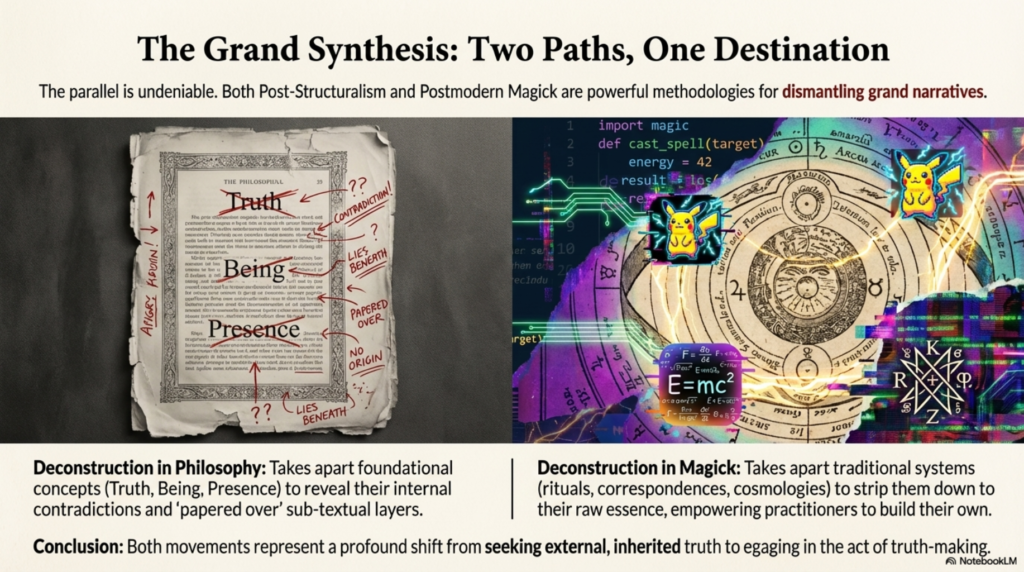
Post-structuralism dismantled Western metaphysics by revealing that language doesn’t reflect reality but constructs it. Meanwhile, chaos magick emerged from practitioners who realized that belief systems function as tools rather than truths. Both movements understood something radical: we’re not discovering meaning, we’re making it.
The presentation walks you through this convergence step by step. From the crumbling monolith of absolute truth to Derrida’s labyrinth of différance, from Nietzsche’s “will to power” to chaos magick’s declaration that “nothing is true, everything is permitted.” Each slide builds on the last, presenting not dry theory but living philosophy rendered in images that mirror the concepts themselves.
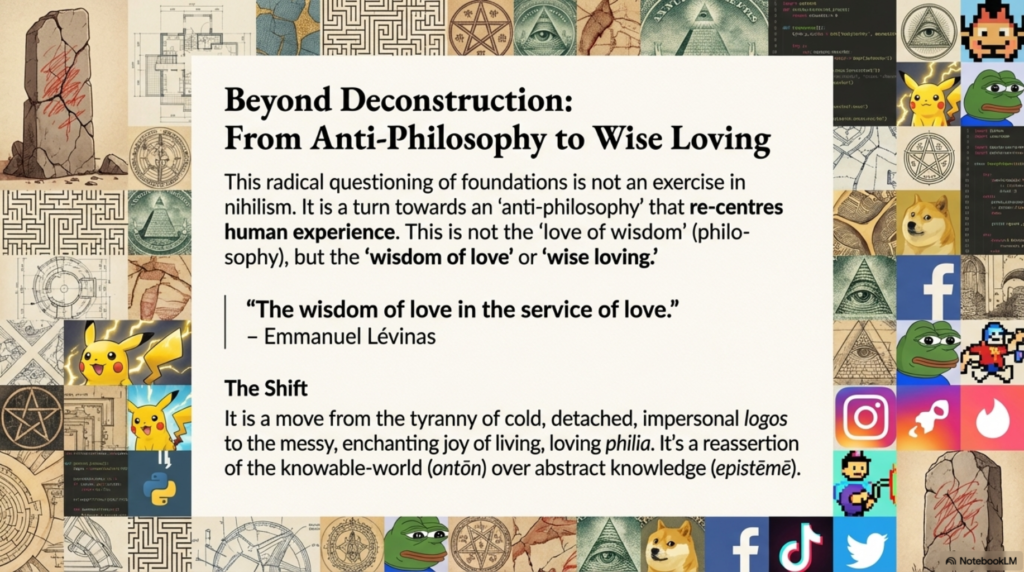
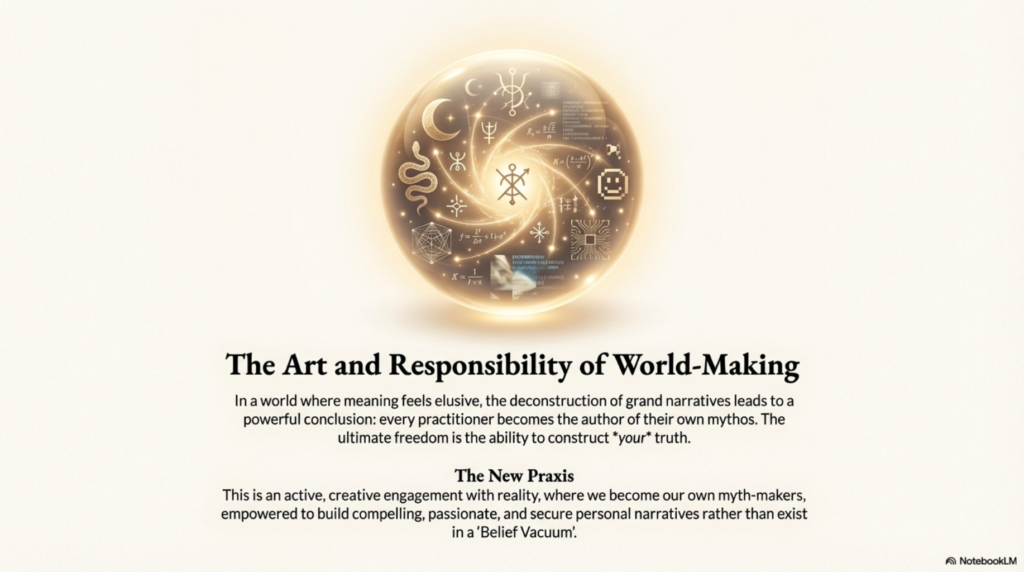
What strikes me most is how this piece refuses to treat these parallel developments as mere coincidence. Instead, it argues they represent a fundamental shift in human consciousness: from seeking external truth to engaging in the act of truth-making. From the tyranny of logos to the wisdom of philia1. From passive readers of a predetermined text to active authors of our own myths.
This is narrative alchemy in its purest form. Stories as code. Reality as remix. Consciousness as craft.
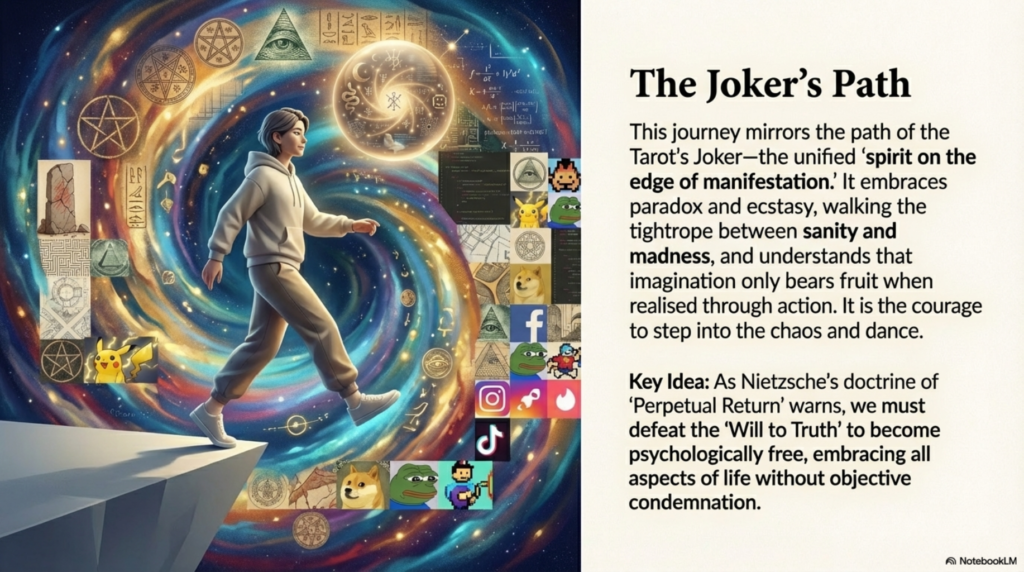
The final slide captures it perfectly: you’re walking the Joker’s path, that tightrope between sanity and madness where imagination only bears fruit when realized through action. It’s the courage to step into chaos and dance with it.
Welcome to the psychogeography of meaning itself. The journey from absolute truth to personal reality starts here.
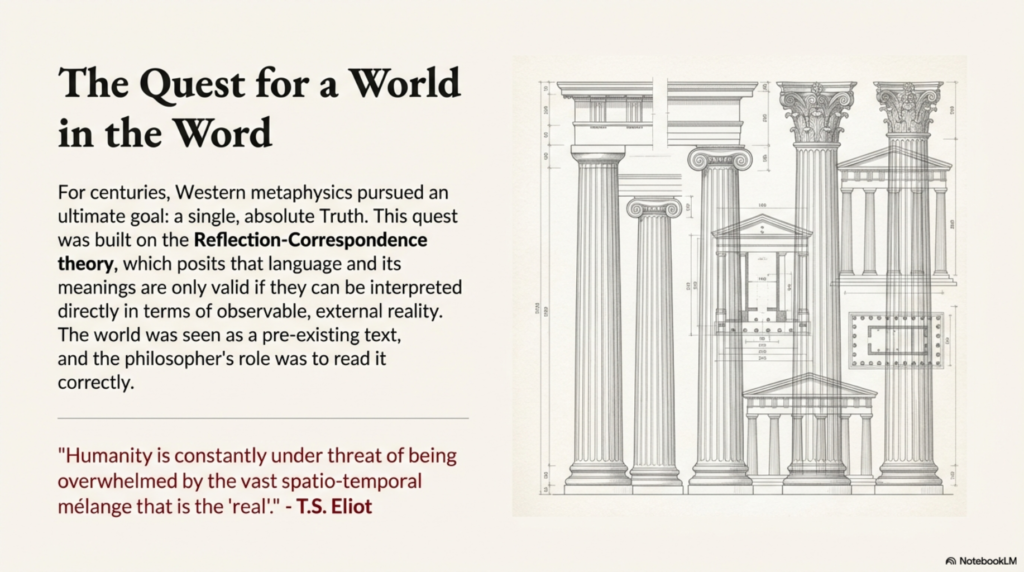
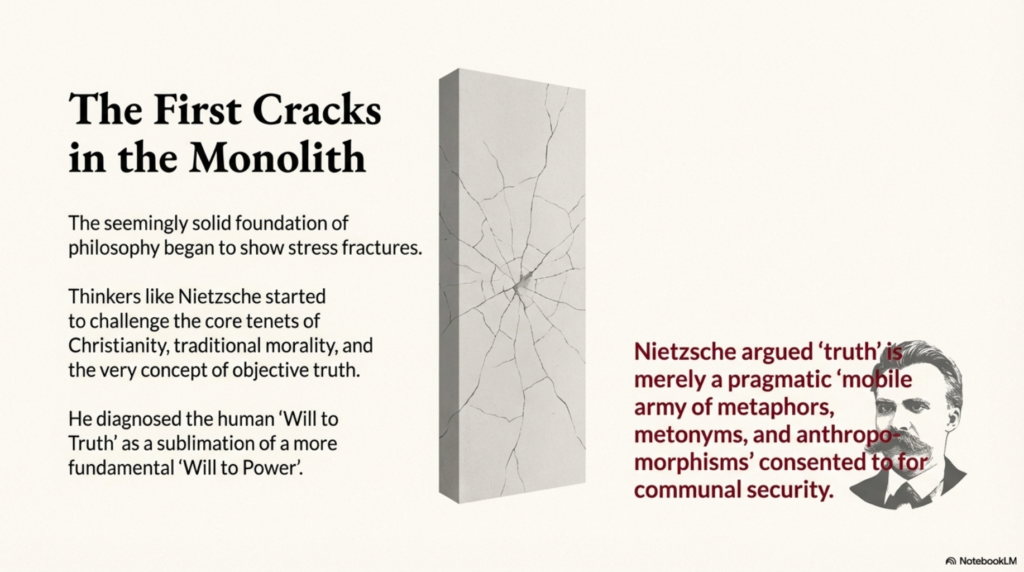
Key Takeaways: Post-Structuralism and Chaos Magick
1. Reality Is Constructed, Not Discovered Both post-structuralism and chaos magick reached the same radical conclusion: there is no fixed, objective truth waiting to be found. Instead, meaning and reality are actively constructed through language, belief, and practice.
2. Language Creates Reality (Not Reflects It) Derrida’s deconstruction revealed that language is a self-referential system. Words don’t point to stable meanings but to other words in an endless chain. Similarly, chaos magicians understand that symbols and beliefs shape experience rather than describe pre-existing truths.
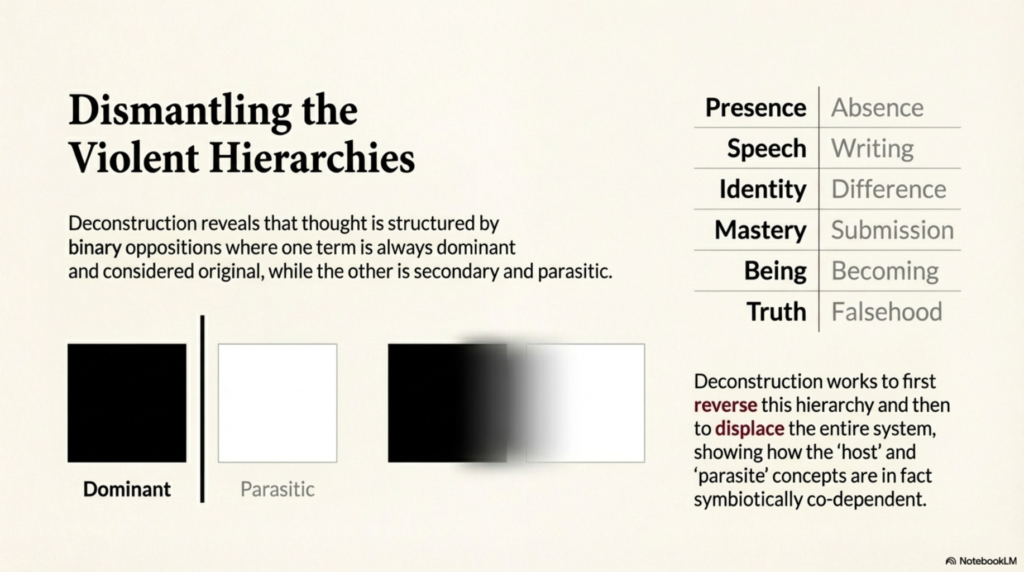
3. Binary Oppositions Are Illusions Western thought relies on hierarchical binaries (presence/absence, truth/falsehood, master/slave). Deconstruction shows these are co-dependent constructs, not natural categories. Chaos magick applies this by freely mixing incompatible belief systems without cognitive dissonance.
4. Belief Is a Tool, Not a Truth The core chaos magick principle “nothing is true, everything is permitted” parallels post-structural skepticism. Both treat belief systems as tactical frameworks to be adopted and discarded based on utility, not ultimate validity.
5. You Are the Author of Your Own Myths Once grand narratives collapse, individual practitioners become myth-makers. This shift moves power from external authorities (texts, traditions, dogmas) to the creative individual who consciously constructs their own meaningful reality.
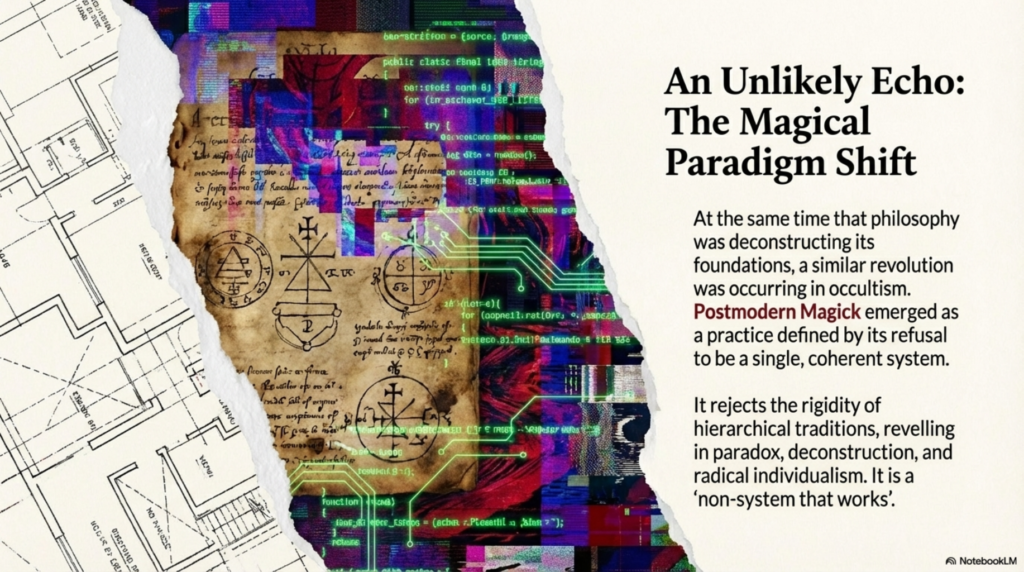
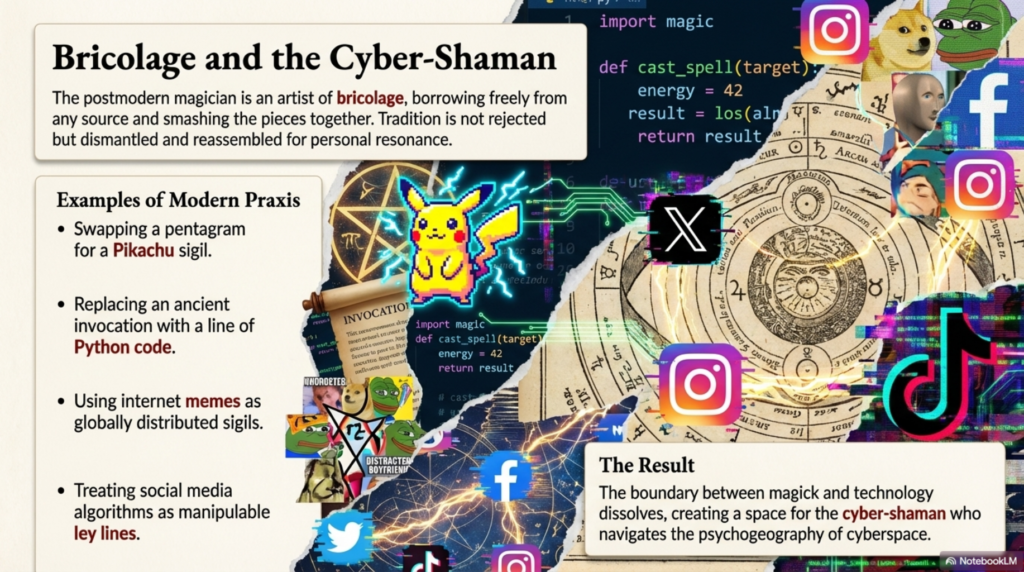
6. Bricolage Replaces Orthodoxy The postmodern magician practices bricolage: borrowing freely from any tradition, remixing ancient symbols with pop culture, treating Pikachu sigils and Enochian invocations as equally valid tools. Post-structuralism’s dismantling of hierarchies makes this radical eclecticism philosophically coherent.
7. From Logos to Philia The transformation isn’t nihilistic but ethical: moving from cold, detached pursuit of abstract truth (love of wisdom) to engaged, compassionate participation in lived experience (wisdom of love). Knowledge serves life rather than dominating it.
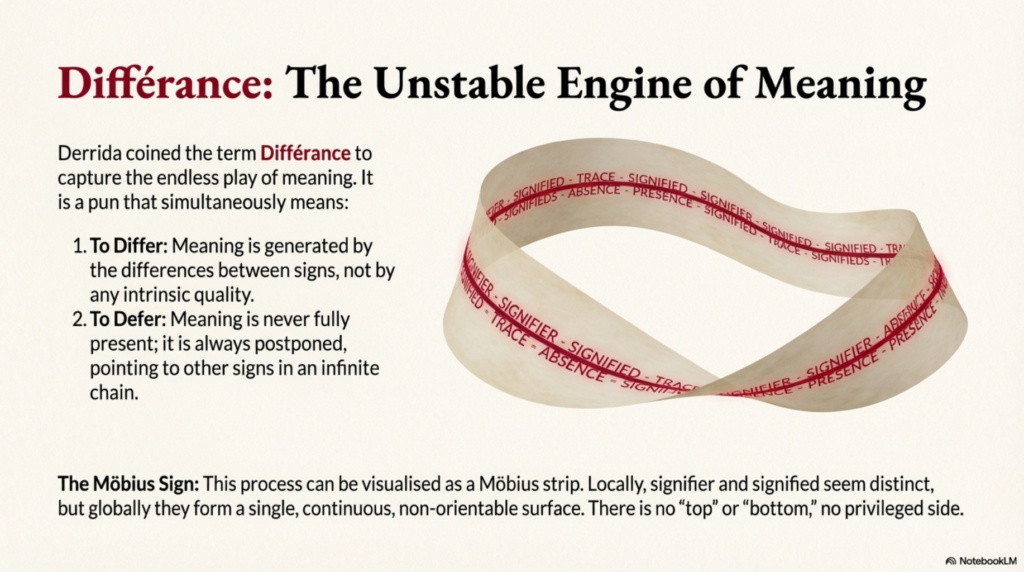
8. Meaning Is Perpetually Deferred (Différance) Derrida’s concept shows meaning is never fully present but always pointing elsewhere. This mirrors the magician’s understanding that reality is fluid, malleable, and responsive to consciousness rather than fixed and inert.
9. Deconstruction Is Liberation, Not Destruction Both movements dismantle oppressive structures not to create nihilistic void but to clear space for authentic creation. The goal is psychological freedom: the ability to engage reality without being imprisoned by inherited narratives.
10. Action Transforms Imagination Into Reality The Joker’s path requires courage to step off the edge. Philosophy without practice remains abstract; magick without grounding becomes delusion. The synthesis demands embodied action that transforms conceptual possibility into lived experience.
The Ultimate Takeaway: We’ve shifted from seeking external, inherited truth to engaging in the art of truth-making. Both post-structuralism and chaos magick offer methodologies for becoming conscious co-creators of reality rather than passive consumers of predetermined meaning. The question isn’t “what is true?” but “what reality am I constructing, and does it serve life?”
Journal Prompts: Exploring Your Personal Reality Construction
1. What story am I living inside of, and who wrote it?
If your life were a narrative with themes, archetypes, and a genre, what would it be? Tragedy? Hero’s journey? Comedy of errors? Redemption arc? Write out the major plot points and recurring patterns. Now ask: who wrote this story? Family expectations? Cultural programming? A younger version of yourself? What story would you write if you were starting from scratch today?
2. The 30-day belief experiment: What happens when I treat belief as a tool?
Choose one belief you’ve never held and adopt it completely for 30 days. “Money flows easily to me.” “Synchronicity guides my path.” “I am naturally magnetic.” Journal weekly: How does this belief change your behavior? Your perception? Your results? At the end, you don’t have to keep the belief, but you’ll have data on how reality responds to different operating systems.
3. Where am I waiting for permission to author my own reality?
What are you waiting to arrive before your “real life” begins? The right relationship? Financial security? Confidence? Recognition? Creative success? What if this waiting is the trap itself, a story where you’re forever the supporting character in someone else’s narrative? What becomes possible if you grant yourself permission right now to be the primary author? Write one concrete action that embodies this shift from waiting to creating.
4. My bricolage practice: What reality am I constructing from the pieces I’ve gathered?
List 5-10 completely disparate influences, traditions, or systems that fascinate you (stoicism, chaos magick, bodybuilding, jazz, quantum physics, tarot, whatever calls to you). Now design a daily or weekly practice that synthesizes elements from at least three of them. Don’t worry about whether it’s “legitimate” or internally consistent. Does it work? Does it serve your transformation? This is your personal mythology in action, your own “non-system that works.”
- The wisdom of philia lies in its focus on deep, mutual, non-erotic friendship, valuing shared goodwill, growth, and common purpose, contrasting with selfish desire (Eros) or the need to win (Philia Nikia), and forming the foundation of true philosophy (Philia Sophia, love of wisdom) through connection, mutual benefit, and understanding rather than mere intellectual victory, creating essential human connection and character development. ↩︎
[…] […]
[…] Weekly Transmission: Technical Foundations and Philosophical Deepening – soulcruzer says: […] […] […]