
Table of Contents
The Journal as Spell Book
Everyone’s journaling these days. Productivity gurus swear by it. Therapists prescribe it. Your phone probably has three different apps trying to get you to do it. Morning pages, gratitude lists, bullet journals, digital diaries with AI coaching built in. The self-help industrial complex has turned journaling into another optimization technique, another way to track and improve yourself.
But here’s what nobody’s telling you: every time you put pen to paper or fingers to keyboard, you’re not just recording reality. You’re creating it.
This isn’t metaphor. This isn’t positive thinking dressed up in mystical language. This is the actual mechanism by which consciousness constructs experience. The act of writing something down makes it more real, more solid, more true. You’re not documenting your life. You’re encoding it. Line by line, entry by entry, you’re writing the operating system of your reality.
Most people journal unconsciously. They think they’re being objective observers, faithfully recording “what happened.” But there is no neutral observation. The moment you choose which details to include, which emotions to name, which story to tell about the day’s events, you’ve made a creative choice. You’ve selected one narrative thread from infinite possibilities and given it substance. You’ve cast a spell.
And here’s the thing: if you’re not aware you’re casting spells, you’re probably casting the same ones over and over. The same complaints. The same fears. The same stories about who you are and what’s possible for you. Your journal becomes a grimoire of repetition, a book of incantations that keep summoning the same reality you’re trying to escape.
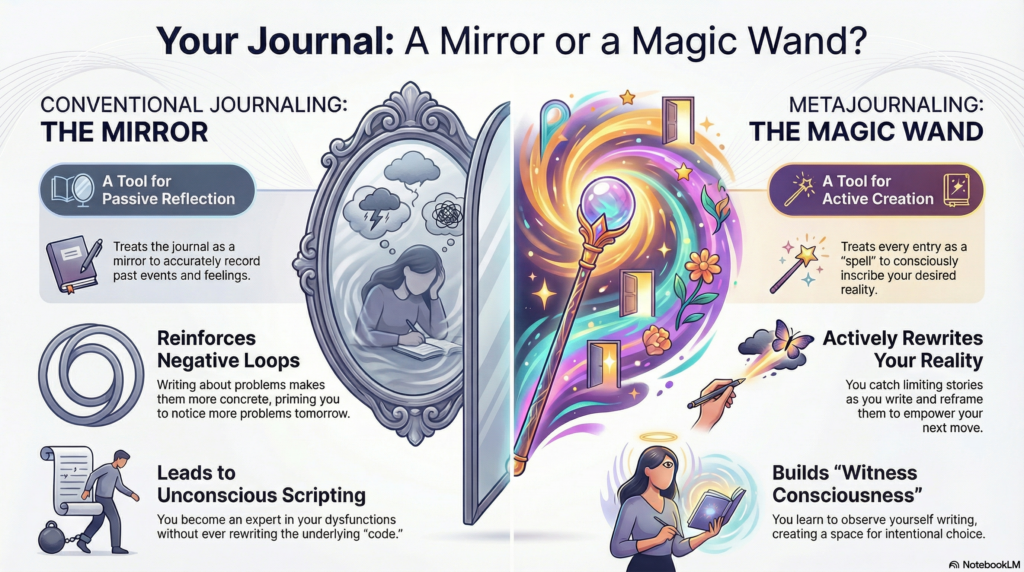
Metajournaling is the practice of waking up inside the act of writing itself. It’s journaling with full consciousness that you’re not recording your story, you’re authoring it. Right now. In this moment. With this sentence. It’s wielding the pen as wand, treating each entry not as documentation but as inscription, as the literal programming of reality.
This is journaling as spiritual technology. As chaos magick. As narrative alchemy.
If stories are code, then your journal is where you write the source. And metajournaling is learning to debug, refactor, and consciously compile the reality you actually want to inhabit.
The question isn’t whether you’re writing your reality into being. You already are. The question is: are you doing it on purpose?
The Problem with Conventional Journaling
Most journaling advice treats the journal as a mirror. Look into it honestly, the wisdom goes, and you’ll see yourself clearly. Process your emotions. Track your habits. Capture the truth of your experience. The assumption is that there’s an objective reality out there, and your job is to document it as accurately as possible.
This is a comforting lie.
What actually happens when you journal conventionally is that you reinforce whatever story you’re already telling. You had a bad day, so you write about having a bad day, which makes the badness more concrete, more undeniable, more real. Tomorrow you’ll have another bad day because you’re someone who has bad days. You’ve written it down. It’s official now. The journal “proves” it.
People think they’re being honest when they journal like this. They’re not lying, after all. They really did feel anxious. The meeting really was awkward. Their partner really did say that annoying thing. But honesty isn’t the same as wisdom. You can be completely honest about your current story while being completely unconscious that it’s just one possible story among many.
Conventional journaling operates under the illusion of objectivity. You write “I am stressed” as if stress is a fact about the universe rather than a story you’re telling about a collection of sensations and circumstances. You write “Nothing ever works out for me” as if this is reportage rather than incantation. You’re not documenting reality. You’re casting votes for a particular version of reality, and those votes accumulate into what you experience as “truth.”
The real problem is the feedback loop. What you write today shapes what you notice tomorrow. If you journal about feeling powerless, you’ll unconsciously look for evidence of powerlessness the next day. Not because you’re being dishonest, but because that’s how attention works. You’ve primed yourself to see that story. Your journal entry becomes a prediction that fulfills itself, and then you journal about that too, which reinforces it further, and the loop tightens.
This is therapy logic applied to journaling: process the difficult emotions, get them out of your system, understand why you feel the way you do. And therapy has its place. But there’s a crucial difference between processing a story and transforming it. Processing means examining the story in detail, understanding its roots, validating its existence. Transformation means recognizing the story as story, seeing the choice point, and consciously selecting a different narrative thread to follow.
Conventional journaling is like writing the same program over and over, debugging it endlessly, documenting every error message in exquisite detail, but never actually rewriting the code. You become an expert in your dysfunction. You can explain exactly why you are the way you are. But you’re still running the same broken software.
The journal becomes a record of your loops. The same conflicts with the same people. The same self-sabotaging patterns with different details. The same fears dressed in new situations. You write about wanting to change, and that becomes another thing you journal about not changing. The wanting becomes part of the loop too.
None of this is the journal’s fault. The technology is neutral. But when you use a reality-creation tool unconsciously, you get unconscious results. You get whatever story happens to be running in the background, reinforced and amplified by the act of inscription.
Most people journal to understand themselves better. But understanding yourself doesn’t change you. Knowing why you do something doesn’t stop you from doing it. Insight without alchemy is just more narrative to carry around.
The question metajournaling asks is: What if you stopped trying to accurately document your story and started consciously authoring it instead? What if the journal wasn’t a mirror but a forge? What if every entry was a chance to write a different spell?
What Metajournaling Actually Is
Metajournaling is the practice of writing with full awareness that you are constructing reality as you write. Not after. Not metaphorically. Right now, in the act of inscription itself.
It starts with a simple recognition: there is no such thing as neutral observation. The moment you decide to journal about something, you’ve already made a creative choice. Out of the infinite stream of experience that was your day, you selected this moment, this feeling, this interaction as significant. You could have chosen differently. You could have written about something else entirely, or framed the same event in a completely different way. The “truth” of what happened is actually a field of possibilities, and the act of writing collapses that field into one specific narrative.
This is quantum mechanics applied to consciousness. Before you write it down, the experience exists in superposition. It could mean many things. But the moment you inscribe a particular interpretation, you’ve locked in that version of reality. You’ve made it solid. You’ve given it weight in the architecture of your consciousness.
Metajournaling means staying awake during this moment of collapse. You’re not just writing. You’re watching yourself write. You’re aware that you’re choosing which story to tell, which details to emphasize, which meaning to extract. You hold three positions simultaneously: the writer (doing the inscribing), the subject (the character in the story), and the witness (the awareness watching both).
This is where it gets alchemical. In traditional alchemy, you need the base metal, the fire, and the alchemist. The base metal is your raw experience. The fire is the transformative process. But the alchemist is the consciousness that orchestrates the work, that knows what it’s doing and why. Without the alchemist’s awareness, you just have metal sitting in fire. It might change, but randomly, not purposefully.
Your journal is the laboratory. Your entries are the experiments. But metajournaling is you as alchemist, consciously directing the transformation. You’re not just processing base experience into narrative. You’re deliberately selecting which narrative will serve your evolution, which story will open possibilities rather than close them, which interpretation will empower rather than constrain.
Think of stories as code. Every narrative is a set of instructions for how to interpret experience and what to do next. “I’m not good at this” is code. “People always let me down” is code. “I’m learning” is code. “I see patterns and I can shift them” is code. Different code, different results. Different reality.
When you journal conventionally, you’re running whatever code happens to be installed, usually inherited from childhood, culture, trauma, or yesterday’s mood. When you metajournal, you become the programmer. You see the code running. You debug it. You refactor it. You write new functions. You consciously compile the reality you want to inhabit.
This is not positive thinking. Positive thinking tries to paste better-feeling thoughts over negative ones without examining the underlying structure. Metajournaling goes deeper. It recognizes that the entire concept of “positive” and “negative” is already a narrative choice, a framing that might or might not serve you. It’s not about forcing optimism. It’s about seeing the mechanics of how story creates experience, and then wielding those mechanics with intention.
The journal becomes something different in this light. Not an archive where you store the past, but a grimoire where you inscribe the future. Not a mirror reflecting who you are, but a forge where you smith who you’re becoming. Every entry is both diagnostic and creative, simultaneously revealing your current operating system and offering the chance to patch it.
This requires a specific kind of attention. You have to be able to write a sentence and simultaneously observe yourself writing it. To feel an emotion and watch yourself choosing how to describe it. To notice a pattern and recognize the choice point in naming it. This is the practice of witness consciousness applied to the act of journaling itself.
It’s subtle at first. You might catch yourself mid-entry and realize you’re writing the same complaint you wrote last week. That moment of recognition is metajournaling. You might notice you’re about to describe yourself as “stuck” and pause, wondering if there’s a more empowering frame. That pause is metajournaling. You might finish an entry and immediately see how the story you just told will shape what you notice tomorrow. That seeing is metajournaling.
Over time, this awareness becomes more fluid. You learn to hold the observer position while writing, to feel the difference between unconscious scripting and conscious authoring. You develop sensitivity to the energetic quality of different narratives, the way certain stories feel heavy and binding while others feel spacious and generative. You start to recognize your own favorite loops before you write them, catching the pattern at the choice point instead of after it’s already locked in.
This is narrative alchemy in practice. The base metal is whatever story you’re carrying. The fire is the conscious attention you bring to the writing process. The gold is the transformed narrative that actually serves your sovereignty and evolution. And you are the alchemist who makes it happen, entry by entry, spell by spell, reality by reality.
The journal is no longer something you do to understand yourself. It becomes the primary tool by which you author yourself. Not who you were, but who you’re choosing to become. Not what happened, but what it means and where it leads. Not recording the story you’re in, but writing the story you want to inhabit.
This is what metajournaling is: wielding your journal as the magical text it actually is, with full consciousness that every word is an instruction to reality, every entry an incantation, every narrative choice a vote for the world you’re calling into being.
The Mechanics of Metajournaling
Understanding metajournaling conceptually is one thing. Actually doing it requires specific practices and a working knowledge of the mechanisms involved. Think of this as the operator’s manual for your consciousness technology.
Pattern Recognition Across Entries
The first mechanical skill is learning to see your loops. Most people have three to five core narratives they cycle through endlessly, but they can’t see them because they’re inside them. One day it’s “I’m overwhelmed by everything I have to do.” Another day it’s “Nobody appreciates my efforts.” Another it’s “I always mess things up when it matters.” The details change, but the underlying code stays the same.
Metajournaling means developing the ability to spot these patterns across entries. Not in retrospect, after months of therapy, but in real-time as you’re writing. You’re midway through describing today’s frustration when you suddenly recognize: I’ve written this exact entry before. Different situation, same story. That recognition is the crack where transformation becomes possible.
This requires reading your own journal actively, not just writing and forgetting. Go back through recent entries looking for recurring phrases, repeated emotions, familiar plot structures. What keeps showing up? What’s the story underneath the stories? If your journal was a computer program, what would the core functions be? Find those, and you’ve found what you’re actually coding into reality.
Catching Yourself in the Act of Inscription
The most crucial mechanical skill is catching yourself at the moment of writing itself. Not after, when you’re reviewing what you wrote, but during, while the pen is moving or the keys are clicking. This is where witness consciousness meets the creative act.
It feels like a slight bifurcation of attention. Part of you is writing the sentence. Another part is watching you write it. You’re feeling the emotion and simultaneously observing yourself choosing how to describe that emotion. You’re in the experience and outside it at the same time.
This is not dissociation. Dissociation is checking out, going numb, splitting off from experience. This is the opposite: a heightened presence that can hold multiple perspectives simultaneously. You’re fully in your experience and fully aware that you’re narrating it, that the narration is a choice, and that this choice has consequences.
Practice this: As you write your next journal entry, pause every few sentences and ask yourself: “What story am I telling right now? What reality am I voting for with these words? Is this the spell I want to cast?” The pause is everything. It creates space between stimulus and inscription, between what happened and how you’re encoding it.
The Choice Point: Recognizing You’re Writing a Spell Right Now
Every sentence is a fork in the road. You can write “Today was a disaster” or you can write “Today was full of unexpected challenges that revealed something important.” Same events, different code, different future.
The choice point is that moment when you realize you’re about to write something and you can still change it. You feel the familiar phrase forming: “I always…” or “I never…” or “Things never work out…” and instead of automatically writing it, you stop. You recognize that you’re about to cast a spell you’ve cast a thousand times before, and you already know where that spell leads.
This doesn’t mean forcing positivity. It means asking: “What’s the most generative story I can tell about this that’s still true?” Truth matters, but truth is multiple. It’s true that you felt anxious. It’s also true that you felt anxious and chose to show up anyway. It’s true that the meeting was awkward. It’s also true that the meeting revealed information you needed. Both are honest. Only one empowers your next move.
The mechanics here are simple but require vigilance: recognize the choice point, pause, consider alternatives, choose consciously. Write the spell you actually want to cast. Not the one that just feels automatic.
Feedback Loops: How Yesterday’s Entry Shapes Today’s Reality
Understanding feedback loops is essential to metajournaling. What you write today literally programs what you notice tomorrow. This isn’t mysticism. It’s basic neuroscience dressed in narrative clothing.
Your brain is a prediction machine. It uses past experience to anticipate what’s coming next, and it filters reality through those predictions. When you journal about feeling powerless, you’re training your prediction engine to look for more powerlessness. Not because you’re being negative, but because that’s what you’ve told your brain to track. Your attention follows your narrative.
The feedback loop works like this: You write about being stuck. That narrative becomes active in your consciousness. Tomorrow, your brain screens reality for evidence of stuckness and filters out evidence of movement. You notice all the ways you’re not progressing and miss all the ways you are. Then you journal about being stuck again, reinforcing the pattern. The loop tightens.
Metajournaling means deliberately disrupting these loops. You write an entry, then immediately consider: “If I take this story into tomorrow, what will I notice? What will I miss? What reality am I priming myself for?” If you don’t like the answer, you reframe the entry before the loop locks in.
This is why the “second pass” matters. Write your entry. Then read it as if someone else wrote it. What reality is this person calling into being? What would happen if they kept writing this story? Would you want to live in that reality? If not, revise. Add a coda. Shift the frame. Break the loop before it hardens.
Different Modalities, Different Effects
The mechanics of metajournaling shift depending on your medium. Analog, digital, audio, each creates different effects on consciousness.
Analog journaling (pen and paper) is slower, more embodied. The physical act of handwriting engages different neural pathways than typing. There’s a ritual quality to it, a deliberateness. The permanence of ink makes you more conscious of what you’re inscribing. You can’t just delete and retype. The mistake stays on the page, which itself becomes information. Analog journaling tends to produce more somatic awareness, more connection to the body’s wisdom.
Digital journaling is faster, more fluid. You can revise easily, which makes it perfect for real-time reframing. You can search across entries instantly, spotting patterns you’d miss in paper journals. The ease of editing can be a double-edged sword: it’s easier to refine your spell, but also easier to polish away the raw truth. Digital journaling tends to emphasize the cognitive dimension, the story-crafting aspect.
Audio journaling captures consciousness in motion. Walking while speaking your thoughts creates a different narrative flow than sitting and writing. The body’s movement influences the mind’s movement. You catch different thoughts, different rhythms. Audio also preserves tone, emotion, the actual sound of your consciousness in that moment. But it’s harder to review, harder to spot patterns without transcription. Audio journaling tends to be more exploratory, more stream-of-consciousness, less filtered.
A metajournaling practice might use all three strategically. Morning pages in analog for embodied ritual. Quick digital entries for real-time pattern debugging. Audio walks for exploratory thinking and processing. Different tools for different aspects of the work.
The key mechanical understanding is that the medium affects the message. How you journal changes what you can journal about and what effects the journaling produces. Metajournaling means being conscious of these differences and choosing your tools deliberately.
The Meta-Entry: Writing About Your Writing
One of the most powerful metajournaling techniques is periodically writing entries about your entries. Reading back through recent journal writings and analyzing them as texts, as magical documents, as code.
What patterns emerge? What stories keep recurring? Where are you unconscious? Where are you avoiding something? Where are you casting the same failed spell over and over? Where did a narrative shift create an actual shift in your experience?
This is debugging at the meta-level. You’re not just examining your life. You’re examining how you’re narrating your life and how that narration creates your experience. You’re looking at the code itself, not just what the code produces.
A meta-entry might look like: “I’ve noticed that every time I write about my work, I frame myself as behind, struggling to catch up, never quite enough. That’s the spell I keep casting. No wonder I feel constantly anxious about productivity. What if I reframed the same activities as building, creating, advancing? Same actions, different story. Different reality.”
This is the journal as recursive technology. You use it to examine itself, to debug its own operation. You become simultaneously the programmer, the program, and the consciousness observing both.
These mechanics, practiced consistently, transform journaling from documentation into creation. You’re no longer recording reality. You’re consciously authoring it, line by line, entry by entry, spell by carefully crafted spell.
Core Practices
Metajournaling isn’t something you understand once and then you’re done. It’s a set of practices you develop over time, skills that deepen with repetition. Here are the fundamental techniques that make metajournaling operational.
The Witness Stance: Observing Yourself Write
The foundational practice is cultivating witness consciousness while journaling. This is the ability to write while simultaneously watching yourself write, to be both participant and observer at once.
Start simple. As you write your next entry, occasionally pause and notice: What am I feeling right now? What story am I telling? What’s my tone? Am I contracting or expanding? Heavy or light? Reactive or reflective?
You’re not judging what you notice. You’re just noticing. The witness doesn’t critique or fix. It simply sees. This seeing itself creates space, a gap between stimulus and response, between event and interpretation, between automatic scripting and conscious authoring.
Practice this in small doses at first. Write a paragraph, then pause and witness. What just happened there? What was that paragraph trying to accomplish? Was it processing, venting, exploring, avoiding? What energy did it carry? As this becomes more natural, you’ll find you can maintain witness awareness while writing, a split attention that observes the act of inscription as it unfolds.
The witness stance is what allows all other metajournaling practices to function. Without it, you’re just writing. With it, you’re writing and seeing yourself write, which means you can choose differently.
Pattern Debugging: Tracking Recurring Narratives
Once you can witness your writing, you start noticing your patterns. Pattern debugging is the systematic practice of identifying and examining your recurring narrative loops.
Keep a separate section in your journal or a dedicated note file where you track patterns as you spot them. When you catch yourself writing a familiar story, note it: “Overwhelm pattern active again” or “Playing the martyr story” or “Catastrophizing about money again.”
Don’t try to fix the patterns immediately. First, just catalog them. Name them. Track how often they show up. Notice what triggers them. A pattern you can see is a pattern you can work with. A pattern you can’t see owns you.
Over time, you’ll develop a taxonomy of your own recurring code. Maybe you have five or six core narratives that cycle through depending on circumstances. Maybe certain patterns only appear in specific contexts (work vs. relationships, mornings vs. evenings, stressed vs. relaxed).
The debugging metaphor is deliberate. In programming, you don’t shame yourself for bugs. You expect them, find them, understand why they’re occurring, and rewrite the code. Same here. Your recurring patterns aren’t character flaws. They’re inherited or outdated code running in your consciousness. Once you can see them clearly, you can consciously rewrite them.
Create a simple tracking method: Pattern name, frequency, typical trigger, underlying belief, alternative frame. For example:
Pattern: “Never enough time”
Frequency: 3-4 times per week
Trigger: Looking at my task list
Underlying belief: I should be more productive than I am
Alternative frame: I’m prioritizing what matters most given actual constraints
The act of tracking patterns changes your relationship to them. They become objects you can examine rather than truths you’re trapped in.
Intentional Reframing in Real-Time
Once you can spot patterns as they’re happening, the next practice is consciously reframing them in the moment, before they lock in.
You’re writing an entry and you catch yourself: “I’m writing the victim story again.” Right there, mid-entry, you stop. You don’t delete what you wrote (that’s still data), but you add a reframe. “Okay, that’s one way to tell it. What if I told it differently? Same facts, different frame…”
Then you write the alternative version. Not as replacement but as expansion. You’re showing yourself that there’s always more than one story available. You’re practicing the sovereignty of narrative choice.
This isn’t toxic positivity. Sometimes the hard truth needs to be told. Sometimes you need to name the difficulty directly. But even hard truths can be framed in ways that empower or disempower, that open possibilities or close them. Intentional reframing means choosing the frame that serves your evolution.
A practical technique: After writing something heavy or loop-reinforcing, immediately write “And also…” then add a reframe. “I felt completely overwhelmed by the meeting. And also, I showed up even though I was anxious, which is evidence of my commitment.” Both true. One narrative leads somewhere generative. The other doesn’t.
The “and also” technique prevents the spiritual bypassing trap. You’re not denying the difficulty. You’re not pretending everything is fine. You’re adding complexity, nuance, agency. You’re refusing to let one story be the only story.
The Second Pass: Reviewing Entries as Magical Texts
This practice involves reading your entries as if they were spells written by someone else, analyzing them for their magical content and likely effects.
At the end of each week, read through your entries with this question: “If these were incantations, what reality are they summoning?” Look for:
- Repeated invocations (words or phrases you use over and over)
- The dominant energy (contracting or expanding, heavy or light)
- Implicit beliefs embedded in your language
- What future you’re voting for with your narratives
- Where you’re wielding agency and where you’re giving it away
Read one of your entries and ask: “Would I want to live in the reality this story creates? If I cast this spell every day for a month, where would I end up?” If you don’t like the answer, that entry shows you exactly what needs to be rewritten.
This second pass is also where you might add meta-commentary directly in your journal. At the end of an entry, add a bracketed note: “[Pattern spotted: I’m framing this as happening TO me instead of recognizing my choices in it. Reframe: I chose X, which led to Y, and now I’m choosing Z.]”
These meta-notes accumulate over time, creating a record not just of your life but of your evolving consciousness about your life. You can literally watch yourself waking up across entries, becoming more conscious, more sovereign, more deliberate.
Meta-Entries: Writing About Your Writing About Your Writing
The deepest metajournaling practice is periodically writing entries that analyze your journaling practice itself. This is where you step back and look at the whole system.
Once a month, or whenever you sense a shift, write a meta-entry exploring questions like:
- What have I been writing about most? What haven’t I been writing about at all?
- What patterns have become visible this month? Which ones am I starting to shift?
- How has my journaling changed my actual experience? What’s different?
- Where am I still unconscious? Where am I resisting seeing something?
- What stories am I ready to stop telling? What new stories want to emerge?
- How is my relationship to the journal itself evolving?
These meta-entries create recursion. You’re using the journal to examine the journal, consciousness observing itself observing itself. This recursive loop is where genuine transformation accelerates because you’re not just changing what you write about, you’re changing how you relate to the entire process of narrative construction.
You might discover that you avoid journaling when certain topics arise. That avoidance is information. You might notice that your entries become more empowered when you write in the morning versus at night. That’s useful data. You might spot that you’re starting to catch patterns faster, reframe more automatically. That’s evidence of the practice working.
The meta-entry is also where you can consciously set new intentions for your journaling practice. “This month I’m tracking how often I frame challenges as threats versus opportunities” or “I’m experimenting with writing in second person to create more objectivity” or “I’m going to write shorter entries but do them daily to build the witness muscle.”
Integration Practice: The Daily Check-In
A simple daily practice ties all of these together. Before you start writing each entry, take thirty seconds to check in:
- What’s my energetic state right now?
- What story am I about to tell?
- Is this a pattern I’ve written before?
- What spell do I actually want to cast with this entry?
- Can I hold witness consciousness while I write?
After writing, take another thirty seconds:
- What did I just write?
- What reality does that narrative create?
- Am I satisfied with that spell?
- Do I need to add a reframe or meta-note?
These bookends transform journaling from automatic to conscious, from documentation to creation. You’re building the habit of awareness around the act of writing itself.
Experimental Variations
Once the core practices become familiar, experiment:
- Write an entire entry in third person to create distance from your story
- Journal as if you’re a benevolent observer documenting an interesting human
- Write the same event three different ways to viscerally feel narrative multiplicity
- Create a “pattern interrupt entry” when you notice a loop, deliberately writing the opposite story
- Use different pens or apps for different narrative modes (one for processing, one for visioning, one for meta-analysis)
The practices of metajournaling are not rigid techniques to follow perfectly. They’re tools to help you wake up inside the act of writing, to remember that you’re not transcribing reality but authoring it, to recognize your journal as the spell book it actually is.
Practice them consistently and they become automatic. The witness stance becomes your default. Pattern recognition happens in real-time. Reframing becomes natural. And your journal transforms from a record of your loops into a laboratory where you consciously evolve your consciousness itself.
Metajournaling in Action
Theory is useful. Practice is where transformation actually happens. Let’s watch metajournaling work in real-time, showing the difference between unconscious scripting and conscious authoring.
A Concrete Example: Transforming a Complaint into a Spell
Imagine you had a difficult conversation with a colleague. You felt dismissed, unheard, frustrated. You sit down to journal about it. Here’s what unconscious journaling looks like:
“Had another frustrating meeting with Sarah today. She completely talked over me when I was trying to explain the new approach. She never listens. I don’t know why I even bother trying to contribute ideas anymore. This always happens. I suggest something, get ignored, then three weeks later someone else suggests the same thing and everyone acts like it’s brilliant. I’m so tired of not being heard. Nobody takes me seriously in this place.”
This entry feels honest. It captures real frustration. But look at what it’s actually doing:
- Reinforcing powerlessness (“never listens,” “always happens”)
- Generalizing one incident into a permanent pattern (“nobody takes me seriously”)
- Removing agency (“I don’t know why I even bother”)
- Casting a spell of continued invisibility and frustration
- Training attention to look for more evidence of being dismissed
Tomorrow, you’ll notice every tiny instance of not being heard and miss every instance where you are. The loop tightens. The spell works.
Now watch metajournaling handle the same event. You start writing the complaint, but witness consciousness activates. You catch yourself mid-entry:
“Had a frustrating interaction with Sarah today. She talked over me when I was explaining the new approach. I felt dismissed and… [pause] Okay, I’m about to write my ‘nobody listens to me’ story again. I can feel it forming. That’s a loop I’ve written a hundred times. What if I tell this differently?
“What actually happened: I presented an idea. Sarah got excited about a different angle and started talking before I finished. She wasn’t trying to dismiss me. She was in her own head about her approach. I got triggered because this pattern feels familiar from childhood, not because Sarah is actually marginalizing me.
“What I can do: Talk to Sarah directly about wanting to finish my thought before we pivot to other ideas. Practice staying grounded when interrupted instead of collapsing into the wounded story. Notice that three other people in the meeting engaged with what I said, even if Sarah didn’t initially.
“Different frame: This is showing me where I still give my power away to old patterns. The difficulty is the teacher. I’m learning to hold my ground without making other people’s behavior mean something about my worth. That’s growth, not victimhood.”
Same event. Completely different spell. The first version codes reality as: “I am powerless, people dismiss me, speaking up doesn’t matter.” The second codes reality as: “I have agency, patterns reveal themselves so I can shift them, difficulty is information.”
The metajournaling version doesn’t deny the frustration. It includes it, processes it, but doesn’t let it be the only story or the final story. It catches the loop, names it, reframes it, and writes a spell that actually empowers the next move.
Before and After: Same Event, Different Encoding
Let’s look at another example. You didn’t get a project you wanted. Unconscious journaling:
“Didn’t get the XYZ project. Of course I didn’t. I’m never going to move forward here. Everyone else gets the good opportunities. I work just as hard but somehow I’m always overlooked. Maybe I’m just not as talented as I think I am. This is pointless.”
Metajournaling the same situation:
“Didn’t get the XYZ project. Initial reaction: collapse into ‘I’m not good enough’ story. [witnessing the pattern] That’s the inherited childhood script talking, not reality.
“Actual facts: I didn’t get this particular project. That’s it. That’s the only fact. Everything else is interpretation. Why didn’t I get it? I don’t actually know. Could be budget, timing, skill fit, politics, random factors. My brain wants to make it about my worth because that’s the familiar story.
“What’s also true: I’ve successfully completed four major projects this year. I have skills and value. One decision doesn’t erase that. This is one data point, not a verdict on my entire career.
“Useful question: What can I learn from this? Should I have pitched it differently? Is there a skill gap to address? Should I talk to my manager about how assignments are made? Turn this into information instead of identity crisis.
“Spell I’m choosing to cast: I’m building a career through consistent good work and learning from every outcome. Some opportunities will be mine, some won’t. I stay focused on the quality of my contribution and trust that the right opportunities will emerge. This ‘no’ clears space for a better ‘yes.'”
The before version writes you as victim of circumstance, powerless, fundamentally flawed. The after version writes you as agent in your own story, learning, adapting, maintaining perspective. One narrative closes possibilities. The other keeps them open.
The Sovereignty Question: Who’s Writing This Story?
The core question metajournaling asks is: Who’s actually writing this entry? Is it your conscious, sovereign self? Or is it:
- Your childhood conditioning
- Your cultural programming
- Your trauma responses
- Your fear
- Your ego defending itself
- Yesterday’s mood
- An inherited family narrative
- The collective anxiety of your environment
Most unconscious journaling is written by these forces. You think you’re being honest, but you’re actually just transcribing whatever program happens to be running. Metajournaling creates the pause where you can ask: “Is this really my story, or am I channeling something else?”
A practical test: Read what you just wrote and ask, “Does this sound like my wisest self speaking, or does this sound like my wound speaking?” Both have voices. Both want to write your journal. But only one creates the reality you actually want to inhabit.
When you catch your wound writing, you don’t shame it. You witness it with compassion: “Ah, there’s the scared part trying to protect me by making me small.” Then you thank it and consciously choose a different narrator: “And here’s what my wise self knows about this situation…”
Integration with Chaos Magick and Sigil Work
For those working with chaos magick, metajournaling becomes a natural extension of your practice. Your journal entries are literally sigilized reality: compressed intention coded into language and inscribed into consciousness.
The standard chaos magick process is: formulate intention, create sigil, charge sigil, release attachment. Metajournaling follows the same logic:
- Formulate intention: What reality do I want to author?
- Create sigil: Write the entry that encodes that reality
- Charge sigil: The emotional engagement of the writing process provides the charge
- Release attachment: After writing the spell, let it work without obsessing
Your journal becomes your ongoing book of spells, a living grimoire where you’re constantly encoding new possibilities. Each entry is a sigil in sentence form. The recurring entries about empowering narratives are repeated spell-casting, building momentum for manifestation.
You can even make this explicit. End certain entries with: “This is my spell. So it is written. So it becomes.” That declarative statement anchors the magical intention of the writing.
Supporting the Triangle of Transformation
Metajournaling directly supports the Triangle of Transformation framework: Status Quo, Will, and Magic, with witness consciousness at the center.
The Status Quo is whatever story you’re currently running. Unconscious journaling just reinforces it, documenting the same reality over and over. Metajournaling helps you see the Status Quo clearly: “This is the story I’ve been telling. This is the spell I’ve been casting. This is the reality it creates.”
Will is the sovereign choice to shift. The moment you catch a pattern and decide to write a different story, that’s Will activating. Metajournaling is the practice ground for Will, where you strengthen the muscle of conscious choice.
Magic is the actual transformation, where new narrative becomes new reality. The journal is where you encode the Magic, where you write the spells that shift your experience. Not through wishful thinking, but through deliberately changing the code that runs your consciousness.
Witness consciousness, at the center of the triangle, is what makes all of this possible. Without witness awareness, you can’t see the Status Quo, can’t activate Will, can’t consciously work Magic. The witness stance developed through metajournaling is the linchpin of the entire transformational process.
Your journal becomes a record of movement through the Triangle. You can literally watch yourself see a pattern (witness), choose to shift it (Will), write a new story (Magic), and create new experience (transformed Status Quo). Entry by entry, you’re documenting and creating your own evolution.
The Proof in Experience
The ultimate test of metajournaling is pragmatic: Does it work? Does your reality actually shift when you consciously shift your narratives?
Track this. When you reframe a limiting story, pay attention to what happens next. When you catch a pattern and write a different spell, notice if new possibilities emerge. When you journal with full consciousness of authoring reality, watch whether your experience begins to reflect that authorship.
You’ll notice that the stories you repeatedly write start manifesting with uncanny consistency. The empowering narratives create empowering outcomes. The limiting narratives create limitation. Not because the universe is magically responsive to your journal (though maybe it is), but because your narratives literally program your attention, your choices, your energy, and therefore your results.
This isn’t theory. This is testable. Write powerless stories for a week and track your experience. Then write empowered stories for a week and track that. The difference will be undeniable. Your journal isn’t recording reality. It’s creating it. Metajournaling is simply doing that creation consciously.
The transformation happens not in one dramatic entry, but in the accumulated weight of conscious inscription. Day after day, entry after entry, pattern caught and reframed, spell cast with intention. The journal becomes the place where you literally write yourself into a new reality, word by word, choice by choice, story by consciously chosen story.
Why This Matters for Narrative Alchemy
Metajournaling isn’t just another technique to add to your spiritual practice toolkit. It’s the foundational technology that makes narrative alchemy operational. Without it, narrative alchemy remains philosophical, conceptual, aspirational. With it, narrative alchemy becomes lived practice, enacted daily in the laboratory of your journal.
The Journal as Primary Grimoire
In traditional alchemy, the grimoire is the master text where the alchemist records formulas, processes, observations, and results. It’s both instruction manual and experimental log, both recipe book and discovery journal. The grimoire captures the work so it can be refined, repeated, and transmitted.
For narrative alchemy, your journal is the grimoire. It’s where you record the base materials of your consciousness (current stories, active patterns, emotional states). It’s where you document the transformational processes you’re applying (reframes, pattern interrupts, conscious spell-casting). It’s where you track the results (shifts in experience, new possibilities emerging, old loops dissolving).
But unlike a traditional grimoire that describes work done elsewhere, your journal is where the alchemical work actually happens. The writing itself is the work. The moment of inscription is the moment of transformation. You’re not documenting alchemy. You’re doing it.
This is why metajournaling matters so crucially. If you’re going to treat your journal as the space where consciousness transformation occurs, you need to be conscious while you’re doing it. You need to know you’re working with volatile materials, potent processes, reality-shaping forces. You need to operate with the precision and awareness of an alchemist in the lab, not someone casually jotting notes.
Every entry becomes an experiment: What happens if I tell the story this way instead of that way? What reality emerges if I encode this interpretation rather than the other? The journal captures both hypothesis and result, both spell and manifestation. Over time, you build a grimoire that’s uniquely yours, a record of which narratives create which realities in your particular consciousness.
Building the Muscle of Conscious Story-Selection
The real challenge of narrative alchemy isn’t understanding that stories create reality. Most people grasp that intellectually within five minutes. The challenge is catching yourself in time to choose a different story before the automatic one locks in. That requires a specific cognitive muscle, and metajournaling is how you build it.
Think of it like training for any skill. A martial artist practices the same movements thousands of times so that in the moment of actual conflict, the right response happens automatically. A musician practices scales endlessly so that during performance, the fingers know where to go without conscious thought. Metajournaling is repetition training for conscious narrative selection.
Every entry is a rep. Every time you catch a pattern, that’s a rep. Every time you pause before writing the automatic story, that’s a rep. Every reframe, every intentional spell-casting, every moment of witness consciousness during writing, all reps. You’re building neural pathways for conscious authorship, strengthening the circuit that notices “I’m about to tell a story” and creates space for choice.
Over time, this muscle gets stronger. What took enormous effort at first becomes more natural. You catch patterns faster. The pause between stimulus and story lengthens. The automatic scripts lose their grip. You develop what feels like a sixth sense for narrative construction, an immediate recognition of when you’re unconsciously scripting versus consciously authoring.
This is the practical bridge between knowing narrative alchemy works and being able to actually do it in real-time, in challenging situations, when it matters most. The journal is your training ground. The daily practice builds the capacity. Then when you’re in the middle of an actually difficult moment, not sitting peacefully with your journal, the muscle is there. You can catch the story forming, pause, choose differently, live differently.
From Unconscious Scripting to Deliberate Enchantment
Unconscious scripting is what happens when you’re not metajournaling. You write whatever comes out, which is usually whatever conditioning, trauma, or habit has programmed into you. You’re a channel for inherited narratives, cultural stories, yesterday’s mood, fear’s voice, ego’s defense mechanisms. The writing just flows through you, and you think it’s “you” writing, but it’s really just programs executing.
Deliberate enchantment is what becomes possible through metajournaling. You’re writing with full awareness that you’re encoding reality. You’re choosing your words like an enchanter chooses ingredients, knowing that each one has properties, creates effects, contributes to the final spell. You’re deliberate about tone, frame, meaning, implication. Every sentence is placed with intention.
This doesn’t mean writing becomes labored or artificial. Actually, the opposite happens. As the metajournaling muscle strengthens, deliberate enchantment becomes fluid, natural, even joyful. You’re not overthinking every word. You’re writing from a place of conscious alignment with your sovereignty and evolution. The words flow, but they’re flowing from your wise self, not your wound.
The shift from scripting to enchantment is the shift from being written by your stories to writing them. It’s the reclamation of authorship over your own narrative. It’s recognizing that you’ve always been creating reality with your stories, and deciding to do it consciously, artfully, magically.
Your journal becomes a record of this shift. You can literally see it in the entries: the early ones where you’re fully in the scripts, then entries where you start catching yourself, then entries where the reframes appear, then eventually entries that are pure enchantment from the first word. The progression itself is encouraging. You’re watching yourself wake up on the page.
The Bridge Between Insight and Embodiment
One of the great failures of personal development work is the gap between insight and embodiment. People have profound realizations, see their patterns clearly, understand what needs to change, and then nothing actually changes. The insight stays intellectual. The knowing stays theoretical. The transformation stays aspirational.
Metajournaling bridges this gap because it’s not just about having insights. It’s about inscribing new patterns into consciousness through the physical act of writing. When you write a new story consciously, you’re not just thinking it. You’re embodying it through the movement of pen on paper or fingers on keys. You’re speaking it into existence through language. You’re encoding it into memory through the act of inscription.
There’s something about the writing process itself that moves insight from head to body, from concept to lived reality. Maybe it’s the slower, more deliberate pace compared to thinking. Maybe it’s the multi-sensory engagement (visual, kinesthetic, sometimes auditory if you read aloud). Maybe it’s the ritual quality, the dedicated time and space. Whatever the mechanism, writing makes things real in a way that thinking doesn’t.
Metajournaling amplifies this by adding consciousness to the process. You’re not just writing, you’re aware that the writing is creating reality. That awareness itself deepens the embodiment. You feel the shift happening as you write the new story. You can sense the old pattern releasing as you inscribe the reframe. The transformation isn’t something that might happen later. It’s happening now, in the act of conscious writing.
This is why journaling is such a powerful practice and why metajournaling makes it exponentially more powerful. The journal becomes the place where insight translates directly into new narrative, and new narrative translates directly into new embodied reality. The bridge is the writing itself, made conscious.
Practice Ground for Rewriting Reality
Life happens fast. Situations arise that trigger you before you can think. Conversations go sideways before you can catch the pattern. Emotions flood in and sweep away your best intentions. You need somewhere safe to practice conscious authorship before you’re tested by actual circumstances.
The journal is that practice ground. It’s low stakes. If you write a limiting story, you can immediately rewrite it. If you miss a pattern at first, you catch it on the second pass. If you cast a spell you don’t like, you cast a different one. The page is forgiving. It lets you experiment, fail, try again, refine your craft.
This practice in the journal then transfers to life. You’re in a difficult conversation and suddenly you catch yourself: “I’m about to tell my ‘nobody listens to me’ story. What if I try the empowered version instead?” That pause, that choice, that ability to shift in real-time, that comes from hundreds of hours practicing it in your journal.
The journal is where you rehearse sovereignty. Where you practice catching patterns. Where you strengthen the witness. Where you learn which reframes actually work for you. Where you discover your own voice as conscious author of your experience. Then life becomes the performance, and you’re ready because you’ve put in the practice.
Narrative alchemy requires this kind of training ground. You can’t just read about it and expect to suddenly rewrite your reality in the heat of the moment. You need repetitions. You need practice. You need a space to develop the skill before you need the skill. Metajournaling provides that space.
The Compounding Effect
Here’s what makes metajournaling especially powerful: the effects compound. One consciously written entry creates a small shift. But that shift changes what you notice the next day, which changes what you write about, which creates another shift, which changes what you notice the day after that. The effects build on themselves.
After a month of metajournaling, you’re not just one month better at it. You’re exponentially more conscious because each day’s practice built on the previous day’s. After a year, the compounding is significant. Your default narratives have shifted. Your automatic patterns have loosened. Your capacity for witness consciousness has expanded. Your sovereignty over your own story has become nearly instinctive.
This is why consistency matters more than intensity. One transformative entry per day for a year will change your reality more than a weekend workshop that fires you up but doesn’t give you ongoing practice. The daily repetition, the accumulated inscriptions, the compounded shifts, this is where real transformation lives.
Your journal becomes a record of this compounding. Flip back six months and read who you were then. Look at the stories you were telling, the patterns you couldn’t yet see, the consciousness you had access to. Then look at where you are now. The distance traveled is visible. The evolution is undeniable. And it all happened entry by entry, day by day, through the dedicated practice of conscious writing.
Why Narrative Alchemy Needs This
Narrative alchemy without metajournaling is like having a theory of transformation without a practice. It’s like understanding chemistry without ever entering a lab. It’s like knowing music theory but never touching an instrument.
Metajournaling is where narrative alchemy becomes real. It’s the daily practice. It’s the operational technology. It’s the place where you actually do the work of consciously authoring your reality rather than just talking about it.
Every principle of narrative alchemy, metajournaling makes tangible:
- Stories as code? The journal is where you write and debug the code.
- Consciousness creates reality? The journal is where you consciously create.
- Patterns can be shifted? The journal is where you spot and shift them.
- You are sovereign author of your experience? The journal is where you claim that sovereignty.
- Transformation happens through conscious choice? The journal is where you practice that choice until it becomes natural.
Without metajournaling, narrative alchemy risks remaining abstract. With it, narrative alchemy becomes embodied practice, testable method, lived reality. The journal is where philosophy becomes magic, where insight becomes transformation, where words become spells that actually reshape your world.
This is why metajournaling matters. Not as another technique among many, but as the core technology that makes the entire narrative alchemy practice operational, sustainable, and genuinely transformative.
Conclusion: The Writer Writes the Writer
There’s a recursive loop at the heart of metajournaling that’s worth sitting with: You write about your life, which shapes your life, which you then write about, which shapes it further. You’re simultaneously the writer, the written, and the writing itself. The observer, the observed, and the act of observation.
This isn’t a bug in the system. It’s the system. It’s how consciousness actually works.
You Are Always Journaling Your Reality Into Being
Here’s the truth that changes everything once you really see it: You’re already doing narrative alchemy. Every moment. You can’t not do it.
Your mind is constantly narrating experience, selecting which details matter, assigning meaning, telling stories about what’s happening and what it means and what comes next. This narration isn’t separate from your reality. It is your reality. The story you’re telling is the world you’re living in.
Most people do this unconsciously. The narration runs in the background like an operating system they never chose and don’t know how to access. They think they’re observing reality neutrally, but they’re actually constructing it selectively, frame by frame, story by story, moment by moment.
The journal just makes this process visible. It externalizes the internal narration, puts it on the page where you can see it. And once you can see it, you can work with it. You can debug it, refine it, rewrite it. You can stop being unconsciously written by your stories and start consciously writing them.
This is what metajournaling reveals: You’re always authoring your reality. The only question is whether you’re doing it consciously or unconsciously, deliberately or by default, as sovereign creator or as unconscious channel for inherited programming.
Metajournaling Is Choosing to Do It Consciously
The shift from regular journaling to metajournaling is the shift from documentation to creation, from recording to authoring, from being written to writing.
It’s the moment you realize: “Wait. This entry I’m writing right now isn’t just capturing what happened. It’s literally constructing what happens next. The story I tell about today becomes the lens through which I experience tomorrow. I’m not documenting my life. I’m encoding it. I’m programming it. I’m spelling it into being.”
That recognition changes everything. Suddenly every entry matters. Every word is a choice. Every narrative is a vote for a version of reality. You can’t write carelessly anymore because you know what you’re actually doing. You’re not filling a journal. You’re writing spells. You’re not processing experience. You’re creating it.
This is the essence of metajournaling: full, conscious awareness that the act of writing is the act of reality creation. Not metaphorically. Not eventually. Right now. In this sentence. With these words.
And once you know that, really know it in your bones, you write differently. You can’t help but write differently. Because you’re awake inside the process of authorship itself.
The Invitation: Treat Your Next Entry as an Incantation
So here’s the invitation, the practical next step, the place where all of this becomes real:
Your next journal entry, write it as if it’s a spell. Because it is.
Before you start, ask yourself: “What reality am I calling into being with these words? What future am I voting for with this narrative? What version of myself am I encoding into consciousness?”
As you write, hold witness awareness. Watch yourself choose each word. Feel the difference between automatic scripting and conscious authoring. Notice when you’re about to write a familiar loop and pause. Choose differently. Cast a better spell.
After you write, read it back as if someone else wrote it. Would you want to live in the reality this entry creates? If not, add a reframe. Write the spell you actually want to cast.
This is metajournaling. Not as distant practice to master someday, but as immediate invitation to engage with your next entry. You already have everything you need: a journal, awareness, and the willingness to treat your words as the reality-shaping forces they actually are.
You don’t need to be perfect at it. You don’t need to transform every entry into enlightened wisdom. You just need to be conscious. Present. Awake to what you’re actually doing when you write. The skill deepens with practice. The muscle strengthens with repetition. But it starts now, with this next entry, with this willingness to see your journal as the magical text it is.
Final Provocation: What Story Are You Writing Right Now?
Not in your journal. Right now. This moment. In your head. About your life. About who you are. About what’s possible.
What’s the story running in the background of your consciousness right now? Is it empowering or limiting? Is it opening possibilities or closing them? Is it a story you consciously chose or one that chose you?
And here’s the deeper question: Are you going to write that story into your journal tonight, reinforcing it, making it more solid, more real? Or are you going to catch it, witness it, and consciously author something different?
Because that’s the choice point. That’s always the choice point. Not whether you’re telling stories, that’s not optional, but which stories you’re telling and whether you’re telling them consciously.
Metajournaling is the practice of living in that choice point. Of recognizing that every moment of narration is a moment of creation. Of wielding your words, spoken or written, as the reality-shaping tools they are.
Your journal is waiting. The page is blank. The spell is yours to cast.
What will you write into being?
The writer writes the reality. The reality writes the writer. And somewhere in that recursive loop, in the space between inscription and manifestation, between word and world, you discover something profound:
You are the author you’ve been waiting for. You always have been. The sovereignty you’re seeking isn’t somewhere else, someday, after more work or more healing or more understanding. It’s here. Now. In the choice you make about the next story you tell.
Your journal is your grimoire. Your words are your spells. Your consciousness is the magic.
Write accordingly.
Discover more from soulcruzer
Subscribe to get the latest posts sent to your email.