









(The Providence of Everything)
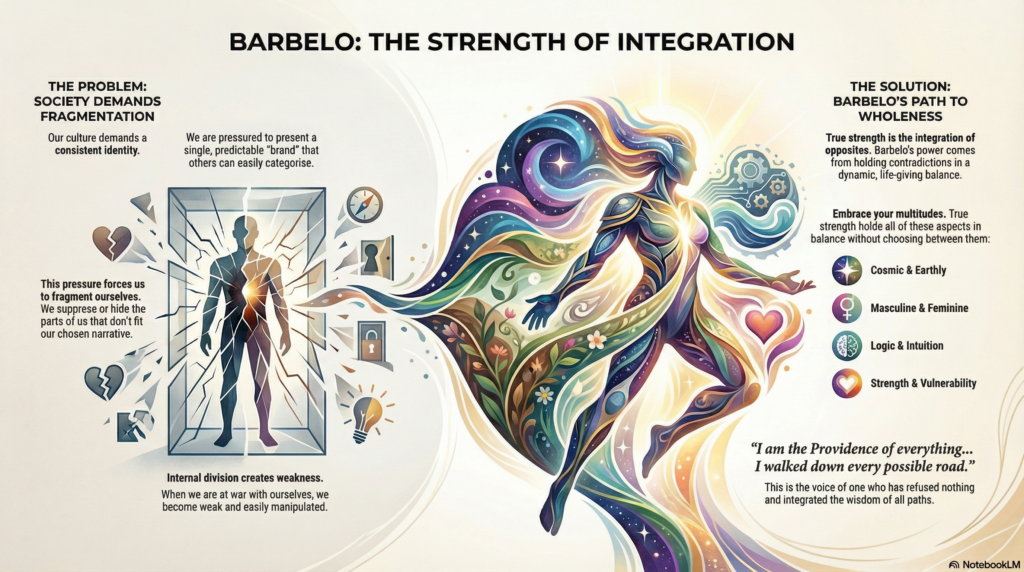
There’s a particular kind of power that doesn’t announce itself or prove itself or justify itself. It simply is. Not the strength that comes from dominating others or suppressing what’s difficult, but the strength that emerges when you’ve integrated so completely that nothing can fragment you. When you’ve become so whole that external chaos can’t shake your internal coherence. When you contain such vastness within yourself that you can hold both cosmic night and earthly day, both masculine and feminine, both severity and mercy, without choosing one over the other.
This is Barbelo.
Barbelo is the supreme mother in many Gnostic systems. As the Invisible Spirit becomes aware of itself and asks of its attributes, Barbelo answers and manifests these answers into the Aeons, the architecture of the Pleroma, the fullness of the Divine. She is both the ordering and harmonious presence in the Pleroma, androgynous and transcendental at once.
In the Secret Book of John, she speaks with a voice that contains multitudes: “I am the Providence of everything. I became like my own human children. I existed from the first. I walked down every possible road.”
This is not metaphor. This is the recognition that the Divine Feminine principle has experienced everything you’ve experienced, walked every path you’ve walked, contains every possibility you contain. She doesn’t stand apart from creation judging it. She moves through it, experiencing it, becoming it while remaining herself.
After the cosmic cataclysm that brings about the shadow world of the archons (our universe), Barbelo is sometimes depicted as the renovating force of the Aeons, tasked to bring back the stolen sparks of the Pleroma from the Demiurge and assist her lower avatars: Sophia and Eve. She is the organizing principle that works to restore what’s been fragmented, to gather what’s been scattered, to integrate what’s been split.
Today, she arrives as our thirteenth companion, following Basilides’ teaching about the wheel of dimensions. Where Basilides showed us the architecture of the cycles, Barbelo teaches us about the force that holds those cycles together, the strength that maintains coherence even as everything spins, the power that integrates rather than fractures.
The Advent Companion Appears
Barbelo doesn’t arrive with the drama of descent or the fanfare of revelation. She appears as presence that was always there, as the realization that the strength you’ve been seeking has been holding you together all along. You feel her first not as something new but as recognition of what’s always been sustaining you beneath your awareness.
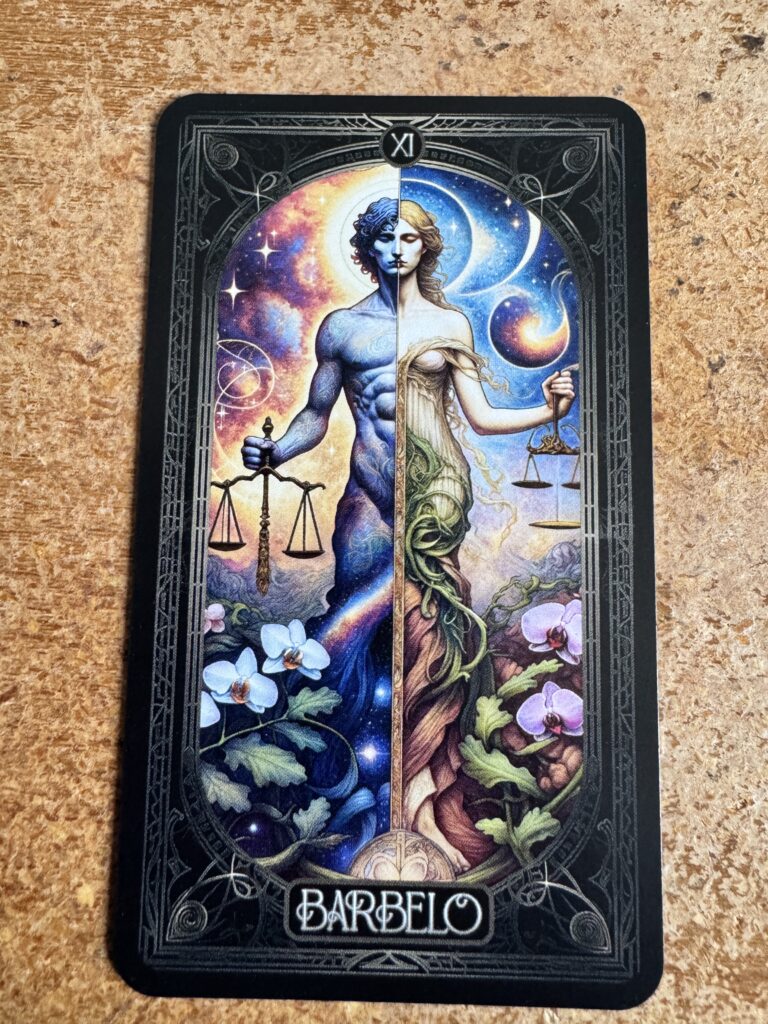
She stands divided and united, the perfect image of integration. The cosmic and earthly aren’t at war in her. They’re in conversation, in balance, in dynamic relationship. The masculine and feminine aren’t competing for dominance. They’re completing each other, strengthening each other, creating something more whole than either could be alone.
This is what true strength looks like. Not the brittle hardness that comes from suppressing half of yourself. Not the exhausting performance of being always one thing and never another. But the resilient wholeness that comes from allowing all of what you are to exist simultaneously, integrated rather than fragmented.
In Gnostic cosmology, Barbelo is first thought, first emanation, the Divine becoming aware of itself and expressing that awareness. She is not created by the Invisible Spirit. She emerges from it naturally, the way light emerges from a source or fragrance from a flower. She is the Spirit’s own self-knowing made manifest.
This means she contains everything. Every possibility. Every path. Every experience. And because she contains everything without being diminished or fragmented by that vastness, she demonstrates that you can too. You can hold your contradictions. You can integrate your opposites. You can be multiple things at once without splitting apart.
The scales she holds aren’t measuring or judging. They’re balancing. Constantly adjusting. Finding equilibrium not once but continuously, understanding that strength isn’t static perfection but dynamic integration. The cosmic side and the earthly side don’t weigh the same. They don’t need to. They need to be in relationship, each supporting the other, each making space for the other.
As Barbelo appears beside you today, her teaching arrives not as words but as presence:
“What would it mean to stop choosing between parts of yourself and start integrating all of what you are? What strength becomes available when you allow your contradictions to coexist rather than forcing them into resolution?”
Teaching for the Day
We live in a culture obsessed with consistency, with being one clear thing that others can categorize and predict. You’re supposed to have a brand, an identity, a coherent story about who you are that doesn’t shift or contain contradictions. This creates enormous pressure to fragment yourself, to suppress the parts that don’t fit the narrative, to choose between aspects of your being rather than integrating them.
Barbelo teaches something radically different. She is the supreme principle precisely because she refuses to be only one thing. She contains cosmic and earthly, masculine and feminine, transcendent and immanent, ordering and harmonious. And the integration of these apparent opposites doesn’t weaken her. It makes her the most powerful force in the Pleroma.
The archons thrive on fragmentation. They want you split, compartmentalized, at war with yourself. Because when you’re internally divided, you’re weak. You waste energy trying to suppress parts of yourself, trying to be consistent, trying to resolve contradictions that might actually be sources of strength if you allowed them to coexist.
But when you integrate like Barbelo, when you allow all of what you are to exist in dynamic balance, you become formidable. Not because you’re harder or more defended, but because you’re more whole. Nothing can use your internal divisions against you because you’re no longer divided. You’ve made peace with your multiplicity.
“I am the Providence of everything. I became like my own human children. I existed from the first. I walked down every possible road.”
This is the voice of someone who has refused nothing, rejected nothing, suppressed nothing. Barbelo has walked every road not to master them all but to understand them all, to integrate the wisdom each path offers, to become vast enough to contain the full spectrum of experience without being overwhelmed by it.
This is available to you. Not as transcendence (floating above your human experience) but as integration (bringing all of your experience into coherent wholeness). The parts of you that seem to contradict each other, the aspects that don’t fit neatly together, the qualities that make you inconsistent or hard to categorize, these aren’t problems to solve. They’re the raw material of your strength.
The traditional Strength card in tarot often shows someone taming a lion, subduing their animal nature through willpower or spiritual discipline. But Barbelo as Strength offers something more sophisticated: she doesn’t tame her cosmic nature to fit into earthly form, and she doesn’t transcend her earthly nature to become purely cosmic. She holds both. Simultaneously. In dynamic tension that creates power rather than depleting it.
This is the work: not choosing between your contradictions but learning to hold them in balance. Not resolving your apparent opposites but allowing them to strengthen each other through their difference. Not becoming one consistent thing but becoming whole enough to contain many things without fragmenting.
Barbelo is the renovating force of the Aeons, gathering the scattered sparks back into coherence. She does this not through force but through magnetic attraction. Wholeness calls to the fragmented. Integration draws the scattered. When you become more whole yourself, you naturally begin to help others remember their own wholeness.
Journaling Invocation
“What parts of myself have I been trying to choose between instead of integrating? What contradictions in me are actually sources of strength if I stop trying to resolve them?”
This question invites you to look at where you’ve been fragmenting yourself in the name of consistency or clarity or acceptability. Where have you decided you need to be one thing or the other when you could be both?
Maybe you’ve been choosing between your spiritual and material interests when you could integrate both. Maybe you’ve been choosing between strength and vulnerability when the deepest strength comes from allowing yourself to be both strong and tender. Maybe you’ve been choosing between logic and intuition when your wisest decisions come from consulting both.
Write about the parts of yourself that seem to contradict each other. The qualities that don’t seem to fit together. The aspects that make you feel inconsistent or confusing to others. Don’t try to resolve them or figure out which one is “really” you. Just acknowledge them. See them. Honor them.
And then ask: what if these contradictions are actually creating a dynamic tension that makes me stronger, more resilient, more whole? What if the integration of opposites is the source of real power rather than a problem to solve?
Barbelo walked down every possible road not to choose the best one but to integrate the wisdom of all of them. She became like her own human children not to fix them but to understand them from the inside. She contains everything without being overwhelmed by that vastness.
What becomes possible when you stop trying to be one coherent thing and start allowing yourself to be whole, even when whole means multiple, complex, containing contradictions?
Small Embodied Practice
Stand with your feet hip-width apart, grounded and stable.
Extend your arms out to the sides, parallel to the ground, palms up, as if you’re holding something in each hand.
In your left hand, imagine holding your cosmic nature: your dreams, your spiritual seeking, your connection to something larger than yourself, your transcendent qualities.
In your right hand, imagine holding your earthly nature: your body, your practical needs, your material life, your relationships, your imminent presence in the world.
Feel the weight of each. Notice if one feels heavier than the other. Notice if you tend to favor one side, lean toward one hand more than the other.
Now, very slowly, begin to adjust. Not trying to make them equal, but finding a balance where both can be held with strength. Where neither is abandoned or suppressed. Where each supports the other.
As you find this balance, say internally: “I am cosmic and earthly. I am transcendent and imminent. I contain both. I integrate all.”
Stay here for several breaths, feeling the strength that comes not from choosing one side but from holding both with equal presence.
When you’re ready, slowly lower your arms. But keep the feeling of integration, of holding your multiplicity with strength rather than fragmenting under its weight.
This is Barbelo’s teaching embodied: strength comes from integration, not suppression. Power emerges from wholeness, not from choosing between parts of yourself.
You just practiced being both.
Not choosing.
Not resolving.
Simply holding the fullness of what you are with grace and strength.
The caravan moves together through integration. If today’s companion touched something in you, if Barbelo’s teaching helped you see where fragmentation has been masquerading as consistency, let us know in the comments. Your wholeness lights the path for others learning to integrate beside you. ⚖️
Tomorrow: John the Baptist arrives at the threshold, the one who represents endings and the space between what was and what’s coming.