
Thanksgiving carries a mythology far older, stranger, and more complex than the tidy story taught in schools. When you peel back the polite veneer, you find a tangle of harvest rites, colonial propaganda, Indigenous resilience, national myth-making, and the deeper, archetypal hunger humans have always had for communal meaning at the turning of the year.
This isn’t an effort to correct or redeem the holiday. It’s an invitation to see that every cultural ritual is a palimpsest, built from stacked layers of human longing, each era inscribing its needs over what came before.
The myth we tell ourselves about Thanksgiving reveals what we hunger for as a culture. The myth we could tell might reveal who we’re becoming.
The First Layer: The Harvest Myth That Predates America
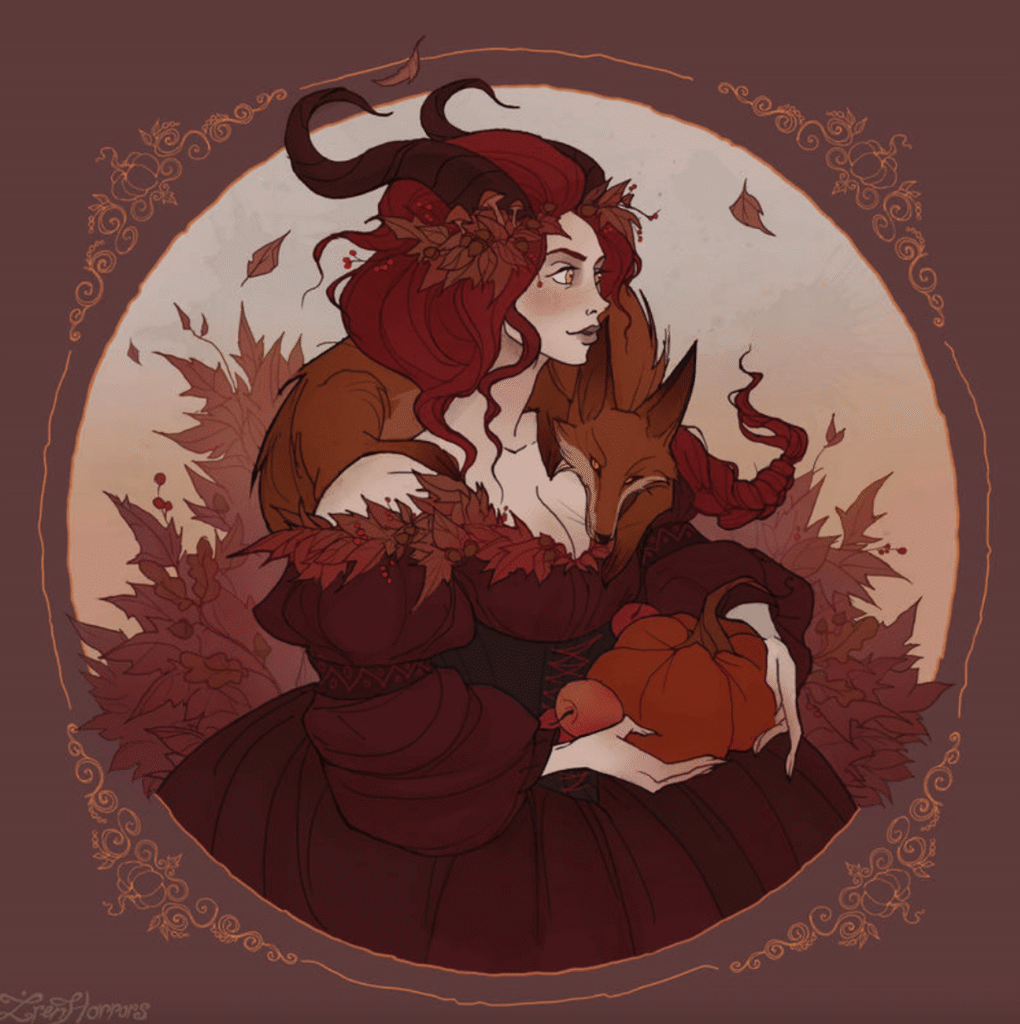
Before it was an American holiday, Thanksgiving echoed a much older archetype: the harvest festival. Every agrarian culture celebrated the moment when the earth gave its gifts and the community gathered to acknowledge dependence on forces larger than themselves.
In Europe, it showed up as Lammas, Harvest Home, the Feast of Demeter, the Corn Mother ceremonies. In ancient Greece, the Eleusinian Mysteries honored Persephone’s descent and Demeter’s grief. In China, the Mid-Autumn Festival celebrated the full harvest moon. The Incas held Inti Raymi to honor the sun’s blessing on their crops.
These rites were not simply about food. They enacted the eternal rhythm: death feeds life, life feeds death, gratitude stands between.
The harvest demanded recognition of a fundamental truth: humans do not create abundance. We participate in it. We are receivers in a vast network of giving. The grain dies to feed us. The season turns. Something greater than individual will orchestrates survival.
This pattern is the skeleton beneath all later layers. It’s why Thanksgiving feels important even when we can’t articulate why. It touches something pre-rational, something that knows the year is a wheel and the wheel must be honored at certain stations.
Practical reflection: What has “ripened” in your life this year that you haven’t acknowledged yet? Not just achievements, but also losses, completions, transformations you’ve been too busy to name.
The Second Layer: Colonial Myth-Making
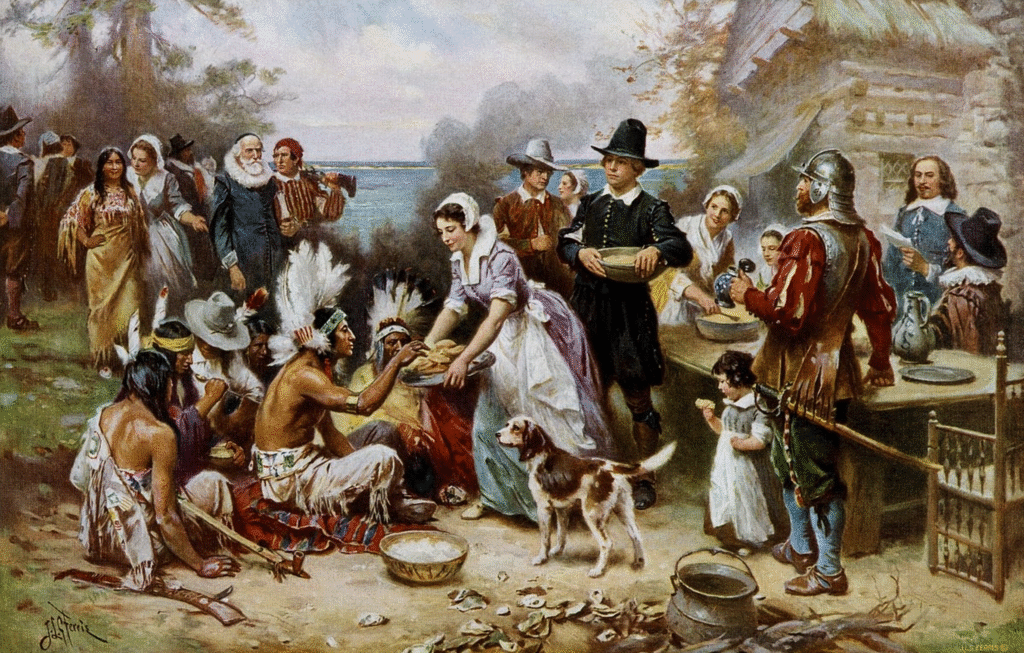
The popular American Thanksgiving story is a crafted narrative, not a factual one. The image of Pilgrims and Wampanoag peacefully breaking bread in 1621 was retrofitted in the 19th century to forge a national identity. It served as a soothing origin story during a time when the nation was fractured and needed a myth of unity.
The actual 17th-century contact between colonists and Indigenous peoples was marked by tension, uneasy alliances, exploitation, and later violence. The single 1621 feast was not called “Thanksgiving” nor did it inaugurate a tradition. It was closer to a harvest celebration with political undertones, a three-day event that the Wampanoag likely joined as much to monitor the colonists as to celebrate with them.
The Pilgrims themselves held irregular days of thanksgiving, most often after military victories. In 1637, the Massachusetts Bay Colony declared a day of thanksgiving after the massacre of Pequot people. The blood beneath the bread was real.
The sanitized version appeared later, when the young nation needed founding myths that presented colonization as cooperative rather than conquered. Sarah Josepha Hale, a magazine editor, campaigned for decades to establish Thanksgiving as a unifying national holiday. She romanticized the 1621 event, turning it into a parable of harmony between cultures.
In other words: the official myth is a kind of collective spell for national innocence. It functions to erase complexity, smooth over violence, and provide a comforting story about American origins. Like all spells, it shapes what we see and what remains invisible.
Practical reflection: What stories in your own life have been simplified into myths of “how it began”? Where might a deeper truth be asking for recognition? What have you edited out of your personal narrative to make yourself more comfortable?
The Third Layer: The Indigenous Throughline
For many Indigenous communities, Thanksgiving is not a day of celebration but a National Day of Mourning. Since 1970, Indigenous people have gathered in Plymouth on Thanksgiving to honor ancestors, acknowledge ongoing injustices, and resist the erasure of their history.
Yet Indigenous traditions also contain rich thanksgiving ceremonies that long predate colonial arrival, and these offer a radically different model for what gratitude can be.
For example, the Haudenosaunee (Iroquois) Thanksgiving Address, sometimes called The Words That Come Before All Else, is a profound, poetic liturgy of gratitude to every being: waters, winds, plants, animals, ancestors, the earth itself. It’s recited at the beginning of gatherings, not as a formality but as a reorientation of consciousness.
It doesn’t thank a distant deity. It thanks the beings themselves: the strawberries for their sweetness, the thunder for bringing rain, the moon for measuring time. Gratitude becomes reciprocal relationship rather than vertical supplication.
This strand reminds us that Thanksgiving can be reclaimed by rooting it in reciprocity, humility, and connection to the more-than-human world. It shifts the question from “What am I thankful for?” to “What relationships sustain me, and how do I honor them?”
The Indigenous perspective also challenges the possessive tone of colonial gratitude. When you believe the land was “given” to you by God or purchased through manifest destiny, gratitude becomes self-congratulatory. When you recognize the land was never yours to take, gratitude becomes inseparable from accountability.
Practical reflection: What non-human presence are you grateful for today? A bird, a tree, the morning air? Can you thank it directly, even silently? What would it mean to recognize that being as kin rather than resource?

The Fourth Layer: Lincoln’s Ritual of National Healing
Thanksgiving only became an official federal holiday because Abraham Lincoln made it one during the American Civil War. In 1863, in the aftermath of Gettysburg and in the midst of unimaginable national trauma, he declared the last Thursday of November a day of “thanksgiving and praise” in the hope of stitching a bleeding nation back together.
Here the myth shifts from harvest to healing. The ritual becomes medicine for a collective psyche in crisis.
Lincoln’s proclamation is worth reading. It acknowledges blessings, yes, but also asks for humility, for care toward the wounded and the widowed, for a recognition that no victory is pure. He was trying to create a moment when Americans might look at each other across the chasm of war and remember they were still, somehow, one people.
It didn’t work, of course. Not fully. But the attempt matters. Thanksgiving was consciously deployed as a ritual technology for collective repair.
There’s a quiet power in that: Thanksgiving as a national breath, a pause meant to remind people of resilience amid conflict. It suggests that gratitude isn’t only for when things are good. Sometimes gratitude is the thread you pull to find your way out of despair.
Practical reflection: What part of you is seeking a ritual of mending this season? What internal war might a day of conscious gratitude help to ease, even slightly?
The Fifth Layer: The Modern Myth of Abundance
Today’s Thanksgiving is drenched in abundance symbolism: overflowing tables, family gatherings, parades, football, shopping frenzies. It’s the one American holiday that explicitly centers on having enough, yet it sits uncomfortably adjacent to Black Friday, which centers on never having enough.
The deeper archetype isn’t about consumption but about the relationship between giving and receiving. Traditional harvest festivals honored both the gift of the earth and the labor of the community. Modern Thanksgiving has largely severed those connections. Most Americans have no direct relationship to the food on their table. We don’t know the soil it came from or the hands that harvested it.
Abundance has become distorted into excess. The holiday has been absorbed into consumer capitalism’s logic: more is better, gratitude is a feeling you have while eating, and the meal itself becomes a performance of family cohesion that may or may not reflect reality.
At its best, the modern myth points us toward the universal human longing for belonging, shared time, and the warmth of communal blessing. The image of a table surrounded by loved ones taps into something primal: the hearth as sacred center, the meal as communion.
At its worst, it becomes a performance of abundance to distract from the scarcity within. Scarcity of connection. Scarcity of time. Scarcity of meaning. We pile the plates high and hope the fullness on the table will quiet the emptiness in the room.
Practical reflection: Where do you experience genuine abundance that isn’t material? Abundance of time, attention, presence, connection? What would it mean to honor that rather than performing it?
The Sixth Layer: The Seeker’s Reclamation
For wanderers on the inner path, Thanksgiving can be reclaimed as a ritual of four movements:
1. Acknowledgment of the forces that carried you.
Not just people, but patterns. Not just gifts, but also the obstacles that shaped you. The year behind you contains a story. What invisible hands guided you through it? What synchronicities, what graces, what unexpected openings appeared when you needed them?
2. Gratitude as a conscious stance, not a list.
Gratitude isn’t an inventory of good things. It’s a posture toward existence. It’s the recognition that you are woven into a web of relationships, some visible and some not, and that your life is sustained by more than you can comprehend.
3. Reciprocity with the world, seen and unseen.
If you receive, what do you give? If the earth feeds you, how do you feed the earth? If the people around you have carried you, how do you carry them? Reciprocity closes the circuit. It transforms gratitude from sentiment into action.
4. Renewal as the year darkens and the inner season shifts.
Thanksgiving sits at the threshold between autumn and winter, between the external harvest and the internal retreat. It’s a last gathering before the long inward turn. What do you take with you into the dark season? What do you leave behind?
In this frame, Thanksgiving becomes a threshold day: a moment between the bright outer year and the introspective winter ahead.
The deeper myth is this: Every year, you harvest yourself.
You gather what you’ve learned, what you’ve lost, what you’ve become. You separate the wheat from the chaff. You acknowledge what fed you and what drained you. You make an offering of your own transformation.
Practical reflection: What part of you feels ready to be harvested, honored, or let go? What aspect of your life has completed its cycle and is ready to be released? What quiet truth has been growing in you all year that’s finally ready to be spoken or embodied?
Closing: The Myth You Choose
Here’s the thing about myths: they’re not lies. They’re lenses. They focus attention, shape meaning, create coherence. The myth you inhabit determines what you see and what remains invisible.
You can participate in Thanksgiving as consumer spectacle. You can reject it as colonial propaganda. You can ignore it as just another Thursday.
Or you can use it.
You can treat it as an annual threshold, a ritual pause, a moment to touch the older patterns beneath the noise. You can make it a day when gratitude becomes a practice, not a feeling. When abundance is measured by connection rather than accumulation. When you honor the harvest of your own becoming.
The mythology of Thanksgiving is still being written. Every year, we add another layer. What you do this Thursday becomes part of the ongoing story.
So what myth will you choose to live inside?
Final reflection: If you were to design a personal Thanksgiving ritual that honored all six layers, what would it include? What would you acknowledge, honor, release, and renew?