
This morning the Thoth deck placed Death in my hand with the peculiar weight that only certain cards carry—that gravitational pull of significance that makes the fingers tingle and the mind sharpen. Not the grim ender of tales that medieval minds conjured, but the skeletal dancer Crowley envisioned in his years of Egyptian exile and hermetic revelation—hipbones swaying in cosmic rhythm, scythe flashing like a conductor’s baton orchestrating the symphony of transformation.
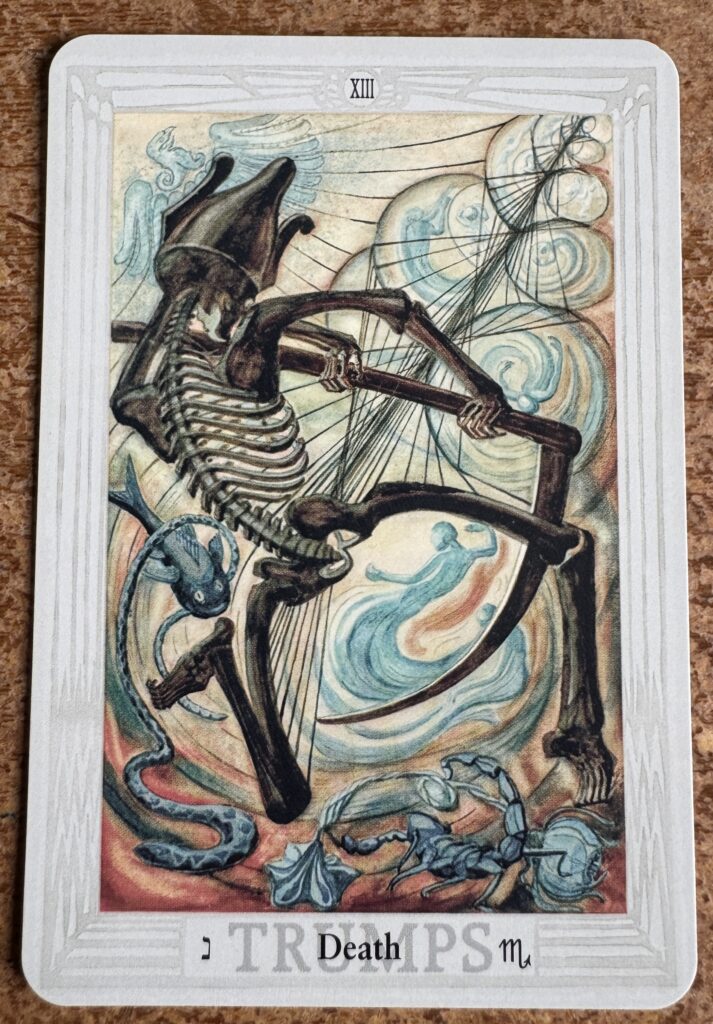
The card felt warm between my thumb and forefinger, its surface worn smooth by decades of seekers’ touch. I studied the intricate details that Frieda Harris painted with such meticulous devotion: the way Death’s spine curves in elegant motion, how his skull tilts with something approaching joy, the theatrical sweep of his robes that suggest not mourning but celebration.
Around him, currents of life swirl in perpetual motion—fish swimming against the current of dissolution, serpent coiling through the mysteries of regeneration, scorpion carrying its transformative sting. Each creature a living reminder that endings are fertile soil, not barren ground. The very air seems to shimmer with possibility, with the electric charge that precedes all genuine change.
I sat with the card spread before me on the worn oak table, my coffee growing cold as steam spiraled upward in lazy helixes, and felt the familiar companion settling at my shoulder like an old friend taking his accustomed place. The weight of his presence was neither heavy nor light—simply there, constant as breath, reliable as gravity. Death doesn’t stalk me with menace through the corridors of my days; he walks with me as a quiet ally, a patient teacher whose lessons unfold in whispers rather than shouts.
His voice comes not as sound but as knowing, that deep cellular recognition that bypasses the rational mind and speaks directly to the marrow. He whispers in the language of intuition and ancestral memory: “What skin will you shed today, old friend? What calcified husk of self has grown too tight, too small for the expanding consciousness within? What outdated story of who you think you are is ready to be cut loose, cast off like autumn leaves surrendering to winter’s transformative touch?”
The questions hang in the air between us, neither demanding immediate answers nor allowing easy dismissal. They settle into my bones with the patient persistence of water wearing smooth the roughest stone.
In my leather-bound journal—its pages yellowed from years of midnight musings and coffee stains like ritual marks—I wrote of phoenix fire, that sacred conflagration that transforms rather than destroys. The pen moved across the paper with its own intelligence, channeling visions of ancient birds rising from their own ashes, wings spread wide against impossible skies. I sketched serpents in the margins, their coils loosening as they wriggled free from constraining skins that had grown brittle and confining, each molt a small death that birthed a larger life.
The words flowed like incantations, conjuring Eliot’s eternal footman—that snickering harbinger who haunts the periphery of consciousness, reminding us that our time is always running out, always pressing us toward the moment of reckoning. I could hear his cruel laughter echoing through the chambers of my psyche, see him lurking in the wings of my personal theater, waiting for the curtain call that comes to every performance.
But more than death’s comedy, I wrote of masks—those elaborate disguises we craft with such care, polishing them until they gleam with false authenticity. The danger, I scrawled in increasingly urgent script, lies not in wearing them but in forgetting they can be removed. When the mask fuses with the flesh, when the performance becomes the performer, we lose the thread that leads back to our essential selves.
Above all, threading through every line like a golden filament, I wrote of authorship—that primal call to step forward from the audience of my own existence and claim the pen that writes reality’s script. To refuse the role of passive observer, of victim to circumstance, of sleepwalker stumbling through someone else’s dream.
Death reminds me that every day is a small rehearsal for dissolution, each dawn breaking over the stage where I practice my final bow. Every breath out becomes a letting go, a miniature death that empties the lungs of yesterday’s stale air, making space for what follows in the eternal rhythm of renewal. The exhale carries with it fragments of who I was moments before—expired thoughts, finished feelings, the cellular debris of a self that existed only in the now-vanished instant.
He is the musician who prunes and plucks at once, his skeletal fingers working the strings of existence with a maestro’s precision. Death cuts away what no longer serves—the brittle branches of outdated identity, the dead wood of worn-out beliefs—while simultaneously striking new chords in the song of becoming. His melody weaves through the symphony of transformation, each note a reminder that endings birth beginnings, that every funeral is also a christening.
In this daily rehearsal, I glimpse the cosmic joke that Burroughs whispered about in his junky wisdom: that death is not the opposite of life but its most intimate collaborator. The eternal footman doesn’t wait in the wings—he dances with us on stage, his presence making every gesture more precious, every word more weighted with meaning. Through his dark choreography, I learn that dissolution is not defeat but the ultimate act of creative destruction, clearing the canvas for whatever masterpiece awaits.
To walk with Death is not to live in fear—that tired mythology of the uninitiated. It is to live awake, hyper-present in each crystalline moment, eyes wide open to the beautiful terror of impermanence. This is not the morbid fascination of the gothic romantic or the nihilistic embrace of the void-worshipper. This is the magician’s recognition that every breath draws us deeper into the mystery, every heartbeat marking time on the cosmic clock.
It is to rise from ashes like some psychedelic phoenix, to shed and regenerate in the eternal cycle of death and rebirth that Jung mapped in his alchemical visions. Each morning becomes an act of resurrection, each sleep a little death rehearsal. I peel away the accumulated skins of yesterday—the roles I played, the masks I wore, the stories I told myself about who I was supposed to be. Layer by layer, the false selves fall away like autumn leaves, revealing something rawer underneath.
To refuse the mask that hides me even from myself—this is the hardest magic of all. The persona we construct for the world’s consumption, that carefully curated fiction we present at the daily masquerade, becomes so familiar we forget it’s a costume. But Death whispers in our ear: strip naked, show your true face, let the authentic self emerge from behind the elaborate theater of social expectation. In his presence, pretense becomes impossible, and what remains is either genuine or nothing at all.
Today, I choose to dance on Death’s floor—not the morbid shuffle of the defeated, but the wild, ecstatic tango of one who has glimpsed the eternal and returned laughing. Each step becomes a conscious letting go, a deliberate release of the accumulated debris that weighs down the soul. I shed expectations like old clothes, drop grudges like stones from my pockets, abandon the bitter collection of should-haves and might-have-beens that clutter the psychic landscape. Each breath transforms into a renewal, an inhalation of pure possibility, an exhalation of everything that no longer serves the great work of becoming.
The rhythm emerges from somewhere deeper than thought, older than fear—the primal drumbeat that has echoed through shamanic caves and mystery schools, through the hearts of mystics who learned to court the darkness and emerge transformed. From this ancient cadence, this conversation between mortality and eternity, I make my vow like a magician casting the most important spell of his life:
To embrace life not as a consolation prize for avoiding death, but as the very medium through which consciousness explores its own infinite nature. To live it to the fullest—not in the desperate accumulation of experiences like a spiritual consumer, but in the profound attention that transforms even the mundane into sacrament. To seize destiny not as some distant prize dangling from the hooks of tomorrow’s promises, but as a step taken here, now, in this eternal present moment where all possibilities converge and the future crystallizes from the raw material of choice.