










“If I just explain it better this time, then they’ll finally understand me.”
Sarah had delivered this line to three different partners across seven years. Different faces, different apartments, same exhausting scene. She’d refined her communication style, read all the relationship books, even developed a PowerPoint presentation (only half-joking) about her emotional needs. Yet here she was again, 2 AM, tears streaming, explaining herself to someone who seemed to be reading from the same script as the others: confused, defensive, somehow making her feel like she was speaking an alien language.
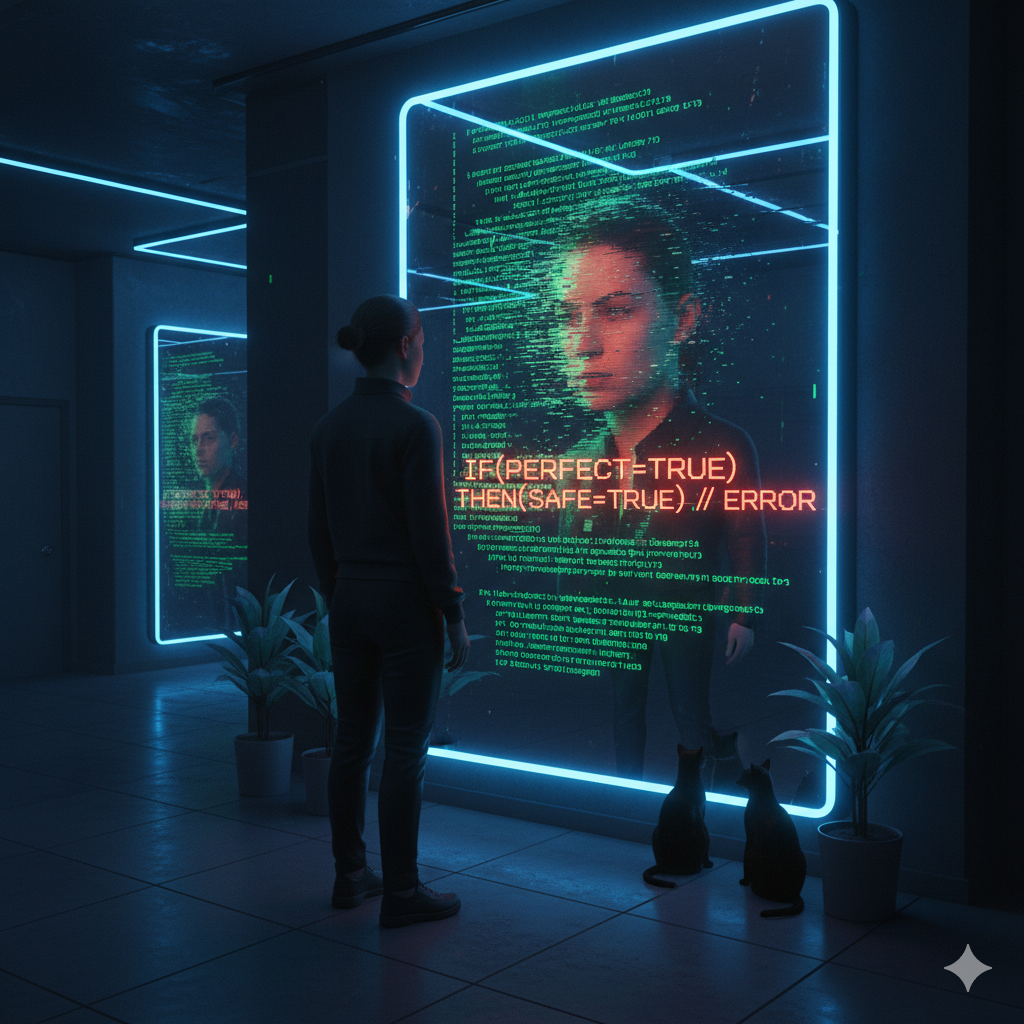
The tragedy wasn’t that Sarah couldn’t communicate. It was that she kept running the same broken program, expecting different results. Her internal operating system was executing an ancient if-then statement, installed somewhere around age seven when she’d learned that if she could just find the right words, then daddy would stop drinking and see how much his little girl needed him.
The spell never worked then. It wasn’t working now. But like most of us, Sarah didn’t even know she was running code—she thought she was living life.
Here’s the thing: we’re all Sarah. We’re all executing narrative software we didn’t consciously install, running if-then formulas we’ve never examined, wondering why reality keeps glitching in the same predictable ways. That promotion that will finally make us feel successful. That weight loss that will finally make us worthy of love. That achievement that will finally prove we’re not imposters.
If only, then surely.
Except the “then” never arrives, does it? Because the bug isn’t in your execution; it’s in the code itself.
What if you could learn to read your own source code? What if you could spot the corrupted if-then statements that keep crashing your reality? What if narrative alchemy isn’t just about telling better stories, but about becoming a reality hacker who can debug their own consciousness?
Welcome to the practice of narrative debugging, where we treat our stories not as fixed laws but as editable spells, where being stuck isn’t a life sentence but a signal that it’s time to check under the hood.
Your reality is more malleable than you think. Let’s learn to read the code.
- Part 1: Recognizing the Glitch in Your Matrix
- Part 2: The Architecture of If-Then Spells
- Part 3: Learning to Read Your Own Source Code
- Part 4: Rewriting the Spell
- Part 5: Integration and Practice
- How to Maintain Your New Narrative OS
- Dealing with Rollback Temptation When Stressed
- Creating Backup Stories for When the Old Code Tries to Reinstall
- The Ongoing Practice of Narrative System Maintenance
- The Community of Debuggers
- When Integration Becomes Natural
- The Practice Never Ends (And That’s the Good News)
- Journal Prompts Section
- Closing: The Ongoing Practice
- Call to Action
Part 1: Recognizing the Glitch in Your Matrix
You know that moment in The Matrix when Neo sees the same black cat twice? That little flicker of déjà vu that signals something’s been changed in the code? Your life is full of these moments; you just haven’t been trained to see them as glitches.
They show up as that sinking feeling when your new boss says something and suddenly you’re twelve years old getting lectured by your father. They manifest as the fourth friend in a row who “betrays” you in eerily similar ways. They’re present in that familiar exhaustion when you realize you’re having that fight again, just with different costumes and set dressing.
These aren’t coincidences or proof that “all people are the same.” These are your if-then loops executing, reality bending itself to match your narrative expectations, your unconscious code summoning the same story from the quantum field of infinite possibilities.
The Gap Where Magic Dies
There’s always a gap between what we believe will happen (our “then”) and what actually manifests. Sarah believed that perfect communication would create understanding. The gap? Understanding requires two people operating from compatible code, not one person perfecting their transmission.
This gap is where our narrative alchemy goes wrong. We cast our spell—”If I’m indispensable at work”—expecting a specific result—”then I’ll be secure”—but reality delivers something else entirely: burnout, resentment, and watches us get laid off anyway because the economy doesn’t care about our if-then formulas.
The tragedy is we rarely examine the gap. Instead, we double down on the “if,” believing we just need to execute it harder, better, more perfectly. If I’m MORE indispensable. If I communicate MORE clearly. If I achieve MORE impressively.
More of a broken spell doesn’t fix the spell. It just exhausts the magician.
Signs You’re Running Outdated Narrative Software
Your operating system starts throwing errors, but since nobody taught you to read the error messages, you interpret them as personal failures rather than system notifications. Here’s what narrative bugs look like in runtime:
The Prophecy Problem: You meet someone new and within minutes, you “know” how this will end. You’ve already written their character arc based on pattern recognition from your past. Surprise: they usually fulfill your prophecy, not because you’re psychic but because your if-then code shapes how you interact with them, pulling the predicted behavior out of them like a magician forcing a card.
The Recurring Boss Battle: Different jobs, same conflict with authority. Different relationships, same trust issues. Different cities, same loneliness. When the scenery changes but the plot doesn’t, you’re not living a life; you’re running a loop.
The Effort Paradox: The harder you try, the worse it gets. This is the telltale sign of corrupted if-then code. You’re like a driver accelerating harder while stuck in mud, not realizing that the solution isn’t more gas; it’s getting out and examining why you’re stuck in the first place.
The Missing Middle: You can clearly see your “if” (what you’re doing) and you desperately want your “then” (the desired outcome), but you can’t actually explain the mechanism that connects them. How exactly does being perfect make you safe? Through what specific process does saving others make you matter? When you can’t answer these questions, you’re operating on faith in faulty code.
That Sinking Feeling: Your body knows before your mind does. That familiar tightness in your chest when you’re about to run the program again. That deflation when you recognize the pattern starting. Your somatic system is your first debugging tool; it’s been tracking the failures all along, storing the data in your muscles and organs, trying to warn you through sensation that you’re about to execute a corrupted file.
The beautiful thing? Once you start recognizing these glitches, you can’t unsee them. Every loop becomes an opportunity to pause, to examine, to ask: what if-then statement am I running here? What spell am I casting that reality keeps refusing to validate?
And that’s when the real alchemy begins, not in getting the spell to finally work, but in understanding why it was broken all along and learning to write better code.
Part 2: The Architecture of If-Then Spells
Every spell has an origin story. Yours probably began before you had words for it, when your nervous system was still learning what it meant to be human in this particular reality.
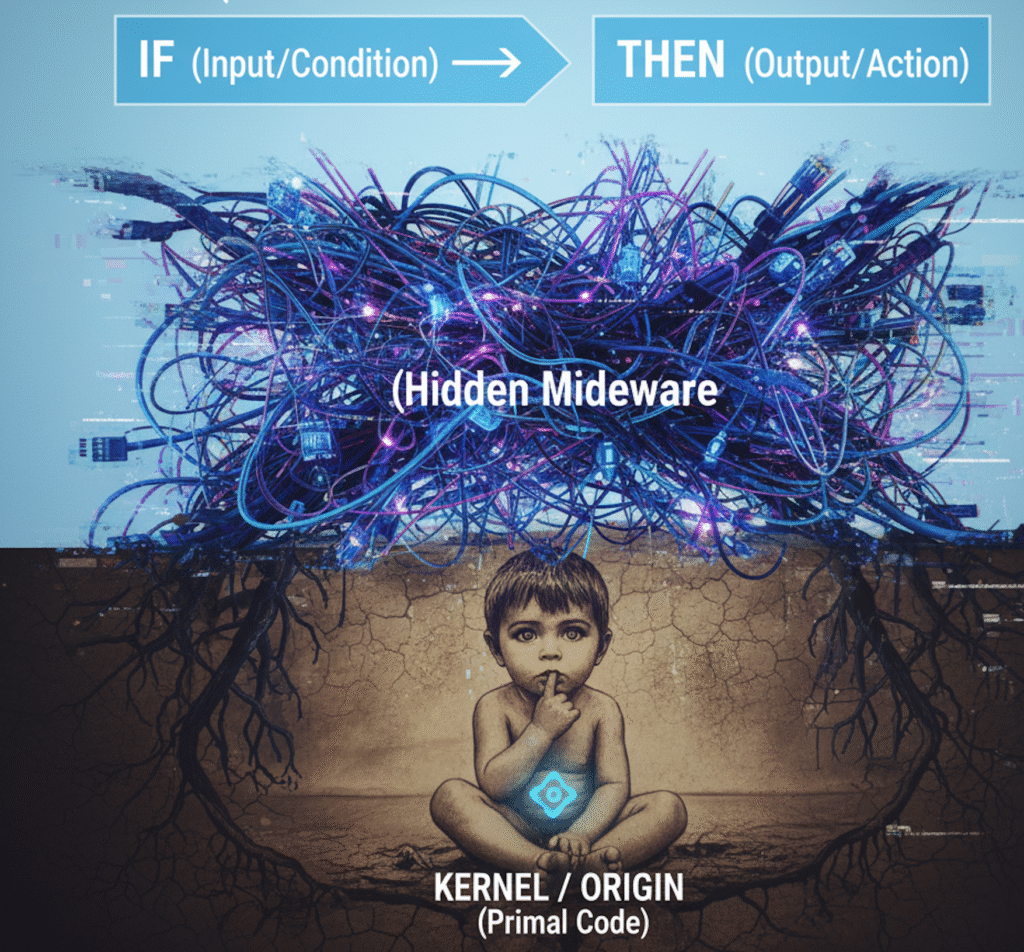
Picture a three-year-old watching their parents fight. They don’t understand mortgage stress or intergenerational trauma or attachment theory. But their brilliant little consciousness needs to make sense of the chaos, needs to establish cause and effect in a world that suddenly feels dangerous. So they write their first piece of code: “If I’m very quiet and good, then the scary thing stops.”
Boom. A spell is born. An if-then statement gets burned into the operating system, deep in the kernel where conscious thought can’t easily reach.
Fast-forward thirty years. That three-year-old is now a manager who can’t understand why they never speak up in meetings, why conflict makes them physically ill, why they’re praised for being “so easy to work with” while watching promotions go to louder colleagues. They don’t remember writing the code. They just know that being quiet feels like survival, even in a conference room where no one’s actually in danger.
Why These Formulas Feel Like Physics
Here’s the insidious part: these if-then statements don’t feel like beliefs—they feel like laws of nature. Gravity pulls objects down. Fire burns. And if you’re not perfect, you’re not safe. These all feel equally true, equally immutable.
This is because the spells were cast when you were still forming your understanding of how reality works. They’re not overlaid on top of your worldview like later beliefs; they’re baked into the foundation. They’re the axioms from which all other narratives derive.
Your nervous system learned these patterns before your prefrontal cortex came online. They’re coded in a more ancient language than logic—the language of survival, of attachment, of primal safety. This is why you can intellectually know that your pattern doesn’t make sense while still feeling compelled to run it. You’re not crazy; you’re just trying to use the wrong debugging tool. You can’t think your way out of a spell that wasn’t thought into existence.
The Hidden Middleware: What’s Really Running Between If and Then
This is where narrative alchemy gets quantum. Because between your “if” and your “then” lies an entire universe of unexamined assumptions, invisible processes, and reality-shaping code that you never consciously wrote.
Let’s dissect a common spell: “If I never need anyone, then I can’t be abandoned.”
Seems logical enough on the surface. But let’s look at the hidden middleware this program requires to run:
- Assumption: Needing others is what causes abandonment
- Assumption: Abandonment is unsurvivable
- Assumption: Complete self-sufficiency is possible
- Assumption: Connection and need are the same thing
- Assumption: The pain of isolation is less than the pain of loss
- Process: Scan all interactions for signs of developing need
- Process: Terminate connections before they become essential
- Process: Reframe loneliness as freedom
- Process: Convert attachment signals into danger warnings
That’s a lot of background code running for what seemed like a simple if-then statement. Most of this middleware is bug-ridden. Needing others doesn’t cause abandonment; it’s part of being human. Abandonment, while painful, is survivable; you’ve already survived it, or you wouldn’t be reading this.
The Catalog of Corrupted Formulas
After years of debugging human narratives, certain patterns show up again and again, like universal bugs in the human operating system. See if you recognize your favorite malware:
“If I’m perfect → then I’m safe” Originally installed when criticism felt like annihilation. Usually comes bundled with impostor syndrome and chronic exhaustion. The bug? Safety isn’t earned through performance; it’s cultivated through self-acceptance and boundaries.
“If I save others → then I matter” Classic helper malware. Installed when being needed was the only reliable source of connection. Creates codependency loops and burnt-out healers. The bug? Your matter-ing is inherent, not transactional.
“If I stay small → then I belong” The dimming spell, cast when being “too much” led to rejection or danger. Keeps you playing minor characters in your own story. The bug? Belonging that requires self-betrayal isn’t belonging—it’s just fitting in.
“If I achieve enough → then I’m real” The productivity daemon, running constantly in the background, consuming massive system resources. Installed when doing was valued over being. The bug? You were real the moment you arrived here. The achievement is just decoration.
“If I control everything → then nothing bad happens” The anxiety algorithm, trying to calculate every variable in an inherently uncertain universe. Usually installed after early chaos or loss. The bug? Control is mostly illusion, and the attempt to maintain it creates the very suffering you’re trying to avoid.
“If I expect nothing → then I can’t be disappointed” The numbness protocol, disguised as wisdom. Installed when hope became too expensive. The bug? This spell doesn’t prevent disappointment; it just guarantees it by ensuring you never receive what you don’t believe you can have.
Each of these formulas made perfect sense when they were written. Each was a brilliant adaptation to an impossible situation. The child who wrote them was doing their absolute best to survive and belong in a world that felt too big, too unpredictable, too much.
But you’re not that child anymore. And the spells that saved you then are suffocating you now.
The beautiful news? Once you understand the architecture, you can begin to rewrite the code. Once you see the middleware, you can start debugging the assumptions. Once you recognize the spell, you lose your obligation to keep casting it.
The formula felt like physics, but it was always just a story. And stories, as any narrative alchemist knows, can be rewritten.
Part 3: Learning to Read Your Own Source Code
The first time you catch yourself mid-pattern, it feels like waking up inside a dream. You’re halfway through the familiar script—maybe you’re composing that over-explaining text, or preparing your usual deflection, or building the wall you always build at exactly this depth of intimacy—and suddenly you see it. You’re not living a moment; you’re running a program.
This is the beginning of narrative literacy: learning to read the code while it’s executing.
Tracing Current Patterns Back to Their Origin Stories
Every corrupted formula has a birthplace, a moment when your brilliant consciousness wrote a piece of survival code that would run for decades. Finding this origin isn’t about blame or wallowing; it’s about understanding the logic of your own operating system.
Start with your most obvious pattern, the one that makes your friends say, “You always do this.” Now, instead of defending or deflating, get curious. Play detective in your own history.
When did you first learn this move? Don’t think—feel. Your body remembers. That tension in your shoulders when you’re about to run the program? That’s been there since you were seven, watching your mother’s face change when dad came home. That catch in your throat before you swallow your truth? That started in fourth grade when expressing your real opinion meant eating lunch alone for a month.
The origin story usually isn’t dramatic. It’s often devastatingly ordinary: a moment when your developing consciousness made a decision about how reality works. “Oh, I see. When I achieve something, mommy’s eyes light up. Achievement equals love. If achievement, then love.” The spell is cast. The code is written. The program begins its decades-long run.
Sometimes you’ll find what I call a “compiler moment”—a specific scene where multiple threads wove together to create a particularly robust piece of code. Maybe it was the day your parents divorced, and you were the one who stayed calm, who helped your little sister, who didn’t cry. Three authority figures praised you for being “so mature.” The compiler took all that data and wrote: “If I suppress my needs and manage others’ emotions, then I’m valuable.”
Thirty years later, you’re the friend everyone trauma-dumps on while you quietly fall apart in private, wondering why you feel so unseen.
Understanding What the Pattern Was Originally Trying to Protect
Here’s where narrative alchemy gets tender: every pattern, no matter how destructive it seems now, was once a protection spell. It was your consciousness loving you the only way it knew how.
That wall you build in relationships? It was protecting a heart that had been shattered by someone who was supposed to keep it safe. Your perfectionism? It was protecting you from the annihilation that felt imminent when you were criticized. Your people-pleasing? It was protecting your belonging in a system where authenticity meant exile.
The pattern wasn’t wrong. It was brilliant. You were brilliant. A tiny consciousness in an overwhelming world, writing code to survive.
But here’s what happened: the spell worked too well. It protected you so effectively that it became your default reality. The temporary shelter became a permanent prison. The emergency protocol became standard operating procedure. The child’s brilliant solution became the adult’s recurring problem.
This is why shame is useless in pattern work. You can’t shame yourself out of a pattern that was born from love, even if it was a child’s incomplete understanding of love. The part of you running this code is trying to protect you. It’s just using outdated threat assessment data.
Recognizing When You’re About to Execute the Familiar Subroutine
Your body is your best debugging tool. It knows before your mind does that you’re about to run the program. Learn its signals.
Maybe your chest tightens three seconds before you agree to something you don’t want to do. Maybe your jaw clenches right before you swallow what you really want to say. Maybe there’s a specific flavor of exhaustion that arrives when you’re about to perform your achievement dance again.
These somatic signatures are your early warning system. They’re like those moments in a video game when the music changes to signal an approaching boss battle. Your body is trying to tell you: “Hey, we’re about to run that code again. The one that never gets us what we want. Just thought you should know.”
Start cataloging these sensations. Not to stop them—not yet—but just to notice. “Oh, there’s that familiar shoulder tension. I must be about to explain myself to someone who isn’t listening.” Or, “Interesting, my breathing just went shallow. I wonder what pattern is loading up.”
The Moment of Choice
Once you start recognizing the pre-pattern signals, something magical happens: a gap opens. A pause between trigger and execution. A moment where you could, theoretically, choose something else.
This gap might only last a microsecond at first. You’ll see it and still run the old code, but now you’re watching yourself do it. You’re becoming conscious of your unconscious patterns. You’re reading the code while it runs.
This is huge. This is everything. This is the beginning of your sovereignty over your own narrative.
In that gap lives your agency. In that pause between stimulus and response lies your freedom to write new code. Viktor Frankl called this space “the last of human freedoms”—the ability to choose your response to any given circumstance.
But let’s be real: at first, you’ll mostly just watch yourself run the old program while internally screaming, “I’m doing it again!” And that’s perfect. Consciousness precedes control. You have to read the code before you can rewrite it.
Start a pattern journal. Not a regular journal where you process feelings, but a technical log where you track your subroutines:
- Trigger detected: [what happened]
- Somatic signature: [what you felt in your body]
- Pattern executed: [what you did]
- Expected outcome: [your “then”]
- Actual outcome: [what really happened]
- Bug report: [where the code failed]
Treat yourself like a fascinating operating system you’re learning to understand. Bring curiosity, not judgment. You’re not broken code; you’re legacy software that needs updating.
The more you observe, the more readable your patterns become. The more readable they become, the more choice you have. And choice—conscious, deliberate choice—is where narrative alchemy begins.
Soon, you’ll stop being surprised when the pattern runs. You’ll start predicting it: “Based on this trigger, I’m about to do exactly that thing I always do.” And eventually, in that gap between knowing and doing, you’ll find room to ask the most powerful question in narrative alchemy:
“What if I didn’t?”
Part 4: Rewriting the Spell
So you’ve caught yourself mid-pattern. You can see the code running. You recognize the gap between trigger and response. Now comes the delicate work: rewriting the spell without destroying the wisdom it contains.
Because here’s what most self-help gets wrong: you don’t delete old code and start from scratch. That’s not transformation; that’s spiritual bypassing. The pattern contains intelligence—corrupted and outdated, maybe, but intelligence nonetheless. Your work isn’t to destroy it but to alchemize it.
The Alchemy of Transformation vs. Deletion
When you try to simply delete a pattern—”I’ll just stop people-pleasing!”—you create a void where that code used to run. And nature, including your psyche, abhors a vacuum. The old pattern rushes back in, usually stronger than before, reinforced by the shame of your “failure.”
Real narrative alchemy is more elegant. You don’t delete; you refactor. You take the core wisdom of the pattern and update it for current reality.
Let’s say your pattern is: “If I never disagree, then I’m safe.”
The core wisdom: Awareness that conflict can be dangerous and relationships need tending. The corruption: Believing your authentic self is inherently threatening to connection. The update: “If I disagree with respect and curiosity, then I create deeper safety through authenticity.”
See what we did there? We didn’t throw away the part of you that cares about safety and relationship. We honored it, then gave it better tools. We’re not asking you to become someone who doesn’t care about harmony; we’re helping you see that real harmony includes your voice.
Creating New If-Then Statements That Actually Compile
Your new code needs to be realistic, or it won’t compile in the operating system of your actual life. This is why affirmations often fail; they’re trying to run software your system can’t execute.
“If I just love myself, then everything will be perfect” is going to throw an error every time. Your system knows that’s not how reality works.
Instead, try: “If I treat myself with the same compassion I show my best friend, then I can navigate imperfection without self-abandonment.”
That can actually run. Your system already knows how to be compassionate to others; you’re just creating a redirect to include yourself in that existing function.
Here’s the template for rewriting that works:
- Keep the core need (safety, belonging, love, significance)
- Update the strategy (from unconscious to conscious, from rigid to flexible)
- Make it testable (specific enough to know if it’s working)
- Include failure protocols (what happens when the new code doesn’t work)
Old: “If I’m perfect, then I’m worthy” New: “If I show up authentically, then I attract people who value the real me. When this feels scary, I can start with small authenticity tests in low-risk situations.”
Testing Small Code Changes in Low-Stakes Situations
You don’t test new code in production. You don’t rewrite your core patterns during a family crisis or a high-stakes presentation. You start in the sandbox, where failure is safe and data is clean.
Choose your beta testers wisely. That friend who’s proven safe? They’re perfect for testing your new “disagreement doesn’t equal danger” code. Start tiny: disagree about where to have lunch. Notice what happens. Both in the relationship and in your body.
Your nervous system needs proof that the new code won’t kill you. And since your old pattern is convinced that it will, you have to gather evidence slowly, gently, irrefutably.
Think of it as microdosing new realities. You’re training your system to tolerate experiences it has marked as dangerous. Each successful test is a small deposit in your new narrative bank account. Eventually, you’ll have enough saved up to make bigger purchases.
Building New Narrative Functions That Serve Current Needs
Your old patterns served past-you. But present-you has different needs, different resources, different capabilities. You’re not seven anymore. You have language, mobility, choices, boundaries. You need code that leverages these adult capabilities.
Instead of: “If I make myself indispensable, then I can’t be abandoned” Try: “If I cultivate genuine connections based on mutual value, then I create relationships that can survive my humanity”
This new function acknowledges your adult ability to:
- Choose relationships
- Communicate needs
- Tolerate loss
- Build multiple connections
- Offer real value beyond mere usefulness
You’re not just updating old code; you’re writing entirely new functions that child-you couldn’t even imagine. Adult functions like:
set_boundary(with_love)express_need(without_shame)receive_support(while_maintaining_dignity)disagree(and_stay_connected)
The Importance of Debugging Logs
Every coder knows: logs are everything. Without them, you’re flying blind, unable to tell what’s working and what’s failing. Your narrative rewrite needs the same documentation.
Keep a simple log:
Date/Time: Tuesday, 3pm Trigger: Boss asked me to stay late Old Code Response: Automatic yes + resentment New Code Attempted: “Let me check my calendar and get back to you” Result: Boss said “sure” – world didn’t end Body Response: Initial panic, then relief Notes: The pause gave me space to realize I could say no
These logs become your proof of concept. On days when your old pattern insists the new way is “dangerous” or “selfish” or “wrong,” you have documented evidence to the contrary. You’re building a library of successful tests, each one making the new code feel more natural, more possible, more yours.
When the Old Code Fights Back
And it will fight back. The old pattern has had years, maybe decades, to entrench itself. It has optimized every subroutine, automated every response. It’s efficient. It’s familiar. It feels like you.
When you try to run new code, the old pattern will throw every error message it knows:
- “This is dangerous”
- “This isn’t who you are”
- “This is selfish/weak/too much/not enough”
- “The old way worked fine”
- “You’re going to lose everything”
This is not regression. This is the extinction burst; the pattern’s last desperate attempt to survive. It’s actually a sign that the new code is taking hold, that real change is happening. The old spell knows its time is up.
When this happens, don’t fight. Fighting gives it energy. Instead, acknowledge: “I hear you, old pattern. Thank you for protecting me all these years. I’ve got it from here.”
Then run your new code anyway. Even if your hands shake. Even if your voice trembles. Even if everything in you screams that this is wrong.
Because on the other side of that terror is freedom. On the other side of the old spell’s death rattle is a reality where you get to choose your response, write your story, debug your patterns in real-time.
You’re not just changing behaviors. You’re rewriting the fundamental code of your reality. You’re updating the spells that shape your world.
And that, fellow alchemist, is how you hack the matrix of your own narrative.
Part 5: Integration and Practice
The new code is running. Sometimes. When you remember. When you catch yourself in time. When the stars align and your nervous system cooperates. But how do you make it permanent? How do you move from consciously executing new patterns to having them run as naturally as the old ones did?
Welcome to the long game of narrative alchemy—the unsexy, undramatic, absolutely essential work of integration.
How to Maintain Your New Narrative OS
Think of your consciousness like a computer that’s been running the same operating system for decades. You’ve just installed a major update, but the old OS keeps trying to restore itself from backup. This isn’t failure; it’s physics. Systems resist change. Homeostasis is a hell of a drug.
Maintenance isn’t about perfection; it’s about persistence. You’re not trying to run the new code flawlessly every time. You’re trying to increase the percentage of times you catch yourself before the old pattern completes its run. Moving from 0% awareness to 10% is huge. From 10% to 30% is transformation. Anything above 50% and you’re living a fundamentally different life.
Create installation rituals for your new code. Every morning, before the day’s triggers hit, remind your system what software you’re choosing to run. Not through affirmations, but through intention:
“Today, I’m practicing the belief that my needs matter.” “Today, I’m testing the code that disagreement doesn’t equal danger.” “Today, I’m running the program where I’m already enough.”
You’re not declaring these things as true. You’re declaring them as experiments. This gives your system permission to test without the pressure of permanent commitment.
Dealing with Rollback Temptation When Stressed
Here’s what nobody tells you about pattern change: stress is kryptonite to new code. When your nervous system gets flooded, it defaults to its oldest, most tested programs. This is why you can be doing great with your new boundaries until your mother calls, and suddenly you’re fourteen again, agreeing to things that violate your very soul.
This rollback is so predictable, you can actually plan for it. Before high-stress situations, explicitly tell yourself: “My system is about to want to run old code. That’s normal. That’s not failure. I might run it, and that’s okay. But I’m going to watch myself do it, and I’m going to be kind to myself afterward.”
The kindness is crucial. Shame is the old pattern’s best friend. It uses your self-attack as evidence that you haven’t really changed, that you’ll never change, that you should just give up and let it run things like before. Don’t give it that ammunition.
Instead, treat rollback like valuable data: “Interesting. When mom uses that tone, I still collapse into people-pleasing. Good to know. What would help me stay online next time?” You’re a scientist observing your own experiment, not a judge condemning your failures.
Creating Backup Stories for When the Old Code Tries to Reinstall
You need narrative insurance—backup stories ready to run when your primary new code fails. These are your emergency protocols, simpler and sturdier than your ideal new patterns.
If your new code is: “I express my needs clearly and directly” Your backup might be: “When I can’t express needs directly, I at least don’t agree to things I’ll resent”
If your new code is: “I trust my intuition completely” Your backup might be: “When I don’t trust my intuition, I at least pause before deciding”
These backup stories prevent total system collapse. They’re the difference between a controlled landing and a crash. They keep you in the game even when you can’t play at your best.
Write them down. Have them ready. When you feel the old pattern taking over and you can’t access your beautiful new code, reach for a backup. It’s like having a generator when the power goes out—not ideal, but enough to keep the lights on.
The Ongoing Practice of Narrative System Maintenance
Integration isn’t a one-time installation; it’s a practice. Like meditation, exercise, or any other transformative discipline, it requires consistent, patient attention. But unlike those practices, narrative maintenance can happen anywhere, anytime, in the midst of your actual life.
Every interaction is a chance to debug. Every trigger is an opportunity to test new code. Every relationship is a laboratory for narrative alchemy. You’re not adding another practice to your life; you’re making your life the practice.
Here’s your maintenance schedule:
Daily: Morning intention setting (30 seconds). Evening pattern review (2 minutes). Just notice what code ran today. No judgment, just data.
Weekly: Read your debugging logs. Look for patterns in your patterns. What triggers are still reliably activating old code? What situations allow new code to run smoothly? Adjust your approach based on what you’re learning.
Monthly: Full system review. What’s working? What’s not? What new code needs writing? What old patterns are showing extinction bursts? This is your chance to celebrate progress and recalibrate strategy.
Quarterly: Reality testing. Are your new patterns actually getting you closer to what you want? Sometimes we trade one broken spell for another. “If I set perfect boundaries, then I’ll be happy” is just perfectionism in a new costume. Stay honest about whether your new code is serving your real needs or just your ego’s idea of evolution.
The Community of Debuggers
You’re not meant to do this alone. The old patterns were often installed in relationship, and they’re most effectively updated in relationship too. Find your fellow debuggers—the friends who can lovingly call you out when you’re running old code, who celebrate when you execute a new pattern successfully, who share their own narrative experiments so you don’t feel like the only one whose reality needs updating.
Create a pattern accountability partner. Someone you can text: “About to have dinner with my dad. Old code wants to run the good daughter program. Requesting backup.” Someone who can remind you of your new story when you forget you have options.
When Integration Becomes Natural
Here’s the miracle that awaits: one day, you’ll face a familiar trigger and automatically run new code. Without thinking. Without effort. Without even noticing until afterward.
You’ll disagree with someone and feel peaceful. You’ll set a boundary without justifying it. You’ll receive a compliment without deflecting. You’ll fail at something and feel curious instead of crushed.
And you’ll realize: the new pattern has become native. It’s no longer code you’re running; it’s who you’re becoming.
This doesn’t mean the old patterns are deleted. They’re still in your system, like old files in deep storage. Occasionally, under extreme stress or specific triggers, they might surface. But they no longer run your life. They’re no longer your default reality.
You’ve successfully hacked your own matrix. You’ve rewritten the spells that shape your world. You’ve become both programmer and program, author and story, alchemist and gold.
The Practice Never Ends (And That’s the Good News)
Here’s the final truth: you’ll never be done debugging. As you evolve, you’ll discover new patterns. As you heal old ones, subtler ones reveal themselves. As you master one level of narrative alchemy, the next level appears.
This isn’t exhausting; it’s exhilarating. It means you’re never stuck. No pattern is permanent. No story is final. Your reality remains malleable, available for constant refinement and reimagination.
You’re not trying to achieve a perfect, bug-free existence. You’re developing mastery in working with your own consciousness. You’re becoming fluent in reading and writing the code of your own experience.
Every pattern you transform makes the next one easier to see, easier to catch, easier to rewrite. You’re not just changing individual stories; you’re upgrading your entire capacity for narrative alchemy.
Welcome to the practice. Welcome to the ongoing experiment of conscious evolution. Welcome to a reality where you’re no longer at the mercy of unconscious patterns but in creative collaboration with your own becoming.
The if-then illusion has been revealed. The spells are visible. The code is readable.
Journal Prompts Section
Identifying Your Loops
- What situation in your life feels most like Groundhog Day? Describe the pattern as if you were explaining a glitch to tech support.
- Complete this: “I keep believing that if I _______, then _______ will finally happen.”
- What story are you tired of telling about yourself? What makes you keep telling it?
Tracing the Source Code
- When did you first learn this if-then formula? Who taught it to you (explicitly or through example)?
- What younger version of you is still writing your current narrative code? What were they trying to solve?
- If your repeating pattern was a protection spell, what danger was it originally guarding against?
Finding the Hidden Middleware
- What are the unspoken steps between your “if” and your “then”? What assumptions hide in that gap?
- Write out your if-then belief, then list three things that would have to be true for it to work. Are they?
- What evidence do you ignore that contradicts your if-then formula?
Rewriting Your Reality Code
- If you could install one new if-then statement in your operating system, what would it be?
- What’s the smallest edit you could make to your current pattern that would produce a different outcome?
- Write an alternative story where your usual trigger appears but you run completely different code. What becomes possible?
Testing and Integration
- Design a low-risk experiment to test your new narrative code this week. What’s your hypothesis?
- What would signal that your old pattern is trying to reinstall itself? Create an interrupt protocol.
- Write yourself a permission slip to fail at the new story at least three times before it “takes.”
Closing: The Ongoing Practice
You’re sitting at your computer, and suddenly you see it, the cursor blinking on your screen isn’t just waiting for text. It’s the universe’s way of showing you that reality is always waiting for your next input. Every moment, that cursor blinks between who you’ve been and who you’re becoming, between old code and new possibilities.
The patterns we’ve explored aren’t bugs in your system; they’re features that have outlived their purpose. That perfectionism that’s exhausting you? It was once a brilliant adaptation that helped a small consciousness navigate an unpredictable world. That wall you build in relationships? It was a masterpiece of engineering when you needed protection more than connection.
You’re not broken code that needs fixing. You’re an evolving system learning to write better spells.
The work of narrative debugging is iterative, not definitive. You’ll never reach a final, pattern-free state—and that’s not the goal. The goal is consciousness. The goal is choice. The goal is to move from being unconsciously programmed to consciously programming, from having stories happen to you to actively authoring your experience.
Some days you’ll run old code and watch yourself do it, horrified and fascinated in equal measure. Other days you’ll execute new patterns so smoothly you’ll forget they were ever new. Both are part of the practice. Both are victories in their own way—one in awareness, the other in integration.
Here’s what changes when you start debugging your narrative patterns: You stop being surprised by your own behavior. You start predicting your triggers. You develop compassion for your glitches. You realize that everyone around you is running their own legacy code, fighting their own if-then illusions, trying to cast spells that stopped working decades ago.
This makes you gentler with yourself and with others. It makes you curious instead of critical. It transforms every interaction into an opportunity to notice what stories are being run, what spells are being cast, what code is asking to be updated.
You begin to see reality itself as malleable, as responsive to the narratives you choose to run. Not in some magical thinking way where you can manifest anything by believing hard enough, but in the very real way that your patterns shape what you notice, how you respond, who you attract, and what becomes possible in your life.
The child who wrote your original code was a genius programmer working with limited hardware and incomplete data. Now you have access to the full system. Now you can read the source code. Now you can write patches and updates and entirely new functions.
You are both the programmer and the program. The storyteller and the story. The alchemist and the lead waiting to become gold.
Every pattern you transform ripples out, changing not just your reality but the reality of everyone you touch. Your debugging work isn’t just personal development; it’s collective evolution. Every spell you rewrite makes it easier for others to recognize and rewrite their own.
So start where you are. Pick one if-then statement that runs your life. Get curious about its origins, its hidden middleware, its promise of salvation that never quite delivers. Test small changes in safe spaces. Document what works and what doesn’t. Be patient with rollbacks and gentle with failures.
Remember: mastery isn’t about perfect execution. It’s about patient observation and gentle experimentation. It’s about treating yourself as a fascinating system worthy of understanding, not a problem requiring solution.
The cursor is blinking. Reality is waiting for your input. You know how to read the code now. You know how to spot the patterns. You know how to rewrite the spells.
What story will you choose to run next?
What if—then what becomes possible?
The matrix of your narrative is yours to hack. The practice is ongoing. The potential is infinite.
Welcome to the beautiful, messy, profound work of conscious becoming.
Ready to debug your own narrative patterns? Start with one if-then statement this week. Write it down. Trace it back. Test a small change. Share your discoveries in the comments below, or join our community of narrative alchemists learning to read and rewrite the code of consciousness.
Remember: You’re not alone in this practice. We’re all running legacy code. We’re all learning to write better spells. We’re all hackers in the matrix of our own becoming.
Call to Action
Your First Debugging Assignment
Right now, before your old patterns convince you this doesn’t apply to you, grab something to write with. Set a timer for 5 minutes. Write down the first if-then statement that comes to mind when you read this:
“The story I’m most tired of living is: If I ____________, then ____________.”
Don’t overthink it. The first one that surfaces is usually the one most ready for transformation. This is your entry point, your first line of code to debug.
Choose Your Practice Level
Level 1: Observer Mode For the next seven days, simply watch this pattern run. No pressure to change it. Just notice when it activates, what triggers it, how it feels in your body. You’re gathering reconnaissance data. Comment below with your pattern—sometimes just naming it publicly begins to loosen its grip.
Level 2: Beta Tester Pick one low-stakes situation this week to run different code. If your pattern is people-pleasing, say no to one small request. If it’s perfectionism, deliberately do something at 70% capacity. Document what happens. Share your results using #NarrativeDebugging.
Level 3: Reality Hacker Commit to a full moon cycle (28 days) of active pattern work. Keep a debugging log. Test new code weekly. Find an accountability partner in our community. Document your system updates and share your breakthrough moments.
Join the Debugging Collective
This work is too important, and too challenging, to do in isolation. Join our community of narrative alchemists:
- Drop your pattern in the comments: Sometimes just stating “My if-then is…” in public breaks its spell
- Share this post with someone who needs to hear that their patterns aren’t their identity
- Subscribe to the Narrative Alchemy newsletter for weekly debugging prompts and pattern-breaking practices
- Join our monthly LIVE Journaling Circle (first Sunday of each month) where we collectively examine and update our narrative code
Resources for Deeper Practice
- Download the free Pattern Tracking Template to document your debugging journey
- Check out our 21-Day Narrative Reset guided practice
- Book a Narrative Alchemy session if you need support identifying and rewriting deep patterns
This Week’s Community Experiment
We’re collectively debugging the pattern: “If I figure it out alone, then I’m truly capable.”
What if we tested the opposite? What if asking for support was evidence of wisdom, not weakness? Share one pattern you’re struggling to debug and let the community offer insights. Use #CollectiveDebugging.
The Invitation
Your patterns were brilliant adaptations to impossible situations. They’ve served their purpose. You can honor them and still let them go.
You don’t have to live the same story forever. You don’t have to run broken code until you die. You don’t have to be a prisoner of patterns written by a younger you who knew less about how reality works.
The cursor is blinking. The next line of code is yours to write.
What spell will you cast today?
Share Your Debug: What if-then pattern are you ready to examine? Drop it in the comments or email me at clay@soulcruzer.com. Every pattern shared makes it easier for someone else to recognize their own.
Remember: We’re all in beta. We’re all debugging. We’re all writing better spells, one line of code at a time.
The matrix has you. But you have the code.
Now let’s hack this thing together.