














The series
Part I – Temperance: The Inner Alchemist
Part II – The Hermit: The Lantern-Bearer
The Myth of Permanent Solitude
Let’s be honest about why we love the mountain.
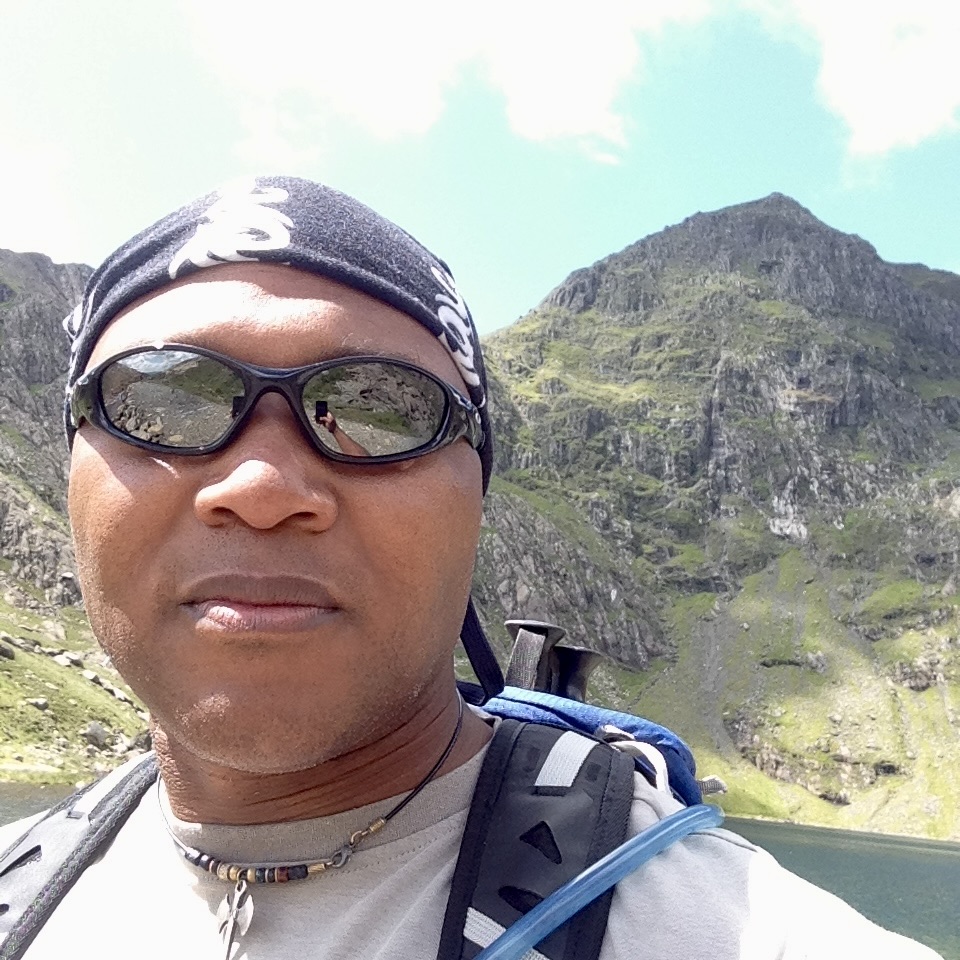
Up there, in the thin air of solitude, no one can misinterpret your insights. No one can water down your truths or try to fit them into their existing frameworks. No one can dismiss your hard-won wisdom as “woo” or “impractical” or “too much.” The mountain is pure. It’s safe. It’s where your inner work can unfold without the contamination of other people’s opinions, projections, or needs.
The mountain is where you get to be right without having to prove it.
This is seductive. This is why so many seekers never come down. They build increasingly sophisticated philosophical systems in the cave. They refine their practices until they’re flawless in execution. They journal and ritualize and transmute with ever-greater precision, mistaking depth for completion.
But here’s the secret the Hermit card reveals if you look closely enough: the old man isn’t sitting in his cave congratulating himself on his enlightenment. He’s standing at the mountain’s edge, holding a lantern, facing down.
Understanding the lessons of the Hermit can deepen your connection with the hermit tarot.
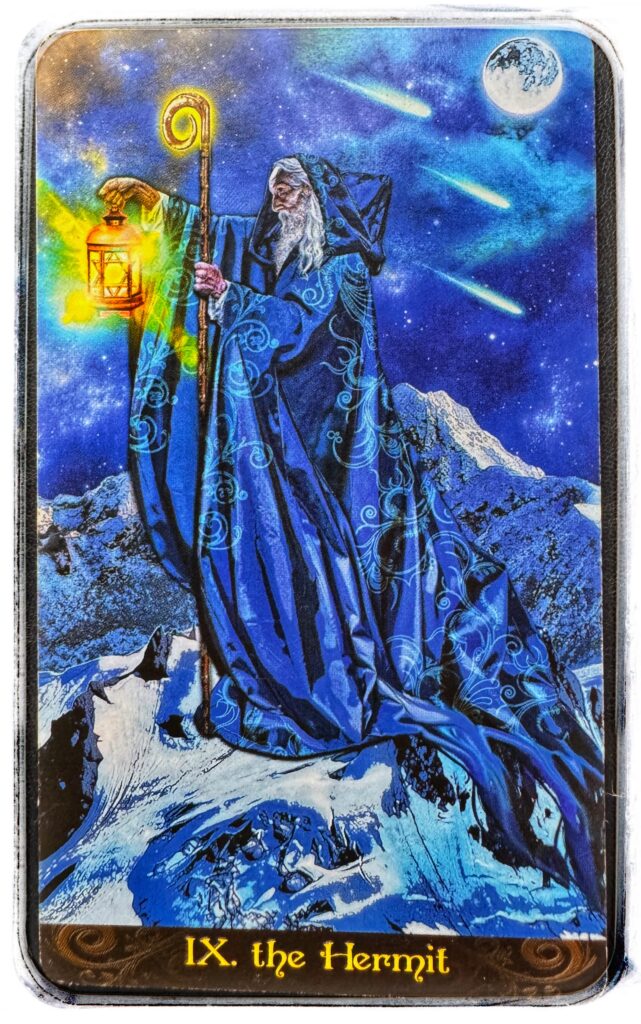
The entire iconography of the card is directional. His staff is planted for the descent. His lantern is raised not to illuminate his own face but to light the path for others. Even his posture suggests imminent movement—this is a moment caught between arrival and departure, between finding the light and sharing it.
The Hermit went up the mountain to discover something. The discovery was never meant to stay there.
Here’s what spiritual culture rarely tells you: the mountain is a crucible, not a destination. Solitude is preparation, not arrival. The insights you gain in isolation are only half-formed (beautiful, potent, true, but incomplete) until they meet the friction of the world. Until they’re tested in dialogue, challenged by other perspectives, and refined by the actual lived experience of trying to apply them in the mess of human relationships, work, and ordinary days.
Your mountaintop revelations are larvae. They need the resistance of the world to develop wings.
From Solitude to Service
There’s an uncomfortable teaching hiding in the Hermit’s lantern: your insights don’t fully belong to you until you give them away.
This isn’t a mystical platitude. It’s a practical epistemology. Try explaining something you think you understand to someone who doesn’t share your context. Watch how quickly the gaps in your thinking reveal themselves. Notice how the act of articulating your wisdom forces you to clarify it, to find better metaphors, and to excavate deeper layers you didn’t know were there.
Teaching completes learning. Not because you’re performing generosity, but because explaining is thinking at a higher resolution. When you try to light someone else’s path, you discover where your own lamp flickers, where your fuel runs thin, where you’ve been operating on assumption rather than understanding.
Visibility, then, isn’t vanity. It’s epistemological necessity. It’s how private insight becomes public knowledge. How personal transformation becomes collective possibility. How your specific experiment in consciousness becomes data in the larger field of human becoming.
This is the move from seeker to guide. Not because you’ve arrived (you haven’t), but because you’ve walked far enough to be useful to someone a few steps behind you. Not because you have all the answers (you don’t), but because you have some answers, and those answers might be exactly what someone else needs to hear right now.
The lantern isn’t for you anymore. It never really was.
What Descending the Mountain Actually Looks Like
Here’s what it doesn’t look like: a TED talk. A book deal. A viral post that makes you a spiritual influencer overnight. Those things might happen, and there’s nothing wrong with them if they do, but they’re not the point.
Descending the mountain usually looks embarrassingly ordinary.
It looks like showing up to the Monday morning team meeting with the presence you cultivated in meditation, instead of the reactivity you used to bring. It looks like having that difficult conversation with your partner using the self-awareness you’ve been developing in therapy, instead of the defensive patterns you used to deploy. It looks like writing the blog post, even though your subscriber list is seventeen people and three of them are your mom on different devices.
It looks like offering your gifts (your coaching, your art, your particular way of seeing) even when you’re not sure anyone wants them. Even when the market is crowded. Even when you feel like you’re shouting into the void.
It looks like being willing to be misunderstood and showing up anyway.
Because here’s the thing about lanterns: they don’t work if you keep them in your backpack. They don’t work if you only take them out when conditions are perfect. They work by burning where the darkness is, regardless of whether anyone sees them right away.
After twenty years of keeping my mystical side private (with only occasional leaks into public view through my poetry and scattered writings) I decided to fully embrace being a narrative alchemist and spiritual technologist. I launched the Narrative Alchemy Codex in full view, with no idea how it might land with my traditional personal development clients and supporters. No certainty that people who’d hired me for coaching would follow me into chaos magick and tarot. No guarantee that talking about “stories as spells” wouldn’t torch the professional credibility I’d spent decades building.
Just a conviction that the insights I’d been having in private needed to meet air.
The first few posts felt like shouting into a canyon. The next few felt like whispering to myself. Slowly (so slowly) people started finding the work. Not because I was special, but because I was specific. Because my particular frequency of light reached people vibrating at similar frequencies.
That’s how it works. You don’t descend the mountain by becoming universally appealing. You descend by being undeniably yourself and trusting that the people who need your particular medicine will find it.
Descending isn’t dramatic. It’s deliberate. It’s the daily choice to live your inner work in the outer world, to let your practice inform your presence, to stop waiting for permission and start being the thing you’ve been becoming.
Addressing the Resistance
Every seeker I’ve ever worked with hits the same walls on the descent. The ego has become very sophisticated at this point in the journey, it knows better than to use crude defenses like “this is stupid” or “I don’t care.” Instead, it wraps itself in spiritual language and whispers seemingly reasonable objections.
Let’s address them directly.
“Who am I to teach?”
You’re someone with a lantern. That’s the only qualification that matters. You’re not claiming to be an enlightened master. You’re not positioning yourself as the definitive authority. You’re simply saying: “I walked this path in the dark, and here’s what I learned. Maybe it’ll help you.”
Every person with any light at all is qualified to illuminate some path for someone. Your job isn’t to light every path for everyone. It’s to hold your lamp steady and see who shows up.
The question isn’t “Who am I to teach?” The question is “Who am I to withhold what I’ve learned?”
“My work isn’t ready.”
It never is. This is the perfectionism trap dressed in spiritual clothing. You’re waiting for some moment of complete understanding that will never arrive. Growth isn’t linear. Mastery isn’t final. You’ll be learning until you die.
The work doesn’t need to be perfect. It needs to be true. It needs to be generous. It needs to be now.
Share what you know, with the caveat that you’re still learning. Share your experiments, your failures, your questions alongside your insights. This isn’t a weakness; it’s the strongest teaching. It gives permission for others to be in-process too.
Perfect teaching creates admirers. Honest teaching creates practitioners.
“What if I’m wrong?”
You will be. Frequently. About many things. And that’s not a bug; it’s a feature.
Being wrong in public is how we collectively refine truth. Someone will challenge your thinking. You’ll adjust. They’ll learn from your adjustment. You’ll learn from their challenge. The field of knowledge advances through exactly this kind of friction.
The alternative is being right in private, which is functionally identical to being invisible. Your perfect understanding, locked in your journal, helps exactly no one.
And here’s the secret: when you’re willing to be wrong, you create permission for others to experiment too. You model something far more valuable than expertise; you model genuine inquiry. You show that wisdom isn’t about having all the answers; it’s about asking better questions and being willing to revise your maps when the territory reveals itself differently.
“But what about spiritual bypassing? What about premature teaching?”
Valid concerns. There’s a real phenomenon of people teaching what they haven’t integrated, performing enlightenment they haven’t embodied, selling solutions to problems they’re still drowning in.
But here’s how you know the difference: Are you teaching from the scar or the wound?
If you’re sharing what you’re currently struggling with as if you’ve solved it; that’s bypassing. If you’re sharing what you’ve moved through (even partially) with honesty about the ongoing work; that’s service.
If you’re using teaching to avoid your own healing, that’s bypassing. If you’re teaching because you’ve done your healing work and discovered something worth sharing, that’s descent.
If you’re building a guru persona to hide behind, that’s bypassing. If you’re showing up as a flawed human sharing your experiments, that’s embodied presence.
Trust yourself. You know the difference. Your body knows. That sick feeling in your stomach when you’re performing? That’s your signal. The groundedness you feel when you’re speaking from integrated truth? That’s your compass.
The Ego’s Final Trick
Here’s the most insidious form of resistance: using humility as camouflage for cowardice.
“I’m just going to keep learning, keep working on myself, stay humble, stay in student mode.” It sounds so spiritual. So evolved. So appropriately non-attached to outcomes.
And sometimes it’s absolutely true. Sometimes you genuinely need more time on the mountain. Sometimes the inner work isn’t done percolating.
But sometimes (often) it’s the ego’s final defense. Because if you never make yourself visible, you can never be criticized. If you never claim any authority, no one can challenge it. If you stay perpetually in student mode, you never have to risk the vulnerability of saying “Here’s what I’ve learned. Here’s what I think. Here’s what I’m offering.”
Humility is a virtue. Hiding is not.
Real humility says: “I don’t have all the answers, and I’m going to share the ones I do have.” False humility says: “I don’t have all the answers, therefore I’ll share nothing.”
One serves the world. One serves your fear.
You’ll know which one you’re operating from by the quality of energy it produces. Real humility feels spacious, grounded, generous. False humility feels contracted, safe, and secretly superior (because at least you’re not one of those “premature teachers” making a fool of themselves).
If you’ve done the inner work (if you’ve sat with Temperance and reconciled your contradictions) you know what you know. The Hermit stage isn’t about gaining permission. It’s about accepting responsibility. For the light you carry. For the path you can illuminate. For the people who won’t find their way if you keep your lantern hidden.
Practice (Expanded)
The Candle Meditation:
Light a single candle in a dark room. Sit before it in silence for at least ten minutes. Let your eyes soften until the flame becomes a blur of light. Notice how even this small flame pushes back the darkness. Notice how you can see by it without looking directly at it.
Now ask: Where am I being called to carry my light into the world?
Don’t force an answer. Let it emerge. It might come as a specific action (write that post, have that conversation, start that project). It might come as a feeling, a direction, a knowing. Whatever comes, write it down immediately after you blow out the candle.
The Three Ways Exercise:
Write down three ways you could bring your inner work into form this week, ranging from smallest to largest:
- Micro-visibility: Something small, low-risk, contained. (Share one insight in a conversation. Post one thought on social media. Email one person about something you’ve learned.)
- Medium-visibility: Something that requires a bit more courage. (Write a blog post. Offer a free session. Speak up in a meeting with your authentic perspective.)
- Macro-visibility: Something that genuinely scares you. (Launch that offering. Publish that piece. Have that conversation you’ve been avoiding.)
Now notice: Which one makes your stomach flip? Which one produces the most resistance?
Start there. Not because you’re trying to be brave, but because resistance is a compass. It points to the growth edge. It shows you where your light wants to go but your fear is blocking the way.
The Witness Walk:
Once this week, walk through your ordinary environment (your neighborhood, your workplace, the grocery store) and practice being “the Hermit among the people.” You’re not separate from the world, but you’re carrying your awareness through it. You’re the one with the lamp, even if no one can see it.
Notice what changes in how you move, how you speak, how you meet others’ eyes. Notice if your presence shifts. You’re not performing enlightenment. You’re simply practicing embodiment: being the person who’s done the inner work, now living it in the checkout line.
Write down what you notice. This is data. This is how you learn what it feels like to be visible in your truth.
The mountain was never the point. The cave was never the destination.
You climbed to find the light. You found it. Now the light has one job: to descend.
Not because you’re a guru. Not because you’re perfect. Not because you have it all figured out.
But because someone out there is still stumbling in the dark, and your lamp—imperfect, flickering, entirely human—might be exactly what they need to take their next step.
The world doesn’t need you to be enlightened.
It needs you to be lit.
And moving.



[…] […]