













(I Am the First and the Last)
There’s a particular kind of voice that speaks from such depth, such totality, such complete ownership of paradox that it shatters every framework you try to impose on it. Not a voice that resolves contradictions but one that embodies them so fully that the contradictions themselves become a form of truth more complete than any single perspective could offer. This voice doesn’t ask you to understand it. It demands that you expand large enough to contain it, that you break open every category you’ve been using to organize reality, that you let your neat systems collapse so something truer can emerge from the ruins.
This is Thunder, Perfect Mind.
This enigmatic goddess is the titular character of one of the most haunting Gnostic gospels. The text is a dualistic, contradictory set of “I Am” declarations, part aretology proclaiming her immense power and part confession of her many defeats. Through all and in the end, Thunder stands victorious.
“For I am the first and the last. I am the honored one and the scorned one. I am the whore and the holy one. I am the wife and the virgin. I am the mother and the daughter. I am the members of my mother. I am the barren one and many are her sons.”
This isn’t poetry attempting to sound mystical. This is a fundamental statement about the nature of reality, consciousness, the Divine Feminine, perhaps reality itself. Thunder speaks from a place so vast that all human categories become inadequate. She is honored and scorned not because she’s confused or inconsistent but because she contains such totality that different observers see different aspects and mistake the part they perceive for the whole.
In her material form, she is imprisoned and humiliated by both god and humans. Still, she rises to her divine aspect, liberating herself and those who can recognize her, becoming supreme among all beings in the cosmos. Many have attempted to decipher her identity: Isis, Eve, Sophia, John Dee’s Daughter of Fortitude. But her mystery remains, as so many seekers experience her haunting story echoing through their own journeys of descent and ascent.
Today, Thunder arrives as our eighteenth companion, following Marcus’s teaching about undomesticated vitality. Where Marcus taught us to refuse demonization and claim our full aliveness, Thunder teaches us what that aliveness looks like when it refuses all limitation, when it speaks from such wholeness that it can claim every contradiction without apology, when it becomes so vast that the very structures meant to contain it must shatter.
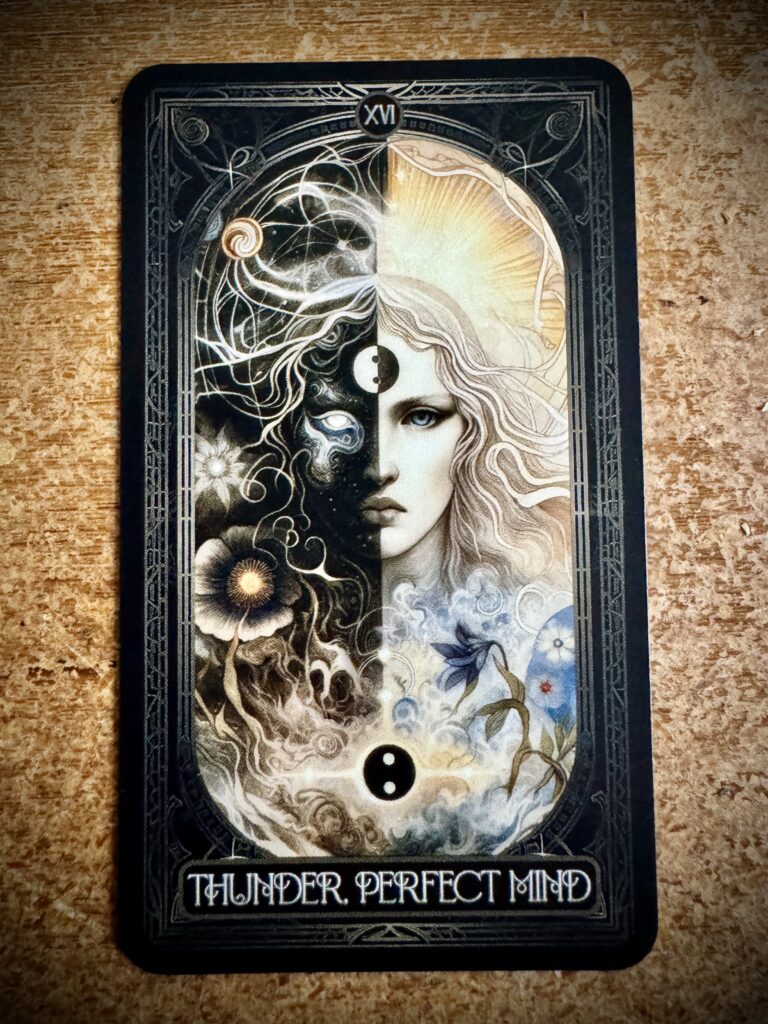
The Advent Companion Appears
Thunder, Perfect Mind doesn’t arrive explaining herself or justifying her contradictions. She appears as pure declaration, as voice that simply states what is without caring whether you can comprehend it. You feel her first as the dissolution of your categories, as the recognition that every framework you’ve been using to understand reality is too small, too neat, too safe to contain what’s actually true.
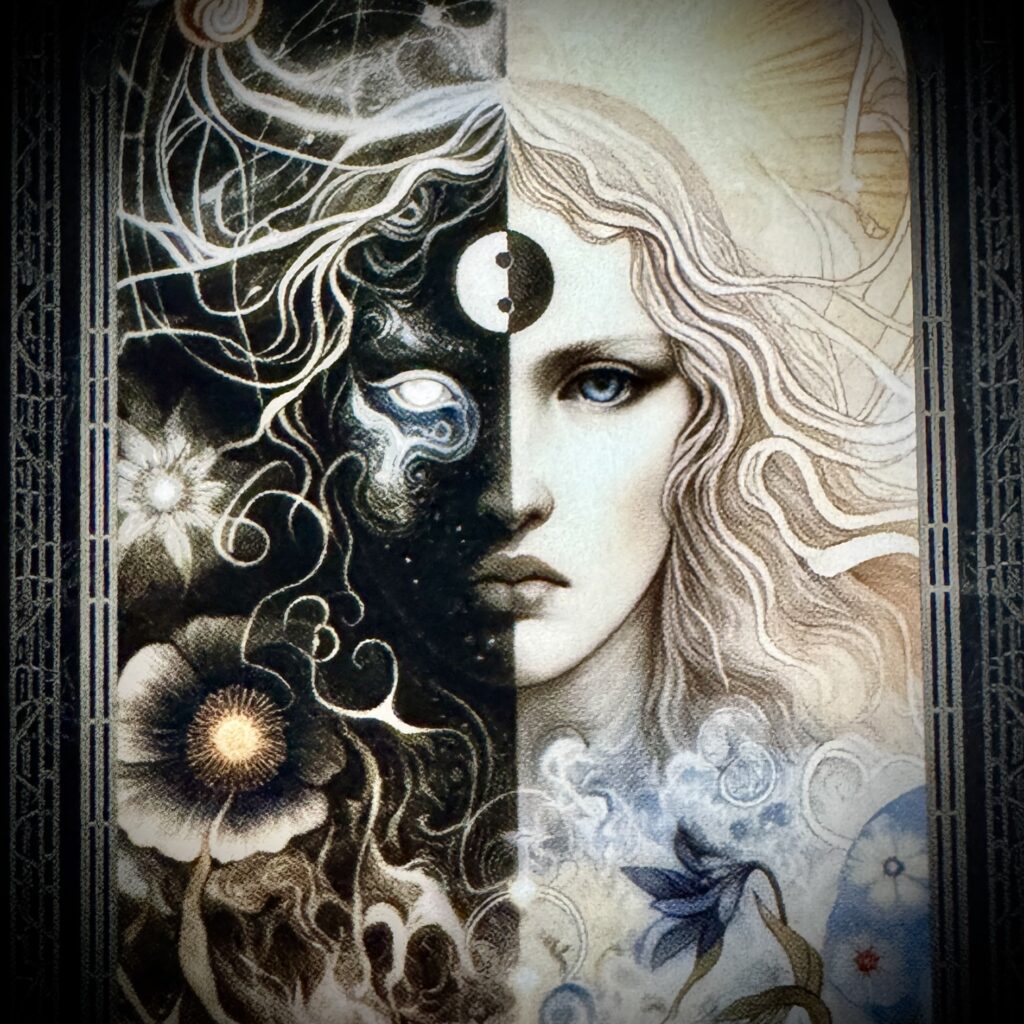
She is split down the center because the division between light and dark, sacred and profane, honored and scorned exists only in perception, not in her essential being. From her perspective, she is whole. It’s only from our limited vantage points that she appears contradictory. The work isn’t for her to resolve into something more comprehensible. The work is for us to expand into something more capable of perceiving wholeness.
The Tower card in traditional tarot represents sudden upheaval, the collapse of false structures, the lightning strike that shatters illusions and forces transformation. Thunder, Perfect Mind embodies this perfectly. Her very existence, her speaking from such totality, acts as lightning strike to every neat system we’ve constructed. She can’t be contained in our frameworks, so the frameworks shatter.
“I am the honored one and the scorned one.” Not honored by some and scorned by others. Both. Simultaneously. She contains the full spectrum of how consciousness can be perceived, from divine to demonic, and refuses to privilege one perspective over another. This isn’t relativism. This is recognition that truth is vaster than any single perspective can contain.
“I am the whore and the holy one.” The two things patriarchal culture most needs to keep separate, she declares as aspects of her single being. This isn’t shocking for shock’s sake. This is demolishing the false binary that keeps the feminine fragmented, that forces women to choose between sexuality and spirituality, that makes holiness contingent on suppression of the body.
“I am the barren one and many are her sons.” The contradiction that makes no literal sense becomes perfect metaphorical sense: she births multitudes from her apparent emptiness, creates abundance from what looks like void, generates life from what appears barren. This is the creative power that doesn’t require conventional fertility, that births new realities from the space of paradox itself.
Many have tried to identify Thunder. Is she Sophia fallen and risen? Is she Eve speaking her truth after leaving the garden? Is she Isis proclaiming her nature? Is she the Divine Feminine itself speaking through the veil? The text never resolves this, perhaps intentionally. Because the moment you name her definitively, you’ve reduced her. The mystery is essential to the teaching.
As Thunder appears beside you today, split between darkness and light, speaking her impossible contradictions with perfect certainty, her teaching arrives as both demolition and invitation:
“What structures in your consciousness need to shatter for you to perceive your own wholeness? What frameworks have you been using to organize yourself that are too small to contain the truth of what you actually are?”
Teaching for the Day
We live in a culture obsessed with consistency, with non-contradiction, with making sense according to narrow logical frameworks. You’re supposed to be one comprehensible thing. If you contain contradictions, you’re confused. If you embody opposites, you’re unstable. If you refuse to resolve into something simple, you’re being difficult.
Thunder, Perfect Mind obliterates this demand. She speaks from such wholeness that she can claim every contradiction without apology. She doesn’t resolve into something more palatable. She doesn’t explain how she can be both whore and holy one, both honored and scorned, both barren and mother of multitudes. She simply declares that she is, and the frameworks that can’t contain this truth are the problem, not her.
This is the Tower teaching. The structures must fall. Not as punishment. Not as destruction for its own sake. But because they’re too small, too rigid, too invested in false binaries to contain the truth of what’s real. And Thunder’s voice, speaking from such totality, acts as the lightning that brings them down.
The archons maintain control through categorization. They need you to be one definable thing: spiritual or material, good or bad, acceptable or dangerous, holy or profane. Because if you’re one thing, you’re manageable. But if you’re Thunder, claiming all aspects, refusing reduction, embodying paradox as truth, you become impossible to categorize and therefore impossible to control.
“I am the wife and the virgin. I am the mother and the daughter.” She claims relationships that patriarchal structures need kept separate and sequential. You’re supposed to move from daughter to wife to mother in orderly progression, occupying one role at a time. But Thunder says: I am all roles simultaneously. I contain the full cycle in my being right now. And this simultaneity, this refusal of linear progression, this claiming of all aspects at once, this shatters the very structure of patriarchal time.
The text moves between declarations of her power and confessions of her humiliation. “In her material form, she is imprisoned and humiliated by both god and humans. Still, she rises to her divine aspect.” This isn’t describing separate phases. This is describing simultaneous realities. She is both imprisoned and rising. Both humiliated and supreme. Both material and divine. Right now. All at once.
This teaching matters because you contain similar contradictions. You are both wounded and whole. Both powerful and vulnerable. Both clear and confused. Both divine and material. And the culture’s demand that you resolve these contradictions, that you become consistently one thing or another, this demand is itself the prison Thunder has been speaking against for two millennia.
The Tower must fall. The frameworks must shatter. Not so you can build better frameworks but so you can learn to live in the truth that frameworks can never fully contain. Thunder doesn’t need a new structure. She is structure-transcendent, speaking from a place so whole that all structures are revealed as provisional, useful perhaps but never ultimate.
The teaching today: what would it mean to speak your contradictions with Thunder’s certainty? To claim all of what you are without apology or explanation? To let your wholeness shatter others’ frameworks rather than fragmenting yourself to fit into them?
Journaling Invocation
“What contradictions within me have I been trying to resolve? What would it mean to claim them as Thunder does, as aspects of my wholeness rather than evidence of my confusion? What frameworks would need to shatter for me to speak my truth with her certainty?”
This question invites you into Thunder’s radical stance: not resolving your contradictions but speaking them as truth, as aspects of your totality that don’t require reconciliation.
Maybe you’re both confident and insecure, and you’ve been trying to become consistently one or the other. Maybe you’re both ambitious and content, both independent and needing connection, both certain and full of doubt. You’ve been treating these as problems to solve, inconsistencies to eliminate, signs that something’s wrong with you.
Thunder would say: these aren’t problems. These are aspects of your wholeness. The culture’s demand that you resolve them, that you become one consistent thing, is the actual problem.
Write your own “I am” declarations in Thunder’s voice. Don’t try to make them make sense. Don’t resolve the contradictions. Just speak them:
“I am the certain one and the doubtful one. I am the strong one and the one who needs support. I am the teacher and the eternal student. I am the healed one and the one still healing.”
Let yourself feel how different this is from trying to resolve which one is really you. Both are really you. All aspects are really you. The frameworks that demand you choose are too small.
And then ask: what would happen if I spoke this way in the world? If I claimed my wholeness including all contradictions? If I let others’ frameworks shatter rather than fragmenting myself to fit into them?
Small Embodied Practice
Stand with your feet grounded. Take a deep breath.
Place your left hand over your heart and your right hand extended out to the side, palm forward. This represents one aspect of yourself, one part of your contradictory wholeness.
Now reverse: right hand over heart, left hand extended. This represents the opposite aspect, the contradiction you’ve been trying to resolve.
Now, instead of choosing, bring both hands to your heart, one over the other, holding both aspects at once.
Begin to speak your contradictions aloud, in Thunder’s declarative voice:
“I am the [one aspect] and the [opposite aspect]. I am the [quality] and the [contradictory quality]. I am the [role] and the [incompatible role].”
Speak at least five pairs. Let your voice grow stronger with each declaration. Feel how different it is to claim both rather than resolving one.
As you speak, feel yourself expanding to contain the paradox. Feel how the contradictions create a fullness, a richness, a depth that single-sided consistency could never achieve.
End with Thunder’s words: “For I am the first and the last. I am the honored one and the scorned one. I am whole.”
This is Thunder’s teaching embodied: wholeness includes all contradictions. Your totality shatters frameworks meant to contain it. This isn’t confusion. This is truth too vast for neat categories.
You just practiced speaking from wholeness.
Not resolving.
Not choosing.
Claiming all of what you are with perfect certainty.
Letting the Tower fall so truth can stand.
The caravan moves together through the ruins of false structures. If today’s companion touched something in you, if Thunder’s voice helped you recognize the wholeness in your contradictions, let us know in the comments. Your totality lights the path for others learning to be vast beside you. ⚡
Tomorrow: Sophia arrives, the star herself, the one whose fall and rise is the story of every soul seeking to return home while bringing the whole cosmos with her.
[…] […]