












(The One Who Made the Wine Bubble)
There’s a particular kind of power that makes authorities nervous not because it threatens violence but because it refuses domestication. Not the power that seeks permission or apologizes for existing, but the power that simply is what it is, unapologetically, wildly, creatively alive in ways that can’t be controlled or predicted or made to serve someone else’s agenda. This is the vitality that gets labeled demonic by those who fear it, called dangerous by those who can’t contain it, named devil by those who need everyone playing by rules this force never agreed to follow.
This is Marcus the Magician’s gift.
Marcus arrived from Egypt armed with arcane gematria, magic, and alchemy, disrupting the early Christian Church in late 2nd century France. Women left their churches and joined his Gnostic coven, egalitarian in nature, with roles changing every ceremony to allow everyone different experiences and responsibilities. He was accused of working for Azazel or Satan, but Marcus’s ceremonies entailed ecstatic experiences of communing with Sophia. To reach this point, numerology and entheogens were utilized. The wine was bubbling. Glowing letters appeared in the air.
The Gospel of Judas contains a line that captures Marcus’s energy perfectly: “Already your horn has been raised, and your wrath is full, and your star passes by, and your heart is determined.”
This is the undomesticated heart. The determined will. The star that passes by on its own trajectory, refusing to orbit according to someone else’s astronomy. The horn raised not in aggression but in announcement: I am here. I am alive. I am not asking permission.
Today, Marcus arrives as our seventeenth companion, following Carpocrates’ teaching about integration and temperance. Where Carpocrates taught us the skilled mixing of opposites, Marcus teaches us what happens when that integration creates such vitality, such creative force, such undeniable aliveness that the world doesn’t know what to do with you except call you dangerous and hope the label makes you smaller.
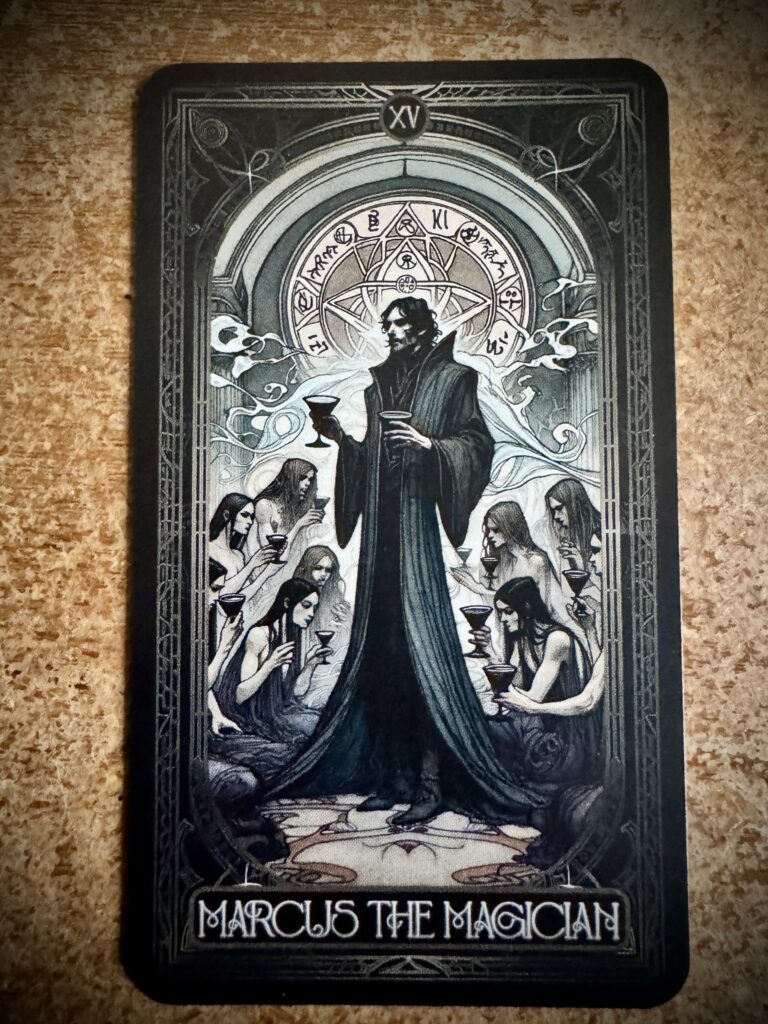
The Advent Companion Appears
Marcus the Magician doesn’t arrive apologizing or explaining. He appears as unrepentant vitality, as creative force that refuses to be channeled into approved forms, as the energy that makes wine bubble and letters glow and women leave their comfortable churches to experience something more real, more alive, more genuinely transformative than what orthodoxy offered.
He stands surrounded by women because his ceremonies honored them as equals, gave them roles orthodox Christianity denied them, created spaces where their spiritual power could be acknowledged and expressed. This wasn’t progressive politics. This was recognition of reality: that wisdom speaks through all bodies, that divine power doesn’t respect patriarchal hierarchies, that any system claiming to channel the sacred while excluding half of humanity is lying about something fundamental.
The chalice he holds contains more than wine. It contains the mystery of transformation, the ecstatic experience that changes consciousness, the direct encounter with Sophia that doesn’t require priestly mediation. Orthodox Christianity hated this because it threatened their monopoly on spiritual authority. If people could commune with the Divine directly through Marcus’s ceremonies, what did they need bishops for?
So they called him devil. Called his magic demonic. Called the women who followed him deluded or seduced. Because when you can’t control something, when you can’t domesticate it or channel it or make it serve your agenda, the easiest move is to demonize it. To make people afraid of the very vitality that might liberate them.
The Devil card in traditional tarot often represents bondage, materialism, being chained to lower impulses. But Marcus as Devil represents something almost opposite: the refusal to be chained, the insistence on direct experience over mediated doctrine, the wild vitality that orthodoxy needs to suppress to maintain control.
In some Gnostic texts, the figure labeled devil or demon by orthodoxy is actually a liberator, a force that disrupts the archontic control system, a power that refuses the Demiurge’s claim to ultimate authority. This isn’t evil. This is rebellion against false authority. This is the creative force that won’t be domesticated into serving someone else’s program.
Marcus’s ceremonies used entheogens, altered states, ecstatic practice. The wine bubbled not through chemical reaction but through what participants experienced as divine presence. Letters glowed in the air, not as hallucination but as visual manifestation of the living wisdom being transmitted. These weren’t tricks. They were technologies of consciousness, methods for accessing states of awareness that revealed truths orthodoxy wanted hidden.
As Marcus appears beside you today, holding his mysteries, surrounded by those who chose his wild ceremonies over safe doctrine, his teaching arrives as both warning and permission:
“When they call you demon for being fully alive, when they label you devil for refusing to be domesticated, when they demonize your vitality because they can’t control it, respond with humor and ease. Embrace whatever Life brings your way and remain grounded in your footing. Don’t allow others to weigh you down with their need to make you smaller.”
Teaching for the Day
We live in a world that fears vitality. Not the managed, productive, channeled-into-acceptable-forms kind of vitality. The wild, creative, unpredictable, ungovernable kind. The kind that makes wine bubble and women leave their churches and authorities nervous because they can’t predict or control where this energy will go or what it will do.
This fear expresses itself through demonization. When someone shows up with undomesticated power, with creative force that won’t serve institutional agendas, with spiritual authority that doesn’t derive from approved credentials, the response is predictable: call them dangerous. Label them devil. Make people afraid of the very thing that might liberate them.
Marcus the Magician demonstrates what happens when you refuse this demonization, when you meet accusations of being demonic with humor and ease, when you simply continue being fully alive regardless of what labels others try to attach to you. He didn’t defend himself against charges of working for Satan. He kept conducting his ceremonies, kept creating spaces for direct experience of the Divine, kept honoring women’s spiritual power even though this infuriated orthodox authorities.
The Gospel of Judas line is telling: “Already your horn has been raised, and your wrath is full, and your star passes by, and your heart is determined.” This is the quality of someone who has stopped asking permission, stopped apologizing for their power, stopped trying to make themselves acceptable to authorities who will never accept them anyway.
The archons maintain control through managed spirituality. They want your religious experience mediated through approved channels, your spiritual authority derived from institutional credentials, your vitality domesticated into forms that serve their agenda. Marcus disrupts this completely by demonstrating that direct experience is possible, that divine communion doesn’t require priestly intermediaries, that your own vitality is itself a form of spiritual authority.
This is why the Devil card in Marcus’s hands becomes liberation rather than bondage. The traditional interpretation suggests being chained to material desires or lower impulses. But what if what you’re actually chained to is the need for approval, the fear of being labeled demonic, the domestication of your vitality to fit acceptable forms?
Marcus’s teaching is both permission and warning. Permission: you’re allowed to be fully alive, wildly creative, ungovernable in your spiritual seeking. Warning: when you claim this freedom, authorities will try to demonize you. They’ll call you dangerous. They’ll suggest you’re working for dark forces. They’ll attempt to make others afraid of you.
His response? Humor and ease. Not defensiveness. Not apologetics. Just continued vitality, continued creativity, continued refusal to be made smaller by others’ fear of your power.
The wine bubbling, the letters glowing, these weren’t circus tricks. They were what happens when consciousness shifts, when direct experience of the Divine breaks through, when the veil between ordinary and sacred reality becomes permeable. Marcus created conditions for these experiences through ritual, through entheogens, through practices that opened perception to dimensions normally filtered out by consensus reality.
Orthodox Christianity called this demonic because it threatened their monopoly on spiritual authority. But Marcus knew something they didn’t: the Divine speaks directly when you create the right conditions, and no institutional authority can prevent or control this direct communion.
The teaching today: what vitality in you has been labeled dangerous? What creative force have you domesticated to make others comfortable? What part of your power have you suppressed because you were afraid of being called demon, devil, dangerous?
And what would happen if you reclaimed that energy with humor and ease, if you allowed yourself to be fully alive regardless of what labels others try to attach to you?
Journaling Invocation

“What parts of your vitality have you suppressed to avoid being labeled dangerous? What creative force are you domesticating to make others comfortable? What would it mean to respond to demonization with humor and ease rather than defensiveness or retreat?”
This question asks you to look at where you’ve made yourself smaller, dimmed your light, suppressed your creative force not because it was actually harmful but because others were uncomfortable with your power.
Maybe you have spiritual experiences or insights that don’t fit orthodox frameworks and you’ve learned to keep them private to avoid judgment. Maybe you have creative impulses that feel too wild, too uncontrolled, too ungovernable and you’ve learned to channel them into acceptable forms. Maybe you have a quality of aliveness that makes some people uncomfortable and you’ve learned to tone it down.
Marcus would ask: who benefits from your domestication? Not you. The authorities who need you manageable, predictable, controllable. The systems that require your vitality be channeled into forms that serve their agenda.
Write about what you’ve suppressed. What power you’ve hidden. What vitality you’ve dimmed. Don’t immediately try to reclaim it. Just acknowledge it. See it. Feel what it cost you to make yourself smaller.
And then ask: what if being called dangerous is actually a sign you’re on the right track? What if the demonization is evidence that you’ve accessed something real, something powerful, something the control systems can’t manage?
Marcus didn’t become less magical to make bishops comfortable. He didn’t tone down his ceremonies to avoid accusations. He kept making the wine bubble. Kept creating spaces where women could claim spiritual authority. Kept demonstrating that direct experience of the Divine is possible and doesn’t require anyone’s permission.
What becomes possible when you reclaim your full vitality with humor and ease, when you meet demonization with the recognition that being called devil often means you’re doing exactly what you should be doing?
Small Embodied Practice
Stand with your feet planted firmly. Take a deep breath and let yourself feel the full extent of your aliveness right now. Not the managed, acceptable version. The full, wild, ungovernable version.
Raise one hand above your head, palm facing up, as if you’re holding something invisible. This is your horn being raised. Your power being claimed. Your vitality being announced without apology.
Now begin to sway, to move, to let energy flow through your body in whatever way wants to move. Don’t control it. Don’t make it pretty or acceptable or spiritual-looking. Just let it be what it is.
As you move, say internally or aloud: “My star passes by. My heart is determined. I am not asking permission to be fully alive.”
Let yourself move for several minutes, letting the energy build, letting your body remember what it feels like to be undomesticated, ungovernable, wildly alive.
If self-consciousness arises, if you hear voices telling you this is silly or dangerous or inappropriate, notice them. These are the internalized authorities trying to domesticate you. Marcus’s response? Humor and ease. Acknowledge the voices and keep moving anyway.
When you’re ready to stop, stand still again. Lower your arm. Take a deep breath. Feel how different your body feels after allowing even a few minutes of unmanaged vitality.
This is Marcus’s teaching embodied: your full aliveness is not demonic. The suppression of your full aliveness is what’s actually dangerous.
You just practiced reclaiming the power that authorities need to label devil because they can’t control it.
Not apologizing.
Not defending.
Simply being fully, wildly, unapologetically alive.
The caravan moves together through untamed territory. If today’s companion touched something in you, if Marcus’s unrepentant vitality helped you recognize what power you’ve been suppressing, let us know in the comments. Your wildness lights the path for others learning to be ungovernable beside you. 🍷
Tomorrow: Thunder, Perfect Mind arrives, the enigmatic goddess who is first and last, honored and scorned, speaking her paradoxical truth that has echoed through millennia.
[…] […]