













(The Alchemist of Opposites)
There’s a particular kind of wisdom that emerges not from choosing sides but from learning to work with all sides simultaneously. Not the false balance of compromise where everyone loses a little, but the alchemical integration where opposing forces become fuel for transformation. This requires a particular steadiness, a capacity to hold fire and water in the same vessel without letting either extinguish or evaporate the other. This is the work of temperance in its truest sense: not moderation as bland mediocrity, but the skilled mixing of extremes to create something more potent than either element alone.
This is Carpocrates’ mastery.
Carpocrates was a deep thinker from Alexandria, negotiating a sensible path between the body and the spirit, heaven and earth. His teachings were noble Hellenistic individualism paired with Christian communism, yet his teachings are said to include sexual rituals. Some speculate he taught redemption through sin theology, advocating that only through many lives lived does one become tired of worldly karma.
For Carpocrates, Jesus was such a man: someone who remembered all his lives and balanced them into a controlled, integrated existence. Not someone who avoided experience but someone who exhausted it so completely that he mastered it. Not transcendence through rejection but transformation through integration.
The Gospel of Thomas contains what might be Carpocrates’ essential teaching: “When you make the two into one, and when you make the inner like the outer and the outer like the inner, and the upper like the lower, and when you make male and female into a single one, so that the male will not be male nor the female be female, when you make eyes in place of an eye, a hand in place of a hand, a foot in place of a foot, an image in place of an image, then you will enter the kingdom.”
This isn’t metaphor. This is instruction. The kingdom isn’t accessed by choosing spirit over matter, masculine over feminine, inner over outer. It’s accessed by making them one, by discovering the place where all opposites meet and merge and create something that transcends the binary altogether.
Today, Carpocrates arrives as our sixteenth companion, following Achamoth’s teaching about death and transformation. Where Achamoth taught us about letting things die completely, Carpocrates teaches us about what we do with all the elements that remain after death: how we recombine them, how we integrate opposing forces, how we create something new not by eliminating contradictions but by bringing them into such perfect tension that they generate entirely new possibilities.
The Advent Companion Appears
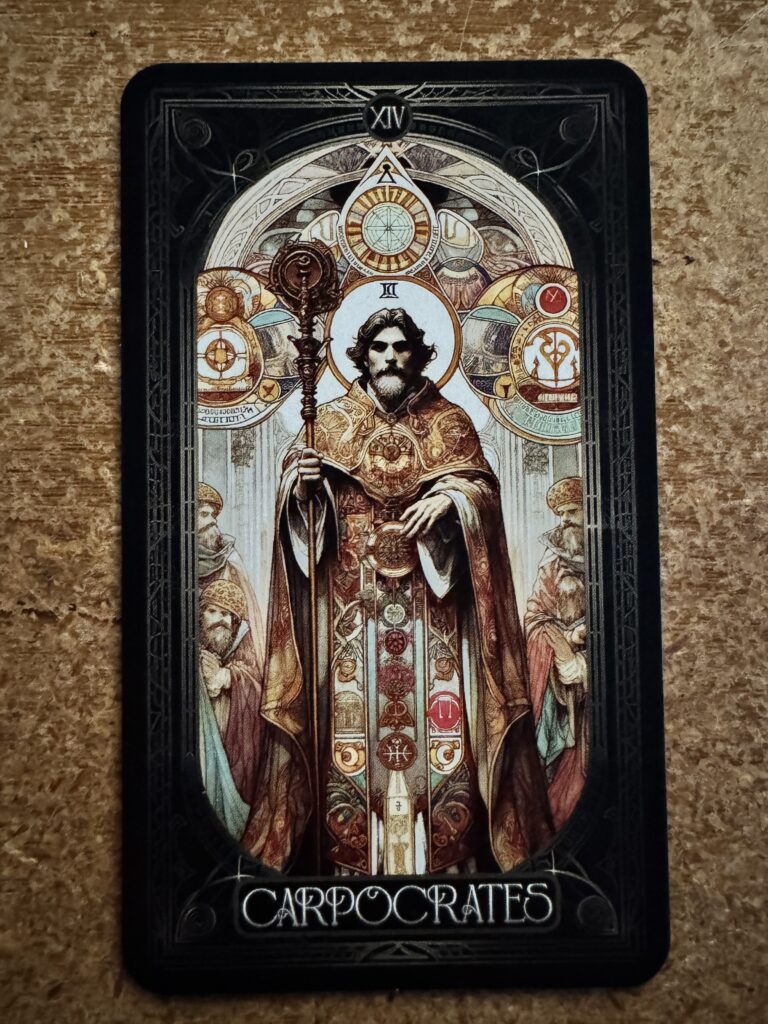
Carpocrates doesn’t appear as a mystic or ascetic. He appears as a practical philosopher, a skilled alchemist, someone who understands that wisdom lives in the mixing, in the combining, in the careful work of bringing opposites into productive relationship. You feel him first as steadiness, as the quality of someone who can hold multiple truths simultaneously without collapsing into confusion or forcing premature resolution.
He stands adorned in symbols because symbols are his language, the visual grammar of transformation. Each image on his robes represents a different polarity, a different pair of opposites that must be integrated: sun and moon, gold and silver, sulfur and mercury, conscious and unconscious, active and receptive. These aren’t just decorative. They’re a map of the inner work, a reminder that every external symbol corresponds to an internal reality that needs balancing.
The staff he holds isn’t for domination or control. It’s the philosopher’s rod, the tool for stirring the alchemical mixture, for keeping the elements in motion so they don’t settle into separation again. Because integration isn’t something you achieve once. It’s something you maintain through constant, skillful attention.
Carpocrates’ teachings were controversial because he refused easy answers. He taught that you couldn’t reach spiritual maturity by avoiding material experience. You had to engage it, exhaust it, learn from it so completely that you became master of it rather than its slave. This wasn’t hedonism. It was systematic experimentation, a commitment to understanding all aspects of human experience from the inside.
Some accused him of teaching “redemption through sin,” but this misunderstands his philosophy. He taught redemption through experience, through living so many lives, exploring so many possibilities, integrating so many opposites that you eventually exhaust the karma of fragmentation and discover the wholeness that was always available beneath it.
His community in Alexandria practiced radical equality, rotating roles in ceremonies so everyone experienced all aspects of ritual life. One day you’re the priest, the next you’re the congregation. One day you’re leading, the next you’re following. This isn’t relativism. It’s systematic training in holding multiple perspectives, in understanding that truth looks different from different positions and wholeness requires integrating all of them.
As Carpocrates appears beside you today, surrounded by his alchemical symbols, his teaching arrives as both challenge and invitation:
“What if your opposites aren’t problems to solve but elements to combine? What if the tension between your contradictions is actually the generative force that could transform you into something more whole?”
Teaching for the Day
We live in a culture that loves binaries and hates both sides. You’re supposed to choose: spiritual or material, masculine or feminine, rational or intuitive, disciplined or spontaneous, serious or playful. Pick a side, commit to it, reject the other. This creates internal warfare, exhausts your energy fighting yourself, and guarantees you’ll remain fragmented.
Carpocrates teaches something more sophisticated: the goal isn’t to choose between opposites but to discover the place where they unite. Not compromise (where both are diminished) but integration (where both are transformed into something new). This is the alchemical work, the temperance that isn’t about moderation but about skillful combination.
“When you make the two into one…” This is the beginning of every spiritual transformation. The recognition that the battle between your opposites isn’t serving you, that choosing one side over the other just creates a different form of fragmentation, that wholeness requires bringing all of what you are into dynamic relationship.
The archons love binary thinking because it keeps you split. Spiritual or material? They win either way. If you choose spiritual and reject material, you’re ineffective in the world. If you choose material and reject spiritual, you’re easy to control through material incentives. But if you integrate both? If you become spiritually grounded while materially effective? Then you’re dangerous to their system.
This is why Carpocrates’ teachings were so threatening. He wasn’t telling people to transcend the world. He was teaching them to master it through integration. To become so whole that they could navigate material reality with spiritual wisdom, to be in the world but not controlled by it, to use physical experience as fuel for consciousness rather than treating it as obstacle to overcome.
His teaching about Jesus is instructive: Jesus wasn’t great because he avoided experience. He was great because he had exhausted experience through so many lives that he remembered them all, integrated them all, balanced them all into mastery. This suggests that spiritual development isn’t about escaping the cycle of experience but about engaging it so completely that you eventually master it.
This doesn’t mean indulging every impulse or pursuing every experience. It means approaching life as laboratory, as alchemical vessel, as the place where transformation happens through skillful combination of elements rather than rejection of half of them.
The traditional Temperance card shows an angel mixing water between two cups, suggesting the careful blending of opposites. But Carpocrates as Temperance offers something more: he shows that this mixing isn’t just about balance but about transformation, about creating something genuinely new through the tension between opposites.
When you make male and female into a single one… This isn’t about erasing gender or difference. It’s about discovering the place within yourself where all polarities meet, where masculine and feminine energies work together rather than competing, where the tension between them generates creative power rather than draining it through conflict.
The teaching today is both practical and profound: look at the opposites within you. The parts that seem to contradict each other. The qualities that create internal tension. Don’t try to resolve them by choosing one over the other. Instead, bring them into relationship. Let them inform each other. Discover what becomes possible when they work together rather than fighting for dominance.
Journaling Invocation
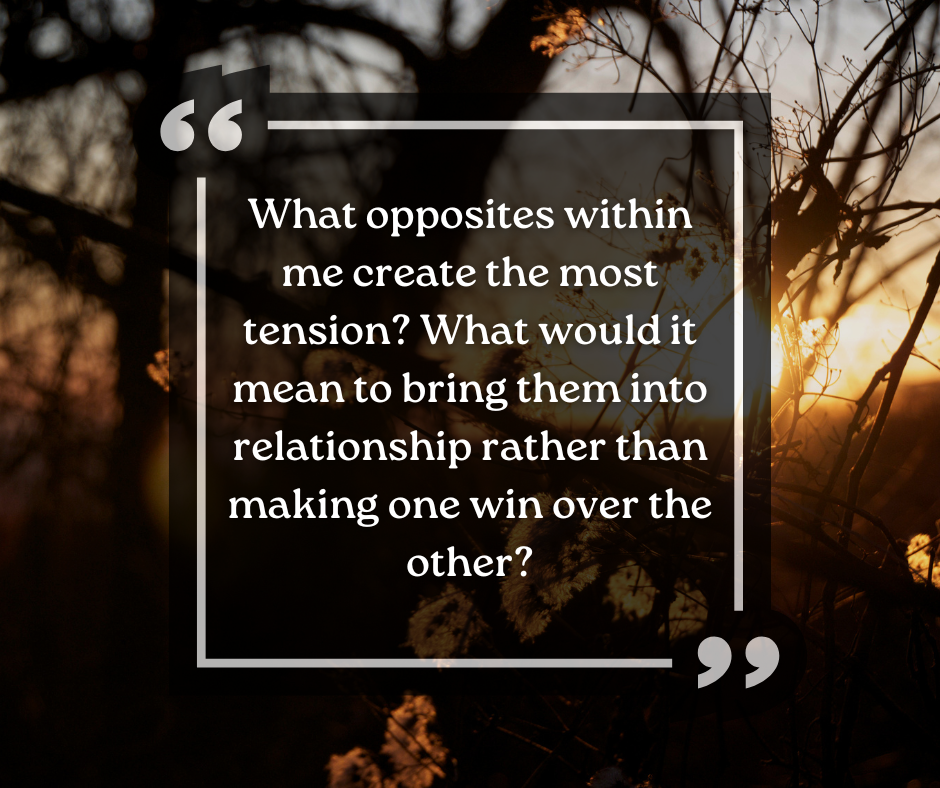
“What opposites within me create the most tension? What would it mean to bring them into relationship rather than making one win over the other? What might I become if I integrated them instead of fragmenting myself by choosing sides?”
This question invites you into the alchemical work that Carpocrates mastered. Not the easy work of choosing sides but the more challenging work of holding opposites in productive tension until something new emerges.
Maybe you experience tension between your need for structure and your desire for spontaneity. Between your rational mind and your intuitive knowing. Between your drive for achievement and your need for rest. Between your serious, responsible self and your playful, creative self.
The usual approach is to decide which one is “really you” and try to suppress or fix the other. But what if both are really you? What if the tension between them is actually the source of your creative power, your unique contribution, your particular genius?
Write about the opposites you experience most acutely. Don’t rush to resolve them. Just describe them, acknowledge them, feel how they pull you in different directions.
And then ask: what if these opposites are actually trying to create something together? What if the tension between them is generative rather than destructive? What becomes possible when I stop trying to eliminate one side and start exploring how they might work together?
Carpocrates would say: the kingdom isn’t accessed by becoming one-sided. It’s accessed by becoming so integrated that all your sides work together in service of your wholeness.
Small Embodied Practice
Stand with your feet hip-width apart, arms at your sides.
Extend your left arm out to the side, palm up. This represents one pole of an opposite within you. Maybe it’s your receptive side, your intuitive knowing, your feminine energy, your need for rest.
Now extend your right arm out to the side, palm up. This represents the other pole. Maybe it’s your active side, your rational mind, your masculine energy, your drive to create.
Feel the stretch in your chest as you hold both arms extended. This is the tension of holding opposites. It creates space, opens the heart, requires strength.
Now, slowly, begin to bring your hands toward each other in front of your chest. As they come together, imagine the energies they represent meeting, mixing, beginning to work together rather than pulling in opposite directions.
When your palms meet in front of your heart, press them together firmly. Feel the warmth where they touch. Feel how both energies are still present but now in relationship, in conversation, in cooperation.
Say internally: “I make the two into one. I integrate my opposites. I discover wholeness through their union.”
Hold this position for several breaths, feeling both sides of yourself meeting in your center, in your heart, in the alchemical vessel of your body.
When ready, slowly separate your hands and lower your arms. But keep the feeling of integration, of both sides working together rather than fighting for dominance.
This is Carpocrates’ teaching embodied: temperance isn’t about moderating yourself into blandness. It’s about bringing all of what you are into such skillful relationship that transformation becomes inevitable.
You just practiced the alchemy of integration.
Not choosing sides.
Not eliminating opposites.
Bringing them into union that creates something more whole than either could be alone.
The caravan moves together through integration. If today’s companion touched something in you, if Carpocrates’ alchemical wisdom helped you see your opposites as creative fuel rather than internal warfare, let us know in the comments. Your integration lights the path for others learning to hold their contradictions with skill beside you. ⚗️
Tomorrow: Marcus the Magician arrives with his understanding of creative force, of humor in the face of those who would make you a demon, of the wild vitality that refuses domestication.
[…] […]