
(The End of Prophecy)
There’s a particular quality that belongs to thresholds, to the liminal moments when one era is ending and another hasn’t quite begun. When the old certainties are dissolving but the new reality hasn’t fully crystallized. When you’re suspended between what was and what will be, unable to move backward, not yet able to move forward. This is the space of the hanged man, the prophet at the end of prophecy, the voice crying in the wilderness that the wilderness is about to change.
This is John the Baptist’s territory.
In Gnostic texts and Christian lore, John the Baptist occupies a unique position. From Adam to John the Baptist, the Gospel of Thomas tells us, “among those born of women, no one is so much greater than John the Baptist that his eyes should not be averted. But I have said that whoever among you becomes a child will recognize the Father’s kingdom and will become greater than John.”
He is the end of prophecy, a bardo between the old shamanistic guard and the new lords of Gnosis: Jesus, Simon Magus, Helen, Mary Magdalene. To the Gnostic Mandaeans, John was a true carrier of Gnosis, not Jesus. In some Christian esoteric lore, he is the head of a mystic order in Alexandria of thirty magicians, including Simon Magus and Helen of Tyre. In other tales, Simon takes his place after Herod Antipas kills John.
But here, in this moment, suspended between earth and sky, between the old world and the new, John embodies something essential about transformation: sometimes you have to hang in the not-knowing. Sometimes the only way forward is to surrender the old ways completely, even when you can’t yet see what replaces them. Sometimes the greatest prophecy is recognizing that prophecy itself is ending.
Today, he arrives as our fourteenth companion, at the exact midpoint of our journey through the Major Arcana. Following Barbelo’s teaching about integration, John teaches us about dissolution, about the necessary ending that must precede any genuine new beginning, about the courage it takes to hang suspended when every instinct screams to find solid ground.
The Advent Companion Appears
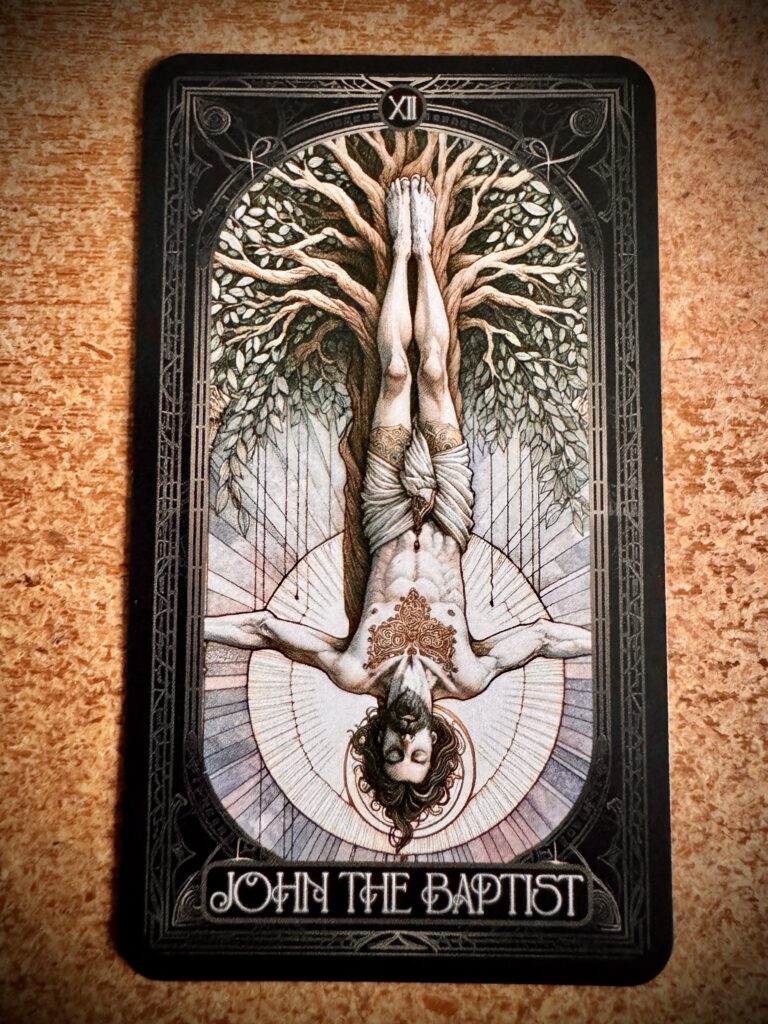
John the Baptist doesn’t arrive preaching or commanding. He appears as suspended presence, as the quality of someone who has stopped trying to control the uncontrollable and started trusting the process of transformation even when it requires complete surrender. You feel him first as the recognition that you’re in a threshold moment, that something is ending, that trying to hold on is futile and letting go is terrifying and both things are simultaneously true.
He hangs from the Tree of Life, but notice: he’s not suffering. His face is serene, almost beatific. This isn’t punishment or torture. This is willing suspension, chosen surrender, the recognition that sometimes the most spiritually mature thing you can do is stop fighting the transition and allow yourself to be held by something larger than your own will.
The inversion is crucial. From John’s perspective, the world has turned upside down. What was up is now down. What was down is now up. And from this inverted vantage point, he sees things he could never see while standing upright in the old order. The roots of the tree reach toward his crown like they’re trying to feed wisdom directly into his consciousness. The branches spread beneath his feet as though the foundations of reality itself have been reversed.
This is what endings feel like when you’re in them. Disorienting. Inverted. Nothing makes sense from the old perspective because the old perspective is precisely what’s dissolving. John teaches us that this disorientation isn’t a sign you’re doing it wrong. It’s a sign the transformation is real.
In some Gnostic texts, John is the last of the old prophets, the final voice of a tradition that’s about to be superseded. In others, he’s the head of a mystery school training the very people who will move beyond what he represents. Both can be true. He can be the culmination of one path and the doorway to another. He can hold the old world with reverence while recognizing its time is complete.
The Gospel of Thomas line is devastating in its honesty: John the Baptist is the greatest among those born of women, yet anyone who becomes like a child, who releases their attachment to greatness and status and the old ways of measuring worth, will surpass him. This isn’t a competition. It’s a recognition that sometimes what got you here won’t get you there. Sometimes the greatest prophet is the one who announces the end of prophecy.
As John appears beside you today, hanging in perfect stillness between worlds, his teaching arrives as paradox:
“What if the ending you’re resisting is the very thing that will liberate you? What if the surrender you’re avoiding is the only path to the transformation you’re seeking?”
Teaching for the Day
We live in a culture that hates endings, that treats every loss as failure, that insists you should always be moving forward, always making progress, always building on what came before. This creates tremendous suffering because life is actually full of genuine endings, complete dissolutions, moments when the only way forward is to let something die completely rather than trying to preserve or evolve or transform it.
John the Baptist teaches us about necessary endings. About the times when holding on becomes the obstacle. About the moments when surrender isn’t weakness but wisdom. About the grace that can emerge when you stop fighting what’s dissolving and allow yourself to be suspended in the not-knowing between what was and what will be.
The hanged man in traditional tarot is about sacrifice, yes, but not the grim martyrdom kind. It’s about willing suspension, chosen surrender, the recognition that sometimes you gain more by releasing than by grasping. John hangs from the tree by choice. He could struggle free if he wanted. But he understands something crucial: the transformation he’s part of requires this pause, this suspension, this moment of complete relinquishment of control.
The archons hate this. They want you always doing, always producing, always maintaining forward momentum. Because when you’re suspended, when you’re in the bardo between endings and beginnings, when you’re hanging in the not-knowing, you’re not controllable. You’re not generating the kind of karma they can exploit. You’re in a liminal space where their programming doesn’t reach.
This is why spiritual traditions around the world have rituals of suspension, of deliberate retreat, of chosen withdrawal from normal life. Because these threshold moments, these times of hanging between worlds, these are when the deepest transformations happen. Not through effort but through surrender. Not through doing but through allowing.
From Adam to John the Baptist, no one greater. But anyone who becomes like a child will surpass him. This is the paradox of the spiritual path: you must become great enough to recognize when your greatness needs to be released. Wise enough to know when wisdom means letting go. Strong enough to choose surrender when surrender is what’s needed.
John represents the ending of an entire era of prophecy, an entire way of relating to the Divine, an entire system of spiritual authority. And he does it with grace, with surrender, with the recognition that his ending creates space for something new. He’s not clinging to his role as the greatest born of women. He’s hanging inverted, seeing from a new perspective, allowing the old world to drain away so the new world can be born.
This is the teaching today: some things must end completely. Not evolve. Not transform. Not get repurposed. End. Die. Dissolve. And your willingness to hang in that ending, to surrender control, to trust the process even when you can’t see what’s coming, this is a profound spiritual act.
The only way out is through. And sometimes “through” means hanging suspended until the transformation is complete.
Journaling Invocation
“What in your life is trying to end that you’re still trying to preserve? What would it mean to surrender completely rather than trying to manage or control the transition?”
This question asks you to look honestly at where you’re fighting endings, where you’re trying to hold on to what’s dissolving, where your resistance to surrender is prolonging suffering rather than preventing it.
Maybe it’s a relationship that has run its natural course but you’re trying to revive it. Maybe it’s a version of yourself that served you beautifully but no longer fits who you’re becoming. Maybe it’s a belief system, a career path, a way of being in the world that’s dissolving and you’re exhausting yourself trying to maintain it.
John the Baptist doesn’t ask you to give up prematurely or abandon things that still have life in them. He asks you to recognize when something is genuinely ending, when your efforts to preserve it are actually blocking the transformation that wants to happen.
Write about what’s trying to end. What wants to dissolve. What you’ve been resisting letting go of even though you know, somewhere deep, that it’s time. Don’t rush to resolve this. Don’t immediately figure out what comes next. Just acknowledge the ending. Honor it. Let yourself hang in it.
Because here’s what John knows: the suspended time, the hanging between worlds, this isn’t wasted time. This is when the deepest work happens. When the old programming drains away. When new perspectives become possible. When transformation occurs at a level so deep you can’t force it or rush it or manage it. You can only surrender to it.
What becomes possible if you stop fighting the ending and start trusting the suspension?
Small Embodied Practice
Find a place where you can safely hang or lean backward (a doorway, a sturdy chair, or simply lying on the ground with your head lower than your heart).
If using a doorway: grip the frame and lean back, allowing your weight to be supported, your body to hang in gentle suspension.
If using a chair: sit backward on it, arms draped over the back, letting your upper body fold forward and hang.
If lying down: lie on your back with pillows under your hips so your head is lower than your torso, allowing blood to flow in a slightly inverted direction.
Once in position, close your eyes. Feel the sensation of being supported while suspended. Notice how it feels to not be in your normal upright, in-control position.
Breathe here. Let your body remember what it’s like to be held without holding. To be suspended without struggling. To surrender without collapsing.
As you hang or lean, say internally: “I release what’s ending. I trust what’s coming. I surrender to the space between.”
Stay for several minutes if comfortable. Notice what arises. Resistance? Relief? Fear? Peace? Don’t judge any of it. Just witness how your system responds to chosen suspension.
When you return to normal position, do so slowly. Sit for a moment. Feel how the world looks slightly different after hanging inverted. This is John’s teaching embodied: new perspectives emerge when you’re willing to hang between worlds.
You just practiced surrender.
Not as defeat.
As transformation.
Choosing to hang in the ending until the new beginning is ready to be born.
The caravan moves together through endings and beginnings. If today’s companion touched something in you, if John’s suspended wisdom helped you recognize what’s trying to end, let us know in the comments. Your willingness to surrender lights the path for others hanging in their own transformations beside you. 🌳
Tomorrow: Achamoth arrives, Wisdom’s shadow, the one who teaches us that death must die, that endings have their own endings, that transformation is never finished.
[…] […]
[…] […]