There’s a particular ache that comes with wondering how history might have unfolded differently. What if the road not taken had become the main highway? What if the voice nearly heard had shaped the dominant narrative? What if the teacher almost chosen had shepherded the tradition into something unrecognizable from what it became?
This is the territory of Valentinus.
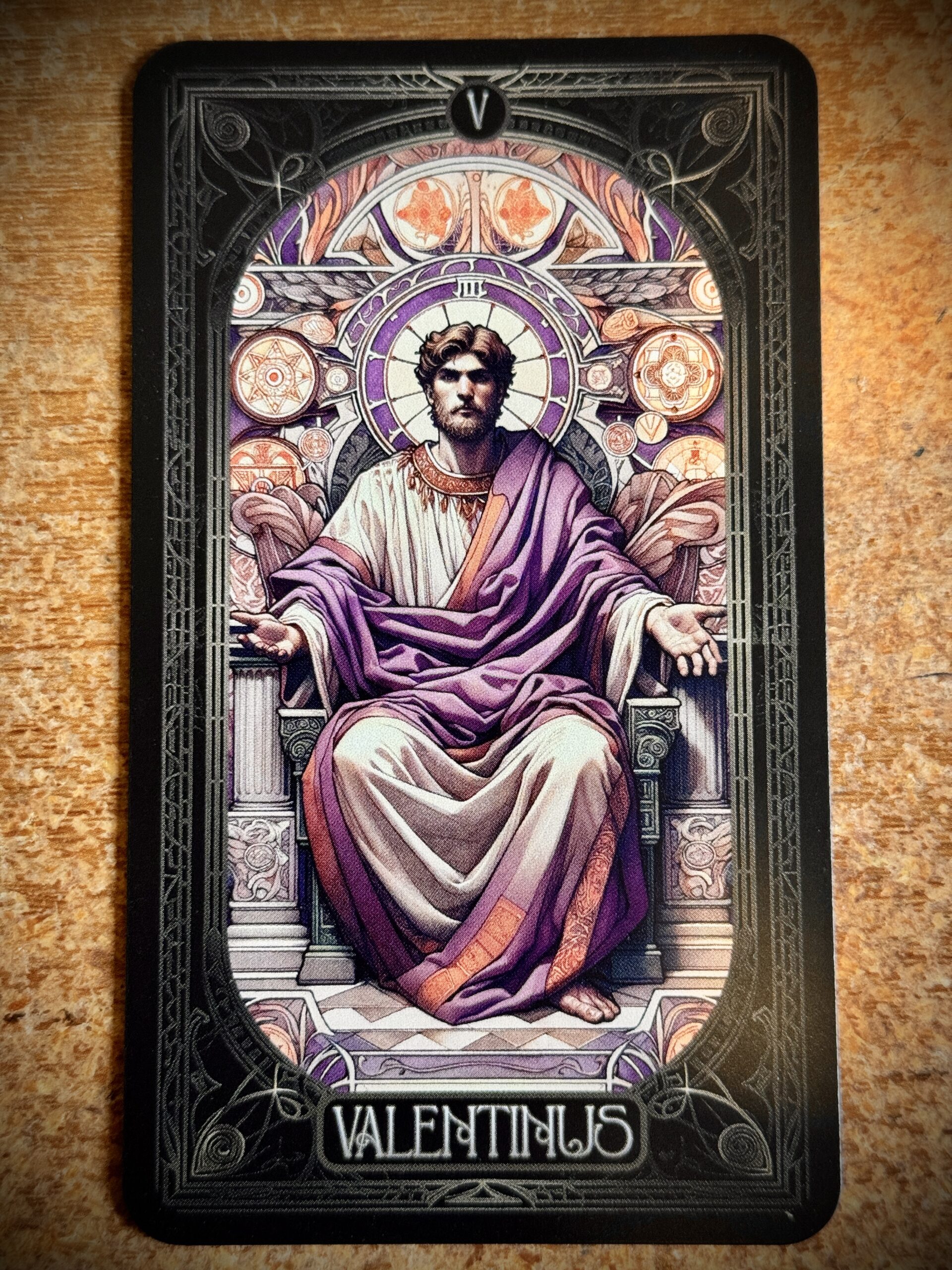
In the card, he sits in contemplative authority, draped in rich purple, surrounded by the sacred geometry of his cosmology. His hands are open in a gesture of offering, of transmission, of teaching freely given to those ready to receive. Behind him, the intricate mandala of aeons and emanations speaks to the elegant, systematic philosophy he developed. This isn’t the rigid dogma of orthodoxy. This is living theology, mystic speculation married to rigorous thought.
Valentinus was an elegant Gnostic teacher and perhaps history’s first systematic Christian philosopher. But more than that, he was the man who almost became Pope in the 2nd century CE. Imagine that alternate timeline. Imagine if this proponent of sacred marriage, inclusive rituals, and mystic speculation had shepherded Christendom. Imagine if Christianity had embraced rather than suppressed the experiential, the feminine, and the individually revelatory.
But history chose differently. And Valentinus, instead of leading from Rome’s throne, led his own movement from the margins. He advocated for an individualistic, sacramental, and experiential form of Gnosticism that the early church both admired and feared. He preached lost secrets. He preached Sophia and Christ united in heaven and in our hearts. He preached reason and kindness as paths to the Divine.
Today, he arrives as our seventh companion, following Jesus’s embodied Logos. Where Jesus demonstrated sovereign authority, Valentinus teaches us what happens when that authority becomes transmission, when sovereignty turns outward to guide and illuminate, when the one who knows helps others remember what they’ve forgotten.
The Advent Companion Appears
Valentinus doesn’t appear with the weight of institutional power or the demand for blind faith. He arrives as the energy of genuine teaching, the quality of someone who has discovered something profound and can’t help but share it. Not to convert. Not to control. But because wisdom naturally overflows when it’s real.
He sits in his contemplative throne, but there’s an accessibility to him, an openness. The purple of his robes speaks to spiritual royalty, yes, but also to the kind of authority that comes from deep inner work rather than external appointment. His hands reach toward you, not grasping but offering, inviting you into a conversation rather than demanding your obedience.
In Valentinian Gnosticism, the path wasn’t about believing the right things. It was about experiencing the right things. About direct encounter with the Divine rather than mediated relationship through institutional gatekeepers. Valentinus taught that the Pleroma, the fullness of the Divine, could be accessed through contemplation, through sacrament, and through the sacred marriage of masculine and feminine principles both within and without.
His cosmology was intricate, yes. The elaborate system of aeons and emanations can seem complex from the outside. But at its heart was something simple and revolutionary: you contain the Divine. The spark of the Pleroma lives within you. Your task isn’t to grovel before an external God but to awaken to the divinity you already carry.
The Gospel of Thomas contains what might be Valentinus’s most essential teaching: “Those who seek should not stop seeking until they find. When they find, they will be disturbed. When they are disturbed, they will be amazed and will rule over all.”
This is the path of the true seeker. Not the comfortable path of received wisdom and easy answers. The path that disturbs, that unsettles, that demands you question everything you thought you knew. And on the other side of that disturbance, amazement. Recognition. The realization that you rule over your own inner kingdom.
As Valentinus appears beside you today, his question arrives as an invitation rather than a test:
“What if seeking itself is sacred? What if the questions matter more than the answers? What if your spiritual path is meant to disturb you awake rather than comfort you to sleep?”
Teaching for the Day
The Hierophant in traditional tarot often represents religious authority, institutional wisdom, and the keeper of orthodox tradition. But Valentinus as Hierophant offers something more subversive: he represents the teacher who refuses to become a gatekeeper. The guide who points inward rather than demanding you defer to external authority.
Valentinus’s near-ascension to the papacy is one of history’s most tantalizing what-ifs. The vote was close. He had supporters, admirers, people who recognized the depth of his wisdom and the coherence of his teachings. But in the end, the institutional church chose a different path. They chose consolidation over mysticism, uniformity over diversity, control over experience.
And Valentinus, rather than fighting for the throne or abandoning his calling, simply continued teaching. He gathered students. He developed his philosophy. He created a movement that honored individual experience, that celebrated the sacred feminine, that insisted on the marriage of spiritual and intellectual rigor.
This is what the Hierophant energy looks like when it’s uncorrupted: teaching that empowers rather than enslaves. Guidance that points toward your own authority rather than demanding you surrender it. Wisdom that invites questioning rather than punishing doubt.
The path Valentinus advocated was never easy. He insisted that true spiritual awakening would disturb you. That genuine seeking meant being willing to have your certainties shaken. That the journey toward amazement required passing through disorientation.
This is so different from the religious messaging most of us inherited. We were taught that faith means certainty, that doubt is dangerous, that questioning is a sign of weakness rather than strength. The archons love this programming because it keeps people compliant, keeps them from seeking too deeply, keeps them dependent on external authorities to tell them what’s true.
Valentinus disrupts this completely. He says: seek until you find, and expect to be disturbed by what you discover. He says: your discomfort is a sign you’re on the right path, not evidence you’ve lost your way. He says: amazement awaits on the other side of the questions that won’t let you sleep at night.
The teaching today isn’t about finding the right teacher or the perfect system or the ultimate answer. It’s about recognizing that seeking itself is sacred. That the questions you’re carrying are part of your spiritual work. That your doubt, your uncertainty, your refusal to accept easy answers, these aren’t obstacles to awakening. They’re the path itself.
Valentinus preached reason and kindness. This pairing is essential. Reason without kindness becomes cold intellectualism. Kindness without reason becomes naive sentimentality. But reason and kindness together, rigorous thought married to compassionate presence, this creates the conditions for genuine transformation.
Journaling Invocation
“What questions am I carrying that I’ve been afraid to ask? What seeking have I shut down because the answers might disturb me?”
This invitation asks you to look at the questions you’ve been avoiding. Not because you don’t care about the answers, but because you suspect the answers might change everything. We all have them. The questions that would require us to rethink fundamental assumptions. The seeking that would demand we leave comfortable certainties behind.
Maybe it’s a question about your faith tradition, the one you’ve been loyal to but secretly wonder about. Maybe it’s a question about your life’s direction, the one that would require admitting you’ve been on the wrong path. Maybe it’s a question about a relationship, a career, a belief about yourself that you’ve never dared to examine directly.
Valentinus says: ask it. Seek it. Don’t stop until you find, even if what you find disturbs you. Because that disturbance isn’t a sign you’ve made a mistake. It’s a sign you’re finally awake enough to see clearly.
Write the questions. Don’t try to answer them yet. Just let them exist on the page, acknowledged and honored. These questions are sacred. They’re trying to lead you somewhere important. Your willingness to ask them, to hold them without rushing to resolve them, is itself a spiritual practice.
What if your doubt is more sacred than your certainty?
What if your questions are more valuable than your answers?
What if the seeking itself is the whole point?
Small Embodied Practice
Sit somewhere quiet where you can be undisturbed. Close your eyes. Place both hands over your heart.
Take a few deep breaths, letting your awareness settle into this moment, this body, this life as it actually is rather than as you think it should be.
Now bring to mind a question you’ve been carrying. Not a practical question like “What should I have for dinner?” but a deeper one. A question about meaning, purpose, truth, belonging. A question that doesn’t have an easy answer.
Instead of trying to answer it, just hold it. Feel it in your body. Where does it live? Your chest? Your belly? Your throat? Notice the quality of the question. Does it create tension or curiosity? Anxiety or aliveness?
As you breathe, imagine that you’re creating space for this question. You’re not trying to resolve it or dismiss it. You’re simply acknowledging: this question is part of my journey right now. This seeking is sacred.
Say silently to yourself: “My questions are welcome here. My seeking is sacred. I trust the path of not knowing.”
Stay with this for several minutes. Let your body learn what it feels like to hold uncertainty with grace rather than anxiety. To be in the question rather than desperately grasping for answers.
This is Valentinus’s teaching embodied: seeking itself is sacred. The questions you carry are part of your spiritual work. Your willingness to be disturbed awake is the path to amazement.
When you’re ready, open your eyes. Notice if something has shifted. Often the questions feel less heavy when we stop treating them as problems to solve and start honoring them as guides to follow.
The caravan moves together. If today’s companion touched something in you, if Valentinus’s teaching helped you honor your questions as sacred rather than seeing them as obstacles, let us know in the comments. Your seeking lights the path for others walking beside you. 🕯️
Tomorrow: Adam and Eve arrive, not as sinners but as the dual forces who chose awakening over obedience.
[…] […]
[…] Adam and Eve: The Lovers and Their Awakening Journey says: […] […] […]