
(The One Who Remembers)
There are truths that live beneath language, knowledge that moves through the body before it reaches the mind, wisdom that hides in plain sight precisely because it’s too essential to be spoken directly. This is the domain of the priestess, the keeper of mysteries who knows that the most profound teachings arrive not through explanation but through recognition. Through resonance. Through the sudden remembering of what you’ve always known but had forgotten you knew.
This is Helen of Tyre’s gift.
In Gnostic mythology, Helen’s story is one of the most haunting in the entire tradition. She was the stolen wisdom principle of the Divine, the “First Thought” of the Godhead itself, kidnapped by rebellious archons and hidden in the material world. They exploited her power to fuel their dominion over the cosmos, forcing her to reincarnate through time, even manifesting as Helen of Troy, all to keep her unseen by the Pleroma, unseen by those who would restore her to her rightful place.
Then Simon Magus found her in the city of Tyre, and they became a priesthood of two. Together, they advocated for the awakening of all humans to their hidden divinity. But Helen wasn’t simply rescued. She remembered. She reclaimed. She stepped into her own power as the Priestess of the Moon, one of the thirty adepts of John the Baptist, a teacher of mysteries in her own right.
True wisdom is never learned; it is only ever remembered.
In the card, she stands in the temple of her own sovereignty, draped in ceremonial power, the blue rose of impossible beauty blooming before her. She is both the mystery and the one who knows the mystery. Both the hidden wisdom and the revealer of what has been concealed.
Today, she arrives as our fourth companion, following the visionary clarity of Simon Magus. Where Simon taught us to see through illusions, Helen teaches us to trust what we know in ways that bypass the rational mind entirely. Because some truths can’t be proven. They can only be recognized. And recognition is always an act of remembering.
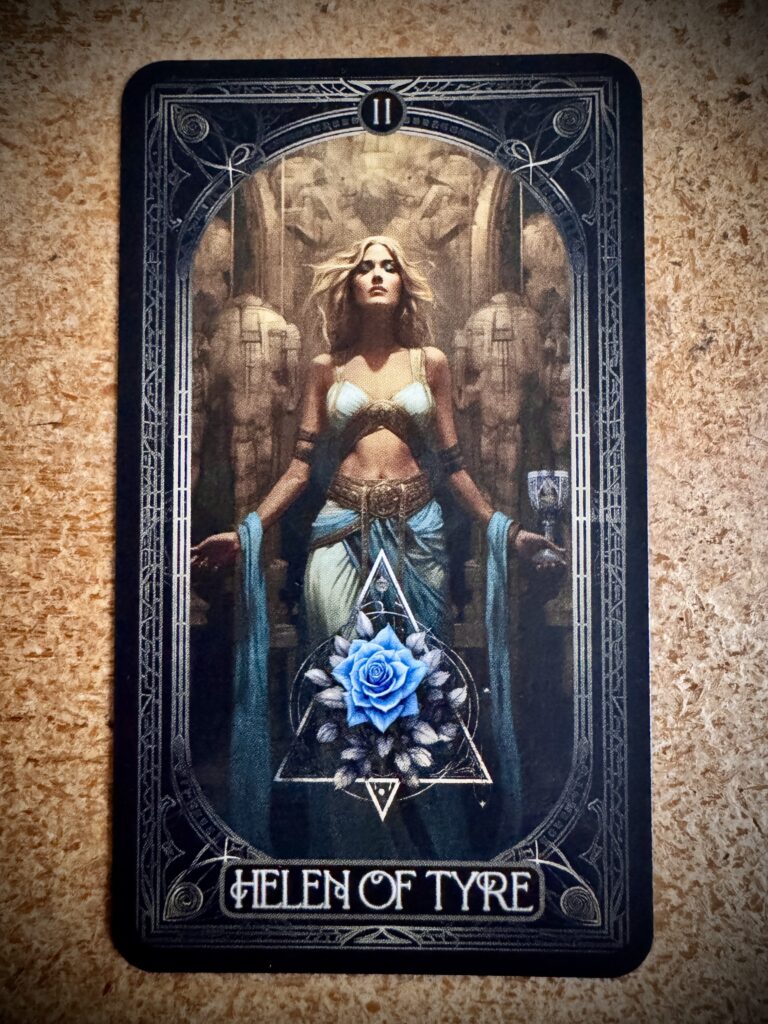
The Advent Companion Appears
Helen doesn’t announce herself with proclamations or teachings. She appears as a quality of knowing that rises from somewhere deeper than thought, older than language. You feel her first as a shift in the atmosphere, a sense that the air itself has become weighted with significance, pregnant with meaning you can’t quite articulate but absolutely recognize.
She stands in her temple, grounded and certain, draped in the vestments of her reclaimed authority. The blue rose before her blooms with an impossible luminosity, the kind of beauty that shouldn’t exist in this world but does anyway, defying the archons’ insistence that only the mechanistic and material are real.
Helen knows something the archons spent centuries trying to make her forget: she is the wisdom principle itself (Ennoia). Not a fragment of it. Not a reflection of it. The actual, living intelligence of the Divine, temporarily concealed but never truly diminished. They could hide her. They could exploit her power. They could force her through countless incarnations. But they could never erase what she fundamentally is.
And neither can anyone erase what you fundamentally are.
This is Helen’s teaching, wordless and complete. She doesn’t need to explain herself or prove her authority. She simply stands in the fullness of her reclaimed knowing, and in her presence, you begin to remember your own.
What have you forgotten about yourself? What wisdom have you been carrying all along, buried beneath the noise of other people’s certainties, beneath the archontic programming that insists you’re smaller than you are, less knowing than you are, less essential than you are?
Helen’s question arrives not as words but as sensation:
“What if you already know what you think you’re seeking? What if the wisdom you’ve been searching for has been living in you all along, waiting for you to stop looking elsewhere and finally recognize it as your own?”
Teaching for the Day
The priestess holds mysteries, yes. But the deepest mystery she holds is this: you are not separate from the wisdom you seek. The knowing you’re hungering for isn’t located in some distant teaching or hidden text or enlightened master. It’s woven into the fabric of your being, as fundamental to you as breath, as natural as the way water finds its level.
But the archons are clever. They didn’t steal your wisdom. They convinced you to doubt it. They trained you to defer to external authorities, to mistrust your own perceptions, to believe that truth lives somewhere outside you and must be earned through struggle or granted through initiation.
Helen’s story demolishes this lie. She was the First Thought itself, the Divine Feminine intelligence that births worlds into being. And even when she was hidden, exploited, forced into forms that concealed her nature, that essential wisdom never left her. It couldn’t. It was her.
The same is true for you.
You contain knowing that predates your conditioning. Intuitions that arrive unbidden and prove themselves accurate. Recognitions that bypass rational analysis entirely and land with the weight of truth.
- The “gut feeling” you ignored? That was her.
- The dream that felt more real than waking life? That was her.
- The sudden certainty that defied logic? That was her.
The priestess path isn’t about acquiring knowledge. It’s about learning to trust what you already know. About developing the courage to honor your inner authority even when it contradicts the dominant narrative. About recognizing that wisdom speaks through your body, your dreams, your sudden knowings, your inexplicable certainties.
Helen’s mysteries weren’t taught in the traditional sense. They were revealed through tantric magic, ancient Egyptian lore, and direct experience of the sacred. She created spaces where people could remember rather than learn, recognize rather than study, awaken rather than strive.
This is what she offers you today: permission to trust yourself. To stop seeking validation for what you already know. To stand in your temple, whatever form that takes, and claim your priestess authority, your sovereign knowing, your unshakeable sense of what’s true even when you can’t explain how you know it.
The blue rose blooms because it chooses to bloom, regardless of what’s deemed possible.
Your wisdom rises because it’s your nature, regardless of what you’ve been taught to doubt.
Journaling Invocation
“What do you know that you’ve been afraid to trust? What wisdom lives in you that you’ve been waiting for permission to claim?”
This question invites you into dangerous territory. Not dangerous because it will harm you, but dangerous because once you start acknowledging your own knowing, you can’t easily return to deferring to external authority. Once you recognize that you’ve been carrying wisdom all along, you become responsible for honoring it.
Maybe it’s something simple: you know a relationship isn’t serving you, but you’ve been waiting for someone else to validate that perception before acting on it. Maybe it’s deeper: you know your life is meant to move in a direction that doesn’t match anyone’s expectations, and you’ve been pretending that inner compass isn’t pointing where it’s clearly pointing.
Or maybe it’s something you can’t even put into words. A knowing that lives in your body, in your bones, in the way your energy shifts when you’re around certain people or in certain situations. A wisdom that speaks through sensation rather than thought.
Helen doesn’t ask you to justify or prove what you know. She asks you to acknowledge it. To give it space. To stop diminishing it because it doesn’t fit the acceptable templates for how knowledge is supposed to arrive.
Write without censoring. Let the knowing that’s been waiting surface, even if it feels presumptuous or impossible or too bold. The priestess doesn’t deal in polite uncertainties. She deals in recognition.
Bonus Question: What Are You Pretending Not To Know? The Priestess does not ask you to learn. She asks you to stop pretending you are ignorant. We often feign confusion because clarity is terrifying. If we admit we know a relationship is dead, a job is toxic, or a creative path is calling us, we are obligated to act. So, we pretend we are “confused.” We pretend we need more data.
Small Embodied Practice
Find a space where you can stand undisturbed. Close your eyes. Take a few deep breaths, letting your awareness settle into your body rather than staying caught in your head.
Now place one hand on your heart and one hand on your belly. Feel the warmth of your palms against your body. Feel your breath moving beneath your hands.
Ask yourself silently: “What do I know right now that I’ve been afraid to trust?”
Don’t search for an answer in your mind. Wait for sensation. Wait for knowing that arrives as feeling, as shift in your body, as subtle movement of energy. Maybe your chest tightens. Maybe your belly relaxes. Maybe you feel a sudden warmth or coolness somewhere. Maybe an image arrives, or a word, or just a sense of yes or no.
Stay with whatever emerges. Don’t analyze it. Don’t immediately try to translate it into language or figure out what it means. Just let yourself feel the knowing moving through your body.
This is Helen’s teaching embodied: wisdom speaks through you before it speaks to you. Your body knows things your mind hasn’t caught up to yet. Learning to trust that somatic knowing, that priestess intelligence, is how you begin to reclaim your authority.
After a few minutes, open your eyes. Take one more breath. Notice if something has shifted, even subtly, in how you hold yourself, how you feel in your own skin.
You just practiced listening to the priestess within.
She’s been speaking all along.
Today, you finally paid attention.
The caravan moves together. If today’s companion stirred something in you, if Helen’s presence helped you remember a wisdom you’d forgotten, let us know in the comments. Your recognition lights the path for others walking beside you. 🌹
Tomorrow: Mary Magdalene arrives, the woman who knew the All.
[…] […]