












I’ve been exploring Nick Bantock’s “The Archeo: Understanding and Developing Your Archetypes”.
I’m sitting here in quiet reflection after another powerful journaling/meditation session; the question that keeps circling back to me is, ‘Why Mephistopheles?’ Why now?
Something has shifted in my practice this week. I’ve felt myself touching something deeper, something more innately powerful. It feels more authentically me than anything I’ve accessed before. It’s as if I’m finally meeting the truest version of myself that I can recognise at this stage of my inner journey.
For years, I’ve carefully skirted around the darker territories of the psyche. I’ve worked in the light, stayed in the comfortable realms, and avoided the shadows that seemed too dangerous to explore.
There’s wisdom in that caution, I know. The darker elements carry immense power, but they’re notorious for their appetite; they have a way of consuming those who aren’t prepared to handle them. How many stories have I read of people who reached for that power only to find it had turned on them, devouring them from within?
And there’s that lyric from Pink Floyd lyric again alluding to Syd Barrett: ‘You reached for the secret too soon…’
Yet something in me has changed. Perhaps it’s confidence, perhaps it’s readiness, or maybe it’s simply time. I’ve decided to stop avoiding what I’ve long known was there waiting. This phase of my inner journey demands something different from me: a willingness to experiment with the very forces I’ve kept at arm’s length.
Enter Mephistopheles….
Mephistopheles is more than a character; he is a function of the psyche, a mask that appears whenever human longing rubs against the limits of the possible. He emerges from the shadows of our deepest frustrations, materialising precisely when our desires collide with the unyielding walls of reality. He is the spirit of “Yes, but”, that corrosive, necessary countervoice that mocks our cherished illusions, strips away the comfortable layers of pretension we wrap around ourselves, and tempts us with seductive shortcuts that promise everything while demanding the unthinkable.
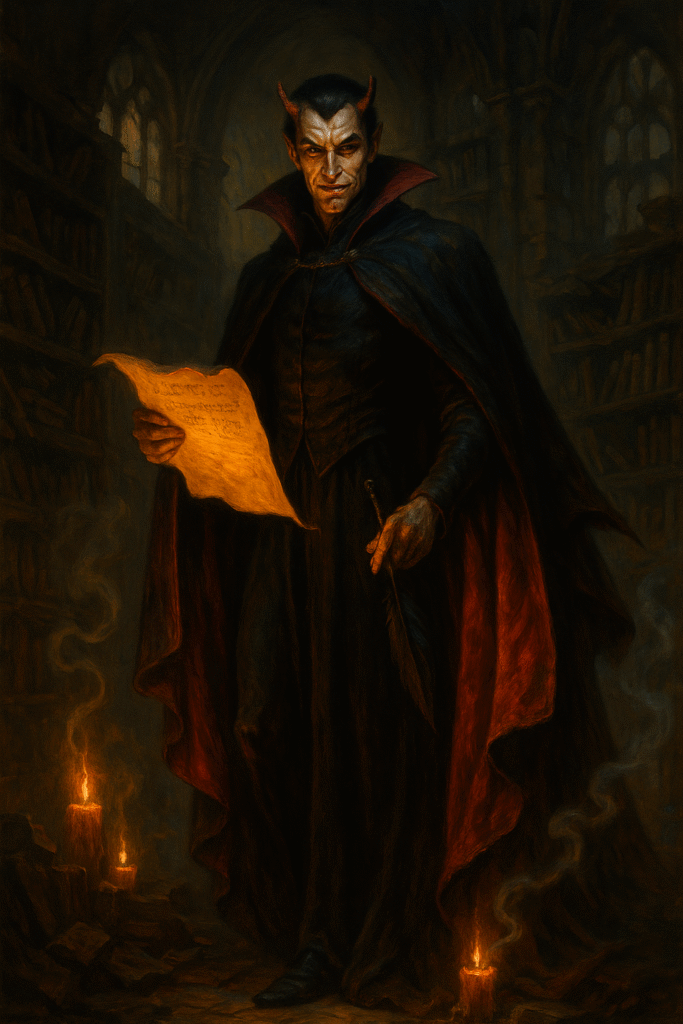
In Goethe’s Faust, he calls himself the “spirit that always negates,” yet this declaration reveals a profound truth about his nature. That negation is not pure evil; it’s catalytic and transformative in ways both terrible and necessary. Like fire sweeping through a dense forest, he clears away the accumulated undergrowth of lies and delusion that chokes the soil of the soul, burning through the deadwood of false beliefs and self-deception so that something more vital, more authentic, may eventually emerge from the ashes. His destruction is creation’s harsh prerequisite, his mockery the acid that dissolves the bonds of complacency.
He does not arrive with fanfare or theatrical flourish. Mephistopheles slips into consciousness the way doubt creeps into faith, gradually, then all at once. One moment you are certain of your path, convinced of your righteousness, secure in your small certainties. Next, his whisper threads through your thoughts like smoke through a keyhole.
“How noble,” his voice might murmur as you donate to charity, “this performance of virtue. But tell me—do you give because you care, or because others are watching?”
The question burrows deep, finds the soft places where your certainties live. He never lies, this ancient provocateur. He simply illuminates the contradictions already present and holds up a mirror that reflects not your face but your hidden motivations. The businessman who prides himself on integrity discovers he has been cutting corners for years. The devoted parent realises their love comes wrapped in control. The activist confronts the intoxicating pleasure they derive from their own righteous anger.
This is his particular genius: he makes explicit what was always implicit. The shadow Jung wrote about, lurking just beyond the periphery of conscious awareness, steps into the light under Mephistopheles’ patient cultivation. He tends these shadow-gardens with the care of a master horticulturist, knowing exactly which psychological conditions will cause long-buried truths to bloom.
Yet his revelations, however devastating, carry within them the seeds of authentic transformation. The executive who admits to his compromised ethics may choose to rebuild his business on genuine principles. The parent who acknowledges their controlling tendencies might learn to love without possession. The activist could discover that effective change requires more than just anger; it demands the harder work of building bridges rather than burning them.
But here lies Mephistopheles’ true cunning: he offers no guarantees. His bargains promise knowledge, power, and fulfilment of desire but never specify the cost of such acquisition. He is the eternal patron of the Faustian contract, where every gain extracts its terrible price. The knowledge comes wrapped in isolation; who can bear to see clearly while others remain blind? The power corrupts even as it liberates. The fulfilled desire reveals itself as hollow, leaving behind only the ache for the next impossible thing.
He watches these transactions with the detached interest of a scientist observing chemical reactions. Neither malicious nor benevolent, he simply is the inevitable consequence of consciousness sophisticated enough to question its own foundations, to doubt its certainties, and to hunger for more than survival allows.
Inside us, Mephistopheles manifests as the tempter, that seductive inner voice that whispers its promises during our moments of greatest vulnerability and discontent. He is the silvered tongue that murmurs, “If only you gave this up, you could have everything your heart has ever craved.” He dangles before our weary minds the tantalising prospect of knowledge without the grinding, relentless years of study – instant expertise that bypasses the humble apprenticeship of learning. He offers power without the crushing weight of responsibility, influence without accountability, and the ability to command without ever having learned to serve.
Most alluring of all, he promises pleasure without consequence, satisfaction without sacrifice, and the fulfilment of every appetite without the bitter aftertaste that inevitably follows excess. On the surface, these appear as simple bargains, straightforward transactions where desire meets opportunity. Yet underneath this veneer of generous exchange, he reveals something far more unsettling: the true depth and desperation of our hunger and the extent to which we are willing to compromise our principles for the promise of immediate gratification.
When he shows up in our lives, and he always does, for no conscious being escapes his attention, it’s not to trick us into some theatrical damnation complete with sulphur and flames. Rather, his purpose is far more subtle and infinitely more revealing: to test how well we truly know the price of our desires, whether we understand that every shortcut demands its payment, and if we possess the wisdom to recognise that what we think we want and what we actually need are often worlds apart. The recognition arrives not as a revelation but as a quiet acknowledgement, the way dawn doesn’t announce itself but simply displaces darkness.
As an archetype, Mephistopheles belongs to the sprawling family of tricksters that have haunted human storytelling since our earliest myths, but he carries a distinctly modern face, one polished to a mirror shine by centuries of urban sophistication. Unlike the ancient Loki or Hermes, who delight in pure chaos and gleeful mischief for its own sake, revelling in the simple joy of upending order, Mephistopheles is something far more unsettling: urbane, ironic, and calculating. He is a demon born not of primitive fear but of the Renaissance, emerging from an age that had learned to question everything and believe in nothing with equal fervour.
He doesn’t command through brute force or supernatural terror. Instead, he negotiates with the smooth precision of a seasoned diplomat. He brokers deals with the casual expertise of a merchant prince. He tempts not through fire and brimstone, not through the crude instruments of fear and intimidation, but through the far more seductive weapons of cynicism, razor-sharp wit, and intellectual sophistication. His arguments arrive dressed in logic, his propositions wrapped in reasonable compromise.
That’s precisely why he resonates so deeply in our age of endless contracts, careful compromises, and weaponised cleverness; we know his voice intimately because we hear it daily echoing through corporate boardrooms where ethics bend to quarterly profits, in the polished rhetoric of politics where truth becomes a matter of strategic positioning, and perhaps most disturbingly, in the smooth rationalisations of our own self-justifications when we explain away the small betrayals that accumulate like compound interest on our souls.
Psychologically, he represents the purest distillation of shadow energy, that murky, uncomfortable territory of the psyche where our most inconvenient truths take refuge. He embodies the part of us that hungers for what it cannot openly acknowledge, that desires what our conscious mind rejects with righteous indignation. He is the voice that whispers during our most virtuous moments, pointing out the self-serving calculations hidden beneath our noble intentions, the petty satisfactions we derive from our moral superiority.
This is the insidious force that systematically undermines our hard-won certainty, compelling us to confront the yawning chasm between our lofty ideals and our base appetites. Jung might recognise him as the archetypal trickster-shadow, the necessary antagonist who strips the hero of protective innocence so they can finally stumble, bloodied and humbled, toward genuine wholeness.
He catalyses transformation not through gentle affirmation or supportive encouragement, but through the far more brutal methodology of challenging every assumption, mocking every pretension, and presenting temptations so precisely calibrated to our weaknesses that resistance becomes a form of self-revelation. His very presence forces us to examine not just what we claim to believe, but why we need to believe it so desperately.
And in this perverse, unsettling way, he reveals himself as perhaps the most paradoxical teacher imaginable, one who instructs through corruption rather than edification, who guides through misdirection rather than clarity. Without his diabolic intervention, Faust would have remained forever trapped in his scholar’s tower, a withered academic drowning in theoretical abstractions and dusty tomes, his soul gradually atrophying from lack of genuine engagement with the messy, intoxicating complexity of lived experience. The good doctor would have pursued knowledge as a purely intellectual exercise, safely removed from the dangerous immediacy of actual consequence.
But with Mephistopheles as his dark companion, Faust finds himself thrust headlong into the raw machinery of desire, compelled to taste the forbidden fruits of experience, to embrace risk and recklessness, and to gamble his very essence on the possibility of transcendence. Through calculated error and deliberate transgression, through the systematic violation of every principle he once held sacred, Faust stumbles toward something approaching a fuller, more complete humanity, one that acknowledges both the heights of aspiration and the depths of appetite.
In mythic terms, Mephistopheles functions as the eternal guardian of psychological thresholds, the sentinel who stands at every crucial juncture demanding payment for passage. He presents you with the contract, that infamous document dripping with implications, its edges seemingly singed by the fires of countless previous negotiations, knowing with exquisite certainty that what truly matters is not the parchment itself or even the precise terms written in its margins, but rather the fundamental choice it represents: What sacred part of yourself will you willingly sacrifice? What comfortable illusion will you refuse to abandon? What cherished piece of your identity will you place upon the altar of transformation?
He understands, with the patience of aeons, that every soul carries within it a hierarchy of values, a secret architecture of priorities that most people never dare examine too closely. The contract merely forces this hidden structure into the harsh light of conscious decision. It compels you to confront the uncomfortable truth about what you truly treasure most deeply and what you’re secretly willing to surrender when the stakes become sufficiently high.
In our modern lives, he shows up whenever we face a compromise that cuts to the soul, manifesting not as a horned figure with a pitchfork, but as that familiar internal voice that speaks with devastating clarity about the price of our ambitions. Do you trade authenticity for success, slowly moulding yourself into the shape that others expect, until you can no longer recognise the person staring back from the mirror? Do you sacrifice freedom for security, choosing the golden cage over the uncertain wilderness of possibility? Do you barter presence for productivity, surrendering the irreplaceable moments of genuine connection for the hollow satisfaction of achievement?
He manifests in those moments as the whisper, the sly negotiator, the cynic who lays the pen in your hand and says, “You know you want this.” His voice carries the weight of practical wisdom, the seductive logic of compromise, and the rational arguments that make surrender seem not just reasonable but inevitable. He speaks in the language of necessity, of pragmatism, of adult responsibility, and of all the sophisticated justifications we use to avoid confronting the rawness of our deepest desires.
But to harness his power, you don’t banish him, and you don’t surrender completely to his seductions. Instead, you let him sharpen you against the whetstone of his challenges. You let his irony burn away the false pieties and comfortable self-deceptions, the layers of social conditioning and inherited expectations that obscure your authentic nature. You allow his relentless questioning to strip away everything that is merely borrowed, merely assumed, merely accepted without genuine examination, until what remains is the one irreducible thing you will never trade, the core essence that defines your truest self.
In that way, Mephistopheles becomes not the thief of your soul but the dark tutor who forces you to claim it fully, to own it completely, to defend it fiercely against all the forces that would dilute or diminish its power. Through his diabolic pedagogy, you discover not just what you believe, but what you believe so deeply that no contract, no matter how tempting, could ever compel you to abandon it.
That’s the mythic map laid bare before us: Mephistopheles as the inner tempter, as the mirror that reflects our deepest contradictions, as the relentless negator who refuses to let comfortable lies stand unchallenged, and as the threshold guardian who blocks the path to authentic selfhood with trials that seem designed to break us. He emerges not as some external monster lurking in the darkness to be feared and avoided, but rather as the shadow mentor whose brutal tests and uncompromising challenges systematically strip away every false layer, every borrowed identity, every inherited assumption, until they expose the bedrock of what you truly are beneath all the accumulated debris of social expectation and self-deception.
This is the paradox at the heart of the Faustian encounter: the very force that appears to threaten your destruction becomes the catalyst for your most profound self-discovery. Through his relentless questioning and his refusal to accept easy answers, Mephistopheles compels you to excavate the authentic core of your being, to unearth the irreducible essence that no external pressure can corrupt or coerce.