
The Alley of Consensus
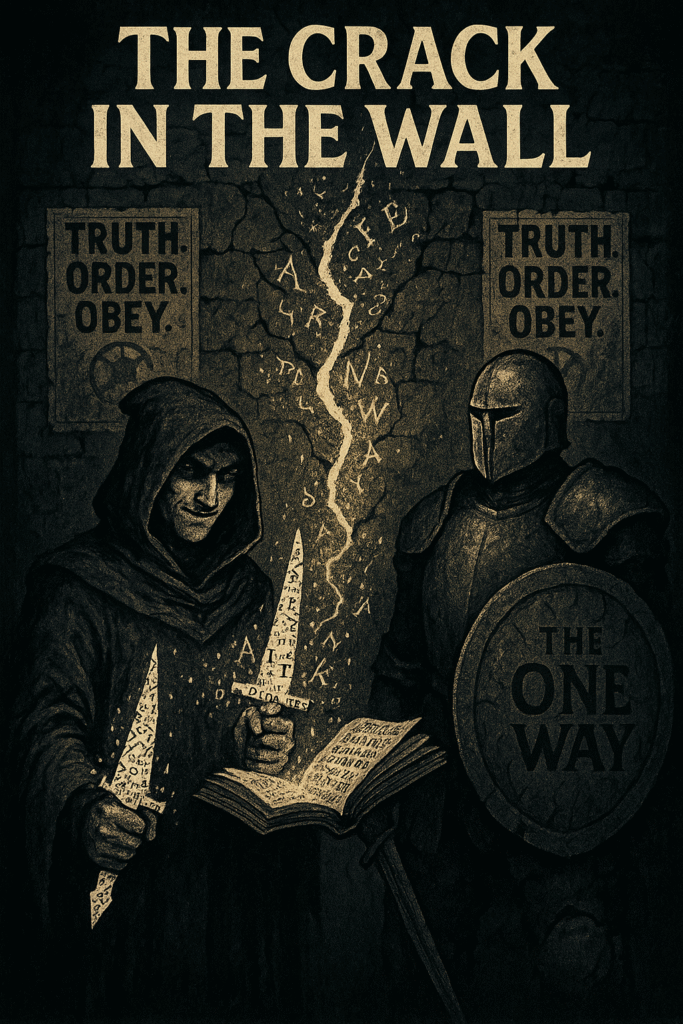
The concrete stretches endlessly in every direction, a monotonous expanse of gray that swallows the horizon. Buildings tower above me like tombstones, their surfaces scarred with identical posters that scream in bold red letters: TRUTH. ORDER. OBEY. The words repeat in perfect rows, layer upon layer, until they blur into a hypnotic pattern that makes my eyes water.
I pull my coat tighter and join the stream of bodies flowing down the street. We move in formation—three across, steady pace, no deviation. The person to my left mutters under her breath.
“Truth brings order, order brings peace.”
The man on my right picks up the refrain without missing a beat.
“Peace through consensus, consensus through truth.”
Their voices blend with hundreds of others, creating a low hum that vibrates through the pavement and into my bones. I mouth the words but keep my voice silent. The syllables taste like ash.
A woman stumbles ahead of me, her briefcase clattering to the ground. Papers scatter across the wet concrete. For a heartbeat, the formation wavers. Then we flow around her like water around a stone, never breaking stride. She scrambles to collect her documents, tears streaming down her face.
“Truth brings order,” she whispers desperately as she stuffs the papers back into her case. “Order brings peace. Peace through—”
Her words crack, but she forces them out anyway.
The posters watch from every surface. Store windows display them. Bus stops frame them. Even the trash cans bear the familiar red lettering. TRUTH. ORDER. OBEY. The glue holding them is fresh—someone replaces them daily, ensuring the message never fades.
I count my steps. Forty-three to the next intersection. The traffic light hangs dead and dark, but we stop anyway. Wait. The crowd breathes in unison, exhales the sacred words.
“Consensus protects us all.”
“Consensus protects us all.”
My lips move with theirs, but my mind drifts to the narrow alley between two office buildings. The one where the posters peel at the corners. Where sometimes, if the light hits just right, you can glimpse the brick underneath—red and real and untouched by slogans.
The light flickers green though no cars pass. We resume our march.
The Crack in the Wall
The formation carries me past the alley, but something snags my peripheral vision. One poster flutters loose from its adhesive prison, corner curled and dancing in the stale air. I slow my pace, letting the bodies flow around me until I drift toward the building’s edge.
The torn poster reveals something impossible.
Not brick. Not concrete. A shimmer that makes my retinas itch—like staring at heat waves rising from summer asphalt, but cold. The space behind the poster ripples with movement. Words. Actual words, floating and tumbling through the gap like pages torn from a book and scattered by wind that doesn’t exist.
freedom spirals past choice while doubt crashes into question and they merge, split, recombine into new configurations that hurt to follow. The letters themselves seem alive, rearranging their molecular structure faster than my eyes can process.
A shadow moves within the shimmer.
Tall, lean, wearing clothes that could belong to any era or none—dark coat that might be leather or canvas or something that hasn’t been invented yet. No insignia. No red posters. No slogans stitched into his sleeves. He carries a notebook bound in what looks like skin, pages thick with ink and marginalia. But it’s the blade in his other hand that stops my breath.
The metal gleams with letters instead of light. Actual text runs along the edge—cut and slice and divide flowing into liberate and free and choose. The words move like mercury, reforming with each shift of his wrist.
“Truth brings order,” someone behind me chants, voice growing louder. “Order brings peace.”
The formation is noticing the disruption. Bodies beginning to cluster, faces turning toward the alley with expressions caught between confusion and programmed alarm. The shadow in the shimmer tilts his head, listening to their approach.
His eyes find mine through the gap in reality. They hold the kind of amusement that comes from watching children play games they don’t realize they’re playing. He raises the text-blade in what might be greeting or warning.
The torn poster flutters again. The shimmer wavers.
“Peace through consensus,” the crowd chants, their voices building toward something that sounds like panic dressed in familiar words. “Consensus through truth.”
The shadow’s grin cuts through dimensions.
Story as Sorcery
The shadow steps through the shimmer like it’s an open door.
“Truth brings order,” he says, but the words come out wrong. They ripple outward like stones dropped into still water, each syllable creating concentric circles that distort the air itself. “But whose truth? Whose order?”
The formation stumbles. Bodies that moved in perfect synchronization suddenly find their feet uncertain, their rhythm broken. Someone in the back row blinks—actually blinks—as if seeing the street for the first time in years.
“Order brings peace,” a woman near me whispers, but her voice wavers. The certainty that held her spine straight crumbles.
The Trickster-Mage reaches into his coat and pulls out fragments of paper—torn words, scattered phrases, pieces of sentences that flutter in his palm like living things. He tosses them into the air above our heads.
The fragments don’t fall.
They hang suspended, rearranging themselves into impossible geometries. freedom and choice spiral around each other, forming an archway that leads nowhere and everywhere. question and doubt mirror each other until they become twin doorways reflecting infinite possibilities. resist burns like a sigil, casting shadows that spell out remember and wake and think.
A man in the front row drops his briefcase. The sound echoes wrong, like metal hitting water instead of concrete.
“What…” he starts, then stops. His hand moves to his throat as if checking whether the words are really his own.
“Peace through consensus,” another person chants, but the words feel hollow now, like echoing down an empty well. “Consensus through…”
She trails off. Her eyes track the floating words overhead, watching truth dissolve and reform into truths, plural, infinite.
The Trickster-Mage grins wider. His text-blade catches the light from the burning sigils, and new words flow along its edge: wake and see and choose and now.
“Consensus through truth,” I hear myself say, but my voice sounds strange in my own ears. Foreign. Like someone else’s uniform borrowed for too long.
The formation breaks entirely. People stand in clusters now, not lines, heads tilted back to watch impossible words dance overhead. Some reach toward the floating fragments. Others step backward, but their feet carry them in directions their minds haven’t chosen yet.
The shimmer behind the torn poster expands, revealing more gaps in the wall, more spaces where different words might live.
The Resistance of Belief
A figure pushes through the scattered crowd, and I recognize the uniform before I see the face. Clean lines, pressed fabric, the kind of authority that makes people step aside without thinking. The Guardian of Consensus moves with mechanical precision, each step an echo of every other step taken by every other Guardian in every other place where order needs reinforcing.
“Citizens.” The voice cuts through the air like a blade through silk. “Return to formation.”
But the crowd doesn’t move. They’re still watching the words overhead, still seeing truths where they once saw truth.
The Guardian’s armor isn’t metal or leather—it’s something more insidious. Certainty wraps around them like plate mail, forged from a thousand repeated phrases, tempered by years of unquestioned doctrine. Their weapon isn’t a sword but something far more dangerous: the absolute conviction that there is only one way to see, one way to think, one way to be.
“Deviation is error,” the Guardian announces, and I feel the pull of old programming tugging at my spine. The urge to straighten, to fall in line, to let someone else’s truth become my truth. “Consensus protects. Order preserves.”
Several people in the crowd shift, taking half-steps back toward formation. The floating words above us flicker, freedom dimming as obedience tries to write itself overtop.
“There is only one way,” the Guardian bellows, and their voice carries the weight of every lecture hall, every church sermon, every political rally where doubt was beaten into submission. The shimmer behind the torn poster wavers.
That’s when the Trickster-Mage laughs.
It’s not a polite chuckle or nervous giggle. It’s the sound of glass breaking in slow motion, of masks cracking, of cages discovering they were never locked. The laugh ripples outward and the Guardian’s certainty-armor develops its first hairline fracture.
“Belief is a tool, not a chain,” he says, and flicks his notebook open with one fluid motion.
The words inside don’t just scramble—they explode. Letters pour out like freed prisoners, consonants and vowels tumbling over each other in joyous chaos. They hit the air and immediately begin forming new combinations, impossible phrases, sentences that twist meaning inside-out and rightside-up simultaneously.
THERE IS ONLY becomes THERE IS ONLY ONE becomes THERE IS ONLY ONE WAY becomes THERE ARE INFINITE WAYS becomes THERE floats alone, pointing nowhere and everywhere.
The Guardian staggers. Their armor of certainty cracks wider as ONE WAY multiplies into MANY WAYS into YOUR WAY into MY WAY into NEW WAY into pathways spelling themselves across the concrete beneath our feet.
“Order through—” the Guardian starts, but the words tangle in their throat as ORDER rearranges itself into REORDER into RECORDER into RE-CORD like musical notes waiting to be played differently.
I watch a woman beside me read the new words forming in the air. Her lips move as she sounds them out: “There are infinite ways.” She looks down at her hands as if seeing them for the first time. “There are infinite ways to…”
“Stand down, citizen,” the Guardian commands, but their voice has lost its absolute pitch. The certainty-armor shows more cracks now, and through the gaps, I glimpse something almost human underneath.
The Trickster-Mage closes his notebook with a snap. The released words continue their dance overhead, but now they’re writing themselves, finding new patterns, new meanings, new possibilities that no Guardian could ever chain.
“Choose,” he says simply, and the word hangs in the air like an invitation.
Planting Seeds
The Guardian reaches for their standard-issue certainty, but their hand closes on empty air. The armor of absolute conviction shows more fractures with each passing second, doubt seeping through like water finding stone.
The Trickster-Mage doesn’t press his advantage. He doesn’t charge forward with sword raised or deliver crushing blows of logic. Instead, he moves like smoke, slipping between the Guardian’s defenses while they’re still trying to reassemble their shattered proclamations.
“Remember when you were seven,” he whispers to a man in a gray suit, barely loud enough for me to hear. “You asked why the sky was blue and your teacher said ‘because it is.’ But you kept asking anyway.”
The man blinks. His hand rises unconsciously to his throat where the daily mantras usually flow.
The Trickster-Mage drifts to a woman clutching her briefcase. “Your grandmother used to tell stories that started with ‘what if.’ You loved those stories. You drew pictures of dragons in the margins of your schoolbooks.”
Her grip on the briefcase loosens.
“Citizens!” The Guardian’s voice cracks like old leather. “Do not listen to—”
But the Trickster-Mage is already elsewhere, crouched beside a teenager whose eyes dart between the floating words overhead and the formation breaking apart around him. “You write poems in your head,” the Trickster-Mage murmurs. “Secret verses you’ve never spoken aloud. They rhyme with freedom.”
The teenager’s lips part slightly, and I see him mouth a word that isn’t from any approved slogan.
“Stop this,” the Guardian commands, but their certainty-armor groans under its own weight. Where once stood an immovable monument of absolute truth, now stands someone desperately trying to hold together a doctrine riddled with holes.
The Trickster-Mage plants his seeds quickly, efficiently. A touch on a shoulder, a phrase whispered in passing, an image dropped like a stone into still water. He doesn’t argue with the Guardian’s pronouncements—he simply offers alternatives that grow in the spaces between thoughts.
“You used to dance when no one was watching.”
“You painted sunsets that looked nothing like regulation sunsets.”
“You asked questions that had no approved answers.”
Each whisper lands in a crack, taking root in forgotten corners of consciousness. The crowd shifts restlessly. People look at their hands, their feet, each other’s faces as if seeing them clearly for the first time in years.
The Guardian stumbles backward, their perfectly pressed uniform wrinkled now, their mechanical precision faltering into human uncertainty. “There is—there must be—the order requires—”
But the Trickster-Mage is already fading into the crowd, his timeless coat blending with shadows and half-remembered dreams. The floating words above us continue their dance, but now they’re joined by new phrases, born from the whispers he’s planted: I remember, I question, I choose.
The Guardian reaches out, grasping at air where absolute truth used to stand. “Wait—you cannot—the consensus demands—”
But the Trickster-Mage is gone.
All that remains is the shimmer behind the torn poster, still showing glimpses of words tumbling through impossible space. And on the wall beside it, letters burn themselves into existence with fire that leaves no ash: READ CROOKED. CUT OPEN. BE FREE.
The graffiti blazes for a moment, each word outlined in flame that doesn’t consume, then settles into the brick as if it had always been there. As if someone had simply forgotten to look closely enough to see it before.
The Guardian stares at the burning words, their certainty-armor now more crack than surface. Around us, the crowd continues to scatter, people walking in directions they choose rather than follow.
The Passerby
A woman in a navy coat stops walking. She stares down at something by her feet—a small scrap of paper that must have fallen when the Trickster-Mage scattered his fragments into the air. The rest of the crowd flows around her, but she doesn’t move.
I watch as she kneels, her briefcase touching the concrete beside her. Her fingers hover over the paper scrap for a moment, as if touching it might burn her or change her forever. Then she picks it up.
From where I stand, I can’t read what’s written on it, but I see her face transform. Her mouth opens slightly. Her eyes widen, not with fear but with something I haven’t seen in years—wonder. Pure, childlike wonder at a new possibility.
She turns the paper over, checking both sides, then reads it again. Her free hand comes up to cover her mouth, and I think she might be trying not to laugh. Or cry. Or both.
Around us, the Guardian continues their desperate attempts to restore order. “Formation!” they call, but their voice lacks its former authority. “Citizens, return to your designated paths! The consensus requires—”
But nobody’s listening anymore. The man who remembered asking about blue skies has wandered off toward the alley where posters peel away from brick. The teenager who writes secret poems stands beneath the floating words, watching them rearrange themselves into new combinations. A small group has gathered around the fiery graffiti on the wall, reading it aloud to each other in hushed, excited voices.
The woman with the paper scrap stands slowly. She folds the fragment carefully and slips it into her coat pocket, right over her heart. Then she looks around at the breaking formation, at the floating words, at the shimmer still visible behind the torn poster, and she smiles.
It’s the first genuine smile I’ve seen on these streets in longer than I can remember.
She picks up her briefcase and walks away, but not in any direction prescribed by the painted lines on the concrete. She chooses her own path, stepping over cracks and around puddles, moving like someone who suddenly remembers that walking can be an act of joy rather than mere transportation.
The Guardian makes one last attempt. “Wait! You cannot simply—the order demands—”
But the woman doesn’t even turn around. She’s already too far away, carried by her own momentum toward whatever horizon she’s chosen.
The shimmer behind the torn poster begins to fade. The floating words settle gently to the ground like leaves, some dissolving into the concrete while others remain, embedded in the sidewalk for future passersby to discover. The Trickster-Mage is truly gone now, leaving behind only his gifts: questions where there used to be certainties, choices where there used to be commands, and small paper scraps carrying impossible messages.
I wonder what was written on that fragment the woman found. What words could spark such recognition, such sudden remembering of who she used to be before the mantras and formations took hold?
The Guardian stands alone now, their certainty-armor cracked beyond repair, watching the last of their formation scatter to the winds. They look smaller somehow, more human. Almost vulnerable.
The graffiti on the wall continues to glow softly: READ CROOKED. CUT OPEN. BE FREE. Below it, the torn poster flutters in a breeze that shouldn’t exist in this concrete maze, revealing glimpses of untouched brick underneath.
Somewhere in the distance, carried on that impossible wind, I think I can hear laughter.
For the intellectually curios, here’s the deep dive
Discover more from soulcruzer
Subscribe to get the latest posts sent to your email.