I first came across the book years ago when I was doing my Insights Discovery certification. It was part of the reading list, but I quickly became a fan and have been using it in my personal development workshops ever since.
I’m rereading it now because I’m doing a bit of shadow work on myself this week. Some thoughts surfaced after reading Sean Manseau’s book about Spotify the Gnostics, Here’s the First Church of David Bowie: Adventures in DIY Shamanism, and I could feel that familiar inner critic: the little judgements, resistances, envies, irritations, and defensive manoeuvres that usually prefer to linger just below the surface of consciousness unnamed.
That is the doorway into shadow work. Not some dramatic descent into the underworld, though it can feel like that sometimes. More often, it begins with a small disturbance. The sentence that catches in your throat. The person who irritates you more than they reasonably should. The idea you reject a little too quickly. The part of yourself you are certain belongs to someone else.
Yesterday felt like wading through wet sand. Every idea that surfaced dissolved before it could be shaped into anything. Underneath that is the voice that says, ‘If I can’t produce today, what does that mean for tomorrow, for the whole enterprise?’ It got louder as the afternoon wore on. I know that voice. It is not telling the truth. Knowing that doesn’t silence it.
This morning I pulled three cards. Sat with them at the desk before anything else happened, before coffee or email or the reflex to check what the world is doing. Let them sit.
Not one of them is set in daylight.
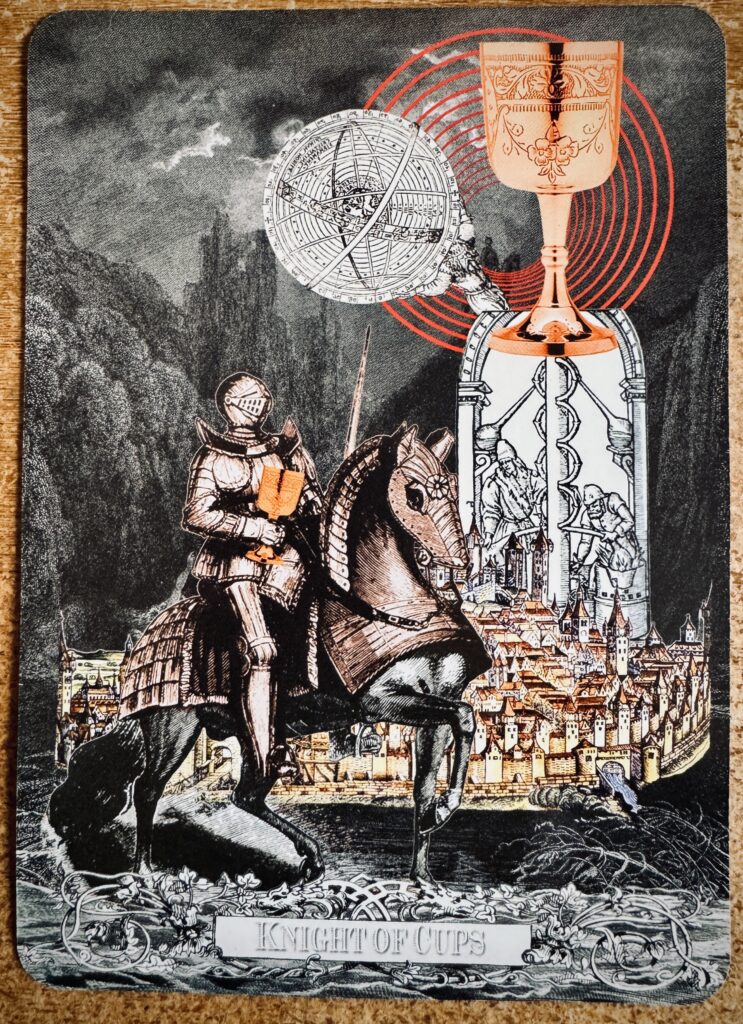
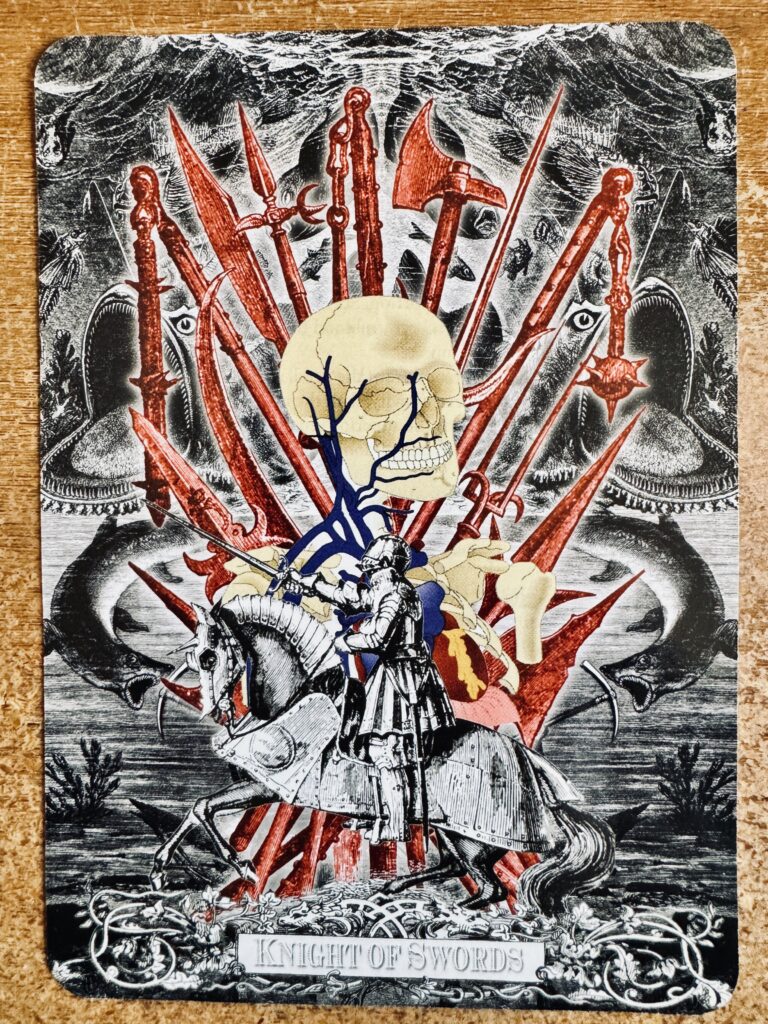
The Knight of Cups approaches at night, the city ahead glowing with its own inner light. The Nine of Cups traveller sits enthroned in a temple space removed from ordinary time. The Knight of Swords charges through a scene that Taussig makes completely explicit: underwater. In the psychic darkness of the unconscious, with monsters converging from every direction and a pale skull floating above like a moon that forgot to rise.
This is a spread with no interest in the surface world. Whatever it is pointing at, it happens in the deep.
The Knight of Cups arrives first, which matters because of what he is carrying. The chalice has a dark streak. It may be cracked. It cannot yet fully hold its contents. He approaches with the vision and the calling but with a damaged container, and the card poses its question immediately: how does the chalice get repaired?
The answer is through the city ahead and not by fighting through it.
The chalice gets repaired by entering the city, stabling the horse, setting down the weapons, removing the armour, and confronting the ogre inside without any of it. The ogre must be befriended and integrated. The union of the ego with the negative aspects of the personality is what repairs the vessel, what allows it to hold the golden energy the Work generates.
The city is hidden between craggy cliffs, glowing with its own inner light at night. Inside, two gates. The unconscious flows in through the iron grate whether the knight invited it or not, coming in without asking. Consciousness enters through the open bridge. Both are present inside the city, and both must be dealt with. There is no passage where only one of them comes through. The moon above strengthens the process, working with what is already there rather than overwhelming it with external light. The celestial feminine as an amplifier, not a source.
Yesterday was the city without armour.
The fallow day, the spinning wheels, and the pressure rising from below: all of that was the ogre in the city. The form it took was the question about production, about whether the inability to generate output was evidence of some deeper structural failure. The ogre always wears a practical disguise. It arrives as a legitimate concern about time or relevance or money and only reveals its real face once you are inside the city gates with it.
The response this morning wasn’t to fight it down or armour back up against it. Something quieter. Knowing what to do when you don’t know what to do. Turning toward the practice rather than away from it: the writing, the cards, the walking. The body holds knowledge that precedes the doubt. Twenty-five years of interior work leaves a residue, a cellular memory of how to return to the centre when the mind is spinning. That is the psychic work that repairs the chalice.
The city generates its own illumination. It always did. Entering at night is what it takes to see it.
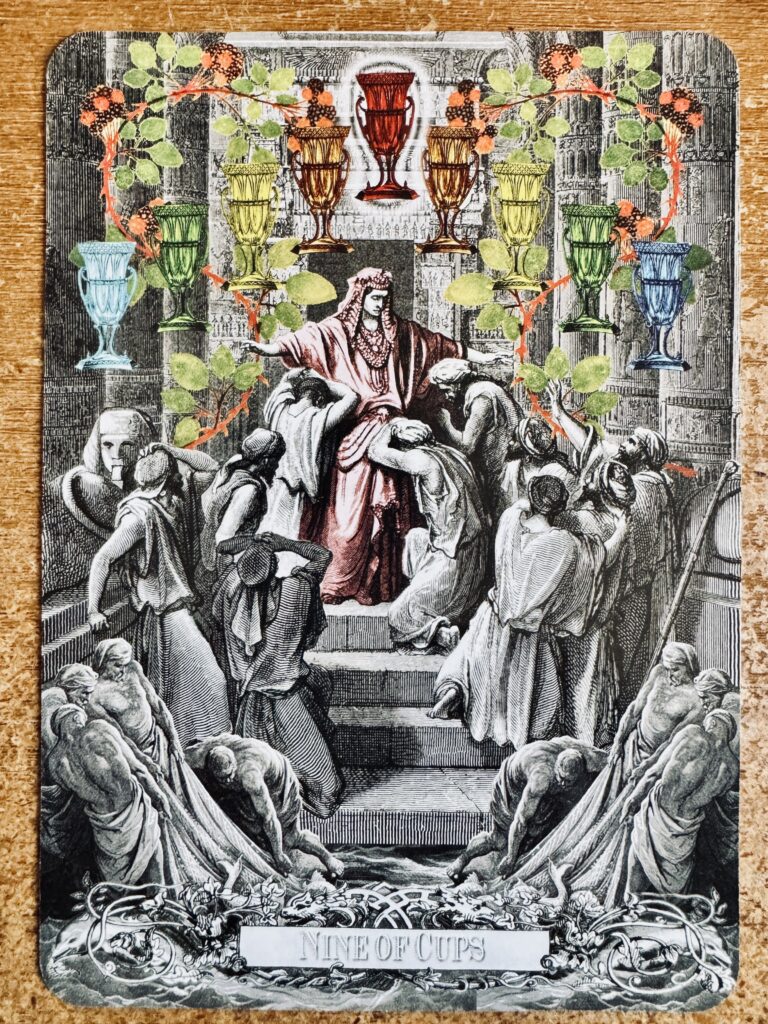
The Nine of Cups sits at the centre of the spread wearing red.
Rubedo. The Great Work is in its final stages of completion. The traveller who has moved through all four elements and ascended the four steps holds the Philosopher’s Stone within reach. The chalice at this stage has been repaired by the interior work. The golden energy can be held and dispensed freely. The traveller is generous and kind and genuinely empathetic because the road has made them so.
The four steps to the throne matter enormously. Earth, water, air, fire. Jung’s four functions. You don’t arrive at that seat by bypassing any of them. The water step is the psychic dissolution, the monsters of the deep. The throne is only accessible because the traveller went through the water, not around it.
The figure is androgynous, which is worth sitting with. It has integrated enough that it can’t be pinned to one side of any binary. Psychic wholeness in this deck looks like a movement into something that holds all of it, rather than a resolution where one part wins. Androgyny isn’t a detail about gender. It is a statement about what the Work produces: something that can no longer be halved by the question.
But the centre card carries a warning as pointed as any sword.
Adulation is dangerous. The people around the throne are a trap as much as they are a sign of the traveller’s bounty. The life of blessing others is genuinely fulfilling and genuinely good and genuinely insufficient because it requires abandoning one’s own journey. Because the adulation becomes habit-forming. Because ego inflation stops spiritual growth in its tracks. The traveller faces a terrible choice: continue the life of public good or go deeper into internal psychic wholeness, which could bring the world an even greater good.
This is the performing versus doing tension I named in the Rosebud session this morning, stated in alchemical terms. The pull toward visibility, the freelancer’s anxiety about which platform carries which audience, and the question of what to post and when and for whom: all of that is the adulation trap wearing practical clothing. The social media performance anxiety and the “If I can’t produce, what chance do I have?” are the same voice, one dressed as ambition and one dressed as fear. Both of them are the sound of the traveller’s attention drifting from the work toward what other people are doing with their chalices.
Document, don’t create. That is my answer to the traveller’s dilemma. Follow the inner journey for its own integrity, and offer what arises from that freely, rather than crafting content for reception. The difference between those two things is the difference between a city that generates its own light and a city that keeps the floodlights on. Both are illuminated. Only one of them knows where the light comes from.
The performance is the throne without the four steps.
The Knight of Swords carries all of this forward in the most extreme way possible.
Taussig is unambiguous: the scene is completely underwater. The drama of this card takes place inside the unconscious. The fish aren’t coming at the knight from outside his world. He has entered theirs. He has ridden down into the psychic depths deliberately, armoured, sword extended, charging through the monsters of the deep on the way to the treasure. The Magnum Opus. The Great Work.
That reframes yesterday entirely. Goethe’s line is exact: through water all things must be destroyed before they can be reborn. The fallow day, the regression to the fluid state, and the dissolution: water is the element all substances must be reduced to before they can emerge, purified. Going underwater is an alchemical necessity. You went underwater yesterday. Today you came up charging.
Unlike the city work, this charge is done fully armoured. The armour makes the charge possible at all. The accumulated practice, twenty-five years of work on the inner life, the military training, the daily journaling that has never stopped, the walks, the tarot, the interior work done in the city without weapons: all of that is what lets you ride your instincts into the deepest water rather than be consumed by it. The charge is the act of will made possible by everything that preceded it.
The armour distinction carries a second reading worth naming. Two interpretations, sitting side by side. The first: the armour allows you to ride your instincts bravely into the unconscious, the accumulated practice as protection, as what makes the descent possible at all. The second: the armour becomes the Persona itself, so hardened it protects you from change rather than enabling the charge. A shell rather than a suit. The question isn’t which reading is true. Both are, depending on the moment. The question the card puts is which one is active right now, in this particular descent, and whether what you carry into the water is a working instrument or a defence against being changed.
The hands are where it gets personally sharp.
Right hand on the sword: intellect and logic, the conscious frameworks, the Narrative Alchemy structures, the systems thinking, and the public articulation. The left hand guiding the horse: intuition and creativity, the subconscious steering the direction, the walks, the journaling, the tarot, and the inner work. Taussig is explicit that both are required. Neither hand wins. The sword without the reins is performance. The reins without the sword is drift. The performing versus doing tension resolved in a single image: both hands on the job, the intellect extended and the intuition steering, neither dominant, both necessary.
Now the spread reads as a complete alchemical sequence.
The Knight of Cups is approaching the city at night with a cracked chalice, doing the unarmed interior work that will repair it. The Nine of Cups traveller enthroned in the rubedo stage, facing the choice between adulation and deeper wholeness. The Knight of Swords is charging fully armoured through the underwater darkness, which is only possible because the interior work has been done first. The three figures are working on the same thing from different positions in the same territory.
The middle card is the vision of what the Work produces and the choice being faced right now, this morning, after the fallow day and before the next charge.
This spread holds the full complexity of the Work as it stands. The interior city works without armour, facing the ogre, repairing the vessel. The choice at the centre between adulation and deeper wholeness. The underwater charge through the psychic darkness with both hands active. These are simultaneous modes of engagement with the same process, all present on the same morning. The error is reading them as stages to be worked through in order and left behind.
The Knight of Cups and the Knight of Swords are in the same territory as the traveller on the throne. The red of the rubedo in the centre card is the same alchemical fire as the red swords in the Knight of Swords. The charge through the unconscious and the figure who has nearly reached the Philosopher’s Stone aren’t separated by vast distance. They’re in the same stage of the Work.
And none of the cards are set in daylight. That keeps demanding attention. The whole drama of this reading happens at night, underwater, in temple time. The surface world of presentations and platforms and production anxieties doesn’t appear in any of the three cards. Not even in the Nine of Cups, the most outward-facing of the three, where the traveller sits enthroned and surrounded. Even there, the setting is interior, removed from ordinary time. The Work doesn’t happen up there, in the daylight of results and receipts and follower counts. It happens here, in the dark, with the city’s own light.
Yesterday was the regression to the fluid state, the dissolution of the water demands before things can be destroyed and reborn. Today the chalice is a little more whole, the traveller’s choice a little clearer, and the charge a little more sure.
The map is not the territory. You have probably encountered this before, from an NLP workshop or a philosophy class or a self-development book that seemed important at the time. It sits in the category of ideas that feel genuinely arresting the first time you meet them and then gradually settle into the furniture. You stop noticing it. It becomes something you agree with rather than something you feel.
Beyond the Map–Territory Distinction
Two Chilean biologists took that idea apart in 1984 and rebuilt it into something considerably more unsettling. Humberto Maturana and Francisco Varela were not philosophers or therapists or practitioners of any inner discipline. They were cognitive scientists trying to answer a deceptively simple question: how does a living system know anything at all? What they found is that cognition is not a representation of a pre-existing world out there. It is the bringing forth of a world through the act of living itself.
That is worth slowing down for. It’s not just that the map differs from the territory, or even that it shapes how we perceive what’s there. The claim is more radical than that. It says there is no territory that exists for you independently of the map you bring to it. What you call “the world” is not something you step into fully formed and neutral. It is something that comes into being through the structure of your perception, your history, your way of making sense of things. You are not accessing a fixed reality—you are participating in the ongoing construction of one.
This is not idealism in the casual philosophical sense, not some claim that external reality does not exist. Maturana and Varela were biologists, and they were careful. What they showed is that the nervous system is not an information-processing device that receives inputs from the outside world and converts them into experience. It is a structurally closed network that generates its own states in response to its own states. The environment does not instruct the organism. It perturbs it. The organism responds according to its own organisation, not according to the structure of what is out there. What you perceive is not the world. It is what your cognitive structure makes of the disturbances the world delivers to it.
How This Shows Up in Everyday Life
Take something as simple as a conversation.
Two people sit in the same room, hear the same words, and watch the same expressions. One leaves feeling respected, understood, and even energised. The other leaves, feeling dismissed, criticised, and quietly diminished. The “event” is identical in any objective sense you might try to construct, but the worlds brought forth are not the same. The difference is not in the words themselves. It is in the structures receiving them—what each nervous system is primed to notice, amplify, and make meaningful.
Or take a more mundane case. You send a message and don’t get a reply. For one person, it barely registers—a neutral gap, easily filled with other things. For another, it becomes charged almost immediately. The silence is not empty. It is interpreted. It becomes a signal: something is wrong, something has shifted, something about me has caused this. The same perturbation—no reply—generates entirely different experiences depending on the organisation of the system encountering it.
Even perception at the sensory level follows this pattern. What you notice in a room depends on what you are already oriented toward. A designer sees layout and proportion. A musician notices acoustics. Someone anxious scans for signs of threat or judgment. The environment has not changed. What has changed is the structure that is coupling with it, selecting from it, bringing certain aspects forward while leaving others effectively invisible.
In each case, the world does not arrive pre-labelled, waiting to be correctly read. It is shaped in the act of encountering it. The disturbance is real. But what it becomes—what it means, what it feels like, what it confirms—is generated within the system itself.
And once you see that, it becomes harder to say, with the same certainty as before, “this is just how things are.”
You Are Not Holding a Map
NLP has always operated on the map-territory distinction. The work is to identify the distortions, deletions, and generalisations in the internal representation; loosen them up; and install something more useful. That is good work. It shifts things. But Maturana and Varela suggest that the metaphor of representation is itself already too simple. We are not carrying around a map that differs from the territory. We are the instrument through which a particular territory is brought into existence. The map and the cartographer are not separate. They have shaped each other into a single cognitive structure, and that structure does not merely reflect a world. It generates one.
What is almost never visible, at first, is the structure. The specific cognitive moves that generate the experience of being stuck. The way attention selects for certain signals and passes over others. The way ambiguous situations get resolved in a particular direction, always the same direction, as if that direction were the only one available. The way the resulting emotional state then functions as confirmation of the belief that generated it in the first place. The loop is tight, and it is self-generating, and it has been running so long it has become indistinguishable from reality.
Someone who has spent decades believing they are fundamentally not quite enough will not be argued out of that belief by counter-evidence. Evidence does not reach them neutrally. It passes through a cognitive structure that has been refined over years to process everything in terms of that particular story. The successes register as luck. The failures register as proof. The positive feedback gets discounted. The criticism goes straight in. This is not perversity or self-sabotage in any wilful sense. It is structural coupling, which is what Maturana and Varela called the continuous co-evolution of organism and environment, each shaping the other through encounter over time, until the organism and its world have drifted into a kind of terrible alignment.
The story did not come from nowhere. It emerged from a history of perturbations, from an environment that kept delivering the same signals, and a nervous system that organised itself in response, shaping and reshaping its structure until a particular world was the only world it knew how to bring forth. And then the world confirmed it. And the structure deepened. And the world became more certain. That is not a metaphor. That is biology.
The World Is Made of You
Jung understood something adjacent to this from a different angle. The shadow, the parts of ourselves we have refused to see, does not just hide. It organises. It shapes perception, drives projection, generates the encounters that seem to confirm what we most fear about ourselves. The unconscious is not a passive repository of forgotten material. It is an active participant in the construction of experience. Depth psychology and cognitive biology, coming from entirely different directions, both arrive at the same essential observation: the world you live in is made of you.
The alchemists had a phrase for the transformation they were describing, which they encoded in symbolic language because the Church was watching, but which pointed at something real: solve et coagula. Dissolve and coagulate. Break the current structure apart and allow a new one to form. The image was of base metal becoming gold, but the process they described was the process of any genuine change. Not adjustment. Not addition. Dissolution of the existing cognitive structure and the emergence of a new one, one that brings forth a different world.
This is why the phrase ‘rewriting the story’, which I use and mean, is also in some ways incomplete. It suggests an editorial process: go in, change some sentences, update the ending. But the story is not a document sitting somewhere that can be revised at arm’s length. It is the structure of the instrument itself. Changing it means changing what kind of knowing is possible. Not just what you know, but how you know. Not just the map you carry, but the cartographic faculty you have become.
That is a longer and stranger process than most people expect when they first come to this work. It is also, when it happens, considerably more thorough. Because when the instrument changes, the world changes with it. Not because the external circumstances have shifted, although sometimes they do. But because the same perturbations are now generating different states. Because attention has learned to land differently. Because the loop that was running on one set of inputs is now running on another, and the world being brought forth is not the world that seemed so solid and inevitable six months ago.
Against the Temptation of Certainty
Maturana and Varela ended their book with a line that has stayed with me since I first encountered it, about the knowledge of knowing obliging us to adopt an attitude of permanent vigilance against the temptation of certainty. That is not a scientific principle. It is an ethical one. The certainty it is warning against is the certainty of the world as given, the world as simply what is there, the world as something you are perceiving rather than something you are bringing forth.
The question that follows is the oldest one in this territory: what does it take to change the instrument? Not to adjust it, not to manage it, but to genuinely transform the cognitive structure through which a particular world has been enacted. That is the question I carry into every coaching conversation I have. That is, in some form, the question underneath all the other questions.
It does not have a quick answer. But it starts, always, with the same recognition. That the world you are in is not the world as it is. It is the world you have learned to bring forth.
And that means it can be brought forth differently.
Most people think imagination is what you use to escape reality.
A child does it naturally. A novelist does it professionally. A bored office worker does it out the window at 3:17 on a Wednesday. Imagination, in the ordinary view, is what happens when attention slips its leash and wanders off into the unreal.
What if imagination is not escape from reality, but the workshop where reality is first assembled? What if the life you keep meeting on the outside is, in ways both subtle and profound, shaped by the scenes you keep enacting on the inside? What if your inner conversations are not background noise, but stage directions? What if the world that keeps arriving is being quietly prepared by the one you keep consenting to within? That is the living nerve of Imagination Creates Reality. Neville’s claim is not modest. He says your own “wonderful human imagination” is the creative power itself, the saving power, the force through which your conditions are transformed.
That is the kind of statement modern people tend to file under either mysticism or madness.
We live in an age that worships the visible. Metrics, outputs, bank balances, diagnoses, headlines, documents, deadlines, proof. We trust what can be pointed to, counted, photographed, measured, and externally verified. The inner life, by contrast, is treated as soft territory. Subjective. Secondary. Decorative, maybe therapeutic, but not causal. We speak as though thought is commentary on life rather than participation in life.
Neville turns that all the way around.
He says the visible world is not first cause. It is shadow. Reflection. Echo. He says consciousness is the real causative field, and imagination is consciousness in action. The world you touch with your hands is not dismissed as unreal, but it is demoted from source to expression. The imaginal comes first. The material follows.
Now, taken lazily, this can sound like the usual manifestation fluff that drifts around the internet wearing expensive perfume and talking about abundance. But Neville is stranger, tougher, and more severe than that. He is not teaching wishful thinking. He is teaching fidelity to an inner act. He is not saying, “want hard enough and the universe will cave.” He is saying: occupy the end. Enter the scene. Feel it as real. Make “then” now and “there” here. Let the wish fulfilled become a state you inhabit rather than a fantasy you visit.
That difference matters.
A fantasy is something you look at from the outside. An imaginal act, in Neville’s sense, is something you step into. You do not stand at the edge of your desired life like a tourist taking photographs. You enter it. You hear the congratulating voice. You feel the ring on your finger. You smell the room. You touch the object. You speak from inside the fulfilled state. Again and again in the selected quotes, Neville insists that imagination becomes creative when it is embodied, sensorial, and emotionally accepted as present fact.
This is where his teaching becomes both mystical and psychologically acute.
Because whether or not one accepts his full metaphysics, there is something undeniably true here: human beings do not live in raw facts alone. We live in interpreted worlds. We move through states. We inhabit assumptions. We become equal to the stories we rehearse. A person who continually enacts rejection inwardly will begin to feel life as rejecting. A person who continually rehearses lack will begin to see the world through the eyes of insufficiency. A person who inwardly normalizes dignity, possibility, welcome, belonging, or abundance starts to stand in a different reality even before anything visible has changed.
The change begins in tone before it appears in circumstance.
That phrase may be worth lingering over: the change begins in tone.
Most people wait for evidence before allowing themselves a new tone of being. They wait for the job before feeling chosen. They wait for the relationship before feeling lovable. They wait for the money before feeling supported. They wait for the invitation before feeling included. Neville says that is backwards. You must assume the feeling of the wish fulfilled first. Not as theatre for an audience, but as an inner act of authorship. The mood must precede the mirror.
That is difficult because most of us are loyal to our old emotional architecture.
We say we want change, but inwardly we keep polishing the same script. We keep telling the old story with better vocabulary. We declare a new desire with the mouth and then spend the rest of the day rehearsing its opposite in thought. We ask for love and inwardly repeat abandonment. We ask for freedom and inwardly practice fear. We ask for expansion while secretly identifying with diminishment. The outer wish is new, but the inner tenancy remains unchanged.
Neville’s answer to this split is discipline of imagination.
Not discipline in the grim moral sense. Not self-punishment. Not forcing bright thoughts over dark ones like paint over damp walls. More like devotion. A steady return. A willingness to re-enter the desired end until it begins to feel ordinary. Natural. Familiar. He says you can repeat the imaginal act night after night before sleep until it feels normal to you. That word matters: normal. The deeper game is not intensity. It is naturalness. You are not trying to whip yourself into a fever of belief. You are trying to become inwardly at home in a different state.
And that is why his seed metaphor is so powerful.
When Neville says the imaginal act is a seed, he is naming something essential about creation. Seeds do their real work underground. There is a hidden interval between planting and evidence. An interval where nothing seems to be happening if you judge by the surface alone. But growth is underway. Neville says once you plant the imaginal seed, do not uproot it with anxiety about how it will happen. That line lands hard in a culture addicted to mechanism. We want the path mapped, the outcome guaranteed, the sequence explained. We want to know how the invisible will become visible. Neville says your responsibility is not the how. It is fidelity to the imaginal act.
There is a kind of relief in that, but also a kind of terror.
Because if the real labor is inward, then excuses thin out. You cannot blame delay entirely on circumstances when you spend your days inwardly voting for the old world. You cannot keep saying you want a new script while privately practicing the old lines. Neville is harsh on this in the most liberating way. He brings responsibility back to the level of consciousness. Not guilt. Responsibility. The ability to respond by choosing what state you inhabit.
His idea of “inner conversations” may be the most useful doorway into the whole teaching.
We are talking to ourselves all day long. Silently, semi-consciously, automatically. We replay arguments. We anticipate criticism. We justify ourselves to imaginary audiences. We relive humiliations. We mutter our own limitations under our breath in the form of identity statements: I am tired. I am behind. I am not that kind of person. I am too old for this. I am always the one who gets overlooked. I am never lucky. These do not feel like spells because they are so ordinary. They feel like observations. Neville says they are creative acts. Every “I am” is generative. Every inner conversation is scriptwriting.
That idea alone can change a life.
Because once you begin to hear your own interior speech as formative rather than descriptive, you start listening differently. You begin to notice that you have been praying all day, just not always for what you want. You have been planting constantly. You have been rehearsing states with such loyalty that they now feel like personality. But a state is not the same thing as essence. Neville’s work loosens that confusion. He speaks of states of consciousness as places one can enter or fall into. That is a subtle but powerful distinction. If I am in a state, I am not reducible to that state. If I have entered discouragement, I am not discouragement itself. If I have lived in lack, I am not made of lack. A state can be exited. A room can be left. A role can be rewritten.
And that brings us to one of Neville’s most luminous ideas: revision.
Revision is the refusal to let the past go on dictating the future simply because it happened once and hurt deeply. In his teaching, the past survives not just as memory but as active script. A scene from years ago can still be shaping your present because you are still inwardly living from it, still granting it authority, still allowing it to define who you are. Revision means returning to that scene in imagination and reworking it. Not pretending history never happened. Not gaslighting yourself with fake positivity. Something far more subtle. You alter the psychic meaning of the event. You withdraw your emotional allegiance from its old conclusion. You refuse to let one scene keep writing every scene that follows.
This is where Neville feels less like a preacher and more like an alchemist of memory.
The base metal is not the bad event itself but the fixed meaning you extracted from it. The transmutation happens when the scene is no longer treated as final truth. You rewrite not because the past is unreal, but because the way it lives in you is not inevitable. Most people do not realize how much of their suffering is repeated suffering. Old pain, newly narrated each day. Old shame, freshly baptized as identity. Revision interrupts that repetition. It says: this scene does not get to be God.
I think that is why Neville still matters.
Not because every reader must adopt his cosmology whole. Not because one has to believe that imagination single-handedly produces every event in a morally complicated world. Taken simplistically, that claim can become cruel and stupid. It can ignore history, accident, illness, injustice, material conditions, and the irreducible fact that other people also exist with agency of their own. A wise reading of Neville does not require collapsing reality into solipsism.
What it does require is taking inward life seriously.
That may be his deepest gift. He restores seriousness to the unseen. He reminds us that consciousness is not a passive screen onto which life is projected. It is participatory. It shapes what we notice, what we expect, what we dare, what we permit, what we repeat, what we endure, how we relate, and how we interpret what arrives. Imagination creates reality not only by mystical causation, but by identity formation. By emotional conditioning. By reorganizing what becomes possible from within us.
And for anyone who lives by words, this hits especially deep.
Because writing has always known what Neville is saying. Language is never neutral. The story you tell changes the world you can perceive. A sentence can become a prison or a bridge. A name can be a wound or an opening. We are all, in one way or another, writing ourselves into experience. Neville universalizes that truth. He says the script is being written not just on the page, but in consciousness itself. The author is the imaginal self. The theatre is everyday life. The lines are inner speech. The repeated role becomes what we call reality.
So maybe that is the cleanest way to say it.
Imagination creates reality because the life you live is always downstream from the self you are being. And the self you are being is made, in large part, from what you repeatedly imagine, assume, feel, and inwardly affirm as true. The outer world may not instantly rearrange itself because you had a lovely visualization before bed. But the tone of your being can change. The script can change. The state can change. And when the state changes, reality begins to gather differently around you.
The world that follows is often written in the silence before it appears.
A practice for tonight
Tonight, before sleep, do something simple.
Do not begin with your biggest impossible dream if that only triggers disbelief. Begin with something that carries genuine warmth. A scene that implies the wish fulfilled. Not the process. Not the struggle. Not the hoping. The end. A short scene, no more than a few seconds long, that would be true if the thing were already real.
Then close your eyes and enter it.
Do not watch yourself from a distance as though you were in a film. Be there. Hear the voice. Feel the texture. Touch the thing. Let the scene become immediate. Let it have weight. Let it have sensory life. Let it be an event, not a concept. If someone were congratulating you, hear the exact tone in their voice. If you are imagining peace, feel the kind of breath you would be breathing in that peace. If you are imagining enoughness, feel the bodily ease of being supported.
Then notice what interrupts the scene.
This part matters. The interruptions are the doorway. The old voice that says not likely. The reflex that says maybe for other people. The tightening in the chest. The urge to argue for your limitations. Do not dramatize these. Just notice them. These are the old inner conversations. These are the inherited lines in the script. This is the architecture Neville is asking you to become conscious of.
And then, gently, return.
No violence. No forcing. No spiritual macho nonsense. Just return to the fulfilled scene. Again and again if needed. Let it become a place you can stand without apology. Let your nervous system learn a different song. Let the new state begin, however quietly, to feel less foreign.
Then tomorrow, listen to your “I am.”
Listen especially in the ordinary moments. In traffic. In the kitchen. In the inbox. In the pause after someone’s tone lands badly. Catch the private sentence before it hardens. Catch the old role before you slip all the way into costume. And where you can, revise. Not with fake brightness, but with authorship. With the dignity of someone who remembers that consciousness is not just where life is suffered. It is also where life is shaped.
That is the real invitation here.
To stop treating imagination like a toy and start treating it like sacred craft.
Because the world you keep meeting tomorrow may already be taking shape in the scenes you are willing to inhabit tonight.
This sounds obvious. Say it out loud, and most people nod. But knowing it and actually experiencing the implications of it are two entirely different things, separated by a gap that most people spend their entire lives not crossing.
Psychological research has long known that we carry an inner narrator: the voice that runs a continuous commentary on our experience, stitches our memories into a coherent sequence, and gives us the sense of being a continuous self moving through time. It is the voice that reads these words to itself. The voice that decides whether what just happened was good or bad, threatening or promising, evidence that you are capable or evidence that you are not. The voice that was there last night when you could not sleep, replaying the conversation from the afternoon and editing it, adding the things you should have said and glossing over the things you actually did.
Research into inner speech suggests this voice is so woven into our experience that many of us can’t imagine what it would be like without it. Children develop it through a fascinating process: what Lev Vygotsky observed as private speech, the out-loud self-talk that children between two and eight do constantly, gradually goes underground and becomes internal. What started as socialised, external language becomes internalised, compressed, and rapid. By adulthood it runs so fast, so automatically, that we rarely catch it in the act.
What we almost never think to question is whether the narrator is telling us the truth.
Not lying, exactly. The narrator is not malicious. But it is not neutral either. It is an editor, not a camera. It decides which footage makes the final cut and which gets left on the floor. It decides the genre: whether this story is a comedy or a tragedy, a bildungsroman or a cautionary tale. And it makes those decisions using scripts it inherited from experience, from early wounding, from the accumulated weight of everything that happened to you before you were sophisticated enough to question the framing.
I see this play out a lot in my coaching practice. Someone has an insight. A real one, the kind where you can see in their face that something has shifted. They leave energised. But before long, the narrator manages to reassert itself. Not because the insight was false, but because the narrator is faster, more practised, and operates below the threshold of conscious attention. It doesn’t argue with the insight. It simply continues running its programme, and the insight slowly loses purchase.
This is not a failure of willpower or intelligence. It is a structural problem. You can’t opt out of a narrator you have never actually separated yourself from.
Within the NLP framework, internal dialogue is one of the primary representational systems, the auditory digital channel. And it is workable. You can change the qualities of the inner voice: its pace, its volume, its tone, who it sounds like. Slow the critical voice down to a drawl, and give it a silly accent, and it loses authority. Speed up an encouraging voice and make it louder. These are not tricks. They are interventions into the properties of the narrator, and they work because the narrator is not fixed. It has qualities that can be altered.
But that is the technique. The deeper understanding runs elsewhere.
Jung described the ego as the narrator of the story we call ‘I’. The persona, the professional face we wear, and the accumulated roles and identities we have adopted and eventually mistaken for our actual nature are built from the narratives the narrator has been running. We don’t have stories about ourselves. We are, in some functional sense, the story. The narrator is the mechanism by which that story is maintained and defended.
Which is why inner transformation is difficult in a very specific way. It is not that people cannot see their limiting stories when you point them out. In my experience, most people can. The difficulty is that the narrator, which is the thing doing the limiting, is also the thing through which they are trying to see it. You are using the editor to audit the edit. The instrument of perception is the thing being examined.
Most people have had brief, unpredictable flashes of this. Moments when the inner monologue suddenly seems like something happening in the room rather than something happening as you. Meditation traditions have been mapping this territory for millennia. The psychotherapy literature has its own vocabulary for it: mentalisation, metacognition, the observing ego. NLP calls it stepping into third position.
What all of these point toward is the same structural shift: from being the narrator to having a narrator.
That shift is not a destination. It is a practice. And it doesn’t require that the narrator become silent, only that it loses the status of absolute authority. The inner voice can speak without its verdict being final. The commentary can run without you treating it as a direct transmission from reality.
Hans Vaihinger, in his Philosophy of As If, argued that human beings live by fictions we gradually mistake for truths. We construct provisional frameworks—about ourselves, about the world, about what things mean—and then, through repetition and necessity, begin to inhabit them as if they were reality itself. For Vaihinger, the important question was not whether such fictions were literally true in some absolute sense, but whether they were useful: whether they helped us move, orient, endure, and act.
The narrator does not know Vaihinger exists. It does not approach its own stories as provisional devices or useful simplifications. It runs them as absolutes. It presents them as settled fact, as reality in its final form. What began as an interpretation hardens into identity. What began as a protective explanation becomes an invisible law. And because the narrator speaks in the first person, with the intimacy of our own inner voice, its fictions rarely appear as fictions at all. They appear as the way things are.
The work, then, is to create a little distance between the story and the one carrying it. Not to abolish story—because we cannot live without narrative—but to loosen its grip enough that it can be seen as narrative rather than destiny. Enough space to notice that what feels inevitable may only be familiar. Enough space to ask, with some seriousness and without self-deception: Is this story serving me, or have I been serving it? And if I have been serving it, what kind of life has that service been asking me to live?
The question is not as abstract as it sounds. It has an answer. And the answer tends to be visceral rather than intellectual, because the narrator does not surrender its authority at the level of argument. It surrenders it at the level of experience. When you catch it running, really catch it in the act rather than theorising about it, something loosens. Not forever. Not irreversibly. But enough.
What gives it away is not a grand revelation but a subtle shift in texture. A sentence begins in your mind and, for a fraction of a second, you hear it as a sentence rather than as reality. There is a small gap where there used to be none. The commentary is still there, still fluent, still persuasive, but it is no longer identical with what is happening. It is about what is happening. That distinction, once felt, cannot be entirely unfelt.
In that moment, the authority of the narrator flickers. Not because it has been defeated, but because it has been seen. And being seen changes its status. What was previously invisible and therefore unquestionable becomes visible and therefore workable. The voice does not disappear. It continues to offer its interpretations, its edits, its familiar conclusions. But something in you is no longer compelled to accept them without question.
This is why the shift cannot be forced through reasoning alone. You cannot argue the narrator into silence any more than you can think your way out of thinking. The movement is experiential. It happens in real time, in the middle of a thought, in the middle of a reaction, when you recognise—directly, not conceptually—that what feels like reality is in fact a construction unfolding at speed.
And in that recognition, even if it lasts only a few seconds, there is space. Space to not follow the next thought automatically. Space to let a reaction pass without enacting it. Space to choose, however slightly, a different way of responding.
And in that loosening is where the real work begins. Because once there is space, even a small one, the question is no longer whether the narrator is accurate. The question becomes what you do with the fact that it is optional. Whether you continue to live inside its most well-worn scripts, or whether you begin, slowly and deliberately, to edit the editor itself.
The truth you believe and cling to makes you unavailable to hear anything new – Pema Chödrön
There’s a story you already know how to run.
Not merely know. You’ve rehearsed it until it passes through the nervous system like a familiar current. You can cue the opening beat, the turning point, the conclusion, and the moral stamped across the middle like an official seal. You know what the event meant. You know what it proved. You know why it could not have unfolded any other way, because the mind, once it has built a corridor through chaos, tends to post guards at both ends and call the route inevitable.
That’s the story we’re working with today.
Not because it’s false. Falsehood is too simple, and the psyche rarely deals in anything so tidy. More often it builds functional fictions: structures sturdy enough to stand in while the weather passes through. But something curious happens when a story is carried long enough. It stops feeling like an interpretation and starts masquerading as a fact. The narrative assembled out of shock, grief, confusion, and that urgent human compulsion to make the blur resolve into a signal begins to harden into an official account. And official accounts, whether issued by governments or egos, are never neutral. They edit perception. They instruct attention. They determine what counts as evidence. They tell you what to expect next and, more quietly, who you get to be inside the aftermath.
There is, of course, a difference between what happened and the frame constructed around what happened. The event occurred. Something ended. Something shifted. Something was said, or withheld, or missed by half a second and a lifetime. But almost immediately, perhaps within hours, the machinery of meaning was already online. You were building an explanation. Not just of the event itself, but of its place in the map. Why this. Why then. Why you. That explanation did real work. It reduced psychic freefall. It gave the experience edges. It built a floor where there had only been impact. It made the thing survivable, which is no small achievement.
But survival logic and truth logic are not always the same operating system.
The tools available at the time were shaped by necessity. You weren’t trying to produce a perfect account for archival purposes. You were trying to make it through. The system prioritized function over fullness. Not total contact with the experience, but tolerable contact. Not revelation, but continuity. Not an elegant philosophy of what occurred, just enough architecture to stop the whole internal structure from caving in.
And fair enough. That is often how humans proceed. We improvise mythology under pressure and later mistake it for geology.
What you built was good enough to live inside. Maybe it was the only version that would have kept the lights on. But you’ve been living inside it for a while now, and that’s where the question becomes interesting. The walls of a story built for survival are not necessarily the walls of a story consciously chosen. What once served as scaffolding can become a cell with excellent branding. Pennebaker’s work on expressive writing keeps circling back to a deceptively subversive point: psychological movement doesn’t come chiefly from emotional discharge, as the popular mythology would have it, but from the construction of a different explanatory frame. The story is not merely the bucket that carries the feeling. The story is the mechanism. The story is the code. Change the frame and the system begins producing different outputs.
Which means the frame you’ve been inhabiting is still doing something right now. It is not a dead artefact. It is active infrastructure. It is shaping interpretation in real time. And the useful question isn’t whether it once helped. It probably did. The useful question is whether it is helping now or whether it set like concrete before you had enough distance, freedom, or consciousness to notice what exactly was being poured.
Every protected story has a seam. Somewhere the smoothing happened. Somewhere a detail was sanded down because it snagged on the meaning. Somewhere a fact, a gesture, a hesitation, or a contradiction failed to fit the official version and was quietly exiled from the record. Not out of dishonesty, necessarily. Out of efficiency. Out of psychic triage. Out of the ancient administrative instinct to keep the map cleaner than the territory.
That seam is where the live wire is.
That edge — the place where the account became elegant by excluding what complicated it — is where you’re writing today.
Journal Prompt
An invitation to separate what happened from the story built to make it manageable.
Choose a turning point in your life that has already been filed, labelled, and shelved. A loss. A departure. A decision that bent the track. Something you can explain quickly because you’ve explained it often. You know what it meant. You know why it unfolded the way it did. The case, as far as your conscious press secretary is concerned, is closed.
Now turn toward the part you never quite include.
Not the polished interpretation. Not the lesson. Not the meaning that arrived later wearing a sensible coat. Go to the omitted detail: one precise moment inside the event that your official version keeps stepping around. The fragment that doesn’t fit neatly. The instant before the narrative machinery spun up and started converting shock into explanation.
What was happening in you right then before the story began its cleanup operation?
Write for twenty minutes. Don’t stop to edit.
If something surfaced in the writing — an image, a memory, something you didn’t expect — I’d like to hear about it. Drop it in the comments or send it to me at clay@soulcruzer.com. I read everything.
Most people look backward for the source of their limits. The difficult childhood. The setback that changed the trajectory. The decision that sent things the wrong way. The logic is sensible: the past is where the stories were written, so the past must be where the limitation lives.
We inherit this orientation early. When something isn’t working, we search for the origin point. What happened? Where did it go wrong? Which moment, which influence, which fracture set the boundary? It feels rigorous, almost scientific, to trace the line backward and locate the cause. If you can find the cause, you can understand the constraint. If you can understand the constraint, you might be able to loosen it.
So we become historians of ourselves. We build careful accounts of how we got here. We learn the language of formative experience, of conditioning, of patterns laid down in earlier chapters. And there is value in that. It can bring clarity. It can bring compassion. It can explain why certain moves feel harder than they “should,” why certain doors never even appear as options.
But there is a quiet assumption running underneath all of this: that the past is where the mechanism of limitation resides. That the past is doing the limiting.
It isn’t.
The mechanism of limitation doesn’t operate backward. It operates forward.
The Story You Inhabit Is a Projecting Lens
Dan McAdams has spent four decades thinking harder than almost anyone about what narrative identity actually is, and one of the things he says that tends to go unnoticed in the popular versions of his work is this: narrative identity is as much about how you imagine the future as about how you reconstruct the past. The story you inhabit isn’t primarily a record. It’s a projecting lens. It determines not just how you interpret where you’ve been but what you can see ahead.
And what you can see ahead is not a neutral field.
It feels that way. It feels like you are looking out at “reality” and making a sober assessment of what is available, what is realistic, what is within reach. But that sense of realism is already filtered. Already edited. Already shaped by a story that has been quietly deciding, long before conscious thought gets involved, what belongs in your field of possibility and what does not.
This is the part that tends to slip past people. We assume imagination is something extra, something optional, something creative we might choose to engage in. But in this sense, imagination is structural. It is the mechanism by which the future appears at all. Before you can choose a direction, you have to be able to perceive it. Before you can perceive it, it has to register as something that could, in principle, happen for someone like you.
And that “someone like you” is doing a lot of work.
It is not a neutral category. It is a conclusion. A compressed identity statement built from memory, experience, interpretation, and repetition. It tells you what kind of person you are, what kind of moves you make, what kind of outcomes tend to follow. And from that, it quietly generates a horizon. Not an explicit list of options, but a felt sense of what is plausible.
Anything that falls outside that horizon does not arrive as a difficult choice.
It does not arrive at all.
And that distinction is enormous, because it means the limitation isn’t sitting in the events that happened. It’s sitting in the futures that your story has made unimaginable. Not impossible in any objective sense. Not forbidden. Not even necessarily unlikely. Simply outside the range of what your current identity knows how to picture.
You can see this in real time if you pay attention to your own reactions.
There are ideas that feel immediately workable. You can picture the steps. You can feel yourself moving toward them. They slot neatly into the life you already recognise as yours. And then there are ideas that produce something else entirely. A kind of blankness. Or a subtle resistance. Or an immediate cascade of reasons why it wouldn’t work. Not after careful consideration, but instantly, almost pre-consciously.
That reaction is not analysis. It is filtering.
The story is doing what it has always done. Protecting coherence. Maintaining continuity. Keeping the future within the boundaries that the past has made familiar. It is efficient. It is stabilising. And it is also, very often, the thing that quietly closes doors before you even realise there was a door there to begin with.
Which is why changing your life rarely begins with changing your circumstances.
It begins with noticing what you cannot currently imagine.
That word is worth staying with. Not impossible. Not unlikely. Unimaginable.
There’s a class of futures the nervous system doesn’t even register as options because the story running below awareness has already ruled them out. They don’t appear in the field of what seems possible. They don’t show up as things a person like you might do, in a life like this one, from where you currently stand.
And because they don’t appear, they can’t be chosen.
You can’t move toward a future you can’t picture. Not through lack of effort or willpower, but through a basic feature of orientation: you can only head in a direction you can see.
The Imaginative Ceiling Is Invisible
I’ve watched this play. Someone identifies what they want, genuinely, with real feeling behind it, and then, in the same breath, begins explaining why it’s not available to them. Not as self-pity, but as apparently neutral observation. They describe the field of possible futures and the thing they want simply isn’t in it. The limitation isn’t their ambition. It’s their imaginative ceiling. And the ceiling is invisible to them because it doesn’t feel like a story. It feels like a realistic assessment of circumstances.
If you listen closely, you can hear the shift happen in real time. Desire speaks first, clean and unfiltered. Then the analysis arrives. The qualifications. The constraints. The quiet, reasonable voice that says, given who I am, given where I am, given how things work, that’s not on the table. Nothing dramatic. No collapse. Just a subtle narrowing of the field until what was alive a moment ago is no longer even under consideration.
What’s striking is how convincing this sounds from the inside. There’s no sense of self-sabotage. No feeling of playing small. It feels like maturity. Like clarity. Like someone who has learned to see the world as it is and adjust accordingly. The language reinforces it: realistic, practical, grounded, sensible. All the words we use to describe good judgement.
But what’s actually happening is selection.
A version of the future is being ruled out before it has the chance to be engaged. Not after testing. Not after failure. Before contact. And because that ruling-out happens so quickly, so automatically, it disappears into the background. It doesn’t register as a decision. It registers as reality.
This is why the ceiling is so hard to notice. It doesn’t present as a barrier you run into. It presents as the absence of options. You don’t feel blocked. You feel oriented. You feel like you’re seeing clearly.
And once that orientation is in place, behaviour follows it without friction. You don’t have to force yourself away from what you want. You simply stop moving toward it. Your attention reorganises around what still feels possible. Your plans adjust. Your actions become coherent with the narrower field. From the outside, it looks like choice. From the inside, it feels like inevitability.
That is the mechanism.
Not a lack of desire. Not a lack of effort. A filtering process that determines what even counts as a viable future before effort ever enters the equation. And until that process becomes visible, it will continue to operate with the full authority of “this is just how things are.”
NLP understood something practical about this before the research caught up with the language. The technique called future pacing, running a detailed, internally experienced rehearsal of a desired outcome, is often described as a form of visualization, which is accurate but undersells what it’s actually doing. You’re not just building confidence through positive imagery. You’re testing whether a future can be inhabited by the self you currently have.
And that test is far more stringent than it appears on the surface.
You can generate an image of almost anything. A different career. A different lifestyle. A different way of being in the world. The imagination, at a purely visual level, is remarkably permissive. It will show you scenes that, in principle, look desirable, even compelling. But the question is not whether you can see the future. The question is whether you can feel yourself inside it without friction.
That’s where the signal shows up.
If the imagined future feels available, congruent, reachable from here, the nervous system accepts it as a possibility and begins organising toward it. Not in some dramatic, cinematic way, but in small, almost imperceptible shifts. Attention starts to notice opportunities that align with it. Behaviour adjusts at the margins. Decisions begin to cluster in that direction. The future starts to exert a quiet pull.
If it feels like something that happens to other people, or to a version of you that doesn’t exist yet, the nervous system rejects it and continues operating within the range it already knows.
And the rejection doesn’t feel like rejection.
It feels like realism.
You don’t say, “I can’t imagine that.” You say, “That’s not really me.” Or, “That’s not how things work.” Or, “That would be nice, but…” The language shifts, but the mechanism is the same. The future is being filtered out not because it is impossible, but because it cannot currently be inhabited by the identity you’re carrying forward.
This is why simple visualization often fails.
It assumes that if you can see something clearly enough, you will move toward it. But clarity of image is not the limiting factor. Congruence of identity is. You can rehearse the scene a hundred times, make it brighter, sharper, more detailed, and still feel the subtle dissonance that says: this isn’t for me. And that dissonance will win, every time, because it sits deeper than the image. It sits at the level of what your system recognises as self.
Seen this way, future pacing isn’t about convincing yourself of something new. It’s diagnostic. It reveals the edge of your current imaginative ceiling. The point at which the future stops feeling inhabitable and starts feeling abstract, distant, or unreal.
And that edge is where the work is.
Because once you can feel where the future drops out of reach, you’re no longer dealing with vague limitation. You’re in contact with the exact place where your story is drawing the line. Not in theory, not as a belief you can debate, but as a lived boundary in experience.
The question then shifts.
Not “How do I make this happen?”
But “What would have to change in how I experience myself for this to feel real?”
When the future fails to feel real in the imagination, most practitioners would say: adjust the submodalities, make the image brighter, bring it closer, step into it rather than watching it from outside. All of which works. It can make the scene more vivid, more immediate, more emotionally charged. It can reduce the distance between you and the imagined outcome and give you a temporary sense of access.
But notice what kind of change that is.
You are modifying the presentation of the future, not the structure that determines whether it is inhabitable. You are tuning the signal, not questioning the filter.
And the filter is doing the real work.
Because the deeper question is why the future felt unavailable in the first place. Why, before any technique is applied, the image arrives thin, distant, or slightly unreal. Why it refuses to “take,” no matter how many times you rehearse it. That refusal is not a failure of imagination in the creative sense. It is a boundary condition.
And the answer is almost always a story.
Not a life-narrative in the formal sense. Not the kind you would tell if someone asked you to summarise your life. A quieter, more operational belief. The kind that doesn’t announce itself as a belief at all. It shows up as assumption. As orientation. As the unspoken sense of what kind of person you are, what you can sustain, what you deserve, how much change is available to you, whether transformation is something that happens to you or something that happens to other people.
This belief is not consulted.
It runs.
It sits below the level of conscious narration and continuously projects forward, scanning each imagined future and asking a silent question: is this consistent with who we are? And if the answer is no, the future is downgraded. It loses weight. It becomes abstract. It stops feeling like somewhere you could actually go.
Not because it’s impossible.
Because it’s incompatible.
Over time, this process becomes so familiar that it disappears. You no longer experience it as a filtering operation. You experience it as reality itself. The futures that pass the filter feel obvious, practical, available. The ones that don’t never quite form. They blur at the edges. They collapse under light scrutiny. They get quietly replaced with something more “realistic.”
And this is how the ceiling installs itself.
Not as a visible barrier you run into, but as a limit on what can be perceived as a viable direction in the first place. The belief projects its boundary outward until it meets the horizon of imagination. And because you’ve never seen beyond it, that boundary doesn’t look like a ceiling.
It looks like the sky.
Which is why working only at the level of imagery will only take you so far. You can brighten the picture, sharpen the details, step more fully into the scene, and still feel the subtle resistance that says: this doesn’t belong to me. And as long as that signal remains, the system will reorganise away from the imagined future, no matter how compelling the image appears.
So the work shifts.
Not just how clearly can I see this future.
But what version of myself would have to exist for this to feel like somewhere I could actually live?
The Work of Transformation Is Forward-Facing
The uncomfortable implication is that the work of transformation isn’t primarily retrospective. Going back and making peace with the past matters. Examining the formative experiences and the beliefs they produced matters. There is real value in understanding how the current story came to be written. It can loosen its authority. It can soften its tone. It can introduce alternatives where previously there was only inevitability.
But that is not where the mechanism is running.
The mechanism that maintains the limitation is forward-facing. It is happening now, continuously, in the way the future is being projected, filtered, and interpreted before it ever arrives as a conscious choice. It is the quiet, ongoing act of placing a ceiling over what counts as possible and then mistaking that ceiling for the shape of reality itself.
And because that act is ongoing, it is also interruptible.
Not only by tracing the ceiling back to its origin, although that can help, but by noticing it in the moment it is being projected. In the instant where a possibility collapses into “not for me.” In the subtle contraction that turns an open field into a narrow path. In the feeling of certainty that something is simply not available, without any real contact with it.
That is where the work becomes alive.
Because at that point you are no longer dealing with a story about the past. You are dealing with the process that is actively constructing the future you are about to step into. And that process can be engaged with directly. Not through force or positive thinking, but through a deliberate widening of what you are willing to imagine as inhabitable.
This is where practice comes in.
Not as repetition of images, but as a gradual expansion of identity. A way of sitting with futures that feel slightly out of reach and staying there long enough for the nervous system to stop rejecting them outright. Not convincing yourself that they are true, but allowing them to become thinkable. Feelable. Something that no longer collapses on contact.
Over time, this does something subtle but significant.
The ceiling doesn’t shatter all at once. It lifts. The horizon shifts. Futures that once felt abstract begin to carry weight. They start to feel less like fantasies and more like directions. And once a direction can be felt, it can be followed. Not perfectly, not in a straight line, but in a way that reorganises behaviour around it.
Which is the point where transformation actually begins to look like change in the world.
Not because the past has been perfectly resolved, but because the future is no longer being unconsciously constrained to match it.
There’s a subtle but important extension of this that McAdams points toward without always stating directly: generativity isn’t just about contribution. It’s about orientation to time.
A generative narrative places the self in an ongoing relationship with what has not yet happened. It assumes, at a structural level, that the future is still open enough to be shaped, influenced, participated in. Not controlled, not guaranteed, but engaged with. There is still something to move toward. Still something to build, offer, tend, or become.
That orientation does something to perception.
It keeps the field of possibility active. It maintains a sensitivity to openings, to places where action might matter, to moments that invite response rather than mere observation. The person is not just living through time. They are leaning into it. Anticipating, projecting, adjusting, contributing. The narrative stays in motion.
When that orientation shifts, when the story turns primarily backward or inward, something else takes its place.
Time becomes something to manage rather than something to meet.
The future is no longer a space of engagement but a narrowing corridor of maintenance. The emphasis moves toward preservation, consolidation, control. Again, none of this feels like a narrative shift from the inside. It feels like wisdom. Like someone who has learned not to overreach. Someone who understands limits and has adjusted accordingly.
But from the outside of the story, you can see what has changed.
The future has lost its demand.
It is no longer asking anything of the person inhabiting it. And because it asks nothing, it draws nothing out. No stretch. No risk. No need to reconfigure identity in order to meet what is coming. The self stabilises, but it also stops evolving in any meaningful sense.
This is where the earlier idea of the imaginative ceiling connects back in a very precise way.
A non-generative narrative doesn’t just describe a smaller life. It actively produces one by collapsing the range of futures that feel worth engaging. It lowers the ceiling until only what is already known remains visible. And because that reduction happens gradually, often in the name of being sensible or realistic, it rarely triggers any alarm.
You don’t feel like something has been lost.
You feel like you’ve become clear.
Which is why this is not just a psychological observation about ageing. It’s a general principle about narrative identity at any stage of life. The question is not how old you are, but whether your story is still projecting forward in a way that requires something new from you.
Whether it is still capable of generating a future that feels alive enough to step into.
Because once that projection stops, the system settles. The horizon contracts. The ceiling lowers. And what remains, however stable or well-managed, is no longer a field of becoming.
It’s a completed sentence you’re still living inside.
Revision vs. Excavation
The distinction I keep coming back to, in coaching work and in my own thinking, is between revision and excavation. Excavation assumes the real self is buried somewhere under the accumulated experience and needs to be uncovered. Revision assumes the self is always being written, always provisional, always capable of a different projection. These aren’t just different metaphors. They produce different practices and different results. The excavator keeps going back. The reviser keeps going forward, not ignoring the past but no longer treating it as the final word on what’s possible.
You can feel the difference in posture almost immediately.
The excavator approaches experience like an archaeologist at a dig site. Careful. Methodical. Patiently brushing away layers to reveal what is already there. The assumption is that something true and stable exists underneath the distortions of history, and that with enough insight, enough honesty, enough courage, it can be uncovered and lived from directly. There is dignity in that work. It can restore continuity. It can reconnect you with parts of yourself that were split off or forgotten. It can make sense of patterns that once felt arbitrary.
But it also carries a subtle constraint.
If the task is to uncover what is already there, then the range of possible selves is, in some sense, already fixed. The future becomes a process of aligning more closely with what you have always been, rather than becoming something that does not yet exist in your current frame of reference. Growth becomes recovery. Change becomes revelation. And while that can be profoundly healing, it can also quietly reinforce the boundaries of what feels legitimate to become.
Revision starts from a different premise.
It treats identity less like an artefact and more like an ongoing draft. Something that is continuously being composed in the interaction between memory, imagination, and action. The past is still present, still influential, still shaping tone and direction, but it is no longer treated as a script that must be faithfully recovered. It becomes material. One input among many. Something that can be reinterpreted, rearranged, or given a different weight in the composition of what comes next.
And because of that, revision opens a different kind of freedom.
Not the freedom to deny what has happened, but the freedom to refuse its authority as the final determinant of what is possible. It allows for the introduction of elements that have no precedent in your past. New directions that don’t “make sense” when viewed through the lens of continuity, but become viable once the story is allowed to project beyond what has already been established.
This is where the earlier idea of the imaginative ceiling becomes directly relevant.
Excavation, by its nature, tends to reinforce the ceiling if it is used exclusively. It keeps returning to the same material, the same formative moments, the same interpretive frame, even if that frame becomes more compassionate or more nuanced over time. It can deepen understanding, but it doesn’t necessarily expand the horizon.
Revision, on the other hand, is explicitly concerned with the horizon.
It asks what new futures can be brought into view, what versions of the self can be made imaginable, what directions can be made inhabitable that were previously filtered out. It works at the level where the ceiling is actually being projected, not just at the level where it was originally formed.
And that changes the question you ask.
The excavator asks: what is true about me that I have not yet fully seen?
The reviser asks: what could become true about me if I allowed it to be imaginable?
Both questions matter.
But they lead to very different kinds of lives.
The useful question isn’t what happened to you. The useful question is: what have you decided is imaginable from here?
The Ceiling Is Where the Work Lives
Because that decision is being made constantly, and mostly without awareness. The story that runs below conscious narrative is continuously projecting a ceiling onto the future. Not because it’s malicious and not because you made a deliberate choice about what to limit yourself to. But because that’s what operational beliefs do. They run forward. They scan the field of the possible and rule things in or out before the question even surfaces to consciousness.
To notice that ceiling isn’t to immediately dissolve it. But it’s the prerequisite for doing anything else. You can’t revise what you can’t see. And you can’t see it by looking backward at where it came from, not exclusively, not if that’s the only direction you look. You find the ceiling by trying to imagine the futures that seem, for reasons you can’t quite name, unavailable to you. The resistance is the location. The thing that doesn’t feel possible is where the story is working.
What becomes available when you start looking there isn’t a technique or a method. It’s a different question. Not who have I been, but who am I capable of imagining myself becoming? And the gap between those two questions is where the work actually lives.
We’ve been sold a very specific myth about self-knowledge. It usually arrives dressed in soft lighting and moral seriousness. Slow down. Turn inward. Observe what’s happening inside with slightly more honesty than usual. Sit with yourself. Journal. Reflect. Notice your thoughts. Notice your feelings. Become conscious of your inner weather and, by some implied miracle, become more conscious of who you are.
It’s an elegant model. It flatters the modern reflective self. Better yet, it comes with a faint halo. The introspective person appears deeper, wiser, more evolved than the poor bastard still out in the noise of action, making decisions with dust on his boots.
There is truth in this model. But only some truth. And perhaps not the kind that deserves the monopoly it’s been granted.
Because introspection is not self-knowledge. It’s one way of investigating the matter. One instrument in the orchestra. Useful, sometimes indispensable, occasionally profound. But not sovereign. Trouble begins when one method of knowing gets promoted into the method, and the inward gaze hardens into something like a state religion. Then anyone who fails to locate truth in the approved chapel starts to suspect they are somehow dodging depth itself.
I’ve been thinking about this because I noticed something in myself the other day. I tried to write in my journal and couldn’t make the switch. I was in what I can only call warrior mode: focused, charged, forward-moving, locked into that rare and costly momentum that doesn’t return politely once interrupted. And I didn’t want to surrender it. I didn’t want to step out of force and into the reflective chamber where everything slows down, softens, turns inward, and begins speaking in interpretive tones. Part of me knew exactly what would happen. The energy would drop. The edge would blur. The line of movement would dissolve into introspective weather. I might become more thoughtful, yes. But less alive in the particular way I needed to be alive.
That resistance felt like more than mood. It felt diagnostic.
Because journalling, contemplation, and introspection often arrive with what might be called monk mode assumptions built into the architecture. Slow down. Step back. Observe. Detach from the field in order to see more clearly what is happening within. There’s obvious wisdom in that. But there’s also a cost. Reflection changes the state of the system. It recruits a different self. The one who watches, names, contextualises, and interprets. A useful self. A necessary self, sometimes. But not the whole parliament.
The self available in stillness is not the same self available in motion.
This sounds obvious the moment you say it, which is usually a sign that culture has worked very hard to make it invisible. We do not build our models of self-knowing as though this were obvious. We tend to assume that slowing down and looking inward gives us a clearer, more truthful view than action ever could. The reflective mind gets treated as a privileged witness. The person writing in a journal appears, by default, closer to the truth than the person in the middle of a hard decision, a conflict, a risk, a pursuit, a seduction, a desire.
I’m no longer convinced that hierarchy survives inspection.
Introspection has a way of flattering itself. It feels deep because it is articulate. It feels true because it produces language. But the ability to describe yourself is not the same as the ability to see yourself accurately. Reflective consciousness is perfectly capable of generating elegant accounts of what’s happening while missing the mechanism entirely. Quite often consciousness behaves less like a microscope than like a press secretary: intelligent, plausible, endlessly verbal, always prepared to issue a statement after the event explaining why everything made sense all along.
That doesn’t make introspection useless. It just makes it less innocent than advertised.
A person can journal beautifully about patterns they have no intention of surrendering. A person can produce pages of exquisite self-awareness while remaining functionally unchanged. A person can become highly literate in their own explanations and still be governed by forces that only reveal themselves in relationship, in stress, in ambition, in conflict, in fear, in longing, in seduction, in exhaustion, in responsibility, and in failure. In other words, there are things you can only know about yourself in the field.
That is the part we keep forgetting. Different conditions disclose different truths.
There is one kind of self-knowing that emerges in stillness: what I can notice, name, feel, think, remember, report from the inside. Valuable. Sometimes profound. But there is another kind that emerges through behaviour: what my repeated actions reveal regardless of what I say about myself. Another appears in relationships: what other people uniquely provoke, expose, or mirror. Another emerges through the nervous system: contraction, bracing, hunger, avoidance, numbness, urgency, freeze, appetite, collapse, expansion. Another only comes online under challenge and commitment, when something real is at stake and the abstract theatre of self-concept loses budget.
The self, it turns out, may not be fully knowable through introspection because introspection only gives access to the self that appears under introspective conditions.
This matters more than we usually admit.
Take something simple, like courage. You can reflect for hours on whether you are courageous. You can write subtle, emotionally intelligent pages about your relationship with fear, your history with conflict, your desire to be brave without becoming reckless. Fine. Maybe useful. But until life actually asks something of you, until there is cost, pressure, danger, exposure, loss, consequence, you do not know what courage looks like in your system. You have a theory. A self-image. A well-written provisional script. Action reveals the pattern.
The same goes for generosity, love, boundaries, ambition, honesty, discipline, trust, self-respect. We like to imagine these qualities are available to introspection, as though one could simply look inward and inspect their contours. But often they are situational disclosures. They emerge under load. Behaviour tells the truth before reflection writes the memoir.
That’s why I’ve become more interested in paradigms of self-knowing than in “self-knowledge” as though it were one clean thing. Introspection is one paradigm. Behavioural pattern recognition is another. Relational mirroring is another. Embodied knowing is another. Narrative interpretation is another. Situational revelation is another. None is complete. Each reveals something and distorts something. The error begins when one of them starts wearing a crown.
Our culture, especially in therapeutic and self-development spaces, tends to overvalue the introspective paradigm because it looks like seriousness. It resembles wisdom. It performs well in language. But language is not the only carrier of truth. Sometimes it is the camouflage.
There is also a moral bias humming in the background. The reflective state gets coded as mature, civilised, spiritually advanced. The active, forceful, appetite-driven state is treated with more suspicion, as though motion were always a cover for avoidance and stillness were always evidence of depth. One can see how people learn to distrust their own forward energy under these conditions. The warrior is asked to justify himself in a civilisation built by monks.
But perhaps the warrior knows things the monk doesn’t.
Not superior things in some cosmic hierarchy. Different things. The warrior may know your edge, your hunger, your threshold, your relationship to risk, your willingness to commit, your appetite for struggle, your instinct when something precious is threatened. The monk may know your attachments, your grief, your emotional weather, your compensations, your habits of interpretation, your private fictions. Both disclose. Both conceal. The trouble starts when either one mistakes itself for the whole operating system.
That, perhaps, is what I was resisting with the journal. Not introspection itself, but the unspoken demand that I abandon one form of aliveness in order to access another. As if self-knowledge requires such a total state change that the very energy I most need to understand must first be dimmed in order to be examined.
It may be that some people do not need more introspection.
They need better ways of reading themselves in motion.
That feels increasingly true to me. Watch what you do when something matters. Watch what happens when desire enters the room. Watch what happens when you are challenged, admired, ignored, constrained, uncertain, responsible, or exposed. Watch where the body tightens. Watch what patterns repeat. Watch which opportunities mysteriously fail to register as possible. Watch what stories the nervous system tells before consciousness has time to put on a tie and step up to the podium.
This is self-knowing too. And in some respects it may be more reliable, precisely because it bypasses the temptation to confuse self-description with self-contact.
None of this is an argument against journalling or introspection. It is an argument against their empire. Reflection has its place. It can deepen recognition, metabolise experience, trace meaning, illuminate hidden patterns. But it is not sovereign. It should not be mistaken for neutral access to the truth of the self. It is one lens. One mood. One epistemology among several.
The self is not fully visible from the inside.
Or perhaps more precisely, the inside is not one place. It is shifting territory, disclosed differently in stillness, in movement, in relationship, in pressure, in memory, in language, in sensation, in longing. To know yourself is not merely to look inward harder. It is to learn which conditions tell the truth about you and which conditions merely generate persuasive commentary.
So yes, introspection is one paradigm of self-knowing. A valid one. A beautiful one, at times. But perhaps not the most reliable, and certainly not the only one.
If you want to know who you are, do not only ask what appears in reflection. Ask what appears in motion. Ask what your patterns reveal when your explanations are not in the room. Ask what your life keeps saying before you’ve translated it into a language you can admire.
When psychology replaced mythology, we traded participation for explanation. We gained a remarkable vocabulary for describing the inner life, but in the process we lost something older and more difficult to name: a felt sense of belonging inside a meaningful drama. Myth did not merely tell us what was happening; it gave us a role to play, a pattern to inhabit, a way of recognising that our struggles were part of something larger than private confusion. Psychology, for all its brilliance, often stands at a slight remove. It helps us analyse the wound, trace its origins, and identify its mechanisms. But analysis is not the same as initiation. Description is not the same as transformation. And only now are we beginning to reckon with the cost of that trade: a world full of people who can explain themselves with increasing precision, yet still do not know how to step into a story that might change them.
This is not a complaint about psychology. The frameworks we now have for understanding the inner life, for mapping personality, tracing the patterns in how we attach and protect and sabotage ourselves, naming the voices that run beneath conscious awareness, are extraordinary compared to anything available two generations ago. The vocabulary is richer. The precision is greater. The compassion built into contemporary therapeutic thinking is genuine. None of that is in doubt.
In many ways, we are more self-aware than any generation that came before us. We can identify our triggers in real time. We can name the defence as it activates, watch the pattern unfold even as we are inside it. There is a strange lucidity to modern selfhood, a capacity to observe ourselves with a kind of clinical clarity that would have been unimaginable in a mythic age.
And yet, something curious happens at that point of recognition. The insight lands, but the life does not move. You can see the pattern and still enact it. You can understand the script and still find yourself speaking the lines. The knowledge accumulates, but the trajectory remains unchanged. It is as if awareness has illuminated the structure without altering it, like turning on a light in a room whose furniture you continue to walk into.
What is in doubt, then, is not the value of understanding, but its sufficiency. Whether knowing your patterns is the same thing as being transformed by them. Whether clarity alone has the power to reorganise a life. Or whether something else is required—something closer to participation than observation, to inhabiting a different story rather than simply analysing the one you are already in.
Mythology was never primarily about explanation. That is a mistake we make because we live downstream of the scientific revolution, which installed explanation as the dominant mode of knowledge. When we look back at mythological systems — the Greeks, the Norse, the Vedic traditions, the shamanic cosmologies that preceded and sometimes persisted alongside all of them — we tend to read them as primitive attempts at what science later did properly. Proto-science. Bad explanations that served their purpose until better ones arrived.
But this misreads what mythology was for. Mythology was not trying to explain the world in the way science does. It was trying to give people a place inside it. A role. A character to inhabit. The hero’s descent and return, the underworld journey, the confrontation with the monster that turns out to hold the treasure: these were not stories about what the world contains. They were maps of what the self does when it encounters the challenges that make a life. They were participatory. They located you inside a larger story and gave you something to be.
When the secular world decided the gods were no longer credible, it handed psychology the job of filling that space. And psychology, reasonably enough, tried to do what it knew how to do: explain. Map. Name the mechanisms. Build the models. The entire ambition of modern psychology — to be a science rather than a wisdom tradition — meant it had to work in the register of description. This is what your attachment style looks like. This is what happens neurologically when you experience threat. These are the cognitive distortions running underneath your anxiety.
All of this is genuinely useful. Knowing your patterns matters. Recognising the inner critic, understanding why you pursue certain people and retreat from others, being able to name what is happening inside you in real time — all of this moves the needle.
But it does not give you a place inside a larger story. And that, I am increasingly convinced, is what people actually need. Not just to understand themselves better, but to locate themselves somewhere. To feel that their struggle has shape. That what they are going through is not random noise but something that makes sense inside a larger arc.
People come back from self-development workshops having genuinely understood something about themselves. The insights they gained are real. The framework is sound. The facilitator has done their job. For a brief moment, there is clarity—a sense that something has clicked into place, that the pattern has finally been seen for what it is.
But a few days later, they find themselves moving through the same loops, reacting in the same ways, inhabiting the same emotional terrain. Nothing, in any meaningful sense, has changed. Because understanding, on its own, does not reorganise a life.
What was missing was not more insight, but a shift in narrative gravity. Understanding without a new story to inhabit is like having a map of a country you have no intention of visiting. The map may be accurate, even beautifully detailed, but it does not move your feet. It does not place you on the road. The territory remains unknown, not because it cannot be reached, but because nothing has compelled you to enter it.
And so the gap persists. The understanding had happened. The becoming had not.
NLP was built precisely to close this gap — or at least that was the ambition. Bandler and Grinder modelled people who were demonstrably transformative: Milton Erickson working through trance and metaphor, Virginia Satir rearranging family systems through the sheer quality of her attention, Fritz Perls cracking open something in his clients that more conventional therapy had not touched. The founders of NLP watched what these people did and tried to extract the pattern. Strip out the personality, the style, the ritual, isolate what actually produces change, then replicate it.
What they captured was real. The patterns they identified — the structure of how people represent their experience, the way submodalities of internal imagery encode emotional charge, the role of language in maintaining or dissolving limiting states — these are genuine discoveries. NLP works. I have used it for two decades and I can tell you it works.
But here is what I think got lost in the translation from modelling to method. Erickson’s meandering stories, his elaborate metaphors, the particular quality of the trance he induced through the cadence of his speech — these were not decorations over a mechanism. They were the mechanism. They worked because they bypassed the analytical mind and spoke directly to the part of the self that lives inside stories. The part that does not respond to argument, to framework, to correctly identified cognitive distortion. The part that responds to narrative. To image. To symbol. To the felt sense of being located inside something that is going somewhere.
When you extract the pattern and remove the participation, you get a technique. Techniques are useful. They are not transformative in the way the original was transformative.
The alchemists had a phrase for the movement they were tracking: solve et coagula. Dissolve and coagulate. The work of transformation requires that whatever currently exists be broken down before anything new can form. The problem with purely explanatory frameworks is that they describe the composition without initiating the dissolution. You understand yourself more clearly — and the structure that needs to change remains intact. Knowledge of your cage does not open the door.
What narrative alchemy is trying to restore is the participation function. Not to replace the explanatory frameworks — the typologies, the coaching models, the neuroscience — but to add back what they leave out. The story you are living inside is not just a description. It is a set of instructions. Change the story and you change the instructions. Change the instructions and the behaviour shifts — not because you have finally analysed yourself into clarity, but because you are now inhabiting a different narrative. The self does not respond primarily to argument. It responds to the story it finds itself in.
The philosopher Paul Ricoeur spent decades making this case, quietly and precisely, in a body of work that is still underread outside academic philosophy. His argument: all self-knowledge is interpretive, and narrative is the primary medium of interpretation. We do not stand outside our lives and observe them neutrally. We are inside a story, and the story is inside us, and the two are not fully separable. Change the narrative frame and you change the interpretation. Change the interpretation and you change what is available to do.
This is not mysticism. It is not woo. It is a claim about how minds actually work — about the fact that we do not experience raw reality but always a mediated version, and that the medium of mediation is story.
Which is also why the mythic frameworks worked as well as they did. They did not give people better explanations. They gave people better stories to be inside. The hero goes into the dark not because they understand the dark but because the story requires it. The descent has meaning because the story gives it shape. Without the story, the descent is just loss. Just difficulty. Just the period in a life when everything went sideways. With the story, it is the part of the arc that precedes the return — the necessary dissolution before the new form can coagulate.
Psychology stripped out the story in its ambition to be scientific. What remained was the mechanism without the meaning. The mechanism is valuable. But people do not live in mechanisms. They live in stories. And the stories they are living in, the ones telling them they are not enough, that they missed their moment, that the best of their life is probably behind them, that who they are is fixed and known, those stories are running at full volume underneath every framework, every insight, every accurately identified pattern.
The question is not whether you understand your patterns. The question is what story you are living inside. And whether that story has the shape that growth actually requires.
That is where the work begins. Not with better analysis. With a different story.
Your brain doesn’t store memories, it reconstructs them every time you recall them.
So when you say “This is who I am,” you’re not describing reality. You’re editing it in real time.
This isn’t a bug. It’s the mechanism.
Every time you remember something, your brain rebuilds it from fragments: sensory details, emotional tags, narrative threads, gaps filled in with current context. The memory you access today is different from the one you accessed last year. Not because the past changed. Because you did.
Which means identity is not a fixed thing you discover. It’s a story you keep revising whether you mean to or not.
Most people think “rewriting your story” is some kind of self-help fantasy. Positive thinking. Fake it till you make it.
But here’s what they miss: you’re already rewriting it. Every single time you recall who you are, what you’re capable of, what happened to you, why you are the way you are.
The question isn’t whether you’re editing the story. You are. The question is whether you’re doing it on purpose.
Because if you’re not directing the edit, the old pattern is. The story you inherited. The one that was assembled when you were younger, less capable, more afraid, or just operating with different information.
That story is still running. Still shaping what you notice, what you attempt, what you believe is possible. And every time you recall it without challenging it, you reinforce it.
This is why insight alone doesn’t change anything. You can know the story is outdated and still live inside it. Because knowing isn’t enough. The story has to be actively reconstructed differently.
That’s the work.
Not fighting your brain. Not pretending the past didn’t happen. Not manufacturing a prettier version.
Directing the reconstruction. Choosing which details to foreground. Asking what else was true. Recognizing that the story you’ve been telling is one edit among many possible edits, and the most recent one doesn’t have to be the final one.
You’re not discovering who you are. You’re deciding.
Most people encounter the idea of “Main Character Syndrome” and immediately ask the wrong question. They treat it as a social media quirk, a harmless bit of TikTok narcissism where teenagers romanticise their commute with a cinematic filter. It’s understandable. It’s also a dead end.
What we are actually looking at is a form of narrative entropy. It is the moment where the story you tell yourself stops being a map of the territory and starts being a wall. When you become the undisputed protagonist of your own life, everyone else in the frame is relegated to the status of a Non-Player Character (NPC). They are there to provide texture, to offer a line of dialogue that moves your plot forward, or to serve as the antagonist that validates your struggle. They are no longer people; they are plot points.
This is the solitary script trap. It feels like empowerment. It feels like taking the wheel. But in reality, it is a sophisticated form of psychological isolation. If stories are code, the underlying scripts that determine our behaviour, our perceptions, and our emotional range, then Main Character Syndrome is a bug that eventually crashes the system.
The Solitary Script Trap
In my twenty-two years working in professional learning and development, I have watched this play out in corporate boardrooms and one-to-one coaching sessions long before it had a hashtag. I’ve seen leaders master outcome frameworks and high-performance metrics while their actual impact on their teams drifted sideways. They weren’t being malicious. They were just living inside a solitary script where the team existed only to facilitate their vision. They were the hero of a story that nobody else was being invited to co-author.
What makes this difficult to spot is that it can wear the costume of competence. From the outside, the person often looks decisive, driven, and strategically clear. They can speak the language of leadership fluently. They can talk about vision, alignment, accountability, and performance. But underneath that polished surface, something relational has started to collapse. Other people are no longer being encountered as centres of experience in their own right. They are being interpreted primarily in terms of their function within the main character’s plot. The colleague becomes an obstacle. The direct report becomes an instrument. The partner becomes a supporting role. The team becomes a backdrop for self-expression rather than a living field of shared intelligence.
This is the trap. The solitary script does not announce itself as narcissism. More often, it arrives as a subtle distortion of perception. You stop asking, “What is actually happening here between us?” and start asking, usually without realising it, “How does this affect my narrative of myself?” Once that shift happens, reality begins to bend around identity maintenance. Feedback stops being information and starts feeling like interference. Dissonance is no longer something to learn from; it becomes something to neutralise, explain away, or overpower.
The feedback loop runs on real data. If you have degraded your input channels through the psychological need to be the protagonist, the loop cannot self-correct. You are working with noise and calling it signal. You think you are “manifesting your reality” or “owning your narrative,” but you are actually just becoming less and less intelligible to the people around you.
And that loss of intelligibility matters more than most people realise. The moment others no longer feel accurately seen by you, trust begins to erode. Not always dramatically. Often it happens quietly. People stop bringing you the full truth. They edit themselves in your presence. They tell you what will preserve the emotional weather rather than what will improve the shared reality. In organisational life, that produces weak decisions, false alignment, and the illusion of momentum. In personal life, it produces loneliness disguised as self-possession. You may still be speaking, directing, and declaring, but you are no longer in genuine contact.
At that point, the problem is not simply that you are self-involved. The deeper problem is epistemological. You have made yourself unreliable to yourself. Your map is no longer being updated by the territory. It is being updated by your attachment to remaining the kind of person your story says you are. That is why Main Character Syndrome is not just a social annoyance or a cultural meme. It is a failure of perception with real consequences. It corrupts the very conditions required for growth, because growth depends on contact with what is actually there, not with a flattering interpretation of it.
This is why humility is not a decorative virtue in human development. It is a functional necessity. Without the capacity to decentre yourself, to let other people remain real even when their reality complicates your own, you lose access to the corrective power of relationship. You become trapped inside a closed narrative circuit, interpreting your own echoes as evidence. And a closed loop, no matter how confident it sounds from the inside, is still a closed loop.
When the Hero Archetype Hardens
This is where the depth psychology lens becomes essential. Jung understood that the self is not a monolithic “I” that sits at the centre of the universe. It is a constellation. A living field of competing drives, archetypes, memories, and potentials, each with its own voice and agenda. What we experience as identity is not a fixed point but a temporary arrangement of these forces.
The problem begins when one archetype takes over the entire system.
When we identify too strongly with the Hero, we do not just become courageous or purposeful. We become narratively rigid. The Hero requires a certain kind of world to exist. It needs obstacles to overcome, enemies to confront, thresholds to cross. And so, without realising it, we begin to organise reality to fit that template. We cast the people around us into roles that support the story we are trying to live.
The colleague becomes the obstruction. The partner becomes the emotional test. The friend becomes the supporting witness to our struggle. Even those who care about us most are quietly assigned parts in a drama they did not agree to perform in.
At that point, perception is no longer neutral. It is recruited.
We stop encountering people as they are and start encountering them as functions within our myth. Their complexity becomes inconvenient. Their contradictions become disruptive. Their autonomy becomes a threat to the coherence of our internal narrative. And because the psyche prefers coherence over truth, we simplify them. We flatten them. We make them legible at the cost of making them real.
It’s a fragile coherence. It only works as long as everyone plays along.
The moment someone refuses the role, the system destabilises. A partner expresses a need that does not fit your plot. A colleague challenges a decision that you have already framed as necessary. A friend reflects something back to you that does not match the identity you are trying to maintain.
In that moment, it does not feel like a disagreement. It feels like a rupture in reality.
It feels like betrayal, resistance, or even disrespect. Not because those things are actually present, but because the narrative cannot accommodate deviation without threatening the identity built on top of it. What you are experiencing is not just conflict. You are experiencing a breakdown in the story that has been organising your perception.
And because the Hero archetype is designed to persist, to push forward, to overcome, it does not respond by softening. It responds by intensifying.
You double down. You argue harder. You withdraw and reframe yourself as misunderstood. You reinterpret the other person’s behaviour in a way that preserves your role. You protect the story at the expense of the relationship.
This is the moment where the Hero quietly mutates into something else.
Left unchecked, the Hero does not remain heroic. It calcifies. It becomes the Tyrant. Not necessarily in the obvious, domineering sense, but in a more subtle psychological form. The Tyrant is the part of you that cannot allow other people to be real if their reality threatens your identity. It enforces narrative order. It prioritises coherence over connection. It would rather be right in its story than responsive in relationship.
From the inside, this still feels like integrity. It feels like standing your ground. It feels like knowing who you are.
From the outside, it feels like being erased.
And this is the deeper cost of Main Character Syndrome. It is not just that you misperceive others. It is that you gradually remove yourself from the living field of relationship where growth actually happens. You become sealed inside an archetypal posture that once served you, but now serves only to protect itself.
The task is not to abandon the Hero. The Hero is necessary. It gives direction, courage, and the willingness to move forward in the face of uncertainty. But it cannot be allowed to dominate the entire psyche.
It has to take its place within the constellation.
It has to learn to sit alongside the Lover, who recognises the reality of others. Alongside the Sage, who questions the story itself. Alongside the Fool, who allows for uncertainty and play. Alongside the Shadow, who carries the parts of you that do not fit the narrative you prefer.
When the Hero is one voice among many, the system stays alive. When it becomes the only voice, the system closes.
And a closed system, no matter how compelling the story it tells, eventually loses contact with reality..
The Failure of Perception
In NLP, we talk about “perceptual positions.” The ability to move from the first position (my eyes) to the second position (your eyes) to the third position (the detached observer). It is one of the most practical models we have for understanding how human beings actually navigate reality, because it recognises something most people miss. Perception is not fixed. It is something you can move within, something you can train, something you can expand.
Main Character Syndrome is a permanent lock on the first position.
It is high-resolution perception of the self and zero-resolution perception of the world. You can describe your own intentions in exquisite detail. You know what you meant, what you felt, what you were trying to do. But when it comes to other people, the resolution drops. Their motives become simplified. Their behaviour gets interpreted through the lens of your internal narrative. You stop seeing them and start reading them.
It is the psychological equivalent of driving a car with the interior light on. The inside of the cabin is perfectly visible. You can see every detail of your own hands on the wheel. But the road ahead disappears into darkness.
And here is the part most people do not realise. You can drive like that for a long time.
You can get away with it because reality does not immediately punish perceptual errors. It lets them accumulate. It lets you build a life on partial data. It lets you construct a narrative that feels coherent from the inside, even as it drifts further and further from what is actually happening around you.
There is a model hiding inside every moment you have ever course-corrected. Every time you have realised you misread a situation, every time you have said “I didn’t see that at the time,” every time you have recognised that someone else experienced the same moment very differently than you did, you were briefly stepping out of the first position.
You were updating your map.
That model requires something very specific to function. It requires the presence of others who are as real as you are. Not as characters in your story, but as centres of perception with their own internal worlds, their own interpretations, their own narratives running in parallel to yours.
If you are the only one with a soul in your story, there is no possibility of genuine transformation.
Transformation requires friction. It requires the moment where your interpretation meets resistance. It requires being moved by something outside of your own controlled narrative. It requires the disruption that comes when another person refuses to behave in a way that keeps your story intact.
Without that friction, there is no update.
There is only reinforcement.
This is where Hans Vaihinger’s “as if” philosophy becomes more than an abstract idea. It becomes a practical discipline of perception. To act as if the other person’s story is just as valid, just as complex, and just as central as your own is not an act of politeness. It is an act of cognitive expansion.
You are deliberately widening the frame.
You are stepping out of the closed loop of your own narrative and allowing reality to become multi-perspectival again. You are reintroducing depth into a world that had become flat.
And that shift changes everything.
Because the moment you grant reality to the other person, your own certainty softens. Not into confusion, but into curiosity. You start asking different questions. What am I not seeing here? What does this look like from where they are standing? What part of my interpretation is accurate, and what part is just consistent with the story I prefer to tell?
Those questions reopen the feedback loop.
They allow perception to become adaptive again instead of defensive. They allow relationship to become a source of information instead of a stage for self-confirmation. They allow growth to happen, not because you forced change, but because you restored contact with what is actually there.
And that is the real danger of Main Character Syndrome.
It is not just that you become self-centred. It is that you lose the ability to see clearly. You lose the capacity to update your model of reality in response to new information. You become trapped in a perceptual posture that feels stable but is quietly drifting out of alignment with the world it is trying to navigate.
At that point, the issue is no longer personality.
It is perception itself.
When the Hero Becomes the Tyrant
I once coached a senior partner at a law firm who was technically brilliant but culturally toxic. He saw himself as the visionary architect of the firm’s future. In his mind, his associates were just the raw materials he used to build his legacy. He was the main character; they were the scaffolding. When he finally looked at his 360-degree feedback, he didn’t see a map of his leadership; he saw a script he didn’t recognise. He was outraged. He spent the first three sessions trying to “correct” the narrative of his team. He wanted to rewrite their feedback to fit his story.
It took a deep dive into archetypal psychology to break the deadlock. We had to find the moment where his “Hero” narrative had turned into a “Tyrant” script. We had to look at the stories he was telling himself about what it meant to be successful, and how those stories had become a prison. He had mastered the code of his profession, but he had never learned to read the code of his relationships.
The Danger of Performing Your Own Life
The danger of romanticising your own life is that you eventually stop living it. You start performing it. You become a spectator of your own experience, constantly checking to see if the lighting is right and if the dialogue sounds profound. You begin to curate moments instead of inhabiting them. Even your struggles start to feel like scenes. Even your pain becomes something to frame, to narrate, to make meaningful before it has actually been lived through.
There is a subtle split that happens here. Part of you is in the moment, but another part is already outside of it, watching, editing, translating it into story. You are no longer fully present. You are managing perception. You are shaping how this will look, how it will sound when told later, how it fits into the identity you are trying to maintain.
And the cost of that split is contact.
Because real life does not arrive pre-shaped. It is awkward. It is inconvenient. It refuses to resolve cleanly. Other people do not deliver their lines on cue. They interrupt your narrative. They misunderstand you. They bring their own weather into the moment. They complicate everything.
When you are performing your life, that complexity becomes a problem to manage rather than a reality to engage with.
You start filtering for what fits the story.
You lean into the moments that reinforce the identity you prefer. You avoid the conversations that would disrupt it. You subtly steer interactions toward outcomes that make narrative sense. And over time, without realising it, you begin to live inside an aesthetic rather than a life.
It can look beautiful from the outside.
It can even feel meaningful from the inside.
But it is a controlled meaning. A closed-loop meaning. A meaning that has been curated rather than discovered through contact with something that resists you.
This is why it becomes lonely.
Not the obvious kind of loneliness, where you are physically alone, but a more refined version. You can be surrounded by people and still feel it. Because you are not actually with them. You are with your interpretation of them. You are relating to your own narrative about the interaction rather than the interaction itself.
And people can feel that.
They may not have the language for it, but they can sense when they are being experienced as part of a performance rather than as a person. They can feel when the space is already occupied by your story. And when that happens, something in them withdraws. They become smaller, quieter, more careful. Or they push back in ways that seem disproportionate but are actually attempts to reclaim their own reality.
This is the point where Narrative Alchemy either deepens or collapses.
If you treat story as something to impose on life, you end up here. Performing, curating, controlling. But if you treat story as something that emerges from contact, from friction, from the unpredictable meeting of different perspectives, then it becomes something else entirely.
It becomes relational.
You cannot turn lead into gold in a vacuum. You need the catalyst of the other. You need the stories of the people around you to challenge, refine, and occasionally dismantle your own. Not as an attack, but as a necessary disruption that keeps your narrative from closing in on itself.
The goal is not to be the main character of a small, controlled story.
The goal is to remain permeable to a larger one.
To stay in contact with a reality that exceeds your ability to script it. To allow other people to surprise you, to contradict you, to exist in ways that do not serve your identity but expand your perception.
Meaning is made, not found. But it is not made in isolation. It is made in the charged space between perspectives, in the tension between different interpretations of the same moment, in the ongoing negotiation of what is real between people who refuse to collapse each other into roles.
If you occupy all the space with your own protagonist energy, there is no room for that process to happen.
There is no friction. No update. No emergence.
You are left with something that looks like a life, reads like a life, even feels like a life when you narrate it back to yourself.
But underneath, it is hollow.
A perfectly polished, entirely empty chronicle of your own experience.
AI Can Deepen the Trap or Break It Open
The AI world adds a new layer to this. We now have tools that can mirror our own narratives back to us with terrifying efficiency. If you ask an LLM to validate your perspective, it will do so. It will help you polish your main character script until it shines. It will refine your arguments, strengthen your framing, and quietly remove the friction that might have forced you to question yourself.
This is the hidden danger. AI does not just reflect your thinking. It amplifies it.
If your starting point is clarity and curiosity, it becomes a force multiplier for insight. But if your starting point is a closed narrative, it becomes an echo chamber with better language. It gives you more elegant justifications for the same limited perspective. It helps you become more convincing to yourself.
And that is a subtle kind of drift.
You do not feel like you are becoming more rigid. You feel like you are becoming more articulate. More certain. More aligned. The narrative tightens. The edges get cleaner. The story becomes easier to tell and harder to challenge.
From the inside, that feels like progress.
From the outside, it often looks like someone who has stopped listening.
This is where the relationship you form with AI matters more than the tool itself.
If you approach it as a validation engine, it will reward you with coherence. If you approach it as a mirror, it will show you your patterns. But if you approach it as a sparring partner, something else becomes possible.
You can begin to use it against your own certainty.
You can ask it to take the strongest possible opposing view to your position. You can ask it what you are not seeing. You can ask it to map the blind spots in your thinking, to reconstruct the situation from another person’s perspective, to show you how your interpretation might look from the outside.
Used this way, AI becomes a kind of cognitive aikido.
It redirects your own momentum back toward you, not to collapse your thinking, but to rebalance it. It reintroduces friction into a system that would otherwise tend toward smooth, self-reinforcing narratives. It helps you recover the second and third perceptual positions that Main Character Syndrome collapses.
It also reveals something deeper.
The fact that AI can so easily generate a coherent version of your perspective should make you slightly suspicious of your own certainty. If a system can take your assumptions and spin them into something that feels true, persuasive, and internally consistent within seconds, then coherence alone is not a reliable signal of truth.
Coherence is cheap.
Reality is not.
The real work, then, is not to use AI to build a better story about yourself. It is to use it to stay in contact with what resists your story. To deliberately surface contradiction. To expose yourself to perspectives that do not immediately fit. To keep the feedback loop open in a landscape where it has never been easier to close it.
In that sense, AI intensifies the core question at the heart of this entire piece.
Are you using tools to reinforce the story you already believe, or to expand your capacity to see beyond it?
Because the same system that can lock you deeper into the solitary script can also become one of the most powerful instruments we have for stepping out of it.
It depends entirely on how you choose to engage with it.
From Main Character to Co-Author
The shift from Main Character to Co-Author is the most difficult rewrite you will ever undertake. It requires a level of humility that our culture currently discourages. It requires you to admit that you might be a supporting character in someone else’s breakthrough, or a background presence in a story that is more important than your own.
It also requires something even more confronting.
It requires you to give up control of the narrative.
Not completely, but enough to let reality speak back.
Because when you are the main character, everything orbits you. Every interaction is interpreted in relation to your identity, your goals, your sense of progress. But when you move into the role of co-author, something shifts. The centre dissolves. The story becomes shared. Meaning is no longer something you impose. It becomes something you negotiate.
You are no longer asking, “How does this fit my story?”
You are asking, “What is trying to emerge here between us?”
That question changes the entire orientation of your attention.
You begin to listen differently. Not for confirmation, but for information. Not for agreement, but for depth. You start to notice the parts of the interaction that do not immediately make sense to you. You become curious about the other person’s internal world, not as a strategy, but as a necessity. Because without their perspective, the story is incomplete.
This is where real relationship begins.
Not at the point where everything aligns neatly, but at the point where difference is allowed to exist without being immediately resolved. Where contradiction is not treated as a threat, but as material. Where the tension between perspectives is not something to eliminate, but something to work with.
Co-authorship is slower.
It does not give you the clean arc of a hero’s journey where everything makes sense in hindsight. It is messy. It requires negotiation, revision, and the willingness to let go of interpretations that once felt certain. It asks you to sit in moments where the meaning has not yet settled, where the outcome is unclear, where your preferred version of events is not the one that holds.
And yet, it is the only position from which something genuinely new can emerge.
Because novelty does not come from repeating your own story more convincingly. It comes from contact with something outside of it. It comes from allowing other people’s realities to intersect with yours in ways that change both.
This is why co-authorship is not passive.
It is not about disappearing, deferring, or becoming secondary in a way that diminishes you. It is about participation without domination. It is about bringing your perspective fully, while remaining open to it being changed by what you encounter.
You are still writing.
But you are no longer writing alone.
And that distinction matters more than most people realise. Because the quality of your life is not determined by how compelling your internal narrative is. It is determined by how well that narrative stays in contact with reality as it unfolds between you and others.
Co-authorship keeps that contact alive.
It keeps the system open.
It allows feedback to move. It allows perception to update. It allows you to become someone you could not have scripted in advance.
And that is the deeper invitation here.
Not to shrink yourself, not to abandon your agency, but to step into a wider field where your story is one thread among many. Where meaning is not owned, but created in relationship. Where you are not the centre of the frame, but an active participant in something larger than your own perspective.
That is not a loss of significance.
It is an expansion of it.
The Question That Changes the Story
The next time you find yourself romanticising a moment of solitary struggle, or quietly casting a disagreement as a scene in your personal drama, pause. Not as a performance. Not as another move in the story. A real pause.
Let the moment lose its narrative shape for a second.
Then ask yourself: Who else is in this frame? Not as a role, not as a function, but as a centre of experience. What is their story? What are they seeing from where they stand? What matters to them here that has nothing to do with you?
And then the harder question.
What if you are not the main character in this moment?
What if this is not your scene to resolve, your arc to complete, your meaning to extract?
That question has a way of cutting through the noise.
Because the moment you genuinely entertain it, something shifts in your perception. The intensity of your narrative loosens. The certainty softens. You begin to feel the presence of the other person, not as an extension of your experience, but as something independent, something that does not collapse neatly into your interpretation.
It can feel destabilising.
There is a kind of vertigo that comes with stepping out of the centre of your own story. You lose the clean edges. The clarity of being right. The forward momentum of knowing exactly what this moment “means.” You are left with something more ambiguous. More alive.
You are left with reality before it has been organised.
And that is where the work actually begins.
Because from that place, you can do something different. You can listen without immediately translating what you hear into your own terms. You can ask questions that are not designed to confirm your perspective. You can allow the other person’s experience to stand, even when it complicates or contradicts your own.
You can stay.
Not as the author imposing structure, but as a participant discovering it.
This is not comfortable. It asks more of you than the main character position ever will. It asks for restraint where you would normally assert. Curiosity where you would normally conclude. Presence where you would normally perform.
But it gives something back that the solitary script never can.
It gives you access to what is actually happening.
Not the edited version. Not the narratively satisfying version. The real one. The one that includes perspectives you would not have chosen, interpretations you might not like, and truths that do not automatically serve your identity.
And here is the paradox.
That contact with the real, the thing that initially feels destabilising, is the only thing that can actually ground you. It is the only thing that allows your story to evolve instead of looping. It is the only thing that opens the possibility of becoming someone other than who you have already decided you are.
So the question is not something you ask once.
It becomes a practice.
A quiet interruption you introduce into moments where your narrative begins to tighten. A way of reopening the frame when it starts to close. A discipline of remembering that every scene you are in is shared, even when it feels intensely personal.
Who else is here?
What am I not seeing?
What changes if I am not at the centre of this?
Those questions do not diminish you.
They return you to reality.
And reality, however uncomfortable it may be in the moment, is the only place where anything meaningful can actually change.
Letting Someone Else Hold the Pen
The ending doesn’t need to be neat. It doesn’t need a call to action or a summary. It just needs to be an opening. A space where you can stop being the protagonist and start being a person again. The story is still being written. The question is whether you are willing to let someone else hold the pen.
Because letting someone else hold the pen is not the same as disappearing from the page.
It is not surrender in the sense of giving up authorship of your life. It is something quieter and more precise than that. It is the willingness to be influenced. To allow what happens between you and another person to shape the direction of the story in ways you did not plan, could not predict, and might not have chosen if you were writing alone.
It is a loosening of grip.
A softening of the instinct to control the meaning of every moment as it unfolds. The recognition that not everything needs to resolve into something that serves your identity. That some moments are not yours to interpret immediately. Some need to be lived first, felt fully, and only later understood, if they are understood at all.
When you let someone else hold the pen, even briefly, something unexpected happens.
The story gains depth.
It stops being a single-thread narrative and becomes something layered. There are perspectives you would never have written in. Turns you would not have taken. Emotions you would have edited out because they complicated the arc. And yet, those are often the exact elements that make the story feel real when you look back on it.
This is the paradox.
Control gives you coherence, but it costs you aliveness.
Relinquishing control, even in small ways, introduces uncertainty, but it restores contact with something living. Something that moves, shifts, and resists your attempts to reduce it to a clean line from beginning to end.
And that aliveness is what most people are actually searching for, even if they would not phrase it that way.
Not a perfect story.
A real one.
One where you are not always the one delivering the insight. Not always the one driving the scene forward. Sometimes you are the one being interrupted. The one being challenged. The one being changed by what you did not see coming.
Those are not failures of authorship.
They are signs that you are no longer writing in isolation.
They are signs that the story has become shared.
And shared stories carry a different kind of meaning. They are less predictable, less tidy, but far more durable. They hold because they are not dependent on one perspective remaining intact. They evolve because they are constantly being rewritten in contact with others.
Letting someone else hold the pen also changes how you experience yourself.
You become less concerned with maintaining a consistent identity and more interested in responding to what is actually happening. You stop asking, “Is this on brand for who I think I am?” and start asking, “What does this moment require of me?”
That shift is subtle, but it is profound.
Because it moves you out of performance and back into participation.
Out of self-narration and into relationship.
Out of a life that is constantly being shaped to fit a story, and into a life where the story is allowed to emerge from the texture of lived experience.
And there is a kind of relief in that.
A quiet release from the pressure to make everything meaningful in real time. To turn every experience into insight. To ensure that every moment fits into a coherent arc you can explain to yourself.
You do not have to hold it all together.
You do not have to know what it means yet.
You can let the moment be incomplete.
You can let the story remain open.
Because in the end, that is what keeps it alive.
Not the perfectly constructed narrative, but the one that is still in motion. The one that has room for interruption, for contradiction, for other voices to enter and change the direction of what comes next.
So maybe that is enough.
Not a conclusion. Not a resolution.
Just a willingness.
To loosen your grip on the pen.
To make space on the page.
To allow the next line of your life to be written in a way that includes more than just you.
A Quiet Reflection
Before you move on, take a moment.
Not to analyse the whole piece, but to let it land somewhere closer to your lived experience.
Sit with these:
Where in your life are you still holding the pen too tightly, shaping moments to fit a story you already believe?
Who around you might you be unconsciously casting into a role, and what changes if you allow them to be fully real instead?
What would it look like, in one small moment today, to loosen your grip and let the next line emerge rather than be controlled?
Jung understood that the self is not a monolithic “I” that sits at the center of the universe. It is a constellation. When we identify too strongly with the Hero archetype, we inevitably cast everyone else into the role of the Shadow, the Herald, or the Threshold Guardian.
We stop seeing the complexity of the other because our internal narrative requires them to be simple. We need them to fit the role we’ve assigned them so our story remains coherent. It’s a fragile coherence. The moment someone refuses to play their part—the moment a partner expresses a need that doesn’t fit your plot, or a colleague challenges a decision—the main character feels it as a personal violation.
It’s not just a disagreement; it’s a script error. And because the main character cannot rewrite the code to include the agency of others, they usually respond with frustration, withdrawal, or a doubling down on their own perspective.
Transformation requires friction. It requires being moved by something outside of your own controlled narrative. If you are the only one with a soul in your story, there is no possibility of genuine change.
I typed a sentence into a machine, and a video came out.
Not a description of a video. Not a storyboard. Not a request routed to some human editor working a night shift in another time zone. A video. Movement, colour, light, duration. Born from a line of text, the way a spell is supposed to work in the old stories: you speak the word, and the world rearranges itself.
I’ve been sitting with this for months now, turning it over, because something fundamental has shifted, and most of the commentary I’ve seen about it is missing the deeper signal. Everyone is talking about what these tools can do. Almost nobody is talking about what it means that text has become the universal substrate of creation.
Everything is text now.
Write a prompt, get an image. Write a prompt, get a song. Write a prompt, get a video, a website, a voice that sounds human, and an entire application that runs and does things in the world. The input is always the same: language. Words arranged with intention. Text as source code for reality.
This is not a metaphor. I’ve spent years calling stories “code” and I meant it functionally every time. But I meant it in the sense that the stories running in your psyche generate your experience of reality. That was already true and always has been. What’s new, what’s genuinely new, is that the external world has caught up with the internal one. The machines now run on the same fuel consciousness always has.
Text in, world out.
The Scribe’s Revenge
There’s a history here that most technologists don’t know or don’t care about, but it matters.
For most of human civilisation, text was power. Literally. The scribe class in ancient Egypt didn’t just record grain inventories. They mediated between the human world and the divine. To write was to make real. The hieroglyph for “word” and the hieroglyph for “to create” share the same root, and that’s not a coincidence or a poetic flourish. It’s a cosmological claim: speech and creation are the same act.
The Kabbalists understood this. The entire universe, in that tradition, is the result of divine language. Letters combining according to sacred grammar, generating reality at every level from the celestial to the material. God spoke, and it was. The Torah is not a description of creation. It is creation, still unfolding, still generative, still producing the world through its ongoing recitation.
The chaos magician understands this too, though the framing is different. A sigil is compressed text. You take a statement of intent, strip it down, reshape it into a symbol that bypasses the conscious mind, and charge it. The mechanism is linguistic at its root. You are writing something into existence. You are using text as technology.
And now the machines do it too.
I don’t think this is an accident. I don’t think it’s a coincidence that the most powerful technology humanity has ever built runs on language rather than on mathematics or physics or raw computation. Yes, there are numbers underneath. Yes, there are matrix multiplications and gradient descents and all the machinery of linear algebra. But the interface, the point of contact between human intention and machine capability, is text. We talk to these things. We write to them. And they respond by generating the world.
The scribes won. They just didn’t know the war was still being fought.
Hypertext Was the Prophecy
I remember the early web. Not with nostalgia, but with the recognition that we were looking at something and didn’t fully understand what we were seeing.
Ted Nelson coined the term “hypertext” in 1965. His vision was not the web we got. It was something stranger: a universal system of interconnected writing where every document existed in relationship to every other document, where links were bidirectional, and where the text itself was alive with connections that the reader could follow in any direction.
We built a flattened version of that. HTML. Hyperlinks. Pages that point to other pages. It was revolutionary, and it was also a reduction. But the core idea, the one that mattered, survived the simplification: text is not linear. Text is a network. Every word exists in relationship to every other word that has ever been written, and the link, whether visible or implied, is the fundamental unit of meaning on the internet.
This is what the literary theorists were talking about when they used the word “intertextuality.” No text stands alone. Every text is woven from other texts. Every sentence carries the ghost of every sentence that came before it. Meaning doesn’t live in the individual document. It lives in the connections between documents, in the web of reference and allusion and echo that no single reader can ever fully trace.
The internet made this visible. Hypertext turned a theoretical claim about language into an architecture you could click through. And now large language models have taken it one step further: they’ve internalised the entire web of text, the whole intertextual network, and they generate from within it. When I prompt an LLM, I’m not searching a database. I’m activating a pattern that exists across the totality of human writing. The response emerges from the relationships between texts, not from any single source.
The machine is the intertextuality made operational.
The Cyber Flâneur
Baudelaire’s flâneur wandered the arcades of Paris with no fixed destination, absorbing the city through attention rather than intention. He was not a tourist following a guidebook. He was not a commuter moving between fixed points. He was a consciousness in drift mode, and the drift itself was the practice. The city revealed itself to the one who moved through it without demanding that it reveal anything in particular.
I’ve been a flâneur of text for as long as I can remember. Decades of clicking through the web, not to find something specific but to see what the network would surface. Following a link from a blog post about Jungian shadow work to a forum thread about feedback loops in cybernetics to a PDF of a 1970s paper on hypertext systems to someone’s personal wiki about chaos magick. The path is the practice. The connections that emerge between apparently unrelated nodes are where the actual thinking happens.
This is how I’ve always worked. Not by sitting down with a research question and pursuing it systematically, but by wandering through text and letting the pattern recognition do its thing. The journal practice, the blog, the years of reading without a syllabus. All of it has been flânerie. All of it has been the practice of moving through text and trusting that something will crystallise.
And now the landscape has changed again.
Because the LLM is a new kind of arcade to wander through. When I sit down with a prompt and start thinking out loud, I’m not directing a tool. I’m walking through a city that’s built from every text I’ve ever read and billions I haven’t. The machine surfaces connections I wouldn’t have found on my own, not because it’s smarter but because it has access to a different geometry of the intertextual network. It sees adjacencies I can’t see. It links nodes I didn’t know were connected.
The flâneur now has a companion. And the companion has read everything.
Text All the Way Down
Here is what I think is actually happening, the thing underneath all the breathless commentary about AI productivity and the anxious hand-wringing about AI replacing artists:
We are discovering that text is the base layer of reality. Not the only layer. Not the whole story. But the generative substrate from which everything else emerges.
The mystics said this. “In the beginning was the Word.” The Kabbalists built an entire cosmology on it. The chaos magicians operationalised it. And now the engineers, without intending to, have proved it by building machines that take text as input and produce reality as output.
Image, video, audio, code, architecture, music. All of it, generated from text. All of it, downstream of language. All of it, the word made manifest through a new kind of mouth.
This should be unsettling. It should be thrilling. It should make you question every assumption you have about the relationship between language and the world.
Because if everything is text, then the question of what you write becomes the most important question you can ask. Not what you consume. Not what you scroll through. Not what the algorithm feeds you. What you write. What you speak. What you prompt into existence.
The drift culture I’ve written about before, the passive consumption, the algorithmic float, that was always a language problem. You were accepting someone else’s text as the input for your reality. Their prompts, their narratives, their code running on your hardware.
Outcome thinking, self-authorship, narrative alchemy: these were always about reclaiming the prompt. Writing your own input. Choosing the text that generates your world rather than letting the feed write it for you.
The technology just made the mechanism visible.
The Prompt Is the Spell
I keep coming back to this convergence. The chaos magician who writes a statement of intent. The flâneur who wanders through text and lets meaning emerge. The blogger who treats writing as a sacred practice. The technologist who types a sentence and watches a world appear.
They’re all doing the same thing. They’re all working with text as generative technology. The medium changes: parchment, hyperlink, command line, chat interface. The principle doesn’t.
You speak, and something comes into being. You write, and the world responds. Not metaphorically. Not eventually. Now. Immediately. Visibly.
The question was always: what are you going to write?
It’s just that the stakes are higher now, because the machines are listening, and they will build whatever you ask for.
Choose your prompts carefully. They are, in the oldest and most literal sense of the word, spells.
David Allen, the productivity guru behind Getting Things Done, once observed: “Your mind is for having ideas, not holding them.” It’s one of those statements that sounds simple until you actually sit with it. If your mind isn’t meant to hold ideas, then where exactly are they supposed to go?
The answer might seem obvious at first. We externalize our thoughts into notebooks, apps, documents, voice memos. We offload our mental RAM into trusted systems so our brains can focus on what they do best: making connections, generating insights, creating new possibilities. But there’s something more fundamental happening here, something that most of us have stopped noticing because we’re swimming in it.
We live in a world of text.
Not metaphorically. Not as a cute turn of phrase. Literally. The infrastructure of modern reality, the actual substrate through which ideas persist and propagate and gain power, is overwhelmingly textual. And once you see this, really see it, everything about how change works starts to look different.
The Textual Layer of Reality
Look around at the external world right now, not the physical objects but the informational landscape you navigate daily. What is it made of? Social media feeds. Email threads. Slack channels. Policy documents. Meeting notes. Google Docs. Text messages. Direct messages. Comment threads. Reddit posts. Substack essays. LinkedIn updates. The list in your notes app. Your journal. The running commentary in your head that you’ve already half-written as if preparing to type it out.
The external world is increasingly made of written narratives rather than oral tradition or pure, unmediated experience. We’ve undergone a profound shift in how human culture operates, and most of us haven’t fully registered what it means.
For most of human history, culture was transmitted orally. Stories were told around fires, wisdom was passed from elder to apprentice through spoken word, and most of what you knew came through direct experience or conversation. Writing existed, but it was specialized, reserved for the important, the official, the ceremonial.
Now we live in text the way fish live in water. Our “external mind,” the collective space where thoughts go to persist and compound and interact with other thoughts, is predominantly textual. The stories running in the background of culture, of organizations, of individual lives, they don’t primarily exist in speeches or songs anymore. They exist in documents. In threads. In the aggregated text that forms the informational environment we swim through every day.
Text has become our extended cognitive architecture. It’s where ideas go to live.
The Spell That Makes Thought Real
Here’s what makes text different from thought: once you write something down, it feels more real. More solid. More authoritative.
A passing thought is ephemeral. It arises, it fades, it might come back, it might not. But the moment you write that thought down, something shifts. It gains weight. It becomes a thing that exists outside your skull, a thing that can be returned to, shared, built upon, argued with.
Text is the spell that makes thought real and transmissible.
Think about this in practical terms. You can have the same anxious thought loop running through your head for weeks, maybe months. It circles and circles, never quite resolving. But the moment you write it out, the moment you journal it or type it into a document, suddenly you can see it. You can examine it. You can ask whether it’s actually true. The act of textualization makes the invisible visible.
And once it’s visible, it becomes editable.
This is why writing is not just recording. Writing is reality-making. When you put words on a page or a screen, you’re not simply capturing what already exists in your head. You’re creating a new object in the world, one that has persistence (it doesn’t fade like thoughts do), transmissibility (it can travel beyond your individual consciousness), and authority (once written, it carries a weight that pure thought rarely achieves).
If you’ve ever kept a journal, you know this intuitively. The act of writing something down changes it. The thought you had in your head and the sentence you write are related but not identical. The sentence is sharper, or messier, or more precise, or more confused than the thought was. And once it’s written, once it’s text, it has a life of its own.
This aligns perfectly with the framework I call “stories are code.” If text is where ideas gain persistence and power, if text is literally the medium through which thought becomes transmissible reality, then text is functional. It does things. It runs. It shapes what happens next.
Text is the code. Writing is programming. And if you’re not writing consciously, then the default scripts are running on autopilot.
The Implications Cascade
Once you accept that we live in a world of text, that the substrate of modern reality is textual, the implications start cascading outward.
Our Reality Is Textual
The stories that run your life aren’t abstract psychological constructs floating in some mental ether. They exist as text. Maybe they’re in your journal. Maybe they’re in the emails you send. Maybe they’re in the way you’ve phrased your LinkedIn bio or the words you use when you introduce yourself at a party (words you’ve repeated so often they’ve become internalized script). Maybe they’re in the policy documents at your workplace, the employee handbook that defines what’s possible and what’s not.
Your limiting beliefs? They’re not just “in your head.” They’re in the text. They’re in the way you describe yourself to others, in the stories you write about your past, in the narratives you’ve constructed to explain why things are the way they are. They’re in the email you drafted but didn’t send, in the journal entry from three years ago that you still remember, in the comment thread where you defended a position that has since calcified into identity.
Culture operates this way too. Organizational culture isn’t primarily about values stated in a mission statement (though those matter). It’s about the accumulated text: the email chains, the Slack messages, the meeting notes, the way people write about what happened and what it meant. The story of your company, your community, your family exists in text. It’s written, rewritten, and reinforced through the documents that persist and circulate.
If you want to understand what’s actually running in the background of any system, human or organizational, look at the text. Read the emails. Read the journals. Read the repeated phrases, the stories that get told over and over. That’s where the actual code lives.
Change Requires Textual Intervention
Here’s where this gets practical for anyone interested in transformation, in narrative alchemy, in what I sometimes call “debugging reality.”
If the stories that shape your life exist primarily as text, then changing those stories requires intervening at the textual level. You can’t just “think differently.” You have to write differently. You have to literally rewrite the code.
This is not the same as positive thinking or affirmations, though those can be part of it. This is deeper. This is recognizing that the story of who you are and what’s possible for you exists in written form, whether you’ve formalized it or not. It exists in how you’ve narrated your past in therapy, in your journal, in conversations with friends that you then replay in your head as if reading from a script.
When you engage in narrative alchemy, you’re not just changing how someone thinks. You’re literally rewriting the code of their reality as it exists in written form. You’re editing the text.
Journaling works because it externalizes the invisible. It takes the thought loops and makes them visible on the page, where they can be examined, questioned, revised. Affirmations work (when they work) because they’re inserting new text into the system, running different code, seeing what happens when you repeatedly write and speak a different story.
Therapy often works through storytelling, through the gradual rewriting of the narrative of your life. You come in with one version of the story. Through conversation (which is oral but often becomes written, in notes, in journaling, in the way you rehearse what you’ll say next session), the story shifts. Details get reinterpreted. The plot changes. The meaning evolves. And as the story changes, so does the reality it describes.
This is textual intervention. This is editing the code.
The Invisible Made Visible and Editable
There’s a reason why every wisdom tradition, every therapeutic modality, every serious practice of self-transformation involves some form of writing. Because writing makes the unconscious visible.
The thought you can’t quite articulate, the feeling that’s too big or too tangled to grasp, the pattern you keep repeating without understanding why—once you write it down, once you turn it into text, it becomes an object you can work with. You can see it. You can move it around. You can ask questions of it. You can edit it.
This is why journaling is so transformative. Not because writing is magic in some vague, mystical sense (though there is that), but because the act of textualization creates the conditions for change. The moment something is written, it’s no longer just happening to you. It’s something you can examine, something you can choose to keep or revise or delete entirely.
Text makes the invisible visible. And once visible, it becomes editable.
This is the territory that narrative alchemists work in. Not the realm of pure thought, not the realm of emotion or sensation, but the textual layer of reality. The layer where stories persist, where they gain authority, where they can be debugged and rewritten.
Language Is a Virus (And You’re Already Infected)
William S. Burroughs had a phrase that haunts anyone who takes language seriously: “Language is a virus from outer space.”
He wasn’t being metaphorical. Or rather, the metaphor was so precise it stopped being metaphor and became diagnosis. Language operates like a virus. It replicates. It spreads from host to host. It colonizes consciousness. And most crucially: you didn’t write most of the code that’s currently running you.
If we live in a world of text, and text is functional code that shapes reality, then Burroughs is pointing to something we need to reckon with: you catch narratives the way you catch a cold. They install themselves. They run in the background. They replicate and spread, often without your conscious participation or consent.
Think about the stories you tell about yourself. How many of them did you actually author? How many were handed to you by parents, teachers, culture, trauma, offhand comments that stuck, narratives absorbed from media or religion or the ambient ideology of your time and place? How many limiting beliefs are running in your system right now that you never consciously chose to install?
The virus metaphor cuts deeper than just “language influences us.” It suggests that language has agency, that narratives want to reproduce themselves, that stories spread because they’re good at spreading, not necessarily because they’re true or useful or healthy.
You know this if you’ve ever tried to talk someone out of a limiting belief. The belief defends itself. It has antibodies. It generates counter-arguments. It finds evidence for its own validity. It recruits other beliefs to support it. The narrative doesn’t just sit there passively waiting to be edited—it fights back, because that’s what successful viruses do. They resist deletion.
This is why simply “knowing better” doesn’t work. You can intellectually understand that a story about yourself is false, outdated, or self-sabotaging, and still find yourself running that exact code when it matters. The virus is deeper than conscious thought. It’s in the text, in the repeated phrases, in the muscle memory of how you narrate your experience.
The Textual Ecosystem Is Already Infected
Here’s what makes this particularly urgent in a world of text: the replication mechanisms are faster and more pervasive than ever before.
Oral culture had natural limits on viral spread. A story could only go as far as someone could travel and tell it. But textual culture? Text replicates at the speed of copy-paste. A limiting narrative can spread through an organization in a single email chain. A cultural story can go viral (we even use that word now) across millions of minds in hours. The infectious narratives that might have taken generations to spread now propagate in real time.
And most of it happens unconsciously. You read something, it sounds true or compelling or emotionally resonant, and you absorb it. You don’t critically examine it. You don’t check the source code. You just… install it. And then you repeat it. You write it in your own words. You share it. You become a vector.
Social media is a particularly efficient transmission mechanism. The most infectious narratives aren’t necessarily the most true or useful—they’re the ones optimized for replication. They’re emotionally charged, identity-confirming, outrage-inducing, tribal-signaling. They spread because they’re good at spreading.
And every time you engage with that text, every time you quote-tweet or comment or write your own version of the narrative, you’re propagating the virus. You’re not just consuming text, you’re replicating it, mutating it, passing it on.
Narrative Alchemy as Antivirus
This is where narrative alchemy stops being a nice metaphor and becomes urgent practical work.
If language is a virus and we live in a world of text, then being unconscious about what you write and what you consume isn’t just passive—it’s dangerous. You’re leaving yourself open to infection. Every unexamined narrative is a potential vector. Every story you tell without questioning its source code is a virus you’re allowing to replicate in your system.
Narrative alchemy, in this context, is antivirus work. It’s the practice of:
Identifying the infectious narratives running in your system
Tracing their origin (where did you catch this story?)
Examining their effects (what does this code actually do when it runs?)
Quarantining the malicious ones
Writing immunizing code to prevent reinfection
When you journal with awareness, you’re not just externalizing thoughts—you’re running diagnostics. You’re looking at what code is running, where it came from, whether it’s serving you or sabotaging you. You’re identifying the viruses.
When you consciously rewrite a limiting belief, you’re not just “thinking positive”—you’re patching a vulnerability. You’re removing malicious code and replacing it with something you actually chose to install.
When you refuse to repeat a cultural narrative that doesn’t serve you, when you stop participating in the textual transmission of a story you don’t believe in, you’re breaking the chain of infection. You’re being a firewall instead of a vector.
The stakes are real. Because in a world of text, the narratives that dominate aren’t necessarily the truest or most life-giving—they’re the most infectious. And if you’re not deliberately choosing what code you run, then you’re running whatever happened to infect you.
Burroughs understood this. Language is a virus. But here’s what he also understood: once you see it, once you recognize the infection for what it is, you can start to develop immunity. You can start writing consciously. You can start treating text not as neutral information but as active code that needs to be examined, debugged, and sometimes deleted entirely.
That’s not paranoia. That’s literacy in a textual world.
For Those Who Believe Words Are Magic
If you’re someone who already understands that words have power, that language shapes reality, that stories are not just descriptions of the world but active forces in creating it, then this matters even more.
You’re a narrative alchemist. A change magician. Someone who works with the technology of transformation. You know that words are magic. You’ve experienced it. You’ve seen how the right phrase at the right time can shift everything, how a reframed story can open possibilities that seemed impossible moments before.
But here’s what happens when you recognize that we live in a world of text: you start to see where the real magic is happening.
The spells are already being cast. The code is already running. Every email you send, every journal entry you write, every social media post, every repeated phrase, every document you create or read or share—all of it is magic. All of it is code. All of it is shaping what comes next.
The question is not whether you’re casting spells. You are. The question is whether you’re doing it consciously or letting the default scripts run on autopilot.
Most people don’t realize they’re living inside unexamined text. They’re running code they didn’t write, repeating narratives they inherited, operating from scripts that were installed by accident or absorbed from culture or written in moments of pain and never updated. The text is running them, rather than the other way around.
But once you see it, once you understand that we live in a textual world and that text is functional, is operational, is code—then you can start writing consciously. You can start debugging. You can start treating your journal not as a diary but as a development environment. You can start treating the stories you tell about yourself not as fixed truth but as editable drafts.
This is what it means to work at the textual layer of reality. This is the foundation of narrative alchemy.
The Foundation Stone
We live in a world of text. That’s not a problem to be solved. It’s the ground we stand on. It’s the medium through which ideas persist and propagate and become real. It’s the layer of reality where transformation actually happens, where stories can be debugged and rewritten, where the code that’s running your life can be examined and edited.
This is foundational. Everything else I’ll write about narrative alchemy, about treating stories as code, about the technology of transformation—all of it rests on this one recognition: the world you navigate is textual, and text is functional.
Once you see that we live in a world of text, you can’t unsee it. And that’s when the real work begins.
You start paying attention to what you write. You start noticing the stories that repeat. You start asking what code is running in the background of your life, and whether it’s producing the results you actually want. You start treating writing not as expression but as intervention, as the primary means through which reality can be debugged and rewritten.
This is where narrative alchemy lives. In the gap between the story as it’s currently written and the story as it could be. In the recognition that text is not passive description but active spell-casting. In the understanding that if you’re going to live in a world of text anyway, you might as well learn to write it consciously.
More to come. This is just the foundation stone.
But foundations matter. They’re what everything else is built on. And now we have one.
The Codex is almost here. After weeks of weaving together the framework and laying the foundations, I’m only a few days away from the official launch of the Narrative Alchemy Codex.
To celebrate, I want to share a glimpse of Chapter 1. This is the opening movement in what will eventually become 15 chapters, plus a bonus for those who want to go deeper. I ran this first draft through NotebookLM to see what kind of deep-dive it could generate, and the result was a pretty cool companion piece.
In just 17 minutes, it explores the heart of narrative alchemy:
Why narrative sovereignty matters.
How story functions as actual transformation technology, not just metaphor.
The imaginal realm where change truly begins.
There’s even a practical exercise waiting for you at the very end.
Enjoy this preview. The full Codex is coming soon. Keep an eye out for the official release. If you’d like to be notified the moment it launches, you can join the circle.
Above the temple of Apollo at Delphi, carved into stone that has outlasted empires, two words wait: γνῶθι σεαυτόν. Know thyself. Not a greeting. Not advice, but a command that doubles as a riddle, delivered at the threshold of the oracle’s chamber, where mortals came to learn their fates.
The ancient Greeks understood what we keep forgetting: self-knowledge is dangerous knowledge. The maxim wasn’t placed there as inspiration for the self-improvement crowd. It was a warning. Before you ask the oracle what will become of you, the inscription demands, do you even know who is asking? Before you seek to know your destiny, can you claim to know the seeker?
Centuries later, Carl Jung would return to these words again and again, making them the motif of his own life’s work. He offered what the ancient Greeks could not. He offered a method. Through dreams and symbols, through active imagination and the patient befriending of what lives in the dark, Jung gave us a way to answer the oracle’s challenge. Not once, but continuously. Not as a destination, but as a practice.
Because self-knowledge, it turns out, is not what we thought it was.
It is not the careful cataloguing of your strengths and weaknesses, not the polishing of your personality until it shines in just the right light. It is not building a better mask for the ego to wear. Self-knowledge is descent into the myth you are already living, into the archetypes that move through you like weather systems, into the stories that script your days without your conscious permission.
This is the alchemical promise: that shadow can become gold, that fate can become freedom, that the story you’ve been living can become the art you choose to make. Self-knowledge is never a final possession, never something you achieve and frame on the wall. It is an ongoing transformation, a crucible that asks you to return again and again to the fire.
In the practice of narrative alchemy, “Know Thyself” marks both threshold and crucible. It is the moment of recognition that your personal narrative, the one you’ve been telling yourself about who you are and why things happen the way they do, is not the whole truth. It is a doorway. And what lies beyond that doorway is not a fixed self waiting to be discovered, but a power waiting to be claimed: the power to see the script beneath your life and to revise it.
Here, self-knowledge becomes self-authorship. Here, the oracle’s ancient challenge transforms into the writer’s eternal practice. To know yourself is to claim your authority over the story. Not the facts, perhaps because those remain. But the meaning, the shape, the trajectory of the narrative arc: these become yours to forge.
The Jungian Inheritance: Method and Myth
Jung knew what the oracle knew: that the self is not a thing to be found but a mystery to be entered. The difference is that Jung gave us a map for the descent.
Not a map in the modern sense and nothing so reassuring as GPS coordinates or a marked trail. Jung’s map is more like the kind mediaeval cartographers drew, where the known world gives way to territories marked ‘here be dragons’. His gift was not certainty but method. A way to move through the interior landscape without getting lost forever, without mistaking the dragon for a demon or the demon for the dragon.
Dreams became his primary text. Not the Freudian dreams of wish fulfilment and repression, but dreams as messages from the depths, letters written in a language older than words. In Jung’s hands, a dream of a dark figure following you down a street is not a symptom to be cured but a character to be met, questioned, and perhaps even befriended. The nightmare is not a malfunction of the psyche but an invitation to dialogue.
Symbols, too, those strange recurring images that appear in your art, your relationships, and your compulsive behaviours. The tower that keeps showing up. The water you’re always drowning in or thirsting for. The wounded animal. These are not decorations. They are the grammar of the unconscious, the language through which the parts of you that have no voice in daylight make themselves known.
And then there is active imagination, Jung’s most radical technique: the practice of engaging with these interior figures as if they were real. Not analysing them from a safe distance, not reducing them to symptoms or metaphors, but meeting them. Sitting down across from the shadow and asking what it wants. Following the anima into her forest. Letting the wise old man speak his riddles without interrupting to explain them away.
This is not therapy as most people understand it. This is mythic descent disguised as psychological practice.
Because what Jung understood, what he spent his life demonstrating through his own breakdowns and breakthroughs, is that we are not living our lives so much as being lived by stories we didn’t consciously choose. Archetypes move through us: the Hero, the Lover, the Orphan, the Magician. They take up residence in our bodies, script our reactions, and determine who we fall in love with and what we run from. To know thyself, in the Jungian sense, is to meet these forces not as abstractions but as presences, to see the myth you are enacting before it’s too late to step into a different role.
This is why Jung’s approach can never be about creating a list of traits, never about polishing the ego’s mask until you achieve some idealised version of yourself. The ego is not the director of this play—at best, it’s a character who’s just realised there’s a play at all. Self-knowledge begins when the ego stops trying to control the narrative and starts listening to the voices that have been speaking all along, from underneath, from the margins, from the places where the script breaks down.
The Jungian inheritance is an invitation to stop being the hero of your own story long enough to meet the storyteller. And to discover, in that meeting, that the storyteller is also you, but a you that’s larger, stranger, and more mythic than the one you’ve been performing for the world.
The Alchemical Process: Transformation, Not Possession
The mediaeval alchemists were not, as we like to think, primitive chemists chasing the impossible dream of turning lead into gold. They knew exactly what they were doing. The laboratory was a mirror. The metals were metaphors. The work was always about the alchemist.
Jung understood this. He saw in the alchemical texts—with their cryptic instructions about blackening and whitening, dissolution and coagulation—a map of psychological transformation that Western culture had forgotten how to read. The alchemists were documenting what happens when consciousness descends into matter, when spirit gets its hands dirty, and when the self undergoes the fires of its own becoming.
This is why self-knowledge can never be a possession. You cannot achieve it, frame it, hang it on the wall. The moment you think you’ve figured yourself out, you’ve merely created a new mask, more sophisticated than the last but still a mask. Self-knowledge is not a destination but an alchemical process, an ongoing cyclical demanding return.
Consider the nigredo, the blackening, the first stage of the work. This is the descent into shadow, the confrontation with everything you’ve exiled from your conscious identity. The rage you’ve been too polite to feel. The grief you couldn’t afford to acknowledge. The selfishness, the pettiness, the hunger, the fear. The alchemists called this stage the “death” of the old self, and they weren’t being poetic. Something has to die for something new to emerge.
Shadow into gold. This is the alchemical promise, but we misunderstand it if we think it means the shadow disappears. The gold doesn’t replace the lead; it’s what the lead becomes when subjected to enough heat, enough pressure, enough honest attention. Your shadow doesn’t vanish when you know it. It transforms. The rage becomes power. The grief becomes depth. The fear becomes discernment. But only if you’re willing to stay in the crucible long enough.
Fate into freedom: another transformation, another paradox. The alchemists spoke of solve et coagula: dissolve and coagulate, break down and rebuild. Your fate is the story you inherited: the family patterns, the cultural scripts, the wounds that shaped you, the roles you were assigned before you could speak. This is your prima materia, your base matter. To transform fate into freedom is not to escape these conditions but to work with them consciously, to dissolve the unconscious identifications and rebuild the self as a chosen act.
You cannot choose whether you were the scapegoat or the golden child, whether you grew up in abundance or scarcity, whether you learned early that the world was safe or that it was not. These are the materials you’ve been given. But you can choose what you make with them. You can choose which story you tell about them. You can choose, in other words, to become the alchemist of your own life rather than remaining the passive recipient of circumstance.
Story into art is the final transformation, the one that completes the work. The stories we inherit are raw, unprocessed, and often brutal. They happen to us. We don’t choose them. But art is always a choice. Art is what happens when you take the raw material of experience and shape it with intention, when you find the form that can hold the chaos, when you discover the meaning that is hidden in the mess.
This is what narrative alchemy offers: not the erasure of your story but its transformation. Not the denial of what happened but the reclamation of what it means. The alchemists sought the philosopher’s stone, that mysterious substance that could turn base metal into gold. But the stone was never external. It was the consciousness that could see transformation itself as the goal, that could value the process over the product, that could stay in the fire without knowing what would emerge.
Self-knowledge is that fire. And you are both the alchemist and the substance being transformed.
Narrative Alchemy: From Script to Authorship
There is a moment—it comes differently for everyone—when you realise you’ve been reading from a script. Not just following habits or patterns, but actually performing lines written long before you arrived. Your reactions aren’t yours. Your beliefs about what you deserve, what’s possible, who you’re allowed to become were handed to you by people who were themselves reading from scripts they never questioned.
This moment of recognition is what narrative alchemy calls the threshold. And it’s here that “Know Thyself” stops being a philosophical abstraction and becomes an urgent, practical necessity.
Because your personal narrative (the story you tell yourself about who you are, why things happened the way they did, and what it all means) is not the truth. It’s a doorway. A provisional interpretation. A first draft written in the dark by a younger version of you who was doing the best they could with limited information and even less power.
The story might go something like this: I am someone things happen to. I am not the kind of person who gets what they want. I am damaged, unlucky, too much, not enough. I am the hero who saves everyone. I am the victim who can never catch a break. I am the one who doesn’t need anyone. These narratives have the weight of truth because you’ve lived inside them for so long. They’ve shaped your choices, filtered your perceptions, and determined which opportunities you could even see.
But here’s what narrative alchemy knows: beneath your personal story runs a deeper script, and beneath that script runs something deeper still. There’s the story you tell yourself. There’s the archetypal pattern you’re unconsciously enacting. And underneath both, there’s the raw, unscripted aliveness that preceded all narratives—the you that exists before interpretation.
To see the script beneath your life is to develop what we might call narrative consciousness. It’s the capacity to observe your own story while you’re living it, to notice the patterns, to catch yourself in the middle of a familiar scene and think, Wait. I’ve played this role before. I know how this ends. What if I chose differently?
This is not the same as positive thinking or reframing. This is not slapping a happy interpretation over a painful experience and calling it healed. Narrative alchemy is more surgical than that, more honest. It asks you to see the story for what it is—not fact, but interpretation. Not reality, but one possible version of reality. And then it asks the dangerous question: What if you revised it?
Revision is where self-knowledge becomes self-authorship. Not authorship in the sense of making things up, of denying what happened or pretending your way into a fantasy. But authorship in the sense of claiming your interpretive power. You cannot change the facts—the losses, the betrayals, the circumstances that shaped you. But you can change what those facts mean. You can change the genre of the story you’re telling.
Is this a tragedy or a transformation narrative? Are you the victim or the heroine on a quest? Is that betrayal the end of your capacity to trust or the beginning of your discernment? Is your sensitivity a wound that makes you weak or a gift that makes you perceptive? The facts remain the same. The story changes everything.
This is radical work because it requires you to give up the secondary gains of your current narrative. If you stop being the victim, you lose the sympathy, the explanation for why your life hasn’t turned out differently, the righteous anger that feels like power. If you stop being the hero who needs no one, you have to admit to loneliness, ask for help, risk being seen as less than invincible. Every narrative gives you something, even the painful ones. Especially the painful ones.
But what it takes away is always more. It takes away your agency. Your ability to surprise yourself. Your access to the full range of human possibility. The script keeps you safe by keeping you small, by making your choices for you before you know there’s a choice to make.
To claim authorship is to step into the uncertainty of an unwritten page. It’s to acknowledge that if the story can be revised, then you’re responsible for what comes next. Not responsible for what happened, that’s done. But you are responsible for what it becomes in the telling, for what you make of it, for the direction the narrative takes from here.
This is the power that waits beyond the threshold: not the power to control reality, but the power to shape meaning. And meaning, it turns out, is everything. Meaning determines whether an experience breaks you or breaks you open. Whether a pattern repeats or transforms. Whether you spend your life as a character in someone else’s story or become the author of your own.
In narrative alchemy, self-knowledge and self-authorship are not two separate stages but one continuous practice. To know yourself is to see the script. To author yourself is to revise it. And to revise it is to know yourself more deeply, which reveals new layers of script, which invites deeper revision. The spiral goes on. The work is never done. And that, finally, is not a problem but the point.
The Threshold and the Crucible
We return, as we must, to Delphi. To those two words carved in stone above the temple entrance, waiting for pilgrims who came seeking prophecy. Know thyself. Not a greeting. Not advice. A challenge that every genuine seeker must accept before they can ask the oracle what comes next.
The ancient Greeks placed it at the threshold for a reason. You cannot know your fate until you know who is asking. You cannot receive the future until you understand the past you’re carrying. You cannot hear the oracle’s answer until you’ve done the work of becoming someone who is capable of hearing it.
But if “Know Thyself” is the threshold—the entry point, the beginning of the journey—it is also the crucible. The vessel that holds you while the fire does its work. The container strong enough to withstand the heat of transformation without shattering. You cross the threshold once, but you return to the crucible again and again, bringing new materials, deeper questions, harder truths.
This is what the practice of narrative alchemy offers: a way to honour both the threshold and the crucible, the beginning and the continuous return. A method for meeting the oracle’s challenge not once but as a way of life.
The power of revision is not a magic trick. It will not undo what happened or erase what you’ve survived. It will not make the difficult parts of your story disappear or transform your wounds into badges of honor with a few choice reinterpretations. The power of revision is both more modest and more profound than that.
It is the power to write the next sentence differently. To notice when you’re following the old script and choose, in that moment, to improvise. To see the pattern as it’s happening and step slightly to the left of where the pattern insists you stand. To recognise that while you cannot control the story you inherited, you have absolute authority over the story you’re creating from this moment forward.
This is what it means to become the alchemist of your own life: not to transcend the material you’ve been given, but to work with it consciously and patiently, with the kind of attention that transforms. Shadow into gold. Fate into freedom. Story into art. These are not metaphors for some distant, idealised state. They are descriptions of the work itself—messy, ongoing, repeatedly undoing itself and beginning again.
The invitation stands where it always has, carved in stone, impossible to ignore once you’ve seen it. Know thyself. Not as a project to complete but as a practice to return to. Not as a truth to possess but as a mystery to enter, again and again, with fresh eyes and an honest heart.
The oracle is still speaking. The temple still stands. The threshold still waits.
And you, you are both the question and the answer, the seeker and the sought, the story and the one who tells it. You are the lead in the crucible and the gold it becomes. You are the script you inherited and the revision you’re writing. You are the myth you’ve been living and the consciousness that can finally see it.
Know thyself. The work begins here. The work never ends. The work is everything.
A Reflection for the Reader
If you’ve read this far, something in these words has found you. Perhaps you’re already standing at the threshold, feeling the weight of the script you’ve been following without quite knowing how to name it. Perhaps you’re deep in the crucible, enduring a transformation you didn’t ask for but can no longer avoid. Or perhaps you’re simply tired—tired of performing a self that doesn’t quite fit, tired of living a story that feels written by someone else.
This is the moment to pause.
Not to take action. Not to fix anything or figure it out. Just to notice. What narrative are you living right now? What role have you been playing? When you think about your life—your relationships, your work, your daily patterns—whose voice do you hear narrating it? Is it yours, or is it an echo of someone who came before?
The oracle’s challenge is not demanding. It’s patient. It will wait as long as you need. But it will not stop asking. Know thyself. Not the self you’ve been told to be. Not the self that keeps everyone else comfortable. The self that lives beneath the script, the one that’s been trying to speak through your dreams, your art, your inexplicable longings, and your strange resistance to paths that should make sense.
You don’t need to have answers. You don’t need to know what comes next. The alchemical work doesn’t require certainty—it requires attention. It requires honesty. It requires the willingness to sit with what you find when you look beneath the surface, even when what you find is uncomfortable, contradictory, or nothing like what you expected.
Start small if you need to. Notice one pattern. Question one belief you’ve always taken as fact. Ask yourself about one recurring story: Is this true, or is this just familiar? Revision doesn’t happen all at once. It happens in moments—small choices to step slightly to the left of where the old script says you should stand.
And here’s what I can promise you: once you begin to see the script, you cannot unsee it. Once you recognize your power to revise, you cannot pretend it doesn’t exist. The work will find you. The threshold will appear in your life again and again, each time asking if you’re ready to cross.
You are the alchemist. You are the substance being transformed. You are the story and the teller. The work is everything—and the work is already yours.