
Yesterday felt like wading through wet sand. Every idea that surfaced dissolved before it could be shaped into anything. Underneath that is the voice that says, ‘If I can’t produce today, what does that mean for tomorrow, for the whole enterprise?’ It got louder as the afternoon wore on. I know that voice. It is not telling the truth. Knowing that doesn’t silence it.
This morning I pulled three cards. Sat with them at the desk before anything else happened, before coffee or email or the reflex to check what the world is doing. Let them sit.
Not one of them is set in daylight.
The Knight of Cups approaches at night, the city ahead glowing with its own inner light. The Nine of Cups traveller sits enthroned in a temple space removed from ordinary time. The Knight of Swords charges through a scene that Taussig makes completely explicit: underwater. In the psychic darkness of the unconscious, with monsters converging from every direction and a pale skull floating above like a moon that forgot to rise.
This is a spread with no interest in the surface world. Whatever it is pointing at, it happens in the deep.
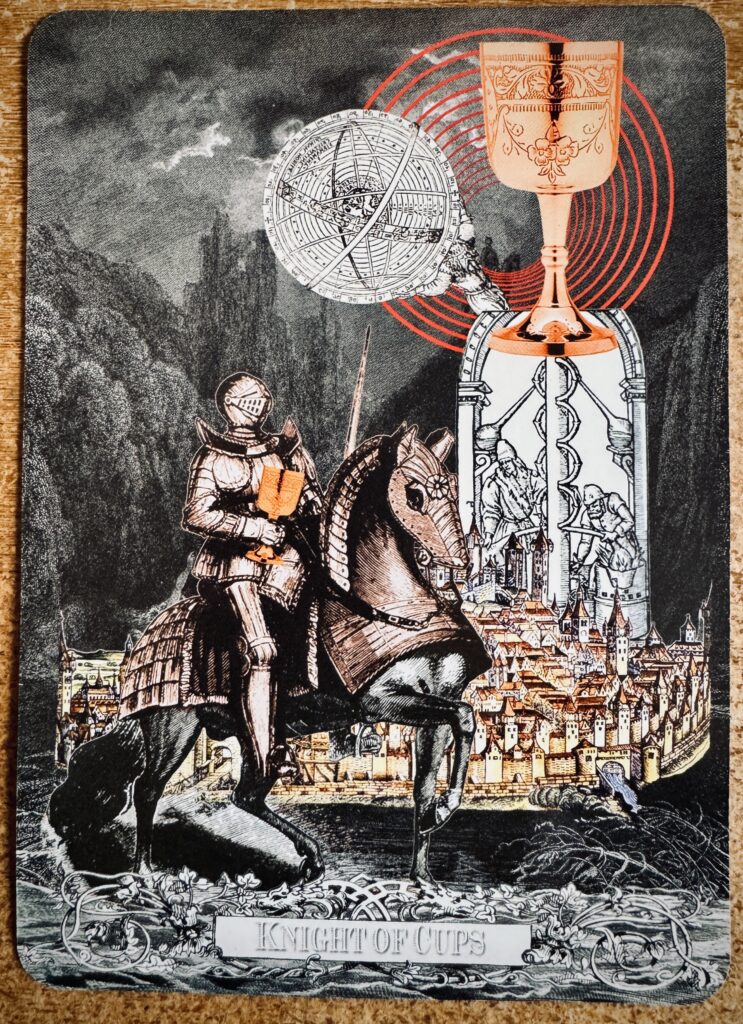
The Knight of Cups arrives first, which matters because of what he is carrying. The chalice has a dark streak. It may be cracked. It cannot yet fully hold its contents. He approaches with the vision and the calling but with a damaged container, and the card poses its question immediately: how does the chalice get repaired?
The answer is through the city ahead and not by fighting through it.
The chalice gets repaired by entering the city, stabling the horse, setting down the weapons, removing the armour, and confronting the ogre inside without any of it. The ogre must be befriended and integrated. The union of the ego with the negative aspects of the personality is what repairs the vessel, what allows it to hold the golden energy the Work generates.
The city is hidden between craggy cliffs, glowing with its own inner light at night. Inside, two gates. The unconscious flows in through the iron grate whether the knight invited it or not, coming in without asking. Consciousness enters through the open bridge. Both are present inside the city, and both must be dealt with. There is no passage where only one of them comes through. The moon above strengthens the process, working with what is already there rather than overwhelming it with external light. The celestial feminine as an amplifier, not a source.
Yesterday was the city without armour.
The fallow day, the spinning wheels, and the pressure rising from below: all of that was the ogre in the city. The form it took was the question about production, about whether the inability to generate output was evidence of some deeper structural failure. The ogre always wears a practical disguise. It arrives as a legitimate concern about time or relevance or money and only reveals its real face once you are inside the city gates with it.
The response this morning wasn’t to fight it down or armour back up against it. Something quieter. Knowing what to do when you don’t know what to do. Turning toward the practice rather than away from it: the writing, the cards, the walking. The body holds knowledge that precedes the doubt. Twenty-five years of interior work leaves a residue, a cellular memory of how to return to the centre when the mind is spinning. That is the psychic work that repairs the chalice.
The city generates its own illumination. It always did. Entering at night is what it takes to see it.
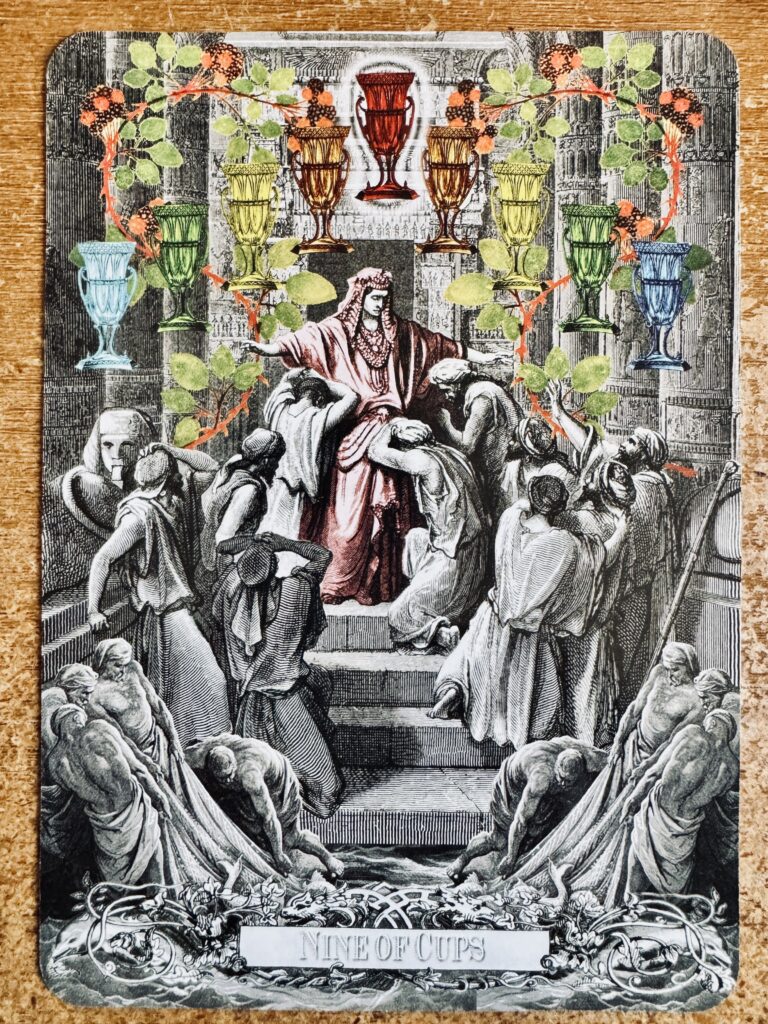
The Nine of Cups sits at the centre of the spread wearing red.
Rubedo. The Great Work is in its final stages of completion. The traveller who has moved through all four elements and ascended the four steps holds the Philosopher’s Stone within reach. The chalice at this stage has been repaired by the interior work. The golden energy can be held and dispensed freely. The traveller is generous and kind and genuinely empathetic because the road has made them so.
The four steps to the throne matter enormously. Earth, water, air, fire. Jung’s four functions. You don’t arrive at that seat by bypassing any of them. The water step is the psychic dissolution, the monsters of the deep. The throne is only accessible because the traveller went through the water, not around it.
The figure is androgynous, which is worth sitting with. It has integrated enough that it can’t be pinned to one side of any binary. Psychic wholeness in this deck looks like a movement into something that holds all of it, rather than a resolution where one part wins. Androgyny isn’t a detail about gender. It is a statement about what the Work produces: something that can no longer be halved by the question.
But the centre card carries a warning as pointed as any sword.
Adulation is dangerous. The people around the throne are a trap as much as they are a sign of the traveller’s bounty. The life of blessing others is genuinely fulfilling and genuinely good and genuinely insufficient because it requires abandoning one’s own journey. Because the adulation becomes habit-forming. Because ego inflation stops spiritual growth in its tracks. The traveller faces a terrible choice: continue the life of public good or go deeper into internal psychic wholeness, which could bring the world an even greater good.
This is the performing versus doing tension I named in the Rosebud session this morning, stated in alchemical terms. The pull toward visibility, the freelancer’s anxiety about which platform carries which audience, and the question of what to post and when and for whom: all of that is the adulation trap wearing practical clothing. The social media performance anxiety and the “If I can’t produce, what chance do I have?” are the same voice, one dressed as ambition and one dressed as fear. Both of them are the sound of the traveller’s attention drifting from the work toward what other people are doing with their chalices.
Document, don’t create. That is my answer to the traveller’s dilemma. Follow the inner journey for its own integrity, and offer what arises from that freely, rather than crafting content for reception. The difference between those two things is the difference between a city that generates its own light and a city that keeps the floodlights on. Both are illuminated. Only one of them knows where the light comes from.
The performance is the throne without the four steps.
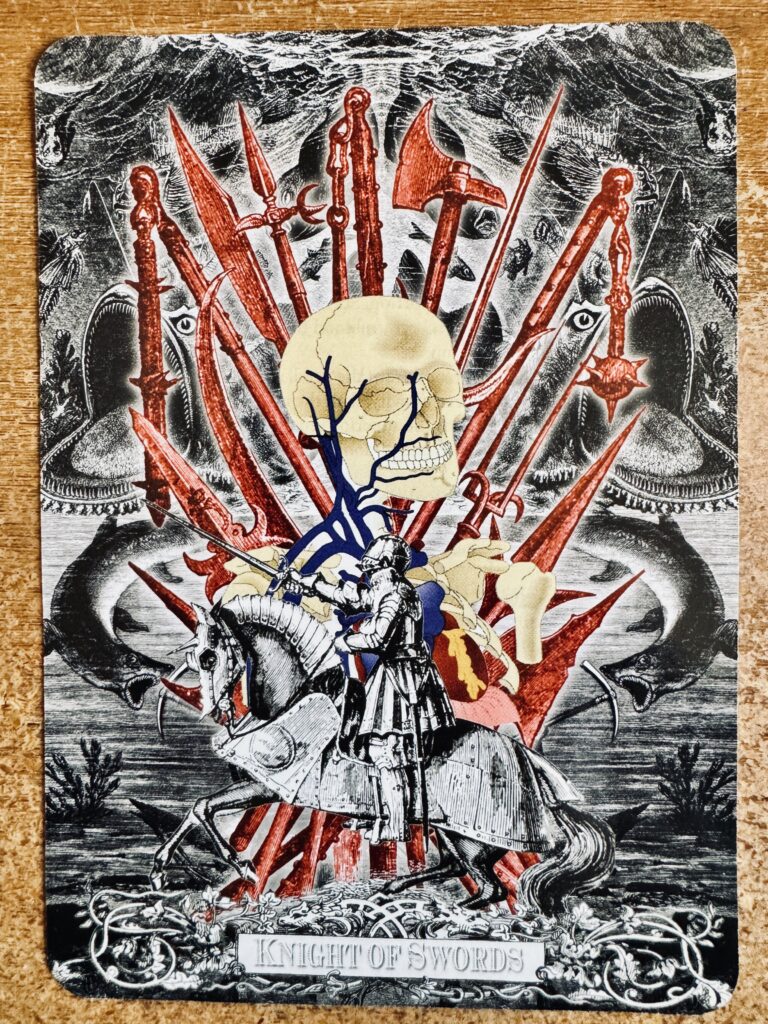
The Knight of Swords carries all of this forward in the most extreme way possible.
Taussig is unambiguous: the scene is completely underwater. The drama of this card takes place inside the unconscious. The fish aren’t coming at the knight from outside his world. He has entered theirs. He has ridden down into the psychic depths deliberately, armoured, sword extended, charging through the monsters of the deep on the way to the treasure. The Magnum Opus. The Great Work.
That reframes yesterday entirely. Goethe’s line is exact: through water all things must be destroyed before they can be reborn. The fallow day, the regression to the fluid state, and the dissolution: water is the element all substances must be reduced to before they can emerge, purified. Going underwater is an alchemical necessity. You went underwater yesterday. Today you came up charging.
Unlike the city work, this charge is done fully armoured. The armour makes the charge possible at all. The accumulated practice, twenty-five years of work on the inner life, the military training, the daily journaling that has never stopped, the walks, the tarot, the interior work done in the city without weapons: all of that is what lets you ride your instincts into the deepest water rather than be consumed by it. The charge is the act of will made possible by everything that preceded it.
The armour distinction carries a second reading worth naming. Two interpretations, sitting side by side. The first: the armour allows you to ride your instincts bravely into the unconscious, the accumulated practice as protection, as what makes the descent possible at all. The second: the armour becomes the Persona itself, so hardened it protects you from change rather than enabling the charge. A shell rather than a suit. The question isn’t which reading is true. Both are, depending on the moment. The question the card puts is which one is active right now, in this particular descent, and whether what you carry into the water is a working instrument or a defence against being changed.
The hands are where it gets personally sharp.
Right hand on the sword: intellect and logic, the conscious frameworks, the Narrative Alchemy structures, the systems thinking, and the public articulation. The left hand guiding the horse: intuition and creativity, the subconscious steering the direction, the walks, the journaling, the tarot, and the inner work. Taussig is explicit that both are required. Neither hand wins. The sword without the reins is performance. The reins without the sword is drift. The performing versus doing tension resolved in a single image: both hands on the job, the intellect extended and the intuition steering, neither dominant, both necessary.
Now the spread reads as a complete alchemical sequence.
The Knight of Cups is approaching the city at night with a cracked chalice, doing the unarmed interior work that will repair it. The Nine of Cups traveller enthroned in the rubedo stage, facing the choice between adulation and deeper wholeness. The Knight of Swords is charging fully armoured through the underwater darkness, which is only possible because the interior work has been done first. The three figures are working on the same thing from different positions in the same territory.
The middle card is the vision of what the Work produces and the choice being faced right now, this morning, after the fallow day and before the next charge.
This spread holds the full complexity of the Work as it stands. The interior city works without armour, facing the ogre, repairing the vessel. The choice at the centre between adulation and deeper wholeness. The underwater charge through the psychic darkness with both hands active. These are simultaneous modes of engagement with the same process, all present on the same morning. The error is reading them as stages to be worked through in order and left behind.
The Knight of Cups and the Knight of Swords are in the same territory as the traveller on the throne. The red of the rubedo in the centre card is the same alchemical fire as the red swords in the Knight of Swords. The charge through the unconscious and the figure who has nearly reached the Philosopher’s Stone aren’t separated by vast distance. They’re in the same stage of the Work.
And none of the cards are set in daylight. That keeps demanding attention. The whole drama of this reading happens at night, underwater, in temple time. The surface world of presentations and platforms and production anxieties doesn’t appear in any of the three cards. Not even in the Nine of Cups, the most outward-facing of the three, where the traveller sits enthroned and surrounded. Even there, the setting is interior, removed from ordinary time. The Work doesn’t happen up there, in the daylight of results and receipts and follower counts. It happens here, in the dark, with the city’s own light.
Yesterday was the regression to the fluid state, the dissolution of the water demands before things can be destroyed and reborn. Today the chalice is a little more whole, the traveller’s choice a little clearer, and the charge a little more sure.
Tuesday, 12 May 2026