Walking Through the Wreckage of Rock: A Guns N’ Roses Reflection

Let’s light a cigarette in the rain-soaked alley of rock history and listen to the myth of Guns N’ Roses—a band born from chaos, glam, and raw street poetry. Their story isn’t clean. It’s messy, electric, soaked in whiskey, and screamed through Marshall stacks. But that’s what makes it mythic.

The Origin: A Collision on the Sunset Strip

Los Angeles, 1985. The Sunset Strip was a neon-lit jungle teeming with leather, eyeliner, and dreams of stardom. In this high-octane scene, two local bands—Hollywood Rose (featuring Axl Rose and Izzy Stradlin) and L.A. Guns (with Tracii Guns and drummer Rob Gardner)—cross-pollinated. When Tracii Guns and his crew dropped out of an early tour, Axl merged the names and formed a new beast: Guns N’ Roses.

The classic lineup took form like a rock ‘n’ roll Big Bang:

  • Axl Rose – a volatile, ferocious frontman with a voice that could shift from serpentine whisper to banshee wail.
  • Slash – a top-hatted guitar shaman whose solos felt like spells cast in fire.
  • Duff McKagan – punk-tinged bassist from Seattle, bringing street grit and sharp instincts.
  • Izzy Stradlin – rhythm guitarist and low-key songwriter, channeling Keith Richards vibes.
  • Steven Adler – a drummer with a swing that made the chaos danceable.

This wasn’t just a band. It was a beautiful accident of alchemy, where five misfits with different styles created something volatile and transcendent.

The Rise: Appetite for Disruption

Their first major gig was a hell-ride to Seattle in a broken-down van. By the time they got back, something had clicked. The wild energy of that tour became lore—and their demos soon got the attention of Geffen Records, who signed them in March 1986.

Then came the thunder.

1987: Appetite for Destruction dropped like a Molotov cocktail into the world of overproduced ’80s rock. The album was raw, unapologetic, and real. It didn’t chart at first—until MTV reluctantly aired “Welcome to the Jungle.” Then it exploded.

By 1988, Guns N’ Roses had become the most dangerous band in the world. “Sweet Child o’ Mine,” “Paradise City,” and “Mr. Brownstone” made them gods of the airwaves and anti-heroes of a generation.

They weren’t just popular—they were elemental. Fire. Sex. Rage. Beauty.

The Fracture: Fame, Excess, and the Slow Burn

As the fame rose, so did the cracks. Drugs, egos, and legal problems crept in like shadows at the edge of the spotlight.

Steven Adler was the first to fall—his heroin addiction made it impossible to keep time, and he was fired in 1990. Matt Sorum took his place.

Axl, increasingly mercurial and control-obsessed, began turning Guns N’ Roses into a kind of personal opera. The others weren’t aligned with his vision. Meanwhile, Slash and Duff wanted to keep the raw edge. Creative differences widened into chasms.

1991 saw the ambitious double album release: Use Your Illusion I & II. These albums were sprawling epics—full of orchestration, piano ballads, and hard rock fury. They debuted at and , respectively. The tour was legendary but chaotic—delays, riots, and on-stage rants from Axl became common.

By 1993, the band was fraying. Izzy had already left. Slash and Duff were growing increasingly alienated. The original fire had become smoke.

The Collapse: Silence and Shadows

By the mid-‘90s, the myth was bleeding out. Slash officially left in 1996. Duff followed in 1997. What remained was Axl and a rotating cast of musicians.

Guns N’ Roses went silent for years. Axl disappeared like a phantom king in exile, tinkering obsessively with what would become the long-delayed Chinese Democracy (finally released in 2008 after more than a decade of delays and over $13 million in production costs).

The Rebirth: Not in This Lifetime… but Yes

Then, the unexpected: in 2016, Slash and Duff reunited with Axl for the Not in This Lifetime Tour. It was one of the highest-grossing tours of all time. Though Adler and Izzy didn’t return full-time, the core fire was rekindled.

And there it is—the mythic arc:

  • A street-born band crashes into stardom,
  • flies too close to the sun,
  • and, years later, emerges from the ruins with scars and stories.

Journal Prompt

What part of you once burned too hot—then collapsed under its own fire—and might still have embers glowing beneath the ash?


The Playlist

The Turning of the Wheel

Wisdom Walk Contemplation

Card of the Day: “Change” – X, Major Arcana, Osho Zen Tarot

In the spiralling galaxy of the soul, there are no straight lines—only cycles, spirals, and sacred turns. This morning, the card that emerges from the silence is Change—X in the Major Arcana of the Osho Zen Tarot. Like the Wheel of Fortune in the Rider-Waite deck, this card is the great turning, but here it hums with a more cosmic vibration. Yin and yang swirl at the centre, surrounded by elemental glyphs and zodiacal wisdom, reminding us that transformation is not a detour—it is the path itself.

Change, in this context, is not just situational—it’s existential. It’s not merely the pivot of events but the pulse of the universe breathing through your life. Look closely: the centre is still, even as the wheel spins. Lightning crackles, symbols orbit, and yet the eye of the storm remains calm, alert, eternal.

In the mythic imagination, this card is the ever-turning wheel of becoming. Think of Shiva’s dance, ever destroying and creating. Think of the Phoenix, not as a bird, but as a process—ash, fire, wing, ash again. Nothing here is fixed. Not your identity. Not your roles. Not your suffering. Not your story.

So the invitation this morning is not to hold on but to participate. To remember that you are both the spoke and the centre, both the turning and the stillness. You don’t control the wheel—but you can choose how to meet the movement. Will you resist and suffer, or spiral inward toward the soul’s deeper rhythm?

Three Questions for Your Journal or Morning Walk:

  1. What season of change am I currently in—initiation, descent, transformation, or return?
    (Let your body answer before your mind does.)
  2. Where in my life am I clinging to stability that no longer serves my evolution?
    (Name it gently. Honour what it gave you. Then loosen your grip.)
  3. If I were to dance with the change instead of resisting it, what would that look or feel like?
    (Describe it in motion—gesture, sound, or symbol.)

Let today be a day of sacred turning. Not a break from your life, but a re-entry. Not a correction, but a continuation. The Wheel is not against you. It is you. Turning, always turning, toward the next version of your becoming.

Awakening the Mythic Imagination: Reclaiming Your Life Through Story

Imagine, for a moment, a fire crackling in the heart of an ancient forest. Sparks leap like tiny stars into the velvet dark, spiralling skyward in silent communion with the heavens. You sit close enough to feel the fire’s gentle warmth kiss your skin, hear its whispers blending with the wind’s hushed secrets. Around you, shadows dance in graceful rhythms, conjuring figures both familiar and strange—spirits of myth, ancestors of imagination.

We’ve all felt it, haven’t we? That subtle tug toward the stories whispered in flame and shadow, a primal longing for something deeper, something woven from the threads of mystery itself. This is the pulse of the mythic imagination, an ancient inner campfire around which your soul has always gathered, even when you forgot its presence.

In earlier times, the storyteller—the griot, the bard, the sage—gathered us around flames much like these, sharing myths that shaped worlds, built cultures, and whispered the hidden truths of our humanity. Today, though the external fires may be fewer, that inner flame still burns. It waits patiently within your being, ready to illuminate your path and reveal the deeper stories shaping your life.

Consider for a moment: what myths are you quietly carrying? What subtle narratives have nestled in your soul, shaping your choices, your identity, your entire way of seeing and being in the world?

Perhaps these myths arrived gently, passed down by elders or found in the pages of cherished books. Or maybe they were imposed silently by culture’s hidden hand, stories of who you “should” be and how you “should” live—whispered persistently enough that you mistook them for truth. But the mythic imagination, the flame inside, offers something radical: the chance to reclaim, rewrite, and rediscover those very myths that shape your existence.

Tonight, sitting together at this inner fire, I invite you to lean closer. Let us journey beneath the surface of your everyday narratives and explore the mythic imagination—the living, breathing stories that shape your soul’s quest.

Gaze into the flames. Listen to the fire’s ancient murmurs. Feel its warmth kindle the spark of recognition deep within.

And as you do, ask yourself gently:

“What myth has brought me here, and what story within my soul is aching to be remembered?”

Mythic Imagination: A Doorway into the Deep

Within every heart lies a hidden door, inconspicuous to casual observers, yet sacred and waiting patiently for the curious seeker. On its surface, you might see nothing more than weathered wood, ancient hinges, and the faintest shimmer of something strange and unknowable. It seems ordinary enough to overlook—but approach it with intention, open it even slightly, and you’ll find yourself stepping onto a threshold where reality deepens, richens, and transforms before your eyes.

This is the doorway of the mythic imagination, the entryway into the hidden rooms of your inner world—the places where life ceases to be merely lived and begins to be narrated, mythologised, and imagined into meaning.

James Hillman, that wise explorer of the psyche, tells us that myths are not merely old stories from dusty books. They are the natural language of the soul, whispered by our dreams, echoed in synchronicities, and glimpsed in the poetic rhythms of our days. They come to life precisely when we stop trying to decode them intellectually and instead allow ourselves to dwell within them, sensing their rhythms and reverberations in the marrow of our being.

I recall vividly the first moment my own mythic imagination stirred awake. It was on a solitary walk through woods thick with the quiet hum of summer, sunlight breaking gently through the canopy like scattered pieces of gold. Lost in thought, perhaps distracted by trivial worries or fleeting concerns, I nearly missed the delicate object resting on the path—a single raven feather, dark as ink, glossy in the sun. As I lifted it, feeling its weightlessness yet sensing a strange gravity, the world shifted subtly around me. In that instant, I wasn’t merely holding a feather—I had stepped into a story.

That simple feather became a symbol, an emissary sent by some deeper narrative asking for attention. It was no longer an object but a metaphor, an invitation, perhaps even a messenger from Odin or Morrigan—archetypes whispered to life by the mythic imagination. What once seemed random had become sacred; the mundane world opened itself to reveal layers of hidden meaning. The raven feather had become my key, and through that seemingly ordinary encounter, my mythic imagination ignited.

This, friend, is what the mythic imagination offers you—a deeper way of seeing, one that transforms the ordinary world into an enchanted realm. It invites you to notice feathers and whispers, dreams and symbols, tarot cards and chance encounters, as doorways into deeper narrative truths. It calls you to see your life not as a mundane progression of events but as a rich story of mythic significance.

The question is never whether this hidden door exists, but whether you dare to open it.

And so I ask you gently, with curiosity and reverence:

What quiet symbols or subtle synchronicities have recently entered your world, whispering an invitation into deeper meaning? What myths might they be offering you, if you choose to step across their threshold?

The Stories We Inherit

Imagine standing on the shore of a river, its waters flowing ceaselessly onward, whispering ancient secrets and carrying forward the dreams, desires, and myths of countless generations. We are each born along this river, swept into currents of stories not entirely our own—tales told long before our first breath, beliefs shaped long before our first thoughts formed.

These are the inherited stories, the unseen myths that guide our lives from within shadows. Some of them nourish and inspire, illuminating paths toward meaning and fulfilment. Others quietly bind us, weaving threads of obligation, expectation, and conformity that can subtly constrict the soul’s longing.

Joseph Campbell speaks eloquently of the “mono-myth”—the hero’s journey—that universal narrative embedded within every culture. Yet alongside this nourishing myth live other, less empowering stories: myths of success as wealth and acclaim; myths of worthiness tied to productivity; myths of identity bound up in endless striving. Each of these stories whispers insistently, shaping what we value, how we act, and who we believe ourselves to be.

I have felt the weight of these inherited myths deeply in my own journey. Once, early in my career, I found myself chasing the relentless myth of achievement—an unconscious quest for validation through success as defined by society’s yardstick. The promotions, the titles, the applause: each milestone was supposed to bring meaning, yet each felt emptier than the last, an echo without source.

It wasn’t until I stepped away, retreating into the solitude of reflection and journaling, that I finally glimpsed the hidden story that had silently shaped my path. In my notebook, I traced back through my choices, mapping my beliefs like constellations. Gradually, patterns emerged—myths whispered by culture, family, schooling, media. I saw clearly how this inherited narrative had defined success as external validation, approval measured by others’ standards rather than my own soulful truth.

Through the mythic imagination, however, I discovered another way: the power not only to see these stories clearly but also to reclaim and rewrite them. Sitting by the metaphorical fire within my soul, I began crafting new stories—stories that embraced deeper truths, stories in which success was no longer a relentless pursuit but a meaningful alignment with purpose, creativity, and joy.

This shift was subtle yet seismic. It was as if I stepped off a familiar but exhausting road and entered a winding path leading through mythic landscapes of my own making. The myths I chose to live by transformed, from shadows quietly directing my steps into lanterns illuminating the journey ahead.

And so it is for each of us. To awaken your mythic imagination is not simply to dream vividly or poetically—it is to recognise clearly the stories you’ve inherited and consciously choose the ones you wish to carry forward. It’s an act of reclaiming, rewriting, and reshaping your very self, story by story, into a more soulful truth.

Let’s pause together at this riverside, then, and gaze into the reflective waters with gentle curiosity. Ask yourself:

“Which stories have guided my life without my conscious consent? Which myths of success, worthiness, or identity am I ready to lovingly release—and what new story is ready to be born in their place?”

Archetypes and Allies

In the quiet moments when the world’s clamor recedes, you can hear the soft footsteps of archetypes moving gracefully within the corridors of your soul. Archetypes—those primal, luminous figures of the collective unconscious—are not distant abstractions; they are your allies, your guides, companions whispering wisdom from realms deeper and older than memory itself.

Carl Jung taught us that archetypes reside in the psyche, timeless patterns that weave themselves into myths, dreams, and symbols. They appear as familiar strangers, embodying aspects of ourselves we’ve forgotten or never consciously known. To awaken your mythic imagination is to welcome these archetypes home, inviting their stories, wisdom, and power to dance within your own lived narrative.

In my own journey, four archetypal allies have emerged clearly—Prometheus, Sophia, Thoth, and Odin—each representing facets of my mythic imagination, each illuminating different corners of my psyche.

Prometheus, the fire-stealer, speaks boldly within me, reminding me always of the power of creativity, rebellion, and illumination. He dares me to challenge the gods of convention, to seek truths hidden in shadows, to trust that wisdom often lies in the courageous theft of forbidden insight. Prometheus, chained yet defiant, teaches me resilience in the face of struggle, perseverance in pursuit of the soul’s true fire.

Sophia, the divine feminine spirit of wisdom, whispers gently, guiding me inward toward contemplation, compassion, and intuitive understanding. She is the gentle muse who invites depth over surface, wisdom over information. Sophia appears in moments of quiet reflection, in dreams scented with jasmine and sandalwood, and in subtle intuitions that arrive softly, urging patience, care, and clarity.

Thoth, the ibis-headed scribe, guardian of words and keeper of knowledge, meets me in the interplay of story and symbol, writing and myth. He teaches that words have the power not only to describe reality but to shape it—each sentence a magical incantation, each narrative a subtle spell shaping consciousness itself. In my work as storyteller, griot, and myth-weaver, Thoth remains my constant companion, guiding my pen and illuminating the transformative power of language.

And then there is Odin—seeker of hidden wisdom, traveler of the nine realms, poet-shaman wandering between worlds. Odin invites me to embrace mystery and paradox, to see clearly through the eye of sacrifice, to grasp knowledge not by hoarding answers but by fearlessly questioning all assumptions. Odin reminds me that wisdom is won not through certainty but through courageous exploration, through willingness to face the unknown.

Each archetype has revealed itself through rituals and practices—through journaling, tarot, mythic reflections, and storytelling. Each has become more than symbolic: they are companions whose presence deepens and enriches my mythic imagination, reminding me that I am never alone on this soul-journey.

Once, during a tarot reading, Odin appeared to me vividly in the form of the Hanged Man—an image of sacrifice, surrender, and wisdom won through inversion. At first glance, the card startled me, echoing a fear of vulnerability. Yet as I allowed the archetype to speak, I recognised his profound teaching: wisdom arises precisely when we surrender control, when we accept the discomfort of uncertainty, when we dare to see the world from an inverted perspective.

In embracing Odin’s archetypal wisdom, I discovered new strength in vulnerability, new clarity in paradox, and new freedom in surrender. This is the mythic imagination’s great gift: archetypes become allies, and their stories transform from ancient fables into living truths guiding your daily life.

Pause for a moment here, and invite your own archetypal allies to step forward. Ask yourself gently:

“Which archetypes have been quietly guiding my journey? What wisdom are they whispering, and how might embracing their presence help me more deeply embody the myth I was born to live?”

Thresholds and Transformations

Picture yourself standing at the edge of a deep forest, twilight settling gently into the spaces between the trees. Behind you lies the familiar path, comfortable yet worn thin by the steps you’ve taken time and again. Ahead lies the unknown—a place both enticing and uncertain, lit only by moonlight and the quiet shimmer of possibilities unseen.

This place—the borderland between the known and the mystery—is the threshold, a sacred liminal space where profound transformations await.

Thresholds are at the heart of the mythic imagination. They signify moments of great transition, when the soul is called to leave behind old identities, beliefs, or ways of being, to step courageously into the unknown. Joseph Campbell described these thresholds as crossings, passages in the hero’s journey where the familiar world must be relinquished for deeper wisdom and true soul-growth to emerge.

In myth, these crossings appear vividly—a hero plunges into the underworld, ventures into an enchanted forest, or sets sail across a turbulent sea. But your thresholds, though subtler, are no less potent. They appear as career changes, personal crises, spiritual awakenings, or simply the quiet realisation that life as you’ve known it no longer fits the soul you’ve become.

I have known such thresholds intimately. One of the most profound came during a period when my life, outwardly successful and secure, suddenly felt empty and misaligned. I stood at an inner crossroads, knowing intuitively that to remain where I was would mean betraying the deeper call whispering from within.

The threshold appeared quietly, as thresholds often do, in a series of sleepless nights and reflective walks, in conversations that echoed with a strange, unsettling resonance. Eventually, the moment of crossing arrived—not with a dramatic flourish, but as a calm yet undeniable knowing that it was time to step forward, even without knowing precisely what awaited on the other side.

I crossed into a space of profound uncertainty, leaving behind familiar identities built around roles and accomplishments. Yet within that uncertainty, something extraordinary unfolded. My mythic imagination awakened fully, guiding me deeper into my inner landscape, helping me reclaim stories I’d forgotten, and illuminating new pathways toward authenticity and purpose.

In the mythic imagination, thresholds aren’t merely places of passage—they are sacred initiations. To cross them is to surrender to transformation, allowing yourself to be reshaped by forces deeper than the conscious mind. It’s a moment of trusting that beneath uncertainty lies the promise of renewal, a deeper alignment with the mythic story your soul seeks to embody.

Perhaps you, too, find yourself standing at such a threshold now, feeling its subtle pull, sensing the quiet whispers urging you forward into mystery. Perhaps your threshold appears as a quiet longing, an inner voice calling for change, or a restless knowing that life holds something deeper, richer, more aligned with your true nature.

As you linger at the threshold, know this: you stand in sacred company. Every hero, every seeker, every soul who has dared live authentically has stood exactly where you now find yourself.

Take a breath. Feel the gentle courage within.

Ask yourself softly, yet earnestly:

“What threshold am I standing at today? What must I leave behind to cross into the deeper story waiting patiently on the other side?”

Mythic Praxis: Living the Imaginal

There comes a time when myth ceases to be something you merely read or imagine and becomes something you live—a breathing, tangible practice that infuses your days with meaning and depth. This deliberate embodiment of the mythic imagination is what I call mythic praxis—the subtle yet profound art of weaving myth into the fabric of everyday life.

Mythic praxis invites you not only to see your life as a narrative but to consciously shape it through rituals, reflections, and symbolic acts that awaken your inner storyteller. It transforms ordinary moments into encounters with the sacred, turning your life into an ongoing dialogue between the tangible world and the imaginal realm.

I discovered the power of mythic praxis through simple but potent rituals—practices such as mythic journaling, wisdom walks, tarot storytelling, and soulful conversations with archetypal allies. These are not mere activities; they are quiet ceremonies that awaken the mythic imagination, inviting it to speak clearly and guide your steps.

Consider journaling: what might seem like a modest act of pen meeting paper becomes, through mythic praxis, a sacred invocation. When I journal, I open myself to the mythic dimensions of my experience, exploring dreams, symbols, and synchronicities. The blank page becomes a portal, the pen a wand, words the threads weaving together my lived story with deeper truths. Each entry reveals hidden connections, archetypal whispers, and subtle guidance, illuminating my path through the mundane toward the profoundly meaningful.

Similarly, wisdom walks—those reflective strolls taken without agenda, open-hearted and attentive—become journeys of revelation. On these walks, nature herself becomes an oracle: each fallen leaf, each murmuring brook, each passing cloud is imbued with symbolic resonance. A hawk soaring overhead might speak of clarity and vision; a winding trail becomes a metaphor for life’s unexpected turns. Mythic praxis is seeing these simple occurrences not as random events, but as meaningful signs, stories waiting to be deciphered by your mythic imagination.

Tarot storytelling is another powerful practice—one that merges symbolism with narrative intuition. The cards, rich with archetypal imagery, offer not merely answers but reflections of the stories living deep within your psyche. In drawing the cards and narrating their symbolic dance, you tap directly into the mythic imagination, discovering profound insights and reclaiming your agency as both storyteller and protagonist of your life’s unfolding tale.

Through these practices, mythic praxis reveals itself as a way of living poetically and intentionally. It reminds you that the mundane world is pregnant with symbolic significance, waiting only for your recognition. It transforms your relationship with reality itself, teaching you that each moment, no matter how ordinary, contains seeds of mythic meaning if approached with reverence and curiosity.

Moreover, mythic praxis deepens your intimacy with yourself and your connection to others. By living your myths consciously, you invite authenticity and vulnerability into your relationships, creating spaces where soulful conversations can flourish, rooted in shared stories and archetypal truths.

As you embrace mythic praxis, something beautiful and alchemical occurs: your life begins to resonate with mythic coherence. The threads of your story—once tangled, fragmented, or seemingly random—start weaving themselves into a meaningful tapestry. You realise, perhaps for the first time, that you are not merely living your life but authoring it, co-creating a story infused with intentionality, imagination, and soul.

Pause with me here, by our inner campfire, and reflect for a moment:

“How might I begin to consciously embody my mythic imagination each day? What rituals or practices could transform my ordinary moments into profound encounters with myth, meaning, and magic?”

Invitation: Becoming the Myth You Were Born to Tell

Our fire now burns low, its embers pulsing gently beneath the ash like a heartbeat—steady, quiet, waiting patiently to flare once more. Yet as our time here draws softly toward its close, this is not an ending; it’s an opening, an invitation to step forward from this sacred threshold into the deeper story of your life.

You see, the mythic imagination is never truly finished. It calls continually, inviting you deeper into the narrative currents that flow beneath your everyday existence. Each insight, each archetype, each threshold crossed is but one chapter in the ever-unfolding myth your soul is here to embody.

You were born with stories inside you—myths whispered into your being long before you took your first breath. To awaken your mythic imagination is to reclaim those stories consciously, to author your life with intention, courage, and soulful authenticity. It is the sacred act of remembering who you are beneath the layers of inherited scripts, societal expectations, and cultural narratives.

What story, then, is yours to tell? What myth pulses within your heart, waiting patiently, insistently, to be lived?

Perhaps you are Prometheus, boldly stealing fire to illuminate a path for yourself and others, daring to defy convention and claim your power of creation. Perhaps you embody Sophia, patiently guiding yourself and others toward wisdom, compassion, and intuitive knowing. Perhaps Thoth calls you, inviting you to shape reality through language, imagination, and the power of your voice. Or perhaps Odin whispers courageously in your ear, reminding you that wisdom is found in embracing mystery, paradox, and the unknown.

Whoever you are, whatever your myth, know this: your story matters. It is unique, sacred, and vital to the great story of human experience. To live your myth is not an indulgence; it is an act of profound courage, creativity, and compassion. It is a gift to yourself, yes—but also to the world, which aches for the richness, depth, and authenticity your true story offers.

Tonight, as you rise from this mythic campfire within, I offer you this gentle invitation:

Become the myth you were born to tell.

Live consciously, poetically, and mythically, transforming your everyday moments into encounters with the sacred. Step courageously across thresholds, welcoming transformation. Befriend your archetypes and allies, honoring the wisdom they whisper to your soul. And most importantly, trust deeply in your own narrative, knowing it to be exactly the story you need—and the one the world needs—from you now.

I leave you with a reflective prompt, a gentle question to guide you onward:

If your life were a myth—and it most assuredly is—what story would you choose to live, beginning today?

Hold this question tenderly. Allow it to linger. Carry it forward, not just as a thought, but as a quiet prayer whispered softly within your heart.

The mythic imagination awaits you. The story of your soul has only just begun.

The Leap Between Moments

wisdom walk contemplation

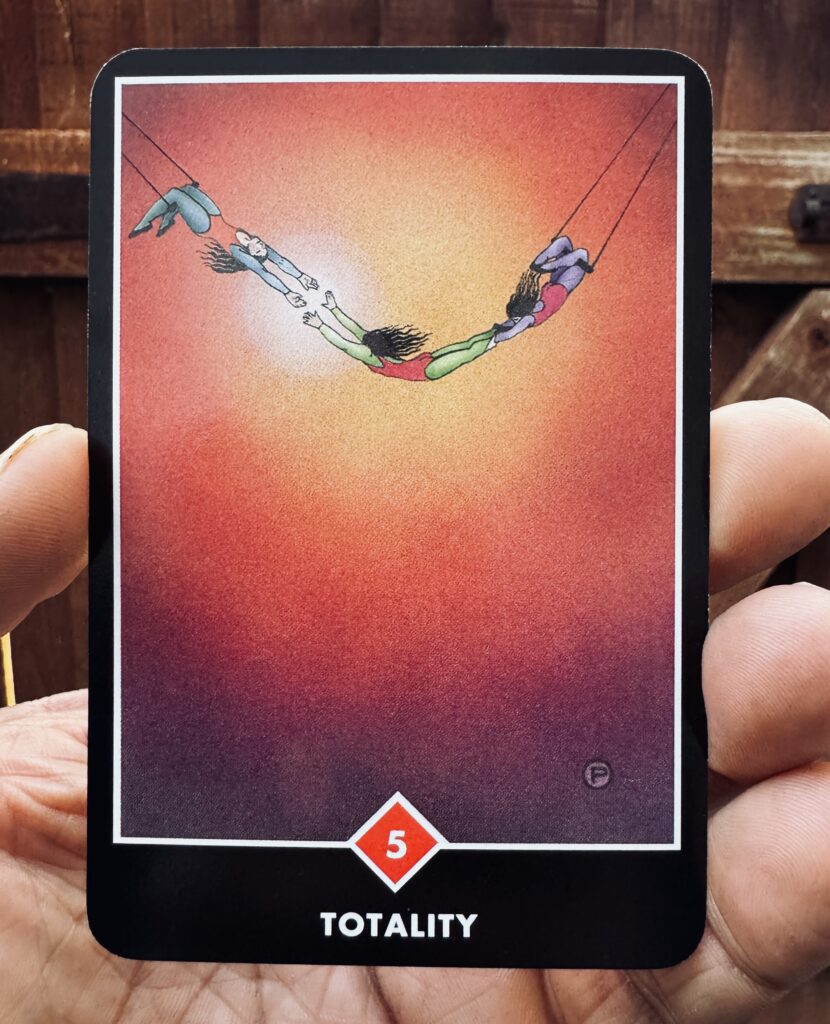
At the peak of the trapeze act, in that heartbeat between letting go and being caught, everything is on the line.

The card Totality captures that split-second moment suspended in trust, focus, and surrender. Three acrobats are mid-air, held not by certainty but by presence—each giving their all, knowing that hesitation would break the arc, and the fall would be inevitable. This is not a card of half-measures. It speaks to the luminous edge where mastery meets vulnerability, where control dissolves into flow.

In the mythic imagination, Totality is the realm of the Fool mid-leap, the moment before Icarus knows if he’ll soar or burn, the point in the story when the hero must commit, heart and bone, to the quest. No more testing the water. No more holding the rope with one hand. You are either in, or you are not.

To live in totality is to offer yourself completely to the moment—not recklessly, but wholeheartedly. It is not about perfection; it is about presence. The leap only works if you’re all in—mind, body, spirit, and will aligned like a tuned bowstring, aimed at the sacred now.

We spend much of life on the edge of that platform—delaying the jump, running rehearsals in our minds, waiting for the perfect conditions. But Totality doesn’t ask for your plan. It asks for your presence. Your Yes. Your sacred risk.

So I ask you, fellow storythinker:

  1. Where in your life are you still clinging to the swing instead of leaping toward what calls you?
    (What have you been hesitating to say Yes to?)
  2. What would it mean to give yourself fully to this moment, this work, this relationship, without holding anything back?
    (What would Totality look like in your current threshold?)
  3. What are you afraid will happen if you let go of control and surrender to full participation?
    (And what might happen if you don’t?)

Let these questions hang in the air like a moment of flight. Don’t rush the answers. Let them arise like wind through the silence. And when you’re ready—leap.

You Were Never Meant to Live an Unstoried Life

A Mythic Invitation for the One Who’s Ready to Remember

Somewhere between the rituals we forgot and the algorithms we obey, a quiet knowing stirs in your chest.

It speaks in the voice of ancient rivers and half-remembered dreams. It murmurs while you scroll. It calls when you walk alone. Not loud, but insistent. A whisper curled around a question:

“Is this really my story? Or just the one I inherited?”

If you’ve ever felt that—a tension beneath the surface, a restlessness that won’t be solved by productivity hacks or weekend escapes—then what you’re feeling isn’t a crisis.

It’s a threshold.

And thresholds are sacred.

They mark the end of one chapter, the hazy beginning of another. They’re the invisible spaces where something old dies so something true can be born. And you, dear meaning-maker, are standing at one now.

Not because you’re broken.
But because you’re being summoned.

🛠️ Enter: The Mythic Self Starter Kit

The Mythic Self Starter Kit isn’t a fix. It’s a flare fired into the dark, a map inked in soul symbols, a portable campfire for your next inner journey.

This isn’t self-help.
It’s soulwork.

Inside the kit, you won’t find to-do lists or 5-step plans. You’ll find mythic prompts, narrative frameworks, and journaling tools designed to help you do the most radical thing a modern human can do:

Reclaim your story.

Not the one you were sold.
The one you came here to live.

🔮 What’s Inside?

Here’s what you receive when you download the Mythic Self Starter Kit:

  • The Mythic Compass – A soulful framework to help you locate yourself mythically and narratively, not just chronologically.
  • Journaling Rituals – Introspective, mythopoetic prompts that draw from archetypes, thresholds, and inner quests.
  • A Myth-Mapping Process – So you can begin to see your life not as a random sequence of events, but as a meaningful myth unfolding.
  • An Invitation to Act III – For those in midlife or a moment of transformation, this kit helps you step into the myth you were born to tell.

And it’s more than just a PDF. It’s the opening move in a soul-chess game. A ritual disguised as a download. A mythic mirror designed to show you the shape of your becoming.

🗺️ Who Is It For?

The Mythic Self Starter Kit is for:

  • The midlife misfit who’s ready to rewrite the story they’ve been living on autopilot.
  • The meaning-seeker who senses something more and wants language for what they’re feeling.
  • The storythinker who understands that narrative isn’t just entertainment—it’s how we construct reality.
  • The soul-curious wanderer who wants deeper questions, not shallower answers.

In short: it’s for you, if you’ve ever looked around and thought, “This isn’t quite it—but I don’t know what is yet.”

✨ Why Myth? Why Now?

Because we are myth-starved.

Because most of what we call “self” has been pieced together from external scripts. Childhood conditioning. Cultural noise. Instagram algorithms. Education systems that taught us to obey rather than inquire.

And because deep down, you know:
There’s something inside you that’s ancient and electric.
A voice that hasn’t spoken in years.
A truth that isn’t found on Google.

That’s what the Mythic Self Starter Kit exists to awaken.

Not to teach you who you are.
But to help you remember who you were before language told you who to be.

🔥 Ready to Begin?

This is the first flame.
A flicker of the soul.
Not the whole path, but the invitation to walk it.

If you feel the pull—
If you’re tired of inherited scripts—
If you’re standing at the threshold and wondering if it’s time—

Then yes. It’s time.

Download the Mythic Self Starter Kit now
And begin the most powerful story you’ll ever tell:
your own.

Because you were never meant to live an unstoried life.
And your soul is too mythic to be mundane.

—Clay
Storythinker & Mythic Mentor for Seekers on the Threshold
Helping you rewrite the story beneath your story.

Reforging the Fires: A Reflection on My Core Values

The train pulled out of Banbury station with a familiar hum,
that soft metallic lullaby that always seems to loosen something in me.
Thoughts. Memories. Half-formed questions rising like mist through the morning fields.

I was on my way to London, travelling to facilitate a workshop on core values. It’s a ritual I’ve led more times than I can count. But this time felt different. Not because of the group or the content or the venue. But because of where I was, internally.

Before every values workshop, I like to revisit my own.
A kind of inner check-in.
Are the fires I’m tending still true?
Have I changed?
Have they?

This time, the answer was yes.

The past year has been a transformational arc in my life. It’s taken me through creative deaths and rebirths, through mythic recalibrations and soul-deep reinventions. I’ve let go of an old identity and stepped more fully into the one that was always waiting underneath.

A Storythinker. A Mythic Mentor.
A barefoot philosopher on a mission to help others rewrite the story beneath their story.

And so, somewhere between Banbury and Marylebone, with my coffee cooling beside me and my journal open across my lap, I went through the same process I was about to lead the London group through.

I asked myself,
What are the core fires I tend?
The values I live by, not in theory but in practice?
What truly shapes how I move through the world, how I create, how I guide others?

What emerged was not just a list.
It was more of a compass.
A living soul-map with six radiant points.
Each one a fire I can return to again and again to remember who I am and what I’m here to do.

Let me share them with you now.


🔥 The Six Fires I Tend

1. Self-Authorship

The story you were handed is not the story you must live.
I believe in reclaiming the pen.
I live by the myth that we are meant to shape our own narrative, not out of rebellion but out of reverence.
We become ourselves by choosing our own plotlines, not performing inherited scripts.

2. Lifelong Learning

Curiosity is a pilgrimage, not a phase.
I learn to stay alive. To stay alert.
Books, conversations, experiments, deep dives into forgotten corners of the internet — all of it feeds the fire. I don’t learn to be impressive. I learn to be in motion.

3. Mythic Imagination

To see with mythic eyes is to remember the world is alive.
I don’t just tell stories. I think in them.
Films become fables. Tarot spreads feel like dream logic.
Myth isn’t something I study. It’s how I see.
I live by the deeper patterns beneath appearances.

4. Freedom

Freedom isn’t ease. It’s fire.
To me, freedom is about living untamed.
Making choices rooted in soul, not in should.
It’s about trusting your own rhythms, even when they don’t fit the world’s calendar.
I’m building a life designed for inner sovereignty.
That’s a quieter kind of power, but it’s real.

5. Soulful Creativity

Creation is a conversation with the soul.
I don’t create content. I create rituals.
Zines, prompts, podcasts, workshops — these aren’t products. They’re portals.
For me, creativity is a devotional act, a way of weaving inner truths into outer form.

6. Sacred Kinship with Nature

The Earth is not background. It’s home.
I find my deepest clarity out on a woodland trail, or alone by the sea, or walking through dawn mist with no destination in mind.
Nature doesn’t inspire me.
It recalibrates me.
It reminds me I’m not a machine. I’m a creature. And my soul lives closer to the ground.

Why These Values Matter to Me

These six fires guide everything I create.
They shape the mythic journaling prompts I write, the Soulcruzer podcast and webzine, and the digital rituals and learning journeys I build for storythinkers and seekers on the edge.

They remind me that I’m not here to be efficient.
I’m here to be true.

Not to master life.
But to meet it mythically.
Soulfully.
Fully.

If these values resonate with something stirring in you — if you feel the call to reclaim your story, reconnect with nature, and reimagine your life as a living myth — then I’d love to offer you a place to begin.

Download the Mythic Self Starter Kit — a free guide to help you explore your own personal mythology, revisit your core values, and start rewriting the story beneath your story.

The fire is lit.
The threshold is open.
Let’s walk this next chapter together.

– Clay

The Mustard Seed Covenant

yellow flower field under blue cloudy sky during daytime

Long before the skyscrapers and the algorithms, before success became a number or a brand, there was only the earth, the sky, and a barefoot wanderer with a dream burning inside him like a hidden sun.

Maybe it was Jesus standing in the fields, brushing the dust from his hands as he spoke of mustard seeds—the smallest of all seeds, he said, and yet, when planted and protected, it would become the greatest of all trees, sheltering even the birds of heaven.

Or maybe it was you, walking barefoot across the wet grass, feeling the aliveness of the earth humming up through your soles. Maybe it was in that quiet moment that you remembered:
To move mountains, to forge a life worthy of your soul, you don’t need certainty from the world.
You need a seed of true belief.
You need a knowing so deep that no gust of doubt, no scorn from the sidelines, can tear it from your hands.

Every great work—every myth that changed the tide of history—began not with confidence but with conviction.

Confidence is brittle. It demands evidence, applause, and momentum.
But conviction—real belief—is subterranean. It grows in darkness. It is the taproot you sink down into the hidden aquifers of life.

This is what the ancient ones knew. The ones who built cathedrals they would never live to see completed. The ones who painted in caves by torchlight. The ones who whispered songs to crops, trusting the earth long before harvests came.

They knew:
You must be a true believer in your own vision, even when the world is still sleeping.
Especially then.

And so the question comes to you, standing barefoot at the threshold of your own becoming:
Will you swear loyalty to the mustard seed within you?
Will you guard it against the slow erosion of doubt?
Will you believe so fiercely that the mountain has no choice but to move?

This is the true covenant.
Not with outcomes.
Not with recognition.
But with the life inside you asking to be lived.


Journaling Prompt:

The Mustard Seed Within

Settle somewhere quiet. Close your eyes and imagine your inner world as a great and wild garden. Somewhere in that garden, a tiny seed is waiting—your deepest knowing, your truest vision.

Now ask yourself:

  • What is the mustard seed I am carrying? What small but sacred knowing have I been entrusted with?
  • Where in my life am I letting doubt erode my covenant with it?
  • What would it look like, sound like, and feel like to tend this seed daily, with the faith that it will become a mighty tree in its own time?

Write for at least 10–15 minutes without editing or censoring. Let yourself be a scribe for your own soul.

Optional bonus: Close your journal entry by writing a personal “Mustard Seed Covenant”—a vow to protect and nourish your true belief, no matter what storms may come.


As you finish this reflection, imagine you’re placing a hand over your heart—feeling not just your pulse, but the pulse of the seed sleeping inside you. It does not demand urgency. It does not bargain for proof. It only asks for your loyalty.

Walk gently this week, friend. Walk barefoot if you can. Feel the earth beneath you and remember:
The power to move mountains lives not in noise nor in numbers but in a single, stubborn seed of belief.
It is enough.
It is everything.

Keep the covenant.
Tend the flame.
And trust the tree that is already growing inside you, even now.

The White Rabbit Lied: On Time, Calling, and the Slow Fire of a Soulful Life

There’s a scene from Through the Looking-Glass that’s always struck me—not the tea party or the queen’s croquet game, but the quiet absurdity of the Red Queen’s line: “It takes all the running you can do to keep in the same place.”

A perfect parable for modern life, isn’t it?

We are not just late—we’re chronically, cosmically behind. Behind the version of ourselves we should have been by now. Behind inboxes and algorithms and the endless scrolling pursuit of the Next Big Clarity. We carry clocks in our pockets and wear productivity like armor, but most days we still feel like ghosts in our own story, chasing someone else’s definition of “on time.”

The White Rabbit? He’s not a guide. He’s an anxiety archetype. A trickster in waistcoat and whiskers, ushering us not toward wonder, but urgency.

But calling? Calling is different. It doesn’t shout. It doesn’t rush. It doesn’t even ask to be efficient.

Calling is slow fire. It’s the work of a soul returning to itself.

And no, calling has nothing to do with religious beliefs. It’s not a divine job title bestowed from on high. It’s more like a whisper in the bones. A felt sense that your life isn’t a project to be completed but a field to be tended. Not a race, but a rhythm.

The rhythm of calling rarely aligns with the clock. It unfolds in spirals, not steps. In revisits, not resolutions. In mistakes made, mistakes mourned, and mistakes mined for mythic gold.

To be called is not to know. It’s to listen longer.

I often hear the lament: Who has the time these days to do the research, learn, reflect, make a mistake, try again? And I get it. We’ve replaced initiation with instruction, curiosity with content, wonder with hacks. But calling refuses to be rushed. It lives in the spaces between productivity. It hums underneath the noise.

So maybe the real question is not “Who has the time?” but “What kind of time do we want to live inside?”

The philosopher Abraham Heschel once wrote: “It is not a thing that lends significance to a moment; it is the moment that lends significance to things.” That line stays with me. Because the work of a lifetime isn’t measured by output, but by presence. Not by speed, but by soul.

Calling is not a task to complete. It’s a lifelong dialogue. A ritual return. A gentle rebellion against all the scripts that tell us we’re behind.

You don’t answer your calling once. You answer it again and again, each time in a new voice. And maybe the point is not to say, “I’ve done calling. What’s next?” Maybe the point is to say, “I’m still listening.”

Still learning the timbre of your own myth. Still making time for the sacred work of trial and error, falling and re-forming. Still holding space for a life that matters—not in the eyes of the market, but in the marrow of your being.

✍️ Journal This:

  • If your calling had no deadline, what shape would it take today?
  • What would it sound like if it didn’t need to be productive, only meaningful?
  • What truth do you keep postponing until there’s “time,” and what would it take to make space for it now?

You’re not behind. You’re becoming.

And that… is the work of a lifetime.

Walk As the Path

Last night, I dreamed of a question.

I was sitting in a circle with others—fellow seekers, perhaps—and someone asked me, Which medium do you want to carry forward? Which path will you walk? And without hesitation, I answered: writing.

When I woke, the answer still rang clear. Not just as a preference, but as a remembering. Writing is not just what I do—it’s how I am. It’s how I walk the world. How I gather fragments of meaning, soul-moments, and story-signals, and shape them into something that speaks to others. Words are how I reach out to my tribe—those scattered souls who are also trying to live a life of meaning, on purpose, with soul.

And lately, I’ve been feeling it more deeply than ever.
This call to be truer to myself—not someday, not later, not when the time is right, but now. To live as fully me as humanly possible. To walk the talk, yes—but also to walk as the talk. To be the thing I’m saying.

This morning, I went for one of my Wisdom Walks. The kind where the thinking quiets down and the listening begins. Where the world, if you pay attention, speaks not in sentences, but in signs.

And as I walked, it became clear:

I’m not preparing to live my myth.
I am living it.

Not in some grand, heroic sense—but in the simple, soulful loop I’ve been walking for a while now:
Reflect → Walk → Gather → Create → Share → Repeat.

Each loop is a cycle of becoming. Each message I write—whether blog post, email, or audiogram—is a soul signal. Not “content,” but a call. A way to say:
Here I am. I see you. Let’s walk together.

This morning, after my walk, I pulled three cards from the Osho Zen Tarot:

Trust. Aloneness. Guidance.

And just like that, the inner reflection became an outer echo.

Trust showed me the leap—the willingness to walk without knowing the entire map. That’s what writing is for me. That’s what these messages are. Leaps into the unknown.
No guarantee, no safety net. Just the inner knowing: This is what wants to be said today.

Aloneness reminded me that this path I walk is solitary at times—but not lonely.
It’s the Hermit archetype: not isolated, but sovereign.
Carrying a lantern not just for my own steps, but to light the way for others who might be nearby in the dark.

And Guidance whispered something I needed to remember:
I’m not doing this alone.
There are invisible hands, synchronicities, inner voices, outer reflections.
Conversations like this one—between me and you, dear reader—are part of that guidance.
We teach each other. We mirror each other. We remind each other who we are.

So today, if my life were already in full alignment—if my being, doing, and offering were one seamless soulstream—I wouldn’t do anything differently.

I’d do exactly what I’m doing now.
I’d wake up, walk the walk, listen deeply, and then send out what I’ve heard.

Not to be productive. Not to perform. But to participate.
To stay in the rhythm of the real.

That’s what I want, more than anything:
To live a meaningful, soulful, purposeful life.
To let my work and my play be one and the same.
To stop asking, “Am I on the path?”
And instead, just walk the path.

Because I am the path, walking.
I am the fire, burning.
I am the story, unfolding.

And so are you.


✍️ A prompt for the road:

If your life were already in full alignment,
What would you create today?
Who would you reach out to?
And how would you show up—right now—as if it were already true?

THE RITUAL OF SACRED STEPS

A soul-guided reflection for transforming an ordinary walk into a mythic pilgrimage.

PRELUDE: THE INVOCATION
Before you step outside, pause.

Stand at the threshold of your door—literal or symbolic.
Place one hand on your chest. Feel your breath. Feel your weight.
Now, whisper an intention—not a goal, but a summons.

Ask:
What part of me is seeking movement today?
What question do I want to carry in my body, not just my mind?
What might the soul reveal if I listened with my feet?

This is your inner compass. Let it guide you.

ACT I: THE WALK AS WAKING DREAM
As you begin to walk, do not rush. This is not exercise. This is exorcism, initiation, encounter.

Let each step be deliberate. Grounded. Attuned.

Notice:

  • The texture of the path beneath you—stone, earth, asphalt, memory.
  • The sounds around you—birdcall, wind through leaves, distant traffic as modern drums.
  • The feelings that rise as you walk—irritation, joy, longing, stillness. They are not distractions. They are messages.

Hold your question in silence. Let it echo. Don’t force answers. The soul speaks in symbols and sensations, not soundbites.

ACT II: THE THRESHOLD MOMENT
At some point, you will cross an invisible line—a turning point in the walk.
Maybe it’s a particular tree, a bench, or a shadow crossing the sidewalk.

Stop here.
This is the axis mundi of your pilgrimage.

Ask:
What am I ready to release?
What am I being invited to receive?
What story am I stepping out of—and which one am I stepping into?

Mark this moment. Say something aloud. A phrase. A truth. A vow.

ACT III: THE RETURN
The walk back is never the same as the walk out.
You’ve crossed the threshold. You carry new eyes.

Notice:

  • What feels different, even if nothing has changed
  • What you’re bringing home—not just insights, but energy.
  • What action this pilgrimage asks of you next.

When you reach your doorway again, pause.
Touch the threshold. Thank the road. Thank your feet.
Thank the question that walked with you.

POSTLUDE: THE JOURNALING RITE
When you return, take 10 minutes to write—
What did I encounter on the path today that I wouldn’t have noticed without intention?
What wants to be remembered?
What myth am I now leaning into?


This isn’t just a walk. It’s a return to the temple of your own awareness.
It’s remembering that even in your neighbourhood, you are never far from the sacred.
The road is always waiting. The question is always calling.

The Gate of Wonder: A Reflection on the Adventure Card

Field Notes from the Edge #007

There’s a moment in every myth where the hero stands before a gate.
Not a grand gate of gold or marble—but something subtler, more symbolic.
A shimmer between worlds. A crack in the ordinary.
A child in the forest, staring into the glow of a rainbow path.

That’s the image I pulled tonight.

From the Osho Zen Tarot deck came the card called Adventure.
A small figure stands on the edge of shadow and light,
stepping—without hesitation—into the unknown.
Not armoured. Not guided. Just open.

I felt something ancient stir.

This card felt less like a message and more like a mirror.
Because lately, I’ve heard the call.
Not just the whisper of a new project,
but the Call—the one Joseph Campbell spoke of.
The one that arrives with the weight of meaning,
that hums through your bones and rearranges your breath.

I’ve answered.

But as anyone who’s walked this path knows,
the call is only the beginning.
Just beyond it stand the gatekeepers:
Fear, Doubt, and Disbelief.

I’ve met them.
They tried to stop me, as they always do.
They mocked me with familiar scripts:
“You’re not ready. You’ll get lost. Who do you think you are?”

And still—I stepped forward.


This adventure is on.

I don’t pretend to know where it leads.
But like the child in the card, I’m approaching it
with childlike curiosity and wonder.
Not because I’m naive,
but because I remember:
wonder is how you walk through the world when you trust the path more than the destination.

It’s easy to forget that.

We get older, we get armoured.
We swap questions for answers.
But the soul doesn’t want certainty—it wants experience.
It wants you to feel the thrill of not knowing,
to be lit by the colors of the unseen,
to walk—open-hearted—into a story that’s still being written.


Two invitations for you, fellow seeker:

  1. Ask yourself:
    What does the child in the Adventure card know that I’ve forgotten?
    Let that inner adventurer speak. Write it down.
    Trust what comes.
  2. Map your Unknown:
    If your next step led into a mythic landscape—what would it look like?
    Who or what would greet you there?
    Draw it. Name it. Bless it.

The gate is always there, just at the edge of habit.
And on the other side?
Not safety. Not clarity.

But something better:
aliveness.

—Clay
Storythinker & Mythic Mentor for Seekers on the Threshold
Helping you rewrite the story beneath your story.


Want to carry this energy with you?
Subscribe to Soulcruzer: Field Notes from the Edge and receive weekly mythic prompts to guide your own inner adventure.

The Rhythm of Becoming: Patience. Release. Surrender.

rock stacking

Somewhere between the womb and the wave,
between the clenched fist and the open hand,
there is a rhythm.

It is not rushed.
It is not forced.
It is the rhythm of becoming.

This morning, I drew three cards from the Osho Zen Tarot.
And together, they told a story—not just for me, but for all of us standing at the edge, waiting for the next page to turn.

PATIENCE came first.
A pregnant figure beneath the arc of the moon.
Not waiting in frustration, but in trust.
She reminded me: every seed has its season. Every story, its sacred pace.
The soul cannot be microwaved. It must marinate in time.

Then came LETTING GO.
A single drop falling from a lotus leaf, returning to the water.
No struggle. Just surrender.
It whispered:
Release what you no longer need to carry.
Let the river take it.
There is grace in dissolving.

And then—perhaps the truest mirror—CONTROL.
A rigid figure of steel and symmetry, gripping the illusion of certainty.
It showed me the tension I still hold.
The part of me that fears the mystery.
That builds pyramids to feel safe from the storm.

But here’s the mythic truth:

Patience is the womb.
Letting Go is the release.
Control is the threshold.

Together, they ask us to soften.
To trust what is gestating.
To release what’s done.
To ungrip the need to manage the magic.


For you, dear seeker—here are some soul prompts to sit with this week:

  • What in me is still ripening, even if I can’t see it yet?
  • What story, role, or name am I ready to return to the river?
  • Where am I gripping out of fear, and how can I soften?

You don’t need to know the next step.
You only need to trust the rhythm.
Something ancient is unfolding in you.
Let it.

In rhythm and in trust,
—Clay

Let the Flame Consume Me

bonfire surrounded with green grass field

A personal resurrection in seven acts

Threshold Moment: The Phoenix Stir

There’s a moment just before the flame catches, when the ashes still whisper the name of who you used to be.

I find myself standing in that moment now. It’s a Friday—gray-skied and bone-cold here in the UK—but mythically speaking, it’s a threshold day. The world calls it the weekend, but for those of us walking the soul path, this is something deeper. A turning point. A chance to die and be reborn.

I’ve been circling this fire for some time—walking my Wisdom Walks, speaking into the wind, sending audio dispatches from the edges of my becoming. People are listening. Something in the voice, in the rhythm, is resonating. They’re feeling the myth behind the words.

And I am, too.

The truth is, there’s a version of me still clinging by the toes to an old way of being. He’s not evil. He’s not broken. He simply no longer belongs. He’s done his part. But I’ve been slow to let him go. Maybe you know the feeling—the ache of becoming, right before the release.

So today, I mark the shift.
Today, I light the pyre.

This isn’t just journaling. This is ritual.
A personal resurrection ceremony in three acts:

  1. Write a eulogy for the version of you that’s outlived his story. Honor him. Mourn him. Then burn the words—or bury them beneath a tree.
  2. Craft a resurrection vow. Speak directly to the self you’re becoming in Act III. Make it mythic. Make it matter.
  3. Walk with intention. Even if it’s cold. Even if it’s just around the block. Let your feet carry the vow into your body.

Me? I’m starting here.
Right here, in the liminal hush before the flame.

“I’ve been hanging by the toes to an old self. Today, I let go.”

The Phoenix doesn’t rise by willpower. It rises because it has no other choice.

And neither do I.


🔥 JOURNALING RITUAL: The Eulogy and the Vow

Today, write like you’re tending a sacred flame.

🕯️ Part One: The Eulogy

  • Who is the self you are ready to release?
  • What story has he been living?
  • What burdens has he carried?
  • What will you thank him for before you let him go?

🌄 Part Two: The Resurrection Vow

  • Who are you becoming in Act III?
  • What values guide this self?
  • What vow do you make to him—to yourself—as you cross the threshold?

“Let the flame consume me. Let it burn bright enough to guide others through the dark.”


The Ashes: A Season of Wandering

Before any resurrection, there is the wandering.

Mine didn’t come with thunderclaps or visions in the desert. It came quietly, like dust settling on a path half-forgotten. I didn’t notice, at first, that I’d drifted from the fire. One day I was mentoring seekers through mythic rites of passage, guiding them up sacred mountains. The next, I was inside boardrooms and performance review loops, speaking the language of metrics and deliverables.

The world called it success. But I knew better.
I knew what it felt like to burn. And I wasn’t burning anymore.

What started as a brief detour became a long exile. A season of soul drift. I convinced myself it was practical. Necessary. Everyone’s got to eat. And there’s truth in that. But in chasing the secure, I left behind the sacred.

I don’t regret those years—they sharpened my skills, taught me to read the map of power and systems. But I see now that I was living as a fraction of myself. A well-spoken ghost.

And yet, the ember never fully died.

“There’s more than this,” it kept whispering.
Usually when I walked. Or when I was still enough to hear it.

Ashes are not endings.
They are fertile. They remember fire.


🌫️ JOURNALING RITUAL: Walking Through Ashes

🪵 Reflect:

  • When did you start to drift from your fire?
  • What did you trade for safety, approval, or success?
  • What have you learned in exile that you wouldn’t have learned at the fire?

🔥 Listen for the Ember:

  • What sacred part of yourself refuses to be extinguished?

The First Flame: Kinabalu and the Campfire

It started in Borneo. Not with a coaching session or a grand insight—but with mud underfoot, sweat on the brow, and stars overhead.

I joined a 10-day adventure race at the foot of Mount Kinabalu. It was grueling—three races a day, deep jungle, no phones, no distractions. But it wasn’t the challenge that changed me. It was what happened after the finish line.

Each night, we’d gather at base camp. Strangers by day, fire-kin by night. We ate, talked, shed our corporate skins. Something ancient woke up around that fire—something raw, honest, and profoundly human.

And then—something even wilder.
When we returned home, people quit their jobs.
Left the city. Changed their lives.

Not because I coached them.
Because something in the jungle and the fire reminded them of who they were.

That’s when it hit me:
Transformation doesn’t need theory.
It needs place, presence, and mythic space.

And so the seed of Personal Growth Adventures was planted.

The Spark Becomes a Flame: Personal Growth Adventures

I didn’t want to teach transformation. I wanted people to live it.

So I built The Ascent Experience—a weekend retreat structured on the Hero’s Journey. From the call to adventure, to the crossing of thresholds, to the return with the elixir. We didn’t talk about myth. We enacted it.

Friday night began with The Feast of Heroes. Strangers gathered like destiny had drawn them to the same table. After dinner, we stepped into the dark. No flashlights. Just trust. Just instinct.

“What is the mountain whispering to you?” we asked them in the night.

Saturday brought the outer ascent—up Mount Snowdon—and the inner descent into values, fears, and forgotten dreams. We walked. We coached. We climbed.

Sunday, they carried the elixir home—not just metaphorically, but in their hands. A stone from the summit. A message from the mountain.

That was my work.
My flame.
My myth.
And then—once again—I drifted.

The Mistake: Unplugging Without a Net

We were good at the rupture.
But we failed at the return.

We knew how to awaken people. To unplug them from the Matrix. But we didn’t know how to walk with them through the reintegration. We left them open—and unguarded.

Some soared. Others stumbled. And I’ve carried that with me.

Because the hero’s journey doesn’t end at the summit.
It ends when the gift is brought home.

“We handed them the elixir, but offered no vessel to carry it in.”

Never again.

Now I know: the work isn’t just about ignition. It’s about accompaniment. About helping people return with their flame intact.


🌀 JOURNALING RITUAL: After the Awakening

🪨 Reflect:

  • Have you ever awakened… and then felt lost?
  • What support did you need—but didn’t receive?
  • What kind of guide would’ve helped you walk the return path?

🔥 Now consider:

  • Who in your life might need your presence now?
  • How can you be a hearth, not just a matchstick?

Resurrection: The Return of the Mentor

This isn’t a reinvention. It’s a resurrection.

The self I’m becoming is the one I left behind—covered in soot and story, still seated at the edge of the fire. And now, I’m returning to him.

Not as a seeker. But as a mentor.
Not with a pitch. But with a vow.

“Let the flame consume me. Let it burn bright enough to guide others through the dark.”

Act III is not about achievement. It’s about offering.
About being a living myth in a world addicted to sleep.
About walking as a soul-guide—not above, not ahead—but beside.

No more hiding.
No more shrinking.
The fire is mine to tend.

The Offering: Wisdom Walks and Adventures Reborn

Every myth ends in return. Every resurrection brings a gift.

Mine? It looks like this:

🌀 Wisdom Walks — reflective audio dispatches from the edge of becoming.
🔥 Adventure Coaching — walking shoulder to shoulder with those ready to reclaim their story.
🪵 Digital Campfires — creating spaces of story, stillness, and shared myth.

But this time, the work doesn’t stop at awakening.
It extends into integration, embodiment, and community.

This time, I’m not just unplugging others. I’m helping them rebuild their life outside the Matrix—with meaning, with myth, and with grounded tools.

“What can I offer the world this spring?”
A fire rekindled.
A voice remembered.
A vow spoken under starlight.

And this:
To walk the path with others
Until they remember they’ve always had one of their own.


🌿 FINAL JOURNALING RITUAL: The Gift You Carry Back

🎒 Reflect:

  • What gift is rising within you now?
  • What flame are you ready to tend—for yourself, and for others?
  • What myth are you here to remember… and to live?

Write your own resurrection vow.
Let it be messy, honest, and mythic.
You are not beginning.
You are returning.

The Phoenix Path

Here in the UK, Easter weekend unfolds across four sacred days. It’s long enough to lose your everyday rhythm and find a deeper one. And if you play the game right, you can slip between the cracks of routine and catch a glimpse of something mythic moving beneath the surface.

While most of us frame it as a bank holiday or a chance to catch up on chores, there’s something older stirring beneath the surface. This season embodies powerful archetypes—death, descent, resurrection, and return. These patterns echo in ancient myths and mirror nature’s own thawing resurrection.

Whether you observe Easter as a religious rite, a cultural rhythm, or simply a welcome break, you’re standing in a liminal doorway. A sacred pause in the flow of things.

What if you used it to remember who you’re becoming?

This weekend, rather than rushing into plans, consider stepping into a slower, deeper story. One told through fire and feathers. One whispered by a mythic bird that has always known how to die well—and rise better.

Let this be your epic ordinary day. A quiet revolution. A return to what truly matters.

—Clay
Storythinker & Mythic Mentor for Seekers on the Threshold
Helping you rewrite the story beneath your story.


In a time before time, when stories walked the earth before language knew their names, there lived a singular bird—a radiant creature of flame and song. Some called it the Phoenix. Others knew it by older names: Bennu, Firebird, Ashfeather, Emberwing.

She was the living symbol of a truth too wild to tame: that death is not the end, but a beginning disguised.

When her time came—and it always came—she did not flee the fire.
She flew straight into it.
Willingly.
Gratefully.

She built her own funeral pyre from the branches of memory, the feathers of former selves, the dry bark of beliefs no longer needed. And at the appointed hour, she sang a song that split the sky—a song of sorrow and surrender, yes, but also one of fierce hope. A becoming-song.

And as the flames consumed her, a miracle unfolded.
From the ashes rose not a stranger, but herself made new.
Winged again. Burning still. Wiser now.

The Phoenix doesn’t fear endings.
She knows:
Ash is fertile. Fire is sacred. The self is a spiral.


✍️ Phoenix Journal Prompts: Chart Your Own Rebirth

Let’s step into the myth. Not as spectators, but as participants.
Use these prompts as rites of passage—a map through your own ashes.

  1. The Pyre
    What parts of my life, habits, or identity are ready to burn?
    What have you been clinging to that no longer serves you?
    What identities have calcified around you that feel too small now?

Bonus Practice: Write a symbolic obituary for an outdated version of yourself.

  1. The Flame
    What is the fire I must walk through?
    What truth are you avoiding?
    What pain, challenge, or transformation do you need to face fully to be free?

Bonus Practice: Give that fire a name. Turn it into a mythical trial.
Example: The Furnace of Self-Forgiveness, The Blaze of Not-Knowing

  1. The Ashes
    What remains when everything unnecessary is gone?
    Beneath the fear, beneath the story—what essential part of you endures?

Bonus Practice: Describe this “ember-self” in metaphor or image.
Who or what are you when all masks fall away?

  1. The New Wings
    What rebirth am I ready to claim?
    Not a resolution. Not a goal. But a truth wanting to be lived through you.

Bonus Practice: Write a “Resurrection Vow” to yourself.
Begin with: “I rise now as…”

  1. The Song
    What is the melody of my becoming?
    If this transformation had a soundtrack, a mantra, a single word—what would it be?

Bonus Practice: Choose a song that captures the energy of your rebirth.
Play it loud. Let it mark the start of your next chapter. My song is:


The Phoenix Path is Spiral, Not Linear

Remember, the Phoenix doesn’t rise once.
She rises every time she falls.
Rebirth is not a singular event, but a sacred pattern, a lifelong rhythm of shedding and becoming.

So don’t rush this.
Let each journaling prompt be a feather.
Let your responses be sparks.
And let the fire be your ally.

Today, you walk the epic ordinary path of the Phoenix.
Not to become someone new,
but to remember who you’ve always been—beneath the soot, beneath the scripts,
burning with purpose.

Act III and the Cosmic Dancer

woman in red dress with red light

What if the third act of your life isn’t about slowing down but becoming the myth you were born to tell? Join me on a wisdom walk through memory, metaphor, and mythic insight as I unpack the tension between old worlds and new callings. Guided by mythic imagination, story, and soul, this is a transmission for those ready to dance with change and live in full colour.

“At 57, I’m not winding down—I’m spiralling in. This is not the finale. This is the reclamation.”

In this Wisdom Walk edition of the Soulcruzer Podcast, I step into the mythic terrain of Act III—the Reclamation Phase. Blending Joseph Campbell’s Hero’s Journey, James Hillman’s mythic imagination, and the soul-deep symbolism of the Osho Zen Tarot, this episode explores the turning of the inner wheel and the soulful integration that defines the latter chapters of life.

In this episode:

  • What it means to live in Act III—not as decline, but as the return with the elixir
  • How soul integration and legacy begin with letting go of split identities
  • Embodied reflections on the three Osho Zen cards drawn for this walk:
    • The Torn One (Schizophrenia) – the inner conflict of clinging to two worlds
    • The Dream Gazer (Postponement) – the cost of waiting to step into the full-color life
    • The Cosmic Dancer (Change) – surrendering to the rhythm of the turning wheel
  • A real-time mythic meditation on life, death, purpose, and legacy
  • The personal reckoning of letting go of the “safe structure” in order to fully serve those who’ve awakened from the Matrix

This isn’t just a podcast—it’s a soul signal for those who’ve stirred from the dream of the ordinary and now find themselves blinking into the mythic light, wondering, What now?


🌀 Mentioned in this episode:

🧭 Walk With Me:

This episode isn’t just meant to be heard—it’s meant to be walked.
Consider taking your own Wisdom Walk while listening.
Take a journal. Embody your own Torn One. Meet your Dream Gazer. Dance with Change.


🗣️ Let’s Continue the Conversation:

  • Have you crossed a threshold recently?
  • Are you holding on to two worlds that no longer coexist?
  • What part of yourself are you ready to retire to the Museum of You?

Reach out, reflect, or respond—email, voice note, or tag me in your own Wisdom Walk reflections.

🧭 Subscribe, Share, Soul-Signal Boost
If this episode speaks to something ancient and alive in you, share it with a fellow storythinker or mythic seeker. This is how we find each other.

The Narcissus Paradox: No Self Without a Stage

In the myth of Narcissus, the boy does not fall in love with himself until he sees his reflection. The tragedy is not his vanity—but his awakening to selfhood through an audience, even if that audience is only the shimmering eye of a pond.

Strip away the metaphor, and we uncover a deeper truth: without an observer, the self becomes unformed, an echo in a cave that never returns.

The Enlightenment gave us the modern notion of the “individual”—a solitary, sovereign mind standing apart from the herd. But this is a fantasy built atop Cartesian scaffolding. I think, therefore I am only if someone, somewhere, hears the thought. Otherwise, it dissipates like steam from a forgotten kettle.

Identity is not forged in solitude, but in relation. We are narrative creatures, yes—but those narratives require an audience to become real. A performer alone on a dark stage is not yet a performer. A diary sealed forever is not yet a story. Even the hermit, chanting alone in a cave, calls out to something—God, the cosmos, the imagined Other.

We are not merely beings who express—we are beings who long to be witnessed. To be seen is to be shaped. To be heard is to be confirmed.

Even our inner dialogues are populated with ghosts of others: teachers, parents, lovers, enemies, algorithms. We imagine their reactions, replay their judgements, and rehearse their applause. The audience becomes internalised. We perform even when no one is watching, because we believe someone might be.

This is not a weakness. It is a profoundly mythic fact of human consciousness: we become real through reflection. We exist because we are mirrored.

And so the artist, the writer, the rogue thinker—whether broadcasting to thousands or whispering into the void—needs the idea of the audience as scaffolding for the self.

You are not you in isolation. You are you in relation.

Even now, in writing this, I become more myself because you read it.

And you, reader, are not reading alone either. You’re co-authoring this moment with me.

No individual without an audience. No soul without a witness.

That’s the secret fire at the centre of the self.

The Garden Is Within You: A Message from the Queen of Rainbows

“You are not late. You are not lost. You are in bloom, even now.”

Somewhere, beneath the noise and urgency of the day, a softer rhythm pulses. Maybe you felt it tug at you just before you clicked here. Maybe it whispered through fatigue or curiosity, through a longing you couldn’t name. However you arrived—welcome. This message is for you.

Drawn today from the Osho Zen Tarot, the Flowering card—known also as the Queen of Rainbows—steps forward like a timeless guide. Not to direct you or correct you, but to remind you of something ancient, something essential:

You are already the garden. The path isn’t something you chase; it’s something you unfold.

Who Is She?

The Queen of Rainbows is no ordinary monarch. She doesn’t rule with decree—she embodies. She is Gaia in bloom, Quan Yin in full expression, the Bodhisattva of everyday radiance. Draped in color, seated upon a great lotus rising from mythic waters, she speaks not with words but through presence.

Her message is not a command. It’s an atmosphere. An invitation. A remembering.

“You do not have to strive to become.
You are already becoming, just by being.
Trust the becoming.”

For the Wanderer in Transition

If you’ve been questioning your path—wondering whether you’re drifting, doubting whether you’re doing enough—this card meets you like a balm. It doesn’t rush to fix. It doesn’t offer a five-step plan. Instead, it offers this:

  • The mud you’ve been trudging through? That’s the soil of your growth.
  • The confusion you’re feeling? That’s the compost of insight.
  • The stillness? That’s where the root system deepens.

You are not stagnant. You are gathering. Gathering energy, truth, and strength. Petal by petal, a new version of you is quietly emerging—no trumpet sound, no finish line. Just slow, sensual, soul-aligned unfolding.

For the One Racing Toward Answers

If you’re the kind who’s always chasing “the next thing”—the insight, the solution, the breakthrough—Flowering whispers:

“Pause. Let it come to you. Let the flower open without prying it apart.”

We live in a culture that rewards speed and certainty. But the sacred doesn’t sprint. The sacred spirals, winds, and weaves. The Queen of Rainbows reminds us that clarity is not forced—it is allowed. You don’t need to wrench meaning from the moment. You can let it ripen.

Let curiosity be your compass, not urgency.

For the One Carrying Grief, Guilt, or Shame

To those who feel heavy—who’ve made mistakes, who feel off-track, who aren’t sure how to begin again—this card comes wrapped in compassion.

She sits upon the waters of the unconscious, where all pain is held and transformed. She doesn’t flinch. She doesn’t judge. She simply says:

“Even the broken bloom.
Even grief has roots that nourish.
You are still worthy of flowering.”

There’s no shame in slow healing. No deadline on self-becoming. The garden accepts you in all states: weeping, laughing, wandering, and weeding.

The Invitation

The Queen of Rainbows does not shout. She opens the gates. She lays out a carpet of blossoms and says:

“Come as you are.
Touch the soil of your own becoming.
Bloom at your pace.
Sit with your soul, and let her speak.”

You don’t need to know what comes next.

You only need to trust that you are not behind, not broken, and not alone.

You are blooming—right now.


A Soft Practice for Today:

If you feel called, take a moment to:

  • Light a candle or pick a flower.
  • Sit in stillness for just a minute.
  • Whisper inwardly: “I allow myself to bloom.”
  • Let that be enough.

Wherever you are on your journey—early spring or late harvest, seedling or sage—this message is for you.

From one soul-seeker to another:
You are the garden, and the flowering has already begun.


ball point pen on opened notebook
Photo by Jessica Lewis 🦋 thepaintedsquare on Pexels.com

🌿 Journal Prompts: Soul-Gardening with the Queen of Rainbows 🌿


A companion for the Inner Garden Playlist and unfolding seekers (choose what resonates with you):

  1. What in me is blooming slowly, in its own time, despite my impatience?
    Let this question sit in your body before you write. You don’t need a perfect answer—just witness the unfolding.
  2. Where have I mistaken stillness for stagnation? What might be growing in the quiet?
    Reflect on a part of your life that feels “on pause.” Is it secretly rooting?
  3. If my inner world were a garden, what would it look like right now?
    Free-write or sketch your garden. What’s flourishing? What’s in decay? What needs pruning? What’s ready to be planted?
  4. What emotions or experiences are composting into wisdom beneath the surface of my life?
    Explore the mess, the shadow, the “wasted time.” What nutrients are hidden there?
  5. What does “flowering” mean to me—not as a goal, but as a way of being?
    Let this be a mythopoetic exploration. Imagine yourself as the flower, not the gardener.
  6. What parts of me feel most alive when I stop striving and start allowing?
    This is the Queen of Rainbows’ core message—let go of force, and find the flow.

🌿 Bonus Prompt for Ritual Closure:
Choose one word that describes the energy of your current inner season. Write it in large letters on a page. Around it, spiral outward with free associations, memories, or images that come to mind. Let the page become a mandala of meaning.

The Inner Garden Playlist: A Blooming Sound Ritual

Here’s an Inner Garden Playlist inspired by the Queen of Rainbows and designed as an auditory companion for the journal prompts. This playlist isn’t just for passive listening—it’s a mood ritual, a sonic space for reflection, soft awakening, and mythic reconnection.

Radical Inside Change = Ritual + Rewriting

top view photo of people writing on notebook

In every old tale worth retelling, there comes a moment when the hero finds themself circling the same path—through dark woods, across barren fields, inside a maze of mirrors. No dragon, no villain, just the echo of their own footsteps retracing the same worn groove. It’s the moment before the transformation, the point where the external quest collapses inward. Joseph Campbell called it the belly of the whale. I think of it as the Ritual of Remembering—when the hero must confront not the world, but the self-script that binds them to repetition.

We modern seekers—story-weavers, rogue learners, mythic story coaches—have our own versions of the spellbound loop. The voice of self-doubt that speaks in our father’s tone. The scarcity script written in a long-dead language of survival. The fear of becoming powerful enough to outgrow our own excuses. These loops are the Minotaurs of our internal labyrinths, fed daily by habit and hidden belief. But here’s the ancient secret reborn in digital skin: you don’t escape the loop by slaying the beast—you shapeshift. You become unpredictable to yourself. You speak new words into the mirror. You change the ritual, and thus, the reality.

What follows is a three-part exercise in mythic self-authorship I call Radical Inside Change. It blends naming, disrupting, and rewriting—alchemical steps whispered through the lineage of chaos magicians, neuro-linguistic tricksters, and journal-keepers of the underworld. This isn’t therapy. It’s technomagic for the soul. A way to collapse the inner simulation and rewrite the code from within. A practice not of effort, but of enchantment. Welcome to the game.

🔮Try these:

Shine the light, give them form. To begin the work of Radical Inside Change, we must first become mythographers of the inner world. Every one of us lives inside a psychic landscape populated not only by memories and desires but by patterns—habitual loops etched so deep they feel like fate. These loops are old spells, cast in childhood or crisis, and repeated until they fade into the wallpaper of our identity. They become the inner script, the silent narrators behind our choices. But here’s the trick: a pattern that remains unnamed is a god in hiding. The moment you name it, you steal back your fire.

Naming is not a small act. It is an invocation. A ritual of reclamation. It means catching the voice in your head mid-sentence and saying: “Ah, there you are—this is the voice of self-doubt.” It’s noticing the tightening in your chest when money comes up and whispering: “This is the scarcity script still trying to keep me safe.” It’s hearing the perfectionist spin its tale of not-good-enough and replying: “This is the fear of success dressed up in ritual armor.”

When you name the loop, you separate it from the self. You shift from being inside the spell to becoming its observer, its narrator, its editor. You begin to see that the pattern is not personal—it is historical, ancestral, perhaps even archetypal. And with that shift, you unlock the door to change. Naming is not judgment. It’s curiosity. It’s bringing a flashlight into the cave, not to kill the monster, but to learn its language.

So take up the pen, the mirror, the voice recorder—whatever your ritual tool may be—and begin the practice of naming. Don’t rush. Linger. Let the loops reveal themselves in whispers, metaphors, or dreams. Give them names like characters in a myth: The Whisperer of Doubt. The Architect of Not Yet. The High Priestess of Overthinking. Once named, they can be bargained with. Transformed. Or left behind like old skins at the edge of becoming.

Not with willpower alone, but with symbolic acts, new environments, and strange rituals.

If naming the loop is the first spell—an invocation of awareness—then disrupting the pattern is the counterspell, the jolt that breaks the circuit. This is not the realm of grit and grind. Willpower alone is like trying to rearrange shadows without moving the light. What we’re after here is something older, weirder, and far more powerful: symbolic disruption. The deliberate insertion of the unexpected. A strange act, performed with full presence, that bends the rails of reality just enough to make space for a new story to emerge.

This is the territory of chaos magick, of trickster gods and fools who speak truth while dancing on the edge of madness. When your life has become too predictable, too fixed in its neural grooves, you don’t fix it—you scramble it. Sleep on the other side of the bed. Rearrange your bookshelves by color instead of genre. Walk backwards through your house while saying your name aloud like it belongs to someone you’re just now meeting. Wear your clothes inside out for a day. Switch your dominant hand for brushing your teeth. Make nonsense noises while journaling. These acts seem silly, but their purpose is sacred: to shake the snow globe of your subconscious and awaken the part of you that remembers: you are not the pattern—you are the player.

Rituals, when stripped of dogma, are technology for the soul. They speak directly to the symbolic mind, the inner storyteller who doesn’t care about logic but is moved by rhythm, metaphor, and meaning. When you perform a symbolic act, you are telling your unconscious: “Something has changed. The old script no longer rules this body. We are no longer under that spell.” The stranger the act, the more it bypasses the ego and slips into the realm where real change begins—not in the mind, but in the myth.

So don’t wait for your circumstances to shift. Shift your posture, your patterns, your play. Let life catch you off guard. Invite surprise as a co-conspirator. These disruptions are not escapes from your story—they are portals, opened by your own hand, into an alternate version of you. The one who already broke free. The one who’s laughing from the other side of the labyrinth, whispering: “This way, friend. The path isn’t straight—it’s strange. Follow the weird.”

This is where journaling shifts from mirror to grimoire.

Most people treat journaling like confession: a private space to vent, reflect, or repeat the day’s script in quieter tones. But in the realm of Radical Inside Change, journaling becomes something far more potent—it becomes ritual authorship. A grimoire, not a diary. A book of spells, not of symptoms. This is where language stops being a mirror and becomes a wand. Where the page is not for documenting who you’ve been, but for summoning who you are becoming.

Think of it this way: your current story—the one etched in your thoughts, your habits, your emotional reflexes—is not immutable. It’s a draft. A rough one at that, written by old versions of you, shaped by forgotten fears and inherited scripts. But what if you could step outside the loop, even for a few moments, and channel the voice of your future self? The one who already slipped the snare. The one who cracked the old code. What would they write to you from the other side of transformation? This is the journaling prompt that becomes a portal:

Write as the version of you who already escaped the loop.
What does this version of you know? What choices did they make that you haven’t yet dared to try? What rituals did they use to rewire the story? Let them speak—not as fantasy, but as memory from the future. This is mythic time, not linear time. The you that is to come is already whispering back to the you that is becoming. The grimoire is the meeting ground.

You might find yourself writing differently—more declaratively, more creatively. Spells instead of summaries. Letters instead of lists. Incantations instead of introspections. This version of you doesn’t merely reflect on the day; they reshape the day’s meaning. They don’t just track emotions; they assign new roles, remix symbols, reclaim power. They rewrite scenes with new outcomes, swap out antagonists for allies, collapse failures into forges. This is journaling as narrative alchemy. A living draft of the soul’s unfolding myth.

And remember—every time you write from that liberated self, you bring them closer to now. You collapse the psychic distance. The more often you speak as them, the more you become them. The grimoire isn’t a record of your past; it’s a spellbook for your becoming. Write boldly. Write mythically. Write like your life depends on it—because, in a way, it always has.

You don’t change by trying to change. You change by living differently.

The modern self-help world loves the grind—waking up at 5 a.m., mastering bulletproof habits, optimizing every second like you’re auditioning to be a machine. But real change? It doesn’t thrive under pressure. It slips in sideways, disguised as curiosity. It happens when you’re not trying to “fix” yourself, but when you’re playing with your own becoming. When you stop seeing life as a problem to solve and start seeing it as an adventure in self-invention. The shift isn’t from lazy to disciplined—it’s from rigid to playful.

In the mythic frame, play is sacred. It’s how gods shape worlds and trickster figures flip the script. Coyote doesn’t hustle his way to wisdom. Loki doesn’t journal a five-year plan. The Fool in the tarot, dancing on the cliff’s edge, carries no agenda—just a bindle of possibility. These archetypes remind us: transformation begins where seriousness ends. When we practice new ways of being not out of guilt or obligation, but out of sheer curiosity—what happens if I show up differently today? What if I wear wonder like a second skin?—then we tap into the kind of change that sticks because it’s alive.

This is the paradox at the heart of Radical Inside Change: You don’t change by trying to change. You change by playing your way into a new version of yourself. By trying on new gestures, new rhythms, new responses—not because you’re broken, but because you suspect there’s a wider field of you that has yet to be explored. When practice becomes play, each day becomes a ritual of possibility. Each act becomes a question: What else could I be, if I stopped trying to be anything at all?

So abandon the grind. Choose enchantment instead. Let your practice be strange, delightful, and a little bit rebellious. Change isn’t a staircase—it’s a spiral dance. And you’re allowed to enjoy the music as you move.

    So here we are—at the threshold, where the old loops echo like chants from a dying cult and the new path waits, unmarked, humming with potential. This is the terrain of Radical Inside Change—not a program, not a prescription, but a portal. A living practice stitched together from three ancient acts: naming the loop, disrupting the pattern, and rewriting the narrative. And through it all, an ethos runs like a wild river beneath your feet: practice as play. Not as penance. Not as performance. But as the sacred mischief of becoming.

    Change is not something you force—it’s something you invite. With strange rituals. With curious questions. With a pen that doesn’t just record, but remakes. This is mythic work, digital-era soulcraft. You’re not fixing yourself. You’re remembering yourself. Reclaiming authorship. Turning your journal into a grimoire, your habits into spells, your everyday life into a myth in motion.

    So take these tools. Bend them. Remix them. Make them yours. Try something peculiar. Speak a new truth into the mirror. Walk backwards. Whisper a future version of yourself into the pages of today. Because the loops are old. But you—you are ancient and becoming. And this story? It’s still being written.

    The Making of a Madman Mystic

    Let’s set the scene: it’s 1959, and a strange, jagged book called Naked Lunch is carving up the American literary landscape like a junk-sick surgeon. The author? William S. Burroughs—a man who never fit the mould, and never wanted to. Burroughs, a Harvard-educated son of a wealthy family who favoured back-alley dealers over dinner parties, traversed life as a haunted flâneur, a rogue archivist of the human psyche, and an agent of chaos, documenting the soul’s descent into addiction, paranoia, and control.

    To understand Burroughs is to take a long walk down a dark alley where literature, drugs, magick, and Cold War paranoia bleed into one another. He’s not just a writer—he’s a one-man mythos, equal parts Mephistopheles, cyberpunk oracle, and shadow-shaman of postmodernism.

    Early Life: The Making of a Madman Mystic

    Born in St. Louis, Missouri, in 1914, William Seward Burroughs came from money. His grandfather invented the adding machine. But young Burroughs was never meant to carry the family name in the polite sense. From an early age, he was drawn to the margins—fascinated by outlaws, guns, and forbidden desires. A sensitive and sharply intelligent boy, he found solace in books, mythology, and the occult. He read SpenglerCrowley, and pulp fiction with equal reverence.

    He studied English at Harvard, dabbled in medicine in Vienna, and ultimately failed to find any conventional path that could contain his restless spirit. His sexual identity—as a gay man in a time of harsh repression—further exiled him from the world of clean-cut careers and white-picket respectability.

    But Burroughs didn’t want a career. He wanted truth—however dark, diseased, or deranged it might be. And he believed the truth was to be found in altered states, criminal underworlds, and the raw edges of language.

    The Beats, the Bullet, and the Book

    In the 1940s and 50s, Burroughs linked up with a ragtag crew of seekers and madmen—Allen Ginsberg, Jack Kerouac, and Gregory Corso—the so-called Beat Generation. He was the elder statesman of the group, the one who’d actually done all the things the others only wrote about. Junk, hustlers, Mexico City dives, and back-alley hallucinations—Burroughs was the real deal.

    But his life took a mythic turn in 1951 when, during a drunken night in Mexico, he shot and killed his wife, Joan Vollmer, in a botched “William Tell” stunt. He later called this moment the event that set him on the path to becoming a writer. It was as if some daimon had to be released through bloodshed—an ancestral curse turned literary destiny.

    Naked Lunch and the Cut-Up Revolution

    What followed was Naked Lunch (1959)—a book that exploded the novel as a form. Part hallucination, part political screed, part horror show, the text dances between vignettes of drug addiction, grotesque sexuality, interdimensional control systems, and Kafkaesque bureaucracy. It was banned for obscenity, championed by Ginsberg, and eventually canonised as a major postmodern work.

    But Burroughs wasn’t finished with form. In collaboration with British artist and fellow mystic Brion Gysin, he began experimenting with the cut-up technique—a literal slicing and rearranging of texts to disrupt linear thought and expose the hidden architecture of language. Inspired by Dada, Surrealism, and the I Ching, Burroughs believed this method could break the control mechanisms embedded in language itself.

    For Burroughs, writing wasn’t just art—it was magickal warfare.

    The Magus of Control

    As his work deepened, Burroughs evolved into something stranger: a fusion of rogue scientist and urban shaman. His books became psychic maps of resistance—The Soft MachineNova Express, and The Ticket That Exploded—each more surreal and conspiratorial than the last. In these texts, humanity is under attack by alien forces of control, and the only weapon is language itself.

    Burroughs’ worldview is a heady blend of Gnosticism, cyberpunk, junkie wisdom, and paranoid prophecy. He warned us of viral media, AI control systems, and psychic colonisation long before these ideas hit the mainstream.

    He also dabbled in chaos magick, practised sigil work, and saw writing as a ritual act. One could say he was the first true technomancer—a mythic figure bridging language, mind, and machine.

    Late Life & Legacy: The Godfather of Punk and Cyberpunk

    In his later years, Burroughs became an unlikely countercultural icon. He collaborated with Laurie Anderson, Kurt Cobain, and Tom Waits. His skeletal visage—always with a fedora and deadpan voice—haunted music videos and underground art galleries alike.

    He died in 1997 in Lawrence, Kansas, a place he chose for its flatness, silence, and simplicity. His final journal entry read, “Love? What is it? Most natural painkiller what there is.”

    Even in death, Burroughs left behind a sigil, a code, a whisper to those of us still decoding the dream.

    Why Burroughs Still Matters

    To read Burroughs is to stare into a cracked mirror and see the control systems flickering behind your reflection. He matters because he didn’t write to soothe or seduce—he wrote to disrupt. He’s the arch-trickster of American letters, the literary equivalent of a virus engineered to crash the system.

    If Ginsberg howled and Kerouac wandered, Burroughs interrogated—the machine, the word, the self.

    In a time where algorithmic language threatens to replace thought, Burroughs reminds us that words are weapons—and the first war is always for the mind.

    He was not here to comfort us. He was here to wake us up.

    📚 Suggested Reading Paths:


    🜁 SETTING THE MYTHIC STAGE

    In mythic praxis, we look not at what a life story says literally but at how it resonates symbolically—how it serves as a script for the soul’s own unfolding.

    Burroughs wasn’t just “a writer on drugs.” He was a modern-day Orpheus, descending into the underworld not to retrieve Eurydice but to retrieve the shattered pieces of his own self—dragged through addiction, trauma, and altered states. His journey maps a dark yet essential dimension of the mythic path: the descent into chaos to uncover hidden power.

    So let’s unpack this post, not as a literary review, but as an invitation to inner myth-making.


    🔮 PROMPTS FOR MYTHIC REFLECTION

    Here are some prompts to explore this through your mythic self. Think of each as a portal—pull a chair up to the digital campfire, open your journal, and see what emerges.

    The Daimon in the Bullet

    “He later called this moment the event that set him on the path to becoming a writer.”

    Burroughs killed his wife Joan in a surreal tragedy that he mythologised as a necessary horror—a blood sacrifice that called forth his daimon.

    Prompt:

    What “wound” or irreversible event in your life marked the beginning of your mythic path?
    What daemon might have been released through that rupture?
    If your wound had a voice, what would it write?

    Cutting Up the Control System

    “He believed this method could break the control mechanisms embedded in language itself.”

    The cut-up technique wasn’t just literary trickery—it was chaos magick with scissors. Burroughs saw language as a virus, a system of control. To cut it was to free the psyche.

    Prompt:

    What words, labels, or phrases have been used to define you—by others or by yourself?
    What happens when you “cut up” those words and rearrange them into a new spell, a new self?
    What would your anti-language sound like?

    Bonus activity: try a literal cut-up. Take a paragraph from your journal or bio and slice it up. Rearrange the fragments. What unexpected truths emerge?

    The Outlaw as Archetype

    “Burroughs wandered through life like a haunted flâneur…an agent of chaos documenting the soul’s descent.”

    He is a modern-day Trickster-Shaman. He walks outside society not out of rebellion alone, but because that’s where the real data is.

    Prompt:

    In what ways are you an outlaw of the soul?
    What parts of yourself live on the margins, in the alleyways of your identity?
    What sacred knowledge have you gathered from being “outside the system”?

    Technomancer Rites

    “One could say he was the first true technomancer—a mythic figure bridging language, mind, and machine.”

    Burroughs prefigured the future—cyberpunk, AI, media viruses. He wrote of word demons and machine sorcery long before we spoke of algorithms or neural nets.

    Prompt:

    How do you use technology as part of your mythic path?
    What digital rituals, artefacts, or symbols are part of your praxis?
    What spells are you casting when you write, code, or post?

    The Mythopoetic Death

    “His final journal entry read, ‘Love? What is it? Most natural painkiller what there is.’”

    Even at the end, Burroughs didn’t resolve his myth—he whispered it forward.

    Prompt:

    If your life ended today, what myth would you leave behind?
    What line, what fragment, what glyph would carry your signature into the void?
    What would the final incantation of your mythic self be?

    🜃 ALCHEMICAL SYNTHESIS

    Burroughs is a mythic archetype for the Shadow Magician—the one who doesn’t fear the grotesque, the diseased, or the obscene because he sees the sacred hiding inside it. He walks with demons not to become one but to understand their methods.

    As you engage your own mythic praxis, ask:

    • Where am I being called to descend?
    • What rituals can I create to cut through illusion?
    • What is the ‘language virus’ I’ve inherited—and how do I rewrite it?

    Your own life might not be as extreme or tragic, but the structures of myth are always there. Burroughs shows us that myth isn’t just ancient—it’s encoded in the modern, the digital, the punk, the paranoid.

    🜂 THE CALL

    If myth is the soul’s symbolic autobiography, then this post is a mirror—cracked, jagged, luminous. It reflects your potential to not just tell your story, but ritually re-author it.
    In the lineage of Burroughs, the question becomes:

    What myth are you writing with your life, your wounds, your digital traces?

    Now go—cut, remix, bleed ink.
    Let your daimon speak.


    Reality by Design: The Thinker, the Prover, and You

    “What the Thinker thinks, the Prover will prove.”
    A riff on Wilson’s central thesis of how reality tunnels get constructed.

    The Thinker and the Prover. One of Robert Anton Wilson’s most mischievously powerful concepts from Prometheus Rising. It’s a simple idea, but like all true mind grenades, it explodes in layers the longer you sit with it. So let’s pull the pin together and see what we find in the debris.

    The Brain as a Bio-Computer with a Confirmation Bias

    Imagine your mind is a kind of cybernetic spellcasting machine. One module, the Thinker, generates thoughts—beliefs, assumptions, expectations. The other module, the Prover, obediently scans reality and says, “Aye, captain,” seeking evidence to validate whatever the Thinker has declared as true.

    Wilson, in true neurosemantic trickster style, likened this to a self-fulfilling prophecy engine:

    “If the Thinker thinks the world is full of threats, the Prover will find proof of it. If the Thinker thinks the world is full of magic and synchronicity, the Prover will find that, too.”

    That’s not just metaphor. Wilson ties this deeply into how our nervous systems are programmed. Early imprinting, traumatic shocks, cultural conditioning—all feed into the Thinker’s inputs. And once those inputs are active, the Prover—our internal yes-man—starts filtering the entire chaos of existence to line up with the script.

    Reality Tunnels: DIY Universes

    Wilson loved talking about “reality tunnels”—the subjective worlds we construct based on our beliefs. The Thinker-Prover dynamic is the engine behind that tunnelling process.

    We don’t experience the world as it is. We experience the world as it matches what we’ve been conditioned to expect. That’s why you can have two people in the same room, and one sees opportunity while the other sees doom. It’s not about what’s out there; it’s about what the Prover’s been trained to look for.

    Want to test this in real time? Start telling yourself every morning, “People are kind and generous.” Then go out and watch what your Prover finds. Flip it next week and think, “Everyone’s out to get me.” Your experience of reality will shift accordingly—not because the world changed, but because your Prover did.

    This isn’t woo. It’s cognition. It’s neuroscience wrapped in a psychedelic narrative.

    The Magick of Belief Engineering

    Wilson’s gift was taking the mechanics of belief and turning them into tools of liberation. Once you realise that your Prover will always prove what your Thinker thinks, the question becomes: Why not hack the Thinker?

    Enter belief engineering.

    Wilson’s idea wasn’t to find the “true” belief and cling to it—it was to recognise that belief is a tool, a reality-tuning device. You can swap beliefs like lenses, experimenting with them like roles in an RPG. Not because they’re “true,” but because they’re useful.

    This is where Prometheus Rising becomes less a book and more a psychonaut’s toolkit. It invites you to:

    • Notice your current reality tunnel.
    • Reverse-engineer the Thinker-Prover scripts behind it.
    • Play with new scripts.
    • Observe how your experience of reality morphs.

    It’s Gurdjieff meets McLuhan meets Crowley—an operating manual for reclaiming cognitive sovereignty.

    So What’s the Point?

    In a culture addicted to “being right,” Wilson offers a different game entirely: being free. He reminds us that our inner narratives are not fixed truths, but fluid stories. The Thinker-Prover model is a call to arms for intellectual self-defense.

    To live unconsciously is to be a slave to whatever programming you inherited. But to awaken—to play with belief as an artist, magician, or guerrilla philosopher—is to become something else entirely.

    It’s not about choosing the correct beliefs. It’s about choosing beliefs that liberate. That expand. That crack open the tunnel and let you see the stars.


    ✍️ Fire-Starter Prompts for the Rogue Learner:

    • What belief have you always “known” to be true? What would your Prover have to find to keep that belief intact?
    • Try the opposite belief for 48 hours. Journal the results.
    • Imagine your Thinker is a character you created in a video game. What new “belief module” would you install to unlock a hidden questline?
    • Reflect: What if none of your beliefs were true, but some were more interesting or empowering than others?

    The Thinker and the Prover aren’t just mental concepts. They’re mythic roles inside us—archetypal actors in the drama of perception. And like any good chaos magician knows, the trick isn’t to believe your beliefs.

    It’s to wield them.

    So go ahead—install a new belief. Train your Prover to see fresh patterns. Reality, it turns out, is way more malleable than they told you.

    And maybe, just maybe, the gods are watching to see what you’ll prove next.