The Seeker and the Sage

Maybe becoming the seeker and the sage isn’t about choosing between movement and stillness. Maybe it’s about learning how to live inside both at once.

I think that’s where a lot of people get caught. They imagine the seeker as the unfinished one, the one still wandering, still questioning, still unsatisfied. Then they imagine the sage as the one who’s arrived, the one who knows, the one who doesn’t need to search anymore. But the more I sit with it, the less convincing that split feels.

Because what’s a sage without wonder? And what’s a seeker without any capacity for reflection? One gets rigid. The other gets scattered. One mistakes certainty for wisdom. The other mistakes motion for depth.

It seems to me the real work is subtler than that. The seeker in you is the part that refuses dead answers. It’s the part that can still feel the pull of mystery, the part that senses life is always larger than the concepts we use to contain it. The seeker keeps you porous. Keeps you honest. Keeps you from settling too quickly into second-hand truths.

But then there’s the sage, and I don’t mean the performative sage, not the one who speaks in polished aphorisms and acts like they’ve transcended confusion. I mean the quieter kind. The part of a person that’s suffered enough, listened enough, and paid enough attention to stop panicking in the face of uncertainty. The part that knows not every question needs an immediate answer. The part that can wait. The part that can notice.

So maybe the seeker asks the living question, and the sage protects the space where that question can deepen.

That feels right to me.

Because there’s a kind of seeking that’s really just avoidance. You keep moving so you never have to be changed by what you’ve already found. You gather teachings, books, symbols, teachers, and frameworks, but you don’t let any of it work on you. You stay in pursuit because pursuit itself gives you an identity. It lets you remain in the romance of becoming without ever enduring the discipline of embodiment.

But there’s also a false version of sagehood. A kind of spiritual finality. A person gets so attached to being wise, composed, or beyond it all that they lose their openness. They stop risking themselves. They stop being teachable. Their wisdom becomes a museum instead of a fire.

So maybe the seeker and the sage need each other precisely to keep each other alive.

The seeker keeps the sage from turning into stone. The sage keeps the seeker from dissolving into the horizon.

And maybe maturity isn’t the death of the seeker, as some traditions subtly imply, but the deepening of the search itself. You still ask, but the quality of the asking changes. It becomes less frantic. Less acquisitive. Less concerned with collecting answers like possessions. You begin to seek not because you’re empty but because reality is inexhaustible. You begin to understand that wisdom isn’t the opposite of mystery. It’s a way of being in right relationship with mystery.

That’s probably how I’d put it.

To become both is to remain available to revelation while also becoming capable of integration. To keep walking toward what calls you while learning how to sit long enough to hear what it’s saying. To be curious, but not scattered. To be grounded, but not closed.

In that sense, the seeker and the sage aren’t two different people, or even two different stages. They’re two disciplines of the soul. One teaches you how to go out. The other teaches you how to come home. And a full life probably asks for both.


the seeker and the sage

Today’s Contemplation: The Self as a Node in the Web

man in white crew neck top reaching for the like
Photo by Oladimeji Ajegbile on Pexels.com

In the semiotic web, the self is not a fixed, isolated entity but a dynamic node in an ever-shifting network of relationships. Your identity emerges from the signs you encounter, the stories you tell, and the meanings you co-create with others. This perspective challenges the notion of a singular, unchanging “I” and instead invites you to see yourself as fluid and relational, constantly evolving through interaction with the world around you.

This understanding of self encourages humility and openness. If your identity is woven from the threads of the web, then you are inherently interconnected with others. Your life is not a solitary pursuit but a collaborative act of meaning-making. This invites you to cultivate empathy, recognising that the stories and signs shaping your life are mirrored in the experiences of others.

Contemplation Prompt

Today, notice the web of relationships and meanings that shape who you are in this moment.

Consider: What signs, stories, or interactions are actively forming your sense of self right now? Where do you feel most interconnected with others? Where might you be holding too tightly to a fixed idea of who you are?

As you move through your day, pay attention to one relationship or exchange that reminds you of your nature as a node in the larger web. How does this interaction shift or reshape your understanding of yourself? What new meaning emerges from this connection?

Today’s Contemplation: The Reality of What You Imagine

Right now, pause and picture something you desire. Notice how vivid it can become in your mind’s eye. Here’s the truth: you’re not fantasizing about a future possibility. You’re tuning into a reality that already exists in the infinite field of potentials.

When you mentally experience something, you’re doing more than daydreaming. You’re selecting from everything that could be. Your imagination isn’t building castles in the air. It’s a precise instrument pointing to actual coordinates in possibility space.

The fact that you can conceive of it proves it exists somewhere in the multiverse of potential. Your ability to imagine is itself the evidence. If it weren’t real in some dimension of possibility, you couldn’t access it mentally.

Your practice today:

Choose one thing you’ve been “hoping for” or “working toward.” Spend three minutes experiencing it as something you’re claiming rather than creating. Feel the difference in your body between reaching for a future and recognizing a present reality.

What changes when you stop trying to create and start choosing what exists?

Walking the Long Game

a Wisdom Walk Contemplation

This morning, I walked with the Strategist.

Not the schemer. Not the manipulator. But the quiet sentinel of foresight and focus—he with arms crossed like twin roads diverging, pipe clenched between thoughtful lips, eyes scanning the board beyond the board.

He came to me not with answers, but with questions. The kind that stick in your chest and stir up old dust. The kind you don’t rush. You walk with them.

And so I did.

I walked the narrow path behind the studio, past the budding hawthorn and the mud-slick bend where the water gathers. I listened to the rhythm of my boots and breath, and I heard the Strategist speak—not in commands, but in challenges:

“This is what you asked for. Now get to it. Make it happen.”

It wasn’t stern. It was clear.

I’ve been circling this threshold for weeks now—tugged between the noise of the digital souk and the signal of the soul-work I know I’m here to do. The webzine is calling. The deep work—the essays, the zines, the prompts, the transmissions—they’re all there, waiting to be built like cairns on the mythic trail.

But still, I’ve lingered. Distracted by the mirage of movement that social media offers. It feels like momentum, but it’s mostly churn. Easy to confuse activity with progress. The Strategist sees through that illusion.

He doesn’t move for the sake of moving. He waits. He watches. And when he acts—he acts with precision.

So today, I listened. And now, I pass the lantern to you.

If you find yourself walking with the Strategist—perhaps in the quiet hour between tasks, or in the murmur of your morning coffee—see what arises when you ask yourself the following:

Wisdom Walk Prompts | In the Company of the Strategist

1. Where am I placing my attention out of habit, and where could I position it with intention?
What rituals, patterns, or digital distractions have I inherited without reflection? What would it look like to move my attention like a chess piece—not out of reaction, but with mythic foresight?

2. What is the larger narrative arc of my work or life—and how does what I’m doing today serve that unfolding myth?
Is the task before me an echo of my true story, or a detour dressed as productivity? How do the pieces of my creative life fit into a larger soul-map?

3. What tools, stories, or signals do I want to leave behind—for future travellers who may one day follow this path?
What am I building not just for now, but for legacy? What will outlast the scroll, the likes, the fleeting noise?

The Strategist archetype isn’t cold or calculating. He’s soulful. He teaches us to align our effort with our essence. To see through the clutter and move with meaning. To remember that we’re not just playing the game—we’re shaping the story beneath it.

So take a walk. Listen to the rhythm of your steps. And if you feel the presence of the Strategist, don’t run. Don’t rush. Just ask the right questions—and trust that the next move will reveal itself when you’re ready to make it.

The Breaking of the Frame

—a Wisdom Walk Contemplation

“Morality is a dead thing when it is inherited rather than discovered.” — Echo of Prometheus

This morning, the card that met me on the path was Morality from the Osho Zen Tarot. A cold figure—tight-lipped, iron-vested, hands clenched. She wears lace like armour and stares through prison bars made of inherited rules.

This is not the morality of soul.
This is morality turned mausoleum.

The card hums with a warning: when right and wrong calcify into code, when they are dictated instead of discovered, they stop guiding and start suffocating. The energy once meant to protect life begins to repress it.

Look closely. Her face is pale with suppression, her heart caged in social expectation. The colours are muted. The background, sterile. The vibrancy of soul has been drained in the name of being good.

But goodness without soul is obedience.
And obedience without questioning is death by a thousand silences.

This card invites us to begin again—not from guilt, but from grounded truth. To unclench the fists. To unlearn the commandments whispered in our ears by fearful ancestors and systems hungry for control. To walk the crooked path of embodied knowing.

Not what should I do?
But: what feels true in my bones?

You are not here to fit the mould.
You are here to melt it and shape something holy.


🌀 Three Contemplative Prompts:

  1. Whose voice defines “right” and “wrong” in your inner world—and do you still choose to obey it?
  2. Where in your life are you rigid out of fear, rather than rooted in truth?
  3. What would your morality look like if it grew from self-awareness instead of self-judgement?


Please feel free to share your experiences and thoughts on the prompts in the comments section.

Clay

The Turning of the Wheel

Wisdom Walk Contemplation

Card of the Day: “Change” – X, Major Arcana, Osho Zen Tarot

In the spiralling galaxy of the soul, there are no straight lines—only cycles, spirals, and sacred turns. This morning, the card that emerges from the silence is Change—X in the Major Arcana of the Osho Zen Tarot. Like the Wheel of Fortune in the Rider-Waite deck, this card is the great turning, but here it hums with a more cosmic vibration. Yin and yang swirl at the centre, surrounded by elemental glyphs and zodiacal wisdom, reminding us that transformation is not a detour—it is the path itself.

Change, in this context, is not just situational—it’s existential. It’s not merely the pivot of events but the pulse of the universe breathing through your life. Look closely: the centre is still, even as the wheel spins. Lightning crackles, symbols orbit, and yet the eye of the storm remains calm, alert, eternal.

In the mythic imagination, this card is the ever-turning wheel of becoming. Think of Shiva’s dance, ever destroying and creating. Think of the Phoenix, not as a bird, but as a process—ash, fire, wing, ash again. Nothing here is fixed. Not your identity. Not your roles. Not your suffering. Not your story.

So the invitation this morning is not to hold on but to participate. To remember that you are both the spoke and the centre, both the turning and the stillness. You don’t control the wheel—but you can choose how to meet the movement. Will you resist and suffer, or spiral inward toward the soul’s deeper rhythm?

Three Questions for Your Journal or Morning Walk:

  1. What season of change am I currently in—initiation, descent, transformation, or return?
    (Let your body answer before your mind does.)
  2. Where in my life am I clinging to stability that no longer serves my evolution?
    (Name it gently. Honour what it gave you. Then loosen your grip.)
  3. If I were to dance with the change instead of resisting it, what would that look or feel like?
    (Describe it in motion—gesture, sound, or symbol.)

Let today be a day of sacred turning. Not a break from your life, but a re-entry. Not a correction, but a continuation. The Wheel is not against you. It is you. Turning, always turning, toward the next version of your becoming.

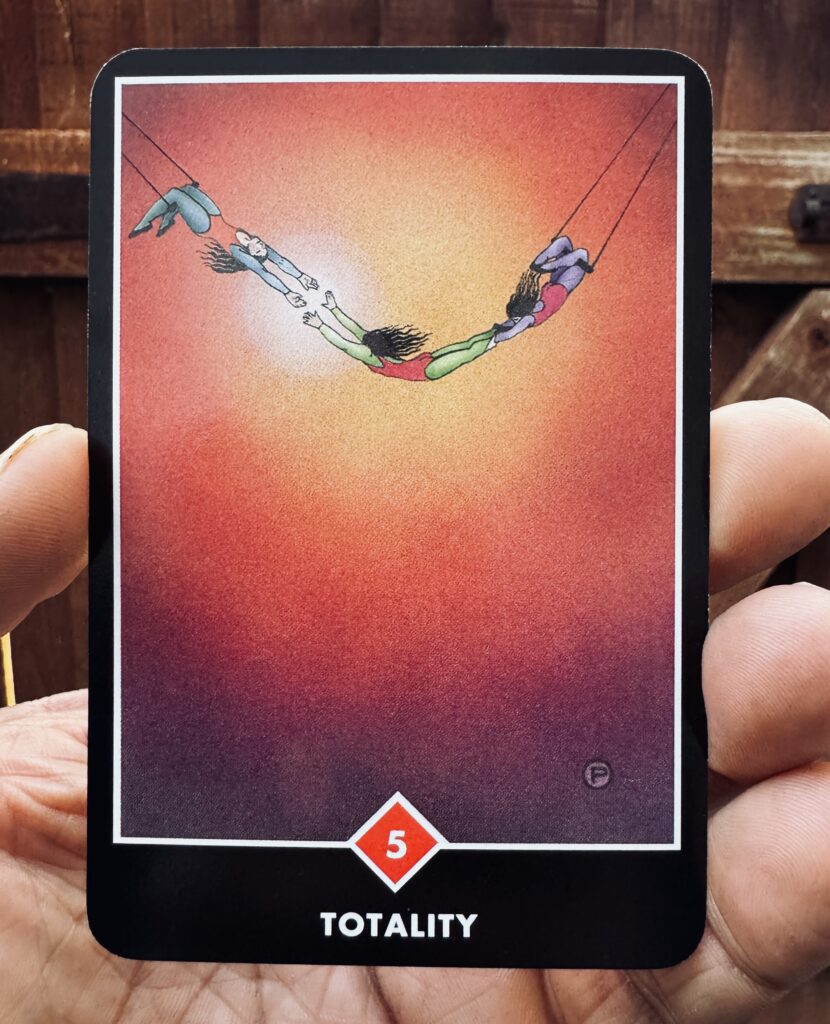
The Leap Between Moments

wisdom walk contemplation

At the peak of the trapeze act, in that heartbeat between letting go and being caught, everything is on the line.

The card Totality captures that split-second moment suspended in trust, focus, and surrender. Three acrobats are mid-air, held not by certainty but by presence—each giving their all, knowing that hesitation would break the arc, and the fall would be inevitable. This is not a card of half-measures. It speaks to the luminous edge where mastery meets vulnerability, where control dissolves into flow.

In the mythic imagination, Totality is the realm of the Fool mid-leap, the moment before Icarus knows if he’ll soar or burn, the point in the story when the hero must commit, heart and bone, to the quest. No more testing the water. No more holding the rope with one hand. You are either in, or you are not.

To live in totality is to offer yourself completely to the moment—not recklessly, but wholeheartedly. It is not about perfection; it is about presence. The leap only works if you’re all in—mind, body, spirit, and will aligned like a tuned bowstring, aimed at the sacred now.

We spend much of life on the edge of that platform—delaying the jump, running rehearsals in our minds, waiting for the perfect conditions. But Totality doesn’t ask for your plan. It asks for your presence. Your Yes. Your sacred risk.

So I ask you, fellow storythinker:

  1. Where in your life are you still clinging to the swing instead of leaping toward what calls you?
    (What have you been hesitating to say Yes to?)
  2. What would it mean to give yourself fully to this moment, this work, this relationship, without holding anything back?
    (What would Totality look like in your current threshold?)
  3. What are you afraid will happen if you let go of control and surrender to full participation?
    (And what might happen if you don’t?)

Let these questions hang in the air like a moment of flight. Don’t rush the answers. Let them arise like wind through the silence. And when you’re ready—leap.