I woke on my fifty-eighth birthday with a song playing in my head.
It wasn’t coming through the speakers, a radio alarm, or a playlist left running overnight. It had crossed over from that porous place between sleep and waking where a fragment of dream, a mood, or a sentence sometimes lingers before the day closes the gate on the night.
The song was Queensrÿche’s Silent Lucidity.
I hadn’t listened to it the night before. As far as I know, nothing in the previous day had planted it there. Yet the chorus was waiting when I opened my eyes.
Some mornings you shrug and get on with things. On others, the imaginal world taps you on the shoulders and demand your attention.
Fifty-eight is a threshold. I have spent much of the summer writing about the space between stories, the interval after an old identity has loosened and before the next one has found its shape. Now the threshold has moved from the page into the room.
A birthday makes you look both ways: back across the life you’ve already lived and forward into the stretch you cannot see. I had been thinking about identity, imagination, will, and the ways I keep parts of myself at a safe intellectual distance. Then I woke with a song about dream control, inner walls, another chance, and learning to become the guide.
I decided to stay with it.
The instruction hidden inside the song
Silent Lucidity 1 begins as a lullaby addressed to someone frightened by a bad dream. The voice offers reassurance: you are safe in bed; the mind created the pain; the day is waiting. Then the lyric turns on a question that could hold an entire philosophy of consciousness:
Your dream is over. Or has it just begun?
The song opens a doorway in that question. The dreamer is invited back into the night world with greater awareness, able to face fear, retrace the years, and ride the movements of the mind rather than be carried helplessly by them.
Halfway through, the music makes room for a spoken instruction. Visualise the dream. Record it in the present tense. Put it into permanent form. Persist, and dream control may follow.
First comes imagination: hold the image. Then language: write it as present reality. Then form: give the experience somewhere durable to live. Finally, persistence: return until lucidity becomes a capacity rather than a lucky accident.
This sequence feels familiar. An image arrives during a walk, in a dream, through a song, or in the quiet before my phone comes alive. I write it down. The note enters the vault. Later it meets another fragment, an old memory, a tarot card, a conversation, a book. Over time, the material may gather enough weight to enter the world as a blog post, an essay, or a practice.
The song contains another voice too, the one promising to watch over the dreamer and help them see it through. I could hear that voice in several ways: a lover, a daemon, a higher self, a guardian of the threshold, or perhaps the lucid part of consciousness speaking to the frightened part still caught inside the dream.
The promise has a limit. The watcher accompanies and protects, but the dreamer still has to learn to become the guide.
That felt like the birthday message.
The gap between knowing and living
Before I touched the tarot deck, I opened my journal.
I wrote that the past month had brought a sense of consolidation, a stripping away of identities. They weren’t necessarily false identities. Many had protected me. They gave me ways to approach parts of myself before I was ready to stand inside them without explanation.
Writer, philosopher, magician, teacher, coach, shamanic wanderer: each name gave something within me a temporary body. I had recently been experimenting with archetypal invocation, deliberately borrowing a larger figure and then returning the borrowed face. Perhaps some of these identities had served in the same way. They gave me access to qualities I could not yet approach directly.
A shield can become heavy after the battle has moved on.
I have used ideas in much the same way. Imagination and will have circled my practice for years. I know the concepts. I can talk about them, connect them to books, place them inside a tradition, compare one model with another. I had already written that you can understand everything and still not know what to do. Now the sentence has followed me into my own practice.
The understanding is there. The embodiment has lagged behind.
This is one of my oldest moves. I jump to meaning before I have stayed with the experience. I explain the image before it has had time to breathe. I reach for a book to confirm what the body already knows. Intellectualisation gives me distance, and for a while distance feels like control.
A few days earlier, I had been writing about prayer in the present tense: giving thanks for what is already here, even when it has not yet come fully into view. The idea is simple. Faith brings an image into focus; action gives it a place in the world. Yet I have often left a gap between the image and the act, as though understanding the principle were the same as practising it.
The song arrived with the missing word: persist.
I built a birthday tarot spread around its movement. What dream is over? What dream has begun? Where is the doorway? What fear guards it? Which inner wall is ready to fall? What watches over me? What power am I ready to claim? What gift must I bring back?
I answered each question in my journal before pulling a card.
Then I shuffled.
Come down from the tree
The first card, the dream that is over, was the Hanged Man.
There he was, suspended between worlds, seeing from another angle, haloed by the insight his inversion had given him. The Hanged Man knows how to wait. He knows surrender, patience, sacrifice, and the strange knowledge that comes when ordinary orientation is turned upside down.
He cannot walk anywhere while he is hanging from the tree.
The card did not dismiss the identities I had worn or the years spent trying to understand myself through them. Their work was initiatory. They had helped me see. The halo suggested that something had been learned.
The instruction I heard was plain: come down now.
The next card was the Page of Wands, answering the question of what new dream has begun. The Page stood alone in an open landscape, studying the living wand in his hands as if it had just spoken.
He has no syllabus, no credential, no approved definition of what a writer should be. He has contact with the signal.
A few weeks earlier, I had found myself asking, why am I waiting to be asked? The Page returned the question in another language. The wand was already in his hands.
This was the writer I had been moving towards through the weblog and the Textual Underground: a writer led by his own inner guide, willing to follow what glows before he can explain where it leads. Writing as encounter. Writing as a way of seeing. Writing that does not have to submit an application to the imagined tribunal of real writers before it begins.
The Hanged Man and the Page made a clean pair. One had completed the long apprenticeship of suspension. The other was ready to walk into the desert carrying one live piece of fire.
Giving imagination a material home
For the doorway, I drew the King of Pentacles.
I had expected something airy or mystical because I had written about meditation and spending more time in the imaginal. Instead, the cards placed a mature ruler of the material world at the gate.
The King sharpened the practice. Meditation may open the door, but embodiment keeps the passage honest. Does the imaginal encounter change the day? Does it become a paragraph, a decision, a ritual, a boundary, a conversation? Does the vision enter the body and the room? Can it survive contact with the calendar?
The vault, the blog, the notebook, the chair where I meditate, the walk, the hour I protect for writing: these are part of the magical apparatus. Imagination needs somewhere to land.
Two months earlier, another tarot spread had given me a sentence I wrote down and, apparently, had not finished learning: the way out of the head is through the hands.
The King of Pentacles suggests that command is less about issuing grand declarations to the universe than tending the conditions. Return to the practice. Give the image weight.
Then came the Three of Pentacles as the fear at the threshold. The card shows a craftsperson presenting work to robed figures who hold the plans. It landed directly on something I had written before the draw: my habit of looking to people who supposedly know the way, my desire to appear smart, and my fear that my peers will not take me seriously.
The figures with the plans form an internal tribunal. Will they approve of what I am building? Do they decide whether the work is legitimate?
There is another fear beneath the fear of judgement. If I no longer require their permission, the responsibility returns to me. I have to decide what faithful work looks like. I have to enter the cathedral as a craftsperson rather than an applicant.
Back in June, my morning pages had framed the same problem more bluntly: Can I give myself permission to live as the person I already am before the market confirms it? The robed figures seemed to be holding that question along with their plans.
The books and the chains
The fifth position asked which wall I had built within. I drew the Devil.
Before the draw, I had written about my obsession with books. I have collected them for years, loved them, lived among them, carried them from house to house. That love is genuine. Another story has wound itself through it.
Someone who reads a lot of books is smart. Being smart was one route to my mother’s approval and, in a different way, to my father’s disapproval. Books became companions, but they also became evidence. A full shelf could testify on my behalf. Finishing a book from cover to cover became a moral act. Reading challenges turned attention into badge culture: how many books did you read this year?
The Devil does not make the books evil. He reveals the contract attached to them.
In the Rider-Waite-Smith image, the figures are chained, but the chains hang loose around their necks. The bondage continues partly because it has come to feel inevitable. The same can happen when a genuine appetite becomes entangled with approval, shame, status, or proof of worth.
I do not need to renounce the library. I can withdraw from the contract.
I no longer use books to establish my right to trust my own mind.
A book can become a companion again, an occasion for thought rather than a container of information. I can read by attraction, need, pleasure, friction, or resonance. I can stop after one sentence if that sentence completes the exchange. I can abandon a book that has gone dead in my hands. The number completed can lose its authority.
The wall is not made of books. It is built from the belief that intelligence must be demonstrated before direct experience can be trusted.
The watcher above the doorway
I had left the sixth journal position blank. I wanted the deck to answer without my help: who or what watches over me?
I drew the Lovers.
An angel appeared above two exposed human figures.
The Lovers and the Devil became the axis of the spread. Both cards show a pair beneath a greater being. In one, the pair is chained inside an unconscious arrangement. In the other, they stand openly beneath a blessing. Choice is no longer governed by fear, appetite, inherited contracts, or the need for approval.
The guardian appeared as the capacity to choose in alignment with what I love, rather than as another authority telling me what to believe.
That brought me back to the voice in the song: the one smiling beside the dreamer in silent lucidity, offering protection without taking away the dreamer’s agency. The daemon may not need another elaborate identity through which to reach me. It may be enough to notice what has life, what carries heat, what asks to be made, and what leaves me more present after I choose it.
Remember what you love. Choose from there.
Return to the bench, then release the work
The seventh card asked what power I was ready to claim. I had written: imagination and will, exercised consciously, daily, consistently.
The card was the Eight of Pentacles.
A craftsperson sits at the bench, making one pentacle after another. There is no lightning bolt or claim of instant mastery. Whatever magic the card contains is found in the return.
Choose an image. Enter it. Write it in the present tense. Give it form. Come back tomorrow.
The Page of Wands receives the signal. The Eight of Pentacles gives it disciplined form. The final card in the spread, the Eight of Wands, releases it. The wands are already flying across open country. The insight cannot remain forever in meditation, private understanding, or the well-organised chambers of the vault. It must travel.
This is the danger of a beautiful archive: the underground can become another form of suspension. I can keep linking, arranging, refining, and preparing while the work waits below the surface.
The underground needs exits.
Enough swords
I drew one more card from the bottom of the deck and placed it across the Eight of Pentacles. I called it the Lucid Card. Its question was simple: what will help me recognise the moment I leave direct experience and retreat into intellectualisation?
The Ten of Swords.
It was the only Sword in the spread, the only card belonging to thought, analysis, mental narrative, and interpretation. It arrived as the alarm.
I know the feeling of the swords accumulating. One explanation becomes another. One reference leads to another book. The experience gets pinned beneath interpretation. The mind insists it must understand everything before I can trust the encounter or act upon it.
The Ten shows that process reaching exhaustion. Nothing more needs to be added.
The cue for lucidity is overkill. When I catch myself explaining the encounter before inhabiting it, constructing an identity around it, looking for an authority to certify it, or reaching for another book instead of staying with what happened, I can recognise the dream.
Enough swords. Wake up.
The image looks grim, but dawn is visible on the horizon. That took me back to where the morning began: a bad dream spinning in the head, then daylight, another chance, and the question of whether the dream has ended or only just begun.
The spread began with the Hanged Man and became lucid through the Ten of Swords. Both figures are immobilised. One has spent long enough seeing the world upside down. The other lies beneath the accumulated products of mind.
No eleventh sword is required.
Crossing the threshold
I do not know what my fifty-eighth year will bring. That is part of the threshold. A doorway loses something when we pretend to know the room on the other side.
I know how I want to cross it.
I want to come down from the tree and follow the living signal. I want to give imagination a material home. I want to notice when the internal tribunal gathers and continue working without waiting for its verdict. I want books to be companions rather than witnesses for the defence. I want to practise at the bench, then let what I make leave my hands.
The Ten of Swords gives me a reality check for the year. When thought begins to replace contact, I can return to feet, breath, room, light, sound. I can write one present-tense sentence about what is here. Then I can take one material action.
Close the book and open the notebook. Walk outside. Write the paragraph. Send the message. Release the post.
The practice needs contact with the world.
The song that crossed the border with me on my birthday offered a practice disguised as a power ballad: visualise the dream, record it, persist, become the guide. The cards answered with their own sequence: receive the signal, give it form, let it travel, and wake when the mind tries to bury the living thing beneath explanation.
So this is how I enter the year:
I come down from the tree.
I follow the living signal.
I give imagination a material home.
I release the need for external certification.
I remove the chains between knowledge and worth.
I choose according to what I love.
I return daily to the bench.
I let the work travel.
When the tenth sword falls, I wake.
In sigil form:
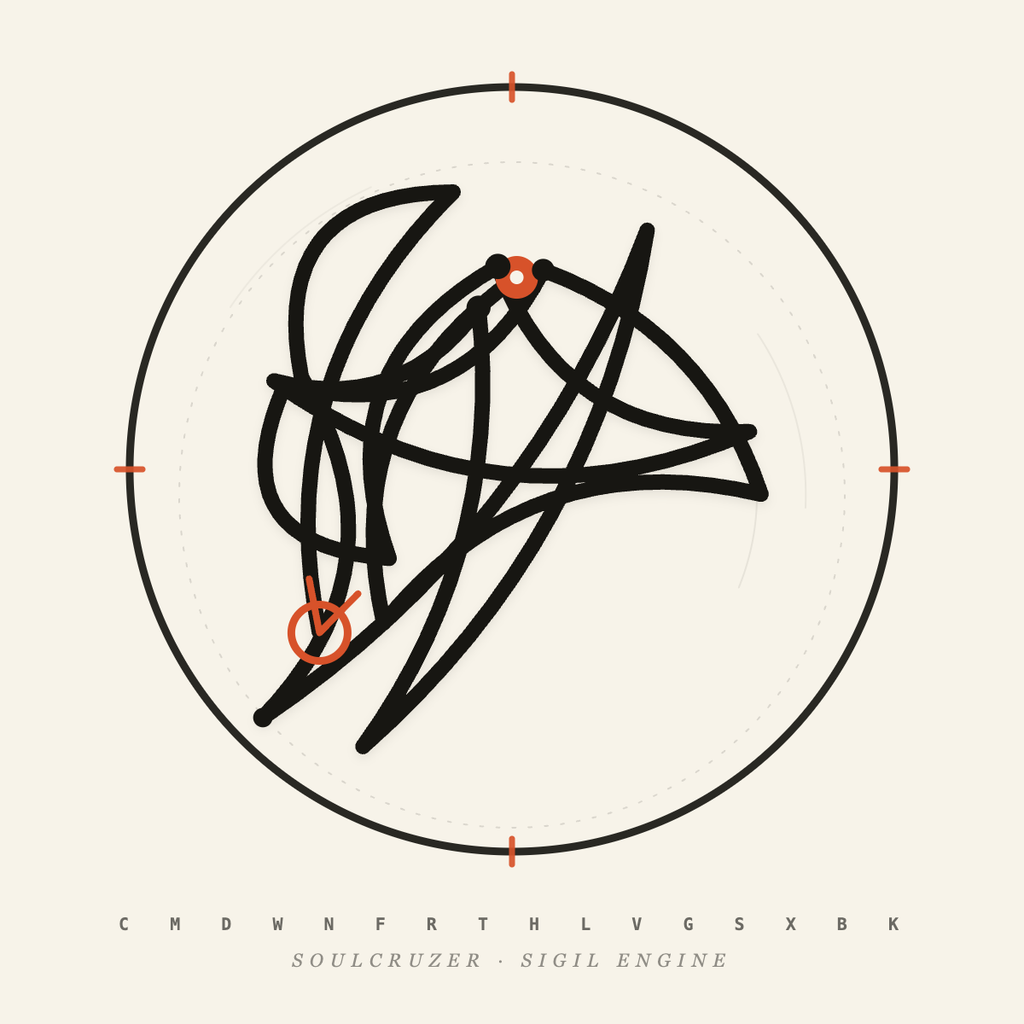
The day has begun. The dream is still alive.
Silent Lucidity
Hush now, don’t you cry
Wipe away the teardrop from your eye
You’re lying safe in bed
It was all a bad dream spinning in your head
Your mind tricked you to feel the pain
Of someone close to you leaving the game of life
So here it is, another chance
Wide awake you face the day, your dream is over
Or has it just begun?
There’s a place I like to hide
A doorway that I run through in the night
Relax child, you were there
But only didn’t realize and you were scared
It’s a place where you will learn
To face your fears, retrace the years
And ride the whims of your mind
Commanding in another world
Suddenly you hear and see this magic new dimension
will be watching over you
(I) am gonna help you see it through
(I) will protect you in the night
(I) am smiling next to you, in silent lucidity
I can’t do this
Visualize your dream, record it in the present tense
Put it into a permanent form
If you persist in your efforts, you can achieve dream control
How’s that then, better?
Dream control, dream control
Help me
If you open your mind for me
You won’t rely on open eyes to see
The walls you built within
Come tumbling down, and a new world will begin
Living twice at once, you learn
You’re safe from the pain in the dream domain
A soul set free to fly
A round trip journey in your head
Master of illusion, can you realize
Your dream’s alive, you can be the guide but
will be watching over you
(I) am gonna help you see it through
(I) will protect you in the night
(I) I’m smiling next to you
Discover more from soulcruzer
Subscribe to get the latest posts sent to your email.