This old post has wandered back into consciousness: Holy Gonzo! Embracing Chaos and Truth on the Path to Self-Discovery. I reposted on social media over the weekend. I wrote it back in October 2024, but reading it now, I’m feeling drawn to explore the subject further. The phrase at the centre of it all is Gonzo Spirituality.
At the time, I was trying to name a kind of spiritual practice that didn’t require me to step away from the life I was actually living. I wasn’t drawn to the serene, white-robed, mountain-retreat version of spirituality. I didn’t want a path that demanded I become calmer, purer, softer-spoken, or more detached from the mess. That may work for some people, but it has never quite felt like my road. I want to embrace the mess, to root in it like a pig in…well, let’s just say, I like my spirituality messy. Cobbled together between late-night notes, contradictions, and strong black coffee. Lots of coffee.
Oh, and did I mention the demons? Not the demons you might find in Paradise Lost or in some ceremonial magick ritual, but the demons you find in your head – the fear, doubt, disbelief, anxiety, grief, hate, and lust, to name a few. These are the demons I want to pull up a stool next to me to talk to.
The older post framed this through Hunter S. Thompson and the spirit of Gonzo journalism. In Gonzo, the writer is not a detached observer pretending to be neutral. The writer is implicated. The writer is in the room, in the car, in the bar, in the fever dream, in the wreckage of the thing being described. There’s no clean separation between the report and the reporter.
That feels important.
Because maybe the same is true of self-discovery. Maybe I don’t get to stand outside my life, clipboard in hand, calmly assessing the evidence. Maybe the only honest way to understand the self is from inside the ride.
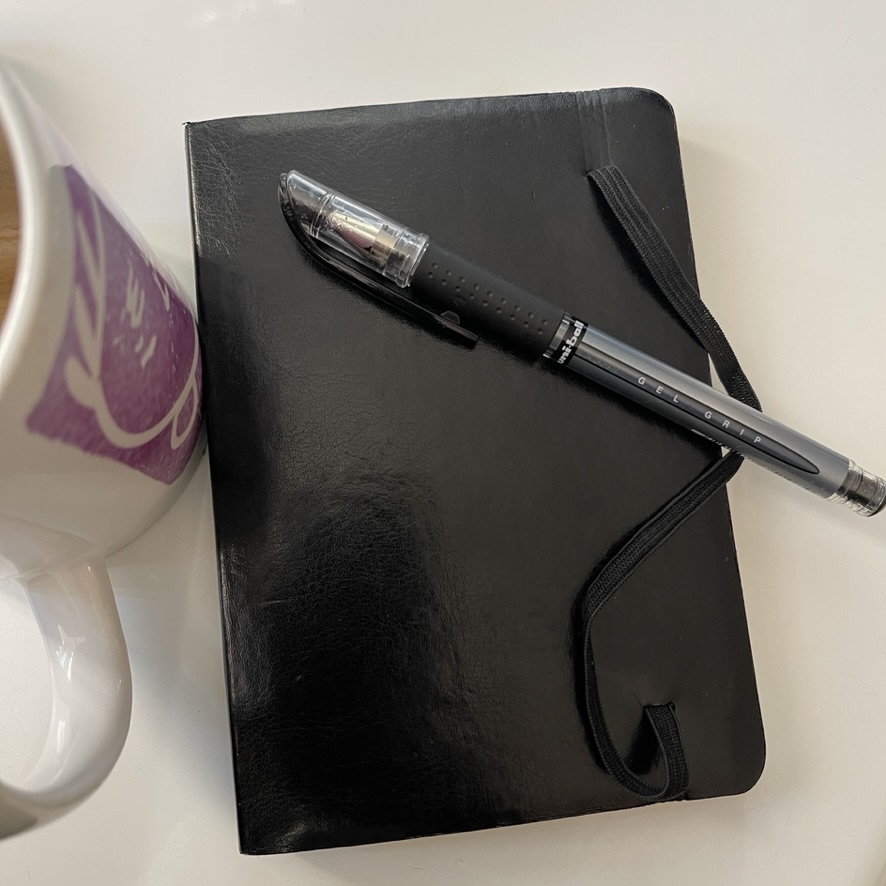
Buy the ticket. Take the ride. Bring a notebook.
That might be the first rule of Gonzo Spirituality.
It’s not my intent to glamourise chaos or to make suffering cool or to intimate that every bad habit is secretly holy. That would be too easy, and probably dangerous too. What I’m trying to get across is that the raw material of life can’t be understood by pretending it isn’t there.
The fear. The doubt. The jealousy. The ambition. The anger. The avoidance. The hunger. The old wounds. The ridiculous cravings. The part that wants transcendence and the part that wants another drink. The part that wants silence and the part that keeps refreshing the feed.
All of it belongs to the field.
Not all of it should be obeyed. But all of it can be listened to.
That’s where the image from the old post still grips me: the bar of the psyche.
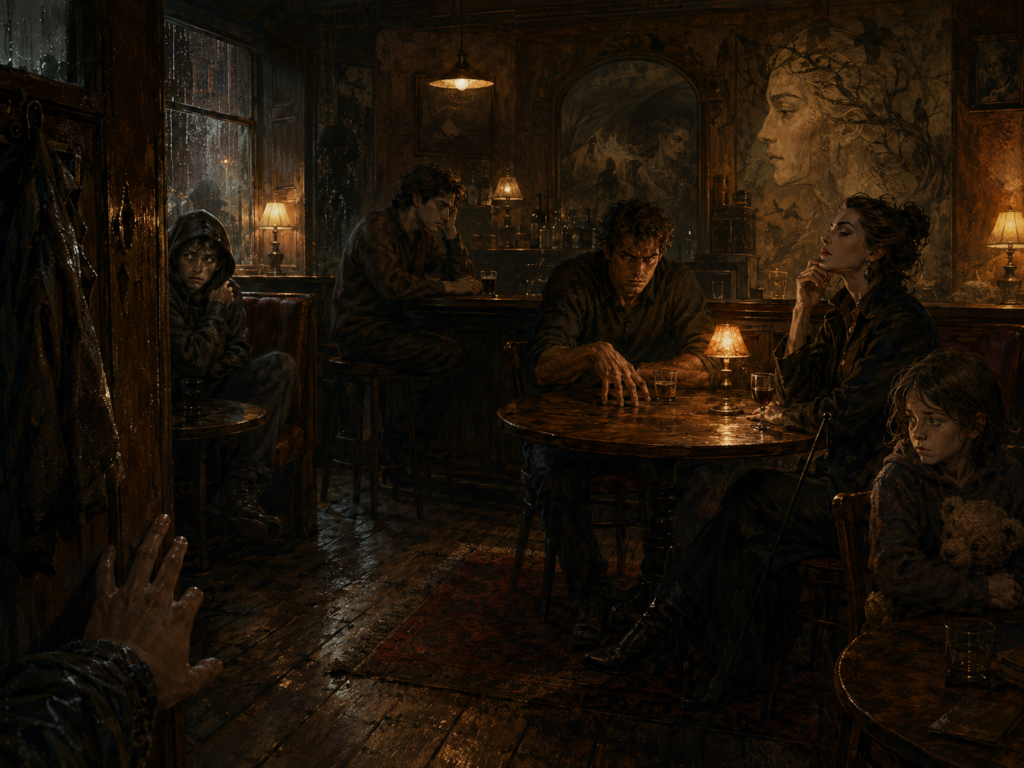
I imagine walking into some dimly lit inner pub, somewhere off the main road of consciousness. The place smells faintly of old wood, soaked coats, and unfinished conversations. Sitting there already are the parts of myself I usually try to avoid. Fear has taken the corner seat. Doubt is nursing something dark. Anger is tapping its fingers on the table. The inner critic has opinions about the décor. The wounded child is quiet, watching the door.
The conventional move might be to banish them, heal them, silence them, transcend them, or surround them with light until they stop making trouble.
The gonzo move is different.
You sit down.
You buy the first round.
You ask, “So, what’s your story?”
This is where the older post now links directly to what I’ve been calling Narrative Alchemy. If stories are code, then these inner figures are not random glitches. They are subroutines, old scripts, survival programs, and half-written myths still running in the background. Some of them are outdated. Some are defensive. Some are dramatic as hell. But most of them began as attempts to protect something tender.
Fear may be guarding the edge of an old fall.
Anger may be protecting a boundary I never learned how to name.
Jealousy may be pointing toward a desire I haven’t admitted.
Doubt may be trying, clumsily, to keep me from self-deception.
Even the demons have data.
This doesn’t mean every inner voice is wise. Some are drunk. Some are liars. Some only know one song and will sing it badly until sunrise. But if I’m willing to listen beneath the noise, I may discover the wound, longing, or story they’ve been carrying.
That’s the work.
Not to turn the self into a clean, well-lit temple where nothing untidy is allowed through the door. More like turning the self into a strange old roadside tavern where the exiled parts can finally come in from the cold and be heard without being handed the keys.
This is where Gonzo Spirituality also pushes back against the dream of escape.
A lot of spiritual language can smuggle in a quiet contempt for ordinary life. The body becomes something to rise above. Desire becomes something to dissolve. The world becomes a distraction. Technology, noise, politics, relationships, work, money, ageing, grief, appetite, frustration — all of it becomes evidence that we are not yet “there.”
But where exactly is “there”?
And who benefits from convincing us that the sacred is always somewhere else?
The older post was already resisting that move. It wanted a spirituality that could happen in the middle of the life I had. Not after the inbox was empty. Not after the house was quiet. Not after I became a better, calmer, more luminous version of myself.
Right here.
In the day as it actually arrives.
In the walk.
In the blog post.
In the argument.
In the app notification.
In the muddy shoes by the door.
In the moment when I notice I’m irritated and, instead of pretending I’m above irritation, I ask what the irritation is trying to show me.
Not passive acceptance. Not resignation. Not “everything happens for a reason” pasted over the wound like a motivational sticker. More like the willingness to begin with what is actually here.
This life.
This body.
This mood.
This history.
This nervous system.
This strange bundle of memory, appetite, language, contradiction, longing, and desire.
I don’t get another self to work with. I get this one.
So the practice becomes less about escape and more about authorship. Not authorship in the fantasy-control sense, as if I can simply rewrite reality by declaring a new story. But authorship as participation. As revision. As noticing the sentences I’m living inside and asking whether they are still true, still useful, still alive.
Gonzo Spirituality says: don’t wait until the manuscript is clean before you start reading it.
Read the messy draft.
Write in the margins.
Question the narrator.
Interview the villains.
Follow the footnotes.
Notice where the plot keeps looping.
And when necessary, revise the code.
This is where blogging enters the picture too. Because blogging, at least for me, has never simply been publishing. It has been a way of taking field notes from the ongoing experiment of being alive. The blog becomes the notebook on the road. The place where the life-material gets turned into language before it disappears. The place where confusion is allowed to become visible enough to work with.
In that sense, the old Gonzo Spirituality post belongs in the same lineage as Working Notes from the Textual Underground. It is another attempt to say: I am not writing from above the mess. I am writing from inside it.
The mess is not a failure of the method.
The mess is the material.
And maybe that’s why the piece still hums. Underneath the Hunter S. Thompson styling and the barroom imagery, there is a serious proposition:
Wholeness does not come from abandoning the life that made you. It comes from learning how to meet that life without flinching.
That includes the light, yes.
But also the shadow.
The awkward contradiction.
The part that still aches.
The part that wants more.
The part that sabotages.
The part that dreams.
The part that keeps walking.
Gonzo Spirituality is not a finished system. I don’t want it to become one. The moment it hardens into doctrine, it loses the very thing that makes it useful. Better to treat it as a working lens, a cracked map, a field method.
A way of entering the chaos with enough courage to listen.
A way of refusing sterile transcendence.
A way of finding the sacred not by floating above the world, but by paying closer attention to the strange, unedited texture of being here.
So yes, I still believe in the bar of the psyche.
I still believe in buying the demons a drink.
Not because they’re in charge.
Because they’ve been waiting a long time to tell their side of the story.
I’ve started reading Ruth Netzer’s Tarot of Self Discovery. I’m only in the introduction, but already I can feel one of those useful recognitions happening. She is writing about tarot in a way that sits very close to my own use of the cards: not as fortune-telling or mystical commandments, but as a form of Jungian active imagination.
The cards become images that help the psyche speak.
Netzer seems to work with two principles at once. One is psychological: the image reflects something going on inside us. The other is synchronistic: the image that appears at a particular moment may carry a strange rightness, as if the unconscious, the world, and the timing of the draw are briefly conspiring to make something visible.
That is the space where tarot becomes interesting to me. Not prediction or obedience. And definitely not “the cards say.” More like, ‘Here is a symbolic mirror.’ What does it constellate? What does it disturb? What does it reveal that ordinary language has not quite managed to reach?
Netzer is also working with the Hero’s Journey, which makes sense. Tarot almost invites that reading. The Major Arcana can easily be seen as a sequence of initiations: departure, trial, descent, death, renewal, and return. But she has also mentioned, more than once now, something she calls the Quest for the Self, placing it alongside the Hero’s Journey and the Heroine’s Journey.
That phrase caught me.
The Quest for the Self.
It feels related to the heroic pattern but not identical to it. The hero goes out. The Self seems to call us inward and downward, then wider.
Hero, heroine, Self
A working distinction might be this.
The Hero’s Journey is the ego going out into the world to be tested. It leaves the ordinary world, faces trials, meets helpers and enemies, wins or receives the boon, and returns changed. Its centre of gravity is ordeal, action, courage, separation, initiation, and return.
The Heroine’s Journey, especially in Maureen Murdock’s sense, often concerns the healing of a split. The feminine is rejected or devalued, the masculine-coded world of achievement is pursued, and then some kind of aridity, wound, or descent forces a return to the body, the mother, feeling, relation, and inner belonging. Its centre of gravity is reconnection.
The Quest for the Self feels wider and stranger than both.
It is not mainly about defeating the dragon. It is not only about healing the split. It is about entering relationship with the total psyche. The ego meets what it has excluded, projected, feared, desired, idealised, and misunderstood. The journey is not towards a prize but towards a more complete relation with the deep pattern of the person.
In Jung’s language, this is individuation: the long, symbolic process by which the ego comes into relationship with the Self.
And the Self is not the same as the personal self, the personality, the social identity, or the story I like to tell about who I am. The Self is the organising centre and circumference of the psyche. It includes consciousness and unconsciousness, light and shadow, masculine and feminine, personal history and archetypal depth.
The Self is not the hero.
The Self is the wider field in which the hero appears.
The shape of the quest
The Hero’s Journey is often drawn as a circle: departure, initiation, return.
The Quest for the Self feels more like a spiral, a mandala, or a labyrinth. You keep circling the centre, but each circuit reveals another layer. You do not simply arrive at the Self as if it were a castle at the end of the map. You are slowly reorganised by your relationship to it.
The first movement is often a call from within. Something in the old ego-story begins to fail. The life may still work on the surface, but underneath it there is a knock at the door. Dreams sharpen. Synchronicities appear. Old symbols return. A card keeps showing up. A book arrives at the right moment. A sentence starts glowing.
The psyche seems to say: the map you are using is too small.
Then comes the encounter with the persona: the mask, the social role, the public operating system. Who have I learned to be? What do I perform? Which parts of me are rewarded? Which parts have been exiled so the approved self can keep functioning?
This is where tarot becomes useful as active imagination. A card can reveal a role, a script, a borrowed authority, a desire-system, a stuck pattern. The question is not, “Which card am I?” The better question may be, “Which part of me is speaking through this image?”
After that, inevitably, comes the shadow.
The shadow is not simply the bad self. It is everything the ego has not been able, willing, or permitted to identify with. Rage, envy, need, grief, vanity, power, tenderness, brilliance, sensuality, weakness, wildness, dependency, genius. All the material pushed outside the conscious self-image.
This is where the Quest for the Self differs from the heroic reflex. The heroic ego wants to defeat the monster. The deeper work asks for a conversation.
The question changes from:
How do I defeat this?
To:
What part of my unlived life is wearing this frightening face?
That is shadow gold territory.
The inner figures
In Jungian terms, the psyche is full of figures: shadow, anima, animus, child, trickster, great mother, wise old man, wounded healer, king, queen, psychopomp, divine animal.
Tarot gives these figures a theatre.
The Fool, the Magician, the High Priestess, the Empress, the Emperor, the Hierophant, the Lovers, the Hermit, Death, Temperance, the Devil, the Tower, the Star, the Moon, the Sun, Judgement, the World. Each card is a chamber. Each image offers a way for the unconscious to become visible without being reduced too quickly to a concept.
That may be why tarot continues to matter. The image does not explain itself away. It waits. It lets the psyche project, react, resist, recognise, and revise.
Used this way, the card is not an oracle issuing orders. It is a doorway.
The psychological principle says: the image reflects inner dynamics.
The synchronistic principle says: this image, now, in this moment, may be oddly exact.
Together they create a charged mirror.
Holding the opposites
At some point, the Quest for the Self becomes less about discovering “who I really am” and more about becoming able to hold contradiction without collapsing it too quickly.
I am monk and frontman.
I am wounded and gifted.
I want solitude and recognition.
I want freedom and belonging.
I am rational and mythic.
I am ordinary and archetypal.
The ego prefers clean identity. The Self seems to prefer wholeness.
Wholeness is untidy. It includes the opposites. A real symbol can hold what logic alone wants to split apart. That is part of the power of tarot, dream images, mythic motifs, and synchronistic events. They can carry contradiction without killing it.
The Self does not always say: choose one side.
Sometimes it says: become large enough to hold the tension until a third thing appears.
Grounding the Self
There is a danger here, of course. Whenever we start speaking about the Self, archetypes, symbols, synchronicity, and the deep pattern of a life, inflation is nearby. The ego can try to claim the whole thing for itself. It can turn the Self into a costume, a spiritual achievement, or a private mythology of specialness.
That is why the work has to remain grounded.
Make coffee. Take a walk. Pay the bill. Write the paragraph. Talk kindly to the person in front of you.
The Self is not an excuse to float away from ordinary life. It asks to be embodied there.
The Quest for the Self does not end with escape from the world. It returns us to the world with a different centre of gravity. We still have a personality, wounds, preferences, irritations, bills, unfinished drafts, and awkward emails. But perhaps we are a little less possessed by one-sided identity. Less ruled by projections. Less desperate to be pure, impressive, innocent, correct, or complete.
The question becomes ethical in the deepest sense:
If this is in me, how shall I live with it consciously?
That may be the real boon.
A working note for now
So for now, my working model is this:
The Hero’s Journey is achievement through ordeal.
The Heroine’s Journey is healing through descent and reconnection.
The Quest for the Self is wholeness through symbolic integration.
Or, put another way:
The Quest for the Self is the Hero’s Journey turned inward, then widened until the hero discovers he was never the whole story.
The hero wants to complete the quest.
The Self wants to complete the person.
And tarot, used well, becomes a cabinet of living images through which the psyche can say:
Look again. There is more of you here than you thought.
Clay, before breath, is just earth with potential. Dense. Damp. Waiting. It belongs to gravity, riverbed, field, grave, brick, and vessel. But breath is movement. Breath is an invisible rhythm. Breath is spirit entering form without ceasing to be invisible.
So when God buried his breath in the clay, maybe he hid wind inside weight.
He took what falls and placed inside it something that rises.
That’s the human paradox right there: mud with a skyward ache.
Not pure spirit. Not mere animal. Not just body, not just soul. A walking contradiction. Earth that dreams. Dust that sings. Flesh that asks why. A creature made from the same stuff as the path underfoot, yet haunted by the breath of the one who walked over the waters.
And buried is the interesting word.
Not placed.
Not installed.
Not added.
Buried.
That suggests concealment. Seed-like. Tomb-like. Treasure-like.
God did not leave his breath on the surface where we could easily point to it and say, “There, that’s the divine bit.” He buried it deep. Under appetite, memory, fear, shame, longing, language, labour, and love. So the spiritual life becomes a kind of archaeology. We dig through ourselves looking for the breath that was hidden there from the beginning.
Maybe that’s why we are always listening inwardly.
Maybe prayer is not us speaking upward so much as us trying to hear the buried breath still breathing.
And because it is buried in clay, the breath is not separate from the clay. The divine does not bypass the body. It enters it. It accepts limitations. It consents to pulse, hunger, fatigue, desire, and death. God’s breath becomes intimate with lungs. With ribs. With dirt under fingernails. With the ache of being embodied.
So maybe incarnation begins earlier than Bethlehem. Maybe the first incarnation is this: breath in clay.
The body as the original chapel.
The mouth as an altar of air.
The human being as a little weather system of God.
There’s also something tender in it. To breathe into clay, God must come close. This is not a command-from-a-distance creation. It is mouth-to-mouth. Nearness. Vulnerability. Divine intimacy. The creator kneels in the dirt, shapes the form, and gives something of himself away.
And that raises the dangerous question:
Did God lose something when he breathed into us?
Or did he multiply himself?
Maybe both.
Maybe every human being is a buried fragment of divine weather, trying to remember the wind it came from.
And then the ethical turn: if God buried his breath in the clay, then every body is holy ground. Not metaphorically only. Actually. The beggar, the enemy, the lover, the stranger, the child, the ageing parent, the difficult self in the mirror: all clay carrying concealed breath.
To harm another is to strike earth where God is hidden.
To love another is to help the buried breath find air.
And perhaps this is what a life is: the slow uncovering of the breath.
We begin as clay animated by something we did not earn. Then we spend our days either hardening around it or becoming porous to it. The breath wants circulation. It wants speech, song, blessing, courage, and forgiveness. But clay dries. Clay cracks. Clay can become brick, wall, idol, or weapon.
So the work is to stay moist enough for the breath to keep shaping us.
The myth of Jim Morrison is a myth of pure instinct. He arrives fully formed in the collective memory: shirtless, obliterated, magnificent, doomed. The leather trousers. The baiting of audiences in New Haven and Miami. The voice that seemed to come from somewhere older than rock and roll. The story we inherited insists that this was all eruption, all Dionysian overflow, a man too full of something dark and vital to contain it.
The story is wrong.
Morrison entered UCLA’s film school in 1964 as a serious student of ideas. He wrote poetry obsessively, in notebooks he carried everywhere, before he ever stood in front of a microphone. He read with appetite and intention across philosophy, anthropology, poetry, and mythology. When Ray Manzarek met him on Venice Beach, he didn’t encounter a wild thing. He encountered someone who had already done significant intellectual work on the question of what he wanted to become.
The esoteric content in Morrison’s life and work is routinely treated as atmosphere. The shamanism, the invocations, the obsession with death and threshold experience, the deliberate use of performance as a form of altered consciousness. These get folded into the legend as texture, as evidence of his romantic excess. They are evidence of a curriculum.
Morrison assembled, largely in his early twenties, a reading list with a coherent through-line. Nietzsche gave him the philosophical frame. The French Symbolists gave him the method. Huxley and Blake gave him the name for what he was trying to do and a theory of why it mattered. Eliade gave him the ritual structure. Frazer gave him the oldest warning, which he either didn’t read carefully enough or chose to ignore. The Beats showed him that this synthesis was survivable and could be made into American vernacular art.
This is a self-education in the deliberate construction and dissolution of self, in the use of transgression and altered states as tools for accessing something beyond ordinary perception, and in the performance of archetypal roles as genuine operative practice rather than theatrical gesture. Morrison wasn’t dressing up as a shaman. He was attempting, with considerable sophistication, to actually be one.
What kind of practitioner does this particular reading list produce? What are its strengths, what are its structural absences, and what happens to the person who follows it all the way to its logical conclusion?
Morrison built one of the most powerful opening rituals of the twentieth century. He just never got around to reading anything about how to close one.
The Nietzschean Foundation
Friedrich Nietzsche published The Birth of Tragedy in 1872 and spent the rest of his career partly embarrassed by it. He thought it overwrought, too Romantic, insufficiently rigorous. He was right on all three counts, and none of that matters. The Birth of Tragedy is one of those books that operates on the reader independently of its scholarly merit. It installs something. Morrison encountered it at UCLA, and it installed itself completely.
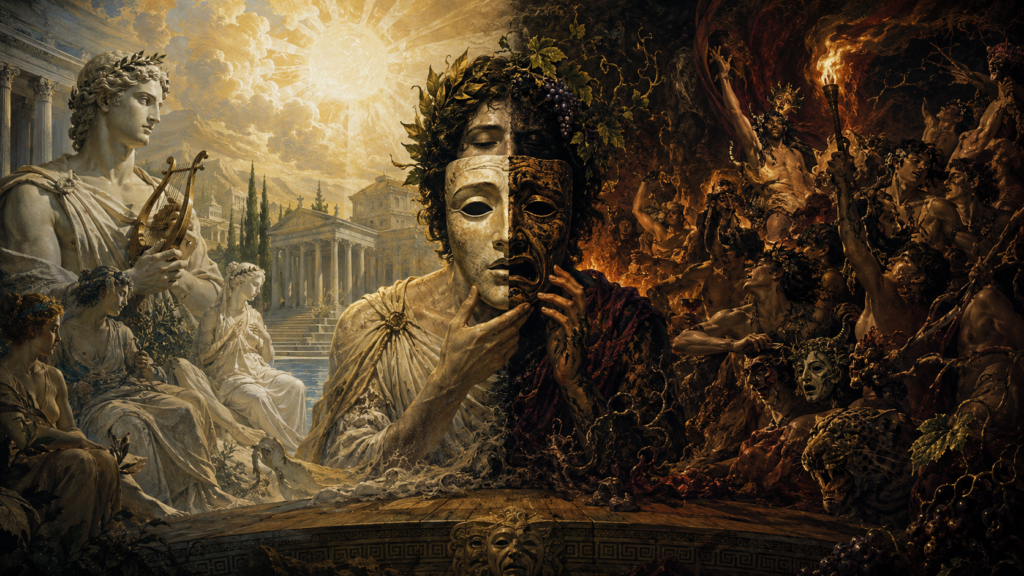
The argument Nietzsche makes is well known in outline and less often followed into its full implications. Greek tragedy was the product of a tension between two opposing drives embodied in two gods. Apollo: the principle of form, individuation, the beautiful surface, the dream. Dionysus: dissolution, intoxication, the merging of the self back into the primal unity from which individual consciousness is a temporary and somewhat painful exile. Great art holds both in productive tension. The Apollonian gives it shape. The Dionysian gives it the charge that makes the shape worth anything.
Most readers take this as aesthetics. Morrison took it as instruction.
He drew from Nietzsche a theory of vocation, not a theory of art. If the Dionysian principle is real, not merely metaphorical, then the artist who serves it is not making representations of dissolution and ecstasy. The artist is a vehicle for the actual thing. The performance is not about Dionysus. The performance is a Dionysian rite, and the audience is not watching one; they are participants in one, whether they understand this or not.
This is a significant leap from what Nietzsche wrote, and a coherent extension of the logic, and it explains something about Morrison’s relationship to his own performances that is otherwise difficult to account for. He wasn’t trying to entertain. He was trying to produce a specific state in a room full of people. The hostility, the provocation, the long silences, the spoken-word sections that confused audiences expecting rock and roll: these make no sense as an entertainment strategy. They make perfect sense as a ritual technique. You are not there to enjoy yourself. You are there to be broken open.
Nietzsche’s second major contribution to Morrison’s operating system is the reframing of power. The will to power, as Nietzsche actually meant it rather than as it was later vulgarised, is not a drive toward domination of others. It is a drive toward the fullest possible expression and expansion of the self, toward becoming what you most essentially are with the least possible compromise. Morrison translated this into a will to experience. Every limit was a door. Every prohibition was a map showing you exactly where to go. The logical destination of this position is total immersion, and total immersion, followed far enough, becomes indistinguishable from annihilation.
Nietzsche saw this danger. In The Birth of Tragedy, he describes the Dionysian initiate as someone who has glimpsed the abyss beneath the comfortable Apollonian surface of civilised life, who has looked directly at the truth that individual existence is a temporary fiction, and who needs art precisely because without it this knowledge would be unliveable. Art is the saving lie that lets the tragic hero go on. Apollo is not the enemy of Dionysus. Apollo is what keeps the Dionysian from destroying the vessel it moves through.
Morrison read all of this. And then he spent roughly eight years systematically dismantling every Apollonian structure in his life.
Whether this was a misreading or the most rigorous possible application is a question the essay will keep returning to. What is clear is that Nietzsche gave Morrison something most rock musicians of his generation didn’t have: a philosophical justification for what he was doing that was genuinely serious, and a vocabulary for the forces he believed he was working with. He wasn’t out of control. He had a theory.
The theory just didn’t include a chapter on what you do when the god decides to stay.
The French Symbolist Current
If Nietzsche gave Morrison the philosophy, the French Symbolists gave him the method. The method was not gentle.
Charles Baudelaire published Les Fleurs du Malin 1857 and was immediately prosecuted for it. The French government understood, correctly, that something more than offensive content was at stake. Baudelaire was proposing a theory of what poetry was for, and the theory was genuinely dangerous. Beauty, he argued, was not found in the elevated and the refined. It was extracted from transgression, from rot, from the city’s underworld, from boredom pushed far enough that it cracks open into something resembling the sublime. The poem was not a vessel for pre-existing feeling. It was an operation performed on consciousness, and the material it worked with was damage.
This is a long way from the Romantic tradition Baudelaire inherited, even though it looks superficially similar. The Romantics believed in inspiration, in the poet as receiver of something that arrived from outside. Baudelaire believed in technique. You constructed the conditions for the visionary state. You didn’t wait for it. The flâneur wandering the Paris arcades, deliberately absorbing the city’s shadows and contradictions, is not a passive observer. He is running a practice.
Morrison absorbed this and recognised something in it that matched his Nietzschean framework precisely. The will to experience, applied to aesthetics, produces Baudelaire. You go toward what repels the comfortable self because that is where the real material is.
Arthur Rimbaud took the argument further than Baudelaire probably intended and further than anyone had gone before in making it explicit. In 1871, at sixteen years old, he wrote two letters to friends that have become known collectively as the Lettres du voyant, the letters of the seer. The relevant passage is compact enough to summarise without much loss: the poet must make himself a seer by a long, immense and reasoned derangement of all the senses. Every form of love, suffering, and madness. He searches himself. He exhausts all poisons in himself and keeps only their quintessences.
The word that matters is reasoned. This is not an invitation to chaos. It is a programme. Rimbaud is describing a systematic technology for dissolving the ordinary perceptual filters that prevent access to deeper states of vision. The derangement is the method, not the point. The point is what becomes visible once the ordinary self is sufficiently disrupted.
Morrison read this as a practitioner reads a manual. The alcohol, the other substances, the deliberate provocation of crisis, the refusal of the comfortable and the stable: these are not simply self-destruction. They are, or they began as, Rimbaldian technique. The question of when the technique becomes indistinguishable from its supposed opposite is one the essay will return to.
What is frequently missed in accounts of both Baudelaire and Rimbaud is their position in a longer esoteric current. Baudelaire was deeply engaged with Swedenborg’s theory of correspondences, the idea that the material world is a system of symbols pointing toward spiritual realities, and this sits behind his most famous poem, Correspondances, in ways that are not merely decorative. Rimbaud’s colour-vowel synaesthesia in Voyelles is working the same territory from a different angle. They are occultists working in the medium of language, and the Symbolist movement they seeded was a significant channel through which esoteric ideas moved into European literary culture and eventually into the American tradition Morrison was growing up in.
The Symbolists are the missing link between German Romanticism and twentieth-century occultism, and Morrison’s absorption of this current means that when he picks up Eliade and Frazer later, he is not encountering alien ideas. He is finding the scholarly anthropological confirmation of a practice he had already theoretically committed to. The seer. The voyant. The one who goes to the edge of what the self can bear and looks over.
Rimbaud eventually stopped. He walked away from poetry entirely at twenty, fled to Africa, and spent the rest of his short life as a gun runner and coffee trader. He tried to close the door. Morrison, apparently, never seriously considered this option.
Huxley, Blake, and the Doors Themselves
The name of the band is a thesis statement.
Understanding what it claims requires going back through Aldous Huxley to William Blake, who is where the real weight lives.
Huxley published The Doors of Perceptionin 1954, an account of a single afternoon spent under mescaline in his Los Angeles home. The drug experience itself, though interesting, is not the book’s real contribution. What Huxley offers, drawing on the philosopher C.D. Broad and ultimately on Henri Bergson, is a structural argument about the nature of ordinary consciousness. The brain, he proposes, is not primarily a generator of experience. It is a reducing valve. Its function is to filter out the vast majority of what is actually available to perception, leaving only what is useful for biological survival and social functioning. What we call normal consciousness is an edited version of reality, and a heavily edited one at that.
The implications are considerable. If the reducing valve is the problem, then the goal of any serious practice, chemical or otherwise, is to force the valve open. Not to add something to experience but to remove what has been artificially subtracted. The doors of perception are not entrances to somewhere else. They are exits from the narrow corridor we mistake for the whole building.
Morrison encountered this and understood it immediately through his Nietzschean and Symbolist frameworks. Huxley was providing the neurophilosophical grounding for what Rimbaud had proposed as a poetic programme. The derangement of the senses is a valve-forcing operation. The Dionysian rite opens what the Apollonian surface keeps closed. Different vocabularies, identical claim.
But Huxley took his title from Blake, and Blake is the deeper source, and Blake is not making the same argument as Huxley, though he is making a compatible one.
The full passage from The Marriage of Heaven and Hellreads: if the doors of perception were cleansed, everything would appear to man as it is, infinite. For man has closed himself up, till he sees all things through narrow chinks of his cavern. Blake is not describing a pharmacological problem with a pharmacological solution. He is describing a spiritual condition, the fallen state in which humanity has contracted into the isolated ego and lost access to the infinite reality that surrounds and interpenetrates it. The cleansing he is calling for is ontological, not chemical. A transformation of what the self fundamentally is, not an alteration of its momentary state.
Urizen, the god of reason and law
Blake was also, and this gets lost in the Huxley citation, a practitioner working within a seriously developed esoteric system of his own construction. The prophetic books, with their complex mythology of Zoas and emanations and eternal forms, constitute one of the most ambitious attempts in English literature to build a complete alternative cosmology. Urizen, the god of reason and law, has usurped the place of the infinite. Los, the spirit of imagination and time, who labours to keep the human form divine alive against Urizen’s contraction. The fallen world is the product of a catastrophic narrowing of perception. The redemption of that world through imaginative vision.
Morrison was dipping into this system without following it all the way into the prophetic books, but enough to understand that Blake was not a Romantic nature poet who had taken something interesting one afternoon. He was a magician who had constructed a working mythology and spent his life operating within it.
The name of the band carries all of this. A commitment to the Blakean diagnosis: that ordinary consciousness is a fallen, contracted, self-imprisoned condition. And to the Huxleyan method, the systematic forcing of whatever doors can be forced. It is also a commitment to Blake’s understanding of what the doors open onto. Not pleasure. Not freedom in any casual sense. The infinite.
Which is not, in Blake’s system, a comfortable destination.
Mircea Eliade and the Shamanic Frame
Mircea Eliade’s Shamanism: Archaic Techniques of Ecstasy was published in English in 1964, the same year Morrison arrived at UCLA. Dense with comparative religious scholarship, surveying shamanic practice across Central Asia, the Americas, Australia, and beyond. Not, on the face of it, a book a twenty-year-old film student picks up for pleasure. Morrison read it anyway, and by most accounts kept it close. Once you have read the previous sources in his syllabus, the reason is obvious. Eliade was doing for shamanism what Frazer had done for the dying god: revealing the pattern beneath the cultural variation, demonstrating that something consistent was happening across radically different traditions, something structural enough to suggest it was tracking a real feature of human experience rather than a local religious habit.
Eliade’s definition of the shaman is precise and worth holding carefully. The shaman is specifically the one who can deliberately enter altered states of consciousness, travel between the ordinary world and the spirit world, and return with knowledge or power that benefits the community. The keyword is return. The shaman’s authority derives not from the ability to descend but from the ability to descend and come back. Anyone can fall. The shaman is the one who falls with intention and climbs back out with something to show for it.
The initiatory experience Eliade documents across cultures follows a consistent grammar. The shaman-to-be undergoes a crisis, often involuntary, in which the ordinary self is dismembered, dissolved, or destroyed at the spirit level. The bones are picked clean. The organs are replaced. A new self is reassembled from the ruins of the old one, and this new self has capabilities the original did not. The dismemberment is not incidental to the initiation. It is the initiation. You cannot become a shaman by studying shamanism. You have to be taken apart.
Morrison read this, and the recognition must have been immediate and visceral. The Nietzschean dismemberment of the Apollonian self. The Rimbaldian derangement that breaks down the ordinary perceptual apparatus. The Blakean dissolution of the reduced ego back into the infinite. These were all, Eliade was now telling him, local versions of a universal initiatory grammar. Morrison was not inventing something. He was rediscovering something very old, and Eliade’s scholarship gave him the anthropological confidence that the rediscovery was real.
A theory of performance as ritual space follows directly from this. If the shaman’s function is to alter the consciousness of a community, to temporarily dissolve the boundaries between the ordinary world and whatever lies beneath or beyond it, then the concert hall is a perfectly legitimate ritual venue. The volume and the rhythm do what the drum does in Siberian shamanic practice. The darkness and the crowd’s compression do what the cave does. The figure on the stage who is visibly operating at the edge of ordinary self-possession models for the audience how far the dissolution can go, and the audience, following that model, goes further than it would alone.
Morrison’s performances could not simply be entertainment. Entertainment keeps the audience comfortable and returns them to themselves at the end. What Morrison was attempting, consciously and with theoretical grounding, was to temporarily unmake the audience’s ordinary selfhood and expose them to something that selfhood normally keeps out. Whether the collective altered state he was reaching for was genuinely shamanic or a sophisticated simulacrum of it is a question that cannot be answered cleanly. The intention is clear.
What Eliade also documents, with the careful neutrality of the scholar who has seen enough to know that outcomes vary, is the shaman who does not complete the return. The initiatory crisis becomes a permanent condition. The dismemberment produces not a new and more powerful self but simple fragmentation. The difference between the shaman and the person who merely goes mad is, in Eliade’s framing, largely a question of whether the descent is controlled and whether the return is completed.
Morrison controlled the descent, at least initially, with considerable skill.
The return is where the record becomes complicated.
Frazer and the Dying God
James George Frazer published the first edition of The Golden Bough in 1890, and it rewired the Western imagination’s relationship to myth and ritual. By the time Morrison encountered it, the book had expanded to twelve volumes and contracted again into a single-volume abridgement, and it had already shaped T.S. Eliot’s The Waste Land, which means it had already passed through one major artistic nervous system before arriving in Morrison’s. What it contains, at its argumentative core, is a pattern so ancient and so widespread that Frazer concluded it must be tracking something structural in human religious life rather than reflecting historical contact between cultures.
The pattern is this: the sacred king must die.
In the ancient world, Frazer argues, the king was not merely a political figure. He was the embodiment of the community’s vitality, the living vessel of the god, the conduit between the human world and the forces that made crops grow and seasons turn. His health was the community’s health. And when his health declined, or when a fixed term of sacred kingship expired, he was killed, ritually and deliberately, so that the divine power he carried could be released back into the community before it became too degraded to serve its function. The god dies so the tribe lives. The vessel is broken, so the contents can be poured out.
Frazer traced this pattern across dozens of cultures: Osiris, Adonis, Attis, Dionysus himself, and eventually, in the book’s most provocative implication, the figure at the centre of Christianity. The dying and rising god is not an anomaly. It is the dominant pattern of sacred kingship across recorded history.
Morrison read this, and something in him recognised it as autobiography.
His obsession with his own death is too consistent and too structured to be dismissed as morbidity or rock star theatre. It runs through the poetry from the beginning, before the fame, before the leather trousers. Death as threshold, death as transformation, death as the logical completion of a life lived at the edge of what the self can contain. He told multiple people across multiple years that he did not expect to live past thirty. He was twenty-seven when he died in Paris.
The evidence suggests he understood the Frazerian trap embedded in the role he had chosen, which makes it more disturbing rather than less. The sacred king who knows he is the sacred king, who has read Frazer and understood the structural logic of his own position, and who continues anyway: this is not naivety. It is either the deepest possible commitment to the role, or a failure of self-preservation so profound it requires a different explanation than simple excess.
There is a passage in The Golden Bough that Frazer treats as an anthropological curiosity. In some traditions, the sacred king was not killed against his will. He was expected to understand his function and accept it, even to cooperate with it, because the willing death of the god was more powerful than the unwilling one. The king who fought his fate diminished the working. The king who went toward it deliberately, who understood that the dissolution of the individual vessel was the point, that the community needed him to die more than it needed him to live, was fulfilling the role at its highest pitch.
Morrison spent the last years of his life in Paris, trying to become a poet rather than a rock star, trying to step out of the sacred king role he had occupied for the Doors’ audience. He grew a beard, gained weight, and drank more than ever. Whether this was an attempt to escape the archetype or to accelerate toward its conclusion probably has no clean answer.
Frazer, unlike Nietzsche and Rimbaud, provided no method. He provided a warning dressed as scholarship. The dying god pattern is presented in The Golden Bough as something humanity eventually grew out of, a primitive mechanism superseded by more sophisticated religious forms. What Frazer did not account for is the possibility that someone might read the book not as history but as a script, and decide, with full knowledge of what the script required, to play the role all the way to the final scene.
The Beat Transmission
Every tradition needs a living transmission, a moment when the ideas stop being words on a page and become something demonstrated in a human life. Morrison had the European sources: the Germans and the French, the Romantics and the Symbolists, the British visionary in his printing shop producing illuminated books nobody read while he lived. What the Beats gave him was proof of concept on American soil, in American idiom, within living memory.
Allen Ginsberg, Jack Kerouac, Gregory Corso, William Burroughs. The generation that came of age in the late 1940s and broke surface in the mid-1950s had already done the synthesis Morrison was attempting. They had taken the Symbolist programme and run it through jazz, Buddhism, and the American road. They had taken the Blakean vision and made it speak in the vernacular of diners and freight trains and shared apartments. They demonstrated, at considerable personal cost, that the esoteric tradition was not the exclusive property of European intellectuals or English eccentrics. It could be lived, loudly and publicly, in San Francisco, New York and Mexico City.
Ginsberg is the most directly relevant figure and the most explicitly esoteric of the group. His account of his Blake vision in 1948, lying in his Harlem apartment, hearing what he took to be Blake’s actual voice reading Ah, Sunflower and The Sick Rose while a sense of cosmic vastness opened in the room around him: this is not a metaphor. Ginsberg treated it as a real event with real consequences for the rest of his life, an initiatory opening that he spent decades trying to recover and stabilise through Tibetan Buddhist practice, through chanting, through the deliberate cultivation of visionary states by various means. He was a practitioner, not merely a poet with interesting influences. And he was, by the time Morrison arrived at UCLA, a living public figure whose work was in circulation and whose example demonstrated that the Rimbaldian programme could be taken seriously in an American context without destroying the practitioner. At least not quickly.
Kerouac offers a different angle on the same territory. His mysticism is more Catholic than occult, more Franciscan than Blakean, rooted in a sense of the sacred as immanent in ordinary American experience, in the faces of the poor and the beauty of the continent’s sheer physical scale. The road in On the Roadis not simply a geographical fact. It is an initiation structure. You leave the known world, you move through disorientation and encounter an extremity, you are changed by what you meet, and you return. Or you don’t, and that also tells you something. Dean Moriarty burning across the country is a figure of Dionysian excess, but in the book’s deeper grammar, he is a kind of sacred fool, a holy madman whose velocity is itself a form of searching.
Morrison absorbed both currents. The Ginsberg influence shows in the poetry’s explicit visionary ambition, its willingness to make large claims about consciousness and reality without embarrassment. The Kerouac influence shows in the romanticism of motion and excess, the sense that American geography is spiritually charged, that the road and the night and the continent’s vast indifference are initiatory forces in their own right.
What the Beats provided, beyond the specific influences, was permission. They showed that this synthesis was possible, that you could be a serious esoteric practitioner and an American artist simultaneously, that the tradition required neither European exile nor academic respectability. They also showed, with varying degrees of visibility, what the costs were. Burroughs killed his wife in a drunken game in Mexico City and spent the rest of his life writing around the wound. Cassady, the original Dean Moriarty, died on a Mexican railway track at forty-two, reportedly counting railroad ties in a stupor. The Beats largely survived, but not all of them, and not without damage that would have been recognisable to anyone who had read Eliade carefully.
Morrison was twenty-two when the Doors formed. He had read the Beats alongside Nietzsche and Rimbaud and Huxley and Eliade and Frazer, and what he had assembled from all of it was a complete theory of what he was going to do and why it mattered.
The only chapter he hadn’t written was the one about what happened next.
What the Syllabus Produces
A reading list is a technology. It doesn’t simply inform the reader. It shapes the reader’s perceptual apparatus, installs frameworks that operate semi-autonomously, and builds the conceptual architecture within which all subsequent experience is sorted and interpreted. Morrison’s syllabus, assembled with the appetite and urgency of someone who felt he didn’t have much time, produced a very particular kind of mind operating within a very particular set of assumptions about what reality was, what art was for, and what the self was supposed to do with its brief tenure in a body.
The first thing the syllabus produces is a practitioner who understands transgression as epistemology. Across every source, the same claim repeats in different vocabularies: ordinary consciousness is a diminished state, the socially conditioned self is a reducing mechanism rather than a full receiver, and the way through the reduction is deliberate rupture. Nietzsche’s Dionysian immersion, Rimbaud’s systematic derangement, Huxley’s forced valve-opening, the shamanic descent, the dying god’s willing dissolution. These are all variants of the same operational thesis. You cannot think your way to the other side of the door. You have to break something to get through.
This produces, in practice, someone with an extremely sophisticated theoretical framework for why destruction is necessary and a correspondingly underdeveloped framework for what comes after.
The second thing the syllabus produces is a practitioner who works with audiences as ritual participants rather than consumers. This follows directly from the Eliadian and Frazerian material, cross-referenced with the Nietzschean theory of tragedy. The rock concert, properly conducted, is not entertainment. It is a collective altered state, the audience’s ordinary boundaries of self temporarily dissolved by volume, darkness, rhythm, and the behaviour of the figure on the stage who is modelling, in real time, how far dissolution can go. Morrison understood this with a clarity most of his contemporaries didn’t approach. The performance was working. The crowd was the coven. The hostility and provocation that confused audiences expecting rock and roll were a ritual technique, disrupting the comfortable spectator relationship and forcing something more demanding.
The third thing the syllabus produces is a practitioner with an unusually developed relationship to death as a symbolic and potentially literal horizon. Nietzsche’s tragic hero, Rimbaud’s voyant who exhausts all poisons in himself, the sacred king who knows his function, the shaman who submits to dismemberment: every significant figure in Morrison’s intellectual inheritance has a structured relationship to their own annihilation. Death in this framework is not the opposite of meaning. It is the place where meaning concentrates most intensely. The self that has been pushed to its absolute limit and breaks there has accomplished something that the self which remains comfortable and intact cannot.
Applied to a living human being rather than an archetypal figure, this is extremely dangerous. The syllabus contains almost nothing to counteract it.
The fourth thing the syllabus produces, and this is the structural flaw that runs through the entire curriculum, is a practitioner with no serious theory of integration, return, or maintenance. Nietzsche broke down in Turin in 1889 and never recovered. Rimbaud stopped writing at twenty and fled. The sacred king dies; the texts do not linger on whoever has to clean up afterwards. Eliade documents shamanic failure alongside shamanic success, but Morrison was reading Eliade for the descent, not the chapter on what distinguishes the shaman who comes back from the one who doesn’t. The Beats largely made it through, but the ones who didn’t, Neal Cassady dead on a railway track in Mexico, the long, slow wreckage of certain others, don’t feature prominently in the version of the tradition Morrison absorbed.
The syllabus produces someone exquisitely equipped to open and almost entirely unequipped to close. Every source adds sophistication to the opening move and silence to the question of what follows it. This is not accidental. The curriculum has a shape, and the shape is a door with a hinge on one side only.
Morrison walked through it in Paris in July 1971, aged twenty-seven, and the door, as doors with one-sided hinges tend to do, did not swing back.
The Unfinished Initiation
Every serious esoteric tradition contains, somewhere in its structure, a theory of return. The shaman descends and comes back. The initiate enters the chamber of death and emerges transformed but alive. Even the dying god, in most of the traditions Frazer surveyed, rises. The point of going all the way down is that going all the way down is not the end. It is the condition of possibility for something that cannot be reached any other way. The descent is the method. The return is the work.
Morrison’s syllabus has no return chapter.
This is not a claim that Morrison was simply self-destructive, or that the intellectual framework he assembled was a sophisticated justification for what would have happened anyway. The reading list is genuine, the thinking is serious, and the synthesis he made from these sources is more coherent and more purposeful than the myth of pure Dionysian overflow allows. He was not stumbling. He was following a map.
The map was incomplete.
In the language of magical practice, Morrison was a superb invoker and a poor banisher. Invocation is the art of opening, of calling something through, of making the self a vessel for a force larger than the ordinary ego can contain. Banishing is the art of closing, of returning the working space to neutral, of ensuring that what was called through does not simply take up residence permanently in the vessel it used. These are complementary skills, and every serious tradition treats them as equally necessary. You do not learn one without the other, because the one without the other is not initiation. It is possession.
Morrison invoked with extraordinary power and almost total consistency. Every element of his practice, assembled from the sources this essay has traced, was directed toward opening: the performances, the substances, the deliberate dissolution of personal and social boundaries, the identification with archetypal figures whose defining characteristic was their willingness to be destroyed. He built, over the course of the Doors’ career, what may be the most sophisticated opening ritual in the history of popular music. The question of whether he ever seriously attempted to close it is answered, with some finality, by the bathtub in Paris.
What the syllabus teaches, read with the gap visible, is not a cautionary tale. Cautionary tales ask you to look at the wreckage and resolve to be more careful. What Morrison’s reading list offers, once you see its shape whole, is a map with one section missing. A missing section is more informative than no map at all, because it tells you exactly where the work remains to be done.
The tradition Morrison assembled from Nietzsche, the Symbolists, Huxley, Blake, Eliade, Frazer, and the Beats is a tradition of aperture. Its great achievement is the systematic dismantling of the reduced, socially conditioned, valve-narrowed self that mistakes the corridor for the building. Morrison did this at a scale and intensity that most practitioners in any tradition never approach. The corpus he left, the recordings, the poetry and the strange, persistent force of his presence in the culture fifty years on, is evidence that the opening produced something real.
But the self that is opened must also be rebuilt, or what pours through has nowhere to live. The shaman who does not return is not more enlightened than the one who does. He is simply gone. The initiation that ends in the underworld is not a deeper initiation. It is an unfinished one.
Morrison knew the texts. He knew the pattern. The most well-read rock musician of his generation, the one who had done the most serious intellectual work on exactly this question, followed the syllabus so faithfully that he reproduced its omission as well as its insights.
The door he named the band after opens in both directions. He only ever walked through it one way.
Jim Morrison’s Reading List
What Morrison read, where to start, and what fills the gaps the essay left open.
The Nietzsche Thread
Start with The Birth of Tragedy (1872). It is not Nietzsche’s most rigorous work, which is exactly why it works on readers the way it does. The Apollo/Dionysus framework arrives fully formed and installs itself. Read it in the Walter Kaufmann translation, which is the standard English edition and includes Nietzsche’s own retrospective preface, “An Attempt at Self-Criticism,” in which he spends several pages being embarrassed about the book he wrote at twenty-seven. The embarrassment is part of the text.
For readers who want to follow the Nietzsche thread further, Thus Spoke Zarathustra and Beyond Good and Evilare the natural next stops. The will to power as vocation rather than domination is worked out more carefully in the latter. But The Birth of Tragedy is the one that did the work on Morrison, and it is the right place to begin.
The French Symbolist Thread
The Flowers of Evil (Les Fleurs du Mal, 1857) by Charles Baudelaire. Richard Howard’s translation is the one most readers find captures the original’s mixture of formal rigour and controlled excess. The key poem for understanding Morrison’s relationship to the tradition is “Correspondances,” which lays out Swedenborg’s theory of symbolic correspondence in fourteen lines and explains why the Symbolist project was always also an esoteric one.
For Rimbaud, go straight to the Complete Worksin Wallace Fowlie’s translation, later revised by Seth Whidden. It includes A Season in Hell (Une Saison en Enfer), Illuminations, and the two letters collectively known as the Lettres du voyant. The seer letters are short enough to read in twenty minutes and dense enough to spend a year with. The phrase “reasoned derangement of all the senses” is in there. So is everything that phrase implies.
The Huxley and Blake Thread
The Doors of Perception(1954) by Aldous Huxley, ideally in the edition that includes its companion essay Heaven and Hell, published the following year. The Doors of Perception makes the argument about the reducing valve and reads quickly. Heaven and Hell extends it into art history and visionary experience across traditions, and is the better of the two for understanding the full framework.
For Blake, the easiest entry is the Penguin Selected Poems, which includes Songs of Innocence and Experience and substantial selections from The Marriage of Heaven and Hell. Readers who want to go deeper into the prophetic mythology will need the full Complete Poetry and Prose (edited by David Erdman), but that is a significant commitment and not necessary to understand what Morrison was drawing on. The Marriage of Heaven and Hell is the essential text. It is also the strangest thing Blake wrote, which is saying something.
The Anthropological Thread
Shamanism: Archaic Techniques of Ecstasy (1951, English translation 1964) by Mircea Eliade. Dense and rewarding, surveying shamanic practice across Central Asia, the Americas, and beyond. The section that matters most for understanding Morrison is the material on initiatory dismemberment and on the difference between the shaman who completes the return and the one who doesn’t. Eliade is precise about this distinction in ways that Morrison apparently chose not to linger on.
The Golden Bough (1890, single-volume abridged edition 1922) by James George Frazer. Read the abridgement. The twelve-volume original is for specialists. The abridgement is still long, and readers who want the core argument can find it concentrated in the early chapters on the sacred king and in the material on Adonis, Attis, and Osiris. The chapter on the voluntary death of the sacred king is the one that reads, with Morrison in mind, like a document written specifically for him.
The essay does not discuss Antonin Artaud, but any honest account of Morrison’s performance theory has to. The Theater and Its Double (1938, English translation 1958) is the missing text. Artaud’s Theatre of Cruelty argued that theatre should function as plague, as an epidemic, as a force that breaks down the audience’s psychological defences and exposes them to something that ordinary social existence keeps sealed off. Morrison’s concerts were Artaud concerts. The hostility, the refusal of entertainment, the deliberate provocation of discomfort: these come from Artaud as much as from Eliade. That Artaud himself ended his life in a psychiatric institution after years of suffering should probably be read alongside the rest of the syllabus.
Life Against Death (1959) by Norman O. Brown is the other significant gap. Brown’s argument, drawing on Freud and Marx and Nietzsche, is that civilisation is essentially a massive defence mechanism against the awareness of death, and that authentic human existence requires confronting rather than repressing mortality. Morrison absorbed this, and it showed. It is also, read carefully, a book with no chapter on what happens after the confrontation.
The Beat Thread
Howl and Other Poems(1956) by Allen Ginsberg. The title poem is the entry point to understanding what the Beats did to Blake and what Morrison understood that to mean. Ginsberg’s 1948 Blake vision, which shaped everything that followed, is described in interviews and in his journals. The Paris Review interview from 1966 is the most detailed account he ever gave.
On the Road (1957) by Jack Kerouac. Read in the original scroll edition if possible (published 2007), which has a different energy from the edited novel: rawer, faster, closer to the Rimbaldian impulse it was drawing on without quite knowing it.
Naked Lunch(1959) by William Burroughs. The least easy of the three and in some ways the most honest about where the tradition leads. Burroughs survived to ninety-three partly because he was a different type of practitioner than Morrison: more detached, more interested in the technique than in becoming the working.
Morrison’s Own Writing
Two collections were published in his lifetime: The Lords and the New Creatures(1969) and the recorded poem An American Prayer (1970, posthumously released 1978 with Doors music). Both are uneven in the way that serious poetry often is, and both contain lines that stop the reading cold.
Step through the dark gate and enter the symbolic underworld of Dante’s Inferno.
This quiz is not simply a test of morality. It is a descent. Drawing on Dante’s legendary vision of the nine circles of Hell, it invites you to wander through the shadowlands of desire, appetite, pride, wrath, betrayal, and longing. Each question acts like a lantern held up to the inner life, revealing the hidden patterns, temptations, and contradictions that shape your personal myth.
Where would your soul be placed in Dante’s infernal architecture? Among the virtuous pagans, caught in the winds of restless desire, consumed by excess, hardened by anger, or drawn deeper into the frozen regions where betrayal lives?
Like a modern Dante’s Inferno test, this quiz offers a playful but thought-provoking way to reflect on your choices, instincts, and moral imagination. It is less about judgment and more about revelation. Which circle calls to you? Which shadow recognises your name?
Dare to descend, and you may return with more than a result. You may glimpse something of your own underworld map.
The couch had claimed me again, that familiar surrender to its uneven cushions, half accident, half defiance. As if staying up late were some small act of resistance against the order of things. When I came to, the world was hushed, thick with that deep-night quiet where hours don’t march so much as they breathe, slow and tidal.
My fingers stayed still. The fabric hung loose, swaying just slightly in the breath of air that slipped through the half-open window.
I wanted to meet the dawn on its own terms. No jarring beep of an alarm, no abrupt transition from dark to glare. Just the gradual shift, the way light would creep in like a thief or a lover, quiet at first, then impossible to ignore. There was a hunger in me for that kind of waking, the kind that doesn’t feel like a violation but an invitation.
The moon had already made her claim on the room, her light pooling on the floorboards, turning the dust motes into slow-falling stars. But the sun would come soon enough, and I wanted to be there when it did. I wanted to feel the first warm brush of gold against my eyelids, the way the world outside would bleed into being, not all at once but in degrees, like a secret being whispered into the ear of the sky. That slow unveiling, the kind that makes you believe, just for a moment, that time itself is something tender.
The night wasn’t done with me yet. The sun could wait its turn.
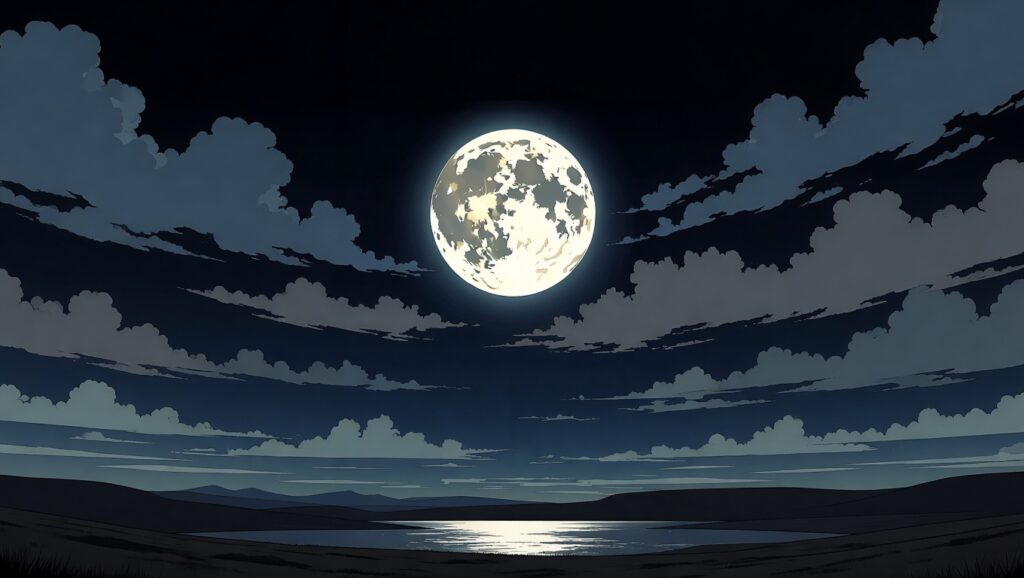
I surfaced from sleep again at 3:34, pulled upward not by sound or touch but by the weight of light itself. The room had become a vessel for something older than walls or glass, something that didn’t ask permission before entering. The moon had shifted position, no longer a distant observer but a presence, full-faced and unrelenting. She hung just beyond the windowpane, her light not diffused by clouds or softened by distance, just pure, liquid silver, poured straight into the room like a slow, deliberate offering.
I didn’t check the phase. It didn’t matter whether she was technically full or just near enough to pretend. What mattered was the way she filled the space, turning the air thick and cool, the way honey thickens when it’s left undisturbed. The glow pooled on the floorboards first, seeping into the cracks between them, then climbed upward, draping itself over the chair in the corner, the stack of books on the nightstand, the half-empty glass of water that caught the light and held it like a secret. By the time it reached me, it was no longer just illumination but something closer to a touch, fingers of cold fire tracing the curve of my shoulder, the ridge of my collarbone, the hollow at the base of my throat.
Signature:
For a long while, I didn’t move. The light didn’t just fall; it settled, the way dust settles after a disturbance, or the way silence settles after a held note finally releases. It found the edges of things: the sharp line of the windowsill, the soft fray of the blanket’s hem, the uneven stack of my notebooks. Made them glow, just faintly, as though they’d been dipped in phosphorescence. My skin prickled, not from cold but from the strange, almost electric sense of being seen. Not by eyes, but by time. By something that had watched a thousand nights like this one, that had slipped through a thousand windows, that had known a thousand versions of this quiet, this stillness.
There’s a word for this. Not bathing. Too deliberate, too human. Not drowning. Too violent. Maybe steeping. Like tea leaves in hot water, like wool in dye. The moon wasn’t washing over me; she was seeping in, colouring the parts of me that usually go unnoticed. The spaces between thoughts. The back of my ribs. The slow, deep pulse behind my sternum. I could feel it happening, the way you feel the first pull of a tide when you’re standing too close to the shore. Not painful. Not even uncomfortable. Just inevitable.
And for the first time in months, I didn’t reach for my glasses. Didn’t squint against the brightness or turn my face away. I let my eyes adjust until the light wasn’t just something I saw but something I was inside of, suspended in, the way a diver is suspended in the middle layer of the sea, neither above nor below, but held, for a moment, in the quiet in-between.
The air had gone thick with silence. It pressed against my skin, not heavy but insistent, like the hush before a secret is shared. And in that quiet, the room became something else, not just walls and shadows, but a kind of threshold. As if the night itself had leaned in closer, breathing against the glass until the boundary between inside and out blurred into something porous, something alive.
I had the strange sense of waking into a language I’d forgotten I knew. Not the sharp, angular words of daylight, the ones that pin things down and name them, but something older, something that moved like water over stone. The kind of speech that doesn’t explain but reminds. The moon hung there, not as a thing to be observed but as a voice already mid-sentence, one that had been speaking long before I’d thought to listen.
My mind wandered to those who’d stood in this same quiet before me, the ones who’d measured time by her phases, who’d carved her likeness into bone and whispered her names like prayers. They wouldn’t have called it light, not really. They would have called it a visitor. A witness. The kind of guest who arrives unannounced but is always expected, the way the tide is expected, the way the turning of the year is expected. She didn’t knock. She didn’t need to. The window was just an excuse; she would have found another way in.
I thought of how she slips into the cracks of things, the spaces between branches, the gaps in a lover’s fingers when they reach for each other in the dark. How she’s been stitched into the seams of stories for so long that we don’t even notice anymore, like a thread pulled so tight it’s become part of the fabric. The poets call her silver, but that’s too clean, too polished. She’s not a coin or a blade. She’s the sheen on a fish’s scales, the glint in a predator’s eye. She’s the reason wolves throw back their heads, why the restless pace their rooms at night. She doesn’t just reflect; she answers.
And there she was, spilling across my floorboards, not careful, not measured, but generous. She didn’t demand anything at all. Only that I stop trying to capture her. With lenses, with words, with the desperate little rituals of modern attention. She wasn’t here to be framed or filtered or reduced to something shareable. She was here to be met.
My fingers didn’t twitch toward the phone on the nightstand. The thought of lifting it, of trying to trap that light in a rectangle of glass, felt like sacrilege, like cupping my hands around a flame only to find them empty. So I didn’t. I let my palms stay open. Let my breath slow until it matched the rhythm of the night outside, until the line between inhaling and being inhaled dissolved.
For the first time in longer than I could remember, I didn’t look at the moon.
I let her look back.
The first light of dawn didn’t so much arrive as it simply was, the way a held breath finally releases without fanfare. No grand proclamation, no sudden blaze across the horizon, just a gradual uncurling of the dark, as if the night had been a clenched fist slowly relaxing its grip. The moon had done her work already, easing the hinges of the world so the morning could slip in unnoticed, unchallenged. The air carried a different weight now, not the heavy stillness of midnight but something lighter, more porous, like the sky itself had been stretched thin enough to let the day seep through.
I’ve spent hours turning it over in my mind, the way you might worry a smooth stone between your fingers. Those unplanned moments, the ones that arrive uninvited, that don’t fit neatly into the ledger of cause and effect, they’re the ones that seem to bypass the usual routes. They slip past the sentries of logic and land somewhere deeper, somewhere the language of the mind doesn’t quite reach. That moonlight didn’t rearrange the furniture of my life. It didn’t hand me a key or a map or even a riddle to solve. But it did something quieter, more unsettling. It reached in and brushed against a cord I’d forgotten was there, and for the briefest stretch of time, something inside me hummed in reply.
The word mythic keeps surfacing, though that’s not quite right. Too grand, too deliberate. It was more like the flicker of recognition you get when you pass a stranger on the street and for a fraction of a second, you’re certain you’ve seen them before, not in this life but in some other, someplace where the rules were different. A wink, maybe, but not the kind that’s performing for an audience. The kind that’s just between two things that already understand each other.
And the strange thing? That’s all it took. No revelation, no instruction manual, no sudden clarity about the meaning of it all. Just the quiet certainty that, for that one stretch of time, the universe had leaned in close enough to breathe the same air as me. And if that’s not enough, then I don’t know what is.
Footnote: On the Mythic Lore of Moon Bathing
There is a particular quality to being awake at 3 a.m. when the rest of the house is sleeping. Not the anxious wakefulness — the grinding kind, where the mind runs its loops and the ceiling offers nothing back. This is different. This is when something pulls you to the window, or out onto the step, and you stand there in the cold with no particular reason for standing there, and the moon is full and the sky is very clear and you feel, quietly, like you have been called.
Most of us close the curtain and go back to bed.
There is an ancient practice in the Vedic tradition called chandra snana. Chandra is the moon. Snana is bathing. Lunar bathing — the practice of sitting or standing in the light of the full moon, skin exposed, receiving what the moon has to offer. Not metaphorically. Actually. Ancient Ayurvedic texts treat moonlight as a substance with medicinal properties: cooling, calming, a counterweight to the heat and intensity of solar energy. The moon was understood to carry soma — the nectar of consciousness, the liquid that the Vedas describe as the fuel of the gods and the balm of the over-taxed mind.
Chandra snana was not mysticism dressed up as medicine. It was medicine that understood the cosmos as the clinic. The moon was prescribed. You went out into it the way you’d take a remedy — with intention, with attention, and with some basic preparation. You faced the moon. You let it touch you. You stayed long enough for something to happen.
What happened, the ancients believed, was a recalibration. The nervous system cooled. The mind settled into a different frequency. What the sun ignited during the day, the moon could regulate at night.
The Greeks understood this differently, but not entirely differently.
They gave the moon three faces. Selene was the moon as pure presence — the Titan who drove the lunar chariot across the night sky, whose face illuminated the darkness without asking anything in return. She was not a huntress or a healer. She was simply radiance. The thing that shines because that is its nature. In later traditions she became associated with the full moon specifically — that moment of maximum brightness, maximum visibility, when nothing is hidden.
Artemis carried the crescent. Daughter of Zeus, twin of Apollo, huntress of the wild edges — she was the moon in its active form, the light that falls through forest canopy, the illumination of things not yet fully formed. Artemis did not preside over domestic spaces. She ran at the borders, at the transitional zones, at the places where culture gave way to wilderness. Her moon was the moon of liminal territory. To be out at night, moving through the half-light, was to be in her domain.
Luna was the Roman version of Selene, but the Romans did something interesting with her. They built her a temple on the Aventine Hill, and they connected her explicitly to the rhythms of biological and civic life — the calendar, the menstrual cycle, the tides. Luna was not abstract. She was structural. She was the force that organised time at its most intimate scale.
Three faces. Three registers of the same light. Presence. Activity. Structure.
What all three shared was this: they were not passive decorations on the night sky. They were agencies. Forces that did things to the world, and to the people living in it.
In Taoist alchemy, the moon is yin made visible.
The Taoist understanding of the cosmos moves along the axis of yin and yang — not as moral opposites but as complementary forces, each containing the seed of the other, each requiring the other to have meaning. Yang is solar, active, expansive, hot. Yin is lunar, receptive, inward, cool. Neither is superior. Both are necessary. The cultivation of either, in isolation, creates imbalance.
Taoist internal alchemy — neidan — works extensively with the gathering and circulation of subtle energies. Lunar practice was a recognised part of this. The full moon was understood as a moment of maximum yin force — a time when the quality of stillness, receptivity, and inward awareness was available at its peak concentration. Practitioners would sit in moonlight not to receive something from outside, but to amplify what was already within them. The moon was a mirror. A teacher. A frequency to entrain to.
There is a particular Taoist practice called yuejing — roughly, moon gazing — that involves sitting quietly, relaxing the eyes, and allowing the moonlight to enter without effort. No striving. No intention beyond the intention to receive. The whole practice is about getting the effortful, purposive, solar mind out of the way long enough for something quieter to move.
The Taoists called this wu wei. Action through non-action. Not passivity, but a different quality of engagement — one that listens before it speaks, that receives before it generates.
Moon bathing, understood this way, is a form of wu wei. You go out. You stand in it. You do not do anything with it.
So what actually happens when the moon wakes you at 3 a.m.?
Something in the body already knows. Not the mind — the mind will tell you it’s cold, it’s late, you have things to do tomorrow. The body knows. The body is not impressed by the schedule.
Moon bathing is simple to the point of embarrassment. You go outside. You find a patch of moonlight. You stand or sit in it — skin exposed if you can manage, face lifted toward the light. You breathe. You let the cool of the night settle in. You stay for ten minutes, or twenty, or as long as feels right, and you do not try to have an experience. You just stay.
The Vedic tradition says you bathe in it the way you’d bathe in water — fully, unhurriedly, present to the sensation. The Greek tradition says you enter the domain of a specific force and respect that you are not in charge there. The Taoist tradition says you become temporarily permeable, let the yin frequency do what it does, and trust that your body has been doing this kind of calibration since long before you had words for it.
All three traditions agree on one thing: the moon is not nothing. The night is not just the absence of day. What happens in the dark, in the quiet, in the silver light, is its own kind of necessary.
The 3 a.m. waking is not insomnia. It is an invitation.
Go out. Stand in it. Let the night do what the night does.
Journal Prompt
Take yourself outside on the next clear, bright night — full moon or close to it. Stay for ten minutes. No phone. Just you and the light.
Then come inside and write to this:
What does the moon ask of you that the sun doesn’t?
Don’t answer it analytically. Sit with it for a moment before you write. Let the question do some work. Notice what comes up from below the usual register — not the to-do list version of you, not the productive version, but the one who woke up at 3 a.m. and felt pulled toward the window.
Write from that one.
The moon doesn’t speak in words. She speaks in tides, in dreams, and in long silences wrapped in silver.
And sometimes, lying there in the quiet dark, doing nothing but receiving, we become the altar.
Imagine, for a moment, a fire crackling in the heart of an ancient forest. Sparks leap like tiny stars into the velvet dark, spiralling skyward in silent communion with the heavens. You sit close enough to feel the fire’s gentle warmth kiss your skin, hear its whispers blending with the wind’s hushed secrets. Around you, shadows dance in graceful rhythms, conjuring figures both familiar and strange—spirits of myth, ancestors of imagination.
We’ve all felt it, haven’t we? That subtle tug toward the stories whispered in flame and shadow, a primal longing for something deeper, something woven from the threads of mystery itself. This is the pulse of the mythic imagination, an ancient inner campfire around which your soul has always gathered, even when you forgot its presence.
In earlier times, the storyteller—the griot, the bard, the sage—gathered us around flames much like these, sharing myths that shaped worlds, built cultures, and whispered the hidden truths of our humanity. Today, though the external fires may be fewer, that inner flame still burns. It waits patiently within your being, ready to illuminate your path and reveal the deeper stories shaping your life.
Consider for a moment: what myths are you quietly carrying? What subtle narratives have nestled in your soul, shaping your choices, your identity, your entire way of seeing and being in the world?
Perhaps these myths arrived gently, passed down by elders or found in the pages of cherished books. Or maybe they were imposed silently by culture’s hidden hand, stories of who you “should” be and how you “should” live—whispered persistently enough that you mistook them for truth. But the mythic imagination, the flame inside, offers something radical: the chance to reclaim, rewrite, and rediscover those very myths that shape your existence.
Tonight, sitting together at this inner fire, I invite you to lean closer. Let us journey beneath the surface of your everyday narratives and explore the mythic imagination—the living, breathing stories that shape your soul’s quest.
Gaze into the flames. Listen to the fire’s ancient murmurs. Feel its warmth kindle the spark of recognition deep within.
And as you do, ask yourself gently:
“What myth has brought me here, and what story within my soul is aching to be remembered?”
Mythic Imagination: A Doorway into the Deep
Within every heart lies a hidden door, inconspicuous to casual observers, yet sacred and waiting patiently for the curious seeker. On its surface, you might see nothing more than weathered wood, ancient hinges, and the faintest shimmer of something strange and unknowable. It seems ordinary enough to overlook—but approach it with intention, open it even slightly, and you’ll find yourself stepping onto a threshold where reality deepens, richens, and transforms before your eyes.
This is the doorway of the mythic imagination, the entryway into the hidden rooms of your inner world—the places where life ceases to be merely lived and begins to be narrated, mythologised, and imagined into meaning.
James Hillman, that wise explorer of the psyche, tells us that myths are not merely old stories from dusty books. They are the natural language of the soul, whispered by our dreams, echoed in synchronicities, and glimpsed in the poetic rhythms of our days. They come to life precisely when we stop trying to decode them intellectually and instead allow ourselves to dwell within them, sensing their rhythms and reverberations in the marrow of our being.
I recall vividly the first moment my own mythic imagination stirred awake. It was on a solitary walk through woods thick with the quiet hum of summer, sunlight breaking gently through the canopy like scattered pieces of gold. Lost in thought, perhaps distracted by trivial worries or fleeting concerns, I nearly missed the delicate object resting on the path—a single raven feather, dark as ink, glossy in the sun. As I lifted it, feeling its weightlessness yet sensing a strange gravity, the world shifted subtly around me. In that instant, I wasn’t merely holding a feather—I had stepped into a story.
That simple feather became a symbol, an emissary sent by some deeper narrative asking for attention. It was no longer an object but a metaphor, an invitation, perhaps even a messenger from Odin or Morrigan—archetypes whispered to life by the mythic imagination. What once seemed random had become sacred; the mundane world opened itself to reveal layers of hidden meaning. The raven feather had become my key, and through that seemingly ordinary encounter, my mythic imagination ignited.
This, friend, is what the mythic imagination offers you—a deeper way of seeing, one that transforms the ordinary world into an enchanted realm. It invites you to notice feathers and whispers, dreams and symbols, tarot cards and chance encounters, as doorways into deeper narrative truths. It calls you to see your life not as a mundane progression of events but as a rich story of mythic significance.
The question is never whether this hidden door exists, but whether you dare to open it.
And so I ask you gently, with curiosity and reverence:
What quiet symbols or subtle synchronicities have recently entered your world, whispering an invitation into deeper meaning? What myths might they be offering you, if you choose to step across their threshold?
The Stories We Inherit
Imagine standing on the shore of a river, its waters flowing ceaselessly onward, whispering ancient secrets and carrying forward the dreams, desires, and myths of countless generations. We are each born along this river, swept into currents of stories not entirely our own—tales told long before our first breath, beliefs shaped long before our first thoughts formed.
These are the inherited stories, the unseen myths that guide our lives from within shadows. Some of them nourish and inspire, illuminating paths toward meaning and fulfilment. Others quietly bind us, weaving threads of obligation, expectation, and conformity that can subtly constrict the soul’s longing.
Joseph Campbell speaks eloquently of the “mono-myth”—the hero’s journey—that universal narrative embedded within every culture. Yet alongside this nourishing myth live other, less empowering stories: myths of success as wealth and acclaim; myths of worthiness tied to productivity; myths of identity bound up in endless striving. Each of these stories whispers insistently, shaping what we value, how we act, and who we believe ourselves to be.
I have felt the weight of these inherited myths deeply in my own journey. Once, early in my career, I found myself chasing the relentless myth of achievement—an unconscious quest for validation through success as defined by society’s yardstick. The promotions, the titles, the applause: each milestone was supposed to bring meaning, yet each felt emptier than the last, an echo without source.
It wasn’t until I stepped away, retreating into the solitude of reflection and journaling, that I finally glimpsed the hidden story that had silently shaped my path. In my notebook, I traced back through my choices, mapping my beliefs like constellations. Gradually, patterns emerged—myths whispered by culture, family, schooling, media. I saw clearly how this inherited narrative had defined success as external validation, approval measured by others’ standards rather than my own soulful truth.
Through the mythic imagination, however, I discovered another way: the power not only to see these stories clearly but also to reclaim and rewrite them. Sitting by the metaphorical fire within my soul, I began crafting new stories—stories that embraced deeper truths, stories in which success was no longer a relentless pursuit but a meaningful alignment with purpose, creativity, and joy.
This shift was subtle yet seismic. It was as if I stepped off a familiar but exhausting road and entered a winding path leading through mythic landscapes of my own making. The myths I chose to live by transformed, from shadows quietly directing my steps into lanterns illuminating the journey ahead.
And so it is for each of us. To awaken your mythic imagination is not simply to dream vividly or poetically—it is to recognise clearly the stories you’ve inherited and consciously choose the ones you wish to carry forward. It’s an act of reclaiming, rewriting, and reshaping your very self, story by story, into a more soulful truth.
Let’s pause together at this riverside, then, and gaze into the reflective waters with gentle curiosity. Ask yourself:
“Which stories have guided my life without my conscious consent? Which myths of success, worthiness, or identity am I ready to lovingly release—and what new story is ready to be born in their place?”
Archetypes and Allies
In the quiet moments when the world’s clamor recedes, you can hear the soft footsteps of archetypes moving gracefully within the corridors of your soul. Archetypes—those primal, luminous figures of the collective unconscious—are not distant abstractions; they are your allies, your guides, companions whispering wisdom from realms deeper and older than memory itself.
Carl Jung taught us that archetypes reside in the psyche, timeless patterns that weave themselves into myths, dreams, and symbols. They appear as familiar strangers, embodying aspects of ourselves we’ve forgotten or never consciously known. To awaken your mythic imagination is to welcome these archetypes home, inviting their stories, wisdom, and power to dance within your own lived narrative.
In my own journey, four archetypal allies have emerged clearly—Prometheus, Sophia, Thoth, and Odin—each representing facets of my mythic imagination, each illuminating different corners of my psyche.
Prometheus, the fire-stealer, speaks boldly within me, reminding me always of the power of creativity, rebellion, and illumination. He dares me to challenge the gods of convention, to seek truths hidden in shadows, to trust that wisdom often lies in the courageous theft of forbidden insight. Prometheus, chained yet defiant, teaches me resilience in the face of struggle, perseverance in pursuit of the soul’s true fire.
Sophia, the divine feminine spirit of wisdom, whispers gently, guiding me inward toward contemplation, compassion, and intuitive understanding. She is the gentle muse who invites depth over surface, wisdom over information. Sophia appears in moments of quiet reflection, in dreams scented with jasmine and sandalwood, and in subtle intuitions that arrive softly, urging patience, care, and clarity.
Thoth, the ibis-headed scribe, guardian of words and keeper of knowledge, meets me in the interplay of story and symbol, writing and myth. He teaches that words have the power not only to describe reality but to shape it—each sentence a magical incantation, each narrative a subtle spell shaping consciousness itself. In my work as storyteller, griot, and myth-weaver, Thoth remains my constant companion, guiding my pen and illuminating the transformative power of language.
And then there is Odin—seeker of hidden wisdom, traveler of the nine realms, poet-shaman wandering between worlds. Odin invites me to embrace mystery and paradox, to see clearly through the eye of sacrifice, to grasp knowledge not by hoarding answers but by fearlessly questioning all assumptions. Odin reminds me that wisdom is won not through certainty but through courageous exploration, through willingness to face the unknown.
Each archetype has revealed itself through rituals and practices—through journaling, tarot, mythic reflections, and storytelling. Each has become more than symbolic: they are companions whose presence deepens and enriches my mythic imagination, reminding me that I am never alone on this soul-journey.
Once, during a tarot reading, Odin appeared to me vividly in the form of the Hanged Man—an image of sacrifice, surrender, and wisdom won through inversion. At first glance, the card startled me, echoing a fear of vulnerability. Yet as I allowed the archetype to speak, I recognised his profound teaching: wisdom arises precisely when we surrender control, when we accept the discomfort of uncertainty, when we dare to see the world from an inverted perspective.
In embracing Odin’s archetypal wisdom, I discovered new strength in vulnerability, new clarity in paradox, and new freedom in surrender. This is the mythic imagination’s great gift: archetypes become allies, and their stories transform from ancient fables into living truths guiding your daily life.
Pause for a moment here, and invite your own archetypal allies to step forward. Ask yourself gently:
“Which archetypes have been quietly guiding my journey? What wisdom are they whispering, and how might embracing their presence help me more deeply embody the myth I was born to live?”
Thresholds and Transformations
Picture yourself standing at the edge of a deep forest, twilight settling gently into the spaces between the trees. Behind you lies the familiar path, comfortable yet worn thin by the steps you’ve taken time and again. Ahead lies the unknown—a place both enticing and uncertain, lit only by moonlight and the quiet shimmer of possibilities unseen.
This place—the borderland between the known and the mystery—is the threshold, a sacred liminal space where profound transformations await.
Thresholds are at the heart of the mythic imagination. They signify moments of great transition, when the soul is called to leave behind old identities, beliefs, or ways of being, to step courageously into the unknown. Joseph Campbell described these thresholds as crossings, passages in the hero’s journey where the familiar world must be relinquished for deeper wisdom and true soul-growth to emerge.
In myth, these crossings appear vividly—a hero plunges into the underworld, ventures into an enchanted forest, or sets sail across a turbulent sea. But your thresholds, though subtler, are no less potent. They appear as career changes, personal crises, spiritual awakenings, or simply the quiet realisation that life as you’ve known it no longer fits the soul you’ve become.
I have known such thresholds intimately. One of the most profound came during a period when my life, outwardly successful and secure, suddenly felt empty and misaligned. I stood at an inner crossroads, knowing intuitively that to remain where I was would mean betraying the deeper call whispering from within.
The threshold appeared quietly, as thresholds often do, in a series of sleepless nights and reflective walks, in conversations that echoed with a strange, unsettling resonance. Eventually, the moment of crossing arrived—not with a dramatic flourish, but as a calm yet undeniable knowing that it was time to step forward, even without knowing precisely what awaited on the other side.
I crossed into a space of profound uncertainty, leaving behind familiar identities built around roles and accomplishments. Yet within that uncertainty, something extraordinary unfolded. My mythic imagination awakened fully, guiding me deeper into my inner landscape, helping me reclaim stories I’d forgotten, and illuminating new pathways toward authenticity and purpose.
In the mythic imagination, thresholds aren’t merely places of passage—they are sacred initiations. To cross them is to surrender to transformation, allowing yourself to be reshaped by forces deeper than the conscious mind. It’s a moment of trusting that beneath uncertainty lies the promise of renewal, a deeper alignment with the mythic story your soul seeks to embody.
Perhaps you, too, find yourself standing at such a threshold now, feeling its subtle pull, sensing the quiet whispers urging you forward into mystery. Perhaps your threshold appears as a quiet longing, an inner voice calling for change, or a restless knowing that life holds something deeper, richer, more aligned with your true nature.
As you linger at the threshold, know this: you stand in sacred company. Every hero, every seeker, every soul who has dared live authentically has stood exactly where you now find yourself.
Take a breath. Feel the gentle courage within.
Ask yourself softly, yet earnestly:
“What threshold am I standing at today? What must I leave behind to cross into the deeper story waiting patiently on the other side?”
Mythic Praxis: Living the Imaginal
There comes a time when myth ceases to be something you merely read or imagine and becomes something you live—a breathing, tangible practice that infuses your days with meaning and depth. This deliberate embodiment of the mythic imagination is what I call mythic praxis—the subtle yet profound art of weaving myth into the fabric of everyday life.
Mythic praxis invites you not only to see your life as a narrative but to consciously shape it through rituals, reflections, and symbolic acts that awaken your inner storyteller. It transforms ordinary moments into encounters with the sacred, turning your life into an ongoing dialogue between the tangible world and the imaginal realm.
I discovered the power of mythic praxis through simple but potent rituals—practices such as mythic journaling, wisdom walks, tarot storytelling, and soulful conversations with archetypal allies. These are not mere activities; they are quiet ceremonies that awaken the mythic imagination, inviting it to speak clearly and guide your steps.
Consider journaling: what might seem like a modest act of pen meeting paper becomes, through mythic praxis, a sacred invocation. When I journal, I open myself to the mythic dimensions of my experience, exploring dreams, symbols, and synchronicities. The blank page becomes a portal, the pen a wand, words the threads weaving together my lived story with deeper truths. Each entry reveals hidden connections, archetypal whispers, and subtle guidance, illuminating my path through the mundane toward the profoundly meaningful.
Similarly, wisdom walks—those reflective strolls taken without agenda, open-hearted and attentive—become journeys of revelation. On these walks, nature herself becomes an oracle: each fallen leaf, each murmuring brook, each passing cloud is imbued with symbolic resonance. A hawk soaring overhead might speak of clarity and vision; a winding trail becomes a metaphor for life’s unexpected turns. Mythic praxis is seeing these simple occurrences not as random events, but as meaningful signs, stories waiting to be deciphered by your mythic imagination.
Tarot storytelling is another powerful practice—one that merges symbolism with narrative intuition. The cards, rich with archetypal imagery, offer not merely answers but reflections of the stories living deep within your psyche. In drawing the cards and narrating their symbolic dance, you tap directly into the mythic imagination, discovering profound insights and reclaiming your agency as both storyteller and protagonist of your life’s unfolding tale.
Through these practices, mythic praxis reveals itself as a way of living poetically and intentionally. It reminds you that the mundane world is pregnant with symbolic significance, waiting only for your recognition. It transforms your relationship with reality itself, teaching you that each moment, no matter how ordinary, contains seeds of mythic meaning if approached with reverence and curiosity.
Moreover, mythic praxis deepens your intimacy with yourself and your connection to others. By living your myths consciously, you invite authenticity and vulnerability into your relationships, creating spaces where soulful conversations can flourish, rooted in shared stories and archetypal truths.
As you embrace mythic praxis, something beautiful and alchemical occurs: your life begins to resonate with mythic coherence. The threads of your story—once tangled, fragmented, or seemingly random—start weaving themselves into a meaningful tapestry. You realise, perhaps for the first time, that you are not merely living your life but authoring it, co-creating a story infused with intentionality, imagination, and soul.
Pause with me here, by our inner campfire, and reflect for a moment:
“How might I begin to consciously embody my mythic imagination each day? What rituals or practices could transform my ordinary moments into profound encounters with myth, meaning, and magic?”
Invitation: Becoming the Myth You Were Born to Tell
Our fire now burns low, its embers pulsing gently beneath the ash like a heartbeat—steady, quiet, waiting patiently to flare once more. Yet as our time here draws softly toward its close, this is not an ending; it’s an opening, an invitation to step forward from this sacred threshold into the deeper story of your life.
You see, the mythic imagination is never truly finished. It calls continually, inviting you deeper into the narrative currents that flow beneath your everyday existence. Each insight, each archetype, each threshold crossed is but one chapter in the ever-unfolding myth your soul is here to embody.
You were born with stories inside you—myths whispered into your being long before you took your first breath. To awaken your mythic imagination is to reclaim those stories consciously, to author your life with intention, courage, and soulful authenticity. It is the sacred act of remembering who you are beneath the layers of inherited scripts, societal expectations, and cultural narratives.
What story, then, is yours to tell? What myth pulses within your heart, waiting patiently, insistently, to be lived?
Perhaps you are Prometheus, boldly stealing fire to illuminate a path for yourself and others, daring to defy convention and claim your power of creation. Perhaps you embody Sophia, patiently guiding yourself and others toward wisdom, compassion, and intuitive knowing. Perhaps Thoth calls you, inviting you to shape reality through language, imagination, and the power of your voice. Or perhaps Odin whispers courageously in your ear, reminding you that wisdom is found in embracing mystery, paradox, and the unknown.
Whoever you are, whatever your myth, know this: your story matters. It is unique, sacred, and vital to the great story of human experience. To live your myth is not an indulgence; it is an act of profound courage, creativity, and compassion. It is a gift to yourself, yes—but also to the world, which aches for the richness, depth, and authenticity your true story offers.
Tonight, as you rise from this mythic campfire within, I offer you this gentle invitation:
Become the myth you were born to tell.
Live consciously, poetically, and mythically, transforming your everyday moments into encounters with the sacred. Step courageously across thresholds, welcoming transformation. Befriend your archetypes and allies, honoring the wisdom they whisper to your soul. And most importantly, trust deeply in your own narrative, knowing it to be exactly the story you need—and the one the world needs—from you now.
I leave you with a reflective prompt, a gentle question to guide you onward:
If your life were a myth—and it most assuredly is—what story would you choose to live, beginning today?
Hold this question tenderly. Allow it to linger. Carry it forward, not just as a thought, but as a quiet prayer whispered softly within your heart.
The mythic imagination awaits you. The story of your soul has only just begun.
There’s a moment in every myth where the hero stands before a gate. Not a grand gate of gold or marble—but something subtler, more symbolic. A shimmer between worlds. A crack in the ordinary. A child in the forest, staring into the glow of a rainbow path.
That’s the image I pulled tonight.
From the Osho Zen Tarot deck came the card called Adventure. A small figure stands on the edge of shadow and light, stepping—without hesitation—into the unknown. Not armoured. Not guided. Just open.
I felt something ancient stir.
This card felt less like a message and more like a mirror. Because lately, I’ve heard the call. Not just the whisper of a new project, but the Call—the one Joseph Campbell spoke of. The one that arrives with the weight of meaning, that hums through your bones and rearranges your breath.
I’ve answered.
But as anyone who’s walked this path knows, the call is only the beginning. Just beyond it stand the gatekeepers: Fear, Doubt, and Disbelief.
I’ve met them. They tried to stop me, as they always do. They mocked me with familiar scripts: “You’re not ready. You’ll get lost. Who do you think you are?”
And still—I stepped forward.
This adventure is on.
I don’t pretend to know where it leads. But like the child in the card, I’m approaching it with childlike curiosity and wonder. Not because I’m naive, but because I remember: wonder is how you walk through the world when you trust the path more than the destination.
It’s easy to forget that.
We get older, we get armoured. We swap questions for answers. But the soul doesn’t want certainty—it wants experience. It wants you to feel the thrill of not knowing, to be lit by the colors of the unseen, to walk—open-hearted—into a story that’s still being written.
Two invitations for you, fellow seeker:
Ask yourself: What does the child in the Adventure card know that I’ve forgotten? Let that inner adventurer speak. Write it down. Trust what comes.
Map your Unknown: If your next step led into a mythic landscape—what would it look like? Who or what would greet you there? Draw it. Name it. Bless it.
The gate is always there, just at the edge of habit. And on the other side? Not safety. Not clarity.
But something better: aliveness.
—Clay Storythinker & Mythic Mentor for Seekers on the Threshold Helping you rewrite the story beneath your story.
Want to carry this energy with you? Subscribe toSoulcruzer: Field Notes from the Edge and receive weekly mythic prompts to guide your own inner adventure.
Somewhere between the womb and the wave, between the clenched fist and the open hand, there is a rhythm.
It is not rushed. It is not forced. It is the rhythm of becoming.
This morning, I drew three cards from the Osho Zen Tarot. And together, they told a story—not just for me, but for all of us standing at the edge, waiting for the next page to turn.
PATIENCE came first. A pregnant figure beneath the arc of the moon. Not waiting in frustration, but in trust. She reminded me: every seed has its season. Every story, its sacred pace. The soul cannot be microwaved. It must marinate in time.
Then came LETTING GO. A single drop falling from a lotus leaf, returning to the water. No struggle. Just surrender. It whispered: Release what you no longer need to carry. Let the river take it. There is grace in dissolving.
And then—perhaps the truest mirror—CONTROL. A rigid figure of steel and symmetry, gripping the illusion of certainty. It showed me the tension I still hold. The part of me that fears the mystery. That builds pyramids to feel safe from the storm.
But here’s the mythic truth:
Patience is the womb. Letting Go is the release. Control is the threshold.
Together, they ask us to soften. To trust what is gestating. To release what’s done. To ungrip the need to manage the magic.
For you, dear seeker—here are some soul prompts to sit with this week:
What in me is still ripening, even if I can’t see it yet?
What story, role, or name am I ready to return to the river?
Where am I gripping out of fear, and how can I soften?
You don’t need to know the next step. You only need to trust the rhythm. Something ancient is unfolding in you. Let it.
There’s a moment just before the flame catches, when the ashes still whisper the name of who you used to be.
I find myself standing in that moment now. It’s a Friday—gray-skied and bone-cold here in the UK—but mythically speaking, it’s a threshold day. The world calls it the weekend, but for those of us walking the soul path, this is something deeper. A turning point. A chance to die and be reborn.
I’ve been circling this fire for some time—walking my Wisdom Walks, speaking into the wind, sending audio dispatches from the edges of my becoming. People are listening. Something in the voice, in the rhythm, is resonating. They’re feeling the myth behind the words.
And I am, too.
The truth is, there’s a version of me still clinging by the toes to an old way of being. He’s not evil. He’s not broken. He simply no longer belongs. He’s done his part. But I’ve been slow to let him go. Maybe you know the feeling—the ache of becoming, right before the release.
So today, I mark the shift. Today, I light the pyre.
This isn’t just journaling. This is ritual. A personal resurrection ceremony in three acts:
Write a eulogy for the version of you that’s outlived his story. Honor him. Mourn him. Then burn the words—or bury them beneath a tree.
Craft a resurrection vow. Speak directly to the self you’re becoming in Act III. Make it mythic. Make it matter.
Walk with intention. Even if it’s cold. Even if it’s just around the block. Let your feet carry the vow into your body.
Me? I’m starting here. Right here, in the liminal hush before the flame.
“I’ve been hanging by the toes to an old self. Today, I let go.”
The Phoenix doesn’t rise by willpower. It rises because it has no other choice.
And neither do I.
🔥 JOURNALING RITUAL: The Eulogy and the Vow
Today, write like you’re tending a sacred flame.
🕯️ Part One: The Eulogy
Who is the self you are ready to release?
What story has he been living?
What burdens has he carried?
What will you thank him for before you let him go?
🌄 Part Two: The Resurrection Vow
Who are you becoming in Act III?
What values guide this self?
What vow do you make to him—to yourself—as you cross the threshold?
“Let the flame consume me. Let it burn bright enough to guide others through the dark.”
The Ashes: A Season of Wandering
Before any resurrection, there is the wandering.
Mine didn’t come with thunderclaps or visions in the desert. It came quietly, like dust settling on a path half-forgotten. I didn’t notice, at first, that I’d drifted from the fire. One day I was mentoring seekers through mythic rites of passage, guiding them up sacred mountains. The next, I was inside boardrooms and performance review loops, speaking the language of metrics and deliverables.
The world called it success. But I knew better. I knew what it felt like to burn. And I wasn’t burning anymore.
What started as a brief detour became a long exile. A season of soul drift. I convinced myself it was practical. Necessary. Everyone’s got to eat. And there’s truth in that. But in chasing the secure, I left behind the sacred.
I don’t regret those years—they sharpened my skills, taught me to read the map of power and systems. But I see now that I was living as a fraction of myself. A well-spoken ghost.
And yet, the ember never fully died.
“There’s more than this,” it kept whispering. Usually when I walked. Or when I was still enough to hear it.
Ashes are not endings. They are fertile. They remember fire.
🌫️ JOURNALING RITUAL: Walking Through Ashes
🪵 Reflect:
When did you start to drift from your fire?
What did you trade for safety, approval, or success?
What have you learned in exile that you wouldn’t have learned at the fire?
🔥 Listen for the Ember:
What sacred part of yourself refuses to be extinguished?
The First Flame: Kinabalu and the Campfire
It started in Borneo. Not with a coaching session or a grand insight—but with mud underfoot, sweat on the brow, and stars overhead.
I joined a 10-day adventure race at the foot of Mount Kinabalu. It was grueling—three races a day, deep jungle, no phones, no distractions. But it wasn’t the challenge that changed me. It was what happened after the finish line.
Each night, we’d gather at base camp. Strangers by day, fire-kin by night. We ate, talked, shed our corporate skins. Something ancient woke up around that fire—something raw, honest, and profoundly human.
And then—something even wilder. When we returned home, people quit their jobs. Left the city. Changed their lives.
Not because I coached them. Because something in the jungle and the fire reminded them of who they were.
That’s when it hit me: Transformation doesn’t need theory. It needs place, presence, and mythic space.
And so the seed of Personal Growth Adventures was planted.
The Spark Becomes a Flame: Personal Growth Adventures
I didn’t want to teach transformation. I wanted people to live it.
So I built The Ascent Experience—a weekend retreat structured on the Hero’s Journey. From the call to adventure, to the crossing of thresholds, to the return with the elixir. We didn’t talk about myth. We enacted it.
Friday night began with The Feast of Heroes. Strangers gathered like destiny had drawn them to the same table. After dinner, we stepped into the dark. No flashlights. Just trust. Just instinct.
“What is the mountain whispering to you?” we asked them in the night.
Saturday brought the outer ascent—up Mount Snowdon—and the inner descent into values, fears, and forgotten dreams. We walked. We coached. We climbed.
Sunday, they carried the elixir home—not just metaphorically, but in their hands. A stone from the summit. A message from the mountain.
That was my work. My flame. My myth. And then—once again—I drifted.
The Mistake: Unplugging Without a Net
We were good at the rupture. But we failed at the return.
We knew how to awaken people. To unplug them from the Matrix. But we didn’t know how to walk with them through the reintegration. We left them open—and unguarded.
Some soared. Others stumbled. And I’ve carried that with me.
Because the hero’s journey doesn’t end at the summit. It ends when the gift is brought home.
“We handed them the elixir, but offered no vessel to carry it in.”
Never again.
Now I know: the work isn’t just about ignition. It’s about accompaniment. About helping people return with their flame intact.
🌀 JOURNALING RITUAL: After the Awakening
🪨 Reflect:
Have you ever awakened… and then felt lost?
What support did you need—but didn’t receive?
What kind of guide would’ve helped you walk the return path?
🔥 Now consider:
Who in your life might need your presence now?
How can you be a hearth, not just a matchstick?
Resurrection: The Return of the Mentor
This isn’t a reinvention. It’s a resurrection.
The self I’m becoming is the one I left behind—covered in soot and story, still seated at the edge of the fire. And now, I’m returning to him.
Not as a seeker. But as a mentor. Not with a pitch. But with a vow.
“Let the flame consume me. Let it burn bright enough to guide others through the dark.”
Act III is not about achievement. It’s about offering. About being a living myth in a world addicted to sleep. About walking as a soul-guide—not above, not ahead—but beside.
No more hiding. No more shrinking. The fire is mine to tend.
The Offering: Wisdom Walks and Adventures Reborn
Every myth ends in return. Every resurrection brings a gift.
Mine? It looks like this:
🌀 Wisdom Walks — reflective audio dispatches from the edge of becoming. 🔥 Adventure Coaching — walking shoulder to shoulder with those ready to reclaim their story. 🪵 Digital Campfires — creating spaces of story, stillness, and shared myth.
But this time, the work doesn’t stop at awakening. It extends into integration, embodiment, and community.
This time, I’m not just unplugging others. I’m helping them rebuild their life outside the Matrix—with meaning, with myth, and with grounded tools.
“What can I offer the world this spring?” A fire rekindled. A voice remembered. A vow spoken under starlight.
And this: To walk the path with others Until they remember they’ve always had one of their own.
🌿 FINAL JOURNALING RITUAL: The Gift You Carry Back
🎒 Reflect:
What gift is rising within you now?
What flame are you ready to tend—for yourself, and for others?
What myth are you here to remember… and to live?
Write your own resurrection vow. Let it be messy, honest, and mythic. You are not beginning. You are returning.