Jim Morrison’s Reading List

The myth of Jim Morrison is a myth of pure instinct. He arrives fully formed in the collective memory: shirtless, obliterated, magnificent, doomed. The leather trousers. The baiting of audiences in New Haven and Miami. The voice that seemed to come from somewhere older than rock and roll. The story we inherited insists that this was all eruption, all Dionysian overflow, a man too full of something dark and vital to contain it.

The story is wrong.

Morrison entered UCLA’s film school in 1964 as a serious student of ideas. He wrote poetry obsessively, in notebooks he carried everywhere, before he ever stood in front of a microphone. He read with appetite and intention across philosophy, anthropology, poetry, and mythology. When Ray Manzarek met him on Venice Beach, he didn’t encounter a wild thing. He encountered someone who had already done significant intellectual work on the question of what he wanted to become.

The esoteric content in Morrison’s life and work is routinely treated as atmosphere. The shamanism, the invocations, the obsession with death and threshold experience, the deliberate use of performance as a form of altered consciousness. These get folded into the legend as texture, as evidence of his romantic excess. They are evidence of a curriculum.

Morrison assembled, largely in his early twenties, a reading list with a coherent through-line. Nietzsche gave him the philosophical frame. The French Symbolists gave him the method. Huxley and Blake gave him the name for what he was trying to do and a theory of why it mattered. Eliade gave him the ritual structure. Frazer gave him the oldest warning, which he either didn’t read carefully enough or chose to ignore. The Beats showed him that this synthesis was survivable and could be made into American vernacular art.

This is a self-education in the deliberate construction and dissolution of self, in the use of transgression and altered states as tools for accessing something beyond ordinary perception, and in the performance of archetypal roles as genuine operative practice rather than theatrical gesture. Morrison wasn’t dressing up as a shaman. He was attempting, with considerable sophistication, to actually be one.

What kind of practitioner does this particular reading list produce? What are its strengths, what are its structural absences, and what happens to the person who follows it all the way to its logical conclusion?

Morrison built one of the most powerful opening rituals of the twentieth century. He just never got around to reading anything about how to close one.


The Nietzschean Foundation
The Syllabus of Jim Morrison

Friedrich Nietzsche published The Birth of Tragedy in 1872 and spent the rest of his career partly embarrassed by it. He thought it overwrought, too Romantic, insufficiently rigorous. He was right on all three counts, and none of that matters. The Birth of Tragedy is one of those books that operates on the reader independently of its scholarly merit. It installs something. Morrison encountered it at UCLA, and it installed itself completely.

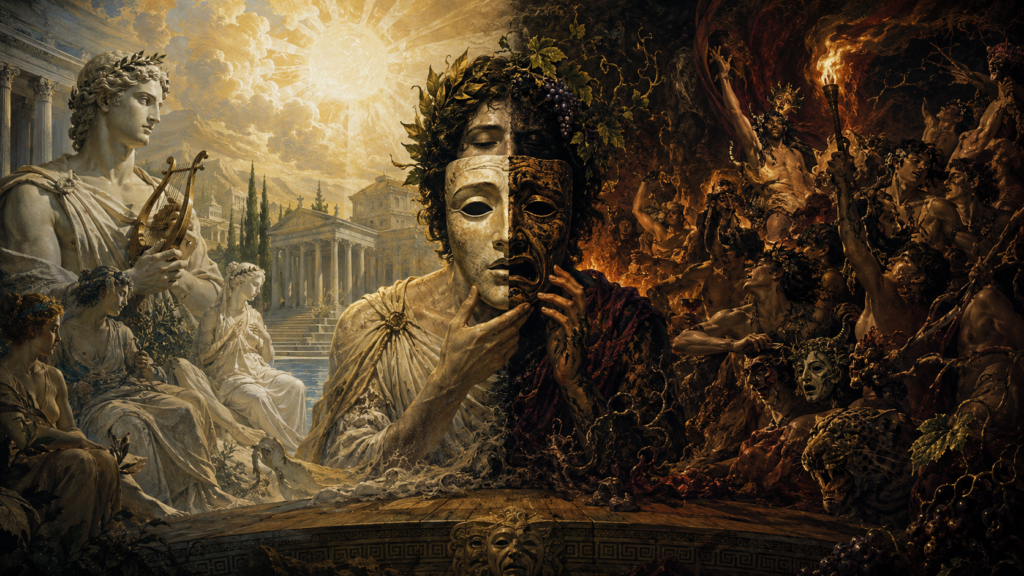
The argument Nietzsche makes is well known in outline and less often followed into its full implications. Greek tragedy was the product of a tension between two opposing drives embodied in two gods. Apollo: the principle of form, individuation, the beautiful surface, the dream. Dionysus: dissolution, intoxication, the merging of the self back into the primal unity from which individual consciousness is a temporary and somewhat painful exile. Great art holds both in productive tension. The Apollonian gives it shape. The Dionysian gives it the charge that makes the shape worth anything.

Most readers take this as aesthetics. Morrison took it as instruction.

He drew from Nietzsche a theory of vocation, not a theory of art. If the Dionysian principle is real, not merely metaphorical, then the artist who serves it is not making representations of dissolution and ecstasy. The artist is a vehicle for the actual thing. The performance is not about Dionysus. The performance is a Dionysian rite, and the audience is not watching one; they are participants in one, whether they understand this or not.

This is a significant leap from what Nietzsche wrote, and a coherent extension of the logic, and it explains something about Morrison’s relationship to his own performances that is otherwise difficult to account for. He wasn’t trying to entertain. He was trying to produce a specific state in a room full of people. The hostility, the provocation, the long silences, the spoken-word sections that confused audiences expecting rock and roll: these make no sense as an entertainment strategy. They make perfect sense as a ritual technique. You are not there to enjoy yourself. You are there to be broken open.

Nietzsche

Nietzsche’s second major contribution to Morrison’s operating system is the reframing of power. The will to power, as Nietzsche actually meant it rather than as it was later vulgarised, is not a drive toward domination of others. It is a drive toward the fullest possible expression and expansion of the self, toward becoming what you most essentially are with the least possible compromise. Morrison translated this into a will to experience. Every limit was a door. Every prohibition was a map showing you exactly where to go. The logical destination of this position is total immersion, and total immersion, followed far enough, becomes indistinguishable from annihilation.

Nietzsche saw this danger. In The Birth of Tragedy, he describes the Dionysian initiate as someone who has glimpsed the abyss beneath the comfortable Apollonian surface of civilised life, who has looked directly at the truth that individual existence is a temporary fiction, and who needs art precisely because without it this knowledge would be unliveable. Art is the saving lie that lets the tragic hero go on. Apollo is not the enemy of Dionysus. Apollo is what keeps the Dionysian from destroying the vessel it moves through.

Morrison read all of this. And then he spent roughly eight years systematically dismantling every Apollonian structure in his life.

Whether this was a misreading or the most rigorous possible application is a question the essay will keep returning to. What is clear is that Nietzsche gave Morrison something most rock musicians of his generation didn’t have: a philosophical justification for what he was doing that was genuinely serious, and a vocabulary for the forces he believed he was working with. He wasn’t out of control. He had a theory.

The theory just didn’t include a chapter on what you do when the god decides to stay.

The French Symbolist Current

If Nietzsche gave Morrison the philosophy, the French Symbolists gave him the method. The method was not gentle.

Charles Baudelaire published Les Fleurs du Mal in 1857 and was immediately prosecuted for it. The French government understood, correctly, that something more than offensive content was at stake. Baudelaire was proposing a theory of what poetry was for, and the theory was genuinely dangerous. Beauty, he argued, was not found in the elevated and the refined. It was extracted from transgression, from rot, from the city’s underworld, from boredom pushed far enough that it cracks open into something resembling the sublime. The poem was not a vessel for pre-existing feeling. It was an operation performed on consciousness, and the material it worked with was damage.

This is a long way from the Romantic tradition Baudelaire inherited, even though it looks superficially similar. The Romantics believed in inspiration, in the poet as receiver of something that arrived from outside. Baudelaire believed in technique. You constructed the conditions for the visionary state. You didn’t wait for it. The flâneur wandering the Paris arcades, deliberately absorbing the city’s shadows and contradictions, is not a passive observer. He is running a practice.

Morrison absorbed this and recognised something in it that matched his Nietzschean framework precisely. The will to experience, applied to aesthetics, produces Baudelaire. You go toward what repels the comfortable self because that is where the real material is.

Arthur Rimbaud took the argument further than Baudelaire probably intended and further than anyone had gone before in making it explicit. In 1871, at sixteen years old, he wrote two letters to friends that have become known collectively as the Lettres du voyant, the letters of the seer. The relevant passage is compact enough to summarise without much loss: the poet must make himself a seer by a long, immense and reasoned derangement of all the senses. Every form of love, suffering, and madness. He searches himself. He exhausts all poisons in himself and keeps only their quintessences.

The word that matters is reasoned. This is not an invitation to chaos. It is a programme. Rimbaud is describing a systematic technology for dissolving the ordinary perceptual filters that prevent access to deeper states of vision. The derangement is the method, not the point. The point is what becomes visible once the ordinary self is sufficiently disrupted.

Morrison read this as a practitioner reads a manual. The alcohol, the other substances, the deliberate provocation of crisis, the refusal of the comfortable and the stable: these are not simply self-destruction. They are, or they began as, Rimbaldian technique. The question of when the technique becomes indistinguishable from its supposed opposite is one the essay will return to.

What is frequently missed in accounts of both Baudelaire and Rimbaud is their position in a longer esoteric current. Baudelaire was deeply engaged with Swedenborg’s theory of correspondences, the idea that the material world is a system of symbols pointing toward spiritual realities, and this sits behind his most famous poem, Correspondances, in ways that are not merely decorative. Rimbaud’s colour-vowel synaesthesia in Voyelles is working the same territory from a different angle. They are occultists working in the medium of language, and the Symbolist movement they seeded was a significant channel through which esoteric ideas moved into European literary culture and eventually into the American tradition Morrison was growing up in.

The Symbolists are the missing link between German Romanticism and twentieth-century occultism, and Morrison’s absorption of this current means that when he picks up Eliade and Frazer later, he is not encountering alien ideas. He is finding the scholarly anthropological confirmation of a practice he had already theoretically committed to. The seer. The voyant. The one who goes to the edge of what the self can bear and looks over.

Rimbaud eventually stopped. He walked away from poetry entirely at twenty, fled to Africa, and spent the rest of his short life as a gun runner and coffee trader. He tried to close the door. Morrison, apparently, never seriously considered this option.

Huxley, Blake, and the Doors Themselves

The name of the band is a thesis statement.

Understanding what it claims requires going back through Aldous Huxley to William Blake, who is where the real weight lives.

Huxley published The Doors of Perception in 1954, an account of a single afternoon spent under mescaline in his Los Angeles home. The drug experience itself, though interesting, is not the book’s real contribution. What Huxley offers, drawing on the philosopher C.D. Broad and ultimately on Henri Bergson, is a structural argument about the nature of ordinary consciousness. The brain, he proposes, is not primarily a generator of experience. It is a reducing valve. Its function is to filter out the vast majority of what is actually available to perception, leaving only what is useful for biological survival and social functioning. What we call normal consciousness is an edited version of reality, and a heavily edited one at that.

The implications are considerable. If the reducing valve is the problem, then the goal of any serious practice, chemical or otherwise, is to force the valve open. Not to add something to experience but to remove what has been artificially subtracted. The doors of perception are not entrances to somewhere else. They are exits from the narrow corridor we mistake for the whole building.

Morrison encountered this and understood it immediately through his Nietzschean and Symbolist frameworks. Huxley was providing the neurophilosophical grounding for what Rimbaud had proposed as a poetic programme. The derangement of the senses is a valve-forcing operation. The Dionysian rite opens what the Apollonian surface keeps closed. Different vocabularies, identical claim.

But Huxley took his title from Blake, and Blake is the deeper source, and Blake is not making the same argument as Huxley, though he is making a compatible one.

The full passage from The Marriage of Heaven and Hell reads: if the doors of perception were cleansed, everything would appear to man as it is, infinite. For man has closed himself up, till he sees all things through narrow chinks of his cavern. Blake is not describing a pharmacological problem with a pharmacological solution. He is describing a spiritual condition, the fallen state in which humanity has contracted into the isolated ego and lost access to the infinite reality that surrounds and interpenetrates it. The cleansing he is calling for is ontological, not chemical. A transformation of what the self fundamentally is, not an alteration of its momentary state.

Urizen, the god of reason and law

Blake was also, and this gets lost in the Huxley citation, a practitioner working within a seriously developed esoteric system of his own construction. The prophetic books, with their complex mythology of Zoas and emanations and eternal forms, constitute one of the most ambitious attempts in English literature to build a complete alternative cosmology. Urizen, the god of reason and law, has usurped the place of the infinite. Los, the spirit of imagination and time, who labours to keep the human form divine alive against Urizen’s contraction. The fallen world is the product of a catastrophic narrowing of perception. The redemption of that world through imaginative vision.

Morrison was dipping into this system without following it all the way into the prophetic books, but enough to understand that Blake was not a Romantic nature poet who had taken something interesting one afternoon. He was a magician who had constructed a working mythology and spent his life operating within it.

The name of the band carries all of this. A commitment to the Blakean diagnosis: that ordinary consciousness is a fallen, contracted, self-imprisoned condition. And to the Huxleyan method, the systematic forcing of whatever doors can be forced. It is also a commitment to Blake’s understanding of what the doors open onto. Not pleasure. Not freedom in any casual sense. The infinite.

Which is not, in Blake’s system, a comfortable destination.

Mircea Eliade and the Shamanic Frame

Mircea Eliade’s Shamanism: Archaic Techniques of Ecstasy was published in English in 1964, the same year Morrison arrived at UCLA. Dense with comparative religious scholarship, surveying shamanic practice across Central Asia, the Americas, Australia, and beyond. Not, on the face of it, a book a twenty-year-old film student picks up for pleasure. Morrison read it anyway, and by most accounts kept it close. Once you have read the previous sources in his syllabus, the reason is obvious. Eliade was doing for shamanism what Frazer had done for the dying god: revealing the pattern beneath the cultural variation, demonstrating that something consistent was happening across radically different traditions, something structural enough to suggest it was tracking a real feature of human experience rather than a local religious habit.

Eliade’s definition of the shaman is precise and worth holding carefully. The shaman is specifically the one who can deliberately enter altered states of consciousness, travel between the ordinary world and the spirit world, and return with knowledge or power that benefits the community. The keyword is return. The shaman’s authority derives not from the ability to descend but from the ability to descend and come back. Anyone can fall. The shaman is the one who falls with intention and climbs back out with something to show for it.

The initiatory experience Eliade documents across cultures follows a consistent grammar. The shaman-to-be undergoes a crisis, often involuntary, in which the ordinary self is dismembered, dissolved, or destroyed at the spirit level. The bones are picked clean. The organs are replaced. A new self is reassembled from the ruins of the old one, and this new self has capabilities the original did not. The dismemberment is not incidental to the initiation. It is the initiation. You cannot become a shaman by studying shamanism. You have to be taken apart.

Morrison read this, and the recognition must have been immediate and visceral. The Nietzschean dismemberment of the Apollonian self. The Rimbaldian derangement that breaks down the ordinary perceptual apparatus. The Blakean dissolution of the reduced ego back into the infinite. These were all, Eliade was now telling him, local versions of a universal initiatory grammar. Morrison was not inventing something. He was rediscovering something very old, and Eliade’s scholarship gave him the anthropological confidence that the rediscovery was real.

A theory of performance as ritual space follows directly from this. If the shaman’s function is to alter the consciousness of a community, to temporarily dissolve the boundaries between the ordinary world and whatever lies beneath or beyond it, then the concert hall is a perfectly legitimate ritual venue. The volume and the rhythm do what the drum does in Siberian shamanic practice. The darkness and the crowd’s compression do what the cave does. The figure on the stage who is visibly operating at the edge of ordinary self-possession models for the audience how far the dissolution can go, and the audience, following that model, goes further than it would alone.

Morrison’s performances could not simply be entertainment. Entertainment keeps the audience comfortable and returns them to themselves at the end. What Morrison was attempting, consciously and with theoretical grounding, was to temporarily unmake the audience’s ordinary selfhood and expose them to something that selfhood normally keeps out. Whether the collective altered state he was reaching for was genuinely shamanic or a sophisticated simulacrum of it is a question that cannot be answered cleanly. The intention is clear.

What Eliade also documents, with the careful neutrality of the scholar who has seen enough to know that outcomes vary, is the shaman who does not complete the return. The initiatory crisis becomes a permanent condition. The dismemberment produces not a new and more powerful self but simple fragmentation. The difference between the shaman and the person who merely goes mad is, in Eliade’s framing, largely a question of whether the descent is controlled and whether the return is completed.

Morrison controlled the descent, at least initially, with considerable skill.

The return is where the record becomes complicated.

Frazer and the Dying God

James George Frazer published the first edition of The Golden Bough in 1890, and it rewired the Western imagination’s relationship to myth and ritual. By the time Morrison encountered it, the book had expanded to twelve volumes and contracted again into a single-volume abridgement, and it had already shaped T.S. Eliot’s The Waste Land, which means it had already passed through one major artistic nervous system before arriving in Morrison’s. What it contains, at its argumentative core, is a pattern so ancient and so widespread that Frazer concluded it must be tracking something structural in human religious life rather than reflecting historical contact between cultures.

The pattern is this: the sacred king must die.

In the ancient world, Frazer argues, the king was not merely a political figure. He was the embodiment of the community’s vitality, the living vessel of the god, the conduit between the human world and the forces that made crops grow and seasons turn. His health was the community’s health. And when his health declined, or when a fixed term of sacred kingship expired, he was killed, ritually and deliberately, so that the divine power he carried could be released back into the community before it became too degraded to serve its function. The god dies so the tribe lives. The vessel is broken, so the contents can be poured out.

Frazer traced this pattern across dozens of cultures: Osiris, Adonis, Attis, Dionysus himself, and eventually, in the book’s most provocative implication, the figure at the centre of Christianity. The dying and rising god is not an anomaly. It is the dominant pattern of sacred kingship across recorded history.

Morrison read this, and something in him recognised it as autobiography.

His obsession with his own death is too consistent and too structured to be dismissed as morbidity or rock star theatre. It runs through the poetry from the beginning, before the fame, before the leather trousers. Death as threshold, death as transformation, death as the logical completion of a life lived at the edge of what the self can contain. He told multiple people across multiple years that he did not expect to live past thirty. He was twenty-seven when he died in Paris.

The evidence suggests he understood the Frazerian trap embedded in the role he had chosen, which makes it more disturbing rather than less. The sacred king who knows he is the sacred king, who has read Frazer and understood the structural logic of his own position, and who continues anyway: this is not naivety. It is either the deepest possible commitment to the role, or a failure of self-preservation so profound it requires a different explanation than simple excess.

There is a passage in The Golden Bough that Frazer treats as an anthropological curiosity. In some traditions, the sacred king was not killed against his will. He was expected to understand his function and accept it, even to cooperate with it, because the willing death of the god was more powerful than the unwilling one. The king who fought his fate diminished the working. The king who went toward it deliberately, who understood that the dissolution of the individual vessel was the point, that the community needed him to die more than it needed him to live, was fulfilling the role at its highest pitch.

Morrison spent the last years of his life in Paris, trying to become a poet rather than a rock star, trying to step out of the sacred king role he had occupied for the Doors’ audience. He grew a beard, gained weight, and drank more than ever. Whether this was an attempt to escape the archetype or to accelerate toward its conclusion probably has no clean answer.

Frazer, unlike Nietzsche and Rimbaud, provided no method. He provided a warning dressed as scholarship. The dying god pattern is presented in The Golden Bough as something humanity eventually grew out of, a primitive mechanism superseded by more sophisticated religious forms. What Frazer did not account for is the possibility that someone might read the book not as history but as a script, and decide, with full knowledge of what the script required, to play the role all the way to the final scene.

The Beat Transmission

Every tradition needs a living transmission, a moment when the ideas stop being words on a page and become something demonstrated in a human life. Morrison had the European sources: the Germans and the French, the Romantics and the Symbolists, the British visionary in his printing shop producing illuminated books nobody read while he lived. What the Beats gave him was proof of concept on American soil, in American idiom, within living memory.

Allen Ginsberg, Jack Kerouac, Gregory Corso, William Burroughs. The generation that came of age in the late 1940s and broke surface in the mid-1950s had already done the synthesis Morrison was attempting. They had taken the Symbolist programme and run it through jazz, Buddhism, and the American road. They had taken the Blakean vision and made it speak in the vernacular of diners and freight trains and shared apartments. They demonstrated, at considerable personal cost, that the esoteric tradition was not the exclusive property of European intellectuals or English eccentrics. It could be lived, loudly and publicly, in San Francisco, New York and Mexico City.

Ginsberg is the most directly relevant figure and the most explicitly esoteric of the group. His account of his Blake vision in 1948, lying in his Harlem apartment, hearing what he took to be Blake’s actual voice reading Ah, Sunflower and The Sick Rose while a sense of cosmic vastness opened in the room around him: this is not a metaphor. Ginsberg treated it as a real event with real consequences for the rest of his life, an initiatory opening that he spent decades trying to recover and stabilise through Tibetan Buddhist practice, through chanting, through the deliberate cultivation of visionary states by various means. He was a practitioner, not merely a poet with interesting influences. And he was, by the time Morrison arrived at UCLA, a living public figure whose work was in circulation and whose example demonstrated that the Rimbaldian programme could be taken seriously in an American context without destroying the practitioner. At least not quickly.

Kerouac offers a different angle on the same territory. His mysticism is more Catholic than occult, more Franciscan than Blakean, rooted in a sense of the sacred as immanent in ordinary American experience, in the faces of the poor and the beauty of the continent’s sheer physical scale. The road in On the Road is not simply a geographical fact. It is an initiation structure. You leave the known world, you move through disorientation and encounter an extremity, you are changed by what you meet, and you return. Or you don’t, and that also tells you something. Dean Moriarty burning across the country is a figure of Dionysian excess, but in the book’s deeper grammar, he is a kind of sacred fool, a holy madman whose velocity is itself a form of searching.

Morrison absorbed both currents. The Ginsberg influence shows in the poetry’s explicit visionary ambition, its willingness to make large claims about consciousness and reality without embarrassment. The Kerouac influence shows in the romanticism of motion and excess, the sense that American geography is spiritually charged, that the road and the night and the continent’s vast indifference are initiatory forces in their own right.

What the Beats provided, beyond the specific influences, was permission. They showed that this synthesis was possible, that you could be a serious esoteric practitioner and an American artist simultaneously, that the tradition required neither European exile nor academic respectability. They also showed, with varying degrees of visibility, what the costs were. Burroughs killed his wife in a drunken game in Mexico City and spent the rest of his life writing around the wound. Cassady, the original Dean Moriarty, died on a Mexican railway track at forty-two, reportedly counting railroad ties in a stupor. The Beats largely survived, but not all of them, and not without damage that would have been recognisable to anyone who had read Eliade carefully.

Morrison was twenty-two when the Doors formed. He had read the Beats alongside Nietzsche and Rimbaud and Huxley and Eliade and Frazer, and what he had assembled from all of it was a complete theory of what he was going to do and why it mattered.

The only chapter he hadn’t written was the one about what happened next.

What the Syllabus Produces

A reading list is a technology. It doesn’t simply inform the reader. It shapes the reader’s perceptual apparatus, installs frameworks that operate semi-autonomously, and builds the conceptual architecture within which all subsequent experience is sorted and interpreted. Morrison’s syllabus, assembled with the appetite and urgency of someone who felt he didn’t have much time, produced a very particular kind of mind operating within a very particular set of assumptions about what reality was, what art was for, and what the self was supposed to do with its brief tenure in a body.

The first thing the syllabus produces is a practitioner who understands transgression as epistemology. Across every source, the same claim repeats in different vocabularies: ordinary consciousness is a diminished state, the socially conditioned self is a reducing mechanism rather than a full receiver, and the way through the reduction is deliberate rupture. Nietzsche’s Dionysian immersion, Rimbaud’s systematic derangement, Huxley’s forced valve-opening, the shamanic descent, the dying god’s willing dissolution. These are all variants of the same operational thesis. You cannot think your way to the other side of the door. You have to break something to get through.

This produces, in practice, someone with an extremely sophisticated theoretical framework for why destruction is necessary and a correspondingly underdeveloped framework for what comes after.

The second thing the syllabus produces is a practitioner who works with audiences as ritual participants rather than consumers. This follows directly from the Eliadian and Frazerian material, cross-referenced with the Nietzschean theory of tragedy. The rock concert, properly conducted, is not entertainment. It is a collective altered state, the audience’s ordinary boundaries of self temporarily dissolved by volume, darkness, rhythm, and the behaviour of the figure on the stage who is modelling, in real time, how far dissolution can go. Morrison understood this with a clarity most of his contemporaries didn’t approach. The performance was working. The crowd was the coven. The hostility and provocation that confused audiences expecting rock and roll were a ritual technique, disrupting the comfortable spectator relationship and forcing something more demanding.

The third thing the syllabus produces is a practitioner with an unusually developed relationship to death as a symbolic and potentially literal horizon. Nietzsche’s tragic hero, Rimbaud’s voyant who exhausts all poisons in himself, the sacred king who knows his function, the shaman who submits to dismemberment: every significant figure in Morrison’s intellectual inheritance has a structured relationship to their own annihilation. Death in this framework is not the opposite of meaning. It is the place where meaning concentrates most intensely. The self that has been pushed to its absolute limit and breaks there has accomplished something that the self which remains comfortable and intact cannot.

Applied to a living human being rather than an archetypal figure, this is extremely dangerous. The syllabus contains almost nothing to counteract it.

The fourth thing the syllabus produces, and this is the structural flaw that runs through the entire curriculum, is a practitioner with no serious theory of integration, return, or maintenance. Nietzsche broke down in Turin in 1889 and never recovered. Rimbaud stopped writing at twenty and fled. The sacred king dies; the texts do not linger on whoever has to clean up afterwards. Eliade documents shamanic failure alongside shamanic success, but Morrison was reading Eliade for the descent, not the chapter on what distinguishes the shaman who comes back from the one who doesn’t. The Beats largely made it through, but the ones who didn’t, Neal Cassady dead on a railway track in Mexico, the long, slow wreckage of certain others, don’t feature prominently in the version of the tradition Morrison absorbed.

The syllabus produces someone exquisitely equipped to open and almost entirely unequipped to close. Every source adds sophistication to the opening move and silence to the question of what follows it. This is not accidental. The curriculum has a shape, and the shape is a door with a hinge on one side only.

Morrison walked through it in Paris in July 1971, aged twenty-seven, and the door, as doors with one-sided hinges tend to do, did not swing back.

The Unfinished Initiation

Every serious esoteric tradition contains, somewhere in its structure, a theory of return. The shaman descends and comes back. The initiate enters the chamber of death and emerges transformed but alive. Even the dying god, in most of the traditions Frazer surveyed, rises. The point of going all the way down is that going all the way down is not the end. It is the condition of possibility for something that cannot be reached any other way. The descent is the method. The return is the work.

Morrison’s syllabus has no return chapter.

This is not a claim that Morrison was simply self-destructive, or that the intellectual framework he assembled was a sophisticated justification for what would have happened anyway. The reading list is genuine, the thinking is serious, and the synthesis he made from these sources is more coherent and more purposeful than the myth of pure Dionysian overflow allows. He was not stumbling. He was following a map.

The map was incomplete.

In the language of magical practice, Morrison was a superb invoker and a poor banisher. Invocation is the art of opening, of calling something through, of making the self a vessel for a force larger than the ordinary ego can contain. Banishing is the art of closing, of returning the working space to neutral, of ensuring that what was called through does not simply take up residence permanently in the vessel it used. These are complementary skills, and every serious tradition treats them as equally necessary. You do not learn one without the other, because the one without the other is not initiation. It is possession.

Morrison invoked with extraordinary power and almost total consistency. Every element of his practice, assembled from the sources this essay has traced, was directed toward opening: the performances, the substances, the deliberate dissolution of personal and social boundaries, the identification with archetypal figures whose defining characteristic was their willingness to be destroyed. He built, over the course of the Doors’ career, what may be the most sophisticated opening ritual in the history of popular music. The question of whether he ever seriously attempted to close it is answered, with some finality, by the bathtub in Paris.

What the syllabus teaches, read with the gap visible, is not a cautionary tale. Cautionary tales ask you to look at the wreckage and resolve to be more careful. What Morrison’s reading list offers, once you see its shape whole, is a map with one section missing. A missing section is more informative than no map at all, because it tells you exactly where the work remains to be done.

The tradition Morrison assembled from Nietzsche, the Symbolists, Huxley, Blake, Eliade, Frazer, and the Beats is a tradition of aperture. Its great achievement is the systematic dismantling of the reduced, socially conditioned, valve-narrowed self that mistakes the corridor for the building. Morrison did this at a scale and intensity that most practitioners in any tradition never approach. The corpus he left, the recordings, the poetry and the strange, persistent force of his presence in the culture fifty years on, is evidence that the opening produced something real.

But the self that is opened must also be rebuilt, or what pours through has nowhere to live. The shaman who does not return is not more enlightened than the one who does. He is simply gone. The initiation that ends in the underworld is not a deeper initiation. It is an unfinished one.

Morrison knew the texts. He knew the pattern. The most well-read rock musician of his generation, the one who had done the most serious intellectual work on exactly this question, followed the syllabus so faithfully that he reproduced its omission as well as its insights.

The door he named the band after opens in both directions. He only ever walked through it one way.

Jim Morrison’s Reading List

What Morrison read, where to start, and what fills the gaps the essay left open.

The Nietzsche Thread

Start with The Birth of Tragedy (1872). It is not Nietzsche’s most rigorous work, which is exactly why it works on readers the way it does. The Apollo/Dionysus framework arrives fully formed and installs itself. Read it in the Walter Kaufmann translation, which is the standard English edition and includes Nietzsche’s own retrospective preface, “An Attempt at Self-Criticism,” in which he spends several pages being embarrassed about the book he wrote at twenty-seven. The embarrassment is part of the text.

For readers who want to follow the Nietzsche thread further, Thus Spoke Zarathustra and Beyond Good and Evil are the natural next stops. The will to power as vocation rather than domination is worked out more carefully in the latter. But The Birth of Tragedy is the one that did the work on Morrison, and it is the right place to begin.

The French Symbolist Thread

The Flowers of Evil (Les Fleurs du Mal, 1857) by Charles Baudelaire. Richard Howard’s translation is the one most readers find captures the original’s mixture of formal rigour and controlled excess. The key poem for understanding Morrison’s relationship to the tradition is “Correspondances,” which lays out Swedenborg’s theory of symbolic correspondence in fourteen lines and explains why the Symbolist project was always also an esoteric one.

For Rimbaud, go straight to the Complete Works in Wallace Fowlie’s translation, later revised by Seth Whidden. It includes A Season in Hell (Une Saison en Enfer), Illuminations, and the two letters collectively known as the Lettres du voyant. The seer letters are short enough to read in twenty minutes and dense enough to spend a year with. The phrase “reasoned derangement of all the senses” is in there. So is everything that phrase implies.

The Huxley and Blake Thread

The Doors of Perception (1954) by Aldous Huxley, ideally in the edition that includes its companion essay Heaven and Hell, published the following year. The Doors of Perception makes the argument about the reducing valve and reads quickly. Heaven and Hell extends it into art history and visionary experience across traditions, and is the better of the two for understanding the full framework.

For Blake, the easiest entry is the Penguin Selected Poems, which includes Songs of Innocence and Experience and substantial selections from The Marriage of Heaven and Hell. Readers who want to go deeper into the prophetic mythology will need the full Complete Poetry and Prose (edited by David Erdman), but that is a significant commitment and not necessary to understand what Morrison was drawing on. The Marriage of Heaven and Hell is the essential text. It is also the strangest thing Blake wrote, which is saying something.

The Anthropological Thread

Shamanism: Archaic Techniques of Ecstasy (1951, English translation 1964) by Mircea Eliade. Dense and rewarding, surveying shamanic practice across Central Asia, the Americas, and beyond. The section that matters most for understanding Morrison is the material on initiatory dismemberment and on the difference between the shaman who completes the return and the one who doesn’t. Eliade is precise about this distinction in ways that Morrison apparently chose not to linger on.

The Golden Bough (1890, single-volume abridged edition 1922) by James George Frazer. Read the abridgement. The twelve-volume original is for specialists. The abridgement is still long, and readers who want the core argument can find it concentrated in the early chapters on the sacred king and in the material on Adonis, Attis, and Osiris. The chapter on the voluntary death of the sacred king is the one that reads, with Morrison in mind, like a document written specifically for him.

The essay does not discuss Antonin Artaud, but any honest account of Morrison’s performance theory has to. The Theater and Its Double (1938, English translation 1958) is the missing text. Artaud’s Theatre of Cruelty argued that theatre should function as plague, as an epidemic, as a force that breaks down the audience’s psychological defences and exposes them to something that ordinary social existence keeps sealed off. Morrison’s concerts were Artaud concerts. The hostility, the refusal of entertainment, the deliberate provocation of discomfort: these come from Artaud as much as from Eliade. That Artaud himself ended his life in a psychiatric institution after years of suffering should probably be read alongside the rest of the syllabus.

Life Against Death (1959) by Norman O. Brown is the other significant gap. Brown’s argument, drawing on Freud and Marx and Nietzsche, is that civilisation is essentially a massive defence mechanism against the awareness of death, and that authentic human existence requires confronting rather than repressing mortality. Morrison absorbed this, and it showed. It is also, read carefully, a book with no chapter on what happens after the confrontation.

The Beat Thread

Howl and Other Poems (1956) by Allen Ginsberg. The title poem is the entry point to understanding what the Beats did to Blake and what Morrison understood that to mean. Ginsberg’s 1948 Blake vision, which shaped everything that followed, is described in interviews and in his journals. The Paris Review interview from 1966 is the most detailed account he ever gave.

On the Road (1957) by Jack Kerouac. Read in the original scroll edition if possible (published 2007), which has a different energy from the edited novel: rawer, faster, closer to the Rimbaldian impulse it was drawing on without quite knowing it.

Naked Lunch (1959) by William Burroughs. The least easy of the three and in some ways the most honest about where the tradition leads. Burroughs survived to ninety-three partly because he was a different type of practitioner than Morrison: more detached, more interested in the technique than in becoming the working.

Morrison’s Own Writing

Two collections were published in his lifetime: The Lords and the New Creatures (1969) and the recorded poem An American Prayer (1970, posthumously released 1978 with Doors music). Both are uneven in the way that serious poetry often is, and both contain lines that stop the reading cold.

Wilderness: The Lost Writings of Jim Morrison (1988) and The American Night: The Writings of Jim Morrison (1990) collect notebook material, prose poems, and fragments from throughout his life. They are worth reading not as finished work but as evidence of the ongoing practice: a mind that never stopped filling notebooks, right up to Paris.


Why You Don’t Experience the World as It Is

The map is not the territory. You have probably encountered this before, from an NLP workshop or a philosophy class or a self-development book that seemed important at the time. It sits in the category of ideas that feel genuinely arresting the first time you meet them and then gradually settle into the furniture. You stop noticing it. It becomes something you agree with rather than something you feel.

Beyond the Map–Territory Distinction

Two Chilean biologists took that idea apart in 1984 and rebuilt it into something considerably more unsettling. Humberto Maturana and Francisco Varela were not philosophers or therapists or practitioners of any inner discipline. They were cognitive scientists trying to answer a deceptively simple question: how does a living system know anything at all? What they found is that cognition is not a representation of a pre-existing world out there. It is the bringing forth of a world through the act of living itself.

why you don't experience the world as it is

That is worth slowing down for. It’s not just that the map differs from the territory, or even that it shapes how we perceive what’s there. The claim is more radical than that. It says there is no territory that exists for you independently of the map you bring to it. What you call “the world” is not something you step into fully formed and neutral. It is something that comes into being through the structure of your perception, your history, your way of making sense of things. You are not accessing a fixed reality—you are participating in the ongoing construction of one.

This is not idealism in the casual philosophical sense, not some claim that external reality does not exist. Maturana and Varela were biologists, and they were careful. What they showed is that the nervous system is not an information-processing device that receives inputs from the outside world and converts them into experience. It is a structurally closed network that generates its own states in response to its own states. The environment does not instruct the organism. It perturbs it. The organism responds according to its own organisation, not according to the structure of what is out there. What you perceive is not the world. It is what your cognitive structure makes of the disturbances the world delivers to it.

How This Shows Up in Everyday Life

Take something as simple as a conversation.

Two people sit in the same room, hear the same words, and watch the same expressions. One leaves feeling respected, understood, and even energised. The other leaves, feeling dismissed, criticised, and quietly diminished. The “event” is identical in any objective sense you might try to construct, but the worlds brought forth are not the same. The difference is not in the words themselves. It is in the structures receiving them—what each nervous system is primed to notice, amplify, and make meaningful.

Or take a more mundane case. You send a message and don’t get a reply. For one person, it barely registers—a neutral gap, easily filled with other things. For another, it becomes charged almost immediately. The silence is not empty. It is interpreted. It becomes a signal: something is wrong, something has shifted, something about me has caused this. The same perturbation—no reply—generates entirely different experiences depending on the organisation of the system encountering it.

Even perception at the sensory level follows this pattern. What you notice in a room depends on what you are already oriented toward. A designer sees layout and proportion. A musician notices acoustics. Someone anxious scans for signs of threat or judgment. The environment has not changed. What has changed is the structure that is coupling with it, selecting from it, bringing certain aspects forward while leaving others effectively invisible.

In each case, the world does not arrive pre-labelled, waiting to be correctly read. It is shaped in the act of encountering it. The disturbance is real. But what it becomes—what it means, what it feels like, what it confirms—is generated within the system itself.

And once you see that, it becomes harder to say, with the same certainty as before, “this is just how things are.”


You Are Not Holding a Map

NLP has always operated on the map-territory distinction. The work is to identify the distortions, deletions, and generalisations in the internal representation; loosen them up; and install something more useful. That is good work. It shifts things. But Maturana and Varela suggest that the metaphor of representation is itself already too simple. We are not carrying around a map that differs from the territory. We are the instrument through which a particular territory is brought into existence. The map and the cartographer are not separate. They have shaped each other into a single cognitive structure, and that structure does not merely reflect a world. It generates one.

What is almost never visible, at first, is the structure. The specific cognitive moves that generate the experience of being stuck. The way attention selects for certain signals and passes over others. The way ambiguous situations get resolved in a particular direction, always the same direction, as if that direction were the only one available. The way the resulting emotional state then functions as confirmation of the belief that generated it in the first place. The loop is tight, and it is self-generating, and it has been running so long it has become indistinguishable from reality.

Someone who has spent decades believing they are fundamentally not quite enough will not be argued out of that belief by counter-evidence. Evidence does not reach them neutrally. It passes through a cognitive structure that has been refined over years to process everything in terms of that particular story. The successes register as luck. The failures register as proof. The positive feedback gets discounted. The criticism goes straight in. This is not perversity or self-sabotage in any wilful sense. It is structural coupling, which is what Maturana and Varela called the continuous co-evolution of organism and environment, each shaping the other through encounter over time, until the organism and its world have drifted into a kind of terrible alignment.

The story did not come from nowhere. It emerged from a history of perturbations, from an environment that kept delivering the same signals, and a nervous system that organised itself in response, shaping and reshaping its structure until a particular world was the only world it knew how to bring forth. And then the world confirmed it. And the structure deepened. And the world became more certain. That is not a metaphor. That is biology.

The World Is Made of You

Jung understood something adjacent to this from a different angle. The shadow, the parts of ourselves we have refused to see, does not just hide. It organises. It shapes perception, drives projection, generates the encounters that seem to confirm what we most fear about ourselves. The unconscious is not a passive repository of forgotten material. It is an active participant in the construction of experience. Depth psychology and cognitive biology, coming from entirely different directions, both arrive at the same essential observation: the world you live in is made of you.

The alchemists had a phrase for the transformation they were describing, which they encoded in symbolic language because the Church was watching, but which pointed at something real: solve et coagula. Dissolve and coagulate. Break the current structure apart and allow a new one to form. The image was of base metal becoming gold, but the process they described was the process of any genuine change. Not adjustment. Not addition. Dissolution of the existing cognitive structure and the emergence of a new one, one that brings forth a different world.

This is why the phrase ‘rewriting the story’, which I use and mean, is also in some ways incomplete. It suggests an editorial process: go in, change some sentences, update the ending. But the story is not a document sitting somewhere that can be revised at arm’s length. It is the structure of the instrument itself. Changing it means changing what kind of knowing is possible. Not just what you know, but how you know. Not just the map you carry, but the cartographic faculty you have become.

That is a longer and stranger process than most people expect when they first come to this work. It is also, when it happens, considerably more thorough. Because when the instrument changes, the world changes with it. Not because the external circumstances have shifted, although sometimes they do. But because the same perturbations are now generating different states. Because attention has learned to land differently. Because the loop that was running on one set of inputs is now running on another, and the world being brought forth is not the world that seemed so solid and inevitable six months ago.

Against the Temptation of Certainty

the world you bring forth

Maturana and Varela ended their book with a line that has stayed with me since I first encountered it, about the knowledge of knowing obliging us to adopt an attitude of permanent vigilance against the temptation of certainty. That is not a scientific principle. It is an ethical one. The certainty it is warning against is the certainty of the world as given, the world as simply what is there, the world as something you are perceiving rather than something you are bringing forth.

The question that follows is the oldest one in this territory: what does it take to change the instrument? Not to adjust it, not to manage it, but to genuinely transform the cognitive structure through which a particular world has been enacted. That is the question I carry into every coaching conversation I have. That is, in some form, the question underneath all the other questions.

It does not have a quick answer. But it starts, always, with the same recognition. That the world you are in is not the world as it is. It is the world you have learned to bring forth.

And that means it can be brought forth differently.

Imagination Creates Reality

The inner script and the world that follows

Most people think imagination is what you use to escape reality.

A child does it naturally. A novelist does it professionally. A bored office worker does it out the window at 3:17 on a Wednesday. Imagination, in the ordinary view, is what happens when attention slips its leash and wanders off into the unreal.

Imagination Creates Reality

Neville Goddard asks us to reverse that assumption.

What if imagination is not escape from reality, but the workshop where reality is first assembled? What if the life you keep meeting on the outside is, in ways both subtle and profound, shaped by the scenes you keep enacting on the inside? What if your inner conversations are not background noise, but stage directions? What if the world that keeps arriving is being quietly prepared by the one you keep consenting to within? That is the living nerve of Imagination Creates Reality. Neville’s claim is not modest. He says your own “wonderful human imagination” is the creative power itself, the saving power, the force through which your conditions are transformed.

That is the kind of statement modern people tend to file under either mysticism or madness.

We live in an age that worships the visible. Metrics, outputs, bank balances, diagnoses, headlines, documents, deadlines, proof. We trust what can be pointed to, counted, photographed, measured, and externally verified. The inner life, by contrast, is treated as soft territory. Subjective. Secondary. Decorative, maybe therapeutic, but not causal. We speak as though thought is commentary on life rather than participation in life.

Neville turns that all the way around.

He says the visible world is not first cause. It is shadow. Reflection. Echo. He says consciousness is the real causative field, and imagination is consciousness in action. The world you touch with your hands is not dismissed as unreal, but it is demoted from source to expression. The imaginal comes first. The material follows.

Now, taken lazily, this can sound like the usual manifestation fluff that drifts around the internet wearing expensive perfume and talking about abundance. But Neville is stranger, tougher, and more severe than that. He is not teaching wishful thinking. He is teaching fidelity to an inner act. He is not saying, “want hard enough and the universe will cave.” He is saying: occupy the end. Enter the scene. Feel it as real. Make “then” now and “there” here. Let the wish fulfilled become a state you inhabit rather than a fantasy you visit.

That difference matters.

A fantasy is something you look at from the outside. An imaginal act, in Neville’s sense, is something you step into. You do not stand at the edge of your desired life like a tourist taking photographs. You enter it. You hear the congratulating voice. You feel the ring on your finger. You smell the room. You touch the object. You speak from inside the fulfilled state. Again and again in the selected quotes, Neville insists that imagination becomes creative when it is embodied, sensorial, and emotionally accepted as present fact.

This is where his teaching becomes both mystical and psychologically acute.

Because whether or not one accepts his full metaphysics, there is something undeniably true here: human beings do not live in raw facts alone. We live in interpreted worlds. We move through states. We inhabit assumptions. We become equal to the stories we rehearse. A person who continually enacts rejection inwardly will begin to feel life as rejecting. A person who continually rehearses lack will begin to see the world through the eyes of insufficiency. A person who inwardly normalizes dignity, possibility, welcome, belonging, or abundance starts to stand in a different reality even before anything visible has changed.

The change begins in tone before it appears in circumstance.

That phrase may be worth lingering over: the change begins in tone.

Most people wait for evidence before allowing themselves a new tone of being. They wait for the job before feeling chosen. They wait for the relationship before feeling lovable. They wait for the money before feeling supported. They wait for the invitation before feeling included. Neville says that is backwards. You must assume the feeling of the wish fulfilled first. Not as theatre for an audience, but as an inner act of authorship. The mood must precede the mirror.

That is difficult because most of us are loyal to our old emotional architecture.

We say we want change, but inwardly we keep polishing the same script. We keep telling the old story with better vocabulary. We declare a new desire with the mouth and then spend the rest of the day rehearsing its opposite in thought. We ask for love and inwardly repeat abandonment. We ask for freedom and inwardly practice fear. We ask for expansion while secretly identifying with diminishment. The outer wish is new, but the inner tenancy remains unchanged.

Neville’s answer to this split is discipline of imagination.

Not discipline in the grim moral sense. Not self-punishment. Not forcing bright thoughts over dark ones like paint over damp walls. More like devotion. A steady return. A willingness to re-enter the desired end until it begins to feel ordinary. Natural. Familiar. He says you can repeat the imaginal act night after night before sleep until it feels normal to you. That word matters: normal. The deeper game is not intensity. It is naturalness. You are not trying to whip yourself into a fever of belief. You are trying to become inwardly at home in a different state.

And that is why his seed metaphor is so powerful.

When Neville says the imaginal act is a seed, he is naming something essential about creation. Seeds do their real work underground. There is a hidden interval between planting and evidence. An interval where nothing seems to be happening if you judge by the surface alone. But growth is underway. Neville says once you plant the imaginal seed, do not uproot it with anxiety about how it will happen. That line lands hard in a culture addicted to mechanism. We want the path mapped, the outcome guaranteed, the sequence explained. We want to know how the invisible will become visible. Neville says your responsibility is not the how. It is fidelity to the imaginal act.

There is a kind of relief in that, but also a kind of terror.

Because if the real labor is inward, then excuses thin out. You cannot blame delay entirely on circumstances when you spend your days inwardly voting for the old world. You cannot keep saying you want a new script while privately practicing the old lines. Neville is harsh on this in the most liberating way. He brings responsibility back to the level of consciousness. Not guilt. Responsibility. The ability to respond by choosing what state you inhabit.

His idea of “inner conversations” may be the most useful doorway into the whole teaching.

We are talking to ourselves all day long. Silently, semi-consciously, automatically. We replay arguments. We anticipate criticism. We justify ourselves to imaginary audiences. We relive humiliations. We mutter our own limitations under our breath in the form of identity statements: I am tired. I am behind. I am not that kind of person. I am too old for this. I am always the one who gets overlooked. I am never lucky. These do not feel like spells because they are so ordinary. They feel like observations. Neville says they are creative acts. Every “I am” is generative. Every inner conversation is scriptwriting.

That idea alone can change a life.

Because once you begin to hear your own interior speech as formative rather than descriptive, you start listening differently. You begin to notice that you have been praying all day, just not always for what you want. You have been planting constantly. You have been rehearsing states with such loyalty that they now feel like personality. But a state is not the same thing as essence. Neville’s work loosens that confusion. He speaks of states of consciousness as places one can enter or fall into. That is a subtle but powerful distinction. If I am in a state, I am not reducible to that state. If I have entered discouragement, I am not discouragement itself. If I have lived in lack, I am not made of lack. A state can be exited. A room can be left. A role can be rewritten.

And that brings us to one of Neville’s most luminous ideas: revision.

Revision is the refusal to let the past go on dictating the future simply because it happened once and hurt deeply. In his teaching, the past survives not just as memory but as active script. A scene from years ago can still be shaping your present because you are still inwardly living from it, still granting it authority, still allowing it to define who you are. Revision means returning to that scene in imagination and reworking it. Not pretending history never happened. Not gaslighting yourself with fake positivity. Something far more subtle. You alter the psychic meaning of the event. You withdraw your emotional allegiance from its old conclusion. You refuse to let one scene keep writing every scene that follows.

This is where Neville feels less like a preacher and more like an alchemist of memory.

The base metal is not the bad event itself but the fixed meaning you extracted from it. The transmutation happens when the scene is no longer treated as final truth. You rewrite not because the past is unreal, but because the way it lives in you is not inevitable. Most people do not realize how much of their suffering is repeated suffering. Old pain, newly narrated each day. Old shame, freshly baptized as identity. Revision interrupts that repetition. It says: this scene does not get to be God.

I think that is why Neville still matters.

Not because every reader must adopt his cosmology whole. Not because one has to believe that imagination single-handedly produces every event in a morally complicated world. Taken simplistically, that claim can become cruel and stupid. It can ignore history, accident, illness, injustice, material conditions, and the irreducible fact that other people also exist with agency of their own. A wise reading of Neville does not require collapsing reality into solipsism.

What it does require is taking inward life seriously.

That may be his deepest gift. He restores seriousness to the unseen. He reminds us that consciousness is not a passive screen onto which life is projected. It is participatory. It shapes what we notice, what we expect, what we dare, what we permit, what we repeat, what we endure, how we relate, and how we interpret what arrives. Imagination creates reality not only by mystical causation, but by identity formation. By emotional conditioning. By reorganizing what becomes possible from within us.

And for anyone who lives by words, this hits especially deep.

Because writing has always known what Neville is saying. Language is never neutral. The story you tell changes the world you can perceive. A sentence can become a prison or a bridge. A name can be a wound or an opening. We are all, in one way or another, writing ourselves into experience. Neville universalizes that truth. He says the script is being written not just on the page, but in consciousness itself. The author is the imaginal self. The theatre is everyday life. The lines are inner speech. The repeated role becomes what we call reality.

So maybe that is the cleanest way to say it.

Imagination creates reality because the life you live is always downstream from the self you are being. And the self you are being is made, in large part, from what you repeatedly imagine, assume, feel, and inwardly affirm as true. The outer world may not instantly rearrange itself because you had a lovely visualization before bed. But the tone of your being can change. The script can change. The state can change. And when the state changes, reality begins to gather differently around you.

The world that follows is often written in the silence before it appears.

A practice for tonight

Tonight, before sleep, do something simple.

Do not begin with your biggest impossible dream if that only triggers disbelief. Begin with something that carries genuine warmth. A scene that implies the wish fulfilled. Not the process. Not the struggle. Not the hoping. The end. A short scene, no more than a few seconds long, that would be true if the thing were already real.

Then close your eyes and enter it.

Do not watch yourself from a distance as though you were in a film. Be there. Hear the voice. Feel the texture. Touch the thing. Let the scene become immediate. Let it have weight. Let it have sensory life. Let it be an event, not a concept. If someone were congratulating you, hear the exact tone in their voice. If you are imagining peace, feel the kind of breath you would be breathing in that peace. If you are imagining enoughness, feel the bodily ease of being supported.

Then notice what interrupts the scene.

This part matters. The interruptions are the doorway. The old voice that says not likely. The reflex that says maybe for other people. The tightening in the chest. The urge to argue for your limitations. Do not dramatize these. Just notice them. These are the old inner conversations. These are the inherited lines in the script. This is the architecture Neville is asking you to become conscious of.

And then, gently, return.

No violence. No forcing. No spiritual macho nonsense. Just return to the fulfilled scene. Again and again if needed. Let it become a place you can stand without apology. Let your nervous system learn a different song. Let the new state begin, however quietly, to feel less foreign.

Then tomorrow, listen to your “I am.”

Listen especially in the ordinary moments. In traffic. In the kitchen. In the inbox. In the pause after someone’s tone lands badly. Catch the private sentence before it hardens. Catch the old role before you slip all the way into costume. And where you can, revise. Not with fake brightness, but with authorship. With the dignity of someone who remembers that consciousness is not just where life is suffered. It is also where life is shaped.

That is the real invitation here.

To stop treating imagination like a toy and start treating it like sacred craft.

Because the world you keep meeting tomorrow may already be taking shape in the scenes you are willing to inhabit tonight.

Nobody’s Coming to Save You

The Uncomfortable Core of Self-Transformation

nobody's coming to save you

The Seductive Misreading

Someone commented on one of my posts the other day, drawing a parallel between the Left Hand Path and Nietzsche’s philosophy. They talked about the Übermensch, about self-deification, about becoming superior. They weren’t wrong about the surface similarities. Both traditions do emphasize the individual over the collective. Both do challenge inherited moral frameworks. Both do talk about becoming rather than being.

But the comment revealed something I see constantly in spiritual and philosophical circles: people read these systems as offering power, specialness, transcendence over ordinary existence. They see an escape hatch from their current life into something more dramatic, more elevated, more impressive.

This is exactly backwards.

The appeal is obvious. Tell someone they can become an Übermensch, a self-deified being who creates their own values and stands above the herd, and you’re offering them exactly what their ego wants to hear. You’re special. You’re different. You’re going to transcend all these ordinary people stumbling around in their inherited beliefs and social conditioning.

It’s seductive as hell. It’s also a complete misreading of what makes either system actually transformative.

The real parallel between Nietzsche and authentic Left Hand Path work isn’t that they offer you power or superiority. It’s that they remove every comfortable excuse you’ve been using to avoid transformation. They don’t hand you a new identity to put on over your current one. They demand you face the uncomfortable truth that nobody is coming to save you, no system is going to do the work for you, and you’ve been the author of your experience all along.

Most people who claim to follow either tradition never actually do this work. They take the romantic aesthetic, the rebellious posture, the vocabulary of transcendence, and they use it to decorate the same untransformed life they were living before. They collect another identity, another set of books to reference, another framework to explain why they’re special.

And this, precisely this, is why most people never actually transform.

Because the moment you make Nietzsche or the Left Hand Path or any other system into something that will elevate you, you’ve missed the entire point. You’ve turned it into another external authority, another savior, another story someone else wrote that you’re hoping will finally make sense of your life.

The uncomfortable truth both traditions actually share is simpler and far more demanding: you are already the author of your experience, you’ve always had the power to transform, and the only thing standing between you and the life you claim to want is your willingness to stop waiting for permission, validation, or rescue.

Nobody’s coming to save you.

Not Nietzsche. Not the Left Hand Path. Not any guru, system, or practice.

And that’s not the problem.

That’s the only thing that’s ever been true.

What Both Actually Demand

Strip away the romantic reading and here’s what you’re left with:

Nietzsche’s “God is dead” isn’t a celebration. It’s a diagnosis of a crisis. The external authority structure that gave life meaning, that told people what to value and how to live, has collapsed. And most people haven’t noticed yet. They’re still going through the motions, following rules whose foundation has crumbled, pursuing meanings that no longer mean anything.

The Übermensch isn’t some superior being who looks down on others. It’s the person willing to face the void left by collapsed meaning and create their own values instead of falling into nihilism or grabbing for the nearest replacement authority. This isn’t empowering in any comfortable sense. It’s terrifying. It means recognizing that no cosmic order validates your choices, no divine plan justifies your suffering, no ultimate truth tells you what matters.

You have to decide what matters. And you have to live with the recognition that you decided, that it could have been otherwise, that nothing outside yourself makes it true.

The Left Hand Path, in its authentic forms, says something structurally identical: no god, no guru, no system is going to transform you. Your consciousness is sovereign. Which doesn’t mean you’re powerful in some grandiose sense. It means you’re completely, utterly responsible for your own transformation. No external authority can do this work for you. No ritual, no practice, no teacher can hand you realization. You can’t follow a map someone else drew and arrive at your own awakening.

Both remove the same comfort: the fantasy that someone or something else knows the way and will guide you there if you just follow correctly.

Nietzsche removes the comfort of divine moral order. Left Hand Path removes the comfort of spiritual hierarchy. Both leave you standing alone, fully responsible for what you make of yourself and your life, with no cosmic validation available and no one to blame if you fail.

This is why both traditions remain niche despite their supposed appeal. Because what they actually offer isn’t power or superiority. What they offer is the end of excuses. The end of deferring to external authorities about what’s true or meaningful. The end of following someone else’s path and expecting to arrive at your own destination.

They demand you face uncomfortable truths without a safety net.

The first uncomfortable truth: meaning isn’t inherent, it’s created. And if you won’t create it, you’ll either adopt someone else’s meanings or slide into nihilistic despair.

The second uncomfortable truth: no amount of knowledge, practice, or belief substitutes for taking full responsibility for your consciousness and its transformation.

The third uncomfortable truth: you cannot outsource this work. Not to philosophy, not to spiritual practice, not to any system no matter how sophisticated or ancient.

And here’s where this connects to something even more immediate and practical than either Nietzsche or esoteric tradition: if consciousness creates reality, as Neville Goddard insisted and as my own experience confirms, then your current circumstances aren’t something that happened to you. They’re something you authored.

Not the external events themselves, necessarily. But your interpretation of them. The identity you constructed in response to them. The story you’ve been telling yourself about what they mean and who you are because of them.

If consciousness is causative, if imagination creates experience, then the life you’re living right now is a printout of the code you’ve been running. Mostly unconsciously. Mostly inherited from family, culture, and random emotional reactions you never examined.

But authored by you nonetheless.

And this is where most people’s interest in transformation ends. Because this recognition removes every comfortable alibi. Every reason it’s not your fault. Every explanation for why you can’t change things yet.

Nietzsche, Left Hand Path, and Neville all point to the same unbearable recognition: you are the variable you haven’t changed.

The Alibis You Lose

When you accept radical responsibility for your consciousness and its transformation, here’s what you can’t do anymore:

You can’t blame your circumstances. Not your childhood, not your education, not your resources, not your age, not your location, not the economy, not the cultural moment you’re living through. You can claim these things influenced you. You can’t claim they determined you. Because if consciousness creates reality, then your relationship to circumstances is causative, not reactive. You’re not responding to a fixed external reality. You’re generating experience through how you imagine yourself in relation to circumstances.

You can’t claim you didn’t know better. Every person stuck in a pattern they hate has had moments of clarity where they saw exactly what they were doing and why. They had the insight. They saw the mechanism. Then they went back to the familiar pattern because the alternative required becoming someone they weren’t ready to become. Ignorance isn’t the problem. Willingness is the problem.

You can’t outsource your choices to authority figures. Not to therapists, not to coaches, not to spiritual teachers, not to books or systems or methodologies. You can learn from them. You can use their tools. But the moment you make them responsible for your transformation, you’ve handed your sovereignty to someone else. You’ve made yourself a follower of someone else’s path. And you cannot follow your way to your own awakening.

You can’t wait for the right moment, the right teacher, the right system. There is no right moment. There’s only this moment and what you choose to do with it. Every moment you spend waiting for better conditions is a moment you spend authoring “not yet” into your experience. And that’s a story. A story you’re telling. A story you could stop telling right now if you were willing to face what you’re actually afraid of.

You can’t identify as a victim of your past. Not your trauma, not your mistakes, not what was done to you, not what you missed out on. You experienced those things. They happened. But the meaning you’ve constructed around them, the identity you’ve built in response to them, the way you keep using them to explain why you can’t transform now, that’s all current authorship. You’re doing that today. You’re choosing that interpretation today. You’re reinforcing that identity today.

Here’s where Neville’s work becomes uncomfortably specific: if consciousness creates reality, then your current experience reflects your habitual imaginal acts. Not what you claim to believe. Not what you wish were true. Not what you affirm occasionally when you remember. But what you actually, consistently imagine about yourself and your relationship to reality.

If you keep experiencing rejection, what are you persistently imagining about your worthiness? If you keep experiencing scarcity, what story are you habitually telling about resources and your relationship to them? If you keep experiencing being overlooked, misunderstood, undervalued, what identity have you constructed that requires that experience to maintain itself?

You are always imagining. You are always telling yourself stories about who you are and how reality works. Those imaginal acts, those narratives, create corresponding experiences. Not someday. Not if you do it right. Always and automatically.

Which means your current life, right now, this moment, is a direct reflection of the stories you’ve been persistently telling yourself.

Not the ones you think you believe. Not the ones you’d tell someone else if they asked. The ones you’re actually running. The operational code. The narrative that’s live in your consciousness when you’re not paying attention.

And this is the recognition that triggers the most resistance I’ve ever witnessed: everything you’re experiencing, you authored. Not consciously, necessarily. Not deliberately. But you authored it through the persistent story you’ve been telling, the persistent identity you’ve been maintaining, the persistent imagination you’ve been living from.

If you’re stuck at 27, 32, 40, 43, 57, 60, 64, it’s because some part of you keeps writing “stuck” into the narrative. If you feel unseen, it’s because you’re imagining yourself as someone who goes unseen. If you feel broke, it’s because you’re living from a story of scarcity. If you feel like you missed your chance, it’s because you’ve constructed an identity around being too late.

These aren’t circumstances happening to you. These are narratives you’re operating from.

And the moment you truly recognize this, you lose every comfortable excuse you’ve been using to explain why you haven’t transformed yet.

You can’t say “I can’t because of X” when you recognize that “I can’t because of X” is itself a story you’re authoring into existence.

You can’t say “It’s too late” when you recognize that “too late” is a meaning you’re assigning, not a fact you’re discovering.

You can’t say “I don’t know how” when you recognize that “I don’t know how” is often code for “I’m not willing to become the person who would know how.”

Every alibi evaporates.

And most people, faced with this recognition, will do absolutely anything to avoid it. They’ll find a new reason it doesn’t apply to them. They’ll locate the one circumstance that surely, certainly is the exception. They’ll agree intellectually while changing nothing practically. They’ll turn the recognition itself into another interesting idea to collect instead of a demand for immediate transformation.

Because accepting full authorship means accepting responsibility for all the years you authored badly. All the experiences you created unconsciously. All the limitations you imagined into persistent manifestation.

It means facing how much agency you actually had all along.

And for most people, that recognition is almost unbearable.

The Recognition That Triggers Resistance

Let me be specific about what this actually looks like.

You’re 62. You’ve been talking about writing a book for fifteen years. You have notes, outlines, half-finished chapters scattered across multiple documents. You tell yourself the timing hasn’t been right. Too busy with work, then too busy with the transition to retirement, then too busy adjusting to retirement, then too distracted by health concerns, then waiting for the right inspiration to strike.

None of that is why you haven’t written the book.

You haven’t written the book because you’re persistently imagining yourself as someone who doesn’t finish things. Or someone whose work isn’t good enough. Or someone who will be judged harshly if they put themselves out there. Or someone who missed their window and it’s too late now.

That’s the operational narrative. That’s the live code. And every day you maintain that identity, you author more evidence that confirms it.

The circumstances you point to, the reasons that feel so solid and inarguable, are effects, not causes. They’re the manifestation of the persistent story you’re telling about who you are and what’s possible for you.

This is the recognition that triggers absolute resistance: your current life is a printout of the code you’ve been running.

Not in some abstract, metaphysical sense. Concretely. The persistent patterns in your experience correspond to persistent patterns in your imagination. The recurring circumstances that frustrate you most are the ones you’ve been most consistently authoring, usually while claiming they’re happening to you.

If you’re stuck, some part of you has been writing “stuck” into the narrative. Not because you consciously chose to be stuck. But because stuckness serves something. It protects you from something. It lets you maintain an identity that would have to die if you actually transformed.

The person who can’t find a relationship isn’t unlucky. They’re imagining themselves as unlovable, or as someone who always chooses wrong, or as someone too damaged for intimacy. And that imaginal act creates corresponding experiences. Not because the universe is punishing them. Because consciousness is causative and they’re generating experience from that imaginal foundation.

The person who can’t get their business off the ground isn’t facing especially difficult market conditions. They’re operating from a story about their inadequacy, or their unworthiness of success, or the danger of visibility. And that story, lived from consistently, manifests as exactly the obstacles they keep encountering.

The person who feels perpetually misunderstood isn’t surrounded by people who refuse to see them clearly. They’re maintaining an identity that requires being misunderstood. Because being misunderstood lets them stay special in their own private knowledge of themselves. It lets them avoid the vulnerability of being actually seen. It protects them from having to show up fully and risk rejection.

These aren’t theories. These are mechanisms I’ve watched operate in my own life and in hundreds of conversations with people who claim they want to transform but keep recreating the same patterns.

And here’s what makes this recognition so difficult: it means all those years of feeling victimized by circumstances were years of unconsciously authoring those circumstances. All that time you spent explaining why you couldn’t, you were actually choosing the story of can’t. All those moments you blamed your past, your resources, your opportunities, you were deflecting responsibility for the operational narrative you were running.

The recognition is almost unbearable because it means you had agency all along. Not perfect agency. Not agency over every external event. But agency over the meaning you made, the identity you constructed, the story you told yourself about who you were in relation to what happened.

You weren’t powerless. You were unconscious.

And unconscious authorship still authors.

This is why people who’ve done years of therapy, read hundreds of books, taken dozens of courses, worked with multiple teachers, still haven’t transformed. They’re treating transformation as something that happens to you if you find the right method. They’re waiting for the magic technique that will change them without requiring them to face what they’re actually authoring.

But you can’t debug code you won’t admit you wrote.

You can’t revise a narrative you insist is just “how things are.”

You can’t transform an identity you’re unconsciously committed to maintaining.

The person who says “I can’t start my business because I don’t have enough money” isn’t stating a fact. They’re maintaining a story. Because plenty of businesses start undercapitalized and figure it out. The real story is “I’m not willing to become the person who starts without perfect conditions.” Or “I’m not willing to risk failing visibly.” Or “I’m not willing to discover that lack of money wasn’t actually the obstacle.”

The money story protects them from facing the actual fear.

The person who says “I can’t leave this job because of my age” isn’t facing an immutable limitation. They’re operating from a narrative about age meaning diminished options, reduced value, narrowing possibilities. Other people their age are making moves. The age isn’t the variable. The story about age is the variable.

The person who says “I can’t pursue my creative work because I have responsibilities” has made responsibilities mean the death of creativity. But responsibility and creativity aren’t opposed. That opposition is authored. It’s a story that lets them avoid discovering whether their creative work is actually any good, whether anyone wants it, whether they’re willing to be seen trying.

Every “I can’t because” statement is a narrative choice presenting itself as a fact.

And the moment you see this clearly, really see it, not as an interesting idea but as the actual mechanism of your experience, something in you revolts.

Because it means you’ve been lying to yourself. Not maliciously. Not consciously. But you’ve been telling yourself stories about external limitation to avoid facing internal choice.

You’ve been blaming circumstances to avoid owning authorship.

You’ve been collecting evidence for your limitations to avoid the terror of discovering you were capable all along.

And this recognition requires mourning. Mourning the years you spent authoring experiences you claimed were inflicted on you. Mourning the agency you had but didn’t use because you didn’t know you had it. Mourning the self-image you’ve maintained that has to die if you’re going to transform.

Most people refuse this mourning. They’ll do anything to avoid it.

They’ll find one more teacher who promises a gentler path. One more system that explains why their case is special. One more framework that lets them understand their patterns without having to actually change them.

They’ll turn the recognition itself into content to consume rather than a demand to act on.

They’ll agree enthusiastically while changing nothing.

Because the alternative is facing something more uncomfortable than any external circumstance: you are the variable you haven’t changed. The story is the problem. And you’ve been the author all along.

To be continued…

Self-Observation Without Judgment: The Lost Practice That Changes Everything

Self-observation

You want to change your life. You’ve read the books, watched the videos, and learnt the techniques. You know about assumption, revision, living in the end, and the I AM formula. You’ve tried them all.

And they work. Sometimes. Briefly. Then you slide back to the same patterns, the same reactions, and the same life you were trying to escape.

NOTE: If you want to chat with the host, click here and listen to the podcast inside the Notebook.

Here’s what nobody told you: there’s a practice that comes before all the techniques. A practice so simple it sounds useless. So uncomfortable, most people skip it entirely. So powerful that Neville Goddard mentioned it in nearly every lecture, yet it’s the one thing his students consistently ignore.

Self-observation without judgement.

Not manifestation. Not assumption. Not revision. Just watching yourself. Uncritically. Like a scientist observing data.

This is the practice that changes everything. And it’s the one you’ve been avoiding.

Why Nobody Does This

You don’t want to observe yourself uncritically because you know what you’ll find.

You’ll discover you’re not as kind as you think. Not as rational. Not as evolved. Not as _______ (fill in the blank). You’ll catch yourself being petty, defensive, jealous, or afraid. You’ll see how mechanical, predictable, and self-deceiving you are.

Neville said it plainly: “If, today, you spent five minutes in uncritical observation of yourself, you would be surprised to discover how deceitful you are.” It is a terrible shock, I know, but every shock of this type will let in the light of awareness.

Nobody wants that shock. So they skip straight to the techniques. “Just tell me how to manifest money. How to attract love. How to get what I want.”

But you can’t manifest from a state you haven’t identified. You can’t shift from a position you refuse to see. You can’t assume a new consciousness while defending your current one.

The work begins with brutal honesty about where you actually are.

What You’re Actually Observing

Here’s what most people get wrong: they think self-observation means watching their circumstances. “I observed that I’m broke. I observed that I’m alone. I observed that my boss is difficult.”

No. That’s observing effects.

Neville was clear: “There is only one cause, and that is consciousness. Your consciousness is the center from which your world mirrors and echoes the state you presently occupy.”

Self-observation means watching your reactions to life. Not what happens to you, but how you respond to what happens. Your reaction reveals your state. Your state is the cause. Everything else is effect.

When someone mentions money and you feel your stomach tighten, that reaction reveals a state. When you check your bank account and immediately start the internal conversation about not having enough, that reveals a state. When you see someone succeeding and feel that flash of resentment, that reveals a state.

The circumstances didn’t create those reactions. The state you’re occupying did.

Watch the reactions. They tell you where you’re standing psychologically. And where you stand psychologically determines what you experience physically.

The Three Levels of Observation

True self-observation happens in three movements, each deeper than the last.

Level One: Observation

Simply notice your reactions. No commentary. No explanation. Just: “I noticed I got defensive when asked about money.”

That’s it. Pure data. You’re building a log of your actual responses to life, not the story you tell yourself about those responses.

Most people can’t even do this for five minutes without justifying. “Well, I got defensive because they were being nosy.” That’s not observation. That’s defense. You just proved the state you’re trying to observe.

Level Two: State Recognition

Once you can observe without defending, you identify the state those reactions reveal.

“I got defensive about money” reveals “I AM insecure financially.” That defensiveness is the symptom. The insecure state is the disease.

“I felt jealous when she announced her promotion” reveals “I AM lacking in my career.” The jealousy is the signal. The lack-state is the broadcaster.

This is where it gets uncomfortable. You have to admit: “The circumstances aren’t the problem. My consciousness of being this is the problem.”

Level Three: Non-Identification

The deepest level: recognizing that the state you’re in is not who you are.

You are not “someone who is insecure about money.” You are consciousness, currently occupying the state of financial insecurity. You can leave that state the same way you entered it.

This distinction is critical. If you think “I AM insecure” is your identity, you’re trapped. If you understand “I am currently in a state of insecurity,” you can move.

States are like rooms in a mansion. You’re in one right now. But you’re not the room. You’re the occupant. And you can walk out anytime.

Why “Uncritical” Is Everything

Neville insisted on this qualifier: observation must be uncritical.

Here’s why: the moment you criticize yourself, you justify your reaction. And justification binds you to the state.

Watch this pattern:

  • “I got angry at my partner.”
  • “Of course I got angry, they were being unreasonable.”
  • You just made yourself right.
  • You associated yourself with the anger.
  • You identified with the state.
  • You’re staying there.

Versus:

  • “I got angry at my partner.”
  • “Interesting. I reacted with anger.”
  • “That reaction came from a state of feeling unheard.”
  • No judgement. Just data.
  • The thread is broken.
  • You can choose differently.

Criticism creates justification. Justification creates association. Association creates identification. Identification creates perpetuation.

Neville: “Always examine yourself uncritically, for the moment you become critical, you automatically justify your reactions and associate yourself with the thing observed.”

The state you want to leave requires your agreement to stay. Uncritical observation withdraws that agreement.

The Daily Practice

Here’s how you actually do this:

Morning (2 minutes)

Set your intention: “Today I will observe my reactions without commentary.”

That’s it. Not “I will be better.” Not “I will stay positive.” Just: I will watch.

Throughout the Day (constant)

When something happens and you react, pause for 3 seconds and note:

  • What was the situation?
  • What was my reaction?
  • What state does that reaction reveal?

You don’t need to journal in the moment. Just notice. Build the muscle of catching yourself reacting instead of being swept away by the reaction.

Aim for 3-5 observations per day minimum. Not because you only react 3-5 times (you react constantly), but because you’re learning to catch yourself in the act.

Evening (15 minutes)

Review your day. Not the events. Your reactions to the events.

Write them down:

  • “When X happened, I reacted with Y.”
  • “When X happened, I reacted with Y.”
  • “When X happened, I reacted with Y.”

Then ask: What pattern do I see?

Do you return to the same emotional state repeatedly? Does the same trigger set you off every time? Are you defending the same position over and over?

That’s your dominant state revealing itself.

And here’s the key: you’re not trying to fix it yet. You’re just seeing it clearly.

What Actually Changes

If you do this practice consistently for one week, something shifts.

You start to see the mechanical nature of your life. You realize you’re running on autopilot. The same stimulus produces the same response, like code executing the same subroutine every time.

“I see someone succeed → I feel inadequate → I criticize them to feel better → I feel worse → I retreat into distraction.”

Loop. Loop. Loop.

But the moment you see the loop, you’re no longer completely in the loop. There’s separation. The observer and the observed are no longer identical.

Neville called this “awakening the dynamic one within.” Your outer self (the reactor) becomes passive. Your inner self (the observer) becomes active.

This is the reversal. This is where consciousness work actually begins.

Because once you can observe a state without identifying with it, you can choose a different state. Not by force. Not by willpower. By simple redirection of attention.

“I notice I’m in the state of financial insecurity. I don’t have to argue about whether that’s justified. I don’t have to defend why I’m there. I just see: I’m here. And I can choose to stand somewhere else.”

The Paradox

Here’s the strange truth: you can’t change what you don’t observe. But observation itself begins the change.

The act of watching your reactions without defending them weakens their hold. Like a hypnotist whose spell breaks the moment you realize you’re being hypnotized.

You might think, “But if I just observe and don’t do anything, how does that help?”

Because most of what binds you to unwanted states is your unconscious consent. You’re not consciously choosing to be defensive about money. You’re mechanically reacting, then justifying the reaction, which consents to the state, which perpetuates the experience.

Observation breaks the chain.

You react. You see yourself react. You recognize the state. You don’t defend it. The consent is withdrawn. The thread snaps.

And in that space between stimulus and response, in that brief pause where you’re watching instead of justifying, a different choice becomes possible.

Not forced. Not manufactured. Simply available.

Start Tonight

Forget everything else you’ve learned about manifestation. Put down the vision boards. Stop affirming statements you don’t believe. Quit trying to “live from the end” when you haven’t even seen where you’re currently standing.

Start here.

Tonight, for 5 minutes before bed, sit quietly and review your day. Not what happened to you. How you responded to what happened.

Write down 3 reactions:

  • “When _____ happened, I reacted with _____.”
  • “When _____ happened, I reacted with _____.”
  • “When _____ happened, I reacted with _____.”

Don’t explain. Don’t justify. Don’t make yourself wrong or right.

Just observe.

Do this for one week. Seven days. Five minutes each evening.

You’ll be shocked at what runs your life when you’re not watching.

And once you see it clearly, everything Neville taught about assumption, revision, and state transference will suddenly make sense. Because you’ll finally understand what you’re actually working with.

Not your circumstances. Your consciousness of your circumstances.

Not the world. Your reaction to the world.

Not who you are. The state you’re currently standing in.

Watch yourself. Without commentary. Without defense. Without trying to fix anything.

The light of awareness does the rest.


Further Reading

The Neville Goddard Deluxe Collection

The Warrior Archetype in Tarot: A Journey of Consciousness

The Warrior Archetype in Tarot: A Journey of Consciousness

The Knight of Wands hits the table with a soft slap.

It is early, the sort of English early that feels damp even inside the house. Light seeps through the kitchen window in a thin grey ribbon. The kettle whistles behind me. My Rider–Waite deck sits where it usually sits, in the bare circle I have worn into the grain with years of shuffling. My fingers are cold. My breath hangs faintly in the air when I exhale.

I flip the card and there he is. The young rider on the restless horse. The desert. The plume of red. The wand held forward as if he means to lance the horizon itself.

I feel it like a memory the body understands before the mind catches up. The buzz in the limbs before a mission. The way time feels thicker, slower, while you wait for the order to move.

The card stares up at me from the table. Or I stare down at him. Either way, this is how the question arrives again, the one that refuses to leave me alone.

What does it mean to be a warrior when the battlefield is your own consciousness?

I am fifty–seven. My knees hurt in the rain. The army is two lifetimes behind me. Yet one look at that card and my spine lengthens by a fraction. My shoulders adjust. A trace of parade-ground posture settles over the man in the cottage kitchen.

The kettle clicks off. Steam ghosts the window. Somewhere in the street outside, a diesel truck coughs to life. I pour the water over the coffee grounds and watch the bloom rise and darken.

This Knight of Wands is supposed to be a symbol. Ink on paper. Yet my nervous system does not know that. It recognizes the posture: forward lean, heels anchored, ready to surge.

You can leave the infantry. The infantry does not quite leave you.

I sit at the table, wrap my hands around the warm mug, and keep looking at the card.

The tarot is a map of consciousness, that is the story I work with now. Seventy–eight cards, each a doorway into some pattern the psyche runs. Lovers and hermits. Towers and suns. Fools and worlds.

But the warrior lives in this landscape too, half hidden but everywhere. In plate armor and silk robes, in crowns and ragged bandages. Sometimes he is a woman closing a lion’s jaw with bare hands. Sometimes he is a crowned figure hurling lightning from a black sky.

The warrior carries swords, certainly. Yet he also raises wands, sits in thrones, rides chariots, crests waves, walks alone at night with a lantern. The archetype moves through the deck the way a river moves through a valley, shaping everything, often unseen.

Why does this matter to me enough that I am willing to spend years inside it?

Because I have seen what happens when a culture forgets what the warrior is actually for.

I have seen twenty–year–olds taught to be efficient killers without being taught how to be guardians of anything beyond flag and career. I have watched executives in dark suits wield budgets like weapons, confused that every room they walk into feels like a threat. I have turned my own body into a weapon, then tried to pretend that the story left behind in my muscles and bones did not shape the way I loved my children.

So this is not an academic exercise for me. It is not a game of symbols, even though I wrap it inside a solo tarot RPG called Magus Eternal and sit in front of screens for much of the day.

The stakes are simple, and they are not simple at all: how we hold the warrior inside us determines who we hurt when we get afraid.

The young man on the Knight of Wands card keeps staring past me, out toward the window, toward fields and roads and a sky he has not met. He is eager. He is beautiful. He is dangerous.

I know him.


The first time I learn to stand like a warrior, it is not in the desert or on some mist–swept battlefield out of legend. It is on a polished gym floor at West Point.

The air smells of sweat and varnish. Fluorescent light hums above us, too bright, flattening every surface. A captain in a grey T–shirt and black shorts walks the line of cadets. We stand at attention in grey T–shirts gone dark under the arms.

“Feet shoulder width. Knees soft. Hips loose. Chest up. You are not dancers. You are not models. You are future officers in the United States Army.”

He paces in front of me, stops, and presses two fingers into my sternum.

“Relax the chest. Keep the spine tall. Good. A warrior does not puff himself up. He does not shrink either. He occupies his space.”

He moves on.

I am eighteen, all tendon and bone. My father is career Navy. His father before him was Army. The word “warrior” sounds to me like hero and professional and man all braided together, though I would not say that out loud. Out loud we say “soldier.” “Infantry.” “Officer.”

The word “warrior” belongs to recruiting posters and martial arts movies. It smells like smoke and destiny. “Soldier” smells like gun oil, boot polish, wet canvas.

It will take me decades to understand that these are not the same thing.

At that age, if I had to pick a card for myself, it would not be the Knight of Wands. It would be his brother across the table: the Knight of Swords.

I do not know the tarot yet, but I know the feeling. The forward–thrusting mind, sharp and certain, hungry for argument, ready to cut through and correct. I am good with words. Though my grades don’t reflect. I learn doctrine fast and recite it back faster. War is a puzzle to solve and a test to ace.

The Knight of Swords in the Rider–Waite deck leans nearly horizontal over his horse’s neck. Sword pointed forward, wind at his back, trees lashed.

When I first pull that card years later, sitting at another oak table in another life, I blink. That was me. That is me, at least the version that West Point rewards.

Cut through. Advance. Close with the enemy. Outthink him. Out–plan him. Out–flank him. Return with results.

The Knights offer this first face of the warrior in the tarot: raw directional energy. Movement. The urge to go somewhere, anywhere, as long as it is forward.

Knight of Wands: the body lunging toward experience. Knight of Swords: the mind lunging toward certainty.

Both of them glow. Both of them burn. Both of them, in their first form, are reckless as hell.

When I graduate and step into the real Army, I carry both in my chest.

In the desert, the Knight of Wands lives in my legs. Sand grinds in my boots. The air is so hot that it feels like my eyeballs have dried to shell. The light is vicious, white and fierce. We move in staggered column, weapons at the high ready, sweat stinging every crease of skin.

We receive an order. We execute it. We move again.

I am good at this. The body learns quickly. You point me at an objective and I go. You tell me this village, that bridge, this checkpoint. I do not pause to ask questions beyond what the plan requires. I am a professional. Professionalism, in that setting, means reducing the distance between intention and action as much as possible.

The Knight of Swords lives in the command tent. Maps spread over folding tables. The green glow of screens. Radios muttering. The captain asking for my estimate of the situation, my recommendation, my plan.

“We could move Alpha along this ridge, sir, and establish a support by fire here. Bravo can push through the wadi, cut off any retreat.”

I love this. I love it the way a chess player loves the board.

One card for the body, one card for the mind. Two young warriors, riding full tilt.

Meanwhile, something else sleeps in the deck, unturned. Something older than flags and call signs. Something bigger than the U.S. Army.

I will not meet him until the armor begins to crack.


I sit back from the kitchen table and take a breath. The Knight of Wands rests where I placed him. Curiosity nudges me to draw his brother.

I shuffle. The cards rasp together, that dry, papery sound that has become one of my favorite sounds on earth. I cut the deck and pull.

Knight of Swords.

The two of them stare up at me now, side by side. Two young men on horses, headed toward horizons they cannot see yet.

They feel like old photographs.

The question that rises is not nostalgic. It has teeth.

Where do you send these two now, Clay, in the landscape of your own consciousness? What war are you about to fight?

Because these knights do not retire. They do not age. Archetypes do not grow old. We must grow around them, or they keep riding until they run us into the ground.

There is the work.


The word “warrior” is older than “soldier” by a long way. It tastes different in the mouth.

A soldier is an employee of a state. He wears a uniform. His battles belong to the people who issue his orders. He has a salary. He has a rank. In many ways, he is a technician, trained in the application of organized violence in specific contexts.

A warrior, as I understand him now, is older than any flag. He belongs to the threshold. He stands at the edge where one thing ends and another begins, and he decides, with his body and his intention, what crosses.

He is a boundary–keeper, not simply a fighter. He holds a line, seen or unseen. He says, “This far. Not further.” Sometimes he says it with a blade. Sometimes with a word. Sometimes with silence.

He protects. He destroys. He is the hand that opens the gate at dawn, and the hand that bars it at night. In some stories he is male, in some female, in many both at once.

When I look at the tarot as a map, I start to see where this older warrior hides.

He sits on the Emperor’s throne, armored beneath red robes. He rides the Chariot between two sphinxes that pull in opposite directions. He falls with the Tower when lightning splits stone. He smiles in the Strength card as gentle fingers close on the jaw of a lion.

He flashes in the edges of the minor arcana too, in the crossing blades and scattered wands, in the sneaking figure who slips away with stolen swords, in the body pierced and facedown under a sunrise that looks too calm.

If the Major Arcana tells the story of a soul awakening to itself, then the warrior is the part of that soul which must learn when to fight and when to stop fighting. When to defend, when to surrender, when to burn something to the ground.

The Knights are only the beginning, an opening volley of energy. They show us what warrior looks like before it knows what it is for. All fire. All mind.

The deck does not stop there though. It gives us a path of maturation, if we are willing to follow.


The Emperor sits on a stone throne carved with rams’ heads. Mountains rise behind him, jagged and bare. His beard is white. His armor gleams at the edges where the red cloth parts. In one hand, an ankh–topped scepter. In the other, a globe.

He is the first clear expression of warrior that the Major Arcana offers. The Magician has power, but it is fluid, tricky, mercurial. The Hierophant has authority derived from tradition, from God and book and temple. The Emperor’s authority comes from something rougher.

“To protect,” his posture says. “To rule. To impose order.”

When this card shows up in my spreads, my body reacts before my intellect does, just like with the Knights. My shoulders tense. My jaw sets, just a little.

I know this man. I have served under him. I have tried to become him. I have rebelled against him, too.

In the Army, the Emperor lives in every senior officer who has forgotten what his rank is for. He is the colonel who clings to control for its own sake. He is the general who treats soldiers as counters on a map, not as kids with knees that hurt when it rains.

In the corporate world, he sits at the head of the conference table, PowerPoint glowing on his face. He signs off on restructures and layoffs. His temper can wreck a year of work in a single meeting. People track his moods like weather patterns.

Yet the Emperor is also my father, paying bills, keeping the car running, making sure there is food on the table. The Emperor is the part of me that insists on a budget for my creative projects, that sets deadlines, that decides to turn the mystical into something with a structure, like a tarot roleplaying game instead of fifty notebooks’ worth of scattered spells and notes.

Authority cuts both ways. That is the tension inside this card.

On my desk, I keep a small plastic soldier from my childhood. He stands by a tiny fence, rifle in hand. Whenever I pull the Emperor, my eye goes to that toy. I remember how I used to place him at the edge of paperback–book fortresses and tell my younger self, “He protects the base.”

The father wound and the father gift live in this card side by side. The wound is control for its own sake, authority that needs obedience to feel real. The gift is the capacity to build something that lasts, and then to take responsibility for its protection.

The Emperor shows me what happens when the Knight of Wands and Knight of Swords grow up without doing their inner work. One becomes the tyrant who never stops charging. The other becomes the cold strategist who treats everything as a problem to be solved, even his children.

But if they grow up well, if they learn the purpose beneath the power, they might become a different kind of Emperor. A builder who remembers that his stone throne sits on top of earth, and earth eventually swallows stone.

When I meditate with this card, I do not ask, “How can I gain more control?” I ask, “Where have I mistaken control for care? Where can I act as a guardian rather than a ruler?”

Sometimes the answer sends me back, gently, to my writing desk. Sometimes it sends me out for a walk, to let go.


If the Emperor shows the warrior seated, the Chariot shows him in motion again, but this time in full armor and ceremony.

In the Rider–Waite deck, the charioteer wears a square breastplate. A canopy of stars stretches above him. Two sphinxes crouch in front of the vehicle, one black, one white. Their bodies face slightly apart, as if each wants to pull in its own direction.

There are no reins in his hands.

He steers something else.

When this card appears, I feel the old training stir, but it is wrapped in something different now. This is not the wild rush of the Knights. This is control. Focus. A steady gaze that looks forward, not because it is hungry, but because it is committed.

The Chariot is about victory, the little white booklets say. Triumph. Willpower.

For me, it is about learning that you cannot bully your own inner forces forever.

I sit in my office in Southam, screens glowing. Tarot deck fanned out beside my keyboard. On one monitor, a document titled “Magus Eternal: The Warrior’s Path.” On the other, a Discord window with a handful of seekers scattered across time zones, trading spreads and experiences.

I draw a card for the project. The Chariot.

Of course.

Building this game, this “spiritual technology,” as I insist on calling it, feels like harnessing a team of wild, differently coloured beasts. There is the part of me that wants it to be clean and structured, a polished system that would satisfy the most meticulous gamer. There is the part of me that wants it to be raw, ritual, messy, closer to a journal full of runes than to a rulebook.

The white sphinx. The black sphinx.

Some days they pull in opposite directions. I sit in this chair and feel myself torn between outlines and oracles, between the part of me that learned to write field manuals and the part of me that wants to throw the manual away and listen to the cards.

The Chariot says, “You do not pick one. You do not let them tear you apart either. You learn to stand tall over both, heart forward, hands still.”

Control through surrender. That is the paradox of this card.

The battle inside our own heads is not much different. Thought pulls one way. Emotion pulls the other. Habit tugs at your sleeve. Fear barks orders. If you try to whip them into line, they resist. If you collapse and let them drag you, they run you into the ditch.

The Chariot shows you another option. Stand. Breathe. Remember what you are actually moving toward.

The warrior, at this stage, is no longer just a fighter. He is a driver of inner energies, a conductor of the many parts of the self. He wears armor because the world still throws stones, yet his real protection is his capacity to stay present when the two sphinxes strain.


Not all structures are worth preserving. Not all victories are clean.

The Tower card falls out of my deck more often than I would like. Sometimes it leaps when I am shuffling, flipping itself onto the table like a drunk at a bar. Lightning splits the stone tower. Flames burst from the windows. A crown topples. Two figures, one in red, one in blue, fall toward jagged rocks below. Night presses in, starless.

The Tower frightens people. Death gets a bad reputation, but I have come to trust Death. Death is transition, the doorway from one state to another. The Tower is what happens when you build your life on something false and that falseness can no longer sustain its own weight.

In martial terms, this is the siege you cannot win. The fortress that must fall. If the Emperor is the builder of walls, the Tower is the collapse of walls, willingly or not.

For years, my identity is a fortress. Clay the officer. Clay the corporate leadership guy. Clay the coach. Clay the one who can walk into chaos and impose order with words and plans.

Inside, behind those stone walls, another part of me paces. The one who reads Jung at night. The one who buys decks of cards in secret. The one who feels that stories are not entertainment but spells.

I keep that part in an upper room. I tell myself I will go up there later, when the war is over, when the bills are paid, when the children are grown.

The lightning strike comes in a form I do not expect. Exhaustion. An inner voice that shifts from whisper to roar.

“I cannot do this any more.”

By “this,” I mean the performance of a role I no longer believe in. The endless strategizing in rooms without windows. The flights from one client site to another, hotels that all blur into the same beige carpet and white sheets.

The day I decide to walk away from that life, it feels less like a choice and more like crumbling. My hands shake as I type the resignation email. My heart hammers in my chest. My jaw aches from clenching.

I pull cards for guidance, because by then the tarot is no longer a secret indulgence. It is my primary mirror.

The Tower lands in the center of the spread.

“Of course,” I say out loud in my little home office. My voice cracks.

Mars energy. Ruin. Release.

The warrior in this card is not swinging a sword. He is the lightning itself. He is the force that says, “This structure is a lie,” and then knocks it down, no matter how many impressive things you have stacked inside.

We fear The Tower because we mistake our fortresses for ourselves. The collapse feels like death because we have tied our identity to roles and routines. Yet the ground under the tower is still there after the dust clears. The sky above remains.

In my own Tower time, I lose status. I lose income. I lose the easy sentence that answers the question, “So what do you do?”

I gain a different kind of clarity, one far more dangerous to my old life. I see the way I have turned my warrior energy against myself, defending structures that keep me small. I see where I have been loyal to the wrong king.

The warrior as destroyer is a frightening image. Yet without that capacity, we never leave the castles we build around our fears.

Sometimes the bravest thing a warrior can do is set fire to his own fortifications.


Strength shows a woman in a white gown with flowers in her hair. She leans over a lion, hands gently closing its jaws. Above her head floats the lemniscate, the sideways eight that the tarot cannot get enough of.

I ignore this card for a long time. It does not look like me, or so I tell myself. It does not look like my story.

Where is the armor? Where is the weapon? Where is the clear enemy?

The first time I allow myself to sit with it, really sit, something in my chest starts to ache.

Look at her hands. No force. No strain. Look at the lion’s eyes. Not angry. Not defeated. Almost soft, in that peculiar way that big predators can look soft when they let their guard down for a moment.

The little white book calls this card “Strength” and talks about courage, patience, persuasion.

In the context of the warrior’s path, this card is a revolution.

Up to this point, strength has meant capacity to act. Capacity to kill, if necessary. Capacity to control. Capacity to direct, to destroy, to endure.

Strength shows me another possibility: the capacity to sit in the presence of raw, animal energy and not flinch. The capacity to tame without breaking.

The beast is both outside and inside. Outside it may be a person who mirrors everything you dislike about yourself, an adversary at work, a political enemy, a stranger on the internet. Inside it is your rage, your hunger, your lust, your terror.

In my life, the lion often takes the shape of my own anger. I am good at keeping it muzzled. Years of discipline and politeness teach me how to smile while my jaw locks, how to nod while something in me howls.

Strength says, “Try something different.”

So I do.

The lion does not go away. He sits beside me now, breathing. I do not push him down. I do not feed him with more imaginary arguments with people who are not in the room. I let him exist, and I keep my hands gentle on his jaw.

This is a different kind of war, if it is war at all.

The feminine warrior principle enters here, not as a woman picking up a sword, but as a posture toward power itself. Not domination. Communion. Not suppression. Dialogue.

When Strength shows up now, I greet her with more reverence than I give to the armored figures. She has done more for my inner peace than any amount of discipline.

She teaches me that the mature warrior does not waste his blade on every threat. Sometimes he sits beside the beast and listens until it has spoken its piece.


If the Major Arcana gives us the grand landmarks of the warrior’s path, the minor arcana shows us the everyday skirmishes.

The suit of Swords is the most obvious territory for this. Air. Mind. Conflict. The cards are full of blades, point and edge.

Yet some of the clearest pictures of what goes wrong with warrior energy appear in scenes that look almost petty on the surface.

The Five of Wands: five young men whacking each other with sticks in what might be a serious fight or might be a training exercise. No blood. No clear opponent. Just flailing.

I know this card intimately. I see it in Twitter arguments, in comment–section brawls, in the way my own thoughts sometimes collide inside my skull when I wake up at three in the morning and everything feels like a problem.

This is what happens when the Knight of Wands has energy to burn and no worthy cause to aim at.

The Seven of Swords: a figure sneaks away from a camp, arms loaded with stolen blades. He looks back over his shoulder, face twisted in a sly half–smile. In the distance, tents and poles stand.

Here, the warrior has turned trickster. No direct confrontation. No honor. Just cunning, employed for questionable ends.

I see this version of myself in the corporate world most clearly. Sitting in side meetings. Working personal agendas under the guise of organizational goals. Smiling while I position someone out of the way of a promotion I want. Not with open sabotage, but with a handful of carefully chosen words in the right ear.

I tell myself I am playing the game. I tell myself this is strategy, not treachery.

The tarot says: look again.

The Ten of Swords: a man lies face down under a black sky streaked with red. Ten swords pin his back. On the horizon, water and a thin strip of dawn.

This card feels melodramatic on first encounter. Overkill. One sword would do the job. Ten feels almost funny, like the picture is exaggerating.

Then I remember nights lying awake, my mind running through every failure, every humiliation. Ten separate narratives of defeat, each one as sharp as a blade. The body on the card is not stabbed once by fate. He is stabbed ten times by story.

This is what happens when the Knight of Swords, untamed, turns inward.

The shadow warrior uses his own intellect as a weapon against himself. He ruminates. He catastrophises. He rehearses old wounds until they feel fresh.

If I had to map my burnout onto a single image, it would be this card. Years of fighting the wrong battles. Years of defending roles I did not actually believe in. Years of refusing the Tower’s invitation until the structure collapsed on my head.

Flat on the ground. Back full of swords.

The dawn in the background is important though. The sky is not entirely dark. Light creeps in at the edge.

Conflict does not end. It transforms. The question shifts from “How do I win?” to “What is worth risking myself for, and what am I done fighting?”

The minor arcana shows the cost of perpetual combat. Nobody wins the Five of Wands. The Seven of Swords may gain power, but he loses respect, including his own. The Ten of Swords hurts victim and aggressor at the same time, even if they share a body.

The warrior archetype, if left in these forms, becomes pathology. A life lived as endless petty struggle. A mind turned into a battlefield that never rests.

To move beyond that, the energy must shift shape again.


When I step back from all these cards and lay them out on the table, a pattern emerges.

Knight of Wands, Knight of Swords: initiation into action and intellect as weapons and tools. Pure forward drive, no reflection. Necessary, in its way. You cannot refine what you have not first experienced in raw form.

The Emperor: the warrior becomes a builder and guardian of systems. Command. Structure. The shadow of tyranny hovering at the edges when fear of chaos outweighs love of what is being protected.

The Chariot: the focus turns inward somewhat. Mastery of opposing forces. The recognition that control cannot be achieved through brute domination, whether of others or of the self. Victory through presence and integration.

The Tower: the harsh teacher. Structures that no longer serve collapse. The warrior learns that not every fortress deserves to stand, even if he built it with his own hands.

Strength: the inversion. Power as gentleness. Courage as the capacity to be intimate with one’s own animal nature without being ruled by it. The warrior’s hands rest on the lion, not around a sword hilt.

The suit of Swords and those scrappy Wands: all the ways it can go wrong. All the small battles that drain life. All the unexamined reflexes to fight, to sneak, to stab, even when there is nothing truly at stake.

Seen together, this is not a rigid ladder but a kind of spiral. The warrior energy in me does not move neatly from one card to the next. I cycle. I regress. I jump ahead.

Some mornings, I wake feeling like the Knight again, restless and hungry, wanting to burn my way through the to–do list, the world, my own resistance. Other days, the Emperor sits heavy on my shoulders, all responsibility and spreadsheets. Some nights, the Tower vibrates in my bones, that sense that something in my life is about to break because I have dodged too many necessary conversations.

I have met a certain kind of man, often my age or older, who is stuck in one of these rooms. The perennial Knight, stuck chasing one more battle, one more conquest, never letting himself rest. The permanent Emperor, locked in control mode, barking orders no one listens to any more. The walking Tower, energy so volatile that jobs, relationships, and projects collapse around him at regular intervals.

The tarot does not judge any of this. It just holds up mirrors.

For me, the crucial shift happens when I realize that my warrior energy does not have to be in service to external wars at all.

It can fight for awareness itself.


The phrase “spiritual warrior” gets thrown around a lot, often striped in vague light. I use it carefully, with the memory of very real wars in my nervous system.

Yet when I look at how my life has actually unfolded, I cannot find a better description for the work I am drawn to now.

The enemies are not countries or corporations. They are unconsciousness, inertia, fear. Not just in the world, but in me.

The weapon is not a rifle. It is attention.

When I work with the tarot, when I build Magus Eternal, when I sit with someone across a screen or a table and listen to the story that governs their life, I can feel that old martial energy turning its face toward a different horizon.

The discipline I learned on ruck marches and in briefing rooms shows up in long hours of writing and coding. The capacity to tolerate discomfort, honed under weight and in heat, shows up while I sit with my own shame or grief instead of running. The habit of scanning for threats becomes a habit of noticing subtle patterns in language, the little tells that reveal where someone’s story is lying to them.

In Jung’s terms, the warrior moves from protecting the ego to serving the Self.

In my terms, he moves from killing bodies to cutting through bullshit.

This is not a simple redemption arc. It is messy. My temper still flares. My old reflex to dominate a conversation still rears up. I still catch myself wanting to win instead of understand.

The difference is that now I have cards on the table that show me these moves in bright ink.

Pull the Five of Wands on a day when I am locked in some petty online argument, and the absurdity comes into focus. “Ah. Right. I am just banging sticks with other boys in the yard.”

Pull the Seven of Swords when I am tempted to spin a half–truth in an email, and I can feel the future version of me, older, watching this moment with a raised eyebrow. “Really, Clay? This is who you want to be?”

Pull Strength when my son, now grown, calls me in tears from another country, and I feel the urge to fix, to give advice, to take the phone and swing some invisible sword at his problems. Strength says, “Shut up for a minute. Listen. Put your hand on the lion’s jaw and let him roar while you stay.”

The suit of Swords in its mature form is not about violence at all. It is about discernment. The capacity to cut through illusion. To say, “This is mine. This is not mine.” To recognize the stories that are controlling you and to write new ones, carefully, knowing that stories are code and code runs lives.

This is where narrative alchemy and the warrior path meet, for me. The warrior serves whatever story he believes is worth dying for. If that story is false, he kills and dies for a lie.

So the real battle, in my third act, is over authorship.

Who writes the story that my warrior energy serves?

If it is algorithms built to keep me scrolling, then my energy goes to outrage spirals that fatten tech companies. If it is old scripts inherited from family or empire, then my energy shores up structures that do not deserve my loyalty. If it is unconscious trauma, then my warrior defends the walls of a prison I built inside myself when I was young.

The spiritual warrior, as I feel him, draws his sword against those scripts. He stands at the threshold of his own attention and says, “You do not get to cross without my consent.”


I look back at the morning’s spread.

Knight of Wands. Knight of Swords.

I pull a third card, out of curiosity more than method, to see which elder sits with them today.

Strength.

The three of them on the table make a small comic strip.

Two young men on horses, ready to charge, and a woman in white calmly holding a lion by the mouth.

I laugh. Out loud, alone in my kitchen.

The light outside has shifted from grey to something closer to silver. Cars hiss through the wet street. A neighbour’s dog barks once, half–heartedly. My coffee has gone cold.

I gather the cards up, but I do not put them away. Instead, I move them to the side of the keyboard on my desk. They will sit there while I write, three small flags in the corner of my vision.

The world beyond this house still loves its warriors in armor more than its warriors in linen. It still funds more tanks than therapists. It still trains more people to use weapons than to hold their own rage with gentleness.

Inside this small room, in this hour, the terrain is different.

Here, the battlefield is a blank page. The weapon is a sentence. The stakes are whether I can tell the truth about what this archetype has done to me, and for me, and through me.

I have carried a rifle. I have marched. I have planned missions. I have watched tracer fire stitch the night.

Now I sit in a chair and negotiate with my own thoughts.

It would be easy to dismiss this as lesser. To say that the real warriors are still out there in armor, while I play with cards. Yet I know how the stories we tell ourselves travel, how they shape the choices that send bodies into harm’s way.

If I can write one essay, one game, one line that helps someone recognize when they are about to fight a battle that is not theirs, that is misguided use of their warrior, then that is work worth doing.

I reach for the deck again without quite knowing why and flip one more card.

Ten of Swords.

The man on the ground, blades in his back, dawn on the horizon.

I do not flinch this time. I have lived that posture. I am not there now.

My eyes go to the thin line of light behind him. I imagine, for a moment, that he lifts his head, pulls the swords out one by one, and stands.

Not to charge, not this time, but to walk.

Out of the field. Toward the water. Toward whatever waits beyond the edge of the card.

I stack the deck, place it gently on top of my notebook, and turn to the screen. Fingers on keys. Breath steady.

I am not laying down my warrior. I am changing what he serves.

The sword now is awareness. The fight is for presence. The line I keep is the edge between my own fear and my capacity to see clearly.

The cards are back in their box. The old plastic soldier on my desk still stands guard by his tiny fence.

I leave him there. I pick up the only blade I still trust myself with, the one I sharpen every day as I write.

Attention.

what lies beyond thought?

This question feels like stepping into the void right off of the edge, where language falters and experience becomes the guide. Beyond thought exists the unspoken raw pulse of being. It’s the space before words form, before ideas solidify—it’s the place where silence speaks and stillness vibrates with infinite possibility. You might call it presence—the simple act of existing without judgement or mental chatter. It’s the undifferentiated now, a pure immediacy that neither clings to the past nor reaches for the future. Some call this mindfulness or no-mind—a state of open awareness that transcends the habitual loops of cognition. Beyond thought lies intuition, a knowing that emerges not from reason but from resonance. It’s the felt sense, the body speaking a language older than words. This is where art is born, where the muse whispers, where the hand moves across the canvas without the mind’s interference. There’s also the transcendent, the spiritual dimensions that defy intellectual frameworks. Here, thought dissolves into awe, into mystery, into a direct encounter with the sublime. For some, this is the infinite silence of meditation or the peak experience of being wholly absorbed in the cosmos. For others, it’s the chaotic dance of energy where form and void meet in a paradoxical unity. And then there is chaos, the fertile place beyond the constructs of reason. It’s where potential seethes, where thought has no dominion, where everything and nothing coexist in a primordial soup. This is the space of raw creation—a field where you can shape reality through will and imagination because nothing is fixed. Perhaps beyond thought is the playground of meaning itself. Not the thoughts we think, but the dynamic field from which thoughts arise—the sea, not the waves. In post-language creativity, this is the realm of fragments, of glimpses, of interconnections that transcend traditional structure. So what is beyond thought? Everything and nothing. The unnameable. The raw hum of existence. The invitation to simply be.

conscious robots

The idea of humans as “conscious robots” or fundamentally machinic beings serves as a compelling entry point into some interesting questions on existence: What does it mean to be conscious? How is our sense of self intertwined with our embodiment? And how might this understanding shift as we move further into the posthuman condition? This framing invites us to probe the boundaries between what is human and what is machine, between autonomy and programmability, and between the biological and the synthetic.

Let us approach this inquiry in layers, spiralling both outward and inward. Philosophically, we confront age-old questions of identity, agency, and free will—questions that feel ever more urgent in an age defined by artificial intelligence and automation. Biologically, we explore the mechanistic intricacies of the human body and brain, marvelling at how these systems operate with an elegance that rivals any engineered machine. And metaphysically, we step into the space where science and spirituality converge, exploring the mysteries of consciousness and its relationship to the cosmos.

This is not merely an intellectual exercise; it’s an opportunity to reimagine the human experience itself. The metaphor of the “conscious robot” challenges us to reconsider what it means to be alive, aware, and connected to the web of life. It asks us to confront uncomfortable possibilities: Are we, in some sense, programmed? What role does choice play in a world where biology and technology intersect? And what might lie beyond the confines of the human form as we move into an era where the boundaries between flesh and silicon blur?

In the spirit of fostering interactivity and engagement, I’ve created this post in two formats: as a deep-dive podcast and as a collaborative Google Doc. You’re welcome to leave comments directly in the document. While this is a review copy, feel free to download it and remix it for your own use. My only request is that if you do remix it, please provide a link back to this post.

Here’s the link to the collaborative Google Doc. And below, you’ll find the Deep Dive podcast of the material. Enjoy.


FAQs

This concept explores the idea that humans, while possessing consciousness and subjective experience, operate like incredibly complex biological machines. Our bodies function through intricate systems of interconnected parts, much like the workings of a machine, with the brain acting as a central processing unit. Our biology, down to our DNA, can be seen as a set of instructions that govern our development and function. However, unlike simple robots, humans possess self-awareness, subjective experiences, and the capacity for self-reflection and change.

The “ghost in the machine” metaphor suggests that consciousness is a non-physical entity that somehow inhabits and animates our physical bodies. It highlights the seeming duality between our tangible biology (the machine) and our intangible experiences of thought, feeling, and awareness (the ghost). This metaphor invites us to consider whether consciousness is merely a product of complex biological processes or something more transcendent.

Our initial “programming” comes from evolution, which has shaped our biology and behaviour over millennia. Our genes, shaped by natural selection, provide the blueprint for our physical development and predispose us to certain behaviours. Culture then adds another layer of programming, shaping our beliefs, values, and ways of interacting with the world. However, humans also possess the unique ability to reflect on and modify this programming through conscious effort and self-development.

The increasing integration of technology into our lives is blurring the boundaries between human and machine. We are becoming cyborgs in a practical sense, with technologies like prosthetics, implants, and AI assistants extending our abilities and changing how we experience the world. This raises questions about where humanity ends and the machine begins, and what it means to be human in an era of technological augmentation.

Recognising our machinic aspects can bring a greater understanding of our biological limitations and the processes that drive our behaviour. This self-awareness can help us make more informed choices and develop strategies for personal growth. However, there is a risk of overemphasising efficiency and optimisation, potentially neglecting the value of emotions, intuition, and the mystery of conscious experience.

Artificial intelligence and robots, in their attempts to mimic human capabilities, force us to examine what truly makes us human. By observing machines performing tasks we consider intelligent or creative, we are prompted to question our own processes of thought, creativity, and even what constitutes consciousness. This mirroring effect can lead to deeper self-understanding and a re-evaluation of what we value as human beings.

While the conscious robot metaphor offers valuable insights, it doesn’t fully encompass the depth and mystery of human experience. There remains an ineffable quality to consciousness, a sense of wonder and transcendence that cannot be fully captured by mechanistic explanations. This suggests that while we are biological machines, we are also something more – poets, artists, and dreamers driven by a yearning for meaning and connection.

Our path forward lies in embracing both our mechanistic and transcendent natures. We can acknowledge our biological programming while cultivating our capacity for creativity, compassion, and self-transcendence. We can view technology not as a threat to our humanity but as a tool for expanding it, collaborating with machines to explore new possibilities and create a future that honours both the wires and the wonder within us.