Lecture Notes: Jungian Perspective and the Tarot—Lesson 2

tarot cards on wooden table

Lecturer: Jungian Analyst, Kenneth James, Ph.D.

Using the Tarot to work on oneself

  • Key Themes:
    • Using the tarot to work on oneself.
    • Receptive vs. inactive modes of using the tarot.
    • Principle of synchronicity in tarot.
    • Understanding the Major Arcana in relation to the individuation process.
  • Receptive and Inactive Modes:
    • Receptive Mode: Consulting the cards for clarification or insight, receiving knowledge.
    • Inactive Mode: Using the cards to actively cultivate qualities or engage in active imagination, meditation, and pathworking.
  • Principle of Synchronicity:
    • Events are connected in time through:
      1. Causality: One event causing another.
      2. Temporality: Co-occurrence of events without a direct causal relationship.
      3. Synchronicity: Events are connected through meaning, not cause.
    • Psyche and matter reflect one another and are connected through meaning.
    • Tarot operates within this synchronicity framework.
  • Structure of the Major Arcana:
    • Composed of three cycles of seven cards, each representing stages of life:
      1. Knowledge (cards 1-7): Development of personal identity.
      2. Understanding (cards 8-14): Exploring inner worlds and synthesising knowledge.
      3. Wisdom (cards 15-21): Embracing deeper consciousness and transformation.
    • The Fool card (0) transcends all cycles, representing the journey of individuation.
  • Detailed Breakdown of the Major Arcana:
    • First Cycle (1-7) – Knowledge:
      • The Magician: Harnessing personal power, using elements of life to shape experience.
      • The High Priestess: Accessing inner wisdom and subconscious knowledge.
      • The Empress: Fertility, creativity, and the nurturing aspect of life.
      • The Emperor: Authority, structure, and order.
      • The Hierophant: Outer spiritual wisdom, tradition, and teaching.
      • The Lovers: Union of opposites, balance in relationships.
      • The Chariot: Moving forward in life with balance but caution.
    • Second Cycle (8-14) – Understanding:
      • Strength: Mastery over inner strength, balancing power with gentleness.
      • The Hermit: Inner reflection and wisdom, going inward for clarity.
      • Wheel of Fortune: The cycles of life, fortune, and fate.
      • Justice: Balance and fairness in decision-making.
      • The Hanged Man: Changing perspective, surrendering old beliefs.
      • Death: Letting go of what no longer serves, transformation.
      • Temperance: Healing, balance, and patience.
    • Third Cycle (15-21) – Wisdom:
      • The Devil: Materialism, illusion, and bondage to false beliefs.
      • The Tower: Destruction of old structures, forced transformation.
      • The Star: Hope, inspiration, and guidance through difficult times.
      • The Moon: Illusion, dreams, and the unconscious mind.
      • The Sun: Joy, clarity, and new potential.
      • Judgment: Awakening, realization, and life’s final decisions.
      • The World: Completion, wholeness, and mastery.
  • Exercises for Participants:
    1. Daily Tarot Draws: Continue drawing one card per day and at the end of the week, review the cards drawn to create a narrative for the week.
    2. Tarot Autobiography: Shuffle the cards and select one with your non-dominant hand, reflecting on an event from your life that resonates with the card. Record how that memory aligns with the card’s meaning.

Key Messages:

  1. Synchronicity as a Framework: Tarot readings operate through the principle of synchronicity, where internal and external realities meet through symbolic meaning.
  2. The Tarot as a Tool for Self-Reflection: Beyond divination, tarot can be used to work on oneself, facilitating personal growth, deeper understanding, and individuation.
  3. Tarot as a Narrative Tool: The tarot helps create a narrative of personal and spiritual development through its symbolism, encouraging reflection and insight into one’s life journey.
  4. The Importance of Interpretation: While traditional meanings of cards exist, personal interpretations are valid and essential. Each person’s interaction with the tarot is unique, fostering a deeper connection to the self.
  5. Major Arcana as Stages of Life: The cards of the Major Arcana mirror the stages of life, moving from knowledge, through understanding, and into wisdom.
  6. Balancing Inner and Outer Realities: The tarot encourages balance between the conscious and unconscious, the personal and the collective, as well as inner wisdom and external guidance.

Which Greek God or Goddess Are You?

Ready to discover which Greek deity mirrors your inner self? Whether you’re a natural-born leader, a strategic thinker, or a master of charm and beauty, there’s a god or goddess out there that vibes with your energy. Maybe you’re a bold Zeus, commanding the skies and ruling with authority, or perhaps you’re more like Athena, wise and ready for battle. Could it be that Apollo’s creative spirit runs through your veins, or do you resonate with the fiery passion of Ares? If you’re all about love and allure, Aphrodite might be your divine counterpart, but if you lean into mystery and depth, Hades could be your soul twin.

Take this quiz and let the Olympian gods reveal which ancient energy is guiding your life!

Embracing The Fool

Lately, I’ve been diving deep into my relationship with The Fool, guided by Rachel Pollack’s The New Tarot Handbook: Master the Meaning of the Cards. As someone who’s always felt an affinity for the archetypes within the tarot, The Fool stands out for me as a figure of pure potential and adventure. There’s something both exhilarating and unsettling about that first step into the unknown, and it feels like a reflection of where I’ve been and where I’m headed.

As part of my journey, I’ve been working through Pollack’s exercises, and the first one I tackled posed six questions about how The Fool has shown up in my life. For each question, I drew a corresponding card, and the experience has been both illuminating and humbling. It’s a curious thing, using tarot not just for divination but as a mirror for self-reflection—seeing how these archetypal energies play out in my life in ways I hadn’t fully grasped before.

The first question was a big one: “How have I been a fool in my life?” For this, I drew the Ace of Wands. I immediately saw the connection. If I’ve been a fool, it’s been in the way I leap headfirst into new creative ventures, following sparks of inspiration without always worrying about where they’ll lead. The Ace of Wands is all about that raw, untamed energy of new beginnings, and I’ve embraced that more times than I can count. Whether it’s a writing project, a new blog community, or an unexpected spiritual path, I’ve always said yes to the adventure. It’s been my way of embracing The Fool’s openness to life.

The second question asked, “How has this helped me?”—a question that made me pause. I drew the Five of Swords here, which traditionally speaks to conflict and tough choices. I initially struggled with this one, but upon reflection, I realised that The Fool has helped me avoid unnecessary conflict by knowing when to walk away. In situations where others might cling to the need to win, I’ve been able to let go and move on. The Fool teaches detachment, and that’s served me well, especially in moments where staying in the fight would have been more damaging than walking away.

But, as with all archetypes, The Fool has a shadow side. “How has being a fool hurt me?” brought out the Death card. Now, Death isn’t a card to fear; it represents transformation and the inevitable endings that come with life. However, being a fool has hurt me when I’ve ignored the signs of necessary endings, clinging to situations far past their expiration dates. It’s that tricky balance between embracing The Fool’s carefree spirit and knowing when it’s time to let go and transform. Being too naive, too resistant to closure, can leave you blindsided when things do inevitably change.

The fourth question—“Where in my life do I need to be more foolish?”—brought forth the Seven of Pentacles, a card about patience and long-term investments. I took this as a sign to loosen up in areas where I’ve been too methodical or overly cautious. The Fool’s energy isn’t always about rushing in headfirst—it’s about trusting the process. Sometimes, it’s about taking risks in the areas where I’ve been carefully tending my garden, letting go of the need to control the outcome, and trusting that life will unfold in its own time.

The most sobering question, “Where will The Fool not serve me?” gave me the Two of Swords, a card of indecision and stalemate. Here, I was reminded that The Fool’s boundless energy and impulsiveness won’t help me when it’s time to make tough decisions. Sometimes, you can’t leap without looking. Sometimes, you have to sit with the discomfort of not knowing, weigh your options, and make a conscious choice. The Fool may want to keep moving, but there are moments when stillness and reflection are what’s needed most.

Finally, “What gift does The Fool bring me?” delivered the Knight of Swords. This card speaks of bold, determined action, and I realised that The Fool’s gift to me is clarity in motion. When I fully embrace life’s possibilities, The Fool gives me the courage to act with purpose. It’s not about wandering aimlessly—it’s about knowing when to charge forward, sword in hand, ready to pursue the vision that’s emerged from all that openness.

Reflecting on this exercise, I see how deeply intertwined The Fool is with my journey. I’ve long been drawn to the spirit of beginnings—there’s something about stepping into the unknown with trust and openness that speaks to my soul. As I continue to explore tarot and Jungian depth psychology, I see that this isn’t just a casual curiosity. It’s the foundation of my work as a coach, a facilitator, and a storyteller. I’m learning to let go of fears and doubts, to embrace my creativity and intuition, and to trust the process of life.

If anything, The Fool reminds me that life is an adventure. Each step is a leap into the unknown, but it’s the willingness to leap that brings growth, transformation, and—most importantly—joy.

The Fool and the Mysterious Number Zero

Now, picture this: The Fool, with nothing but a small bundle slung over his shoulder, standing on the edge of a great precipice. The sun warms his back, the earth crumbles beneath his feet, and yet his gaze is skyward, carefree and trusting.

His number? Zero.

Not one, not ten, but that infinite space of potential—where all is possible and nothing is set in stone. Zero is a mystical number, one that holds the key to creation itself. It is the point of pure potential, the moment before form takes shape, the silence before the first word is spoken. Imagine it as the cosmic egg, the unbroken shell from which the whole universe hatches—a fragile yet infinite vessel that cradles the beginnings of all things. It’s not empty; far from it. It is everything waiting to be born.

In this sense, zero is the great paradox. It is nothing, yet it contains everything. Within its void lies the spark of creation, the initial breath that sets the cosmos into motion. Think of it like a seed buried in the dark earth, full of life yet dormant, waiting for the right moment to burst forth. The magic of zero is that it embodies both stillness and movement.

In many myths, creation often emerges from a primal void, a formless expanse that seems empty but is pregnant with possibility. The ancient Greeks called it Chaos, the fertile disorder from which order and life sprang forth. In Hindu cosmology, there is the concept of Brahman, the infinite and unmanifested reality from which the entire universe is woven. Zero represents this same principle—the point of inception, where all things come into being, not from something, but from no-thing.

To engage with the energy of zero is to embrace the unknown, to step into the space where creation is yet unshaped, unspoken, but fully present. It reminds us that in every ending, there is a new beginning; in every void, there is the promise of something emerging. Zero is the doorway to transformation, the place where imagination, spirit, and matter begin their dance. The Kabbalists called it Ein Sof—the endless, boundless source of all that is. It’s like the dark womb of the earth, teeming with life, though no-one can see it yet.

And there, on the cliff’s edge, The Fool stands at the doorway between worlds, at the threshold of the known and the unknown. His heart is light, and his spirit is free, for he trusts that whatever happens next will guide him toward discovery. But this Fool is not just an innocent wanderer. No, he represents something far deeper. In the teachings of Carl Jung, that wise old seeker of the soul, zero is much like the unconscious. The Fool’s journey is a mirror of our own quest, diving deep into the uncharted waters of our psyche, into that mysterious realm where all our dreams, archetypes, and long-forgotten memories reside.

The unconscious isn’t just some dark, forgotten basement where our unwanted thoughts are locked away—no, it’s a vast ocean, deep and mysterious, where the raw material of our souls lies waiting to be shaped. Imagine it: endless, shimmering, alive with currents that pulse with hidden energy, a realm far richer and more expansive than we might first believe. It’s not a place of neglect, but one of immense potential. This is where the unseen forces that shape our lives swirl, just beneath the surface, waiting to rise.

Now, friends, imagine what happens when we allow ourselves to dip into this zero space, when we listen to the whispers of our unconscious. The Fool’s leap is not reckless; it’s an act of trust in something greater. Jung himself would say that this is how we grow—by bringing the hidden parts of ourselves into the light. We don’t fear the leap, because we know that within the abyss, there is something calling to us, something that will guide us toward wholeness.

The unconscious, you see, is alive with potential. It’s where the stories we haven’t yet told are waiting to be discovered. It’s where the symbols that shape our lives are hiding, like treasures in the deep. Every now and then, one of these symbols rises, whether in a dream, in a sudden flash of insight, or in a quiet moment of reflection. And when we follow these signs, we’re stepping into that same unknown that The Fool walks into.

Imagine, now, that crossroads in your life—the moments when you didn’t know which path to take, when the way forward seemed foggy, but something within you stirred. That’s the zero, my friends, the place of possibility. It’s not random. Oh no, it’s the fertile ground from which growth emerges. It’s like planting a seed. At first, all you have is the dark earth, but deep within, life is unfolding. You just have to trust that something is growing, even when you can’t see it.

And that’s what Jung meant by individuation—becoming who we truly are by diving into this unconscious, this zero, and bringing its gifts into the world. It’s a bit like the Fool’s journey. Every step forward requires us to leave behind the known and step into the unknown, to let the hidden parts of ourselves rise to the surface, like stars slowly appearing in the night sky.

So, whenever you draw The Fool from the tarot deck, remember this story. It’s not just about beginnings–it’s about stepping into the boundless realm of possibility that zero represents, a space where all things are yet to be formed but everything is already present in potential. The Fool isn’t just a symbol of naivety or reckless abandon; he’s a guide, a reminder that life’s most profound transformations don’t come from playing it safe. They arise when we’re willing to take that leap into the unknown, to embrace uncertainty with an open heart, trusting that the universe, or perhaps our own unconscious, will guide us to where we need to be.

And so the Fool steps off the cliff, into the void, into the zero.

Balancing power and compassion

Today, I drew the Strength card, and as I reflected on its meaning, it revealed something deeper than just physical or outward power. Strength, as this card teaches, is an internal force—a quiet resilience rooted in patience, compassion, and self-control. It’s the kind of strength that shows up not in grand gestures, but in the ability to remain calm and composed, even when chaos swirls around us.

The traditional image of the Strength card often features a woman gently opening the mouth of a lion. This image is striking not because the woman is overpowering the lion, but because there’s a balance between them. The lion, representing raw, primal power, could easily assert dominance, yet it yields to her touch. This speaks to a deeper truth: real strength is not about overpowering or controlling others, but about mastering ourselves—our impulses, our fears, and our emotions.

In reflecting on this, I find myself drawn to the Jungian archetypes that resonate with the Strength card. Jung believed that within each of us lies a collection of archetypal figures that guide and shape our journey to individuation—our path to wholeness. The Strength card aligns with the archetype of the “Self” in Jungian psychology. The Self is the central archetype, representing the integration of all aspects of the personality—the conscious and the unconscious, the light and the shadow. It’s the part of us that strives for balance, harmony, and inner unity, much like the relationship between the woman and the lion.

The lion represents the shadow, the raw, untamed part of our psyche that holds both destructive and creative potential. It’s the primal force that can overwhelm us if left unchecked. Yet, in the Strength card, the woman (a symbol of consciousness) doesn’t suppress or fight the lion. Instead, she tames it with gentleness, compassion, and understanding. This mirrors the Jungian process of integrating the shadow—acknowledging its existence, facing it with courage, and bringing it into harmony with the rest of our psyche. In doing so, we become whole, capable of wielding our power responsibly and compassionately.

The Strength card also speaks to the anima or animus, depending on the gendered perspective of the individual. In Jungian terms, the anima represents the feminine energy within a man, while the animus represents the masculine energy within a woman. The card’s gentle female figure guiding the lion suggests the harmonious integration of these inner energies. True strength comes from embracing both the active and passive, the rational and the emotional, the powerful and the nurturing sides of ourselves. This integration leads us to a fuller expression of who we are—a balanced self capable of immense strength without aggression, power without force.

As I sit with the image of the lion and the woman, I’m also reminded of the archetype of the “Hero” in Jungian thought. The Hero’s journey is one of encountering trials and challenges, not through brute force, but through the discovery of inner strength. The Hero, at some point, must face the shadow, confront fears, and transform by integrating those darker aspects. The Strength card symbolizes a moment on this journey when we realize that real power isn’t about fighting external battles—it’s about mastering the internal ones. It’s about finding the courage to be vulnerable, the wisdom to be compassionate, and the grace to hold back when necessary.

There’s also a deeply spiritual element to the Strength card. In many decks, there’s a heart hanging on a locket around the woman’s neck, and to me, this symbolizes love as the core of strength. It brings to mind the Christian image of the Lamb of God—Christ as a symbol of love, sacrifice, and humility. There’s a profound message here: strength isn’t always about standing tall or fighting. Sometimes, it’s about bending, yielding, and offering love in the face of resistance. This echoes the idea in Jungian thought that true individuation requires the balance of opposites—strength and vulnerability, power and gentleness, the lion and the lamb.

In carrying the energy of this card today, I feel called to embrace both my inner lion and my inner lamb. The Jungian archetype of the Self reminds me that strength is found in the integration of all parts of myself, both light and shadow. There’s no need to force, no need to overpower. Real strength comes from being in harmony with myself and with the world around me.

Today, I carry the lesson of Strength not as a display of power, but as a reminder that true strength lies in mastery of the self—quiet, calm, and compassionate. The woman and the lion walk together in me, and I find peace in knowing that I can hold both my wildness and my gentleness with grace. Through this balance, I come closer to wholeness, embodying the Jungian journey of individuation in my own life.

Strength

Pegasus: A Creature Born of Chaos

I’m starting a new series on the website dedicated to mythology and meaning, where I’ll be exploring ancient myths and their symbolic meanings in modern times. I’m hoping to uncover how these timeless stories still resonate in our modern lives. To kick things off, I’m starting with an exploration of Pegasus, the winged horse of Greek myth, simply because during one of my shamanic dream journeys this week, I met Pegasus. Near the end of the journey, he flew down from the sky to meet me, confirming a message about trusting my intuition as I step into this new phase of my creative and spiritual soul adventure.


In Greek mythology, Pegasus is a creature of rare beauty and power, a winged horse born from one of the most unusual and dramatic stories of the ancient world. His mythic origins, his relationship to the gods, and his symbolic resonance have inspired imaginations for millennia. As an amateur mythologist, I feel it’s impossible to overlook how Pegasus captures the tension between the earthly and the divine, while embodying creativity, transcendence, and the eternal quest for inspiration.

The Birth of Pegasus: A Creature Born of Chaos

Pegasus’s birth is as mythical as his existence. He sprang forth from the blood of Medusa, a Gorgon, after her death at the hands of the hero Perseus. Medusa, once a beautiful woman, was cursed by Athena to become a hideous monster whose gaze turned men to stone. When Perseus beheaded Medusa, her blood fell into the sea, and from this violent, chaotic act, Pegasus and his brother, Chrysaor, were born.

This birth is rich with symbolic meaning. Medusa represents chaos, darkness, and the terrifying aspects of the feminine archetype. Yet, from her death comes Pegasus—a creature of light, purity, and divine power. In this sense, Pegasus symbolises the potential for beauty and inspiration to emerge from the darkest, most chaotic corners of existence. He is a reminder that creativity often springs from difficult or even traumatic experiences and is transformed through the alchemy of the imagination.

Pegasus and the Divine: The Horse of the Gods

Once born, Pegasus ascended to Mount Olympus, where he was given a role of celestial significance. He became Zeus’s trusted steed and was entrusted with the task of carrying the thunderbolts that Zeus hurled during his battles. Pegasus, in this role, serves as a mediator between the earthly and divine realms, moving freely between the mortal world and the heavens.

This aspect of Pegasus points to his role as a psychopomp—a figure who guides souls or messages between different planes of existence. In myth and ritual, the psychopomp serves as a bridge between the human and the divine, and Pegasus embodies this intermediary function. His wings allow him to transcend the ordinary world and enter the sphere of the gods, making him a symbol of spiritual elevation, transformation, and the aspiration towards a higher consciousness.

Pegasus and Inspiration: The Fountain of the Muses

One of the most enduring associations with Pegasus is his connection to the Muses, the goddesses of artistic inspiration. Legend holds that Pegasus struck Mount Helicon with his hooves, causing the sacred spring of Hippocrene to burst forth. This fountain was said to be a source of poetic inspiration, and those who drank from its waters would be blessed with creativity and insight.

Here, Pegasus becomes a direct link to the world of art, music, poetry, and all forms of creative expression. His ability to tap into the earth and unleash a wellspring of inspiration symbolises the connection between the creative mind and the subconscious. Just as Pegasus draws from the earth to bring forth the fountain, artists and creators draw from their inner depths to express something profound and transformative. This association also reflects the idea that creativity is both divine and grounded, an intersection of the spiritual and material worlds.

The Winged Horse: Transcendence and Freedom

The wings of Pegasus are perhaps his most iconic feature. They represent the ability to rise above, to transcend limitations, and to explore realms that are ordinarily inaccessible. Wings, in general, are potent symbols in mythology, often signifying spiritual ascension, freedom, and the soul’s journey beyond the physical world.

In many ways, Pegasus’s wings are a metaphor for the creative process itself. To create is to lift oneself beyond the ordinary and reach for something higher. Like Pegasus, the artist or dreamer transcends the mundane and enters a realm of limitless possibility, unbound by earthly concerns. Wings also evoke the lightness and joy that come from following inspiration, suggesting that true creativity is both liberating and exhilarating.

Pegasus and the Hero’s Journey

Although Pegasus is often depicted alongside gods and goddesses, he is also tied to the hero’s journey. The most notable hero associated with Pegasus is Bellerophon, who, with the help of the goddess Athena, tamed the wild horse. Bellerophon rode Pegasus during his battle with the Chimera, a fearsome monster with the body of a lion, the head of a goat, and the tail of a serpent. With Pegasus’s help, Bellerophon soared above the creature and defeated it with arrows, a victory that would have been impossible without the winged horse.

In this context, Pegasus represents the aid that comes from the divine, or from the higher self, during moments of great trial. The horse’s ability to fly allows Bellerophon to overcome a seemingly insurmountable challenge, suggesting that tapping into inspiration, intuition, or spiritual guidance can offer the perspective needed to solve life’s most difficult problems. Yet, the story also serves as a cautionary tale: when Bellerophon attempted to ride Pegasus to Mount Olympus and join the gods, he was struck down for his hubris. Pegasus continued his flight to Olympus alone, underscoring the idea that divine power is not to be controlled or possessed, but to be honoured and respected.

Pegasus as a Symbol Today

Pegasus remains a powerful symbol in modern culture, often representing freedom, imagination, and inspiration. As a figure of myth, he has transcended his original context to become a universal symbol of the creative spirit. He reminds us that imagination has the power to lift us beyond the ordinary and connect us to something greater. Whether seen as a source of artistic inspiration, a guide in spiritual transformation, or a figure of transcendence, Pegasus endures as a timeless emblem of the power of creativity.

In the end, Pegasus is more than a mythological creature. He represents the infinite potential within each of us to rise above, to create, and to connect with the divine source of inspiration. Just as Pegasus was born from chaos, so too can our most beautiful and transcendent creations emerge from the challenges we face, lifting us to new heights of understanding and expression.

Lecture Notes: The Jungian Perspective and the Tarot—Lesson 1

Lecturer: Jungian Analyst, Kenneth James, Ph.D.

The Jungian Perspective

  • Definition of a Jungian Perspective:
    • The Jungian perspective must relate to the process of individuation.
    • Jung’s psychology is practical, aiming to facilitate individuation.
  • Individuation as the Core:
    • Goal of inner work and a lifelong process.
    • Process of becoming “undivided” (moving from division toward wholeness).
    • Complexes, drives, and fantasies create inner divisions.
    • Life naturally pushes individuation; inner work, including tarot, aids the process.

Tarot and Its Role in Individuation

  • Tarot as a Tool for Inner Work:
    • The tarot is used in the service of individuation.
    • Jung’s concept of “abbézement du nouvementale” — lowering the mental level to access deeper unconscious material.
  • Ego and the Tarot:
    • Consulting the tarot relativizes the ego’s dominance.
    • Tarot helps us confront defenses and resistance to the unconscious.
    • Non-egoic determinants of experience influence life.

Structure of the Tarot Deck

  • Two Decks in One:
    • 78 cards in total, divided into:
      1. Major Arcana (22 cards) – archetypal, transpersonal forces.
      2. Minor Arcana (56 cards) – daily experiences, personal situations.
  • Major Arcana:
    • Reflect archetypal forces that shape human experience.
    • Examples include “The Fool,” “The Lovers,” and “Death.”
  • Minor Arcana:
    • Depicts everyday situations and interpersonal dynamics.
    • Four suits: Pentacles, Wands, Swords, and Cups.
    • Includes court cards (King, Queen, Knight, Page) and pip cards (Ace to 10).

Tarot, Jung, and the Unconscious

  • Jung’s Views on Tarot:
    • Tarot represents the flow of the unconscious.
    • Applicable for intuitive methods that help us understand life.
    • Tarot reveals meaning between the unconscious and outer world.

Key Messages:

  • Individuation as Life’s Work:
    • Tarot, like dreams and synchronicities, helps guide us towards wholeness.
    • The process is natural, inevitable, and essential for personal growth.
  • Tarot as an Oracle:
    • Consulting tarot is an acknowledgement of needing information beyond egoic control.
    • It helps us surrender to a broader, non-rational form of knowledge.
  • The Role of Archetypes:
    • Archetypes shape the personal and collective experience and are key to understanding both.
  • Complexes and Ego Defence Mechanisms:
    • The tarot helps us see past our ego defences, opening the door to self-awareness.
  • Non-Egoic Forces and the Self:
    • Beyond the ego, non-egoic forces (complexes, archetypes) play a significant role in shaping life experiences.
    • Recognising these forces is essential for growth and individuation.

Exercises for Participants:

  1. Tarot Diary Exercise:
  • Draw a card each day, reflect on its meaning in the morning and before bed.
  1. Narrative of Insight:
  • Select three cards, tell a story connecting them without focusing on divination.

Closing Thoughts

  • Integration of the Tarot and Jung’s Psychology:
    • Tarot serves as an ally in the individuation process, helping us navigate life’s inner and outer worlds.

Jung’s model of the psyche

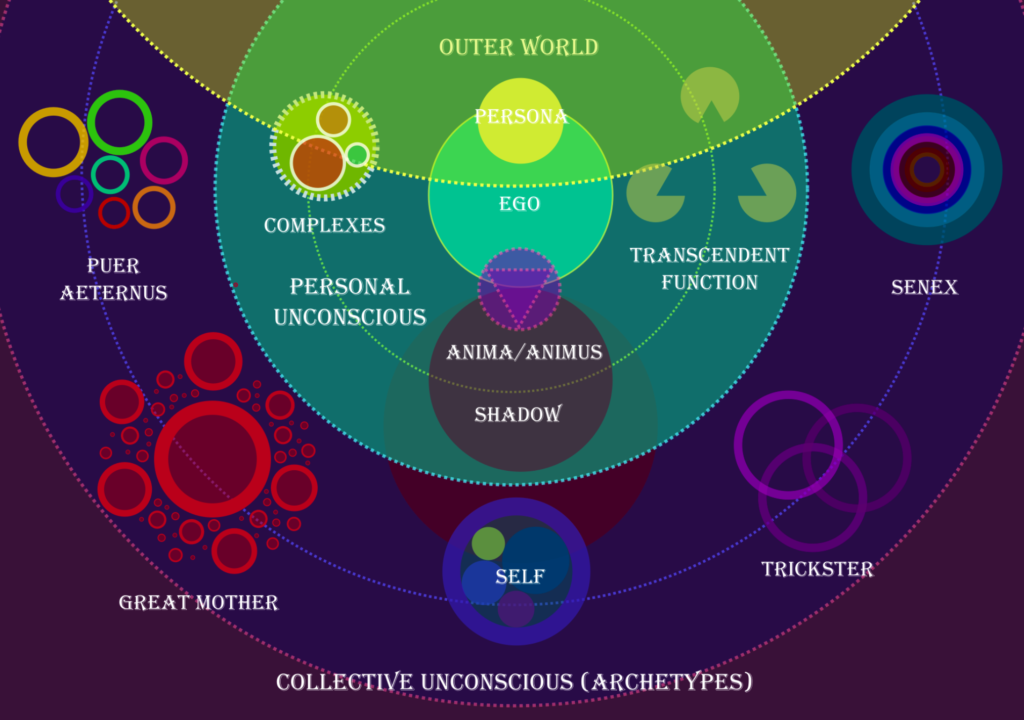
From Philosophy Maps

This is a beautiful visualisation of Carl Jung’s model of the psyche, particularly focussing on the interactions between the conscious and unconscious mind. Here’s a breakdown of its elements:

  • Outer World: Represents the external reality and social environment we navigate.
  • Persona: The social mask we wear to interact with the outer world, shaped by societal roles and expectations.
  • Ego: The centre of our conscious identity, responsible for decision-making and self-awareness.
  • Personal Unconscious: Contains repressed memories, thoughts, and emotions, along with personal complexes that influence behaviour.
  • Complexes: Patterns of emotions, memories, and perceptions organised around common themes (e.g., power, inferiority) and often triggered by specific experiences.
  • Anima/Animus: The unconscious feminine (Anima) or masculine (Animus) aspects within individuals, representing the balance of internal energies.
  • Shadow: The hidden, often darker aspects of the personality that are repressed or denied by the conscious mind.
  • Self: The core of the unconscious, representing the totality of the psyche, integrating both conscious and unconscious aspects. It connects to archetypal energies.
  • Collective Unconscious: A shared level of the unconscious that houses universal archetypes, such as the Great Mother, Trickster, Senex (wise old man), and Puer Aeternus (eternal youth).
  • Archetypes: Universal, recurring symbols or patterns (e.g., Trickster, Great Mother) that influence human behaviour and experiences.
  • Transcendent Function: bridges the conscious and unconscious, enabling psychological growth and self-integration. This function helps mediate between opposites like the persona and shadow.

Overall, this diagram is a guide to understanding the layers of Jungian psychology and the journey towards individuation—integrating all parts of the psyche to achieve wholeness.

The Tarot and Jungian psychology

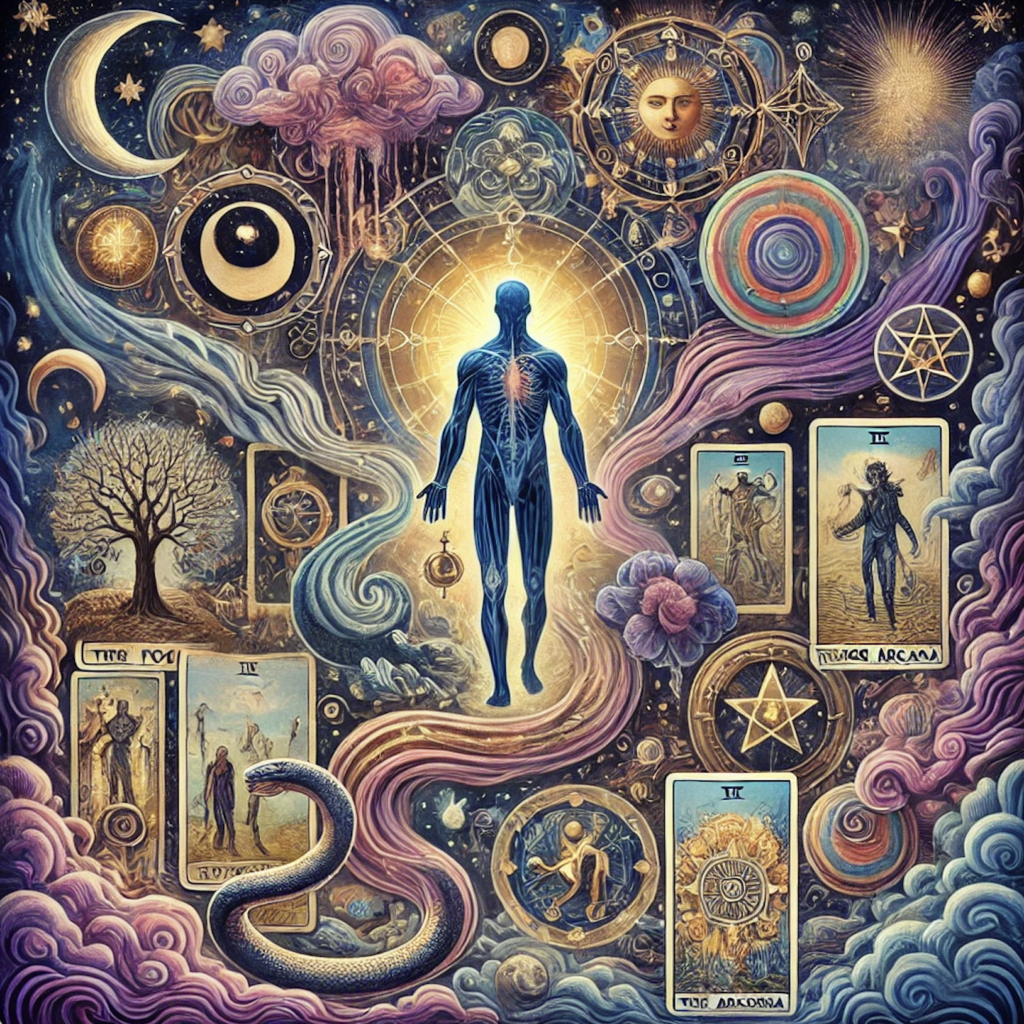
The Tarot and Jungian psychology are intimately connected in their shared concern with the deep layers of the psyche and their reliance on archetypes to convey spiritual, psychological, and existential truths. Both systems offer symbolic maps that help navigate the inner world, facilitating self-reflection and personal growth. By exploring the structure of the Tarot deck through the lens of Jungian psychology, we can begin to see how the layers of the psyche correspond to different parts of the deck, offering a profound tool for self-understanding.

The Major Arcana and the Collective Unconscious

In Jungian psychology, the collective unconscious is a level of the psyche that transcends personal experience. It contains archetypal images and motifs that are shared among all humans, regardless of culture or time. These archetypes are expressions of universal human experiences: birth, death, love, power, transformation, and so on. They are not accessible through the conscious mind but reveal themselves in myths, dreams, and symbols—very much like the Major Arcana in Tarot.

The 22 cards of the Major Arcana can be seen as archetypes that emerge from the collective unconscious. They represent fundamental forces and stages of the human journey, from the Fool’s initial leap into the unknown to the World card’s completion of the cycle. Each card carries deep symbolic meaning that reflects universal experiences. For example, the Magician is a powerful figure of creation and will, echoing the archetypal image of the hero or creator in Jungian thought, while the Hermit represents the seeker on a quest for inner wisdom, akin to the Jungian archetype of the Wise Old Man.

These Major Arcana archetypes can be likened to “guides” within the collective unconscious, shaping our experiences and prompting transformation. When we pull a card from the Major Arcana, we are accessing these universal forces, encountering figures that mirror core spiritual or psychological experiences.

The Minor Arcana and the Personal Unconscious

The personal unconscious in Jungian psychology consists of memories, experiences, and complexes that are unique to the individual but are often buried beneath the surface of conscious awareness. This layer is shaped by personal history and development, and its contents can influence behavior, emotions, and thoughts in subtle but profound ways.

The Minor Arcana, which consists of four suits, can be seen as representing the more personal, day-to-day aspects of life that are rooted in the personal unconscious. Each suit—Pentacles, Cups, Swords, and Wands—corresponds to different dimensions of human experience:

  • Pentacles (Earth) relate to the material world and physical reality, including issues of work, security, and the body.
  • Cups (Water) represent the realm of emotions, relationships, and inner feelings.
  • Swords (Air) symbolize the intellect, communication, and conflict—reflecting the mental and psychological challenges individuals face.
  • Wands (Fire) stand for creativity, action, and inspiration, embodying the drive to express oneself and manifest ideas into the world.

These suits echo the personal unconscious by delving into the specific, everyday manifestations of our unconscious energies. If the Major Arcana are the grand archetypes of existence, the Minor Arcana depict how these energies are channeled into our lives through thoughts, feelings, and actions.

The Court Cards and the Ego

In the Tarot deck, each suit contains four Court Cards: the Page, Knight, Queen, and King. These figures represent various aspects of personality and are often seen as different facets of the ego. In Jungian terms, the ego is the center of consciousness, the part of the psyche that organizes thoughts and perceptions and manages day-to-day interactions with the external world.

The Court Cards, then, can be understood as expressions of the ego’s role in navigating different domains of life:

  • Pages often represent youthful, exploratory aspects of the ego, a willingness to learn and grow.
  • Knights are dynamic and action-oriented, reflecting the ego’s drive to engage and shape the external world.
  • Queens embody a more mature, nurturing approach, balancing action with insight and emotional intelligence.
  • Kings are the culmination of mastery within their element, symbolizing a balanced and fully realized ego that has developed wisdom and authority over its domain.

The Court Cards show us how the ego relates to the different energies of the suits and offers insight into how we might integrate these aspects of our personality into a cohesive whole.

The Fool’s Journey: A Map of Individuation

The Tarot can also be viewed through the framework of Jung’s concept of individuation—the process of becoming whole by integrating the unconscious into conscious awareness. The Fool’s journey through the Major Arcana can be seen as a symbolic representation of this process.

Beginning as the Fool, who represents pure potential and innocence, we journey through the stages of life, encountering figures that correspond to various archetypal forces—the Magician, the Empress, the Devil, and so on—each one inviting deeper self-awareness and integration of unconscious material. As we meet these archetypes, we are forced to confront different layers of our psyche, from the personal complexes represented in the Devil to the transcendent unity found in the World.

By completing the Fool’s journey, we approach individuation, a state where the conscious and unconscious are harmoniously balanced, and the individual has fully realized their true nature. The Tarot offers this journey as both a personal map and a universal pattern, helping seekers make sense of their inner world through myth and symbol.

Conclusion: Tarot as a Mirror of the Psyche

The Tarot and Jungian psychology are complementary systems that offer a rich, symbolic language for exploring the human soul. The Major Arcana corresponds to the collective unconscious, the Minor Arcana to the personal unconscious, and the Court Cards to the ego. Together, they map out the journey of individuation, helping us to see not only the forces that shape our lives but also the path toward greater self-awareness and integration.

The Tarot, then, becomes more than a divinatory tool; it is a mirror of the psyche, reflecting back the archetypal forces and personal energies that govern our inner world. By engaging with the cards, we engage with the deepest aspects of ourselves, opening the door to transformation and wholeness.

restarting the community efforts

I’m restarting the community pages here using BuddyPress and BBPress. If you’re not already a member of the site, you can register and create your own profile here on soulcruzer. I’ll get a group and a forum started shortly.

the muses i belong

The days blur together, as if time is just a suggestion, bending and weaving with each passing thought. I can’t tell whether the dreams are spilling into the waking world or if the world is simply dreaming me. This morning, I woke with fragments of a lucid dream still clinging to my mind, as though they’d never fully left. Kate was there, and so was someone else—maybe Devon, maybe not—but it felt more like the muses had come to play again, and I was one of them. We watched ourselves, three muses in the half-light of a hotel room, playing at creation, conjuring worlds from nothing more than whispers and a flicker of desire. There was something eerie about it all, a tension I couldn’t place, like waiting for the punchline of a cosmic joke. Kate, in her pyjamas, seemed oblivious to the impending shift, but I sensed it—the arrival of something shadowed and haunting, lingering just beyond sight.

I’ve been getting lost in other people’s dreams lately. It’s as though their ideas are enchanted portals, and I can’t resist tumbling down, abandoning my own path to chase the shimmer of their magic. Each new rabbit hole feels like it holds the key to something—a piece of the puzzle I didn’t know I was trying to solve. But every time, I find myself deeper in someone else’s story, my own practice slipping like sand through my fingers. It’s curious, this pull towards other people’s dream worlds. They seem so full of wonder, as if I could inhabit them and forget my own. But I know now, it’s time to reclaim that space for myself. I need to stay grounded in my own story.

Driving up here, the road stretched before me like a ribbon unraveling toward the horizon, and I thought about NovelCrafter. It struck me—what I want isn’t just another tool. It’s a way to weave magic and reality into something whole, a speculative memoir where the boundary between fantasy and memory dissolves. I see myself writing it: part magical realism, part the absurdity of daily life. Maybe I’ll write about today, how I felt the tug of the fox’s sly gaze as I passed the edge of the woods, a reminder to stay alert and agile. Or how the Tower card fell from my deck this morning, its crumbling spire whispering of upheaval, destruction that leads to clarity.

But here’s the trick—those foxes, the Tower, they aren’t just symbols anymore. They show up, uninvited, walking through my day like they belong. The fox darting across my mind, the Tower standing tall in the back of my thoughts as I drink my coffee. It’s always there, reminding me to break free. “Don’t cling to the past,” it seems to say, “or you’ll miss the magic unfolding before you.”

I recall the dream again. Kate in her pyjamas, ready for bed. I watched, waiting for the ghost. I knew it was Halloween in the dream—it always is when these hauntings happen. But I never saw the ghost. Maybe that’s the point. Perhaps the ghost is my own, something I’m waiting for—something I’m afraid to meet but also too curious to avoid. I half expect it to show up later today, while I’m meditating or walking barefoot through the grass, grounding myself. Grounding is essential now; without it, I’d be swept up entirely by the dreams of others. It’s so easy to follow their muses, their ghosts, their towers. Yet I keep reminding myself that the real work is here, on my own path, not in chasing shadows.

Even now, I feel the muses whispering—”What if you combined all these pieces? What if you made this liminal space your own?” I could see it: the fox becomes my guide, leading me out of rabbit holes and into the deeper forest, where paths aren’t so easily marked. The muses follow, tugging at the threads of my thoughts, weaving them into stories of wonder and surrealism. There’s a beauty in this in-between, where nothing is solid, and everything shimmers with possibility.

But I can’t stay in the dream forever. I need to pull it through, integrate it, let the images live within my work without consuming me. Stay grounded, I think. The Tower might fall, the fox might run, but I’m here, feet on the earth, pen in hand, ready to craft my own narrative.

I have to remember: the world may be full of magic, but it’s my magic that matters now. Every symbol, every myth that emerges in my dreams or on my tarot deck is an invitation to explore, yes—but also to integrate, to make it mine. My life isn’t just a story waiting to be written; it’s already unfolding, here and now, with each step forward and each breath taken. I am the dreamer and the dream, the writer and the muse. And the ghost? Maybe that’s just the part of me I haven’t met yet, waiting patiently in the shadows, ready to step into the light.

in-between spaces

I sit at my desk, the hum of the world still catching its breath from the night’s slumber. The sunlight is hesitant, as if it knows it should rise but isn’t quite ready to commit. This feels like the perfect time for some morning pages—a stream of consciousness that lets my thoughts spill out like water finding its course through rocks and earth.

I reach for my notebook, and as the pen touches the page, something curious happens. The words I write don’t seem entirely my own. Instead of the usual jumble of musings about my day or plans, the ink forms a river—literally. A small river on the page, its waters shimmering like quicksilver, twisting between the lines of my journal. I dip my finger into the ink and suddenly, I’m there.

The landscape is familiar but foreign, a half-remembered dream. Trees grow in spirals, leaves curling like question marks. A fox with emerald eyes stands on the path ahead, watching me. Is this some dream-shamanic journey I’ve wandered into? I’m not sure, but the ground beneath me feels solid, and the air is crisp with potential.

I walk toward the fox, and it doesn’t run. Instead, it speaks—soft, like a breath you’d miss if you weren’t listening closely.

“Write your dreams,” it says, its tail flicking with subtle impatience. “Record them. Live them.”

I nod because the fox is right. It’s time I renew that practice, time I dive deeper into the liminal, that in-between space where reality and dreams blur. Morning pages are the portal, but the dreamwork—the shamanic journeys, the hypnotic meditations, the sound of drums reverberating in the back of my mind—that’s the real work. The practice that weaves waking and sleeping into the same thread. I’m reminded of Robert Moss’ words—dreams and reality aren’t separate; they’re different lenses to view the same landscape.

The fox turns and darts away, and before I can follow, I’m back at my desk, staring at the now blank page. The river of ink is gone, but the message lingers in the air.

Later, in the afternoon, I make my way to Liverpool, and Joseph Campbell keeps me company. His voice echoes in the car, weaving the Hero’s Journey into every curve of the road. I can feel the myths breathing alongside me, the stories ancient yet evergreen. I know the power they hold—the power to reshape the psyche, to uncover those buried fragments of soul. His words about the hero’s call to adventure make me think of my own journey, not just through life but through the worlds that exist beyond the veil of this one. Perhaps I’ve been listening too much to the logical voices that try to impose order and meaning. Perhaps I’ve forgotten how to “fall in love” with the pictures in front of me—be they tarot cards or dream symbols.

Rachel Pollack had the right idea. Her tarot explorations in A Walk Through the Forest of Souls were like nothing I’ve read before—less rigid, more fluid, as though the cards themselves were breathing, inviting me to ask them questions instead of demanding answers. It’s time to let them speak their stories, to let the images reveal what they want, without the weight of interpretation hanging over them like a fog.

I pull a deck from my bag as the car continues its journey north. The cards feel warm in my hands, alive. I shuffle without thinking, without intention, and draw three: The Fool, Death, and The Tower.

I chuckle to myself. Of course. The story of transformation, of destruction and rebirth. A theme echoed in every myth, in every dream, and in every creative endeavour I’ve ever attempted. It’s the same story I’ve been telling myself but hadn’t yet realised I was living.

There’s a flash from the corner of my eye, and suddenly the fox is back—sitting calmly in the passenger seat. It’s strange how normal this feels now, like the veil between reality and imagination is thinner than I thought. The fox yawns lazily, eyes on the cards in my hand.

“You know what this means,” it says, as if we’re old friends, as if we’ve had this conversation before. Maybe we have, in dreams I’ve forgotten.

“I do,” I reply. It’s time to weave the magic of the surreal into my writing, to infuse my blog with this very essence. No more boundaries between the real and the unreal. I’ll call upon the cards, the myths, the dreams—perhaps even the fox—to guide me.

The road stretches out in front of me, endless and full of possibility. The pen is back in my hand, and the ink, once again, is a river waiting to be followed.

a morning full of synchronicities

It’s been a morning full of synchronicities for me starting with a not so pleasant memory, one that is a reoccurring memory that holds no real value for me and isn’t worth reliving again and again.

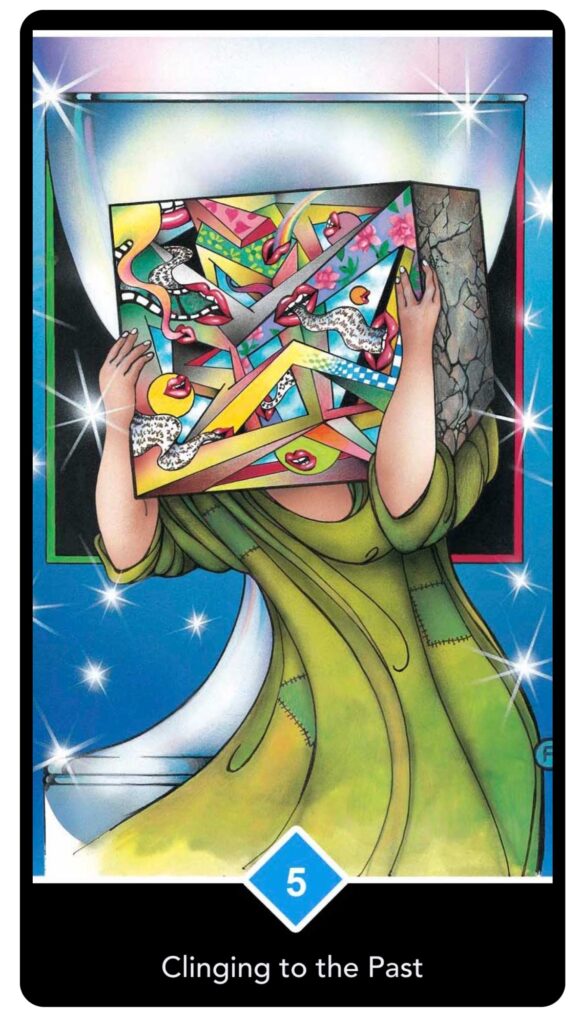
Breaking state, I drew a card from the Osho Zen Tarot deck and lo and behold it was the ‘clinging to the past’ card, which has a clear message to let go of the past and fully embrace the future.

The figure pictured in this card is so preoccupied with clutching her box of memories that she has turned her back on the sparkling champagne glass of blessings available here and now. Her nostalgia for the past really makes her a ‘blockhead’, and a beggar besides, as we can see from her patched and ragged clothes. She needn’t be a beggar, of course–but she is not available to taste the pleasures that offer themselves in the present. It’s time to face up to the fact that the past is gone, and any effort to repeat it is a sure way to stay stuck in old blueprints that you would have already outgrown if you hadn’t been so busy clinging to what you have already been through. Take a deep breath, put the box down, tie it up in a pretty ribbon if you must, and bid it a fond and reverent farewell. Life is passing you by, and you’re in danger of becoming an old fossil before your time!

These tenses–past, present and future–are not the tenses of time; they are tenses of the mind. That which is no longer before the mind becomes the past. That which is before the mind is the present. And that which is going to be before the mind is the future. Past is that which is no longer before you. Future is that which is not yet before you. And present is that which is before you and is slipping out of your sight. Soon it will be past….

I learned in my shamanic practitioner’s course that a message from the universe generally comes in three by way of confirmation that you should definitely pay attention to the message.

In the carpark, at the train station, a fox darted across my view. It came under the fence and into the carpark and trotted right in front of my parked car.

I looked up foxes.

Foxes often embody adaptability, cleverness, and the ability to navigate through difficult terrain, both physically and emotionally. In folklore and spiritual symbolism, they’re sometimes considered tricksters, but not in a malicious sense. The fox’s cunning is more about finding ways to survive and thrive, using intuition and agility. Their presence can signify the need to let go of old habits, perspectives, or even attachments, so you can embrace a more fluid and adaptable approach to life.

That message hit home too, but it didn’t stop there. While browsing magazine rack in the station, I stumbled upon this headline on the cover of Psychologies magazine: “Break Free from the Past.”

Talk about synchronicity…

There’s a wildness, a lightness to this message—a reminder to me that life doesn’t have to be weighed down by what’s behind me. I can lean into the present, adapt, and remain open to what’s before me right now in this present moment.

moments 22.09.2024

1) I remembered how grateful I feel when I reflect on the week and follow the larger arc of my journey. It’s easy to let days blend into weeks and weeks blend into months and months blend into years and miss the passage of time, witnessing life as one big blur.

2) Happy to be back in the creative space of my own website.

3) Noticing the change in season, summer giving way to autumn, the shorter days and longer nights, the bees making a push to gather the last of the nectar before the weather completely changes.

4) A blackbird came to us to die. We made his last moments on this physical plane pleasant and dignified.

5) I roller skated for the first time in 40 years. I wasn’t expecting how quickly my body would remember how to groove on quads.

6) Realising that God hides in the in-between spaces.

7) I embraced my role as a facilitator and realised the gift inherent in shifting mindsets.

8) Feeling giddy in the stationary store buying new stock for my facilitator’s kit bag.

9) Playing Dungeons and Dragons with my friends twice this week.

10) Bring this practice over from my Substack newsletter days. This was a good weekly practice for me because it made me pause for a moment to acknowledge and be grateful for the big and the small moments that shape the arc of my journey.

I would encourage others to do the same. I find the best way to do this is to notice the moments in your days as you move through the week, so come Sunday it’s just a matter of going back through your notebook or journal and choosing what resonates with you as you reflect back on the week.

Enjoy.

roller skating for the first time in 40 years!

Orphans

I’ve been going through some of my old poems and converting to flash fiction. Here is the original poem:

We had faith in the soothsayer’s poison.
We knew how to sacrifice our sons and daughters
to secure the future of our race. We chant broken prayers
through the night, only madmen dream.

I kneel and hope to find you in the ruins and decay.
My memories of you fade–how you smothered me
with your shame, lulled me to sleep with your ambition.

You were my friend, my purple-haired, monstrous wild child,
a lonely girl with a sad tale, impossible eyes, and hard to ignore.
We were orphans, engaged to each other, separated by fate.

I decided to expand it into a flash fiction piece with a cyberpunk flare. I was thinking cyberpunk needs a rebirth, especially now that we are living in the future that the original cyberpunk writers wrote about. I asked the question: Are we living in the future that cyberpunk warned us about?

Here is the poem in flash fiction form.


We had faith in the soothsayer’s poison, a belief coded deep into our neural implants. It wasn’t the kind of faith you found in temples or altars; no, this was different. It was raw, metallic—an algorithm that pulsed through our veins, a digital religion wrapped in ancient whispers. We knew the cost of our obedience, how to sacrifice our sons and daughters, not in flesh but in code. Upload their consciousness to the Grid to preserve the future of our race, cold and calculating, ensuring we would live on in the endless streams of data.

The city pulsed with neon veins as we chanted broken prayers into the void, hacking the dark corners of cyberspace. These prayers weren’t to any deity but to the remnants of old systems, the ghosts of lost servers, the AI gods long abandoned. Only the madmen dream anymore—those willing to drift in the liminal space between the real and the virtual. I am one of them, kneeling amidst the wreckage of a forgotten data farm, hoping to find you in the ruins, in the decay, in the dead pixels flickering across the skyline.

I close my eyes and try to reconstruct you from memory—your face a distant, corrupted file. The way you smothered me with your shame, a relentless torrent of emotional malware, your ambition infecting everything in its path. You lulled me into sleep cycles filled with synthetic dreams, ones where your voice was the only constant, a glitching loop that whispered of things I couldn’t understand but felt deep in my core.

You were my friend, once. My purple-haired, monstrous wild child, a misfit in a world that demanded conformity. You hacked your way through life with impossible eyes—eyes that saw beyond the gridlines of reality, into the soft code that bound us all. I still remember the first time you found me, lost in a back-alley VR club, disoriented and terrified. You smiled that crooked smile and pulled me from the void, made me feel like we could rewrite the script of our existence.

We were orphans, you and I, not in the literal sense, but in the way the system had abandoned us. We grew up in the shadow of megacorps and digital overlords, knowing full well that no one was coming to save us. Engaged to each other, bonded by the absurdity of it all, promising ourselves to a future that never arrived. Fate had a way of severing those kinds of connections—ripping the code apart, leaving us to drift in separate streams of consciousness, locked in different nodes of the network.

I think of you sometimes, in the quiet moments between hacking jobs, when the city sleeps and the hum of the machines dulls to a soft lullaby. I wonder where you are now. Did you escape the Grid? Or did you become another ghost in the machine, another lost soul wandering the endless expanse of cyberspace?

I kneel here, in the ruins, searching for traces of you in the decaying code, hoping that somewhere, somehow, you’re still out there, waiting for me to find you. But my memories fade, like corrupted data on a failing drive. I wonder if, when I find you, you’ll recognise me, or if we’ll be nothing more than echoes of who we once were—faded, fragmented, lost to the system.

The future we sacrificed for never came, did it? All that remains are these broken prayers, these decaying bits of what once was, and the ever-present hum of a world that no longer cares. We had faith once, but now, only the madmen dream.

seeing the world through the lens of myth and symbolic storytelling

I’ve been dipping in and out of Stephen Larsen’s book, The Mythic Imagination: The Quest for Meaning Through Personal Mythology for a while now. It’s become an ongoing companion that keeps nudging me to explore how I exercise my own mythic imagination.

I find myself tapping into this deeper way of seeing whenever I’m walking in the woods or doing one of my shamanic journeys. There’s something about being in those spaces, surrounded by nature or in the stillness of inner exploration, where myth and symbol come alive for me. It’s as if they rise up from the earth or the depths of my mind, guiding me through the familiar patterns of life—birth, death, love, and transformation.

For me, the mythic imagination is about seeing the world through the lens of myth and symbolic storytelling. It’s about accessing that well of archetypal narratives that sit at the core of who we are, as humans.

These stories aren’t outdated or irrelevant; they’re alive, dynamic, and constantly shifting but always reflecting something essential. Myths, to me, are like mirrors that reflect my subconscious mind back to me. They are stepping stones to the collective unconscious.

Lately, I’ve been reflecting on how I might bring this sense of the mythic into my coaching practice. It feels like an untapped resource, something that could help people access the deeper, archetypal stories that are shaping their lives, whether they’re aware of them or not.

I think weaving mythic wisdom into the work I do would help people see their lives as part of a greater, unfolding story.

metamodernism may offer a way forward for me

Metamodernism seems like an interesting space to play in. I came across the term a while back when I was exploring postmodernism, and I asked the question what comes after postmodernism. I didn’t go any further than asking the question. But now metamodernism has resurfaced and has my attention.

What it is:

I love the idea of winking at our irony while still engaging earnestly with things that matter to me. It’s like not taking myself too seriously, even about serious matters:

Metamodernism doesn’t discard postmodern critique; instead, it tries to move forward by oscillating between these contrasting impulses. It acknowledges the fragmentation and uncertainty postmodernism exposed, yet it seeks to reclaim a sense of meaning, wonder, and connection in a world that often feels detached and absurd. So, rather than living in permanent irony, metamodernism suggests that we can “wink” at our irony while still engaging earnestly with things that matter to us.

There’s a playfulness to it, like juggling multiple truths at once.

The term itself hints at this fluid movement—”meta” means beyond, and “modernism” ties back to the optimism of earlier times, but metamodernism doesn’t just move forward; it loops back, reshapes, and synthesises elements from different eras. You’ll find it everywhere, from art and literature to music and philosophy. It’s especially visible in pop culture, where people can deeply care about something while simultaneously poking fun at it.

Millennials and Gen Z apparently have it the way they engage with content:

There’s a sense of deep emotion mixed with humour, irony blended with authenticity. Memes, for example, might capture a profound truth about loneliness or anxiety but do so with a sort of knowing smirk. In a metamodern sense, it’s as if they’re saying, “Yes, life is absurd and fragmented, but in recognising that, we can still care, we can still create meaning.”