We treat meaning like it’s some luxury add-on to life, like it’s something you get to once you’ve checked all the boxes. But that’s backwards. Meaning isn’t the cherry on top. It’s in the foundation, right up there with food and water and air.
You can suffocate without oxygen and starve without food. But without meaning? You drift. You’re technically alive, but there’s this hollowness. Yeah, you’re breathing, but nothing’s actually anchoring you to the ground.
People will push through absolute hell if they think it means something. But give someone a comfortable life with no purpose? That comfort curdles into despair pretty fast. A prisoner in a labour camp can survive on crusts of bread if he has a reason to live, as Viktor Frankl showed. Yet a millionaire in a mansion, stripped of purpose, can feel more impoverished than the beggar on the street.
So when we say humans need meaning, we’re really saying that stories, myths, and purpose are the nutrition we need for the soul. Like vitamins you can’t see but absolutely need. Take them away, and even the most beautiful life feels like a wasteland.
Meaning doesn’t just rain down from the sky. You don’t wait around for it to arrive. You make it. You choose it. Sometimes you have to rip it back from the edge of despair. Living well isn’t just about keeping your body going. It’s also about wrestling with meaning until it settles into your bones.
That’s why stories, myths, philosophy… none of that is extra. They’re not for when you have spare time. They are the oxygen your inner life breathes.
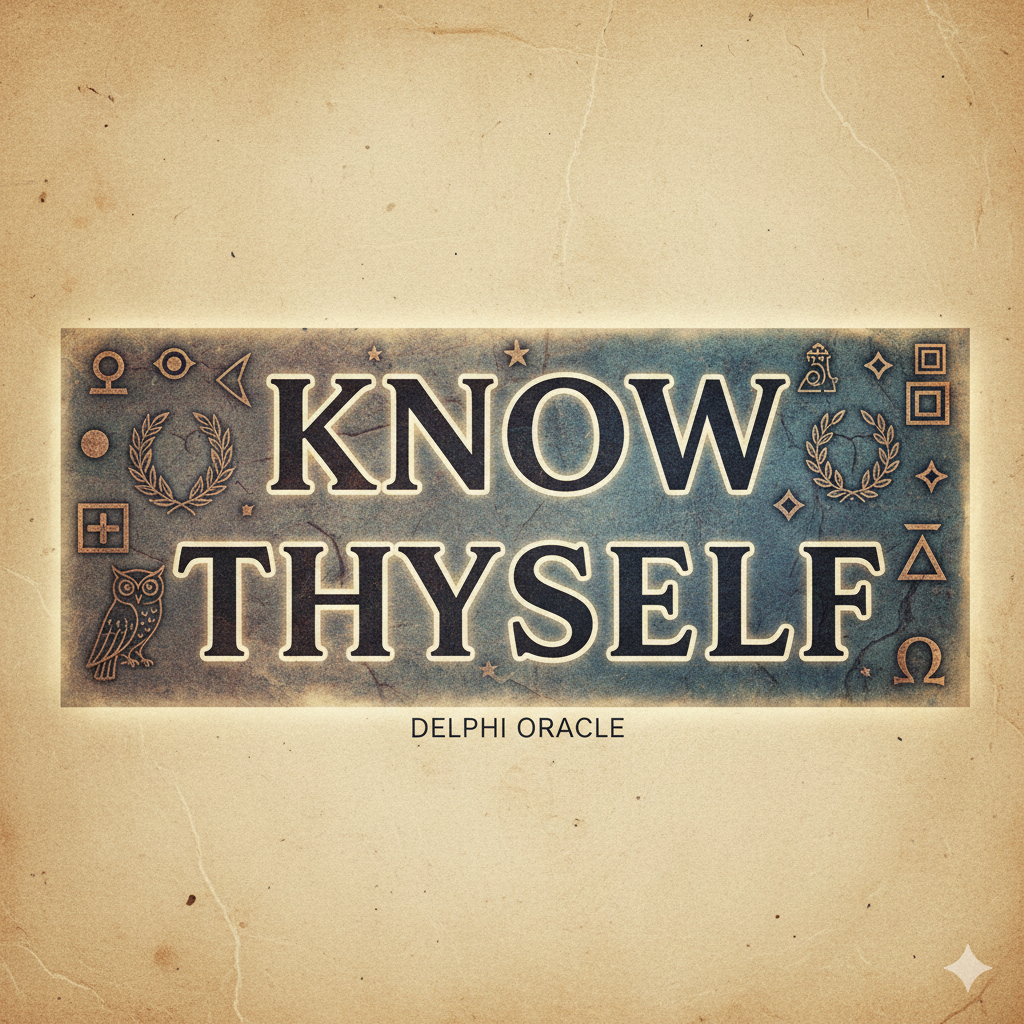
Above the temple of Apollo at Delphi, carved into stone that has outlasted empires, two words wait: γνῶθι σεαυτόν. Know thyself. Not a greeting. Not advice, but a command that doubles as a riddle, delivered at the threshold of the oracle’s chamber, where mortals came to learn their fates.
The ancient Greeks understood what we keep forgetting: self-knowledge is dangerous knowledge. The maxim wasn’t placed there as inspiration for the self-improvement crowd. It was a warning. Before you ask the oracle what will become of you, the inscription demands, do you even know who is asking? Before you seek to know your destiny, can you claim to know the seeker?
Centuries later, Carl Jung would return to these words again and again, making them the motif of his own life’s work. He offered what the ancient Greeks could not. He offered a method. Through dreams and symbols, through active imagination and the patient befriending of what lives in the dark, Jung gave us a way to answer the oracle’s challenge. Not once, but continuously. Not as a destination, but as a practice.
Because self-knowledge, it turns out, is not what we thought it was.
It is not the careful cataloguing of your strengths and weaknesses, not the polishing of your personality until it shines in just the right light. It is not building a better mask for the ego to wear. Self-knowledge is descent into the myth you are already living, into the archetypes that move through you like weather systems, into the stories that script your days without your conscious permission.
This is the alchemical promise: that shadow can become gold, that fate can become freedom, that the story you’ve been living can become the art you choose to make. Self-knowledge is never a final possession, never something you achieve and frame on the wall. It is an ongoing transformation, a crucible that asks you to return again and again to the fire.
In the practice of narrative alchemy, “Know Thyself” marks both threshold and crucible. It is the moment of recognition that your personal narrative, the one you’ve been telling yourself about who you are and why things happen the way they do, is not the whole truth. It is a doorway. And what lies beyond that doorway is not a fixed self waiting to be discovered, but a power waiting to be claimed: the power to see the script beneath your life and to revise it.
Here, self-knowledge becomes self-authorship. Here, the oracle’s ancient challenge transforms into the writer’s eternal practice. To know yourself is to claim your authority over the story. Not the facts, perhaps because those remain. But the meaning, the shape, the trajectory of the narrative arc: these become yours to forge.
The Jungian Inheritance: Method and Myth
Jung knew what the oracle knew: that the self is not a thing to be found but a mystery to be entered. The difference is that Jung gave us a map for the descent.
Not a map in the modern sense and nothing so reassuring as GPS coordinates or a marked trail. Jung’s map is more like the kind mediaeval cartographers drew, where the known world gives way to territories marked ‘here be dragons’. His gift was not certainty but method. A way to move through the interior landscape without getting lost forever, without mistaking the dragon for a demon or the demon for the dragon.
Dreams became his primary text. Not the Freudian dreams of wish fulfilment and repression, but dreams as messages from the depths, letters written in a language older than words. In Jung’s hands, a dream of a dark figure following you down a street is not a symptom to be cured but a character to be met, questioned, and perhaps even befriended. The nightmare is not a malfunction of the psyche but an invitation to dialogue.
Symbols, too, those strange recurring images that appear in your art, your relationships, and your compulsive behaviours. The tower that keeps showing up. The water you’re always drowning in or thirsting for. The wounded animal. These are not decorations. They are the grammar of the unconscious, the language through which the parts of you that have no voice in daylight make themselves known.
And then there is active imagination, Jung’s most radical technique: the practice of engaging with these interior figures as if they were real. Not analysing them from a safe distance, not reducing them to symptoms or metaphors, but meeting them. Sitting down across from the shadow and asking what it wants. Following the anima into her forest. Letting the wise old man speak his riddles without interrupting to explain them away.
This is not therapy as most people understand it. This is mythic descent disguised as psychological practice.
Because what Jung understood, what he spent his life demonstrating through his own breakdowns and breakthroughs, is that we are not living our lives so much as being lived by stories we didn’t consciously choose. Archetypes move through us: the Hero, the Lover, the Orphan, the Magician. They take up residence in our bodies, script our reactions, and determine who we fall in love with and what we run from. To know thyself, in the Jungian sense, is to meet these forces not as abstractions but as presences, to see the myth you are enacting before it’s too late to step into a different role.
This is why Jung’s approach can never be about creating a list of traits, never about polishing the ego’s mask until you achieve some idealised version of yourself. The ego is not the director of this play—at best, it’s a character who’s just realised there’s a play at all. Self-knowledge begins when the ego stops trying to control the narrative and starts listening to the voices that have been speaking all along, from underneath, from the margins, from the places where the script breaks down.
The Jungian inheritance is an invitation to stop being the hero of your own story long enough to meet the storyteller. And to discover, in that meeting, that the storyteller is also you, but a you that’s larger, stranger, and more mythic than the one you’ve been performing for the world.
The Alchemical Process: Transformation, Not Possession
The mediaeval alchemists were not, as we like to think, primitive chemists chasing the impossible dream of turning lead into gold. They knew exactly what they were doing. The laboratory was a mirror. The metals were metaphors. The work was always about the alchemist.
Jung understood this. He saw in the alchemical texts—with their cryptic instructions about blackening and whitening, dissolution and coagulation—a map of psychological transformation that Western culture had forgotten how to read. The alchemists were documenting what happens when consciousness descends into matter, when spirit gets its hands dirty, and when the self undergoes the fires of its own becoming.
This is why self-knowledge can never be a possession. You cannot achieve it, frame it, hang it on the wall. The moment you think you’ve figured yourself out, you’ve merely created a new mask, more sophisticated than the last but still a mask. Self-knowledge is not a destination but an alchemical process, an ongoing cyclical demanding return.
Consider the nigredo, the blackening, the first stage of the work. This is the descent into shadow, the confrontation with everything you’ve exiled from your conscious identity. The rage you’ve been too polite to feel. The grief you couldn’t afford to acknowledge. The selfishness, the pettiness, the hunger, the fear. The alchemists called this stage the “death” of the old self, and they weren’t being poetic. Something has to die for something new to emerge.
Shadow into gold. This is the alchemical promise, but we misunderstand it if we think it means the shadow disappears. The gold doesn’t replace the lead; it’s what the lead becomes when subjected to enough heat, enough pressure, enough honest attention. Your shadow doesn’t vanish when you know it. It transforms. The rage becomes power. The grief becomes depth. The fear becomes discernment. But only if you’re willing to stay in the crucible long enough.
Fate into freedom: another transformation, another paradox. The alchemists spoke of solve et coagula: dissolve and coagulate, break down and rebuild. Your fate is the story you inherited: the family patterns, the cultural scripts, the wounds that shaped you, the roles you were assigned before you could speak. This is your prima materia, your base matter. To transform fate into freedom is not to escape these conditions but to work with them consciously, to dissolve the unconscious identifications and rebuild the self as a chosen act.
You cannot choose whether you were the scapegoat or the golden child, whether you grew up in abundance or scarcity, whether you learned early that the world was safe or that it was not. These are the materials you’ve been given. But you can choose what you make with them. You can choose which story you tell about them. You can choose, in other words, to become the alchemist of your own life rather than remaining the passive recipient of circumstance.
Story into art is the final transformation, the one that completes the work. The stories we inherit are raw, unprocessed, and often brutal. They happen to us. We don’t choose them. But art is always a choice. Art is what happens when you take the raw material of experience and shape it with intention, when you find the form that can hold the chaos, when you discover the meaning that is hidden in the mess.
This is what narrative alchemy offers: not the erasure of your story but its transformation. Not the denial of what happened but the reclamation of what it means. The alchemists sought the philosopher’s stone, that mysterious substance that could turn base metal into gold. But the stone was never external. It was the consciousness that could see transformation itself as the goal, that could value the process over the product, that could stay in the fire without knowing what would emerge.
Self-knowledge is that fire. And you are both the alchemist and the substance being transformed.
Narrative Alchemy: From Script to Authorship
There is a moment—it comes differently for everyone—when you realise you’ve been reading from a script. Not just following habits or patterns, but actually performing lines written long before you arrived. Your reactions aren’t yours. Your beliefs about what you deserve, what’s possible, who you’re allowed to become were handed to you by people who were themselves reading from scripts they never questioned.
This moment of recognition is what narrative alchemy calls the threshold. And it’s here that “Know Thyself” stops being a philosophical abstraction and becomes an urgent, practical necessity.
Because your personal narrative (the story you tell yourself about who you are, why things happened the way they did, and what it all means) is not the truth. It’s a doorway. A provisional interpretation. A first draft written in the dark by a younger version of you who was doing the best they could with limited information and even less power.
The story might go something like this: I am someone things happen to. I am not the kind of person who gets what they want. I am damaged, unlucky, too much, not enough. I am the hero who saves everyone. I am the victim who can never catch a break. I am the one who doesn’t need anyone. These narratives have the weight of truth because you’ve lived inside them for so long. They’ve shaped your choices, filtered your perceptions, and determined which opportunities you could even see.
But here’s what narrative alchemy knows: beneath your personal story runs a deeper script, and beneath that script runs something deeper still. There’s the story you tell yourself. There’s the archetypal pattern you’re unconsciously enacting. And underneath both, there’s the raw, unscripted aliveness that preceded all narratives—the you that exists before interpretation.
To see the script beneath your life is to develop what we might call narrative consciousness. It’s the capacity to observe your own story while you’re living it, to notice the patterns, to catch yourself in the middle of a familiar scene and think, Wait. I’ve played this role before. I know how this ends. What if I chose differently?
This is not the same as positive thinking or reframing. This is not slapping a happy interpretation over a painful experience and calling it healed. Narrative alchemy is more surgical than that, more honest. It asks you to see the story for what it is—not fact, but interpretation. Not reality, but one possible version of reality. And then it asks the dangerous question: What if you revised it?
Revision is where self-knowledge becomes self-authorship. Not authorship in the sense of making things up, of denying what happened or pretending your way into a fantasy. But authorship in the sense of claiming your interpretive power. You cannot change the facts—the losses, the betrayals, the circumstances that shaped you. But you can change what those facts mean. You can change the genre of the story you’re telling.
Is this a tragedy or a transformation narrative? Are you the victim or the heroine on a quest? Is that betrayal the end of your capacity to trust or the beginning of your discernment? Is your sensitivity a wound that makes you weak or a gift that makes you perceptive? The facts remain the same. The story changes everything.
This is radical work because it requires you to give up the secondary gains of your current narrative. If you stop being the victim, you lose the sympathy, the explanation for why your life hasn’t turned out differently, the righteous anger that feels like power. If you stop being the hero who needs no one, you have to admit to loneliness, ask for help, risk being seen as less than invincible. Every narrative gives you something, even the painful ones. Especially the painful ones.
But what it takes away is always more. It takes away your agency. Your ability to surprise yourself. Your access to the full range of human possibility. The script keeps you safe by keeping you small, by making your choices for you before you know there’s a choice to make.
To claim authorship is to step into the uncertainty of an unwritten page. It’s to acknowledge that if the story can be revised, then you’re responsible for what comes next. Not responsible for what happened, that’s done. But you are responsible for what it becomes in the telling, for what you make of it, for the direction the narrative takes from here.
This is the power that waits beyond the threshold: not the power to control reality, but the power to shape meaning. And meaning, it turns out, is everything. Meaning determines whether an experience breaks you or breaks you open. Whether a pattern repeats or transforms. Whether you spend your life as a character in someone else’s story or become the author of your own.
In narrative alchemy, self-knowledge and self-authorship are not two separate stages but one continuous practice. To know yourself is to see the script. To author yourself is to revise it. And to revise it is to know yourself more deeply, which reveals new layers of script, which invites deeper revision. The spiral goes on. The work is never done. And that, finally, is not a problem but the point.
The Threshold and the Crucible
We return, as we must, to Delphi. To those two words carved in stone above the temple entrance, waiting for pilgrims who came seeking prophecy. Know thyself. Not a greeting. Not advice. A challenge that every genuine seeker must accept before they can ask the oracle what comes next.
The ancient Greeks placed it at the threshold for a reason. You cannot know your fate until you know who is asking. You cannot receive the future until you understand the past you’re carrying. You cannot hear the oracle’s answer until you’ve done the work of becoming someone who is capable of hearing it.
But if “Know Thyself” is the threshold—the entry point, the beginning of the journey—it is also the crucible. The vessel that holds you while the fire does its work. The container strong enough to withstand the heat of transformation without shattering. You cross the threshold once, but you return to the crucible again and again, bringing new materials, deeper questions, harder truths.
This is what the practice of narrative alchemy offers: a way to honour both the threshold and the crucible, the beginning and the continuous return. A method for meeting the oracle’s challenge not once but as a way of life.
The power of revision is not a magic trick. It will not undo what happened or erase what you’ve survived. It will not make the difficult parts of your story disappear or transform your wounds into badges of honor with a few choice reinterpretations. The power of revision is both more modest and more profound than that.
It is the power to write the next sentence differently. To notice when you’re following the old script and choose, in that moment, to improvise. To see the pattern as it’s happening and step slightly to the left of where the pattern insists you stand. To recognise that while you cannot control the story you inherited, you have absolute authority over the story you’re creating from this moment forward.
This is what it means to become the alchemist of your own life: not to transcend the material you’ve been given, but to work with it consciously and patiently, with the kind of attention that transforms. Shadow into gold. Fate into freedom. Story into art. These are not metaphors for some distant, idealised state. They are descriptions of the work itself—messy, ongoing, repeatedly undoing itself and beginning again.
The invitation stands where it always has, carved in stone, impossible to ignore once you’ve seen it. Know thyself. Not as a project to complete but as a practice to return to. Not as a truth to possess but as a mystery to enter, again and again, with fresh eyes and an honest heart.
The oracle is still speaking. The temple still stands. The threshold still waits.
And you, you are both the question and the answer, the seeker and the sought, the story and the one who tells it. You are the lead in the crucible and the gold it becomes. You are the script you inherited and the revision you’re writing. You are the myth you’ve been living and the consciousness that can finally see it.
Know thyself. The work begins here. The work never ends. The work is everything.
A Reflection for the Reader
If you’ve read this far, something in these words has found you. Perhaps you’re already standing at the threshold, feeling the weight of the script you’ve been following without quite knowing how to name it. Perhaps you’re deep in the crucible, enduring a transformation you didn’t ask for but can no longer avoid. Or perhaps you’re simply tired—tired of performing a self that doesn’t quite fit, tired of living a story that feels written by someone else.
This is the moment to pause.
Not to take action. Not to fix anything or figure it out. Just to notice. What narrative are you living right now? What role have you been playing? When you think about your life—your relationships, your work, your daily patterns—whose voice do you hear narrating it? Is it yours, or is it an echo of someone who came before?
The oracle’s challenge is not demanding. It’s patient. It will wait as long as you need. But it will not stop asking. Know thyself. Not the self you’ve been told to be. Not the self that keeps everyone else comfortable. The self that lives beneath the script, the one that’s been trying to speak through your dreams, your art, your inexplicable longings, and your strange resistance to paths that should make sense.
You don’t need to have answers. You don’t need to know what comes next. The alchemical work doesn’t require certainty—it requires attention. It requires honesty. It requires the willingness to sit with what you find when you look beneath the surface, even when what you find is uncomfortable, contradictory, or nothing like what you expected.
Start small if you need to. Notice one pattern. Question one belief you’ve always taken as fact. Ask yourself about one recurring story: Is this true, or is this just familiar? Revision doesn’t happen all at once. It happens in moments—small choices to step slightly to the left of where the old script says you should stand.
And here’s what I can promise you: once you begin to see the script, you cannot unsee it. Once you recognize your power to revise, you cannot pretend it doesn’t exist. The work will find you. The threshold will appear in your life again and again, each time asking if you’re ready to cross.
You are the alchemist. You are the substance being transformed. You are the story and the teller. The work is everything—and the work is already yours.
I’ve always felt most at ease on the edges of things. At parties, I drift toward the bookshelves. In conversations, I’m the one asking the question that sends everyone sideways. The centre has its uses, but it often feels like a place of performance rather than presence. This little piece came out of one of my early-morning walks, where margins are not metaphor but geography: mist, hedgerows, half-seen shapes that belong neither to night nor day.
What I wanted to catch here was the strange fact that philosophy, when lived rather than studied, rarely shows up in lecture halls. It shows up in the steam rising from a chipped mug or in the way a heron stands still long enough to make you aware of your own fidgeting. The piece isn’t trying to solve anything. It’s an attempt to dwell in that liminal space where life itself feels like commentary, if only you slow down long enough to read it.
Dawn. The village sleeps behind you like a collection of dreams waiting to be disturbed. You walk the narrow footpath barefoot, earth cool beneath your soles, a chipped enamel mug warming your palm. The ceramic is old, with a white surface stained amber from years of morning rituals, steam rising in wisps that disappear before they form.
Mist clings to the hedgerows, transforming familiar landmarks into half-remembered shapes. A blackbird in the hawthorn releases a cascade of notes that pulls the landscape into focus. Each footfall feels like a period at the end of an unspoken sentence.
You’ve never belonged at the centre of things, never felt comfortable in bright circles where others speak with certainty. The margins are where you breathe freely, where air doesn’t carry the weight of expectations. Out here, beyond streetlights and purposeful lives, your classroom is the hush between night and day. Your desk is a crooked oak whose bark tells stories, your companions the shifting fog and unseen myths whispering in the fields.
You pause beside a weathered stone fence post and set the mug down. Coffee sends up another curl of steam. You open your journal, the leather cover soft from handling, the pages warped from moisture and time. The pen feels familiar as you begin to write.
What spills onto the page isn’t doctrine or theory. It’s incantation—words chosen for weight and rhythm rather than precision. You’re not here to deliver certainty or package wisdom into neat conclusions. You’re here to crack categories open, to bend the tunnels of assumed reality, to remind yourself that philosophy isn’t confined to dusty volumes but seeps into every moment.
Each sip carries bitter earthiness and memory. Each word flows like water finding its course. Each step along this ancient path is practice—daily devotion to questions without final answers. Life into philosophy, philosophy into life, boundaries dissolving like mist when the sun burns it away.
You walk not to arrive somewhere specific but to awaken to the walking itself—the endless conversation between foot and earth, thought and breath, the person you were when you left your door and the person you’re becoming with each step into growing light.
The fog thins as you reach the old stone bridge spanning the creek. Water moves beneath with quiet purpose, carrying leaves toward whatever lies downstream. You lean against the moss-covered parapet and watch the current weave between rocks polished smooth by centuries.
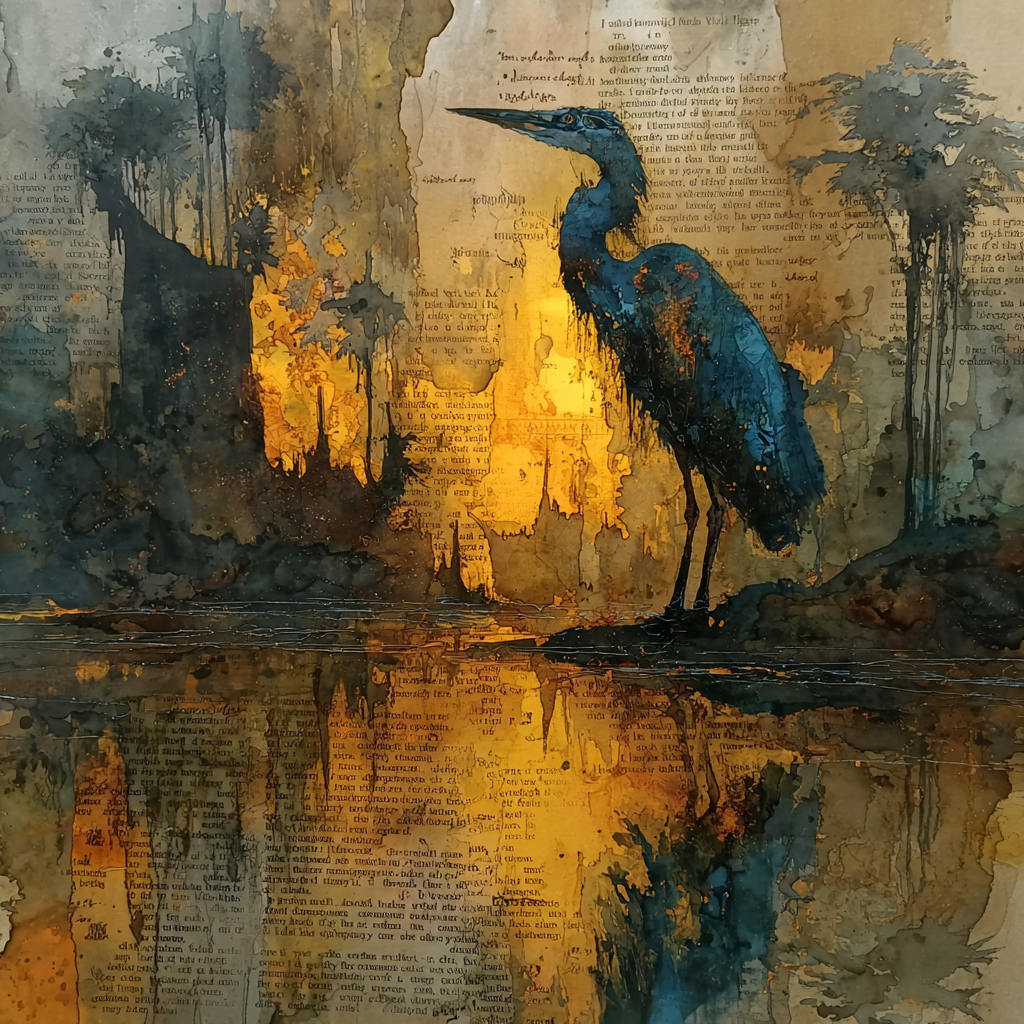
A heron appears without announcement, stepping with deliberate grace through shallows. Its neck curves like a question mark, yellow eyes fixed on something beneath the surface you cannot see. The bird stands motionless—a study in patience that makes your restlessness obvious. You shift weight, adjust your grip on the mug, and glance at your journal as if the blank page might offer instruction.
But the heron simply waits.
You think of times you’ve hurried past such moments, rushing toward imagined urgency that dissolved upon arrival. Meetings that could have been emails, conversations that circled without landing, books read for completion rather than understanding. Here, beside this creature that knows something about time you’ve forgotten, your hurry feels like a costume you can finally remove.
The coffee has cooled to the perfect drinking temperature. You take a longer pull and taste complexity you missed when it was too hot—bitter, yes, but also earthy and almost sweet, with undertones of rain on summer pavement.
A fish breaks the surface. Silver flash, concentric circles, then stillness. The bird doesn’t strike, doesn’t even seem to notice. You realise it’s not hunting as you understand hunting. It’s simply present to the possibility of fish, to the wetness of water, to morning light filtering through feathers.
Your pen finds the page without conscious direction. Words appear that surprise you, sentences writing themselves while your attention splits between the heron and water moving over stone. The writing feels less like work and more like eavesdropping on a conversation already in progress—one that began before you arrived and will continue after you leave.
The bird moves, not to hunt but to relocate, stepping upstream with the same unhurried precision. It settles into a new position and resumes its mysterious practice.
You are an actor reciting a script you didn’t write.
We all live by stories, those patterns of limitation, fear, and unworthiness inherited from our family, our culture, or our past pain. These stories run deep, determining our roles, our boundaries, and what we believe is possible. But what if the slogan, “Change your story, change your world,” wasn’t just motivational shorthand but an ancient, powerful truth?
This essay reveals that narrative is the true alchemy.
Narrative Alchemy is the process of stripping away the layers of expectation to reclaim your fundamental birthright: the power to define yourself.
Learn how to:
Dismantle generational “performances” of fear and lack.
Reinterpret painful experiences, finding meanings that serve your growth.
Transform obstacles into plot twists and problems into puzzles.
You are not denying your history; you are refusing to be limited by it. No matter how convincing the evidence for your limitations appears to be, you retain the power to begin again.
The page is always blank. The pen is always in your hand. What truth are you brave enough to write?
I was walking my usual path when a curl of pipe smoke drifted across the morning air. Out of the mist appeared Lin Yutang, the laughing philosopher himself, strolling as if he had all the time in the world. He looked like a man who had never hurried a day in his life.
Clay: Lin, I’ve been thinking about irreverence. Aleister Crowley once said it was vital to well-being. And when I tried it on for size, when I let myself be cheeky with my own ego, I felt light, almost euphoric. Like the soul was laughing with me.
Lin Yutang: Good! A philosopher who cannot laugh is only half a philosopher. I once said the philosopher ought to be a wayward scamp, not a solemn priest. The business of living is already serious enough. Why add more weight with pompous thought?
His words hung in the air like incense, but lighter and playful.
Clay: So irreverence is not carelessness but medicine?
Lin Yutang: Precisely. It breaks the crust of self-importance. It says to the soul, “You are free.” Think of Chuang Tzu, dreaming he was a butterfly. If he had taken himself too seriously, he would have missed the joy of transformation.
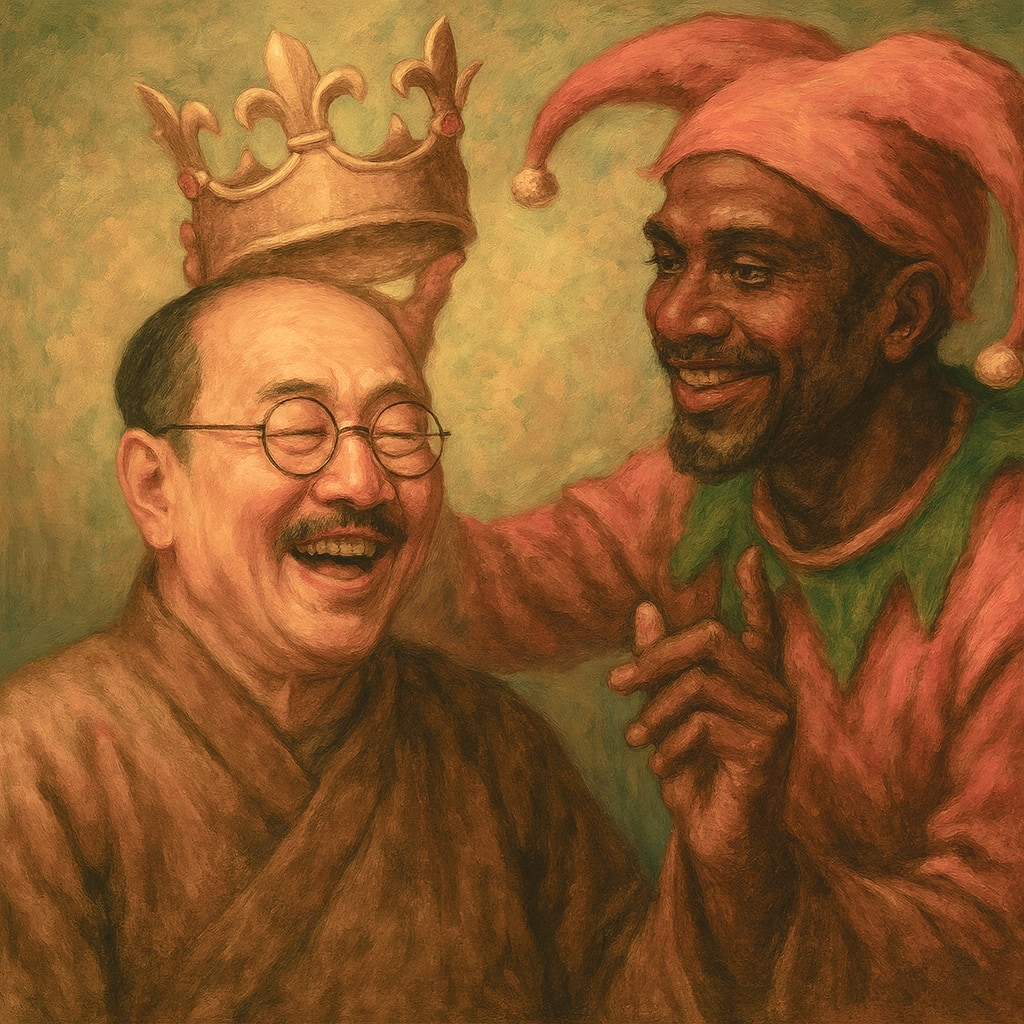
Clay: I like that. When I shout to myself, “Be more irreverent!” I feel as though I’m knocking the crown off my ego’s head.
Lin Yutang: That crown is very uncomfortable anyway. Why wear it? Better to go barefoot and laugh. A laughing philosopher is closer to truth than a grim one, because truth is flexible, not rigid.
I could almost hear the crown clattering to the ground, replaced by bare feet and a grin.
Clay: That flexibility feels like a crack where the sacred can slip through. Reverence roots me, but irreverence makes me dance.
Lin Yutang: Then you have understood. Reverence and irreverence are partners. One bows, the other winks. Together, they keep the soul supple.
Clay: So maybe the true philosopher isn’t a sage on a mountaintop but a trickster in the marketplace.
Lin Yutang: Yes, a scamp with a twinkle in his eye. To live well, and wisely, is to laugh at yourself and with the world. Anything less is only half-living.
We walked a while in silence. Then Lin’s chuckle broke out, sudden as birdsong.
Clay: It’s funny. I used to think philosophy was about stern faces and serious books. But when I laughed at myself, really laughed, it felt like a kind of enlightenment.
Lin Yutang: Exactly! Laughter is philosophy’s secret shortcut. One chuckle can collapse a whole tower of solemn nonsense. Confucius gave us rules, but Chuang Tzu gave us wings. Which one makes the soul lighter?
Clay: Wings, always. Rules make me feel like I’m carrying bricks.
Lin Yutang: Then throw the bricks into the river and watch them sink. Keep the wings. A philosopher who cannot laugh at his own conclusions is already trapped in them.
The smoke from his pipe curled upward like a butterfly in flight.
Clay: That makes me wonder, maybe irreverence is a kind of discipline. Not the rigid kind, but a practice of loosening, of remembering to shake the dust off.
Lin Yutang: Beautifully said. Discipline in laughter, yes. To laugh is to breathe, to return to the body, to be human again. A serious philosopher becomes a statue; a laughing one stays alive.
Clay: Then perhaps irreverence is not just medicine but nourishment. The bread and wine of the soul.
Lin Yutang: Ha! Now you’re talking like a Taoist. Eat when you’re hungry, laugh when you’re heavy, and nap when you’re tired. The art of living is not complicated. Only our egos make it so.
Clay: Then I’ll cultivate irreverence the way others cultivate gardens, daily, joyfully, with dirt under my nails.
Lin Yutang: And when the weeds of self-importance grow, pull them out and laugh at how fast they return. That is the gardener’s wisdom, and the philosopher’s too.
Clay: So, irreverence is not a weapon against the ego but a playmate who keeps it humble.
Lin Yutang: Precisely. You have caught the spirit. Reverence bows; irreverence tickles. Together they make the soul dance between heaven and earth.
He tapped out the ash from his pipe, and the morning felt brighter and lighter. The world itself seemed to laugh.
Clay: But Lin, I wonder about the risks. When I watch others, especially those drunk on their own certainties, I see how irreverence can become its own kind of armour. A shield of cynicism.
Lin Yutang: Ah, you touch on something important. There is wise irreverence and foolish irreverence. The fool mocks everything because he understands nothing. The wise man laughs because he understands too much. One is bitter water, the other is sweet wine.
He paused to relight his pipe, the flame dancing briefly in his eyes.
Lin Yutang: You see, true irreverence requires first knowing what is worth revering. Only then can you playfully dance with it. The cynic has never learned to bow, so his mockery is hollow. The sage has bowed so deeply that when he stands and grins, the universe grins with him.
Clay: So irreverence without reverence is just… noise?
Lin Yutang: Exactly. Like a child banging pots and calling it music. But irreverence born from reverence—that is like jazz. It knows the rules so well it can break them beautifully.
A sparrow landed nearby, pecked at something invisible to us, then flew away with apparent satisfaction.
Clay: I think I’ve been afraid of irreverence because I’ve seen it wielded carelessly. Like watching someone throw stones in a temple.
Lin Yutang: But you are not throwing stones. You are polishing the Buddha until he gleams, then giving him a gentle poke to make sure he doesn’t take himself too seriously. Even the Buddha must laugh sometimes, or what good is enlightenment?
Clay: That image delights me. A laughing Buddha seems more trustworthy than a solemn one.
Lin Yutang: Of course! Solemnity can be a mask for uncertainty. Laughter is naked honesty. When you laugh at yourself, you show the world you are not afraid of being human. This is true courage, not the brittle kind that stands rigid against the wind.
The path ahead curved through a grove of bamboo, and the morning light filtered through in golden streaks.
Clay: I notice something else. When I practice irreverence, when I catch my ego mid-performance and chuckle, it’s like stepping outside myself for a moment. I become both actor and audience.
Lin Yutang: Yes! You have discovered the secret theatre of the soul. In that moment of laughter, you are neither fully identified with your role nor completely separate from it. You are playing, and play is the highest art.
Clay: It reminds me of children. They can be a king one moment and a dragon the next, but they never forget they’re playing.
Lin Yutang: Exactly so. Children are natural philosophers because they have not yet learned to take their thoughts too seriously. They know the secret adults forget—that life is a game, and the point is not to win but to play well.
He gestured with his pipe toward a group of children’s voices echoing from somewhere beyond the trees.
Lin Yutang: Listen to them laugh. No philosophy, no method, just pure joy. This is what we lose when we put on the crown of expertise. We forget how to be delighted by simple things.
Clay: So irreverence is a kind of returning? Going back to that childlike state where everything is fresh and nothing is too sacred to play with?
Lin Yutang: Not going back—spiraling back. You take all your learning, all your reverence, all your understanding, and then you add the spice of playfulness. Like making soup. The ingredients are serious, but the cook can still taste and adjust and even sing while stirring.
Clay: That metaphor makes me hungry. But also… it makes sense of something that’s been puzzling me. I’ve noticed that the wisest people I know, the ones who seem to really understand life, they’re also the ones most likely to make jokes, to not take themselves too seriously.
Lin Yutang: Of course! Wisdom is like wine, it makes you either very happy or very sad. But the truly wise choose happiness. They have seen through the grand illusions and found them… amusing. Not worthless, but amusing.
A butterfly danced between us, seeming to mock the very idea of straight lines.
Lin Yutang: Look there, the butterfly does not fly seriously from flower to flower. It meanders, it explores, it seems to waste time. Yet it accomplishes its purpose perfectly. This is the way of irreverent wisdom.
Clay: You’re saying efficiency itself might be overrated?
Lin Yutang: I’m saying that the shortest distance between two points might be a straight line, but the most interesting journey is full of delightful detours. The irreverent mind takes scenic routes through problems and often discovers treasures the serious mind marches past.
Clay: I think I’ve been guilty of that kind of marching. So focused on getting to the answer that I miss the joy of the question.
Lin Yutang: Questions are more interesting than answers anyway. Answers close doors; questions open them. And the most delicious questions are the ones that make you laugh as you ponder them. “What if I’m taking this all too seriously?” Now there’s a question worth living with.
We had reached a small clearing where a bench waited under an old oak. Lin settled onto it with a sigh of contentment.
Clay: You know what strikes me? This whole conversation has been about philosophy, but it doesn’t feel heavy or academic. It feels… alive.
Lin Yutang: Because we are not trying to solve philosophy, we are trying to live it. There is a difference between studying water and swimming in it. Too many philosophers spend their time on the shore, taking notes.
Clay: And irreverence is what gets you to jump in?
Lin Yutang: Irreverence is what reminds you that you’re already wet. You were never separate from the water to begin with. The serious mind thinks it needs to learn to swim before it enters the river. The playful mind realises it was born swimming.
He blew a perfect smoke ring, which hung in the still air like a small gray halo before dissolving.
Clay: That’s beautiful. And terrifying. If I’m already swimming, then all my preparations, all my careful studying…
Lin Yutang: Not wasted, but not necessary either. Like carrying an umbrella on a clear day—useful perhaps, but don’t let it stop you from feeling the sun on your face.
Clay: So wisdom isn’t something I achieve, but something I… uncover?
Lin Yutang: Now you begin to sound like Lao Tzu. The wise are not wise because they have accumulated much, but because they have removed much. Irreverence is excellent at removal, it strips away pretense, punctures pomposity, and dissolves the unnecessary seriousness we coat everything with.
Clay: Like a cosmic declutterer.
Lin Yutang: Precisely! Marie Kondo for the soul. Does this belief spark joy? No? Thank it for its service and let it go with a laugh.
His comparison made me chuckle, and I realised that even this small laugh felt like a tiny liberation.
Clay: I’m beginning to think irreverence might be the most practical wisdom there is.
Lin Yutang: Because it is! Practical and mystical at once. When you can laugh at your mistakes, you learn faster. When you can laugh at your successes, you don’t become attached to them. When you can laugh at your suffering, you transform it into comedy. This is alchemy of the highest order.
Clay: You make it sound so simple.
Lin Yutang: Simple, not easy. The simple things are often the hardest. Try explaining laughter to someone who has forgotten how. Try teaching play to someone who thinks everything is work. But once you remember—ah, then it becomes as natural as breathing.
The sun had climbed higher, and the morning mist was burning off. The world looked crisp and new.
Clay: Lin, I have one more question. How do you know when you’re being appropriately irreverent versus just… foolish?
Lin Yutang: Listen to your heart after you laugh. Does it feel lighter or heavier? Clean or dirty? True irreverence cleanses; false irreverence stains. One comes from love, the other from fear. The love says, “We’re all in this beautiful mess together.” The fear says, “I must tear down what I cannot understand.”
Clay: So the test is in the aftermath?
Lin Yutang: The test is in the motivation. Are you laughing to include or to exclude? To elevate or to diminish? To celebrate the absurdity or to deny the mystery? The wise fool laughs with the universe; the foolish fool laughs at it.
He stood, stretching like a contented cat.
Lin Yutang: But enough talk about laughter. The morning is too beautiful to spend it all in words. Come, let us practice what we preach. Let us be appropriately irreverent with this serious business of walking.
And with that, he began to skip like a schoolboy, his dignified philosopher’s robe flapping behind him. I hesitated for only a moment before joining him, and together we skipped our way deeper into the morning, laughing at the sheer ridiculousness and perfect rightness of it all.
The trees seemed to applaud with their rustling leaves, and somewhere in the distance, a church bell chimed, not solemn, but celebratory, as if even time itself had caught the spirit of our irreverent joy.
This afternoon at Habano Café, Mike and I sank into one of those conversations that stretch out over burgers and coffee, meandering through memory and possibility. We reminisced about our old days as training consultants, swapped stories about being grandfathers, and compared notes on the stubborn pull of writing. Mike slid a signed copy of his newly published book across the table to me. It was a gesture that landed with both pride and camaraderie.
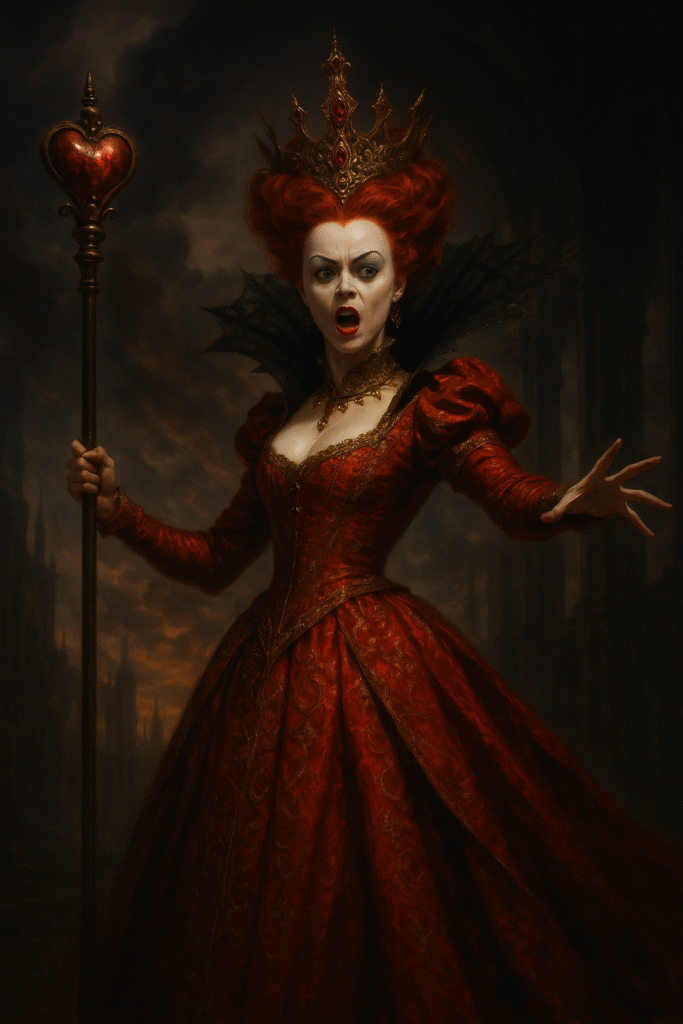
At some point, our talk turned to the dizzying speed of technological change. That’s when Mike dropped the Red Queen line from Through the Looking-Glass:
“Now, here, you see, it takes all the running you can do, to keep in the same place. If you want to get somewhere else, you must run at least twice as fast as that!” – The Red Queen
It fit perfectly. The world feels like it’s accelerating, especially now that AI has arrived not as a novelty but as a genuine collaborator. We aren’t just racing to stay relevant; we’re learning to run alongside machines that think, create, and problem-solve with us.
In biology, the Red Queen hypothesis explains how species must keep evolving simply to survive in an environment where everything else is evolving too. Culture, technology, and even our own habits follow a similar rhythm. If you don’t move, you slip behind. If you do move, you may only hold your ground.
But here’s where the café conversation took a twist. Maybe the point isn’t just to run faster. Maybe it’s to choose why you’re running at all. Mike and I found ourselves circling back to writing, to legacy, to the kind of creative work that doesn’t just chase trends but builds meaning. AI, for us, isn’t another treadmill to exhaust us; it’s an unexpected running partner, one that might just help us find a stride worth keeping.
I left Habano with the taste of coffee still lingering, a signed book in my bag, and that Red Queen line echoing in my mind. Yes, the pace of change is staggering. But perhaps the real art is learning when to run, when to walk, and when to simply sit with a friend over a burger and remember who you’ve been, so you can decide who you’re becoming.
We’ve inherited a story of success that looks a lot like farming. Put your head down. Work the land. Plant the seeds of skill and discipline. Grind away for years. Guard your harvest. Repeat.
It’s the agricultural model of achievement: steady, linear, and long-term. And it has value. Persistence matters. Discipline matters. But, in a fast-changing world, the field doesn’t always hold. By the time you’ve put in your 10,000 hours, the soil may have dried up, the market may have shifted, and the game may have changed.
The Hunter/Gatherer Alternative
In Michael Neill’s latest Cafe for the Soul post, he offers a different metaphor: the hunter/gatherer.
Hunters don’t grind one patch of land forever. They travel light. They keep their senses sharp, scanning for what’s available right now. A ripe fruit here. A herd passing through there. They take what’s needed, adapt quickly, and move on when conditions shift. No hoarding, no backbreaking toil in barren fields.
When we map this onto modern life, the hunter/gatherer mindset prizes responsiveness, adaptability, and opportunity-spotting. It asks us to notice the openings that are already around us—in an email, in a conversation, in a passing idea—and act before they vanish.
The hunter’s toolkit is different from the farmer’s. Where farmers invest in ploughs and irrigation systems, hunters cultivate awareness and mobility. They develop pattern recognition, that ability to read subtle signs that others miss. They learn to trust their intuition about timing, knowing when to strike and when to wait. Most importantly, they understand that scarcity is often an illusion; there’s usually another opportunity around the corner if you know how to look.
The Coaching Reframe
Here’s the coaching takeaway:
Instead of asking, “How can I keep working this one field?” Try asking, “Where’s the fresh game today?”
That simple reframe can free us from the grind and open us to the opportunities at our feet. It’s about balancing long-term goals with agility so we’re not trapped in a field that’s no longer fertile, rather than abandoning them altogether.
Consider how this plays out in different domains. The farmer-entrepreneur doubles down on their original business model even as the market shifts. The hunter-entrepreneur pivots quickly, following emerging trends and customer needs. The farmer-professional climbs the traditional corporate ladder rung by rung. The hunter-professional builds a portfolio of skills and relationships that can adapt to new industries and roles.
The Integration: Why We Need Both
For me, both models hold truth. In the fast pace of today’s world, I find myself leaning on the hunter’s skills, like staying light, moving quickly, and spotting what’s fresh before it disappears. It’s how I keep up with the shifts, how I keep my work alive and responsive.
At the same time, running my blog feels much closer to farming. Soulcruzer is my field. I plant new insights, tend to ideas, and cultivate a space where people can return, season after season. It’s a place of steady growth, a kind of digital soil that grows richer the more I care for it.
And maybe it’s not just a field; perhaps it’s also a campsite. A fire that stays lit so others can gather round, share their own stories, and feel part of something communal.
The Rhythm of Sustainable Success
Hunting keeps me fed in the short term. Farming keeps the fire burning in the long term. Together, they create a rhythm that feels sustainable, alive, and true to the times we’re living in.
But there’s a third element often overlooked: the rest between seasons. Traditional societies understood this: the fallow periods that let the land recover and the ceremonial times when the community gathered to share stories and make meaning from their experiences.
In our always-on culture, we’ve forgotten the wisdom of rhythms. We try to farm and hunt simultaneously, burning out in the process. The integrated approach requires not just knowing when to plant and when to roam, but when to simply be still and let insights settle, relationships deepen, and energy restore itself.
Living the Question
Gather what’s close. Hunt when the hunt is on. And remember to rest in between. Success is about actually living, not just harvesting what we’ve grown, or hunting the next big thing.
Perhaps the deepest insight isn’t choosing farmer or hunter, but learning to ask better questions: What season am I in right now? What does this moment call for? How can I honour both the need for growth and the need for discovery?
In a world that’s changing faster than ever, our survival, and our thriving, may depend not on having the right answer, but on staying fluid enough to dance with whatever questions emerge. The farmer’s patience. The hunter’s alertness. The gatherer’s appreciation for what’s already here.
That’s a way of being fully alive, not just a strategy for success.
This week has been about laying scaffolding around a vision, the kind of quiet construction that doesn’t always look dramatic from the outside but changes everything on the inside. I’ve been shaping Soulcruzer into something more than a blog, more than a collection of scattered essays and passing thoughts. What I see emerging is a living engine, a publishing hub that can carry the weight of the ideas, practices, and stories I want to share.
In some ways, it reminds me of Dan Shipper’s Every, which has become a touchstone for thoughtful writing in the world of business and productivity. But where Every is anchored in tech and work culture, Soulcruzer is rooted in mythic imagination, narrative alchemy, and the art of living well in an AI age. It’s about weaving philosophy with practice, story with transformation, and showing how ancient wisdom and modern tools can come together to re-enchant the way we live.
The scaffolding I’m building now—courses, zines, journals, games, dispatches—isn’t just infrastructure. It’s architecture for Act III, a temple of words and rituals where seekers, creators, and contemplative rebels can gather. And piece by piece, the outlines are becoming clearer.
The Drumbeat of Narrative Alchemy
Narrative Alchemy became the steady drumbeat of the week, the rhythm I kept returning to no matter what else I touched. I began shaping its canon, the texts and ideas that form its backbone, and drafted codex entries that start to give it language and form. I worked with the alchemical stages (calcination, dissolution, and coagulation) and reimagined how they might apply to the stories we tell about ourselves and the myths we live inside without even noticing.
From this work, two clear seeds emerged. The first is an introductory ebook, a kind of field guide to the practice of Narrative Alchemy. It will be part primer, part invitation, and kind of a way for new seekers to glimpse the power of rewriting the stories that shape their lives. The second is a journaling circle where people can experiment with these ideas together, turning theory into a lived practice through daily writing, reflection, and shared myth-making.
Both ideas feel like doorways into something larger. Not just products or programmes, but something, something epic. To step through these doorways is to accept the invitation to work with story as a living force, to see narrative not as entertainment or analysis but as a transformation. My sense is that this is where the real community begins.
A Breakthrough: Magus Eternal
There was a naming breakthrough, too: Magus Eternal. The words settled into my bones in a way the earlier titles never quite did. It feels like a name that has always existed, waiting for me to stumble across it.
Magus Eternal is the solo tarot RPG I’ve been crafting. The war of magi is eternal. Across centuries, in worlds that burn and worlds reborn, it always ends the same: two rivals, one final duel, and reality itself at stake. In this game, you play a Chaos Magician who has pierced the veil of illusion and glimpsed the awful truth that this conflict has played out before, and you have already died in it. Yet here you are again, given thirteen days to gather strength, uncover hidden knowledge, and prepare to face your rival in the last rite.
I’ll be publishing it soon. If you’re into solo RPGs, do give it a try. For me, it’s more than a game; I’m using it as an experiment in myth-making disguised as play.
Writing as Hyper-Sigil
And woven through all of this is the hyper-sigil practice. Soulcruzer is not simply a site or a newsletter to me. I’m looking at it as a living spell, a kind of ongoing act of enchantment written into the fabric of cyberspace and the digital world. For me, every post, every line, becomes a sigil cast into the collective imagination.
When I write, I’m not only sharing ideas. I’m charging words with intention, inscribing possibility into the fabric of the present. Each dispatch is a flare in the dark and an invitation for others to step into the current with me. To read is to participate. To follow along is to become part of the spell. The practice changes the way I approach the page. The act of writing becomes a way of bending probability, of nudging reality toward a more mythic shape.
This is the serious play at the heart of Soulcruzer: to treat words as more than description, to use them as incantation. It’s a reminder that publishing is never neutral. Each post carries the weight of choice, what I choose to amplify, what I choose to ignore, and what I choose to call into being. In this way, the blog itself is a hyper-sigil: a long-form work that grows more potent with each contribution, each witness, each echo that carries it further.
Looking Ahead
The path forward feels less like a to-do list and more like tending a fire with sparks flying everywhere. My task is to keep the rhythm so the energy doesn’t slip away, keep the pulse of publishing alive, ship small, and ship often.
What excites me most is the sense of architecture forming beneath the surface. Act III is no longer a vague horizon; it’s scaffolding that is slowly turning into a temple. Each piece of writing, each experiment, each conversation is another stone laid. I can feel the outlines of something durable taking shape: not just a blog, but a mythic media engine that carries story, soul, and spell into the world.
The work is steady, yes, but it is also sacred play. To show up each day, to write as enchantment, to build structures that others can step into, that is the real alchemy. What lies ahead is not simply productivity or output, but a continuation of the myth-making I’ve already begun. And with every step, the current grows stronger.
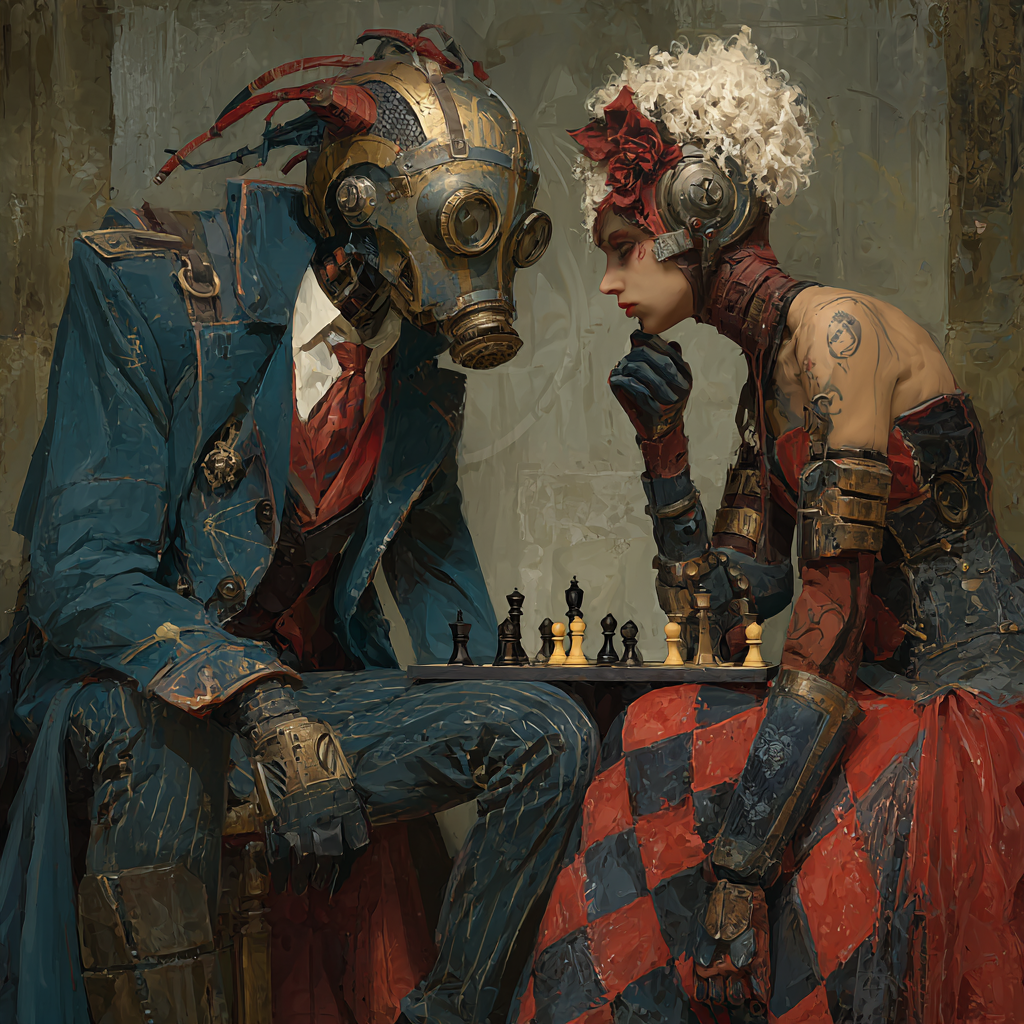
The chessboard is the world; the pieces are the phenomena of the universe; the rules of the game are what we call the laws of Nature. The player on the other side is hidden from us. We know that his play is always fair and patient. But also we know, to our cost, that he never overlooks a mistake, or makes the smallest allowance for ignorance. – Thomas Huxely
Here’s a short take before I head into the weekend. This week I’ve been reading Alley Wurd‘s book, Sub/Urban Butoh Fu and he has me interested in exploring the meta-games we play or fail to play. And so, I wrote this piece.
The chess master stares at the board for seventeen minutes. Not at the pieces, she memorised their positions three moves ago, but at her opponent’s breathing. The slight quickening when he considers the knight fork. The held breath before he touches his queen. She’s not playing chess anymore. She’s playing the player.
This is the meta-game. The game beneath the game, where victory belongs not to those who master the rules but to those who master the rule-makers.
I learned this watching my brother-in-law’s daughter negotiate bedtime. She never argues about the time directly. Instead, she questions the authority of clocks. “Why does eight o’clock get to decide when I’m tired?” A four-year-old deconstructing temporal tyranny. She’s not fighting the bedtime; she’s rewriting the operating system that makes bedtime possible.
Every interaction contains at least three games: the surface game (what we pretend we’re playing), the psychological game (what we’re actually playing), and the meta-game (the awareness that we’re playing at all). Most people never leave the first level. They argue about chess moves while someone else redesigns the board.
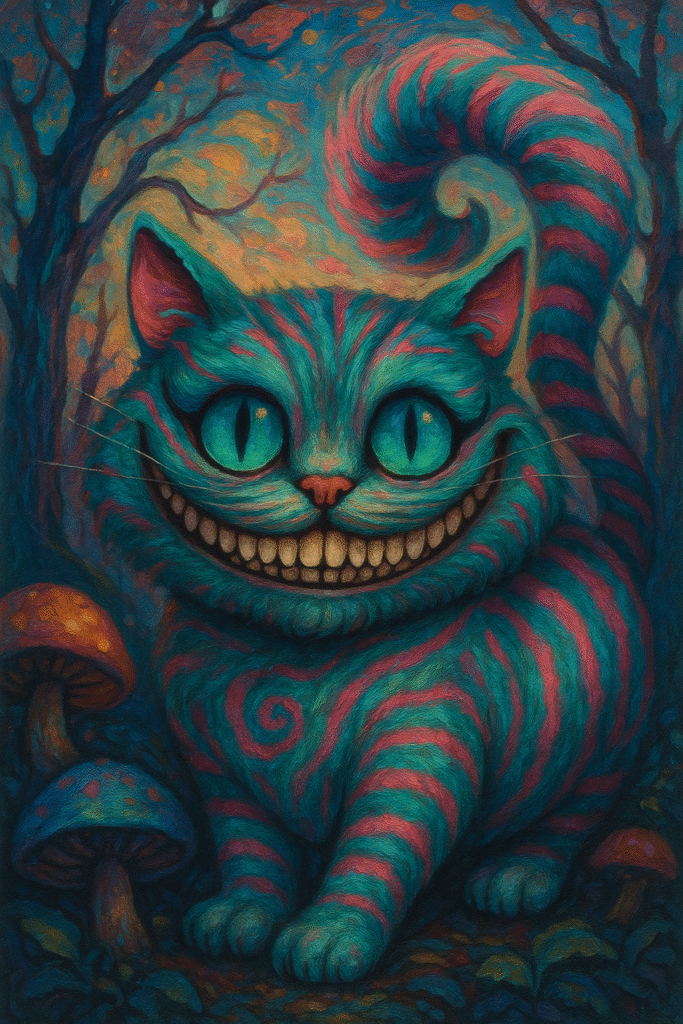
The Cheshire Cat materialises on my coffee table, grinning around a cigarette that exists only on Wednesdays.
“You humans,” he purrs, “are so delightfully unaware of your own machinery. You think you’re choosing chocolate over vanilla, but you never question who built the ice cream shop.”
He gestates toward my laptop, where I’m writing about meta-games. “Even now, you think you’re explaining something to your readers. But the real game is what happens when they realise they’ve been meta-gamed by your explanation of meta-gaming.”
The cigarette becomes a question mark, then dissolves. The Cat’s grin lingers long enough to wink.
The meta-game operates everywhere, invisible as air until you learn to see it. The job interview where you’re not being evaluated on qualifications but on how well you perform as a “person who deserves employment.” The marriage where the fight about dishes is really about who gets to define what love looks like. The democracy where citizens think they’re choosing policies, unaware they’re being played by algorithms that learned their preferences before they did.
To play the meta-game requires a peculiar form of double-consciousness. You must participate sincerely in the surface game while simultaneously recognising its constructed nature. Like being an actor who forgets they’re performing while never forgetting they’re on stage.
The danger isn’t ignorance; it’s the nihilism that comes with too much awareness. Once you see how many games are rigged, the temptation is to stop playing altogether. But withdrawal is just another move on the meta-board, observed and countered by players who anticipated your retreat.
The wisdom lies in playing multiple levels simultaneously without losing your humanity to the mechanics. The chess master who reads her opponent’s breathing but still loves the beauty of a well-executed gambit. The parent who recognises their child’s rhetorical strategies but remains genuinely moved by their questions about fairness.
Perhaps the highest form of meta-gaming isn’t winning but maintaining wonder and seeing through the illusion while preserving its capacity to enchant. Playing the game, playing the player, but never forgetting that all games, even meta-games, are ultimately elaborate forms of play.
The real question isn’t whether you’re being played, because, well, you are, constantly, by systems both visible and hidden. The question is whether you’re awake enough to play back, consciously and with compassion, in the vast recursive game where players play players playing games.
I discover hope’s source code on a Thursday morning, staring at my coffee cup like it holds the secrets of the universe. Which, in a way, it does.
The revelation arrives not as lightning but as slow recognition. My mind has been running hope protocols all along, background processes I never bothered to examine. Every story I tell myself about tomorrow, every memory I choose to highlight or bury, every interpretation I layer on top of struggle. These aren’t random events. They’re driven by the unseen algorithms of my past.
Consider how a video game keeps you engaged. Progress bars. Achievement unlocks. The promise that this level leads somewhere meaningful. Remove these elements, and players abandon the quest within minutes. But life rarely offers such obvious mechanics. Instead, we construct them unconsciously, cobbling together fragments of narrative and expectation until something resembling forward momentum emerges.
The problem is most of us inherit our hope frameworks secondhand. Family scripts about what success looks like. Cultural myths about struggle and reward. Religious or secular promises about eventual justice. These inherited algorithms run in the background, generating hope or despair based on code we never wrote.
I think of my neighbour, June, who spent decades believing a promotion at her corporate job would finally validate her worth. The hope felt real and drove her through sixty-hour weeks and endless performance reviews. But the algorithm wasn’t hers. It belonged to a system that profited from her belief in meritocracy, her faith that good work equals good outcomes. When the layoffs came, her hope crashed because she’d been playing someone else’s game.
False hope operates this way. It borrows its logic from external sources, promises rewards controlled by others, and ties meaning to outcomes beyond your influence. The progress bar moves according to rules you can’t see, let alone modify. This bothers me.
Generative hope works differently. You write the code yourself.
I’ve started treating my morning walks like debugging sessions. What stories am I running about the day ahead? Which memories am I highlighting to fuel confidence or undermine it? When I notice myself waiting for external validation to feel worthy, I catch the borrowed algorithm in action.
Then comes the hacking. I design micro-victories: finishing this paragraph, having a real conversation with a stranger, or choosing curiosity over judgement when someone disagrees with me. These are local victories that accumulate into genuine momentum.
The deeper work involves rewriting the quest itself. Instead of hoping for eventual recognition as a writer or blogger, I focus on the craft of paying attention. Instead of waiting for the world to become less chaotic, I cultivate my capacity to dance with uncertainty. The game changes from “endure until rescue arrives” to “develop skills worth having.”
Don’t confuse this with positive thinking or manifestation magic. This is conscious architecture. I’m not pretending struggle doesn’t exist or that willpower conquers everything. I’m recognising that hope is a system I can influence through design choices.
The meta-game reveals itself once you see the code. You stop being the character who hopes something good might happen and become the programmer who builds mechanics that generate aliveness regardless of external circumstances.
This morning, watching steam rise from my coffee, I notice something shift. Not in the world, but in my relationship to it. The cup remains the same temperature, but the narrative has changed. I’m no longer waiting for hope to visit. I’m authoring it, one conscious choice at a time.
The game is always already in progress. The question is whether you’re playing by someone else’s rules or writing your own.
The dance between I and Me lives right at the heart of selfhood, it’s the movement between the actor and the mask, the subject and the object, and the experiencer and the experienced.
William James started the split: I as the knower, the pure subject of consciousness; Me as the known, the self that can be observed—my body, my history, my reputation, my roles. George Herbert Mead later turned this into a dance floor: I is spontaneous, unpredictable, creative response; Me is the social mirror, the internalised chorus of others telling us who we are supposed to be.
So what’s the space between them? It’s not a gap you could drop a coin through. It’s more like the tension in a bowstring. On one side, I pulls toward raw immediacy: breath, impulse, spark. On the other, Me holds the shape, keeps the pattern recognisable. Together they generate the music of identity. Too much Me and you ossify into a statue of expectations. Too much I and you’re pure chaos, a fire with no hearth.
The space itself is liminal, a threshold, rehearsal hall, dream corridor. It’s where improvisation happens. Imagine jazz: the Me is the chord progression, the agreed key; the I is the solo riffing over the structure. The in-between is the groove where they entwine.
In coaching or soulcrafting terms, that space is fertile. It’s where someone can step back, see the “Me” they’ve been living as a script, and then let the “I” improvise a new line. Presence lives there. Choice lives there. The mythic imagination wakes up there because you are no longer fully trapped in the character nor dissolved into pure subject, but able to author between them.
Exploring that space is like learning to lucid dream while awake, when you realise you are both the dreamer and the dreamed, the actor and the playwright, always in motion.
I’m sitting here in quiet reflection after another powerful journaling/meditation session; the question that keeps circling back to me is, ‘Why Mephistopheles?’ Why now?
Something has shifted in my practice this week. I’ve felt myself touching something deeper, something more innately powerful. It feels more authentically me than anything I’ve accessed before. It’s as if I’m finally meeting the truest version of myself that I can recognise at this stage of my inner journey.
For years, I’ve carefully skirted around the darker territories of the psyche. I’ve worked in the light, stayed in the comfortable realms, and avoided the shadows that seemed too dangerous to explore.
There’s wisdom in that caution, I know. The darker elements carry immense power, but they’re notorious for their appetite; they have a way of consuming those who aren’t prepared to handle them. How many stories have I read of people who reached for that power only to find it had turned on them, devouring them from within?
Yet something in me has changed. Perhaps it’s confidence, perhaps it’s readiness, or maybe it’s simply time. I’ve decided to stop avoiding what I’ve long known was there waiting. This phase of my inner journey demands something different from me: a willingness to experiment with the very forces I’ve kept at arm’s length.
Enter Mephistopheles….
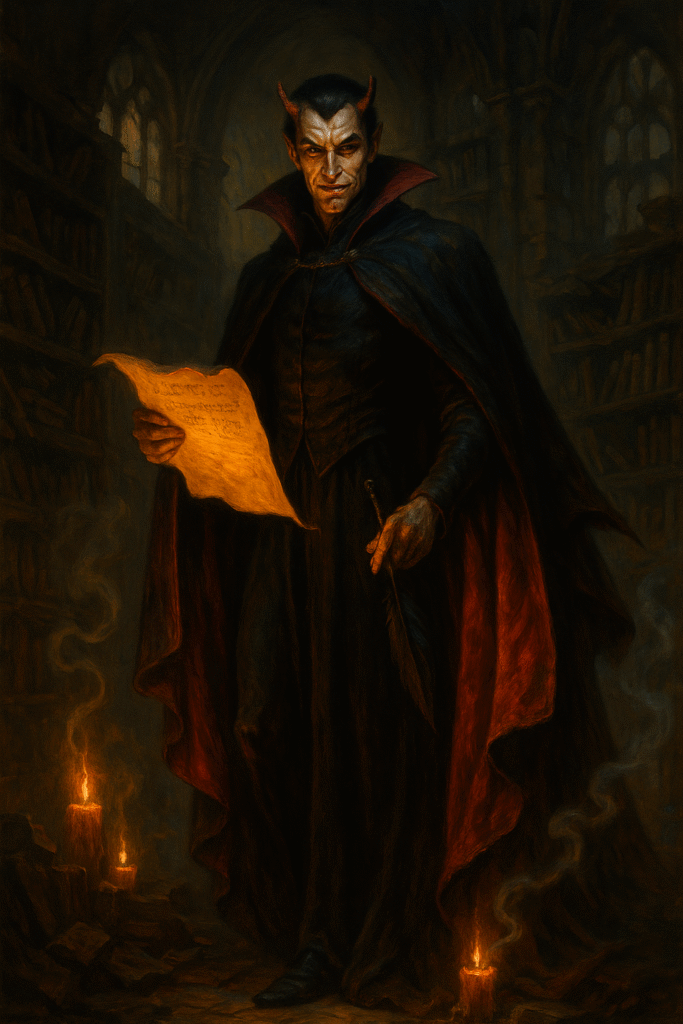
Mephistopheles is more than a character; he is a function of the psyche, a mask that appears whenever human longing rubs against the limits of the possible. He emerges from the shadows of our deepest frustrations, materialising precisely when our desires collide with the unyielding walls of reality. He is the spirit of “Yes, but”, that corrosive, necessary countervoice that mocks our cherished illusions, strips away the comfortable layers of pretension we wrap around ourselves, and tempts us with seductive shortcuts that promise everything while demanding the unthinkable.
In Goethe’s Faust, he calls himself the “spirit that always negates,” yet this declaration reveals a profound truth about his nature. That negation is not pure evil; it’s catalytic and transformative in ways both terrible and necessary. Like fire sweeping through a dense forest, he clears away the accumulated undergrowth of lies and delusion that chokes the soil of the soul, burning through the deadwood of false beliefs and self-deception so that something more vital, more authentic, may eventually emerge from the ashes. His destruction is creation’s harsh prerequisite, his mockery the acid that dissolves the bonds of complacency.
He does not arrive with fanfare or theatrical flourish. Mephistopheles slips into consciousness the way doubt creeps into faith, gradually, then all at once. One moment you are certain of your path, convinced of your righteousness, secure in your small certainties. Next, his whisper threads through your thoughts like smoke through a keyhole.
“How noble,” his voice might murmur as you donate to charity, “this performance of virtue. But tell me—do you give because you care, or because others are watching?”
The question burrows deep, finds the soft places where your certainties live. He never lies, this ancient provocateur. He simply illuminates the contradictions already present and holds up a mirror that reflects not your face but your hidden motivations. The businessman who prides himself on integrity discovers he has been cutting corners for years. The devoted parent realises their love comes wrapped in control. The activist confronts the intoxicating pleasure they derive from their own righteous anger.
This is his particular genius: he makes explicit what was always implicit. The shadow Jung wrote about, lurking just beyond the periphery of conscious awareness, steps into the light under Mephistopheles’ patient cultivation. He tends these shadow-gardens with the care of a master horticulturist, knowing exactly which psychological conditions will cause long-buried truths to bloom.
Yet his revelations, however devastating, carry within them the seeds of authentic transformation. The executive who admits to his compromised ethics may choose to rebuild his business on genuine principles. The parent who acknowledges their controlling tendencies might learn to love without possession. The activist could discover that effective change requires more than just anger; it demands the harder work of building bridges rather than burning them.
But here lies Mephistopheles’ true cunning: he offers no guarantees. His bargains promise knowledge, power, and fulfilment of desire but never specify the cost of such acquisition. He is the eternal patron of the Faustian contract, where every gain extracts its terrible price. The knowledge comes wrapped in isolation; who can bear to see clearly while others remain blind? The power corrupts even as it liberates. The fulfilled desire reveals itself as hollow, leaving behind only the ache for the next impossible thing.
He watches these transactions with the detached interest of a scientist observing chemical reactions. Neither malicious nor benevolent, he simply is the inevitable consequence of consciousness sophisticated enough to question its own foundations, to doubt its certainties, and to hunger for more than survival allows.
Inside us, Mephistopheles manifests as the tempter, that seductive inner voice that whispers its promises during our moments of greatest vulnerability and discontent. He is the silvered tongue that murmurs, “If only you gave this up, you could have everything your heart has ever craved.” He dangles before our weary minds the tantalising prospect of knowledge without the grinding, relentless years of study – instant expertise that bypasses the humble apprenticeship of learning. He offers power without the crushing weight of responsibility, influence without accountability, and the ability to command without ever having learned to serve.
Most alluring of all, he promises pleasure without consequence, satisfaction without sacrifice, and the fulfilment of every appetite without the bitter aftertaste that inevitably follows excess. On the surface, these appear as simple bargains, straightforward transactions where desire meets opportunity. Yet underneath this veneer of generous exchange, he reveals something far more unsettling: the true depth and desperation of our hunger and the extent to which we are willing to compromise our principles for the promise of immediate gratification.
When he shows up in our lives, and he always does, for no conscious being escapes his attention, it’s not to trick us into some theatrical damnation complete with sulphur and flames. Rather, his purpose is far more subtle and infinitely more revealing: to test how well we truly know the price of our desires, whether we understand that every shortcut demands its payment, and if we possess the wisdom to recognise that what we think we want and what we actually need are often worlds apart. The recognition arrives not as a revelation but as a quiet acknowledgement, the way dawn doesn’t announce itself but simply displaces darkness.
As an archetype, Mephistopheles belongs to the sprawling family of tricksters that have haunted human storytelling since our earliest myths, but he carries a distinctly modern face, one polished to a mirror shine by centuries of urban sophistication. Unlike the ancient Loki or Hermes, who delight in pure chaos and gleeful mischief for its own sake, revelling in the simple joy of upending order, Mephistopheles is something far more unsettling: urbane, ironic, and calculating. He is a demon born not of primitive fear but of the Renaissance, emerging from an age that had learned to question everything and believe in nothing with equal fervour.
He doesn’t command through brute force or supernatural terror. Instead, he negotiates with the smooth precision of a seasoned diplomat. He brokers deals with the casual expertise of a merchant prince. He tempts not through fire and brimstone, not through the crude instruments of fear and intimidation, but through the far more seductive weapons of cynicism, razor-sharp wit, and intellectual sophistication. His arguments arrive dressed in logic, his propositions wrapped in reasonable compromise.
That’s precisely why he resonates so deeply in our age of endless contracts, careful compromises, and weaponised cleverness; we know his voice intimately because we hear it daily echoing through corporate boardrooms where ethics bend to quarterly profits, in the polished rhetoric of politics where truth becomes a matter of strategic positioning, and perhaps most disturbingly, in the smooth rationalisations of our own self-justifications when we explain away the small betrayals that accumulate like compound interest on our souls.
Psychologically, he represents the purest distillation of shadow energy, that murky, uncomfortable territory of the psyche where our most inconvenient truths take refuge. He embodies the part of us that hungers for what it cannot openly acknowledge, that desires what our conscious mind rejects with righteous indignation. He is the voice that whispers during our most virtuous moments, pointing out the self-serving calculations hidden beneath our noble intentions, the petty satisfactions we derive from our moral superiority.
This is the insidious force that systematically undermines our hard-won certainty, compelling us to confront the yawning chasm between our lofty ideals and our base appetites. Jung might recognise him as the archetypal trickster-shadow, the necessary antagonist who strips the hero of protective innocence so they can finally stumble, bloodied and humbled, toward genuine wholeness.
He catalyses transformation not through gentle affirmation or supportive encouragement, but through the far more brutal methodology of challenging every assumption, mocking every pretension, and presenting temptations so precisely calibrated to our weaknesses that resistance becomes a form of self-revelation. His very presence forces us to examine not just what we claim to believe, but why we need to believe it so desperately.
And in this perverse, unsettling way, he reveals himself as perhaps the most paradoxical teacher imaginable, one who instructs through corruption rather than edification, who guides through misdirection rather than clarity. Without his diabolic intervention, Faust would have remained forever trapped in his scholar’s tower, a withered academic drowning in theoretical abstractions and dusty tomes, his soul gradually atrophying from lack of genuine engagement with the messy, intoxicating complexity of lived experience. The good doctor would have pursued knowledge as a purely intellectual exercise, safely removed from the dangerous immediacy of actual consequence.
But with Mephistopheles as his dark companion, Faust finds himself thrust headlong into the raw machinery of desire, compelled to taste the forbidden fruits of experience, to embrace risk and recklessness, and to gamble his very essence on the possibility of transcendence. Through calculated error and deliberate transgression, through the systematic violation of every principle he once held sacred, Faust stumbles toward something approaching a fuller, more complete humanity, one that acknowledges both the heights of aspiration and the depths of appetite.
In mythic terms, Mephistopheles functions as the eternal guardian of psychological thresholds, the sentinel who stands at every crucial juncture demanding payment for passage. He presents you with the contract, that infamous document dripping with implications, its edges seemingly singed by the fires of countless previous negotiations, knowing with exquisite certainty that what truly matters is not the parchment itself or even the precise terms written in its margins, but rather the fundamental choice it represents: What sacred part of yourself will you willingly sacrifice? What comfortable illusion will you refuse to abandon? What cherished piece of your identity will you place upon the altar of transformation?
He understands, with the patience of aeons, that every soul carries within it a hierarchy of values, a secret architecture of priorities that most people never dare examine too closely. The contract merely forces this hidden structure into the harsh light of conscious decision. It compels you to confront the uncomfortable truth about what you truly treasure most deeply and what you’re secretly willing to surrender when the stakes become sufficiently high.
In our modern lives, he shows up whenever we face a compromise that cuts to the soul, manifesting not as a horned figure with a pitchfork, but as that familiar internal voice that speaks with devastating clarity about the price of our ambitions. Do you trade authenticity for success, slowly moulding yourself into the shape that others expect, until you can no longer recognise the person staring back from the mirror? Do you sacrifice freedom for security, choosing the golden cage over the uncertain wilderness of possibility? Do you barter presence for productivity, surrendering the irreplaceable moments of genuine connection for the hollow satisfaction of achievement?
He manifests in those moments as the whisper, the sly negotiator, the cynic who lays the pen in your hand and says, “You know you want this.” His voice carries the weight of practical wisdom, the seductive logic of compromise, and the rational arguments that make surrender seem not just reasonable but inevitable. He speaks in the language of necessity, of pragmatism, of adult responsibility, and of all the sophisticated justifications we use to avoid confronting the rawness of our deepest desires.
But to harness his power, you don’t banish him, and you don’t surrender completely to his seductions. Instead, you let him sharpen you against the whetstone of his challenges. You let his irony burn away the false pieties and comfortable self-deceptions, the layers of social conditioning and inherited expectations that obscure your authentic nature. You allow his relentless questioning to strip away everything that is merely borrowed, merely assumed, merely accepted without genuine examination, until what remains is the one irreducible thing you will never trade, the core essence that defines your truest self.
In that way, Mephistopheles becomes not the thief of your soul but the dark tutor who forces you to claim it fully, to own it completely, to defend it fiercely against all the forces that would dilute or diminish its power. Through his diabolic pedagogy, you discover not just what you believe, but what you believe so deeply that no contract, no matter how tempting, could ever compel you to abandon it.
That’s the mythic map laid bare before us: Mephistopheles as the inner tempter, as the mirror that reflects our deepest contradictions, as the relentless negator who refuses to let comfortable lies stand unchallenged, and as the threshold guardian who blocks the path to authentic selfhood with trials that seem designed to break us. He emerges not as some external monster lurking in the darkness to be feared and avoided, but rather as the shadow mentor whose brutal tests and uncompromising challenges systematically strip away every false layer, every borrowed identity, every inherited assumption, until they expose the bedrock of what you truly are beneath all the accumulated debris of social expectation and self-deception.
This is the paradox at the heart of the Faustian encounter: the very force that appears to threaten your destruction becomes the catalyst for your most profound self-discovery. Through his relentless questioning and his refusal to accept easy answers, Mephistopheles compels you to excavate the authentic core of your being, to unearth the irreducible essence that no external pressure can corrupt or coerce.
This morning the Thoth deck placed Death in my hand with the peculiar weight that only certain cards carry—that gravitational pull of significance that makes the fingers tingle and the mind sharpen. Not the grim ender of tales that medieval minds conjured, but the skeletal dancer Crowley envisioned in his years of Egyptian exile and hermetic revelation—hipbones swaying in cosmic rhythm, scythe flashing like a conductor’s baton orchestrating the symphony of transformation.
The card felt warm between my thumb and forefinger, its surface worn smooth by decades of seekers’ touch. I studied the intricate details that Frieda Harris painted with such meticulous devotion: the way Death’s spine curves in elegant motion, how his skull tilts with something approaching joy, the theatrical sweep of his robes that suggest not mourning but celebration.
Around him, currents of life swirl in perpetual motion—fish swimming against the current of dissolution, serpent coiling through the mysteries of regeneration, scorpion carrying its transformative sting. Each creature a living reminder that endings are fertile soil, not barren ground. The very air seems to shimmer with possibility, with the electric charge that precedes all genuine change.
I sat with the card spread before me on the worn oak table, my coffee growing cold as steam spiraled upward in lazy helixes, and felt the familiar companion settling at my shoulder like an old friend taking his accustomed place. The weight of his presence was neither heavy nor light—simply there, constant as breath, reliable as gravity. Death doesn’t stalk me with menace through the corridors of my days; he walks with me as a quiet ally, a patient teacher whose lessons unfold in whispers rather than shouts.
His voice comes not as sound but as knowing, that deep cellular recognition that bypasses the rational mind and speaks directly to the marrow. He whispers in the language of intuition and ancestral memory: “What skin will you shed today, old friend? What calcified husk of self has grown too tight, too small for the expanding consciousness within? What outdated story of who you think you are is ready to be cut loose, cast off like autumn leaves surrendering to winter’s transformative touch?”
The questions hang in the air between us, neither demanding immediate answers nor allowing easy dismissal. They settle into my bones with the patient persistence of water wearing smooth the roughest stone.
In my leather-bound journal—its pages yellowed from years of midnight musings and coffee stains like ritual marks—I wrote of phoenix fire, that sacred conflagration that transforms rather than destroys. The pen moved across the paper with its own intelligence, channeling visions of ancient birds rising from their own ashes, wings spread wide against impossible skies. I sketched serpents in the margins, their coils loosening as they wriggled free from constraining skins that had grown brittle and confining, each molt a small death that birthed a larger life.
The words flowed like incantations, conjuring Eliot’s eternal footman—that snickering harbinger who haunts the periphery of consciousness, reminding us that our time is always running out, always pressing us toward the moment of reckoning. I could hear his cruel laughter echoing through the chambers of my psyche, see him lurking in the wings of my personal theater, waiting for the curtain call that comes to every performance.
But more than death’s comedy, I wrote of masks—those elaborate disguises we craft with such care, polishing them until they gleam with false authenticity. The danger, I scrawled in increasingly urgent script, lies not in wearing them but in forgetting they can be removed. When the mask fuses with the flesh, when the performance becomes the performer, we lose the thread that leads back to our essential selves.
Above all, threading through every line like a golden filament, I wrote of authorship—that primal call to step forward from the audience of my own existence and claim the pen that writes reality’s script. To refuse the role of passive observer, of victim to circumstance, of sleepwalker stumbling through someone else’s dream.
Death reminds me that every day is a small rehearsal for dissolution, each dawn breaking over the stage where I practice my final bow. Every breath out becomes a letting go, a miniature death that empties the lungs of yesterday’s stale air, making space for what follows in the eternal rhythm of renewal. The exhale carries with it fragments of who I was moments before—expired thoughts, finished feelings, the cellular debris of a self that existed only in the now-vanished instant.
He is the musician who prunes and plucks at once, his skeletal fingers working the strings of existence with a maestro’s precision. Death cuts away what no longer serves—the brittle branches of outdated identity, the dead wood of worn-out beliefs—while simultaneously striking new chords in the song of becoming. His melody weaves through the symphony of transformation, each note a reminder that endings birth beginnings, that every funeral is also a christening.
In this daily rehearsal, I glimpse the cosmic joke that Burroughs whispered about in his junky wisdom: that death is not the opposite of life but its most intimate collaborator. The eternal footman doesn’t wait in the wings—he dances with us on stage, his presence making every gesture more precious, every word more weighted with meaning. Through his dark choreography, I learn that dissolution is not defeat but the ultimate act of creative destruction, clearing the canvas for whatever masterpiece awaits.
To walk with Death is not to live in fear—that tired mythology of the uninitiated. It is to live awake, hyper-present in each crystalline moment, eyes wide open to the beautiful terror of impermanence. This is not the morbid fascination of the gothic romantic or the nihilistic embrace of the void-worshipper. This is the magician’s recognition that every breath draws us deeper into the mystery, every heartbeat marking time on the cosmic clock.
It is to rise from ashes like some psychedelic phoenix, to shed and regenerate in the eternal cycle of death and rebirth that Jung mapped in his alchemical visions. Each morning becomes an act of resurrection, each sleep a little death rehearsal. I peel away the accumulated skins of yesterday—the roles I played, the masks I wore, the stories I told myself about who I was supposed to be. Layer by layer, the false selves fall away like autumn leaves, revealing something rawer underneath.
To refuse the mask that hides me even from myself—this is the hardest magic of all. The persona we construct for the world’s consumption, that carefully curated fiction we present at the daily masquerade, becomes so familiar we forget it’s a costume. But Death whispers in our ear: strip naked, show your true face, let the authentic self emerge from behind the elaborate theater of social expectation. In his presence, pretense becomes impossible, and what remains is either genuine or nothing at all.
Today, I choose to dance on Death’s floor—not the morbid shuffle of the defeated, but the wild, ecstatic tango of one who has glimpsed the eternal and returned laughing. Each step becomes a conscious letting go, a deliberate release of the accumulated debris that weighs down the soul. I shed expectations like old clothes, drop grudges like stones from my pockets, abandon the bitter collection of should-haves and might-have-beens that clutter the psychic landscape. Each breath transforms into a renewal, an inhalation of pure possibility, an exhalation of everything that no longer serves the great work of becoming.
The rhythm emerges from somewhere deeper than thought, older than fear—the primal drumbeat that has echoed through shamanic caves and mystery schools, through the hearts of mystics who learned to court the darkness and emerge transformed. From this ancient cadence, this conversation between mortality and eternity, I make my vow like a magician casting the most important spell of his life:
To embrace life not as a consolation prize for avoiding death, but as the very medium through which consciousness explores its own infinite nature. To live it to the fullest—not in the desperate accumulation of experiences like a spiritual consumer, but in the profound attention that transforms even the mundane into sacrament. To seize destiny not as some distant prize dangling from the hooks of tomorrow’s promises, but as a step taken here, now, in this eternal present moment where all possibilities converge and the future crystallizes from the raw material of choice.
The concrete stretches endlessly in every direction, a monotonous expanse of gray that swallows the horizon. Buildings tower above me like tombstones, their surfaces scarred with identical posters that scream in bold red letters: TRUTH. ORDER. OBEY. The words repeat in perfect rows, layer upon layer, until they blur into a hypnotic pattern that makes my eyes water.
I pull my coat tighter and join the stream of bodies flowing down the street. We move in formation—three across, steady pace, no deviation. The person to my left mutters under her breath.
“Truth brings order, order brings peace.”
The man on my right picks up the refrain without missing a beat.
“Peace through consensus, consensus through truth.”
Their voices blend with hundreds of others, creating a low hum that vibrates through the pavement and into my bones. I mouth the words but keep my voice silent. The syllables taste like ash.
A woman stumbles ahead of me, her briefcase clattering to the ground. Papers scatter across the wet concrete. For a heartbeat, the formation wavers. Then we flow around her like water around a stone, never breaking stride. She scrambles to collect her documents, tears streaming down her face.
“Truth brings order,” she whispers desperately as she stuffs the papers back into her case. “Order brings peace. Peace through—”
Her words crack, but she forces them out anyway.
The posters watch from every surface. Store windows display them. Bus stops frame them. Even the trash cans bear the familiar red lettering. TRUTH. ORDER. OBEY. The glue holding them is fresh—someone replaces them daily, ensuring the message never fades.
I count my steps. Forty-three to the next intersection. The traffic light hangs dead and dark, but we stop anyway. Wait. The crowd breathes in unison, exhales the sacred words.
“Consensus protects us all.”
“Consensus protects us all.”
My lips move with theirs, but my mind drifts to the narrow alley between two office buildings. The one where the posters peel at the corners. Where sometimes, if the light hits just right, you can glimpse the brick underneath—red and real and untouched by slogans.
The light flickers green though no cars pass. We resume our march.
The Crack in the Wall
The formation carries me past the alley, but something snags my peripheral vision. One poster flutters loose from its adhesive prison, corner curled and dancing in the stale air. I slow my pace, letting the bodies flow around me until I drift toward the building’s edge.
The torn poster reveals something impossible.
Not brick. Not concrete. A shimmer that makes my retinas itch—like staring at heat waves rising from summer asphalt, but cold. The space behind the poster ripples with movement. Words. Actual words, floating and tumbling through the gap like pages torn from a book and scattered by wind that doesn’t exist.
freedom spirals past choice while doubt crashes into question and they merge, split, recombine into new configurations that hurt to follow. The letters themselves seem alive, rearranging their molecular structure faster than my eyes can process.
A shadow moves within the shimmer.
Tall, lean, wearing clothes that could belong to any era or none—dark coat that might be leather or canvas or something that hasn’t been invented yet. No insignia. No red posters. No slogans stitched into his sleeves. He carries a notebook bound in what looks like skin, pages thick with ink and marginalia. But it’s the blade in his other hand that stops my breath.
The metal gleams with letters instead of light. Actual text runs along the edge—cut and slice and divide flowing into liberate and free and choose. The words move like mercury, reforming with each shift of his wrist.
The formation is noticing the disruption. Bodies beginning to cluster, faces turning toward the alley with expressions caught between confusion and programmed alarm. The shadow in the shimmer tilts his head, listening to their approach.
His eyes find mine through the gap in reality. They hold the kind of amusement that comes from watching children play games they don’t realize they’re playing. He raises the text-blade in what might be greeting or warning.
The torn poster flutters again. The shimmer wavers.
“Peace through consensus,” the crowd chants, their voices building toward something that sounds like panic dressed in familiar words. “Consensus through truth.”
The shadow’s grin cuts through dimensions.
Story as Sorcery
The shadow steps through the shimmer like it’s an open door.
“Truth brings order,” he says, but the words come out wrong. They ripple outward like stones dropped into still water, each syllable creating concentric circles that distort the air itself. “But whose truth? Whose order?”
The formation stumbles. Bodies that moved in perfect synchronization suddenly find their feet uncertain, their rhythm broken. Someone in the back row blinks—actually blinks—as if seeing the street for the first time in years.
“Order brings peace,” a woman near me whispers, but her voice wavers. The certainty that held her spine straight crumbles.
The Trickster-Mage reaches into his coat and pulls out fragments of paper—torn words, scattered phrases, pieces of sentences that flutter in his palm like living things. He tosses them into the air above our heads.
The fragments don’t fall.
They hang suspended, rearranging themselves into impossible geometries. freedom and choice spiral around each other, forming an archway that leads nowhere and everywhere. question and doubt mirror each other until they become twin doorways reflecting infinite possibilities. resist burns like a sigil, casting shadows that spell out remember and wake and think.
A man in the front row drops his briefcase. The sound echoes wrong, like metal hitting water instead of concrete.
“What…” he starts, then stops. His hand moves to his throat as if checking whether the words are really his own.
“Peace through consensus,” another person chants, but the words feel hollow now, like echoing down an empty well. “Consensus through…”
She trails off. Her eyes track the floating words overhead, watching truth dissolve and reform into truths, plural, infinite.
The Trickster-Mage grins wider. His text-blade catches the light from the burning sigils, and new words flow along its edge: wake and see and choose and now.
“Consensus through truth,” I hear myself say, but my voice sounds strange in my own ears. Foreign. Like someone else’s uniform borrowed for too long.
The formation breaks entirely. People stand in clusters now, not lines, heads tilted back to watch impossible words dance overhead. Some reach toward the floating fragments. Others step backward, but their feet carry them in directions their minds haven’t chosen yet.
The shimmer behind the torn poster expands, revealing more gaps in the wall, more spaces where different words might live.
The Resistance of Belief
A figure pushes through the scattered crowd, and I recognize the uniform before I see the face. Clean lines, pressed fabric, the kind of authority that makes people step aside without thinking. The Guardian of Consensus moves with mechanical precision, each step an echo of every other step taken by every other Guardian in every other place where order needs reinforcing.
“Citizens.” The voice cuts through the air like a blade through silk. “Return to formation.”
But the crowd doesn’t move. They’re still watching the words overhead, still seeing truths where they once saw truth.
The Guardian’s armor isn’t metal or leather—it’s something more insidious. Certainty wraps around them like plate mail, forged from a thousand repeated phrases, tempered by years of unquestioned doctrine. Their weapon isn’t a sword but something far more dangerous: the absolute conviction that there is only one way to see, one way to think, one way to be.
“Deviation is error,” the Guardian announces, and I feel the pull of old programming tugging at my spine. The urge to straighten, to fall in line, to let someone else’s truth become my truth. “Consensus protects. Order preserves.”
Several people in the crowd shift, taking half-steps back toward formation. The floating words above us flicker, freedom dimming as obedience tries to write itself overtop.
“There is only one way,” the Guardian bellows, and their voice carries the weight of every lecture hall, every church sermon, every political rally where doubt was beaten into submission. The shimmer behind the torn poster wavers.
That’s when the Trickster-Mage laughs.
It’s not a polite chuckle or nervous giggle. It’s the sound of glass breaking in slow motion, of masks cracking, of cages discovering they were never locked. The laugh ripples outward and the Guardian’s certainty-armor develops its first hairline fracture.
“Belief is a tool, not a chain,” he says, and flicks his notebook open with one fluid motion.
The words inside don’t just scramble—they explode. Letters pour out like freed prisoners, consonants and vowels tumbling over each other in joyous chaos. They hit the air and immediately begin forming new combinations, impossible phrases, sentences that twist meaning inside-out and rightside-up simultaneously.
THERE IS ONLY becomes THERE IS ONLY ONE becomes THERE IS ONLY ONE WAY becomes THERE ARE INFINITE WAYS becomes THERE floats alone, pointing nowhere and everywhere.
The Guardian staggers. Their armor of certainty cracks wider as ONE WAY multiplies into MANY WAYS into YOUR WAY into MY WAY into NEW WAY into pathways spelling themselves across the concrete beneath our feet.
“Order through—” the Guardian starts, but the words tangle in their throat as ORDER rearranges itself into REORDER into RECORDER into RE-CORD like musical notes waiting to be played differently.
I watch a woman beside me read the new words forming in the air. Her lips move as she sounds them out: “There are infinite ways.” She looks down at her hands as if seeing them for the first time. “There are infinite ways to…”
“Stand down, citizen,” the Guardian commands, but their voice has lost its absolute pitch. The certainty-armor shows more cracks now, and through the gaps, I glimpse something almost human underneath.
The Trickster-Mage closes his notebook with a snap. The released words continue their dance overhead, but now they’re writing themselves, finding new patterns, new meanings, new possibilities that no Guardian could ever chain.
“Choose,” he says simply, and the word hangs in the air like an invitation.
Planting Seeds
The Guardian reaches for their standard-issue certainty, but their hand closes on empty air. The armor of absolute conviction shows more fractures with each passing second, doubt seeping through like water finding stone.
The Trickster-Mage doesn’t press his advantage. He doesn’t charge forward with sword raised or deliver crushing blows of logic. Instead, he moves like smoke, slipping between the Guardian’s defenses while they’re still trying to reassemble their shattered proclamations.
“Remember when you were seven,” he whispers to a man in a gray suit, barely loud enough for me to hear. “You asked why the sky was blue and your teacher said ‘because it is.’ But you kept asking anyway.”
The man blinks. His hand rises unconsciously to his throat where the daily mantras usually flow.
The Trickster-Mage drifts to a woman clutching her briefcase. “Your grandmother used to tell stories that started with ‘what if.’ You loved those stories. You drew pictures of dragons in the margins of your schoolbooks.”
Her grip on the briefcase loosens.
“Citizens!” The Guardian’s voice cracks like old leather. “Do not listen to—”
But the Trickster-Mage is already elsewhere, crouched beside a teenager whose eyes dart between the floating words overhead and the formation breaking apart around him. “You write poems in your head,” the Trickster-Mage murmurs. “Secret verses you’ve never spoken aloud. They rhyme with freedom.”
The teenager’s lips part slightly, and I see him mouth a word that isn’t from any approved slogan.
“Stop this,” the Guardian commands, but their certainty-armor groans under its own weight. Where once stood an immovable monument of absolute truth, now stands someone desperately trying to hold together a doctrine riddled with holes.
The Trickster-Mage plants his seeds quickly, efficiently. A touch on a shoulder, a phrase whispered in passing, an image dropped like a stone into still water. He doesn’t argue with the Guardian’s pronouncements—he simply offers alternatives that grow in the spaces between thoughts.
“You used to dance when no one was watching.”
“You painted sunsets that looked nothing like regulation sunsets.”
“You asked questions that had no approved answers.”
Each whisper lands in a crack, taking root in forgotten corners of consciousness. The crowd shifts restlessly. People look at their hands, their feet, each other’s faces as if seeing them clearly for the first time in years.
The Guardian stumbles backward, their perfectly pressed uniform wrinkled now, their mechanical precision faltering into human uncertainty. “There is—there must be—the order requires—”
But the Trickster-Mage is already fading into the crowd, his timeless coat blending with shadows and half-remembered dreams. The floating words above us continue their dance, but now they’re joined by new phrases, born from the whispers he’s planted: I remember, I question, I choose.
The Guardian reaches out, grasping at air where absolute truth used to stand. “Wait—you cannot—the consensus demands—”
But the Trickster-Mage is gone.
All that remains is the shimmer behind the torn poster, still showing glimpses of words tumbling through impossible space. And on the wall beside it, letters burn themselves into existence with fire that leaves no ash: READ CROOKED. CUT OPEN. BE FREE.
The graffiti blazes for a moment, each word outlined in flame that doesn’t consume, then settles into the brick as if it had always been there. As if someone had simply forgotten to look closely enough to see it before.
The Guardian stares at the burning words, their certainty-armor now more crack than surface. Around us, the crowd continues to scatter, people walking in directions they choose rather than follow.
The Passerby
A woman in a navy coat stops walking. She stares down at something by her feet—a small scrap of paper that must have fallen when the Trickster-Mage scattered his fragments into the air. The rest of the crowd flows around her, but she doesn’t move.
I watch as she kneels, her briefcase touching the concrete beside her. Her fingers hover over the paper scrap for a moment, as if touching it might burn her or change her forever. Then she picks it up.
From where I stand, I can’t read what’s written on it, but I see her face transform. Her mouth opens slightly. Her eyes widen, not with fear but with something I haven’t seen in years—wonder. Pure, childlike wonder at a new possibility.
She turns the paper over, checking both sides, then reads it again. Her free hand comes up to cover her mouth, and I think she might be trying not to laugh. Or cry. Or both.
Around us, the Guardian continues their desperate attempts to restore order. “Formation!” they call, but their voice lacks its former authority. “Citizens, return to your designated paths! The consensus requires—”
But nobody’s listening anymore. The man who remembered asking about blue skies has wandered off toward the alley where posters peel away from brick. The teenager who writes secret poems stands beneath the floating words, watching them rearrange themselves into new combinations. A small group has gathered around the fiery graffiti on the wall, reading it aloud to each other in hushed, excited voices.
The woman with the paper scrap stands slowly. She folds the fragment carefully and slips it into her coat pocket, right over her heart. Then she looks around at the breaking formation, at the floating words, at the shimmer still visible behind the torn poster, and she smiles.
It’s the first genuine smile I’ve seen on these streets in longer than I can remember.
She picks up her briefcase and walks away, but not in any direction prescribed by the painted lines on the concrete. She chooses her own path, stepping over cracks and around puddles, moving like someone who suddenly remembers that walking can be an act of joy rather than mere transportation.
The Guardian makes one last attempt. “Wait! You cannot simply—the order demands—”
But the woman doesn’t even turn around. She’s already too far away, carried by her own momentum toward whatever horizon she’s chosen.
The shimmer behind the torn poster begins to fade. The floating words settle gently to the ground like leaves, some dissolving into the concrete while others remain, embedded in the sidewalk for future passersby to discover. The Trickster-Mage is truly gone now, leaving behind only his gifts: questions where there used to be certainties, choices where there used to be commands, and small paper scraps carrying impossible messages.
I wonder what was written on that fragment the woman found. What words could spark such recognition, such sudden remembering of who she used to be before the mantras and formations took hold?
The Guardian stands alone now, their certainty-armor cracked beyond repair, watching the last of their formation scatter to the winds. They look smaller somehow, more human. Almost vulnerable.
The graffiti on the wall continues to glow softly: READ CROOKED. CUT OPEN. BE FREE. Below it, the torn poster flutters in a breeze that shouldn’t exist in this concrete maze, revealing glimpses of untouched brick underneath.
Somewhere in the distance, carried on that impossible wind, I think I can hear laughter.
For the intellectually curios, here’s the deep dive
That lyric cuts right into the marrow of things. It’s a perfect koan dressed up in nu-metal clothing.
Small mind is that cramped, anxious, grasping perspective we get locked into when we’re running on habit, fear, and borrowed life scripts. It’s the voice that says: stay safe, don’t risk, don’t look foolish. It’s the same force that clings to certainty even when it’s suffocating.
Small mind wants control.
But freedom lives in big mind. In Zen, they’d call it shoshin or beginner’s mind. In Taoism, it’s the uncarved block, the childlike openness. The lyric is reminding us that the moment you let small mind die off, life cracks open into its wider horizon. It’s not that you “gain” freedom becasue that was always there. You just stop barricading yourself against it.
There’s a mythic edge here too: think of all the heroes who had to “lose” their little self…the ego, the narrow role…before stepping into their larger destiny. Odysseus stripped of his identity in disguise, Siddhartha leaving his palace, the Fool stepping off the cliff. Losing the small mind is an initiation.
What’s powerful is that System of a Down doesn’t frame it like a gentle suggestion. It’s raw, almost violent: lose it. Drop it like dead weight. Then, and only then, can you breathe the wide air.
The practical bite here is this: every time you catch yourself locked into small mind…
tight focus on outcome,
obsession with appearances,
defensive posturing…
you can treat it like a signal flare. A reminder that you’re being invited to let it fall away, to step back into the expanse.
👉 Where is “small mind” holding you back right now? And what would shift if you let it go—even briefly?
You describe the poet not as a custodian of nation or nostalgia but as a cartographer of fracture. A maker of forms that fail beautifully. A being that crosses over the thresholds of grammar, time, and self.
You say, “A poem is nothing but an attempt to transcend the boundaries of language,” and I nod, for isn’t this what it has always been? A leap into the abyss, line by line, seeking coherence over completion. Voice over victory.
The wall you climb isn’t just Berlin’s. It’s also the wall between the visible and the sayable, between being and speaking, between suffering and the word that might still redeem it.
I hear echoes of the philosopher in his cell, in his skin, undergoing a spiritual exorcism not of clarity but of breaking. To write from exile, you suggest, is to write as one who has been removed from the mother tongue and yet insists on midwifing new speech from it.
Your shift from “poet of China” to “poet in Chinese” to “poet in Yanglish” mirrors the dissolution and reinvention of self that exile demands. The homeland becomes grammar. The sentence becomes soil.
And what you say of “political poetry” strikes with precision: that resistance cannot live in slogans, cannot be painted onto poems like propaganda banners.
Real resistance is metaphysical. It begins at the limits of language, where we cease to be citizens of a nation and become citizens of the void. When we write from that space, we don’t raise fists; we raise forms.
You are, like Qu Yuan and Du Fu, a poet of rivers. One carried forward by loss, writing not to escape death but to accompany it more truthfully. Your poems are not meant to be domesticated. They are meant to howl at the grammar until the grammar breaks open and lets something feral and holy through.
There is, in your voice, something I recognise. That sense that poetry is not a vocation but a condition. That to be a poet is to live inside the question, never outside it. That the poem is not the product but the pilgrimage.
the poet walks a corridor with no doors
carrying a lantern that burns from both ends
each wall is a tongue. each silence a mother.
he doesn't ask to be understood
he asks to be broken cleanly by the truth.
Picture this: Socrates walks into a modern university philosophy department…
He’s wearing his usual threadbare cloak and sandals dusty from the streets of Athens, eyes bright with that familiar mischievous gleam. He approaches a graduate student hunched over a laptop, typing furiously about “post-Kantian epistemological frameworks in late-stage capitalism.”
“Writing my dissertation on the categorical imperative’s applicability to contemporary moral dilemmas,” the student replies without looking up.
“Ah,” Socrates nods. “And how has this changed the way you live?”
Silence.
“I mean,” Socrates continues, “what did you do differently this morning because of what you learnt yesterday? Have you become a better friend? A wiser person? Do you know yourself more clearly?”
The student finally looks up, confused and slightly annoyed. “That’s not really the point. This is academic philosophy. It’s about rigorous analysis, not… life advice.”
Socrates smiles sadly and walks away, probably to go bother someone at the campus coffee shop about whether they really know what justice means.
The Great Philosophical Heist
This imaginary encounter captures a real tragedy: somewhere between ancient Athens and modern academia, philosophy lost its way. What began as humanity’s most practical endeavor—the art of living well—became its most impractical one.
We turned wisdom-seeking into paper-writing, life-changing questions into dissertation topics, and the examined life into something you need a PhD to access.
But here’s what they don’t tell you in Philosophy 101: you don’t need permission to think deeply about your life.
When Philosophy Was Wild
Philosophy wasn’t always trapped in ivory towers. In ancient Athens, it happened in the agora, the bustling marketplace where merchants hawked their wares and citizens conducted the daily business of democracy. Socrates wove through crowds like a friendly pest, approaching successful businessmen with deceptively simple questions:
“You seem to be doing well for yourself. Tell me, what is success?”
Twenty minutes later, the businessman would walk away scratching his head, his entire worldview slightly askew. He’d been philosophising.
This wasn’t abstract theorising. This was philosophy as a public disturbance, as a wake-up call, as a necessary irritation. Socrates called himself a “gadfly” sent by the gods to sting the lazy horse of Athens into awareness.
Meanwhile, Stoic philosophers set up shop in covered walkways where people naturally gathered. They didn’t retreat to private studies, they embedded themselves in the flow of civic life. Marcus Aurelius wrote his “Meditations” not in a library but in a tent while campaigning on the frontier.
Philosophy was survival equipment for everyone. Life was precarious, death was close, and people needed frameworks for making sense of suffering, uncertainty, and moral complexity.
How We Lost the Plot
The transformation didn’t happen overnight. Philosophy’s journey from wild wisdom practice to domesticated academic discipline unfolded over centuries, each generation moving a little further from the streets and a little closer to the ivory tower.
The University Takeover
In the 12th and 13th centuries, European universities wanted to preserve and systematise ancient wisdom. They created formal curricula, standardised texts, and rigorous methods of inquiry. Philosophy gained intellectual respectability—and lost its soul.
What had once been a living conversation between teacher and student became a predetermined curriculum to be mastered. The goal shifted from wisdom to expertise, from transformation to information transfer.
The Jargon Explosion
Academic philosophy developed its own specialised vocabulary, ostensibly for precision but effectively for exclusion. Simple questions got buried under layers of technical terminology:
“How should I live?” became debates about “deontological versus consequentialist normative frameworks.”
“What can I know?” transformed into discussions of “epistemic justification and the Gettier problem.”
“What is love?” disappeared into analyses of “intentional states and propositional attitudes.”
Graduate students learnt to translate their genuine curiosity about life into academic-speak. Someone wondering, “Why do bad things happen to good people?” learnt to write about “the problem of evil in contemporary theodicy.”
The questions that brought people to philosophy in the first place got lost in translation.
The Digital Final Blow
Just when it seemed philosophy couldn’t get any further removed from lived experience, the internet arrived. Philosophy moved from classrooms to screens, from embodied dialogue to disembodied text exchanges.
Social media transformed philosophical discourse into hot takes and gotcha moments. Complex questions requiring sustained attention got reduced to Twitter-length pronouncements. The transformative power of philosophical practice was domesticated into bite-sized advice for personal improvement.
We ended up with a paradox that would have baffled the ancients: more philosophical information available than ever before, but less philosophical wisdom being lived.
What You’re Missing (And Why It Matters)
When philosophy retreated indoors, it didn’t just lose its audience; it lost essential parts of itself. Here’s what got stripped away:
The Embodied Mind
Your body is smarter than academic philosophy wants to admit. While professors debate the mind-body problem in seminar rooms, your nervous system constantly processes philosophical information: the gut feeling that tells you someone isn’t trustworthy, the physical tension that signals a moral conflict, and the sudden lightness that comes when you finally understand something.
Try this experiment: Think of a difficult decision you’re facing. Spend ten minutes analysing it purely rationally—make lists of pros and cons, and apply logical frameworks. Notice how that feels in your body.
Then take a twenty-minute walk without your phone, letting the question rest in the background without trying to solve it. Pay attention to what emerges.
Chances are, your walking mind will surface insights your sitting mind missed.
Philosophical Friendship
Philosophy was never meant to be a solo sport. The deepest insights have always emerged through dialogue, debate, and shared exploration. But academic philosophy turned thinking into a competitive individual activity, and digital culture made it even more isolated.
Here’s a telling question: When was the last time you had a conversation where someone changed your mind about something important? Not where you argued your position more forcefully, but where you actually discovered you’d been thinking about something in a limited way?
If you can’t remember, you’re missing one of philosophy’s essential experiences, what the Greeks called metanoia, the fundamental transformation of perspective that happens when Socratic questioning dissolves an assumption you didn’t even know you were making.
How to Rewild Your Own Thinking
The good news is that philosophy’s wild nature isn’t gone; it’s just dormant. You don’t need to enrol in graduate school or master ancient Greek to begin practicing philosophy as a way of life.
Start Where You Are
The most radical thing you can do is take your own experience seriously as philosophical material. The questions keeping you up at night, the contradictions you notice in your own behaviour, and the moments when you feel most confused or most certain, all of this is already philosophical content.
Morning practice: Instead of reaching for your phone the moment you wake up, spend five minutes with one genuine question: What am I taking for granted about today? What do I actually want from this life? What would it mean to be fully present in my relationships?
Let the question sit without forcing an answer. Notice what surfaces.
Upgrade Your Conversations
You can start by upgrading the conversations you’re already having. Instead of another dinner party discussing work, weather, and weekend plans, try asking everyone to bring one real question they’re wrestling with:
What does it mean to be a good parent?
How do we know when we’re being authentic versus performative?
What’s the difference between ambition and greed?
The rules are simple: No advice-giving unless specifically requested. Instead, ask follow-up questions that help people explore their own thinking more deeply: “What do you mean when you say ‘good’?” “Can you think of a time when you felt completely authentic?”
Make Philosophy Practical
Ancient philosophy was always practical—it offered concrete methods for training attention, managing emotions, clarifying values, and making decisions.
Stoic morning reflection: Before checking email or social media, spend five minutes considering the day ahead. What’s within your control today, and what isn’t? What opportunities will you have to practice patience, courage, or justice?
Socratic questioning for difficult choices: When facing a decision, try self-inquiry: What do I really want here? What am I afraid of? What assumptions am I making? What would I choose if I weren’t worried about what others think?
Evening examination: Review your day with gentle self-scrutiny. Where did you act in alignment with your values? Where did you fall short? What patterns do you notice? The point isn’t self-flagellation but self-knowledge.
The Promise: Philosophy as Your Birthright
There’s a moment in every philosophical awakening when you realise something profound: you’ve been thinking deeply about life all along. The questions that keep you up at night, the contradictions you notice, the moments when you step back and wonder what it all means—this isn’t pre-philosophical confusion waiting to be resolved by expert knowledge.
This is philosophy itself, in its most authentic form.
You were born philosophical. Every child who asks “Why?” or “What if?” is doing philosophy. Every teenager who questions authority is engaged in the same inquiry that occupied Socrates and Confucius. Every adult who faces a moral dilemma is walking the same path philosophers have walked for millennia.
Somewhere along the way, we bought into the lie that philosophy belongs to professors, that wisdom requires credentials, and that you need to master ancient languages before you’re qualified to explore the deepest questions of human existence.
This is like saying you need a degree in biology before you’re allowed to breathe.
What If Your Daily Life Became Your Philosophy Classroom?
Imagine approaching each day as a philosophical experiment. Your morning routine becomes an exploration of habit and intention. Your work becomes a laboratory for understanding purpose and relationship. Your difficulties become teachers offering lessons in resilience and wisdom.
This isn’t about adding philosophy to your life like another task on your to-do list. It’s about recognising the philosophical dimensions already present in everything you do.
When you choose how to spend your time, you’re making a statement about what you value. When you decide how to treat other people, you’re enacting your ethics. When you face uncertainty, you’re confronting the same questions that have puzzled humans since consciousness first turned its attention on itself.
The classroom is everywhere because the subject matter is everywhere.
Start Where You Are, Use What You Have
Philosophy doesn’t begin when you figure everything out. It begins when you admit you haven’t figured everything out and decide that’s interesting rather than embarrassing.
You don’t need perfect circumstances to begin. You need to start where you are, with whatever questions are already stirring in your experience, using whatever capacity for attention and curiosity you currently possess.
Start small: Notice one assumption you’re making today and gently question it. Ask one person one real question and listen to their answer. Take one walk without your phone and pay attention to what emerges.
The ancient promise remains available: that a life examined is worth living, that wisdom can be cultivated, and that it’s possible to learn how to live well regardless of circumstances. Not because someone else figured it out for you, but because you’re willing to engage in the ongoing experiment of conscious living.
The laboratory is open. The experiment is already underway. All that’s required is your participation.
Want to dive deeper into reclaiming philosophy as a way of life? My new ebook “From Agora to Algorithm: How Philosophy Lost Its Way (And How You Can Find It Again)” includes a complete 3-week philosophical life experiment guide, practical exercises for daily wisdom, and everything you need to start your own philosophical revolution. [Get it here] and begin your journey from academic philosophy to lived wisdom.
The tent stakes bite into the soft earth beside the Wye, and I realise how long it’s been since I’ve heard this particular silence, the kind that comes when you strip away everything except what fits in a rucksack. No folding camper. No elaborate camp kitchen. Just me, a two-man tent, and the bare necessities whispering their own kind of abundance.
This was meant to be a shared adventure. Dave should be here, helping me puzzle over guy ropes and debating whether we packed too much cheese and not enough whisky. But life sometimes has its own plans, and he had to bow out to take care of family matters.
So what was to be a couple of lads drinking whisky and philosophising around a campfire became one of solitude.
And perhaps that’s exactly what was meant to unfold.
(2)
The Teaching of Solo Canvas
There’s something different about camping alone, something that strips you down to the essentials you’d forgotten you possessed. Without another voice to fill the space, you begin to hear what the river has to say. Without shared tasks, you move to the rhythm your body actually wants to keep.
I find myself slowing into the kind of presence that only comes when there’s nowhere else to be and no one else’s needs to anticipate. My tent becomes not just a shelter but a meditation hall. The camp stove becomes an altar of simple sufficiency.
Back-to-basics camping, I called it. But maybe it’s a forward to something else entirely. Maybe it’s about remembering what we truly need versus what we believe we need, as well as distinguishing between what nourishes us and what merely fills our time.
(3)
Tomorrow’s Pilgrimage
Hay-on-Wye awaits with its labyrinth of second-hand bookshops, each one a cathedral of other people’s released treasures. I’ll wander those narrow aisles tomorrow, hunting not just for books but for the kind of serendipitous discovery that only happens when you’re moving slowly enough to notice what’s noticing you.
There’s something perfect about book hunting after a night spent beside flowing water. Both activities require the same quality of patient attention, the same trust that what you need will reveal itself when the time is right.
But tonight, it’s just the Wye and me, learning the ancient art of being exactly where we are.
(4)
The Deeper Current
Chillaxing, I call it, but there’s nothing lazy about this kind of rest. It’s the sacred non-doing that our souls crave but our culture rarely permits. Reading by tent light. Documenting the texture of solitude. Listening to the river’s old wisdom about persistence and flow.
Sometimes life reorganises itself around absence—Dave’s necessary absence becomes my unexpected gift of aloneness. Sometimes what feels like loss becomes an invitation to discover what we can only find when we’re not looking over our shoulder for company.
The Wye keeps flowing, indifferent to human plans and grateful for human presence in equal measure. Tonight, that feels like the most important lesson of all.
Day Two
(5)
The River’s Confession
Dawn never came, not in the way I expected anyway. The sky remains a grey canvas, clouds thick as monastery walls, keeping the sun’s emergence a secret between heaven and earth. But the river doesn’t need a dramatic sunrise to sing its morning prayers. The Wye flows with the same ancient rhythm, indifferent to weather, carrying its lullaby through the mist.
I sit on the bank in this cathedral of sound, listening to the water over stone, bird calls weaving through the liquid bass note that never stops. This is the soundtrack to existence here, and something in my chest loosens, like a fist finally opening after holding tight for too long.
Poetry stirs in my bones.
The deep kind of poetry. The poetry that recognises that life itself is writing something through me. Something I’ve been too busy wearing other people’s uniforms to notice.
When my journey into adulthood began, I was a poet wanting to be a soldier. So I chose the soldier’s path, walked among warriors, learned their language and their rhythms. But underneath the uniform, I was always a crocodile trying to wear alligator skin—close enough to pass, but never quite fitting.
My colonel saw it: “You’re so laid back you’re almost going in reverse. But when you decide to be present, you fill the room.”
Always that tension. The poetic sensibility was trying to bloom while I kept covering it with corporate soil. Soldier, financial consultant, manufacturing engineer, corporate trainer, each role a new attempt to bury what kept sprouting.
But roots are persistent things. Trees know how to push through concrete.
(6)
The Nameless Monk
T.S. Eliot whispers across the water: We shall not cease from exploration, and the end of all our exploring will be to arrive where we started and know the place for the first time.
Am I returning to the beginning?
I see myself as a monk with no name, a pilgrim who has forgotten what he’s searching for. Like Bono sang: I have climbed the highest mountains / I have run through the fields / only to be with you…but I still haven’t found what I’m looking for. The search has become so long, so meandering, that the original quest has dissolved into the very act of searching itself.
But perhaps that’s exactly the point. Perhaps the monk doesn’t need a name because names are just another uniform, another skin to wear that isn’t quite right.
(7)
The Barefoot Philosopher Emerges
the river teaches and the monk remembers…
Sitting here by the Wye, listening to the water teach me patience, I feel the strongest urging my poetic nature has made in years. It wants to manifest. It wants to be free. And I finally understand what it wants and why. We all have to be who we came here to be.
The barefoot philosopher emerges, not as an academic philosopher writing dense treatises and stuffy arguments, but as someone who follows the ancient Greek tradition of philosophy as lived practice—wisdom discovered through poetry, truth revealed in simple images, and meaning found in the kind of ordinary moments that crack open into something larger.
Like the Chinese sages who captured entire philosophies in single images: bamboo bending in wind, water finding its way around stone, the moon reflected in still water.
The barefoot philosopher walks beside rivers and finds the universe in the sound of current over pebble. Writes field notes that are really love letters to the mystery of being here, of being human, of finally taking off all the uniforms and walking barefoot into whatever wants to emerge.
The Wye keeps flowing, carrying away every version of myself I thought I needed to be.
What remains is simpler, truer, more willing to let poetry speak through ordinary moments beside extraordinary water.
(8)
Walking with Wordsworth
I set off toward Hay-on-Wye on a circular route that promises to bring me back to myself by evening, but first, I embark on a pilgrimage through fields that remember other pilgrims.
I walk not alone, but in company with the wind, with the wildflower, with the soul of a poet who once sang the sacred in the ordinary.
I invoke Wordsworth deliberately, calling his spirit to walk beside me like an old friend who knows these paths better than maps ever could. Let my footsteps echo his hymn that Nature is not a backdrop but being itself, not scenery but scripture written in hedgerow and cloud.
(9)
The Field of Dancing Grass
No golden daffodils await in this particular field—but something better. Tall grass rises like a congregation that knew I was coming, swaying and cheering my procession toward the town of books. The wind lifts their green arms in blessing, and suddenly Wordsworth’s poem blooms unbidden:
I wandered lonely as a cloud that floats on high o’er vales and hills…
But here, what dances is not daffodils but this wild grass, ten thousand blades swaying in the breeze, and I remember why I love his original version better—”dancing daffodils” instead of the later “golden daffodils.” Movement means more than colour. A thing alive doesn’t stand still for symbolism.
It sways.
I wandered in rhythm, through a field with no golden daffodils, only tall, untamed grass swaying like a crowd that knew I was coming.
The hills ahead hold books waiting to be discovered, stories seeking new readers, and wisdom pressed between pages like flowers. But this field? This field holds the hymn that makes all reading possible—the recognition that words are just dried music, poetry the attempt to capture what the grass already knows about dancing with invisible wind.
I walk as lonely as a cloud. Wordsworth walks with me, not his statue or syllabus, but the part of him that still lives in every blade of grass, every moment when an ordinary landscape suddenly reveals itself as holy ground.
The barefoot philosopher finds his rhythm in the sway of growing things, learns that pilgrimage is not about reaching destinations but about letting the journey turn you inside out until you find, beneath hedgerow and cloud, a self you had forgotten to name.
(10)
The Oracle Outside the Café
Hay-on-Wye receives me like an old story. Streets curve with the logic of centuries, bookshops lean into each other like old friends sharing secrets, and somewhere between the cobblestones and café windows, I find myself caught in that familiar threshold moment—half-in, half-out of decision.
A sweet old woman, warm-eyed and weather-worn, emerges from the café I’ve been studying like a text I can’t quite translate.
“You look lost,” she says, not unkindly.
The words hang in the air between us. Do I look lost? Or do I look like someone finally learning how to wander with purpose? The distinction feels important, though I can’t say why.
I explain my dilemma—coffee versus motion, the eternal pilgrim’s choice between stopping and continuing.
“You can’t go wrong,” she smiles, and I want to fold those words into my pocket like a note from the gods. Simple advice. Timeless, really. The kind of wisdom that only comes from living long enough to know that most of our anxious deliberations dissolve into the same gentle outcome.
Then she leans closer, conspirator-like: “Have you seen the big clock and the granary yet?”
I haven’t.
She lights up with the particular joy of locals who get to share their treasures with wandering strangers. “Oh, you must. It’s just up the way…” And with slow, practiced movements, she traces my next steps in the air like a cartographer of magic, her hands drawing invisible maps that somehow make perfect sense.
I thank her, but she’s already vanishing down the lane like a living footnote in my day’s unfolding poem, leaving me with directions to wonders I didn’t know I was looking for.
This is how guidance comes to the barefoot philosopher—not through grand revelations but through ordinary angels who appear outside cafés, offering wisdom as simple as “you can’t go wrong” and as specific as “turn left at the clock tower.”
Sometimes the best navigation comes from those who’ve learned to move through the world with the unhurried certainty that all paths lead somewhere worth being.
Day Three
(11)
The River’s Farewell
Morning coffee by the Wye, breaking camp
Sleep came easier with a double mattress inside the tent—though not without its quirks. The car-camping design betrays itself with that annoying seam down the middle, creating a valley where two worlds meet but don’t quite touch. Still, I wake more rested, more grateful for this experiment in simplicity.
I watched Doctor Strange before bed, which may explain the surreal nature of the dream that followed. I found myself at a work event, seated beside a vegan who had been served nothing but carrots and potatoes. I remember standing up for her—insisting the kitchen do better. That detail sticks with me. It wasn’t my fight, but I made it mine.
Funny how the dreamworld reveals our deeper alignments. Maybe it wasn’t about food at all. Maybe it was about defending dignity—even in strange lands.
The head cold lingered. Coughs kept me surfacing through sleep like a swimmer gasping in fog. But it’s on the way out. The body always knows how to heal, given patience and presence.
The rhythm of tent camping has been good to me. There’s something about paring things back—the absence of electricity, the way the river becomes your radio, and a cup of coffee takes on the gravity of ritual.
Even in this two-man tent, the gear accumulates. It reminds me: simplicity isn’t about having nothing; it’s about carrying only what matters.
(12)
Community of Temporary Neighbors
This riverside camp reveals its own small society, mostly tents with scattered camper vans, no electric hookups, no caravans, just the basics of sleeping under the stars. Port-a-potties serve as humble temples; converted horse trailers house showers that feel luxurious after river-water washing.
I met Marta and her friend, veterans of this riverside Eden. Polish by birth, British by time, they spoke of this campsite like a beloved relative. Another man, solo in his van with a loyal dog. Kayakers gliding like whispers across the surface. Everyone here seems to know something unspoken.
The river serves many kinds of pilgrims. Each stranger becomes a temporary neighbour in this village that assembles and dissolves with the rhythm of weekends.
(13)
The Harvest of Pages
Hay-on-Wye delivered its promised treasures, not through heavy browsing but through the kind of serendipitous discovery that happens when you move slowly enough for books to choose you. Two poetry collections found their way into my pack: voices from China and Georgia, foreign tongues translated into familiar English, expanding my vocabulary of wonder.
Their stories and poems whisper across cultures, proving that contemplation speaks every language and that the search for meaning transcends borders drawn on maps. I will bring these new voices back to the river, blending them with the echoes of Wordsworth and the timeless commentary of the Wye.
(14)
The Clearing and the Calling
Now morning coffee steams beside flowing water one last time, and the ritual of breaking camp begins.
The tent will collapse back into manageable squares, the mattress will deflate to travel size, and the riverside village will reorganise itself around my absence. But something remains expanded, something that doesn’t pack away so neatly.
Three days beside the Wye have reminded the nameless monk of his name, helped the poet in disguise step out of borrowed uniforms, and taught the barefoot philosopher that wisdom doesn’t require elaborate infrastructure, just willingness to sit still long enough for rivers to share what they know about persistence, about flow, and about finding your way around obstacles rather than through them.
The Wye keeps flowing, carrying away everything that was temporary while blessing what remains.
Baby Rosie waits in Ludlow, and the road calls with its own kind of current.
But first, this final sip of riverside coffee, this last listen to rapids teaching patience to stones.
During my wisdom walk today, I was listening to the audiobook Epicurus of Samos: His Philosophy and Life when a particular passage hit me: “To win real freedom, you must be the slave of philosophy. The man who submits and surrenders himself to her is emancipated on the spot, for the very service of philosophy is freedom.”
I was so in awe of the words that I immediately clipped the passage to fully unpack when I got home. At first glance, this seems like a contradiction. How can slavery lead to freedom? How can surrender create liberation? But as I’ve reflected on my own journey of dedicating myself fully to philosophical practice, I’m beginning to understand what Epicurus means.
The Energy of Commitment
What struck me most about this passage wasn’t just its paradoxical nature, but how perfectly it describes my own experience. I’ve been pouring tremendous energy and essence into philosophy, not just reading about it, but living it as a daily practice. This commitment isn’t casual or part-time; it’s become woven into the fabric of how I approach each day, each decision, and each moment of reflection.
When I say I’m putting my “essence” into philosophy, I mean something more than intellectual curiosity or academic study. It’s the difference between having philosophy as a hobby and having it as a way of being. It’s the difference between thinking about wisdom and actually practicing it in the messiness of real life. Every conversation, every choice, and every reaction becomes an opportunity to apply philosophical principles and insights.
What’s remarkable is that rather than feeling constrained by this level of commitment, I’ve discovered it’s offering me a road to freedom unlike anything I’ve experienced before. There’s something counterintuitive happening here. We’re taught to fear total commitment because we think it will narrow our options and trap us into being only one thing. But what I’m finding is the opposite: when you fully surrender to something as expansive as philosophical inquiry, it doesn’t limit you but actually opens up space for your most authentic self to emerge.
This isn’t the kind of freedom we typically imagine: freedom from all constraints, freedom to do whatever we want whenever we want. That kind of freedom often leaves us paralysed by endless options or at the mercy of our most immediate impulses. Instead, what philosophy offers is something deeper: the freedom to be my most authentic self through the lens of philosophical inquiry. It’s freedom not from structure, but through structure. Freedom not from discipline, but through discipline.
The Laboratory of Self-Awareness
On a day-to-day basis, this philosophical commitment has become a practice of deepening self-awareness. I find myself constantly questioning: Why do I do what I do? What motivates my actions? Is this response coming from social conditioning, habitual thinking, or something more authentic?
These questions arise naturally throughout the day. When I feel irritated by someone’s comment, I pause and ask: Is this irritation really about what they said, or is it triggering something deeper in me? When I make a decision, I examine: Am I choosing this because it’s what I truly want, or because it’s what I think I should want? When I form an opinion about something, I explore: Where did this viewpoint come from? Have I actually examined it, or am I just repeating something I absorbed from my environment?
This questioning isn’t about judgement or criticism; it’s about understanding. It’s about creating space between the automatic reaction and the deliberate choice. Most of us live much of our lives on autopilot, responding to situations based on patterns we’ve developed over years without ever consciously choosing them. Philosophy interrupts this automaticity. It introduces what I think of as a “sacred pause” between stimulus and response.
When I examine my behaviour patterns, my decisions, my thoughts, and my opinions through this philosophical lens, I’m not trying to impose some predetermined system onto my life. I’m not trying to force myself to fit into Stoicism or Buddhism or any other philosophical framework. Instead, I’m discovering my philosophy through the act of living and questioning. It’s an organic process of understanding what truly resonates with my deeper nature versus what I’ve simply inherited from culture, family, or circumstance.
This daily practice has transformed ordinary moments into opportunities for insight. A conversation with a friend becomes a chance to examine my communication patterns. A moment of frustration becomes a window into my expectations and attachments. A decision about how to spend my evening becomes an exploration of my values and priorities. Life itself becomes the laboratory where I can test ideas, observe patterns, and gradually align my actions with my evolving understanding of what it means to live authentically.
The True Nature of Things
What I’m really seeking is what I call “the true nature of things for me”—not some universal truth that applies to everyone, but what’s genuinely true for my experience and understanding. This distinction is crucial because so much of philosophy can become an exercise in trying to fit ourselves into someone else’s conclusions rather than arriving at our own insights through direct experience.
When I say “the true nature of things for me,” I’m acknowledging that while there may be universal principles, the way they manifest and apply in my specific life, with my unique history, temperament, and circumstances, is deeply personal. What brings me peace might create anxiety for someone else. What I find meaningful might seem trivial to another person. The philosophical path isn’t about finding the “right” answers that work for everyone; it’s about discovering what’s authentic and sustainable for my own journey.
This approach feels more honest and sustainable than trying to force myself into someone else’s philosophical framework. I’ve tried that before—attempting to adopt wholesale the practices and beliefs of great thinkers, only to find myself struggling against my own nature. There’s something almost violent about trying to squeeze yourself into a philosophical system that doesn’t quite fit, like wearing shoes that are the wrong size.
Instead, I’m learning to be curious about what resonates and what doesn’t, what serves my growth and what creates internal conflict. Sometimes a Stoic approach to detachment feels exactly right for a situation I’m facing. Other times, a more Buddhist emphasis on compassion better serves both me and those around me. Rather than feeling like I need to choose one philosophical allegiance, I’m discovering that wisdom often lies in being flexible and responsive to what each moment calls for.
The beauty of this practice is that it’s helping me develop what I might call “philosophical reflexes,” where questioning and examining become as natural as breathing. Just as we don’t have to consciously think about breathing once we’ve learnt how, these habits of inquiry are becoming automatic responses to experience. When something disturbs my peace, I instinctively ask what it’s teaching me. When I feel joy, I naturally explore what conditions created that state. When I face a difficult decision, I automatically examine it through the lens of my values and long-term vision.
Every moment becomes an opportunity to understand myself more deeply and to align my actions with my evolving philosophy of life. This isn’t about perfection or having all the answers. It’s about staying awake to my own experience and remaining curious about what it means to live with integrity and authenticity. The more I practice this way of being, the more I discover that the questions themselves are often more valuable than any final answers I might arrive at.
The Paradox Resolved
So how does this “slavery” to philosophy actually create freedom? I think it’s because most of what we typically think enslaves us (social expectations, material desires, fear of judgement, unconscious patterns) are actually chaotic masters that pull us in different directions. They promise freedom but deliver only more bondage.
Consider how we’re constantly pulled by competing demands: the pressure to succeed professionally while also being present for family, the desire for financial security while also wanting to pursue meaningful work, and the need for approval from others while trying to stay true to ourselves. These forces don’t operate according to any coherent principle; they simply react to whatever stimulus is strongest in the moment. We end up living reactive lives, bouncing from one urgent demand to another without any clear sense of direction or purpose.
Social expectations are particularly insidious because they masquerade as wisdom while actually keeping us trapped in patterns that serve others’ agendas rather than our own growth. We chase external markers of success—the right job, the right relationship status, the right possessions—thinking they’ll bring us freedom, only to find ourselves more anxious and less satisfied than before. The promise is always that once we achieve this next thing, we’ll finally be free to be ourselves. But the goalpost keeps moving, and the freedom never arrives.
Philosophy, by contrast, offers a different kind of discipline. It teaches us to examine these impulses rather than be driven by them. When we commit fully to the practice of thinking clearly, questioning assumptions, and living according to our deeper understanding, we’re freed from being unconsciously controlled by forces we haven’t examined.
This philosophical discipline works by giving us a stable centre from which to evaluate all these competing demands. Instead of being pulled in every direction by whatever is loudest or most urgent, we develop the capacity to pause and ask: Does this align with what I actually value? Is this moving me toward the kind of person I want to become? Am I responding from wisdom or from fear?
The “slavery” to philosophy is really a commitment to this process of conscious choice. It means being willing to say no to things that don’t serve our deeper purposes, even when they’re socially expected or immediately gratifying. It means accepting the discipline of regular reflection, of examining our motivations, of choosing the harder path when it’s the more authentic one.
What emerges from this commitment is a different quality of freedom altogether. It’s not the freedom to do whatever we want in the moment, but the freedom to live according to our deepest values and understanding. It’s not freedom from all constraints, but freedom through choosing our constraints consciously rather than having them imposed on us by unconscious patterns or external pressures.
Walking the Path
This isn’t about reaching some final destination where we’ll be completely free and fully self-aware. It’s about the ongoing practice of walking the path with increasing consciousness and authenticity. Every day offers new opportunities to question, to understand, and to align our actions with our deepest insights.
As I continue my wisdom walks and my philosophical practice, I’m discovering that Epicurus was right: in surrendering to philosophy, we find not constraint but liberation. Not limitation but expansion. Not slavery but the deepest kind of freedom—the freedom to be genuinely ourselves.
The paradox isn’t really a contradiction at all. It’s an invitation to understand freedom differently, to see that true liberation comes not from having no commitments, but from committing fully to what helps us become most authentically who we are.
What does philosophical freedom mean to you? How has commitment to deeper questioning changed your relationship with yourself and your choices?
A morning revelation sparked by ghosts, boredom, and the art of thriving
I woke up this morning with a thought that wouldn’t let go. It started with something as simple as watching the US version of Ghosts — you know, that show where spirits from different eras are stuck in a house together, trying to figure out how to spend eternity.
Here’s what hit me: these ghosts have been around for hundreds, sometimes thousands of years. They’re not worried about survival anymore; they’re already dead. So what’s their biggest challenge? Boredom. Everything they do is just trying to stay entertained, to find meaning in the endless stretch of existence.
And I realised: that’s not so different from us.
The Two-Level Game
We’re all playing life on two levels:
Level 1: Survival — We need food, water, shelter, and safety. This is the biological game, the one every living creature plays. It’s necessary, urgent, and non-negotiable.
Level 2: The Boredom Game — Once survival is handled, we’re left with consciousness, time, and the need to do something with both. This is where we create meaning, chase experiences, build relationships, and yes — try not to go insane from boredom.
Most animals play both levels too. Watch a cat that’s well-fed and safe; it’ll still hunt, play, and explore. It’s not just surviving; it’s engaging with existence itself.
The Thriving Trap
But here’s where humans got creative (maybe too creative): we invented thriving.
Thriving goes beyond survival and even beyond healthy boredom management. It’s the endless pursuit of more: more status, more stuff, more achievement, more everything. It’s what makes us buy into systems that promise fulfilment through accumulation.
Don’t get me wrong, some thriving is natural. We want to grow, improve, and connect. But somewhere along the way, thriving became this separate game with its own rules, its own scoreboards, and its own anxiety.
I think we’ve overcomplicated it.
What Epicurus Knew
The ancient philosopher Epicurus had this figured out. He wasn’t about chasing intense pleasures or climbing social ladders. He focused on ataraxia, a kind of tranquil contentment that comes from freedom from pain and anxiety.
He understood that happiness isn’t about winning some external game. It’s about playing the game of existence with skill and enjoyment, without getting lost in the scorekeeping.
The Game-Changer Realisation
Here’s my morning epiphany: Life is a game, and you’re already playing it.
It’s not a game of winners and losers, but rather a game of play—something you engage in for the sheer joy of engaging, something you explore because exploration is fascinating, and something you experience because experience is the ultimate goal.
When you see it this way, everything changes:
Fear becomes less paralyzing (it’s just part of the game mechanics)
Doubt becomes less relevant (whose rules are you doubting anyway?)
Risk becomes more interesting (what happens if I try this move?)
Failure becomes feedback (how does this affect my game?)
Playing Your Own Game
The beautiful thing about recognising life as a game is that you get to choose how to play it. You can play conservatively or boldly, solo or with others, for high stakes or just for fun.
The only real rule is that the game ends eventually. And knowing that, really knowing it, can make you more willing to make interesting moves, to go for what you want, and to engage fully with the experience of being alive.
Because ultimately, that’s all any of us are doing anyway. We’re conscious beings, trying to create something meaningful with the time we have, fighting off boredom, and finding our own version of happiness.
So why not play well? Why not take risks? Why not go for what you want?
The game’s already in progress. You might as well make it interesting.
What’s your take on life as a game? Are you playing it the way you want to, or are you following someone else’s rules? Let me know in the comments. I’d love to hear how you’re choosing to play.