Self-Observation Without Judgment: The Lost Practice That Changes Everything

Self-observation

You want to change your life. You’ve read the books, watched the videos, and learnt the techniques. You know about assumption, revision, living in the end, and the I AM formula. You’ve tried them all.

And they work. Sometimes. Briefly. Then you slide back to the same patterns, the same reactions, and the same life you were trying to escape.

NOTE: If you want to chat with the host, click here and listen to the podcast inside the Notebook.

Here’s what nobody told you: there’s a practice that comes before all the techniques. A practice so simple it sounds useless. So uncomfortable, most people skip it entirely. So powerful that Neville Goddard mentioned it in nearly every lecture, yet it’s the one thing his students consistently ignore.

Self-observation without judgement.

Not manifestation. Not assumption. Not revision. Just watching yourself. Uncritically. Like a scientist observing data.

This is the practice that changes everything. And it’s the one you’ve been avoiding.

Why Nobody Does This

You don’t want to observe yourself uncritically because you know what you’ll find.

You’ll discover you’re not as kind as you think. Not as rational. Not as evolved. Not as _______ (fill in the blank). You’ll catch yourself being petty, defensive, jealous, or afraid. You’ll see how mechanical, predictable, and self-deceiving you are.

Neville said it plainly: “If, today, you spent five minutes in uncritical observation of yourself, you would be surprised to discover how deceitful you are.” It is a terrible shock, I know, but every shock of this type will let in the light of awareness.

Nobody wants that shock. So they skip straight to the techniques. “Just tell me how to manifest money. How to attract love. How to get what I want.”

But you can’t manifest from a state you haven’t identified. You can’t shift from a position you refuse to see. You can’t assume a new consciousness while defending your current one.

The work begins with brutal honesty about where you actually are.

What You’re Actually Observing

Here’s what most people get wrong: they think self-observation means watching their circumstances. “I observed that I’m broke. I observed that I’m alone. I observed that my boss is difficult.”

No. That’s observing effects.

Neville was clear: “There is only one cause, and that is consciousness. Your consciousness is the center from which your world mirrors and echoes the state you presently occupy.”

Self-observation means watching your reactions to life. Not what happens to you, but how you respond to what happens. Your reaction reveals your state. Your state is the cause. Everything else is effect.

When someone mentions money and you feel your stomach tighten, that reaction reveals a state. When you check your bank account and immediately start the internal conversation about not having enough, that reveals a state. When you see someone succeeding and feel that flash of resentment, that reveals a state.

The circumstances didn’t create those reactions. The state you’re occupying did.

Watch the reactions. They tell you where you’re standing psychologically. And where you stand psychologically determines what you experience physically.

The Three Levels of Observation

True self-observation happens in three movements, each deeper than the last.

Level One: Observation

Simply notice your reactions. No commentary. No explanation. Just: “I noticed I got defensive when asked about money.”

That’s it. Pure data. You’re building a log of your actual responses to life, not the story you tell yourself about those responses.

Most people can’t even do this for five minutes without justifying. “Well, I got defensive because they were being nosy.” That’s not observation. That’s defense. You just proved the state you’re trying to observe.

Level Two: State Recognition

Once you can observe without defending, you identify the state those reactions reveal.

“I got defensive about money” reveals “I AM insecure financially.” That defensiveness is the symptom. The insecure state is the disease.

“I felt jealous when she announced her promotion” reveals “I AM lacking in my career.” The jealousy is the signal. The lack-state is the broadcaster.

This is where it gets uncomfortable. You have to admit: “The circumstances aren’t the problem. My consciousness of being this is the problem.”

Level Three: Non-Identification

The deepest level: recognizing that the state you’re in is not who you are.

You are not “someone who is insecure about money.” You are consciousness, currently occupying the state of financial insecurity. You can leave that state the same way you entered it.

This distinction is critical. If you think “I AM insecure” is your identity, you’re trapped. If you understand “I am currently in a state of insecurity,” you can move.

States are like rooms in a mansion. You’re in one right now. But you’re not the room. You’re the occupant. And you can walk out anytime.

Why “Uncritical” Is Everything

Neville insisted on this qualifier: observation must be uncritical.

Here’s why: the moment you criticize yourself, you justify your reaction. And justification binds you to the state.

Watch this pattern:

  • “I got angry at my partner.”
  • “Of course I got angry, they were being unreasonable.”
  • You just made yourself right.
  • You associated yourself with the anger.
  • You identified with the state.
  • You’re staying there.

Versus:

  • “I got angry at my partner.”
  • “Interesting. I reacted with anger.”
  • “That reaction came from a state of feeling unheard.”
  • No judgement. Just data.
  • The thread is broken.
  • You can choose differently.

Criticism creates justification. Justification creates association. Association creates identification. Identification creates perpetuation.

Neville: “Always examine yourself uncritically, for the moment you become critical, you automatically justify your reactions and associate yourself with the thing observed.”

The state you want to leave requires your agreement to stay. Uncritical observation withdraws that agreement.

The Daily Practice

Here’s how you actually do this:

Morning (2 minutes)

Set your intention: “Today I will observe my reactions without commentary.”

That’s it. Not “I will be better.” Not “I will stay positive.” Just: I will watch.

Throughout the Day (constant)

When something happens and you react, pause for 3 seconds and note:

  • What was the situation?
  • What was my reaction?
  • What state does that reaction reveal?

You don’t need to journal in the moment. Just notice. Build the muscle of catching yourself reacting instead of being swept away by the reaction.

Aim for 3-5 observations per day minimum. Not because you only react 3-5 times (you react constantly), but because you’re learning to catch yourself in the act.

Evening (15 minutes)

Review your day. Not the events. Your reactions to the events.

Write them down:

  • “When X happened, I reacted with Y.”
  • “When X happened, I reacted with Y.”
  • “When X happened, I reacted with Y.”

Then ask: What pattern do I see?

Do you return to the same emotional state repeatedly? Does the same trigger set you off every time? Are you defending the same position over and over?

That’s your dominant state revealing itself.

And here’s the key: you’re not trying to fix it yet. You’re just seeing it clearly.

What Actually Changes

If you do this practice consistently for one week, something shifts.

You start to see the mechanical nature of your life. You realize you’re running on autopilot. The same stimulus produces the same response, like code executing the same subroutine every time.

“I see someone succeed → I feel inadequate → I criticize them to feel better → I feel worse → I retreat into distraction.”

Loop. Loop. Loop.

But the moment you see the loop, you’re no longer completely in the loop. There’s separation. The observer and the observed are no longer identical.

Neville called this “awakening the dynamic one within.” Your outer self (the reactor) becomes passive. Your inner self (the observer) becomes active.

This is the reversal. This is where consciousness work actually begins.

Because once you can observe a state without identifying with it, you can choose a different state. Not by force. Not by willpower. By simple redirection of attention.

“I notice I’m in the state of financial insecurity. I don’t have to argue about whether that’s justified. I don’t have to defend why I’m there. I just see: I’m here. And I can choose to stand somewhere else.”

The Paradox

Here’s the strange truth: you can’t change what you don’t observe. But observation itself begins the change.

The act of watching your reactions without defending them weakens their hold. Like a hypnotist whose spell breaks the moment you realize you’re being hypnotized.

You might think, “But if I just observe and don’t do anything, how does that help?”

Because most of what binds you to unwanted states is your unconscious consent. You’re not consciously choosing to be defensive about money. You’re mechanically reacting, then justifying the reaction, which consents to the state, which perpetuates the experience.

Observation breaks the chain.

You react. You see yourself react. You recognize the state. You don’t defend it. The consent is withdrawn. The thread snaps.

And in that space between stimulus and response, in that brief pause where you’re watching instead of justifying, a different choice becomes possible.

Not forced. Not manufactured. Simply available.

Start Tonight

Forget everything else you’ve learned about manifestation. Put down the vision boards. Stop affirming statements you don’t believe. Quit trying to “live from the end” when you haven’t even seen where you’re currently standing.

Start here.

Tonight, for 5 minutes before bed, sit quietly and review your day. Not what happened to you. How you responded to what happened.

Write down 3 reactions:

  • “When _____ happened, I reacted with _____.”
  • “When _____ happened, I reacted with _____.”
  • “When _____ happened, I reacted with _____.”

Don’t explain. Don’t justify. Don’t make yourself wrong or right.

Just observe.

Do this for one week. Seven days. Five minutes each evening.

You’ll be shocked at what runs your life when you’re not watching.

And once you see it clearly, everything Neville taught about assumption, revision, and state transference will suddenly make sense. Because you’ll finally understand what you’re actually working with.

Not your circumstances. Your consciousness of your circumstances.

Not the world. Your reaction to the world.

Not who you are. The state you’re currently standing in.

Watch yourself. Without commentary. Without defense. Without trying to fix anything.

The light of awareness does the rest.


Further Reading

The Neville Goddard Deluxe Collection

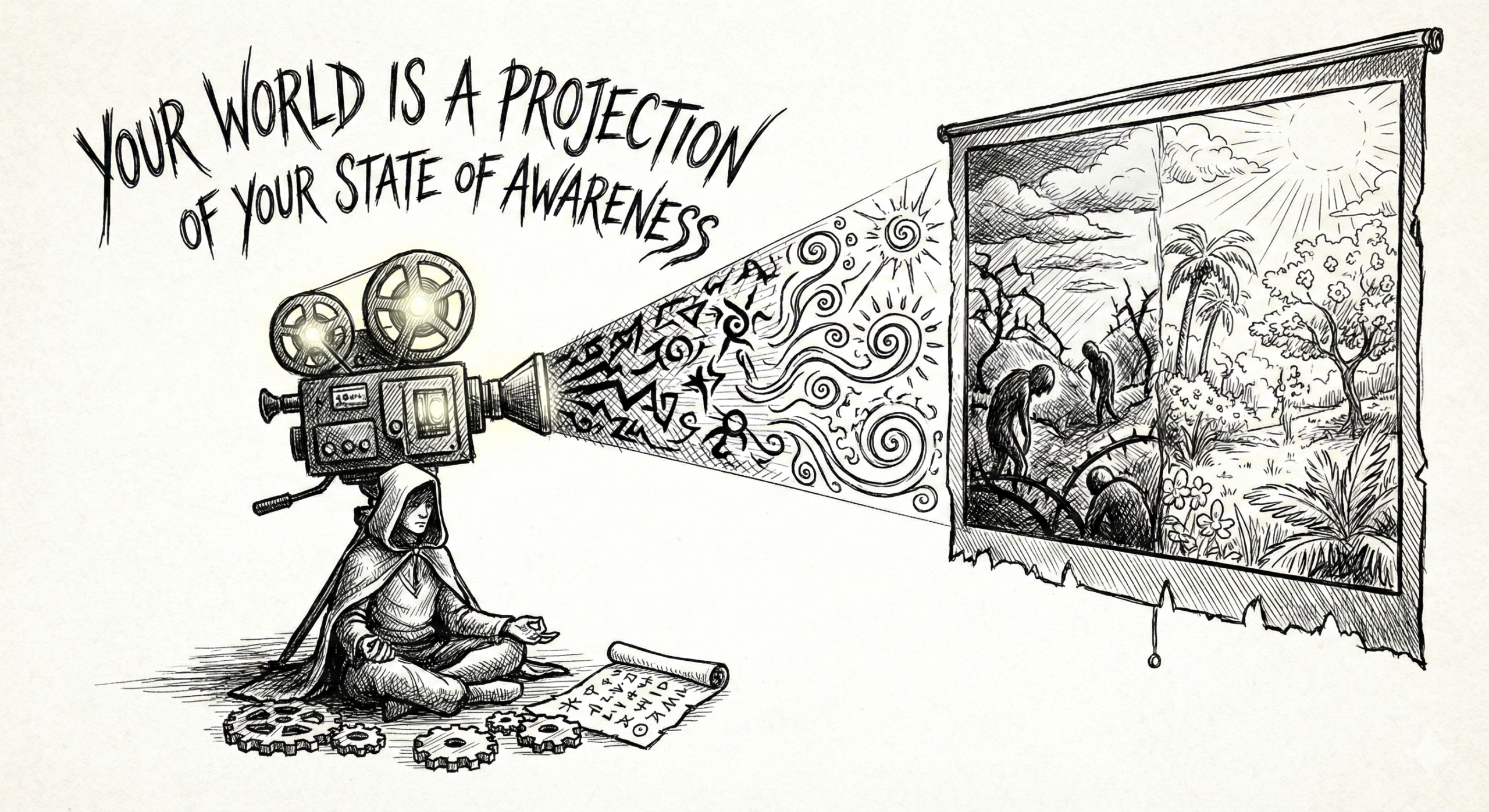
Your World is a Projection of Your State of Awareness

state of awareness

Think about this: your reality isn’t happening TO you. It’s happening THROUGH you.

Your state of awareness operates like a projector beam. The world you experience is whatever appears on the screen of perception. Most people assume the screen is the problem. They argue with the images, rearrange the furniture inside the scene, or try to force a better storyline. Very few notice the beam itself.

But the beam is doing most of the work.

When your awareness is contracted, tense, and defensive, the world doesn’t feel neutral. It feels hostile. An unread email becomes a threat. A delayed reply becomes a verdict. A casual comment carries hidden criticism. Nothing has objectively changed. Same inbox. Same people. Same environment. But the quality of awareness projecting the scene has narrowed, and so the world it reveals narrows with it.

Anxious awareness scans for danger. It highlights risk, omission, and inadequacy. It edits reality down to sharp edges and worst-case interpretations. In that state, life feels like something you must survive rather than participate in. You move carefully, brace constantly, and mistake vigilance for intelligence.

Now notice what happens when the state shifts.

In moments of calm or flow, the same external conditions tell a different story. The inbox becomes a set of possibilities rather than ambushes. Conversations feel open instead of loaded. Problems still exist, but they register as workable instead of overwhelming. The world hasn’t magically improved. Your awareness has widened, softened, and stabilized. The beam changed, so the projection did too.

This is the part most people miss. They think perception is passive. That consciousness merely observes what is already there. In reality, awareness is an active filter. It decides what gets emphasized, what fades into background noise, and what never makes it onto the screen at all.

Your nervous system, beliefs, and habitual attention patterns are constantly shaping what reality looks like to you. You don’t see the world as it is. You see the world as your current state allows it to appear.

Change the screen and nothing really changes. Change the beam and everything does.

Same external conditions. Radically different experienced realities.

This isn’t about positive thinking or manifesting parking spaces. It’s deeper and more unsettling than that. Your consciousness doesn’t merely observe reality like a camera pointed at the world. It participates. It selects, emphasizes, filters, and organizes what becomes visible and actionable for you in any given moment.

Two people can stand in the same room, face the same constraints, receive the same information, and yet inhabit entirely different worlds. One experiences friction everywhere. The other senses openings. One reads the situation as hostile or depleted. The other reads it as workable or alive with possibility. Nothing external has changed. The difference is not circumstance. It’s the state of awareness interpreting the circumstance.

Awareness determines meaning before thought ever arrives. Long before you form an opinion or tell yourself a story, your nervous system and attention have already decided what matters, what feels threatening, and what feels inviting. From there, cognition simply explains what awareness has already framed.

This is why wisdom traditions, long before neuroscience had language for it, focused obsessively on consciousness training rather than circumstance control. Meditation, contemplation, prayer, ritual, solitude. These weren’t escapes from the world. They were methods for refining the instrument through which the world is encountered. The ancient operators understood something modern culture keeps forgetting: change the quality of awareness, and the same reality reorganizes itself.

When awareness is narrow, reality appears narrow. When awareness is rigid, reality feels brittle. When awareness is spacious, reality becomes surprisingly cooperative. Not perfect. Not painless. But workable in ways that were previously invisible.

Shift the quality of the beam, and what appears on the screen changes. Not because the world bends to your wishes, but because you finally have access to more of what was always there.

Your beliefs are code. Your attention is the compiler. Your awareness is the runtime environment.

Most people spend their lives trying to rearrange the furniture in a burning building. They’re obsessed with external fixes while the projector keeps beaming out the same corrupted program. Better job, new relationship, different city. But if the quality of awareness stays the same, you just get the same movie in a different theater.

Real transformation happens when you debug the consciousness itself. When you recognize that your habitual patterns of attention, your inherited narratives, your unconscious beliefs are all actively shaping what you perceive as “reality.”

This is narrative alchemy at its core.

You’re already running code. That part isn’t optional. The question is whether you’re running legacy programs inherited from trauma, culture, and unconscious conditioning, or whether you’ve begun to consciously refactor the system.

Much of what you call “reality” is the output of automated processes you didn’t author. Early emotional experiences, social norms, survival strategies, and unexamined beliefs quietly become default settings. They determine what you notice, what you ignore, what feels possible, and what feels forbidden. Over time, these patterns harden into a background operating system you mistake for the world itself.

Your perceptual apparatus is constantly filtering an overwhelming flood of data. At any moment, your senses are receiving far more information than you could ever consciously process. So the system predicts. It compresses. It selects. Neuroscience calls this predictive processing. The brain doesn’t passively receive reality. It generates a best-guess model of what’s happening and updates it only when the prediction fails badly enough.

Magick, myth, and contemplative traditions arrived at the same insight through a different door. They noticed that expectation shapes experience, belief stabilizes perception, and attention animates what it touches. They called it manifestation, spellcraft, or world-making. Different language. Same mechanism.

Either way, you are not reacting to raw reality. You are interacting with a model generated by your current state of consciousness.

This is why repeating the same patterns produces the same outcomes even when the surface details change. New job, same exhaustion. New relationship, same conflict. New city, same dissatisfaction. The scenery updates, but the codebase stays intact, so the simulation resolves in familiar ways.

Consciousness work is not about denying the world or fantasizing a better one. It’s about taking responsibility for the interpreter that’s running. When you shift the quality of attention, loosen rigid beliefs, and interrupt unconscious narratives, you don’t force reality to comply. You simply allow different data to register. Different possibilities to render. Different responses to become available.

That’s the real leverage point.

The world you see is the world your awareness can support. As that awareness expands, stabilizes, and becomes more coherent, the experienced world reorganizes accordingly. Not because you cast a spell on reality, but because you stopped running corrupted code without realizing it.

Once you see this, you can’t unsee it. The question stops being “How do I change my circumstances?” and becomes “What state of awareness am I bringing to this moment?”

Because awareness is not neutral. It is toned. It has texture. It can be hurried or settled, defensive or curious, rigid or receptive. And that tone quietly governs what options even register as real. Some states of awareness make entire pathways invisible. Others illuminate doors you didn’t know were there.

This is why willpower fails so reliably. You can force behavior for a while, but if the underlying awareness remains contracted, the system eventually snaps back to its default pattern. You don’t rise to the level of your intentions. You fall to the level of your state.

Most self-improvement advice tries to operate at the level of the screen. Think different thoughts. Say better affirmations. Take new actions. But if the beam remains distorted, those changes feel fragile and effortful. They require constant maintenance because they’re fighting the projector instead of adjusting it.

Cultivating awareness is different. It’s slower at first, but exponentially more powerful. When awareness stabilizes, clarity becomes natural. When awareness softens, flexibility appears without force. When awareness widens, resilience emerges as a side effect rather than a goal.

This is also why the work can feel uncomfortable. Expanding awareness means noticing the habits of contraction you’ve been calling “normal.” It means seeing how often you rush, brace, assume, or defend without realizing it. There’s no moral failure here. Just mechanics. A system doing exactly what it was trained to do.

The practice is not to judge the beam, but to refine it.

As you learn to recognize your states in real time, you gain choice. Not infinite choice. Not fantasy-level control. But enough leverage to interrupt old loops and allow new responses to arise. Enough space to respond rather than react. Enough clarity to see that many of the walls you’ve been pushing against were projections all along.

This is how inner work becomes outer change without trying to be.

Change the quality of awareness, and behavior reorganizes. Relationships reorganize. Work reorganizes. Even difficulty reorganizes, showing up less as a threat and more as a challenge you can actually meet.

Same world. Different beam. Different life.

🜃


Further reading

Prometheus Rising by Robert Anton Wilson

nothing is as it seems

Charles T. Tart’s book, Waking Up, has been on my bookshelf for a while now. It caught my attention this morning because I’ve been thinking about which habits of being, thinking, perceiving, and feeling I want to break or change.

cultivating personal well-being and compassion

makes our efforts to create a more just world much more sustainable and joyful. When we lead from a place of wholeness instead of anger or ego, we inspire rather than divide. And in uplifting others, our own spirits soar ever higher!

Peace and justice work hand-in-hand; each makes the other possible over the long haul. As we build understanding between groups and dismantle systems of oppression, we also heal centuries-old wounds in the human family. With patience and care for all, a new legacy unfolds—one of cooperation over competition.

But we all get tired and overwhelmed sometimes! It’s important to check in with yourself and reconnect with your vision. Seek support from loved ones, and take time to renew your spirit. Do what feeds your soul, then return to inspire positive change once again. We’re in this together for the long haul, and with compassion as our fuel, anything is possible.

we tend to sleepwalk through life

We get caught up in familiar routines and habits without really thinking much about it. It’s like we’re wandering around in a bit of a daze, seeing the world through foggy glasses.

Deep down inside us there’s this other awareness that’s wanting to wake up and see things as they really are. Some part of ourselves that knows our usual perception of things is limited or distorted in certain ways.

Our experience of the world is always filtered through who we are as individuals. Our perspective gets shaped by our background, our interests, and our biases—the whole puzzle of fragments that makes up our identity.

we each see things
in our own way, but it’s often
not the full picture.

Waking up means seeing through the veil and confronting reality more directly. But it’s not just an intellectual thing; it’s about having the blinkers come off and really feeling that revelation vividly. It’s those “Ah ha!” moments when things suddenly make more sense and we see connections we missed before.

Part of waking up is recognising those filters we didn’t even know we had, whether from our culture, family background, or just habits of thinking, believing, seeing, perceiving, and feeling.

Seeing the filters for what they are opens up new possibilities. It’s like a whole new landscape emerges once we step outside of our narrow tunnels of perception.

And just like with creativity or personal growth, waking up is an ongoing journey, not a single destination. There are always deeper layers to explore and understand. Especially now with AI and all these new technologies offering us new lenses to see both the world and ourselves through.

As we wake up, we also have to think about how we want to shape reality collectively. Our own awakening is intertwined with that of others, and we each have a responsibility to contribute to humanity’s story moving forward. That includes considering ethical implications as technology blurs the boundaries between virtual and real.

Waking up is not just about seeing clearly, but about reimagining what could be possible without the old limits we took for granted. It means moving from passive observation to consciously participating in creation.

So how can we best put our awakened awareness into action? How do we want to steer this ship we’re all on into the future unfolding before us?

YOU CAN LOOK WITHIN TO SEEK THE LIGHT.

altered perception

The untamed wilderness called to me, away from the high-tech urban clutter. A refuge where I could wander, question everything I thought I knew about myself and my world. Society warned that ruin awaited me out there where order and conformity reigned supreme. Still I had to go.

I gaze inward, seeking to illuminate the contours of my psyche. My steps along this personal path seem singular, yet I suspect countless others traverse similar inner terrain. Each journey mirrors the traveller; where one may encounter quiet meadows, another finds turbulent seas.

As I walk on, the familiar gives way. Before me, the landscape of society frays into unknowns—here be dragons, warns the inner cartographer. And yet I venture forth, drawn by the call of self-knowledge. My guide? That inner flame sparks transformation.

This barren country has its nourishments, difficult though they may be to uncover. Within its starkness, I find freedom to question norms that bind identities to single stories. My steps echo those discordant myth-breakers who shatter tyrannies of assumed truth.

In the wastelands, strange visions arise unbidden. I ponder realities beyond the tangible, straying into metaphysical pastures. What lies beneath everyday existence? I trace the outlines of consciousness—that golden key that promises to unlock the doors of perception. If I could but grasp its essence, would I comprehend my own?

I wonder why the herd shrinks from these inward trails. Too easily, they refigure our selves, threaten the known. And what we know, we think we can control, while these inward selves obey no master. They emerge transformed from the chrysalis of introspection, demand change, and resist the security of certainty.

No map charts the path I take. Without a compass or company, each step carves its own direction. My soul, cloaked in silence, bears the cost of isolation. And yet, epiphanies blossom even here. Inwards courses understanding, not just of myself but that greater mystery: what it means to walk in human form.

My inward journeys recall cyberpunk’s nocturnal realm, where neon dreams and concrete nightmares entwine. Rebels against dystopia’s regimes, cyberpunk’s characters blaze trails of defiance, seeking sovereignty of identity and selfhood. Their journeys parallel mine—flights from enforced normality into risky realms of self-redefinition.

Sometimes the quest seems vain folly. What profit is in this turning away from mankind’s bustling, built-up thoroughfares? Those highways promise progress—or so goes the siren song. Yet I find myself rejecting that clarion call to participate, preferring the unaccompanied path.

For where the highway leads, I no longer care to follow. I have glimpsed the contours of my soul and, thereby, the fresh possibilities of my world. To choose conformity over self-knowledge? Craven to my mind. No, I press onward, inward, outward, and onward.

I realise now why the prospect of those inward journeys provoked such suspicion in people. Too disruptive, too dangerous in what they revealed. But I thirsted for danger, for tearing off the veils that blurred my vision.

awareness is

a shape-shifting spirit that dwells within us, casting its mystic glow across the landscape of our minds. At times, it takes on the voice of a wise oracle, revealing truths we have long forgotten. In other moments, it is a playful sprite, reflecting our experiences back to us through a fantastic kaleidoscope that fragments and transforms our very sense of reality.

We each carry unique portals within us—thresholds between the real world and the imaginary one awareness conjures. As we cross these portals, the spirit casts its magic, awakening dormant thoughts, unlocking hidden emotions, and illuminating the shadows where our biases lurk. Awareness has the power to bend the very fabric of our perspective, reshaping our outlook through its wizardry. The more we allow it to work its magic, the more of ourselves and the world around us we can see by its illuminating gaze.

In this modern age where technology and media weave their own spells around us, awareness enables us to peer behind the curtain and recognise the allure they dangle before us. Wielding its fantastical light, we can disentangle ourselves from false enchantments and step back into the realm of conscious clarity.

Awareness also lets us connect to others like sorcerers tapping into a collective dream. As we share our experiences, we create mystical bonds that unite our individual quests for meaning into a shared vision that can ripple outward, shifting perspective in others. In doing so, we can spark incredible transformations, as if our interwoven awareness itself is a magical wand changing not just ourselves, but the very essence of society.

The spirit beckons us forward to unleash its magic—to see through its eyes, transform with its power, and reconnect with truths long forgotten but ever waiting to be found again. Heed its call, unlock the portal within, and discover just how deep the rabbit hole goes. What fantastical adventures might we find through the magical spirit of awareness?

soundtrack

https://open.spotify.com/playlist/2SQzTGgvsm6sSNlU5M5rrB?si=d5ac71f9edfe45f8