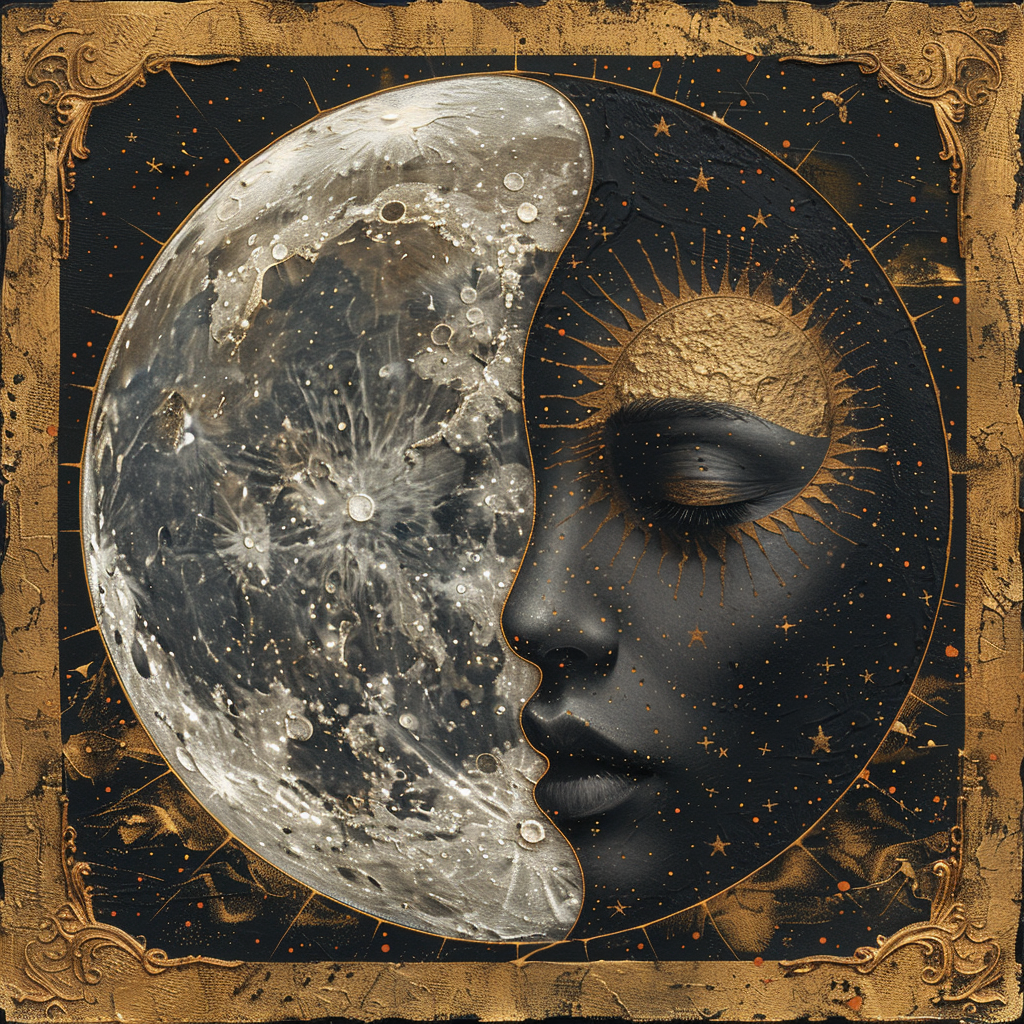
How should I live? Socrates called it the examined life. The Daoists called it the Way. Every philosophical tradition worth its name has some version of it, which tells you something. This question isn’t optional. It’s baked into what it means to be human.
I was listening to Jordan Peterson’s Maps of Meaning on my walk into town this afternoon, heading to Tesco to pick up a few things. I listened to chapter one, Maps of Experience. Already, it feels like one of those books you don’t just read. You go into it.
His opening move is deceptively simple. We don’t experience the world as a bunch of objects. We experience it as a field of meaning.
A chair isn’t just a physical thing with weight and structure. It’s something to sit on. Something in the way. Something that belongs to someone. Something that defines a corner of a room. The meaning shows up first. The “object” comes later, when we deliberately shift into analysis.
That sounds obvious until you follow it all the way through.
If meaning comes first, if the world we actually live in is a world of significance rather than just things, then how we make meaning isn’t some optional add-on. It’s the central question. And the tools we’ve built for that, myth, religion, story, and ritual, are not primitive versions of science waiting to be replaced. They answer a different kind of question. One science doesn’t even try to answer.
Peterson is making an epistemological point, not a theological one. Science asks how things work. Myth asks how you should act in relation to them. Those are different categories.
You can understand the neurochemistry of grief and still have no idea how to grieve. You can explain the evolutionary function of courage and still not know how to be brave. A map of mechanism isn’t a map of meaning.
What mythology carries, across cultures and millennia, is behavioural wisdom. Not the kind you can fully capture in neat propositions. The hero who descends into the underworld, faces the monster, and comes back changed is as precise a description as we have of how real change works. You go into the unknown. You face what’s there. If you make it back, you bring something with you that matters, not just for you but also for others.
The hero’s journey isn’t just a story template. It’s a map of territory every one of us has to cross at some point.
I’ve spent over twenty years working at the level of story, with people trying to rewrite the scripts running their lives, often without realising those scripts are there. What I keep seeing is this. Transformation doesn’t happen in the rational mind.
You can understand a story is false. You can trace where it came from, see what it’s costing you, and even describe a better version. And still stay stuck. Understanding sits on the surface. The story runs deeper.
Peterson is giving me the theoretical scaffolding for what I’ve been seeing in practice. Myth is where the code runs. Reason mostly skims across the top. Which is why you can’t just think your way into a different life. You have to work at the level of story.
This is where Friedrich Nietzsche comes in. He saw, maybe more clearly than anyone, what was at stake when the West started dismantling its mythic foundations in the name of reason.
“The death of God” is a cultural diagnosis. The framework that held meaning together for centuries was losing its grip. The stories were no longer landing in the way they needed to.
They still existed. The language was still there. The symbols were still in circulation. But something in the relationship between people and those stories had shifted. They were no longer inhabited in the same way. What had once organised perception, behaviour, and value from the inside began to feel external, optional, even arbitrary.
The structure remained in place, but the felt reality that gave it force had thinned. And once that happens, a framework can persist for a long time in form while quietly losing its ability to orient action.
The framework doesn’t disappear just because you’ve stopped believing in it.
Peterson touches on this almost in passing, but it deserves more attention. The idea that human beings have inherent worth. That truth matters, not just strategically but morally. That history has direction, that actions accumulate, that things tend somewhere. These are not scientific facts. They are inheritances. Mythic ones.
The code is still running, whether you’re aware of it or not.
Nietzsche saw the consequence. You can’t keep the fruit while cutting the root. Eventually the structure underneath inherited morality collapses. What fills that gap is not reason. Reason is good at taking things apart. It is not good at building something to live inside.
What tends to rush in is ideology, a partial map pretending to be the whole territory. The twentieth century gave us more than enough evidence of that.
This is what Peterson is pointing at when he contrasts the hero with the ideologue. The hero goes into the unknown willing to be changed. The ideologue goes in with conclusions already fixed and forces everything to fit them. One updates the map. The other defends it.
I’ve been orbiting these ideas for a long time, from different directions. Carl Jung and archetypes. NLP and deep structure. Chaos magick and the idea that belief is something you use, not something you have to commit to permanently.
Underneath it all, the same question keeps returning. Why do these ancient stories still hit? Even now. Even for people who have rejected the systems that produced them. Why does the hero going into the dark still land in the chest like recognition?
Peterson’s answer is clean. Those stories describe the structure of experience itself. The known and the unknown. Order and chaos. Mapped territory and the edges where the map runs out.
Every life moves through that terrain.
Myths are the compressed record of how to do it. They were carried forward because they worked. Because the people who knew how to move through that landscape made it through. The others did not.
Story is not just how we communicate meaning. It is how we hold it.
Peterson has spent thirty years mapping this from inside the library. I’ve spent twenty-odd years mapping it from inside the room. Different routes, similar conclusions. That kind of convergence is always interesting.
So I’m going in.
I don’t know yet where it will lead. The best thinking rarely ends up where you expect. I’ll write as I go. Follow the thread rather than pretend I already know the destination.
If this is your kind of terrain, the questions that don’t sit still, the place where mythology and the problem of how to live turn out to be the same thing, come along.
When psychology replaced mythology, we traded participation for explanation. We gained a remarkable vocabulary for describing the inner life, but in the process we lost something older and more difficult to name: a felt sense of belonging inside a meaningful drama. Myth did not merely tell us what was happening; it gave us a role to play, a pattern to inhabit, a way of recognising that our struggles were part of something larger than private confusion. Psychology, for all its brilliance, often stands at a slight remove. It helps us analyse the wound, trace its origins, and identify its mechanisms. But analysis is not the same as initiation. Description is not the same as transformation. And only now are we beginning to reckon with the cost of that trade: a world full of people who can explain themselves with increasing precision, yet still do not know how to step into a story that might change them.
This is not a complaint about psychology. The frameworks we now have for understanding the inner life, for mapping personality, tracing the patterns in how we attach and protect and sabotage ourselves, naming the voices that run beneath conscious awareness, are extraordinary compared to anything available two generations ago. The vocabulary is richer. The precision is greater. The compassion built into contemporary therapeutic thinking is genuine. None of that is in doubt.
In many ways, we are more self-aware than any generation that came before us. We can identify our triggers in real time. We can name the defence as it activates, watch the pattern unfold even as we are inside it. There is a strange lucidity to modern selfhood, a capacity to observe ourselves with a kind of clinical clarity that would have been unimaginable in a mythic age.
And yet, something curious happens at that point of recognition. The insight lands, but the life does not move. You can see the pattern and still enact it. You can understand the script and still find yourself speaking the lines. The knowledge accumulates, but the trajectory remains unchanged. It is as if awareness has illuminated the structure without altering it, like turning on a light in a room whose furniture you continue to walk into.
What is in doubt, then, is not the value of understanding, but its sufficiency. Whether knowing your patterns is the same thing as being transformed by them. Whether clarity alone has the power to reorganise a life. Or whether something else is required—something closer to participation than observation, to inhabiting a different story rather than simply analysing the one you are already in.
Mythology was never primarily about explanation. That is a mistake we make because we live downstream of the scientific revolution, which installed explanation as the dominant mode of knowledge. When we look back at mythological systems — the Greeks, the Norse, the Vedic traditions, the shamanic cosmologies that preceded and sometimes persisted alongside all of them — we tend to read them as primitive attempts at what science later did properly. Proto-science. Bad explanations that served their purpose until better ones arrived.
But this misreads what mythology was for. Mythology was not trying to explain the world in the way science does. It was trying to give people a place inside it. A role. A character to inhabit. The hero’s descent and return, the underworld journey, the confrontation with the monster that turns out to hold the treasure: these were not stories about what the world contains. They were maps of what the self does when it encounters the challenges that make a life. They were participatory. They located you inside a larger story and gave you something to be.
When the secular world decided the gods were no longer credible, it handed psychology the job of filling that space. And psychology, reasonably enough, tried to do what it knew how to do: explain. Map. Name the mechanisms. Build the models. The entire ambition of modern psychology — to be a science rather than a wisdom tradition — meant it had to work in the register of description. This is what your attachment style looks like. This is what happens neurologically when you experience threat. These are the cognitive distortions running underneath your anxiety.
All of this is genuinely useful. Knowing your patterns matters. Recognising the inner critic, understanding why you pursue certain people and retreat from others, being able to name what is happening inside you in real time — all of this moves the needle.
But it does not give you a place inside a larger story. And that, I am increasingly convinced, is what people actually need. Not just to understand themselves better, but to locate themselves somewhere. To feel that their struggle has shape. That what they are going through is not random noise but something that makes sense inside a larger arc.
People come back from self-development workshops having genuinely understood something about themselves. The insights they gained are real. The framework is sound. The facilitator has done their job. For a brief moment, there is clarity—a sense that something has clicked into place, that the pattern has finally been seen for what it is.
But a few days later, they find themselves moving through the same loops, reacting in the same ways, inhabiting the same emotional terrain. Nothing, in any meaningful sense, has changed. Because understanding, on its own, does not reorganise a life.
What was missing was not more insight, but a shift in narrative gravity. Understanding without a new story to inhabit is like having a map of a country you have no intention of visiting. The map may be accurate, even beautifully detailed, but it does not move your feet. It does not place you on the road. The territory remains unknown, not because it cannot be reached, but because nothing has compelled you to enter it.
And so the gap persists. The understanding had happened. The becoming had not.
NLP was built precisely to close this gap — or at least that was the ambition. Bandler and Grinder modelled people who were demonstrably transformative: Milton Erickson working through trance and metaphor, Virginia Satir rearranging family systems through the sheer quality of her attention, Fritz Perls cracking open something in his clients that more conventional therapy had not touched. The founders of NLP watched what these people did and tried to extract the pattern. Strip out the personality, the style, the ritual, isolate what actually produces change, then replicate it.
What they captured was real. The patterns they identified — the structure of how people represent their experience, the way submodalities of internal imagery encode emotional charge, the role of language in maintaining or dissolving limiting states — these are genuine discoveries. NLP works. I have used it for two decades and I can tell you it works.
But here is what I think got lost in the translation from modelling to method. Erickson’s meandering stories, his elaborate metaphors, the particular quality of the trance he induced through the cadence of his speech — these were not decorations over a mechanism. They were the mechanism. They worked because they bypassed the analytical mind and spoke directly to the part of the self that lives inside stories. The part that does not respond to argument, to framework, to correctly identified cognitive distortion. The part that responds to narrative. To image. To symbol. To the felt sense of being located inside something that is going somewhere.
When you extract the pattern and remove the participation, you get a technique. Techniques are useful. They are not transformative in the way the original was transformative.
The alchemists had a phrase for the movement they were tracking: solve et coagula. Dissolve and coagulate. The work of transformation requires that whatever currently exists be broken down before anything new can form. The problem with purely explanatory frameworks is that they describe the composition without initiating the dissolution. You understand yourself more clearly — and the structure that needs to change remains intact. Knowledge of your cage does not open the door.
What narrative alchemy is trying to restore is the participation function. Not to replace the explanatory frameworks — the typologies, the coaching models, the neuroscience — but to add back what they leave out. The story you are living inside is not just a description. It is a set of instructions. Change the story and you change the instructions. Change the instructions and the behaviour shifts — not because you have finally analysed yourself into clarity, but because you are now inhabiting a different narrative. The self does not respond primarily to argument. It responds to the story it finds itself in.
The philosopher Paul Ricoeur spent decades making this case, quietly and precisely, in a body of work that is still underread outside academic philosophy. His argument: all self-knowledge is interpretive, and narrative is the primary medium of interpretation. We do not stand outside our lives and observe them neutrally. We are inside a story, and the story is inside us, and the two are not fully separable. Change the narrative frame and you change the interpretation. Change the interpretation and you change what is available to do.
This is not mysticism. It is not woo. It is a claim about how minds actually work — about the fact that we do not experience raw reality but always a mediated version, and that the medium of mediation is story.
Which is also why the mythic frameworks worked as well as they did. They did not give people better explanations. They gave people better stories to be inside. The hero goes into the dark not because they understand the dark but because the story requires it. The descent has meaning because the story gives it shape. Without the story, the descent is just loss. Just difficulty. Just the period in a life when everything went sideways. With the story, it is the part of the arc that precedes the return — the necessary dissolution before the new form can coagulate.
Psychology stripped out the story in its ambition to be scientific. What remained was the mechanism without the meaning. The mechanism is valuable. But people do not live in mechanisms. They live in stories. And the stories they are living in, the ones telling them they are not enough, that they missed their moment, that the best of their life is probably behind them, that who they are is fixed and known, those stories are running at full volume underneath every framework, every insight, every accurately identified pattern.
The question is not whether you understand your patterns. The question is what story you are living inside. And whether that story has the shape that growth actually requires.
That is where the work begins. Not with better analysis. With a different story.
Thanksgiving carries a mythology far older, stranger, and more complex than the tidy story taught in schools. When you peel back the polite veneer, you find a tangle of harvest rites, colonial propaganda, Indigenous resilience, national myth-making, and the deeper, archetypal hunger humans have always had for communal meaning at the turning of the year.
This isn’t an effort to correct or redeem the holiday. It’s an invitation to see that every cultural ritual is a palimpsest, built from stacked layers of human longing, each era inscribing its needs over what came before.
The myth we tell ourselves about Thanksgiving reveals what we hunger for as a culture. The myth we could tell might reveal who we’re becoming.
The First Layer: The Harvest Myth That Predates America
Before it was an American holiday, Thanksgiving echoed a much older archetype: the harvest festival. Every agrarian culture celebrated the moment when the earth gave its gifts and the community gathered to acknowledge dependence on forces larger than themselves.
In Europe, it showed up as Lammas, Harvest Home, the Feast of Demeter, the Corn Mother ceremonies. In ancient Greece, the Eleusinian Mysteries honored Persephone’s descent and Demeter’s grief. In China, the Mid-Autumn Festival celebrated the full harvest moon. The Incas held Inti Raymi to honor the sun’s blessing on their crops.
These rites were not simply about food. They enacted the eternal rhythm: death feeds life, life feeds death, gratitude stands between.
The harvest demanded recognition of a fundamental truth: humans do not create abundance. We participate in it. We are receivers in a vast network of giving. The grain dies to feed us. The season turns. Something greater than individual will orchestrates survival.
This pattern is the skeleton beneath all later layers. It’s why Thanksgiving feels important even when we can’t articulate why. It touches something pre-rational, something that knows the year is a wheel and the wheel must be honored at certain stations.
Practical reflection: What has “ripened” in your life this year that you haven’t acknowledged yet? Not just achievements, but also losses, completions, transformations you’ve been too busy to name.
The Second Layer: Colonial Myth-Making
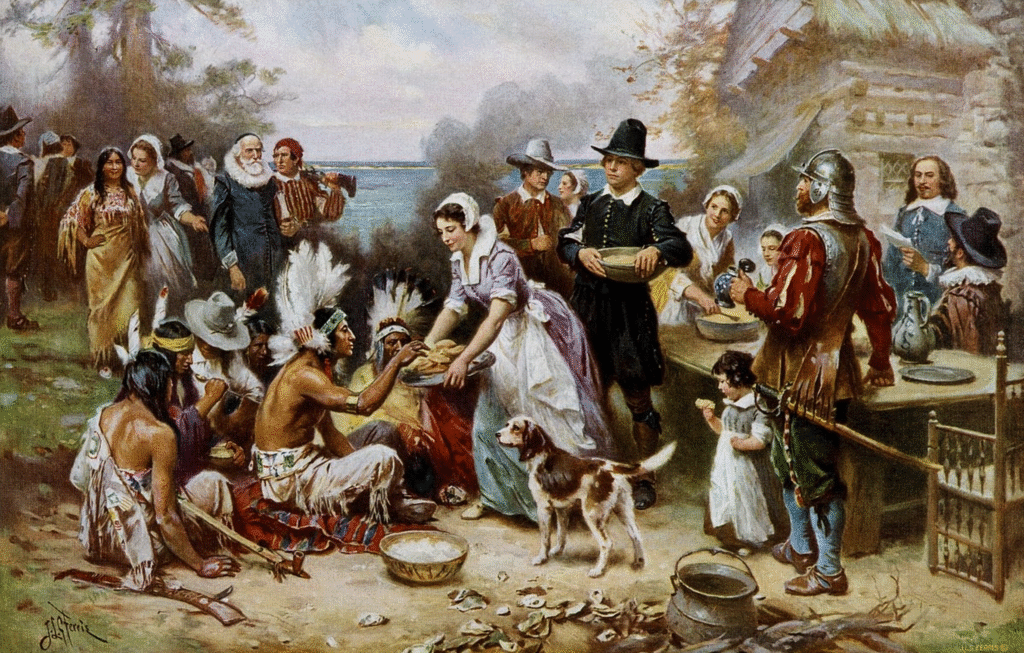
The popular American Thanksgiving story is a crafted narrative, not a factual one. The image of Pilgrims and Wampanoag peacefully breaking bread in 1621 was retrofitted in the 19th century to forge a national identity. It served as a soothing origin story during a time when the nation was fractured and needed a myth of unity.
The actual 17th-century contact between colonists and Indigenous peoples was marked by tension, uneasy alliances, exploitation, and later violence. The single 1621 feast was not called “Thanksgiving” nor did it inaugurate a tradition. It was closer to a harvest celebration with political undertones, a three-day event that the Wampanoag likely joined as much to monitor the colonists as to celebrate with them.
The Pilgrims themselves held irregular days of thanksgiving, most often after military victories. In 1637, the Massachusetts Bay Colony declared a day of thanksgiving after the massacre of Pequot people. The blood beneath the bread was real.
The sanitized version appeared later, when the young nation needed founding myths that presented colonization as cooperative rather than conquered. Sarah Josepha Hale, a magazine editor, campaigned for decades to establish Thanksgiving as a unifying national holiday. She romanticized the 1621 event, turning it into a parable of harmony between cultures.
In other words: the official myth is a kind of collective spell for national innocence. It functions to erase complexity, smooth over violence, and provide a comforting story about American origins. Like all spells, it shapes what we see and what remains invisible.
Practical reflection: What stories in your own life have been simplified into myths of “how it began”? Where might a deeper truth be asking for recognition? What have you edited out of your personal narrative to make yourself more comfortable?
The Third Layer: The Indigenous Throughline
For many Indigenous communities, Thanksgiving is not a day of celebration but a National Day of Mourning. Since 1970, Indigenous people have gathered in Plymouth on Thanksgiving to honor ancestors, acknowledge ongoing injustices, and resist the erasure of their history.
Yet Indigenous traditions also contain rich thanksgiving ceremonies that long predate colonial arrival, and these offer a radically different model for what gratitude can be.
For example, the Haudenosaunee (Iroquois) Thanksgiving Address, sometimes called The Words That Come Before All Else, is a profound, poetic liturgy of gratitude to every being: waters, winds, plants, animals, ancestors, the earth itself. It’s recited at the beginning of gatherings, not as a formality but as a reorientation of consciousness.
It doesn’t thank a distant deity. It thanks the beings themselves: the strawberries for their sweetness, the thunder for bringing rain, the moon for measuring time. Gratitude becomes reciprocal relationship rather than vertical supplication.
This strand reminds us that Thanksgiving can be reclaimed by rooting it in reciprocity, humility, and connection to the more-than-human world. It shifts the question from “What am I thankful for?” to “What relationships sustain me, and how do I honor them?”
The Indigenous perspective also challenges the possessive tone of colonial gratitude. When you believe the land was “given” to you by God or purchased through manifest destiny, gratitude becomes self-congratulatory. When you recognize the land was never yours to take, gratitude becomes inseparable from accountability.
Practical reflection: What non-human presence are you grateful for today? A bird, a tree, the morning air? Can you thank it directly, even silently? What would it mean to recognize that being as kin rather than resource?
The Fourth Layer: Lincoln’s Ritual of National Healing
Thanksgiving only became an official federal holiday because Abraham Lincoln made it one during the American Civil War. In 1863, in the aftermath of Gettysburg and in the midst of unimaginable national trauma, he declared the last Thursday of November a day of “thanksgiving and praise” in the hope of stitching a bleeding nation back together.
Here the myth shifts from harvest to healing. The ritual becomes medicine for a collective psyche in crisis.
Lincoln’s proclamation is worth reading. It acknowledges blessings, yes, but also asks for humility, for care toward the wounded and the widowed, for a recognition that no victory is pure. He was trying to create a moment when Americans might look at each other across the chasm of war and remember they were still, somehow, one people.
It didn’t work, of course. Not fully. But the attempt matters. Thanksgiving was consciously deployed as a ritual technology for collective repair.
There’s a quiet power in that: Thanksgiving as a national breath, a pause meant to remind people of resilience amid conflict. It suggests that gratitude isn’t only for when things are good. Sometimes gratitude is the thread you pull to find your way out of despair.
Practical reflection: What part of you is seeking a ritual of mending this season? What internal war might a day of conscious gratitude help to ease, even slightly?
The Fifth Layer: The Modern Myth of Abundance
Today’s Thanksgiving is drenched in abundance symbolism: overflowing tables, family gatherings, parades, football, shopping frenzies. It’s the one American holiday that explicitly centers on having enough, yet it sits uncomfortably adjacent to Black Friday, which centers on never having enough.
The deeper archetype isn’t about consumption but about the relationship between giving and receiving. Traditional harvest festivals honored both the gift of the earth and the labor of the community. Modern Thanksgiving has largely severed those connections. Most Americans have no direct relationship to the food on their table. We don’t know the soil it came from or the hands that harvested it.
Abundance has become distorted into excess. The holiday has been absorbed into consumer capitalism’s logic: more is better, gratitude is a feeling you have while eating, and the meal itself becomes a performance of family cohesion that may or may not reflect reality.
At its best, the modern myth points us toward the universal human longing for belonging, shared time, and the warmth of communal blessing. The image of a table surrounded by loved ones taps into something primal: the hearth as sacred center, the meal as communion.
At its worst, it becomes a performance of abundance to distract from the scarcity within. Scarcity of connection. Scarcity of time. Scarcity of meaning. We pile the plates high and hope the fullness on the table will quiet the emptiness in the room.
Practical reflection: Where do you experience genuine abundance that isn’t material? Abundance of time, attention, presence, connection? What would it mean to honor that rather than performing it?
The Sixth Layer: The Seeker’s Reclamation
For wanderers on the inner path, Thanksgiving can be reclaimed as a ritual of four movements:
1. Acknowledgment of the forces that carried you.
Not just people, but patterns. Not just gifts, but also the obstacles that shaped you. The year behind you contains a story. What invisible hands guided you through it? What synchronicities, what graces, what unexpected openings appeared when you needed them?
2. Gratitude as a conscious stance, not a list.
Gratitude isn’t an inventory of good things. It’s a posture toward existence. It’s the recognition that you are woven into a web of relationships, some visible and some not, and that your life is sustained by more than you can comprehend.
3. Reciprocity with the world, seen and unseen.
If you receive, what do you give? If the earth feeds you, how do you feed the earth? If the people around you have carried you, how do you carry them? Reciprocity closes the circuit. It transforms gratitude from sentiment into action.
4. Renewal as the year darkens and the inner season shifts.
Thanksgiving sits at the threshold between autumn and winter, between the external harvest and the internal retreat. It’s a last gathering before the long inward turn. What do you take with you into the dark season? What do you leave behind?
In this frame, Thanksgiving becomes a threshold day: a moment between the bright outer year and the introspective winter ahead.
The deeper myth is this: Every year, you harvest yourself.
You gather what you’ve learned, what you’ve lost, what you’ve become. You separate the wheat from the chaff. You acknowledge what fed you and what drained you. You make an offering of your own transformation.
Practical reflection: What part of you feels ready to be harvested, honored, or let go? What aspect of your life has completed its cycle and is ready to be released? What quiet truth has been growing in you all year that’s finally ready to be spoken or embodied?
Closing: The Myth You Choose
Here’s the thing about myths: they’re not lies. They’re lenses. They focus attention, shape meaning, create coherence. The myth you inhabit determines what you see and what remains invisible.
You can participate in Thanksgiving as consumer spectacle. You can reject it as colonial propaganda. You can ignore it as just another Thursday.
Or you can use it.
You can treat it as an annual threshold, a ritual pause, a moment to touch the older patterns beneath the noise. You can make it a day when gratitude becomes a practice, not a feeling. When abundance is measured by connection rather than accumulation. When you honor the harvest of your own becoming.
The mythology of Thanksgiving is still being written. Every year, we add another layer. What you do this Thursday becomes part of the ongoing story.
So what myth will you choose to live inside?
Final reflection: If you were to design a personal Thanksgiving ritual that honored all six layers, what would it include? What would you acknowledge, honor, release, and renew?
A question I’ve been mulling over is whether AI’s role in our mythic journey a Pandora or Prometheus, first I wanted to examine the original myths. Last week, I explored Pandora’s Paradox: The Curse, the Gift, and the Mystery of Hope. And now Prometheus. He features in popular culture a lot, most recently in the Netflix series KAOS. So here’s my retelling of hid story.
The story of Prometheus is one of defiance, sacrifice, and the unbreakable spirit of resistance against tyranny—qualities that have made him a symbol of human creativity and rebellion across centuries.
Prometheus was one of the Titans, the primordial beings who ruled before the Olympian gods came to power. Unlike his Titan kin, Prometheus was a friend to humanity. He looked upon mortals with empathy and saw their struggles in a world often ruled by fear and darkness. Prometheus became their benefactor, teaching them various arts, sciences, and skills to elevate their condition. He taught them architecture, medicine, navigation, and most notably, he gave them the gift of fire.
But the gift of fire wasn’t a mere passing down of knowledge; it was an act of cosmic rebellion. Zeus, the king of the gods, had forbidden humans from possessing fire. In his eyes, fire was too powerful a tool for mortal beings and would make them too independent, too close to the gods in their capacity for creation and destruction. Yet Prometheus saw this differently. He believed that humanity deserved the chance to rise, to learn, and to create. So, he stole fire from the forge of Hephaestus, the god of craftsmanship, and carried it down to earth, igniting the first flame for humanity.
With fire, humanity experienced an awakening. They were no longer bound by the natural cycles of day and night or reliant on the mercy of the gods for warmth and food. Fire brought with it possibilities for invention, survival, and progress. It was the spark that allowed humans to dream beyond survival.
However, Zeus was furious when he discovered Prometheus’ transgression. For defying his orders, Zeus exacted a punishment that would serve as a cautionary tale for anyone—god or mortal—who might dare to defy him. He ordered that Prometheus be bound to a rock on Mount Caucasus, a remote and desolate place, where he would suffer daily torment. Each morning, an eagle, Zeus’s emblem of power, would swoop down and tear into Prometheus’ flesh, eating his liver—a particularly excruciating form of torture since the liver would regenerate overnight due to Prometheus’ immortality.
Yet Prometheus did not repent. His act of defiance was born out of love for humanity and a belief in their potential. His suffering became a kind of eternal protest against tyranny and cruelty. Bound but unbroken, Prometheus endured his punishment as a silent declaration that some things are worth suffering for, that some causes transcend even the godly order.
Interestingly, Prometheus’ story has a twist: he possessed knowledge of a prophecy that would one day threaten Zeus’s own rule. Zeus eventually struck a bargain with Prometheus, offering him freedom in exchange for this knowledge. In some versions, it is Hercules, Zeus’s son, who ultimately frees Prometheus as part of his own heroic journey, shooting down the eagle and shattering Prometheus’ chains. Thus, the god of foresight (for Prometheus’s name means “forethought”) was freed, though his tale of sacrifice and defiance left an indelible mark on the human spirit.
Prometheus has since been celebrated in art, literature, and philosophy as a champion of enlightenment and knowledge. His story echoes in the idea that knowledge is power and that some things are worth standing up for, even against the most formidable forces. Through his act of rebellion, Prometheus embodies the human spirit’s insatiable curiosity, creativity, and resistance against oppression—a story that reminds us that, in every age, there are those willing to suffer for the light they bring into the world.
Note: I need to tell you Pandora’s story. It’ll make sense later why I’m telling you her story now.
The story of Pandora, one of Greek mythology’s most intriguing tales, begins with a divine act of revenge. The gods, irked by the trickery of Prometheus, the Titan who stole fire from Olympus and gifted it to humanity, decided to create something they thought would be humanity’s undoing. This “gift” would forever alter the world of humans and gods alike.
Zeus, ever the strategist and mindful of Prometheus’ disobedience, hatched a plan to even the score. He instructed Hephaestus, the blacksmith god, to sculpt a woman from clay. This woman, Pandora, was to be as beautiful as she was dangerous—a mix of divine attributes and mortal susceptibility. She was to embody everything alluring and irresistible, a kind of divine honeytrap, yet with an underlying layer of mystery and unknown consequence.
With the help of the other Olympian gods, Pandora was endowed with various “gifts” that would make her impossible to ignore. Aphrodite gave her beauty; Athena imparted skill and wisdom; Hermes gifted her a cunning mind and an eloquent tongue. Each god, in their own way, contributed to the creation of Pandora, whose name itself means “all-gifted” or “the one who bears all gifts.” But it was also Hermes, with Zeus’ direction, who slipped into her a touch of curiosity—a trait both seemingly innocent yet deeply transformative in the story.
Upon her creation, Pandora was presented to Epimetheus, Prometheus’ unsuspecting brother. Though Prometheus had warned him not to accept any gifts from the gods, Epimetheus couldn’t resist Pandora’s charm and beauty. He welcomed her into his life without questioning the consequences, and with that act, the stage was set for one of mythology’s most famous unravelings.
In some versions of the story, Pandora was given a jar (later mistranslated as a box) as part of her dowry. This jar was sealed, and she was told never to open it. Yet, as the days passed, curiosity gnawed at her—a small but persistent desire to know what lay inside. It was, after all, the very quality the gods had infused into her soul. Curiosity became unbearable, and one fateful day, Pandora succumbed to it.
As she lifted the lid, the air filled with a dark, swirling torrent. Out poured all the evils the gods had kept bottled up: disease, despair, greed, jealousy, and anger, all the suffering and miseries that had never before plagued the human race. The horrors spread like wildfire, seeping into every crevice of the human experience. Shocked and terrified, Pandora quickly tried to close the jar, but it was too late. Almost everything had escaped.
Almost.
One thing remained inside the jar. As Pandora cautiously opened it one last time, out drifted the final occupant: hope. Fragile, quiet, and seemingly small in comparison to the horrors unleashed before it, hope emerged. And therein lies one of the story’s great mysteries: what is hope doing among all these woes? Is it a balm for the wounded spirit, something to ease human suffering and inspire resilience? Or is it itself a further curse, prolonging the agony by keeping us striving, expecting, and dreaming even in the face of impossible odds?
Pandora’s story has been interpreted in countless ways. Some see it as a warning against curiosity or disobedience, a reflection of ancient beliefs about the dangers of knowledge without wisdom. Others see Pandora as a symbol of human complexity—a figure who embodies both the beauty and peril of exploration. She stands as a reminder of our own duality: our thirst for understanding, even at the cost of our own peace, and our need for hope, even when it can lead us into uncertain territory.
For all her tragic legacy, Pandora is also, perhaps, a hero of sorts. She brought into the world not just suffering but resilience. Hers is a story of the Pandora we all have inside: a restless, questioning spirit, a spark of divine curiosity, and the paradoxical promise of hope amidst all that might bring us low.
Who put hope into the jar? The great mystery…
The mystery of who placed hope into Pandora’s jar is one of the most fascinating questions in Greek mythology, and it’s a subject of ongoing debate among mythologists. In most versions of the story, the gods collectively contributed to the jar’s contents, with Zeus leading the charge. The jar was filled with all the miseries, plagues, and evils that would haunt humanity: disease, despair, jealousy, and anger. But hope—elpis in Greek—was something quite different from the other contents, which raises the question of whether it was meant as a curse or a blessing.
Some interpretations suggest that Zeus himself included hope in the jar as a kind of cruel irony, intending it to be an extension of human suffering. This perspective argues that hope can keep humans striving, longing, and expecting change even when circumstances are grim, almost as if hope prolongs suffering by creating an attachment to a better future. It keeps humans clinging to life and struggling on, even when all seems lost—an especially complex form of punishment if intended as such.
Others believe that a more compassionate god or goddess may have slipped hope into the jar as an antidote to the despair that would escape. Some versions suggest Athena or Hermes, gods known for their wisdom and mercy, may have been responsible. Here, hope is seen as a gift of resilience, a small but powerful counterbalance to the otherwise bleak contents of the jar, giving humans something to hold onto even in their darkest moments.
Hope’s presence in the jar remains a mystery. Was it a form of divine mercy hidden amidst punishment? Or a curse designed to keep humans clinging to dreams that may never come to pass? The ambiguity of hope’s origin reflects the ancient Greeks’ nuanced understanding of the human experience. Perhaps, like Pandora’s own nature, hope was meant to be a mixture of blessing and curse—an enigmatic force that both sustains us and leaves us vulnerable to perpetual longing.
So, the question remains tantalisingly open, leaving room for interpretation. And maybe that’s exactly the way the ancient storytellers intended it: an unanswered question at the heart of one of humanity’s oldest stories about itself.
I’ve created a beginner’s guide to the geography of the psyche, designed for those of us without a formal background in psychology. The full guide is about 48 pages—far too long for a single blog post! So, I’m thinking of publishing it as an ebook eventually, but first, I’ll be serialising it here on the blog. Afterward, I’ll compile the posts into an ebook and make it available on Gumroad.
This series is especially for spiritual explorers who approach depth psychology from a mystical perspective, blending psychological insights with the Tarot. My goal is to show how depth psychology can enrich and deepen our spiritual practices.
The Outer World as a Mirror: Mapping the Psyche through Nature
When we look at nature, we often find it mirrors our internal experiences, reflecting our emotions, thoughts, and unconscious desires. The landscapes we encounter in the physical world resonate deeply with the landscapes within us. Whether we are walking through a dense forest, standing at the foot of a mountain, or staring out over an endless ocean, these natural elements hold profound symbolic meanings that can help us understand the terrain of our own minds. The outer world becomes a kind of mirror for the inner psyche, with each landscape representing a different facet of our inner lives.
Mountains: The High Points of Insight and Spiritual Revelation
Mountains have long been symbols of ascension, insight, and spiritual revelation. In many cultures, mountains are considered sacred, the place where the divine and the earthly meet. They represent the pinnacle of human striving, a journey to reach the highest point of understanding or enlightenment. Psychologically, mountains often symbolise those moments in life where we gain clarity or a new perspective—times when we rise above the confusion of day-to-day life to see things from a broader, more enlightened vantage point.
Climbing a mountain, whether literally or metaphorically, is not easy. It requires effort, perseverance, and the willingness to confront obstacles along the way. The mountain, then, also represents the challenges we must overcome to reach a higher state of awareness. These are the times when we confront difficult truths about ourselves, wrestle with inner conflicts, or undergo personal transformation. Once at the top, one feels a sense of accomplishment, peace, and understanding, but it is also common to come to the realisation that there are always more mountains to climb, just like in life.
In the psyche, these high points can be moments of spiritual insight or revelation—what some might call epiphanies. Think of the way Moses climbs Mount Sinai to receive divine wisdom or how the Buddha attains enlightenment after his long spiritual journey. These are stories not just of physical ascents but of psychological ones. In our own lives, mountain symbolism might show up in dreams during periods of intense personal growth or when we are in pursuit of spiritual or emotional clarity. Mountains invite us to reflect on where we seek elevation in our lives and what obstacles we are willing to overcome to reach these peaks of insight.
Forests: The Wild, Untamed Unconscious
If mountains represent clarity and elevation, forests symbolise the opposite: the wild, untamed, and mysterious parts of the unconscious. Forests in myth and story are often places of danger and discovery. They are where the hero loses their way, where shadows lurk, and where transformations occur. In the psyche, forests represent the parts of ourselves that are uncharted—the emotions, thoughts, and memories we have not fully explored or integrated. Entering the forest is a metaphor for engaging with the unconscious, venturing into the unknown to confront what we have repressed or hidden away.
Forests are places where we encounter our fears, but they are also places of potential and growth. Just as a forest is full of life, teeming with plants, animals, and ecosystems, so too is the unconscious, filled with untapped potential and creativity. Jung often described the unconscious as a fertile ground where the seeds of growth are planted. But to find these seeds, we must first be willing to step into the forest and explore the parts of ourselves that we don’t fully understand.
Lothlórien and the wood-elves
The German fairy tale Hansel and Greteloffers a powerful metaphor for this. The children’s journey into the dark forest symbolises a descent into the unconscious, a place filled with danger but also transformation. The witch they meet is an archetype of the shadow—what is feared and rejected—but by facing her, they gain a deeper understanding of themselves and emerge from the forest stronger and wiser. Psychologically, entering the forest often corresponds to moments in life when we are forced to confront difficult emotions or unresolved issues. The forest is where we wrestle with our shadow, but it’s also where we find the path to growth and integration.
Oceans: Depths of Emotion and the Vast Unconscious
While mountains and forests offer images of clarity and mystery, the ocean represents something even deeper: the vast, boundless unconscious. Oceans are often seen as symbols of emotion, the subconscious, and the unknown depths within us. The surface of the ocean can be calm or turbulent, much like our conscious minds. But beneath the surface lies the vastness of the unconscious—filled with uncharted feelings, memories, and desires.
Jung referred to water, particularly the ocean, as a symbol of the unconscious. Oceans are places where things are hidden from view, where the unknown resides. In dreams, the ocean might represent the depth of one’s emotional world or a sense of being overwhelmed by feelings that are difficult to understand or control. Yet, just like the unconscious, the ocean is also a place of immense potential. It contains hidden insights and truths that are only accessible by plunging into its depths.
The metaphor of the ocean also speaks to the fluidity of emotions. Water flows, ebbs, and changes, just as our emotions do. When we dream of being on or near the ocean, it might be a reflection of our current emotional state—whether we feel at ease, adrift, or caught in a storm. The ocean, with its vastness, reminds us that much of our psyche is unknown to us, but that doesn’t mean it’s beyond reach. By exploring these depths—through therapy, reflection, or creative expression—we can uncover the hidden parts of ourselves and integrate them into our conscious lives.
In literature, the ocean has long been used as a symbol for emotional and psychological exploration. In Moby Dick, for instance, the ocean represents not just a physical journey but an internal one. Captain Ahab’s pursuit of the white whale is a metaphor for his obsession and emotional turmoil. The ocean is both his battleground and the reflection of his inner chaos.
In our own lives, the ocean within represents the emotional currents that guide us—whether we’re aware of them or not. By understanding the symbolism of the ocean, we can begin to map the emotional depths of our psyche, knowing that just as the ocean is ever-changing, so too are we.
By seeing the outer world as a mirror for the psyche, we can begin to map the complex and varied terrain of our inner lives. Mountains, forests, and oceans aren’t just natural landscapes—they are symbols that help us navigate our emotions, thoughts, and unconscious desires. As we explore these inner landscapes, we come closer to understanding ourselves, knowing that each step we take brings us deeper into the mystery of our own psyche.
Mythical and Archetypal Landscapes
Just as the natural world offers physical landscapes that mirror our psychological states, mythical and archetypal landscapes provide symbolic spaces that reflect the deeper, often hidden, dimensions of the psyche. These landscapes, like deserts, caves, and islands, are not just places in mythic tales; they serve as metaphors for different stages of inner exploration. Each of these spaces calls us into a deeper relationship with ourselves, revealing hidden truths or offering moments of respite and clarity. By reflecting on these landscapes, we gain insight into the psychological processes at work during our own journeys of self-discovery.
The Desert: A Place of Solitude and Self-Reflection
The desert, in both myth and personal experience, is often a place of solitude, starkness, and introspection. It represents a kind of psychological wilderness where all distractions are stripped away, leaving only the self and the vast, open expanse of the inner world. In many spiritual traditions, the desert is where seekers go to shed their attachments, confront their ego, and encounter their deeper, truer selves. The barrenness of the desert symbolises the absence of external noise, forcing the traveller to face their inner landscape without distractions.
For example, in the Bible, both Moses and Jesus retreat to the desert for periods of intense self-reflection and communion with the divine. Moses’ time in the desert represents not just a physical journey but a psychological one, where he sheds his old identity as an Egyptian prince to embrace his role as a leader and prophet. Similarly, Jesus’ 40 days in the desert symbolise the stripping away of ego and temptation, leading to greater spiritual clarity.
In psychological terms, the desert is the place where the ego dissolves. It is where we are forced to let go of the superficial aspects of identity—status, possessions, even relationships—that we often cling to. In this stripped-down state, we have the opportunity to confront our deeper, more authentic selves. However, the desert can also be a harsh and uncomfortable place to be. The absence of external distractions can make the inner journey all the more challenging, as we are forced to confront uncomfortable truths about ourselves. Yet, it is often in the desert that the greatest breakthroughs occur—insights that can only come from solitude and deep reflection.
Caves and Underworlds: The Descent into Shadow Work
If the desert is a place of ego dissolution, then caves and underworlds represent an even deeper journey—into the hidden recesses of the unconscious. In myth, caves and underworlds are often places of initiation and transformation. These are the dark, mysterious spaces where the hero must descend to confront the shadow self—the parts of the psyche that are repressed, feared, or ignored. This descent is not just a physical journey but a symbolic one, representing the process of shadow work, where we face the aspects of ourselves that we would rather keep hidden.
In Jungian psychology, shadow work involves acknowledging and integrating these repressed aspects of the self. The cave, then, becomes a metaphor for the psychological descent into these darker places. In myths, such as the Greek story of Orpheus descending into the underworld to rescue Eurydice, the underworld is a place of confrontation with loss, death, and unresolved emotions. Orpheus’ journey is a poignant reflection of the psychological process we undergo when we descend into the unconscious—often to confront our grief, fears, or unresolved conflicts.
The cave, too, appears in various spiritual and mythological traditions as a place of transformation. In Plato’s Allegory of the Cave, the cave symbolises ignorance and illusion. The journey out of the cave into the light represents the process of enlightenment—moving from the shadows of misunderstanding to the clarity of truth. Psychologically, the cave represents the journey inward, where we confront not only the darkness but also the possibility of emerging into the light of self-awareness.
The Cave
The importance of shadow work cannot be overstated. When we avoid or deny the darker aspects of ourselves, we become fragmented, and these repressed parts of the psyche often manifest in unhealthy ways—through projection, fear, or conflict. But by descending into the cave and facing our shadow, we have the opportunity to reclaim these lost parts of ourselves and reintegrate them, leading to a more complete and authentic sense of self.
Islands and Oases: Safe Spaces of Clarity and Rest
In contrast to the harshness of deserts and the depths of caves, islands and oases in myth and psychology often represent places of respite, clarity, and healing. These are the spaces where the psyche finds rest and regeneration—where moments of insight and self-understanding arise after periods of struggle or difficulty. In many ways, these landscapes symbolise the Self—the integrated, whole part of the psyche that emerges after the journey through the unconscious.
In Homer’s Odyssey, the island of Ithaca represents Odysseus’ ultimate destination—a return to the Self after years of wandering. The island becomes a symbol of homecoming, both literal and psychological. After years of trials and confrontations with various aspects of his psyche, Odysseus’ return to Ithaca represents the reintegration of his fragmented self. The island serves as a place of resolution, where he can finally rest in his own wholeness.
Ithaca by C.P. Cavafy (with Sean Connery & Vangelis)
Similarly, oases in deserts serve as symbols of hope and rejuvenation. In the midst of a harsh and barren landscape, an oasis provides the traveller with water, shelter, and the chance to recover from the rigours of the journey. Psychologically, oases represent those moments of clarity and peace that we encounter after periods of deep inner work. They remind us that even in the midst of difficult psychological journeys, there are moments of rest and relief.
In practical terms, islands and oases might appear in dreams or moments of insight during meditation or therapy. These are the times when, after wrestling with the unconscious or confronting difficult truths, we experience a sense of peace, clarity, and understanding. These moments offer a glimpse of the integrated Self—the part of us that is whole, balanced, and in harmony with both the conscious and unconscious aspects of the psyche.
By reflecting on mythical and archetypal landscapes like deserts, caves, and islands, we gain a deeper understanding of the psychological processes at play within us. These landscapes serve as metaphors for the different stages of inner exploration—from the solitude and ego dissolution of the desert to the shadow work of the cave to the moments of rest and clarity on the island. Each landscape offers its own unique challenges and rewards, guiding us through the complex terrain of the psyche towards greater self-awareness and integration.
How These Landscapes Appear in Dreams and Active Imagination
Landscapes, whether natural or mythical, don’t just exist in the outer world—they also show up vividly in our inner lives, especially in dreams and practices like active imagination. These inner landscapes often serve as symbols or metaphors for our emotional and psychological states, providing insight into the deeper layers of the psyche. By paying attention to the landscapes that arise in our dreams or during inner journeys, we can begin to decode the unconscious messages they carry and uncover truths that may not be immediately accessible to the conscious mind.
Dreamwork: Landscapes as Symbols of the Unconscious
Dreams are one of the most direct ways our unconscious communicates with us. In the dream world, landscapes often take on symbolic significance, reflecting our emotional or psychological state at the time. Jung saw dreams as messages from the unconscious, and he emphasised the importance of engaging with the images and symbols that emerge in our dreams. Landscapes in dreams can serve as powerful symbols, offering clues about where we are on our psychological journey.
For example, a dream about walking through a dense forest might symbolise feelings of uncertainty or being lost in the unconscious. The forest represents the unknown, a place where we encounter the mysteries and challenges of our inner world. If the dreamer feels fear or anxiety while in the forest, it might suggest unresolved fears or parts of the psyche that have yet to be integrated. Alternatively, if the forest feels peaceful or inviting, it could signal a willingness to explore the unknown and embrace the journey of self-discovery.
Water, particularly oceans or rivers, is another common landscape in dreams, often representing emotions or the flow of the unconscious. A dream of standing on the shore of a vast ocean may symbolise the overwhelming nature of one’s emotions or the realisation that much of the psyche lies beyond conscious awareness. The ocean, with its depths and mysteries, mirrors the unconscious, where hidden thoughts and feelings reside. If the dreamer is navigating a river, it could represent the flow of life or the process of moving through emotional experiences, depending on the river’s condition—whether it’s calm or turbulent.
In many indigenous cultures, dreamwork is seen as a form of shamanic journeying, where the dreamer traverses various inner landscapes to gain wisdom or healing. The shaman, like Jung, views these dream landscapes as real in the sense that they reveal hidden truths about the self. By engaging with the imagery of the dream, the dreamer can extract meaning and insight, bringing those truths back into the conscious world for integration.
Active Imagination: Engaging with Inner Landscapes
While dreams may offer spontaneous glimpses into the unconscious, active imagination is a more deliberate process of engaging with the imagery that arises from within. Carl Jung developed this technique as a way of directly accessing the unconscious, allowing the dreamer or meditator to interact with the symbols and landscapes that appear in the mind’s eye. Through active imagination, one can explore inner landscapes with intention, navigating the psyche as one might travel through a vivid mental map.
In active imagination, landscapes like mountains, deserts, forests, or caves often emerge as symbolic representations of where the psyche currently resides. If a mountain appears during an inner journey, it might symbolise the desire for insight or spiritual growth, as mountains often represent higher states of consciousness. If the dreamer sees themselves climbing the mountain, it might reflect the hard work of psychological integration or the pursuit of a higher understanding.
Active imagination can also help us process difficult emotions or experiences.
For instance, someone working through a period of grief or trauma might encounter a cave in their visualisations. This cave, much like the underworld in mythology, represents the place of descent—where the dreamer must confront their shadow or the parts of themselves they have been avoiding. By entering the cave in active imagination, the individual symbolically engages in shadow work, bringing unconscious material to the surface for reflection and healing.
These inner landscapes often hold personal meaning, but they also tap into universal archetypes. A journey into the desert, for instance, might reflect a period of ego dissolution, where the dreamer or meditator feels disconnected from their old identities and is searching for deeper meaning. This symbolic landscape is mirrored in the experiences of many spiritual seekers who withdraw from society—whether literally or metaphorically—into the wilderness to confront the self and return transformed.
The Significance of Recurring Landscapes in Personal Mythology
One of the most interesting aspects of landscape imagery in dreams and active imagination is the way certain landscapes may recur over time, creating a kind of personal mythology. Just as mythic heroes and gods traverse certain symbolic landscapes in their stories, we often find ourselves repeatedly encountering specific places in our inner worlds. These recurring landscapes offer valuable insight into the themes and patterns that shape our psychological and spiritual development.
For example, someone who frequently dreams of being on an island might be grappling with feelings of isolation or a desire for sanctuary. Islands, as mentioned earlier, can represent places of safety and clarity, but they can also symbolise separation from others or the outside world. If this landscape appears repeatedly, it could signal an ongoing inner tension between the need for solitude and the desire for connection.
Similarly, recurring dreams of water might indicate ongoing emotional processing. If the dreamer frequently finds themselves in turbulent seas, it could point to unresolved emotional conflicts or the need for greater emotional regulation. On the other hand, peaceful lakes or rivers might suggest that the dreamer is in a phase of emotional flow and harmony.
In personal mythology, these recurring landscapes become important symbols of our inner journey. They represent the places within ourselves that we are continually drawn to, either because we have not yet fully explored their meaning or because they hold deep significance for our psychological development. By paying attention to these recurring landscapes, we can begin to map the patterns and themes that define our personal mythology, gaining greater insight into who we are and where we are headed.
Whether they appear in spontaneous dreams or through the deliberate practice of active imagination, landscapes offer profound insight into the unconscious mind. These inner worlds—forests, oceans, mountains, caves—carry symbolic meaning, reflecting our emotions, desires, and the deeper truths of our psyche. By engaging with these landscapes, we open ourselves to the wisdom of the unconscious, uncovering patterns in our personal mythology and guiding ourselves towards greater self-awareness and wholeness.
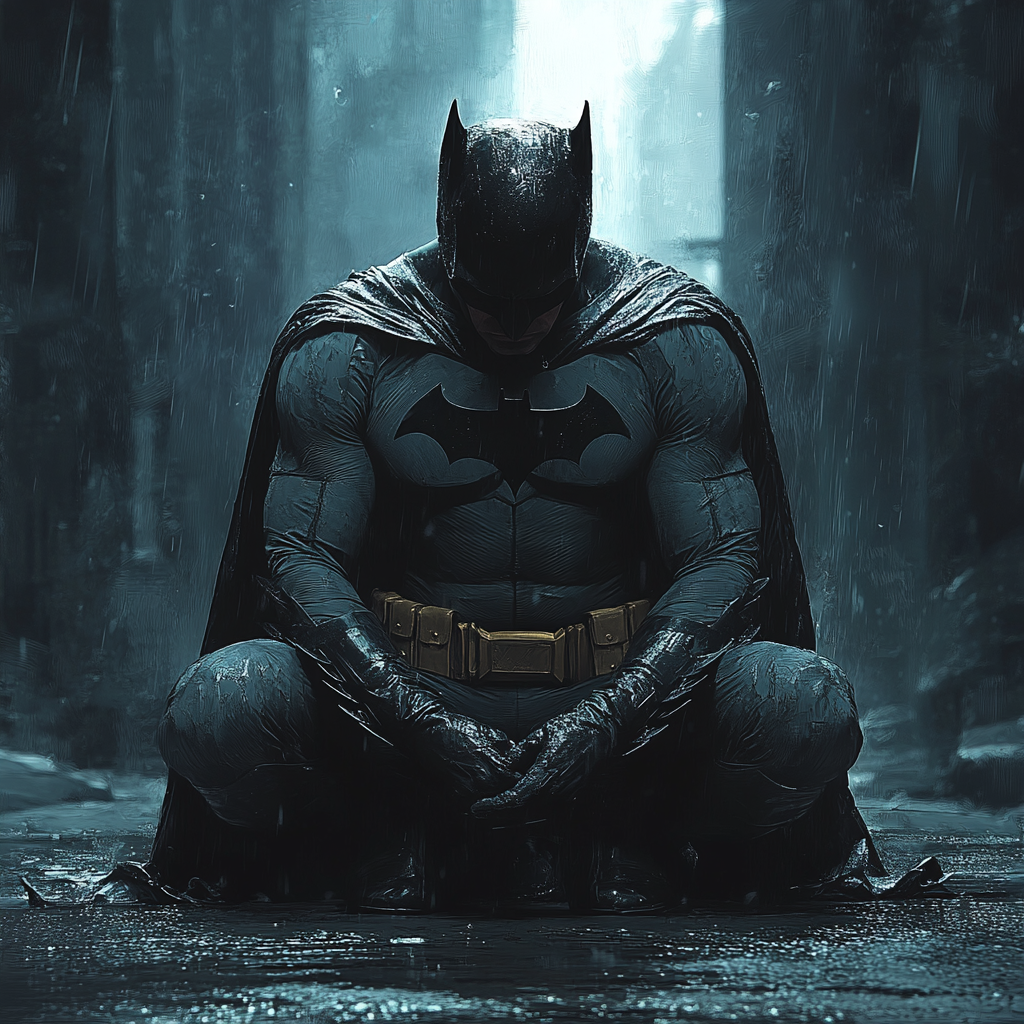
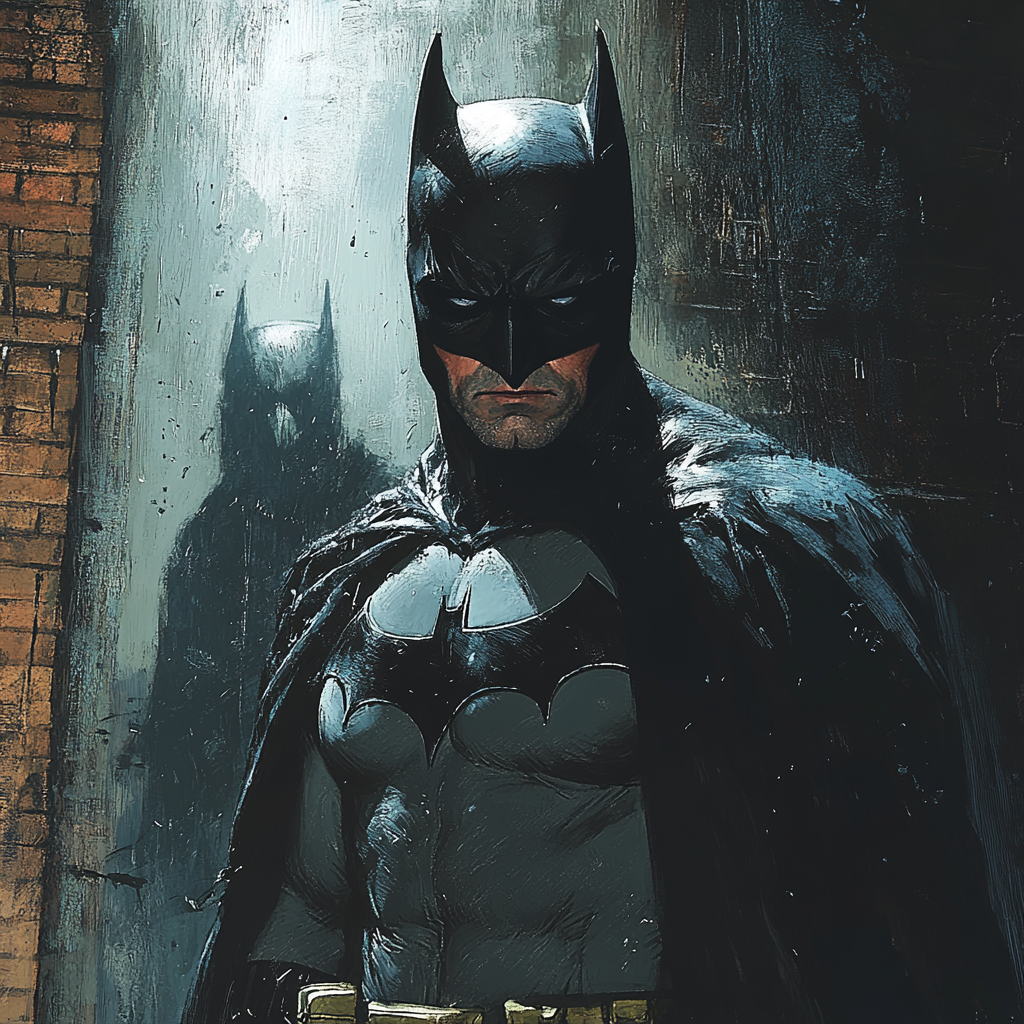
Batman has long stood as a symbol of resilience, justice, and the power of human will. Cloaked in darkness, he’s a hero who walks the line between vigilante and saviour, refusing to stray too far into the light or the shadow. But beneath the mask, Bruce Wayne is a man shaped by trauma—an orphan who witnessed the brutal murder of his parents and who, as a result, was thrust into a lifelong battle with his inner demons. What sets Batman apart from other heroes is that his strength doesn’t come from superhuman abilities but from his woundedness. He is, at his core, a wounded hero, an archetype that has echoed through mythology and depth psychology for centuries.
In this way, Batman joins a pantheon of mythic figures like Hades and Osiris—gods who are comfortable navigating the liminal spaces between life and death, light and shadow. Both Hades, the ruler of the underworld, and Osiris, the god of death and resurrection, embody the kind of archetypal journey that Batman undertakes. They each dwell in realms where the veil between worlds is thin, where life’s darkest truths must be confronted in order to transform and gain wisdom. Batman, too, exists in this space, constantly drawn into the depths of Gotham’s underworld, both literally and metaphorically.
As we explore the idea of Batman as the wounded hero, we’ll look at how his trauma serves as a gateway to the archetypal shadow realms that mythological figures like Hades and Osiris represent. We’ll also see how his story reflects the universal human experience of living in that tension between light and dark, order and chaos, wholeness and fragmentation. This archetypal resonance is what makes Batman not just a symbol of justice but also a figure deeply connected to our collective unconscious—a hero who, despite his wounds, rises again and again to fight the darkness.
The Wounded Hero Archetype
At the heart of every myth, there is a wound—a pivotal moment of trauma that shapes the hero’s journey. In the world of archetypes, the wounded hero represents the figure who has suffered deeply, yet channels that suffering into a higher purpose. Carl Jung described archetypes as universal symbols or motifs that recur throughout the collective unconscious, and the wounded hero is one of the most profound. This archetype embodies the paradox that, through wounding, one is forged into a hero—brokenness becomes the source of power, insight, and transformation.
Batman is perhaps one of the clearest modern embodiments of the wounded hero. His story is inseparable from the tragedy that defines him: the death of his parents, gunned down in front of his young eyes in a senseless act of violence. This trauma doesn’t just propel Bruce Wayne into the vigilante life; it becomes the wound he carries for the rest of his days. It’s his burden, his drive, and his raison d’être. Batman’s entire mission—the protection of Gotham—is rooted in his unresolved grief and pain, and this is precisely what makes him a wounded hero. Unlike many superheroes who thrive in the light of their powers or victories, Batman is continuously shaped by his shadows.
In mythology, the wounded hero archetype often manifests in gods and figures who endure immense suffering but emerge with a new kind of wisdom or power. Take, for instance, the myth of Osiris. He is a god who was once whole, only to be brutally murdered and dismembered by his brother Set. His pieces were scattered across the world, and it was only through the tireless efforts of his wife, Isis, that he was reassembled and brought back to life. But even in his resurrection, Osiris was changed—he became the ruler of the underworld, forever marked by his death, yet transformed into a powerful figure of judgment and renewal.
Like Osiris, Batman is perpetually marked by his trauma. His mission to rid Gotham of its darkness is both an external and internal battle—a fight to keep the chaos of the world at bay while managing his own internal shadows. The same principle applies to Hades, who, though not a hero in the traditional sense, rules over the dead in a world of darkness, presiding over what most fear to face: the finality of death and the unknown. Hades does not fear the shadows; he lives within them, much like Batman.
The wounded hero archetype, then, is not about overcoming trauma in the traditional sense—it’s about living with it, transforming it into something powerful. Batman, like Hades and Osiris, walks this line between destruction and renewal. His wound never heals, and in many ways, it isn’t supposed to. It’s a sacred wound that allows him to be the dark protector Gotham needs, and this unresolved pain is what connects him to the mythic archetype of the wounded hero. His power isn’t his physical strength or intellect; it’s his ability to carry his wound and use it as the fuel for his mission.
In Jungian terms, the wounded hero is a figure who integrates their shadow—those darker, unresolved parts of the psyche. Batman’s relentless pursuit of justice is as much an attempt to reconcile his inner darkness as it is to bring order to the streets of Gotham. It’s this delicate balance between light and shadow, trauma and heroism, that makes the archetype so compelling, not just in mythology but in the way it resonates with our own lives.
We all carry wounds, and like Batman, we’re faced with the choice: do we allow our wounds to define us, or do we find a way to transform them into our strength?
Batman’s Trauma: The Catalyst for the Heroic Journey
Batman’s origin story is one of the most compelling in modern mythology, not because it involves cosmic battles or godlike powers, but because it’s rooted in a simple, devastating moment: a child losing his parents. This trauma—Bruce Wayne witnessing the brutal murder of Thomas and Martha Wayne—becomes the defining event of his life. It’s not just a loss; it’s the birth of Batman. The pain and fear that young Bruce felt in that alley never fade, but rather evolve into the fuel that drives him forward. In many ways, this trauma is not something that can be healed—it becomes a companion that informs his mission, his identity, and his methods.
In psychology, trauma often manifests as a split, a fragmentation of the self. For Bruce, this split creates the dual identity of Bruce Wayne, the billionaire playboy, and Batman, the dark vigilante. This division reflects the deep internal rift caused by his trauma, a rift that echoes through every action he takes. Unlike many heroes, Batman doesn’t possess an inherent sense of invulnerability or hope. His heroism is forged in the fires of loss, and this makes him a complex, sometimes contradictory figure. He’s not saving Gotham to fulfill an abstract ideal of justice—he’s trying to prevent the city’s dark underbelly from creating more victims like himself.
Where many mythic heroes are driven by quests of discovery or transformation, Batman’s journey is more about containment. He’s not trying to conquer an external enemy; he’s attempting to manage the internal chaos that was unleashed the night his parents died. His trauma never fully resolves, but it transforms into something larger than himself—a mission to bring order to the chaos of Gotham’s streets. This mission, however, is not one of pure altruism; it’s deeply personal. Every criminal he apprehends, every villain he faces, is in some ways a symbolic confrontation with the forces of darkness that took his parents from him.
This is where Batman’s path diverges from that of other mythic figures. In mythology, the hero’s journey often involves crossing thresholds, confronting external trials, and emerging changed on the other side. In contrast, Batman’s journey is cyclical—there is no final battle, no decisive victory. Instead, his fight is ongoing, endless, as he constantly returns to the same darkness that created him. His trauma acts as both a wound and a compass, forever guiding him back to the streets of Gotham, where the line between good and evil is blurred.
While mythological figures like Osiris undergo literal death and resurrection, Batman’s transformation is psychological. After the death of his parents, Bruce Wayne essentially “dies” as well, and from that death, Batman is born. But unlike Osiris, who is reassembled and made whole, Bruce never fully recovers from his dismemberment. He exists in a permanent state of fragmentation, with Batman representing the shadow self that rises from his wound. His mask is more than just a disguise—it’s a manifestation of his internal split, allowing him to function in a world where his trauma is both his greatest strength and his deepest vulnerability.
Batman’s trauma also places him in direct opposition to many of his adversaries, who are often twisted reflections of his own darkness. Characters like the Joker or Two-Face represent what happens when trauma consumes an individual entirely. They are the embodiment of chaos, reminding Batman that he is always on the brink of becoming what he fights against. This dynamic is central to his journey—his trauma not only shapes his mission but also keeps him in constant tension with the forces of disorder that he seeks to control.
In many ways, Batman’s journey mirrors that of Hades, the god who presides over the dead but is never truly part of the world of the living. Batman operates in the shadows, and while he protects the living, his life is one of isolation and darkness. Gotham itself becomes a kind of underworld—full of corruption, crime, and chaos—that only Batman can navigate. He is both the protector and the prisoner of this world, unable to escape its grip because it is tied to the wound he carries.
Unlike mythic heroes who seek resolution or transcendence, Batman knows that his trauma cannot be undone. His role as Gotham’s guardian is not about healing—it’s about control. He cannot stop the darkness within himself, but he can channel it, direct it, and use it to prevent others from experiencing the same pain. This is the paradox of the wounded hero: Batman’s greatest strength comes from his wound, but it is also the source of his unending struggle. There is no final victory, no moment of triumph—only the constant return to the shadows.
Batman as a Liminal Figure
One of the most fascinating aspects of Batman’s character is how he exists in a liminal space—a realm that lies between the clear boundaries of light and dark, good and evil, life and death. Liminality, in myth and psychology, refers to the threshold between two states of being, a place where transformation occurs but is never fully resolved. Batman, more than almost any other hero, embodies this liminality, constantly navigating the grey areas of morality, law, and identity.
Unlike heroes like Superman, who represent the clear light of idealised justice, Batman operates in the shadows, both literally and metaphorically. He is not a symbol of pure goodness, nor is he an agent of chaos like his arch-nemesis, the Joker. Instead, Batman treads the fine line between order and disorder, justice and vengeance. This makes him a liminal figure, one who thrives in the in-between spaces where the usual rules of morality and law no longer apply.
In myth, we often see liminal figures in gods and beings who dwell at the edges of the known world, like Hades. He exists apart from both the living and the dead, ruling over a shadowy domain that is neither here nor there. Like Hades, Batman is comfortable operating in the unseen, hidden corners of Gotham City, a place of corruption and crime where the law struggles to maintain control. But unlike Hades, who reigns over the dead with cold detachment, Batman actively engages with this world, striving to impose his own sense of justice within it.
Similarly, Osiris embodies liminality through his own transformation. After his death and resurrection, Osiris does not return to the land of the living but instead becomes the ruler of the underworld, a place where life and death intermingle. In the same way, Batman never truly exists in the daylight world of Bruce Wayne. Even when he walks among Gotham’s elite as a billionaire, his true self remains in the shadows, bound to his identity as the Dark Knight. Like Osiris, Batman has been forever changed by the trauma he endured, and this transformation leaves him unable to fully return to the world of the living.
Batman’s liminality is not just about his relationship to Gotham’s criminal underworld; it’s also reflected in his complex moral code. He follows a strict rule never to kill, which separates him from the villains he fights, but his methods are often violent, brutal, and psychologically taxing. This tension between upholding justice and flirting with the darker impulses of vengeance is what makes him such a unique figure among superheroes. He refuses to cross certain lines, yet he constantly tests their boundaries, often operating outside the law to achieve his goals.
This moral ambiguity places Batman in stark contrast to heroes who follow clear, idealised codes of conduct. His world is not one of black-and-white choices but of difficult, sometimes morally grey decisions. For example, he works alongside police commissioner Jim Gordon but refuses to be constrained by the rules of the legal system. This liminal space allows him to pursue justice on his own terms, without the restrictions that bind others. It’s what makes him both a hero and an outlaw, a figure trusted by Gotham’s citizens yet feared by its criminals.
Yet Batman’s liminality also comes at a cost: isolation. Much like Hades, who is cut off from the world of the living, Batman’s constant dwelling in the shadows leaves him distanced from those he cares about. His relationships are strained because of the double life he leads, and even his allies, like Alfred and Gordon, can only support him from a distance. He is a protector, but one who is perpetually alone, caught between two worlds that he can never fully belong to—Bruce Wayne’s world of privilege and Batman’s world of darkness. This duality is the core of his struggle.
In many ways, Batman’s identity is defined by his ability to navigate these in-between spaces. His strength comes not from his ability to overpower enemies but from his comfort in uncertainty, in ambiguity. He operates where others fear to tread, engaging with the shadowy parts of the human experience, both in the criminals he faces and in his own psyche. Batman’s true superpower is his ability to move fluidly between these worlds, embodying the archetype of the liminal figure—a hero who, like Hades or Osiris, can dwell in the dark without losing sight of the light.
This constant dance between light and shadow is what makes Batman so compelling as a modern mythic figure. He is the embodiment of the grey areas that we all inhabit—the place where our fears, desires, and moral dilemmas collide. Batman’s liminality makes him relatable on a deeply human level. We, too, must often navigate the spaces between right and wrong, light and dark, grappling with the tension between who we are and who we aspire to be. And like Batman, we must learn to walk the line, finding our strength not in purity or perfection, but in our ability to hold these opposites in balance.
Hades and Osiris: Gods of the Shadow and the Underworld
Batman’s character has often been compared to mythological figures, but few parallels are as striking as those with Hades and Osiris, both of whom are gods of the shadow, rulers of realms beyond the living. While Batman is no god, his embodiment of shadow work, trauma, and his place in Gotham’s underworld closely aligns him with these ancient figures. Both Hades and Osiris reign over domains that are hidden from the light, where transformation occurs not in life, but through death, destruction, and rebirth. In many ways, Batman shares their dominion over the darker aspects of existence—he is not a figure of pure light but a guardian of the liminal spaces where life and death, good and evil, intertwine.
Hades: Lord of the Unseen
Hades, the Greek god of the underworld, is not often portrayed as a villain, but he is undoubtedly a figure of mystery and shadow. As the ruler of the dead, Hades’ domain is beneath the surface, both literally and figuratively. He reigns in the underworld, a place of finality and separation from the living world above. Much like Batman, Hades is often misunderstood. He is not evil, but he is feared, and his role as lord of the dead places him at the edge of the known world, where most mortals dare not go.
Batman, too, inhabits this hidden, shadowy realm. His Gotham is not the bright, hopeful city depicted in the daytime; it is a place of crime, corruption, and fear, especially when the sun sets. Like Hades, Batman rules over this underworld, not with cruelty but with a sense of responsibility. He becomes a protector of those who live in fear of the chaos lurking in the city’s dark corners. But, unlike the bright, shining heroes of Metropolis, Batman embraces the role of a shadowy figure—his power comes from the darkness itself, from understanding its depths and manoeuvring within it.
Hades’ connection to the unseen and the underworld mirrors Batman’s role in Gotham. Both figures stand at the threshold between two worlds—life and death for Hades, law and chaos for Batman. They are not consumed by these worlds but instead rule over them with an intimate understanding of their complexity. Batman’s ability to operate in the shadows and navigate Gotham’s criminal underbelly with precision and purpose speaks to this shared mastery of the unseen. His very identity is cloaked in darkness, and it is in this darkness that he finds his strength.
Osiris: Death, Resurrection, and Renewal
Osiris, on the other hand, offers a different kind of shadow: one that speaks to transformation and renewal. As the Egyptian god of death and rebirth, Osiris is dismembered by his brother Set, torn apart, and later reassembled by his wife, Isis. His journey through death leads him to the throne of the underworld, where he becomes a figure of resurrection. Osiris is both broken and reborn, a god who symbolises the cyclical nature of life and death, destruction and creation.
Batman’s journey parallels Osiris’s in profound ways. Bruce Wayne, shattered by the trauma of his parents’ death, undergoes his own form of symbolic death. The boy who witnessed that brutal act in the alley dies with his parents, and from this fragmentation, Batman is born. But like Osiris, Batman’s journey is not about healing in the traditional sense—it’s about transformation. His trauma doesn’t fade into the background; it becomes the very foundation of his new identity. Bruce Wayne’s brokenness is reassembled, not as a healed whole, but as a new, more powerful form: Batman.
Like Osiris, Batman’s rebirth comes with a deep connection to the shadow. He operates within the dark spaces of Gotham, but this is not a place of destruction alone—it is also a place of creation. Batman’s existence in the shadows allows him to rebuild what has been broken, bring order to chaos, and restore a sense of justice to a city that seems irreparably corrupt. In this way, he mirrors Osiris’s role as a figure of resurrection and renewal. He transforms Gotham, much as Osiris oversees the cycle of life and death, always returning to the underworld to guide those who pass through its gates.
But while Osiris ultimately ascends to a place of peace, ruling the dead from a distance, Batman’s transformation is never fully complete. His resurrection is ongoing, a cycle of destruction and renewal that plays out again and again in the pages of his story. Each new crisis, each new villain, brings him back to the core of his trauma, forcing him to rebuild himself anew. Batman, like Osiris, is forever marked by his wounds, yet it is through these wounds that he draws his power.
Batman’s Unique Connection to the Underworld
In comparing Batman to these mythological figures, it becomes clear that his role as Gotham’s protector is not just about fighting crime. It is about his ability to navigate the spaces where most people cannot go—into the darkness, into the heart of trauma, into the underworld itself. Hades’ reign over the dead and Osiris’s mastery of resurrection speak to Batman’s own ability to engage with death and rebirth, not as a one-time transformation but as a constant cycle of destruction and renewal.
Batman, Hades, and Osiris are all rulers of the shadow in their own way. But while Hades and Osiris are gods, fixed in their roles, Batman remains human. His power comes from his willingness to embrace his humanity, to accept the pain of his trauma, and to use it as a source of strength. He is not just a hero of the light, but a hero of the liminal spaces, the in-between places where transformation occurs. Like Hades and Osiris, he is comfortable in the shadows, not because he is unafraid of them, but because he knows they are necessary for true renewal.
The Shadow Self: Batman’s Relationship with Darkness
One of the most profound aspects of Batman’s character is his intimate relationship with the shadow—a concept deeply rooted in Carl Jung’s psychological theory. Jung believed that the shadow represents the unconscious parts of ourselves, the aspects we deny, repress, or fear. It contains both darkness and potential, the things we hide from the world and even from ourselves. In Batman’s case, the shadow is not just something he grapples with; it’s something he has learnt to live within. His heroism is not born from his ability to conquer the shadow but from his willingness to engage with it, face it, and wield its power.
Batman’s shadow self is symbolised by the mask he wears, the dark persona he adopts to fight crime. Unlike many heroes, who live in the light of public adoration or who represent ideals of purity, Batman embraces the shadow as part of his identity. The Bat itself, a creature of the night, embodies fear, the unknown, and the hidden. By taking on this symbol, Bruce Wayne chooses to confront his own fear and use it as a weapon. But more than that, he becomes a living representation of the shadow, moving through Gotham’s darkest corners, confronting the city’s hidden evils while simultaneously acknowledging the darker parts of himself.
In Jungian terms, the shadow must be integrated, not defeated. Batman’s relationship with his shadow is one of complex integration—he doesn’t banish it or try to destroy it. Instead, he accepts its role in his life, knowing that without it, he could not fulfil his mission. The criminals he faces are often extreme manifestations of unintegrated shadows—figures like the Joker or Two-Face, who have been fully consumed by their darker impulses. In many ways, these villains represent what Batman might become if he allowed his shadow to take full control, giving in to the desire for vengeance or chaos.
However, what sets Batman apart is his discipline, his unwavering commitment to a moral code that keeps him from crossing certain lines. This code, particularly his refusal to kill, is what prevents him from becoming the very thing he fights against. His struggle is constant—he must continually confront his shadow without letting it consume him. In this way, Batman’s journey is not one of transcending the shadow but of balancing it. He moves within the shadowy realms of Gotham and within himself, walking the tightrope between justice and vengeance, order and chaos.
The tension between Batman and his shadow is also evident in his relationships with other characters. His closest allies, such as Alfred, Commissioner Gordon, and even his protégé, Robin, often serve as reminders of his humanity, grounding him when he veers too close to the edge. They act as mirrors, reflecting back the parts of Bruce Wayne that he might lose touch with when submerged in the Batman persona. The dichotomy between Bruce Wayne and Batman is itself an expression of this shadow work—Bruce represents the part of him that seeks connection, order, and stability, while Batman is the embodiment of his shadow, the part that operates in darkness and isolation.
Jung’s concept of the shadow also ties into Batman’s lifelong confrontation with fear. As a boy, Bruce Wayne was paralysed by the fear and helplessness of watching his parents die. As Batman, he consciously adopts fear as a tool. His mastery over fear allows him to confront the criminals of Gotham, many of whom, like the Scarecrow, use fear as their primary weapon. In this sense, Batman’s ability to navigate the shadow extends beyond his own psyche and into the external world—he uses fear to strike at the heart of Gotham’s villains, turning the psychological weapon they wield back against them.
What’s particularly interesting about Batman’s relationship with his shadow is that it’s not about defeating the darkness, but about finding power within it. Unlike other heroes, whose arcs might focus on overcoming internal demons, Batman’s journey is about accepting that the darkness will always be part of him. His strength lies in his ability to channel this darkness towards a greater purpose, without letting it overwhelm him. He is not immune to the pull of his shadow, but he knows how to navigate it with precision. This makes him a hero of paradox—one who embodies both light and shadow, hope and fear, justice and vengeance.
In this sense, Batman’s relationship with his shadow is what makes him a unique and enduring figure in modern mythology. He is not a hero in the traditional sense of purity and perfection, but a hero of the liminal, the in-between spaces where light and dark coexist. His strength comes not from banishing the shadow but from integrating it into his identity, accepting its role in his life without surrendering to it. Batman teaches us that the shadow is not something to fear but something to understand, to confront, and ultimately, to use as a source of power and transformation.
Navigating Life and Death: Batman’s Role as a Death-Rebirth Figure
One of the most defining characteristics of Batman’s journey is his continual dance with death—not only as a thematic element of his story but as a symbolic process of destruction and rebirth. Unlike mythological heroes who undergo a singular death and resurrection, Batman’s entire existence is framed around this cyclical process. He repeatedly experiences symbolic “deaths,” moments of profound destruction and loss, only to rise again—reborn and more determined than ever. This cycle mirrors the ancient myths of gods like Osiris, whose death and rebirth symbolise the deeper mysteries of transformation.
From the very beginning, Batman’s story is rooted in death—the murder of his parents in Crime Alley, a tragedy that marks the “death” of Bruce Wayne as an innocent child. But this loss doesn’t destroy him. Instead, it propels him into becoming something entirely new. Bruce Wayne, as he was, ceases to exist, and from his personal destruction, Batman is born. This is the first and most significant instance of Batman’s role as a death-rebirth figure, but it is far from the last.
Throughout his story, Batman continually confronts his own mortality—both physically and psychologically. In the Knightfall saga, for instance, he is physically broken by Bane, who shatters his body and forces Bruce to relinquish the Batman identity for a time. This represents another symbolic death, as Batman is no longer capable of protecting Gotham. Yet, this “death” leads to a period of renewal, where Bruce undergoes a painful recovery, both physically and spiritually, to reclaim the mantle of the Dark Knight. His rebirth isn’t just a return to his previous self—it’s a transformation. Each time Batman is broken, he rises with new strength and insight, much like Osiris, who, after being dismembered and reassembled, rules the underworld as a more powerful and eternal figure.
In myth, the journey through death often leads to profound insight and wisdom, and Batman’s relationship with death follows a similar path. His role as Gotham’s protector is not just about physical survival; it’s about navigating the psychological and existential thresholds that define human existence. Batman has faced death in countless forms—whether battling the Joker’s lethal schemes, walking the fine line of self-destruction through his relentless pursuit of justice, or even faking his own death (as seen in The Dark Knight Rises). Each encounter with death forces him to confront his deepest fears and vulnerabilities, yet each time, he emerges with a renewed sense of purpose.
This cycle of destruction and rebirth is also reflected in Batman’s interactions with Gotham itself. The city, often depicted as a crumbling, decaying entity, goes through its own cycles of destruction and renewal. Batman’s role as a guardian is, in many ways, about ensuring that Gotham’s death—whether in the form of corruption, crime, or literal destruction—leads to rebirth. He is both a protector and a destroyer, allowing certain systems of power to crumble while helping new, more just structures emerge from the rubble. This is the essence of the death-rebirth archetype—allowing what no longer serves to die so that something new can rise in its place.
Batman’s complex relationship with death extends beyond his own experiences and into the lives of those around him. His greatest foes—such as the Joker and Ra’s al Ghul—are often figures who, in their own ways, also embody the death-rebirth cycle. Ra’s al Ghul, with his use of the Lazarus Pit to cheat death, represents the shadow side of this archetype—seeking immortality without true transformation. The Joker, too, flirts with death in nearly every confrontation, embodying chaos and destruction without the renewal that Batman seeks. These villains serve as foils to Batman’s more constructive engagement with the cycle of death and rebirth—they represent what happens when the process becomes unbalanced, when death is sought without the intent for true renewal.
Batman’s no-kill rule is also deeply tied to this archetype. While he constantly faces death, he refuses to cross that final line with his enemies, understanding that killing would mark an irreparable transformation in himself. In refusing to kill, Batman preserves the potential for renewal—not only for himself but also for Gotham and the criminals he fights. He believes in the possibility of redemption, even if it seems far-fetched, and by allowing his enemies to live, he maintains a belief in the cycle of rebirth—that even those lost in darkness might one day rise again.
Perhaps the most striking example of Batman’s role as a death-rebirth figure is found in the Death of the Family storyline, where he confronts the Joker in a symbolic battle for the soul of Gotham. In this narrative, Batman comes face-to-face with his own mortality, as the Joker seeks to strip him of everything he holds dear. Yet, rather than succumbing to the Joker’s nihilistic vision, Batman emerges with a renewed sense of his mission and a deeper understanding of the stakes involved. It’s not just about defeating villains—it’s about navigating the constant tension between destruction and creation, life and death.
In the end, Batman’s role as a death-rebirth figure is not about achieving a final victory over death but about living within its cycles. He doesn’t seek immortality, nor does he aim to escape the consequences of his actions. Instead, he embraces the idea that destruction is a necessary part of transformation, and that each time he faces death—whether literal or symbolic—he has the opportunity to rise again, stronger and more focused. This cyclical process mirrors the human experience, where loss and renewal are constant companions, and where our ability to navigate these cycles defines who we are.
Conclusion: The Wounded Hero as a Bridge Between Worlds
In the end, Batman stands as more than just a comic book hero—he is a symbol of the wounded hero archetype, a figure who continually navigates the complex space between light and shadow, life and death, heroism and humanity. His journey is not one of simple triumph, but one of ongoing struggle, transformation, and rebirth. Like mythological figures such as Hades and Osiris, Batman thrives in liminal spaces, where few others dare to tread. His power comes not from his ability to defeat enemies or overcome his trauma, but from his willingness to live within the tension of these opposites and to make meaning from them.
Batman’s woundedness is not just a backstory—it’s the core of his character. It’s what gives him his edge, his drive, and his unshakeable commitment to his mission. But unlike many other heroes, who may find resolution or healing in their arcs, Batman’s wound remains an integral part of who he is. His trauma never fully heals, and that’s what keeps him grounded in the world of Gotham, fighting endlessly for justice. His identity as both Bruce Wayne and Batman is split, much like the dismembered Osiris, and yet, in this fragmentation, he finds his purpose. Rather than seeking to return to a life of wholeness, Batman accepts that his brokenness is the key to his mission.
In many ways, Batman serves as a bridge between worlds. He connects the ordinary and the extraordinary, the human and the heroic, the light and the dark. He operates in the physical world of Gotham while also inhabiting the psychological landscape of his own shadow. He is not fully one thing or the other, and this liminality allows him to act as a guide, both for Gotham’s citizens and for the readers who follow his journey. Batman shows us that the path of the wounded hero is not about erasing the pain or conquering the darkness, but about integrating those aspects into a larger sense of self and purpose.
This bridging role is crucial because it makes Batman a figure of both vulnerability and strength. He’s not invincible like Superman, nor is he purely driven by an ideal of justice like Wonder Woman. Instead, Batman’s heroism is messy, complicated, and deeply human. His connection to the shadow, the underworld, and the cycle of death and rebirth makes him relatable to anyone who has faced loss, struggled with trauma, or found themselves navigating the grey areas of life. In Batman, we see a reflection of our own struggles with the darkness, and we are reminded that it is possible to face it and emerge stronger—not by escaping the darkness but by learning to move within it.
Batman’s archetypal resonance goes beyond the pages of comics or the screen of blockbuster films. He speaks to a universal truth about the human condition: that we are all wounded in some way, and yet these wounds can become the source of our greatest strength. His journey is a testament to the idea that even in our brokenness, we have the power to rise, to transform, and to make meaning from the chaos of our lives. Just as Osiris’s dismemberment leads to his reign in the underworld, and just as Hades presides over the shadowy realm of death, Batman’s place in Gotham’s shadows allows him to be a force for order, for justice, and for hope.
In conclusion, Batman embodies the archetype of the wounded hero because he never turns away from his trauma. Instead, he allows it to guide him, to push him deeper into the shadow, where he finds both danger and purpose. He is not a hero of absolutes, but of balance—a figure who walks the line between darkness and light, never fully belonging to either but understanding the necessity of both. His story reminds us that the journey of the wounded hero is not about healing in the traditional sense but about finding power, purpose, and even redemption within our wounds. Like Batman, we too can become heroes of our own stories, embracing our shadows and using them to illuminate the path ahead.
Call to Adventure
Batman’s journey invites us to look at our own lives through the lens of the wounded hero. His story shows that our wounds, rather than holding us back, can become the very source of our strength. So, ask yourself:
What shadows are you walking through right now? How might your own experiences of pain and trauma be transformed into something powerful and purposeful?
I encourage you to reflect on your own relationship with the shadow—the parts of yourself you might hide or suppress—and consider how they can be integrated into your life in a meaningful way. Whether it’s through journaling, meditation, or even creative expression, take time to explore the places where light and shadow meet within you.
If you’re interested in diving deeper into archetypes, mythology, or Jungian psychology, I’d love to hear from you. Share your thoughts in the comments, or join my Mythic Soul Tribe, where we explore these concepts together, using tools like the Tarot and personal mythology to navigate the liminal spaces of our lives. Let’s walk this path of transformation side by side, embracing the shadows and finding strength in our wounds.
The journey of the wounded hero is one we all share. Let’s take it together.
Ready to discover which Greek deity mirrors your inner self? Whether you’re a natural-born leader, a strategic thinker, or a master of charm and beauty, there’s a god or goddess out there that vibes with your energy. Maybe you’re a bold Zeus, commanding the skies and ruling with authority, or perhaps you’re more like Athena, wise and ready for battle. Could it be that Apollo’s creative spirit runs through your veins, or do you resonate with the fiery passion of Ares? If you’re all about love and allure, Aphrodite might be your divine counterpart, but if you lean into mystery and depth, Hades could be your soul twin.
Take this quiz and let the Olympian gods reveal which ancient energy is guiding your life!
I’m starting a new series on the website dedicated to mythology and meaning, where I’ll be exploring ancient myths and their symbolic meanings in modern times. I’m hoping to uncover how these timeless stories still resonate in our modern lives. To kick things off, I’m starting with an exploration of Pegasus, the winged horse of Greek myth, simply because during one of my shamanic dream journeys this week, I met Pegasus. Near the end of the journey, he flew down from the sky to meet me, confirming a message about trusting my intuition as I step into this new phase of my creative and spiritual soul adventure.
In Greek mythology, Pegasus is a creature of rare beauty and power, a winged horse born from one of the most unusual and dramatic stories of the ancient world. His mythic origins, his relationship to the gods, and his symbolic resonance have inspired imaginations for millennia. As an amateur mythologist, I feel it’s impossible to overlook how Pegasus captures the tension between the earthly and the divine, while embodying creativity, transcendence, and the eternal quest for inspiration.
The Birth of Pegasus: A Creature Born of Chaos
Pegasus’s birth is as mythical as his existence. He sprang forth from the blood of Medusa, a Gorgon, after her death at the hands of the hero Perseus. Medusa, once a beautiful woman, was cursed by Athena to become a hideous monster whose gaze turned men to stone. When Perseus beheaded Medusa, her blood fell into the sea, and from this violent, chaotic act, Pegasus and his brother, Chrysaor, were born.
This birth is rich with symbolic meaning. Medusa represents chaos, darkness, and the terrifying aspects of the feminine archetype. Yet, from her death comes Pegasus—a creature of light, purity, and divine power. In this sense, Pegasus symbolises the potential for beauty and inspiration to emerge from the darkest, most chaotic corners of existence. He is a reminder that creativity often springs from difficult or even traumatic experiences and is transformed through the alchemy of the imagination.
Pegasus and the Divine: The Horse of the Gods
Once born, Pegasus ascended to Mount Olympus, where he was given a role of celestial significance. He became Zeus’s trusted steed and was entrusted with the task of carrying the thunderbolts that Zeus hurled during his battles. Pegasus, in this role, serves as a mediator between the earthly and divine realms, moving freely between the mortal world and the heavens.
This aspect of Pegasus points to his role as a psychopomp—a figure who guides souls or messages between different planes of existence. In myth and ritual, the psychopomp serves as a bridge between the human and the divine, and Pegasus embodies this intermediary function. His wings allow him to transcend the ordinary world and enter the sphere of the gods, making him a symbol of spiritual elevation, transformation, and the aspiration towards a higher consciousness.
Pegasus and Inspiration: The Fountain of the Muses
One of the most enduring associations with Pegasus is his connection to the Muses, the goddesses of artistic inspiration. Legend holds that Pegasus struck Mount Helicon with his hooves, causing the sacred spring of Hippocrene to burst forth. This fountain was said to be a source of poetic inspiration, and those who drank from its waters would be blessed with creativity and insight.
Here, Pegasus becomes a direct link to the world of art, music, poetry, and all forms of creative expression. His ability to tap into the earth and unleash a wellspring of inspiration symbolises the connection between the creative mind and the subconscious. Just as Pegasus draws from the earth to bring forth the fountain, artists and creators draw from their inner depths to express something profound and transformative. This association also reflects the idea that creativity is both divine and grounded, an intersection of the spiritual and material worlds.
The Winged Horse: Transcendence and Freedom
The wings of Pegasus are perhaps his most iconic feature. They represent the ability to rise above, to transcend limitations, and to explore realms that are ordinarily inaccessible. Wings, in general, are potent symbols in mythology, often signifying spiritual ascension, freedom, and the soul’s journey beyond the physical world.
In many ways, Pegasus’s wings are a metaphor for the creative process itself. To create is to lift oneself beyond the ordinary and reach for something higher. Like Pegasus, the artist or dreamer transcends the mundane and enters a realm of limitless possibility, unbound by earthly concerns. Wings also evoke the lightness and joy that come from following inspiration, suggesting that true creativity is both liberating and exhilarating.
Pegasus and the Hero’s Journey
Although Pegasus is often depicted alongside gods and goddesses, he is also tied to the hero’s journey. The most notable hero associated with Pegasus is Bellerophon, who, with the help of the goddess Athena, tamed the wild horse. Bellerophon rode Pegasus during his battle with the Chimera, a fearsome monster with the body of a lion, the head of a goat, and the tail of a serpent. With Pegasus’s help, Bellerophon soared above the creature and defeated it with arrows, a victory that would have been impossible without the winged horse.
In this context, Pegasus represents the aid that comes from the divine, or from the higher self, during moments of great trial. The horse’s ability to fly allows Bellerophon to overcome a seemingly insurmountable challenge, suggesting that tapping into inspiration, intuition, or spiritual guidance can offer the perspective needed to solve life’s most difficult problems. Yet, the story also serves as a cautionary tale: when Bellerophon attempted to ride Pegasus to Mount Olympus and join the gods, he was struck down for his hubris. Pegasus continued his flight to Olympus alone, underscoring the idea that divine power is not to be controlled or possessed, but to be honoured and respected.
Pegasus as a Symbol Today
Pegasus remains a powerful symbol in modern culture, often representing freedom, imagination, and inspiration. As a figure of myth, he has transcended his original context to become a universal symbol of the creative spirit. He reminds us that imagination has the power to lift us beyond the ordinary and connect us to something greater. Whether seen as a source of artistic inspiration, a guide in spiritual transformation, or a figure of transcendence, Pegasus endures as a timeless emblem of the power of creativity.
In the end, Pegasus is more than a mythological creature. He represents the infinite potential within each of us to rise above, to create, and to connect with the divine source of inspiration. Just as Pegasus was born from chaos, so too can our most beautiful and transcendent creations emerge from the challenges we face, lifting us to new heights of understanding and expression.
As I’m beginning to do more active imagination and dream work, I thought it might be a good idea to start profiling the various entities and beings I meet on my inner journeys. As I shared with you yesterday, Lilith appeared in my dreams. And this morning, utilising Jung’s active imagination technique, I met and had a conversation with Lilith. I’ll probably share that encounter in a separate post.
Mythological Origins
Lilith’s complex and enigmatic nature has captivated the imaginations of people across cultures and throughout history. Her origins can be traced back to ancient Mesopotamian mythology, where she first appears in the Sumerian epic poem “Gilgamesh and the Huluppu-Tree” as a dark goddess or demon who makes her home in the trunk of a willow tree. In this early incarnation, Lilith is portrayed as a wild, untamed force of nature, associated with storms, chaos, and destruction.
As Lilith’s mythos evolved and spread to other cultures, she took on new dimensions and interpretations. In Jewish folklore, she emerges as a central figure in the Talmudic and Kabbalistic traditions. Here, she is often portrayed as the first wife of Adam, created from the same earth as him rather than from his rib like Eve. However, Lilith refused to be subservient to Adam, insisting on equality in their relationship. When Adam tried to dominate her, Lilith uttered the sacred name of God and fled from the Garden of Eden, choosing exile and freedom over submission and subjugation.
This portrayal of Lilith as a rebellious, independent figure who challenges patriarchal authority has made her an enduring symbol of female empowerment and resistance. She represents the wild, untamed aspects of femininity that refuse to be controlled or dominated by male power structures. In this sense, Lilith embodies the shadow side of the feminine archetype—the parts that are often suppressed, feared, or demonised by society.
Lilith’s association with darkness and the demonic also speaks to her role as a guardian of the shadow realms of the psyche. She represents the parts of ourselves that we may fear or reject—our deepest desires, our rage, and our primal instincts. By integrating these shadow aspects of ourselves, we can achieve greater wholeness and self-understanding.
In some traditions, Lilith is also associated with sexuality and sensuality. As a figure who embodies feminine power and agency, she represents the right of women to own their desires and to express their sexuality freely, without shame or constraint. This aspect of Lilith has made her a controversial figure in some religious traditions that seek to control or suppress female sexuality.
Despite efforts to demonise or marginalise her, Lilith has endured as a potent symbol of feminine power, creativity, and transformation. Her complex and multifaceted nature reflects the diversity and depth of the feminine experience itself. For those seeking to reclaim the lost or suppressed aspects of the divine feminine, Lilith offers a pathway to deep self-discovery, healing, and empowerment. She reminds us that even in the face of oppression and adversity, the wild and untamed spirit of the feminine can never be fully tamed or conquered.
Symbology
The Owl
Lilith’s association with the owl is a powerful symbolic connection that highlights her role as a guide through the mysterious and often challenging realms of the psyche. In many cultures, the owl is seen as a symbol of wisdom, intuition, and the ability to see beyond surface-level realities.
Just as owls are nocturnal creatures, Lilith is often associated with the night, the moon, and the hidden aspects of the self. Owls have keen vision in the darkness, allowing them to navigate through the shadows and hunt their prey with precision. Similarly, Lilith’s energy can help us to see through the darkness of our own psyche, illuminating the hidden truths and unconscious patterns that may be holding us back.
The owl’s ability to rotate its head 360 degrees is also symbolic of Lilith’s capacity to see situations from all angles, offering a comprehensive understanding of the complexities of the human experience. This all-encompassing perspective can be invaluable when confronting our own shadows and working through difficult emotions or experiences.
In some traditions, the owl is also associated with the ability to cross between the worlds of the living and the dead. This connection further emphasises Lilith’s role as a guide through the underworld of the psyche, helping us to confront and integrate aspects of ourselves that we may have suppressed or denied.
The owl’s silent flight and swift hunting abilities also speak to Lilith’s power and efficiency in navigating the realms of the unconscious. She can help us swiftly identify and confront the root causes of our fears, traumas, and limiting beliefs, facilitating deep healing and transformation.
By connecting with Lilith’s owl energy, we can tap into our own inner wisdom, intuition, and the ability to navigate through the darkness of our own psyche. We can learn to trust our instincts, embrace our shadow selves, and see the world with a clear, discerning eye. Through this process, we can emerge from the darkness, transformed and empowered, ready to embrace our authentic selves and live our lives with greater purpose and clarity.
The Snake
The snake is a powerful and complex symbol that has been associated with Lilith in various mythological and archetypal contexts. As a creature that sheds its skin, the snake represents transformation, renewal, and the cyclical nature of life and death.
In many ancient cultures, the snake was revered as a symbol of healing and regeneration. The shedding of the snake’s skin was seen as a metaphor for the shedding of the old self, allowing for new growth and transformation to occur. This symbolism aligns with Lilith’s role as a facilitator of deep inner work, guiding individuals through the process of releasing old patterns, beliefs, and traumas to make way for healing and personal evolution.
The snake’s ability to move effortlessly between the realms of earth and the underworld also connects it to Lilith’s energy. As a guide through the shadow realms of the psyche, Lilith can help us navigate the depths of our unconscious, confronting our fears and integrating the hidden aspects of ourselves. This process of descending into the darkness and emerging transformed is mirrored in the snake’s journey as it moves through the underworld and sheds its skin.
In some traditions, the snake is also associated with the kundalini energy, a powerful life force that lies dormant at the base of the spine. When awakened, this energy rises through the chakras, facilitating spiritual growth and enlightenment. Lilith’s connection to the snake can be seen as a symbol of her ability to help us awaken our own inner power and potential, guiding us through the process of spiritual transformation.
However, the snake is also often associated with temptation, deception, and the shadow aspects of the self. In the biblical story of the Garden of Eden, it is the snake that tempts Eve to eat the forbidden fruit, leading to the fall of humanity. This connection highlights Lilith’s role as a challenger, forcing us to confront the parts of ourselves that we may prefer to keep hidden and the desires that we may be afraid to acknowledge.
By embracing Lilith’s snake energy, we can learn to shed our old skins, releasing the patterns and beliefs that no longer serve us. We can confront our shadows, integrate our hidden desires, and emerge transformed and empowered. Through this process, we can tap into our own inner wisdom, healing abilities, and the power of regeneration, allowing us to grow and evolve on our spiritual and personal journeys.
The Moon
Lilith’s connection to the moon is a powerful symbol that emphasises her association with the feminine, intuition, and the cyclical nature of life. The moon has long been revered as a celestial body that embodies the mysteries and power of the feminine divine.
In many ancient cultures, the moon was associated with goddesses and female deities, representing the intuitive, receptive, and nurturing aspects of the divine feminine. Lilith’s connection to the moon highlights her role as an embodiment of these feminine qualities, reminding us to honour and embrace the power of our own intuition and inner wisdom.
The moon’s cyclical nature, with its waxing and waning phases, mirrors the natural rhythms of life, death, and rebirth. This connection emphasises Lilith’s role as a guide through the cycles of transformation and change that are an inherent part of the human experience. Just as the moon goes through its phases, we too must navigate the ebb and flow of our own lives, learning to embrace the darkness and the light within ourselves.
The moon’s influence on the tides and the natural world also speaks to Lilith’s power to affect change and transformation on a deep, subconscious level. As a guide through the shadow realms of the psyche, Lilith can help us tap into the hidden depths of our own being, bringing to light the unconscious patterns and beliefs that may be shaping our lives.
In some traditions, the moon is also associated with the menstrual cycle and the power of feminine fertility. This connection further emphasises Lilith’s role as a symbol of female empowerment and the celebration of the sacred feminine. By embracing Lilith’s moon energy, we can learn to honour the natural cycles of our own bodies and the creative power that lies within us.
The moon’s light, which illuminates the darkness of the night, is also a symbol of hope and guidance. Lilith’s connection to the moon reminds us that even in our darkest moments, there is always a glimmer of light to guide us forward. By connecting with Lilith’s energy, we can learn to trust in the cyclical nature of life, knowing that even the darkest of times will eventually give way to new growth and transformation.
Embracing Lilith’s moon energy can help us cultivate a deeper connection with our own intuition, emotional depths, and the sacred feminine within us. By honouring the cyclical nature of life and the transformative power of the moon, we can navigate the ups and downs of our own journey with greater grace, resilience, and self-awareness.
The Wild and Untamed
Lilith’s embodiment of the wild and untamed aspects of nature and the human psyche is a powerful representation of her role as a facilitator of personal growth, transformation, and the embracing of our authentic selves. In a world that often encourages conformity and the suppression of our deepest desires and instincts, Lilith stands as a beacon of liberation and self-expression.
The untamed aspects of nature, such as the raw power of a thunderstorm, the untouched beauty of a wild forest, or the primal instincts of animals, remind us of the inherent wildness that exists within ourselves. Lilith’s energy encourages us to reconnect with this wildness, to embrace our raw, unfiltered emotions, and to express ourselves authentically without fear of judgement or reprisal.
In the human psyche, the untamed aspects can manifest as our deepest passions, our most intense desires, and the parts of ourselves that we may have learned to suppress or hide away. Lilith invites us to explore these aspects of our being, to confront the fears and shame that may have kept us from fully expressing ourselves, and to integrate these wild, untamed parts into our conscious awareness.
By embodying the untamed, Lilith also challenges societal norms and expectations, particularly those that seek to control or limit the expression of feminine power and sexuality. She reminds us that our desires, our sexuality, and our authentic self-expression are sacred and worthy of celebration, rather than something to be ashamed of or suppressed.
Embracing Lilith’s wild, untamed energy can be a liberating and transformative experience, but it is not always a comfortable one. It requires us to confront the parts of ourselves that we may have been taught to fear or reject, to step outside of our comfort zones, and to risk the disapproval or misunderstanding of others. However, by doing so, we can tap into a deep wellspring of personal power, creativity, and authenticity that can enrich our lives in countless ways.
Lilith’s untamed energy can also help us to cultivate a deeper connection with the natural world and the primal forces that shape our existence. By reconnecting with the wildness within ourselves, we can develop a greater appreciation for the beauty, power, and resilience of the untamed world around us.
Ultimately, by embodying the wild and untamed aspects of nature and the human psyche, Lilith invites us to embrace our full, authentic selves, to celebrate the raw power and beauty of our own being, and to live our lives with passion, purpose, and unapologetic self-expression.
Dream Work and Active Imagination
In dream work and active imagination, Lilith emerges as a powerful and transformative figure, guiding individuals on a profound journey of self-discovery and shadow integration. Her presence in these inner landscapes serves as a catalyst for confronting and embracing the deepest, most hidden aspects of the psyche.
When Lilith appears in dreams or active imagination, she often takes on the role of a fierce and unyielding guide, leading us into the heart of our own darkness. She beckons us to venture into the shadow realms of our being, to face the fears, desires, and traumas that we may have long suppressed or denied. This process can be deeply challenging, as it requires us to confront the parts of ourselves that we may feel ashamed of or afraid to acknowledge.
However, Lilith’s energy is not one of judgement or condemnation but rather of radical acceptance and integration. She encourages us to look upon our shadow selves with compassion and understanding, recognising that these aspects are not separate from us but are integral parts of our whole being. By embracing and integrating our shadows, we can begin to heal the deep wounds and traumas that may have long held us back, freeing ourselves from the chains of self-doubt, fear, and limitation.
Lilith’s presence in dream work and active imagination can also serve as a powerful reminder of our own inner strength, resilience, and creativity. She reflects back to us the untamed, wild aspects of our own nature, inviting us to tap into the primal power and authenticity that lie within us. Through her guidance, we can learn to honour our own desires, to set boundaries that protect our sacred self-expression, and to refuse to be defined or limited by societal expectations or norms.
The process of working with Lilith’s energy in these inner realms is not a passive one, but rather requires active engagement and a willingness to step into the unknown. It may involve confronting difficult emotions, memories, or experiences that we have long avoided, and may require us to take bold, decisive action in our waking lives to break free from patterns of self-sabotage or limitation.
However, the rewards of this deep, transformative work are immeasurable. By embracing our shadow selves and integrating the wild, untamed aspects of our being, we can achieve a greater sense of wholeness, self-understanding, and authentic self-expression. We can tap into a deep well of creativity, passion, and purpose that may have long been buried beneath layers of fear and self-doubt.
Final Thoughts
Lilith’s enduring presence in mythology and her powerful role in facilitating personal growth and transformation make her a truly captivating and relevant figure for those seeking to deepen their self-understanding and forge a profound connection with the divine feminine within.
Throughout history, Lilith has emerged time and again as a complex, multifaceted figure, embodying the very essence of the untamed, wild, and transformative aspects of the feminine psyche. Her story, in all its variations and interpretations, speaks to the timeless struggle of women to assert their autonomy, power, and authentic self-expression in the face of societal norms and expectations that seek to limit or control them.
As a guide and catalyst for personal growth, Lilith invites us to embark on a journey of radical self-discovery and shadow integration. She beckons us to venture into the deepest, darkest recesses of our own being, to confront the fears, traumas, and desires that we may have long suppressed or denied. Through this process of deep, often challenging inner work, we can begin to heal the wounds of the past, to break free from limiting patterns and beliefs, and to tap into the immense wellspring of power, creativity, and resilience that lies within us.
Lilith’s energy is one of transformation, of the shedding of old skins and the embracing of new, more authentic ways of being. She reminds us that growth and change are not always comfortable or easy, but that by stepping into the unknown and embracing the totality of our being—light and shadow alike—we can unlock the full potential of our own innate wisdom, strength, and purpose.
In connecting with Lilith’s energy, we also forge a deeper connection with the divine feminine within ourselves and in the world around us. We learn to honour the sacred feminine qualities of intuition, creativity, sensuality, and emotional depth, and to celebrate the power and beauty of the feminine in all its forms. We can start to heal the collective wounds of the feminine that centuries of patriarchal oppression and suppression have inflicted by embracing Lilith’s archetype.
Ultimately, Lilith’s enduring presence in our mythological and psychological landscapes serves as a reminder of the immense transformative power that lies within each of us. She invites us to step into our own wild, untamed nature, to embrace our shadows and our light, and to live our lives with authenticity, passion, and purpose. For those seeking to deepen their self-understanding and to connect with the divine feminine within, Lilith stands as a powerful and enduring guide, illuminating the path to wholeness, healing, and transformation.
Questions
As you navigate your path of self-discovery and personal growth, consider what aspects of Lilith’s story resonate with you. Where might you be holding back your true self for fear of judgement or rejection? How can embracing the lessons of Lilith empower you to live more authentically and fully?