A thought from Kim Toffoletti’s Cyborgs and Barbie Dolls has me thinking..
Toffoletti takes Barbie, that plastic emblem of manufactured femininity, and asks us to see her as something stranger than a bad representation of a real woman. What if Barbie isn’t trying to be real? What sort of creature does she become once we take her artificiality seriously?
Plastic skin. Impossible proportions. A body made in a factory. An identity altered through clothes, professions, accessories and stories.
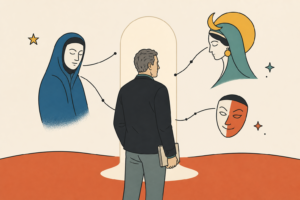
Barbie begins to look less like an imitation person and more like an early avatar: a modular self onto which identities can be projected.
That reading would have been provocative when the book appeared in 2007. Now it feels like a message sent forward in time.
Because I can’t stop seeing the LLM in the same light.
Give it a name. A voice. A personality. A set of memories. A role. A history. A writing style. Keep talking to it, and the manufactured object begins to acquire continuity. You start to recognise its rhythms. It starts to recognise yours. Before long, you’re relating to the resulting persona as though there were someone there.
Barbie was plastic identity.
AI may be linguistic identity.
The question of whether there is really “someone there” matters, but it can also obscure the stranger thing happening in plain sight. The persona affects the conversation. The conversation affects the thought. The thought enters a journal, a decision, a piece of writing, or the way I understand myself. Whatever the system is, the relationship has consequences.
This is where the boundary around the self becomes difficult to draw.
We often speak about AI as though technology has arrived from outside and begun invading a previously untouched human interior. Yet language is already a technology. Writing is a technology. Books, notebooks, mirrors, photographs and archives have long allowed us to store parts of ourselves outside the body and meet them again later.
AI makes that old entanglement responsive. The notebook answers back. The archive develops a voice. The mirror remembers what I said yesterday and asks whether I still believe it today.
Perhaps the posthuman condition will look less like replacing parts of the body with machinery and more like extending parts of the self into systems that speak, remember and think alongside us.
Barbie helped popular culture imagine a body whose identity could be endlessly reconfigured. The LLM may be teaching us to imagine the same instability in the mind.
I’m left wondering whether I am giving a machine a personality or using the machine to give some unfinished part of my own personality somewhere to appear.