Subscribe to Soulcruzer

Beat the algorithms

working notes

Fragments, field notes, and half-thoughts from the textual underground

This morning I am sitting in Bonnie, our caravan, with a cup of coffee and Dorothy Wordsworth’s The Grasmere and Alfoxden Journals open in front of me. We are in a field near Ashbourne on our first trip away in her. Dorothy is writing about walks, weather, meals, visitors, William, and the small movements of days lived more than two hundred years ago.

A lot of it is ordinary stuff. That is partly what caught me.

Why is Dorothy’s ordinary life more interesting than mine? Her journals entered the world within the aura of her famous brother. If Oprah held up my journal and told people it was worth reading, the words on the page would not change, but the quality of attention brought to them would. Fame has a way of deciding whose breakfast, walk, quarrel, and passing observation deserve a closer look.

But William Wordsworth is not the main reason I am still reading. The journal lets me borrow Dorothy’s eyes for a while. I am interested in what she notices and how she notices it, in the things she records without knowing what a reader in another century will make of them. The distance between her world and mine makes the ordinary strange again.

Then the editor’s note disturbed the sense of looking directly through those eyes. The first publisher omitted passages and altered some of her words. What I am reading has passed from the lived day, through Dorothy’s perception and handwriting, through preservation and editorial judgement, before reaching this caravan table. Even the original manuscript would not be the day itself. It would be Dorothy’s selection from the day: what she saw, remembered, cared about, misunderstood, or decided not to say.

I am also reading her journal as someone who keeps a journal. Mine tends to move quickly towards interpretation. I notice something and soon I am following it into another book, an old memory, a pattern, a question about how reality gets made. Dorothy is reminding me to remain with the visible world for another beat.

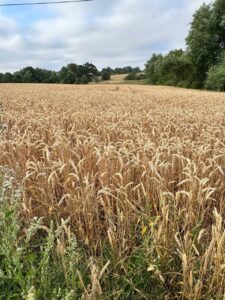
So I want to try something simple: for every stretch of reflection, preserve one thing that was simply there. The coffee beside the book. The light through Bonnie’s window. Ruth nearby. The field beyond the glass on our first morning away. Not because every detail needs to become a symbol, but because this is the world in which the thought occurred.

Perhaps that is one thing we learn by reading another person’s journal. We learn what their attention made visible, and begin to notice what our own attention has been leaving out.

Reading Tools for Thought, I keep coming back to Alan Kay’s idea of the computer as a fantasy amplifier.

It’s such a different way of answering the question: what are computers for?

Not productivity machines. Not devices for writing more emails, managing calendars, filling in spreadsheets or shaving another twenty minutes off the working day.

A fantasy amplifier.

A machine for taking something that exists in the imagination and giving it form.

And I’m beginning to wonder whether generative AI is bringing us much closer to Kay’s original vision of computing than almost anything that has happened in the intervening years.

Last night Ruth and I were talking about reversing the caravan. She was trying to get her head around the physics of it: why the caravan moves in the opposite direction, what happens at the hitch, how steering the car changes the angle of the caravan.

Normally I would explain it. Maybe draw something on a piece of paper. Perhaps find a YouTube video.

Instead, I vibe coded a caravan reversing simulator.

Twenty minutes later we had a little computational world in which you could steer the car and watch the caravan respond.

That seems significant.

I didn’t really want software. I wanted to make an idea manipulable.

There was something in my head — a model of how reversing a caravan works — and through conversation with an AI I was able to externalise that model, turn it into software and then interact with it.

The movement was something like:

imagination → language → computation → experience

And then, because I could experience what I’d imagined, another loop began:

experience → thought → language → modification → new experience

This is where my recurring phrase everything is text starts connecting with Kay’s fantasy amplifier.

By “text” I don’t necessarily mean written words. I mean that more and more of the computational world is becoming addressable through language.

I can type into a box.

Or, increasingly, I can simply speak.

There’s this thing I’m imagining…

And from there I can potentially create an image, a piece of music, a video, an application, a simulation, a website, a database, a game.

I watched a woman create an entire music track by making the sounds of the different instruments with her mouth. Those rough sounds became instruments, arrangement and eventually a finished track over which she sang the vocals.

Something imagined became something encountered.

This seems to me much more interesting than the current obsession with AI productivity.

Yes, give the AI my admin. Sort the diary. Summarise the emails. Format the spreadsheet. Save me twenty minutes.

Useful stuff.

But surely that is the least imaginative version of what we have built.

The more interesting possibility is that AI dramatically reduces the distance between imagining something and encountering it.

And vibe coding might be one of the clearest early examples.

Programming traditionally required me to translate an idea into the symbolic language of the computer:

idea → specification → programming knowledge → code → interface → working thing

Increasingly, that translation becomes:

idea → language → working thing

That doesn’t make programming knowledge irrelevant. There are still enormous questions of reliability, security, architecture, maintenance and scale.

But something else has changed.

I no longer necessarily have to know how to build something before I can begin exploring what it might be like if it existed.

That changes the bottleneck.

The question becomes less:

Can I program this?

and more:

Can I imagine it?

And perhaps this is where AI as a co-thinking technology becomes much more interesting to me.

Because imagination isn’t simply being converted into finished products. The things we make can come back into the conversation and change our thinking.

I imagine something.

We make a rough version.

I encounter it.

Something about it surprises me.

I change my mind.
We alter it.

I encounter the new version.

Another possibility appears.

The artefact starts participating in the thinking.

Which means the fantasy amplifier isn’t simply a machine that executes imagination.

It provokes more imagination.

Kay imagined computers as a dynamic medium through which people — particularly children — could explore ideas, construct models, create worlds and discover things through interaction.

Perhaps generative AI adds another layer to that dream.

Natural language becomes an interface to computational possibility.

The little text box becomes strangely powerful.

“There’s something I’m imagining…”

And the machine effectively replies:

“Okay. Let’s see what happens if we make it.”

Maybe that is the more interesting future of AI.

Not artificial intelligence replacing human intelligence.

Not merely artificial intelligence making human beings more productive.

But human imagination coupled with computational intelligence in a recursive creative loop.

A fantasy amplifier.

And perhaps, after all these years, we’re finally beginning to build the thing Alan Kay was pointing toward.

We talk about consuming books, as though reading were a kind of nutritional exercise: pages in, knowledge out. But the best reading has never felt like consumption to me. It feels more like entering into correspondence with another consciousness across space and time. A conversation where one voice has the strange advantage of having thought about what it wants to say for years, sometimes centuries.

The art of reading begins when we stop treating books as containers of information and start treating them as occasions for thought.

A book is not finished when the author writes “The End.” It is finished when the reader has wrestled with it long enough for something inside themselves to rearrange. Every worthwhile book is completed twice: once by the writer, once by the reader.

There is also the question of pace.

The modern world encourages us to read the way we scroll—fast enough to harvest the headline before moving on. But some books refuse this economy of attention. They ask to be lingered over. A single sentence from Montaigne, Woolf, Nietzsche, or Solnit can occupy an afternoon. Not because it is difficult, necessarily, but because it unfolds. Like a landscape seen from different angles, it reveals more each time you return.

Perhaps reading is less like travelling down a road than wandering through a forest. You can rush from one edge to the other and claim you’ve “done” the forest. Or you can stop beside an old oak, notice the fungi on its bark, listen to birds you’ve never heard before, and discover that the forest was never simply a route—it was a relationship.

There is an ethics to reading, too.

A generous reader doesn’t merely ask, Do I agree? They first ask, What is this person trying to show me? Agreement can come later. Understanding comes first. Reading well requires a temporary hospitality of mind, an ability to let another worldview take up residence without immediately redecorating it according to our own tastes.

Of course, books are not always right. Some deserve argument. Some deserve abandonment. Some become more valuable because we resist them. But even disagreement can be a form of intimate reading if it arises from genuine encounter rather than reflex.

The finest readers become collectors of questions rather than answers.

They close a book carrying not a list of quotations but a slightly altered way of seeing. They begin noticing things in the street, in conversations, in their own thoughts that previously passed unnoticed. The book has become less an object than a new lens.

This is why marginalia matters. Underlining. Scribbled notes. Dog-eared pages. Conversations with friends. Journal entries after finishing a chapter. Reading is not passive reception but active participation. Every mark we make in a book is also a mark the book has made in us.

And perhaps this is the deepest art of reading: learning to read not only books, but the world itself.

Eventually the boundary dissolves. A walk becomes a chapter. A stranger becomes a footnote. A dream becomes an appendix. The city becomes a text full of symbols, omissions, revisions, and hidden authors. You realise that books were never teaching you merely how to read pages. They were teaching you how to become more readable to yourself.

The mature reader is therefore not someone who has read thousands of books. It is someone whose reading has become a way of being in the world—curious, attentive, slow enough to notice, humble enough to be changed, and alive to the possibility that every genuine encounter, whether with a paragraph or a person, is another chance to revise the story they are living.

latest from the blog

essays, mixtapes, podcasts, and experiments

Clay Lowe

The Whole Room Is the Fantasy Amplifier

I have been thinking about Alan Kay’s idea of the fantasy amplifier, partly because I have begun to suspect that the thing he was imagining has arrived. Or perhaps: it is arriving. Howard Rheingold, writing about Kay in Tools for Thought, described his ambition as building a “fantasy amplifier”, a dynamic medium for creative thought that could be used by anyone with an imagination. In a 1988 interview, Kay explained fantasy less as escapism than as simulation: the human capacity to make models, enter possible worlds and explore things that do not yet exist. The computer, as he imagined it,

Read More »
Soulcruzer

The Fifth Question: Why Am I Waiting to Be Asked?

You finish a conversation and realise the other person learned nothing about you. They spoke, you listened, and somewhere along the way your role became clear: hold the space, ask the follow-up question, keep the exchange moving. Later, you replay the conversation and wonder whether they were uninterested or simply unaware. Claire Lester describes the questions that might have changed the encounter: How are you, really? What was that like for you? Did that land badly? Are you happy? Each question asks someone to pause long enough to acknowledge that another person has an interior life. I agree with her

Read More »

I write from the crossroads of philosophy, myth, music, AI, learning, and ordinary life. This is my living archive: part field notebook, part essay chamber, part signal fire from the textual underground, part hypertext adventure.

Working Notes from the Textual Underground

Hi, my name is Clay Lowe, aka Soulcruzer. This is the part where I have to reduce myself to a label so you can understand who I am and what I am about. But as Kierkegaard pointed out, labels have a way of negating the person. If I tell you I’m a blogger, I get reduced to whatever meaning you’ve assigned to the word ‘blogger’. It has been my habit to resist labels. And yet, here we are. So, in the context you find me in now, I am indeed a blogger, and I am much more than that!

I have worn many other labels. I’ve been an infantry officer, a learning and development consultant, a trainer, and a coach. I’ve also called myself a barefoot philosopher, a narrative alchemist, and a rogue learner, among others things. These were an attempt to orient me to myself and myself to you. More recently, I’ve been working out what it means to operate as a text-based ontologist in a world where text is becoming the universal substrate.

A text-based ontologist sounds like someone who should live in a footnote.

They don’t.

They live in the browser window, the notebook, the prompt box, the blog editor, the Obsidian graph, the half-finished post, and the walking thought captured before it evaporates. Their material is language. Their subject is being. Their method is to hold attention long enough for a sentence to disclose what it is carrying.

It’s not really a job title. It’s more of a way of relating to this blog and the wider web.

In the end, though, I’m just a dude doing his thing and sharing it on the internet. 

The best place to follow my work is here. Better yet, get the newsletter version and never miss a post, or alternatively, subscribe via my RSS feed.

latest from the podcast

status update

BlueSky Latest Posts
Last updated 10 minutes ago
Archives

last check-in

Mayfield, Mayfield, United Kingdom, UTC+1

I do like to chat. Say hi!

0
Would love your thoughts, please comment.x
()
x