I have been thinking about walking. This week has clarified something about why.
You stay alive to your life by staying in motion. The physical motion is part of it. The attention staying awake is the larger part. The question underneath: Do you have a practice that holds? A real one, lived rather than intended, that keeps the self porous and curious and in genuine contact with the actual world.
This is what Japhy Ryder understood. In The Dharma Bums, he has a vision: thousands of young Americans walking into the mountains with rucksacks on their backs, refusing the dream of the box, the car, the television flickering in every window at the same hour on every street. The rucksack on the back is proof of something. You’ve got what you need. You can go anywhere. The road is still there.
Guy Debord called the drift the dérive. The unplanned walk that follows what the Situationists called psychogeographic pulls: the alley that looks interesting, the hill appearing over rooftops, the smell you can’t identify that makes you turn left. The environment has its own intelligence. The dérive asks you to submit to it for a while. Go out without a destination. Come back having been somewhere you didn’t plan to go.
These two traditions, Kerouac’s rucksack revolution and Debord’s dérive, have always sat in separate rooms in my mind. One is wilderness, one is urban. One is spiritual, one is political. But this week I see what they share: both are practices of refusal. Both insist that the narrowing is a choice.
The wisdom walk is the thread that connects them. The older, quieter idea that walking itself is a form of thinking. That the body in motion produces a quality of attention that the desk can’t replicate. That ideas arrive on the path that won’t come any other way. Thoreau knew it. The Peripatetics knew it. The pilgrim walking to the Holy Land, à la Sainte Terre, knew it. Thoreau traced the word saunter back to those pilgrims. Every walk is a pilgrimage if you take it seriously enough.
This morning, before the day got going, I spent a few hours with Claude working on the about page, the worldview piece, and the values. The shape of things has never felt clearer. The vault as the living memory layer. Notes, fragments, essays, experiments. The snapshot photography coming back. The narrative alchemy coaching. The text-based ontologist stepping fully into the role: language as the primary instrument, the web as the native medium, the walk as the thinking engine.
At fifty-seven, I wrote: Act III is the reclamation. At fifty-eight, watching Roger leave with the top down and sitting with what this week has been, I understand it more bodily than I did. The cosmic dancer surrenders to the rhythm of the turning wheel. Actively, with great intention, having seen what the alternative looks like.
The rucksack revolution belongs to anyone who understands what the alternative looks like.
The recipe: go out without a fixed route. Carry what you need and nothing more. Let the environment pull you where it wants. Follow the thought that arrives. Trust that the thinking will happen if you stay present to it.
The walk is the answer. It has always been the answer. The question is whether you take it.
I’m going home to the Midlands this afternoon. Back to the flatlands.
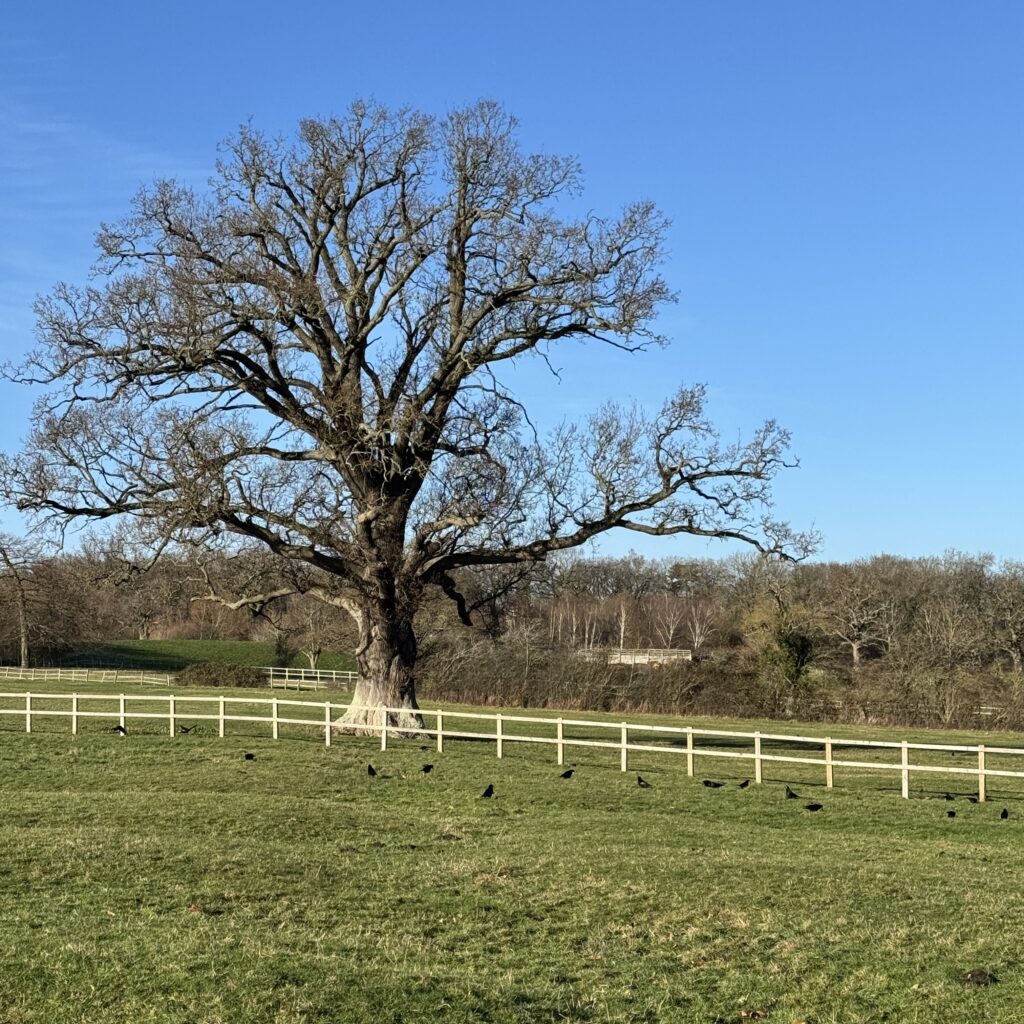
Out on today’s walk, I came across a field full of ravens (or rooks, I can never quite tell without a close-up). Hundreds of them, clustered around my favorite tree. These birds have always felt significant to me, in fact, at one point, they were my spirit animal. I love encountering them out in the wild at some random moment that insignificantly significant.
I was out unpacking my reflections from my morning quiet time. A simple question: what to do with a Saturday?
Odd that such a simple question spiraled into a philosophical reflection on the passage of time and more importantly, how I spend my time.
The Archaeology of Saturdays
Single. Days belonged to randomness then. Friends and impulse and whatever came next.
**
Marriage without children: a curatorial phase. Museums as weekend ritual. Art galleries. New cities mapped by their cultural coordinates. Restaurants collected like stamps.
**
Then: children.
The weekend stopped being mine. Became theirs. Prams pushed through parks. Playgrounds. Play groups. Days structured around their wonder, their growth, their needs. I was infrastructure now. The one who built the world they explored.
**
Later, when they needed me less: I remembered myself.
The sports hippie returning. Mountain bike tires on dirt trails. Rock face under fingertips. Paddle cutting water. Adventure races that pushed the body past what it thought possible.
North Face. Salomon. Leather bracelets. Granola eating… Every stereotype, fully inhabited. Not ironically. Earnestly.
**
Then Radio Warwickshire shifted everything again.
Weekends became sonic. Live music in small venues. Community events across Warwickshire. Interviewing unsigned bands. Photographing the indie scene. Connected to artists, to sound, to the underground pulse of things.
**
Each phase: a different Saturday. Each Saturday: a different self.
The Slump
And then… a dead period.
I remember asking on a podcast: “What do you do when you’ve done everything?”
Not literally everything, of course. But when you’ve climbed mountains before, when you’ve been to museums, when you’ve experienced the activities that once excited you, and the novelty fades. Yes, it’s a different mountain, a different painting, but the act is the same.
I hit that wall. The sameness of it all.
(Pausing here at a seasonal creek turned river by recent rain and snow. Someone’s built a dodgy crossing. Kid-me would have leaped across without thinking. Approaching-60-me is putting the phone in a dry bag first.)
Act Three Eyes
Maybe the answer isn’t finding completely new things. Maybe it’s revisiting old passions with new eyes.
A scaled-down sports hippie revival. More mountain biking. Wisdom walks in different locations (even if it means driving to the trailhead rather than rolling out my front door).
But now I’m experiencing these things through Act Three eyes. As a 57-year-old grandfather in the final act.
You know what Act Three is in movies, right? The climax has happened. You’re sliding toward the conclusion. UK male life expectancy: 82-84. I’m 57. Do the math.
So what do I focus on in Act Three?
I wrote about this recently on the blog. I need to revisit it myself as I orient toward 2026.
But first, I’m going to attempt this makeshift creek crossing.
A Wisdom Walk from Marston Doles to Napton-on-the-Hill
There’s something about the rhythm of the feet on a towpath that unlocks the mind. Today’s wisdom walk wasn’t just about getting my steps in after a morning glued to the screen. It was about working through the soul of what I’m building here.
The afternoon sun was warm on my back as I followed the canal from Marston Doles toward Napton-on-the-Hill. My phone buzzed with notifications, and my watch reminded me I was still shy of my daily movement goals, but none of that mattered. What mattered was the conversation happening between my walking self and my thinking self.
The Brand Revelation
I’d been wrestling with four different bio options for the Barefoot Philosopher rebrand. You know how it is; you can stare at words on a screen until they lose all meaning. But put one foot in front of the other, let the mind wander while the ducks paddle alongside, and suddenly clarity emerges.
“Barefoot philosopher helping contemplative rebels find wisdom in everyday moments.”
That’s it. That’s the line.
Not “intelligent misfits”; I feel like that’s too exclusive, too academic. I also don’t want to limit myself to “ancient wisdom”; that’s too narrow, despite my love for Marcus Aurelius and Seneca. The magic happens in those everyday moments. Like right now, walking this towpath, working through the very essence of what wisdom means in motion.
Ancient Philosophy Meets Morning Coffee
The second line came easier after that: “I blend ancient wisdom with modern insights for a soul-led life.”
But here’s where it gets interesting: that phrase I’d been playing with, “ancient philosophy meets morning coffee,” suddenly revealed itself not as a bio line but as something bigger. It felt like a podcast waiting to be born. Can you picture it? Recording from actual coffee houses, maybe finding a co-host who shares the vision, and bringing those contemplative moments to life in real conversation.
The Barefoot Wisdom Cafe isn’t just a concept; it’s a practice. It’s the morning coffee contemplations, those stolen moments of reflection between the chaos. You don’t need to carve out massive chunks of time for wisdom. Sometimes it’s just grabbing a coffee and having a think.
The Mobile Warrior’s Epiphany
Somewhere between the duck family (mama with nine little ones—what a sight) and the impromptu concert from a fellow traveller, it hit me: this is how real work gets done. Not chained to a desk, but moving through the world, processing ideas in motion.
The irony wasn’t lost on me that I was solving my bio problem while literally embodying the solution of walking slow enough for the soul to catch up.
The beauty of this mobile approach isn’t just the thinking space; it’s the human connections that happen when you’re present in the world. A canal boat crew six hours into their journey from Hayford to Cosgrove. A quick exchange about the lovely weather, about needing fresh air after screen time. Real conversation with strangers instead of just text messages with strangers.
That’s the difference between living behind screens and living in the world. Both have their place, but the balance matters.
The Wisdom in Walking
As I found my way back through overgrown trails and boundary markers, dodging hungry mosquitoes and losing my lens cap to curious brambles, the third line crystallised: “Walking slow enough for the soul to catch up.”
This isn’t just poetic flourish; it’s a methodology. It’s recognising that our best insights often come not when we’re pushing hard but when we’re moving at the pace of reflection. When we give our deeper selves permission to join the conversation.
The contemplative rebels I want to reach? They already know this. They’re the ones who’ve sensed that there’s more to life than the hustle, more to wisdom than the latest productivity hack. They’re ready for the ancient stuff, yes, but applied to right now, right here, in the everyday moments that actually make up a life.
Building Something Real
By the time I reached my car, I had covered 3.38 miles, solidified my bio decisions, and conceptualised an idea for a new podcast series. I realised I’d done something that couldn’t have happened at my desk. I’d thought with my whole self, not just my head.
The Barefoot Philosopher isn’t just a brand I’m building; it’s a way of being I’m remembering. One foot in the ancient wisdom traditions, one foot in the messy, beautiful reality of modern life. Walking the path between them, slow enough for the soul to catch up.
The X platform might be controversial these days, but it’s still solid for micro-blogging. That’s where this next phase launches. Short reflections, daily wisdom, and the kind of content that meets people in their everyday moments rather than demanding they carve out special time for enlightenment.
Because here’s the thing about contemplative rebels: we don’t need permission to think deeply. We just need reminders that it’s possible, practical, and actually more efficient than the alternatives.
The trail always leads home, but the walking changes everything.
This post was composed during and after a wisdom walk through the Warwickshire countryside. Sometimes the best way to write about walking is to actually walk first.
Sunday evening. The rain has passed; the clouds linger. I’m out on a wisdom walk letting my feet meet the earth and my thoughts catch up with my breath.
The day began scattered. Too many moving parts: the sale of the old truck and the logistics of the new one—registrations, license plates, and tax. My house, in a state of lived-in chaos, mirrored my mind. Inner clutter. Outer clutter. Echoes of each other.
When I’m in that state, one thing that helps me is getting physical. Doing something with my body gives my mind a break from itself. So I turned to the shed. It needed sorting, and I needed centring. By midday, we were in a rhythm. Lifting, moving, organising. A kind of shed-zen. It brought me back into my body, and with it came a clearer mind.
Now I’m walking and reflecting. I didn’t want to end the day sitting. Movement sharpens insight. This is something I’ve been returning to all week: the connection between walking and thinking. Between motion and meaning.
This week’s theme has beenphilosophy as a way of life. Pierre Hadot has been my guide, reminding me that philosophy isn’t meant to be confined to the lecture hall. It’s meant to be walked, spoken, and lived. Rebecca Solnit’s Wanderlust added fuel to the fire, tracing the long lineage of thinkers who took their thoughts on foot. From Socrates to Rousseau, Nietzsche to Thoreau. Philosophy has often worn out the soles of its shoes.
For me, this is it. Reading, reflecting, walking, writing, talking, and sharing. That’s the core of my game. Everything else can orbit that.
The insight that lands tonight is simple. Do the thing. Don’t just think about it. Don’t just map it endlessly. Embody it.
Walk the walk. Talk the talk. Play my game. Let the rest go.
As the Stoics remind us, what others think, say, or do is none of our business. Our business is what lies within our control. What lies within my control is showing up fully, soulfully, and doing the work that calls me.
So here I am. Out walking beneath a soft sky. Speaking my reflections into the air.
This morning, 7:13 AM, Croatian hat settled on my head, backpack loaded with gear I probably don’t need. The familiar circuit calls—out the front door, down to the path, into the rhythm that unwinds whatever the mind has been tangling.
The weekend just passed brought a new soul into our family circle. A tiny human, barely breathing outside the womb, is already reshaping the geometry of time around her. My son and his partner, young and bright-eyed in that particular way of first-time parents, hold this small mystery while I watch from the strange vantage point of a newly minted grandparent.
From here, I can see it all clearly: the great arc of time stretched before me like a walking path. On one end, my son’s young family at the beginning of their story, all possibility and sleepless wonder. On the other end, the great-grandparents in their seventies and eighties are sliding into the twilight of their years. And here I stand in the middle, the trajectory of my life made visible through them.
It’s this unique position, actually, when you think about it. You’re seeing what your past looked like—young family, all that energy and chaos. And you’re seeing what your future looks like, too, in 20 years or so.
The circle of life isn’t just a Disney lyric anymore; it’s the living geometry of generations, each one watching the others from their place on the arc. If I look at this through the lens of a classic story, I see myself entering the beginning of Act III.
The Questions That Matter
This middle space brings different questions than the earlier acts. Not “What do I want to become?” but “What legacy am I leaving?” Not “How do I succeed?” But “What stories will they tell about Pops when I’m gone?”
When I held my son for the first time, I was nearly the same age he is now. Our parents then were the age we are today. It’s this beautiful symmetry—time folding back on itself like the path I’m walking this morning, each generation experiencing the same wonder, the same protective fear, and the same overwhelming love for something so small and vulnerable.
But what changes in this middle position is perspective. When you’re young with a baby, you’re just surviving—feeding, changing, soothing, hoping you don’t break this precious thing. When you’re watching your child become a parent, you’re witnessing the miracle from a different angle entirely. You see the continuity, the great river of life flowing from one generation to the next.
The Grandfather’s Craft
So what does it mean to be a grandfather in this story? Not just biologically, but as a role, a craft to be learned?
I think about my own grandfather—the stories that have survived about him, the fragments of wisdom that somehow made it through the decades to shape who I am today. Most of what he said is lost to time, but the essence of him, the way he moved through the world, somehow got passed down from my father to me.
Now I’m the one creating those fragments for this tiny girl sleeping in Ludlow. What essence will I leave behind? What will she remember about Pops when she’s older?
The weight of this hits me about halfway through my wisdom walk, near the old tree that marks the return point. I’m not just responsible for my own story anymore. I’m helping to author the opening chapters of hers, laying down the foundation stories she’ll carry forward.
The Wisdom Walk Philosophy
This is where the barefoot philosopher thing starts to make sense. Not as some marketing gimmick or personal brand, but as a way of being that’s worth passing down. The grandfather who goes for wisdom walks, who thinks out loud, who wonders about the big questions while his feet find familiar paths.
Maybe that’s what philosophers are really for—not to write dense academic papers that gather dust, but to model a way of engaging with life that’s curious, contemplative, and present. To show the next generation that it’s okay to take time to think, to walk, and to wonder.
I imagine taking her on these walks when she’s older. Little legs trying to keep up, asking those beautiful questions that only children ask: “Why do leaves fall down?” “Where do thoughts come from?” “What makes the sky blue?” And instead of rushing to Google for answers, we’ll walk and wonder together.
The Story I Want to Tell
The morning mist is lifting now, and I can see the Holy Well ahead—that ancient spring where people have been coming for centuries seeking healing, wisdom, and connection to something larger than themselves. It occurs to me that this is exactly what I’m doing on these walks, what I want to teach her to do: to seek out the sacred in the ordinary, to find wisdom in movement, and to trust that the answers we need often come when we stop trying so hard to find them.
When she asks about her grandfather someday, I want the stories to be simple but true: He went for walks. He thought about big questions. He paid attention to small things. He believed that wisdom came from living fully, not from accumulating facts.
I want her to know that he chose presence over productivity, curiosity over certainty, wonder over worry. That he tried to live authentically, even when—especially when—the culture around him was obsessed with performance and appearances.
The Raw Experience of Love
Here’s what I’m learning as I circle back toward home: the most profound experiences can’t be manufactured or marketed. You can’t optimise your way into the feeling of holding your grandchild for the first time. You can’t productivity-hack the moment when she first recognises your face and smiles.
This is raw experience at its most essential—love that requires no craft, no strategy, and no improvement. Just presence. Just showing up fully to the miracle of another human being who carries your family’s story forward into an unknown future.
All my life I’ve been trying to learn crafts—writing craft, video craft, and marketing craft. But maybe the most important craft I need to master now is the craft of being a grandfather. And that craft is surprisingly simple: Pay attention. Show up. Love without condition. Walk and wonder and trust that the wisdom will come.
Coming Home
The familiar gate appears ahead, my circuit complete. Backpack heavier now with the weight of these thoughts, but my step lighter somehow. The questions that seemed so urgent an hour ago—about careers and content and finding my authentic voice—feel less pressing now.
I’m a grandfather. That’s the story that matters. Everything else is just details.
The little one sleeping in Ludlow will wake soon to a world full of wonder and confusion, beauty and pain. My job isn’t to prepare her for it all—that’s impossible. My job is to show her that it’s possible to walk through it with curiosity, with presence, and with love.
To show her that wisdom isn’t something you arrive at but something you practise daily on whatever path you choose to walk.
The Holy Well bubbles quietly behind me as I head toward home, carrying this ancient blessing forward: may you find healing in movement, wisdom in wondering, and love in the simple act of paying attention.
Time to see what we can make of this beautiful, ordinary morning.
Pops and Rosie sharing a barefoot philosopher’s moment.