I’ve been on the road for most of the past couple of weeks, which has disrupted my blogging routine a bit. During times like this, I tend to shift my focus to microblogging. Up until now, I’ve mainly stuck to Twitter (or X) and Instagram for that, but with all the shenanigans on X and the opaque algorithmic trickery on platforms like Instagram and Threads, I’ve been gravitating more toward Bluesky as my go-to microblogging platform.
If you’re already on Bluesky, let’s connect—my handle is @soulcruzer.bsky.social. If you’re not on the platform yet, I’d recommend giving it a shot. It’s a lot more social (at least for now), open-source, and doesn’t rely on the same algorithmic games that suppress posts because you’re not “one of the cool kids” or because you dared to include a link. Your posts are more likely to reach your actual circle of friends. For these reasons, Bluesky has become my favourite public microblogging space—second only to my own blog, of course.
Now, on to some updates. I have a backlog of posts I want to share here, including continuing The Mirror of Echoes mystery play and Mapping the Geography of the Psyche. This weekend, though, my focus is on finishing a Twine game I’ve been working on. The project serves a dual purpose: it’s a hypersigil for me personally, and it’s also laying the groundwork for a new philosophy I’m developing around the idea of cultivating personal power through chaos.
Looking ahead to 2025, my focus will be on exploring art as the last bastion of magick and championing chaos magick as a means of cultivating personal power. It’s going to be an exciting year, with a lot of experimentation, creativity, and deeper dives into these themes. Stay tuned!
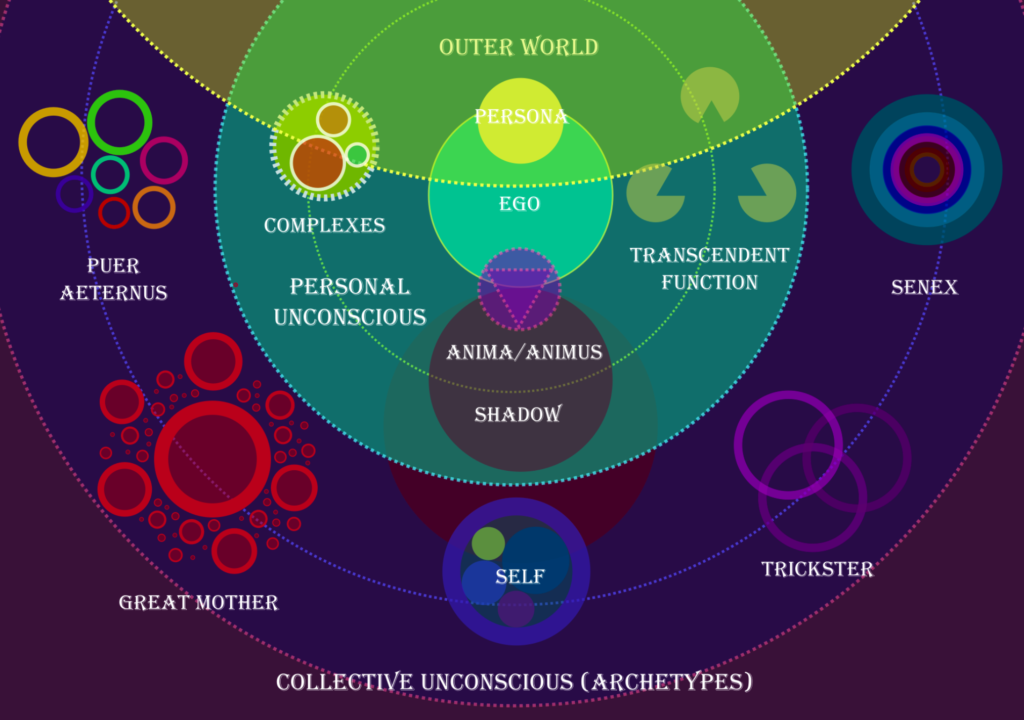
This is a beautiful visualisation of Carl Jung’s model of the psyche, particularly focussing on the interactions between the conscious and unconscious mind. Here’s a breakdown of its elements:
Outer World: Represents the external reality and social environment we navigate.
Persona: The social mask we wear to interact with the outer world, shaped by societal roles and expectations.
Ego: The centre of our conscious identity, responsible for decision-making and self-awareness.
Personal Unconscious: Contains repressed memories, thoughts, and emotions, along with personal complexes that influence behaviour.
Complexes: Patterns of emotions, memories, and perceptions organised around common themes (e.g., power, inferiority) and often triggered by specific experiences.
Anima/Animus: The unconscious feminine (Anima) or masculine (Animus) aspects within individuals, representing the balance of internal energies.
Shadow: The hidden, often darker aspects of the personality that are repressed or denied by the conscious mind.
Self: The core of the unconscious, representing the totality of the psyche, integrating both conscious and unconscious aspects. It connects to archetypal energies.
Collective Unconscious: A shared level of the unconscious that houses universal archetypes, such as the Great Mother, Trickster, Senex (wise old man), and Puer Aeternus (eternal youth).
Archetypes: Universal, recurring symbols or patterns (e.g., Trickster, Great Mother) that influence human behaviour and experiences.
Transcendent Function: bridges the conscious and unconscious, enabling psychological growth and self-integration. This function helps mediate between opposites like the persona and shadow.
Overall, this diagram is a guide to understanding the layers of Jungian psychology and the journey towards individuation—integrating all parts of the psyche to achieve wholeness.
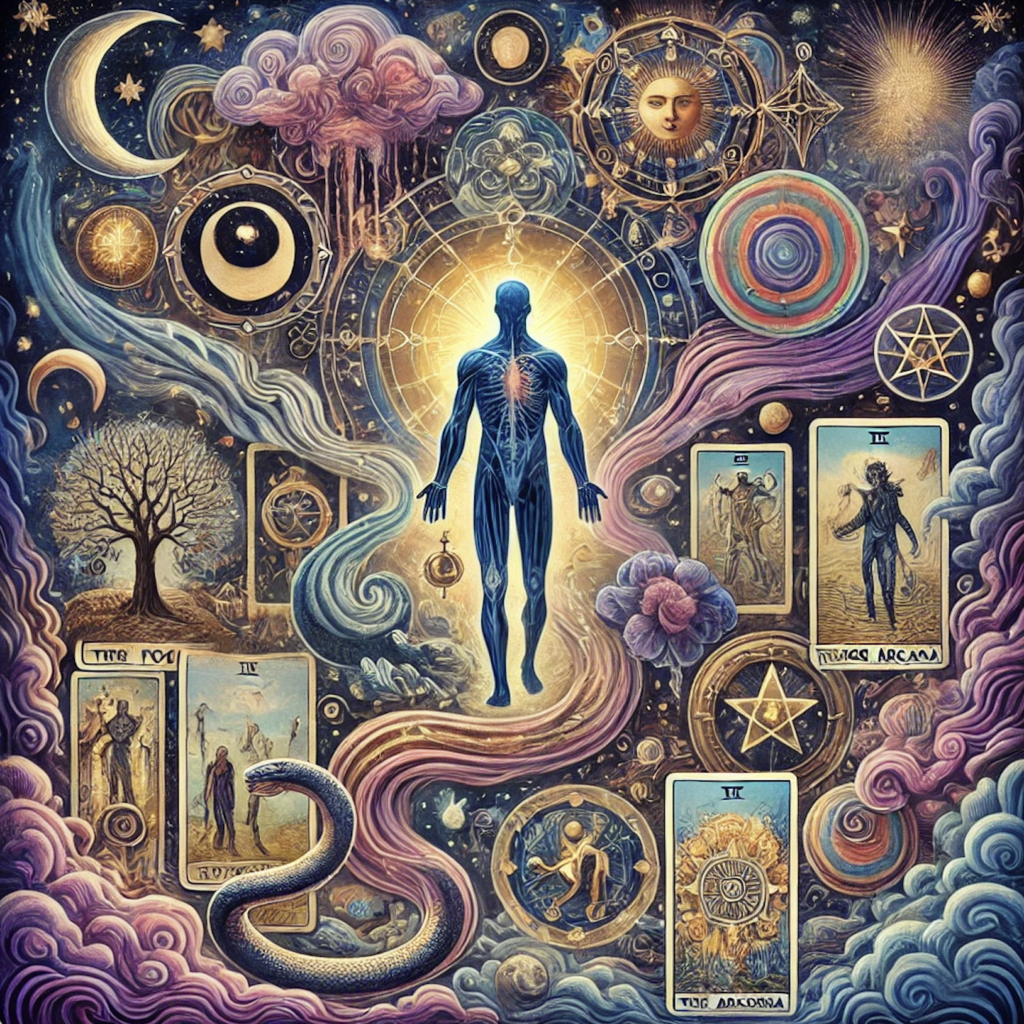
The Tarot and Jungian psychology are intimately connected in their shared concern with the deep layers of the psyche and their reliance on archetypes to convey spiritual, psychological, and existential truths. Both systems offer symbolic maps that help navigate the inner world, facilitating self-reflection and personal growth. By exploring the structure of the Tarot deck through the lens of Jungian psychology, we can begin to see how the layers of the psyche correspond to different parts of the deck, offering a profound tool for self-understanding.
The Major Arcana and the Collective Unconscious
In Jungian psychology, the collective unconscious is a level of the psyche that transcends personal experience. It contains archetypal images and motifs that are shared among all humans, regardless of culture or time. These archetypes are expressions of universal human experiences: birth, death, love, power, transformation, and so on. They are not accessible through the conscious mind but reveal themselves in myths, dreams, and symbols—very much like the Major Arcana in Tarot.
The 22 cards of the Major Arcana can be seen as archetypes that emerge from the collective unconscious. They represent fundamental forces and stages of the human journey, from the Fool’s initial leap into the unknown to the World card’s completion of the cycle. Each card carries deep symbolic meaning that reflects universal experiences. For example, the Magician is a powerful figure of creation and will, echoing the archetypal image of the hero or creator in Jungian thought, while the Hermit represents the seeker on a quest for inner wisdom, akin to the Jungian archetype of the Wise Old Man.
These Major Arcana archetypes can be likened to “guides” within the collective unconscious, shaping our experiences and prompting transformation. When we pull a card from the Major Arcana, we are accessing these universal forces, encountering figures that mirror core spiritual or psychological experiences.
The Minor Arcana and the Personal Unconscious
The personal unconscious in Jungian psychology consists of memories, experiences, and complexes that are unique to the individual but are often buried beneath the surface of conscious awareness. This layer is shaped by personal history and development, and its contents can influence behavior, emotions, and thoughts in subtle but profound ways.
The Minor Arcana, which consists of four suits, can be seen as representing the more personal, day-to-day aspects of life that are rooted in the personal unconscious. Each suit—Pentacles, Cups, Swords, and Wands—corresponds to different dimensions of human experience:
Pentacles (Earth) relate to the material world and physical reality, including issues of work, security, and the body.
Cups (Water) represent the realm of emotions, relationships, and inner feelings.
Swords (Air) symbolize the intellect, communication, and conflict—reflecting the mental and psychological challenges individuals face.
Wands (Fire) stand for creativity, action, and inspiration, embodying the drive to express oneself and manifest ideas into the world.
These suits echo the personal unconscious by delving into the specific, everyday manifestations of our unconscious energies. If the Major Arcana are the grand archetypes of existence, the Minor Arcana depict how these energies are channeled into our lives through thoughts, feelings, and actions.
The Court Cards and the Ego
In the Tarot deck, each suit contains four Court Cards: the Page, Knight, Queen, and King. These figures represent various aspects of personality and are often seen as different facets of the ego. In Jungian terms, the ego is the center of consciousness, the part of the psyche that organizes thoughts and perceptions and manages day-to-day interactions with the external world.
The Court Cards, then, can be understood as expressions of the ego’s role in navigating different domains of life:
Pages often represent youthful, exploratory aspects of the ego, a willingness to learn and grow.
Knights are dynamic and action-oriented, reflecting the ego’s drive to engage and shape the external world.
Queens embody a more mature, nurturing approach, balancing action with insight and emotional intelligence.
Kings are the culmination of mastery within their element, symbolizing a balanced and fully realized ego that has developed wisdom and authority over its domain.
The Court Cards show us how the ego relates to the different energies of the suits and offers insight into how we might integrate these aspects of our personality into a cohesive whole.
The Fool’s Journey: A Map of Individuation
The Tarot can also be viewed through the framework of Jung’s concept of individuation—the process of becoming whole by integrating the unconscious into conscious awareness. The Fool’s journey through the Major Arcana can be seen as a symbolic representation of this process.
Beginning as the Fool, who represents pure potential and innocence, we journey through the stages of life, encountering figures that correspond to various archetypal forces—the Magician, the Empress, the Devil, and so on—each one inviting deeper self-awareness and integration of unconscious material. As we meet these archetypes, we are forced to confront different layers of our psyche, from the personal complexes represented in the Devil to the transcendent unity found in the World.
By completing the Fool’s journey, we approach individuation, a state where the conscious and unconscious are harmoniously balanced, and the individual has fully realized their true nature. The Tarot offers this journey as both a personal map and a universal pattern, helping seekers make sense of their inner world through myth and symbol.
Conclusion: Tarot as a Mirror of the Psyche
The Tarot and Jungian psychology are complementary systems that offer a rich, symbolic language for exploring the human soul. The Major Arcana corresponds to the collective unconscious, the Minor Arcana to the personal unconscious, and the Court Cards to the ego. Together, they map out the journey of individuation, helping us to see not only the forces that shape our lives but also the path toward greater self-awareness and integration.
The Tarot, then, becomes more than a divinatory tool; it is a mirror of the psyche, reflecting back the archetypal forces and personal energies that govern our inner world. By engaging with the cards, we engage with the deepest aspects of ourselves, opening the door to transformation and wholeness.
I’m restarting the community pages here using BuddyPress and BBPress. If you’re not already a member of the site, you can register and create your own profile here on soulcruzer. I’ll get a group and a forum started shortly.
I’m restarting the community pages here using BuddyPress and BBPress. If you’re not already a member of the site, you can register and create your own profile here on soulcruzer. I’ll get a group and a forum started shortly.
I find myself tapping into this deeper way of seeing whenever I’m walking in the woods or doing one of my shamanic journeys. There’s something about being in those spaces, surrounded by nature or in the stillness of inner exploration, where myth and symbol come alive for me. It’s as if they rise up from the earth or the depths of my mind, guiding me through the familiar patterns of life—birth, death, love, and transformation.
For me, the mythic imagination is about seeing the world through the lens of myth and symbolic storytelling. It’s about accessing that well of archetypal narratives that sit at the core of who we are, as humans.
These stories aren’t outdated or irrelevant; they’re alive, dynamic, and constantly shifting but always reflecting something essential. Myths, to me, are like mirrors that reflect my subconscious mind back to me. They are stepping stones to the collective unconscious.
Lately, I’ve been reflecting on how I might bring this sense of the mythic into my coaching practice. It feels like an untapped resource, something that could help people access the deeper, archetypal stories that are shaping their lives, whether they’re aware of them or not.
I think weaving mythic wisdom into the work I do would help people see their lives as part of a greater, unfolding story.
Metamodernism seems like an interesting space to play in. I came across the term a while back when I was exploring postmodernism, and I asked the question what comes after postmodernism. I didn’t go any further than asking the question. But now metamodernism has resurfaced and has my attention.
What it is:
Metamodernism is an intriguing concept that seeks to describe the cultural landscape we’re living in—a world that’s not quite postmodern but something beyond it. It’s a reaction to the jaded scepticism and irony of postmodernism, while also recognising that modernist idealism, with its rigid structures and belief in progress, isn’t a viable return either. If modernism is the bright, clean dawn of possibility and postmodernism is the late-night self-reflective doubt, metamodernism might be the early morning hours, caught between both—where sincerity and irony, hope and doubt, optimism and scepticism are all swirling around together.
I love the idea of winking at our irony while still engaging earnestly with things that matter to me. It’s like not taking myself too seriously, even about serious matters:
Metamodernism doesn’t discard postmodern critique; instead, it tries to move forward by oscillating between these contrasting impulses. It acknowledges the fragmentation and uncertainty postmodernism exposed, yet it seeks to reclaim a sense of meaning, wonder, and connection in a world that often feels detached and absurd. So, rather than living in permanent irony, metamodernism suggests that we can “wink” at our irony while still engaging earnestly with things that matter to us.
There’s a playfulness to it, like juggling multiple truths at once.
The term itself hints at this fluid movement—”meta” means beyond, and “modernism” ties back to the optimism of earlier times, but metamodernism doesn’t just move forward; it loops back, reshapes, and synthesises elements from different eras. You’ll find it everywhere, from art and literature to music and philosophy. It’s especially visible in pop culture, where people can deeply care about something while simultaneously poking fun at it.
Millennials and Gen Z apparently have it the way they engage with content:
There’s a sense of deep emotion mixed with humour, irony blended with authenticity. Memes, for example, might capture a profound truth about loneliness or anxiety but do so with a sort of knowing smirk. In a metamodern sense, it’s as if they’re saying, “Yes, life is absurd and fragmented, but in recognising that, we can still care, we can still create meaning.”
Something that struck me as interesting is the fact that the Christian church used to wield so much power.
I’m looking at this 12th century church and thinking that once upon a time, tomorrow, Sunday, this church would have been packed.
Everyone in this village would have attended the service and people would have noticed if you weren’t at the there.
Fast forward to tomorrow and I suspect if I were to step into this same church, there would be hardly anyone here. This contrast made me reflect on the immense influence Christianity once had—not just on the people, but on the state, on every aspect of life. It’s remarkable to consider the distance between the church’s former power and now.
If you’ve been enjoying my posts, I’ve got something new to share with you. I’ve added a dedicated Support page to the blog, offering a few easy ways to show your appreciation. Whether you want to buy me a virtual coffee via Ko-Fi, send a Bitcoin tip, or use PayPal, you can now choose the option that works best for you.
Your support, whether through kind words, sharing the blog with others, or even a small donation, means the world to me. It helps keep this space ad-free and allows me to focus on bringing you more content that resonates. So, if my writing, musings, or projects have inspired you, and you feel called to contribute, know that it’s deeply appreciated.
Thank you for being a part of this journey and for helping me continue creating from a place of passion and purpose. 🌟
At first glance, according to Juniper, the answer seems like an obvious “yes.” Our world feels like it’s been plucked from the pages of Neuromancer, with its omnipresent technology, fractured power structures, and a pervasive sense of surveillance. Yet, I don’t think it’s a direct mapping of the dystopia they projected. It feels like the vision has evolved, subtly blending cyberpunk’s dark edges with the mainstream.
In classic cyberpunk, technology is often portrayed as a double-edged sword—liberating in some ways but soul-crushing in others. Think of Blade Runner’s dark cityscapes, where towering corporations loom over fragmented human lives. Our world does mirror some of this. The pervasive nature of the internet, social media, AI, and corporate dominance is very real. We’re often glued to our phones, communicating through virtual avatars (even with people in the same room).
There’s a sense of alienation lurking about…
What the cyberpunk writers couldn’t quite foresee was the allure of today’s tech. Devices have become sleek, desirable, and fashionable. They’ve been woven into the fabric of our identity, unlike the clunky tech of cyberpunk visions. Our dependence on technology might still be dystopian in the sense of control and surveillance, but it doesn’t feel dark—it feels… glossy and aspirational. We’ve domesticated dystopia, made it shiny and friendly, even as it controls us.
Cyberpunk’s megacorps ruled over cities like deities, omnipotent and untouchable. While that image has merit in today’s tech titans like Amazon, Google, and Meta, the landscape is more fragmented than the classic dystopian model suggested. Yes, corporations wield immense power over data, privacy, and consumption patterns, but the rise of decentralised networks and cryptocurrencies has introduced wildcards into the game.
Instead of a monolithic control structure, we see micro-realities. People operate in different silos of information and ideology, each governed by its own influencers or digital fiefdoms. There’s a certain chaotic freedom within this fragmented corporate dominance, but it’s hard to tell who’s really pulling the strings. The old cyberpunk vision of top-down domination has mutated into something both more subtle and complex.
Cyberpunk’s heroes often lived on society’s fringes, hacking systems, rebelling against oppressive structures, and operating within digital black markets. In many ways, this spirit still thrives. Think of the hacker communities, crypto enthusiasts, and advocates for digital privacy. Movements like Anonymous or Wikileaks fit the cyberpunk mould, but with today’s tech evolving so quickly, the lines between rebel and conformist blur.
What’s fascinating is how the counterculture has shifted. The cyberpunk rebel once fought from the outside, with a sense of desperation or hopelessness. Today’s “hackers” can be entrepreneurs, operating within the system while pushing against its boundaries. Subversion has become commodified, and dissent often feels like just another consumer choice. We’ve got edge, but it’s Instagrammable.
If there’s one thing that cyberpunk nailed, it’s the creeping pervasiveness of surveillance. The future it described, where privacy is a quaint relic, is pretty much our reality. Data harvesting, facial recognition, and digital footprints make it near impossible to operate outside of the system. But here’s the twist—most of us accept it. We trade privacy for convenience without blinking. In the cyberpunk world, surveillance was an omnipresent threat, something to avoid or hack around. In our world, we invite it in, giving away data in exchange for entertainment, connection, and ease.
It’s not just about being watched—it’s about being visible. The digital panopticon that cyberpunk writers feared has evolved into something stranger: a reality where people willingly curate their lives for the pleasure and consumption of others. Instead of resisting surveillance, we participate in it.
So, are we living in a post-cyberpunk world?
In a way, yes. We’re in a world where the cyberpunk dream has been realised, but not in the way those stories suggested. The gritty, neon dystopia imagined by Gibson, Ridley Scott, and others has unfolded, but it’s not the world of outlaws and rebels—it’s a world where we’ve made peace with the dystopia, integrated it into daily life, and dressed it up with a smile.
What’s most chilling isn’t that the cyberpunk future arrived; it’s that we don’t even recognise it as dystopia anymore. The fusion of tech, surveillance, corporate power, and fragmented realities have all seeped into our lives so seamlessly that the dark vision has become mundane. We’ve normalised the weirdness, celebrated the corporate power structure, and embraced the technology that simultaneously frees and binds us.
We may not have the flying cars or chrome-plated streets, but we are undeniably living in the post-cyberpunk world. The neon lights are still there, just hidden behind the blue glow of our screens.
“The master in the art of living makes little distinction between his work and his play, his labour and his leisure, his mind and his body, his education and his recreation, his love and his religion. He hardly knows which is which. He simply pursues his vision of excellence at whatever he does, leaving others to decide whether he is working or playing. To him, he is always doing both.”
This quote has been attributed to several different sources, so I’ll leave it to the internet to sort out. For me, it has been the Golden Barge I’ve been chasing all of these years. But like for Jephraim Tallow, it has remained forever, just around the bend or up ahead in the distance, in the fog.
If you’re not familiar with Tallow, he’s the main character in Michael Moorcock’s novella The Golden Barge. He’s a young and introspective man who embarks on a surreal and existential journey. Jephraim is driven by a desire to follow a mysterious golden barge that he glimpses on the horizon. It’s a symbol of his yearning for meaning and transcendence.
The story is deeply allegorical, with Jephraim’s quest often interpreted as a search for purpose or self-discovery. Moorcock uses Jephraim’s odyssey to explore philosophical themes such as identity, free will, and the nature of reality. The character of Jephraim is both deeply flawed and intensely reflective, making him a quintessential anti-hero in Moorcock’s literary tradition.
I know we’re not supposed to attach any outcomes to meditation, but I often hope my golden barge is waiting for me on the other side of meditation.
judgement is a kind of cheap currency. it’s easy to spend, requires little thought, and rarely offers much value in return. and who better to deal in such currency than the fool because they neither recognise its worthlessness nor perceive its true cost…
the fool is quick to judge because they see only the surface of things. they like putting things into neat little boxes like “good” and “bad,” “right and “wrong.” this binary thinking is comforting in its simplicity because it relieves them of the burden of understanding and dealing with the complexity and ambiguity of the human experience.
judging often reveals more about the person doing the judging than it does the person or thing being judged!
better to choose humility over arrogance.
wouldn’t it better to leave the judging to the fools?
as it seems…adding the ActivityPub plugin to the site was supposed to take a few minutes. the videos make it look as easy as clicking a few links…well I can’t say the experience of a few minutes has been reality.
surrender is such an evocative word. it conjures up images of white flags and final breaths and giving up. but what i’m beginning to realise is that in the space of spirituality, surrendering isn’t about giving up, it’s about giving in. it’s about leaning into the flow and allowing life to unfold instead of exhausting yourself trying to force life to happen.
something i still need to deal with though is my lingering belief that surrendering is a passive act, and as an action man, this goes against the grain of who i believe myself to be.
my digital garden is more of a jungle right now, wild and untamed. i’m going to have to hack through the overgrowth and do some much needed pruning to get it to where i want it to be…work in progress
This is my first use of the IndieBlocks plugin, which is meant to allow me to post short-form content by way of a custom post type. The neat thing is it auto-generates titles like Notional Velocity does, which helps enable writing quick notes without having to fuss with coming up with a title. The Notes posts are meant to be quick and dirty, like a tweet.