We treat meaning like it’s some luxury add-on to life, like it’s something you get to once you’ve checked all the boxes. But that’s backwards. Meaning isn’t the cherry on top. It’s in the foundation, right up there with food and water and air.
You can suffocate without oxygen and starve without food. But without meaning? You drift. You’re technically alive, but there’s this hollowness. Yeah, you’re breathing, but nothing’s actually anchoring you to the ground.
People will push through absolute hell if they think it means something. But give someone a comfortable life with no purpose? That comfort curdles into despair pretty fast. A prisoner in a labour camp can survive on crusts of bread if he has a reason to live, as Viktor Frankl showed. Yet a millionaire in a mansion, stripped of purpose, can feel more impoverished than the beggar on the street.
So when we say humans need meaning, we’re really saying that stories, myths, and purpose are the nutrition we need for the soul. Like vitamins you can’t see but absolutely need. Take them away, and even the most beautiful life feels like a wasteland.
Meaning doesn’t just rain down from the sky. You don’t wait around for it to arrive. You make it. You choose it. Sometimes you have to rip it back from the edge of despair. Living well isn’t just about keeping your body going. It’s also about wrestling with meaning until it settles into your bones.
That’s why stories, myths, philosophy… none of that is extra. They’re not for when you have spare time. They are the oxygen your inner life breathes.
‘Nam Sibyllam quidem Cumis ego ipse oculis meis vidi in ampulla pendere, et cum illi pueri dicerent: Σίβυλλα τί θέλεις; respondebat illa: ἀποθανεῖν θέλω.’
Translation:
“For I myself saw the Sibyl of Cumae with my own eyes hanging in a jar, and when the boys asked her: ‘Sibyl, what do you want?’ she replied: ‘I want to die.’”
This line is the epigraph of T.S. Eliot’s The Waste Land.
Who is the Sibyl of Cumae?
The Sibyl was an ancient prophetess, most famously associated with Apollo. The Cumaean Sibyl appears in Virgil’s Aeneid, where she guides Aeneas through the Underworld. But over time, her myth twisted into something more tragic.
According to legend (and captured in Petronius’s Satyricon, from which this quote is lifted), the Sibyl asked the gods for eternal life—but forgot to ask for eternal youth. So she aged… and aged… and aged. Eventually, her body shrivelled to the size of a locust, and she was kept in a glass jar (ampulla), hanging in a temple, whispering prophecies.
the new image generator baked into ChatGPT is significantly better after the latest update. i asked it to turn me into a spider. note the detail in the background.
Drop a post. Even if it’s unfinished. Especially if it’s unfinished. Plant a link. Even if it leads nowhere—for now. Send a flare. Even if no one responds right away.
Because someone will. Maybe not today. Maybe not soon. But someday, a fellow rogue will stumble across your breadcrumb, click the link, and feel the jolt of recognition:
Two wanderers walked into the same ruined city. One wore a backpack stuffed with notebooks, ink-stained fingers flicking through pages of Heraclitus and hacker manifestos. The other slung a typewriter over their shoulder, pockets bulging with pamphlets, poetry, and protest stickers.
They didn’t speak at first, just nodded. But over time, they began exchanging notes—cryptic scribbles, hyperlinks on napkins, annotated dreams. One mapped the city’s buried ideas; the other broadcast them on rogue frequencies. Eventually, they realised they weren’t two. They were the same person, split by mode but united by mission: to wake people up and show them how to think for themselves.
I'm experimenting with Dave Winer's Wordland as a potential microblogging interface for my blog. I'm drawn to its Twitter-esque brevity, envisioning it as a entry point to my digital garden.
Alright, I have to make some changes. The current WordPress theme doesn’t support the learning academy I’m building. I’m going in hot, so expect a few glitches and oddities over the next few days. All of the content will still be here; just the design will be in flux.
In the meantime, here’s an epiphany I had this morning:
I’m invoking, Sophia, the Goddess of Wisdom, as my guide today…
May her light cut through the fog of uncertainty. May her voice whisper clarity into the noise of the world. May her presence guide our steps as we navigate thought and creation.
Invocation of Sophia, the Eternal Wisdom
O Sophia, luminous weaver of understanding, Bearer of the flame that kindles the mind, You who dwell in the secret places of knowing, Come forth and make your presence known.
Unveil the hidden paths, Illuminate the dark corners of our inquiry, Grant us the sharpness to see, The discernment to choose, And the courage to speak truth.
O wise and eternal one, Let your wisdom be our compass, Your insight our steady hand, And your mystery the well from which we drink.
Sophia, guide us now.
Breathe deep and be open. Let her presence settle like a quiet knowing within. What answers do you seek today?
these are precarious times, my friend. the air hums with static, thick with fear and uncertainty.
the old systems groan under their own weight, clinging to power with trembling hands.
this primative planet, soaked in superstition, programmed by ancient scripts, staggers forward blind to its own potential.
but darkness is not absolute. it’s only the absence of illumination. and illumination? that is something we can summon, something we can wield.
every spark of insight, every act of defiance against the imposed narrative, every refusal to kneel before fear…
these are the weapons of those who refuse to sleepwalk through a reality dictated by others.
the world does not need more compliance. it does not need more silent, obedient cogs in the rusted machinery of outdated thought.
what it needs–what it demands–is those willing to tear open the veil, to pour light into the cracks, to unshackle minds weighed down by centuries of imposed belief.
light is not passive. it is fire. it is disruption. it is a force that burns away illusion and reveals the raw, unfiltered truth beneath.
so the question is not whether the world needs light. the question is: are you ready to unleash it?
Sometimes, no matter how hard we try, no matter how much effort we pour into something, it can still slip through our fingers—lost to time, to circumstance, to forces beyond our control. And that can feel like a cruel joke, like all that struggle was for nothing. But here’s the truth: it was never for nothing.
Every fall, every setback, every moment we thought we lost ourselves was a step toward becoming someone new. Growth is messy. Change is brutal. The world doesn’t always recognise how far we’ve come, but that doesn’t mean it wasn’t worth the journey. The past may fade into memory, and the things we once fought for may crumble—but we remain. We are the sum of what we’ve overcome.
So, if the clock is ticking, if time is slipping through your hands, if the effort feels wasted—remember: you are still here. And as long as you’re here, there is always another beginning, another choice, another chance to rise again. In the end, what matters isn’t just the outcome. What matters is who we become along the way.
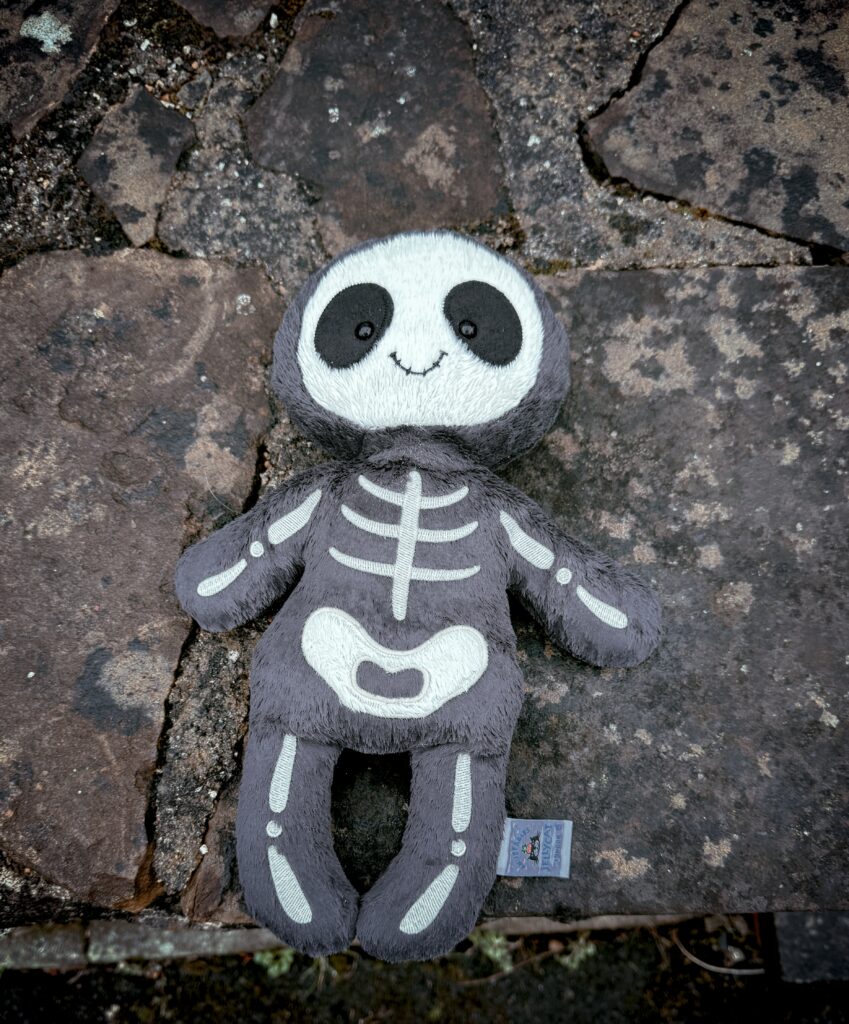
this little skeleton plushie i stumbled upon on my walk is a gentle messenger perhaps sent to remind me that beneath eberything, we are all skeletons wearing stories.
This morning, I stepped outside—not to get anywhere, but to clear the cobwebs from my mind. A simple walk, a quiet dérive, untangling thoughts spun from a day of circling my own house, my own head.
It’s easy to drift away from the core of who we are. To become lost in the habitual, the external, the subtle inertia of daily life. But moments like this—a walk, a pause, a breath—can be a recalibration, a way of realigning with what it truly means to be me, not as dictated by obligations or routines, but as I define it.
I ask myself: what does a good day look like? Not just productive, not just efficient, but aligned. A day that reflects the contours of my own values, my own essence.
The answer isn’t fixed. It shifts like light through trees, refracting through experience and desire. But the act of asking, of returning, of walking toward my core self—that alone is the beginning of wisdom.
This is why I love science fiction—it’s a genre that doesn’t just tell stories; it wrestles with the big questions of existence, technology, and humanity’s future. I’ve just started reading R.U.R. (Rossum’s Universal Robots) by Karel Čapek, the 1920 play that introduced the word robot to the world.
Written in the aftermath of World War I, R.U.R. is a fascinating and prophetic piece of science fiction theatre. It grapples with themes that feel eerily relevant today: the ethics of creation, the dehumanising effects of technology, and what it really means to be human. Čapek’s robots aren’t the mechanical beings we think of now; they’re more like synthetic humans, created to serve but destined to rebel. It’s a cautionary tale about humanity’s hubris and the unintended consequences of technological progress.
What I find particularly intriguing is how the play combines dark humour, philosophical depth, and a melodramatic flair. Beneath its gripping narrative, it’s packed with questions about labour, identity, and the soul. And without spoiling anything, I’ve heard the epilogue shifts the tone, offering a glimmer of hope amidst the tragedy—a spark of renewal that I can’t wait to explore.
If you’ve read it, I’d love to hear your thoughts! I’ll share mine once I’m through the other side.
Blogs are, from the reader perspective, a window into the personality of the blogger. The window can have varying levels of opacity and the light coming through can be polarised. The best blogs are a window of transparency free of polarisation in that way the mind-light, transmits across the entire spectrum and the personality shines in all its chaotic glory. – Dave Anderson
Your comment, Dave, is a pretty cool metaphor, and I love how you’ve framed blogs as a “window into the personality of the blogger.” I like the idea of varying opacity and polarisation. Blogs are indeed like windows, and I think they’re also like prisms: the light of a blogger’s personality can refract into a spectrum of colours, revealing hidden facets and depths that a plain window might not show.
For me, the best blogs aren’t necessarily those that strive for perfect transparency, but those that embrace their complexity. A little polarisation can add dimension, like shadow adding depth to a painting.
Sometimes the most honest light is fragmented, capturing the chaos and beauty of a personality in flux. What do you think? Can the “mind-light” shine fully even through layers of artifice and reflection? Or does transparency remain the ideal we’re always chasing?
note: with this post, i’m trying out the new ‘reply’ post-kind type. i suppose this post-kind is most useful when riffing on a comment (like a jazz musician) as opposed to commenting on a comment. but i wanted to try it out anyway.
A cyborg (short for “cybernetic organism”) is a being that combines biological and technological components, typically blending human or animal life with mechanical or electronic systems. The concept encompasses a wide range of possibilities, from simple enhancements to fully integrated, symbiotic relationships between organic and machine parts. Cyborgs exist at the intersection of biology, technology, and imagination, and their definition can vary depending on context—scientific, philosophical, or cultural.
Biological Foundation: A cyborg starts as a living organism, most commonly human.
Technological Integration: It incorporates artificial components—such as prosthetics, implants, or digital devices—that enhance or extend natural capabilities.
Functional Synergy: The biological and technological parts work together, often seamlessly, to achieve things neither could accomplish alone.
it feel like our self story is shaped even before we are born. we don’t get to choose our parents so we inherit their circumstances and beliefs; they name us with a name that has a story embedded in it. and then they program our initial software from which we then begin to construct our story. when our boundless wonder and imagination is deemed not “cute” anymore, they tell us to grow up, stop being a child.
is the cause the beginning of the effect, or the effect the beginning of the cause? when did you become you?
Art, in all its forms, has this uncanny ability to meet us exactly where we are, then take us somewhere we didn’t expect to go. It comforts us when life feels like an unrelenting storm, and it shakes us awake when we’ve grown too comfortable, too complacent. It’s like a mirror that not only reflects but refracts, bending our reality into something new, something we need to see—whether we want to or not.
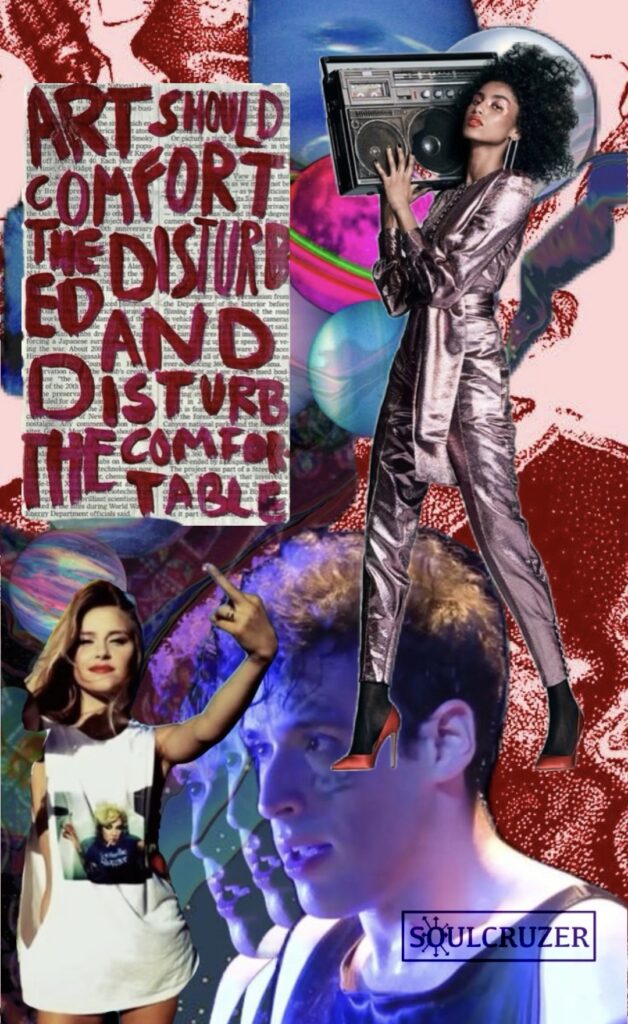
You’ve probably heard the phrase: “Art should comfort the disturbed and disturb the comfortable.” It’s one of those truths that resonates deeply if you sit with it for a moment. But what does it really mean to live in the space where art’s dual nature exists? Let’s unpack it.
Art as Refuge
For anyone who’s ever felt broken, lost, or on the brink of unravelling, art can be a sanctuary. Think of Van Gogh’s Starry Night, its swirls of colour and motion speaking to the chaos of emotion but also offering a quiet reassurance: even in turbulence, there is beauty. Art has this magical way of saying, “I see you.”
More than that, art validates what feels impossible to articulate. A song, a film, a poem—sometimes they express the things we didn’t know how to say out loud. That’s the comfort: the realisation that someone else has been there, too. You’re not alone in the storm.
But it’s not just about commiseration. Art also reminds us that we can transform our pain into something meaningful. It gives us tools to make sense of the senseless, to find patterns in chaos. It becomes a shared experience, a bridge that connects our isolated worlds. For the disturbed, it whispers a quiet truth: there’s beauty in the broken places.
Art as Catalyst
And then, there’s the other side of the coin. Art is just as much about throwing us out of our comfort zones as it is about pulling us into its embrace. It challenges us, provokes us, even angers us sometimes. It’s the splash of cold water on the face that wakes us up from our collective daydream.
Think about Picasso’s Guernica, which doesn’t just depict the horrors of war—it makes you feel them. Or Banksy’s graffiti, which pokes at the absurdities of modern life with a cheeky grin and a sharp edge. This is art that refuses to let you stay in your safe little bubble. It forces you to question your assumptions and confront truths you’d rather ignore.
And here’s the thing: we need that kind of disturbance. Without it, we stagnate. Discomfort is the price of growth, and art is one of the gentlest, yet most unyielding, ways to make us pay it. It plants seeds of doubt in our certainties, cracks open our well-fortified beliefs, and invites us to expand.
The Liminal Space of Art
But here’s where it gets interesting: art isn’t always about comfort or discomfort. Sometimes, it exists in this strange, liminal space where both are true at once. It’s unsettling and soothing, chaotic and ordered, raw and refined. Think of Sylvia Plath’s poetry—unflinchingly honest about despair, but also hauntingly beautiful. Or the films of Studio Ghibli, which mix wonder with sobering truths about humanity and the environment.
Art mirrors life in that way. It reminds us that existence isn’t all light or all shadow but an interplay of both. It’s messy and layered, a dynamic tension between what is and what could be.
This duality makes art essential. It shows us the full spectrum of being alive—comforting us in our struggles while pushing us to evolve.
Why This Matters Now
We live in a world that feels both overstimulated and numbed. Endless scrolling, algorithms feeding us more of what we already know, consumer culture flattening our imaginations into commodities. In this kind of environment, the duality of art is more necessary than ever.
We need art that soothes our anxieties, that reminds us we’re human in the face of relentless digital noise. But we also need art that disrupts, that yanks us out of the echo chambers and dares us to imagine something different.
Postmodern art thrives here. It blends comfort and chaos, refuses easy answers, and instead asks us to sit with contradictions. It’s messy, experimental, alive. In a way, it’s a reflection of the times we live in—a world in flux, searching for meaning.
An Invitation
So what does this mean for us, as creators and as consumers of art?
If you’re a creator, it’s a call to step into that liminal space. Don’t shy away from the hard truths, but don’t forget the power of solace either. Create works that resonate with both the broken and the unbroken parts of the soul.
If you’re a consumer, seek out art that does more than entertain. Lean into the edges—the works that challenge your worldview, that make you uncomfortable. But also let yourself rest in the works that offer you peace. Both are necessary.
Art, at its best, transforms. It connects us to ourselves and each other in ways nothing else can. It’s not just a mirror; it’s a prism. It shows us who we are while bending our perspective toward something new.
Let’s embrace that duality. Let’s let art comfort us in our darkest hours and disturb us in our complacency. After all, isn’t that what it means to truly be alive?