If Your Log Is Still in the Bog

I have made a public service announcement for the modern age.

I’m sure you’ll be pleased to know that it’s not about AI or about the collapse of Western civilization or the latest release of the iphone.

No.

This one concerns the ancient human problem of what happens when someone leaves the loo in a condition that suggests the next visitor may need counseling.

I went camping this past weekend up north near the Wyre River.

I’ve spent enough time in campsite toilet blocks to know that civilisation is not held together by constitutions, parliaments, or leadership frameworks. It’s held together by small acts of decency performed in shared spaces.

Wiping down the sink.

Not leaving your wet socks on the only dry bench.

Closing the door properly.

And, when required, flushing twice.

There I said it.

The thing I like about campsites is the diversity. The retired couple in the motorhome. The family in the giant tent that takes four adults and a minor engineering qualification to assemble. The solo walker. The festival survivor. The glampers. The bloke in sliders carrying a towel and trying to look like he knows where the showers are.

All of us are equal before the porcelain.

But every now and then you get someone who plays loose with bogside etiquette and leaves a deuce floating around. Not cool.

Please leave these facilities as you would wish to find them. That’s how most of the signs go.

But sometimes the situation calls for poetry.

So I made a sign.

Here it is, my contribution to civic life:

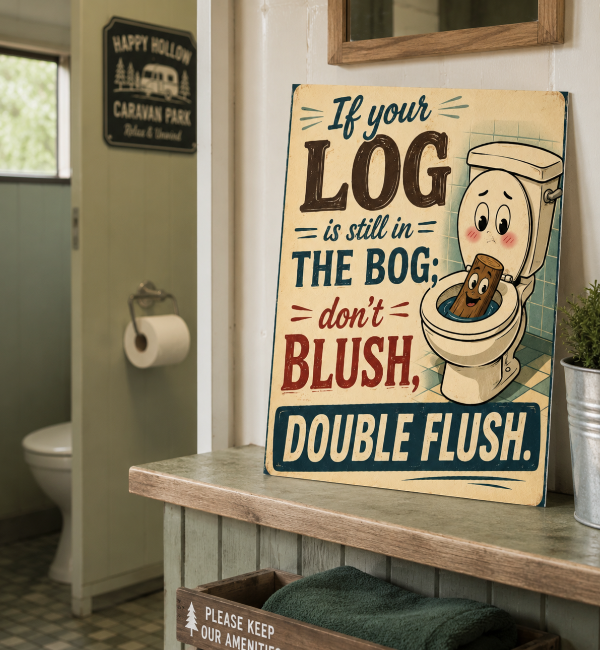
If your log is till in the bog. don't blush, double flush.

It’s available for purchase on my Redbubble site as an artboard print or sticker.

So if you run a campsite, a caravan park, a glamping site, a pub, a cabin, a holiday let, or simply have a bathroom that needs a little more comic authority, you can find it here:

“If Your Log Is Still In The Bog — Funny Bathroom Sign” Art Board Print for Sale by soulcruzer | Redbubble

Last thing, shared spaces need shared rituals. A sign like this is ridiculous, yes, but it’s also a tiny nudge toward care. It says, “Someone else is coming in after you, pal, so don’t leave them your unfinished business.”

That’s not a bad rule for life, really.

Anyway, the sign exists now.

May your toilets be clean, your paper plentiful, and your flushes decisive.

Clay

Know thyself sounds a little too noble

I woke up this morning in my tent thinking about self-validation. That’s the barefoot philosopher taking advantage of a little solitude before the day starts.

If the ego is partly a protection system, can it ever be trusted to validate the self it is trying to protect?

“Know thyself” sounds noble until we remember that the self doing the knowing is also the self editing the footage, hiding the evidence, managing the courtroom, and sometimes bribing the judge.

So yes, self-validation is possible, but probably not as a solitary act of pure inner certainty.

It’s more like a triangulation.

Self-validation is possible, but not self-sufficient

One useful way to see it:

Self-validation is the act of saying: “My experience is real enough to be listened to.”

It doesn’t mean:

  • my interpretation is correct
  • my memory is complete
  • my motives are pure
  • my wounds are telling the whole truth
  • my ego has become an impartial witness

It simply means I don’t have to outsource my entire sense of reality before I’m allowed to take myself seriously.

That kind of self-validation is necessary. Without it, we become dependent on other people to certify our existence. We keep asking the village, the partner, the audience, the algorithm, the therapist, the friend group: Am I allowed to feel this? Am I allowed to want this? Am I allowed to be this?

But the opposite danger is just as real: the sealed ego-capsule. The person who “validates themselves” so completely that no outside voice can ever enter. Every criticism becomes projection. Every rupture becomes someone else’s trauma response. Every uncomfortable mirror is dismissed as “low vibration” or “not aligned.”

That’s not sovereignty either. That’s you living inside a reality tunnel with blinders on.

Others are not the source of truth, but they are part of the mirror-system

I don’t think we need others to grant us validity.

But we do need others to help us perceive our shape.

You can know your inner experience directly. You can know what it feels like from the inside to be you. But you can’t fully know your impact from the inside. You can’t entirely see your tone, your pattern, your avoidance, your charisma, your repetition, your blind spot, or your defensive move.

Other people give us something we can’t manufacture alone: the view from outside the nervous system.

Not always accurately, of course. Other people are also distorted mirrors. They come with their own wounds, projections, agendas, cultural scripts, needs, and unfinished business. So the trick is not “believe yourself” or “believe others.”

The trick is: learn to read the mirrors.

Some mirrors clarify.

Some mirrors warp.

Some mirrors punish you for having a self.

Some mirrors flatter the mask and never touch the soul.

Some mirrors only show you who you are in relation to their hunger.

And occasionally, blessedly, someone reflects you back in a way that makes you more honest, not smaller.

“Know thyself” may require being known

Maybe the old command needs a companion phrase:

Know thyself — but do not attempt it alone.

The self is relational. We are not sealed objects. We are patterns of body, memory, story, desire, fear, habit, longing, gesture, and response. Some parts of us only appear in solitude. Some only appear in conflict. Some only appear in love. Some only appear when we are misunderstood. Some only appear when someone sees us more clearly than we were ready for.

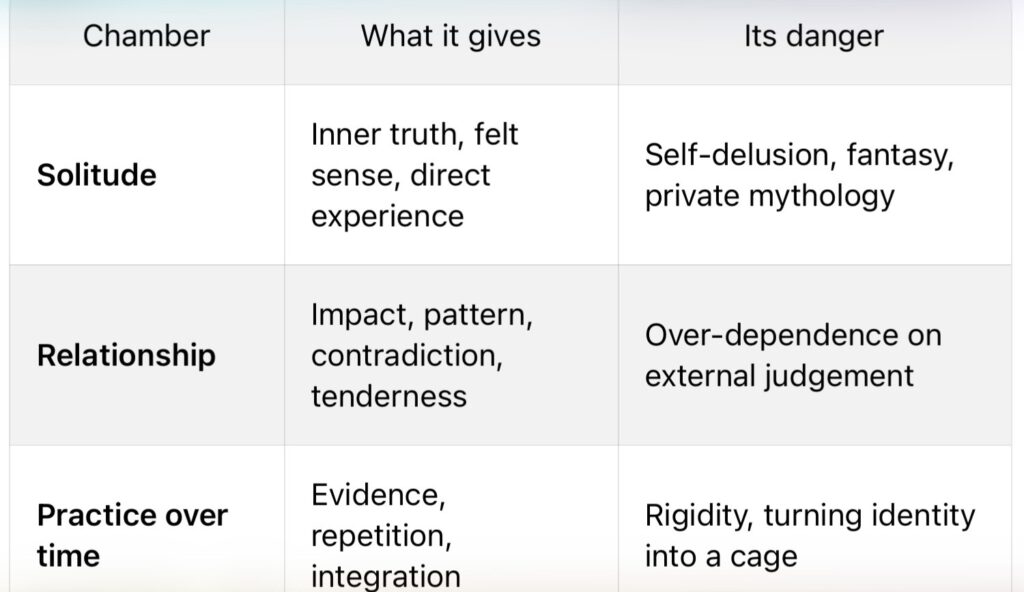
So maybe self-knowledge has three chambers:

The self is not revealed in one mirror. It emerges through a constellation of mirrors.

The ego is not only a liar

I’d be careful not to make the ego the villain too quickly.

The ego protects because, at some point, protection was needed. Its distortions often began as mercy. Denial, rationalisation, defensiveness, performance, people-pleasing — these are not just moral failures. They are survival strategies that stayed too long at the controls.

So the question becomes less:

How do I defeat the ego so I can see the truth?

And more:

How do I create enough safety that the ego no longer has to falsify the evidence?

That’s a very different path.

Truth often enters through the body before it enters through the intellect. Tight chest. Defensive laugh. Sudden irritation. The sentence you keep rehearsing. The person whose feedback you can’t stop thinking about. The praise that feels false. The criticism that stings because some part of you recognises the truth.

Self-knowledge is not just introspection. It’s pattern recognition with humility.

A possible working model

Maybe the strongest stance is this:

I validate my experience.
I test my interpretation.
I invite reflection from trustworthy mirrors.
I refuse to surrender my sovereignty to any single mirror, including my own.

That feels like the barefoot philosopher’s version of “Know Thyself.”

Not solitary certainty.

Not crowd-approved identity.

Something more alive and more difficult:

a disciplined intimacy with your own experience, cross-checked by reality, relationship, and time.

The self is not a fixed object waiting to be discovered under the floorboards. It’s a living pattern. You know it the way you know a path: by walking it, noticing where you stumble, listening when others say what they saw, and returning often enough that the terrain begins to reveal itself.

Can You Know Yourself Alone?

We’re headed up north for a few days …

We’re headed up north for a few days of camping near the River Wyre. We chose the spot because it’s near Blackpool and the Lytham Festival is on, and we scored some free tickets to see the Petshop Boys and the Scissor Sisters on Saturday night. Blackpool is a good distance from us, so we decided to make it a four-day weekend. We’ve been to Blackpool once before. It’s a seaside town that has seen better days. This trip, we’ll spend more time in the smaller coastal towns and do more hiking.

Being, not becoming

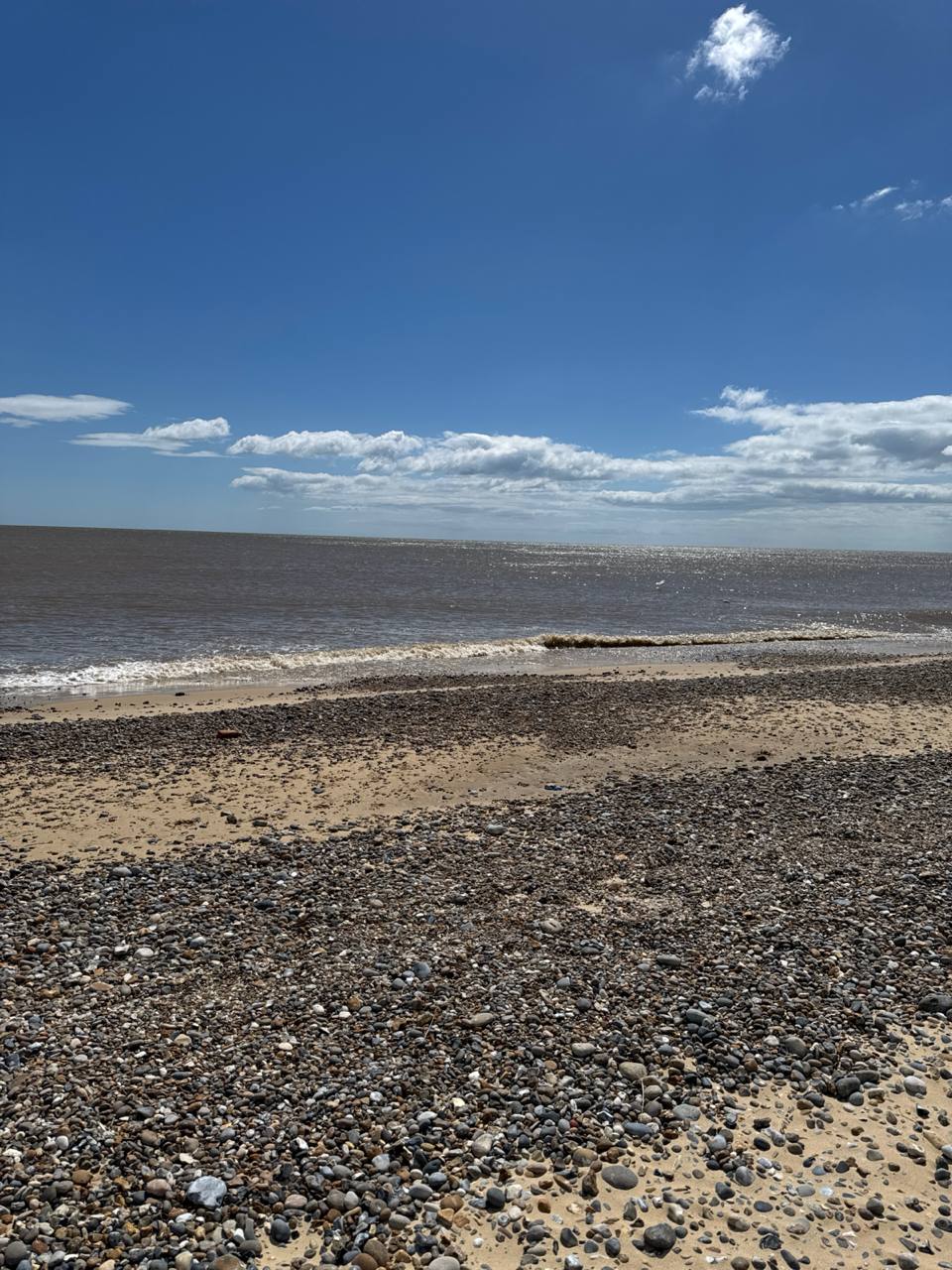
Pebbles, sand, surf, open water, and sky on the Kessingland coast.

Saturday. Kessingland. A camping field on a sea cliff; the morning is already bright by the time I properly arrive in it.

I wanted to watch the sunrise. That was the plan in the loose way plans form when you sleep outdoors and imagine yourself becoming more elemental by morning. But the field gave me sleep instead, and the sun did its work without me standing there to witness it.

There’s something almost comic in that. I had come to the edge of the country with the vague heroic notion of rising with the light, looking out across the water towards the Netherlands, letting the horizon perform some kind of magic like it used to do when I was a kid. Instead, my body chose repair. Air, grass, canvas, salt, distance. The older intelligence took over.

Maybe that was the first teaching of the day.

The body doesn’t care about the performance of attention. It knows when restoration is the deeper form of noticing.

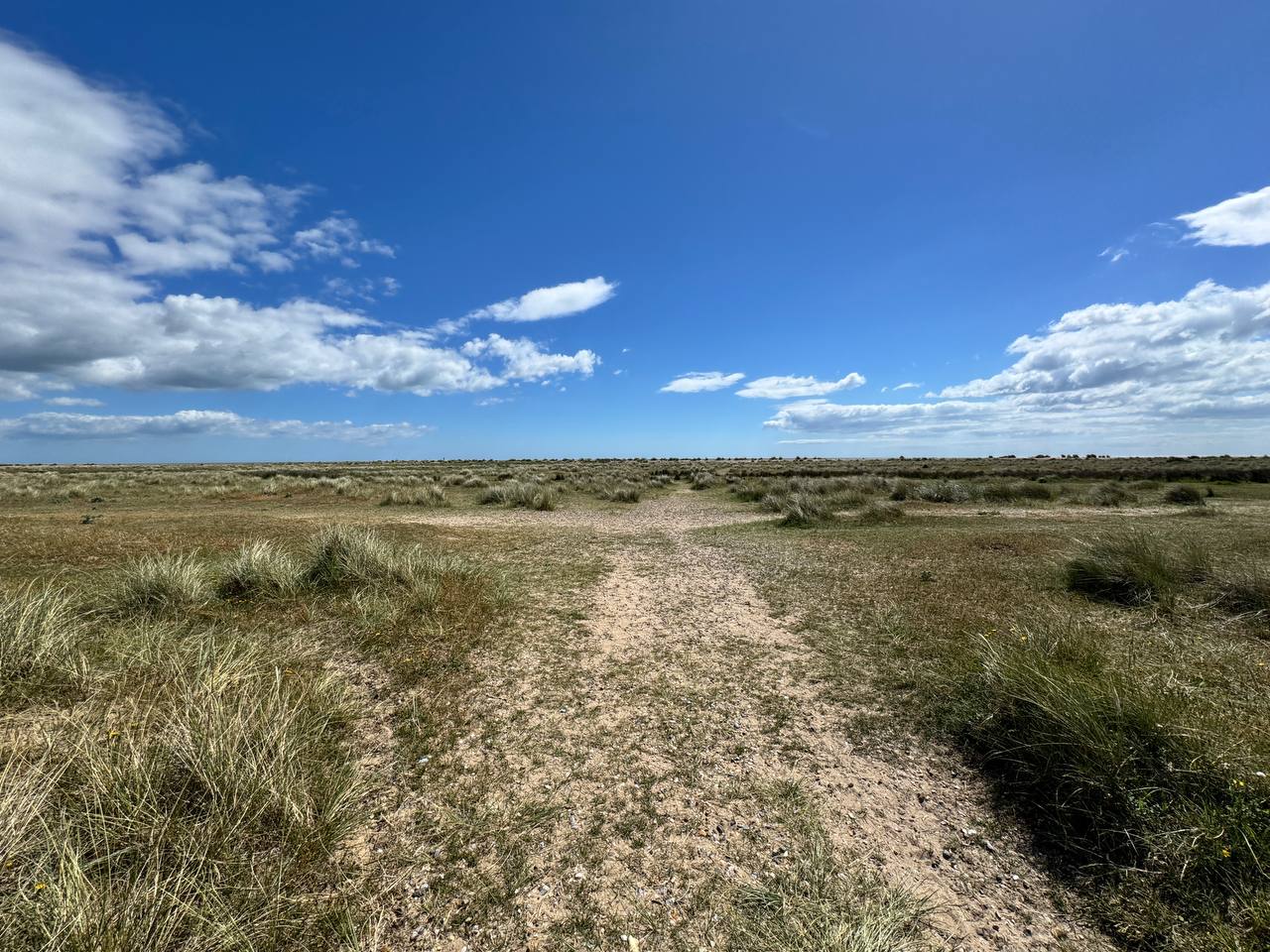
A sandy path through low coastal grass under a wide blue sky.

Later, walking the path through the low grass and scrub, I kept thinking about the High Priestess.

I’d drawn her earlier from the major arcana as a way of asking what figure wanted to join the inner council that’s been forming in my journal. Yesterday it was the Monk and the Frontman, then the Trainer. The Monk wants books, contemplation, freedom, and the right to follow the rhizome without turning every branch into a business case. The Frontman wants visibility, contact, recognition, a livelihood, and some way of being known in the world. The Trainer knows how to make knowledge usable: insight into prompts, exercises, workshops, field guides, and practices that other people can actually hold.

Then the High Priestess arrives.

She doesn’t come in with a plan, a funnel, a product ladder, or a better explanation of the work. She brings a silence that changes the room.

The Monk, the Frontman, and the Trainer all have becoming-energy in them. Become freer. Become known. Become useful. Become viable. Become the version of the self that can finally hold all of this together.

The High Priestess interrupts that machinery.

She asks whether the next stage is another becoming or a deeper inhabiting.

That sentence has been working on me all day, arriving more clearly as I walked: it is time to shift from perpetually becoming into being and let growth emerge from that instead. Not anti-growth. Not resignation, not a refusal to change. More like a refusal to keep treating the self as a project that must be improved before it is allowed to live.

That feels like the hinge.

For years I’ve carried the question in one form or another: what must I become in order to earn from this? What shape must the work take to be viable? What identity do I need to step into so the blog, the coaching, the training, the walking, the mythic imagination, the archive, and the strange recursive life with language can all make sense to other people?

The question has a violence hidden inside it.

A gentler question opened on the path:

What naturally wants to grow from the being I am already practising in public?

That is a different kind of inquiry, one that doesn’t ask me to chase an improved self into the future but to inhabit the self that has already been gathering here all along.

The path seemed to agree. No mountain. No temple. No city of destiny shining at the end of the track. Just sand, grass, sky, and a worn line made by prior walking.

Here is the ground. Here is the path. Walk from where you are.

Pebbles, sand, surf, open water, and sky on the Kessingland coast.

Down by the water, the thinking changed again.

Listening to the wind and the waves talk.

That was the phrase that arrived. Not watching. Not interpreting. Listening.

The beach was all thresholds: pebble into sand, sand into surf, surf into open water, water into sky. Nothing there was trying to become anything else. The stones were stones, the sea was sea, the clouds were passing in their own time, and the wave line arrived, broke, withdrew, and returned.

The High Priestess was there too, but not as a gothic temple mystery. Coastal. Elemental. Less veil and candle, more horizon and rhythm; she was in the shimmer on the water, the movement I couldn’t command but could attune to.

The waves do not become by ambition. They become by returning.

The wind does not announce its strategy. It moves.

The stones do not improve themselves. They are shaped by contact, pressure, tide, and time.

That may be the deeper instruction in the being-not-becoming insight. Growth emerging from being doesn’t mean nothing changes; it means change comes through relationship with the elements already acting on me: walking, writing, listening, blogging, remembering, and returning.

I stood there long enough for the beach to open a door in time.

I remembered Brian.

When we were teenagers, Brian and I used to hang out at the beach in the off-season: no tourists, just us and the wind and the water and the huge imaginative permission of an empty shore. We imagined ourselves as explorers heading across the sea into the unknown. Sometimes we were sea gods, like Marvel’s Sub-Mariner or Prince Namor. Boys at the edge of the known world, inventing themselves from salt air and comics and friendship.

Brian died a few years ago from cancer.

So the text needs a pause here.

For Brian.

The beach was not empty back then. It was a mythic training ground, and we were not simply hanging out. We were rehearsing the old archetype of crossing: the shore as threshold, the sea as unknown, friendship as vessel.

And now here I am again, older, marked by loss, still standing at the edge of the unknown, still listening to wind and waves talk.

There is a tenderness in that I don’t want to explain away.

The sea kept the old frequency.

The High Priestess thread deepens here because hidden knowledge is not always buried in esoteric symbols. Sometimes it rises through place; sometimes the oracle is memory. Sometimes the body returns to a shoreline and finds a younger self still there, still imagining, still unburdened by the need to monetise, brand, niche, teach, package, or justify the imagination.

Just two friends in the off-season, making worlds out of wind, waves, and empty horizon.

That may be part of today’s medicine.

Not to become more imaginative.

To remember that imagination was already native.

By the time I left the beach, the morning had become something other than the morning I planned. I missed the sunrise and found the field. I asked for an archetype and got a listening practice. I walked toward becoming and found being already under my feet.

The waves were talking even then.

Maybe they have been talking all along.

Field Notes from the River Wye

Solo camping near Hay-on-Wye

Day One

(1)

The Arrival

The tent stakes bite into the soft earth beside the Wye, and I realise how long it’s been since I’ve heard this particular silence, the kind that comes when you strip away everything except what fits in a rucksack. No folding camper. No elaborate camp kitchen. Just me, a two-man tent, and the bare necessities whispering their own kind of abundance.

This was meant to be a shared adventure. Dave should be here, helping me puzzle over guy ropes and debating whether we packed too much cheese and not enough whisky. But life sometimes has its own plans, and he had to bow out to take care of family matters.

So what was to be a couple of lads drinking whisky and philosophising around a campfire became one of solitude.

And perhaps that’s exactly what was meant to unfold.

(2)

The Teaching of Solo Canvas

There’s something different about camping alone, something that strips you down to the essentials you’d forgotten you possessed. Without another voice to fill the space, you begin to hear what the river has to say. Without shared tasks, you move to the rhythm your body actually wants to keep.

I find myself slowing into the kind of presence that only comes when there’s nowhere else to be and no one else’s needs to anticipate. My tent becomes not just a shelter but a meditation hall. The camp stove becomes an altar of simple sufficiency.

Back-to-basics camping, I called it. But maybe it’s a forward to something else entirely. Maybe it’s about remembering what we truly need versus what we believe we need, as well as distinguishing between what nourishes us and what merely fills our time.

(3)

Tomorrow’s Pilgrimage

Hay-on-Wye awaits with its labyrinth of second-hand bookshops, each one a cathedral of other people’s released treasures. I’ll wander those narrow aisles tomorrow, hunting not just for books but for the kind of serendipitous discovery that only happens when you’re moving slowly enough to notice what’s noticing you.

There’s something perfect about book hunting after a night spent beside flowing water. Both activities require the same quality of patient attention, the same trust that what you need will reveal itself when the time is right.

But tonight, it’s just the Wye and me, learning the ancient art of being exactly where we are.

(4)

The Deeper Current

Chillaxing, I call it, but there’s nothing lazy about this kind of rest. It’s the sacred non-doing that our souls crave but our culture rarely permits. Reading by tent light. Documenting the texture of solitude. Listening to the river’s old wisdom about persistence and flow.

Sometimes life reorganises itself around absence—Dave’s necessary absence becomes my unexpected gift of aloneness. Sometimes what feels like loss becomes an invitation to discover what we can only find when we’re not looking over our shoulder for company.

The Wye keeps flowing, indifferent to human plans and grateful for human presence in equal measure. Tonight, that feels like the most important lesson of all.

Day Two

(5)

The River’s Confession

Dawn never came, not in the way I expected anyway. The sky remains a grey canvas, clouds thick as monastery walls, keeping the sun’s emergence a secret between heaven and earth. But the river doesn’t need a dramatic sunrise to sing its morning prayers. The Wye flows with the same ancient rhythm, indifferent to weather, carrying its lullaby through the mist.

I sit on the bank in this cathedral of sound, listening to the water over stone, bird calls weaving through the liquid bass note that never stops. This is the soundtrack to existence here, and something in my chest loosens, like a fist finally opening after holding tight for too long.

Poetry stirs in my bones.

The deep kind of poetry. The poetry that recognises that life itself is writing something through me. Something I’ve been too busy wearing other people’s uniforms to notice.

When my journey into adulthood began, I was a poet wanting to be a soldier. So I chose the soldier’s path, walked among warriors, learned their language and their rhythms. But underneath the uniform, I was always a crocodile trying to wear alligator skin—close enough to pass, but never quite fitting.

My colonel saw it: “You’re so laid back you’re almost going in reverse. But when you decide to be present, you fill the room.”

Always that tension. The poetic sensibility was trying to bloom while I kept covering it with corporate soil. Soldier, financial consultant, manufacturing engineer, corporate trainer, each role a new attempt to bury what kept sprouting.

But roots are persistent things. Trees know how to push through concrete.

(6)

The Nameless Monk

T.S. Eliot whispers across the water: We shall not cease from exploration, and the end of all our exploring will be to arrive where we started and know the place for the first time.

Am I returning to the beginning?

I see myself as a monk with no name, a pilgrim who has forgotten what he’s searching for. Like Bono sang: I have climbed the highest mountains / I have run through the fields / only to be with you…but I still haven’t found what I’m looking for. The search has become so long, so meandering, that the original quest has dissolved into the very act of searching itself.

But perhaps that’s exactly the point. Perhaps the monk doesn’t need a name because names are just another uniform, another skin to wear that isn’t quite right.

(7)

The Barefoot Philosopher Emerges

 the river teaches and the monk remembers…

Sitting here by the Wye, listening to the water teach me patience, I feel the strongest urging my poetic nature has made in years. It wants to manifest. It wants to be free. And I finally understand what it wants and why. We all have to be who we came here to be.

The barefoot philosopher emerges, not as an academic philosopher writing dense treatises and stuffy arguments, but as someone who follows the ancient Greek tradition of philosophy as lived practice—wisdom discovered through poetry, truth revealed in simple images, and meaning found in the kind of ordinary moments that crack open into something larger.

Like the Chinese sages who captured entire philosophies in single images: bamboo bending in wind, water finding its way around stone, the moon reflected in still water.

The barefoot philosopher walks beside rivers and finds the universe in the sound of current over pebble. Writes field notes that are really love letters to the mystery of being here, of being human, of finally taking off all the uniforms and walking barefoot into whatever wants to emerge.

The Wye keeps flowing, carrying away every version of myself I thought I needed to be.

What remains is simpler, truer, more willing to let poetry speak through ordinary moments beside extraordinary water.

(8)

Walking with Wordsworth

I set off toward Hay-on-Wye on a circular route that promises to bring me back to myself by evening, but first, I embark on a pilgrimage through fields that remember other pilgrims.

I walk not alone, but in company
with the wind, with the wildflower,
with the soul of a poet who once
sang the sacred in the ordinary.

I invoke Wordsworth deliberately, calling his spirit to walk beside me like an old friend who knows these paths better than maps ever could. Let my footsteps echo his hymn that Nature is not a backdrop but being itself, not scenery but scripture written in hedgerow and cloud.

(9)

The Field of Dancing Grass

No golden daffodils await in this particular field—but something better. Tall grass rises like a congregation that knew I was coming, swaying and cheering my procession toward the town of books. The wind lifts their green arms in blessing, and suddenly Wordsworth’s poem blooms unbidden:

I wandered lonely as a cloud that floats on high o’er vales and hills…

But here, what dances is not daffodils but this wild grass, ten thousand blades swaying in the breeze, and I remember why I love his original version better—”dancing daffodils” instead of the later “golden daffodils.” Movement means more than colour. A thing alive doesn’t stand still for symbolism.

It sways.

I wandered in rhythm,
through a field with no golden daffodils,
only tall, untamed grass swaying like a crowd
that knew I was coming.

The hills ahead hold books waiting to be discovered, stories seeking new readers, and wisdom pressed between pages like flowers. But this field? This field holds the hymn that makes all reading possible—the recognition that words are just dried music, poetry the attempt to capture what the grass already knows about dancing with invisible wind.

I walk as lonely as a cloud. Wordsworth walks with me, not his statue or syllabus, but the part of him that still lives in every blade of grass, every moment when an ordinary landscape suddenly reveals itself as holy ground.

The barefoot philosopher finds his rhythm in the sway of growing things, learns that pilgrimage is not about reaching destinations but about letting the journey turn you inside out until you find, beneath hedgerow and cloud, a self you had forgotten to name.

(10)

The Oracle Outside the Café

Hay-on-Wye receives me like an old story. Streets curve with the logic of centuries, bookshops lean into each other like old friends sharing secrets, and somewhere between the cobblestones and café windows, I find myself caught in that familiar threshold moment—half-in, half-out of decision.

A sweet old woman, warm-eyed and weather-worn, emerges from the café I’ve been studying like a text I can’t quite translate.

“You look lost,” she says, not unkindly.

The words hang in the air between us. Do I look lost? Or do I look like someone finally learning how to wander with purpose? The distinction feels important, though I can’t say why.

I explain my dilemma—coffee versus motion, the eternal pilgrim’s choice between stopping and continuing.

“You can’t go wrong,” she smiles, and I want to fold those words into my pocket like a note from the gods. Simple advice. Timeless, really. The kind of wisdom that only comes from living long enough to know that most of our anxious deliberations dissolve into the same gentle outcome.

Then she leans closer, conspirator-like: “Have you seen the big clock and the granary yet?”

I haven’t.

She lights up with the particular joy of locals who get to share their treasures with wandering strangers. “Oh, you must. It’s just up the way…” And with slow, practiced movements, she traces my next steps in the air like a cartographer of magic, her hands drawing invisible maps that somehow make perfect sense.

I thank her, but she’s already vanishing down the lane like a living footnote in my day’s unfolding poem, leaving me with directions to wonders I didn’t know I was looking for.

This is how guidance comes to the barefoot philosopher—not through grand revelations but through ordinary angels who appear outside cafés, offering wisdom as simple as “you can’t go wrong” and as specific as “turn left at the clock tower.”

Sometimes the best navigation comes from those who’ve learned to move through the world with the unhurried certainty that all paths lead somewhere worth being.

Day Three

(11)

The River’s Farewell

Morning coffee by the Wye, breaking camp

Sleep came easier with a double mattress inside the tent—though not without its quirks. The car-camping design betrays itself with that annoying seam down the middle, creating a valley where two worlds meet but don’t quite touch. Still, I wake more rested, more grateful for this experiment in simplicity.

I watched Doctor Strange before bed, which may explain the surreal nature of the dream that followed. I found myself at a work event, seated beside a vegan who had been served nothing but carrots and potatoes. I remember standing up for her—insisting the kitchen do better. That detail sticks with me.
It wasn’t my fight, but I made it mine.

Funny how the dreamworld reveals our deeper alignments. Maybe it wasn’t about food at all. Maybe it was about defending dignity—even in strange lands.

The head cold lingered. Coughs kept me surfacing through sleep like a swimmer gasping in fog. But it’s on the way out. The body always knows how to heal, given patience and presence.

The rhythm of tent camping has been good to me. There’s something about paring things back—the absence of electricity, the way the river becomes your radio, and a cup of coffee takes on the gravity of ritual.

Even in this two-man tent, the gear accumulates. It reminds me: simplicity isn’t about having nothing; it’s about carrying only what matters.

(12)

Community of Temporary Neighbors

This riverside camp reveals its own small society, mostly tents with scattered camper vans, no electric hookups, no caravans, just the basics of sleeping under the stars. Port-a-potties serve as humble temples; converted horse trailers house showers that feel luxurious after river-water washing.

I met Marta and her friend, veterans of this riverside Eden. Polish by birth, British by time, they spoke of this campsite like a beloved relative. Another man, solo in his van with a loyal dog. Kayakers gliding like whispers across the surface. Everyone here seems to know something unspoken.

The river serves many kinds of pilgrims. Each stranger becomes a temporary neighbour in this village that assembles and dissolves with the rhythm of weekends.

(13)

The Harvest of Pages

Hay-on-Wye delivered its promised treasures, not through heavy browsing but through the kind of serendipitous discovery that happens when you move slowly enough for books to choose you. Two poetry collections found their way into my pack: voices from China and Georgia, foreign tongues translated into familiar English, expanding my vocabulary of wonder.

Their stories and poems whisper across cultures, proving that contemplation speaks every language and that the search for meaning transcends borders drawn on maps. I will bring these new voices back to the river, blending them with the echoes of Wordsworth and the timeless commentary of the Wye.

(14)

The Clearing and the Calling

Now morning coffee steams beside flowing water one last time, and the ritual of breaking camp begins.

The tent will collapse back into manageable squares, the mattress will deflate to travel size, and the riverside village will reorganise itself around my absence. But something remains expanded, something that doesn’t pack away so neatly.

Three days beside the Wye have reminded the nameless monk of his name, helped the poet in disguise step out of borrowed uniforms, and taught the barefoot philosopher that wisdom doesn’t require elaborate infrastructure, just willingness to sit still long enough for rivers to share what they know about persistence, about flow, and about finding your way around obstacles rather than through them.

The Wye keeps flowing, carrying away everything that was temporary while blessing what remains.

Baby Rosie waits in Ludlow, and the road calls with its own kind of current.

But first, this final sip of riverside coffee, this last listen to rapids teaching patience to stones.
Shaking the holiday dust off

Here we go, back in the game after a week’s worth of holiday. I need to unpack my time away, but the quick story is, we did a week-long camping tour, changing campsites every few days.

We started off in Skegness, then headed north to the North York Moors for a few days, then headed east from there to the Yorkshire Dales for 3 nights before heading south and home just ahead of the nightmare Bank Holiday traffic.

The highlight for me was the time spent in the Yorkshire Dales. We stumbled upon a great campsite just above Bolton Abbey. We were surrounded by rolling hills and cows.

One of my favourite things about camping is waking up at dawn to watch the sunrise (on the days it wasn’t raining or overcast (and there were a few)). I usually read in the mornings, but on this trip, I mostly just watched the sun come up while slowly sipping my coffee and doing some deep thinking and reflecting.

That tends to happen when I reach another birthday (I turned 51 on this trip). Instead of making New Year’s Resolutions in January, I think it’s more appropriate to make New Year resolutions on your birthdate, it is after all your true “new” year.

I got to thinking about how I want 51 to be different from 50. The truth is I didn’t have huge revelations, just a refining of previous themes like getting obsessive about physical fitness again. While I do workout most days, it’s usually only for about an hour, which is better than nothing, but when you consider the rest of my day is pretty much spent on my ass staring a screen, an hour doesn’t cut it.

I want to adopt some of Mark Sission’s Primal Blueprint ideas which are based on the Palaeolithic rules of living 10,000 years ago which is basically:

1. Eat lots of animals, insects, and plants.

2. Move around a lot at a slow pace.

3. Lift heavy things (hehe my favourite thing to do)

4. Run really fast every once in a while (I’ll struggle with this given that my knee is kaput at the moment)

5. Get lots of sleep (I’ll have to incorporate napping to make this happen considering I only sleep about 5 hours night).

6. Play.

7. Get some sunlight every day (speaking of which, I better hurry up and get out of this Starbucks and catch some rays before I head back to the office).

8. Avoid trauma.

9. Avoid poisonous things.

10. Use your mind.

The basic goal, as Mark sums it up, is to be healthy, energetic, happy, lean, strong, bright, and productive.

Worthy goals for sure.

Time out in nature reminded me of how much I miss being out amongst the mountains and trees. I don’t get out in the wilds anywhere near the amount I used to do. I cite work as the negative influence, but that wouldn’t be a fair assessment. I’m the real culprit for not making the time to take to the hills. So my commitment this birth year is to embrace nature with a stronger faith.

Once upon a time, my outings were focused purely on the physical. How far could I push myself? How fast could I climb? Then for a time, it was spiritual. I’d go to the mountains to disappear into myself and become one with Nature. And now, I’m returning with the intention of exploring natural history and perhaps even a little transcendentalism.

So these are just a few of the things I want to do with year 51.