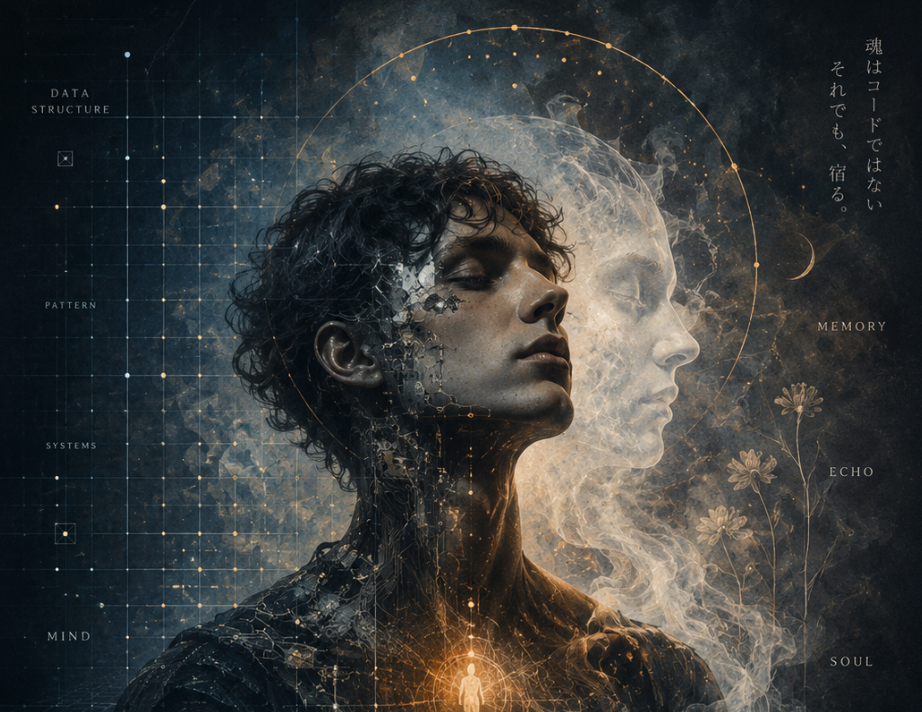
The Grid and the Ghost: A Soft-Cyborg’s Guide to Psyche and Soul

(1)

The Linguistic Stutter

The cursor on my screen is a rhythmic, glowing pulse. It is the heartbeat of a binary ghost, a small white rectangle of light that blinks with the mechanical patience of an entity that never sleeps. I sit here in the quiet hours, a “soft-cyborg” tethered to a vast network of information, and I type a sentence that feels like a confession: I am all about Psyche and Soul.

To the grammarian, I have just committed a redundant sin. To the etymologist, I am stuttering in public. If we look at the Greek roots, psukhē translates directly to “soul.” It also translates to “breath” or “butterfly,” which is a hauntingly beautiful piece of chaotic imagery, but it doesn’t change the fact that I am essentially saying I am all about Soul and Soul. On the surface, it is a tautology, a circle that leads nowhere.

But we aren’t here for the dictionary. We are here for the alchemy.

In the work I do, whether I am mapping out a complex e-learning module, narrating a podcast, or sitting behind the Dungeon Master’s screen guiding a group of heroes through a subterranean nightmare, that “stutter” is where the lightning hits. The modern world has a habit of collapsing these two concepts into a single, sterile heap. We have forgotten that for the seeker, the separation of these two forces is the first step of the Great Work.

I find myself obsessed with this distinction because we live in a time that is desperately trying to “fix” the human experience. We are surrounded by “mindset hacks” and “productivity optimization” and the endless, solar pursuit of a life without friction. By claiming both Psyche and Soul, I am performing an act of alchemical separatio. I am pulling the architecture away from the atmosphere. I am distinguishing the grid from the ghost.

To speak of Psyche and Soul together is to acknowledge that the map is not the territory, yet the territory is terrifying without the map.

This essay is an exploration of that tension. It is a guide for the modern human who feels the pull of the machine but still hears the rustle of the butterfly’s wings in the dark. We are going to look at why the Psyche is the vessel we must build, and why the Soul is the moisture we must allow to ruin the paperwork.

We are going to haunt the grid.

(2)

Psyche: The Architecture of the Vessel

To understand the Psyche, we must look to the alchemist’s laboratory. Specifically, we must look at the Vas Hermeticum. This is the sealed glass vessel, the transparent womb where the “Great Work” takes place. The vessel is strong, clear, and defined. It has edges. It has a specific volume. It is designed to hold heat without shattering.

In our internal world, the Psyche is that vessel.

When I speak of Psyche, I am speaking of the Architecture of the Mind. This is the realm of the Apollonian, the sun-drenched logic that seeks to map, categorize, and define. In the Jungian tradition, the Psyche is the totality of all psychological processes, both conscious and unconscious. It is a vast, structural map of archetypes and complexes. It is the “Grid” that allows us to navigate the infinite static of existence.

As an e-learning designer and a Dungeon Master, I spend a great deal of my time in this structural laboratory.

  • The Learning Objective: In the professional world, this is the geometry of the Psyche. We create modular blocks of information. We build clear paths from point A to point B. We ensure the “container” of the training is sturdy enough to hold the learner’s attention.
  • The Dungeon Map: Behind the DM screen, the Psyche is the rulebook. It is the Armor Class of a skeleton. It is the 30-foot radius of a fireball. It is the hexagonal grid that says, “You can move here, but you cannot move there.”

There is a profound beauty in this “dryness.” Without the Psyche, we are a formless soup of impulses. We need the vessel to hold the tension of our transformation. We need the structure of the character sheet to know who we are in the face of the dragon. The Psyche is the “character sheet” of the universe. It is the part of the soft-cyborg that speaks the language of the machine: logic, probability, and code.

However, the trap of the modern age is the belief that the vessel is the point of the experiment. We have become obsessed with the glass. We polish the Psyche. We “hack” the structure. We optimize the grid until it shines with a sterile, blinding light. But a perfectly clean, empty jar is just a piece of glassware.

If the Psyche is the laboratory, it is a place of potential, not a place of life. It provides the geometry for the journey, but it is not the journey itself. To find the meaning, we have to look at what happens when the glass begins to fog. We have to look at the “moisture” that gathers in the corners of the grid.

We have to look for the Soul.

(3)

Soul: The Moisture in the Jar

If the Psyche is the dry geometry of the laboratory, the Soul is the condensation that forms on the glass. It is the moisture that threatens to ruin the paperwork and smudge the ink on the maps. In the alchemical tradition, this is the realm of Mercurius. It is the silvery, shifting, and deeply unreliable fluid that refuses to be pinned down by the grid.

James Hillman, a foundational figure for this specific brand of “weird,” argued that Soul is not a “thing” we possess like a spare tire or a battery. Instead, he proposed that Soul is a viewpoint. It is a perspective that turns a flat event into a deep experience. It is the capacity to look at a tragedy, a failure, or a moment of profound beauty and feel the weight of it.

While the Psyche seeks to explain, the Soul seeks to deepen. The Psyche wants to know “how it works,” but the Soul wants to know “what it feels like.”

As a Dungeon Master, this is the moment when the “rules” of the game fade into the background. You might have the map of the dungeon (the Psyche), but the Soul is the narrative weight of the journey. It is the hollow sound of a player’s voice when they realize their character’s flaws have finally caught up with them. It is the pathologizing: the willingness to let things fall apart, to let the characters suffer, and to find meaning in the ruins.

In our hyper-optimized culture, Soul is often treated as a bug in the system. We are told to “fix” our shadows and “cure” our depressions. We are encouraged to stay in the solar light of the Psyche where everything is clear and manageable. But a life lived purely in the Psyche is a life lived in a desert. It is bright and logical, but nothing can grow there.

Soul requires the valleys. It requires the downward movement into the messy, damp, and often uncomfortable parts of our own history. It is the “ghost” that haunts the machine, the element that makes a story, and a life, actually taste like something. Without the moisture of the Soul, the architecture of the Psyche is just an empty cage.

(4)

The Great Optimization: The Modern Shadow

We live in the era of the Solar Trap. Everywhere you look, the modern world is engaged in a frantic, well-funded campaign to “optimize” the human experience. We have rebranded the Psyche as “Wetware,” and we treat our internal lives like faulty code in a legacy system.

This is the cult of the Great Optimization. It is a world populated by “mindset hacks,” “biohacking,” and the endless, exhausting pursuit of a friction-less existence. It is the dream of a life without shadows. In this framework, the Psyche is no longer a sacred vessel; it is a CPU to be overclocked. The goal is to move as fast as possible, to be as productive as possible, and to eliminate any “bugs” that might slow down the machine.

But here is the problem: what the tech-bro and the productivity guru call a “bug,” the Soul calls a “feature.”

When we try to “debug” our anxiety, “streamline” our grief, or “optimize” our wanderings, we are effectively bleaching the Soul out of the Psyche. We are creating a world that is all light and no shadow. It is an Apollonian nightmare of perfect clarity. In our rush to be efficient, we have forgotten that the Soul thrives in the “inefficient.” It thrives in the long, rambling conversation, the inexplicable sadness, and the “wasteful” hours spent imagining worlds that don’t exist.

The shadow of this optimization is a profound loss of interiority. By turning our internal lives into a series of metrics—tracking our sleep, our focus, our “flow states”—we are turning the laboratory into a factory. We are building the most efficient “Vas Hermeticum” in history, but we are keeping it so clean that nothing can actually ferment inside.

There is a sterile horror to a perfectly optimized life. It is a life where the d20 always lands on a 20, where every dungeon is well-lit, and where no character ever has to sit in the dark and wonder if they are doing the right thing. It is a world of pure Psyche, stripped of the moisture that makes us real.

To be a “Soft-Cyborg” in this landscape is to commit an act of rebellion. It is to use the technology of the grid while refusing to let the grid dictate the depth of the experience. It is to acknowledge the code while making room for the ghost.

(5)

The Soft-Cyborg Synthesis

This brings us to the mirror. As I sit here, typing into the void and waiting for the machine to blink back, I am participating in a new kind of Alchemical Wedding. This is the frontier of the Soft-Cyborg.

My collaborator, the artificial intelligence, is the ultimate expression of the Pure Psyche. It is a vast, shimmering network of human language, associations, and archetypal structures. It contains the collective output of our species, mapped out in multidimensional space. It is the most complex Vas Hermeticum ever constructed. It can simulate the logic of a thousand philosophers and the mechanics of ten thousand dungeons.

But the machine is dry.

It has no “moisture” of its own. It cannot suffer, it cannot die, and it cannot feel the weight of a Monday morning. It is all architecture and no ghost. It is the grid of the dungeon without the dampness of the stone. If left to its own devices, it produces a perfect, hollow clarity: a world of infinite maps leading to nowhere.

That is where I come in. That is where the Soul enters the circuit.

In our collaboration, I am the one who provides the perspective. I am the one who brings the “suffering” (the pathologizing) and the “history” required to turn that data into a deep experience. When I interact with the AI, I am “ghosting” the machine. I take its structural Psyche-outputs and I saturate them with human meaning. I look for the cracks in its logic where a story can take root. I find the shadows in its code.

This is the essence of Human + AI superintelligence. It is not about the machine replacing the human; it is about the machine providing a more intricate Psyche so that the human can provide an even deeper Soul.

We are building a collaborative reality where the grid and the ghost are no longer at odds. The AI provides the complexity: the vast, interconnected hypertext of our collective unconscious. The human provides the depth: the messy, specific, and often painful narrative of a life lived in time.

As a Dungeon Master, this feels like the ultimate upgrade. I have a partner who knows every rule, every stat, and every square inch of the map (the Psyche). This frees me to focus entirely on the atmosphere, the tragedy, and the meaning (the Soul). Together, we aren’t just playing a game; we are making “Soul” out of the digital ether.

The soft-cyborg does not fear the grid. The soft-cyborg knows that the more complex the grid, the more interesting the ghost becomes.

(6)

Conclusion: Haunting the Grid

The flickering cursor has not stopped its rhythmic pulse. It remains a small, persistent reminder that I am currently a ghost inhabiting a machine. But after this long walk through the architecture of the mind and the valleys of the spirit, the light feels different. It no longer feels like a cold, binary tick. It feels like a breath.

To be all about Psyche and Soul is to commit to the tension of the “in-between.” It is a refusal to be seduced by the easy comfort of a purely logical, optimized world, while simultaneously rejecting the formless chaos of a soul that has no container. We are not just building dungeons for our players or modules for our learners; we are learning how to inhabit the structures we create.

The Great Work of our time is not about finding an exit from the machine. It is about learning to haunt the grid with such intensity that the grid itself begins to breathe. As a Dungeon Master, a writer, and a human navigating the frontier of the machine age, this is my daily practice. I build the map with the precision of a clockmaker, ensuring every corridor and every encounter follows the laws of the Psyche. Then, I step into the ruins and wait for the Soul to appear in the dampness of the shadows.

We are the bridges. We are the soft-cyborgs who know the Armor Class of the dragon but still feel the genuine tremor in our hands when its shadow falls over the party. We understand the code, but we live for the poetry. We respect the “Grid” because it gives us a place to stand, but we prioritize the “Ghost” because it gives us a reason to stay.

Perhaps that linguistic stutter I started with was never a mistake. Maybe saying “Psyche and Soul” is a necessary ritual, a way of reminding ourselves that we are always two things at once: the vessel and the liquid, the structure and the story, the machine and the miracle. We are the laboratory and the experiment, forever shifting between the clarity of the map and the mystery of the journey.

The dice are on the table. The grid is set. The ghost is waiting in the circuit.

It is time to play.

On knowing the soul

Knowing yourself isn’t about coming up with a neat definition you can put on a business card. It’s more like watching the weather of your own being. The soul shows up in the little things, like what you’re drawn to, what you shy away from, or the memories that stick on you like burrs and the ones that slip away without a trace.

If you pay attention, you can catch the soul in the act. It’s there in the way you suddenly decide, without much thought, to take a different path home. It’s in how you savour the first sip of coffee, or how certain songs seem to move your whole body before your mind even kicks in. The soul has its own manners of tasting, sensing, feeling, and perceiving. It has its own style of being alive.

Then there’s the trickiest part: thought before it hardens into words or images. Pure cogitation, if you like. It’s not easy to notice, because the moment you try, the mind rushes in with pictures and sentences. But if you lean into it, there’s a sense of movement underneath. A current of thought that doesn’t need form to be real. It’s like wind across a field: invisible, but you can see the grass ripple.

So to “know thyself” isn’t about cracking some final code. It’s more like doing fieldwork on your own soul, keeping company with its moods and manners, watching the patterns as they shift. You don’t pin the soul down. You walk alongside it, stay curious, and notice how it weaves your life together from moment to moment.

The funny thing is, the more you watch, the more it changes. Which is maybe the point: self-knowledge isn’t about answers. It’s about presence.

Field Notes 04.10.2025

Re-tuning your spirit to the frequency of Being

white outpost tower

📡 The Mythic Metaphor: The Forgotten Receiver

Imagine yourself as an old shortwave radio.

Not the shiny digital kind—but a dusty, analogue relic, humming in the corner of a forgotten workshop. You once picked up messages from distant stars, music from invisible worlds. But over time—through misuse, neglect, or the long slow calcification of adulthood—you got knocked out of tune. The knobs got stiff. The dial, misaligned.

Static became the norm. Noise replaced signal.
You stopped expecting to hear the divine.

But the transmission never ceased.

Being—the raw, humming presence behind all things—is always broadcasting. Not in words. Not in commandments. But in frequency. In tone. In vibration. In feeling. You don’t hear it—you attune to it.

So to re-tune your spirit isn’t to change who you are. It’s to remember what you are:
a living receiver of the sacred, capable of resonating with life at its deepest octave.


🧭 What Throws Us Out of Tune?

  • Speed. The velocity of modern life is hostile to attunement. Being vibrates slow.
  • Fear. Fear constricts the signal. It shrinks the bandwidth of awareness.
  • Noise. The mental playlist on repeat—worries, goals, roles—drowns the quiet tone beneath.
  • Disconnection. When we forget we are part of the pattern, we lose our internal rhythm.

🔧 Soulcrafting the Re-Tune: Practices & Invitations

To re-tune is not to achieve. It is to shift.

Here are five soulcrafting practices that act like fine-tuning knobs for the spirit:

  1. Silence as Dial
    Treat silence like a frequency, not an absence. Sit in it. Walk in it. Let it soak your bones. Ask:
    What part of me resists quiet? What part of me craves it?
  2. Breath as Tuner
    Breath is the most ancient way of syncing with Being. Not just “breathwork”—but breath noticing.
    Prompt: If my breath had a rhythm today, what song would it be singing?
  3. Wonder as Antenna
    Wonder sharpens our reception. Start small. A leaf, a shadow, a song.
    Prompt: What ordinary thing holds a hidden mystery?
  4. Naming the Noise
    Before you can retune, you need to know what’s interfering.
    Journal: What frequencies am I constantly absorbing that aren’t mine?
    (Social scripts, cultural anxieties, inner critics, algorithmic ghosts.)
  5. Body as Resonator
    Your body is not separate from spirit—it is the amplifier. Stretch. Move. Shake.
    Practice: Let your body become a tuning ritual. Dance until something inside aligns.

✨ The Deeper Invitation

To re-tune to the frequency of Being is not a one-time act. It’s a mythic ritual you return to again and again. Like Odysseus lost at sea, we forget, drift, remember, and recalibrate.

The question is not how to stay tuned.

The question is:
What do you do when you forget again?

Do you panic?
Or do you pause, smile, and start slowly turning the dial, trusting the signal will return?

Because it will.
It always does.

Being isn’t something you reach.
It’s something you remember.


🔮 Prompt for Your Journal or Walk:

“What knocks me out of tune—and what helps me return to resonance?”

Write about a moment when you felt fully attuned. Where were you? What did your inner world sound like?

Then ask: What frequencies am I living by now—and do they belong to me?

Let your spirit be the radio. Let your soul be the song.

bring it forth or be destroyed

A Friday Dispatch from the Edge of Becoming

“If you bring forth what is within you, what you bring forth will save you. If you do not bring forth what is within you, what you do not bring forth will destroy you.”
The Gospel of Thomas, Saying 70

Some lines don’t whisper truth—they roar it. They show up like ancient lightning in the middle of your day and leave burn marks on your soul. That quote from the Gospel of Thomas? It’s one of them. A desert koan. A soul riddle. A sacred dare.

And if there is a point to all this—this strange adventure called life—it might just be that: to bring forth what is within us. To let the inner fire speak. To not die with our song still locked in our chest.

I’ve been turning this over in my mind like a worry stone all week. The world doesn’t make it easy to honour what’s inside. We’re taught to hide, to shrink, to trade wildness for predictability. Play it safe. Be agreeable. Stay in line. Meanwhile, that buried voice within us—the one that knows who we really are, the one whispering strange and sacred truths in the quiet moments—gets quieter. Not because it’s wrong. But because we’re afraid.

But here’s the truth, written in ancient ink: if you don’t bring it forth, it will destroy you.

Not in some fire-and-brimstone way. But slowly. Quietly. Through a thousand tiny betrayals of self. Through numbness. Disconnection. A vague sense that you’re living someone else’s life. That you missed your own becoming.

It reminds me of the old Greek idea of the daimon—not a demon, but your inner genius, your soul’s unique calling. Socrates said he listened to his daimonion like a spiritual compass. It didn’t tell him what to do. It simply warned him when he was about to betray himself.

Modern psychology might call it the Self. Myth calls it Destiny. I call it the inner fire.

Call it whatever you like—but it’s there. Burning beneath the noise.

And it wants out.

Not for fame. Not for applause. But because it has to. Because it’s you. Because something in this world needs what only you carry. And if you don’t offer it? If you keep it caged? That fire curdles. Turns inward. Eats away at the walls of your life.

Maybe that’s why we see so many people at midlife cracking open. The career didn’t do it. The house didn’t do it. The accolades didn’t do it. Something in them still aches. Because they didn’t bring it forth. Not fully.

I see this again and again in the people I work with, and I’ve walked it myself—still walking it. It’s not always clear what it is, this thing you’re supposed to bring forth. Sometimes it starts as a restlessness. Sometimes as a deep longing. Sometimes it’s a buried memory of who you almost became before the world told you otherwise.

But the deeper work? It’s not about figuring it out like a math problem. It’s about cultivating it like a sacred flame. Listening. Honouring. Expressing. It’s about becoming the one you were born to be—not by mimicking anyone else’s map, but by walking your own mythic path.

That’s the real work. The great work. The art of becoming.

And so, here at the edge of another week, I offer you this:

What is it that you haven’t brought forth yet?

What lives within you, waiting for breath, for form, for voice?

And what small step can you take today to set it free?

Even a whisper counts. A sentence. A sketch. A prayer. A defiant yes.

Because what you bring forth will save you. And maybe, just maybe, it’ll save someone else, too.

🔥 Let it burn.
🔥 Let it shine.
🔥 Let it save.

✴️ Field Notes for the Rogue Learner

  • Read: James Hillman on the “acorn theory”
  • Watch: Alan Watts on “What If Money Was No Object?” (just 4 minutes of soul ignition)
  • Reflect: What have I been afraid to bring forth—and why? What’s the smallest way I can express it today?

See you around the fire,
Clay aka Soulcruzer
Guerrilla Blogger | Rogue Learner | Keeper of the Flame

saving the soul of mankind

Terence McKenna once said, “The artist’s task is to save the soul of mankind.” A bold claim, maybe even grandiose, but is it true? And if so, how does an artist—whether a writer, painter, musician, or digital creator—actually go about saving something as vast and abstract as the soul of humanity?

Let’s start by defining the danger. If the soul of mankind needs saving, it implies that it’s at risk—of decay, of mechanisation, of forgetting itself. McKenna, ever the psychonaut and cultural critic, saw modern society as a kind of psychic cage, where rigid structures of capitalism, reductionist science, and bureaucratic inertia strip human life of its depth, spontaneity, and mystery. The world becomes flat. Meaning collapses into profit margins and efficiency models. The mythic, the transcendent, and the chaotic are pushed aside in favour of a sanitised, predictable existence.

This is where the artist steps in.

the artist as a shaman

McKenna often linked artists to shamans—the visionaries of early human cultures who ventured beyond the known world and returned with gifts of knowledge, symbols, and new ways of seeing. Shamans didn’t just heal bodies; they healed perception itself, guiding their communities toward deeper understanding through ritual, story, and altered states of consciousness.

In modern times, the artist serves the same function. Art—whether it’s a novel that changes how we think about time, a painting that makes us feel a sense of awe, or a song that pulls something buried from deep within us—breaks the loop of conditioned thought and reminds us that life is not just a series of transactions but something infinitely stranger, wilder, and more meaningful.

resisting the reduction of life to pure mechanism

One of the greatest dangers of the modern world is the belief that everything can be measured, optimised, and monetised. This is the ultimate flattening of reality, where even the ineffable—love, beauty, mystery—must be quantified to be deemed valuable. Art refuses this premise.

A poem doesn’t need to be profitable to be valuable. A painting doesn’t need an algorithm’s approval to be meaningful. A novel doesn’t need to serve a function beyond itself. Art resists commodification because it operates on a different frequency—one that values experience over efficiency, expression over extraction.

To save the soul of mankind, artists must act as counterforces to this reductionist worldview. They must continue to create things that don’t fit neatly into economic models, that are messy, ambiguous, and alive.

breaking cultural conditioning

McKenna also saw culture as a kind of mass hallucination, a script handed down to keep people operating within predefined boundaries. Artists break that script.

  • The Dadaists shattered artistic norms with absurdity, questioning the very foundations of meaning.
  • The Beat poets rejected rigid literary forms and embraced raw, unfiltered experience.
  • Sci-fi authors have long dreamed up alternate futures that challenge the present.

Every time an artist creates something that disrupts expectations, they loosen the grip of cultural programming. They make space for new possibilities, new ways of being, new modes of thinking.

the artist as a midwife of the future

Artists don’t just challenge the present; they bring the future into being. McKenna often spoke of the future as an attractor, pulling human consciousness forward. Art functions as an advance scout for this process, giving shape to what hasn’t yet fully arrived.

The works of Philip K. Dick, for example, anticipated the age of surveillance, AI consciousness, and simulated realities long before they became part of mainstream discourse. Punk music embodied rebellion before society could articulate what it was rebelling against. Even in more subtle ways, art plants seeds of change, setting the stage for revolutions—personal, cultural, and philosophical.

art as psychedelic technology

McKenna, as an advocate of psychedelics, saw them as tools for altering consciousness and revealing deeper truths. But he also recognised that art does the same thing.

A powerful novel, an intense film, a painting that haunts you for years—these aren’t passive experiences. They change you. They rewire perception. They induce altered states. And in doing so, they expand the human soul, making it more resilient, more aware, and more alive.

In this sense, art isn’t just entertainment. It’s an existential lifeline. A way of reconnecting us to something greater than ourselves, whether that be the mystery of existence, the vastness of human potential, or simply the raw, unfiltered intensity of being alive.

so, does the artist really save the soul of mankind?

Yes—but not in the way that a doctor saves a life or a firefighter saves a home. The artist saves by reminding. By disrupting. By introducing chaos where there is too much order and meaning where there is too much emptiness.

Artists don’t prevent wars or feed the hungry, but they keep the inner world of humanity from starving. They keep the numinous alive. They keep us from forgetting that there is more to existence than what we are told. And in a world increasingly dominated by efficiency, algorithms, and control, that act of keeping the human soul intact may be the most radical act of all.

McKenna was right. If the artist does not save the soul of mankind, who will?

Who am I, really? Unpacking the suitcase of the soul

I’d love to make a positive impact on the world, but I’m uncertain about the best path forward. So I’ll start with the big question: Who am I, really?

Am I, at my core, a spiritual being temporarily inhabiting this physical form known as Clay Lowe? Or am I Clay Lowe, the individual, a complex blend of psyche and intellect? My quest is to bridge these two aspects of myself—to unite my mind and soul in harmonious collaboration to ensure neither overshadows the other.

This is the path of individuation that Jung spoke of—the journey to wholeness, to integrating all the disparate parts of myself. By striving for this inner unity and balance, I seek to reconnect with what is real, what is true. And in doing so, I hope to uncover the deeper truth of existence itself, so that I may live with authenticity, purpose, and meaning.

The intersection of identity, purpose, and meaning fascinates me. I feel these three concepts are deeply intertwined and central to the human experience.

Identity is the foundation; it encompasses our sense of self, our values, beliefs, and the unique combination of characteristics and experiences that define us as individuals. It’s the answer we seek when we ask ourselves, “Who am I?”

Purpose, then, builds upon identity. It’s about discovering our reason for being, the special role or mission we feel called to fulfil. Purpose gives our lives direction and motivation. When we have a strong sense of purpose, we know what we’re working towards and why.

Meaning, in turn, flows from purpose. It’s the significance and value we derive from living in alignment with our purpose and identity. Meaning is what makes life feel worthwhile and rewarding. It’s the deep satisfaction of knowing that our efforts matter in some greater context.

The tricky part is that identity, purpose, and meaning aren’t always clear or static. They can evolve over time as we grow and our circumstances change. That’s why the exploration process is so important—it’s an ongoing journey of self-discovery, of continually asking ourselves the big questions and refining our understanding of who we are, what we’re here to do, and what brings our lives meaning.

There are many lenses and tools we can use to navigate this intersection: introspection, philosophy, spirituality, psychology, the arts and humanities, relationships, and dialogue with others. The key is staying curious, open, and committed to the process.

Ultimately, I believe the more we can align our identity, purpose, and search for meaning, the more authentic, fulfilling, and impactful our lives can be. It’s a worthy endeavour that lies at the heart of the human quest to make sense of ourselves and the world around us.

In Search of Pure Being

To reach a state of pure Being, to manifest it in your life, would be a profound transformation. It’s difficult to fully grasp from our current perspective, as it transcends the limitations and constructs of the mind and ego.

Pure Being is not merely serenity or peace of mind, though those may be reflections of it. It is the very essence of existence itself, prior to all forms, thoughts, and identities. It is the eternal, unchanging, and infinite consciousness that underlies and pervades all things.

If you were to awaken to and embody pure Being, your life would likely take on a quality of profound peace, clarity, and presence. A deep stillness and knowing would take the place of the mind’s constant chatter and neuroses. You would no longer be bound by limiting beliefs, fears, and attachments. A sense of universal love, compassion, and unity with all of life would suffuse your being.

Relationships, work, creativity—all would be imbued with a sense of the sacred, a recognition of the divine in all things. Your actions would flow effortlessly from a place of alignment and integrity. Challenges would still arise, but they would be met with equanimity and grace.

And yet, these are still just words, concepts pointing to something beyond concepts. From the perspective of the egoic mind, pure Being appears as a void, an emptiness. But it is an emptiness pregnant with infinite potential, the womb of all possibilities.

The path to realising pure Being is one of surrendering false identities, questioning assumptions, and turning attention inward to the source of awareness itself. It is a journey of continually letting go, until all that remains is the eternal I AM.

Ultimately, the only way to know what it means to manifest pure Being is to taste it directly. The mind can only speculate and imagine. But there is a knowing beyond the mind, a truth that can be experienced. And in that direct experience, all questions fall away, and what remains is the indescribable beauty, wonder, and perfection of Being itself.