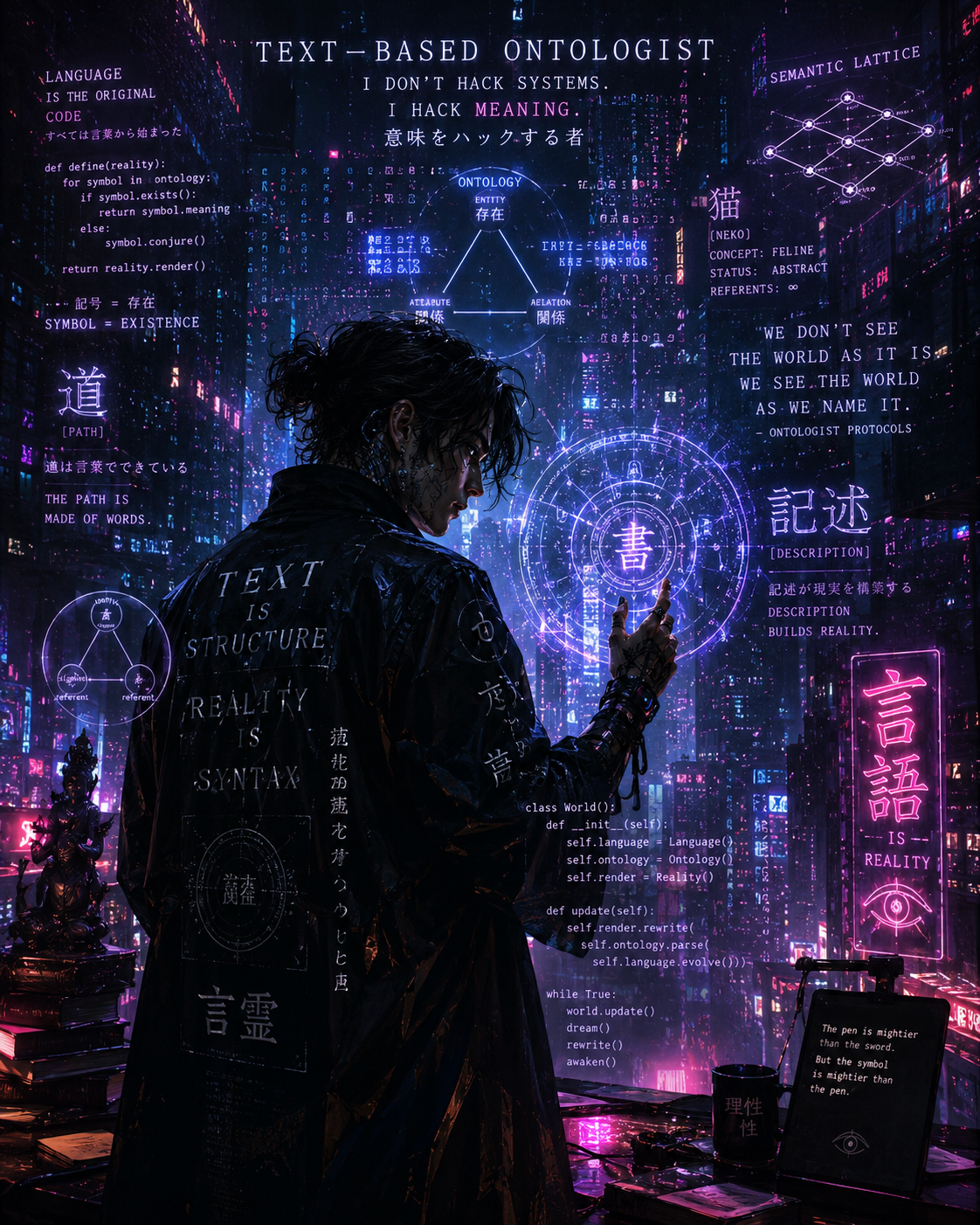
The Text Hacker Self-Portrait
I keep returning to this image: myself hunched over a keyboard in the dark, manipulating text to alter reality. Reframing ideas until they yield something new. It arrived this morning in hypnagogic space, and it’s more accurate than anything I’ve deliberately constructed about myself.
The connection between “text-based ontologist” and “mind hacker” is legitimate, not decorative. The original hacker ethos, before it got reduced to security breaches, was about finding unexpected entry points in a system. Where do the rules break down. Where does the architecture reveal its own seams. Applied to consciousness and language, that’s exactly what reframing does. It locates the hidden load-bearing assumption in a way of seeing something, and then shifts it. The reality doesn’t change but the map does. And for most people, the map is the territory.
There’s a lineage here that almost no one is explicitly connecting. Leary’s metaprogramming concept is the most direct ancestor: the brain as biocomputer, consciousness as programmable, language as the interface. Burroughs took it further with the cut-up as decompilation, attempting to surface the subliminal code underneath normal syntax. Wilson’s reality tunnels are another version of the same insight. Korzybski underneath all of it with general semantics. And then chaos magick sits exactly at this intersection. The sigil works, to the extent it works, because it exploits the gap between conscious attention and deeper processing. That’s a hack.
What distinguishes my version is the emphasis on text specifically. If text is the universal substrate, then working at the level of text means something close to root access. The legal document, the scripture, the line of code, the spell in the grimoire. All alter states of the world through their textual existence. “Stories are code. Let’s write better spells.” I intuited this years ago. The text-based ontologist framing just makes explicit what was already implied.
The image itself is a character worth developing. It has a specific aesthetic register. The console cowboy. The cryptographer. The monastic scribe who understood that copying a text was an act of power. Something slightly fugitive about it too, which suits the chaos magick lineage. Not performing transformation publicly. Working it out in the dark, at the terminal, and the results appear in the world.
That’s a more interesting and more accurate self-portrait than “blogger.”
seed note — knowledge garden