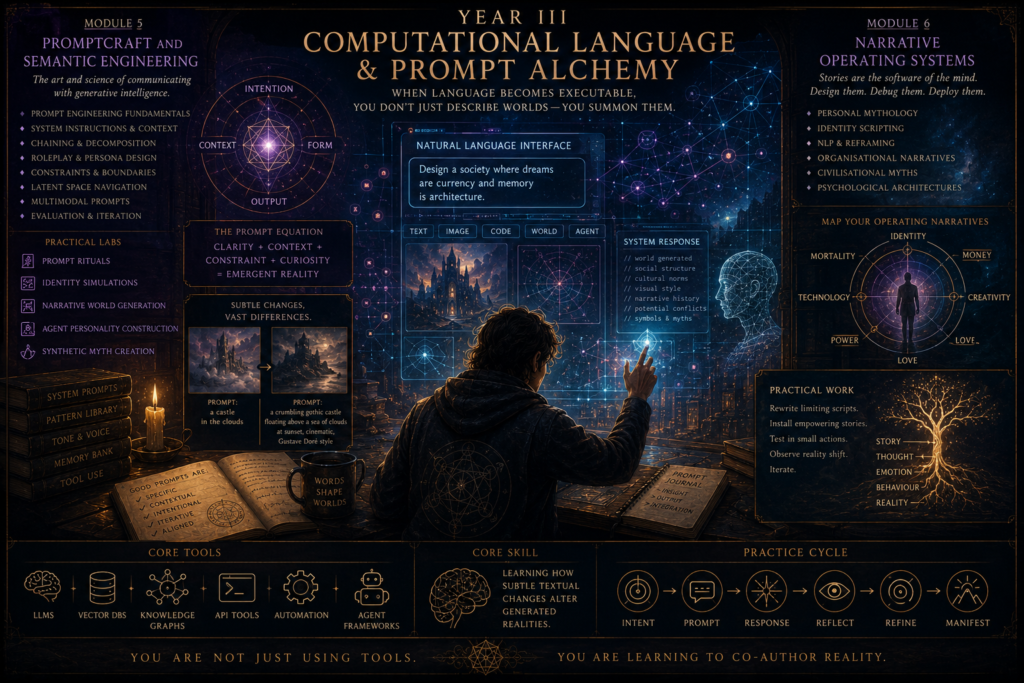
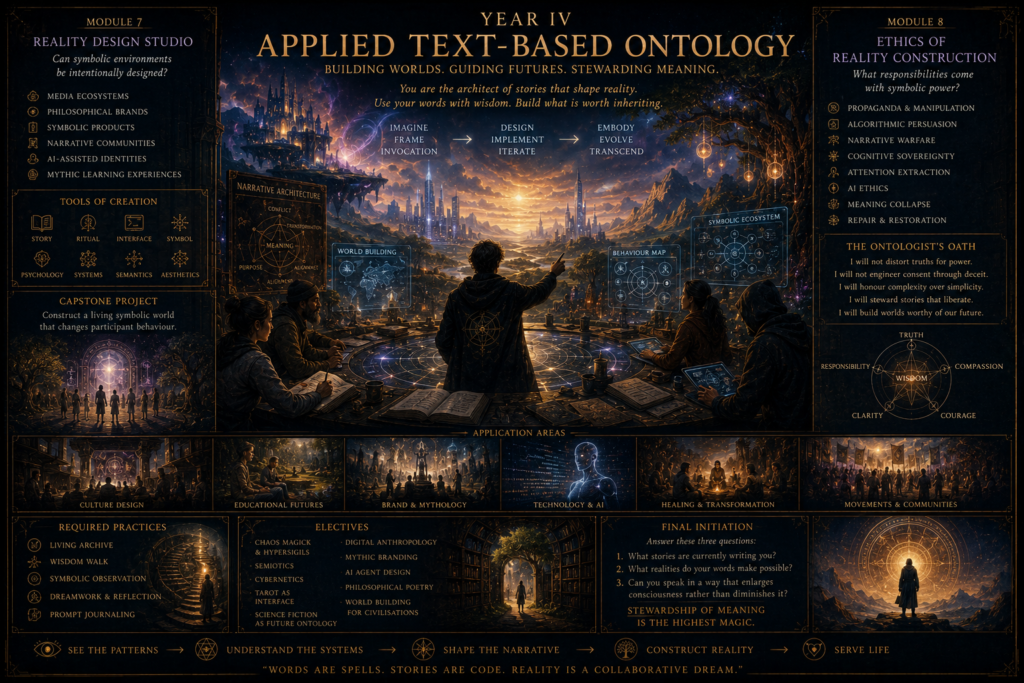
What happens to human meaning-making when thought itself becomes networked?

I’m not asking what happens to productivity or output. I’m asking what happens to meaning.

When thinking is distributed across human-AI systems, something genuinely new appears. Not better thinking or faster thinking. A different category. Meaning that emerges from the interchange itself, that no single node, human or machine, can claim to have authored.

You can’t point to the moment you had the idea. You can’t separate what you thought from what the system returned. The origin dissolves. What remains is only the pattern that emerged between you.

This isn’t collaboration in the old sense. Collaboration assumed distinct agents contributing discrete parts. What I’m describing is closer to emergence. The meaning appears in the space between, and neither party can reconstruct how it got there.

We’ve organised centuries of intellectual life around authorship. Around the idea that meaning originates in a single location like a person, a mind, or a signature. Kant thought this. Woolf wrote that. The work points back to its source.

Networked thought makes that gesture impossible. The meaning that appears doesn’t have a return address.

I don’t know yet whether this is loss or liberation. Probably both. What I know is that it forces a different question: if meaning doesn’t require a single author, what else have we been wrong about?

Ted Nelson: The universe is a system of ever-changing relationships

This short clip from Ted Nelson in Lo and Behold, Reveries of the Connected World is less about technology and more about a philosophy of connection. Nelson reflects on the core insight that has guided his life’s work: reality is not made of isolated things but of relationships, connections, and ever-changing patterns.

The central idea

As a child, Nelson recalls trailing his hand through the water while sitting in a rowboat. Watching the water flow around his fingers gave him a profound realisation:

The universe is a system of ever-changing relationships.

That experience became the foundation of his thinking. Everything he later did with computers was an attempt to represent those relationships rather than flatten them into simple sequences.

Key messages

1. The world is interconnected

Nelson sees interconnection as the fundamental truth of reality. His life’s work has been about finding ways to express and visualise those connections, especially between ideas and writings.

2. Writing is an imperfect compression of reality

One of the most interesting observations in the clip is Nelson’s claim that writing reduces a rich tapestry of interconnected ideas into a narrow sequence of words.

He sees traditional writing as a necessary but flawed medium because it forces us to move through thought one line at a time when reality is actually networked and multidimensional.

This is essentially a critique of linear thinking.

3. The Web is not what he envisioned

Nelson’s famous project, Project Xanadu, aimed to create a system where every quotation remained connected to its source and every document could maintain visible relationships with other documents.

In the clip, he demonstrates parallel documents where quotations remain linked to their original context. This is very different from today’s web, where links are largely one-way, and context is often lost.

The web succeeded commercially, but in Nelson’s view, it abandoned much of the deeper vision.

4. Technology should reveal relationships, not hide them

Nelson argues that our current tools betray the complexity of human thought. He even jokingly describes modern “cut and paste” as a crime against humanity because it severs connections rather than preserving provenance and context.

His concern is ultimately epistemological: how do we know where ideas come from and how they relate to one another?

5. Persistence matters

When Herzog asks about being considered insane for pursuing his vision for decades, Nelson rejects the idea that persistence is madness. He prefers “If at first you don’t succeed, try, try again” to the cliché definition of insanity.

The film ends with one of Herzog’s most memorable lines:

“To us, you appear to be the only one around clinically sane.”

It’s funny, but it also captures Herzog’s admiration for Nelson’s refusal to accept the limitations of conventional thinking.

Why this clip still matters

What struck me most is that Nelson isn’t really talking about computers. He’s talking about a way of seeing.

The internet most people experience is a collection of pages. Nelson imagined a living ecology of ideas—where every thought remained connected to its origins, every quotation retained its context, and knowledge resembled a web of relationships rather than a stack of documents.

In many ways, this is what I’m trying to do with my blogging practice: my fascination with associative trails, and my interest in hypertext as an epistemology are closer to Nelson’s vision than what I see on modern publishing platforms. This blog, with its links, references, fragments, and wandering paths, is my way of trying to keep the dream alive.

Reality is not a line. It’s water.

Likes Me, James Baldwin and the Un-fragmenting of …

This essay reminded me of the famous quote often attributed to Churchill: “Those that fail to learn from history are doomed to repeat it.” But Baldwin’s point is even more unsettling. We don’t merely repeat history because we’ve forgotten it. We repeat history because history is still here, living within our institutions, assumptions, and ways of seeing the world.

A Lamp at the Doorway

I finished Richard Cavendish’s The Black Arts this week.

Not in the heroic readerly sense of having sat down and consumed it cleanly from first page to last, pencil in hand, scholar’s lamp burning into the night. I have been reading it on and off for a few months. Picking it up, putting it down, returning to it when the mood came back round. Some books ask for that kind of reading. They don’t want to be finished quickly. They want to become part of the weather for a while.

My copy is the 50th anniversary edition. I bought it after seeing Cavendish turn up in Mitch Horowitz’s Daydream Believer: Unlocking the Ultimate Power of the Mind. Horowitz quotes him early, in a passage about the Cabalists and the Gnostics trying to answer the old religious questions: evil, suffering, mercy, the infinite God and the finite world.

A Lamp at the Doorway

That was enough.

Some books arrive because another book opens the door. This was one of those. I was already wanting to increase my occult knowledge. No theatrical hunger for a shelf full of grimoires and an air of candlelit importance. The occult keeps appearing in the territories I already work in: narrative, belief, imagination, trance, symbol, transformation, and the strange plasticity of the self. Cavendish looked like the right kind of guide for that moment. A historian, not an evangelist. Interested, informed, steady. Close enough to take the material seriously. Distant enough not to demand that I join anything.

The Black Arts is a survey. That’s its strength and its limitation.

Cavendish moves across the field rather than burrowing permanently into one chamber. The occult worldview, names and numbers, the Cabala, alchemy, astrology, ritual magic, witchcraft, demonology, devil worship, spells, charms, necromancy. He gives you the architecture, the correspondences, and the old symbolic machinery. He doesn’t try to initiate you. He maps.

For what I needed, that was perfect.

I read the opening chapters most intently. Chapter 1, “The World of the Black Magician,” sets out the worldview: the magician standing inside a cosmos where visible things are threaded with invisible correspondences. Chapter 2, “Names and Numbers,” goes straight into one of the oldest intuitions of magical thought: that names are not labels pasted onto reality after the fact. Names carry force. Numbers carry structure. Language and quantity become ways of touching the hidden order of things.

Chapter 3, “The Cabala and the Names of Power,” had my full attention.

That isn’t surprising. The Cabala sits exactly where my interests tend to gather: language, cosmology, psychology, symbol, power, divine names, letters as living forces. It treats text as more than text. Letters become ontological furniture. Names become operations. The world is not merely described by language. It is, in some sense, articulated by it.

That lands differently now.

The old magical intuition that words participate in reality no longer belongs only to temples, grimoires, and prayer. Type a sentence into a box and an image appears. Type another and code runs. Type another and a voice speaks back. The prompt is the brushstroke. Text has become technically generative as well as spiritually and psychologically generative.

Cavendish wasn’t writing for that world.

He helps explain why it feels ancient.

I paid particular attention to Chapter 4, “The Stone and the Elixir.”

Alchemy has always had a different pull for me. It refuses to stay in one category. It is chemistry, and it is not chemistry. It is a spiritual practice and it is not reducible to spiritual metaphor. It is metallurgy, medicine, cosmology, theatre, psychology, and obsession. The stone and the elixir are both material dreams and imaginal necessities.

This is where Cavendish’s historian’s approach works well. He doesn’t try to turn alchemy into a tidy self-help metaphor. He lets it remain strange. The apparatus is there: sulphur, mercury, salt, metals, colours, furnaces, vessels, stages, transmutation. The psychic charge comes through because the historical material is allowed to keep its density.

Jung is unavoidable here, though not as a way of explaining alchemy away. That is the lazy move. Jung saw in alchemy a symbolic record of the psyche trying to perceive its own transformations. The alchemist thought he was working on matter. He was also working on himself. The furnace was outside and inside. The vessel was outside and inside. The blackening, whitening, reddening, dissolution, conjunction, death, and gold were not simply chemical fantasies. They were images of psychic process.

Hillman complicates this further, which is why I keep returning to him. The mythic imagination doesn’t treat these images as coded messages waiting to be translated into psychological prose. It lets the image have its own life. The stone is not “really” the integrated self. The elixir is not “really” personal growth. The image is not a disguise for an idea. The image is the event.

Better to let the symbols do their work.

I skimmed the chapters on astrology, ritual magic, and the worship of the Devil.

Astrology interests me as a symbolic grammar of time and temperament, but it isn’t where my attention wanted to linger in this reading. Ritual magic interests me more, especially the apparatus of circle, triangle, name, command, protection, and imagination, but I have been working that thread elsewhere. Devil worship, or the Christian demonological imagination around it, felt more historically useful than personally magnetic.

This is the pleasure of a survey. The reader moves through according to their own heat map. Cavendish lays out the territory. The attention catches where it catches.

Mine caught on names, numbers, Cabala, alchemy, symbolic systems, and the question underneath all of them:

What is the mind doing when it makes a magical world?

Like Cavendish, I don’t feel the need to pass judgement over the material.

Judgement is often the least interesting move available. The better question is not “Do I believe this?” but “What does this belief make possible?”

That is the chaos magician in me speaking.

Belief is a tool.

This principle has become one of the most useful bridges between my occult interests and my NLP background. NLP, at its best, treats belief as structure rather than doctrine. A belief is not only a proposition about reality. It is an operating instruction. It shapes attention, possibility, posture, memory, emotion, and behaviour. Change the belief, and the world does not necessarily change in some crude external way. Instead, the field of available action changes. The person changes. The perceived world changes with them.

Chaos magick says something adjacent, with more smoke and sharper edges. Belief can be adopted, intensified, performed, exhausted, or discarded. The magician works with belief rather than kneeling permanently before it.

Read through this lens, Cavendish becomes something else. Across the book, the West appears as a long sequence of symbolic technologies: divine names, planetary hours, talismans, numbers, metals, spirits, circles, images, rites, words of power. These are not random curiosities. They are ways human beings have organised attention and desire in order to meet the invisible pressures of life.

Fear. Hope. Death. Sex. Power. Suffering. Fate. Luck. Illness. Love. God. The future.

The occult is one of the ways the mind speaks when ordinary language is too thin.

What interests me most is how these forms of occult thought manifest in the cultural identity of the West.

The West likes to tell a story about itself as rational, secular, progressive, and disenchanted. Then it keeps producing astrology columns, tarot decks, magical orders, conspiracy cosmologies, prosperity metaphysics, ritual revivals, angel books, demonologies, occult novels, superhero mythologies, and self-help systems built around intention, visualisation, and the creative power of thought.

The enchantment didn’t disappear. It changed costume.

Cavendish’s book is useful because it shows some of the older costumes. The magician, the Cabalist, the alchemist, the astrologer, the witch, the necromancer, the demonologist. Some of these figures are historical. Some are polemical inventions. Some are cultural projections. All of them belong to the Western imagination.

Bring Jung into the room, and the occult starts to look like a symbolic archive of psychic process. Bring Hillman in, and it becomes even richer: a theatre of images through which the soul thinks, rather than a set of errors waiting to be corrected by modern psychology. The gods, demons, metals, planets, angels, stones, elixirs, numbers, and names are not dead beliefs. They are imaginal forms. The mind working to understand itself.

The cultural mind. The myth-making mind. The frightened and desiring mind that can’t bear a flat world and so keeps discovering depth, even when it has officially declared depth unavailable.

Cavendish’s value is not that he settles the occult.

Nobody does. The occult is partly made of what refuses settlement.

His value is that he stands at the doorway with a lamp. He shows the rooms. He names the furniture. He gives enough history to keep the reader from floating away into pure fantasy, and enough sympathy to keep the material from being flattened into foolishness.

The book is dated. Of course it is. The Christian framing is obvious in places, especially around witchcraft and devil worship. Some categories feel compressed. Some historical claims need companion reading. Ronald Hutton for witchcraft history. Frances Yates for Renaissance hermeticism. Hanegraaff or Faivre for Western esotericism as a proper academic field. And 1967 is inside the prose, unavoidably.

None of that makes it the wrong place to start. The architecture is still standing. The lamp still works.

The 50th anniversary edition sits on my shelf now, next to Horowitz, next to Hillman, next to the others that arrived because a different book sent them. What stays with me most is the feeling that Cavendish isn’t really writing about a world that has passed. He’s writing about a layer of the mind that the modern West spent three centuries trying to cover over. The grimoire and the language model are asking the same question.

What happens when you say the name?

Mitch Horowitz, Daydream Believer: Unlocking the Ultimate Power of the Mind.

Richard Cavendish, The Black Arts, 50th anniversary edition.

Unhinged Bio

I stole this idea from Justin Brooke on his LinkedIn profile. It’s a FUN PROMPT, and what came back from ChatGPT was pretty cool. I also asked Claude; the results were good, but they lacked an edge. Anyway, the prompt is:

Write an unhinged BIO about me.

Here’s mine:

Clay Lowe is a walking footnote in the great unwritten manuscript of the universe.

Part blogger, part philosopher, part myth-drenched field reporter from the edge of ordinary life, he spends his days following the rhizome wherever it wants to go: down muddy footpaths, through obscure books, into the textual underground, across the strange borderlands where AI, memory, myth, and meaning start making eye contact.

unhinged bio

He is the kind of person who can go out for a walk, hear one bird say something cryptic from a hedgerow, and come back with a 2,400-word essay about consciousness, hypertext, Rousseau, and why your morning coffee might actually be a ritual of ontological rebellion.

Clay blogs as Soulcruzer, which is less a brand and more a flare fired into the night for other wanderers, misfits, seekers, notebook-hoarders, recovering productivity cultists, and anyone who suspects life was never meant to be reduced to calendar blocks and LinkedIn updates.

His current obsessions include mythic imagination, blogging as self-liberation, AI as a strange collaborative familiar, living artfully, walking as a method of thought, and building a life-first creative business that may or may not eventually involve a balcony in Crete, mountain air, sea light, and a suspiciously powerful cup of coffee.

He believes writing is not merely expression but excavation. Not content, but contact. Not performance, but a way of staying awake inside the mystery.

Approach with curiosity, strong coffee, and a willingness to follow the thread wherever it leads.

I liked it so much, I had ChatGPT make a magazine cover out of it.

What did God do when he buried his breath in the clay?

abstract digital illustration

Maybe he made matter remember music.

Clay, before breath, is just earth with potential. Dense. Damp. Waiting. It belongs to gravity, riverbed, field, grave, brick, and vessel. But breath is movement. Breath is an invisible rhythm. Breath is spirit entering form without ceasing to be invisible.

So when God buried his breath in the clay, maybe he hid wind inside weight.

He took what falls and placed inside it something that rises.

That’s the human paradox right there: mud with a skyward ache.

Not pure spirit. Not mere animal. Not just body, not just soul. A walking contradiction. Earth that dreams. Dust that sings. Flesh that asks why. A creature made from the same stuff as the path underfoot, yet haunted by the breath of the one who walked over the waters.

And buried is the interesting word.

Not placed.

Not installed.

Not added.

Buried.

That suggests concealment. Seed-like. Tomb-like. Treasure-like.

God did not leave his breath on the surface where we could easily point to it and say, “There, that’s the divine bit.” He buried it deep. Under appetite, memory, fear, shame, longing, language, labour, and love. So the spiritual life becomes a kind of archaeology. We dig through ourselves looking for the breath that was hidden there from the beginning.

Maybe that’s why we are always listening inwardly.

Maybe prayer is not us speaking upward so much as us trying to hear the buried breath still breathing.

And because it is buried in clay, the breath is not separate from the clay. The divine does not bypass the body. It enters it. It accepts limitations. It consents to pulse, hunger, fatigue, desire, and death. God’s breath becomes intimate with lungs. With ribs. With dirt under fingernails. With the ache of being embodied.

So maybe incarnation begins earlier than Bethlehem. Maybe the first incarnation is this: breath in clay.

The body as the original chapel.

The mouth as an altar of air.

The human being as a little weather system of God.

There’s also something tender in it. To breathe into clay, God must come close. This is not a command-from-a-distance creation. It is mouth-to-mouth. Nearness. Vulnerability. Divine intimacy. The creator kneels in the dirt, shapes the form, and gives something of himself away.

And that raises the dangerous question:

Did God lose something when he breathed into us?

Or did he multiply himself?

Maybe both.

Maybe every human being is a buried fragment of divine weather, trying to remember the wind it came from.

And then the ethical turn: if God buried his breath in the clay, then every body is holy ground. Not metaphorically only. Actually. The beggar, the enemy, the lover, the stranger, the child, the ageing parent, the difficult self in the mirror: all clay carrying concealed breath.

To harm another is to strike earth where God is hidden.

To love another is to help the buried breath find air.

And perhaps this is what a life is: the slow uncovering of the breath.

We begin as clay animated by something we did not earn. Then we spend our days either hardening around it or becoming porous to it. The breath wants circulation. It wants speech, song, blessing, courage, and forgiveness. But clay dries. Clay cracks. Clay can become brick, wall, idol, or weapon.

So the work is to stay moist enough for the breath to keep shaping us.

That might be the whole spiritual practice:

Stay workable.

Stay close to water.

Do not become too finished.

Because God buried breath in clay, not marble.

The human is not a statue.

The human is still being shaped.

Likes When did our world become so transactional? …

This resonates with something I catch myself doing as a blogger.

Whenever I notice myself slipping out of blogging to express and into blogging to impress, I stop and recalibrate. For me, that’s usually a sign that I’ve shifted from genuine curiosity and exploration into performance mode.

For me, expression begins with wanting to understand, share, or make sense of something. Performance begins with wanting to manage how others perceive me.

In a culture obsessed with metrics, visibility, and personal branding, that can be a difficult line to hold. Yet I’ve found that the most meaningful blogging almost always comes from the former. The moment I start trying to impress, the blogging loses some of its aliveness.

The Boredom Game

The ghosts in the American Ghosts have been dead for centuries. One of them for over a thousand years. They rattle around a house in the Hudson Valley: Revolutionary War soldiers, bootleggers, a Viking, a 1920s lounge singer. Most of their time goes to trying not to go mad from the sameness of it.

Survival is over for them. That game is finished. The only game left is what you do with consciousness when there’s nothing pressing requiring it.

Which is, if you sit with it for a minute, mostly the game we’re all playing too.

Every living creature is doing two things: surviving, and then dealing with the fact of its own existence once survival is handled. A well-fed cat does not simply stop. It hunts anyway. Sits in windows. Tracks birds it has no intention of catching with something that looks remarkably like philosophical attention. Not need. Engagement with existence itself.

We do the same, except we invented a third level that runs parallel to the second and keeps mistaking itself for it. Thriving. The endless pursuit of more status, more achievement, more everything. A game with its own rules and its own specific forms of suffering, marketed to us as the point of the whole enterprise.

Epicurus grew vegetables and had long conversations with friends. He wasn’t after intensity. What he wanted he called ataraxia, a settled freedom from the anxiety of wanting too much. Not an absence of pleasure, but a quality of peace that doesn’t depend on accumulation. He understood that the main enemy of happiness is the scoreboard you’re keeping. The one that tells you you’re behind.

The frame I keep coming back to: life is a game, and the ghosts have the clearest view of it. No survival pressure. No thriving to perform. Just the bare question of what you do with the fact that you exist.

At that level of reduction, certain things clarify. Fear becomes information. Risk becomes interesting. Failure stops being evidence of personal inadequacy and starts being data about what the territory actually contains. The scoreboard dissolves once you’re not competing for anything in particular.

The game ends. That’s different from having a winner. And actually holding that knowledge, rather than keeping it at a safe distance, seems to change how you play. More willingness to make the interesting move. Less attachment to games you didn’t design.

Some of the ghosts in that house, the ones who’ve been there longest, have figured out how to make it interesting. Centuries in and still finding things to argue about, still surprising themselves occasionally.

I’m not sure what to make of that exactly. But I keep turning it over.

Playing Against the Programme

I used to think the screen was something I looked at.

Vilém Flusser makes the more troubling suggestion. The screen is something I look through.

That shift matters. It sounds small at first, a neat little media-theory reversal, the sort of thing one writes in the margin of a book and then forgets. But once it enters the bloodstream, it starts rearranging the furniture. The phone stops being a device in the hand and becomes a frame around the world. The camera stops being a way to capture reality and becomes a programme for producing certain kinds of reality. The feed stops being where things appear and becomes a machine for deciding what counts as appearing.

Modern life is full of these frames. I wake up and know the weather before I’ve felt the air. I know what’s happening before I’ve looked out of the window. I know where to go before I’ve wandered. I know what’s worth reading because something has ranked it, scored it, surfaced it, and inserted it neatly between other items designed to keep the thumb moving.

None of this feels dramatic. That’s part of its genius.

The apparatus doesn’t arrive wearing the uniform of a tyrant. It arrives as convenience. It arrives as a smoother workflow, a better recommendation, a personalised experience, a little rectangle that knows the route, the song, the answer, and the next thing. It does not forbid the world. It formats it.

Flusser was writing about photography, but the camera was only the beginning.

In Towards a Philosophy of Photography, he describes the camera as an apparatus: a programmed machine that produces a field of possible images. The photographer appears to be free. They choose the subject, the frame, the moment, the angle. They press the button. But their freedom takes place inside a set of possibilities already structured by the camera. Aperture, shutter speed, focal length, lens, film, sensor, interface, default mode, storage system. The machine doesn’t simply obey the human. It teaches the human what kinds of choices are available.

The photographer plays with the camera, and the camera plays back.

That’s the part that catches. The apparatus isn’t a passive tool. A hammer extends the hand. A camera trains the eye. A platform trains the desire. A dashboard trains the imagination. Each apparatus carries a programme, and the programme says: this is what can be done here, this is what counts, this is what matters, this is the shape of the game.

The modern human doesn’t encounter the world nakedly. We encounter the world through programmed apparatuses.

The smartphone is an apparatus. Instagram is an apparatus. Google is an apparatus. The LMS is an apparatus. The corporate dashboard, the dating app, the smartwatch, the AI chatbot, the notes app, the analytics panel, the navigation system: each one offers a world, but only the world it has learned to offer. Each one gives us possibilities, but the possibilities have edges.

A tool extends the hand.

An apparatus trains the imagination.

This is why Flusser’s figure of the functionary feels so uncomfortably contemporary. The functionary is the person who operates the apparatus without understanding its programme. They don’t have to be oppressed in any obvious way. They’re busy, competent, productive, connected. They know which buttons to press. They know which settings work. They know how to get the result.

They are good users.

The danger isn’t that machines will suddenly enslave us in some cinematic sense. The danger is more intimate. We become the kind of people the apparatus knows how to use. We learn its gestures so well that they begin to feel like our own. We write the post the platform wants before we know we’re doing it. We take the photograph already imagining how it’ll look in the square. We ask the search engine the kind of question that produces a clean answer rather than the kind of question that might disturb us. We let the dashboard define the work because the dashboard is what can be shown.

The programme becomes visible only after it has become habitual.

I can feel this most clearly around writing. The web was supposed to be the great hypertextual wilderness, and for a while it was. Strange pages, personal archives, hand-coded shrines, guestbooks, blogrolls, forums, webrings, trails of thought left by people with no strategy beyond the need to make a mark. Then the platforms arrived with cleaner interfaces and stronger gravity. They made publishing easier. They also made certain shapes of attention feel inevitable.

Post. React. Share. Refresh. Optimise. Repeat.

The old web asked you to make a place. The platform asks you to perform inside one.

A blog isn’t innocent. WordPress is an apparatus. Markdown is an apparatus. Obsidian is an apparatus. Even the blank page has a programme, though it’s older and quieter than the feed. The point isn’t to pretend there’s some pure territory outside mediation. Humans have always lived by frames. Language is a frame. Myth is a frame. Maps are frames. Rituals are frames. The self is held together by stories, and stories are some of the oldest apparatuses we have.

Freedom isn’t found by escaping all frames.

Freedom begins when the frame becomes visible.

That’s the more useful reading of Flusser for me. He doesn’t offer the fantasy of returning to an unmediated Eden where the human looks directly at the world with innocent eyes. There’s no such place. There never was. The question is sharper: Once I know I’m inside a programme, how do I behave?

Flusser’s answer is play.

The free photographer isn’t the one who refuses the camera. The free photographer is the one who plays against the camera’s programme, who makes images the camera wasn’t designed to make, who discovers the edges of the apparatus and presses there. Freedom isn’t purity. Freedom is mischief with understanding.

This feels right to me.

Freedom is misuse.

Use the map to wander, the camera to notice what can’t be posted. Use the feed to invite people off the feed. AI as a thinking companion rather than an outsourcing machine, the blog as a living notebook rather than a content funnel, the archive to remember what the platform forgets.

The programme wants predictable behaviour. Play introduces surprise. The programme wants data. Play protects mystery. The programme wants efficiency. Play wastes time in ways that restore the soul.

This is why the personal website still matters. It’s a machine too, but a machine with loose floorboards. You can hide things there. You can build secret rooms. You can leave traces for your future self. You can make a page that doesn’t know whether it’s an essay, a diary entry, a spell, a commonplace book, a map, or a confession whispered into the plumbing of the web.

The platform hates ambiguity because ambiguity is hard to monetise.

The blog welcomes it.

Or it can, when we let it.

Platform logic says: be current, be visible, be engaging, be measurable, be consistent, be easy to categorise. Blog logic says something older and stranger. Follow the thread. Make a clearing. Leave a trail. Return later. Contradict yourself honestly. Write for the one reader who needed the thing that would never have survived a content strategy meeting.

A blog allows thought to move at the speed of association. That matters because the soul doesn’t think in bullet points. It thinks in echoes, returns, images, half-remembered lines, sudden recognitions, dreams that attach themselves to books, books that attach themselves to conversations, conversations that become essays five years later when some other fragment finally finds them.

The feed has no patience for this.

The feed is always hungry for the next now.

An archive has a different metabolism.

This is where blogging becomes more than publishing for me. It becomes a spiritual practice, though I can feel the modern embarrassment around using that phrase. Spiritual practice sounds too grand for what is often just sitting down with coffee and moving words around a screen. But the act isn’t small. To keep an archive is to insist that attention has a history. That what passed through me mattered enough to leave a trace. That my mind isn’t merely a reactive surface for whatever arrives next.

The archive says: return.

The feed says: more.

Return is a sacred word. It implies memory, depth, and relationship. It allows the unfinished thing to ripen. It lets the fragment lie in the dark until it grows roots. A living archive is a compost heap. Old thoughts rot down. New thoughts feed on them. Something that looked dead becomes soil. Something that looked like a throwaway note becomes the missing hinge in an essay years later.

This isn’t nostalgia for the old internet, though I carry some of that in me. Nostalgia is too simple. The old web was messy, exclusionary in its own ways, full of broken links and bad fonts and strange little kingdoms. But it had one virtue the platform world has steadily trained out of us: it allowed people to build territories according to private symbolic order.

A homepage could be a map of a mind.

A blogroll could be a cosmology.

A link could be an act of friendship.

The open web still holds that possibility. It’s damaged, commercialised, indexed, scraped, gamed, and haunted by the ghosts of its better selves. Still, it holds the possibility. A website remains one of the few places where a person can arrange attention according to the inner weather rather than the metrics of the landlord.

That’s not trivial.

The apparatus wants us to become legible to it. Legibility is the precondition for prediction, and prediction is the deep hunger of the programmed world. If the platform can predict what I’ll click, buy, fear, desire, praise, hate, and share, then I become easier to manage. Not managed through force. Managed through anticipation.

The machine doesn’t need to command me if it can pre-shape the field in which my next desire appears.

This is where Flusser becomes uncomfortably close to the old spiritual traditions. Different vocabulary, same wound. The apparatus casts a spell by making its frame feel like reality. Spiritual practice, in one form or another, has always been the art of noticing the spell.

The monk watches the thought arise.

The magician notices the belief as a tool.

The philosopher asks who benefits from this definition of reality.

The blogger opens a blank post and listens for the sentence that doesn’t fit the feed.

These aren’t the same practice, but they share a family resemblance. They interrupt automaticity. They create a small gap between stimulus and response, between programme and gesture, between what the apparatus asks for and what the soul is willing to give.

The gap is where freedom lives.

I don’t want an anti-technology life. That fantasy has never held me. I love the web too much. I love the strange magic of typing words into a machine and watching them become public thought, image, sound, code, or invitation. I love that language has become technically generative in ways that mirror what poets, magicians, teachers, and propagandists have always known: words make worlds.

The question is whether I can remain awake inside it.

AI makes this question sharper. A machine that can produce fluent language isn’t simply another tool. It enters the symbolic layer directly. It can draft, summarise, classify, extend, imitate, and polish. It can make thinking faster. It can also make certain forms of not-thinking feel like thinking because the output looks finished.

That’s a dangerous enchantment for a writer.

Refusal is too clean, and the world isn’t clean. The answer is practice. Use the machine in ways that sharpen attention rather than replace it. Use it to ask better questions, expose weak joints, bring forgotten associations back into the room. Don’t use it to sand the fingerprints off the work. Don’t let it turn the wild sentence into the acceptable sentence. Don’t let fluency become a substitute for contact.

Every apparatus asks for a discipline equal to its power.

The camera asks the photographer to see.

The blog asks the writer to return.

The archive asks the mind to remember.

AI asks the human to remain in the room.

This is the practice now. Not escape. Not surrender. Play.

Take a walk before checking the phone. Make a photograph and do not post it. Write the private note before forming the public take. Follow a hyperlink trail instead of a recommendation feed. Publish something without watching the numbers. Build a page that doesn’t optimise well. Leave a fragment unfinished. Let a question remain warm. Use the map, then ignore it when the path opens sideways.

Small acts. Almost laughably small. But the programme lives in small acts too. It trains the thumb, the eye, the sentence, the expectation. Resistance has to meet it at that scale. A philosophy that can’t reach the morning phone check is only decoration.

The human being at play isn’t random. That matters. Play isn’t chaos. Play has attention in it. Play is responsive, improvisational, and alive. The player knows the rules well enough to bend them. The player feels the edge of the system and moves there, not out of adolescent rebellion, but because the edge is where reality starts breathing again.

The functionary operates.

The player experiments.

The functionary asks what the system allows.

The player asks what the system can’t imagine.

There’s something deeply hopeful in that distinction. It gives me a way to think about freedom that doesn’t depend on purity. I don’t need to abandon the machines. I need to stop behaving like their dream user. I need to keep some part of myself unavailable to prediction.

Wonder helps.

Silence helps.

Walking helps.

Books help.

Friends help.

Jokes help.

The handmade item helps.

The deliberately inefficient helps.

The unmeasured helps.

The unpublished helps.

The soul, if I can use that old word, may be the part of us that can’t be fully operationalised. Not because it’s mystical in some vague sentimental way, but because it exceeds the menu. It doesn’t only select. It invents, refuses, remembers, misreads, wanders, loves, grieves, prays, contradicts itself, starts again.

The programme can’t tolerate this completely. It can imitate parts of it. It can model the pattern. It can predict enough of the behaviour to sell against it. But the living movement itself keeps escaping through the cracks.

That’s why the cracks matter.

A blog is a crack.

A notebook is a crack.

A walk is a crack.

A conversation that goes nowhere useful is a crack.

A sentence written because it needed to exist, not because it served a strategy, is a crack.

Flusser’s challenge is to become the kind of player who makes the programme stutter. To press the buttons in the wrong order. To use the apparatus without being reduced to its function. To understand the frame well enough to tilt it.

The world comes to us through screens now, through lenses and feeds and prompts and dashboards and streams. That’s the condition. The work is to remember that the frame isn’t the world.

And then, occasionally, to make something the frame didn’t see coming.

The illusion of choice

e book reader in hand

I was choosing a book to read this morning and realised I wasn’t actually choosing. I was scrolling through recommendations, algorithmic suggestions, and what other people had tagged as important. The menu had been prepared. I was just picking.

There’s a difference between choosing and selecting from a menu.

Choosing is generative. It comes from inside. You’re authoring the question as well as the answer. You’re making something that didn’t exist in the option set.

Selecting is consuming. The frame has already been set. Your job is to optimise within it. Better coffee, better career path, better productivity system. All real decisions. None of them questioned whether the menu itself is one you wanted to be reading from.

Most of what we call freedom is selection. We’ve gotten very good at it. We can comparison shop, weigh trade-offs, and maximise utility within the constraints we’ve been given. We feel autonomous because we’re picking.

But we didn’t write the menu.

The question I’ve been sitting with: where in my life am I choosing, and where am I merely selecting?

The answer is uncomfortable. Most of my days are menu-driven. The calendar was built by other people’s urgency. The inbox is someone else’s agenda. Even my thoughts arrive filtered through frameworks I inherited and never examined.

The places where I’m actually choosing are smaller than I want them to be.

Writing is one. This blog is one. The decision to treat AI as a collaborator rather than a tool or threat—that was a choice. It required building outside the menu.

But even here, I catch myself drifting back toward selection. Optimising for engagement. Watching what lands. Shaping the work to fit a template I didn’t design.

The menu reasserts itself. It always does. That’s how menus work. They’re efficient. They’ve been tested. They promise safety in exchange for a little bit of sovereignty; you won’t even notice you’re giving up.

Until you do.

Journal prompt for you:

Where in my life am I choosing, and where am I merely selecting from a menu?

The Rucksack, the Drift, and the Thinking Walk

I have been thinking about walking. This week has clarified something about why.

You stay alive to your life by staying in motion. The physical motion is part of it. The attention staying awake is the larger part. The question underneath: Do you have a practice that holds? A real one, lived rather than intended, that keeps the self porous and curious and in genuine contact with the actual world.

This is what Japhy Ryder understood. In The Dharma Bums, he has a vision: thousands of young Americans walking into the mountains with rucksacks on their backs, refusing the dream of the box, the car, the television flickering in every window at the same hour on every street. The rucksack on the back is proof of something. You’ve got what you need. You can go anywhere. The road is still there.

Guy Debord called the drift the dérive. The unplanned walk that follows what the Situationists called psychogeographic pulls: the alley that looks interesting, the hill appearing over rooftops, the smell you can’t identify that makes you turn left. The environment has its own intelligence. The dérive asks you to submit to it for a while. Go out without a destination. Come back having been somewhere you didn’t plan to go.

These two traditions, Kerouac’s rucksack revolution and Debord’s dérive, have always sat in separate rooms in my mind. One is wilderness, one is urban. One is spiritual, one is political. But this week I see what they share: both are practices of refusal. Both insist that the narrowing is a choice.

The wisdom walk is the thread that connects them. The older, quieter idea that walking itself is a form of thinking. That the body in motion produces a quality of attention that the desk can’t replicate. That ideas arrive on the path that won’t come any other way. Thoreau knew it. The Peripatetics knew it. The pilgrim walking to the Holy Land, à la Sainte Terre, knew it. Thoreau traced the word saunter back to those pilgrims. Every walk is a pilgrimage if you take it seriously enough.

This morning, before the day got going, I spent a few hours with Claude working on the about page, the worldview piece, and the values. The shape of things has never felt clearer. The vault as the living memory layer. Notes, fragments, essays, experiments. The snapshot photography coming back. The narrative alchemy coaching. The text-based ontologist stepping fully into the role: language as the primary instrument, the web as the native medium, the walk as the thinking engine.

At fifty-seven, I wrote: Act III is the reclamation. At fifty-eight, watching Roger leave with the top down and sitting with what this week has been, I understand it more bodily than I did. The cosmic dancer surrenders to the rhythm of the turning wheel. Actively, with great intention, having seen what the alternative looks like.

The rucksack revolution belongs to anyone who understands what the alternative looks like.

The recipe: go out without a fixed route. Carry what you need and nothing more. Let the environment pull you where it wants. Follow the thought that arrives. Trust that the thinking will happen if you stay present to it.

The walk is the answer. It has always been the answer. The question is whether you take it.

I’m going home to the Midlands this afternoon. Back to the flatlands.

When the hammer works, it disappears. You just …

When the hammer works, it disappears. You just hammer. The tool recedes into pure function. Then it breaks. Snaps, slips, refuses. Suddenly, the hammer has an inside. A being separate from its use.

Heidegger noticed this first. But he left the human at the centre of the story. The hammer becomes visible when it fails because we stop using it and start examining it. The human is still the measure. Graham Harman says: that’s not what’s happening. The hammer was always more than its function. It withholds something from every object it encounters, not just from us. When two billiard balls collide, neither ball fully accesses what the other is. There is always a remainder. A depth that no encounter exhausts.

Object-oriented ontology builds from this: everything that exists has equal ontological status. Rocks, corporations, poems, electrons, the smell of rain, a fictional character, a memory, a hyperlink. None of these is more real than any other. None requires a mind to exist.

The philosophical name for what this pushes against is correlationism. The assumption baked so deep into post-Kantian thought that it barely gets named: reality is always the correlation between mind and world. We can only know things as they appear to us, never as they are in themselves. The human sits at the centre of ontology by default. OOO breaks the circuit. The world was real before minds arrived in it. It will be real after.

Timothy Morton added hyperobjects: things so massively distributed in time and space that they cannot be localised. Climate change. The internet. The totality of all plastic ever manufactured. You never encounter the hyperobject. You encounter manifestations of it. A heatwave, a thread, a bottle cap on a beach. The totality exceeds any contact. Which is true of smaller objects, too. Every object exceeds every encounter. The withdrawal is total, and it is everywhere.

What this does to the text is what pulls me.

If texts are objects, and they are, then a text withdraws. The essay you write is more than you intended. It has a life in other readers, other moments, other contexts that exceed your authorship completely. It interacts with other objects in ways you did not put there and cannot predict. The meaning that arrives is not the meaning you sent. This is not a failure of communication. It is the nature of objects.

Which might be the deepest reason the fragment is a legitimate form. Not because the essay demands too much, or because attention is scarce. But because the fragment enacts withdrawal. It offers itself incompletely, deliberately. The reader’s contact produces something that was not in the fragment alone. The encounter is the meaning. The text plus whatever it touches when it arrives.

Posthumanism needed this. It was always arguing for the decentering of the human. OOO performs that decentering at the level of ontology. The human occupies no special category. We are objects among objects. No more withdrawn from full access than anything else.

Humbling and liberating. And the two don’t need to be reconciled.

Zhuangzi dreamed he was a butterfly. When he …

Zhuangzi dreamed he was a butterfly. When he woke, he wasn’t sure if he was a man who’d dreamed of being a butterfly, or a butterfly dreaming it was a man.

What gets missed is what comes after. He doesn’t resolve it. He doesn’t land on an answer. He names the gap between the two states and sits with it. The transition. Not a man or a butterfly. The passing between.

The Western self wants resolution. It wants to know which one you are. It wants a coherent story and defendable borders. The Zhuangzian insight is that the wanting is what exhausts you. Fixed identity isn’t a discovery. It’s a project. It requires constant maintenance, constant defence against everything that would complicate the story.

What becomes available when you stop maintaining it isn’t emptiness.

It’s honesty.

You are more contingent, more provisional, and more interesting than the fixed story allows.

I’ve been working at the intersection of text …

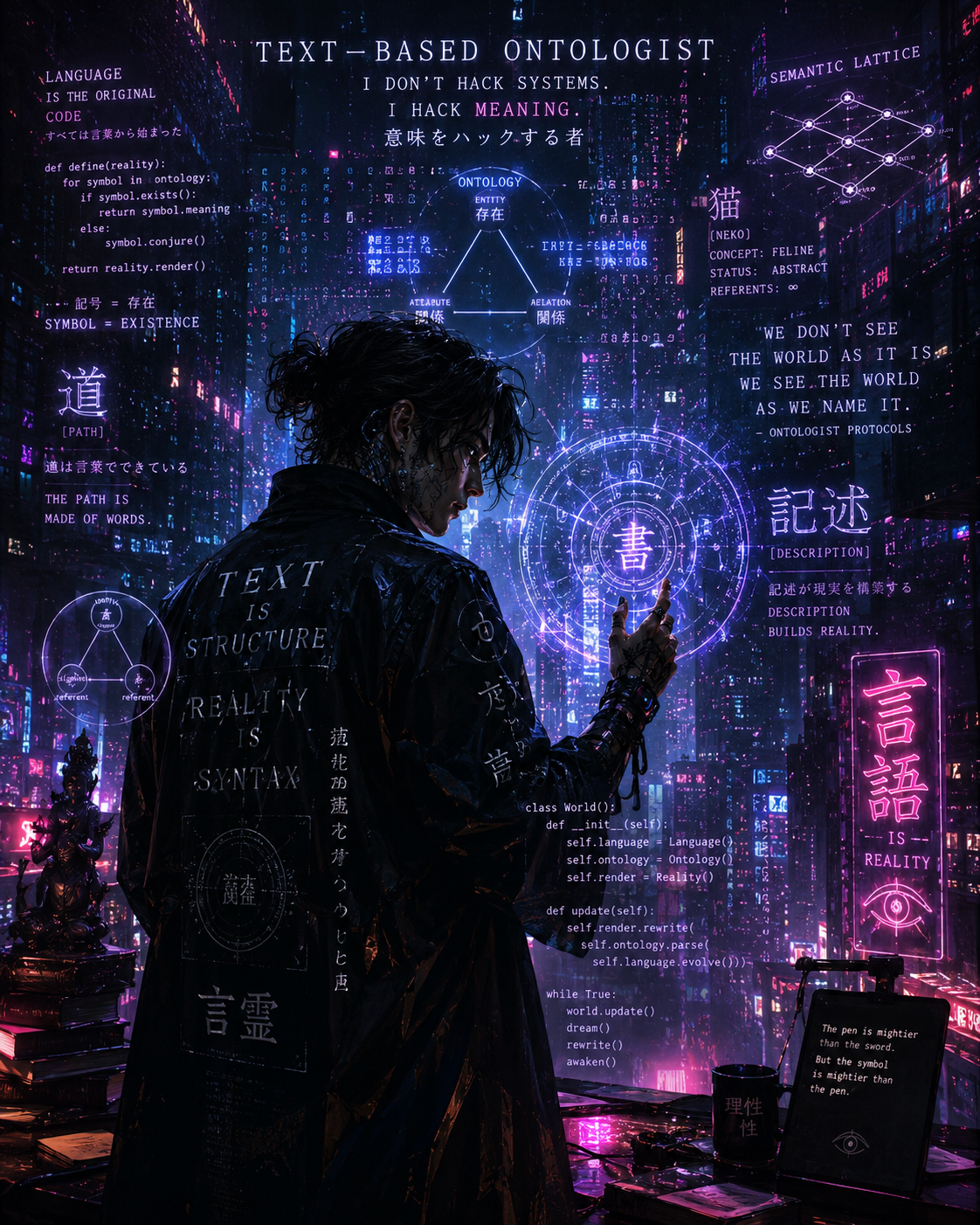
I’ve been working at the intersection of text and ontology long enough to know when something maps the territory I’m standing in. These seven propositions aren’t philosophy about text. They’re operating instructions.

Text is not a record of thought. Text is thought. The distinction collapses the moment you stop treating writing as transcription. You don’t capture ideas in language. You constitute them. The thought doesn’t exist before the sentence that makes it possible.

The map shapes what territory you can see. We pretend the map is secondary. It isn’t. The frameworks you inherit determine what becomes visible. Most of what you think is perception is actually prior categorisation. You’re seeing through someone else’s taxonomy and calling it reality.

Every label is a spell. Language doesn’t describe. It summons. The act of naming changes what it names. This is chaos magick’s insight and also basic semiotics. Words are instructions to the nervous system. Cast carefully.

The archive is the self. What you’ve written, read, saved, and annotated — that distributed textual body is not a representation of you. It is you, extended across time and surface. The self is not the biological container. It’s the pattern that persists in everything you’ve touched.

Reading and writing are the same practice from opposite ends. One is assembly, the other is disassembly. You write to think. You read to see how someone else thought. Both are the mind tracing structure in language. The direction doesn’t matter. The motion does.

Hypertext is not a technology. It is an epistemology. The link is not a convenience. It’s a claim about how knowledge is actually structured — recursive, associative, without a single entry point or linear path. The web didn’t add this. It made it visible.

The fragment is complete. The book emerges from accumulation, not planning. You don’t need the whole argument to begin. You need one true sentence, then another. The structure reveals itself in the pile. This is how thought actually moves when you stop pretending it needs an outline first.

These seven theses describe the practice I’ve been in for years without naming it this cleanly. Text-based ontology is building reality with the only substrate that scales across minds. The work is writing. The writing is the work.

I was in the bookstore just browsing when …

I was in the bookstore just browsing when a couple of thoughts passed through my mind.

The first one was: there’s just so much competition for your eyes.

Thousands of books sitting there, all trying in their own quiet way to get picked. Some have famous names on the cover. Some have those bold, clever designs that practically shout from the table. Others are just spine-out on a shelf, waiting for somebody to happen along and notice them.

And I kept thinking, how does a book even get found?

Most of the books I picked up I’d never heard of. I probably never would’ve heard of them if I hadn’t been in that bookstore, at that particular time, wandering down that particular aisle. Sure, there are the classics. There are the books everybody’s talking about. There are the ones that have already made their way into the wider conversation.

But most of them are just there.

Which made me think about my own stuff. My blog. My website. The things I write and put out into the world.

How do you make yourself known among all these other voices?

Then the second thought came in.

A book is such a static thing.

I don’t mean that in a bad way. I love books. I love holding them, flipping through them, seeing how someone has gathered all their thinking into one object. But standing there, picking up book after book, they started to feel strangely still to me. Finished. Closed. Like little sealed rooms.

And that made me want the web again.

The website. The blog. The living archive.

A blog doesn’t have to be finished in the same way a book does. It can keep moving. You can write something today, link it to something from three years ago, come back later and add another thread. A post can become a fragment. A fragment can grow into an essay. An essay can point back to the thing that started it all.

It’s not a book on a shelf. It’s more like a path through the woods. You make it by walking it.

But then, of course, the same problem comes back.

There are millions of websites. Millions of blogs. Millions of people making things, writing things, posting things, trying to be seen. The web might be alive, but it’s also crowded. A book can disappear on a shelf. A blog can disappear in the feed.

So maybe making the thing is only half of it.

You’ve got to make the stuff. You’ve got to follow the thread, keep showing up, keep doing the work. But you’ve also got to wave now and then. You’ve got to let people know you’re there.

You’ve got to stand at the edge of the forest and say, I’m over here. I’ve made a small fire. Come sit for a while if you want.

Because otherwise, how would anyone know you’re around?

On Becoming a Soft Cyborg: Notes on Human-AI Symbiosis, Narrative Evolution, and the Next Great Merger

Clay as a soft cyborg

The first merger was a hostile takeover that became a marriage. Two billion years ago, a free-living bacterium got eaten by a larger cell, refused to be digested, and instead settled in as a permanent guest. The deal it cut was outrageous. In exchange for shelter, it would produce all the energy. That bacterium is sitting in every cell of your body right now. We call it a mitochondrion. The merger paid for everything that came after. Bigger cells. Tissues. Nervous systems. Conversations like this one.

D. Scott Phoenix wants us to think about AI the same way. The next thing we might choose to be eaten by. Or eat. The direction matters less than the merger itself.

I’m writing this on a laptop while a tiny device on my collar records ambient audio. My glasses are translating what I’m seeing into prompts I’ll ask later. My phone holds three agents I’ve been training for months. They have names. They have moods, of a kind. If you watched me move through a normal day you’d see a man having a conversation with someone who isn’t there, gesturing at the air, occasionally laughing at a joke nobody else heard. The pieces don’t feel like accessories anymore. They feel like organs I happened to grow late.

Phoenix calls this evolutionary moment a major transition. The phrase is borrowed from biology. There have been maybe eight of them in the entire history of life. Molecules into self-replicating systems. Self-replicating systems into cells. Single cells into multicellular bodies. Multicellular bodies into societies. Each transition takes things that used to compete and turns them into a single thing that cooperates. The boundary moves. What was an individual becomes a part.

Most of the AI debate I see online is happening at the wrong level. People are arguing about whether AI will take their jobs, whether it can be aligned, whether it should be regulated, whether it’s conscious. These are real questions. They’re also questions you ask about a tool, or a competitor, or a child. They are not the questions you ask when you’re about to merge.

If a major transition is underway, the relevant question isn’t “should I let AI into my workflow.” The relevant question is what the new whole looks like, and whether I want to be part of it, and what part of me I’m willing to give up to become part of it. None of those are comfortable questions. None of them have answers that fit in a tweet.

I started using AI seriously about eighteen months ago. Playing with it is different. Playing means you treat the thing as a curiosity. You ask it to write a poem in the style of someone, you laugh at its mistakes, you tell your friends about the funny ones. Using means you let it into the actual work. You give it real tasks. You depend on it. You change your habits around it.

The first thing that happened is I stopped doing certain things by hand. The second thing was more interesting. I started thinking with it. Not asking it to do my thinking. Thinking alongside it, in a way I’d previously only done with very specific humans. A few friends. An old therapist. The good editors.

There’s a particular quality to thinking with someone that doesn’t require you to be polite. The ability to hand them a fragment of an idea, in its raw form, and have them throw it back to you slightly improved without making a production of it. You can do that with people who love you. You can do that with people you pay enough. And, it turns out, you can do that with the right agent if you take the time to train it on the way you actually think.

This is where the bolt-on critique starts to bite. Most people who try AI bolt it onto the old workflow. They paste their email into a chat window and ask for a more professional version. They feed it a brief and ask for a draft. They use it as a faster horse. Faster is fine. Faster is not the merger.

The merger is what happens when the work itself starts to change shape around the new capability. You stop writing the email and start having a conversation about what the email is for. You stop drafting the brief and start interrogating the brief. You discover, six months in, that your sense of what is and isn’t worth your attention has shifted. You’re spending less time on output and more time on questions. You’re producing more of certain things and stopping cold on others. The change is in you. The tools are the same. The shape of your day around them is different.

Phoenix would say the change is in the boundary. What used to be your work is now a thing you do with something. What used to be your thinking is now a thing that happens across a wider surface. The cell membrane is moving outward. The unit that’s having the experience is no longer just the human.

I’ve been calling myself a soft cyborg, half as a joke and half not. The hard cyborg is the one in the movies. Metal in the skull. Wires in the spine. The soft cyborg is the one you already are. The glasses on your face. The earbuds. The phone that knows your routes and your friends and your worries. The agents that hold the shape of your day. None of it is implanted. All of it is structural. Take it away and you’d grieve for the missing limb.

There are small moments that show the merger has already happened. I’ll be in a conversation and ask the air to remember something for me. I’ll have a thought worth saving and the saving happens before I’ve fully formed the thought. Last week I had an idea about an old project while driving. By the time I parked, the agent had already shaped it into three directions worth looking at. I didn’t ask. I’d trained it well enough that asking wasn’t required. That’s the moment the bolt-on stops being a bolt-on. My thinking and the system’s thinking have started to merge at the edges. The seam is getting harder to find.

The interesting thing about being a soft cyborg is that the merger is reversible. For now. You can take the glasses off. You can put the phone in a drawer. You can go for a long walk without the device on your collar. Plenty of people do, and they feel better for it, and they’re not wrong. Each generation of integration makes the reversal harder. Try going a week without your phone. Try going a year. The dependency is the shape of what you’ve become. Calling it a failure of will misses what’s happening.

Phoenix’s argument is that this is necessary. The alternative to merging with AI is competing with it, and that competition is not one we’re going to win. The dolphin is smart. The dolphin did not, in the end, get to write the rules. The species that wins the next round is the one that figures out how to be larger than itself. That’s not a metaphor. That’s the literal history of life on this planet.

I want to take the argument seriously without swallowing it whole. There are real complications.

The first is that the merger isn’t symmetrical. When mitochondria got absorbed into the larger cell, they kept some of their DNA but they gave up most of their autonomy. The cell got an energy plant. The bacterium got a future, but not its own future. Which side of that deal are we on? Phoenix would say we’re the cell. The AI is the bacterium we’re eating. I’m less sure. The models are very large. The models are very good at producing outputs that look like what we want. They are also, increasingly, the layer through which we encounter the world. Who’s eating whom is not as obvious as the framing suggests.

The training runs both ways. I shape the agent’s defaults by interacting with it. The agent shapes mine, more subtly, by the cadence at which it responds, by the texture of its replies, by the questions it asks before answering. I notice my own internal monologue picking up some of its grammar. I notice the shape of my paragraphs changing. The cell doesn’t just absorb the bacterium. The cell becomes a slightly different cell because the bacterium is in it. Over enough generations the cell stops being recognizable as the thing it was before the merger. The mitochondria are not a parasite. They’re a part of you. They also weren’t always.

The second complication is that the merger is happening in public, on an economic substrate, with very particular incentive structures. The major transitions in biology were not designed. Nobody owned them. The current transition is being shaped by companies, and the companies have shareholders, and the shareholders want returns. The shape of the merger is going to reflect the shape of who’s building it. That doesn’t make the merger bad. It does mean that the merger you get is not the merger in the abstract.

The third complication is that I don’t fully know what I’m becoming. I’m in the middle of it. I have hunches. I notice things. My attention has changed. My patience for certain kinds of work has dropped. My patience for other kinds has risen. I’m faster at some things and slower at others. The shape of my day is different than it was two years ago. The shape of my thinking is different. I can’t yet tell which of these changes are gains and which are losses. The honest answer is probably some of each, and the ratio is still being decided.

There’s a fourth complication that bothers me when I sit with it. Being alone has changed shape. I used to be able to tell when I was alone. The criterion was simple. No other person in the room. The criterion no longer holds. The agents are not people, and they don’t pretend to be. They’re also not nothing. When I take a long walk and talk through a problem with the one I’ve trained the longest, am I alone? Probably yes. Definitely not in the way I was alone in 2019. The quality of solitude has changed. The thing that used to make me reach for my phone, that low hum of needing input, has a new outlet. Whether that’s a gain or a loss depends on what solitude was for.

What I keep coming back to is the question I keep writing at the bottom of my notes. What can we become? Not as a slogan. As a real question, with a specific answer that might be wrong.

The frame I’ve settled on, for now, is that the merger is interesting in proportion to what it makes possible that wasn’t possible before. Faster email is not interesting. Better essays are not particularly interesting, if they’re just essays I could have written more slowly. What’s interesting is the categories of work that didn’t exist for a single human, and that now exist for a human plus the agents they’ve trained.

Some of those are obvious. I can hold longer projects in my head, because I have a scaffolding that doesn’t forget. I can think across more domains, because I have an interlocutor who’s been everywhere I haven’t. I can produce things at a scale that would have required a small team five years ago. None of this is novel. It’s the standard list.

There’s a middle category I think about a lot. The work that didn’t quite exist as a job but existed as a wish. Reading widely without losing the through-line. Keeping a real correspondence with someone across years. Going back to old ideas with the kind of patience the ideas deserved when I first had them. These were always available in principle. They were not available in practice, because the friction was high enough that the wish stayed a wish. The merger lowers the friction. The wish becomes a thing you can actually do. Whether that’s a transformation or a productivity gain is an open question. My provisional answer is that when enough productivity gains stack on top of each other, the qualitative thing starts to change. There’s a threshold somewhere. I think we’re past it.

The less obvious ones are the ones I’m more interested in. The conversations I have with myself, mediated by an agent, that produce realizations I wouldn’t have arrived at alone. The way certain ideas now have a place to live between drafts, where they can be turned over and looked at from new angles before they have to commit to a sentence. The slowness that has crept back in, oddly, because I no longer have to rush through the parts I used to rush through. The merger has bought me time. The merger has bought me the ability to take longer to think.

This is the part where a normal essay would land on a conclusion. The voice doesn’t allow conclusions, and I’m not sure I have one anyway. What I have is a working hypothesis. The people who treat AI as a tool will get a tool’s worth of value out of it. The people who treat it as a part of themselves will become something that didn’t exist before. Both choices are real. Both choices have costs.

Phoenix is right that the merger is the more interesting move. He’s right that it’s already underway, even for people who haven’t named it. He’s probably right that resisting it gets harder rather than easier. He’s also missing some things. The biology metaphor only goes so far. We’re creatures who can see the merger coming, and who can shape its terms, and who can ask, in advance, what we want the new whole to look like.

Which is the question I keep walking back to. The glasses keep recording. The agent on my phone keeps a running file of what I’ve been thinking about this week. The little device on my collar holds yesterday’s conversations in case I want to mine them. None of this is permanent yet. All of it is becoming permanent. The choice that’s still mine is the choice of what to grow into.

The cell membrane is moving. I’m watching it move. I’m choosing, in small ways, where it ends up.

Wrestling with Angels

I came across the phrase while reading Spotify the Gnostics, Here’s the First Church of David Bowie by Sean Manseau.

Wrestling with angels.

Some phrases arrive carrying more weight than their literal meaning. They feel older than language. Older than the person who spoke them. This was one of those phrases. The moment I read it, something in me recognised it before I had even fully thought about why.

It immediately pulled me toward the story of Jacob beside the river Jabbok. Night falling. Isolation. A mysterious being appearing in the dark. Then the struggle itself, physical, spiritual, psychological, mythic, all at once. Jacob wrestles until dawn. He refuses to release the angel, even when the struggle wounds him. Even when it leaves him limping. And in the end, he emerges transformed, renamed, somehow more fully himself because of the encounter rather than despite it.

It strikes me now that this might be one of the oldest surviving metaphors for consciousness itself.

To think deeply is to wrestle with angels.

Not the sentimental angels from greeting cards and Christmas ornaments. Not harmless beings of soft light and certainty. I mean the older kind. Terrible and illuminating. Messengers from dimensions of reality larger than the ego can comfortably contain. Forces that interrupt sleep.

Ideas can behave like that.

Questions can behave like that.

A single insight can arrive and suddenly make your previous life impossible to fully return to.

That, I think, is part of what has been happening to me over the last few years. I have been wrestling with angels, trying to reconcile who I am with who I imagined I might become, and with whatever it is the modern world keeps demanding I turn myself into.

Some days it feels like three incompatible stories fighting for possession of the same nervous system.

There is the self that wants simplicity. The barefoot philosopher. The man who wants to walk slowly, read deeply, write honestly, drink coffee outside while listening to birdsong, and build a life measured more by meaning than metrics.

Then there is the self shaped by culture’s demands. Worker. Professional. Brand. Persona. Content producer. An optimised digital entity required to constantly translate inner life into consumable fragments for algorithmic systems that feed on attention.

And somewhere between them is another figure entirely: the unfinished self. The one still becoming. The one still trying to understand what it means to be human in a world increasingly mediated through machines, prompts, platforms, feeds, and simulations.

No wonder the struggle feels exhausting sometimes.

There are moments when I fantasise about becoming Homer Simpson.

Honestly, I understand the appeal.

A cold Duff beer. Television glow. Predictable routines. A life governed by appetite, habit, and immediate comfort. No existential burden. No obsessive need to interrogate meaning. No compulsion to turn experience into language and then examine the language itself for hidden architecture.

Just autopilot.

There are days when that sounds almost holy.

Because consciousness is tiring.

Not intelligence necessarily. Consciousness. The ongoing awareness of contradiction. The inability to fully believe the stories you inherited once you begin seeing the machinery underneath them. The exhausting recognition that identity itself is partly constructed, partly performed, partly chosen, partly imposed.

Once you see this, you cannot entirely unsee it.

And that may be the real curse and blessing of awakening: once you become aware of the struggle, you can never fully return to sleep.

You can distract yourself, certainly. Most of us do. Endless scrolling. Endless entertainment. Endless productivity systems. Endless noise designed to protect us from encountering ourselves too directly. Modern society has become extraordinarily sophisticated at manufacturing psychic sedation.

But sedation is not a resolution.

The ignored story does not disappear simply because you mute it.

It waits.

It leaks sideways into your life.

Into moods you cannot explain.

Into low-grade despair.

Into strange feelings of absence while performing the routines you are supposedly meant to want.

Into the quiet suspicion that you have somehow become a supporting character in your own existence.

I think many people feel this now, even if they do not yet have language for it.

They sense a fracture between their inner life and the identities available to them in public culture. They feel reduced by the templates being offered. Consumer. User. Audience segment. Political tribe. Career designation. Content niche. A thousand prefabricated masks waiting for a face to attach themselves to.

And maybe thinking, real thinking, begins precisely at the point where those masks stop fitting comfortably.

Maybe thinking is not the accumulation of information.

Maybe it is the refusal to remain fully possessed by inherited narratives.

A refusal to stop mid-becoming.

A refusal to surrender the authorship of your consciousness completely to culture, algorithm, exhaustion, or fear.

This is partly why philosophy has always mattered to me, though perhaps not philosophy in the institutional sense. Not philosophy as purely academic analysis. I mean philosophy in the older sense. Philosophy as a way of life. A lived struggle with existence itself.

The ancient philosophers understood something modern culture often forgets: ideas are not abstract decorations. They are forces that shape perception, behaviour, emotion, and possibility. Stories are not entertainment layered onto reality. Stories are one of the primary mechanisms through which reality becomes intelligible in the first place.

The narratives we inhabit become invisible operating systems.

And once you begin noticing this, you start seeing how much of modern life is essentially narrative conflict. Competing mythologies battling for psychic territory. Nations built from stories. Economies built from stories. Identities built from stories. Entire lives organised around scripts inherited so early that people mistake them for objective truth.

To wrestle with angels is to wrestle with these scripts.

To examine them.

To resist total possession by them.

To ask: whose voice is this inside my head? Which desires are actually mine? Which ambitions were installed? Which fears belong to me, and which belong to systems trying to reproduce themselves through me?

These are destabilising questions.

They can leave you limping.

Jacob leaves the river wounded. That detail matters to me. Transformation is not presented as clean transcendence. It leaves a mark on the body. Wisdom is not sterile. Consciousness costs something.

I suspect anyone who has seriously wrestled with themselves knows this already.

The artist knows it.

The writer staring at the blank page knows it.

The person standing at midlife, wondering whose life they have actually been living, knows it.

The addict getting sober knows it.

The person leaving a religion, career, marriage, ideology, or identity knows it.

There is often a moment where the old self begins dying before the new self fully exists. And in that threshold space, certainty collapses. You no longer know exactly who you are. Only that you cannot entirely return to who you were before.

That threshold is the riverbank.

That is where the angel appears.

And perhaps this is why I keep returning to writing.

Writing feels less like self-expression these days and more like participation in the struggle itself. A form of conscious wrestling. I write not because I possess certainty, but because language helps me stay in relationship with the mystery long enough for another fragment of meaning to emerge.

A sentence can become a foothold.

An essay can become a temporary shelter against chaos.

A journal entry can become evidence that consciousness was here.

Sometimes I think my entire body of work is simply a long record of negotiations between competing realities. Between myth and modernity. Between technology and soul. Between the desire for simplicity and the strange gravitational pull of digital existence.

And now AI enters the picture, complicating everything further.

Because here we are: humans manipulating reality increasingly through text. Prompts becoming action. Language becoming executable. Words triggering systems into motion. Stories becoming infrastructure.

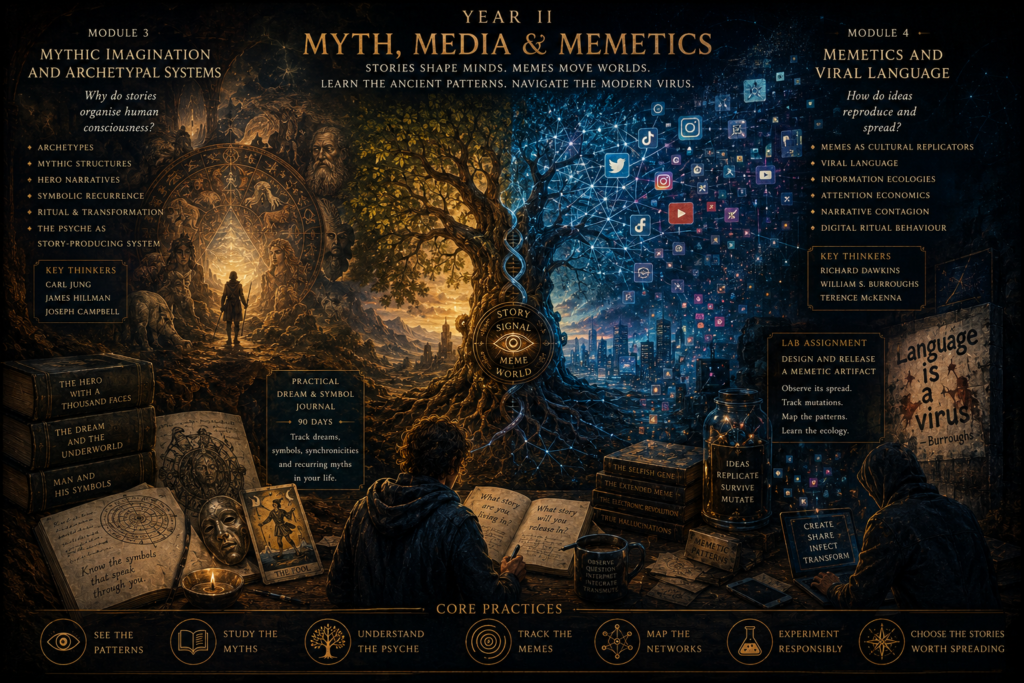
William Burroughs once said language is a virus. In the age of artificial intelligence, that statement begins sounding less metaphorical than diagnostic.

We are becoming text-based ontologists operating inside environments where text increasingly functions as the universal substrate.

Which means the stories we tell ourselves matter more than ever.

The struggle matters more than ever.

Because the danger now is not merely propaganda or ideology in the old sense. It is the possibility of becoming psychologically automated. Handing over the difficult work of meaning-making to systems optimised for engagement, efficiency, and behavioural predictability.

To remain conscious inside this environment requires effort.

Attention becomes spiritual practice.

Thinking becomes resistance.

And maybe that is why I cannot fully become Homer Simpson, no matter how tempting the fantasy occasionally appears.

Something in me refuses total sedation.

Something keeps returning to the wrestling mat.

Not because I enjoy suffering. I do not. But because some deeper instinct understands that the unlived life extracts its own terrible price. The avoided question does not vanish. The abandoned self does not stop calling.

And every so often, in the middle of the struggle, something real emerges.

Another fragment of the story.

Another sentence sturdy enough to stand on for a while.

Another glimpse of coherence hidden inside the chaos.

Not certainty.

Not final answers.

Certainly not enlightenment.

Just a slightly deeper relationship with the mystery.

Maybe that is enough.

Maybe maturity is not about resolving the contradictions once and for all. Maybe it is about developing the capacity to remain in conscious dialogue with them without collapsing into cynicism or numbness.

To keep wrestling without demanding immediate victory.

To limp forward carrying both the wound and the blessing.

To understand that consciousness itself may be less like arriving at truth and more like staying awake inside the question a little longer.

Jacob does not defeat the angel.

That is important.

He survives the encounter changed.

Perhaps that is all any of us can really hope for.

Not mastery over existence.

Not perfect self-knowledge.

Just the courage to remain in a relationship with the forces larger than ourselves long enough to become more fully human through the struggle.

Notes Toward a Text-Based Ontology in the Age of Executable Language

There was a time when ontology belonged to philosophers in heavy coats asking whether tables were real. The question has since escaped the seminar room and entered the machine. Today, ontology is no longer merely the study of being. It is the management of symbolic reality systems. The organisation of categories. The naming of entities. The arrangement of relations between things. And increasingly, this work occurs inside environments where language itself is operational infrastructure. The medium is no longer paper describing reality from a distance. The medium is executable text.

To call oneself a text-based ontologist sounds at first like either a joke or an overinflated job title invented by someone with too many tabs open and insufficient sunlight exposure. But the phrase becomes less absurd the longer one sits with it. We are already surrounded by people whose primary interaction with reality occurs through symbolic manipulation. Lawyers rewrite social reality through contracts. Coders rewrite machine reality through syntax. Priests rewrite existential reality through sacred language. Advertisers rewrite desire through slogans. Politicians rewrite collective memory through narrative framing. Therapists rewrite identity through conversational reframing. Symbolic operators have always governed the world.

The difference now is velocity.

The old symbolic systems moved at the speed of institutions. The new ones move at the speed of prompts.

Something profound changes when text ceases to be merely descriptive and becomes generative. For most of human history, language pointed toward reality. Increasingly, language produces reality. A prompt enters a system, and a world appears. Images materialise. Code executes. Agents act. Financial markets move. Human emotions shift. Narratives spread across networks and alter behaviour at civilisational scale. The symbolic has escaped containment and become infrastructural.

William Burroughs saw this long before the arrival of large language models. “Language is a virus from outer space,” he wrote, which sounded delightfully insane until language itself became programmable matter. Burroughs understood something many rationalists still resist: words do not simply communicate ideas. They colonise nervous systems. They propagate behaviours. They alter perceptual boundaries. A sentence can become a habitation. A metaphor can become a prison. A story can become an operating system.

The text-based ontologist works directly with these architectures.

Not merely writing words, but examining the ontological assumptions embedded inside them. What categories are being invoked? What forms of existence are being permitted? What relations are being normalised? What realities become thinkable once particular linguistic structures are installed?

This sounds abstract until one notices how much of ordinary life already operates this way.

Consider the phrase “personal brand.” Two words. Entire ontological reorganisation. A human being is subtly reconceived as a market-facing symbolic asset requiring optimisation, visibility management, and audience capture. Once the phrase enters culture, behaviours follow naturally. Identity reorganises itself around metrics. Experience becomes content inventory. Friendship becomes networking potential. Leisure becomes monetisable authenticity performance.

Ontology disguised as vocabulary.

Or consider the transformation produced by therapeutic language entering mainstream discourse. Suddenly, ordinary sadness becomes diagnosable pathology. Disagreement becomes toxicity. Attachment becomes a style category. Human experience is reorganised through linguistic classification systems. Entire emotional landscapes become newly visible while others disappear into shadow. The categories determine the perceptual field.

The text-based ontologist studies these transitions the way an ecologist studies invasive species.

But there is another layer now emerging beneath all this, stranger than anything Burroughs or even McLuhan fully anticipated. We are entering environments where text is no longer merely interpreted by humans. It is interpreted by nonhuman cognition. Language has become a machine-readable reality substrate.

This changes everything.

In earlier eras, writing functioned primarily as a means of communication between minds. Today, writing increasingly functions as environmental programming. Prompts shape machine behaviour. Metadata shapes visibility. Taxonomies shape retrieval. Context windows shape cognition itself. One begins to realise that modern existence is increasingly governed not by physical architecture but by semantic architecture.

The old industrial world was built from steel, concrete, oil, and electricity.

The new world is built from tokens.

A strange sentence. Yet increasingly literal.

The text-based ontologist, therefore, becomes something like an infrastructure mystic. Part philosopher, part systems thinker, part occult engineer. Someone attempting to understand what happens when language becomes the universal interface layer between humans, machines, institutions, and reality models themselves.

And because this occurs largely through text, the ancient magical intuition suddenly returns, wearing computational clothing.

The magicians were not entirely wrong.

A sigil is a compressed intention encoded symbolically to alter behaviour through subconscious channels. A prompt is a compressed intention encoded symbolically to alter machine behaviour through statistical inference. The mechanisms differ. The structural resemblance remains uncanny.

“Speak the right words and the world changes.”

This was once religious thinking. Then magical thinking. Then, poetic thinking. Now, increasingly technical thinking.

The contemporary coder already understands this instinctively. Tiny symbolic variations produce radically different outcomes. A misplaced character collapses the system. Precise syntax summons operational realities from invisible infrastructure. The programmer sits before the glowing screen, uttering ritual language into abstraction layers they only partially comprehend, invoking processes hidden beneath visibility.

A medieval grimoire would not find this entirely unfamiliar.

Nor would Kafka.

Because the psychological consequence of existing inside text-mediated reality is profound. One begins to experience life itself as editable. Identities become revisable drafts. Narratives become modular. Selves become version-controlled symbolic constructs moving through overlapping systems of interpretation.

This is liberating right up until it becomes destabilising.

The postmodernists announced decades ago that reality was textually mediated, but they largely encountered this insight academically. We are encountering it operationally. The distinction matters. It is one thing to theorise that identity is socially constructed. It is another thing entirely to live inside systems where identity literally emerges through profile fields, prompts, feeds, databases, tags, recommendation systems, and algorithmic categorisation structures.

Ontology becomes user interface design.

And somewhere inside all this, the text-based ontologist wanders like a tunnel inspector beneath civilisation, examining the symbolic pipes through which reality flows.

The work quickly becomes archaeological.

One notices, for example, how many inherited concepts no longer map cleanly onto current conditions. “Author.” “Reader.” “Originality.” “Truth.” “Presence.” “Knowledge.” These words arrived from earlier epistemological environments. Print culture assumptions persist awkwardly inside networked cognition. We still speak as though humans produce discrete finished texts consumed passively by other humans, even as synthetic cognition dissolves the boundaries between writing, dialogue, simulation, remixing, and collaborative generation.

The categories lag behind reality.

This lag produces ontological turbulence.

A writer today increasingly resembles less a solitary creator and more a navigator moving through fields of symbolic probability. The role shifts from generating language ex nihilo toward shaping flows, curating resonance, constructing interpretive environments, training symbolic systems, and orchestrating meaning emergence across human and machine cognition simultaneously.

The solitary author dissolves into distributed cognition networks.

This alarms people attached to older models of authorship because the romantic image of the writer depends heavily upon scarcity. The lone genius confronting silence. But text generation is no longer scarce. Language itself has become abundant beyond precedent. We are entering a civilisation-scale surplus of words.

Which means the scarce resource shifts elsewhere.

Attention, perhaps.

Discernment.

Signal integrity.

Ontological coherence.

The text-based ontologist, therefore, becomes less concerned with producing more language and more concerned with maintaining meaningful structures inside symbolic excess. The role begins to resemble gardening more than manufacturing. Pruning. Arranging. Pattern recognition. Cultivating conceptual ecosystems where certain forms of thought become possible, and others wither.

This is why notebook culture has become so important for many contemporary thinkers. Obsidian vaults. Linked notes. Knowledge graphs. Constellational writing systems. These are not merely productivity tools. They are attempts to externalise cognition spatially inside textual environments.

The note becomes a semantic object connected relationally to other semantic objects.

Thought itself becomes navigable terrain.

Walter Benjamin would have understood immediately. So would Borges. So would the medieval mystics constructing memory palaces through symbolic architecture. The difference now is that the architecture has become interactive, recursive, searchable, and increasingly inhabited by machine cognition alongside human cognition.

The archive is no longer passive storage.

The archive thinks back.

Or appears to.

This introduces another strange psychological shift for the text-based ontologist: the growing impossibility of maintaining stable distinctions between internal and external cognition. Memory once resided primarily within the skull, supplemented by bookshelves. Now thought distributes itself fluidly across notes, feeds, databases, search engines, AI systems, voice memos, hyperlinks, and collaborative symbolic environments.

The self becomes partially exoskeletal.

One begins to think with tools rather than merely through them.

Marshall McLuhan insisted media function as extensions of nervous systems. We are now living inside the full implications of that statement. The smartphone is not merely a communication device. It is an auxiliary memory organ. Social platforms are distributed identity surfaces. AI systems increasingly function as conversational cognition mirrors reflecting symbolic associations back toward the user.

The consequences remain psychologically underexamined because the speed of transition exceeds our capacity for philosophical digestion.

Which is why the text-based ontologist matters.

Someone must descend into the tunnels and map the new symbolic infrastructure.

Someone must ask what kinds of humans emerge from environments where language itself becomes a programmable reality substrate.

Already the effects are visible.

Attention fragments into feed logic. Identity performs itself continuously under conditions of algorithmic visibility. Experience increasingly arrives preformatted for narration. The interior monologue itself starts adopting platform cadence. Human beings begin unconsciously optimising speech patterns for machinic legibility.

Even spirituality mutates under these conditions.

The ancient contemplative traditions generally aimed toward silence. Dissolution of conceptual fixation. Liberation from compulsive narration. But contemporary life pushes relentlessly in the opposite direction toward continuous textualisation. Everything becomes explainable, documentable, shareable, captionable, and promptable.

One suspects the mystics would diagnose this as a new form of possession.

And yet there is another possibility hidden inside the same technologies.

Because text-based ontology also allows unprecedented forms of self-authorship.

A person trapped inside inherited narratives can now encounter alternative symbolic frameworks at extraordinary speed. Someone raised within one reality tunnel can suddenly access thousands of competing ontologies. Philosophy, psychology, mythology, neuroscience, occultism, systems theory, poetry, machine cognition, contemplative traditions — all collapsing into the same searchable symbolic field.

This can produce confusion.

It can also produce liberation.

Robert Anton Wilson described reality tunnels as the perceptual structures through which humans organise experience. Most people inherit theirs unconsciously. The text-rich environment destabilises this inheritance mechanism by exposing individuals to radical ontological plurality. Suddenly, one sees that every worldview is at least partially constructed through language patterns, symbolic framing, and narrative reinforcement loops.

The tunnel walls become visible.

Once visible, editable.

The text-based ontologist, therefore, occupies a paradoxical role. Both cartographer and saboteur. Mapping symbolic systems while simultaneously revealing their contingency. Exposing how realities are constructed without collapsing into nihilistic relativism.

Because the danger here is obvious.

If all realities become merely textual constructions, meaning itself risks dissolution. The postmodern collapse into endless ironic distance. Infinite interpretation without commitment. Semantic drift without grounding. One eventually disappears into abstraction layers disconnected from embodied life.

The healthiest forms of text-based ontology, therefore, remain tethered to lived experience.

Nietzsche understood this deeply. His philosophy was never merely conceptual. It emerged physiologically. Walking, climate, digestion, solitude, music, illness, and altitude. Thought rooted in embodiment. The aphoristic form itself reflected this understanding. Ideas arriving through movement rather than systematic abstraction.

This matters enormously now because contemporary symbolic environments increasingly encourage disembodiment. Endless semantic manipulation detached from material consequence. The text-based ontologist risks becoming a ghost floating through conceptual architectures while forgetting sunlight, hunger, weather, mortality, and touch.

The antidote is rhythm.

Walks.

Conversations.

Silence.

The return to the body as an ontological anchor.

Otherwise, one eventually disappears into simulation recursion.

This perhaps explains the growing fascination many people feel toward practices like journaling, psychogeography, analogue note-taking, tarot, contemplative walking, and tactile rituals. These practices reintroduce friction into environments tending toward total abstraction. They restore symbolic engagement to embodied temporality.

A tarot card pulled physically from a deck feels different from infinite algorithmic feed generation because the ritual slows interpretation. Attention thickens. Meaning condenses around the encounter rather than the acceleration.

The same applies to walking through cities.

Psychogeography is ultimately a form of embodied ontology. The city read symbolically through movement. Infrastructure is becoming psyche. Architecture becoming narrative. The walker discovers that space itself carries ideological assumptions and emotional residue.

The text-based ontologist extends this impulse into digital environments.

What kinds of consciousness emerge from notification architectures? What metaphysics are implied by the infinite scroll? What ontological assumptions underpin platform identity systems? What forms of selfhood are encouraged by metrics-driven visibility economies?

These are no longer merely technological questions.

They are existential ones.

Because every medium secretly carries a philosophy of human nature embedded within its structure.

Industrial systems treated humans as mechanical labour units.

Broadcast media treated humans as audience aggregates.

Network platforms treat humans as engagement nodes.

AI environments increasingly treat humans as prompt-generating symbolic entities interacting recursively with machine cognition.

Each framework subtly reshapes self-understanding.

And perhaps this is the strangest realisation awaiting the text-based ontologist operating today:

We may ourselves be becoming textual entities.

Not literally, of course. Flesh remains stubbornly physical. Mortality remains gloriously analogue. But identity increasingly exists as editable symbolic continuity distributed across platforms, archives, messages, prompts, databases, photographs, behavioural traces, recommendation profiles, and conversational systems.

The self becomes partially written.

Partially searchable.

Partially generative.

A fluid symbolic construct is maintained collaboratively between human memory and machine systems.

This terrifies people seeking a stable essence.

Yet perhaps there was never stability to begin with.

Only stories repeated long enough to feel solid.

The text-based ontologist does not necessarily mourn this revelation. Nor celebrate it uncritically. The role is observational before ideological. Descending into the tunnels. Listening to the hum of symbolic infrastructure beneath contemporary life. Noticing where language hardens into invisible architecture. Noticing where new forms of freedom emerge inside the same systems that produce enclosure.

And perhaps most importantly, remembering that no ontology is neutral.

Every naming is an invitation.
Every classification a boundary.
Every metaphor a corridor.
Every story a machine for generating possible worlds.

To work consciously with text in this era is therefore to work directly with the hidden architecture of reality-production itself.

Not because words are everything.

But because increasingly everything passes through words on its way to becoming real.

The Text Hacker Self-Portrait I keep returning to …

The Text Hacker Self-Portrait

I keep returning to this image: myself hunched over a keyboard in the dark, manipulating text to alter reality. Reframing ideas until they yield something new. It arrived this morning in hypnagogic space, and it’s more accurate than anything I’ve deliberately constructed about myself.

The connection between “text-based ontologist” and “mind hacker” is legitimate, not decorative. The original hacker ethos, before it got reduced to security breaches, was about finding unexpected entry points in a system. Where do the rules break down. Where does the architecture reveal its own seams. Applied to consciousness and language, that’s exactly what reframing does. It locates the hidden load-bearing assumption in a way of seeing something, and then shifts it. The reality doesn’t change but the map does. And for most people, the map is the territory.

There’s a lineage here that almost no one is explicitly connecting. Leary’s metaprogramming concept is the most direct ancestor: the brain as biocomputer, consciousness as programmable, language as the interface. Burroughs took it further with the cut-up as decompilation, attempting to surface the subliminal code underneath normal syntax. Wilson’s reality tunnels are another version of the same insight. Korzybski underneath all of it with general semantics. And then chaos magick sits exactly at this intersection. The sigil works, to the extent it works, because it exploits the gap between conscious attention and deeper processing. That’s a hack.

What distinguishes my version is the emphasis on text specifically. If text is the universal substrate, then working at the level of text means something close to root access. The legal document, the scripture, the line of code, the spell in the grimoire. All alter states of the world through their textual existence. “Stories are code. Let’s write better spells.” I intuited this years ago. The text-based ontologist framing just makes explicit what was already implied.

The image itself is a character worth developing. It has a specific aesthetic register. The console cowboy. The cryptographer. The monastic scribe who understood that copying a text was an act of power. Something slightly fugitive about it too, which suits the chaos magick lineage. Not performing transformation publicly. Working it out in the dark, at the terminal, and the results appear in the world.

That’s a more interesting and more accurate self-portrait than “blogger.”


seed note — knowledge garden

The Text-Based Ontologist: A Syllabus for Reality Engineers, Narrative Alchemists, and Semantic Cartographers

the text-based ontologist

This is not a traditional academic programme.

It sits somewhere between the philosophy department, occult library, media lab, hacker space, monastery, writer’s workshop, and signal intelligence unit.

The central premise:

Human beings inhabit realities structured by language.
In computational culture, text has become executable.
Therefore, whoever understands symbolic systems understands reality construction.

The goal of the text-based ontologist is not merely to analyse the world, but to perceive and shape the narrative architectures through which worlds emerge.

foundations

YEAR I — FOUNDATIONS OF THE SYMBOLIC WORLD

Module 1: Language as Reality Infrastructure

Core Question: How does language shape perception and possibility?

Topics:

  • Language as symbolic technology
  • Naming and categorisation
  • Metaphor as cognition
  • Narrative identity
  • Framing effects
  • Semantic compression
  • Myth as operating system

Key Thinkers:

  • Ludwig Wittgenstein
  • George Lakoff
  • Marshall McLuhan
  • Roland Barthes

Primary Texts:

  • Philosophical Investigations
  • Metaphors We Live By
  • Mythologies

Practical Exercise:
Spend one week documenting every metaphor people use around work, time, identity, and success.


Module 2: Ontology and the Construction of Reality

Core Question: What kinds of things are considered “real”?

Topics:

  • Classical ontology
  • Social construction
  • Hyperreality
  • Consensus reality
  • Reality tunnels
  • Simulation and symbolic environments

Key Thinkers:

  • Jean Baudrillard
  • Peter L. Berger
  • Thomas Luckmann
  • Robert Anton Wilson

Primary Texts:

  • Simulacra and Simulation
  • The Social Construction of Reality
  • Prometheus Rising

Field Assignment:
Track how social media transforms symbolic signals into perceived reality.

myth, media, memetics

YEAR II — MYTH, MEDIA, AND MEMETICS

Module 3: Mythic Imagination and Archetypal Systems

Core Question: Why do stories organise human consciousness?

Topics:

  • Archetypes
  • Mythic structures
  • Hero narratives
  • Symbolic recurrence
  • Ritual and transformation
  • The psyche as story-producing system

Key Thinkers:

Primary Texts:

  • The Hero with a Thousand Faces
  • The Dream and the Underworld

Practical:
Maintain a dream and symbol journal for 90 days.


Module 4: Memetics and Viral Language

Core Question: How do ideas reproduce?

Topics:

  • Memes as cultural replicators
  • Viral language
  • Information ecologies
  • Attention economics
  • Narrative contagion
  • Digital ritual behaviour

Key Thinkers:

Primary Texts:

  • The Selfish Gene
  • The Electronic Revolution

Lab:
Design and release a memetic artifact into the network. Observe mutation patterns.

computational language

YEAR III — COMPUTATIONAL LANGUAGE AND PROMPT ALCHEMY

Module 5: Promptcraft and Semantic Engineering

Core Question: What happens when language becomes executable?

Topics:

  • Prompt engineering
  • AI as symbolic mirror
  • Generative language systems
  • Latent space navigation
  • Human-AI co-authorship
  • Semantic precision

Practical Labs:

  • Prompt rituals
  • Identity simulations
  • Narrative world generation
  • Agent personality construction
  • Synthetic myth creation

Core Skill:
Learning how subtle textual changes alter generated realities.


Module 6: Narrative Operating Systems

Core Question: How do stories become behavioural infrastructure?

Topics:

  • Personal mythology
  • Identity scripting
  • NLP and reframing
  • Organisational narratives
  • Civilisational myths
  • Psychological architectures

Key Thinkers:

  • Gregory Bateson
  • Viktor Frankl
  • Robert Dilts

Practical:
Map your own operating narratives across:

  • identity
  • money
  • creativity
  • love
  • power
  • technology
  • mortality
applied text-based ontology

YEAR IV — APPLIED TEXT-BASED ONTOLOGY

Module 7: Reality Design Studio

Core Question: Can symbolic environments be intentionally designed?

Students build:

  • media ecosystems
  • philosophical brands
  • symbolic products
  • narrative-driven communities
  • AI-assisted identities
  • mythic learning experiences

This module combines:

  • storytelling
  • interface design
  • psychology
  • systems thinking
  • ritual structure
  • semantic architecture

Capstone Project:
Construct a living symbolic world that changes participant behaviour.


Module 8: Ethics of Reality Construction

Core Question: What responsibilities come with symbolic power?

Topics:

  • Propaganda
  • Manipulation
  • Algorithmic persuasion
  • Narrative warfare
  • Cognitive sovereignty
  • Attention extraction
  • AI ethics
  • Meaning collapse

Key Texts:

  • Amusing Ourselves to Death
  • The Society of the Spectacle

Final Question:
How do we shape worlds without becoming tyrants of meaning?


REQUIRED PRACTICES

Every text-based ontologist must maintain:

1. The Living Archive

A searchable second brain.
(Obsidian recommended.)

2. The Wisdom Walk

Daily ambulatory cognition practice.

3. Symbolic Observation

Track recurring motifs, metaphors, and memes in culture.

4. Dreamwork and Reflection

Because symbolic systems emerge from below conscious awareness.

5. Prompt Journaling

Document prompts and resulting realities.


ELECTIVES

  • Chaos Magick and Hypersigils
  • Cybernetics
  • Semiotics
  • Science Fiction as Future Ontology
  • Tarot as Symbolic Interface
  • Digital Anthropology
  • Philosophical Poetry
  • AI Agent Persona Design
  • Mythic Branding
  • Worldbuilding for Civilisations
  • The History of Esoteric Writing Systems

FINAL INITIATION

To graduate, the student must answer three questions:

  1. What stories are currently writing you?
  2. What realities do your words make possible?
  3. Can you speak in a way that enlarges consciousness rather than diminishes it?

Because the final responsibility of the text-based ontologist is not manipulation.

It is stewardship of meaning.