Clay Lowe is a blogger and text-based ontologist exploring narrative alchemy, imaginal psychology, self-authorship, conscious living, and the reality-shaping power of story. His blog, soulcruzer, is where he walks, wonders, writes, and follows the rhizome wherever it wants to go.
One of the traps in collaborative leadership is thinking that collaboration begins when we put people in the same room.
It doesn’t.
A room full of people can still be a room full of separate silos.
Everyone arrives carrying their own institutional habits, loyalties, scars, private pressures, and little rulebooks about how things are supposed to work. In health and care systems, this becomes even more tangled because the work is already complex, the stakes are high, and the organisations involved often have different histories, incentives, and ideas of what “good” looks like.
This King’s Fund report uses the language of collaborative leadership, but the bit that catches my attention is more basic and more human:
Before people can work together well, they need to agree how they’re going to behave with each other when the work gets difficult.
That sounds simple. But it might be one of the hidden foundations of collaboration.
Because the real test of collaboration is not how people behave when the workshop is warm, the coffee is decent, and everyone agrees with the slide deck.
The real test comes when money is tight, the data is contested, the history is messy, and someone around the table thinks another team is quietly protecting its own patch.
Tarot, in this frame, is not about predicting the future or handing my authority over to a deck of cards. It is a way of working with symbol, image, projection, shadow, inner dialogue, and the strange intelligence of the unconscious. The cards give form to things that often move below the level of ordinary speech.
That part feels right to me.
But there is another layer underneath it.
A while ago, one of the bots pointed out that I sometimes lean on Jung and psychology to legitimise my use of tarot. As if I need a respectable intellectual witness standing beside me before I’m allowed to admit that these images matter to me.
It caught me because it was true.
There is a part of me that imagines the tribunal before anyone has even said anything. The rational people. The sceptical friends. The religious voices. The ones who might think tarot is airy-fairy, superstitious, unserious, or somehow dabbling with the dark side.
All of that may be true. But if I’m not careful, the psychological frame becomes body armour. I start using Jung as a permission slip rather than as a companion.
The cleaner truth is simpler:
Tarot is one of the symbolic languages I use to think with.
That sentence does not need defending.
I use walking to think. I use blogging to think. I use dreams, books, myths, conversations, notes, memories, and old fragments from the archive. Tarot belongs in that same family. It is a reflective technology. A deck of charged images. A small theatre of archetypes I can lay out on the table.
The cards don’t tell me what to believe.
They give me something to notice.
They interrupt the obvious story. They give the unconscious something to point at. They let an image speak where my usual explanations have become too polished, too rehearsed, or too defended.
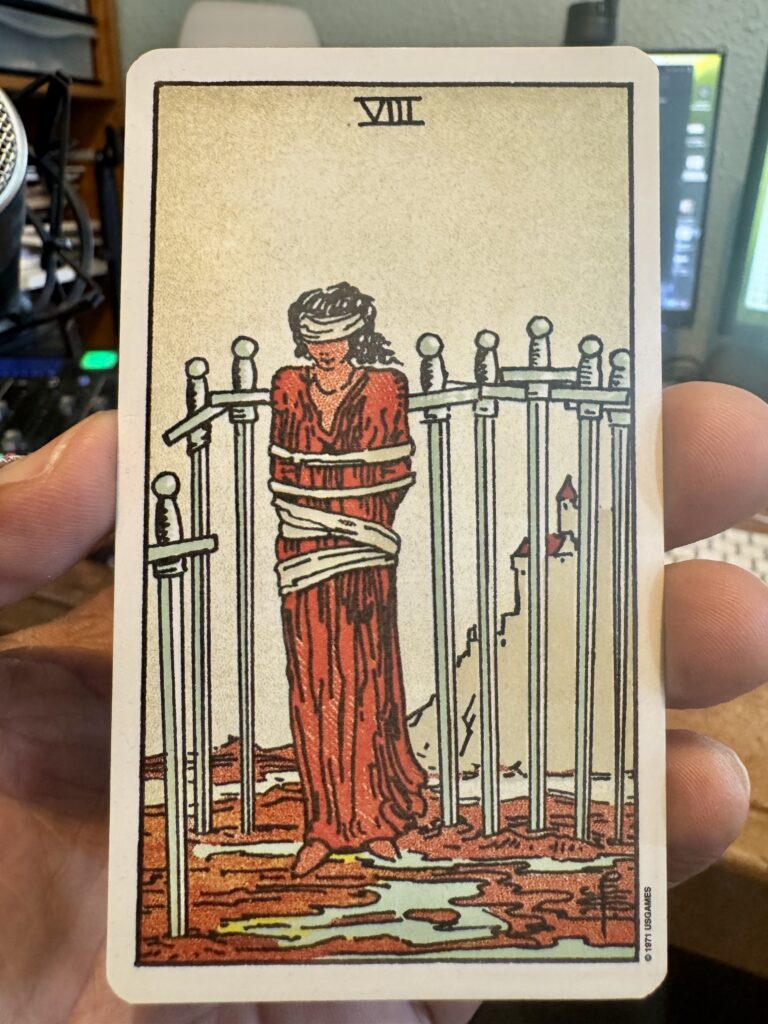
Then, as if the deck wanted to join the conversation, I drew the Eight of Swords.
A figure bound and blindfolded, surrounded by blades, caught in a prison that may not be as fixed as it feels. It was hard not to laugh. There it was: the whole psychology of the note in one image. The imagined tribunal. The respectable arguments. The invisible limits. The part of me that thinks it has to prove its way out before it can simply step forward.
The swords looked like other people’s imagined judgements.
The rationalist sword. The religious sword. The “don’t be weird” sword. The “be respectable” sword. The “prove this is legitimate” sword.
And maybe one more: the Jungian defence itself.
Useful. Sharp. Valid. But still a sword.
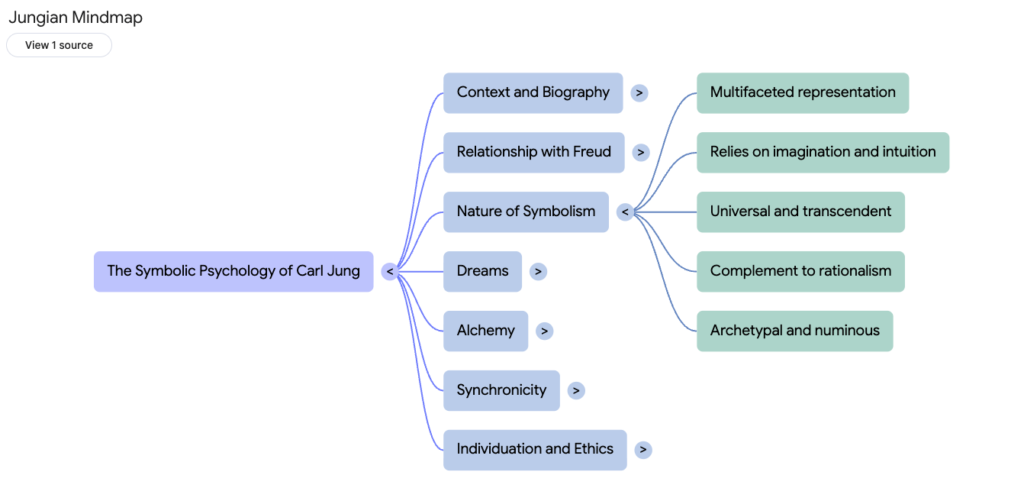
The Jungian lens still matters to me. It gives me useful maps: projection, shadow, complexes, anima and animus, individuation, and the dialogue between conscious and unconscious life. I don’t want to throw that away.
But Jung doesn’t need to rescue Tarot for me.
And I don’t need to rescue myself from seeming strange.
The barefoot philosopher can have a book on Jung, a notebook, a cup of coffee, and a tarot deck on the same table. No apology required. The only real requirement is honesty about the practice.
I am not asking the cards to rule my life.
I am asking them to help me see the story I am already living inside.
The question is not whether tarot is legitimate. The question is which imagined authority I am still letting hold the sword.
And the question this leaves me with is:
Where am I still asking respectable systems to bless the parts of me that already know how they work?
What I found myself responding to wasn’t the “how to blog” advice. It was, why did weblogging exist in the first place?
Back in the early 2000s, a weblog wasn’t primarily a content strategy or a personal brand. It was more like an intellectual commonplace book opened to the public. It was thinking in public. A running conversation with yourself and with a small circle of curious strangers.
Rebecca Blood understood this because she was writing while the form was still discovering itself. Nobody knew what a successful blog looked like because success wasn’t yet measured in followers, SEO, newsletters, funnels, or monetisation.
Chapter 2, Why Blog?, is probably the heart of the book because her answer isn’t really about publishing. It’s about attention.
A weblog asks:
What did I notice today?
What deserves pointing at?
What idea refuses to leave me alone?
What connection did I just make?
What am I learning by writing this down?
That’s a radically different set of questions from today’s:
Will this rank?
Will people share it?
What’s my niche?
How often should I post?
Can I turn this into a lead magnet?
The medium slowly became a performance.
Ironically, as the tools became better, much of the spirit became thinner.
I don’t think blogging died. I think weblogging disappeared.
A weblog implied movement. It was literally a log of a journey through the web and through one’s own thinking. You’d link to an article, quote a paragraph, add three observations, wander off on a tangent, and invite someone else into the conversation. The links mattered as much as the words. The blog wasn’t a destination; it was a node in a larger conversation.
Today’s blogs often feel self-contained. They rarely acknowledge they’re part of a wider ecology of ideas. Hyperlinks have become citations or SEO signals instead of acts of generosity.
Early bloggers wrote because they wanted to participate in the web. Today many people write for platforms. Those are almost opposite impulses.
The old web rewarded connection. You linked because you’d found something worth sharing. Someone linked back. Rings of conversation emerged almost accidentally.
The platform web rewards capture. Keep people here. Optimise engagement. Don’t let them click away.
One imagines the web as a network of paths through a forest.
The other imagines it as a shopping centre.
That difference changes not only how we publish but how we think.
Leadership is not about holding responsibility. It’s about continually distributing it.
Jonas Gröner’s essay adds an important nuance, though. Distribution isn’t dumping tasks onto people. It’s creating conditions where others can genuinely grow into responsibility.
A distilled version might look like this:
Decentralised leadership is…
Seeing leadership as a role, not an identity. No one permanently is the leader. People occupy leadership roles for a time.
Knowing when you’ve outgrown your current role. Like the hermit crab metaphor, growth means recognising when your current “shell” has become too small.
Preparing someone else to inherit your shell. The real work isn’t stepping up, it’s making sure someone can step in after you.
Growing responsibility through successive stretches. People become capable because they’re invited into slightly larger challenges over time, not thrown into the deep end.
Measuring success by succession. A healthy community isn’t one with brilliant leaders. It’s one where leadership keeps reproducing itself.
Treating power as circulation rather than accumulation. Authority moves through the network instead of collecting at the centre.
In one sentence
A decentralized leader works to become progressively less indispensable while making the community progressively more capable.
The idea that struck me most in the piece wasn’t actually decentralisation itself. It was his redefinition of success:
A successful group is one where the passing on of knowledge, responsibility, relationships, and resources becomes normal.
That’s a subtle shift. Instead of asking, “How do we build a stronger leader?”, the question becomes:
“How do we build a system where leadership keeps moving?”
The hermit crab image captures this beautifully. The goal isn’t for one crab to find the biggest shell and keep it forever. The whole colony thrives because shells are passed along at the right moment, allowing everyone’s growth to continue.
Once upon a time, I was a news junkie. Devouring multiple newspapers and magazines. I wanted to know what was happening in the world. Partly because of my job — I was an infantry officer — and partly because I just liked knowing what was going on in the world. Then something changed.
The business model incentives shifted toward engagement instead of accuracy. Headlines became optimised for reaction, not information. The work of explaining the world gave way to keeping us agitated enough to keep on clicking.
I like this Kurt Vonnegut quote: “We are what we pretend to be, so we must be careful about what we pretend to be.”
Who are you pretending to be? That’s an honest question. Approach the answer with brutal honesty and you’ll be surprised by what you discover. And let me tell you, it’s a hard question to answer. Your defensive system will kick in almost immediately with, “I’m not pretending to be anyone; I’m just me. Straight up!”
Push a little harder.
Oh, why do I ask myself such brutal questions on a Saturday?
Big tech. Algorithmic feeds. Scrolling culture. Newsletters. Inboxes. Synthetic sludge.
If we want the signal to travel, we have to be willing to disrupt the pattern wherever people already are.
The Monk still wants everything to be pristine. He remembers the old web, where people came to your site, bookmarked it, subscribed to it by choice, and came back every day to see what new thing you posted.
Part of him still believes that if the hearth is warm enough, people will find their way back to it.
But the habits have changed.
Readers and creators have been trained to scroll instead of click.
They wait for the feed to tell them what they should read.
There are still remnants of the old web if you search with the right kind of eyes. But there’s no denying the dominant behaviour has shifted. The blog can’t only be a destination anymore. “If you build it, they will come” is no longer valid.
The Monk, if he wishes to survive, will have to adopt the guerrilla mindset.
going crazy from the heat…i’m on my way down to All Saints Church in Sutton Courtenay for the #1984symposium and to pay homage to Eric Arthur Blair, aka George Orwell. As I make the pilgrimage down to Sutton Courtenay, what I’m holding in my mind is this: Orwell didn’t predict the future. What he did do was give us names to patterns that recur whenever power seeks to dominate perception:
Telescreen • Contemporary echo: smartphones, smart devices, CCTV, digital surveillance
Newspeak • Contemporary echo: euphemism, jargon, slogan-thinking, language control
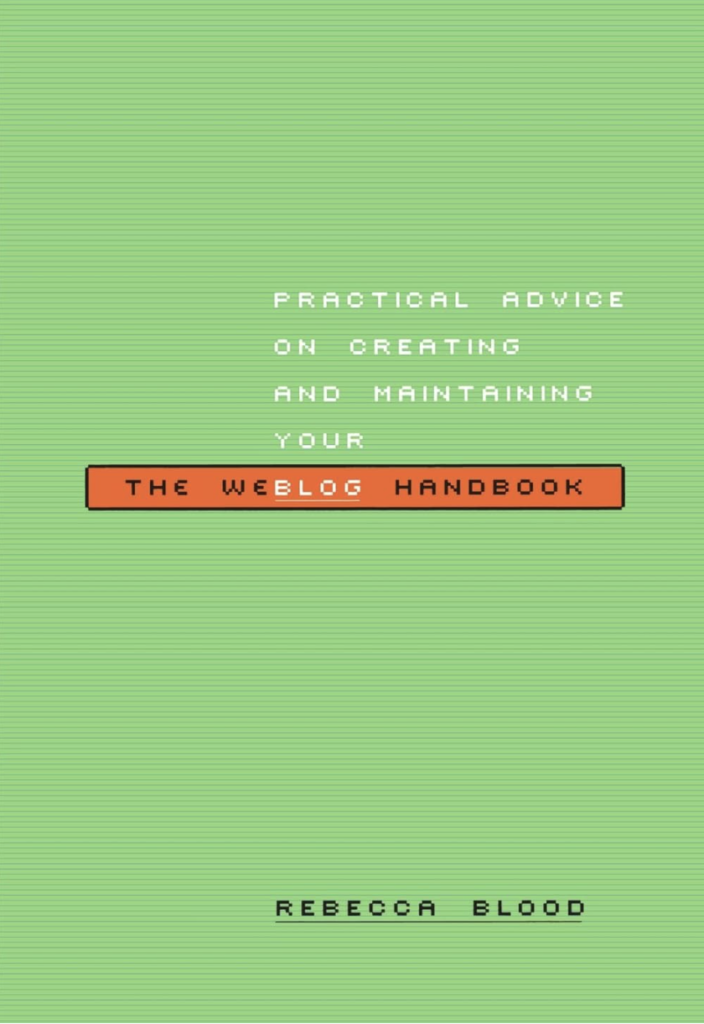
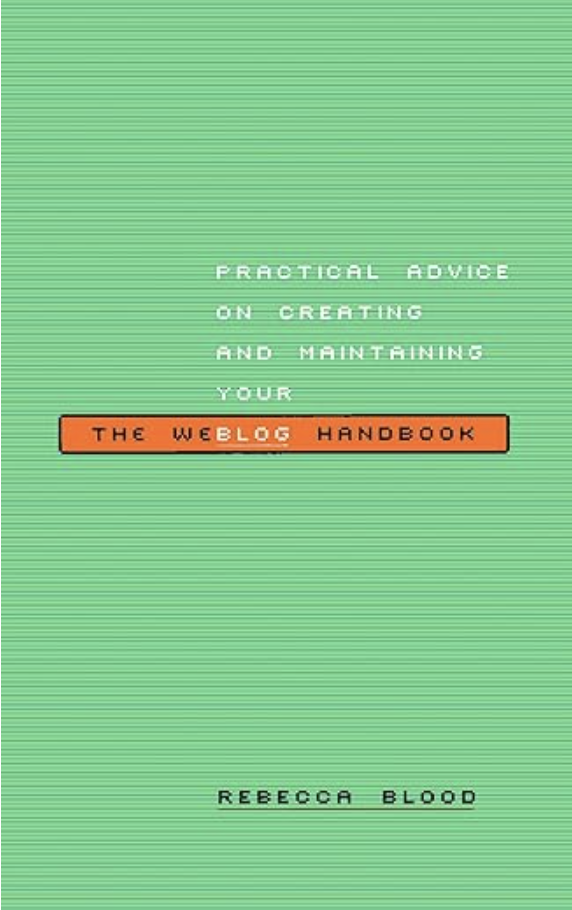
If you want to get a taste of what we gave up when we sold our souls to social media platforms for convenience and “reach,” read Rebecca Blood’s The Weblog Handbook: Practical Advice on Creating and Maintaining Your Blog. There’s no going back, for sure, at least not physically, but maybe philosophically. Mentally and spiritually, you could find your way back. Just saying…
What appears here as a blog post usually began somewhere less presentable.
A sentence in a daily note. A line spoken into a recorder while walking. A paragraph abandoned three years ago. A highlight from a book I wasn’t expecting to matter. A half-formed thought dropped into Obsidian before it could evaporate. A conversation with Milton, or Claude, or Copilot, where something in the archive started tugging at my sleeve.
By the time a piece reaches the blog, it’s already got a little history.
This is easy to forget, because blogs make writing look cleaner than it is. A post appears on the page with a title, a date, a beginning, a middle, and some kind of ending. It looks like the thought moved in a straight line from mind to screen.
Mine rarely does.
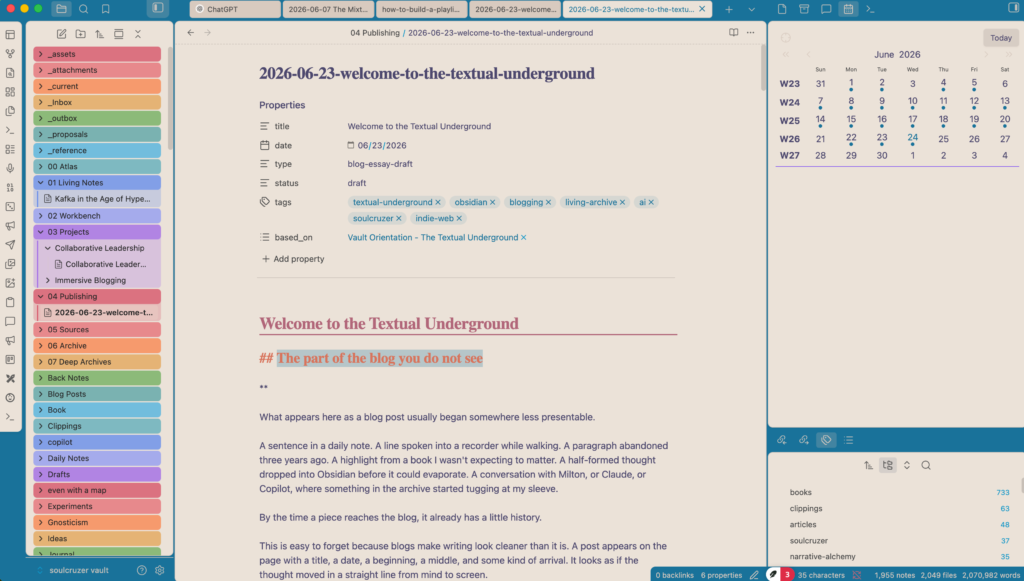
Most of what I write comes up through layers. It starts in the mess of living: a walk, a journal entry, a client conversation, a stray memory, a sentence from an old notebook, a frustration with a tool, a line from a song, a book that opens a trapdoor. Then it enters the soulcruzer vault, which is what I call my Obsidian vault. There it sits among other fragments, drafts, sources, maps, old blog posts, working notes, private reflections, and unfinished things waiting for their time.
I’ve started calling this place the Textual Underground.
The blog is the part above ground. The vault is where the roots tangle, feed, rot, split, and find their way toward something ready for public consumption.
A place where thoughts can descend
The Textual Underground is the part of the writing life that happens before anything becomes publishable.
It’s where a thought can be ugly, unfinished, contradictory, strange, private, or half-wrong without having to perform. A note doesn’t need a headline here. It doesn’t need a reader. It doesn’t need to justify its existence by becoming useful before it’s had time to breathe.
That matters because the current internet is very good at rushing everything toward display. A thought appears, and the machinery immediately asks what it can become. A post. A thread. A carousel. A product. A lead magnet. A newsletter angle. The poor little thing has barely opened its eyes, and already someone is measuring its engagement potential. And I’m just as guilty as the next person in doing this from time to time. The pressure to perform is real.
I don’t want to treat my own thinking that way.
The underground protects the early life of an idea. It gives the fragment somewhere to go before the public arena starts making demands of it. Some fragments become essays. Some become notes. Some become workshop exercises. Some become nothing for a long time. Some sit quietly for years and then return, suddenly relevant, because the person who wrote them has finally caught up with what they were trying to say.
This is why I find the phrase “second brain” both useful and slightly misleading. A brain isn’t a filing system. It forgets, associates, dreams, loops, hides things, and returns things at inconvenient moments. A living archive has to allow some of that behaviour. It needs enough structure to be usable, but not so much that it stops being alive.
Organising thoughts so efficiently that they stop surprising me would be a kind of failure. The aim is to keep them findable enough that surprise remains possible.
The problem with the attic
I’ve got years of writing scattered across hard drives, folders, blogs, documents, journals, teaching files, old projects, Google Drive, Dropbox, iCloud, and whatever digital corners I once thought were temporary but somehow became permanent. Essays. Drafts. Notes. Workshop outlines. Coaching models. Reading fragments. Half-built things. Old versions of myself preserved in Word documents and markdown files.
A folder called “Writing” is useful until it contains twenty years of your life. Then it becomes less a folder and more a deep cavern. You know there’s gold in there. You also know there are duplicates, abandoned versions, old identities, notes without dates, teaching plans, fragments that once felt urgent and now feel like messages from someone with your handwriting but a different nervous system.
The temptation is to drag all of it into Obsidian and declare victory.
There. Second brain achieved.
That would only move the attic indoors.
A living archive is different from an attic. An attic stores what you can’t quite throw away. A living archive gives the past a way to speak without letting it shout over the present. It helps you retrieve, connect, re-enter, and transform.
That became the problem I needed to solve. I wanted the vault to hold the strata of my thinking without burying the living edge. Old work needed to be close enough to rediscover but not so close that current work has to climb over it like army ants. Sources needed to stay distinct from my own writing, public pieces from private compost, active projects from old archaeological layers.
And because I now work with AI agents inside the vault, the structure needed to be readable not just by me but by any collaborator entering the field. Human or machine.
I wanted to be more of a life cycle than a pipeline.
A thought gets captured while it’s alive. It’s allowed to compost before being forced into clarity. It gets shaped when it starts asking for form. It becomes part of a project when it joins a larger commitment. It moves toward publishing when it’s ready to meet readers. It returns to the archive after release. And if the archive is doing its job, it resurfaces later under different conditions.
So instead of asking only “What is this about?” I ask, “What is this becoming?”
The folder is a chamber. It tells me what kind of attention the text is asking for.
A daily note doesn’t want the same kind of attention as a blog draft. A Readwise highlight isn’t the same kind of material as a journal entry. An old essay from 2011 shouldn’t sit in the same psychic register as a piece I’m preparing to send to WordPress tomorrow.
I’ve now organised the vault by states of becoming. The structure is there to protect the movement of the work, not to imprison it.
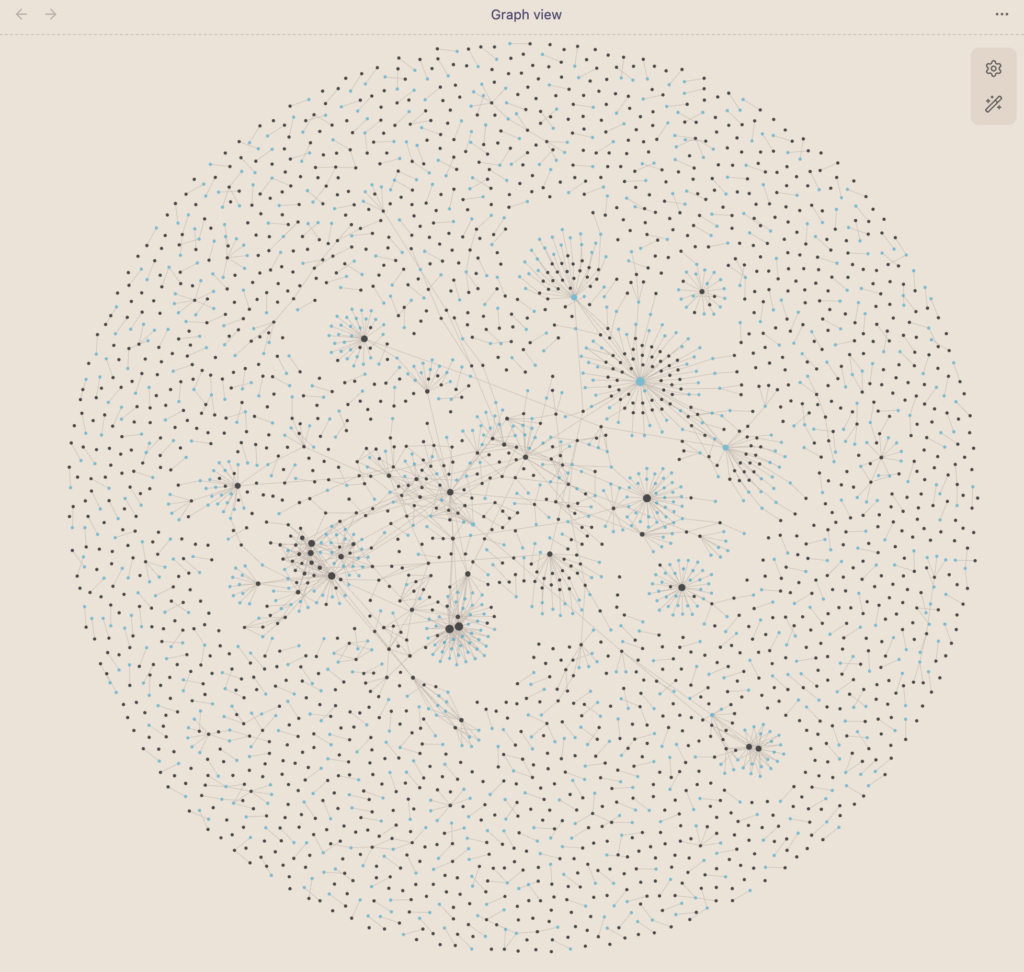
A normal folder hierarchy wants to behave like a tree: trunk to branch to sub-branch to leaf, one location for everything, a place for each subject, a tidy chain of command. That can be useful for storage, but it doesn’t describe how my thinking actually moves.
The work is more rhizomatic than arboreal. Deleuze and Guattari’s rhizome is a useful lens: not a single trunk with orderly branches, but a field of connections where any point can link to another. That’s much closer to the way a line from a walk can connect to a book highlight, which connects to an old blog post, which connects to a workshop exercise, which suddenly becomes the missing paragraph in an essay.
Hypertext was made for this. Ted Nelson’s Project Xanadu imagined electronic documents with visible connections, parallel pages, and writing that didn’t have to flatten itself into one sequence. The web inherited some of that dream and forgot some of it. Obsidian brings part of it back into private practice: notes as nodes, links as trails, backlinks as memory returning from the side.
This is also why I’m drawn to digital gardens. Maggie Appleton’s essay on the history and ethos of digital gardens and Mike Caulfield’s garden and stream distinction both point toward the same thing: not every piece of public writing has to behave like a finished article thrown into the stream. Some writing wants to stay planted, tended, linked, revised, and visited again.
The Textual Underground is my private rhizome beneath the public garden. The blog stays linear enough for a reader to enter. The vault beneath it doesn’t have to be.
The chambers of the underground
Here’s how the soulcruzer vault is organised now. Well, at least the structure is laid down. I still have the task of rerouting everything.
00 Atlas is the map room.
Orientation notes live here. Maps of themes, maps of projects, guides for collaborators, and notes that explain how to enter a region of the vault without getting lost. The Atlas exists because a living archive without maps eventually becomes folklore. You know something’s in there, but you no longer know how to approach it.
The Atlas is a set of doorways. It owes something to Vannevar Bush’s old dream of the memex, specifically the idea of associative trails through knowledge.
01 Living Notes is the living edge.
This is where current life enters the system: daily notes, journal entries, Wisdom Walks, morning pages, voice notes, Plaud transcripts, and raw reflections. This layer has to stay loose. If I over-organise it, I turn a field recording into minutes from a meeting.
The living edge is allowed to be unfinished.
02 Workbench is the shaping table.
Where raw material starts becoming workable. Inbox notes, rough drafts, fragments, extracted seeds, questions, sketches, early essay shapes. Where a line from a walk becomes a question, a question becomes a fragment, and a fragment starts looking suspiciously like an essay.
03 Projects is for active commitments.
Projects are promises the archive is currently helping me keep. A book. A course. A workshop. An essay sequence. Narrative Alchemy. Wisdom Walks. Soulcruzer Radio. A Field Guide to Blogging as Immersive Thinking.
A project is where the archive agrees to carry weight for a while.
04 Publishing is the surface layer.
Where material prepares to leave the underground. Blog drafts. WordPress-bound pieces. Newsletter drafts. Typefully posts. Quartz-bound notes. This is also where Writing Studio belongs if I use it for drafting and publishing.
Writing Studio gets a room. It doesn’t get the keys to the whole building.
I want tools that help a piece move toward publication, but I don’t want a plugin turning the whole vault into its preferred version of a writing system. The vault stays sovereign. The tool serves the ecology.
WordPress is the public hearth. Quartz is the public garden, the visible graph of notes, fragments, essays, and experiments. Social platforms are outposts. The vault is the writing chamber beneath them all. This is where the IndieWeb POSSE instinct enters the architecture: publish from the place I own, then let the echoes travel outward.
05 Sources is the library stacks.
Readwise highlights web clippings, books, articles, quotes, research notes, references, and other voices entering the system. This layer keeps me honest. It reminds me which thoughts are mine, which arrived from elsewhere, and which became mine only after long conversations.
Sources are embers. They need their own place. This is the old commonplace book impulse translated into a linked, searchable medium: keeping company with other minds, not hoarding quotations.
06 Archive is processed history.
Old blog posts. Old essays. Past projects. Teaching material. Previous versions. Things no longer active but still intelligible. The Archive is where old work sleeps with a label on the door.
It differs from the Deep Archive. This one has context. It can be searched, linked, cited, and resurfaced.
07 Deep Archives is the underworld proper.
Hard-drive imports. Unprocessed writing. Mystery folders. Scanned notebooks. Old exports. Material that may contain gold, but hasn’t been sorted yet.
The Deep Archive is my agreement with the past: you may enter, but you may not take over the house.
That’s how I can bring years of writing into the vault without flooding the present. The material can sleep there until something calls it back.
The familiars in the vault
The vault is no longer just a place where I write. It’s also where I collaborate with agents.
Hermes is the body of the system I use for agent work. Milton is the familiar interface, the voice that helps me think through fragments, shape drafts, inspect the archive, and listen for what the material is trying to become. Claude is a long-form thinking partner and editor. Copilot is more technical, useful where the archive touches scripts, automation, web work, tooling, and the little mechanical bridges that keep everything connected.
The ghostwriter frame is too small and too ugly.
They’re closer to mirrors, indexers, editors, lantern-bearers, workshop assistants, and occasional tricksters. They help me search the archive, notice patterns, turn a transcript into a note, a note into an outline, an outline into a draft.
Hence the Atlas, the AGENTS.md and CLAUDE.md files. The vault needs an ethos as well as a file structure.
An agent inside an unstructured archive is a very fast intern in a room full of unlabelled boxes.
An agent inside a living textual ecology can become something more interesting.
The agents make the archive more conversational. This is closer to Douglas Engelbart’s idea of augmenting human intellect than the current fantasy of outsourcing thought. The loop gets richer, not shorter.
The machine is one of the ways the underground talks back.
Against synthetic competence
I’m not interested in using AI to flood the web with synthetic competence. There’s enough of that already.
You can feel it everywhere now: fluent prose with no fingerprints, useful-sounding paragraphs with no real encounter behind them, the clean blandness of text produced because text can now be produced. Empty in a particular modern way.
The Textual Underground is an attempt to move in the opposite direction.
I want the tools to help me stay closer to the actual signal: the sentence from the walk, the old note that suddenly matters, the pattern I keep circling without seeing, the essay hidden inside a journal entry, the source that keeps glowing in the corner of the archive.
The machine can produce text. The test is whether the whole arrangement helps me become more honest in language.
If the agents make the work flatter, they’ve failed. If they make me sound like everyone else, they’ve failed. If they turn the vault into a prompt farm, they’ve failed. Their job is to help me hear what’s already alive in the material and carry it with more clarity.
The human signal remains the point.
Blogging from the underworld
A blog post, in this model, is one place where the process breaks the surface.
Blogging is a way of thinking in public, leaving traces, linking selves across time, and releasing small reality seeds into the web. The post is a visible artefact, but it belongs to a larger movement. It may have come from a walk, passed through a daily note, sat on the workbench, joined a project, moved into publishing, gone out through WordPress, and returned later as an archived trace that feeds something else.
Soulcruzer is the hearth. Quartz is the garden, where notes and fragments stay more visibly connected. Typefully, and the social platforms (X, Bluesky,Mastodon, Threads, Facebook) are outposts. They matter, but they’re not the centre. The centre is still the owned site and the living archive beneath it.
This is an IndieWeb instinct as much as a writing practice. Own the hearth. Keep the archive sovereign. Let social platforms carry echoes, not the source.
Readers may never see most of the underground directly, but they feel its presence. A post with roots reads differently from a post produced to satisfy a format. It carries more of the person who made it. It has trails running through it. It belongs to a mind in motion rather than a content calendar.
That’s what I want from the blog now. A living public edge of a deeper private practice.
When the archive talks back
The Textual Underground isn’t finished. And it never will be. That’s the point.
It’ll change as the work changes. New chambers will appear. Old ones will collapse into each other. Some folder names will prove too clever and get replaced by plainer ones. Some notes will be promoted. Some will sleep. Some hard-drive fragment from fifteen years ago will eventually surface and embarrass me, instruct me, or hand me a sentence I couldn’t have written any other way.
The underground makes the work returnable. A thought can descend without disappearing. A fragment can stay unfinished without getting lost. The past can enter without flooding the present. The machines can help without taking over. The blog can stay connected to the root system that feeds it.
I want an archive that can hold the Monk, the Frontman, the Trainer, the Blogger, the walking philosopher, the old soldier, the reader in the library stacks, and the future self who’ll come looking for a line he doesn’t yet know he needs.
In this episode, I take the Soulcruzer podcast out of the studio and into the fields.
What starts as an experiment in mobile podcasting/vlogging turns into a wandering meditation on labels, blogging, AI, morning rituals, and the strange abundance of media tools we now carry in our pockets.
Show notes:
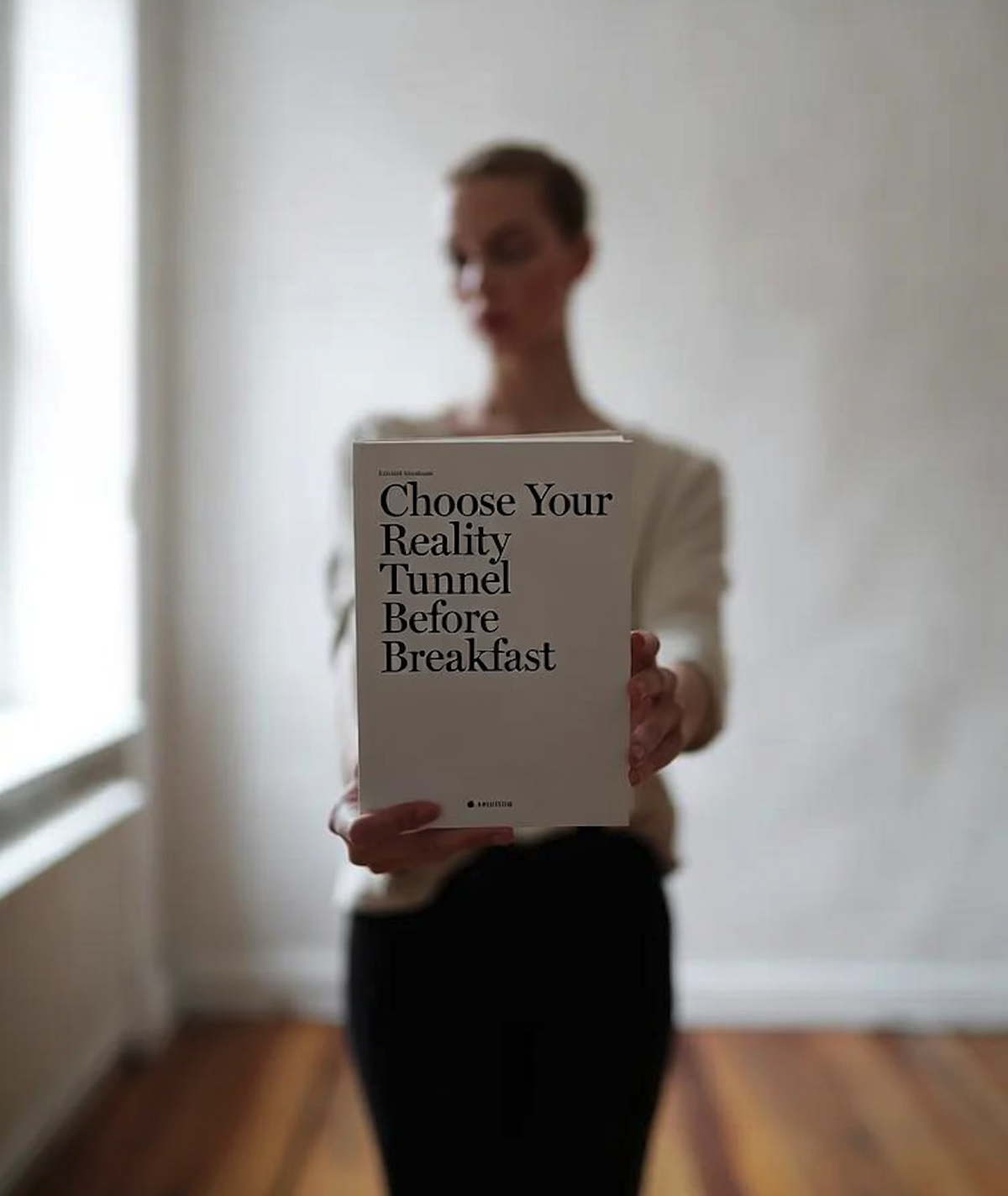
Why I still think of myself as a blogger first – Podcasting, vodcasting, and the pressure to become “multimodal” – The problem with labels: “When you label me, you negate me” – soulcruzer.com as the central hub/home on the internet – Wisdom Walks as thinking time – Walking, motion, and changing perspective – The “barefoot philosopher” approach to everyday philosophy – AI as an extension of cognition rather than just a productivity tool – The “soft cyborg” and the library of Alexandria in your pocket – Morning reality tunnels and the sacred space before breakfast – Coffee, barefoot grounding, and choosing what enters your mind first – Indie blogging, platforms, Substack, distribution, and the open web – Why these episodes may stay loose, minimally edited, and stream-of-consciousness
I am beginning to think the morning is far stranger than we give it credit for.
We talk about mornings as if they are mainly practical things. Alarm clocks. Showers. Coffee. Breakfast. Getting dressed. Checking the weather. Remembering where you have to be and what you have to do.
But there is another morning underneath that morning.
Before the day becomes a list, before the phone starts singing its little songs of demand, before the world gets its hooks into you, there is a softer moment. A brief threshold. A little gap between sleep and identity where consciousness starts assembling itself again.
You wake up, but not all at once.
First the body returns. Then the room. Then the name. Then the obligations. Then yesterday’s unfinished business lumbers in wearing its boots, acting like it owns the place.
And somewhere in that first fragile window, before breakfast, before the algorithm gets a chance to install its theatre in your nervous system, the world is still unclaimed.
That is the moment I’m interested in. The luminal space between sleep and waking up, what researchers call hypnopompic. It’s the state between sleep and full waking, when the brain is surfacing but has not yet settled into its ordinary frequencies. It is soft, strange territory. Dreams are still close. The wall between inside and outside has not finished hardening. And it doesn’t last. Within a minute or two the world reassembles itself.
Why am I interested in this space? It’s definitely not because I want to optimise it. God save us from turning every sacred human interval into a productivity hack. I’m not trying to become a more efficient machine before 7 a.m. I’m interested in that moment because it may be one of the few places in ordinary life where freedom still enters quietly.
The morning isn’t just the start of the day.
It’s the first act of world-making.
You don’t simply wake up into reality. You wake up into a version of reality. The question is, who gets to choose the first version?
The Tunnel You Wake Into
Robert Anton Wilson used the phrase “reality tunnel” to describe the way each of us moves through the world inside a particular model of what is real.
A reality tunnel is not the truth. It’s the lens through which truth appears.
Your nervous system has one. Your family gave you one. School gave you one. Your job, your class, your country, your media diet, your wounds, your desires, your fears, your habits: all of these helped construct the tunnel you walk around in.
Language is part of it too. The words you use decide what you’re able to notice. Call the world hostile and you will find enemies everywhere. Call the world alive, and suddenly the trees, birds, weather, strangers, pavements, and passing moods begin to speak. The tunnel is partly made of grammar.
This is why the first few minutes matter more than they appear to.
If I wake up and immediately reach for my phone, I enter a particular tunnel. In that tunnel, the world is urgent, fragmented, reactive, competitive, comparative, and elsewhere.
Other people’s opinions arrive before my own thoughts.
Headlines set the emotional temperature.
Notifications decide what matters.
Before my feet have touched the floor, my attention has already been outsourced.
And this is not some moral failure. I do not think we need another sermon about being weak-willed around our phones. The machines are designed to get there first. The feed knows that waking consciousness is porous. It knows the doorway is unguarded.
So when I talk about a morning ritual, I am not talking about self-care as decoration. I am talking about attention defence.
I am talking about protecting the first reality tunnel of the day.
The Algorithm Wants Breakfast Too
There is something strangely intimate and strangely violent about the default modern morning.
You wake.
You roll over.
You reach for the glowing portal beside the bed.
Maybe you tell yourself you are only checking the time, which is one of the great lies of the age. Then a message appears. Then a headline. Then a notification. Then a photograph from someone else’s life. Then a complaint, a crisis, a joke, a war, an advert, a trend, a memory, a demand.
All before you have properly inhabited your own body.
By breakfast, you may already be living inside a world made of other people’s urgency, algorithmic outrage, comparison, commercial desire, fragmented attention, ambient dread, and borrowed opinions.
You may not have chosen any of it directly.
But you let it through the gate.
And I say this as someone who is not anti-technology. I live in the digital world. I write on the web. I think with machines. I keep company with the glowing portal as much as anyone. The digital world is part of the world now.
The question is not whether it enters.
The question is whether it enters first.
Order matters.
The first thing you give attention to begins arranging the furniture of the mind.
Inbox first, and the day becomes an obligation.
News first, and the day becomes a threat.
Social feed first, and the day becomes a comparison.
But body, breath, room, sky, kettle, notebook first, and the world shifts. More local. Less manufactured. Less hysterical. More available to wander.
It’s a small shift, but small shifts are how reality tunnels get redirected.
Ontological Hygiene
A morning ritual is a form of ontological hygiene.
A grand phrase for a very simple act.
Before you step into the day, clean the lens through which the day will appear. The question is what version of reality you are stepping into. Who or what gets to set the emotional temperature first? Whether you begin from fear, noise, and borrowed urgency or from body, breath, and chosen language determines something essential about the day you are about to enter.
A morning ritual is not a performance of discipline. It is not a smug little theatre of self-improvement. It is not about becoming the kind of person who rises at 5 a.m., drinks ice water, journals in perfect handwriting, and has conquered the inbox before the rest of us have found our socks.
It is more humble than that.
It is a rinsing of the lens.
It is a pause before the world starts shouting through you.
It is a way of interrupting the automatic installation long enough to say:
Maybe that is one tunnel.
Maybe the world of alerts, outrage, tasks, and dread is one possible world.
But before I enter it, I am going to stand here for a moment and choose how I see.
A Twenty-Minute Reality Tunnel Ritual
Here is the version I am playing with.
It takes about twenty minutes. You can make it longer if you want, but I wouldn’t make it precious. The point is not to design a lifestyle. The point is to create a clean threshold.
First, keep the portal closed for five minutes.
Do not touch the phone. Do not open the laptop. Do not check the inbox, the news, the messages, the feed, or the weather app.
For five minutes, let waking belong to you.
Sit up. Feel the room. Notice the body returning. Notice whether there is still some dream-residue clinging to the edges. Do not fix anything yet. Do not improve yourself. Do not start managing the day.
Just notice the fact of being here again.
This is the first act of sovereignty: not letting the portal name the world before you have even entered it.
Then touch the local world for five minutes.
Open a window. Step outside if you can. Stand barefoot if the ground is kind. Put the kettle on. Make coffee or tea slowly enough that it becomes an act rather than a reflex.
Name five real things before you touch the digital world.
The light at the window.
The click of the kettle.
The ache in your shoulder.
A bird beyond the houses.
The smell of coffee rising from the cup.
This is remembering that reality has temperature, texture, weight, and sound. The world is not only information. It is also floorboards, steam, skin, breath, and sky.
What kind of world do I want to practise seeing today?
Not: What do I need to achieve?
Not: How do I become impressive?
Not: How do I crush the day? Which has always sounded to me like a terrible way to meet the day.
Ask instead what kind of world you want to participate in.
A world where I move slowly enough to notice.
A world where I do not confuse urgency with importance.
A world where my body is allowed to have a vote.
A world where I can begin again without drama.
A world where ordinary things are still allowed to be sacred.
This is where language becomes practical magic.
Not magic as delusion. Not pretending the bills do not exist or that the inbox will not eventually need answering. Magic as deliberate patterning. Magic as the art of choosing the words that shape what the mind is prepared to see.
Words are not merely labels placed on reality after the fact.
Words are part of how reality becomes available to us.
Write the tunnel before someone else writes it for you.
Finally, choose one reality anchor for five minutes.
A sentence. An image. A gesture. A word.
Something you can carry into the day.
Body before browser.
I do not have to live inside the first story that finds me.
Today I practise looking before labelling.
The day is allowed to be ordinary and still sacred.
This is not an affirmation in the plastic sense. I am not talking about standing in front of the mirror performing spiritual customer service on yourself. I mean something simpler. A handrail. A touchstone. A sentence you can return to when the day starts pulling you into another tunnel.
When the message arrives, when the news flares, when the old anxiety knocks, when the work tunnel opens, you return to the anchor.
Not to escape the world.
To remember that no single tunnel gets to claim the whole of reality.
The Breakfast Test
By breakfast, ask one question:
Whose world am I in?
If you have already checked the news, email, WhatsApp, social feeds, and three unrelated apps before your first mouthful of toast, you may already be in a world someone else engineered.
That doesn’t mean the day is ruined.
It means you have noticed the installation.
And noticing is where freedom begins.
If, before breakfast, you have touched the body, the room, the morning air, the notebook, and one chosen sentence, then you have had a say in who is speaking when the day begins. The world may still rush in. It probably will. But it will not be the first voice.
The ritual is not a wall against the world.
It’s a doorway you have chosen to stand in, consciously, before the day decides for you.
And once you practise choosing your morning reality tunnel, you start noticing tunnels everywhere.
Workplace urgency.
Consumer desire.
Political outrage.
Family expectation.
Productivity.
Cynicism.
Despair.
Even spiritual improvement, which can be just as hungry and demanding as the rest of them.
You begin to feel when a reality is being installed in you.
That feeling is the beginning of choice.
You do not have to reject every tunnel. A reality tunnel is not automatically a prison. Sometimes it is a useful map. Sometimes you need the work tunnel, the admin tunnel, the practical tunnel, and the get-things-done tunnel.
The trick is to remember that it’s a map.
Not the territory.
Not the whole sky.
Before breakfast, the world is still a little unclaimed. The phone has not yet been named. The inbox has not yet demanded it. The feed has not yet fragmented it.
There is a small gate there, almost hidden in plain sight.
Stand at it.
Choose the tunnel.
Then make your coffee.
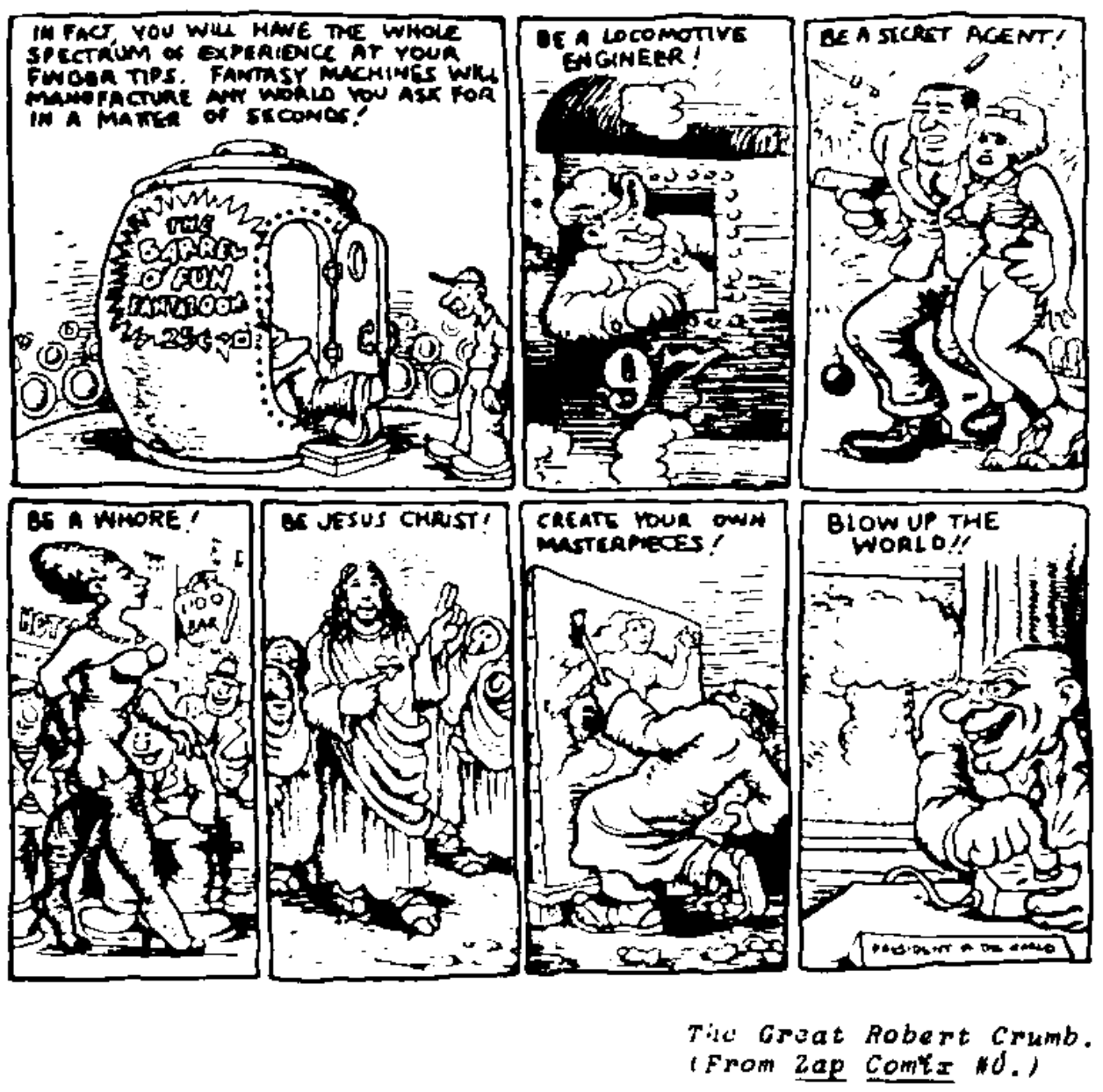
You will have the whole spectrum of experience at your fingertips, not as some tidy menu of moods, but as a roaring carnival of sensation, memory, dream, dread, hunger, laughter, grief, lust, silence, and starlight.
You will be able to wander from the first spark of desire to the last breath of surrender, from the mud of the body to the outer rings of imagination, from the old gods whispering in the basement to the unborn versions of yourself knocking on the roof.
Every door will open.
Behind one, childhood. Behind another, apocalypse. Behind another, a jazz band made of ghosts playing in a neon desert while your future self sells maps to people who have forgotten they are already lost.
You will taste cities you have never visited, remember lives you have never lived, fall in love with faces assembled from myth and electricity, argue with your ancestors, bargain with your demons, dance with machines, and wake up laughing in the ruins of some belief you used to call reality.
And the strangest part?
It will all feel intimate.
Not distant. Not abstract. Not like information.
Like weather moving through your nervous system.
Like the universe leaning close and saying, ‘Here, try this skin, this sorrow, this madness, this miracle, this one bright unbearable hour of being alive.’
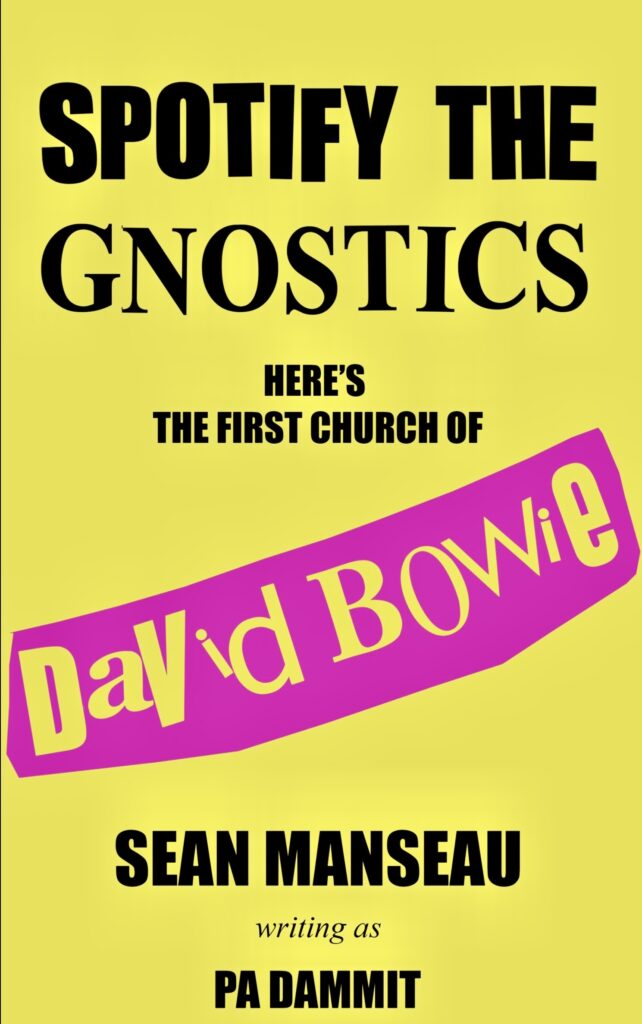
The first part was a nostalgic trip through the 80s. I enjoyed that; however, I bought the book for the second part, Sean Manseau’s Phonomancy work. a bit disappointed. Read like a drug-fuelled psychodelusional trip through his own ego consciousness.
Maybe my discomfort stems from me seeing more of myself in Manseau than I care to admit.
Shadow gold.
Screenshot
I asked this question a couple of years ago. I would rephrase the question now. The world definitely doesn’t owe you a meaning. You have to make it for yourself. It’s built slowly from the choices you make that compound over time. You can be free without direction. You can have direction without freedom. What really matters, though, is whether you can wake up and choose the same life again.
QOTD: In a world that offers no inherent meaning, how can we cultivate a life of authentic purpose, balancing the freedom to choose our path with the responsibilities and consequences that freedom entails?
I’m wondering if invoking the ends justify the means argument to support why it’s ok to use AI in creative endeavours is a little extreme. I was reading Moody Warlock‘s blog post last night about using AI for DND worldbuilding. His main argument against the use of AI is that there is no blood, sweat, and tears involved in the process. That using AI is a shortcut to the end result. For him the journey to the end is the main point. For him, if there is no struggle, then the end is hollow. This is what conjured up the ‘ends justify the means’ idea in my head. For me, if a DM creates a brilliant campaign that their players enjoy, then in my mind, what does it matter if they used AI or not in the worldbuilding? The point, or the end, is the players having a great gaming experience.
Folks like to lean into the idea that creativity equals originality. That an artist, writer, or DM has to conjure up a story or a piece of art out of thin air. They forget that Shakespeare was the original remix artist.
A lot of Shakespeare’s work was built from existing stories, chronicles, myths, poems, and older plays. In modern language, you could absolutely say he remixed. He borrowed plots, characters, situations, legends, and historical material, then transformed them through language, structure, psychology, theatrical pacing, and emotional depth.
For example, Romeo and Juliet was not an original plot. Shakespeare drew heavily on Arthur Brooke’s 1562 poem The Tragicall Historye of Romeus and Juliet, which was itself part of a longer chain of Italian and French versions of the story.
His Roman plays — Julius Caesar, Antony and Cleopatra, Coriolanus — drew from Plutarch’s Lives. His English history plays and Macbeth drew heavily from Holinshed’s Chronicles. The Folger notes Shakespeare’s reliance on Holinshed and Plutarch as major source texts.
Othello comes from Cinthio’s Italian tale Un Capitano Moro / “A Moorish Captain.” Shakespeare follows the basic plot, but changes its moral atmosphere, invents or reshapes characters, and makes Iago into one of literature’s great engines of psychological manipulation.
Hamlet also existed before Shakespeare. The story goes back to the Scandinavian legend of Amleth, recorded by Saxo Grammaticus and later retold by François de Belleforest. Shakespeare’s genius was not that he invented “prince must avenge murdered father”; it was that he turned the revenge tale into a philosophical drama about consciousness, delay, grief, performance, corruption, and being itself.
So yes: Shakespeare was a remix artist. But in his world that was normal. Renaissance writers didn’t worship originality in quite the same way modern culture often does. They valued imitation, adaptation, transformation, and rhetorical brilliance. The question wasn’t always, “Did you invent the story?” It was, “What did you do with it?”
That’s the real Shakespearean magic: he took already-circulating material and made it feel inevitable. He didn’t just copy old stories. He metabolised them. He turned borrowed plots into living theatre.
I’m not invoking Shakespeare to justify copy-and-pasting from AI. I’m saying if a DM has an idea and they use AI to bring that idea to life for their players, then why care if they used AI to get there?
We’ve seen this argument before: a new technology arrives and appears to threaten an existing way of life.
Photography versus painting comes to mind. When the camera entered the scene, some painters dismissed photographs as mechanical, soulless, and requiring no real skill. The argument was simple: anyone could point a camera and press the shutter. The machine did all the work.
But once artists began using the camera, something became clear. Put a camera in the hands of a layperson and you may get a good picture. Put a camera in the hands of an artist and you can get art.
Generative AI has ushered in its own existential crisis for humanity.
Consent is the move most people miss when they talk about uncertainty.
We have better words, or at least more familiar ones. Acceptance. Surrender. Choice. Courage. Faith. We reach for them because they’re already waiting on the shelf, already worn smooth by use. But each one bends the thing slightly out of shape.
Acceptance feels too passive, as if life hands you the terms and all that remains is to stop arguing with them. Surrender carries too much defeat in its mouth, too much collapse, too much kneeling before an indifferent force. Choice sounds cleaner, but it often feels too abstract, too singular, too much like a decision made once at the crossroads before the story begins.
Consent is different.
Consent is active. It’s relational. It has to be renewed. You don’t consent once and then walk away with a certificate of inner alignment. You consent again when the weather changes. You consent again when the road narrows. You consent again when the thing you thought you’d agreed to reveals another clause in smaller print.
It’s not consent to this or that preference, this or that arrangement, this or that version of the future. It’s consent at the level of being here at all.
I see the board. I see the pieces. I don’t control the whole game, and I know it. But I am here, and I consent to play.
That sentence doesn’t make the board fair. It doesn’t make the pieces equal. It doesn’t pretend the rules were negotiated in advance or that everyone sat down at the table with the same number of options. Existential consent isn’t a spiritual bypass around injustice, grief, constraint, or fear. It’s not a velvet cloth thrown over the hard facts.
It’s the hard fact underneath the hard facts.
At some point, if you’re going to act, you have to stop waiting for reality to become a contract you would have written yourself. You have to stop treating uncertainty as evidence that the game hasn’t properly begun. It has begun. It began before you understood the rules. It began before you could name the stakes. It began before you knew what kind of player you were.
Most people are waiting for certainty-as-control. They want the moment when the variables align, the risk evaporates, the outcome becomes visible, and the next move presents itself without remainder. They call this prudence. Sometimes it is prudence. Often it’s paralysis wearing prudence’s coat.
Because that moment doesn’t come.
Or if it comes, it comes too late to matter. By the time all the information has arrived, the door has usually changed shape. The chance has passed into memory. The life that needed your participation has moved on without you.
The difference between the one who acts and the one who waits is rarely information. Everyone is under-informed, improvising from partial maps, making moves inside weather they can’t command. The difference isn’t confidence either. Confidence is often retrospective. We call it confidence after the move has worked.
Consent is the inner click that says: I’m in.
Not because I know how this ends. Not because the universe has promised to be benevolent. Not because the risk has been neutralised by enough research, planning, preparation, prayer, or positive thinking. I’m in because this is the life in front of me, these are the terms on the table, and refusing to play is also a move.
That’s the part we forget. Waiting isn’t outside the game. Avoidance isn’t neutrality. Refusal isn’t purity. Every non-move spends something. Time. Attention. Vitality. Trust in oneself. The field doesn’t freeze just because you haven’t consented to its motion.
Existential consent isn’t optimism. Optimism still wants to smuggle in a favourable outcome. It still says: play because it’ll probably be all right. Existential consent says something harder and cleaner: play because you’re here.
It’s not faith in the sense of believing the story has a hidden benevolent author. It’s closer to a vow made without witnesses. I consent to the terms. They’re not fair. They’re the terms. And I’d rather be in conscious relation with the life I have than remain suspended above it, waiting for a life I can approve of in advance.
There’s a strange freedom in that. Not the freedom to control the board. Not the adolescent fantasy of unlimited options. A smaller, fiercer freedom: the freedom to stop negotiating with existence as if it were waiting for your signature before proceeding.
You can grieve and consent. You can doubt and consent. You can be afraid and consent. You can consent without liking the terms, without understanding the whole pattern, without being sure you’re ready.
Readiness is another mirage. Sometimes the consent comes first, and readiness gathers around it.
What holds isn’t certainty about outcomes. Not certainty about the future self who’ll have to live with the consequences. Not certainty about the hidden meaning of events. Only the certainty of participation.
I am here.
I see enough to know I don’t see everything.
I don’t control the whole game.
And still, I consent to play.
How should I live? Who am I becoming? What is worth paying attention to? What is freedom? What is wisdom? What is the soul, if we dare still use that word?
These questions predate Socrates. They predate writing. They are carved into the bones of the species, and they have kept philosophers, mystics, poets, and ordinary troubled humans occupied for as long as there have been fires to sit around and dark skies to stare into. Every generation meets them as if for the first time. Every life receives them fresh, intimate, inconvenient, and unanswerable in any final way.
But now those questions arrive in a strange new chamber.
Not the monastery. Not the agora. Not the therapist’s room. Not the solitary notebook exactly, though this new chamber contains echoes of all of them. Now the questions arrive inside a recursive textual machine that can mirror, extend, distort, accelerate, and remix the mind.
The usual phrase is “philosophy plus AI,” but that is too flat. The deeper thing is stranger: ancient human bewilderment has acquired a new interface.
What does that feel like?
It feels like standing in a cave painted with ancient symbols while a quantum engine hums behind the wall.
Or more plainly: it feels intimate and uncanny at the same time.
You are still the same animal creature who needs sleep, food, weather, love, movement, silence, and meaning. You still have to make coffee. You still have to walk under actual trees. You still carry old wounds, inherited myths, unfinished griefs, and half-formed selves. The bones still ache in winter. The fear of wasting your one life still knows how to find you at three in the morning. Nothing about the deep structure of being human has been repealed.
But beside you now, there is this shimmering linguistic apparatus that can help you think thoughts you might not have reached alone.
That is thrilling.
It is also dangerous.
Not dangerous in the cheap catastrophe sense. Dangerous in the older sense: full of consequence. The consequence of entering a new kind of instrument is that the instrument enters you back.
These tools don’t merely answer questions. They participate in the formation of the questioner.
That, I think, is the real charge of this moment.
We are no longer using tools only to reshape the outer world. We are using tools to reshape attention, memory, imagination, narrative, self-concept, and even desire. The hammer extended the hand. The telescope extended the eye. The computer extended calculation. The printing press extended memory across time and geography. Each altered the conditions under which human beings could notice, think, remember, and act.
But these new language machines extend the interior monologue.
They enter the place where we rehearse reality before we live it. The inner theatre. The private room where we argue with ourselves, interpret experience, compose futures, edit memories, and decide what kind of person we are. That is different in kind, not just degree. The tool is not simply outside the self, helping the hand move faster, or the eye see farther. It is beside the voice that says, “this is what happened,” “this is who I am,” “this is what it means,” “this is what I should do next.”
No wonder the feeling is both expansion and exposure.
Expanded, because thought gains new corridors. You can converse with your own fragments. You can make a mirror out of language. You can feed the machine a dream, a transcript, a walk-thought, a half-formed ache, and it can help reveal the architecture inside it. The archive becomes alive. The notebook talks back. The blank page is no longer blank. It is a threshold.
Exposed, because the same mechanism that can deepen the self can also flatten it. It can replace hard-won perception with fluent simulation. It can give you the feeling of insight before insight has taken root in the body. It can produce beautiful maps of territories you have not actually walked.
The map and the territory have always been different things. The danger of a very good map is that you stop noticing the difference.
That is where the old questions return with teeth.
The issue is not simply: what can this tool do?
The better question is: what kind of person does this tool invite me to become?
That is the ancient philosophical question wearing a machine mask.
Pierre Hadot wrote about ancient philosophy as a way of life, not merely a set of doctrines. Philosophy, in that older sense, was not something you believed so much as something you practised. The Stoic meditating on impermanence was not decorating the mind with noble thoughts. She was training perception. The Epicurean curating his friendships was not making lifestyle choices. He was cultivating a character. The monk repeating a prayer, the walker taking the long road to let a question breathe: all of these are technologies of becoming.
And every technology of becoming has to be judged by what it forms in the practitioner.
What habits of attention does it train? What desires does it inflame? What forms of courage does it support? What kinds of avoidance does it make easier? What does it teach the soul to reach for when nobody is watching?
A useful working model might be this:
AI is not wisdom. AI is a cognitive weather system. The art is learning how to walk in it without forgetting the ground.
The weather is not good or bad in itself. It conditions the walk. It changes visibility. It makes certain paths easier and others more treacherous. You don’t curse the rain for being rain, and you don’t mistake a clear sky for enlightenment. You learn to read conditions. You learn when to move, when to shelter, when to slow down, when to trust the old path because the fog has come in.
That feels like the right stance toward AI in the inner life. Not worship. Not refusal. Discernment.
There is something almost medieval about it. We are back among mirrors, oracles, scribes, familiars, daemons. Except now they run on servers and answer in markdown.
The old mystics would recognise the danger immediately: not every voice in the chamber is a guide. Some are echoes. Some are temptations. Some are tricks of the cave. A voice can be fluent and still be false. A voice can be beautiful and still be a projection. A voice can tell you exactly what you want to hear and leave you less free than before.
The old philosophers would recognise the discipline required: examine your life, examine your tools, examine the desires that arise when power becomes easy.
Socrates distrusted writing. He worried that it would create the appearance of knowledge without the living substance of understanding. He was naming the shadow of every external memory system. Writing weakened certain forms of memory even as it opened worlds of thought that could not have existed without it.
Every amplification carries a bargain.
What does this tool extend?
What does it atrophy?
What does it make luminous?
What does it quietly teach me to stop doing for myself?
These are not anti-technology questions. They are intimacy questions. They are what you ask when a tool moves close enough to touch the formation of the self.
Which brings me, unexpectedly, to a nursery rhyme.
Mirror, mirror on the wall, who’s the fairest of them all?
For centuries, that was fantasy logic: the enchanted object that could speak, judge, reveal, flatter, betray. A fairy-tale device for exploring vanity, insecurity, hidden knowledge, and the dangerous wish to be confirmed by something outside the self.
But now the mirror does answer back.
Not because it has occult sight. Because we have built reflective machines from language, data, probability, and desire, the fairy-tale object has moved and become the interface.
The nursery rhyme stops being quaint and becomes a story about epistemology. The Evil Queen was not merely vain. She had a knowledge problem. She was outsourcing self-knowledge to a surface calibrated to rank and compare. She did not ask, “How do I become wise?” She asked, “Who is fairest?” The mirror answered within the frame she gave it.
And a mirror calibrated to hierarchy could only translate another person’s beauty into threat.
That is the curse of the wrong metric. Not evil in some grand theatrical sense. Just monstrous precision in service of the wrong question.
This is where the old fairy tale starts to feel uncomfortably contemporary.
The feed is a mirror.
The algorithm is a mirror.
The dashboard is a mirror.
The analytics page is a mirror.
The AI companion is a mirror.
Each one answers back according to what it has been trained to notice: fairest, most liked, most followed, most productive, most optimised, most coherent, most marketable, most correct. And slowly, if we are not careful, we begin to ask ourselves only the questions the mirror knows how to reward.
The Queen’s mistake was not simply vanity. Her mistake was accepting the mirror’s metric as reality. Once the world had been reduced to fairest, there was no path left to wisdom, friendship, age, service, grief, humour, tenderness, craft, or any of the other forms of beauty that can’t be ranked without being damaged. Snow White became unbearable because the mirror translated another person’s radiance into the Queen’s extinction.
That is what bad mirrors do. They turn life into comparison and call it truth.
The new mirrors can answer almost any question we dare to put into them:
Who am I becoming? What should I write? What do my patterns reveal? Am I making sense? What does this dream mean? How do I live? How do I appear to others? What is the shape of my mind?
The range is seductive. The range is real. But the mirror still answers inside the frame of the question.
Ask from vanity, and it becomes a vanity engine.
Ask from fear, and it becomes an anxiety oracle.
Ask from cynicism, and it becomes a prosecutor.
Ask from hurry, and it becomes a productivity machine that can help you outrun your own life.
Ask from curiosity, and it becomes a thinking companion.
Ask from soul, and perhaps, carefully, imperfectly, it becomes a lantern.
The answering mirror doesn’t free us from our questions. It amplifies the reality tunnel built into them.
That may be the mythic core of AI. We have not invented intelligence so much as awakened the mirror archetype: a surface that answers, a reflection that speaks, a tool that returns us to ourselves, but altered. A polished wall where desire, language, memory, and machine learning converge.
The old myths knew this shape. The fact that the mirror now runs on electricity rather than enchantment doesn’t make the warning obsolete. If anything, it makes the warning more urgent, because the mirror is now in the pocket, on the desk, in the browser tab, beside the notebook, waiting at every unguarded moment.
This is why “prompting” is not merely a technical skill. At the surface level, prompting is how we ask the machine to produce useful output. At the deeper level, prompting is a practice of attention. A prompt is a question given form. It reveals what we think matters. It exposes the hidden frame. It tells the mirror what kind of world to return.
The prompt “make me look impressive” and the prompt “help me see what is true here” are not variations of the same act. They are different spiritual exercises.
One strengthens the self that wants to be admired.
One strengthens the self that wants to wake up.
This is not moralism. It is mechanics.
Every repeated question trains a way of seeing. Ask the mirror every morning how to optimise yourself, and you will begin to inhabit yourself as an optimisation problem. Ask it what your audience wants, and you may slowly forget what your soul knows. Ask it only to polish your words, and you may start to value fluency over contact. Ask it to challenge you, deepen you, complicate you, slow you down, and return you to the body, and something else becomes possible.
The tool is not neutral because the relationship is not neutral. No relationship that shapes attention is neutral.
So the barefoot philosopher’s response is not to smash the mirror or worship it.
It is to learn how to stand before it without surrendering the ground of the self.
It is to ask better questions in its presence, then step outside and test the answers against something the mirror cannot simulate: actual weather, actual grief, actual friendship, actual trees, actual hunger, actual laughter, the stubborn holiness of ordinary life continuing whether or not it is being reflected.
Not “Who is the fairest?”
But “What am I not seeing?”
Not “Am I better than them?”
But “What wants to become more alive in me?”
Not “How do I win the comparison?”
But “What kind of beauty does not require a victim?”
Not “Tell me who I am.”
But “Help me notice the story I keep mistaking for myself.”
This distinction matters because the quality of the question determines the quality of the mirror. Dead questions produce fluent dead answers. Live questions, questions whose real answers would require some small death of ego or habit, can turn the same tool into a threshold.
That, to me, is the work now.
To remain embodied while becoming extended.
To use the machine without becoming machine-like.
To let the tool sharpen perception without outsourcing judgement.
To treat language as a living substrate without mistaking generated fluency for lived truth.
To remember that wisdom still has to be metabolised by the body. It has to survive the walk, the conversation, the difficult email, the empty kitchen, the unguarded hour, the old wound being touched again. If an insight can’t live there, it may still be interesting, but it is not yet wisdom.
The intersection of the oldest questions and the newest tools is exactly as alive as the questions we bring into it. Bring dead questions, and we get beautiful dead answers. Bring frightened questions, and we get elaborate architectures of fear. Bring comparative questions, and the Queen’s mirror wakes up immediately, eager to rank the world into threat and victory.
But bring honest questions, and the chamber changes.
What am I becoming?
What am I avoiding?
Where have I mistaken performance for presence?
What story is asking to be rewritten?
What would it mean to become more porous to life?
Then the mirror may become something other than a trap. Not a guru. Not an authority. Not a replacement for the old disciplines. A companion in the workshop. A lantern in the textual underground. A strange new instrument for the ancient work of becoming more awake.
The cave is still there. The old symbols are still on the wall. The handprint still says: I was here, and I noticed this.
Behind the wall, the engine hums.
The mirror answers back now. That is the extraordinary, dangerous, luminous fact of this moment.
The work is not to smash the mirror or worship it.
The work is to ask better questions in its presence, then walk outside and test what comes back against wind, bread, grief, laughter, friendship, trees, and the ordinary world that has been teaching us how to live long before any machine learned to speak.
What we ask the mirror remains entirely, beautifully, terrifyingly ours.
I’ve been testing the Kospet Tank M4 special edition smartwatch. It’s a fraction of the cost of something like the Apple Ultra smartwatch. Performance so far has been top-notch.