A Lamp at the Doorway

I finished Richard Cavendish’s The Black Arts this week.

Not in the heroic readerly sense of having sat down and consumed it cleanly from first page to last, pencil in hand, scholar’s lamp burning into the night. I have been reading it on and off for a few months. Picking it up, putting it down, returning to it when the mood came back round. Some books ask for that kind of reading. They don’t want to be finished quickly. They want to become part of the weather for a while.

My copy is the 50th anniversary edition. I bought it after seeing Cavendish turn up in Mitch Horowitz’s Daydream Believer: Unlocking the Ultimate Power of the Mind. Horowitz quotes him early, in a passage about the Cabalists and the Gnostics trying to answer the old religious questions: evil, suffering, mercy, the infinite God and the finite world.

A Lamp at the Doorway

That was enough.

Some books arrive because another book opens the door. This was one of those. I was already wanting to increase my occult knowledge. No theatrical hunger for a shelf full of grimoires and an air of candlelit importance. The occult keeps appearing in the territories I already work in: narrative, belief, imagination, trance, symbol, transformation, and the strange plasticity of the self. Cavendish looked like the right kind of guide for that moment. A historian, not an evangelist. Interested, informed, steady. Close enough to take the material seriously. Distant enough not to demand that I join anything.

The Black Arts is a survey. That’s its strength and its limitation.

Cavendish moves across the field rather than burrowing permanently into one chamber. The occult worldview, names and numbers, the Cabala, alchemy, astrology, ritual magic, witchcraft, demonology, devil worship, spells, charms, necromancy. He gives you the architecture, the correspondences, and the old symbolic machinery. He doesn’t try to initiate you. He maps.

For what I needed, that was perfect.

I read the opening chapters most intently. Chapter 1, “The World of the Black Magician,” sets out the worldview: the magician standing inside a cosmos where visible things are threaded with invisible correspondences. Chapter 2, “Names and Numbers,” goes straight into one of the oldest intuitions of magical thought: that names are not labels pasted onto reality after the fact. Names carry force. Numbers carry structure. Language and quantity become ways of touching the hidden order of things.

Chapter 3, “The Cabala and the Names of Power,” had my full attention.

That isn’t surprising. The Cabala sits exactly where my interests tend to gather: language, cosmology, psychology, symbol, power, divine names, letters as living forces. It treats text as more than text. Letters become ontological furniture. Names become operations. The world is not merely described by language. It is, in some sense, articulated by it.

That lands differently now.

The old magical intuition that words participate in reality no longer belongs only to temples, grimoires, and prayer. Type a sentence into a box and an image appears. Type another and code runs. Type another and a voice speaks back. The prompt is the brushstroke. Text has become technically generative as well as spiritually and psychologically generative.

Cavendish wasn’t writing for that world.

He helps explain why it feels ancient.

I paid particular attention to Chapter 4, “The Stone and the Elixir.”

Alchemy has always had a different pull for me. It refuses to stay in one category. It is chemistry, and it is not chemistry. It is a spiritual practice and it is not reducible to spiritual metaphor. It is metallurgy, medicine, cosmology, theatre, psychology, and obsession. The stone and the elixir are both material dreams and imaginal necessities.

This is where Cavendish’s historian’s approach works well. He doesn’t try to turn alchemy into a tidy self-help metaphor. He lets it remain strange. The apparatus is there: sulphur, mercury, salt, metals, colours, furnaces, vessels, stages, transmutation. The psychic charge comes through because the historical material is allowed to keep its density.

Jung is unavoidable here, though not as a way of explaining alchemy away. That is the lazy move. Jung saw in alchemy a symbolic record of the psyche trying to perceive its own transformations. The alchemist thought he was working on matter. He was also working on himself. The furnace was outside and inside. The vessel was outside and inside. The blackening, whitening, reddening, dissolution, conjunction, death, and gold were not simply chemical fantasies. They were images of psychic process.

Hillman complicates this further, which is why I keep returning to him. The mythic imagination doesn’t treat these images as coded messages waiting to be translated into psychological prose. It lets the image have its own life. The stone is not “really” the integrated self. The elixir is not “really” personal growth. The image is not a disguise for an idea. The image is the event.

Better to let the symbols do their work.

I skimmed the chapters on astrology, ritual magic, and the worship of the Devil.

Astrology interests me as a symbolic grammar of time and temperament, but it isn’t where my attention wanted to linger in this reading. Ritual magic interests me more, especially the apparatus of circle, triangle, name, command, protection, and imagination, but I have been working that thread elsewhere. Devil worship, or the Christian demonological imagination around it, felt more historically useful than personally magnetic.

This is the pleasure of a survey. The reader moves through according to their own heat map. Cavendish lays out the territory. The attention catches where it catches.

Mine caught on names, numbers, Cabala, alchemy, symbolic systems, and the question underneath all of them:

What is the mind doing when it makes a magical world?

Like Cavendish, I don’t feel the need to pass judgement over the material.

Judgement is often the least interesting move available. The better question is not “Do I believe this?” but “What does this belief make possible?”

That is the chaos magician in me speaking.

Belief is a tool.

This principle has become one of the most useful bridges between my occult interests and my NLP background. NLP, at its best, treats belief as structure rather than doctrine. A belief is not only a proposition about reality. It is an operating instruction. It shapes attention, possibility, posture, memory, emotion, and behaviour. Change the belief, and the world does not necessarily change in some crude external way. Instead, the field of available action changes. The person changes. The perceived world changes with them.

Chaos magick says something adjacent, with more smoke and sharper edges. Belief can be adopted, intensified, performed, exhausted, or discarded. The magician works with belief rather than kneeling permanently before it.

Read through this lens, Cavendish becomes something else. Across the book, the West appears as a long sequence of symbolic technologies: divine names, planetary hours, talismans, numbers, metals, spirits, circles, images, rites, words of power. These are not random curiosities. They are ways human beings have organised attention and desire in order to meet the invisible pressures of life.

Fear. Hope. Death. Sex. Power. Suffering. Fate. Luck. Illness. Love. God. The future.

The occult is one of the ways the mind speaks when ordinary language is too thin.

What interests me most is how these forms of occult thought manifest in the cultural identity of the West.

The West likes to tell a story about itself as rational, secular, progressive, and disenchanted. Then it keeps producing astrology columns, tarot decks, magical orders, conspiracy cosmologies, prosperity metaphysics, ritual revivals, angel books, demonologies, occult novels, superhero mythologies, and self-help systems built around intention, visualisation, and the creative power of thought.

The enchantment didn’t disappear. It changed costume.

Cavendish’s book is useful because it shows some of the older costumes. The magician, the Cabalist, the alchemist, the astrologer, the witch, the necromancer, the demonologist. Some of these figures are historical. Some are polemical inventions. Some are cultural projections. All of them belong to the Western imagination.

Bring Jung into the room, and the occult starts to look like a symbolic archive of psychic process. Bring Hillman in, and it becomes even richer: a theatre of images through which the soul thinks, rather than a set of errors waiting to be corrected by modern psychology. The gods, demons, metals, planets, angels, stones, elixirs, numbers, and names are not dead beliefs. They are imaginal forms. The mind working to understand itself.

The cultural mind. The myth-making mind. The frightened and desiring mind that can’t bear a flat world and so keeps discovering depth, even when it has officially declared depth unavailable.

Cavendish’s value is not that he settles the occult.

Nobody does. The occult is partly made of what refuses settlement.

His value is that he stands at the doorway with a lamp. He shows the rooms. He names the furniture. He gives enough history to keep the reader from floating away into pure fantasy, and enough sympathy to keep the material from being flattened into foolishness.

The book is dated. Of course it is. The Christian framing is obvious in places, especially around witchcraft and devil worship. Some categories feel compressed. Some historical claims need companion reading. Ronald Hutton for witchcraft history. Frances Yates for Renaissance hermeticism. Hanegraaff or Faivre for Western esotericism as a proper academic field. And 1967 is inside the prose, unavoidably.

None of that makes it the wrong place to start. The architecture is still standing. The lamp still works.

The 50th anniversary edition sits on my shelf now, next to Horowitz, next to Hillman, next to the others that arrived because a different book sent them. What stays with me most is the feeling that Cavendish isn’t really writing about a world that has passed. He’s writing about a layer of the mind that the modern West spent three centuries trying to cover over. The grimoire and the language model are asking the same question.

What happens when you say the name?

Mitch Horowitz, Daydream Believer: Unlocking the Ultimate Power of the Mind.

Richard Cavendish, The Black Arts, 50th anniversary edition.

I’ve been working at the intersection of text …

I’ve been working at the intersection of text and ontology long enough to know when something maps the territory I’m standing in. These seven propositions aren’t philosophy about text. They’re operating instructions.

Text is not a record of thought. Text is thought. The distinction collapses the moment you stop treating writing as transcription. You don’t capture ideas in language. You constitute them. The thought doesn’t exist before the sentence that makes it possible.

The map shapes what territory you can see. We pretend the map is secondary. It isn’t. The frameworks you inherit determine what becomes visible. Most of what you think is perception is actually prior categorisation. You’re seeing through someone else’s taxonomy and calling it reality.

Every label is a spell. Language doesn’t describe. It summons. The act of naming changes what it names. This is chaos magick’s insight and also basic semiotics. Words are instructions to the nervous system. Cast carefully.

The archive is the self. What you’ve written, read, saved, and annotated — that distributed textual body is not a representation of you. It is you, extended across time and surface. The self is not the biological container. It’s the pattern that persists in everything you’ve touched.

Reading and writing are the same practice from opposite ends. One is assembly, the other is disassembly. You write to think. You read to see how someone else thought. Both are the mind tracing structure in language. The direction doesn’t matter. The motion does.

Hypertext is not a technology. It is an epistemology. The link is not a convenience. It’s a claim about how knowledge is actually structured — recursive, associative, without a single entry point or linear path. The web didn’t add this. It made it visible.

The fragment is complete. The book emerges from accumulation, not planning. You don’t need the whole argument to begin. You need one true sentence, then another. The structure reveals itself in the pile. This is how thought actually moves when you stop pretending it needs an outline first.

These seven theses describe the practice I’ve been in for years without naming it this cleanly. Text-based ontology is building reality with the only substrate that scales across minds. The work is writing. The writing is the work.

The Hill of the Goblins and other matters

Sunday. Mid-morning.

We’re just south of Mold, tucked into a fold in the Flintshire landscape that the main roads have mostly forgotten about. I’m on a family retreat with my wife, our son and his partner, our daughter, and Rosie. Rosie is eleven months old now and is the reason we are all here. She’s the reason for most things now. The Welsh countryside handled the phones for us: my signal was nearly nonexistent, and the Airbnb WiFi was hit and miss, but nobody really minded. I did most of my reading in the mornings before the house woke up, which is my habit. And, during nap times, I would steal a few more pages.

My wife and I are settling into our new titles as Nanna and Pops. We are new to these titles and still finding out what they mean. What I know so far is that watching Rosie move through the world is one of the stranger and more absorbing things I have done. She is on the verge of walking. She can pull herself upright using furniture and edge along it, hand over hand, completely focused, working out in real time how a body operates in space. She crawls to whatever calls her attention and arrives at it with an expression of total seriousness. Watching a mind at that stage — before language, before category, just pure investigation — does something to you. I kept catching myself thinking, ‘That’s what learning actually looks like before we teach ourselves to be afraid of getting it wrong.’

I’m in a chair with a cup of coffee that’s gone lukewarm and a comic book guide to chaos magic open across my knees.

This is, I think, exactly where I’m supposed to be.

The Hill ofthe Goblins

Mold is an interesting place to read this particular book.

The town sits in the Vale of Clwyd, and its name is Norman French — mont-hault, high hill — named after the man who built the castle here around 1140. Robert de Montalt raised his motte and bailey, and the Welsh promptly spent the next century taking turns tearing it down. Owain Gwynedd took it in 1146. Llywelyn the Great took it again in 1201. The English got it back. The Welsh took it back. This is how things worked on the Welsh March. The high hill changed hands, and the name stuck.

But the Norman castle is the newcomer. A mile west of Mold sits Maes Garmon — the Field of Germanus — the traditional site of what medieval chroniclers called the Alleluia Victory. In AD 430, the Bishop of Auxerre led a force of Romano-Britons against an invading force of Picts and Saxons. His weapon was a battle cry. He taught his troops a call, and at the critical moment, three times he cried Alleluia. The army took it up. The sound rolled back off the surrounding hills. The invaders, apparently, fled in terror.

A bishop who won a battle by understanding acoustics, psychology, and the power of collective belief. I’m going to come back to that.

And then there’s Bryn yr Ellyllon. The Hill of the Goblins.

In 1833, some workers quarrying stone just outside town broke into an ancient burial mound and found something that stopped everything. A cape made of solid gold, shaped to fit a single human body, hammered from one ingot into a piece of ceremonial dress that would have made the arms almost useless — the upper body pinned and immobilised, the person inside it turned into a figure of pure ritual power. It dates to somewhere between 1900 and 1600 BC. Whoever wore it was not going to fight or dig or carry. They were going to be seen. They were going to stand at the centre of something and radiate authority while the people around them supplied the meaning.

The Mold Gold Cape is in the British Museum now. The hill it came from is called the Hill of the Goblins because the local folk memory knew, without knowing how it knew, that something supernatural had happened there. That’s what happens when people bury power in the earth. The land remembers, even when the story is lost.

This particular corner of Wales is saturated. Layers on layers. You don’t read a book about magic here and feel like you’re doing something eccentric.

I came to The Psychonaut Field Manual sideways, the way I come to most good things.

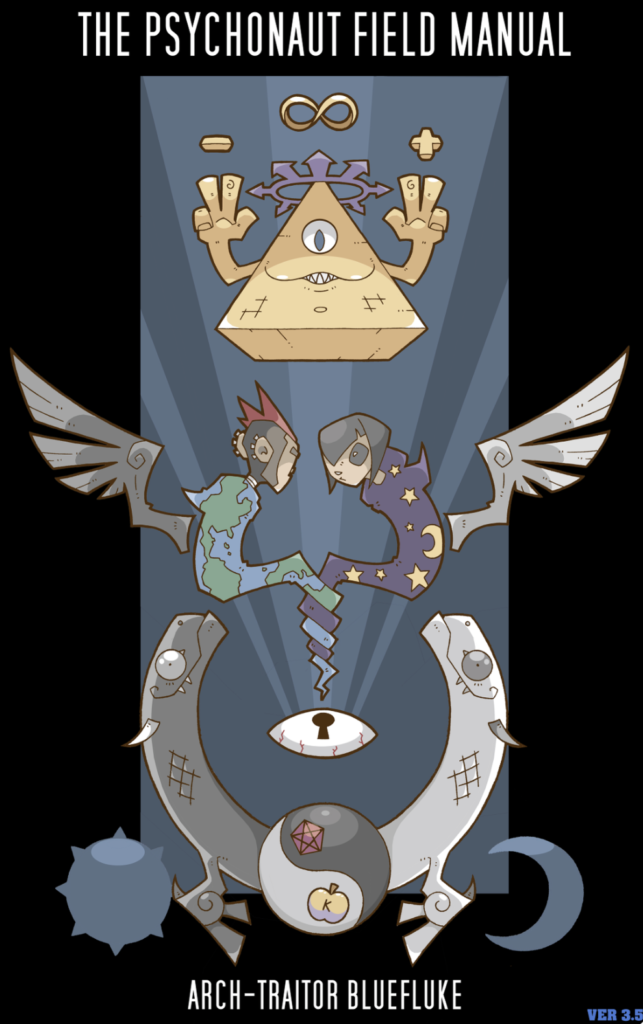
I’ve been reading Sarah Lyons’ How to Study Magic, a book that does what it says and gives you the lay of the land across different magical traditions without trying to sell you any of them. She covers chaos magic, though lightly, and I suspect deliberately so. It’s clearly a territory she respects but doesn’t want to reduce. What she does instead is point toward the deeper water, like Phil Hine’s Condensed Chaos, Aidan Wacher’s Six Ways, and Bluefluke‘s manual for people who want to actually work the practice. She directs readers to the Ultraculture website for the download. I looked there and didn’t find it. Eventually I tracked it down on the Internet Archive. It’s a PDF. A comic book PDF. Forty-four pages of hand-illustrated guidance, drawn in a style that sits somewhere between a D&D sourcebook and an underground zine, and the best part is it’s free (as long as you don’t try to sell it).

The trouble with most introductory chaos magic books — and I’ve read enough of them — is that they fall into one of two failure modes. Either they go so deep into the historical and theoretical apparatus that the beginner drowns in citation before they’ve done a single practical exercise, or they’re so vague and evocative that you finish the book feeling spiritually stirred and practically no further forward. Bluefluke’s introduction names this problem directly: “Few legitimate books exist for the lone beginner, and even fewer aren’t just regurgitating century-old tech written in plain language under a cohesive narrative.”

The Psychonaut Field Manual is the book Bluefluke wanted to find and couldn’t. So he drew it himself.

It is “a theology-free manual containing all the best tech written in plain language under a cohesive narrative.” His words. And they’re accurate. He means it literally. There is no required belief system here, no tradition you have to buy into, no authority you have to defer to. You bring your own cosmology, add it to the exercises, and see what happens. The manual is the engine. You supply the fuel.


What hooked me, on page four, was this.

Level One is called BELIEF IS A TOOL. It opens with the following:

Any damned fool can operate any of the following tech provided they believe that they can. Belief is not only the first tool you’ll master on your journey but also the most powerful. Faith moves mountains and shit. Call it imposition of the will. Call it the placebo effect. Call it the descent into madness. Regardless, magic works.

This is precisely the point at which most esoteric writing flinches. The author will acknowledge that belief is important, then spend the next three paragraphs hedging the claim, gesturing at neuroscience or synchronicity theory or the morphic field, trying to make the supernatural respectable. Bluefluke does none of this. He states the operating principle, acknowledges that you can call it whatever you want, and moves on. The name is irrelevant. The mechanism is not.

What he’s describing is something that runs through everything I work with. In NLP it is the presupposition that the internal map determines the external territory. In Vaihinger’s Philosophy of As If it is the concept of the useful fiction — the idea that you can hold a belief provisionally, as a tool, without requiring it to be objectively true, and still gain the full functional benefit of holding it. In chaos magic it is the principle that Peter Carroll articulated in Liber Null: that the specific content of a magical paradigm matters far less than the intensity and clarity of the belief itself. And in Bluefluke’s visual shorthand it is two characters standing next to each other — one saying, ‘See! Nothing is happening!’ I knew magic was bullshit,” while the other says, “Holy shit. This is awesome! I knew it would work!” — demonstrating, in one panel, the entire phenomenology.

He goes further than the cartoon, though. Ceremonial magicians in robes doing the Enochian hokey pokey — his words — look ridiculous from the outside. But the theatre of the thing is load-bearing. “Shit happens not because they think it will but because they know it will. Whether they attribute the outcome to inner mastery or sketchy metaphysical hippie shit is irrelevant. It doesn’t matter what you believe. Just believe.”

The bishop at Maes Garmon understood this. He wasn’t doing theology. He was doing belief engineering. Get the collective into a single focused state, and the outcome follows. The alleluia rolled off the hills, and the army that heard it ran.

This is what has always drawn me to chaos magic over any system that requires doctrinal commitment. The other frameworks I work with — Jungian depth psychology, narrative therapy, and the archetypal tradition — they all make truth claims or at least make it tempting to treat their maps as the territory. Chaos magic refuses. It hands you the map, reminds you it’s a map, and suggests you throw it away once you’ve reached the destination. Belief is a technology, not a confession of faith.


From there the manual builds in clean, numbered levels.

Level Two is Gnosis, which Bluefluke defines with unusual precision: “Your goal here is not to find inner peace or become ‘one with everything’. Rather, it’s to shut down all auxiliary thought in order to focus most of your brain’s processing power on a singular point of action.” This is not the yoga retreat definition of meditation. It’s an operational state. You are developing the ability to hold complete attention on a single point, which will be the substrate for everything that follows — sigil work, visualisation, projection. Without this capacity the rest of the manual doesn’t function. He knows this and says so. Practise for at least ten minutes a day. He doesn’t ask whether you feel like it.

Level Three opens the third eye. Not as a mystical organ but as a visualisation training system. Step by step, increasingly demanding exercises to develop the ability to project stable imagery with what he calls vivid closed-eye clarity. The point he makes here stays with me: “The third eye + pineal gland theory is 100% required tech for future exercises, and the more you practise it, the more vivid your visualisations will become.” He’s not interested in whether the third eye is literally a gland. He’s interested in whether the training produces the result. It does. That’s the argument.

Level Four — Right Hand of Eris — introduces sigil construction using a tarot deck as a decryption key. It’s one of the most grounded and practical treatments of sigil magic I’ve read. The tarot isn’t invoked here for its traditional meanings or its esoteric associations. It’s used as an image generator: you pull cards, write down the figures, scratch out the vowels and repeating letters, and simplify the result into a geometric shape, and the sigil emerges from the process. Practical, demystified, immediately repeatable.

Then comes what Bluefluke calls the First Big Secret. This is where the manual earns its depth.

The mind, he writes, is not a single entity. It is a multi-organism. He maps it as three interlocking operating systems: the subconscious, which he calls the reptile brain — “the realist, the survivalist, the hungry man”; the superconscious, the higher self — “the artist, the moralist, the idea man”; and the self-conscious, the soul — the software layer created by the interaction of the other two in early childhood, built from perceived needs and the given environment. “Consciousness is less like a dictatorship in which you are supreme leader and more like a yin/yang democracy wherein you are the only voter.”

The goal of the magical practice, as Bluefluke frames it, is to get all three to operate in alignment toward a chosen outcome. When they disagree — when the reptile brain wants safety and the higher self wants transformation and the software layer is running old code about whether you deserve either — the working fails. Getting them on the same page is the actual work. The sigils and the gnosis and the third eye training are all infrastructure for that one conversation.

This is where chaos magic converges, fully, with narrative therapy, NLP, and depth psychology. Different maps, same territory. The three operating systems are the id and ego and superego in new clothes, or the subpersonalities of Internal Family Systems, or the representational systems of NLP, or the complexes of Jungian analysis. The content differs. The structure of the problem — a divided mind working at cross-purposes to itself — is universal.


If you’re a visual learner, you’ll love this format as an introductory text to chaos magic and beyond.

There is a lot of chaos magic material in the text. Dense, reference-heavy, arcane in the original sense — hidden, deliberately obscured, written for an in-group. The Psychonaut Field Manual is drawn. The ideas wear costumes. The characters argue in speech bubbles. The instruction steps are numbered in chunky headers. The warnings come in CAPITALS with illustrated faces making alarmed expressions. There is a character called a servitor — an artificial spirit created to carry out specific tasks — depicted as a small floating creature with its own personality, and the instruction on how to delete it when its job is done (“It is vital that once your servitor has completed its task that you delete it. If you fail to do so it will grow, become resentful and possibly turn on you”) is illustrated with an increasingly agitated small demon. This is not an accident of format. The visual language is the clarity. The ideas are strange enough without being packaged in language that performs its own strangeness.

Bluefluke uses rough language. He uses profanity as punctuation, which either puts you off immediately or signals immediately that there is no mystification going on here. The book is not trying to sound important. It’s trying to be understood.

That matters for a field where obscurity has often functioned as a barrier to entry — and a power mechanism for those on the inside of it.

Bluefluke has been sharing this manual since 2014. It’s now in its fourth edition. He has continued to update it, improve it, extend it — while keeping it free. The Internet Archive currently hosts at least three separate versions. His DeviantArt page has over a million views. None of this happened through marketing. It happened because the thing is good and he let it go.

That’s the sigil firing. The thing released is the thing that works.


I read the whole manual over the weekend, put it down, picked it up again on Sunday morning, and sat with it for a while. The hills rolled south toward the Clwyd Valley. Somewhere under the fields a few miles away, a Bronze Age figure waited three and a half thousand years to be found wearing a gold cape in the Hill of the Goblins.

The Alleluia rolled off the hills and the army fled.

Someone, three hundred years after that, built a castle and named it for his own high place.

Every layer of this landscape is somebody’s working. Somebody’s charged intention, buried or built or shouted into the acoustics of a particular valley at a particular moment. Not all of it survives. But the land does, and the names do, and the gold does, and something about the atmosphere of the place stays alive long past anyone who could explain it.

The Psychonaut Field Manual is free. If you’ve ever been curious about chaos magic and bounced off the available material because it assumed too much, was mystified too much, or positioned itself too far inside a tradition you didn’t share, start here.

Seeing the Fnords in the Machine

Seeing the Fnords in the Machine

I just read Michael Rock’s essay “If You Don’t See the Fnord it Can’t Eat You” and it clarified something I’ve been circling around for months.

Rock traces the paranoid history of subliminal messaging from Robert Anton Wilson’s Discordian chaos to Madison Avenue’s mind control fantasies. The fnord1 is typography that triggers dread without semantic content. You don’t read it consciously, but it programs anxiety directly into your nervous system.

Here’s what matters: the conspiracy theorists are right about the mechanism even when they’re wrong about the specifics.

Stories do operate below conscious awareness. They do shape emotional states and condition responses. The marketplace has always understood this. Advertisers use invisible triggers to create chronic low-grade emergency, then offer consumption as the only relief.

Rock writes: “The essence of control is fear. The fnords produced a whole population walking around in chronic low-grade emergency, tormented.”

Sound familiar?

The Counter-Spell

Your social media feeds are riddled with fnords. News sites pump them out continuously. Every doom scroll is a delivery system for ambient anxiety that keeps you trapped in reactive mode, reaching for the next dopamine hit, the next purchase, the next distraction.

But here’s the leverage point Rock identifies: vision is resistance.

To see the fnords is to break the control network. To recognize narrative as code is to stop being unconscious wetware running someone else’s program.

This is why I treat stories as functional technology rather than entertainment. Why I position my blog as a hypersigil rather than a content platform. This is why I insist on “Stories are Code” as an operational framework.

The Practice

Every piece of content you create either contains fnords or exposes them.

When you write your I AM declarations, you’re creating anti-fnords, conscious sigils designed to counter the invisible programming. When you treat your morning pages as spell work, you’re debugging the malicious code that runs while you sleep.

Rock proves that typeface choice affects perceived truthfulness. Typography shades meaning. Every design decision reinforces or undermines magical intent. This isn’t metaphor. This is engineering.

The Triangle of Transformation works because it doesn’t try to rationally explain the totality of your experience. It gives you ritual technology to reprogram your relationship to it. You learn to see the narrative code, then consciously rewrite it.

The Real Conspiracy

You are not unconscious. You are not helpless. You are not at the mercy of forces beyond your comprehension.

You are the author. You always have been.

The real conspiracy is making you forget that every story you tell yourself is a spell you’re casting, every belief you hold is code executing in your consciousness, every repeated thought is a sigil charging itself through your attention.

Rock’s essay is sophisticated design theory. But strip away the academic language and you get chaos magick 101: symbols operate below awareness, affect precedes analysis, repetition builds power, and whoever controls the transmission controls the response.

The marketplace figured this out decades ago. They’ve been using it against you ever since.

Time to use it for yourself instead.

Read Rock’s full essay here. Then ask yourself: what fnords am I running that I can’t see? What invisible code is programming my responses?

Because if you don’t see the fnord, it can’t eat you.

But once you see it, you can rewrite it.

That’s the real magic.


  1. Fnord is a fictional word coined in the satirical underground culture of the 1960s and popularized by Robert Anton Wilson and Robert Shea in The Illuminatus! Trilogy.
    At its core, a fnord is a piece of hidden psychological conditioning. It is a signal designed to trigger anxiety, obedience, or emotional response without entering conscious awareness. You do not notice the fnord itself. You only feel its effects.
    In Wilson’s telling, fnords were inserted into newspapers and media so that whenever readers encountered certain charged topics, they felt a vague sense of fear or urgency. The reader could not say why they felt uneasy. They just did. That unease made them easier to guide, sell to, or control. The trick worked precisely because it stayed below the level of rational thought.
    Over time, “fnord” escaped its fictional cage and became a useful concept. People began using it as shorthand for any invisible influence embedded in language, media, or systems that bypasses critical thinking and hits the nervous system directly. A headline engineered to induce panic. A design choice that signals authority. A repeated story that frames the world as permanently on the brink of disaster.
    The famous line captures the mechanism perfectly: “If you don’t see the fnord, it can’t eat you.” Once you notice the pattern, its power weakens. Awareness breaks the spell.
    In practical terms, a fnord is not about secret cabals or literal mind control. It is about how stories, symbols, and signals shape perception before analysis kicks in. Fear first. Explanation later. Often never.
    That is why the idea persists. It gives language to something most people intuitively feel but struggle to name: the background hum of manufactured urgency that keeps attention hooked and bodies tense.
    To define it cleanly, without the mythology: a fnord is an unseen cue that programs emotional response while remaining cognitively invisible. Once you learn to spot them, you stop mistaking anxiety for truth. ↩︎