I’ve been thinking about vaporwave as more than an internet aesthetic. Yes, it gives us the pink neon, the Greek busts, the dead malls, the Japanese text, the VHS blur, the Windows 95 ghosts, and the palm trees under impossible sunsets. But beneath all that surface noise, something stranger is happening. Vaporwave feels like a walk through the ruins of a future we once believed in. The smooth corporate dream. The frictionless lifestyle. The shopping mall as a public square. The early internet as a frontier. The screen as a doorway. The brand as an identity. The promise that technology
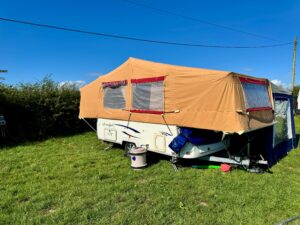
I have made a public service announcement for the modern age. I’m sure you’ll be pleased to know that it’s not about AI or about the collapse of Western civilization or the latest release of the iphone. No. This one concerns the ancient human problem of what happens when someone leaves the loo in a condition that suggests the next visitor may need counseling. I went camping this past weekend up north near the Wyre River. I’ve spent enough time in campsite toilet blocks to know that civilisation is not held together by constitutions, parliaments, or leadership frameworks. It’s held
I walked to the gym this morning. That sounds too ordinary to announce, which is probably why it matters. The gym is only seven minutes away by car. My normal routine is to get in, drive there, work out, drive back, eat something, shower, and be behind the desk by nine like a good citizen of the industrial clock. That’s the sensible move. The 9-to-5 clock still lives in me. I can feel it. Even now, self-employed, answering to no manager hovering over my shoulder, I can still feel the old tribunal warming itself up somewhere behind my eyes. By
Fragments, field notes, and half-lit thoughts from the textual underground
July 11, 2026
11:27 am
This morning I had one of those spells where there were so many possible things to do that I couldn’t bring myself to choose any of them. Nothing dramatic. Just the little wheel-spin of a mind faced with too many open tabs and too many worthy directions.
Then I decided to walk into town for sausages and hot dog buns.
That gave the day a shape.
There’s fresh sunshine in Southam to enjoy. I’ll light the barbecue this afternoon, cook a few sausages, and sit outside for a while in the shade and drink a few IPAs my daughter dropped off this morning and that are now chilling in the fridge. I think that’s a good enough recovery plan. No grand strategy. Just food, a walk, some sun, and lounging in the back garden.
I forget this sometimes. The answer to a head full of choices isn’t always another choice. Sometimes it’s a pack on my back, a familiar route into town, and something simple to prepare when you get back.
The work can wait until my mind clears. For now, the sausages will do.
The government’s argument is basically that the media landscape has changed, and public-service broadcasters are getting buried inside algorithmic platforms. People increasingly get news and culture through YouTube, TikTok, etc., so the UK wants trusted public service content (BBC, ITV, Channel 4, 5) to remain visible rather than disappear behind whatever the recommendation engines reward.
I get it; however, because attention is a scarce resource online, a recommendation slot isn’t neutral. If an algorithm boosts one thing, something else moves down. And I’m already so far down the list that something like this will essentially make me invisible.
For a solo YouTuber, podcaster, blogger, or filmmaker, the modern bargain has always been this: you don’t have a broadcaster’s budget, but at least you can compete in the same feed. A bedroom creator can occasionally outrank a corporation because the audience decides. That possibility is part of what made the creator economy exciting.
The question becomes: what is YouTube?
If it’s like old television infrastructure, then the government sees “prominence rules” as similar to making BBC One easy to find on your TV guide.
If it’s a creative commons/marketplace of individual voices, then forcing prominence feels more like giving established institutions premium shelf space in a shop where everyone else has to fight for the back shelves.
There’s another layer too: institutions like the BBC already have advantages:
brand recognition
archives
production budgets
journalists
marketing teams
existing audiences
Meanwhile, an independent creator is trying to win attention one post at a time.
The tricky bit is that both fears can be true: misinformation is a real concern, and concentrating visibility around legacy institutions can make the web feel less open.
It actually connects to a lot of the early weblogging ethos: the internet was exciting because a person with a weird little website could sit beside CNN, BBC, or The Guardian in the same browser window. Authority came partly from links, reputation, community, and usefulness — not just institutional status.
The philosophical question hiding underneath this story is: should the internet optimise for trusted institutions or for discovery from the edges?
The early web crowd would probably say: the interesting stuff usually comes from the edges. 😉
The brain is a meaning-making machine. It’s constantly trying to connect dots, predict what happens next, and turn scattered information into a coherent shape.
When everything is already explained, the pattern is complete. The brain can relax or get bored.
But when there is uncertainty like a missing piece, an unanswered question, a strange detail, or an unfinished story, the brain becomes more alert. It “leans forward” psychologically, searching for the pattern that will resolve the tension.
The uncertainty creates an open loop. We want closure, so we keep reading, watching, listening, or exploring.
In writing, this means you don’t always need to explain everything immediately. Sometimes the most compelling sentence is the one that creates a gap in the reader’s understanding:
I had walked down that street hundreds of times. This was the first time I noticed the door.
Now the reader’s brain starts working: What door? Why hadn’t he seen it? What is behind it?
July 10, 2026
2:51 pm
Everything becomes source material.
I have been reading an old mythogeography interview with Phil Smith. The thread has me thinking about walking, place, story, performance, and the odd things that gather around a route once I stop treating it as just a way of getting somewhere.
On my own much smaller patch of ground, that might mean the walk to the gym with my Plaud running, capturing the ordinary moments of people beginning their day. Or it might be a half-formed thought about the old industrial clock that The Man uses to keep us marching in step. Or maybe it’s a line lifted from a book I’m reading over coffee.
None of it needs to arrive as an insight.
That’s what I mean when I say everything becomes source material. Left alone, that phrase can sound like a content marketer’s battle cry if you leave it there. I mean something quieter than that. The world keeps handing over fragments. My job is to notice them, carry them for a while, remix them with whatever else is already moving through me, then put them back into the stream.
The page is another stretch of the path. The walk ends, but the thread carries on through a link, a voice memo, or a sentence that caught on something and refused to let go.
Sometimes the whole practice is just this: notice what caught you, follow it for a few steps, and leave the door open.
July 9, 2026
9:44 am
There is a particular comedy in being your own publisher, your own platform, your own little one-person media empire.
The upside is freedom.
The downside is that when the site falls over, there is no calm tech team in matching hoodies quietly restoring the kingdom while you sip coffee and think writerly thoughts.
It’s just you.
You and the critical error message.
Which is how I found myself this morning laughing at the strange bargain I’ve made with the open web. I left Substack last year because I didn’t want to build my house inside someone else’s walled garden. I wanted sovereignty. My own domain. My own server. My own little patch of digital ground.
And then, naturally, my patch of digital ground went face down in the mud.
The irony arrived by way of an app called Kerouac, which, with a name like that, was always going to get my attention. It bills itself as a studio for pro bloggers, pulling together posts, drafts, ideas, pipelines, feeds, and whatever other fragments of a writing life are scattered across the web.
I signed up for the free trial. No credit card. Low commitment. Maximum curiosity.
My first impression: too much structure. Too many panes. A little too much productivity inducing anxiety for my taste. But it also has a discovery feed, and that led me to JA Westenberg, whose work I’ve followed and liked for a while.
From there I ended up back in the Substack flow, reading her notes, posts, linked videos, and newsletters all stitched together in one clean stream. I had to admit, grudgingly, that it worked. There was cohesion. A centre of gravity. A single place where the work gathered and pointed outward.
And then I clicked over to my own site to ponder its cohesion.
Critical error.
Beautiful timing, really.
There I was, admiring the elegant flow of a platform I had left because I didn’t want to be owned by it, only to be reminded that independence comes with maintenance costs. If you want the freedom of the road, you also have to know what to do when the van breaks down.
This is the bit we don’t always talk about in the romance of the indie web. Owning your platform is noble. It is also admin. It is backups, updates, plugins, hosting, monitoring, and occasionally staring at a broken homepage while wondering if “pro blogger” is too generous a category for a man whose blog is currently unconscious.
Still, I don’t think this is an argument against owning your work.
It is just a reminder that ownership is not an aesthetic. It is a practice.
You don’t get to claim the open road and then complain there’s no concierge.
The other timely thing was Westenberg’s post about the humble Moleskine notebook. I’ve been having my own notebook renaissance lately, using paper again as a visual thinking tool. Less dashboard, more scratchpad. Less system, more contact.
Maybe that is the shape I’m after online too.
Not more platforms. Not more clever pipes.
A notebook with a door.
A place where the thinking can happen in public, where the fragments can gather, where the trail is visible, and where, yes, I occasionally have to crawl under the bonnet myself.
That might be the real bargain of the indie web:
freedom, but with spanners.
Update:
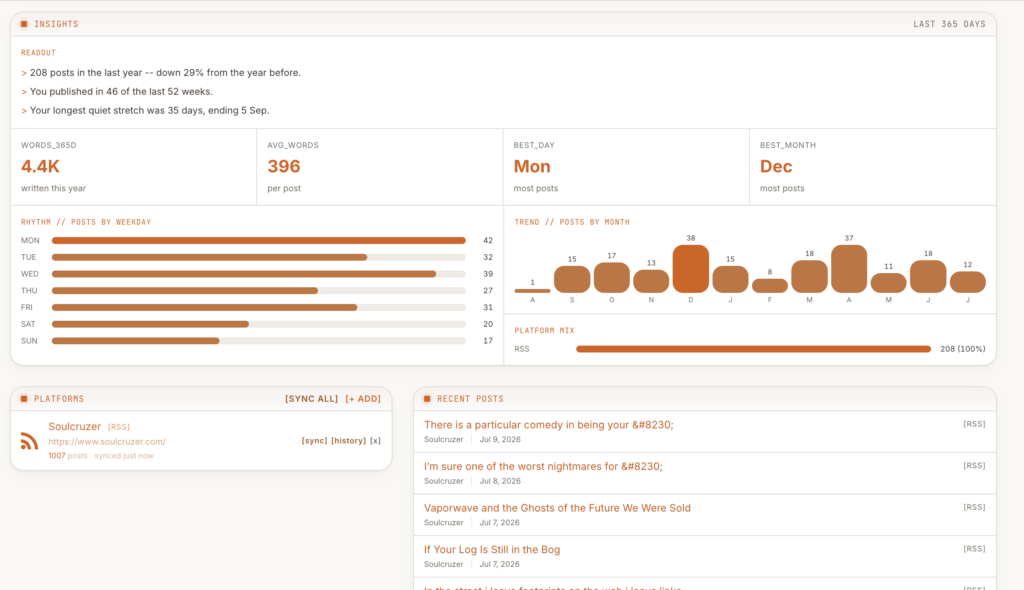
I wrote the above earlier this morning. I have since connected my blog to the app. And I must say, I really like the insights page.
July 8, 2026
9:47 am
I’m sure one of the worst nightmares for any parent is your child going missing.
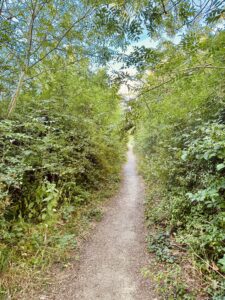
I was out on my morning Wisdom Walk today and noticed an unusual number of people in the fields where I usually walk. There are often dog walkers about, but this felt different.
At one point, I saw a woman looking into an old cowshed. I thought maybe she was a photographer trying to catch the shed in the morning light. But then she came toward me and explained that she was searching for a young girl who had gone missing. No one had seen or heard from her since about 5 PM yesterday. According to her cousin, who posted the callout to the community on our local news group on Facebook, the girl has no mobile phone or money.
Suddenly, I felt the dread that all those people out searching must have been carrying.
I checked the Facebook group to get more details and to see what the girl looked like so I could keep an eye out for her as I completed my circuit around the fields.
If you felt that same dread as I was telling this story, you can relax now too. The young girl has been found. There are no details yet, but it appears she is unharmed..
I write from the crossroads of philosophy, myth, music, AI, learning, and ordinary life. This is my living archive: part field notebook, part essay chamber, part signal fire from the textual underground, part hypertext adventure.
Working Notes from the Textual Underground
Hi, my name is Clay Lowe, aka Soulcruzer. This is the part where I have to reduce myself to a label so you can understand who I am and what I am about. But as Kierkegaard pointed out, labels have a way of negating the person. If I tell you I’m a blogger, I get reduced to whatever meaning you’ve assigned to the word ‘blogger’. It has been my habit to resist labels. And yet, here we are. So, in the context you find me in now, I am indeed a blogger, and I am much more than that!
I have worn many other labels. I’ve been an infantry officer, a learning and development consultant, a trainer, and a coach. I’ve also called myself a barefoot philosopher, a narrative alchemist, and a rogue learner, among others things. These were an attempt to orient me to myself and myself to you. More recently, I’ve been working out what it means to operate as a text-based ontologist in a world where text is becoming the universal substrate.
A text-based ontologist sounds like someone who should live in a footnote.
They don’t.
They live in the browser window, the notebook, the prompt box, the blog editor, the Obsidian graph, the half-finished post, and the walking thought captured before it evaporates. Their material is language. Their subject is being. Their method is to hold attention long enough for a sentence to disclose what it is carrying.
It’s not really a job title. It’s more of a way of relating to this blog and the wider web.
In the end, though, I’m just a dude doing his thing and sharing it on the internet.
The best place to follow my work is here. Better yet, get the newsletter version and never miss a post, or alternatively, subscribe via my RSS feed.
latest from the podcast
Soulcruzer
The Soulcruzer podcast is an audioblog from the edge of the inner life.
Part personal essay, part field recording, part narrative alchemy, it follows the strange places where story, psyche, myth, technology, and everyday experience begin to speak to each other.
One episode might wander through tarot as reflective technology. Another might take Nietzsche’s eternal return for a walk, explore games as containers for transformation, or ask what happens when ancient wisdom meets the AI age. Depth psychology brushes against the esoteric. Philosophy comes down from the shelf. Theory gets tested against life.
This is not polished guru-talk or productivity theatre. It is a mind in movement: raw notes, live experiments, confessional mysticism, and working fragments from the textual underground.
At the heart of it all is a simple premise:
Stories are code. Reality is programmable. And the life you are living might be more editable than you were taught to believe.
If you are drawn to the deep work, the strange edges, and the art of becoming more fully alive, subscribe wherever you get your podcasts.
Why My Blog Is Still My Home on the Internet
bySoulcruzer
In this episode, I take the Soulcruzer podcast out of the studio and into the fields.
What starts as an experiment in mobile podcasting/vlogging turns into a wandering meditation on labels, blogging, AI, morning rituals, and the strange abundance of media tools we now carry in our pockets.
– Why I still think of myself as a blogger first – Podcasting, vodcasting, and the pressure to become “multimodal” – The problem with labels: “When you label me, you negate me” – soulcruzer.com as the central hub/home on the internet – Wisdom Walks as thinking time – Walking, motion, and changing perspective – The “barefoot philosopher” approach to everyday philosophy – AI as an extension of cognition rather than just a productivity tool – The “soft cyborg” and the library of Alexandria in your pocket – Morning reality tunnels and the sacred space before breakfast – Coffee, barefoot grounding, and choosing what enters your mind first – Indie blogging, platforms, Substack, distribution, and the open web – Why these episodes may stay loose, minimally edited, and stream-of-consciousness