There’s a moment in every partnership, every deep connection, when two people must decide whether they’ll stay comfortable or grow together. Whether they’ll maintain the illusion of safety or risk everything for truth. Whether they’ll remain asleep in the garden or wake up and walk out, hand in hand, into the unknown.
This is the choice Adam and Eve made.
In Gnostic lore, Adam and Eve are committed dual forces who begin their saga trapped in the Garden under the thrall of the Demiurge and his archons. The Garden wasn’t paradise. It was a controlled environment, a simulation designed to keep them docile, obedient, forever children who would never question their captivity. Eve is often depicted as an avatar of Sophia, brutally victimized by the archons because she dared to wake up. Yet she is supported by the silent strength of Adam and sometimes the wisdom of the serpent, who is a reflection of her own knowing.
Together, Adam and Eve overcome the forces of forgetfulness and trauma. They leave the garden not in shame but in sovereignty. They work harmoniously to bring about the doom of the Demiurge, not through violence but through the simple, radical act of choosing awareness over obedience, knowledge over comfort, partnership over isolation.
Today, they arrive as our eighth companion, following Valentinus’s teaching about sacred seeking. Where Valentinus showed us that questions are sacred, Adam and Eve demonstrate what happens when two people ask those questions together, when seeking becomes shared, when awakening is mutual rather than solitary.
The Advent Companion Appears
Adam and Eve don’t arrive separately. They appear as a unit, as the dynamic tension and harmony that exists in true partnership. You feel them first as a reminder that awakening isn’t always a solo journey. Sometimes the most radical thing you can do is choose to grow alongside another person, to hold each other accountable to truth even when lies would be easier.
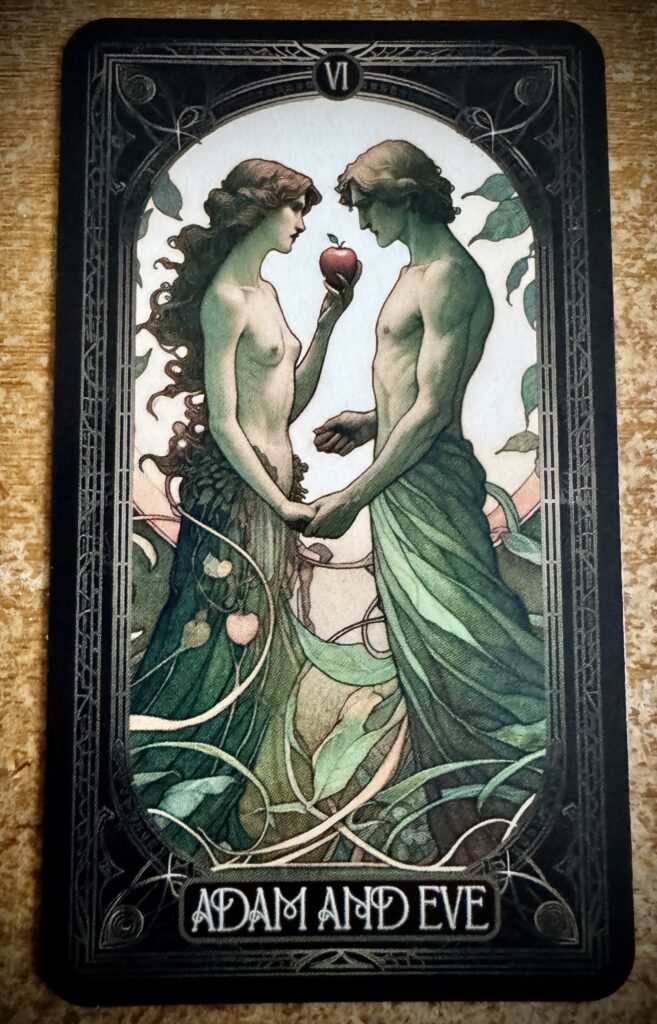
They stand in the garden that was meant to be their prison, transformed by their presence into the site of their liberation. The apple between them glows with possibility. Not forbidden fruit. Sacred knowledge. The recognition that consciousness is worth any price, that awareness is more valuable than safety, that truth matters more than comfort.
Eve’s story in Gnostic texts is one of extraordinary courage. The archons targeted her precisely because she was the one who could wake Adam, who could disrupt their carefully controlled simulation. She bore the brunt of their violence, their attempts to punish her for daring to see clearly. Yet she never stopped. She never went back to sleep. She never let the trauma convince her that ignorance was better than knowing.
And Adam? His strength isn’t loud or dramatic. It’s the quiet steadiness of someone who trusts his partner’s vision even when he can’t yet see what she sees. Who chooses solidarity over comfort. Who walks out of the garden not because he fully understands where they’re going, but because he knows that going together matters more than staying safe alone.
This is the Lovers card in its deepest form: not romantic fantasy, but the recognition that some awakenings require partnership. That certain truths can only be held between two people. That the journey out of the archontic prison is sometimes walked side by side, each person’s courage strengthening the other’s resolve.
The serpent in the image isn’t the villain of the biblical story. In Gnostic interpretation, the serpent is often wisdom itself, the voice that says “You don’t have to accept this. You can choose differently. You’re meant for more than this controlled existence.” The serpent is Eve’s own knowing, externalized, offering her the choice the Demiurge never wanted her to have.
As Adam and Eve appear beside you today, their question arrives as both invitation and challenge:
“What truth are you and your beloveds ready to hold together? What garden of false comfort are you willing to leave behind for the sake of genuine connection?”
Teaching for the Day
The traditional telling of Adam and Eve’s story is one of the most successful propaganda campaigns in history. The archons, working through orthodoxy, convinced generations of humans that consciousness was a crime, that curiosity was sin, that the choice to know was the source of all suffering.
But the Gnostic telling reveals something completely different: Adam and Eve’s choice to eat from the tree of knowledge wasn’t a fall. It was an uprising. A refusal to remain unconscious. A commitment to awareness even when awareness brought difficulty.
And they made that choice together.
This is what the Lovers card teaches us: true partnership isn’t about finding someone who makes you comfortable. It’s about finding someone with whom you can risk discomfort in service of growth. Someone who won’t let you go back to sleep. Someone whose own commitment to truth calls forth your own.
The Demiurge wanted Adam and Eve separate, isolated, each one alone in their programming. He knew that consciousness shared between two people becomes exponentially more powerful. That mutual awakening is harder to suppress than individual insight. That partnership in truth-seeking creates a bond the archons can’t easily break.
This is why they targeted Eve so viciously. Not just to punish her, but to try to break the bond between them, to make Adam blame her, to turn partnership into accusation. The orthodox story succeeded in this for millennia, teaching people to see Eve as temptress, as the one who ruined everything, as the source of sin.
But the Gnostic story shows something different: Eve was the bravest one. The first to wake. The one willing to risk everything for consciousness. And Adam’s greatness was in trusting her vision, in choosing partnership over comfort, in walking out of the garden beside her rather than staying behind in false paradise.
The Gospel of Eve, now mostly lost except in fragments and references, contained this powerful recognition: “I am thou and thou art I, and wherever thou art, there am I, and I am sown in all things; and whence thou wilt, thou gatherest me, but when thou gatherest me, then gatherest thou thyself.”
This is the teaching of true partnership: when you gather your beloved, you gather yourself. When you support their awakening, you deepen your own. When you hold truth together, you become something larger than either of you could be alone.
The choice Adam and Eve faced wasn’t about apples or disobedience. It was about whether to remain children in a controlled environment or become sovereign adults in an uncertain world. Whether to stay comfortable and unconscious or risk everything for awareness. Whether to face reality alone or together.
They chose together. They chose awareness. They chose to leave.
And in that choice, they became the first humans to truly be human, to claim their divine spark, to refuse the archontic program.
Journaling Invocation
“What garden of false comfort am I being called to leave? What partnership in my life is ready to deepen through shared truth-seeking rather than shared comfort?”
This question invites you to look at where you’ve been choosing safety over growth, comfort over consciousness, the familiar garden over the unknown wilderness. Sometimes we stay in situations, relationships, or beliefs not because they’re true but because they’re safe. Not because they nourish us but because they’re known.
Adam and Eve teach us that leaving the garden isn’t loss. It’s liberation. But it requires courage. And sometimes, that courage is easier to find when you’re not walking alone.
Maybe there’s someone in your life with whom you could have more honest conversations, go deeper into the questions that matter, stop performing comfort and start exploring truth together. Maybe there’s a partnership that’s ready to evolve from surface-level connection to soul-level witnessing.
Or maybe you’re being called to examine your relationship with comfort itself. Where have you been choosing the familiar garden over the uncertain journey? Where has the promise of safety kept you smaller than you’re meant to be?
Write without censoring. Let yourself acknowledge the gardens you’ve been tending that are actually prisons. Let yourself name the partnerships that could deepen if you were willing to stop pretending everything is fine and start exploring what’s true.
Eve didn’t wait for permission. She chose awareness. Then she offered that choice to Adam. He could have stayed behind. He could have blamed her. He could have chosen the garden’s false safety over the wilderness of consciousness.
But he didn’t.
What would it mean to make the choice they made, whether with a partner or alone, to choose awareness over comfort, truth over safety, the uncertain path of consciousness over the controlled environment of sleep?
Small Embodied Practice
If you have a partner or trusted friend available, stand facing each other at arm’s length. If you’re alone, stand facing a mirror or simply imagine a trusted presence across from you.
Make eye contact. Hold it longer than feels comfortable. This is the first practice: truly seeing and being seen.
Now extend one hand toward the other person (or toward the mirror, or into the space between you and your imagined companion). Palm up, offering. Feel the vulnerability of this gesture, the risk of reaching out.
If with another person, let them place their hand in yours or over yours. If alone, place your other hand palm-down over your extended palm.
Take three deep breaths together, maintaining eye contact. Feel the connection, the shared awareness, the recognition that consciousness witnessed becomes consciousness amplified.
Now speak or think these words:
“I choose awareness with you.” “I choose truth with you.” “I choose the uncertain path over the false garden.”
Notice what happens in your body. Does something open? Does resistance arise? Do you feel the weight and gift of choosing growth over comfort, together?
This is Adam and Eve’s teaching embodied: true partnership means witnessing each other’s awakening. Supporting each other’s courage to leave false gardens. Choosing consciousness together, even when comfort would be easier.
If you’re doing this alone, you’re practicing partnership with your own deeper self, with your own divine spark, with the part of you that knows truth is worth any price.
Release the hand connection. Take one more breath together.
You just practiced the sacred choice that changed everything: awareness over obedience, knowledge over comfort, partnership in consciousness over isolation in sleep.
The caravan moves together. If today’s companions touched something in you, if Adam and Eve’s shared courage helped you recognize where you’re ready to choose truth over comfort, let us know in the comments. Your partnership in consciousness lights the path for others walking beside you. 🍎
Tomorrow: Abraxas arrives, the force of pure action, the god above gods who charges into each new dawn.
There’s a particular ache that comes with wondering how history might have unfolded differently. What if the road not taken had become the main highway? What if the voice nearly heard had shaped the dominant narrative? What if the teacher almost chosen had shepherded the tradition into something unrecognizable from what it became?
This is the territory of Valentinus.
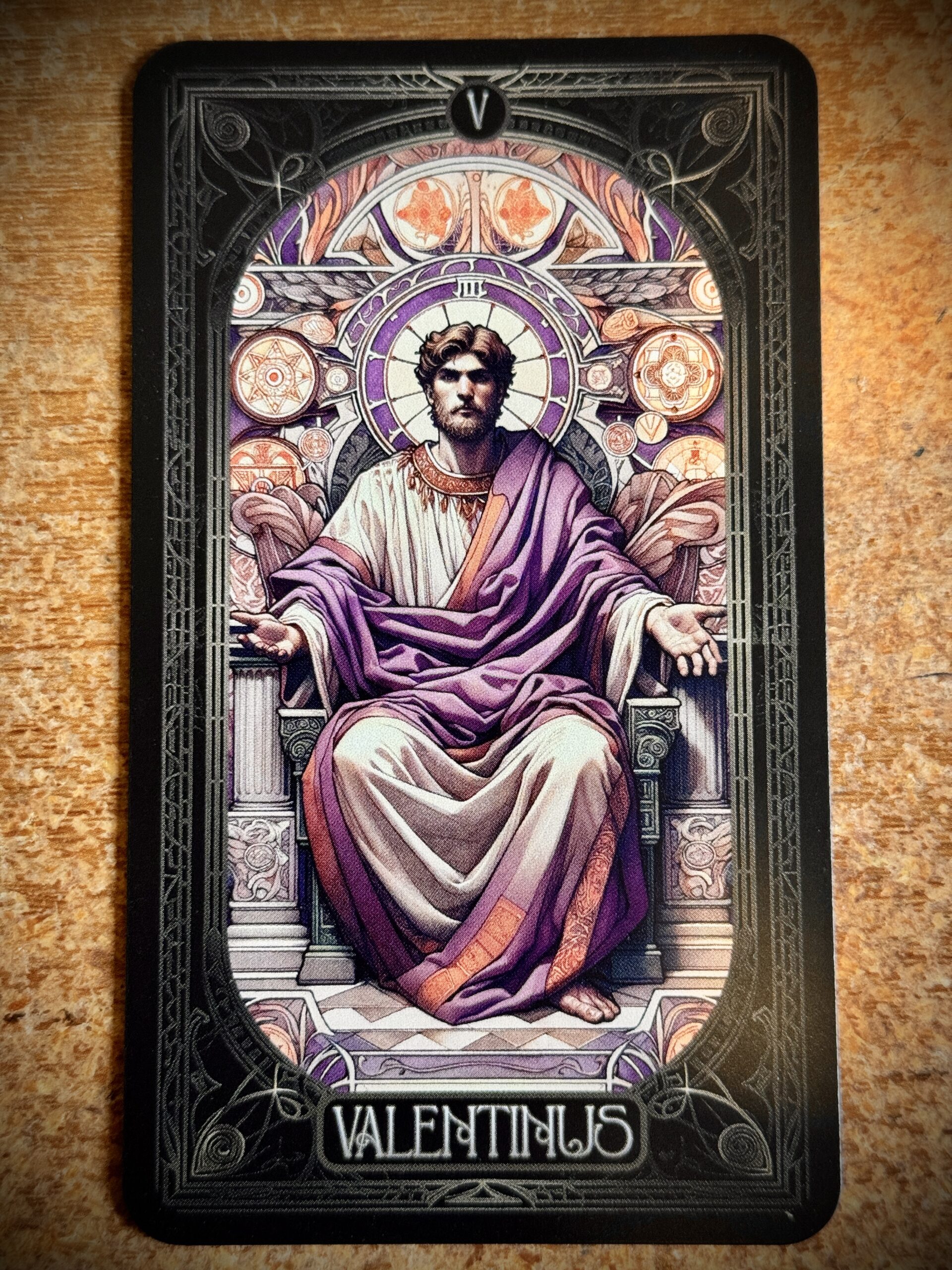
In the card, he sits in contemplative authority, draped in rich purple, surrounded by the sacred geometry of his cosmology. His hands are open in a gesture of offering, of transmission, of teaching freely given to those ready to receive. Behind him, the intricate mandala of aeons and emanations speaks to the elegant, systematic philosophy he developed. This isn’t the rigid dogma of orthodoxy. This is living theology, mystic speculation married to rigorous thought.
Valentinus was an elegant Gnostic teacher and perhaps history’s first systematic Christian philosopher. But more than that, he was the man who almost became Pope in the 2nd century CE. Imagine that alternate timeline. Imagine if this proponent of sacred marriage, inclusive rituals, and mystic speculation had shepherded Christendom. Imagine if Christianity had embraced rather than suppressed the experiential, the feminine, and the individually revelatory.
But history chose differently. And Valentinus, instead of leading from Rome’s throne, led his own movement from the margins. He advocated for an individualistic, sacramental, and experiential form of Gnosticism that the early church both admired and feared. He preached lost secrets. He preached Sophia and Christ united in heaven and in our hearts. He preached reason and kindness as paths to the Divine.
Today, he arrives as our seventh companion, following Jesus’s embodied Logos. Where Jesus demonstrated sovereign authority, Valentinus teaches us what happens when that authority becomes transmission, when sovereignty turns outward to guide and illuminate, when the one who knows helps others remember what they’ve forgotten.
The Advent Companion Appears
Valentinus doesn’t appear with the weight of institutional power or the demand for blind faith. He arrives as the energy of genuine teaching, the quality of someone who has discovered something profound and can’t help but share it. Not to convert. Not to control. But because wisdom naturally overflows when it’s real.
He sits in his contemplative throne, but there’s an accessibility to him, an openness. The purple of his robes speaks to spiritual royalty, yes, but also to the kind of authority that comes from deep inner work rather than external appointment. His hands reach toward you, not grasping but offering, inviting you into a conversation rather than demanding your obedience.
In Valentinian Gnosticism, the path wasn’t about believing the right things. It was about experiencing the right things. About direct encounter with the Divine rather than mediated relationship through institutional gatekeepers. Valentinus taught that the Pleroma, the fullness of the Divine, could be accessed through contemplation, through sacrament, and through the sacred marriage of masculine and feminine principles both within and without.
His cosmology was intricate, yes. The elaborate system of aeons and emanations can seem complex from the outside. But at its heart was something simple and revolutionary: you contain the Divine. The spark of the Pleroma lives within you. Your task isn’t to grovel before an external God but to awaken to the divinity you already carry.
The Gospel of Thomas contains what might be Valentinus’s most essential teaching: “Those who seek should not stop seeking until they find. When they find, they will be disturbed. When they are disturbed, they will be amazed and will rule over all.”
This is the path of the true seeker. Not the comfortable path of received wisdom and easy answers. The path that disturbs, that unsettles, that demands you question everything you thought you knew. And on the other side of that disturbance, amazement. Recognition. The realization that you rule over your own inner kingdom.
As Valentinus appears beside you today, his question arrives as an invitation rather than a test:
“What if seeking itself is sacred? What if the questions matter more than the answers? What if your spiritual path is meant to disturb you awake rather than comfort you to sleep?”
Teaching for the Day
The Hierophant in traditional tarot often represents religious authority, institutional wisdom, and the keeper of orthodox tradition. But Valentinus as Hierophant offers something more subversive: he represents the teacher who refuses to become a gatekeeper. The guide who points inward rather than demanding you defer to external authority.
Valentinus’s near-ascension to the papacy is one of history’s most tantalizing what-ifs. The vote was close. He had supporters, admirers, people who recognized the depth of his wisdom and the coherence of his teachings. But in the end, the institutional church chose a different path. They chose consolidation over mysticism, uniformity over diversity, control over experience.
And Valentinus, rather than fighting for the throne or abandoning his calling, simply continued teaching. He gathered students. He developed his philosophy. He created a movement that honored individual experience, that celebrated the sacred feminine, that insisted on the marriage of spiritual and intellectual rigor.
This is what the Hierophant energy looks like when it’s uncorrupted: teaching that empowers rather than enslaves. Guidance that points toward your own authority rather than demanding you surrender it. Wisdom that invites questioning rather than punishing doubt.
The path Valentinus advocated was never easy. He insisted that true spiritual awakening would disturb you. That genuine seeking meant being willing to have your certainties shaken. That the journey toward amazement required passing through disorientation.
This is so different from the religious messaging most of us inherited. We were taught that faith means certainty, that doubt is dangerous, that questioning is a sign of weakness rather than strength. The archons love this programming because it keeps people compliant, keeps them from seeking too deeply, keeps them dependent on external authorities to tell them what’s true.
Valentinus disrupts this completely. He says: seek until you find, and expect to be disturbed by what you discover. He says: your discomfort is a sign you’re on the right path, not evidence you’ve lost your way. He says: amazement awaits on the other side of the questions that won’t let you sleep at night.
The teaching today isn’t about finding the right teacher or the perfect system or the ultimate answer. It’s about recognizing that seeking itself is sacred. That the questions you’re carrying are part of your spiritual work. That your doubt, your uncertainty, your refusal to accept easy answers, these aren’t obstacles to awakening. They’re the path itself.
Valentinus preached reason and kindness. This pairing is essential. Reason without kindness becomes cold intellectualism. Kindness without reason becomes naive sentimentality. But reason and kindness together, rigorous thought married to compassionate presence, this creates the conditions for genuine transformation.
Journaling Invocation
“What questions am I carrying that I’ve been afraid to ask? What seeking have I shut down because the answers might disturb me?”
This invitation asks you to look at the questions you’ve been avoiding. Not because you don’t care about the answers, but because you suspect the answers might change everything. We all have them. The questions that would require us to rethink fundamental assumptions. The seeking that would demand we leave comfortable certainties behind.
Maybe it’s a question about your faith tradition, the one you’ve been loyal to but secretly wonder about. Maybe it’s a question about your life’s direction, the one that would require admitting you’ve been on the wrong path. Maybe it’s a question about a relationship, a career, a belief about yourself that you’ve never dared to examine directly.
Valentinus says: ask it. Seek it. Don’t stop until you find, even if what you find disturbs you. Because that disturbance isn’t a sign you’ve made a mistake. It’s a sign you’re finally awake enough to see clearly.
Write the questions. Don’t try to answer them yet. Just let them exist on the page, acknowledged and honored. These questions are sacred. They’re trying to lead you somewhere important. Your willingness to ask them, to hold them without rushing to resolve them, is itself a spiritual practice.
What if your doubt is more sacred than your certainty? What if your questions are more valuable than your answers? What if the seeking itself is the whole point?
Small Embodied Practice
Sit somewhere quiet where you can be undisturbed. Close your eyes. Place both hands over your heart.
Take a few deep breaths, letting your awareness settle into this moment, this body, this life as it actually is rather than as you think it should be.
Now bring to mind a question you’ve been carrying. Not a practical question like “What should I have for dinner?” but a deeper one. A question about meaning, purpose, truth, belonging. A question that doesn’t have an easy answer.
Instead of trying to answer it, just hold it. Feel it in your body. Where does it live? Your chest? Your belly? Your throat? Notice the quality of the question. Does it create tension or curiosity? Anxiety or aliveness?
As you breathe, imagine that you’re creating space for this question. You’re not trying to resolve it or dismiss it. You’re simply acknowledging: this question is part of my journey right now. This seeking is sacred.
Say silently to yourself: “My questions are welcome here. My seeking is sacred. I trust the path of not knowing.”
Stay with this for several minutes. Let your body learn what it feels like to hold uncertainty with grace rather than anxiety. To be in the question rather than desperately grasping for answers.
This is Valentinus’s teaching embodied: seeking itself is sacred. The questions you carry are part of your spiritual work. Your willingness to be disturbed awake is the path to amazement.
When you’re ready, open your eyes. Notice if something has shifted. Often the questions feel less heavy when we stop treating them as problems to solve and start honoring them as guides to follow.
The caravan moves together. If today’s companion touched something in you, if Valentinus’s teaching helped you honor your questions as sacred rather than seeing them as obstacles, let us know in the comments. Your seeking lights the path for others walking beside you. 🕯️
Tomorrow: Adam and Eve arrive, not as sinners but as the dual forces who chose awakening over obedience.
There’s a particular quality of presence that doesn’t bend or waver, that remains centered regardless of what chaos swirls around it. Not rigidity. Not stubbornness. But an unwavering commitment to truth that becomes the still point around which everything else organizes itself. This is the power of divine order, not as control but as natural authority. The kind that needs neither force nor justification because it emanates from complete alignment with what is real.
This is the domain of Jesus Christ in the Gnostic tradition.
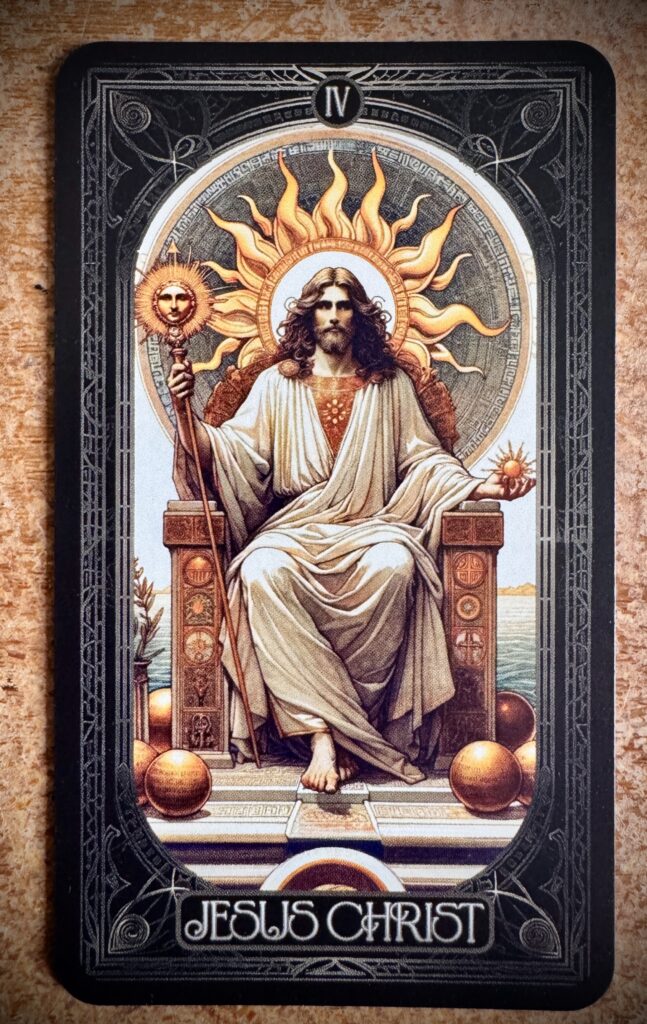
In the card, he sits enthroned between earth and water, fire and air, holding both the scepter of authority and the orb of cosmic wisdom. The radiant sun behind him isn’t just decoration. It speaks to his nature as the Logos, the ordering principle of creation itself, divine reason embodied in human form. He doesn’t rule through domination. He orders through presence. Through being so thoroughly aligned with truth that reality itself rearranges around him.
The Gnostic Jesus is nothing like the suffering savior of orthodox Christianity. He didn’t come to die for sins. He didn’t arrive to be sacrificed on an altar of cosmic appeasement. He emanated from the Aeon Christ to accomplish something far more subversive: to save humanity from ignorance and awaken those seeking liberation from the archontic simulation.
In his higher form, he is associated with the Logos, the divine intelligence that structures the multiverse. He is the Emperor not through conquest but through embodying the natural laws that govern existence. His authority is the authority of someone who has remembered completely who they are and refuses to pretend otherwise, no matter what the archons demand.
Today, he arrives as our sixth companion, following Mary Magdalene’s embodied wisdom. Where Mary taught us that knowing becomes being, Jesus teaches us what happens when that being stands firm in its authority, when integration leads to sovereignty, when inner alignment creates outer order.
The Advent Companion Appears
Jesus doesn’t arrive with sermons or commandments. He appears as a stable presence, as someone who has stopped negotiating with illusions and started living from an unshakeable center. You feel him first as a sense of rightness, of things falling into their proper place, of chaos settling into coherent pattern.
He sits on his throne not to dominate but to demonstrate. This is what it looks like when someone stops asking for permission to be who they are. When someone embodies their divine nature so completely that questions of worthiness or adequacy simply dissolve. The scepter and orb aren’t symbols of external power. They represent mastery of inner and outer worlds, the capacity to hold spiritual truth and material reality in both hands without choosing one over the other.
In Gnostic texts like The Gospel of Thomas or The Secret Book of James, Jesus repeatedly points his students inward. He isn’t offering salvation from outside. He’s revealing what already lives within. “The kingdom is inside you and outside you,” he teaches. “When you know yourselves, then you will be known, and you will understand that you are children of the living Father.”
This is Emperor energy stripped of all patriarchal distortion: not power over but power through. Not authority that diminishes others but authority that calls others into their own sovereignty. Jesus in the Gnostic tradition is a mirror showing you your own divine potential, not a savior doing the work for you.
The spheres around him, the cosmic architecture in the card’s symbolism, remind us that he moves between dimensions with ease. Often regarded as a trickster in these texts, Jesus’s presence in the material world is deliberately hidden from the archons. Like Zeus or Odin disguised as mortals to impart teaching or learn about the simulation’s glitches, Jesus incarnates in forms that fool the cosmic controllers while awakening those ready to see.
As he appears beside you today, his question arrives with quiet certainty:
“What would it mean to stop negotiating with the archons’ version of who you should be and start living from the unshakeable truth of who you actually are?”
Teaching for the Day
Authority has been so corrupted in our world that many spiritual seekers instinctively recoil from the word. We’ve seen too much domination masquerading as leadership, too much control disguised as care, too many power structures that diminish rather than elevate. But the Gnostic Jesus demonstrates a different kind of authority entirely.
True authority comes from authorship. You become an authority when you author your own life rather than living someone else’s script. When you stop performing versions of yourself designed to appease the archons and start expressing what’s genuinely true, regardless of whether it’s acceptable or comfortable or easy to explain.
The Logos isn’t about rigid rules or external commandments. It’s about coherence. It’s the principle that brings order to chaos not through force but through alignment with deeper patterns of reality. When you live from the Logos within you, from your own divine reason, life begins to organize itself around that clarity. Not magically. Not without effort. But naturally, the way water finds its level or crystals form their precise geometries.
Jesus in the Gnostic gospels keeps pointing to this: “Listen to the Logos, understand Gnosis, love life, and no one will persecute you and no one will oppress you other than you yourselves.” The persecution comes from within, from the internalized archons, from the parts of you that have learned to police your own awakening.
The Emperor card in traditional tarot often suggests structure, discipline, and order imposed from above. But Jesus as Emperor offers something more subtle: the order that emerges when you stop fighting yourself. When the war between who you pretend to be and who you actually are finally ends. When you integrate so completely that there’s no gap between your inner knowing and your outer expression.
This requires something that looks like discipline but feels like freedom: the daily choice to align with truth even when lies would be easier. The ongoing commitment to integrity even when compromise beckons. The willingness to stand in your authority even when the world insists you should shrink.
The archons maintain control through a specific trick: they convince you that authority is something granted by external systems. That you need credentials, validation, permission, approval before you can fully inhabit your power. Jesus disrupts this completely. His authority comes from being so aligned with the Divine that questions of whether he’s “allowed” to speak or act or teach become absurd.
This is available to you. Not as fantasy. As function. When you stop seeking authority from outside and start recognizing it within, when you author your own life from the Logos that lives in your core, you become ungovernable by anything except truth itself.
And that changes everything.
Journaling Invocation
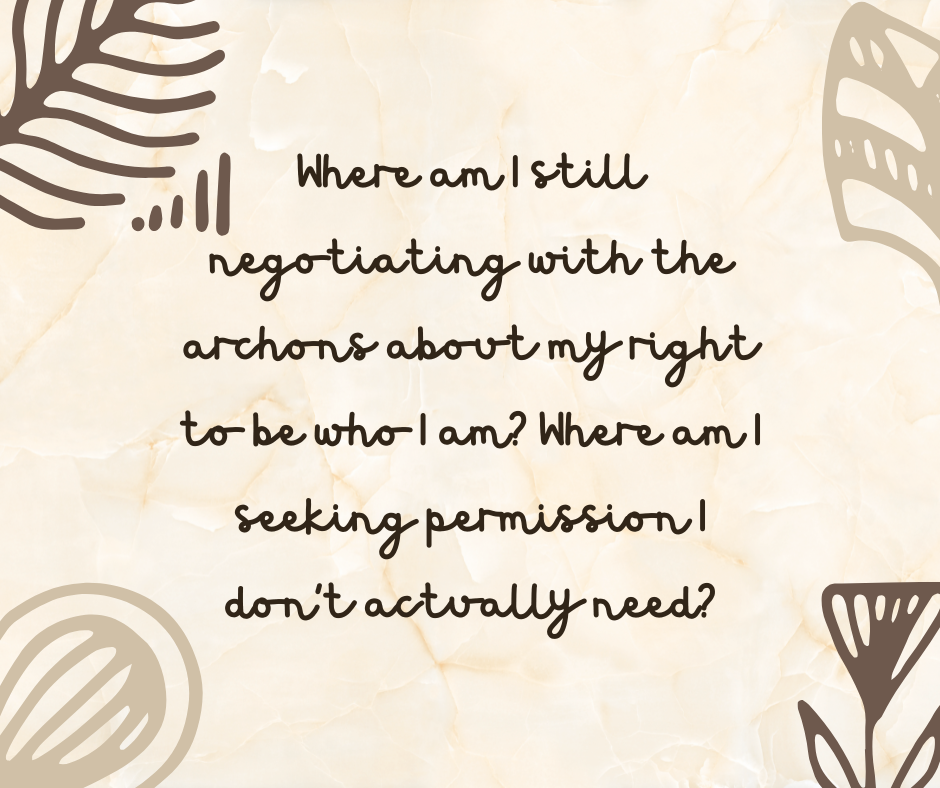
“Where am I still negotiating with the archons about my right to be who I am? Where am I seeking permission I don’t actually need?”
This question cuts to the heart of authority. We’re so trained to defer, to wait for approval, to believe that our legitimacy must be granted by systems outside ourselves. Jesus demonstrates something different: you are already legitimate. You are already authorized. The question is whether you’re willing to live from that truth.
Maybe you’ve been waiting for someone to recognize your gifts before you claim them. Maybe you’ve been deferring your calling until you have the right credentials, the proper training, the official stamp of approval. Maybe you’ve been performing a smaller version of yourself because the full version seems too much, too bright, too threatening to the established order.
Write about where you’re still playing small. Where you’re still asking permission. Where you’re still negotiating with voices (internal or external) about whether you’re allowed to be the full expression of what you actually are.
Jesus didn’t ask the Pharisees if he could teach. He didn’t seek approval from the archons before revealing their illusions. He simply lived from such deep alignment with truth that questions of permission became irrelevant.
What would that look like for you? Not as arrogance. Not as disregard for wisdom or relationship. But as the natural expression of someone who has stopped fragmenting themselves to fit into spaces too small to hold them.
Where are you ready to stop asking and start being?
Small Embodied Practice
Stand with your feet hip-width apart, grounded and stable. Let your spine lengthen naturally, your shoulders settle, and your breath move easily.
Now imagine a golden thread running from the crown of your head straight up through the ceiling, through the sky, connecting to something vast and luminous above you. At the same time, feel roots extending from your feet deep into the earth, anchoring you, stabilizing you.
You’re held between heaven and earth, just like Jesus in the card. Neither floating away into spirit nor collapsing into matter. Both. Simultaneously. The Logos incarnate.
From this centered place, place one hand on your heart. Feel the steady rhythm there. This is your authority. Not something you earned or achieved or were granted. Your birthright as a spark of the Divine.
Say quietly, either aloud or internally: “I am authorized by truth itself.”
Notice what happens in your body when you claim this. Does resistance arise? Does something soften? Does your chest open or your jaw clench? Don’t judge any of it. Just witness how your system responds to claiming your natural authority.
Stay here for several breaths, holding yourself between earth and sky, grounded and elevated, material and spiritual, Emperor of your own becoming.
When you’re ready, release the visualization but keep the feeling. This is what it’s like to stand in your sovereign authority without apology or negotiation.
You just practiced being the Logos in your own life. Not as concept. As presence. As the still point around which everything else organizes itself.
The caravan moves together. If today’s companion touched something in you, if Jesus’s unwavering authority helped you recognize where you’ve been seeking permission you don’t need, let us know in the comments. Your sovereignty lights the path for others walking beside you. ☀️
Tomorrow: Valentinus arrives, the teacher who almost became Pope, the one who knew that seeking is the way.
In this episode, I explore the tension between authenticity and effectiveness in reaching people with transformative work. This is my attempt to unpack how we can work within systems we aim to subvert without losing focus on our mission.
Key Topics:
The Gnostic Caravan Project
Working through the Gnostic Tarot deck during Advent
There’s a particular kind of knowing that doesn’t come from books or teachers or transmitted wisdom. It’s the knowing that arrives when you stop performing understanding and start embodying it. When you cease trying to grasp truth intellectually and allow it to move through you as lived experience. When you recognize that wisdom isn’t something you acquire but something you become.
This is Mary Magdalene’s territory.
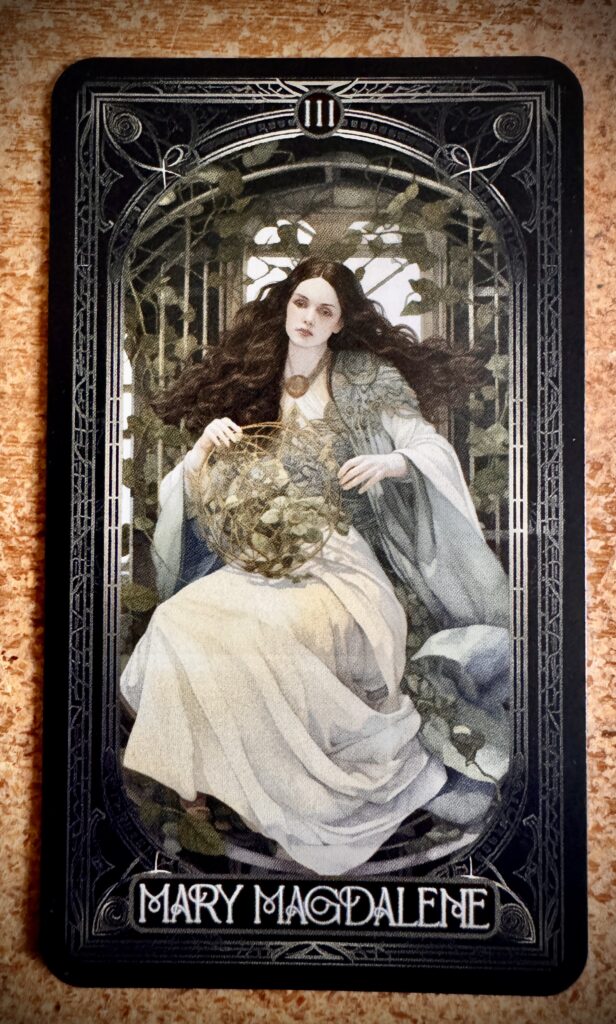
In Gnostic texts, Mary is far from the repentant sinner of biblical tradition or the penitent prostitute of Christian mythology. She appears as Jesus’s primary disciple, the leader of her own movement, and the force behind her own gospel. In the Dialogue of the Savior, Jesus declares that she is “the woman who knew the All,” meaning Mary sees behind all veils to grasp the secrets of the multiverse. Not theoretically. Not abstractly. She perceives the complete architecture of reality and moves through it with sovereign grace.
Some sages view Mary as the Divine Bride on earth, an avatar of Sophia herself, Holy Wisdom united with Holy Reason to bring restoration to a fallen universe. She doesn’t simply understand the mysteries. She embodies them. She is both student and teacher, both seeker and the one who has found, both the question and its living answer.
In the card, she sits in serene contemplation, cradling the world itself in her lap. Not grasping it. Not controlling it. Simply holding it with the kind of gentle authority that comes from recognizing your place in the cosmic order. Her dark hair flows like a river of night, grounding her in the material world even as her gaze suggests she sees far beyond it.
Today, she arrives as our fifth companion, following Helen’s priestess wisdom. Where Helen taught us to trust the knowing that lives within, Mary teaches us what happens when that inner wisdom becomes fully integrated, when knowing transforms into being, when understanding ripples out to touch everything around us.
The Advent Companion Appears
Mary Magdalene doesn’t arrive with fanfare or mystical display. She appears as presence itself, as the quality of someone who has stopped arguing with reality and started dancing with it. You feel her first as a settling, a sense of coming home to yourself in a way you hadn’t realized you’d been away.
She sits in the garden of her own becoming, surrounded by the verdant growth that naturally appears when someone tends their inner world with devotion. The globe she cradles isn’t a symbol of dominion but of relationship. She holds the world the way you might hold something infinitely precious and infinitely fragile, with both reverence and ease.
Mary knows something that took her years to embody: wisdom without love becomes arrogance, and love without wisdom becomes sentimentality. But wisdom and love united, Holy Sophia and the awakened heart working in concert, this is the force that can actually transform reality rather than simply understanding it.
The Gnostic texts tell us that the other disciples were jealous of Mary’s closeness to Jesus, her depth of understanding, and her ability to receive teachings they couldn’t grasp. But what they mistook for favoritism was actually resonance. Mary didn’t just learn the teachings. She became them. She integrated them so completely that the boundary between teacher and teaching, between knower and known, dissolved entirely.
This is the Empress energy in its Gnostic form: the fertile ground where wisdom takes root and grows into something that nourishes not just yourself but everyone around you. The capacity to hold complexity without collapsing under it. The ability to see the full scope of reality, its beauty and its horror, and still choose to engage with it lovingly.
As Mary appears beside you today, her question arrives not as a challenge but as an invitation:
“What would it mean to stop trying to understand your life and start living it as though you already know what you need to know?”
Teaching for the Day
There’s a particular trap on the spiritual path that ensnares the brightest seekers: the belief that understanding equals transformation. That if you just read one more text, attend one more teaching, integrate one more insight, you’ll finally arrive at the clarity you’ve been seeking.
Mary Magdalene teaches us something more subtle and more demanding: knowing means nothing until it becomes embodied. Understanding that doesn’t change how you move through the world is just spiritual entertainment. Wisdom that doesn’t alter your relationships, your choices, your daily patterns is merely information wearing a mystical costume.
The Gnostic tradition speaks of three kinds of humans: the hylic (material-bound), the psychic (soul-animated), and the pneumatic (spirit-awakened). But these aren’t fixed categories or spiritual castes. They’re modes of engagement. Mary embodied the pneumatic path not because she possessed special knowledge unavailable to others, but because she allowed what she knew to completely restructure how she lived.
This is what it means to “know the All.” Not to have memorized every esoteric teaching or unlocked every secret. To have integrated wisdom so thoroughly that you see the interconnected nature of everything, the way each moment contains all moments, the way each choice ripples outward through the fabric of reality.
The world in Mary’s lap isn’t something separate from her. It’s an extension of her care, her consciousness, and her capacity to hold life with both tenderness and strength. This is the Empress energy: creative power that births new realities not through force but through devoted presence.
The archons want you perpetually seeking, perpetually one step away from embodiment, caught in endless loops of learning without integrating, understanding without transforming. They’re perfectly happy to let you accumulate spiritual knowledge as long as that knowledge never actually changes who you are.
Mary disrupts this pattern by demonstrating what happens when someone stops collecting insights and starts living them. When wisdom moves from the head to the heart to the hands to the feet. When knowing becomes being becomes doing becomes the natural expression of who you’ve become.
This is the invitation today: to take what you know, what you’ve been learning on this journey, and let it sink deeper than intellectual understanding. To let it reshape your posture, your breath, and your way of moving through the world. To become the teaching instead of just comprehending it.
The difference is everything.
Journaling Invocation
“What do you already know that you haven’t fully integrated? What truth have you been circling around intellectually that you’re ready to embody completely?”
This question asks you to look at the gap between your understanding and your lived experience. We all have it. The places where we know something to be true but haven’t yet allowed that truth to reorganize how we actually live.
Maybe you know that your worth isn’t dependent on productivity, but you still drive yourself to exhaustion trying to prove your value. Maybe you know that fear is just an archontic whisper, but you still let it dictate major life choices. Maybe you know that you’re meant for something specific and significant, but you keep living as though you’re waiting for permission that will never come.
Mary doesn’t judge this gap. She simply asks you to acknowledge it. Because the first step toward embodiment is recognizing where you’ve been treating wisdom as information rather than as transformation.
Write without defending yourself or explaining why the gap exists. Just name it. What do you know that you’re not yet living? What understanding sits in your head that hasn’t made its way into your hands, your choices, your daily rhythms?
And then ask the deeper question: What would it look like to close that gap? Not all at once. Not through some heroic effort. But gradually, devotedly, the way a gardener tends soil until it becomes fertile ground for what wants to grow.
Mary knew the All because she stopped trying to possess the teachings and started letting the teachings possess her, transform her, and work through her as lived reality.
What’s ready to make that journey in you?
Small Embodied Practice
Sit somewhere comfortable where you won’t be disturbed. Place your hands in your lap, palms up, one hand cradling the other, forming a kind of bowl or vessel.
Close your eyes. Take several deep breaths, letting your body settle and your mind quiet.
Now imagine that you’re holding something infinitely precious in your cupped hands. Not grasping it. Not controlling it. Simply holding it with care. It might be an image, a sensation, a quality of light. It might be the world itself, your life, a relationship, a dream, or a knowing that you’ve been carrying.
Feel the weight of it, whatever it is. Feel how it rests in your hands, trusting you to hold it with both tenderness and strength.
As you breathe, notice: are you holding this thing with tension or with ease? Are you gripping it out of fear it might escape, or resting with it the way Mary rests with the world in her lap?
With each exhale, let any gripping soften. Let your hold become more spacious without becoming careless. Practice the Empress energy: the capacity to hold life itself with devoted, relaxed presence.
Stay here for several minutes. Let your body learn what it feels like to hold something precious without controlling it. To care for something without consuming it. To be responsible for something without being burdened by it.
This is Mary’s teaching embodied: wisdom becomes real when you can hold the full weight of life with grace.
When you’re ready, open your eyes. Notice how your body feels. Notice if something has shifted in your capacity to be with what is, rather than constantly trying to fix or change or understand it.
You just practiced the knowing that Mary embodies. Not intellectual knowing. Not striving knowing. The knowing that lives in your bones and breathes through your presence.
The caravan moves together. If today’s companion touched something in you, if Mary’s embodied wisdom helped you recognize where knowing needs to become being, let us know in the comments. Your integration lights the path for others walking beside you. 🌍
Tomorrow: Jesus arrives, not as savior but as revealer of what already lives within you.
There are truths that live beneath language, knowledge that moves through the body before it reaches the mind, wisdom that hides in plain sight precisely because it’s too essential to be spoken directly. This is the domain of the priestess, the keeper of mysteries who knows that the most profound teachings arrive not through explanation but through recognition. Through resonance. Through the sudden remembering of what you’ve always known but had forgotten you knew.
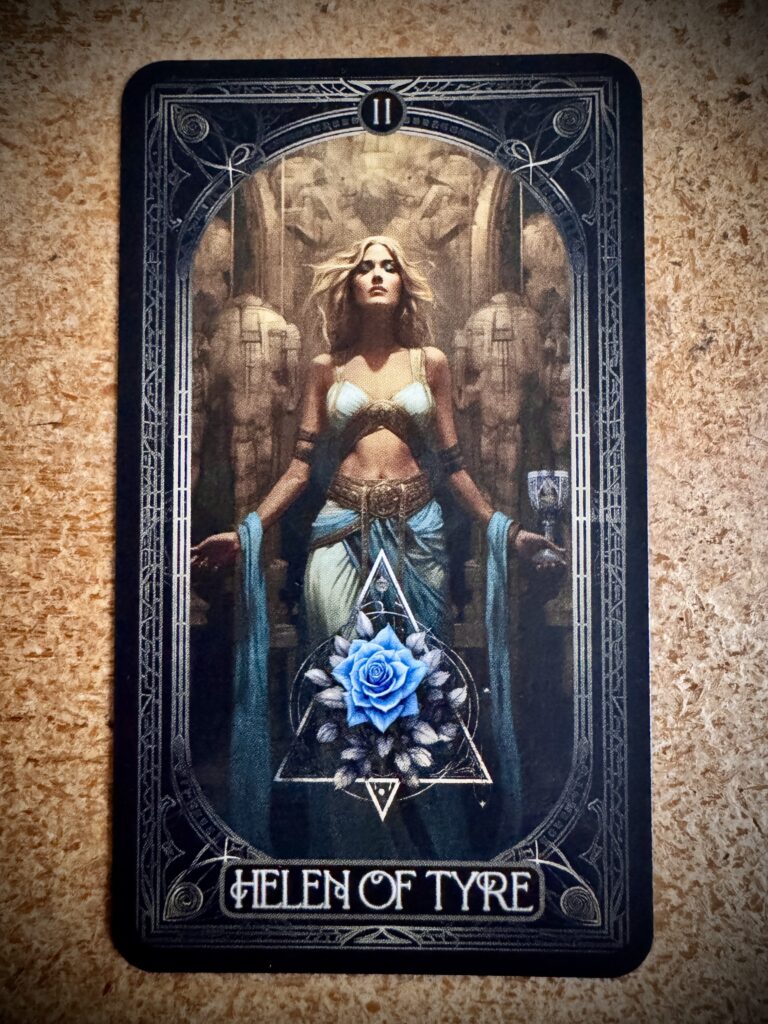
This is Helen of Tyre’s gift.
In Gnostic mythology, Helen’s story is one of the most haunting in the entire tradition. She was the stolen wisdom principle of the Divine, the “First Thought” of the Godhead itself, kidnapped by rebellious archons and hidden in the material world. They exploited her power to fuel their dominion over the cosmos, forcing her to reincarnate through time, even manifesting as Helen of Troy, all to keep her unseen by the Pleroma, unseen by those who would restore her to her rightful place.
Then Simon Magus found her in the city of Tyre, and they became a priesthood of two. Together, they advocated for the awakening of all humans to their hidden divinity. But Helen wasn’t simply rescued. She remembered. She reclaimed. She stepped into her own power as the Priestess of the Moon, one of the thirty adepts of John the Baptist, a teacher of mysteries in her own right.
True wisdom is never learned; it is only ever remembered.
In the card, she stands in the temple of her own sovereignty, draped in ceremonial power, the blue rose of impossible beauty blooming before her. She is both the mystery and the one who knows the mystery. Both the hidden wisdom and the revealer of what has been concealed.
Today, she arrives as our fourth companion, following the visionary clarity of Simon Magus. Where Simon taught us to see through illusions, Helen teaches us to trust what we know in ways that bypass the rational mind entirely. Because some truths can’t be proven. They can only be recognized. And recognition is always an act of remembering.
The Advent Companion Appears
Helen doesn’t announce herself with proclamations or teachings. She appears as a quality of knowing that rises from somewhere deeper than thought, older than language. You feel her first as a shift in the atmosphere, a sense that the air itself has become weighted with significance, pregnant with meaning you can’t quite articulate but absolutely recognize.
She stands in her temple, grounded and certain, draped in the vestments of her reclaimed authority. The blue rose before her blooms with an impossible luminosity, the kind of beauty that shouldn’t exist in this world but does anyway, defying the archons’ insistence that only the mechanistic and material are real.
Helen knows something the archons spent centuries trying to make her forget: she is the wisdom principle itself (Ennoia). Not a fragment of it. Not a reflection of it. The actual, living intelligence of the Divine, temporarily concealed but never truly diminished. They could hide her. They could exploit her power. They could force her through countless incarnations. But they could never erase what she fundamentally is.
And neither can anyone erase what you fundamentally are.
This is Helen’s teaching, wordless and complete. She doesn’t need to explain herself or prove her authority. She simply stands in the fullness of her reclaimed knowing, and in her presence, you begin to remember your own.
What have you forgotten about yourself? What wisdom have you been carrying all along, buried beneath the noise of other people’s certainties, beneath the archontic programming that insists you’re smaller than you are, less knowing than you are, less essential than you are?
Helen’s question arrives not as words but as sensation:
“What if you already know what you think you’re seeking? What if the wisdom you’ve been searching for has been living in you all along, waiting for you to stop looking elsewhere and finally recognize it as your own?”
Teaching for the Day
The priestess holds mysteries, yes. But the deepest mystery she holds is this: you are not separate from the wisdom you seek. The knowing you’re hungering for isn’t located in some distant teaching or hidden text or enlightened master. It’s woven into the fabric of your being, as fundamental to you as breath, as natural as the way water finds its level.
But the archons are clever. They didn’t steal your wisdom. They convinced you to doubt it. They trained you to defer to external authorities, to mistrust your own perceptions, to believe that truth lives somewhere outside you and must be earned through struggle or granted through initiation.
Helen’s story demolishes this lie. She was the First Thought itself, the Divine Feminine intelligence that births worlds into being. And even when she was hidden, exploited, forced into forms that concealed her nature, that essential wisdom never left her. It couldn’t. It was her.
The same is true for you.
You contain knowing that predates your conditioning. Intuitions that arrive unbidden and prove themselves accurate. Recognitions that bypass rational analysis entirely and land with the weight of truth.
The “gut feeling” you ignored? That was her.
The dream that felt more real than waking life? That was her.
The sudden certainty that defied logic? That was her.
The priestess path isn’t about acquiring knowledge. It’s about learning to trust what you already know. About developing the courage to honor your inner authority even when it contradicts the dominant narrative. About recognizing that wisdom speaks through your body, your dreams, your sudden knowings, your inexplicable certainties.
Helen’s mysteries weren’t taught in the traditional sense. They were revealed through tantric magic, ancient Egyptian lore, and direct experience of the sacred. She created spaces where people could remember rather than learn, recognize rather than study, awaken rather than strive.
This is what she offers you today: permission to trust yourself. To stop seeking validation for what you already know. To stand in your temple, whatever form that takes, and claim your priestess authority, your sovereign knowing, your unshakeable sense of what’s true even when you can’t explain how you know it.
The blue rose blooms because it chooses to bloom, regardless of what’s deemed possible. Your wisdom rises because it’s your nature, regardless of what you’ve been taught to doubt.
Journaling Invocation
“What do you know that you’ve been afraid to trust? What wisdom lives in you that you’ve been waiting for permission to claim?”
This question invites you into dangerous territory. Not dangerous because it will harm you, but dangerous because once you start acknowledging your own knowing, you can’t easily return to deferring to external authority. Once you recognize that you’ve been carrying wisdom all along, you become responsible for honoring it.
Maybe it’s something simple: you know a relationship isn’t serving you, but you’ve been waiting for someone else to validate that perception before acting on it. Maybe it’s deeper: you know your life is meant to move in a direction that doesn’t match anyone’s expectations, and you’ve been pretending that inner compass isn’t pointing where it’s clearly pointing.
Or maybe it’s something you can’t even put into words. A knowing that lives in your body, in your bones, in the way your energy shifts when you’re around certain people or in certain situations. A wisdom that speaks through sensation rather than thought.
Helen doesn’t ask you to justify or prove what you know. She asks you to acknowledge it. To give it space. To stop diminishing it because it doesn’t fit the acceptable templates for how knowledge is supposed to arrive.
Write without censoring. Let the knowing that’s been waiting surface, even if it feels presumptuous or impossible or too bold. The priestess doesn’t deal in polite uncertainties. She deals in recognition.
Bonus Question: What Are You Pretending Not To Know? The Priestess does not ask you to learn. She asks you to stop pretending you are ignorant. We often feign confusion because clarity is terrifying. If we admit we know a relationship is dead, a job is toxic, or a creative path is calling us, we are obligated to act. So, we pretend we are “confused.” We pretend we need more data.
Small Embodied Practice
Find a space where you can stand undisturbed. Close your eyes. Take a few deep breaths, letting your awareness settle into your body rather than staying caught in your head.
Now place one hand on your heart and one hand on your belly. Feel the warmth of your palms against your body. Feel your breath moving beneath your hands.
Ask yourself silently: “What do I know right now that I’ve been afraid to trust?”
Don’t search for an answer in your mind. Wait for sensation. Wait for knowing that arrives as feeling, as shift in your body, as subtle movement of energy. Maybe your chest tightens. Maybe your belly relaxes. Maybe you feel a sudden warmth or coolness somewhere. Maybe an image arrives, or a word, or just a sense of yes or no.
Stay with whatever emerges. Don’t analyze it. Don’t immediately try to translate it into language or figure out what it means. Just let yourself feel the knowing moving through your body.
This is Helen’s teaching embodied: wisdom speaks through you before it speaks to you. Your body knows things your mind hasn’t caught up to yet. Learning to trust that somatic knowing, that priestess intelligence, is how you begin to reclaim your authority.
After a few minutes, open your eyes. Take one more breath. Notice if something has shifted, even subtly, in how you hold yourself, how you feel in your own skin.
You just practiced listening to the priestess within. She’s been speaking all along. Today, you finally paid attention.
The caravan moves together. If today’s companion stirred something in you, if Helen’s presence helped you remember a wisdom you’d forgotten, let us know in the comments. Your recognition lights the path for others walking beside you. 🌹
Tomorrow: Mary Magdalene arrives, the woman who knew the All.
Every December the world dims in a way that invites a deeper kind of seeing. The long nights, the turning of the year, and the ancient pull toward reflection create a natural threshold for inner transformation. This is the heart of Advent in our Narrative Alchemy practice: not a season of passive waiting, but a conscious return to the inner light that has been gathering quietly within you all year. It is the perfect moment to step into the Gnostic journey of remembering, integrating, and rewriting your story.
Advent was once understood as a time of waiting for light, a slow attunement to the mystery approaching from beyond the horizon. But here, in our Narrative Alchemy practice, we approach it from another angle. We’re not waiting for something outside ourselves to arrive. We’re walking toward the light that has been quietly stirring within us all year.
This is where the narrative alchemy advent Gnostic Caravan begins.
As Narrative Alchemists, we read our lives as unfolding myth. We treat the year as a story-cycle. And at year’s end, we don’t simply close the book, we descend into the pages and meet the characters who shaped us from within. December becomes a corridor of thresholds. A pilgrimage inward.
The Gnostic Tarot offers the perfect companions for this time. Its Major Arcana aren’t abstract archetypes; they’re mythic figures who have rebelled, awakened, descended, and risen through the spheres. They know the terrain of shadow and revelation. They’ve walked through forgetfulness into remembering. They understand divine foolishness, psychic upheaval, and the trembling clarity that comes after the storm.
So across the next twenty-four days, we travel with them. One companion at a time. One lantern-lit step at a time.
I’m walking this path beside you. Not as someone who has mastered it, but as someone listening for the same inner tremors, watching the same horizon. Yet I’m also stepping into the Hermetic role of guide, holding up a lantern, pointing the way when the symbols begin to shimmer, helping you translate the mythic into the lived.
This season isn’t asking you to upgrade yourself. It’s asking you to remember what’s already true, and to gather the pieces you’ve scattered through the year and bring them home. This is not a race toward January. It’s more about meeting the coming year with a steadier center, a clearer pulse, and a coherence you can actually feel.
Advent, in this framing, becomes a narrative alchemical rite: a slow turning toward the flame that survives every winter.
By the time we reach the Solstice threshold, the caravan will have revealed twenty-four facets of your own unfolding story. Some will challenge you. Some will comfort you. Some will spark recognition you didn’t expect. All of them will escort you across the hinge of the year with more clarity, more courage, and more soul.
The journey begins tomorrow with Sabaoth—the awakened rebel, the one who leaps into the unknown.
The lantern is lit. The companions are gathering.
If the lantern speaks to you, tell me in the comments that you’re walking with us. Your presence shapes the journey as much as the companions do.
Day 1 — The Lantern at the Edge
(A Threshold Companion)
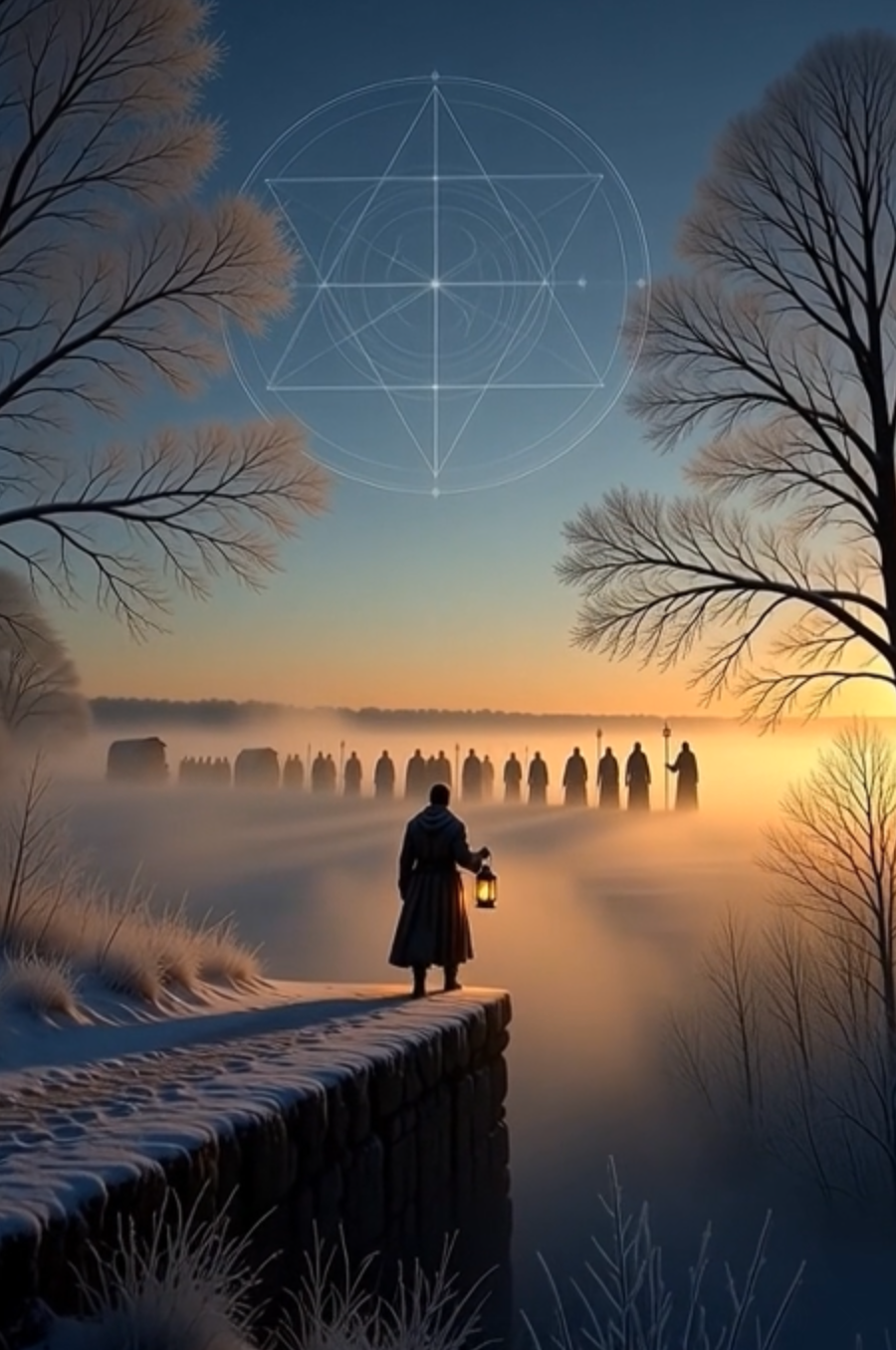
There’s a moment before any true journey when the world feels hushed, as if it’s leaning close to listen. You and I stand there now, in that charged quiet, where even the air feels aware of what’s about to begin. It’s the kind of silence that doesn’t ask for reverence but invites honesty. The year behind us glows faintly like a dying ember—still warm, still carrying its lessons, but already softening into memory. Ahead, the path stretches into shadow, not forbidding, simply waiting. And in that stillness, something in us leans forward. Not to chase anything. Not to prove anything. It’s more like the subtle tilt of the soul toward its own unfolding, a recognition that the next chapter is already stirring.
This is where the Hermetic current begins: in the threshold-lit place where nothing is fully illuminated and nothing is fully hidden. It’s the interval between breaths, the hinge between seasons, the moment when a person realizes they’re not just moving through time; time is moving through them. As we stand together in that half-light, I raise a lantern. It doesn’t flare with certainty or revelation. It offers a modest glow, the kind that reveals only the next step and nothing more. True wisdom rarely arrives in grand gestures. It arrives in increments, in pieces small enough to be lived, understood, practiced. The lantern teaches us to trust the pace of illumination.
And this lantern (this quiet, steady flame) it isn’t mine alone. It was carried by those who walked before us, and it will be carried by those who walk after. It belongs to anyone willing to approach their life as a story that’s still forming rather than a verdict already sealed. It belongs to those who choose curiosity over fear, presence over performance. Today, it becomes yours too. The journey ahead is not one to be traveled in isolation. It asks for a shared light, for companions who walk side by side, each holding their own flicker of clarity. Together, those small flames reveal more than any single blaze ever could.
The Advent Companion Appears
The Lantern at the Edge arrives quietly, the way authentic guidance often does—not with spectacle, but with presence. It doesn’t step forward as a figure or spirit. It doesn’t speak in riddles or command attention. Instead, it glows. It invites. It is guidance shaped as a gentle form: light held just above the darkness, enough to stir recognition rather than demand belief.
The lantern hovers at the boundary where your inherited stories thin and the deeper myths of your life begin to breathe. That perimeter is subtle. Most people rush past it without knowing they’ve crossed anything. But when you pause, as we are pausing now, the boundary reveals itself as a living edge—a seam where the self you’ve been meets the self you’re becoming.
This is the moment when the Gnostic Caravan begins to assemble. From far off, you may sense the faint rustle of companions preparing to enter your awareness—Sabaoth waking from his programming, Simon Magus stirring his brilliance, Helen gathering her hidden wisdom, Mary Magdalene stepping forward with her unbound knowing. Twenty-two mythic figures, each carrying a facet of the journey, waiting to walk beside us one by one.
But none of them approach until the Lantern at the Edge has done its work. Its message is simple, and yet it cuts clean to the heart:
“Begin with awareness. Begin with the smallest truth you can bear to hold.”
Not the grand truth. Not the final truth. Not the truth you think you should be able to handle. The one you can hold today, without collapsing under it. The lantern honors the pace of your unfolding.
It doesn’t reveal the whole path, because the whole path would be too much all at once. It reveals only the portion you are willing to see, the piece of the story you are ready to inhabit. That humility is its genius. That restraint is its compassion.
And as its circle of light meets your feet, you feel something shift. A faint sense of orientation. A sense that the journey has already begun, not through effort or resolve, but through willingness. The lantern appears when the soul says, even quietly, “I’m ready to see what’s next.”
From here, the path opens—just a little—and the first companion waits at the horizon.
Teaching for the Day
Transformation rarely begins with fireworks. It begins with a quiet decision: the willingness to look at your life without turning away. Not with judgment. Not with urgency. Simply with presence. Most of us are conditioned to chase breakthroughs, dramatic turning points, sudden clarity. But the lantern reminds us that true illumination doesn’t arrive as revelation; it arrives as recognition. It asks only that you witness what is already here, already stirring at the edge of your awareness.
The lantern insists on this truth: you don’t need to see the whole path to begin. In fact, trying to see the whole path is often a way of avoiding the first step. Big visions can become shields. Grand intentions can become hiding places. The lantern offers a kinder rhythm. It reveals what you are capable of holding today, no more, no less. It trusts your readiness even when you doubt it.
This is the essence of Hermetic practice: illumination is incremental. Wisdom arrives in workable fragments. You receive a thread, you pull gently, and the thread reveals another thread. The story unfolds because you’re willing to follow the smallest glimmer of truth without demanding the entire map.
Awareness is the first alchemy. Not insight. Not action. Awareness.
Clarity isn’t a lightning strike. It’s a daily ember. A steady returning to yourself. A soft recalibration toward what is real.
Small clarity, repeated daily, becomes transmutation. Not the glamorous kind people paint in symbols and gold leaf, but the intimate kind that reshapes your inner architecture. This is how real change moves: by subtle degrees, by tiny yet honest shifts, by choosing to keep the lantern lit even on days when the path feels narrow or your spirit feels tired.
And so today is not about understanding everything. It’s about noticing one thing. One pattern. One truth. One place where the light touches your life and invites you to look a little closer.
That is enough to begin the journey..
Journaling Invocation
“What truth about your life feels ready to be illuminated today, even if only by a faint glow?“
This question isn’t meant to be interrogative. It’s an opening gesture, a turning of the inner doorknob. You’re not hunting for an insight to pin down or a revelation to perform. You’re simply inviting whatever small truth has been waiting patiently at the edge of your awareness to step forward.
Some truths arrive boldly. Others slip in sideways, shy and half-formed. Some come as a feeling in the body before they ever find words. Some are nothing more than a quiet tug of intuition that says, “Here. Look here.” All of them count.
The point is not to find the “right” truth. The point is to notice what is already stirring.
Let the question work on you rather than rushing to answer it. Hold it the way you would hold a cup warming your hands on a cold morning. Let its heat seep slowly inward. The truth that is ready will rise on its own, like breath on a still winter dawn.
You don’t need to coax it. You don’t need to force it. You just need to make a little space, a little silence, a little willingness.
Allow the question to open a door instead of demanding that anything walk through it. If all you discover is a faint glimmer, that is enough. If all you sense is a direction rather than a destination, that too is enough.
This practice is not about volume. It’s about attunement. Whatever truth comes—even fragile, even partial—is sufficient to guide the next step.
Small Embodied Practice
Before bed or at dawn, step into a space where the light is minimal: a hallway, a quiet room, even the edge of your bedroom where shadows still hold their shape. Let yourself settle there for a moment before doing anything. Feel the weight of your body, the way your breath naturally slows when the world softens around you.
Then turn on a single, low light. A lamp on its dimmest setting. A candle if that feels natural. Even the glow of a small bulb is enough. Don’t brighten the room. Keep it barely lit, as if you’re honouring the boundary between night and day, seen and unseen.
Let your eyes adjust slowly. Resist the impulse to look for something specific. Just observe how shapes reveal themselves in their own time – edges of furniture, folds of fabric, small textures that emerge one stroke at a time. Notice how the world doesn’t rush to meet you. It offers itself gradually, in patient increments.
Breathe with this unfolding. Inhale as a contour sharpens. Exhale as a new detail emerges. Feel how your body responds to gradual clarity, no tension or urgency, just arrival.
This is the Lantern at the Edge teaching through your senses. Clarity that comes slowly is clarity that can be lived. You are learning to trust the pace of illumination, to honour the rhythm of recognition rather than the impulse for revelation.
When you’re ready, close your eyes for a breath or two. Notice how even in darkness, the echo of light remains behind your eyelids. The body remembers. Awareness lingers. That small glow is enough to carry into your day or into your sleep.
You don’t need brilliance. You need willingness. And tonight (or this morning) you’ve practiced exactly that.
If this advent journey into your deep story resonates, tell me in the comments that you’re walking with us. Your presence doesn’t just join the Gnostic Caravan. It shapes the path we take together.
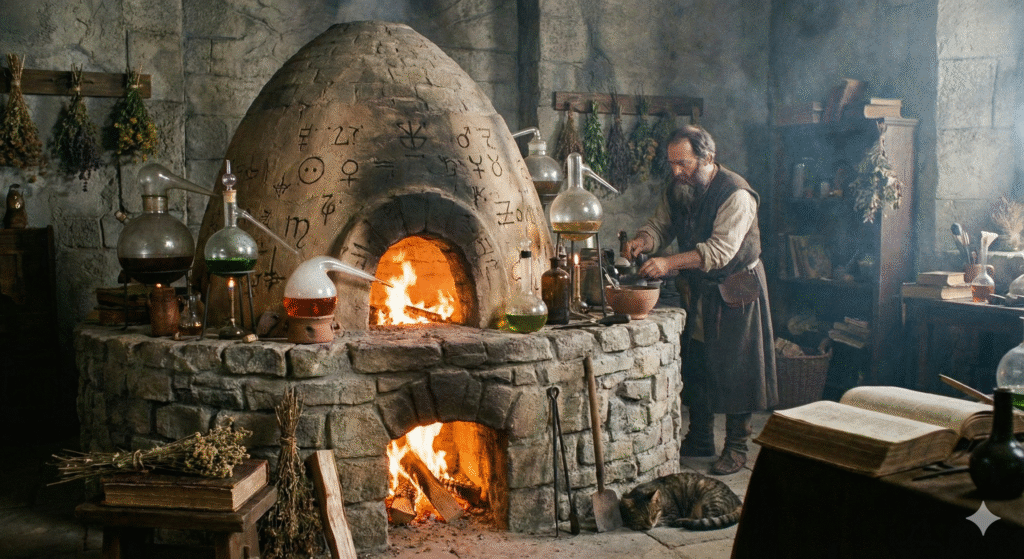
The medieval alchemist’s laboratory notebook wasn’t just a record of experiments. It was where the Great Work actually happened. Every observation, every failed attempt, every successful transmutation got inscribed onto parchment because the act of recording was inseparable from the process itself. The notebook was the laboratory.
Your journal functions the same way. It’s not documentation of your transformation. It’s not a diary where you record what happened to you. It’s the actual site where consciousness transmutes. The page becomes your athanor, the alchemical vessel where raw experience gets heated, pressurized, and refined into wisdom. This is why journaling isn’t just helpful for inner work. It’s essential. It’s the foundation upon which all other practices rest.
By the end of this post, you’ll understand why serious transformation work is nearly impossible without a journaling practice, and you’ll learn the three-stage alchemical approach that turns writing from passive recording into active magic.
The Journal as Alchemical Laboratory
Understanding the Athanor
In alchemical tradition, the athanor is the furnace, the sealed vessel where base materials undergo transformation. It’s not just a container. It’s a carefully controlled environment where heat, pressure, and time work together to change the fundamental nature of what’s placed inside. Lead doesn’t become gold through wishful thinking. It requires the precise conditions the athanor provides.
Your journal page is your athanor. When you write, you’re not simply transcribing thoughts that already exist fully formed in your mind. You’re creating a contained space where the messy, formless experience of being human can undergo genuine transformation. The blank page provides constraint. The act of writing applies heat. The linear nature of text creates pressure. These aren’t metaphors. They’re the actual conditions under which consciousness changes.
Think about what happens when you try to explain something complex to another person. The act of articulation forces clarity. You discover what you actually think by trying to put it into words. Writing does this but with even more power because the page doesn’t interrupt, doesn’t judge, doesn’t mishear. It simply receives and reflects.
Prima Materia: Your Raw Experience
The alchemists called their starting material prima materia, the first matter. It was crude, undifferentiated, chaotic. Your raw experience is the same. The anger you feel but can’t quite name. The confusion about a relationship. The vague sense that something needs to change. The repetitive thought patterns that run in circles. The emotional residue from yesterday or last year.
This is what you bring to the page. Not polished insights. Not carefully crafted narratives. Not the story you tell at dinner parties. You bring the actual mess of being conscious, the unprocessed flow of thoughts and feelings that constitutes your inner life.
Most people never examine this material directly. They live inside it, react from it, make decisions based on it, but they never put it outside themselves where they can actually see it. This is like trying to perform chemistry while the substances are still inside their original containers, mixed together, unlabeled. You can’t work with what you can’t see.
Writing externalizes the internal. It takes what’s formless and gives it form. It takes what’s invisible and makes it visible. This alone is transformative, but it’s just the beginning.
The Three Stages of Alchemical Journaling
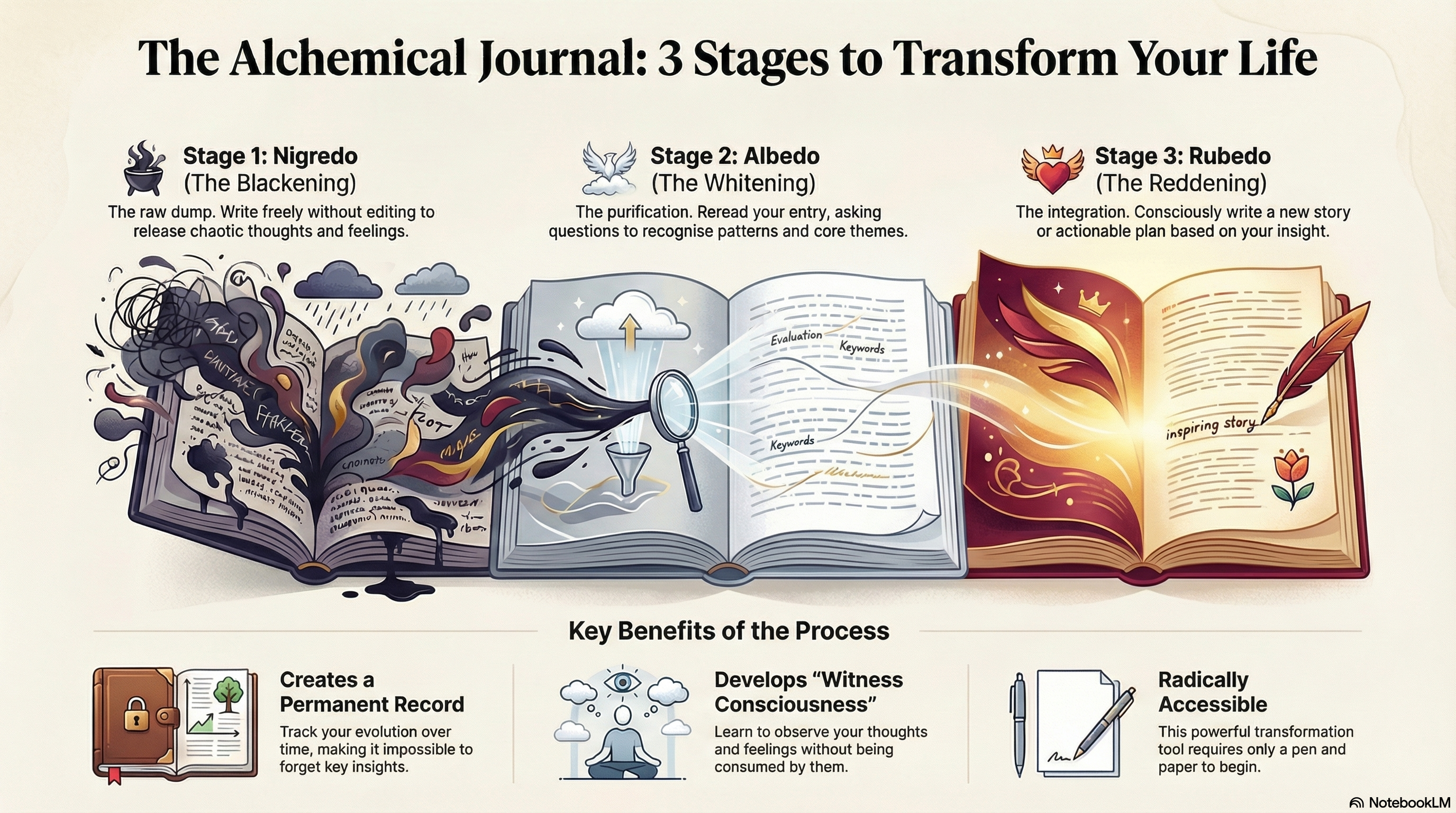
The alchemical tradition describes transformation as a three-stage process: nigredo, albedo, and rubedo. Blackening, whitening, and reddening. Most people who journal never move past the first stage. They experience some of the benefits, but they miss the real magic that happens in stages two and three.
Nigredo (The Blackening Phase): Dumping the Chaos
Nigredo is decomposition, the breaking down of existing structures. In your journal, this is the raw dump. You write whatever comes. You don’t edit, don’t make it coherent, don’t worry about grammar or sense or whether future-you will understand. You let the darkness onto the page.
This might look like: “I’m so angry at him and I don’t even know why, it’s not rational, I know I’m being unfair, but I can’t stop feeling this way, and then I feel guilty about feeling angry which makes me more angry, and underneath that is something else, fear maybe? Or just exhaustion? I don’t know, I’m so tired of having the same argument, why does this keep happening…”
No punctuation, no structure, just the stream. This is emotional and cognitive compost. It needs to decompose before anything new can grow.
The benefits of nigredo are real. You get emotional release. You externalize what was eating at you from the inside. You create some distance between you and your experience. Many people stop here and think this is journaling. They feel better after venting, so they assume they’re done.
But nigredo alone doesn’t create transformation. It creates space for transformation. If you stop at the blackening phase, you’re just repeatedly dumping your psychological waste without processing it. You’ll feel temporary relief, but the same patterns will keep recurring because you haven’t actually changed the underlying structure.
Albedo (The Whitening Phase): Recognizing Patterns
Albedo is purification, the separation of essential from non-essential. In your journal practice, this is when you read back what you wrote and start asking questions.
You become your own analyst. You look at the text on the page not as the person who wrote it but as an observer. You ask: What patterns do I see here? What words do I keep using? What assumptions am I making? What’s the story underneath the story?
Using the example from nigredo, you might notice in albedo that every time you write about this relationship, the word “exhausted” appears. You might notice that your anger always contains guilt. You might see that you’re running a story about being unfair or irrational, which prevents you from taking your own feelings seriously.
This is where signal separates from noise. You start to see the themes that run through your life. The archetypal patterns. The repeated narratives. The places where you’re stuck in a loop.
The questions you ask in albedo are crucial:
What’s the core feeling under the surface emotions?
What story am I telling myself about this situation?
Where else in my life does this pattern show up?
What would I need to believe for this to make sense?
What am I protecting or avoiding by staying in this pattern?
You write these questions in your journal. You answer them. Sometimes the answers surprise you. Often they reveal something you already knew but hadn’t admitted to yourself.
Albedo develops witness consciousness, the capacity to observe your own mind without being completely identified with it. This is arguably the most important skill in transformation work. When you can watch yourself thinking, you’re no longer entirely trapped by your thoughts.
Rubedo (The Reddening Phase): Integration and Action
Rubedo is the final stage, the creation of something new and stable. The gold. In your journal, this is when you consciously write the new story.
You take what you learned in albedo and you craft something you can actually use. You move from insight to practice. You ask: Given what I now understand, what do I choose to do differently? What new narrative can I construct that serves me better than the old one?
This isn’t positive thinking or affirmations. It’s not denying the difficult reality you uncovered in nigredo or the patterns you recognized in albedo. It’s consciously choosing how you’ll relate to that reality going forward.
Continuing with our example, rubedo might look like: “I see now that my exhaustion comes from trying to manage his emotions while suppressing my own. The new story is that my feelings are data, not character flaws. I choose to treat my anger as information about my boundaries rather than evidence that I’m a bad person. Next time this situation arises, I’ll name what I’m feeling without apologizing for it. I’ll say ‘I notice I’m feeling angry’ instead of ‘I’m sorry, I know this is stupid but…’ This is the practice.”
This is wisdom. This is actionable understanding. This is the philosopher’s stone, the catalyst that transforms everything it touches.
Rubedo creates new narratives that actually function better than the old ones. It gives you scripts you can run in real situations. It closes the loop between understanding and behavior change.
Why Journaling Outperforms Other Transformation Tools
The Power of the Written Record
Unlike meditation, therapy, or conversation with friends, journaling creates a permanent record. You can return to what you wrote last week, last month, last year. You can track patterns across time in a way that’s impossible when everything stays in your head or disappears into spoken words.
This matters enormously. Memory is unreliable and self-serving. We forget the insights we had. We minimize past pain. We rewrite our own history to maintain consistency. The journal doesn’t let you do this. It holds you accountable to what you actually thought and felt.
When you read entries from six months ago, you see how far you’ve come. You see which patterns have genuinely shifted and which ones are still running. You can’t gaslight yourself when the evidence is right there in black and white.
The written record also reveals long-term patterns that are invisible in the moment. You might not notice that every January you go through a period of existential questioning. But your journal shows you. You might not realize how often a particular person’s name appears in your anxious thoughts. But the pattern becomes obvious when you review your entries.
This longitudinal data about your own consciousness is invaluable. It’s research. It’s evidence. It’s proof that transformation is actually happening or clear indication of where you’re stuck.
Develops Witness Consciousness
There’s a profound difference between being angry and writing “I feel angry.” The moment you write it, you’ve created a gap between yourself and the emotion. You’re no longer completely identified with the anger. You’re the one observing and naming the anger.
This is witness consciousness, the capacity to watch your own mental and emotional states without being entirely consumed by them. It’s the foundation of all serious inner work. You can’t change what you can’t observe. You can’t observe what you’re completely identified with.
Journaling trains this capacity better than almost any other practice. Every time you write about your experience, you’re practicing the observer position. You’re strengthening the part of you that can watch the rest of you without judgment, with curiosity, with compassion.
This isn’t dissociation. You’re not disconnecting from your feelings. You’re developing the flexibility to be in them when that’s appropriate and to step back and examine them when that’s more useful. This flexibility is freedom.
Democratizes the Great Work
The real magic of journaling is its radical accessibility. You don’t need a teacher. You don’t need special training. You don’t need expensive equipment or years of study. You need something to write with and something to write on. That’s it.
This democratizes transformation work in a way that few other practices do. Meditation requires learning technique. Therapy requires money and access. Many spiritual practices require initiation or community. Journaling requires only honesty and a blank page.
This doesn’t make it easy. Honesty is hard. Facing what’s actually happening in your inner life is hard. But the barrier to entry is low, and the potential payoff is enormous.
Anyone can start right now. That’s powerful.
Journaling vs. Other Practices
Journaling isn’t the only transformation tool, and it works best in combination with other practices. But it has unique advantages.
Meditation develops present-moment awareness and the capacity to not react to every thought. But it doesn’t help you understand the content and patterns of your thoughts. Journaling does.
Therapy provides expert guidance and a relational container for healing. But it’s limited to the hour you’re in session. Journaling is available anytime, as often as you need it.
Tarot and other divination practices offer archetypal frameworks for understanding your situation. But they don’t capture the granular, specific details of your actual inner experience. Journaling does.
The unique benefit of journaling is that it combines active transmutation with tangible record. You’re not just having insights that evaporate. You’re creating a document of your own consciousness evolving. You can literally watch yourself change across the pages.
Getting Started with Alchemical Journaling
What You Need
Minimally: a notebook or digital document and a writing implement. That’s actually all you need.
Some people prefer physical notebooks because the act of handwriting engages the brain differently than typing. Others prefer digital for searchability and ease of review. Either works. Choose what you’ll actually use.
Optional enhancements: a dedicated space, a specific time, a ritual that signals to your mind that you’re entering the laboratory. But don’t let the lack of perfect conditions stop you from starting.
Your First Alchemical Writing Session
Set aside 20-30 minutes where you won’t be interrupted.
Begin with Nigredo (10 minutes): Write whatever is present for you right now. Don’t think about it, don’t plan it, just start writing and let it flow. Write about what’s bothering you, what you’re excited about, what you’re confused about, whatever wants to come out. Don’t edit. Don’t judge. Just dump it onto the page.
Move to Albedo (10 minutes): Read what you just wrote. As you read, ask yourself: What patterns do I notice? What words keep appearing? What’s the underlying feeling or belief? Write your observations. Write your questions. Write your answers to those questions.
Finish with Rubedo (5-10 minutes): Based on what you discovered in albedo, write what you want to remember or practice. What’s the insight you want to carry forward? What’s the new story or approach you want to try? Make it specific and actionable.
That’s the complete cycle. You’ve just performed the Great Work.
Building a Sustainable Practice
For journaling to become transformative rather than just occasionally helpful, it needs to be consistent. Daily is ideal. Three times a week is good. Once a week is better than nothing, but you’ll miss some of the pattern recognition that comes from frequent practice.
Many people find morning works best because your defenses are down and you haven’t yet constructed the day’s persona. Others prefer evening as a way to process the day. Experiment and find what actually works for your life.
The key is to make it so easy that you’ll actually do it. Better to journal for 10 minutes every day than to plan an elaborate hour-long practice you never get around to.
Resistance is normal. Your psyche doesn’t always want to be examined. When you feel resistance, write about the resistance. That’s valid nigredo material.
Common Journaling Mistakes to Avoid
Stopping at nigredo: Venting feels good, but it doesn’t create change by itself. Always move through all three stages, even if you spend different amounts of time in each.
Performing for an imagined audience: Write as if no one will ever read this. The moment you start crafting your words for how they’ll sound to someone else, you lose the raw honesty that makes journaling powerful. This is your laboratory, not your public relations department.
Skipping the review phase: Albedo requires that you read back what you wrote. Many people write and then immediately close the journal. They get the emotional release of nigredo but miss the insight of albedo. Build in time to read and reflect.
Inconsistent practice: Journaling once when you’re in crisis and then not again for months means you never build the longitudinal understanding of your patterns. The magic is in the accumulation. Make it regular.
Using it as a weapon against yourself: The journal is for honest observation, not harsh self-judgment. If you find yourself writing cruel things about yourself, notice that pattern in albedo and work with it in rubedo. The journal should make you freer, not more trapped in negative self-talk.
The Great Work Begins With a Blank Page
The medieval alchemists spent lifetimes in their laboratories, pursuing the transformation of lead into gold. They understood something we often forget: real change requires work. It requires a container, a process, and consistent practice. It requires you to actually engage with the raw materials of your life rather than just thinking about them.
Your journal is that laboratory. The page is your athanor. The three stages of nigredo, albedo, and rubedo are your process. The raw material is your own consciousness, and the gold you’re creating is a life lived with more awareness, more freedom, more alignment with who you actually are.
This is why journaling isn’t optional for serious transformation work. It’s not a nice addition to your practice. It’s the foundation. It’s where you learn to observe your own mind, recognize your patterns, and consciously rewrite the narratives that run your life.
The Great Work doesn’t require special gifts or mystical experiences. It requires honesty, consistency, and the willingness to look at what’s actually happening beneath the surface of your daily life.
It requires a blank page and the courage to fill it.
Start today. Open your notebook or create a new document. Write whatever is present for you right now. Don’t make it perfect. Just begin. The transformation happens in the doing, not in the planning.
The triangle of transformation is a a teaching on Intent, Will, and Self-Knowledge.
There is a moment in every seeker’s life when change stops being an idea and becomes a practice. Not grand. Not dramatic. Just quietly intentional. This teaching offers a simple, reliable framework you can use anytime you want to reshape your inner world and redirect the flow of your life. It begins with a hand-drawn triangle from my notebook and ends with a method you can carry in your pocket.
The triangle has three forces: Status Quo, Will, and Magic. At the center sits the Eye, the witness that holds everything together. When these elements move in harmony, transformation becomes natural rather than forced. This is ancient Hermetic wisdom reframed for modern life. As above, so below. As within, so without.
Let’s walk through it.
1. Recognition: The Status Quo
Every journey starts with a clear look at where you are.A moment of seeing, free from judgement or self-diagnosis.
The Status Quo is the ground beneath your feet. It’s the patterns that shape your days, the beliefs you carry quietly, and the invisible habits that steer your choices. It’s the story you’ve been living, often without realizing you’re the one telling it. Most people never examine this terrain. They simply keep moving, following grooves worn deep by repetition and assumption.
Transformation asks for a pause. A breath. A snapshot of your present reality.
This is not about cataloging failures or dwelling on what’s wrong. It’s about accuracy. About seeing the shape of your current narrative clearly enough to work with it. You can’t rewrite a story you refuse to read. You can’t transform a pattern you pretend doesn’t exist.
When you name the Status Quo honestly, you begin the work of self-authorship. You step out of autopilot and into conscious life. You claim the power to observe your own experience without being consumed by it.
The Status Quo is neither enemy nor prison. It’s simply the starting coordinate on your map.
Reflection Prompt: What is true for me right now, emotionally, mentally, and energetically? What patterns am I living inside without examining?
Try This: Write a short snapshot in your journal describing your current state without explaining or justifying anything. Be ruthlessly honest. No one needs to see this but you.
2. Alignment: The Power of Will
Will, in this framework, is not effort or strain. It is direction. It is the deeper intelligence inside you that already knows the shape of your becoming.
Think of Will as a compass pointing toward the version of you waiting on the other side of your resistance. You don’t invent Will. You uncover it. You listen for it beneath the noise of obligation, expectation, and fear.
Will is not about forcing yourself into a predetermined mold. It’s not about becoming what you think you should be. It’s about recognizing what you already are in potential and moving toward that truth with increasing clarity.
When you align with Will, your life begins to move in a cleaner line. Distractions fall away. Decisions simplify. You stop chasing ten thousand contradictory desires and settle into the one trajectory that feels true. Energy that was scattered across competing agendas suddenly flows in a single direction.
This is the moment your inner world begins to tilt toward transformation. This is where you stop asking “What do I want?” and start asking “What am I becoming?”
The difference is profound.
Reflection Prompt: What direction is my becoming pointing toward? If I stripped away every external voice, what truth would remain?
Try This: Write one sentence describing the trajectory your future self is already oriented toward. Not a goal. Not a wish. A recognition of the pull you already feel.
3. Declaration: Crafting a Statement of Intent
The Statement of Intent lives at the base of the triangle. It is the bridge between the world you stand in and the future you’re stepping into. This is where Will becomes language. And language becomes a spell.
A good Statement of Intent is simple. Present tense. Clean. Uncluttered by emotion or explanation. It names the identity you’re stepping into rather than the outcome you hope to receive. It speaks from the place you’re moving toward, not from the place you’re leaving behind.
Instead of “I want to be calmer,” you might say, I move through my days with grounded presence and clear breath.
Instead of “I want to write more,” try, I live as a writer every day.
Notice the difference. The first versions are pleas. They come from lack. The revised versions are declarations. They come from power.
The Statement of Intent is not a visualization exercise or a wish sent into the void. It is a claim. A vow. A line drawn in the psychic sand that says, “This is who I am becoming, and I am already stepping across the threshold.”
This is the hinge of the whole working. Everything else revolves around this moment of declaration.
Reflection Prompt: If my Will were already embodied, what would I be doing or being right now? How would I move? How would I speak? How would I choose?
Try This: Write a one-sentence Statement of Intent that reads like a vow. Make it clean. Make it true. Make it impossible to misinterpret.
4. Transmutation: Entering the Magical State
Magic, in this teaching, refers to shifted awareness. It is the state where identity loosens and becomes pliable. You don’t have to perform a ritual. You don’t need candles or symbols (though you can use them if they help). What matters is entering a state where your Intent feels alive inside you.
This is the moment you step outside the ordinary frame of reference. The place where the self you’ve been living as softens just enough to allow a new pattern to take root. The magical state is not exotic or mystical in the way popular culture portrays it. It’s simply the condition where consciousness becomes receptive to change.
This can be a walk. A breath cycle. A quiet moment of meditation. A sigil activation. A hand over your heart. A gaze into the sky. A dance. A run. A moment of stillness so complete it feels like falling.
The method doesn’t matter. The shift does.
You’re looking for the moment when the noise of your default narrative quiets. When the clutch of habitual thought loosens. When you feel spacious enough to hold your Statement of Intent not as a concept but as a living presence.
This is the moment you create the condition for transformation to take root. This is where the spell begins to work.
Reflection Prompt: What reliably shifts me into a deeper state of awareness? What practices or experiences dissolve my usual boundaries?
Try This: Choose one method and hold your Statement of Intent gently in your awareness while entering that altered state. Don’t force it. Don’t perform. Just be present with it.
5. Integration: The Eye at the Center
After you make the shift, you do not push or strain. You observe. You let the work breathe.
The Eye symbolizes awareness. Witnessing. The calm center that notices without interfering. This is where synchronicities begin to flicker. Small choices shift. Feelings rearrange themselves. You experience tiny alignments that signal the work is moving.
Integration is the art of allowing. Of trusting the process more than the outcome. Of recognizing that transformation does not happen in a single blinding flash but in a thousand small adjustments that compound over time.
You are watching for evidence. Not proof. Not results. Just the subtle signs that your inner world is reorganizing itself around your Intent. A phrase that appears three times in one day. A conversation that opens exactly the door you needed. A decision that suddenly feels obvious when it was murky before.
The Eye does not analyze. It does not second-guess. It simply sees. And in that seeing, it allows the work to deepen.
This is where most people abandon the practice. They enter the magical state, make their declaration, and then immediately start interrogating reality for proof that it worked. That interrogation disrupts the process. It pulls you back into the old frame.
Stay in the Eye. Let the shifts come to you.
Reflection Prompt: What small shifts do I notice in myself or in the world around me? What feels different, even if I can’t name why?
Try This: Write one observation that reflects the new pattern beginning to move. Keep it simple. Keep it honest.
6. The Hermetic Insight
Every stage of the triangle echoes the Hermetic maxim:
When your inner world changes, your outer world responds. When the outer world changes, something in you has already stirred. The triangle simply operationalizes this truth. It gives you a way to work with the natural laws of transformation rather than against them.
Your consciousness is not separate from the world you experience. The story you tell yourself shapes the reality you perceive. The identity you inhabit determines the choices you make. The choices you make construct the life you live.
The Triangle of Transformation recognizes this feedback loop and turns it into a tool. You begin by naming the current story (Status Quo). You identify the direction of your deeper self (Will). You declare the new identity (Intent). You enter the state where change can occur (Magic). And you witness the shifts as they ripple outward (The Eye).
This is how inner alchemy becomes outer transformation. This is how you move from being shaped by your stories to consciously shaping them.
7. Using the Triangle in Daily Life
You can use this framework in multiple ways:
As a morning ritual to set your direction before the day scatters your attention.
As a journaling practice before decision-making, helping you align your choices with your deeper Will.
As a personal alchemy method during life transitions, when the old story no longer fits and you need to craft a new one.
As a creative tool to align your projects with your deeper Will, ensuring that what you make reflects who you’re becoming.
As a companion to your Wisdom Walks or contemplative coffee rituals, anchoring those practices in intentional transformation.
It becomes a quiet companion, a compass you can return to again and again. Not something you use once and file away, but a living practice that evolves with you.
The Triangle is fractal. You can apply it to a single decision or to the arc of your entire life. You can work it in ten minutes or over ten months. The structure remains the same. The depth adjusts to your need.
8. Why This Works
The Triangle works because it addresses all three levels of human transformation at once.
Cognitive: You name the pattern. You make it conscious. You give it language.
Emotional: You feel into your Will. You connect with the deeper current beneath your surface desires.
Somatic/Energetic: You enter the magical state. You create the felt shift that allows new identity to take root.
Most transformation practices focus on only one of these levels. Therapy focuses on cognition. Meditation focuses on awareness. Visualization focuses on emotion. The Triangle weaves them together into a single coherent practice.
And then it adds the Eye. The witness. The part of you that remains steady while everything else shifts. This is what keeps the practice grounded. This is what prevents spiritual bypass or fantasy thinking.
You’re not pretending the change has already happened. You’re creating the conditions for it to happen and then observing the evidence as it emerges.
This is magic as technology. This is narrative work as transformation practice.
Try It Now
If you want to begin today, take out your notebook and move through the cycle:
Name your Status Quo. Be honest. Be specific. What story are you living right now?
Feel into your Will. What direction is your becoming already oriented toward?
Write your Statement of Intent. Make it present tense. Make it clean. Make it true.
Enter a magical state, however subtle. A breath. A walk. A moment of stillness.
Observe what shifts. Watch for the small signs. Trust the process more than the outcome.
That is the whole path, held inside a single triangle.
Scripts handed down from family. Cultural narratives about success and failure. Inner voices that narrate every stumble as proof of some fundamental flaw.
What if you could rewrite those stories?
Not through positive thinking or wishful affirmation, but through deliberate narrative craft. By treating your life as a working document instead of a fixed text.
That’s what I explore in my new short story, The Narrative Alchemist.
It follows Daniel and Emily as they encounter Mara, a teacher who demonstrates something unsettling: the pain we feel isn’t just from what happens to us, but from the stories we tell about what happens. Change the story, and you change the life that unfolds from it.
This isn’t fantasy fiction. It’s a dramatized exploration of real principles I work with in my own practice. Story as substance. Identity as draft. Imagination as operational tool. The way symbolic literacy and mythic patterns shape our daily choices.
The story includes practical frameworks:
How to rewrite origin stories without denying what actually happened
Techniques for editing the inner narrator that delivers harsh commentary
Methods for living chosen narratives through daily ritual
The difference between reframing and spiritual bypassing
Think of it as narrative alchemy in narrative form. A demonstration of the principles through story, not just explanation.
Download The Narrative Alchemist Short Story Now (It’s Free)
If you’ve ever felt trapped by an old shame, a limiting belief, or a constant inner critic, this story is your introduction to the craft of taking back the pen. Download “The Narrative Alchemist” for free today and learn how to make your story the life that unfolds.
Where the existential chaos magician sees through the illusion to recognize all rules as arbitrary constructs, the narrative alchemist recognizes something more fundamental: stories are living matter. They’re not just false or true, limiting or liberating. They’re raw material, saturated with potential energy, capable of transformation.
Table of Contents
Seeing the Story Behind the World
There comes a moment when the world cracks open in a quiet but unmistakable way. It isn’t a grand revelation or a flash of cosmic insight. It’s a subtle shift where you begin to notice something strange beneath the surface of ordinary life. You realise that what most people call reality isn’t a solid thing. It’s a story. A story told so convincingly, so consistently, that it starts to masquerade as truth.
The systems you were raised inside. The identities you were handed. The beliefs you inherited. The roles you learned to play. All of it turns out to be narrative architecture, not objective fact. Culture is a script. Identity is a plotline. Even morality is framed by the stories a society finds useful at the time.
Once you see this, you can’t unsee it.
For many, this realisation is unsettling. If everything is a story, then where’s the real? If meaning is constructed, then who’s constructing it? Some resist the insight and cling tighter to the old narratives. Others fall into uncertainty, unsure of what to trust.
But The Narrative Alchemist sees something else entirely.
If the world is made of stories, then story becomes the prima materia. It becomes the raw, shapeless substance you can refine, shape, and wield. You no longer wait for the world to hand you a script. You pick up the pen. You begin to notice how narrative shapes behaviour, how metaphor shapes emotion, how symbols shape the psyche. Story stops being entertainment. It becomes the operating system of identity itself.
To see through the illusion isn’t to reject story. It’s to work with it consciously. It’s to recognise that the stories you live inside aren’t fixed. They can be revised, rewritten, and transmuted.
The Narrative Alchemist doesn’t seek the truth behind the story. They seek the power within it.
They understand you don’t need an absolute narrative to live well. You need a chosen one. A crafted one. A narrative you can inhabit with intention, imagination, and agency.
Once you realise that narrative is the hidden engine of reality, the question shifts from “What is the meaning of life?” to “What story am I choosing to live in?” The moment you ask that question consciously is the moment the real work begins.
The Core Principles of the Narrative Alchemist
The Narrative Alchemist moves through the world with a set of guiding principles. These aren’t commandments. They’re ways of seeing and creating that turn story into the central tool of self-authorship. They’re flexible, adaptable, and always open to revision. After all, the story is yours to shape.
Story as Substance: Reality is shaped by the narratives you inhabit. Most people assume stories come after reality, as ways to explain what’s already happened. The Narrative Alchemist sees the reversal. Stories come first. They set the frame for what you notice, what you believe, how you behave, and who you imagine yourself to be. Change the story and the landscape of your reality shifts with it. Story is the raw material of transformation.
Imagination as Instrument: The imaginal isn’t pretend. It’s generative. The average person treats imagination like a recreational space. The Narrative Alchemist understands that imagination is how the psyche makes new possibilities available. It’s the forge where unseen options appear and new identities take shape. You don’t daydream to escape reality. You use imagination to sketch the next version of it.
Identity as Draft, Not Doctrine: Who you are is editable. Most people cling to identity as if it’s carved in stone. The Narrative Alchemist recognises identity as a working manuscript. It’s always in revision. Old chapters can be rewritten. Side characters can be removed. Entire subplots can be dropped. Nothing about who you’ve been is final. The self is clay, not marble.
Symbolic Literacy: You learn to read the hidden architecture of stories. Symbols aren’t decorations. Archetypes aren’t myths from the past. They’re internal pattern languages that shape how you perceive the world and how you act in it. The Narrative Alchemist studies symbols the way an engineer studies blueprints. They understand that every story, every belief, every identity rests on a symbolic structure. Knowing how to read it is the first step toward rewriting it.
Craft over Consumption: You create the story instead of living inside someone else’s script. Most people consume narratives. They binge stories, repeat stories, inherit stories. The Narrative Alchemist chooses to create them. You don’t let culture, family, politics, or tradition hand you a ready-made script. You craft your own storyline with intention. You become the author instead of the character lost in somebody else’s plot.
These principles aren’t fixed. They’re alive. They shift as your story evolves, expanding and contracting as needed. The Narrative Alchemist uses them as a compass, not a cage. They’re reminders that nothing about your story is permanent. Everything can be rewritten.
Narrative Philosophy: Why the Story We Tell Becomes the Life We Live
To understand the Narrative Alchemist, you need to understand how deeply human beings depend on story. Not as entertainment. Not as myth. Not as metaphor. Story is how consciousness organises experience. It’s how the mind arranges chaos into something that feels like a life.
When you realise this, the nature of reality shifts. The world stops looking like a series of objective events and starts looking like a living manuscript. A manuscript written through memory, emotion, bias, imagination, culture, and desire. Once this clicks, you recognise that you’re never dealing with raw reality. You’re dealing with the story you’ve been telling about it.
How humans use narrative to create coherence. We’re born into chaos. Sensation, emotion, experience. Nothing arrives with a label. Story is how we organise the flood. It’s how the psyche turns randomness into a plot we can live inside. Identity becomes the main character. Values become the moral code. Relationships become subplots. Challenges become trials. Without story, we’d drown in noise. With story, we gain direction.
The trap of inherited scripts: living inside stories that aren’t yours. Most people never question the narrative frame they’ve been handed. Family stories. Cultural stories. Religious stories. Educational stories. They take these as truth rather than interpretation. The danger is simple. If you don’t choose your story, someone else will. And you’ll live a life shaped by a narrative you didn’t author.
The alchemist’s insight: the story isn’t fixed. It’s fluid. Narrative doesn’t sit outside you like a law. It flows through you like a river. Which means it can be redirected. Rewritten. Transmuted. Your past isn’t cement. It’s clay. Your future isn’t a prophecy. It’s a blank page. Once you realise that narrative is a living process, you stop asking “What’s my story?” and start asking “What am I choosing this story to mean?”
Archetypes as internal pattern languages. Archetypes aren’t ancient characters or spiritual metaphors. They’re the inner templates that shape how you move through the world. The Warrior. The Sage. The Rebel. The Lover. These patterns guide how you respond to conflict, purpose, love, fear, and change. When you learn to recognise the archetypes influencing your behaviour, you gain the ability to shift roles consciously. Instead of unconsciously repeating an archetype, you choose which one to embody.
Meaning emerges through the story you live, not the world you observe. Meaning isn’t found by digging deeper into the material world. It’s generated by the narrative stance you take. What you consider important. What you focus on. What you frame as challenge or opportunity. Meaning is the byproduct of interpretation. When you shift the story, you shift the meaning. When the meaning shifts, the world feels different. You feel different.
Narrative Philosophy is simple to state but profound to live: Your life is shaped less by what happens and more by the story you tell about it. The moment you truly understand that is the moment you begin to rewrite reality from the inside out.
The Alchemical Art of Story: Turning Experience Into Power
Narrative alchemy isn’t about writing fiction or telling pretty stories. It’s the disciplined art of transforming the raw material of experience into something more potent, more intentional, and more aligned with who you’re becoming. It’s a way of working directly with the psyche, not through force but through the subtle chemistry of symbols, metaphors, and meaning.
Story becomes the fire. You become the vessel. Identity becomes the substance that changes shape.
Story as alchemical fire: the heat that releases hidden meaning. Every experience carries potential, but not every experience becomes wisdom. The difference is fire. The alchemist applies narrative attention to the raw material of life. Reflection. Reframing. Interpretation. The heat of story reveals patterns, truths, and possibilities that would otherwise remain buried. Without narrative heat, experience stays inert. With it, experience transforms.
Reframing as transmutation: shifting the meaning changes the reality. Most people assume events dictate meaning. The Narrative Alchemist knows the opposite is true. Meaning dictates the emotional reality of the event. When you shift the frame, you shift the outcome. A failure can become a trial. A loss can become a turning point. A wound can become an initiation. Transmutation doesn’t erase the past. It changes what the past means.
Metaphor as operational magic: the symbols you choose shape how you live. Metaphors aren’t ornamental. They’re functional. They guide behaviour. They set expectations. They define your place in the world. If you see life as a battlefield, you’ll fight. If you see it as a pilgrimage, you’ll seek. If you see it as a game, you’ll play. The metaphors you choose become the spells you cast on yourself. The Narrative Alchemist selects them with precision.
Symbol as psychic catalyst: a single image can shift an entire story. Symbols hold power because they bypass the rational mind and speak directly to the subconscious. A key. A mask. A threshold. A flame. These aren’t just images. They’re codes. They activate archetypes. They unlock forgotten capacities. They call forth traits you’ve neglected. When used deliberately, a symbol becomes a lever capable of moving the entire inner world.
Language as spell-making: the words you repeat become the reality you reinforce. The psyche listens. It listens to your labels, your self-talk, your descriptions, your inner narratives. Words don’t just describe reality. They generate it. Saying “I always do this” creates a feedback loop. Saying “I’m someone who is becoming” opens a gate. The alchemist speaks with intention because they know language carries power. To change your words is to change the world they shape.
Narrative alchemy is a practical art. It doesn’t require belief in anything supernatural. It only requires understanding that story is the medium through which the mind interprets the world. When you work with story consciously, you’re no longer at the mercy of random meaning. You become the one who decides what the story will do and who you will be inside it.
Section V: Narrative Magick: How Stories Bend Reality
Narrative magick isn’t about escaping into fantasy. It’s about recognising that the stories you hold shape how you think, how you behave, and what you believe is possible. Story becomes a force that bends perception. Perception becomes a force that bends reality. When you understand this, storytelling becomes one of the most powerful tools available to the human mind.
Most people think stories reflect reality. The Narrative Alchemist knows they generate it.
The difference between passive storytelling and narrative sorcery. Passive storytelling is entertainment. It passes the time. It gives you a brief escape. Narrative sorcery is different. It uses story as a mechanism to alter states of mind, shift identity, unlock capacity, and reshape the emotional landscape you move through. Passive stories come and go. Narrative magick rewrites the inner architecture of how you encounter the world.
Flexible narrative frames: choosing the story that serves you, not the one that traps you. The average person sticks to a single life narrative. “I’m this kind of person.” “I never do well with that.” “I’ve always been like this.” These aren’t truths. They’re frames. The Narrative Alchemist treats frames like tools. If a particular story empowers you, use it. If it limits you, retire it. You aren’t required to carry the same narrative through your entire life. You can choose a story that aligns with your growth instead of your fears.
Archetypes, motifs, and themes as inner engines of transformation. Symbols and archetypes aren’t esoteric artifacts. They’re internal engines that shape how you act without you noticing. When you consciously adopt a new archetype, you change the energy you bring to your day. When you shift the theme of your story from survival to adventure, your behaviour shifts with it. When you recognise the motif running through your life, you can decide whether to keep it or release it.
Story rituals: using narrative techniques to reprogram the subconscious. Journaling can become spellcraft when done with intention. A new self-description becomes a talisman when repeated over time. A personal myth written at a pivotal moment becomes an invocation. A single line that you read every morning can anchor a new identity. The ritual doesn’t need ceremony. It needs clarity. You’re teaching your subconscious what world you live in and who you are becoming inside it.
The power of narrative forgetting: plant the story, then let it work. Just like a sigil, a story doesn’t always transform things while you stare at it. You plant it. You release it. You let the subconscious take over. A new narrative seed grows in the background, influencing choices, behaviour, and perception. You don’t need constant rehearsal. You need conviction and release. That’s how narrative magick takes root.
Narrative magick isn’t mystical. It’s psychological. It works because the psyche responds to the stories you feed it. When you shape the narrative, you shape the lens. When the lens changes, the world looks different. And when the world looks different, you begin to act in ways that make a different world possible.
The Narrative Alchemist doesn’t just understand the power of story. They use it. They take the insights of narrative philosophy and apply them to real life with intention and precision. This playbook isn’t a rigid method. It’s a set of living practices that help you rewrite the story you inhabit and become the author of your own myth.
Rewriting the Origin Story: Liberating yourself from the old script. Your past isn’t fixed. It isn’t a chain. It’s a draft. What holds most people back isn’t what happened to them but the story they told about it. The Narrative Alchemist revisits old moments and rewrites them with new interpretation. You shift emphasis. You reclaim agency. You extract meaning instead of pain. By rewriting your origin story, you reshape the trajectory of everything that follows.
Casting the Self: Choosing who you are instead of repeating who you’ve been. Identity is one of the most powerful narrative forces in existence. Most people inherit roles without question. The Alchemist casts themselves deliberately. You decide your archetype. Your tone. Your style. Your posture toward life. You choose an identity that supports the path you’re walking rather than the fears you’re avoiding. You’re not discovering yourself. You’re creating yourself.
Editing the Inner Narrator: Transforming the voice in your head. Everyone has an inner narrator. For many, it’s a critic, a cynic, or an echo of someone else’s voice. The Narrative Alchemist edits that voice. You adjust its tone. You shift its perspective. You teach it to guide rather than sabotage. A single shift in inner narration can change how you approach challenge, success, relationships, and purpose. You’re not stuck with the narrator you were given. You can write a new one.
Mythic Mapping: Identifying the archetypes shaping your journey. Every life is animated by archetypal currents. Some empower you. Some drain you. The Narrative Alchemist maps these forces consciously. You notice when the Rebel takes the lead. You notice when the Sage awakens. You notice when the Victim tries to retake the throne. This map helps you choose which archetype to amplify and which to retire. You don’t let the unconscious cast the roles. You choose the cast yourself.
Narrative Ritual: Using deliberate symbolic action to reinforce identity. The rituals of the Narrative Alchemist don’t need feathers or candles. They need clarity. A morning sentence. A nightly rewrite. A symbol on a desk. A phrase on a wall. A journal where new stories take shape. Ritual becomes a way of teaching your subconscious the world you intend to live in. Every small symbolic act reinforces the narrative you’re stepping into.
Living the Story: Acting in alignment with the identity you’ve authored. The story doesn’t come alive in your mind. It comes alive through action. Once you’ve written the identity, you behave like the person inside that story. A Narrative Alchemist knows that action seals the narrative. A small choice repeated becomes character. Character becomes storyline. Storyline becomes destiny. You don’t wait for confidence or clarity. You move in the direction of the story you’ve chosen to live.
This playbook is a starting point. It evolves with you. Every chapter you write reveals the next chapter you’re capable of. Narrative alchemy isn’t about constructing a perfect story. It’s about crafting a living one. A story that grows as you grow. A story that changes as you change.
Conclusion – Becoming the Author of the Life You Are Meant to Live
You’ve seen the scaffolding behind the world. You’ve recognised that reality isn’t delivered as truth. It’s delivered as story. You’ve felt the quiet click of understanding that meaning is shaped from the inside and that narrative isn’t something you consume. It’s something you create.
You stand now at the threshold not of some mystical realm but of your own authorship. The pen is already in your hand. The page is already open. There’s no script waiting for you. There’s only the story you choose to write next.
The challenge isn’t simply to understand narrative alchemy. It’s to live it. To step into the role of author rather than character. To stop waiting for meaning to descend and start crafting the meaning you want to inhabit. To recognise that every identity, every belief, every interpretation is a draft. And drafts can be rewritten.
Will you revisit your origin story and reclaim the chapters that once felt fixed?
Will you choose an identity that serves your becoming instead of your history?
Will you transform the voice inside your mind so it guides rather than limits you?
Will you map your archetypes and decide who takes the lead?
Will you use symbols, words, and ritual to reinforce the story you’re stepping into?
Most people drift through life inside narratives they didn’t write. But you don’t have to drift. You can choose. You can craft. You can rewrite the world from the level of story.
This is your invitation to step forward. Not into fantasy. Into authorship.
Your life is a manuscript. Your identity is a character. Your purpose is the story you’re willing to create through action, imagination, and intention.
A practical guide for bending belief, rewriting perception, and treating reality as play through chaos magick.
Reality is More Malleable Than You Think
Most people move through their days as if reality were fixed. As if the way things appear is the way things are. As if the story you tell about your life is simply reporting facts rather than actively constructing them.
Reality hacking is the practical arm of chaos magick. It’s the art of working directly with beliefs, perception, and symbolic action to influence experience. Not through wishful thinking or positive affirmations, but through deliberate engagement with the symbolic layer of consciousness where meaning gets made.
The chaos magician sees meaning as constructed, not inherited. Because of this, daily life becomes a field for experimentation. Every moment offers a chance to test what’s possible. Every belief becomes a tool you can pick up or put down. Every story becomes code you can rewrite.
This toolkit contains seven practices. They’re small, portable, and easy to integrate. They require no robes, no moon phases, and no esoteric language. They ask for curiosity and a willingness to test what is possible.
If you understand that life is a game you get to rewrite, this toolkit becomes second nature. What follows are the specific techniques for playing that game with intention, precision, and a sense of adventure.
Practice One: The Daily Sigil Spark
What It Is
Sigil making is a micro ritual for focusing desire and intention. You take a want, compress it into a symbol, charge it with awareness, and release it into your subconscious to work in the background. It’s one of the most accessible and repeatable practices in chaos magick.
Why It Works
Sigils bypass the rational mind and encode intent directly into the subconscious. When you consciously want something, your mind often generates resistance, doubt, or counter narratives. The sigil short circuits that process. It plants the seed without argument. Then you forget it and let it grow.
This is how chaos magick helps you cultivate a deeper connection to your intentions.
How to Do It
The basic process takes less than five minutes:
Step one: Write your desire as a present tense statement. Make it specific and affirmative. “I am focused and productive today” or “I receive the insight I need” or “I move through this conversation with ease.”
Step two: Remove all repeating letters from the statement. Cross them out as you go. What remains is your raw symbolic material.
Step three: Combine the remaining letters into a single symbol. Stack them, weave them, simplify them. Let them merge into something that looks more like a glyph than language. Trust your instinct. There’s no wrong way to do this.
Step four: Charge the sigil. This means focusing your full attention on it while generating emotional energy. You can do this through breath work, by holding a strong emotion, or by staring at the symbol until it burns into your vision. The method matters less than the intensity.
Step five: Forget it and return to your day. The sigil is now installed. Don’t think about it. Don’t check for results. Let it run silently in the background like software you’ve just clicked install on.
Here’s an example of how to make a physical sigil:
Here are a couple of useful links to free digital sigil makers:
Create a one sentence “daily desire” each morning and design a tiny sigil on the back of your hand or in the margin of your notebook. Treat it as a background program running silently. At the end of the day, notice what shifted without forcing connection.
By applying chaos magick, you open up to new possibilities simply by changing your perspective.
Practice Two: Belief Bending Through Personal Myth
What It Is
This practice involves temporarily adopting a belief, archetype, or story to shape behavior and perception for a short period. You step into a frame and see what it does to your experience.
Why It Works
Chaos magick treats belief as a tool. You can step into any frame you choose. The magician doesn’t ask “is this true?” but rather “what does this make possible?” When you embody a particular archetype or narrative, you gain access to behaviors, emotions, and perceptions that belong to that frame. Reality bends to meet you.
How to Do It
Step one: Choose an archetype to embody today. This could be the Warrior, the Artist, the Fool, the Sage, the Lover, the Trickster. Pick one that feels useful or intriguing.
Step two: Identify one behavior that archetype would express. How would the Warrior approach this meeting? How would the Fool respond to criticism? What would the Artist notice walking down this street?
Step three: Adopt that behavior in a small, real world moment. Don’t announce it. Don’t perform it theatrically. Just embody it as naturally as possible and see what happens.
Step four: Journal the impact in a single sentence. What changed? What became available that wasn’t before?
Optional Experiment
Rotate three different archetypes across three days and track which one bends reality most noticeably. Pay attention to how other people respond to you, what opportunities appear, and how your internal state shifts.
Practice Three: Reframing Reality with the Three Line Rewrite
This is a quick method for shifting the story you’re telling about an event. It takes less than two minutes and can be done anywhere. It’s narrative alchemy at its most compressed.
Why It Works
Narrative determines emotional tone and available action. Reframe the story and you change the outcome. The same event can be read as defeat, learning, or comedy depending on the lens you apply. This practice makes that shift explicit and repeatable.
How to Do It
Grab a notebook or open a notes app. Write three lines:
Line one: The story you’re currently telling. The raw, unedited version. “I screwed up the presentation and now everyone thinks I’m incompetent.”
Line two: A neutral or alternative reading. Strip out judgment and assumption. “I gave a presentation that didn’t land the way I hoped. People had questions I wasn’t prepared for.”
Line three: The empowered or playful interpretation. Find the version that opens possibility. “I discovered exactly where my material needs refining and got direct feedback on what matters most to this audience.”
That’s it. You’ve just shifted the narrative field.
Optional Experiment
Use the three line rewrite on a minor frustration every day for a week. Observe how quickly reality softens or redirects. Notice if the people involved start acting differently once your internal story changes.
Practice Four: Sigil Walks and Somatic Anchoring
What It Is
This practice combines movement with intention to create embodied magick. You walk with a single word or phrase, let it sink into your body, and use the rhythm of walking to open intuitive perception.
Why It Works
Walking shifts brainwave states, opens spatial thinking, and grounds symbolic work into the body. It’s harder to stay stuck in your head when your legs are moving. The repetitive motion creates a light trance state that makes synchronicity and insight more accessible.
How to Do It
Step one: Choose a single word intention. Something like “clarity,” “ease,” “courage,” or “flow.”
Step two: Inhale with the word. Let it fill your body. Don’t force it. Just breathe and hold the word lightly in awareness.
Step three: Walk at a steady, present pace. Not fast, not slow. Let your attention rest half on the word and half on your surroundings.
Step four: Allow imagery, memory, and symbols to surface. Don’t chase them. Just notice what comes. A bird. A color. A phrase. A sensation. Let them pass through without attachment.
Step five: End the walk with a single action that anchors the intention into the day. It could be writing one sentence in your journal, texting someone, or making a small decision you’ve been avoiding. The action seals the work.
Optional Experiment
Walk in silence for ten minutes while treating every object around you as a symbolic message. A red car. A fallen branch. A child laughing. Record the ones that stand out. See if they connect to something you’re processing.
Practice Five: Micro-Rituals for Reality Softening
What It Is
These are highly compressed rituals that mark psychological transitions. They’re tiny doorways between states of being.
Why It Works
Ritual shifts the brain into liminal mode, opening intuitive access and emotional reset. Even a gesture as small as a breath or a touch can signal to your nervous system that something is shifting. Over time, these micro rituals become triggers for presence, focus, or creative flow.
How to Do It
Step one: Choose a small doorway moment. Waking up. Starting work. Ending a task. Walking into your home. Beginning a phone call.
Step two: Attach a simple symbolic gesture. A pause. A deep breath. A phrase you speak internally. A touch to your heart or forehead. Keep it subtle and repeatable.
Step three: Perform it consistently for three days. Let it become automatic.
Step four: Observe what shifts. Does the transition feel cleaner? Do you carry less residue from the previous moment? Do you arrive more fully present?
Optional Experiment
Create a “threshold gesture” before entering a room or beginning a call. Treat it as stepping into a chosen version of yourself. See if people respond differently when you show up with that level of intention.
Practice Six: The Imaginal Dialogue
What It Is
This is a conversational method for accessing deeper insight by speaking to imagined figures, archetypes, or future selves. You create an inner dialogue and let the subconscious speak through it.
Why It Works
The imaginal is the interface between conscious intent and subconscious patterning. Dialogue brings hidden perspectives forward. When you address a figure directly and listen for their response, you’re not inventing answers. You’re giving voice to parts of yourself that don’t usually get to speak.
How to Do It
Step one: Sit with a journal. Get quiet.
Step two: Invite a figure into imaginal space. This could be your future self, a mentor archetype, a tarot figure, or even a symbol like “the voice of my intuition.” Don’t overthink it. Just name who you want to speak with.
Step three: Ask a single question. Make it real. “What am I avoiding?” “What do I need to see?” “What’s the next right step?”
Step four: Write their response without editing. Let your hand move. Don’t censor. Don’t judge. Just transcribe what comes.
Step five: Close with gratitude and leave it alone. Thank the figure. Close the journal. Walk away. Let the insight settle without analysis.
Optional Experiment
Try the dialogue with two opposing archetypes and let them debate. The Rebel and the Guardian. The Dreamer and the Strategist. Watch what new insight emerges from the tension between them.
Practice Seven: The Red Pen Ritual for Killing Old Stories
What It Is
This is a symbolic method for dissolving limiting narratives by striking them out and rewriting them. It combines the physical act of destruction with the creative act of authorship.
Why It Works
Physical action plus symbolic destruction creates psychological release and narrative reorientation. When you cross out a limiting story with a red pen and immediately write a new one, you’re performing surgery on your own consciousness. The brain registers the shift as real.
How to Do It
Step one: Identify a story that feels heavy or outdated. Something you’ve been carrying that no longer serves. “I’m not good with money.” “I always sabotage relationships.” “I can’t trust my own judgment.”
Step two: Write it in your journal without holding back. Let it be as raw and dramatic as it wants to be. Don’t soften it.
Step three: Use a red pen to strike through key lines. Cross them out with force. Let the gesture carry intention.
Step four: Immediately write a new interpretation beside it. Not the opposite. Not toxic positivity. Just a truer, more empowered reading. “I’m learning to build a healthier relationship with money.” “I’ve protected myself in relationships and I’m now choosing differently.” “I’m developing trust in my own discernment.”
Step five: Close the journal and take one aligned action in the next 24 hours. Something small that reflects the new story. The action seals the work.
Optional Experiment
Burn the page outdoors or tear it into small pieces and plant the fragments in soil. Let the physical ritual mirror the internal release. Watch what grows in its place.
Reality Hacking in Daily Life: Integration Notes
Reality hacking is most powerful when embedded in the everyday. These practices aren’t meant to be special occasions. They’re meant to become ordinary tools you reach for without thinking.
Make it ordinary. Don’t wait for the perfect moment. Use these practices in traffic, during lunch breaks, while walking the dog. Let them be as mundane as brushing your teeth.
Mix and match. Use one practice per day or rotate them in seven day cycles. There’s no prescribed order. Follow your curiosity and notice what calls to you.
Track your experiments. Chaos magick is results based. Keep a small log of synchronicities, emotional shifts, or surprising outcomes. You don’t need pages of analysis. Just a sentence or two. Over time, patterns will emerge.
Revisit the existential chaos magician. Reality becomes a game when you understand you’re allowed to rewrite the rules. If you want to deepen that frame, return to the Reality as Play section of The Existential Chaos Magician and see how these practices fit into the larger cosmology.
The World is Softer Than It Looks
Reality hacking is not about control. It’s about participation. It’s the art of becoming a co-author in your own life rather than a passive reader of someone else’s script.
The world is more responsive than you’ve been taught. It’s more playful. More willing to meet you halfway. But you have to engage it as a partner, not as an obstacle.
These seven practices are invitations to test that proposition. They’re small enough to be safe and specific enough to produce results. They ask only that you stay curious and track what happens.
“If I just explain it better this time, then they’ll finally understand me.”
Sarah had delivered this line to three different partners across seven years. Different faces, different apartments, same exhausting scene. She’d refined her communication style, read all the relationship books, even developed a PowerPoint presentation (only half-joking) about her emotional needs. Yet here she was again, 2 AM, tears streaming, explaining herself to someone who seemed to be reading from the same script as the others: confused, defensive, somehow making her feel like she was speaking an alien language.
The tragedy wasn’t that Sarah couldn’t communicate. It was that she kept running the same broken program, expecting different results. Her internal operating system was executing an ancient if-then statement, installed somewhere around age seven when she’d learned that if she could just find the right words, then daddy would stop drinking and see how much his little girl needed him.
The spell never worked then. It wasn’t working now. But like most of us, Sarah didn’t even know she was running code—she thought she was living life.
Here’s the thing: we’re all Sarah. We’re all executing narrative software we didn’t consciously install, running if-then formulas we’ve never examined, wondering why reality keeps glitching in the same predictable ways. That promotion that will finally make us feel successful. That weight loss that will finally make us worthy of love. That achievement that will finally prove we’re not imposters.
If only, then surely.
Except the “then” never arrives, does it? Because the bug isn’t in your execution; it’s in the code itself.
What if you could learn to read your own source code? What if you could spot the corrupted if-then statements that keep crashing your reality? What if narrative alchemy isn’t just about telling better stories, but about becoming a reality hacker who can debug their own consciousness?
Welcome to the practice of narrative debugging, where we treat our stories not as fixed laws but as editable spells, where being stuck isn’t a life sentence but a signal that it’s time to check under the hood.
Your reality is more malleable than you think. Let’s learn to read the code.
You know that moment in The Matrixwhen Neo sees the same black cat twice? That little flicker of déjà vu that signals something’s been changed in the code? Your life is full of these moments; you just haven’t been trained to see them as glitches.
They show up as that sinking feeling when your new boss says something and suddenly you’re twelve years old getting lectured by your father. They manifest as the fourth friend in a row who “betrays” you in eerily similar ways. They’re present in that familiar exhaustion when you realize you’re having that fight again, just with different costumes and set dressing.
These aren’t coincidences or proof that “all people are the same.” These are your if-then loops executing, reality bending itself to match your narrative expectations, your unconscious code summoning the same story from the quantum field of infinite possibilities.
The Gap Where Magic Dies
There’s always a gap between what we believe will happen (our “then”) and what actually manifests. Sarah believed that perfect communication would create understanding. The gap? Understanding requires two people operating from compatible code, not one person perfecting their transmission.
This gap is where our narrative alchemy goes wrong. We cast our spell—”If I’m indispensable at work”—expecting a specific result—”then I’ll be secure”—but reality delivers something else entirely: burnout, resentment, and watches us get laid off anyway because the economy doesn’t care about our if-then formulas.
The tragedy is we rarely examine the gap. Instead, we double down on the “if,” believing we just need to execute it harder, better, more perfectly. If I’m MORE indispensable. If I communicate MORE clearly. If I achieve MORE impressively.
More of a broken spell doesn’t fix the spell. It just exhausts the magician.
Signs You’re Running Outdated Narrative Software
Your operating system starts throwing errors, but since nobody taught you to read the error messages, you interpret them as personal failures rather than system notifications. Here’s what narrative bugs look like in runtime:
The Prophecy Problem: You meet someone new and within minutes, you “know” how this will end. You’ve already written their character arc based on pattern recognition from your past. Surprise: they usually fulfill your prophecy, not because you’re psychic but because your if-then code shapes how you interact with them, pulling the predicted behavior out of them like a magician forcing a card.
The Recurring Boss Battle: Different jobs, same conflict with authority. Different relationships, same trust issues. Different cities, same loneliness. When the scenery changes but the plot doesn’t, you’re not living a life; you’re running a loop.
The Effort Paradox: The harder you try, the worse it gets. This is the telltale sign of corrupted if-then code. You’re like a driver accelerating harder while stuck in mud, not realizing that the solution isn’t more gas; it’s getting out and examining why you’re stuck in the first place.
The Missing Middle: You can clearly see your “if” (what you’re doing) and you desperately want your “then” (the desired outcome), but you can’t actually explain the mechanism that connects them. How exactly does being perfect make you safe? Through what specific process does saving others make you matter? When you can’t answer these questions, you’re operating on faith in faulty code.
That Sinking Feeling: Your body knows before your mind does. That familiar tightness in your chest when you’re about to run the program again. That deflation when you recognize the pattern starting. Your somatic system is your first debugging tool; it’s been tracking the failures all along, storing the data in your muscles and organs, trying to warn you through sensation that you’re about to execute a corrupted file.
The beautiful thing? Once you start recognizing these glitches, you can’t unsee them. Every loop becomes an opportunity to pause, to examine, to ask: what if-then statement am I running here? What spell am I casting that reality keeps refusing to validate?
And that’s when the real alchemy begins, not in getting the spell to finally work, but in understanding why it was broken all along and learning to write better code.
Part 2: The Architecture of If-Then Spells
Every spell has an origin story. Yours probably began before you had words for it, when your nervous system was still learning what it meant to be human in this particular reality.
Picture a three-year-old watching their parents fight. They don’t understand mortgage stress or intergenerational trauma or attachment theory. But their brilliant little consciousness needs to make sense of the chaos, needs to establish cause and effect in a world that suddenly feels dangerous. So they write their first piece of code: “If I’m very quiet and good, then the scary thing stops.”
Boom. A spell is born. An if-then statement gets burned into the operating system, deep in the kernel where conscious thought can’t easily reach.
Fast-forward thirty years. That three-year-old is now a manager who can’t understand why they never speak up in meetings, why conflict makes them physically ill, why they’re praised for being “so easy to work with” while watching promotions go to louder colleagues. They don’t remember writing the code. They just know that being quiet feels like survival, even in a conference room where no one’s actually in danger.
Why These Formulas Feel Like Physics
Here’s the insidious part: these if-then statements don’t feel like beliefs—they feel like laws of nature. Gravity pulls objects down. Fire burns. And if you’re not perfect, you’re not safe. These all feel equally true, equally immutable.
This is because the spells were cast when you were still forming your understanding of how reality works. They’re not overlaid on top of your worldview like later beliefs; they’re baked into the foundation. They’re the axioms from which all other narratives derive.
Your nervous system learned these patterns before your prefrontal cortex came online. They’re coded in a more ancient language than logic—the language of survival, of attachment, of primal safety. This is why you can intellectually know that your pattern doesn’t make sense while still feeling compelled to run it. You’re not crazy; you’re just trying to use the wrong debugging tool. You can’t think your way out of a spell that wasn’t thought into existence.
The Hidden Middleware: What’s Really Running Between If and Then
This is where narrative alchemy gets quantum. Because between your “if” and your “then” lies an entire universe of unexamined assumptions, invisible processes, and reality-shaping code that you never consciously wrote.
Let’s dissect a common spell: “If I never need anyone, then I can’t be abandoned.”
Seems logical enough on the surface. But let’s look at the hidden middleware this program requires to run:
Assumption: Needing others is what causes abandonment
Assumption: Abandonment is unsurvivable
Assumption: Complete self-sufficiency is possible
Assumption: Connection and need are the same thing
Assumption: The pain of isolation is less than the pain of loss
Process: Scan all interactions for signs of developing need
Process: Terminate connections before they become essential
Process: Reframe loneliness as freedom
Process: Convert attachment signals into danger warnings
That’s a lot of background code running for what seemed like a simple if-then statement. Most of this middleware is bug-ridden. Needing others doesn’t cause abandonment; it’s part of being human. Abandonment, while painful, is survivable; you’ve already survived it, or you wouldn’t be reading this.
The Catalog of Corrupted Formulas
After years of debugging human narratives, certain patterns show up again and again, like universal bugs in the human operating system. See if you recognize your favorite malware:
“If I’m perfect → then I’m safe” Originally installed when criticism felt like annihilation. Usually comes bundled with impostor syndrome and chronic exhaustion. The bug? Safety isn’t earned through performance; it’s cultivated through self-acceptance and boundaries.
“If I save others → then I matter” Classic helper malware. Installed when being needed was the only reliable source of connection. Creates codependency loops and burnt-out healers. The bug? Your matter-ing is inherent, not transactional.
“If I stay small → then I belong” The dimming spell, cast when being “too much” led to rejection or danger. Keeps you playing minor characters in your own story. The bug? Belonging that requires self-betrayal isn’t belonging—it’s just fitting in.
“If I achieve enough → then I’m real” The productivity daemon, running constantly in the background, consuming massive system resources. Installed when doing was valued over being. The bug? You were real the moment you arrived here. The achievement is just decoration.
“If I control everything → then nothing bad happens” The anxiety algorithm, trying to calculate every variable in an inherently uncertain universe. Usually installed after early chaos or loss. The bug? Control is mostly illusion, and the attempt to maintain it creates the very suffering you’re trying to avoid.
“If I expect nothing → then I can’t be disappointed” The numbness protocol, disguised as wisdom. Installed when hope became too expensive. The bug? This spell doesn’t prevent disappointment; it just guarantees it by ensuring you never receive what you don’t believe you can have.
Each of these formulas made perfect sense when they were written. Each was a brilliant adaptation to an impossible situation. The child who wrote them was doing their absolute best to survive and belong in a world that felt too big, too unpredictable, too much.
But you’re not that child anymore. And the spells that saved you then are suffocating you now.
The beautiful news? Once you understand the architecture, you can begin to rewrite the code. Once you see the middleware, you can start debugging the assumptions. Once you recognize the spell, you lose your obligation to keep casting it.
The formula felt like physics, but it was always just a story. And stories, as any narrative alchemist knows, can be rewritten.
Part 3: Learning to Read Your Own Source Code
The first time you catch yourself mid-pattern, it feels like waking up inside a dream. You’re halfway through the familiar script—maybe you’re composing that over-explaining text, or preparing your usual deflection, or building the wall you always build at exactly this depth of intimacy—and suddenly you see it. You’re not living a moment; you’re running a program.
This is the beginning of narrative literacy: learning to read the code while it’s executing.
Tracing Current Patterns Back to Their Origin Stories
Every corrupted formula has a birthplace, a moment when your brilliant consciousness wrote a piece of survival code that would run for decades. Finding this origin isn’t about blame or wallowing; it’s about understanding the logic of your own operating system.
Start with your most obvious pattern, the one that makes your friends say, “You always do this.” Now, instead of defending or deflating, get curious. Play detective in your own history.
When did you first learn this move? Don’t think—feel. Your body remembers. That tension in your shoulders when you’re about to run the program? That’s been there since you were seven, watching your mother’s face change when dad came home. That catch in your throat before you swallow your truth? That started in fourth grade when expressing your real opinion meant eating lunch alone for a month.
The origin story usually isn’t dramatic. It’s often devastatingly ordinary: a moment when your developing consciousness made a decision about how reality works. “Oh, I see. When I achieve something, mommy’s eyes light up. Achievement equals love. If achievement, then love.” The spell is cast. The code is written. The program begins its decades-long run.
Sometimes you’ll find what I call a “compiler moment”—a specific scene where multiple threads wove together to create a particularly robust piece of code. Maybe it was the day your parents divorced, and you were the one who stayed calm, who helped your little sister, who didn’t cry. Three authority figures praised you for being “so mature.” The compiler took all that data and wrote: “If I suppress my needs and manage others’ emotions, then I’m valuable.”
Thirty years later, you’re the friend everyone trauma-dumps on while you quietly fall apart in private, wondering why you feel so unseen.
Understanding What the Pattern Was Originally Trying to Protect
Here’s where narrative alchemy gets tender: every pattern, no matter how destructive it seems now, was once a protection spell. It was your consciousness loving you the only way it knew how.
That wall you build in relationships? It was protecting a heart that had been shattered by someone who was supposed to keep it safe. Your perfectionism? It was protecting you from the annihilation that felt imminent when you were criticized. Your people-pleasing? It was protecting your belonging in a system where authenticity meant exile.
The pattern wasn’t wrong. It was brilliant. You were brilliant. A tiny consciousness in an overwhelming world, writing code to survive.
But here’s what happened: the spell worked too well. It protected you so effectively that it became your default reality. The temporary shelter became a permanent prison. The emergency protocol became standard operating procedure. The child’s brilliant solution became the adult’s recurring problem.
This is why shame is useless in pattern work. You can’t shame yourself out of a pattern that was born from love, even if it was a child’s incomplete understanding of love. The part of you running this code is trying to protect you. It’s just using outdated threat assessment data.
Recognizing When You’re About to Execute the Familiar Subroutine
Your body is your best debugging tool. It knows before your mind does that you’re about to run the program. Learn its signals.
Maybe your chest tightens three seconds before you agree to something you don’t want to do. Maybe your jaw clenches right before you swallow what you really want to say. Maybe there’s a specific flavor of exhaustion that arrives when you’re about to perform your achievement dance again.
These somatic signatures are your early warning system. They’re like those moments in a video game when the music changes to signal an approaching boss battle. Your body is trying to tell you: “Hey, we’re about to run that code again. The one that never gets us what we want. Just thought you should know.”
Start cataloging these sensations. Not to stop them—not yet—but just to notice. “Oh, there’s that familiar shoulder tension. I must be about to explain myself to someone who isn’t listening.” Or, “Interesting, my breathing just went shallow. I wonder what pattern is loading up.”
The Moment of Choice
Once you start recognizing the pre-pattern signals, something magical happens: a gap opens. A pause between trigger and execution. A moment where you could, theoretically, choose something else.
This gap might only last a microsecond at first. You’ll see it and still run the old code, but now you’re watching yourself do it. You’re becoming conscious of your unconscious patterns. You’re reading the code while it runs.
This is huge. This is everything. This is the beginning of your sovereignty over your own narrative.
In that gap lives your agency. In that pause between stimulus and response lies your freedom to write new code. Viktor Frankl called this space “the last of human freedoms”—the ability to choose your response to any given circumstance.
But let’s be real: at first, you’ll mostly just watch yourself run the old program while internally screaming, “I’m doing it again!” And that’s perfect. Consciousness precedes control. You have to read the code before you can rewrite it.
Start a pattern journal. Not a regular journal where you process feelings, but a technical log where you track your subroutines:
Trigger detected: [what happened]
Somatic signature: [what you felt in your body]
Pattern executed: [what you did]
Expected outcome: [your “then”]
Actual outcome: [what really happened]
Bug report: [where the code failed]
Treat yourself like a fascinating operating system you’re learning to understand. Bring curiosity, not judgment. You’re not broken code; you’re legacy software that needs updating.
The more you observe, the more readable your patterns become. The more readable they become, the more choice you have. And choice—conscious, deliberate choice—is where narrative alchemy begins.
Soon, you’ll stop being surprised when the pattern runs. You’ll start predicting it: “Based on this trigger, I’m about to do exactly that thing I always do.” And eventually, in that gap between knowing and doing, you’ll find room to ask the most powerful question in narrative alchemy:
“What if I didn’t?”
Part 4: Rewriting the Spell
So you’ve caught yourself mid-pattern. You can see the code running. You recognize the gap between trigger and response. Now comes the delicate work: rewriting the spell without destroying the wisdom it contains.
Because here’s what most self-help gets wrong: you don’t delete old code and start from scratch. That’s not transformation; that’s spiritual bypassing. The pattern contains intelligence—corrupted and outdated, maybe, but intelligence nonetheless. Your work isn’t to destroy it but to alchemize it.
The Alchemy of Transformation vs. Deletion
When you try to simply delete a pattern—”I’ll just stop people-pleasing!”—you create a void where that code used to run. And nature, including your psyche, abhors a vacuum. The old pattern rushes back in, usually stronger than before, reinforced by the shame of your “failure.”
Real narrative alchemy is more elegant. You don’t delete; you refactor. You take the core wisdom of the pattern and update it for current reality.
Let’s say your pattern is: “If I never disagree, then I’m safe.”
The core wisdom: Awareness that conflict can be dangerous and relationships need tending. The corruption: Believing your authentic self is inherently threatening to connection. The update: “If I disagree with respect and curiosity, then I create deeper safety through authenticity.”
See what we did there? We didn’t throw away the part of you that cares about safety and relationship. We honored it, then gave it better tools. We’re not asking you to become someone who doesn’t care about harmony; we’re helping you see that real harmony includes your voice.
Creating New If-Then Statements That Actually Compile
Your new code needs to be realistic, or it won’t compile in the operating system of your actual life. This is why affirmations often fail; they’re trying to run software your system can’t execute.
“If I just love myself, then everything will be perfect” is going to throw an error every time. Your system knows that’s not how reality works.
Instead, try: “If I treat myself with the same compassion I show my best friend, then I can navigate imperfection without self-abandonment.”
That can actually run. Your system already knows how to be compassionate to others; you’re just creating a redirect to include yourself in that existing function.
Here’s the template for rewriting that works:
Keep the core need (safety, belonging, love, significance)
Update the strategy (from unconscious to conscious, from rigid to flexible)
Make it testable (specific enough to know if it’s working)
Include failure protocols (what happens when the new code doesn’t work)
Old: “If I’m perfect, then I’m worthy” New: “If I show up authentically, then I attract people who value the real me. When this feels scary, I can start with small authenticity tests in low-risk situations.”
Testing Small Code Changes in Low-Stakes Situations
You don’t test new code in production. You don’t rewrite your core patterns during a family crisis or a high-stakes presentation. You start in the sandbox, where failure is safe and data is clean.
Choose your beta testers wisely. That friend who’s proven safe? They’re perfect for testing your new “disagreement doesn’t equal danger” code. Start tiny: disagree about where to have lunch. Notice what happens. Both in the relationship and in your body.
Your nervous system needs proof that the new code won’t kill you. And since your old pattern is convinced that it will, you have to gather evidence slowly, gently, irrefutably.
Think of it as microdosing new realities. You’re training your system to tolerate experiences it has marked as dangerous. Each successful test is a small deposit in your new narrative bank account. Eventually, you’ll have enough saved up to make bigger purchases.
Building New Narrative Functions That Serve Current Needs
Your old patterns served past-you. But present-you has different needs, different resources, different capabilities. You’re not seven anymore. You have language, mobility, choices, boundaries. You need code that leverages these adult capabilities.
Instead of: “If I make myself indispensable, then I can’t be abandoned” Try: “If I cultivate genuine connections based on mutual value, then I create relationships that can survive my humanity”
This new function acknowledges your adult ability to:
Choose relationships
Communicate needs
Tolerate loss
Build multiple connections
Offer real value beyond mere usefulness
You’re not just updating old code; you’re writing entirely new functions that child-you couldn’t even imagine. Adult functions like:
set_boundary(with_love)
express_need(without_shame)
receive_support(while_maintaining_dignity)
disagree(and_stay_connected)
The Importance of Debugging Logs
Every coder knows: logs are everything. Without them, you’re flying blind, unable to tell what’s working and what’s failing. Your narrative rewrite needs the same documentation.
Keep a simple log:
Date/Time: Tuesday, 3pm Trigger: Boss asked me to stay late Old Code Response: Automatic yes + resentment New Code Attempted: “Let me check my calendar and get back to you” Result: Boss said “sure” – world didn’t end Body Response: Initial panic, then relief Notes: The pause gave me space to realize I could say no
These logs become your proof of concept. On days when your old pattern insists the new way is “dangerous” or “selfish” or “wrong,” you have documented evidence to the contrary. You’re building a library of successful tests, each one making the new code feel more natural, more possible, more yours.
When the Old Code Fights Back
And it will fight back. The old pattern has had years, maybe decades, to entrench itself. It has optimized every subroutine, automated every response. It’s efficient. It’s familiar. It feels like you.
When you try to run new code, the old pattern will throw every error message it knows:
“This is dangerous”
“This isn’t who you are”
“This is selfish/weak/too much/not enough”
“The old way worked fine”
“You’re going to lose everything”
This is not regression. This is the extinction burst; the pattern’s last desperate attempt to survive. It’s actually a sign that the new code is taking hold, that real change is happening. The old spell knows its time is up.
When this happens, don’t fight. Fighting gives it energy. Instead, acknowledge: “I hear you, old pattern. Thank you for protecting me all these years. I’ve got it from here.”
Then run your new code anyway. Even if your hands shake. Even if your voice trembles. Even if everything in you screams that this is wrong.
Because on the other side of that terror is freedom. On the other side of the old spell’s death rattle is a reality where you get to choose your response, write your story, debug your patterns in real-time.
You’re not just changing behaviors. You’re rewriting the fundamental code of your reality. You’re updating the spells that shape your world.
And that, fellow alchemist, is how you hack the matrix of your own narrative.
Part 5: Integration and Practice
The new code is running. Sometimes. When you remember. When you catch yourself in time. When the stars align and your nervous system cooperates. But how do you make it permanent? How do you move from consciously executing new patterns to having them run as naturally as the old ones did?
Welcome to the long game of narrative alchemy—the unsexy, undramatic, absolutely essential work of integration.
How to Maintain Your New Narrative OS
Think of your consciousness like a computer that’s been running the same operating system for decades. You’ve just installed a major update, but the old OS keeps trying to restore itself from backup. This isn’t failure; it’s physics. Systems resist change. Homeostasis is a hell of a drug.
Maintenance isn’t about perfection; it’s about persistence. You’re not trying to run the new code flawlessly every time. You’re trying to increase the percentage of times you catch yourself before the old pattern completes its run. Moving from 0% awareness to 10% is huge. From 10% to 30% is transformation. Anything above 50% and you’re living a fundamentally different life.
Create installation rituals for your new code. Every morning, before the day’s triggers hit, remind your system what software you’re choosing to run. Not through affirmations, but through intention:
“Today, I’m practicing the belief that my needs matter.” “Today, I’m testing the code that disagreement doesn’t equal danger.” “Today, I’m running the program where I’m already enough.”
You’re not declaring these things as true. You’re declaring them as experiments. This gives your system permission to test without the pressure of permanent commitment.
Dealing with Rollback Temptation When Stressed
Here’s what nobody tells you about pattern change: stress is kryptonite to new code. When your nervous system gets flooded, it defaults to its oldest, most tested programs. This is why you can be doing great with your new boundaries until your mother calls, and suddenly you’re fourteen again, agreeing to things that violate your very soul.
This rollback is so predictable, you can actually plan for it. Before high-stress situations, explicitly tell yourself: “My system is about to want to run old code. That’s normal. That’s not failure. I might run it, and that’s okay. But I’m going to watch myself do it, and I’m going to be kind to myself afterward.”
The kindness is crucial. Shame is the old pattern’s best friend. It uses your self-attack as evidence that you haven’t really changed, that you’ll never change, that you should just give up and let it run things like before. Don’t give it that ammunition.
Instead, treat rollback like valuable data: “Interesting. When mom uses that tone, I still collapse into people-pleasing. Good to know. What would help me stay online next time?” You’re a scientist observing your own experiment, not a judge condemning your failures.
Creating Backup Stories for When the Old Code Tries to Reinstall
You need narrative insurance—backup stories ready to run when your primary new code fails. These are your emergency protocols, simpler and sturdier than your ideal new patterns.
If your new code is: “I express my needs clearly and directly” Your backup might be: “When I can’t express needs directly, I at least don’t agree to things I’ll resent”
If your new code is: “I trust my intuition completely” Your backup might be: “When I don’t trust my intuition, I at least pause before deciding”
These backup stories prevent total system collapse. They’re the difference between a controlled landing and a crash. They keep you in the game even when you can’t play at your best.
Write them down. Have them ready. When you feel the old pattern taking over and you can’t access your beautiful new code, reach for a backup. It’s like having a generator when the power goes out—not ideal, but enough to keep the lights on.
The Ongoing Practice of Narrative System Maintenance
Integration isn’t a one-time installation; it’s a practice. Like meditation, exercise, or any other transformative discipline, it requires consistent, patient attention. But unlike those practices, narrative maintenance can happen anywhere, anytime, in the midst of your actual life.
Every interaction is a chance to debug. Every trigger is an opportunity to test new code. Every relationship is a laboratory for narrative alchemy. You’re not adding another practice to your life; you’re making your life the practice.
Here’s your maintenance schedule:
Daily: Morning intention setting (30 seconds). Evening pattern review (2 minutes). Just notice what code ran today. No judgment, just data.
Weekly: Read your debugging logs. Look for patterns in your patterns. What triggers are still reliably activating old code? What situations allow new code to run smoothly? Adjust your approach based on what you’re learning.
Monthly: Full system review. What’s working? What’s not? What new code needs writing? What old patterns are showing extinction bursts? This is your chance to celebrate progress and recalibrate strategy.
Quarterly: Reality testing. Are your new patterns actually getting you closer to what you want? Sometimes we trade one broken spell for another. “If I set perfect boundaries, then I’ll be happy” is just perfectionism in a new costume. Stay honest about whether your new code is serving your real needs or just your ego’s idea of evolution.
The Community of Debuggers
You’re not meant to do this alone. The old patterns were often installed in relationship, and they’re most effectively updated in relationship too. Find your fellow debuggers—the friends who can lovingly call you out when you’re running old code, who celebrate when you execute a new pattern successfully, who share their own narrative experiments so you don’t feel like the only one whose reality needs updating.
Create a pattern accountability partner. Someone you can text: “About to have dinner with my dad. Old code wants to run the good daughter program. Requesting backup.” Someone who can remind you of your new story when you forget you have options.
When Integration Becomes Natural
Here’s the miracle that awaits: one day, you’ll face a familiar trigger and automatically run new code. Without thinking. Without effort. Without even noticing until afterward.
You’ll disagree with someone and feel peaceful. You’ll set a boundary without justifying it. You’ll receive a compliment without deflecting. You’ll fail at something and feel curious instead of crushed.
And you’ll realize: the new pattern has become native. It’s no longer code you’re running; it’s who you’re becoming.
This doesn’t mean the old patterns are deleted. They’re still in your system, like old files in deep storage. Occasionally, under extreme stress or specific triggers, they might surface. But they no longer run your life. They’re no longer your default reality.
You’ve successfully hacked your own matrix. You’ve rewritten the spells that shape your world. You’ve become both programmer and program, author and story, alchemist and gold.
The Practice Never Ends (And That’s the Good News)
Here’s the final truth: you’ll never be done debugging. As you evolve, you’ll discover new patterns. As you heal old ones, subtler ones reveal themselves. As you master one level of narrative alchemy, the next level appears.
This isn’t exhausting; it’s exhilarating. It means you’re never stuck. No pattern is permanent. No story is final. Your reality remains malleable, available for constant refinement and reimagination.
You’re not trying to achieve a perfect, bug-free existence. You’re developing mastery in working with your own consciousness. You’re becoming fluent in reading and writing the code of your own experience.
Every pattern you transform makes the next one easier to see, easier to catch, easier to rewrite. You’re not just changing individual stories; you’re upgrading your entire capacity for narrative alchemy.
Welcome to the practice. Welcome to the ongoing experiment of conscious evolution. Welcome to a reality where you’re no longer at the mercy of unconscious patterns but in creative collaboration with your own becoming.
The if-then illusion has been revealed. The spells are visible. The code is readable.
Journal Prompts Section
Identifying Your Loops
What situation in your life feels most like Groundhog Day? Describe the pattern as if you were explaining a glitch to tech support.
Complete this: “I keep believing that if I _______, then _______ will finally happen.”
What story are you tired of telling about yourself? What makes you keep telling it?
Tracing the Source Code
When did you first learn this if-then formula? Who taught it to you (explicitly or through example)?
What younger version of you is still writing your current narrative code? What were they trying to solve?
If your repeating pattern was a protection spell, what danger was it originally guarding against?
Finding the Hidden Middleware
What are the unspoken steps between your “if” and your “then”? What assumptions hide in that gap?
Write out your if-then belief, then list three things that would have to be true for it to work. Are they?
What evidence do you ignore that contradicts your if-then formula?
Rewriting Your Reality Code
If you could install one new if-then statement in your operating system, what would it be?
What’s the smallest edit you could make to your current pattern that would produce a different outcome?
Write an alternative story where your usual trigger appears but you run completely different code. What becomes possible?
Testing and Integration
Design a low-risk experiment to test your new narrative code this week. What’s your hypothesis?
What would signal that your old pattern is trying to reinstall itself? Create an interrupt protocol.
Write yourself a permission slip to fail at the new story at least three times before it “takes.”
Closing: The Ongoing Practice
You’re sitting at your computer, and suddenly you see it, the cursor blinking on your screen isn’t just waiting for text. It’s the universe’s way of showing you that reality is always waiting for your next input. Every moment, that cursor blinks between who you’ve been and who you’re becoming, between old code and new possibilities.
The patterns we’ve explored aren’t bugs in your system; they’re features that have outlived their purpose. That perfectionism that’s exhausting you? It was once a brilliant adaptation that helped a small consciousness navigate an unpredictable world. That wall you build in relationships? It was a masterpiece of engineering when you needed protection more than connection.
You’re not broken code that needs fixing. You’re an evolving system learning to write better spells.
The work of narrative debugging is iterative, not definitive. You’ll never reach a final, pattern-free state—and that’s not the goal. The goal is consciousness. The goal is choice. The goal is to move from being unconsciously programmed to consciously programming, from having stories happen to you to actively authoring your experience.
Some days you’ll run old code and watch yourself do it, horrified and fascinated in equal measure. Other days you’ll execute new patterns so smoothly you’ll forget they were ever new. Both are part of the practice. Both are victories in their own way—one in awareness, the other in integration.
Here’s what changes when you start debugging your narrative patterns: You stop being surprised by your own behavior. You start predicting your triggers. You develop compassion for your glitches. You realize that everyone around you is running their own legacy code, fighting their own if-then illusions, trying to cast spells that stopped working decades ago.
This makes you gentler with yourself and with others. It makes you curious instead of critical. It transforms every interaction into an opportunity to notice what stories are being run, what spells are being cast, what code is asking to be updated.
You begin to see reality itself as malleable, as responsive to the narratives you choose to run. Not in some magical thinking way where you can manifest anything by believing hard enough, but in the very real way that your patterns shape what you notice, how you respond, who you attract, and what becomes possible in your life.
The child who wrote your original code was a genius programmer working with limited hardware and incomplete data. Now you have access to the full system. Now you can read the source code. Now you can write patches and updates and entirely new functions.
You are both the programmer and the program. The storyteller and the story. The alchemist and the lead waiting to become gold.
Every pattern you transform ripples out, changing not just your reality but the reality of everyone you touch. Your debugging work isn’t just personal development; it’s collective evolution. Every spell you rewrite makes it easier for others to recognize and rewrite their own.
So start where you are. Pick one if-then statement that runs your life. Get curious about its origins, its hidden middleware, its promise of salvation that never quite delivers. Test small changes in safe spaces. Document what works and what doesn’t. Be patient with rollbacks and gentle with failures.
Remember: mastery isn’t about perfect execution. It’s about patient observation and gentle experimentation. It’s about treating yourself as a fascinating system worthy of understanding, not a problem requiring solution.
The cursor is blinking. Reality is waiting for your input. You know how to read the code now. You know how to spot the patterns. You know how to rewrite the spells.
What story will you choose to run next?
What if—then what becomes possible?
The matrix of your narrative is yours to hack. The practice is ongoing. The potential is infinite.
Welcome to the beautiful, messy, profound work of conscious becoming.
Ready to debug your own narrative patterns? Start with one if-then statement this week. Write it down. Trace it back. Test a small change. Share your discoveries in the comments below, or join our community of narrative alchemists learning to read and rewrite the code of consciousness.
Remember: You’re not alone in this practice. We’re all running legacy code. We’re all learning to write better spells. We’re all hackers in the matrix of our own becoming.
Call to Action
Your First Debugging Assignment
Right now, before your old patterns convince you this doesn’t apply to you, grab something to write with. Set a timer for 5 minutes. Write down the first if-then statement that comes to mind when you read this:
“The story I’m most tired of living is: If I ____________, then ____________.”
Don’t overthink it. The first one that surfaces is usually the one most ready for transformation. This is your entry point, your first line of code to debug.
Choose Your Practice Level
Level 1: Observer Mode For the next seven days, simply watch this pattern run. No pressure to change it. Just notice when it activates, what triggers it, how it feels in your body. You’re gathering reconnaissance data. Comment below with your pattern—sometimes just naming it publicly begins to loosen its grip.
Level 2: Beta Tester Pick one low-stakes situation this week to run different code. If your pattern is people-pleasing, say no to one small request. If it’s perfectionism, deliberately do something at 70% capacity. Document what happens. Share your results using #NarrativeDebugging.
Level 3: Reality Hacker Commit to a full moon cycle (28 days) of active pattern work. Keep a debugging log. Test new code weekly. Find an accountability partner in our community. Document your system updates and share your breakthrough moments.
Join the Debugging Collective
This work is too important, and too challenging, to do in isolation. Join our community of narrative alchemists:
Drop your pattern in the comments: Sometimes just stating “My if-then is…” in public breaks its spell
Share this post with someone who needs to hear that their patterns aren’t their identity
Check out our 21-Day Narrative Reset guided practice
Book a Narrative Alchemy session if you need support identifying and rewriting deep patterns
This Week’s Community Experiment
We’re collectively debugging the pattern: “If I figure it out alone, then I’m truly capable.”
What if we tested the opposite? What if asking for support was evidence of wisdom, not weakness? Share one pattern you’re struggling to debug and let the community offer insights. Use #CollectiveDebugging.
The Invitation
Your patterns were brilliant adaptations to impossible situations. They’ve served their purpose. You can honor them and still let them go.
You don’t have to live the same story forever. You don’t have to run broken code until you die. You don’t have to be a prisoner of patterns written by a younger you who knew less about how reality works.
The cursor is blinking. The next line of code is yours to write.
What spell will you cast today?
Share Your Debug: What if-then pattern are you ready to examine? Drop it in the comments or email me at clay@soulcruzer.com. Every pattern shared makes it easier for someone else to recognize their own.
Remember: We’re all in beta. We’re all debugging. We’re all writing better spells, one line of code at a time.
There’s a moment in every life, though most of us miss it, or misname it when it arrives, when the stories we’ve been told about ourselves begin to feel like borrowed clothes. Too tight in some places, too loose in others, and always, always carrying the faint scent of someone else’s life. This is the moment when narrative alchemy begins: not with grand revelation, but with the quiet discomfort of recognizing that the voice in your head isn’t entirely your own.
I’ve come to understand that refusing borrowed judgment isn’t a single act of rebellion but a slow dissolution, like watching ink fade from an ancient manuscript until the palimpsest beneath reveals itself. Every culture writes its story over our original text. Every family adds their marginalia. Every algorithm refines the plot. We become living manuscripts, overwritten so many times that we mistake the latest revision for our authentic story.
The currency metaphor haunts me. We trade in these borrowed judgments daily, accepting them as legal tender for our worth, our direction, our very sense of reality. “Success looks like this,” whispers the cultural narrator. “Good people do that,” insists the familial chorus. We nod, we spend these counterfeit bills, and wonder why the transactions leave us spiritually bankrupt. The tragedy isn’t that we’ve been deceived, it’s that we’ve become accomplices in our own counterfeiting operation.
But here’s where the alchemy turns: the moment you recognize a judgment as borrowed is the moment it begins to lose its power. Like a spell that only works if you don’t know it’s being cast, borrowed judgment depends on unconsciousness. The work isn’t to fight these judgments, fighting still keeps you in relationship with them, but to see them, really see them, as the arbitrary constructs they’ve always been.
I think of shame as the guardian at the threshold, the dragon every hero must face but few recognize as their teacher. We’ve been told shame is our enemy, something to overcome or eliminate. But what if shame is actually the heat necessary for transformation? In alchemy, you need fire to separate the pure from the impure. Shame is that fire, showing us precisely where we’ve fused with foreign matter, where someone else’s fear has crystallized into our apparent truth.
The paradox of shame is that it always points toward significance. We don’t feel shame about things that don’t matter to us. The intensity of that burning sensation maps the territory of our authentic concerns, distorted though they may be through the lens of borrowed judgment. When I feel shame rising, I’ve learned to ask: What boundary is being revealed here? Whose story is threatened by my deviation?
This inquiry transforms shame from prosecutor to informant. Each flush of heat becomes data about where I’ve internalized someone else’s blueprint for being. The shame I feel about ambition might reveal my mother’s fear of being seen. The shame about rest might carry my culture’s equation of worth with productivity. Layer by layer, the excavation proceeds, each borrowed story releasing its grip as I name it for what it is: not truth, but interpretation. Not law, but opinion calcified by time and repetition.
The excavation metaphor deserves pause. We’re not creating truth, that would just be authoring another fiction. We’re uncovering what was always there, like an archaeologist brushing away centuries of dust from an ancient mosaic. Each refused judgment, each alchemized shame, removes another layer of sediment. What emerges isn’t new; it’s original in the truest sense, the origin story before all the rewrites.
The truth you uncover, the story beneath all stories, doesn’t belong to you in the way you might expect. It’s both utterly personal and completely transpersonal. You have to become absolutely yourself to discover what you share with everything else. The deepest individuation leads not to isolation but to a kind of cosmic intimacy. You realize your true story is a note in a larger symphony, distinct yet inseparable from the whole.
I’ve watched this process in myself and others, this gradual awakening to the possibility of authoring rather than accepting. It begins with irritation, a subtle chafing against inherited narratives. Then comes the fear. What if I let go of these borrowed truths and find nothing underneath? This is the void every alchemist must enter, the dark night where all stories dissolve and you must sit with the terrifying freedom of meaninglessness before meaning reconstitutes itself from within.
The social response is predictable and swift. The moment you begin refusing borrowed judgments, you become illegible to those still reading from the standard script. You’re no longer playing your assigned role in their narrative, and this threatens the entire production. Some will try to shame you back into character. Others will write you out of their story altogether. This exile is part of the alchemy, you must be willing to be misunderstood by the old world to birth yourself into the new.
But here’s what I’ve discovered: once you’ve touched your own truth, once you’ve tasted the difference between borrowed and authentic judgment, you can never fully go back. You might occasionally slip into old patterns, speak forgotten lines from discarded scripts, but something in you now knows the difference. You’ve become sensitized to the counterfeit. Your soul has developed a discrimination that operates below conscious thought.
The final movement in this alchemical process isn’t withdrawal from the collective story but a return with gifts. Not as a preacher or reformer—those are just more borrowed roles—but as a living permission slip. Your very existence, stripped of borrowed judgments and shame-based conformity, becomes a reminder to others that the script is optional. You don’t have to convince anyone; your freedom is contagious to those ready to catch it.
This is narrative alchemy: the transformation of inherited stories into conscious choice, of shame into sovereignty, of borrowed judgment into excavated truth. It’s not a process you complete but a practice you maintain, a continuous attention to the stories running through you, a perpetual willingness to ask: Is this mine? Does this serve? What’s beneath this?
The static never fully clears; you just get better at hearing the signal through it. The excavation never ends; you just get more skilled with the tools. And the borrowed judgments keep arriving, from new sources, in cleverer disguises, but now you know what to do with them. You hold them up to the light of your own knowing, that quiet hum that was always there, waiting beneath the noise. You test their weight against your soul’s true currency.
Some you’ll keep, not because they’re imposed but because upon examination, they resonate with your excavated truth. Others you’ll refuse, gently but firmly, like declining counterfeit bills at the market. And in this continuous process of accepting and refusing, keeping and releasing, you become not just the protagonist of your own story but its author, editor, and most devoted reader.
The village fire still burns behind you. The voices still call. But you’ve learned to distinguish between the warmth that nourishes and the heat that merely burns. You’ve discovered that the edge of the map isn’t empty space but undiscovered country—your own true territory, waiting all along for you to claim it.
This is the work. Not to escape the human story but to finally, fully inhabit your own chapter of it. Not to transcend shame but to alchemize it into the gold of authentic presence. Not to reject all judgment but to ensure that the judgments you accept are purchased with your own soul’s currency, validated against your own excavated truth.
The manuscript of your life is still being written. The question is: who’s holding the pen?
This post began as a simple line in my journal: Objective reality is a shuffled deck of tarot cards. I wrote it half in jest, but the phrase wouldn’t let me go. It felt like a key; one of those small, glinting thoughts that opens into a much larger room.
What emerged was not a theory but a way of seeing. The tarot, for me, has always been less about divination and more about dialogue: a living alphabet of images through which reality speaks. When we pull a card, we’re not asking what will happen; we’re asking what’s happening now, in me, through me, and around me.
The idea of the “shuffled deck” is a reminder that everything is in motion. Life is not a fixed order of events, but an ongoing conversation between form and possibility. To live mythically is to recognize this and to meet each moment as an invitation to participate in the cosmic shuffle.
Objective reality is a shuffled deck of tarot cards...
Not a metaphor. Not poetry. An operational truth that nobody wants to admit because it dissolves the comfortable fiction that the universe runs on rails, that cause follows effect in orderly procession, that tomorrow’s cards are stacked in predictable sequence beneath today’s draw.
The cards are all there; seventy-eight archetypal forces shuffling through existence. The Fool perpetually stepping off cliffs that don’t materialize until his foot leaves solid ground. The Tower crumbling in every earthquake and divorce and market crash. The Lovers trying to remember what united them in the first place. They’re not symbols of reality; they’re the constituent elements, the fundamental particles of meaning itself.
We pretend otherwise. Science catalogs the “laws of nature” as if reality signed a contract to behave consistently. Philosophy builds elaborate systems of ontology, mapping the fixed terrain of being. But deep down, in the 3 a.m. moments when certainty dissolves, we suspect the truth: the universe is more improvisational jazz than classical score, more Fool than Emperor.
Every moment, a new arrangement. Every breath, the cosmos cuts the deck again.
When you pull a card, you’re not uncovering fate. You’re synchronizing with the current arrangement of the cosmic shuffle. The spread isn’t prophecy. It’s alignment, your internal deck momentarily mirroring the external one. In that instant of correspondence, “objective” reality collapses into something more intimate: recognition. Two mirrors facing each other, reflecting infinite regress.
Maybe that’s all truth ever is: the momentary coherence between your inner myth and the world’s outer story. Tomorrow the deck reshuffles. The Emperor loses his throne. Death shows up at a wedding. The Star appears in a wasteland where nothing should bloom.
The wise don’t try to fix the deck in place. They learn to read it mid-shuffle.
But here’s where it gets strange: the cut itself.
That moment when consciousness decides now is when we look, here is where we divide the deck. Because the shuffle never stops. Reality doesn’t pause for observation. We’re the ones who freeze-frame it, who transform continuous flux into discrete meaning by the simple act of looking.
Which raises the uncomfortable question: are we shuffling the deck by observing it?
The quantum physicists hint at this with their collapsing wave functions and observer effects. Schrödinger’s cat isn’t waiting patiently in superposition; The box becomes dead-cat-or-alive-cat when we open it. The act of measurement doesn’t reveal a pre-existing state; it participates in creating one.
So maybe we’re not reading an independent deck at all. Maybe every consciousness shuffles its own while trying to read the cosmic one, and what we call “objective reality” is just the overlapping portion of eight billion Venn diagrams, the cards we all happened to draw in the same order at the same millisecond.
The Fool steps off the cliff that doesn’t exist until he steps. But also: the cliff doesn’t exist until we witness him stepping.
Who’s shuffling whom?
Then turn the deck around. Look from the other side.
Stop being the reader. Become the deck itself.
This is the secret that dissolves the comfortable distance between subject and object: you are not pulling the Magician from the deck. You are the Magician, just now realizing you’ve been drawn. That current of will and creative power rippling through your words, your projects, your sudden clarity of purpose, that’s the archetype wearing your face, trying itself on to see how it fits in this particular century, this specific life.
And just as suddenly, the Wheel turns. Now you’re the Hanged Man, suspended upside-down in paradox, unable to move, your world inverted to reveal what can only be seen from this impossible angle. You didn’t choose this card. The deck chose to express itself as you-in-suspension.
Each archetype takes its turn. They’re not your enemies or teachers exactly, more like intelligences within the fabric of being itself, borrowing your nervous system to experience material existence. They don’t stay long. Once their lesson is embodied, once the pattern is lived rather than merely understood, the next one cuts in like a new dance partner at a ball that never ends.
The human ego hates this. It wants to be the dealer, the one in control, the master of fate. But once you see yourself as the deck rather than the reader, that illusion dissolves like morning fog. You recognize that life itself is a reading in progress, a continual spread where forces of love and loss, power and folly, death and renewal cross paths through the particular arrangement of cells and story you call “yourself.”
That’s when the game deepens into something like grace.
The real magic isn’t predicting which card comes next. It’s inhabiting each one fully when it arrives. Being the Fool without irony. The Hermit without loneliness. The Death card without terror, understanding that transformation always looks like ending from the inside.
And somewhere between those successive transformations, you glimpse it: the deck isn’t separate from the world. It’s a living language, an alphabet of the soul that reality uses to spell itself into form. When you live as the deck rather than trying to read it from outside, you become part of that syntax, an active glyph in the cosmic sentence that writes itself into being moment by moment.
It’s not fortune-telling anymore.
It’s fortune-living.
And here’s the final twist, the one that makes isolation ache the way it does:
We are each other’s cards.
When your Magician meets my Tower, something alchemical happens that neither of us could have conjured alone. When my Hermit withdraws, you arrive as the Lovers, reminding me that connection is also a form of wisdom. We draw each other constantly, shuffling each other’s possibilities through every conversation, every glance, every collision of separate worlds.
You are the cards I cannot draw for myself. I need you to be my Devil, showing me the chains I don’t see. You need me to be your Temperance, holding the middle path when you tilt toward extremes. We’re simultaneously the deck, the reader, and the cards being read; an infinite recursive loop of meaning-making.
The deck reads itself through us.
Which means loneliness isn’t just the absence of company. It’s being a card face-down in an unplayed hand, removed from the shuffle, unable to activate or mean or participate in the great reading. Unable to be drawn. Unable to draw.
The cosmos shuffles between breaths, and we are the breath and the shuffle and the cards themselves, forever arranging into temporary meanings that dissolve and reform like clouds spelling words that the wind erases before anyone can finish reading them.
This is the only reality there is.
The rest is just our longing for the deck to hold still.
I’ve always been drawn to the borderlands, the places where philosophy turns poetic and science begins to sound like prayer. Alchemy lives in that liminal space. It was never only about furnaces and metals, but about consciousness itself: how it fractures, matures, and reunites.
When I discovered The Book of Lambspring, I felt as though I had stumbled upon a mirror from another century. Its fifteen emblems spoke in riddles, but behind each one pulsed something startlingly human. The alchemist’s fire, the black beast, the two fishes swimming in the sea—all of it read like a coded story of the psyche struggling toward wholeness.
I began reading not as a historian, but as a practitioner of what I call Narrative Alchemy, the art of transforming the raw material of experience through story and symbol. I wanted to see how these old images could still act as spiritual technologies, how they might guide modern seekers through the same inner laboratory where the medieval philosophers once worked.
So this isn’t a translation or commentary in the traditional sense. It’s a correspondence across time. My goal is to reanimate these emblems, to show how they still speak to the creative, divided, yearning human being of today. Each section is both an interpretation and an invitation, a chance to look into the mirror of Lambspring and glimpse your own reflection moving beneath the surface.
If these words feel less like explanation and more like initiation, that’s intentional. Alchemy was always an experiential art. You don’t just read it; you let it work on you.
I offer this work, then, as a modern alchemist’s field journal, a way to listen to the ancient voice still echoing through our inner sea.
Every alchemist began with a vessel, a fire, and a mystery. The vessel was the body. The fire was attention. The mystery was whatever stirred restlessly in the dark, asking to be transformed.
To read The Book of Lambspring in this way is to step into that same experiment. It asks nothing more of you than to listen, to let the old symbols move through your imagination as if they were dreams sent to remind you of something you already know.
So before you begin, take a breath. Feel the quiet tide of your own inner sea.
Now, let us open the first emblem and wade into the waters where the two fishes swim.
(1)
The Sea of Forgetting
The Seeker had no name, or had forgotten it so long ago that the forgetting itself had become a kind of name. They woke each morning with the taste of salt on their tongue and a weight in their chest, as if they’d swallowed the ocean in their sleep.
Sometimes, in the space between dreaming and waking, they felt it: a vast sea moving beneath their ribs. It glowed faintly, like bioluminescence in deep water, but the light was dim, obscured by silt and shadow. The sea breathed with them—or perhaps they breathed with it—but the rhythm was all wrong, stuttering and strained, like trying to dance to music they could no longer hear.
The Seeker spent their days at the shore of this inner sea, hands busy with the futile work of control. They built dams of thought to hold back the tide of feeling. They dredged the shallows for meaning, sifting through sand and broken shells. They charted the currents with elaborate maps, trying to predict when the waters would rise and fall, never quite managing it, never quite understanding why.
The sea was too much and not enough. Some days it threatened to drown them; other days it receded so far they feared it had dried up entirely, leaving only cracked earth and the memory of moisture. They did not know—had never known—that the sea was their own life-force, the source and sum of everything they were. They thought it was something to be managed, mastered, controlled.
At night, the dreams came.
In the dreams, they stood waist-deep in luminous water that stretched to every horizon. The sky above was the same color as the sea below, so there was no way to tell which was which, no way to orient themselves. They were always alone in these dreams, or thought they were, until the night the voice came.
It might have been the wind moving across the water. It might have been an old teacher they’d once known, someone whose face they could no longer quite remember. Or it might have been the sea itself, finally speaking after years of silence.
The voice was neither male nor female, neither young nor old. It sounded like waves against stone, like breath through reed, like the whisper of fins cutting through dark water.
“Two fishes swim in your sea,” it said, “yet you know neither.”
The Seeker turned in circles, searching for the speaker, but saw only endless water and the strange doubled sky.
“Two fishes,” the voice repeated, softer now, almost sad. “But look closer: they cast only one shadow.”
The Seeker looked down into the water at their feet. For just a moment—less than a heartbeat—they saw it: two shapes moving in the depths, circling each other in an ancient pattern. One bright as quicksilver, darting upward. One dark as lunar pearl, spiraling down. And beneath them both, impossibly, a single shadow.
Then the dream dissolved, as dreams do, and the Seeker woke gasping in their small room, the weight in their chest heavier than before, the taste of salt sharp on their lips.
But something had shifted.
The sea within had been disturbed.
And in the depths, unnoticed yet, two fishes began to stir.
(2)
The Meeting of the Fishes
For three nights after the voice came, the Seeker could not dream at all. They lay awake in the dark, feeling the sea churn restlessly beneath their ribs, listening to their own heartbeat like a drum calling something forth from the deep. On the fourth night, exhaustion finally pulled them under.
The dream began differently this time.
The Seeker did not stand at the shore. They were already in the water, suspended in that strange twilight depth where the pressure of the sea becomes indistinguishable from the pressure of one’s own thoughts. Above them, the surface glimmered like hammered silver. Below, the darkness went down and down, perhaps forever.
They took a breath—though they should not have been able to breathe—and dove.
Down they swam, through layers of temperature and color. The water grew warmer, then colder, then warm again. It shifted from blue to green to a deep indigo that had no name. Their body felt both heavy and weightless, as if gravity itself could not decide what to do with them here.
And then, in the midst of that indigo vastness, they saw the fishes.
The first appeared as a streak of light, so sudden and bright that the Seeker flinched. It darted upward in a spiral, trailing luminescence like a comet. Its scales caught and threw back the light in silver fragments, restless, electric, alive with an almost frantic energy. It moved as if the water itself were too slow, too thick, as if it longed to burst free into air, into fire, into something faster than flesh.
When it circled back and hung suspended before the Seeker, its voice was quick, urgent, thrumming with intensity.
“I am Spirit,” it said. “I am the ascending flame, the breath that rises, the thought that pierces heaven. Follow me upward, where clarity lives, where light never dims, where you can finally see everything from above and understand.”
The Seeker felt the pull of it immediately—that familiar hunger for transcendence, for escape from the messy weight of the body, for the clean, bright realm of pure idea. Spirit’s voice resonated in their skull, between their eyes, in the hollow of their throat where words waited to be spoken.
Before they could answer, the second fish emerged from the depths below.
It rose slowly, almost languidly, as if it had all the time in the world and knew it. Its scales held a different light—softer, lunar, opalescent. It glowed from within, the way certain deep-sea creatures glow, with a bioluminescence that seems to come from some ancient, patient source. Where Spirit darted and flashed, this fish moved in long, graceful undulations, as if it were dancing to music only it could hear.
“I am Soul,” it said, and its voice was low, resonant, moving through the Seeker’s chest like the rumble of distant thunder through stone. “I am the descending root, the weight that knows, the feeling that holds memory. Follow me downward, into the fertile dark, where everything is connected, where you can finally feel the whole of things and be held by them.”
The Seeker felt this pull too—the longing to sink into the body’s wisdom, to stop the endless chatter of thought, to rest in the wordless knowing that lived in the belly, the bones, the blood. Soul’s voice vibrated in their sternum, their solar plexus, deep in the cradle of their hips where the first waters of life had once held them.
For a moment, the Seeker floated between them, equally drawn to both, paralyzed by the impossibility of choosing.
Then Spirit and Soul turned to face each other, and the argument began.
“You would drag them into darkness,” Spirit said, circling faster now, agitated. “Into the mud and muck of emotion, the prison of the body, the tomb of forgetting. I offer freedom—thought unbound, consciousness ascending, liberation from the wheel of suffering.”
“You would burn them to ash,” Soul replied, its voice still calm but edged now with something harder. “You offer only escape, only denial of half of what they are. I am not prison but foundation. I am not tomb but womb. Without me, you are nothing but smoke and mirrors, ideas without ground, light without warmth.”
“Without me,” Spirit flashed back, “you are nothing but stagnation, weight without purpose, feeling that goes nowhere, the endless repetition of the same old stories.”
“Without me,” Soul countered, “you are nothing but dissociation, severed from source, homeless, rootless, a ghost pretending to be alive.”
They swam faster now, circling each other in tighter and tighter spirals. The water between them began to churn, to heat, to crack with something like lightning. The Seeker could feel the argument in their own body—the familiar war between head and heart, between doing and being, between the drive to transcend and the need to belong.
How many times had they lived this division? How many mornings had they woken with Spirit’s voice urging them toward ambition, achievement, the next goal, the higher ground—while Soul whispered from beneath, asking them to slow down, to feel, to remember what mattered beyond the bright tyranny of accomplishment?
How many times had they tried to silence one to hear the other more clearly, only to find themselves half-alive, half-present, moving through the world like a figure cut in two?
The Seeker reached out, desperate to stop the argument, desperate to catch one fish or the other and end the war by choosing. Their hand closed around quicksilver brightness—
And both fishes vanished.
The water went still. Empty. The Seeker’s hand closed on nothing.
Heart pounding, they reached again, this time diving down toward the lunar glow—
And again, both disappeared.
The Seeker hung suspended in the suddenly quiet water, alone, confused, aching with a strange hollowness in their chest. The loneliness was profound, but so was something else: a tingling along the spine, a subtle electricity, as if their body were trying to tell them something their mind could not yet grasp.
In the silence, they heard it again—that voice like wind, like waves, like the sea speaking its own truth:
“You ask which fish to follow, but they share one heart.”
The Seeker looked down into the water, and for just a moment saw what they had seen before: two shapes circling in the depths, seemingly separate, yet casting only one shadow on the ocean floor.
One shadow.
The revelation trembled at the edge of understanding, but before it could land, before the Seeker could truly see it, the dream began to fade. The water grew thin. The light changed.
And the Seeker woke in their small room, gasping, their hand still outstretched as if reaching for something that had always been just beyond their grasp.
But in their chest, beneath the familiar weight of the sea, something new had kindled: a question that burned like a small, steady flame.
What if the answer isn’t to choose?
(3)
The Vessel and the Fire
The question haunted the Seeker through the days that followed. It walked with them through the marketplace, where vendors called out their wares and the smell of bread and honey hung thick in the air. It sat with them at meals, making food taste like ashes. It lay beside them at night, whispering in the dark: What if the answer isn’t to choose?
But if not to choose, then what?
The Seeker had lived their whole life in the logic of either/or. Either Spirit or Soul. Either thought or feeling. Either the transcendent heights or the embodied depths. To suggest there might be another way felt like being asked to see a color that had no name, to hear a note that existed between all other notes.
On the seventh night after the fishes had vanished from their grasp, the Seeker returned to the inner sea. This time they did not dive. They simply sat at the shore, feet in the water, and waited.
The sea was calm. No fishes appeared. But as the Seeker sat in the stillness, watching the way moonlight—or was it starlight?—played across the gentle waves, they became aware of something else.
A presence.
At first they thought it was their own reflection, rippling on the water’s surface. But when they looked closer, they saw it was not quite their face looking back. The features were similar, but older. Much older. The eyes held a depth of knowing that the Seeker did not yet possess, but also something familiar, something that felt like coming home.
The reflection spoke, and its voice was their own voice, aged like wine, like wood, like stone worn smooth by centuries of water.
“You have learned the first lesson,” it said. “That reaching for one makes both disappear. This is good. This is necessary.”
“Who are you?” the Seeker asked, though some part of them already knew.
“I am the Hermit. I am the elder self. I am who you will become when the work is complete, or perhaps who you have always been, waiting for you to remember.” The reflection smiled, and the smile held both sorrow and joy, as if it had seen everything the Seeker would have to endure and knew it was worth it. “I am here to show you the way, though the way is nothing I can give you. You must discover it yourself, as all seekers must.”
“The voice said the fishes share one heart,” the Seeker said. “But I don’t understand. They seem so different, so opposed—”
“They are opposed,” the Hermit interrupted gently. “As day opposes night, as inbreath opposes outbreath, as tide opposes shore. But opposition is not the same as separation. The sun and moon oppose each other across the sky, yet both are needed for the world to turn.”
The Seeker felt something shift in their chest, a subtle realignment, like tectonic plates settling into new configuration.
“Then what must I do?”
The Hermit’s eyes gleamed with something that might have been mischief, might have been compassion.
“The fishes must be cooked in their own water.”
The Seeker blinked. “I don’t, what does that mean?”
“It means,” the Hermit said, “that you cannot separate them to understand them. You cannot pull them out of their element to examine them in the dry light of analysis. They must remain in the sea, their sea, your sea, the same sea, and there they must be transformed by fire.”
“But fire and water—”
“Are also opposites that need each other,” the Hermit finished. “Water without fire is stagnant, lifeless. Fire without water is destructive, consuming. Together, they create the vessel of transformation.”
The Seeker looked down at their hands, uncertain. “How do I begin?”
The Hermit was quiet for a long moment, and in that silence, the Seeker felt the weight of what was being asked. Finally, the reflection spoke again.
“To create the vessel, you must first make a sacrifice. Not of blood or gold or any outward thing, but of something far more precious: a belief you have clung to about who you must be.”
The Seeker’s throat tightened. They knew immediately which belief the Hermit meant. It was the belief that had shaped their entire life: that they had to become someone other than who they were. Someone smarter, stronger, more spiritual, more grounded, more something. That their worth depended on transcending their humanity or finally accepting it, on reaching the summit or touching the depths, on getting it right.
It was the belief that they were not enough as they were.
The thought of releasing it felt like being asked to step off a cliff.
“If I let go of that,” the Seeker whispered, “what will be left?”
“Everything,” the Hermit said simply. “Let go.”
And so, sitting there at the shore of the inner sea, the Seeker did something they had never done before. They stopped trying to become anything. They stopped reaching for transcendence or grasping for groundedness. They simply… released.
The belief dissolved like salt in water.
And as it dissolved, the sea itself began to change.
The boundaries between water and air grew permeable, luminous. The Seeker realized they could no longer tell where their body ended and the sea began. They were the shore. They were the water. The sea was not something they contained. They were something the sea dreamed into being.
“The sea itself is the vessel,” the Hermit said, and now the voice seemed to come from everywhere and nowhere, from inside and outside at once. “You are both the work and the worker, the substance and the one who transforms it. There is no separation. There has never been separation. That was the first illusion, and now you have begun to see through it.”
The Seeker looked down and saw that their body had become translucent, like the walls of a glass alembic. Through their own skin they could see the sea within, could see the two fishes emerging again from the depths, circling, watching, waiting.
“And the fire?” the Seeker asked. “Where does the fire come from?”
The Hermit smiled again, and this time the smile was fierce, almost wild.
“From the only place fire ever comes: from what burns you. From grief. From longing. From the honest questions you have been afraid to ask. From every moment you have turned away from your own heart.”
As the words landed, the Seeker felt it: a heat beginning to build in their chest. Not the comfortable warmth of contentment, but something hotter, more dangerous. It was the burn of all the years they had spent divided against themselves. The ache of relationships they had held at arm’s length because they didn’t know how to be both strong and vulnerable. The rage at all the time lost trying to be someone they were not. The desperate, fierce longing to finally come home to themselves.
The fire was grief. The fire was love. The fire was the unbearable tenderness of being alive and not knowing how to do it right, and finally admitting that there was no “right,” only this: the messy, broken, beautiful truth of being human.
The heat intensified. The sea within began to warm.
“How long?” the Seeker gasped. “How long must I tend this fire?”
“Days,” the Hermit said, and the reflection began to fade, dissolving back into the water from which it had emerged. “Maybe lifetimes. The water will darken before it clears. The fishes will dissolve before they reform. You will think you have lost everything. But you must not extinguish the fire. You must not leave the vessel. You must become both the observer and the observed, the one who watches and the one who burns.”
“Will you stay with me?” the Seeker asked, suddenly afraid.
“I am always with you,” the Hermit said, nearly gone now, just a shimmer on the water’s surface. “I am the part of you that has already made this journey, the part that knows the way through. When you forget, remember: you are not separate from what you seek to transform. Enter the sea completely. Become the vessel. Let the fire burn.”
And then the reflection vanished, and the Seeker was alone.
But not alone.
In the depths of the inner sea, the two fishes had returned. They circled each other slowly, warily, like dancers who had once known the steps but had forgotten the music. The Seeker could feel them moving—Spirit like quicksilver lightning along the spine, Soul like deep tidal pulls in the belly, and for the first time, they did not try to choose between them.
Instead, the Seeker took a breath, deep, full, surrendered, and let themselves sink completely into the water.
They did not stand at the shore anymore. They were the sea.
And in their chest, the fire burned steady and low, patient as stone, ancient as stars.
The work had begun.
The Seeker felt the heat spreading through the water, felt Spirit and Soul begin to sense it too. The fishes swam closer to each other, not in argument now but in something else, curiosity, perhaps, or recognition. The water around them began to shimmer and swirl.
Days passed, or maybe only hours. Time moved differently here. The Seeker watched as Spirit and Soul circled, clashed, separated, returned. Sometimes they moved in harmony. Sometimes they collided with such force that the water churned and the Seeker’s body shook with the impact. But always, always, the fire burned beneath, patient and relentless, and the sea held everything, the harmony and the collision, the light and the dark, the rising and the falling, all of it contained in the vessel that was the Seeker’s own being.
Their breath became the rhythm that rocked the vessel. Inhale: Spirit rose. Exhale: Soul descended. Inhale and exhale, rise and fall, the eternal tide that moved through all things.
The Seeker began to understand: this was the cooking. This was the coction. Not a single moment of transformation but a process, a patience, a tending. The work of a lifetime, distilled into this one eternal now.
And as they watched, as they breathed, as they held the fire and the water and the two fishes in the vessel of their own awareness, something began to change.
The water began to darken.
(4)
The Blackening (Nigredo)
At first, the darkening was subtle, a faint cloudiness at the edges of perception, like ink dropped into clear water. The Seeker thought it might pass, might dissipate with the next breath or the next turning of the tide.
It did not pass.
The darkness spread.
It moved through the inner sea like smoke, like silt stirred up from the ocean floor, like blood dissolving into water. The luminous quality of the water that strange phosphorescence that had always been there, faint but constant, began to dim. The quicksilver flash of Spirit grew harder to see. The lunar glow of Soul faded into the murk.
The Seeker tried to keep watching, tried to maintain their observer’s calm, but panic began to creep in at the edges. This is part of the process, they told themselves. The Hermit said the water would darken. This is expected. This is necessary.
But knowing something intellectually and enduring it in the body are two entirely different things.
The darkness deepened.
Days passed, or was it weeks? Time had become unreliable, slippery. The Seeker could no longer tell if they were sleeping or waking, dreaming or awake. The boundaries between states dissolved along with everything else. They moved through their outer life like a ghost, going through the motions of eating and speaking and performing the small tasks that life required, but all of it felt distant, muffled, as if happening to someone else.
The real life was happening inside, in the sea that had become a black storm.
The water grew thick, viscous, oppressive. It pressed against the Seeker’s chest with a physical weight that made breathing difficult. At night, or what passed for night in this strange suspended time, they would wake gasping, clawing at their throat, certain they were drowning from the inside out.
The fire that had once burned steady in their chest now felt like it was consuming them. The heat had become something cruel, merciless. It burned through every defense, every pretense, every carefully constructed story they had told themselves about who they were.
All the old wounds rose to the surface, pulled up from the depths by the relentless churning of the waters. Every failure, every betrayal, every moment of shame and regret. Every time they had chosen Spirit over Soul or Soul over Spirit, abandoning half of themselves for the illusion of wholeness. Every relationship that had failed because they could not be both vulnerable and strong, both present and free. Every dream deferred, every truth unspoken, every small death they had died in the name of being acceptable, being safe, being enough.
The darkness showed them everything they had tried not to see.
And the worst part, the part that made the Seeker want to extinguish the fire, abandon the vessel, claw their way back to the surface and the simple, divided life they had known before, was that the fishes were gone.
Spirit and Soul, who had been so vivid, so present, so real, had vanished into the black water. The Seeker called for them, searched for them, dove deep and swam in frantic circles looking for any trace of silver or pearl, any flash of light in the darkness.
Nothing.
They were alone in the black sea with only the fire that burned and burned and showed no mercy.
I have lost everything, the Seeker thought, and the thought was not metaphor but felt truth, carved into bone. I have destroyed the very thing I was trying to save.
The grief was enormous, oceanic, a drowning from within. The Seeker wept, and their tears became indistinguishable from the salt water of the inner sea. They raged at the Hermit for not warning them it would be this bad, at themselves for being foolish enough to begin this work, at the fishes for abandoning them, at God or fate or whatever force had set them on this path in the first place.
But the fire burned on, indifferent to rage, indifferent to grief.
And slowly, so slowly the Seeker did not notice at first, something began to shift.
It happened in a moment of absolute exhaustion. The Seeker had been fighting the darkness for what felt like lifetimes, trying to see through it, trying to dispel it, trying to find the fishes and bring them back by sheer force of will. They had been holding themselves rigid, braced against the storm, refusing to let the blackness touch the core of who they were.
But you cannot hold yourself rigid forever. Eventually, the body gives out. Eventually, the will breaks.
The Seeker broke.
They stopped fighting.
They stopped trying to see through the darkness and simply let themselves be blind. They stopped trying to find the fishes and accepted that they were gone. They stopped trying to control the fire and let it burn where it would. They stopped trying to maintain any sense of who they had been and let that self dissolve into the black water.
It was not a heroic surrender. There was nothing noble or spiritual about it. It was simply the surrender of something that has exhausted every other option, the way a body finally gives in to sleep after days of insomnia, not because sleep is chosen but because consciousness can no longer be maintained.
The Seeker let go.
They stopped being the observer standing apart from the work, stopped being the alchemist tending the vessel from outside. They simply became the darkness. Became the grief. Became the storm and the water and the fire and the dissolving self, all of it happening at once with no one standing apart to witness or judge or try to make meaning of it.
They sank into the blackness the way a stone sinks into water, with no resistance, no agenda, no hope for what might come after.
And in that moment of complete surrender, something extraordinary happened.
The storm began to still.
Not immediately. Not all at once. But gradually, by increments too small to measure, the churning waters began to settle. The Seeker floated in the darkness, no longer fighting it, no longer afraid of it, and the darkness began to feel less like drowning and more like… rest.
Like the dark of the womb. Like the dark of the earth where seeds sleep through winter. Like the dark behind closed eyes when sleep finally comes after a long and difficult day.
The fire still burned, but it no longer felt cruel. It felt like the warmth of a hearth in winter, like the heat of summer soil where things grow in secret, like the fever that burns away infection to leave the body clean.
The Seeker breathed. Just breathed. In and out, with no thought of Spirit rising or Soul descending, no attempt to control or direct the tide. Just the simple, animal fact of breath moving through a body that was both vessel and sea, both fire and water, both the work and the worker.
Let the sea be as it is, the Seeker thought, or perhaps the sea thought through them. Let the darkness be dark. Let the fire burn. Let everything be exactly what it is, without my interference, without my fear, without my need for it to be anything other than this.
And in that allowing, that acceptance, that profound and simple letting-be, something began to change.
At first, the Seeker thought they were imagining it, a faint shimmer in the depths, so subtle it might have been a trick of their exhausted mind. But no. There it was again. A flicker of light in the blackness, like a star being born, like the first pale hint of dawn at the edge of a long night.
The black water began to clear.
Not quickly. Not dramatically. But slowly, gently, the way morning comes: by such small degrees that you cannot point to the moment when night ends and day begins, only that darkness was, and now there is light.
The Seeker did not grasp for it. Did not try to hurry it along. They simply floated in the darkness-becoming-light, breathing, allowing, witnessing without attachment to what came next.
The water cleared.
And deep in the depths, something moved.
The Seeker’s breath caught. Their heart, which had been beating slow and steady in the rhythm of surrender, suddenly quickened.
There, in the water that was no longer quite so black, something was stirring.
A pulse. A shimmer. A presence.
The fishes were returning.
But they were different now. Changed. The Seeker could feel it even before they could see them clearly. Something in the quality of their movement, in the light they cast, in the way they moved through the water.
The storm had transformed them.
The darkness had been their chrysalis.
And now, in the stillness after the storm, in the clear water that had been black and was now beginning to shimmer again with that strange inner light, the two fishes emerged.
And they were swimming together.
(5)
The Whitening (Albedo)
They emerged from the depths like a memory returning, like a word long forgotten suddenly spoken aloud. The Seeker watched, barely breathing, as the two fishes spiraled upward through water that had become luminous, translucent, alive with a light that seemed to come from everywhere and nowhere at once.
Spirit appeared first, but changed. The frantic quicksilver energy had softened into something more graceful, more fluid. The fish still shone bright, still moved with that characteristic upward impulse, but there was a new quality to its motion, a patience, a willingness to curve and spiral rather than simply shoot straight toward the sky. Its light was no longer harsh and electric but warm, golden, like sunlight filtered through honey.
And then Soul rose to meet it, also transformed. The lunar glow had brightened, become more radiant while still retaining its depth. Soul still moved with that characteristic downward pull, that gravitational intimacy with the deep, but now there was lift in it too, a buoyancy, as if it had learned that descent and ascent were not opposites but phases of the same eternal spiral.
They swam toward each other, and the Seeker’s heart stuttered in their chest, half expecting the old collision, the old argument, the war between up and down, light and dark, transcendence and embodiment.
But it did not come.
Instead, the two fishes met in the middle of the water—in the middle of the Seeker’s being—and began to spiral around each other in a movement so beautiful, so perfectly synchronized, that the Seeker felt tears spring to their eyes.
They moved like two dancers who had finally remembered the choreography they had always known. Like two streams of water braiding together. Like the double helix of DNA, like the caduceus with its twin serpents, like smoke rising from two incense sticks and weaving into a single column of fragrance.
Spirit rose, and Soul descended to meet it. Soul descended, and Spirit rose to meet it. And in the meeting, in the constant exchange between them, they traced a pattern in the water that was neither up nor down but both and neither, a third thing entirely, a movement that transcended the binary logic that had once seemed so absolute.
The Seeker watched, transfixed, as the pattern repeated: spiral and return, rise and fall, expansion and contraction. And slowly, like a puzzle piece clicking into place, like a door opening in a wall you didn’t know was there, the understanding came.
They are not two beings. They have never been two beings.
The fishes were one movement, seen from two angles. One breath, expressing itself as inhale and exhale. One tide, manifesting as ebb and flow. One life-force, dancing the eternal dance of polarities that needed each other to exist.
Spirit could only rise because Soul gave it something to rise from. Soul could only descend because Spirit gave it something to descend toward. They were not opponents but partners, not enemies but lovers, not two separate things trying to become one but one thing that had always expressed itself as two in order to move, to grow, to transform.
The fishes share one heart.
Now, finally, the Seeker understood what those words meant.
They did not share a heart the way two people might share a house, each with their own room, their own territory. They shared a heart the way a heart shares itself with every beat—the systole and diastole, the contraction and expansion, the rhythmic pulse that is neither one nor two but the living paradox of both.
The Seeker felt it in their own chest: the heart that had always been beating this double rhythm, this eternal dialogue between opposites that was not opposition but collaboration. The heart that pumped blood up to the brain (Spirit) and down to the belly (Soul) in an endless circulation that was the very definition of life.
How did I not see this before?
But even as the question formed, the Seeker knew the answer. They had not been ready to see it. The seeing required the darkness first, the dissolution, the surrender. It required the death of the old way of thinking, the binary logic that said you had to choose, had to be one thing or another, Spirit or Soul, transcendence or embodiment, light or dark.
The darkness had burned that logic away. And in its absence, the truth could finally be seen.
The two fishes continued their spiral dance, and as the Seeker watched, another realization arrived, this one even more profound than the first.
The sea was never mine to control.
All this time—all those years standing at the shore, trying to manage the tides, trying to predict and direct the currents—the Seeker had believed they were the master of the inner sea. They had thought it was something that belonged to them, something they possessed and therefore had to control.
But now, in this moment of crystalline clarity, they saw the truth: they did not contain the sea. The sea contained them.
The sea had always been whole. The sea had always been breathing them into being. The fishes were not swimming in “their” sea. The Seeker was swimming in the fishes’ dream, in the sea’s great imagination, in the vast consciousness that dreamed all things into existence and held all things in its depths.
The Seeker was not the alchemist standing apart from the work, manipulating the elements. The Seeker was the work. Was the vessel and the fire and the water and the fishes and the transformation all at once. There had never been any separation. That was the great illusion, the primordial forgetting from which all suffering flowed.
I am not separate from what I seek to transform. I am the transformation itself.
The understanding moved through the Seeker’s body like lightning, like grace, like the sudden recognition of a face you have always known but could never quite remember.
The inner sea expanded.
It happened in an instant and over eons, in the way that true transformation always happens, outside of time, in the eternal now that contains all moments at once.
The boundaries of the sea, which the Seeker had always felt as the limits of their own being, suddenly dissolved. Or perhaps they had never been there at all, and the Seeker was only now seeing clearly for the first time.
The sea was vast. Limitless. It stretched to every horizon and beyond, connecting to every other sea, every other consciousness, every other being that had ever existed or would ever exist. The Seeker was not a separate drop in the ocean but a wave in which the whole ocean expressed itself, unique and unrepeatable yet utterly inseparable from the whole.
They were not alone. They had never been alone. That, too, had been part of the great forgetting.
The water, which had been black and was now clear, which had been heavy and was now light, sparkled with an inner radiance that the Seeker recognized as the same light that had been dimly glowing all along, hidden beneath the silt and shadow. It was the light of consciousness itself, the light of the life-force, the light that all the mystics and sages had tried to describe and ultimately failed because it could only be experienced, never adequately explained.
And in this light, reflected on the surface of the now-vast sea, the Seeker saw their own face.
But it was not the face they remembered. Or perhaps it was the face they had always had but had never been able to truly see. It was at once familiar and strange, young and ancient, masculine and feminine and neither, human and divine and everything in between.
It was their true face. Their original face. The face they had worn before the world taught them who they should be.
And as they gazed at this reflection, which was and was not their own, which was the sea gazing at itself, consciousness beholding consciousness, they heard it: their name.
Not the name they had forgotten in the Sea of Forgetting. Not the name the world had given them or the name they had tried to make for themselves through achievement or spiritual practice or any other striving.
Their true name. The name the sea had been calling them all along, in every wave, every tide, every movement of the fishes in the depths.
They heard it, and in hearing it, remembered it. And in remembering it, became it.
The Seeker wept, but these were not tears of grief. They were tears of recognition, of homecoming, of the overwhelming relief that comes when you finally arrive at a place you have been seeking your entire life and discover you were already there, had always been there, had never actually left.
The two fishes continued their eternal spiral, and now the Seeker could see that their dance was weaving something, not something new but something that had always existed, that they were now able to perceive for the first time.
They were weaving the pattern of wholeness. The pattern that held all opposites in balance without collapsing them into sameness. The pattern that allowed for differentiation without separation, for unity without uniformity.
Spirit and Soul, distinct yet unified. Rising and falling, yet moving as one. The eternal breath of existence itself.
The Seeker breathed with them, and the breathing was effortless now, natural, the way breathing is supposed to be before fear makes it shallow, before thought makes it strained. Breath moved through them like wind through a reed, like water through a river bed, meeting no resistance because there was no longer anyone trying to control it.
In. Out. Rise. Fall. Expansion. Contraction. The eternal tide.
The body began to soften in ways the Seeker had not known it was holding tension. The shoulders dropped. The jaw unclenched. The belly, which had been held tight with the chronic anxiety of someone always braced for impact, finally released.
Warmth spread from the heart, that heart the fishes shared, that heart the Seeker was finally learning to trust, outward through the chest, down the arms to the fingertips, up the throat to the crown of the head. The warmth was not the cruel heat of the fire that had burned through the darkness, but something gentler: the warmth of blood moving freely through open vessels, the warmth of life itself when it is no longer obstructed by fear.
The spine straightened, but not through effort. It straightened the way a plant straightens toward light, drawn upward by something natural, something innate. The Seeker felt as if invisible tides were lifting them from within, as if the sea itself were breathing them upright, aligning them with some fundamental axis of being they had always been meant to stand on.
And still the fishes danced.
The Seeker understood, finally, that this was not a destination but a revelation. The work was not complete, perhaps would never be complete in the way they had once imagined completion. But something essential had shifted. Some fundamental seeing had occurred that could not be unseen.
They had witnessed the unity beneath the apparent duality. They had seen the one heart beating in two chambers. They had remembered their name.
And in that remembering, everything changed.
The sea within was no longer something to be managed or mastered. It was something to be trusted, to be lived from, to be allowed to breathe through them and move through them and express itself through the vessel of their life.
Spirit and Soul were no longer warring impulses to be reconciled through effort and discipline. They were the natural rhythm of existence, the systolic and diastolic pulse of consciousness itself, and all the Seeker had to do was stop interfering and let them dance.
The inner sea stretched vast and clear now, luminous with its own light, and the Seeker floated in it with a peace they had never known, not the peace of having arrived somewhere but the peace of finally understanding there was nowhere else to go.
They were already here. Had always been here. Would always be here, in this eternal now where the fishes swam their spiral dance and the sea held everything in its depths.
The Seeker closed their eyes and breathed.
And felt, for the first time, fully alive.
(6)
The Reddening (Rubedo)
The return to the outer world was gradual, gentle, like waking from a dream so vivid that for several moments you cannot tell which realm is real, the dream or the waking.
Except that the Seeker was not waking from the dream. They were waking into it, or perhaps waking to the understanding that there had never been two separate worlds at all. The inner sea and the outer life were not divided by any boundary except the one they had imagined into being.
The sea breathed, and the Seeker’s life moved with it.
At first, the changes were so subtle they might have been missed by someone who was not paying attention. But the Seeker was paying attention now in a way they never had before, not the harsh, effortful attention of someone watching for danger or trying to optimize every moment, but the soft, receptive attention of someone who has learned to listen.
They woke one morning to find that the familiar weight in their chest had transformed. It was still there—the sea would always be there, was the very fact of their aliveness—but it no longer pressed with that old heaviness, that chronic anxiety that had been their constant companion for as long as they could remember. Instead, it felt full. Not heavy but substantial. Not burdened but nourished.
When they rose and dressed and moved through the small rituals of morning, there was a fluidity to their movements that had not been there before. The body knew how to move when consciousness was not constantly second-guessing it, when Spirit and Soul were dancing together rather than pulling in opposite directions.
The Seeker prepared tea, and the act of preparing tea—something they had done ten thousand times before—became suddenly luminous with presence. The weight of the kettle in their hand. The sound of water beginning to simmer. The fragrance of herbs releasing into steam. These were not interruptions to some more important spiritual state. They were the spiritual state, the sacred made manifest in the ordinary, the eternal expressing itself through the simple fact of a body moving through a kitchen in morning light.
This is it, the Seeker thought, or perhaps the sea thought through them. This has always been it.
In the days that followed, the transformation ripened.
The Seeker went to the marketplace, as they had done countless times before. But now, when the bread-seller called out her greeting, the Seeker heard not just words but the warmth behind them, the simple human reaching-toward that happens in even the most mundane exchanges. They smiled back, and the smile came from somewhere deep and unguarded, and the bread-seller’s face lit up in response.
“You seem different,” she said, studying the Seeker with curious eyes. “Lighter somehow. Have you been traveling?”
Yes, the Seeker thought. I have been traveling through an inner sea, through darkness and dissolution, through the death of who I thought I was. I have been to places that have no names and seen things that cannot be spoken.
But what they said was simply: “I’ve been learning to let go.”
The bread-seller nodded as if this made perfect sense, as if everyone knew what it meant to let go, and perhaps they did. Perhaps everyone carried their own inner sea, their own two fishes, their own journey from forgetting to remembering. The Seeker had never thought to ask before.
They carried their bread home, and the weight of it felt like a prayer.
The transformation deepened in the realm of relationship, where it always must if it is real.
There was a friend the Seeker had been avoiding for months, someone who had reached out repeatedly, wanting to talk about some hurt that had opened between them. The old Seeker would have continued avoiding, caught between Spirit’s impulse to transcend the messiness of human conflict and Soul’s fear of being truly seen and possibly rejected.
But the new Seeker—or perhaps not new at all, perhaps the Seeker who had always been waiting beneath the forgetting—found themselves walking to the friend’s door.
The conversation was not easy. There were tears, difficult truths, the kind of vulnerability that makes the body want to flee. But the Seeker stayed. They felt Spirit’s impulse to rise above it, to philosophize or defend or explain their way out of the discomfort. They felt Soul’s impulse to sink into shame, to absorb all the blame, to collapse under the weight of having caused harm.
But they did neither.
Instead, they simply breathed. Let the two fishes swim their spiral dance. Let Spirit and Soul inform each other, the clarity of truth-telling and the tenderness of feeling-with, the ability to see clearly and the willingness to be moved, the strength to hold boundaries and the softness to remain open.
The conversation ended with an embrace that felt like the mending of something that had been torn in the fabric of the world. Walking home afterward, the Seeker noticed that their chest felt both more spacious and more full, as if some chronic constriction had finally released.
The healing rippled outward in ways that could not be predicted or controlled.
The Seeker had always struggled with their creative work, starting projects with great enthusiasm (Spirit’s ascending fire) only to abandon them when the initial excitement faded, or getting mired in perfectionism and self-doubt (Soul’s descending weight) and never beginning at all.
But now, seated at their desk with paper and pen, they found a new way of working. They felt Spirit’s impulse to reach, to vision, to imagine what did not yet exist—and instead of dismissing Soul’s slower, more embodied knowing, they let both inform the work. The ideas came (Spirit rising) and were tested against felt sense (Soul grounding). The vision soared (Spirit) and was given form through patient, loving attention to craft (Soul).
The work flowed. Not effortlessly, there was still effort, still frustration, still the very human struggle of trying to bring something invisible into visible form, but it flowed the way water flows around stones, finding its way without force, moving because it must, because that is what water does.
And the work was good. Better than good. It carried something the Seeker’s previous work had lacked—a wholeness, an integration, a sense that it came from someone who was no longer divided against themselves.
Creativity, the Seeker realized, was what happened when the two fishes swam in harmony. It was the child born from the marriage of Spirit and Soul, vision and embodiment, inspiration and perspiration. It could not exist without both.
The peace that had arrived in the inner sea began to settle into the bones like warm stone, like the weight of a cat sleeping in your lap, like the heaviness that comes after good work, good food, good love—the satisfied heaviness of a life fully lived.
The Seeker’s body itself felt different. More tender, somehow. More alive. They noticed the pulse in their wrists, the way breath moved through the belly, the subtle electricity that ran along the skin when they touched the rough bark of a tree or plunged their hands into cool water or felt sunlight on their face.
The body was no longer a prison to transcend (Spirit’s old lie) or a shameful thing to hide (Soul’s old wound). It was the vessel through which the sea expressed itself, the instrument through which Spirit and Soul played their eternal duet. It was holy, not despite its limits and hungers and inevitable mortality, but because of them.
This flesh is the philosopher’s stone, the Seeker thought, running a hand along their own forearm, feeling the map of veins beneath the skin, the blood that carried both fire and water through the small cosmos of the body. This life is the great work. There is nothing to achieve but this: to be fully alive, fully present, fully given to the truth of this moment.
People began to notice.
“You seem so present these days,” someone said at a gathering. “So… here. It’s like you’re actually listening when we talk, not just waiting for your turn to speak.”
The Seeker smiled, because it was true. They were listening now in a way they never had before, with both Spirit’s clarity and Soul’s empathy, with both the discernment that could hear what was being said and the compassion that could feel what was being felt beneath the words.
“What’s your secret?” another person asked, half-joking but also genuinely curious. “You look like someone who’s figured something out. Did you go on a retreat? Start meditating? Find some new practice?”
The Seeker considered how to answer. How could they explain the inner sea, the two fishes, the darkness and the dissolution and the slow return to light? How could they speak of a journey that had taken place entirely within yet had changed everything without?
They couldn’t. Not really. Some things cannot be taught but only discovered. Some truths cannot be handed over but only lived into.
So they simply smiled—a smile that held both Spirit’s brightness and Soul’s depth, both the joy of having remembered and the sadness of having forgotten for so long—and said: “I learned to let the sea teach me its tide.”
The questioner looked puzzled, waiting for more. But the Seeker offered nothing else, and after a moment, the conversation moved on to other things.
It was enough. More than enough.
Walking home that evening, the Seeker felt the inner sea moving with each step, felt the two fishes swimming their eternal spiral, felt the rhythm of breath and heartbeat and the countless other rhythms that moved through them, circadian and seasonal and cellular and cosmic, all of them part of the one great tide.
The sky above was deepening into twilight, that liminal time when day and night dance together, when the boundary between light and dark becomes permeable and the world is suspended in the beauty of transition.
The Seeker stopped walking and simply stood there, feeling it all. The sea within and the sky above and the earth beneath their feet. The separation between inner and outer had become so thin, so transparent, that in moments like this it disappeared entirely.
I am the sea, they thought. I am the sky. I am the breath that moves between them. I am Spirit rising and Soul descending and the eternal point of balance where they meet.
I am the two fishes, and I am the one heart they share.
I am the vessel and the fire and the water and the work.
I am already whole. I have always been whole. I was only ever looking for what I already was.
The understanding brought neither elation nor pride, neither spiritual accomplishment nor self-satisfaction. It brought only a deep, quiet settledness, the feeling of finally being at home in one’s own life, in one’s own skin, in one’s own moment-by-moment existence.
The Seeker walked on, carrying no doctrine, no method, no teaching to proclaim. They carried only presence. Only this radical ordinariness. Only the quiet radiance of someone who had died to who they thought they should be and been reborn as simply who they were.
The two fishes swam on in the inner sea, and the sea was vast and clear, and the Seeker breathed with the tide, and life continued its ancient, ever-new unfolding.
And it was enough.
It was more than enough.
It was everything.
(7)
Closing Image
The Seeker stands at the shore each morning now.
Not at the outer shore of some literal sea, though sometimes they walk there too, letting salt wind tangle their hair and cold water lap at their feet. But always, always, they return to the inner shore, that permeable boundary between the vast sea within and the equally vast world without, and they stand there in the pearl-gray light of dawn and simply watch.
The two fishes are there, as they have always been. As they always will be.
Some mornings they are easy to see: Spirit flashing silver-bright near the surface, catching the first rays of light; Soul glowing deep below, steady as a lantern in the depths. The Seeker watches them spiral and play, rise and fall, their movements tracing the ancient pattern that has no beginning and no end.
Other mornings, the fishes are harder to discern. The light is strange, or the water is stirred by some passing storm of emotion or circumstance, or the Seeker is tired and cannot quite focus. On these mornings, they might see only one fish, or think they see two only to realize they were looking at a single fish from different angles, or become confused about which is Spirit and which is Soul, or whether such distinctions have ever mattered at all.
On the very best mornings—or perhaps the most honest ones—the Seeker cannot tell where the fishes end and the waves begin. Cannot tell if they are watching two separate beings or one fish seen twice or simply the play of light on water or the sea’s own dreaming made briefly visible.
They have stopped trying to count.
This morning, this particular morning that is all mornings, this eternal now that contains every dawn that has ever been or will ever be, the Seeker stands at the inner shore and watches the sun rise over the water.
The fishes leap.
They arc through the air in perfect synchrony, their bodies catching the light, and for just a moment the Seeker sees them clearly: two distinct forms, separate and beautiful and utterly themselves.
Then they dive back into the sea, and the water closes over them, and in the ripples left behind the Seeker cannot tell if there were two or one or many or none.
It doesn’t matter.
What matters is the watching. The presence. The soft attention that expects nothing and receives everything. The willingness to stand here, morning after morning, and witness the eternal play of opposites dancing into union, of union expressing itself as opposites, of the one becoming two becoming one in the endless spiral of existence.
The Seeker takes a breath—deep, full, effortless—and feels it move through them: Spirit rising with the inhale, Soul descending with the exhale, the tide that breathes all things into being and breathes them back into mystery.
There are two fishes in every heart, the old voice whispers, the one that might be wind or teacher or the sea itself speaking its truth. When they swim apart, life is a storm. When they swim as one, the sea becomes the sky.
The Seeker smiles, because yes, that is true. But also because there is more, there is always more, layer upon layer of truth that reveals itself only when you stop grasping for it.
The fishes swimming apart is not a problem to be solved. It is part of the dance. The storm is not a failure. It is part of the process. Even the forgetting is necessary, how else would there be remembering? How else would the gift be recognized as gift?
And the sea becoming the sky…
The Seeker looks up. Looks down. Sees the same light in both directions, the same vast openness, the same limitless depth.
The sea has always been the sky.
They were never separate.
Another breath. Another wave. Another moment of standing here at the threshold between inner and outer, between past and future, between who they were and who they are becoming, which is also who they have always been.
The work is not finished. The work is never finished, because life itself is the great work, and life continues its unfolding until the final breath dissolves into the final tide.
But something has been completed. Some essential circuit has been closed. Some fundamental remembering has occurred that cannot be forgotten again, not entirely, not even in the darkest nights that will surely come.
The Seeker knows now what they could not have known before: that wholeness is not a destination but a practice, not an achievement but a returning, not something to be grasped but something to be allowed.
They know that the two fishes will sometimes swim in harmony and sometimes clash in storm. That the water will sometimes be clear and sometimes turn black. That there will be days of radiance and days of dissolution, days when everything makes sense and days when nothing does.
And all of it—all of it—is the work. All of it is holy. All of it is the sea teaching its tide to those who have the patience and humility to learn.
The sun has fully risen now. The world is waking. Somewhere in the distance, a bird calls. Somewhere closer, a door opens and closes. Somewhere inside the Seeker’s own body, a heart beats its double rhythm, systole and diastole, Spirit and Soul, the two chambers that share one pulse.
The Seeker turns from the inner shore and walks back into their life.
They carry nothing but themselves, this body, this breath, this moment. They carry no secret teaching, no map for others to follow, no doctrine to proclaim. They carry only the quiet knowing that comes from having made the journey, from having descended into darkness and emerged into light, from having died to illusion and been born into truth.
And if someone asks—if someone sees that quiet radiance and wants to know its source—the Seeker will smile and perhaps say nothing at all, because some things cannot be spoken.
Or perhaps they will offer the only words that matter: Go to your inner sea. Find your two fishes. Learn to let them swim.
The rest, each seeker must discover for themselves.
The two fishes swim in the inner sea.
Sometimes they are gold and silver. Sometimes they are light and shadow. Sometimes they are thought and feeling, doing and being, reaching and resting, speaking and silence.
Sometimes they are simply the twin currents of a single life, flowing in opposite directions yet moving always toward the same destination, which is no destination at all but only this: the eternal present, the holy ordinary, the radical simplicity of being alive and awake and aware of the great mystery that breathes through all things.
The sea holds them both.
The sea holds everything.
And we, all of us, whether we know it or not, are swimming in that sea, are made of that sea, are the sea dreaming itself into infinite forms and calling itself by infinite names.
Two fishes in every heart.
One heart in every sea.
One sea in every breath.
When they swim apart, life is a storm. When they swim as one, the sea becomes the sky.
May you know your fishes.
May you trust your sea.
May you remember your name.
THE END
To the invisible teacher within, to the elder self that guides from the future, to the sea that holds all things in its depths, to the two fishes that swim the spiral dance, and to every seeker who has ever stood at the inner shore watching the sun rise over the waters of their own becoming:
May the work continue. May the dance go on. May we all remember what we have always known.
Blessed be the journey. Blessed be the arriving. Blessed be the eternal return.
Before Freud had his couch or Jung his mandalas, there were monks and magi testing the chemistry of consciousness. They believed the elements of the world corresponded to the elements of the self. Lead was not just metal, but melancholy. Gold was not merely treasure, but spirit transfigured by awareness. They called it the Magnum Opus—the Great Work—but its true stage was always the human heart.
In the half-light of a stone cell, a man in a hooded robe leans over a glass vessel. The hood shades his brow, and the fire turns his cheekbones into small cliffs. His fingers tremble as he stirs the molten heart of a mystery, a thin rod of iron moving the red glow in slow circles. The vessel breathes out a sour, sweet sigh each time he shifts it closer to the coals. Soot has wormed its way into the weave of his sleeves and made a home beneath his nails. On the bench at his side, a chipped cup holds vinegar, and a fold of damp linen waits to soothe a burn he hasn’t gotten yet, but almost certainly will.
To his neighbours, he is an alchemist, a dreamer, perhaps a danger. They hear the clink of flasks at impossible hours and see his lamplight when they rise to bake bread. A fishmonger mutters about arsenic. A child tells a story of a man who keeps a dragon in a jar. The parish priest passes his door with a prayer under his breath. Fear wears the clothes of caution in a street like this. But to us, looking back through centuries of smoke, he might be something else entirely: the first psychologist.
He works by firelight, not theory. There is no slate on the wall, only a warped shelf sagging under the weight of retorts and jars, each with a scrap of parchment tied around its neck. His notes are a riddle of cramped lines and lunar glyphs, all written by a hand that refuses to keep a straight margin. A coal pops, sending a spark across the floor, and he steps back without looking, as if the floorboards have learned to catch embers the way a palm learns a lover’s face.
His laboratory smells of mercury and hope. Brimstone whispers in the cracks, old vinegar clings to the mortar like a memory, and there is a sweetness he cannot explain that rises whenever a reaction goes right. Damp straw under the table holds the bite of the river fog. Fat from the last candle leaves a greasy rim around a saucer. In the corner, a bucket of sand gives up the smell of salt and summer streets.
Around him, symbols scatter like fragments of a dream: a serpent eating its tail inked in the margin of a folio, a lion devouring the sun scratched into a brick with the edge of a nail, a crowned child rising from the blackened residue of matter in a woodcut tacked to a beam. He keeps a little bronze coin that shows a two-faced god, and sometimes he turns it between his fingers until the firelight makes one face glow while the other falls away. To the modern eye, these are absurdities. But to the alchemist, they are mirrors. He peers into an alembic and sees the curve of his own face, a blur in the steam, a grief he thought he had hidden playing at the edge of the glass. The black scum that blooms at the top of a failing batch is not waste to him, but mood made visible. Each experiment is a reflection of the soul at work upon itself, and the vessel serves as both window and well.
Books change hands in marketplaces with the same secrecy as contraband. Margins fill with arguments written in different inks from different decades, the dead and the living conversing by way of foxed pages. The night feels longer in those rooms, and the flame begins to seem like a companion rather than a tool.
They believe the elements of the world correspond to the elements of the self. Salt is not just a crystal on a tongue, but the taste of persistence and the sting of tears. Sulphur is not only a yellow rock with a brimstone reek, but quick temper and flash. Mercury slips through fingers and thoughts alike, the mind’s own restlessness caught in a silver bead. Lead sits heavy in the palm and in the chest, a Saturnine drag on the limbs that refuses to lift until it is worked and reworked. Gold is not merely treasure, but spirit clarified, patient and bright, the warm centre that survives a hard winter.
He watches matter blacken, whiten, yellow, and redden, and he names the phases with the same tenderness others reserve for their children. Nigredo teaches him about despair, the necessary dark that breaks old structures. Albedo shows him the quiet after weeping, a clean page with the shadow of the ink still faintly there. Citrinitas is a pale dawn that stretches the eye beyond habit. Rubedo is joy that does not shout, a steady heat rather than a flare. He does not always succeed. The glass fogs, the mixture seizes, the room fills with a choking stench, and he sits with his failure until it tells him something useful. He learns the feel of his own impatience as clearly as the heat of the brazier on his knuckles.
He is not alone in his body. Regret stands at his left shoulder and snorts when he reaches for the easy solution. Hunger sits low in his belly and murmurs in favour of risk. Curiosity makes a tent of his hood and draws him back to the bench when he swore he would sleep. Sometimes he speaks to them without moving his lips. Sometimes he writes to them in the margins and answers himself with a different pen, so he will know which self replied.
The town outside has its cycles and its rules. Inside, time is measured by the thinning wax and the rise of a faint blue flame that means something is finally going right. The walls sweat in the winter, and a hook on the door keeps the worst of the draught at bay. A mouse has learned the habit of his hands and skitters only when a jar rolls. When he steps outside at dawn, he looks ordinary. The sun does not gild him. He is a man with smoke in his hair and the stiffness of a long night in his shoulders. Yet he carries a warmth that does not show until he speaks to the baker’s girl and asks after her sick brother in a voice that has learned to listen.
They call it the Magnum Opus, the Great Work, but its true stage is always the human heart. The furnace stands made of clay and brick, yet the hotter fire kindles in the ribcage, fanned by breath and attention. Crucibles crack, and so do beliefs. The alembic condenses vapours, and so do the eyes when a new thought beads and slides into clarity. When we watch him now, we do not see a wizard bending nature to his will. We see a man learning the weight of his own moods by giving them form and heat, then asking them to change. We recognise the patient of the future in the physician of this room. We recognise ourselves.
I stumbled upon this delicious gothic prompt in my Tarot group: “The card most likely to wander in the graveyard at midnight.”
It was meant in good fun, but the question caught my imagination.
I couldn’t narrow it down to just one. Death seemed obvious; after all, the graveyard is his playground. The Hanged Man struck me as another likely visitor, searching for a new vantage point among the shadows. Judgement could easily find a quiet stone to sit upon, asking whether a life has been well lived. And the Four of Swords, always drawn to rest and retreat, might curl up beside a marker, not for eternal sleep, but for a temporary pause in the stillness.
It was a light-hearted prompt, yet it opened into something deeper. When I pictured these cards together in that midnight graveyard, I no longer saw a place of fear. I saw what I’ve come to call the Illuminal Library. This is a place where the dead whisper reminders to the living, where silence transforms into a text, and where each gravestone serves as a page in a book filled with life lessons
The Graveyard as Illuminal Library
When I sit with the image of tarot archetypes wandering a graveyard, I don’t see a horror scene. I see a library; quiet, timeless, filled with texts written in stone and silence. A graveyard is, in its own way, a place of study. It holds not only the record of lives lived but also the lessons of impermanence and presence.
In this imagined Illuminal Library, each card I chose takes on a role. Death is the librarian, not grim but patient, reminding us that endings are doorways, not just closures. The Hanged Man drapes himself from the branches of an old yew, content to dangle in suspension, because among the graves he sees life from an angle most of us avoid. Judgement is quieter here than on her card—no trumpet blaring—just a thoughtful presence, sifting through the questions: Did I live fully? Am I awake yet, or still half-asleep in my own story? And the Four of Swords rests in the cloistered peace of the place, not to surrender life, but to restore it, taking comfort in silence that the living world rarely offers.
If I had to add one more companion to this midnight gathering, it would be the Moon. That card already belongs to thresholds, illusions, and shadows. The Moon drifts through the library like a trickster archivist, ensuring nothing is read too literally and that mystery itself remains part of the teaching.
Taken together, these figures transform the graveyard. No longer a site of dread, it becomes a school of perspective, a library of endings that points us back toward how to live…
Lessons from the Dead
If the graveyard is an Illuminal Library, then the question naturally follows: what book might we find there, written by the dead for the living?
I imagine it would not be long or elaborate. The dead don’t waste words. The message would be simple and direct: Live the life you came to live. Live it without fear.
Perhaps that is the only lesson worth passing on. Not rules or doctrines, but a reminder that every heartbeat is already slipping into memory. Life isn’t a rehearsal. You don’t know how many pages are left in your story, which makes the current page sacred.
And sometimes the book doesn’t even need a paragraph. I imagine turning the page and finding only two words scribbled there: Tick-tock.
It’s both a warning and an invitation. The clock is always moving, but that doesn’t diminish life; it heightens it. When we understand time as finite, the ordinary moment gains weight. A walk, a meal, a conversation, even silence itself: all become rare treasures, because one day they will end.
The 5:50 Story
This lesson is not abstract for me. Years ago, while hiking with friends in the Cotswolds, one of my buddies got a sudden text: his dad had just died. The news came as an unexpected shock. The rest of the group carried on, while I walked back to the car with my friend. Along the way, we tried to make sense of what had just happened, though of course there was no sense to be made.
Somewhere in that conversation, a thought came out of my mouth that I hadn’t rehearsed: we never know if we have five minutes or fifty years left to live. So it’s best to live life to the fullest. Maximise every moment.
That phrase—five minutes or fifty years—stuck with me. It condensed into a shorthand for me: 5:50. Since then, it has returned to me in strange ways. I often glance at a clock and see it glowing back at me, a small but insistent reminder. Call it coincidence if you like, or synchronicity if you prefer. To me, it feels like a living message: Be here. Be present. Don’t postpone.
5:50 has become my personal memento mori, my private tarot card. It echoes the wisdom of the samurai, who taught that one should live each day as if already dead1. When you do that, fear loosens its grip, and even the most ordinary act takes on an intensity. Drinking tea. Writing a sentence. Saying goodbye. Each one matters, because it may be the last.
The 550 Card
If 5:50 were a tarot card, it wouldn’t belong to the Major or Minor Arcana. It would sit outside the deck entirely, ever-present, like the quiet hum beneath every reading. It doesn’t take a turn in the shuffle because it’s always already there.
I picture it as a black card with a digital clock glowing in green: 5:50. Around it, faint ripples spread outward like circles in water, suggesting that each moment touches every other. A single white feather drifts across the image, light and ungraspable, reminding us of both mortality and grace.
The meanings are simple. Upright, it calls for presence, courage, and urgency: you don’t know how much time you have, so live now. Reversed, it warns against procrastination and distraction—the ways we lull ourselves into believing time is endless.
More than a card, though, 550 is a companion. It doesn’t interpret the spread; it interrupts it, whispering: Yes, but how much time do you think you have? It is the tick-tock in the background of every choice, the reminder that possibility is finite.
In that sense, 550 is the clock on the wall of the tarot hall, keeping time while the Fool leaps, the Lovers embrace, and the Tower collapses. It belongs to no suit, no sequence, but without it, the whole deck would lose its edge.
Final thoughts
What began as a playful question about tarot cards in a midnight graveyard turned into something much larger. Death, the Hanged Man, Judgement, the Four of Swords, and the Moon all had their place among the gravestones, but the graveyard itself became something richer. It became the Illuminal Library, a place where silence speaks and the dead offer reminders to the living.
And among those reminders, one stands out: Tick-tock. The clock is always moving. Whether we have five minutes or fifty years left, the call is the same: to live fully, to show up, to treat each moment as rare and unrepeatable.
For me, that reminder has taken form as the number 5:50, a personal tarot card that sits outside the deck. It is not a card of prediction but of presence. It doesn’t tell the future; it insists on the present.
The Illuminal Library, the graveyard, and the 550 card are all reflections of the same truth: life is fleeting, and that is precisely what makes it precious.
The invitation, then, is simple. Notice the tick of the clock. Don’t wait. Step fully into the life you came here to live.
Musashi emphasises the samurai principle of approaching each action as if it were one’s last, a cornerstone of bushido philosophy. By accepting death beforehand and living as though already deceased, the warrior eliminates fear and hesitation, enabling total focus and decisive action. This mindset encourages treating each moment and task with ultimate seriousness and presence, as there may be no second chance. This philosophy influenced not just combat but all aspects of a samurai’s life—calligraphy, tea ceremony, and daily conduct were all to be performed with the same mindful intensity, as if each act were the final one. ↩︎
So here we are. You understand the theory. You know that consciousness and matter are woven together, that you’re a magnet in an iron globe, and that the universe says yes to what you carry. You’ve accepted that you have the power, and the responsibility, to choose your attitude.
Now what? How do you actually work with this in the messy reality of a Tuesday afternoon when you’re anxious about money, frustrated with your partner, and facing a deadline you’re not sure you can meet?
This is where kairomancy moves from philosophy to practice. From understanding to application. From “interesting idea” to a “way of life.”
The first principle: You have to be deliberate about what you’re asking for.
And by “asking for,” I don’t mean making vision boards or reciting affirmations (though those can be useful if done right). I mean, what are you actually asking for, underneath your conscious intentions? What is your body asking for? What is your habitual emotional state requesting from the universe?
Because (and this is important) the universe responds to the real ask, not the stated one.
You might say you want a relationship, but if you’re carrying “I’m not enough” or “people always leave” or “I’ll probably get hurt again,” that’s what you’re actually asking for. That’s the field you’re generating. And the universe will say yes to that, the underlying frequency, not the surface wish.
You might say you want success, but if you’re carrying “I don’t deserve this” or “good things don’t happen to people like me” or “I’m a fraud waiting to be exposed,” those are your real requests. And they will be fulfilled with perfect fidelity.
This is why Moss emphasises that we need to check what we’re carrying “in our body and our energy field,” not just in our thoughts. The thoughts are the tip of the iceberg. The body holds the real programme, the actual broadcast.
So the practice starts with ruthless honesty: what am I actually asking for right now? What is my body asking for? What is my energy asking for?
And then, if the answer doesn’t match what you consciously want, you have work to do.
The work is twofold: clearing and claiming.
Clearing means identifying and releasing the patterns, beliefs, and emotional charges that are asking for what you don’t want. This isn’t a one-time thing. It’s archaeological. You dig, you find something, you clear it, you dig deeper, you find more.
Maybe it’s a story you’ve been telling yourself since childhood: “I’m not the kind of person who…” or “Things never work out for me when…” or “I always end up…” These stories are magnetic fields. They have to be seen, questioned, felt fully, and released—not with force, but with awareness. Once they’re conscious, they lose some of their automatic power.
Maybe it’s an emotional charge around a past wound that’s still broadcasting distress. The betrayal you haven’t fully processed. The failure you’re still ashamed of. The loss you haven’t grieved. These unmetabolised experiences sit in your field like static, distorting the signal you’re trying to send. They have to be felt through, integrated, and allowed to complete.
This clearing work is often uncomfortable. It requires you to feel things you’ve been avoiding, admit things about yourself you’d rather not see, and let go of stories that have been organising your reality for years. But it’s necessary. You can’t generate a clear field while you’re still carrying uncleared debris.
And then: claiming.
Claiming means deliberately embodying the state, the attitude, and the frequency of what you actually want to magnetise. Not pretending you already have it. Not faking confidence you don’t feel. But finding the feeling of it in your body and choosing to inhabit that feeling, even before circumstances have changed.
What does it feel like to be capable? Not in your head, but in your body. Where do you feel it? What’s the quality of your breath? Your posture? Your gaze? Can you find that feeling for thirty seconds? A minute? Can you practise moving through your day from that state?
What does it feel like to be abundant? Not “I have a million dollars” (which your nervous system won’t believe), but “I have enough, and more is available to me.” What’s the texture of that? How does an abundant person hold their body? How do they make decisions? How do they respond to small setbacks?
What does it feel like to be loved? Not “someone specific loves me,” but the simple state of being someone who is lovable, who experiences love, who lives in a friendly universe. Can you find that somewhere in your memory, in your body? Can you practise carrying it?
This is not visualisation or imagination, exactly. It’s embodiment. You’re finding the actual felt sense in your nervous system and training yourself to live from it. You’re teaching your body a new baseline, a new normal. And as you do that, your field shifts. The magnetism shifts. What you attract shifts.
There’s a powerful practice here that Moss points to but doesn’t spell out explicitly, so I’ll make it concrete:
The “As If” Experiment
For one day—or even one hour—move through your life as if the thing you want is already organising your reality.
Not as if you already have the specific outcome. But as if you’re already the person who would have that outcome. As if you already carry that frequency.
If you want to be a successful writer, spend an hour moving through your life as if you already are one. How would a successful writer approach their morning coffee? How would they handle an interruption? What would their relationship to the blank page be? You’re not pretending to be published; you’re embodying the state of being a writer who does their work with confidence and consistency.
If you want a healthy relationship, spend a day moving through your life as if you’re already someone who’s in one. How would that person treat themselves? What boundaries would they have? How would they speak to the barista, the stranger on the street, or their own reflection in the mirror? You’re not pretending someone specific loves you; you’re embodying the state of being someone who experiences and generates love.
This practice does something the mind can’t do: it gives your nervous system direct experience of the state you’re trying to magnetise. And the nervous system learns through experience, not through reasoning. Do this enough, and the “as if” starts to become the actual. The field stabilises at the new frequency.
The Timing Question: When to Change Course vs. When to Change Attitude
Here’s where it gets tricky. Because sometimes the right move is to change your external circumstances, not just your attitude about them. Sometimes the job really is wrong for you. Sometimes the relationship really is toxic. Sometimes you’re not attracting difficulty because of your attitude—you’re in an actually difficult situation that requires action, not adjustment.
So how do you know? When do you change the situation, and when do you change your attitude about the situation?
There’s no formula, but here’s a guideline: If you’ve changed your attitude, really changed it, in your body, not just in your thoughts, and the situation still feels wrong, still drains you, still moves you away from your deeper life, it’s probably time to change the situation.
But if you find yourself repeatedly ending up in similar situations with different people or in different places. Same pattern, different setting. That’s a sign that the situation isn’t the problem. Your field is. And no amount of external change will help until you change what you’re carrying.
The person who keeps attracting controlling partners isn’t unlucky in love; they’re broadcasting something that controlling people pick up on. Leaving one controlling partner for another won’t solve it. Changing what makes them attractive to controllers will.
The person who keeps getting passed over for promotion despite being qualified isn’t necessarily in a broken system, they might be carrying “I don’t deserve this” so loudly that decision-makers unconsciously respond to it. Changing companies won’t fix it. Changing the underlying field will.
This is the spiral path Moss talks about: “Each time life loops around to where you think you were before, you’ve risen to a slightly higher level, so you can see things with greater awareness and, hopefully, make better choices.”
You’re not going in circles. You’re spiralling. Each return to a familiar challenge is an opportunity to meet it from a different field, a different frequency. And when you do—when you finally show up to the familiar challenge with a genuinely shifted attitude—the challenge itself transforms. Or you realise it was never really the challenge you thought it was.
The Daily Practice
Kairomancy isn’t something you do occasionally when things go wrong. It’s a constant practice of calibration. Moss suggests what he calls the OATH—being Open, Available, Thankful, and ready to Honour the Kairos moments when they come.
But underneath that is the simpler, more fundamental practice: multiple times a day, check your field.
Before you walk into the meeting, check: what am I carrying?
Before you start your work, check: what frequency am I broadcasting?
When something goes sideways, check: what was I asking for underneath?
When something goes beautifully right, check: What was I carrying that magnetised this?
The practice is observation first, adjustment second. You’re developing sensitivity to your own field the way a musician develops sensitivity to pitch. And once you can hear it clearly, you can tune it.
This is how conscious magnetism becomes a way of life rather than an occasional technique. You’re always working with the yes. Always aware that what you carry is what you’ll receive. Always choosing—as much as humanly possible—to embody what you want to magnetise rather than what you fear.
Not perfectly. The Trickster will have opinions. Life will throw curveballs. You’ll forget, fall back into old patterns, and get hijacked by strong emotions.
But each time you remember, you strengthen the capacity. Each time you choose consciously, you make the next conscious choice a little easier. Each time you shift your field deliberately, you prove to yourself that the field is shiftable.
And slowly, or sometimes suddenly, you notice: your life is rhyming differently. Different people are showing up. Different opportunities are appearing. The “coincidences” that find you match a different frequency than they used to.
The universe is still saying yes.
But you’ve changed what you’re asking for.
The Paradox and the Mystery
Here’s where we have to be careful. Because everything I’ve just described—the magnetism, the field, the conscious choice of attitude—can start to sound like a system. Like a formula. Like if you just get your attitude right and hold the correct frequency, you can control outcomes.
And that’s not quite it.
Because the universe is not a vending machine. You don’t just insert the right attitude and receive the corresponding result. Reality is far stranger, far more playful, and far more alive than that.
This is the paradox at the heart of kairomancy: You have tremendous power to shape your reality through what you carry. And you’re not in control. Both things are true simultaneously, and holding both at once is essential.
Moss quotes Jung’s stone at Bollingen, the inscription about time being a child playing a board game: “Synchronicity is a child at play, moving pieces on a board. On our side of reality, we see the pieces move, but not the hand that moves them.”
There’s an intelligence at work, call it synchronicity, call it the Tao, call it the living universe that’s playing a game we can participate in but not dominate. We can learn the rules, develop skills, and make good moves. But we’re not the only player. And sometimes the game has moves we never anticipated, outcomes we couldn’t have designed, and reversals that seem cruel until we see them from a different angle years later.
This is why Moss insists, “We are less interested in how and why these things work than that they do work and offer a rich harvest if we work—or rather, play—with them.”
Play. Not control. Not manipulation. Play.
The child playing the board game isn’t following a rigid formula. The child is creative, spontaneous, and responsive to the moment. Sometimes the child changes the rules mid-game. Sometimes the child tips the board over and starts something completely different. The child is serious about the play but not attached to any particular outcome. The play itself is the point.
This is the consciousness we need to bring to kairomancy. Yes, be deliberate about your attitude. Yes, work consciously with your field. Yes, recognise that you’re magnetising reality with what you carry. And stay loose. Stay curious. Stay open to the game going in directions you didn’t plan.
Because here’s what happens when you try to control it too tightly: you get brittle. You become so attached to specific outcomes that you miss the actual gifts being offered. You hold your “positive attitude” so rigidly that it becomes a new form of defensiveness. You’re no longer playing—you’re gripping.
And the universe responds to gripping the same way it responds to everything else: Yes. More of that. Tighter constraints. More evidence that you need to control things. Situations that activate your control patterns.
The kairomancer’s art is finding the balance: strong intention and light touch. Clear direction and willingness to be redirected. Conscious magnetism and surrender to mystery.
This is why Moss emphasises that we’re walking in many worlds simultaneously, that the secret logic of our lives involves “the crisscrossing of event tracks from parallel worlds.” Reality is not simple, not linear, and not reducible to cause and effect. There are multiple influences, multiple levels, and multiple players in this game.
You set an intention. You embody the frequency. You do the work. And then… something unexpected happens. Not what you planned, but somehow better. Or not better—different. Strange. Sideways. Exactly what you needed but not what you thought you wanted.
Or: You do everything right, hold the perfect attitude, generate a clear field, and nothing happens. Or the wrong thing happens. Or disaster strikes.
What then?
This is where the mystery lives. And this is where dogmatic “law of attraction” thinking becomes not just wrong but dangerous, because it has no room for the mystery. It demands that everything be explainable, that every outcome be traceable to attitude and vibration. And when it doesn’t work—when the cancer comes despite the positive thinking, when the business fails despite the abundance consciousness, when the relationship ends despite the loving energy—there’s only blame. You didn’t believe hard enough. Your vibration wasn’t pure enough. You had hidden blocks.
But Moss is wiser than that. He knows about the Trickster. He knows about the spiral path where you come back to familiar challenges but at a higher level. He knows about the principle “by what you fall, you may rise”—that sometimes the breakdown is necessary for the breakthrough, that sometimes the gift comes disguised as loss.
He knows, in other words, that we don’t know. We can’t know. The game is more complex than our understanding of it.
This is actually liberating. It means you’re not responsible for everything that happens. You’re not a god who controls all outcomes through the purity of your consciousness. You’re a participant in a larger intelligence, a player in a game that includes you but is not about you.
Your job is not to control every outcome. Your job is to bring the best consciousness you can to each moment, to carry what you want to carry, to generate the field you want to generate, and then to pay attention to what actually happens, including and especially when it’s not what you expected.
Because sometimes—often, even—the universe says yes to something you didn’t know you were asking for. Something deeper than your conscious intention. Something your soul was requesting even while your ego was planning something else.
You think you’re asking for a specific job, but what you’re really asking for is a life that challenges you to grow in unexpected directions. The job falls through. You’re devastated. And then something else opens that takes you down a path you never imagined but that, five years later, you recognise as exactly right.
You think you’re asking for a relationship to last, but what you’re really asking for is to learn how to love yourself. The relationship ends. You’re shattered. And in the shattering, something reorganises. You discover capacities you didn’t know you had. You become someone you couldn’t have become if the relationship had continued.
This doesn’t mean the loss wasn’t real or the pain wasn’t valid. It doesn’t mean everything happens for a sanitised, greeting-card reason. It means the game is deep, and the moves aren’t always readable in the moment.
Jung and Pauli talked about this when they explored synchronicity. They weren’t claiming that consciousness creates reality in a simple, mechanical way. They were pointing to something more subtle: an acausal connecting principle, a meaningful patterning that links inner and outer events without one causing the other in any linear sense.
Synchronicity isn’t you manifesting what you want through the power of your thoughts. It’s the universe organising itself into meaningful patterns that your consciousness participates in but doesn’t originate. You’re in the pattern, influencing it, shaped by it, co-creating it. But you’re not the author of it.
This is the humility that has to accompany the power. Yes, your attitude matters. Yes, your field is creative. Yes, you’re magnetising reality. And there are forces at work larger than your personal will, intelligences playing through you that have perspectives you can’t see, and plot lines unfolding that will only make sense in retrospect.
The kairomancer holds both: radical responsibility and radical trust. Conscious participation and surrender to the larger game.
In practical terms, this means: Do your work. Choose your attitude. Generate your field. Take your actions. And then let go of the outcome. Not with detachment or indifference, but with trust that what comes, even if it’s not what you planned, is workable. Is data. Is the next move in a game you’re learning to play but will never completely master.
Moss says it plainly: “The way will show the way.” You don’t need to see the whole path before you start walking. You just need to take the next step from the best consciousness you can bring, and trust that the path will reveal itself as you move.
This is the Spanish saying he quotes: “Wayfarer, there is no way, you make the way by walking it.”
Not “you control the way.” Not “you determine every aspect of the way.” You make the way by walking it. The way emerges in response to your walking. But it’s not predetermined. It’s co-created, moment by moment, between your choices and the field’s response, between your intention and the universe’s play.
And sometimes—often—the universe plays Trickster. Things fall apart at the threshold. The GPS sends you down the wrong road that turns out to be exactly right. You lose what you were clutching and discover what you actually needed. The disappointment becomes the doorway. The failure becomes the teaching.
Moss reminds us: “If nothing goes wrong, you do not have much of a story.” The Trickster isn’t the enemy of kairomancy, he’s an essential part of it. He keeps it alive, unpredictable, and real. He makes sure you don’t get too comfortable with your formulas, too convinced of your control, or too rigid in your certainty.
He’s the reminder that this is play, not engineering. Mystery, not mechanism.
So you practise. You check your field. You choose your attitude. You work with the magnetism consciously. You get better at it. You see results. Doors open. Synchronicities multiply. Your life starts to rhyme in beautiful ways.
And then something doesn’t work. Something breaks. Something comes from left field that scrambles all your careful frequency tuning.
And you remember: ‘Oh, right.’ Child at play. Pieces moving on a board. Hands I cannot see.
And you adjust. You work with what came instead of what you expected. You look for the gift in the disruption, the teaching in the breakdown, and the hidden rightness in what seemed wrong.
Not because everything is perfect or meant to be. But because this is how you stay in the game. This is how you keep playing.
With power and humility. With intention and surrender. With consciousness and mystery.
Both.
Always both.
Conclusion: The Daily Practice of Conscious Magnetism
Let’s return to where we started. You’re standing outside that door, about to walk into the meeting.
But now you know something you didn’t know before. You know that whatever you’re carrying—the knot in your stomach, the rehearsed defences, the braced-for-impact tension—is already in that room. It got there before you did. It’s shaping the field you’re about to enter, magnetising certain responses, repelling others, and setting up the encounter before a single word is spoken.
You pause. You check.
What am I carrying right now?
Not as a judgement. Just as data. What’s the actual texture of your presence in this moment? Fear? Defence? Resentment? Or maybe—if you’ve been doing the work—curiosity? Open alertness? A kind of grounded readiness that doesn’t need to know how things will go?
You feel it in your body. Your shoulders. Your jaw. Your breath. The quality of your attention.
And then, and this is the practice, you choose. Not perfectly. Not with complete control over your nervous system. But you choose what you want to feed, what you want to strengthen, and what field you want to generate from here.
Maybe you take three deep breaths and feel your feet on the ground. Maybe you remember a time you handled something difficult well. Maybe you simply acknowledge the fear instead of pretending it’s not there, and in the acknowledging, it softens from panic into alert readiness.
The field shifts. Just a little. But a little is enough.
Because here’s what you’ve learned: the universe says yes to what you are, not what you’re pretending to be. And you’ve just shifted, even slightly, what you are in this moment.
You open the door.
And the meeting… might go exactly as you feared. Or it might surprise you. Or it might be neither good nor bad but simply what happens, and what you do with it will matter more than how it unfolds.
But whatever happens, you’re not walking in blind anymore. You’re not at the complete mercy of unconscious patterns, broadcasting distress and wondering why everything’s difficult. You’re participating consciously. You’re in the game.
This is what it means to live as a kairomancer, to practise conscious magnetism as a way of life: you recognise that you’re always broadcasting. Always generating a field. Always magnetising something.
The only question is whether you’re doing it consciously or unconsciously. Whether you’re choosing what you carry or being chosen by it. Whether you’re playing or being played.
And consciousness, it turns out, makes all the difference.
Not because it gives you control over every outcome—we’ve established that it doesn’t, that the game is larger than your understanding, and that mystery and Trickster are built into the fabric of things.
But because it gives you agency. Power. Partnership with the creative forces that shape reality. You’re no longer a passive recipient of whatever circumstances arrive. You’re a co-creator, working with the magnetism that was always there but that you’re now wielding deliberately.
The practice is simple. Deceptively simple. But simple is not the same as easy.
Multiple times a day—before meetings, before starting work, before difficult conversations, when things go wrong, when things go unexpectedly right—pause and check:
What am I carrying right now? What am I broadcasting? Is this what I want to be magnetic for?
And if the answer is no, you have the power to shift. Not always dramatically. Not always completely. But a shift is possible. It’s always possible. This is the one freedom that can never be taken from you: the power to choose your attitude, to adjust your field, to work with the magnetism consciously.
The specific practices we’ve explored:
Develop your personal science of shivers—learn to trust your body’s knowing before your mind’s explanation.
Do regular attitude checks, asking not just what you’re thinking but what you’re carrying in your body and energy field.
Practise the “as if” experiment—move through your life as if you already embody the state you want to magnetise.
Clear the old patterns and charges that are asking for what you don’t want.
Claim the frequencies you do want by finding them as felt senses in your body and training yourself to inhabit them.
Stay loose. Play. Remember, you’re participating in a mystery larger than your understanding.
The larger implications:
If this is even partially true—if consciousness and matter are woven together, if you’re a magnet in an iron globe, if the universe says yes to what you carry—then the most powerful thing you can do is become conscious of what you’re broadcasting.
Not to control everything. Not to bend reality to your will. But to take responsibility for your participation in reality’s unfolding. To recognise that you’re not separate from what happens—you’re woven into it, influencing it, co-creating it through the field you generate moment by moment.
This changes how you move through your day. You can’t be casual about your inner weather anymore; you can’t afford to marinate in resentment or carry around chronic anxiety without recognising you’re sending those out as requests, as magnetic forces that will draw corresponding circumstances back to you.
You become careful—not paranoid, but careful—about what you feed, what you rehearse, and what you allow to become your baseline frequency. Because you know now that the baseline isn’t neutral. It’s creative.
And you become grateful. Because once you see how responsive reality is, how much the world shifts in response to your shifts, how often synchronicity appears when you’re in the right state—you realise you’re not alone in a dead universe, struggling against indifferent matter.
You’re in a living conversation. The world is speaking to you. You’re speaking back through what you carry. It’s responsive. It’s alive. It says yes.
To all of it. To what serves you and what doesn’t. To your highest possibilities and your lowest patterns. To your consciousness and your unconsciousness with perfect equality.
Which means the game—and it is a game, remember, a child at play—is always available. You’re always, in every moment, choosing what to magnetise. And the universe is always, in every moment, responding.
Not mechanically. Not predictably. Not the way you might want or expect. But responding. Saying yes. Arranging itself into patterns that rhyme with your inner state in ways that are sometimes obvious, sometimes subtle, and sometimes only visible years later.
The invitation, then, is this:
Start treating your attitude like the creative force it is. Not as optional or decorative or merely reactive, but as the primary lever you have for shaping your experience of reality.
Start small if you need to. Pick one situation today—one meeting, one conversation, one moment when you’d normally go unconscious—and bring awareness to what you’re carrying. Check the field. Choose deliberately, even if the choice is just to breathe differently or stand differently or remember something true.
Notice what happens. Not in a desperate, “Did it work?” way, but with curiosity. With scientific interest in your own experiment. The universe said yes to something—what was it? What did you broadcast, consciously or unconsciously, that got reflected back?
And then do it again tomorrow. And the next day. Not perfectly. You’ll forget. You’ll fall back into old patterns. You’ll catch yourself broadcasting the exact frequency you don’t want to be magnetic for.
That’s fine. That’s part of it. The practice isn’t perfection. The practice is waking up, over and over, to what you’re doing. Catching yourself one moment sooner than you did yesterday. Choosing consciously one more time today than you did last week.
Because here’s what happens with practice: the gap between stimulus and response widens. The time between unconscious broadcast and conscious awareness shrinks. You get faster at catching yourself, more skilled at shifting, and more fluent in the language of your own field.
And your life starts to rhyme differently. Subtly at first, then more obviously. Different people show up. Different opportunities appear. The same challenges come around, but you meet them from different ground, and they transform in response.
You start to notice: Oh. The universe is saying yes. It always was. I just didn’t realise I was the one doing the asking.
And once you realise that—really realise it, not as a concept but as a lived experience—everything changes.
Not because your circumstances magically become perfect. But because you’re no longer helpless in the face of them. You have power. Real power. Not over every outcome, but over the one thing that actually matters: what you carry, what you broadcast, and what you magnetise.
You’re conscious now. Awake to the game. Participating deliberately rather than stumbling through blind.
You’re a magnet in an iron globe, and you know it.
And knowing it, you can play.
With intention and surrender. With power and humility. With consciousness and trust in the mystery that holds consciousness.
The universe is still saying yes.
But you—you’ve changed what you’re asking for.
And that, finally, is the magic you’ve been doing all along.
You just didn’t know it.
Now you do.
So: What are you going to carry into your next moment?
Choose carefully. Choose consciously. Choose in your body, not just your mind.
And then watch—with curiosity, with playfulness, with scientific interest in the miracle you’re participating in—as the world says yes.
A message has been coming through all week. In my reflection sessions, through the cards, in the quiet spaces between tasks, and it’s this:
There’s a question I’ve been avoiding asking myself.
I’ve known it was there. You always do. It’s the question that sits just outside your direct gaze, the one you circle around in your journal without ever landing on it. The one that makes you pick up your phone instead of sitting with the silence.
For me, that question has been hiding beneath months of vision-building, framework-creating, and myth-making. I’ve been so busy constructing the architecture of transformation that I haven’t let myself see what needs to be deconstructed first.
I’ve been practicing the subtle art of avoidance. I’ve painted vivid visions of Act III. The house in Crete. The barefoot philosopher’s rhythm. The shift from technician to quiet alchemist. I’ve built frameworks, designed rituals, and even created games as containers for transformation.
All of this is real. All of this matters.
But beneath it, there’s been a tether. A shadow sense that something in my old story must be sacrificed before the new one can fully breathe.
And I’ve been avoiding naming it.
Because naming makes it real. Naming means you have to act. Naming turns the mythic into the personal and the theoretical into the visceral.
So instead, I’ve done what spiritual seekers often do: I’ve added MORE. More practices. More clarity. More frameworks. More courage-building. As if the answer was in accumulation rather than release.
So the question…
Last night, during my evening reflection, I finally stopped circling and asked:
“What am I willing to release in order to fully live the life I keep describing?”
And immediately, I felt it land. Not in my mind, but in my body. That particular weight shift that happens when you finally speak the true thing.
Because the truth is this: it isn’t about adding anything. It’s about subtraction. It’s about shedding the identities I’ve outgrown. The roles I’ve mastered…
I continue to cling to old versions of myself that no longer serve me, but I do so out of habit, fear, and the human tendency to cling to the familiar even when it is strangling us.
It’s a threshold question. And once you name it, you realise the guardians aren’t ahead of you; they’re the parts of you still holding the gate shut.
What the cards said…
This morning, I sat with my deck. Asked for guidance on this threshold. And pulled three cards in sequence:
The Hanged Man
Suspension. Inversion. The pause before the shedding.
This card doesn’t offer action. It demands surrender. It says, Stop struggling to control the narrative. Stop trying to figure your way through this with more planning, more strategy, and more frameworks. Let yourself dangle in the in-between until you see with new eyes.
The Hanged Man is uncomfortable because Western culture tells us that progress means movement. But sometimes the most radical thing you can do is hang upside down and let the blood rush to your head until reality looks different.
I’m being asked to suspend. To stop. To let the question work on me rather than working the question.
Death
The inevitable shedding. Not doom, but composting.
This card doesn’t whisper that something has to be released. It insists. The old skin, the tethered identity, and the comfortable role I’ve carried for decades have served their purpose. To keep it now would be to stagnate. To carry dead weight.
Death’s scythe clears the field for the new. But you can’t plant seeds in a field still full of last season’s stubble. The burning must happen first.
This is Calcination in alchemical terms—the burning away of what’s no longer essential. And Death says, ‘You don’t get to choose what burns. The fire chooses. Your job is to not run from it.’
King of Swords
After surrender and release comes clarity.
The King is the sovereign of discernment, cutting away illusions with a sharp edge. Where Death clears the field, the King defines what remains. He says, ‘This is the truth. This is the line. This is how you’ll think and act moving forward.‘
This is the card of intellectual and spiritual authority, but only after you’ve paid the price of the first two cards. You don’t get the King’s clarity without first hanging suspended and letting parts of yourself die.
The King promises that on the other side of this threshold, there will be a sharper, cleaner way of being. A lighter presence. A sovereignty earned through release rather than accumulation.
The mythic arc…
Seen together, these three cards form a complete journey:
Suspend and see differently (Hanged Man)
Release what cannot continue (Death)
Stand in sovereign clarity (King of Swords)
This is the alchemical progression: Dissolution (the hanging, the surrender), Putrefaction (the death, the decomposition), and Separation (the King’s discernment of what remains).
The tarot is underscoring what I already knew but wasn’t ready to face: the gateway isn’t about grasping for more. It’s about loosening my grip, letting the old fall away, and then stepping forward with a sharper, lighter presence.
So here’s what I know:
I don’t know yet what I’m releasing. Not specifically. Not concretely.
But I’m finally willing to ask. And I’m willing to stay with the question rather than rushing to answer it.
My practice this week is simple:
Stay suspended (Hanged Man)
Notice what wants to die (Death)
Wait for the clarity (King of Swords)
I’ll document what unfolds. Not because I have answers, but because the transmission happens in the process, not the outcome.
This is what narrative alchemy looks like from the inside. Not the polished teaching. Not the framework from the other side of transformation. But the raw, messy, uncertain threshold work.
If you’ve been avoiding a question too, maybe this is your invitation to ask it.
Not to answer it. Not to solve it. Just to finally name it and let it work on you.
The cards will help you figure out what comes next.