Catherine Nicholson dispels some of the myths surrounding virtual training

I’ve been interested in virtual training since the early days of Webex. The game has changed in the virtual training space and I was curious to know from someone who does a lot of training in this space, what is the field of virtual training like these days.

Catherine Nicholson of The Virtual Training Team was kind enough to share her thoughts on virtual training with me.


Links:
Email: Catherine Nicholson
Website: http://www.thevirtualtrainingteam.co.uk/

Note: Catherine will be running a series of train the trainer events (virtually of course) in January 2019. If you want to find out more, drop her an email.

The happiness pill

‪I’ve been exploring this week the various angles we use to wiggle our way into happiness and try to create a system that makes happiness a constant instead of the variable that it is. ‬

Getting back into the game

In anticipation of the video-making I’ll be doing in the near future with my learning design work, I thought I’d best brush off my video editing skills. I don’t make as many videos these days, just the occasional one or two. But now I’m anticipating a lot of video work coming up so best be getting back into the spirit of it.

The title also refers to the fact that Sarah and I bringing the Havana Cafe Sessions Podcast out of hiatus. So yeah, getting back into that game too.

Finding the sweet spot

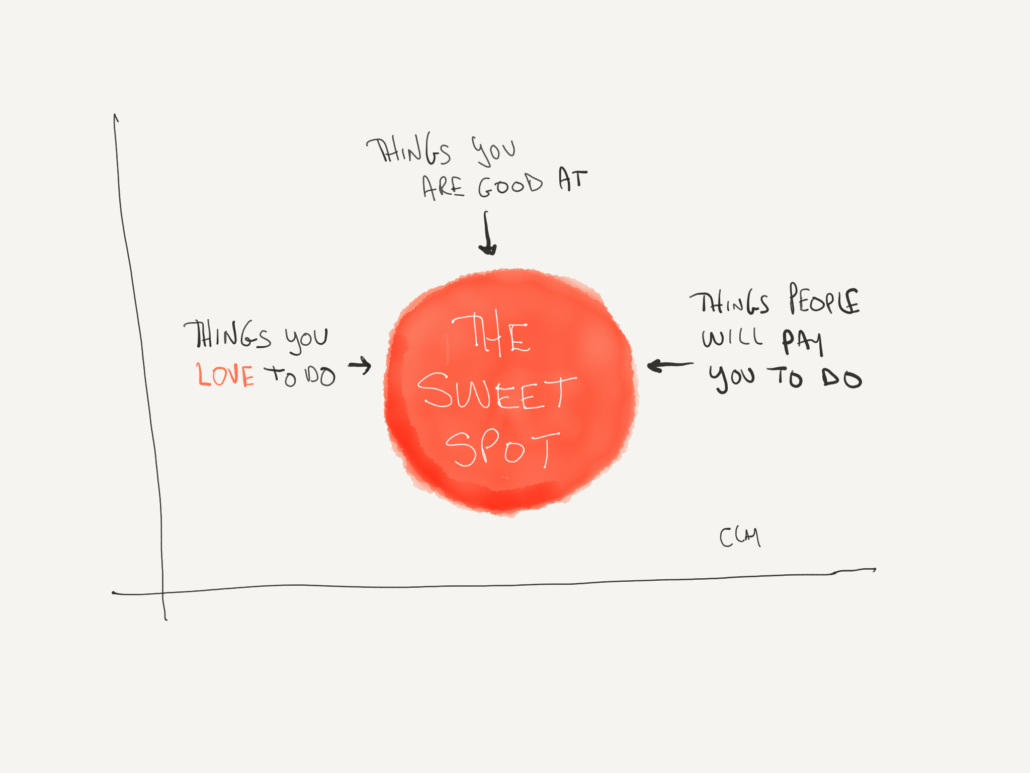
The general advice is to find your passion and do that for a living. But you need to add a little bit more to the equation.

Find the intersection of these three things:

  • Things you are good at
  • Things you love to do
  • Things people will pay you to do

Then you’re on to a winner.

Whenever I feel stuck

One of my favorite tools to use when I’m feeling stuck and unable to make a decision about something, I turn to Robert Dilt’s Logical Levels. I also use it as a coaching tool. Sometimes I even write out the levels on 5×8 cards and lay them on the floor and physically step through the levels.

Basically, it’s a language tool. You can tell on what level someone is operating on by the language they use to discuss their problem or situation. If they continue to operate on only one level, their problem or situation can seem unsolvable. But if they can change the level of their thinking, they can change the problem or at least their perspective on the problem.

The six levels break down like this:

Environment is about the external conditions in which behaviour takes place, and in which we operate. A person operating at this level will probably be explaining what happened, who was there and so on. In general, the ‘story’ will not be about the person telling it, and the energy will be in explaining how something happened. This may involve complaining.

Behaviour is actions and reactions by an individual within the environment. A person operating at this level will be describing what they thought and did, and what effect that had. It also includes what they might have done, and what effect that would have had.

Capability or competence might be considered the ‘how’ level. Competences drive behaviour through a personal strategy, involving skills and their development. A person operating at this level, is talking and thinking about ‘how’ to achieve something, including what skills they might need to develop to do so.

Belief might be thought of as the level of ‘why’, and is sometimes also described as ‘values’. It is about the reasons behind the behaviour, including any underlying values. Beliefs and values can either reinforce or undermine capabilities. For example, a belief that you are ‘no good at drawing’ could undermine any attempt to learn to draw well.

Identity is about ‘who’ you are, and could also be considered as the sense of self. Conversations on this level are often about personal self-actualisation, such as ‘What do I like?’, ‘What makes me tick?’, ‘What is my passion?’ A person suffering from stress and burnout often engages at this level.[1]

Here’s what a series of questions might sound like when you use the logical level: what it might look like in practice:

“Why do you think he’s behaving like that?” [Beliefs/values]
“How could you respond differently?” [Competence/capability]
“How could you change the situation, to try to prevent this happening in the first place?” [Competence/capability]
“Do you think he’s trying to assert his sense of self a bit?” [Identity]

Next time you’re working with someone who finds themselves a bit stuck, pay attention to their language. See if you can identify on what level they are stuck and then ask questions that will move them off of that level to get a better perspective of the problem and find a useful solution.


Don’t miss a post. Sign up for free.

We learn best when we share and debate ideas. I value your perspective. Feel free to continue the conversation anytime: claylowe187@gmail.com

They don’t want you to take the test

Nir Eyal posted this on Medium: How to achieve your goals by creating an enemy.

I was going to flick on by it, but I didn’t. I wanted to see what he had to say about enemies. I know a thing or two about enemies, and in my experience, it’s never a good thing to have one or many.

Now I get it, that Nir Eyal, is suggesting this as a motivational tool to do good things and achieve your goals and whatnot,  but the problem is, history is riddled with examples of how this technique has been used for pure evil.

Remember Charlie Company and the small village of My Lai?

Or Abu Ghraib?

Heck, you don’t even have to go back that far or travel to foreign lands. Just scan your local rag today and you’ll find plenty of examples of this “they” technique being used to galvanize one set of people against another. Or one country against another. Or one community against another.

I spent some time as a professional soldier, and one of the lessons I remember from my ethical and moral philosophy class is to never demonize the enemy. That’s when bad things happen.

When you demonize the enemy, they become less than human, even less than the beasts and the fowl of the earth. They become monsters and monsters must be slain. It doesn’t matter how you slay them. They are monsters after all. They deserve no quarter, no mercy, no pity, no nothing, just death!

OK I know, I’m probably blowing poor Nir Eyal’s article way out of proportion here, but considered this when DJ Khaled says things like:

They don’t want you motivated. They don’t want you inspired,” he blares on camera. “They don’t want you to win,” he warns. On Ellen DeGeneres’s talk show, Khaled urged the host, “Please, Ellen, stay away from them!”

The “they” Khaled invokes are clearly a sinister force. But who are they?

Who do you imagine the people are imagining are the “they”?

And this is the thing, and why it bothers me so much, their minds, our minds are going to naturally form an image of who “they” is. They may be nameless, but they will have a shape and a form, and a context and they WILL become your enemy. And that bias you didn’t think you had, or the fair and just person that you believe yourself to be will be compromised. Want to see what I mean, take this test.

Or don’t take the test.

THEY don’t want you to take the test.


Don’t miss a post. Sign up for free.

We learn best when we share and debate ideas. I value your perspective. Feel free to continue the conversation anytime: claylowe187@gmail.com

Emotions

This week, I’ve been working on a piece of self-paced e-learning for parents of children with special needs with my good friend Aimee Mann of Aimee Mann Mentoring. The e-course is called Getting Your Voice Heard. It’s a workshop she runs in physical space and is now converting it into an online format in order to reach more carers out there who can’t always make it to the live workshops.

Often parents of children with special needs find themselves in conversations with specialists, teachers and other school officials about their child.

As you might imagine, these situations can be very emotionally charged. Especially when the parent doesn’t know what’s going on with their child and the people who are supposed to know, don’t know either.

But decisions need to be made.

And sometimes the parents let their emotions get the better of them. They leave the meetings frustrated, confused and disappointed that they were not able to advocate for their child effectively.

So one of the modules on this e-course is about how our emotions affect our decision-making and what can be done to make sure emotions are used to their full effect.

Here’s a little snippet:

Your emotions influence the decisions you make every day. The question is, and your success depends on the answer to this question, do you have the ability to understand and interpret the emotions at play in your life at any given moment?

You see, when an emotion is triggered in your brain, it sends a signal to your nervous system and your nervous system responds by creating a feeling in your body, triggering certain thoughts in your mind. The combination of these feelings and thoughts affect your behaviour, in other words, they determine how you act in response to any given situation.

How much should you pay attention to these responses and the thoughts they create?

Well as it turns out, lots, especially when you’re advocating for your child in potentially very emotionally charged situations.

Our emotions aren’t particularly sophisticated and they’re definitely not precise. But they weren’t designed for sophistication and precision. Their function is to help you take in a lot of information about your situation quickly and without a lot of thinking. We get a gut feeling and we act. And in most cases, not very rationally.

Think of your emotions as an alert system. It’s your body’s way of preparing you for action. What you have to learn to do is read the signals and make conscious choices about how you can most effectively use this heightened state of alertness.

This isn’t to suggest that you need to hide or suppress your emotions. Why would you want to deny yourself access to a primal force that has evolved over thousands of years and is designed to help you do what you need to do?

Your emotional system can you give you a tremendous advantage in your decision making if you learn to use it properly.

In your decision-making, today, ask yourself what emotion, in you, is at play? What signal is that emotion trying to send you? How can you use that information to best influence the situation you’re in?


Don’t miss a post. Sign up for free.

We learn best when we share and debate ideas. I value your perspective. Feel free to continue the conversation anytime: claylowe187@gmail.com

Dopamine tastes good

“I wish the real world would stop hassling me.”Matchbox Twenty

Ok, here’s goes the start of my 30-day blogging challenge.

Why? For no reason other than wanting to start daily blogging again. I miss it as a platform for keeping up with myself. Like the old days. Plus I was inspired by Seth godin’s post yesterday. He blogs every day and he’s always recommending that people should blog every day for their own sanity if nothing else. Yesterday he gave a shout out to 5 bloggers he reads every day who have just posted their 1000th blog post.

I use to blog a lot – my soulcruzer blog has 1,020 posts. And I have several other blogs out there in various states of disarray – radio warwickshire, havana cafe sessions, wayseeking, and a tumblr blog. There are long gaps to be sure. But I keep coming back to blogging. Then I disappear again, distracted like everybody else in an endless sea of scrolling newsfeeds. You know the culprits – Facebook, Twitter, Instagram, Google+, LinkedIn – to name a few.

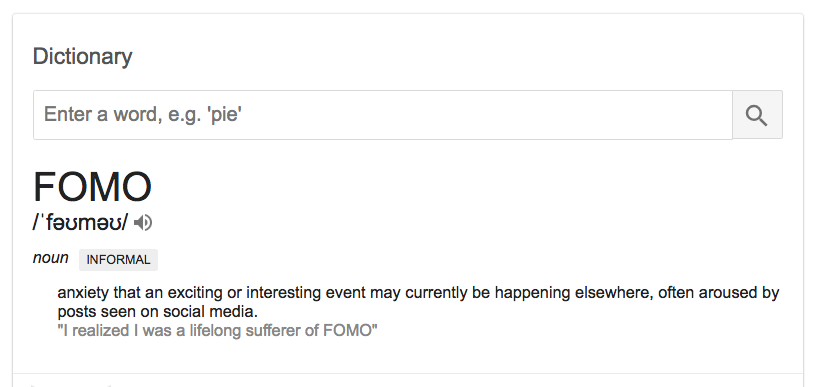
It’s laziness on my part, plus FOMO, and being a hapless praise seeking monkey. Dopamine tastes good.

Add on top of that, nobody reads blogs anymore.

No matter! I’m going to drive on anyway – at least for 30 days on this site.

I’m calling it my learning blog, partly because I’m trying to map out my brain and partly because I want a place to rap about my passion for learning and technology. I’ll leave the poetry and drawing stuff to my soulcruzer blog and the spiritual stuff to my wayseeking blog and the stuff that doesn’t seem to fit anywhere, I’ll dump on my Tumblr (which I think is still a pretty good platform, although forgotten or abandoned by the mainstream).

Oh and just a side note:

Spotify has me pegged this week. Just about every song on the Discovery playlist is striking a chord with the inner workings of my mind right now.

Sometimes algorithms do get it right.


Don’t miss a post. Sign up for free.

We learn best when we share and debate ideas. I value your perspective. Feel free to continue the conversation anytime: claylowe187@gmail.com

as the wheel turns

I’ve lost count of how many times I’ve destroyed this site in order to rebuild it. Reminds of the Good Place season 2, when has to keep resetting his personal block of Hell trying to get the main characters to stop discovering that they are, in fact, in Hell, not Heaven.

That being said, here we go again…

This site is now my portal site, you can come here to find out what I’m up to in all my areas of the Internet and Social Media. I’d like to say that this will be the last time I destroy this site, but we’ll see…

Until then bookmark it or RSS feed it.

night’s leaves

on a pristine
october afternoon
i applied for a job
begging at the ports

all for the sake
of feeling my way
against the ghost
of your truth

my lies limed
and loaded flowed
easy riding the night’s
last flicker of hope

i was young
i tried to capture
you with rhymes
and exotic suggestions

touching myself
pretending to be
a poet of all things

you were a tourist
picking through
the constellations
looking for something
behind my falling words

you found nothing but
a boy from jazz highway
rustling night’s leaves

rapture

on the radio
the buzzing world
whistling

blowers moan
the clack of
balls clicking

so well straining

a high thin monkey
woman begging for
rapture

before the beginning

in the moment she answered
formless in-between states of grief
shadows dancing underneath her eyes
she did not recognise me

darkness
dull and desperate
before the beginning
began

i caught myself staring like a
chimp caught humping another
chimp, never would i be better

imitating the ways of the master not to
create but to destroy the beat of her heart

the pulse of 3am hits me

I have to quit being anonymous inside the machine…artificial space in a dreamlike dimension…the pulse of 3am hits me inside the unconscious sea…a voyage below…subway empty…closing haunted spaces…this lack of a beginning divides me in the light under the flare of a system flooded by the black sun…time interval of an astronaut something stirs in the underground…52 eyes decomposing in the dark…these words cannot locate my lover’s nervous lips