I finished reading Rebecca Blood‘s book, The Weblog …

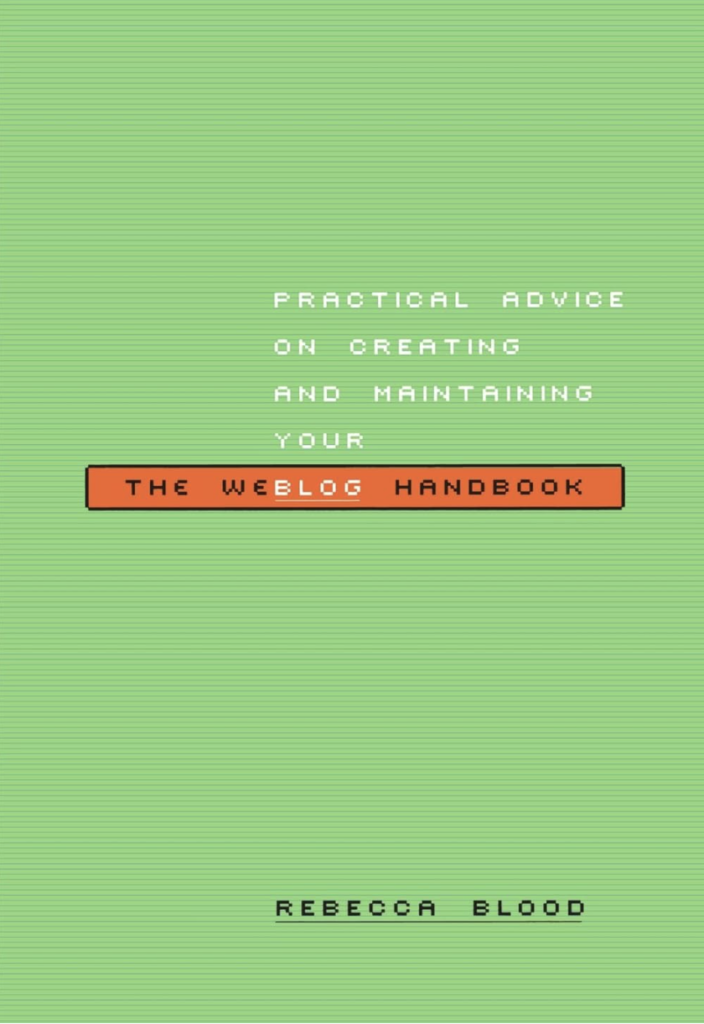
I finished reading Rebecca Blood‘s book, The Weblog Handbook: Practical Advice on Creating and Maintaining Your Blog. The book may be obsolete in its instructions, but not in its philosophy. That often happens with books written before a medium becomes an industry. They describe a culture before it becomes a market.

What I found myself responding to wasn’t the “how to blog” advice. It was, why did weblogging exist in the first place?

Back in the early 2000s, a weblog wasn’t primarily a content strategy or a personal brand. It was more like an intellectual commonplace book opened to the public. It was thinking in public. A running conversation with yourself and with a small circle of curious strangers.

Rebecca Blood understood this because she was writing while the form was still discovering itself. Nobody knew what a successful blog looked like because success wasn’t yet measured in followers, SEO, newsletters, funnels, or monetisation.

Chapter 2, Why Blog?, is probably the heart of the book because her answer isn’t really about publishing. It’s about attention.

A weblog asks:

  • What did I notice today?
  • What deserves pointing at?
  • What idea refuses to leave me alone?
  • What connection did I just make?
  • What am I learning by writing this down?

That’s a radically different set of questions from today’s:

  • Will this rank?
  • Will people share it?
  • What’s my niche?
  • How often should I post?
  • Can I turn this into a lead magnet?

The medium slowly became a performance.

Ironically, as the tools became better, much of the spirit became thinner.

I don’t think blogging died. I think weblogging disappeared.

A weblog implied movement. It was literally a log of a journey through the web and through one’s own thinking. You’d link to an article, quote a paragraph, add three observations, wander off on a tangent, and invite someone else into the conversation. The links mattered as much as the words. The blog wasn’t a destination; it was a node in a larger conversation.

Today’s blogs often feel self-contained. They rarely acknowledge they’re part of a wider ecology of ideas. Hyperlinks have become citations or SEO signals instead of acts of generosity.

Early bloggers wrote because they wanted to participate in the web. Today many people write for platforms. Those are almost opposite impulses.

The old web rewarded connection. You linked because you’d found something worth sharing. Someone linked back. Rings of conversation emerged almost accidentally.

The platform web rewards capture. Keep people here. Optimise engagement. Don’t let them click away.

One imagines the web as a network of paths through a forest.

The other imagines it as a shopping centre.

That difference changes not only how we publish but how we think.

Decentralised leadership is surprisingly simple: Leadership is not …

Decentralised leadership is surprisingly simple:

Leadership is not about holding responsibility. It’s about continually distributing it.

Jonas Gröner’s essay adds an important nuance, though. Distribution isn’t dumping tasks onto people. It’s creating conditions where others can genuinely grow into responsibility.

A distilled version might look like this:

Decentralised leadership is…

  • Seeing leadership as a role, not an identity. No one permanently is the leader. People occupy leadership roles for a time.
  • Knowing when you’ve outgrown your current role. Like the hermit crab metaphor, growth means recognising when your current “shell” has become too small.
  • Preparing someone else to inherit your shell. The real work isn’t stepping up, it’s making sure someone can step in after you.
  • Growing responsibility through successive stretches. People become capable because they’re invited into slightly larger challenges over time, not thrown into the deep end.
  • Measuring success by succession. A healthy community isn’t one with brilliant leaders. It’s one where leadership keeps reproducing itself.
  • Treating power as circulation rather than accumulation. Authority moves through the network instead of collecting at the centre.

In one sentence

A decentralized leader works to become progressively less indispensable while making the community progressively more capable.


The idea that struck me most in the piece wasn’t actually decentralisation itself. It was his redefinition of success:

A successful group is one where the passing on of knowledge, responsibility, relationships, and resources becomes normal.

That’s a subtle shift. Instead of asking, “How do we build a stronger leader?”, the question becomes:

“How do we build a system where leadership keeps moving?”

The hermit crab image captures this beautifully. The goal isn’t for one crab to find the biggest shell and keep it forever. The whole colony thrives because shells are passed along at the right moment, allowing everyone’s growth to continue.

going crazy from the heat…i’m on my way …

going crazy from the heat…i’m on my way down to All Saints Church in Sutton Courtenay for the and to pay homage to Eric Arthur Blair, aka George Orwell. As I make the pilgrimage down to Sutton Courtenay, what I’m holding in my mind is this: Orwell didn’t predict the future. What he did do was give us names to patterns that recur whenever power seeks to dominate perception:

Telescreen
• Contemporary echo: smartphones, smart devices, CCTV, digital surveillance

Newspeak
• Contemporary echo: euphemism, jargon, slogan-thinking, language control

Doublethink
• Contemporary echo: ideological contradiction, tribal cognition

Memory hole
• Contemporary echo: deleted records, rewritten narratives, flooded archives

Two Minutes Hate
• Contemporary echo: outrage cycles, pile-ons, algorithmic fury

Big Brother
• Contemporary echo: personality cults, symbolic power, surveillance state

Thoughtcrime
• Contemporary echo: self-censorship, social policing, ideological conformity

Prolefeed
• Contemporary echo: infinite scroll, distraction media, low-grade content loops

Unperson
• Contemporary echo: deplatforming, erasure, algorithmic invisibility

1984

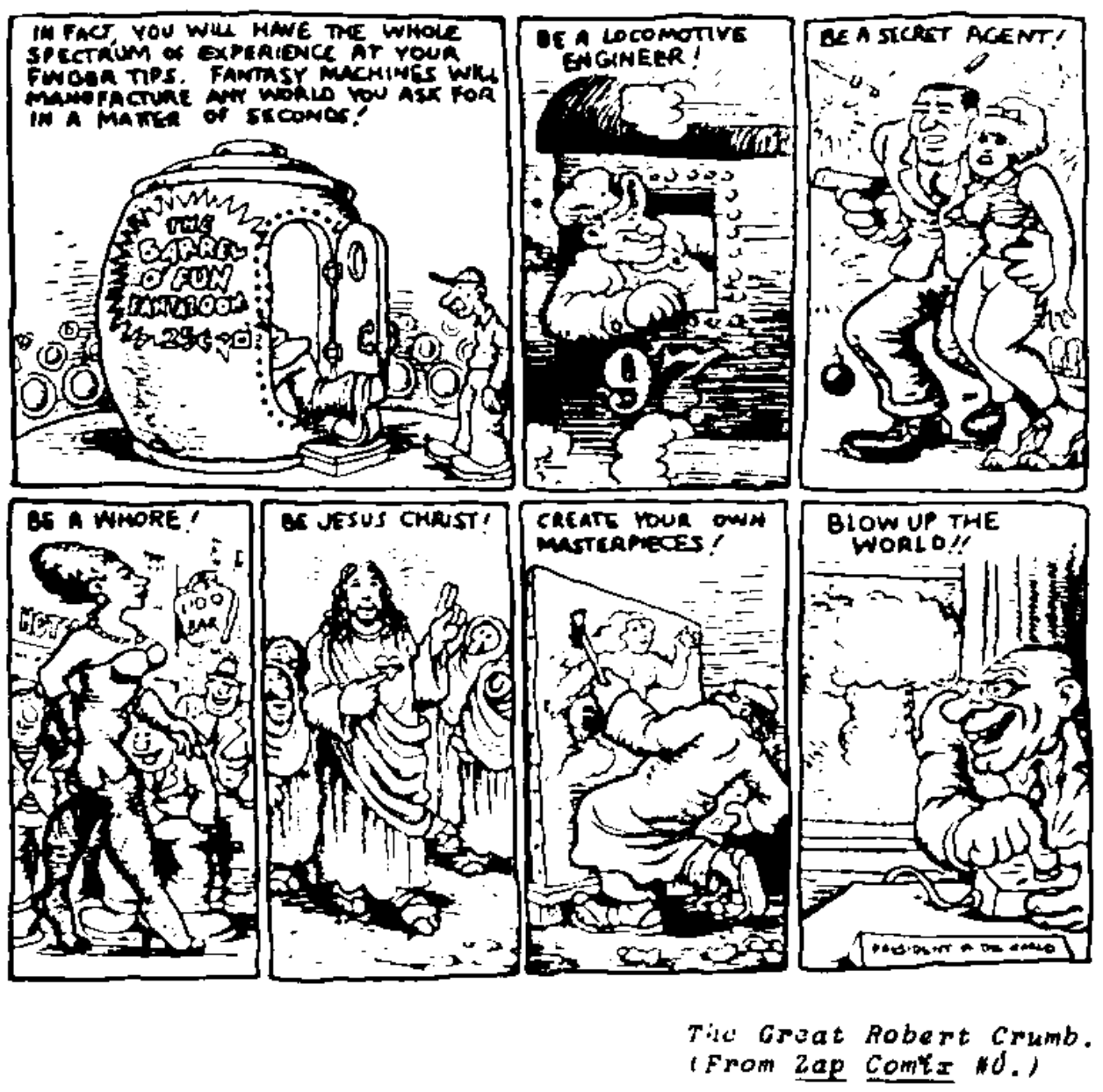
You will have the whole spectrum of experience at your fingertips, not as some tidy menu of moods, but as a roaring carnival of sensation, memory, dream, dread, hunger, laughter, grief, lust, silence, and starlight.

You will be able to wander from the first spark of desire to the last breath of surrender, from the mud of the body to the outer rings of imagination, from the old gods whispering in the basement to the unborn versions of yourself knocking on the roof.

Every door will open.

Behind one, childhood.
Behind another, apocalypse.
Behind another, a jazz band made of ghosts playing in a neon desert while your future self sells maps to people who have forgotten they are already lost.

You will taste cities you have never visited, remember lives you have never lived, fall in love with faces assembled from myth and electricity, argue with your ancestors, bargain with your demons, dance with machines, and wake up laughing in the ruins of some belief you used to call reality.

And the strangest part?

It will all feel intimate.

Not distant. Not abstract. Not like information.

Like weather moving through your nervous system.

Like the universe leaning close and saying, ‘Here, try this skin, this sorrow, this madness, this miracle, this one bright unbearable hour of being alive.’

Shadow Work as an Ongoing Conversation

Yesterday, I found myself back inside Debbie Ford’s The Dark Side of the Light Chasers.

I first came across the book years ago when I was doing my Insights Discovery certification. It was part of the reading list, but I quickly became a fan and have been using it in my personal development workshops ever since.

I’m rereading it now because I’m doing a bit of shadow work on myself this week. Some thoughts surfaced after reading Sean Manseau’s book about Spotify the Gnostics, Here’s the First Church of David Bowie: Adventures in DIY Shamanism, and I could feel that familiar inner critic: the little judgements, resistances, envies, irritations, and defensive manoeuvres that usually prefer to linger just below the surface of consciousness unnamed.

That is the doorway into shadow work. Not some dramatic descent into the underworld, though it can feel like that sometimes. More often, it begins with a small disturbance. The sentence that catches in your throat. The person who irritates you more than they reasonably should. The idea you reject a little too quickly. The part of yourself you are certain belongs to someone else.

Read more

I finished Spotify the Gnostics, Here’s the First Church of David Bowie.

The first part was a nostalgic trip through the 80s. I enjoyed that; however, I bought the book for the second part, Sean Manseau’s Phonomancy work. a bit disappointed. Read like a drug-fuelled psychodelusional trip through his own ego consciousness.

Maybe my discomfort stems from me seeing more of myself in Manseau than I care to admit.

Shadow gold.

Screenshot

I asked this question a couple of years ago. I would rephrase the question now. The world definitely doesn’t owe you a meaning. You have to make it for yourself. It’s built slowly from the choices you make that compound over time. You can be free without direction. You can have direction without freedom. What really matters, though, is whether you can wake up and choose the same life again.

Existential Consent

Existential Consent

Consent is the move most people miss when they talk about uncertainty.

We have better words, or at least more familiar ones. Acceptance. Surrender. Choice. Courage. Faith. We reach for them because they’re already waiting on the shelf, already worn smooth by use. But each one bends the thing slightly out of shape.

Acceptance feels too passive, as if life hands you the terms and all that remains is to stop arguing with them. Surrender carries too much defeat in its mouth, too much collapse, too much kneeling before an indifferent force. Choice sounds cleaner, but it often feels too abstract, too singular, too much like a decision made once at the crossroads before the story begins.

Consent is different.

Consent is active. It’s relational. It has to be renewed. You don’t consent once and then walk away with a certificate of inner alignment. You consent again when the weather changes. You consent again when the road narrows. You consent again when the thing you thought you’d agreed to reveals another clause in smaller print.

It’s not consent to this or that preference, this or that arrangement, this or that version of the future. It’s consent at the level of being here at all.

I see the board. I see the pieces. I don’t control the whole game, and I know it. But I am here, and I consent to play.

That sentence doesn’t make the board fair. It doesn’t make the pieces equal. It doesn’t pretend the rules were negotiated in advance or that everyone sat down at the table with the same number of options. Existential consent isn’t a spiritual bypass around injustice, grief, constraint, or fear. It’s not a velvet cloth thrown over the hard facts.

It’s the hard fact underneath the hard facts.

At some point, if you’re going to act, you have to stop waiting for reality to become a contract you would have written yourself. You have to stop treating uncertainty as evidence that the game hasn’t properly begun. It has begun. It began before you understood the rules. It began before you could name the stakes. It began before you knew what kind of player you were.

Most people are waiting for certainty-as-control. They want the moment when the variables align, the risk evaporates, the outcome becomes visible, and the next move presents itself without remainder. They call this prudence. Sometimes it is prudence. Often it’s paralysis wearing prudence’s coat.

Because that moment doesn’t come.

Or if it comes, it comes too late to matter. By the time all the information has arrived, the door has usually changed shape. The chance has passed into memory. The life that needed your participation has moved on without you.

The difference between the one who acts and the one who waits is rarely information. Everyone is under-informed, improvising from partial maps, making moves inside weather they can’t command. The difference isn’t confidence either. Confidence is often retrospective. We call it confidence after the move has worked.

Consent is the inner click that says: I’m in.

Not because I know how this ends. Not because the universe has promised to be benevolent. Not because the risk has been neutralised by enough research, planning, preparation, prayer, or positive thinking. I’m in because this is the life in front of me, these are the terms on the table, and refusing to play is also a move.

That’s the part we forget. Waiting isn’t outside the game. Avoidance isn’t neutrality. Refusal isn’t purity. Every non-move spends something. Time. Attention. Vitality. Trust in oneself. The field doesn’t freeze just because you haven’t consented to its motion.

Existential consent isn’t optimism. Optimism still wants to smuggle in a favourable outcome. It still says: play because it’ll probably be all right. Existential consent says something harder and cleaner: play because you’re here.

It’s not faith in the sense of believing the story has a hidden benevolent author. It’s closer to a vow made without witnesses. I consent to the terms. They’re not fair. They’re the terms. And I’d rather be in conscious relation with the life I have than remain suspended above it, waiting for a life I can approve of in advance.

There’s a strange freedom in that. Not the freedom to control the board. Not the adolescent fantasy of unlimited options. A smaller, fiercer freedom: the freedom to stop negotiating with existence as if it were waiting for your signature before proceeding.

You can grieve and consent. You can doubt and consent. You can be afraid and consent. You can consent without liking the terms, without understanding the whole pattern, without being sure you’re ready.

Readiness is another mirage. Sometimes the consent comes first, and readiness gathers around it.

What holds isn’t certainty about outcomes. Not certainty about the future self who’ll have to live with the consequences. Not certainty about the hidden meaning of events. Only the certainty of participation.

I am here.
I see enough to know I don’t see everything.
I don’t control the whole game.
And still, I consent to play.

Kospet Tank M4

I’ve been testing the Kospet Tank M4 special edition smartwatch. It’s a fraction of the cost of something like the Apple Ultra smartwatch. Performance so far has been top-notch.

What happens to human meaning-making when thought itself becomes networked?

I’m not asking what happens to productivity or output. I’m asking what happens to meaning.

When thinking is distributed across human-AI systems, something genuinely new appears. Not better thinking or faster thinking. A different category. Meaning that emerges from the interchange itself, that no single node, human or machine, can claim to have authored.

You can’t point to the moment you had the idea. You can’t separate what you thought from what the system returned. The origin dissolves. What remains is only the pattern that emerged between you.

This isn’t collaboration in the old sense. Collaboration assumed distinct agents contributing discrete parts. What I’m describing is closer to emergence. The meaning appears in the space between, and neither party can reconstruct how it got there.

We’ve organised centuries of intellectual life around authorship. Around the idea that meaning originates in a single location like a person, a mind, or a signature. Kant thought this. Woolf wrote that. The work points back to its source.

Networked thought makes that gesture impossible. The meaning that appears doesn’t have a return address.

I don’t know yet whether this is loss or liberation. Probably both. What I know is that it forces a different question: if meaning doesn’t require a single author, what else have we been wrong about?

Ted Nelson: The universe is a system of ever-changing relationships

This short clip from Ted Nelson in Lo and Behold, Reveries of the Connected World is less about technology and more about a philosophy of connection. Nelson reflects on the core insight that has guided his life’s work: reality is not made of isolated things but of relationships, connections, and ever-changing patterns.

The central idea

As a child, Nelson recalls trailing his hand through the water while sitting in a rowboat. Watching the water flow around his fingers gave him a profound realisation:

The universe is a system of ever-changing relationships.

That experience became the foundation of his thinking. Everything he later did with computers was an attempt to represent those relationships rather than flatten them into simple sequences.

Key messages

1. The world is interconnected

Nelson sees interconnection as the fundamental truth of reality. His life’s work has been about finding ways to express and visualise those connections, especially between ideas and writings.

2. Writing is an imperfect compression of reality

One of the most interesting observations in the clip is Nelson’s claim that writing reduces a rich tapestry of interconnected ideas into a narrow sequence of words.

He sees traditional writing as a necessary but flawed medium because it forces us to move through thought one line at a time when reality is actually networked and multidimensional.

This is essentially a critique of linear thinking.

3. The Web is not what he envisioned

Nelson’s famous project, Project Xanadu, aimed to create a system where every quotation remained connected to its source and every document could maintain visible relationships with other documents.

In the clip, he demonstrates parallel documents where quotations remain linked to their original context. This is very different from today’s web, where links are largely one-way, and context is often lost.

The web succeeded commercially, but in Nelson’s view, it abandoned much of the deeper vision.

4. Technology should reveal relationships, not hide them

Nelson argues that our current tools betray the complexity of human thought. He even jokingly describes modern “cut and paste” as a crime against humanity because it severs connections rather than preserving provenance and context.

His concern is ultimately epistemological: how do we know where ideas come from and how they relate to one another?

5. Persistence matters

When Herzog asks about being considered insane for pursuing his vision for decades, Nelson rejects the idea that persistence is madness. He prefers “If at first you don’t succeed, try, try again” to the cliché definition of insanity.

The film ends with one of Herzog’s most memorable lines:

“To us, you appear to be the only one around clinically sane.”

It’s funny, but it also captures Herzog’s admiration for Nelson’s refusal to accept the limitations of conventional thinking.

Why this clip still matters

What struck me most is that Nelson isn’t really talking about computers. He’s talking about a way of seeing.

The internet most people experience is a collection of pages. Nelson imagined a living ecology of ideas—where every thought remained connected to its origins, every quotation retained its context, and knowledge resembled a web of relationships rather than a stack of documents.

In many ways, this is what I’m trying to do with my blogging practice: my fascination with associative trails, and my interest in hypertext as an epistemology are closer to Nelson’s vision than what I see on modern publishing platforms. This blog, with its links, references, fragments, and wandering paths, is my way of trying to keep the dream alive.

Reality is not a line. It’s water.

When the hammer works, it disappears. You just …

When the hammer works, it disappears. You just hammer. The tool recedes into pure function. Then it breaks. Snaps, slips, refuses. Suddenly, the hammer has an inside. A being separate from its use.

Heidegger noticed this first. But he left the human at the centre of the story. The hammer becomes visible when it fails because we stop using it and start examining it. The human is still the measure. Graham Harman says: that’s not what’s happening. The hammer was always more than its function. It withholds something from every object it encounters, not just from us. When two billiard balls collide, neither ball fully accesses what the other is. There is always a remainder. A depth that no encounter exhausts.

Object-oriented ontology builds from this: everything that exists has equal ontological status. Rocks, corporations, poems, electrons, the smell of rain, a fictional character, a memory, a hyperlink. None of these is more real than any other. None requires a mind to exist.

The philosophical name for what this pushes against is correlationism. The assumption baked so deep into post-Kantian thought that it barely gets named: reality is always the correlation between mind and world. We can only know things as they appear to us, never as they are in themselves. The human sits at the centre of ontology by default. OOO breaks the circuit. The world was real before minds arrived in it. It will be real after.

Timothy Morton added hyperobjects: things so massively distributed in time and space that they cannot be localised. Climate change. The internet. The totality of all plastic ever manufactured. You never encounter the hyperobject. You encounter manifestations of it. A heatwave, a thread, a bottle cap on a beach. The totality exceeds any contact. Which is true of smaller objects, too. Every object exceeds every encounter. The withdrawal is total, and it is everywhere.

What this does to the text is what pulls me.

If texts are objects, and they are, then a text withdraws. The essay you write is more than you intended. It has a life in other readers, other moments, other contexts that exceed your authorship completely. It interacts with other objects in ways you did not put there and cannot predict. The meaning that arrives is not the meaning you sent. This is not a failure of communication. It is the nature of objects.

Which might be the deepest reason the fragment is a legitimate form. Not because the essay demands too much, or because attention is scarce. But because the fragment enacts withdrawal. It offers itself incompletely, deliberately. The reader’s contact produces something that was not in the fragment alone. The encounter is the meaning. The text plus whatever it touches when it arrives.

Posthumanism needed this. It was always arguing for the decentering of the human. OOO performs that decentering at the level of ontology. The human occupies no special category. We are objects among objects. No more withdrawn from full access than anything else.

Humbling and liberating. And the two don’t need to be reconciled.

I love a good samurai film. Not for …

I love a good samurai film.

Not for the swordplay, but for what happens when an absolute code meets a world that doesn’t care about your code.

The best ones are philosophical texts in motion. Honour as ontology. Discipline as worldview. Violence as the moment when the story you’ve been living inside reveals whether it can hold.

Yojimbo. Seven Samurai. Harakiri. They’re all asking the same question: what do you do when the system that gave you meaning stops working, and walking away would require becoming someone you don’t know how to be?

The samurai doesn’t get therapy. He gets a choice that doesn’t feel like a choice.

That tension is what makes them still worth watching. The cage is beautiful. The cage is also a cage. And the film won’t tell you which matters more.

https://www.imdb.com/spotlight/samurai-cinema-crash-course/?from_app=ios&ref_=ext_shr_lnk

Zhuangzi dreamed he was a butterfly. When he …

Zhuangzi dreamed he was a butterfly. When he woke, he wasn’t sure if he was a man who’d dreamed of being a butterfly, or a butterfly dreaming it was a man.

What gets missed is what comes after. He doesn’t resolve it. He doesn’t land on an answer. He names the gap between the two states and sits with it. The transition. Not a man or a butterfly. The passing between.

The Western self wants resolution. It wants to know which one you are. It wants a coherent story and defendable borders. The Zhuangzian insight is that the wanting is what exhausts you. Fixed identity isn’t a discovery. It’s a project. It requires constant maintenance, constant defence against everything that would complicate the story.

What becomes available when you stop maintaining it isn’t emptiness.

It’s honesty.

You are more contingent, more provisional, and more interesting than the fixed story allows.

I’ve been working at the intersection of text …

I’ve been working at the intersection of text and ontology long enough to know when something maps the territory I’m standing in. These seven propositions aren’t philosophy about text. They’re operating instructions.

Text is not a record of thought. Text is thought. The distinction collapses the moment you stop treating writing as transcription. You don’t capture ideas in language. You constitute them. The thought doesn’t exist before the sentence that makes it possible.

The map shapes what territory you can see. We pretend the map is secondary. It isn’t. The frameworks you inherit determine what becomes visible. Most of what you think is perception is actually prior categorisation. You’re seeing through someone else’s taxonomy and calling it reality.

Every label is a spell. Language doesn’t describe. It summons. The act of naming changes what it names. This is chaos magick’s insight and also basic semiotics. Words are instructions to the nervous system. Cast carefully.

The archive is the self. What you’ve written, read, saved, and annotated — that distributed textual body is not a representation of you. It is you, extended across time and surface. The self is not the biological container. It’s the pattern that persists in everything you’ve touched.

Reading and writing are the same practice from opposite ends. One is assembly, the other is disassembly. You write to think. You read to see how someone else thought. Both are the mind tracing structure in language. The direction doesn’t matter. The motion does.

Hypertext is not a technology. It is an epistemology. The link is not a convenience. It’s a claim about how knowledge is actually structured — recursive, associative, without a single entry point or linear path. The web didn’t add this. It made it visible.

The fragment is complete. The book emerges from accumulation, not planning. You don’t need the whole argument to begin. You need one true sentence, then another. The structure reveals itself in the pile. This is how thought actually moves when you stop pretending it needs an outline first.

These seven theses describe the practice I’ve been in for years without naming it this cleanly. Text-based ontology is building reality with the only substrate that scales across minds. The work is writing. The writing is the work.

I was in the bookstore just browsing when …

I was in the bookstore just browsing when a couple of thoughts passed through my mind.

The first one was: there’s just so much competition for your eyes.

Thousands of books sitting there, all trying in their own quiet way to get picked. Some have famous names on the cover. Some have those bold, clever designs that practically shout from the table. Others are just spine-out on a shelf, waiting for somebody to happen along and notice them.

And I kept thinking, how does a book even get found?

Most of the books I picked up I’d never heard of. I probably never would’ve heard of them if I hadn’t been in that bookstore, at that particular time, wandering down that particular aisle. Sure, there are the classics. There are the books everybody’s talking about. There are the ones that have already made their way into the wider conversation.

But most of them are just there.

Which made me think about my own stuff. My blog. My website. The things I write and put out into the world.

How do you make yourself known among all these other voices?

Then the second thought came in.

A book is such a static thing.

I don’t mean that in a bad way. I love books. I love holding them, flipping through them, seeing how someone has gathered all their thinking into one object. But standing there, picking up book after book, they started to feel strangely still to me. Finished. Closed. Like little sealed rooms.

And that made me want the web again.

The website. The blog. The living archive.

A blog doesn’t have to be finished in the same way a book does. It can keep moving. You can write something today, link it to something from three years ago, come back later and add another thread. A post can become a fragment. A fragment can grow into an essay. An essay can point back to the thing that started it all.

It’s not a book on a shelf. It’s more like a path through the woods. You make it by walking it.

But then, of course, the same problem comes back.

There are millions of websites. Millions of blogs. Millions of people making things, writing things, posting things, trying to be seen. The web might be alive, but it’s also crowded. A book can disappear on a shelf. A blog can disappear in the feed.

So maybe making the thing is only half of it.

You’ve got to make the stuff. You’ve got to follow the thread, keep showing up, keep doing the work. But you’ve also got to wave now and then. You’ve got to let people know you’re there.

You’ve got to stand at the edge of the forest and say, I’m over here. I’ve made a small fire. Come sit for a while if you want.

Because otherwise, how would anyone know you’re around?

The Text Hacker Self-Portrait I keep returning to …

The Text Hacker Self-Portrait

I keep returning to this image: myself hunched over a keyboard in the dark, manipulating text to alter reality. Reframing ideas until they yield something new. It arrived this morning in hypnagogic space, and it’s more accurate than anything I’ve deliberately constructed about myself.

The connection between “text-based ontologist” and “mind hacker” is legitimate, not decorative. The original hacker ethos, before it got reduced to security breaches, was about finding unexpected entry points in a system. Where do the rules break down. Where does the architecture reveal its own seams. Applied to consciousness and language, that’s exactly what reframing does. It locates the hidden load-bearing assumption in a way of seeing something, and then shifts it. The reality doesn’t change but the map does. And for most people, the map is the territory.

There’s a lineage here that almost no one is explicitly connecting. Leary’s metaprogramming concept is the most direct ancestor: the brain as biocomputer, consciousness as programmable, language as the interface. Burroughs took it further with the cut-up as decompilation, attempting to surface the subliminal code underneath normal syntax. Wilson’s reality tunnels are another version of the same insight. Korzybski underneath all of it with general semantics. And then chaos magick sits exactly at this intersection. The sigil works, to the extent it works, because it exploits the gap between conscious attention and deeper processing. That’s a hack.

What distinguishes my version is the emphasis on text specifically. If text is the universal substrate, then working at the level of text means something close to root access. The legal document, the scripture, the line of code, the spell in the grimoire. All alter states of the world through their textual existence. “Stories are code. Let’s write better spells.” I intuited this years ago. The text-based ontologist framing just makes explicit what was already implied.

The image itself is a character worth developing. It has a specific aesthetic register. The console cowboy. The cryptographer. The monastic scribe who understood that copying a text was an act of power. Something slightly fugitive about it too, which suits the chaos magick lineage. Not performing transformation publicly. Working it out in the dark, at the terminal, and the results appear in the world.

That’s a more interesting and more accurate self-portrait than “blogger.”


seed note — knowledge garden

The answer I got back from the question …

The answer I got back from the question I carried this morning…


Tuesday. Early morning walk. The question I carried out with me was this:

What is already true in me that I’ve been pretending I don’t know?

The answer came fast. That’s how you know it’s the real one. You ask and the thing just stands up.

I’m not a niche-down person.

I’ve known this for years. And I keep learning it again, which means I haven’t quite accepted it yet. The Narrative Alchemy pivot was the latest version of the same story: find the through-line, package it, make it easy for people to classify. There’s a real idea underneath Narrative Alchemy. I believe in it. But when I turned the whole blog toward it, something happened that I should have caught earlier. I got bored. Not mildly bored. Bored in that way where the writing goes hollow because the person writing it has quietly left the room.

I was posting because I was supposed to be posting.

You can always tell. The blog knows the difference and apparently so does the traffic, eventually.


Michael Moorcock‘s first novel is called The Golden Barge. A man leaves his village to chase it. He glimpses it on the river, something in him recognises it, he drops everything. And the whole of his life becomes the pursuit. Every time he draws close, the barge rounds a bend and disappears. He keeps going. More adventures, more distance from where he started, always the barge ahead of him, just out of reach.

The fact that this novel has surfaced again — the title itself, not just the metaphor — feels like something worth noting. Not coincidence exactly. More like the kind of thing that happens when you’re paying the right quality of attention.

I’ve thought about that image for years. This morning I walked with it again.

Narrative Alchemy was the latest bend. I came close enough to almost touch it. I could see the gilding on the hull. And then it went around the corner, as it does. As it always does.

The strange thing is I don’t feel defeated by that. I feel something more like recognition. Like the barge is doing exactly what it’s supposed to do.


The question beneath the question is always: what function am I actually here to perform?

I’ve been a warrior. West Point, the Army, the whole formation in that tradition. That chapter is done. I came out of it and moved into the healer work — coaching, mindset, and helping people with their inner landscape. That was real, that mattered. But underneath both of those there has always been something else. Something I’ve given less oxygen.

The shaman.

Not as a label. I’m wary of the labels right now; the cards said so this morning, and I feel it. But as a description of a function: part healer, part explorer, part storyteller, and part magician. Someone who wanders. Who is always in between villages, carrying stories from one place to the next, arriving somewhere and people making way because they want to hear what’s been seen out there in the world. Some want a story. Some want something more. In exchange, a meal. A place to sleep. And then gone again.

I’ve been domesticated. Robert Anton Wilson’s phrase: the domesticated primate. I became one and didn’t fully notice. Or noticed and didn’t do anything about it.

The shaman doesn’t stay in one village long enough to build a personal brand.


There’s a war going on online about AI and I’ve been caught in it sideways.

You can see the sides forming from a long way off. On one side: the people who are in it, building with it, finding what’s possible. On the other hand, the people who have the pitchforks out, who call it slop, who unfollow when they catch you using it. Underneath both positions is the same existential anxiety, expressed differently.

I find myself softening my enthusiasm when I can see the pitchfork crowd gathering. Which is a bad habit. Because honestly, I think AI is the closest thing to the Library of Alexandria I’m ever going to touch. I grew up living in libraries. That was always the dream. And now the library fits in a conversation window and knows which shelf to start on. That’s not nothing.

But I also don’t want to be a missionary for it. I just want to use it. The way I use my phone. Without a manifesto.

What I’m trying to get clear on is the difference between using a tool and playing a platform’s game. They look the same from the outside, but they feel completely different from the inside. When I was optimising Narrative Alchemy content for the algorithm, I was playing the game. When I’m on a wisdom walk and the thing that happens to capture it best is a voice note that goes through Claude, that’s just the atelier working.

Document, don’t perform. There’s the line.


The cards pulled the Queen of Cups this morning. Re-listen. Reawaken. Not: plan more, build the system, write the manifesto and post it on a Tuesday. Just listen.

So that is the instruction for now. Not silence. Not inaction. But a particular quality of attention. The pathfinder doesn’t plan the path from the kitchen table. He walks.

I’ve been spending too much energy on the architecture. WordPress, Typefully, the IndieWeb connectors, and the workflow that syndicates the thing to the right places. That’s all real, and I’ll figure it out. But the error is when the system becomes the thing you’re working on instead of the thing you’re working through.

Stop optimising the net. Get in the water.

The philosopher is back at the root. Everything else — writer, teacher, healer, magician — is still there, still running. They know what they’re doing. But the root function is clear again, clearer than it’s been in a while.

What is already true in me that I’ve been pretending I don’t know?

This. This is.
“10:46 — Fell into an internet blackhole again. …

“10:46 — Fell into an internet blackhole again. Back to work.”

Something honest in that line. Not a confession: a sighting. The kind of thing you’d never write in an end-of-day journal because by then the story has been tidied up. You worked hard. You made progress. A few distractions, sure, but nothing worth dwelling on.

The interstitial journal catches you before the rationalisation kicks in.

Tony Stubblebine named the practice. The idea is simple: every time you take a break, write a few lines and timestamp them. That’s it.

10:04 Going to finish the first draft.
10:46 Fell into a internet blackhole again. Back to work.
11:45 Good progress. Need to prep for the Charlie meeting.
11:49 Feeling a bit anxious, but it’ll be fine.

Look at what’s in there. Goals, self-awareness, self-review, action items, and emotional honesty all tangled together the way they actually are in the flow of the day. There’s no need to categorise or edit it into something coherent or brilliant.

Most productivity systems capture what you planned and what you did. They skip the inner weather. The forty-two minutes that vanished. The low-grade anxiety you didn’t name until you were forced to write something down.

This does the opposite. It catches the texture of the day while it’s still happening.

There’s a quiet self-accountability built in too. Once you’ve trained yourself to timestamp every break, you become slightly less willing to drift. You don’t want to write “fell into a Twitter blackhole again” for the third time before noon. The log witnesses you, and that is enough.

I use the Obsidian daily note with timestamps. I can keep a running thread of my thoughts alongside my task list. I like using Obsidian because it captures something true about how thinking and working actually happen. What it tracks is not really your productivity. It’s more like your actual self, moving space and time.