I have in mind to evolve, to break out of habits that bind me, that confine me, that leave my soul a stagnate pool of green slime. My habits are vicious little gnomes that enslave my behaviors, perceptions, emotions, and thoughts and limit my range of possibilities in a limitless world. I think it is time to fight and win back some of the freedom I’ve given up, whatever the cost.
chillaxing
After a week of train travel, I needed a break from motion, so I opted for a chilled out weekend at home doing something close to nothing. We did manage to catch The Karate Kid, which I enjoyed. I love Jackie Chan. He seems like a real down to earth guy who loves what he does. The story stayed true to the original, while adding it’s own particular flavor to the franchise. The karate, er I mean Kung-fu, was 100 times better than the original. I do agree with some of the critics. The movie could have been about a half hour shorter, basically the beginning was slow with all the saying goodbyes, the journeys in taxis, and the plane ride. But once the film got rolling proper, I was hooked. Oh yeah, awesome move at the end.
“But, O, how bitter a thing it is to look into happiness through another man’s eyes!”
“But, O, how bitter a thing it is to look into happiness through another man’s eyes!”
– Shakespeare, As You Like It
truth or beauty?
I decide to have a sit down lunch today. It has been at least a couple of weeks since I’ve had a decent burger. I spot the Slug and the Lettuce. They do a decent bacon cheeseburger, so I head there. The place is not busy which surprises me for a Friday lunch time in the city.
A quick glance at the menu and I understand why. £9.75 for a burger. Geez…
A little stunned, I order from the chap at the bar. He tells me to take a seat wherever I like. I pull out the Time magazine I bought this morning. I am eager to read the interview of novelist Jonathan Franzen, although I have never read any of his work, I figure he must be important to grace the cover of Time magazine. Only 5 other novelists have done so – Salinger, Nabokov, Morrison, Joyce, and Updike. Besides, I like reading about other writers.
The interview reads well. I like what Franzen seems to be about as a writer. I will have to read a couple of his novels, Corrections being his most known work, and Freedom, which is out at the end of this month.
I clocked that the clouds have burst and the rain is coming down heavy. Good reason to hunker down delay going back to the office.
– –
Emerson, in his essay on Nature, says that the poet and the philosopher differ only in their main end. The poet animates nature with his own thoughts, as does the philosopher. However the poet’s main end is Beauty and the philosopher’s main end is Truth.
I fancy myself a poet and a philosopher. How true that is, I am not sure. I am probably more the court jester than a poet or philosopher. That aside, I had to ask myself the question: is my main aim beauty or truth?
I believe both ends are noble pursuits, but I think for me, on balance, Truth is my main end. It underpins all that I do. Perhaps it is that I seek the truth in a poetic way.
a day for signs and omens…
When I kissed Ruth goodbye this morning, the position she was laying in reminded me of the the Hanged Man in the Tarot Major Arcana. I had one of those moments of “hmmm, I better follow this intuition,” so I snatched the mini tarot book from my bedroom book shelf. I wanted to know what the significance of the Hanged Man might be. Wisdom, circumspection, discernment, trials, intuition, divination, and prophecy are the words associated with this card. The words that resonated with me out of that list initially was wisdom, but then as I started writing this sentence, intuition came into the frame and then I remember an email my sister sent me earlier this week that said the pastor at my mom’s memorial service told her something that a prophet had told her about my mom. My sister didn’t explain it in the email. She told me she would need to talk to me in person about it.
Being in this space I decided to shuffle the tarot deck and do a simple past, present, future spread. The cards turned out were: The Wheel of Fortune in the past position, Judgement in the present position, and The Fool in the future position. What I took from that reading was destiny, change of position/renewal and folly/intoxication with life.
I feel like I need to give birth to something.
Perhaps today is a day to pay attention to signs and omens…
dispatches 11.07.2010
A new day, another train ride down to London. I was in an optimistic mood this morning. It felt like I had turned a corner and ahead of me the horizon and wide open possibilities for the future. It is exciting.
My book about Pythagorean numerology arrived yesterday. It is written by Glynis McCants, a former stand-up comic and writer. I have dabbled in numerology in the past. I am not sure what has guided me back here, but it fits in with the project I am working on at present. I figured out my Life Path number which is the most important number in the series of numbers that are meant to affect our lives. My Life Path number is 3. Three’s are creatives. I must admit that the description of a 3 Life Path seems uncannily accurate. McCant’s description of a 3 person confirmed what I already knew about myself, which is what some would say makes subjects like numerology and astrology believable because people project themselves into the words, which reflect what you already believe to be true about yourself. I guess it doesn’t matter whether it’s true or not. It only matters if you believe it to be true and find the words helpful in your own personal reflection. I tend to evaluate these things on whether they are useful or not useful. If it’s useful, use it; if not, discard it. In this case, the words are useful and that is enough for me.
On an entirely different note…
Joy, the trolly lady, has stopped speaking to me. I used to buy my coffee from the stand on the platform and the occasional bacon roll from Joy. She gave me a lecture once about how I could save money by buying my coffee and my bacon roll from her. So I did. However, her coffee is not that greatest, plus I was spending a fortune buying coffees. So I decided to make my own coffee and bring it in a thermos. Joy didn’t like this one bit. The first time I brought my own coffee, she gave me a dirty look. The second time she decided she’d flog me the bacon roll anyway. Mostly I say no thanks. But she asks every day. Last Friday I asked her for a bacon roll and she said sorry I don’t have any. Call me paranoid, but I got the feeling she had some bacon rolls, but she wanted to make sure she offered them to her regular customers first. Fair enough, I guess. Monday, I brought my own bacon roll and coffee onboard. And now Joy has fallen out with me completely. Today I didn’t have a coffee or a bacon with me and Joy wasn’t compelled to offer to sell me either. She just looked at me, squinted, and kept on pushing her trolley right past me.
The rest of my day passed without incident. Things were quiet on the work front. The kind of quiet that precedes a storm. These next few weeks will be critical.
At lunch, I decided to wander down streets I had never been, in search of a new place to eat. There were plenty of choices. I settled on a little joint called the Snaxx Cafe. Nothing fancy. The prices were much the same as any place else in London. It was quiet, clean, and had a good view so I decided to stay and enjoy a bacon and egg sandwich.
I am still fighting though a cold I picked up from sitting in iceboxes all day. It boggles my mind that on the train and in the office I work that the air condition is blowing full blast as if it were hot outside. Even stranger, when asked to if the air can be turned off, the reply is “We can’t. There is a summer setting and a winter setting and we can’t turn the air conditioning off until late September.” OK.
I decide to burn the cold out off me by sitting in the steam room and the sauna after work. I find extreme heat often cures me. We’ll see.
“It is our conception of death which decides our answers to all the questions that life puts to us.”
“It is our conception of death which decides our answers to all the questions that life puts to us.”
– Dag Hammarskjold
life is an adventure on paper, but is it in reality?

All life is technically an adventure, a bold, usually risky, undertaking with uncertain outcomes.
However, because most of us live in expectation that everything should turn out just as we want it to, life becomes oddly a function of habit where we live in the immediate future or past, but rarely ever the present.
I notice it in myself. I drive the same route to work in the morning, my expectation being that today’s drive should more or less resemble yesterday’s drive. When something happens that upsets that expectation, an accident, a slow tractor hogging the rode, the immediate reaction is to get annoyed or angry. I take the same train, sit in the same carriage, generally sit in the same seat if no one has beaten me to it. I walk the same route to the office, stop at the same coffee shop, order the same drink (in fact, I do this so habitually that the staff don’t even asked what I want to drink anymore, they automatically start preparing my medium black coffee to go).
Here is were the past creeps in. Because it happened that way yesterday, and the day before that and the day before that, we automatically presumes the same thing will happen again today. But in reality the outcome is uncertain. However, we presume it to be certain and get upset when it doesn’t turn out just as we want it.
In an adventure, the uncertainty of the outcome is what makes it exciting.
Imagine what life would be like if we embraced the uncertainty of life from moment to moment.
I wonder if we slip into presumptions and habits of routine because we cannot take too much excitement? Or do we need to feel certain, even if it is a false certainty just so we can function? Or is it that we can’t break the cycle of our mind either being in the future or the past from one moment to the next?
I thought might be time to get back into sketching…great…
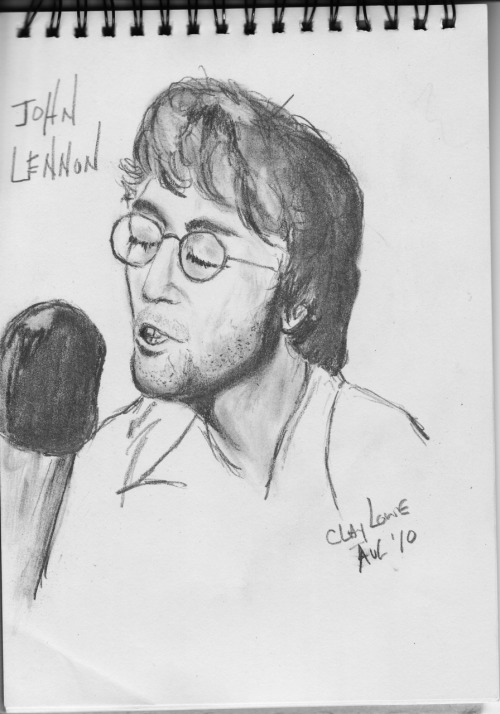
I thought might be time to get back into sketching…great for relaxing and focuses the mind. I sketched this picture of Jonh Lennon on my way home from London late last night.
i’ll see it when i believe it
The visible world is only a construct in your mind. When you see something you are not seeing what is really there. What you are seeing is your visual cortex’s best guess of what is there. Your visual cortex then produces something that nearly resembles the object you believe you are seeing. Most people have, at one time or another, used the phrase: “I’ll believe it when I see it.” in reality it is more likely: “I’ll see it when I believe it.”
Milton Glaser’s Great Rules For Life

Loving this…
Ten Things I have Learned
Part of AIGA Talk in London, November 22, 2001
Now on www.miltonglaser.com
Please check out Milton Glaser’s site here and you can find the original essay here.
1. YOU CAN ONLY WORK FOR PEOPLE THAT YOU LIKE.
This is a curious rule and it took me a long time to learn because in fact at the beginning of my practice I felt the opposite. Professionalism required that you didn’t particularly like the people that you worked for or at least maintained an arms length relationship to them, which meant that I never had lunch with a client or saw them socially. Then some years ago I realised that the opposite was true. I discovered that all the work I had done that was meaningful and significant came out of an affectionate relationship with a client. And I am not talking about professionalism; I am talking about affection. I am talking about a client and you sharing some common ground. That in fact your view of life is someway congruent with the client, otherwise it is a bitter and hopeless struggle.
2. IF YOU HAVE A CHOICE NEVER HAVE A JOB.
One night I was sitting in my car outside Columbia University where my wife Shirley was studying Anthropology. While I was waiting I was listening to the radio and heard an interviewer ask ‘Now that you have reached 75 have you any advice for our audience about how to prepare for your old age?’ An irritated voice said ‘Why is everyone asking me about old age these days?’ I recognised the voice as John Cage. I am sure that many of you know who he was – the composer and philosopher who influenced people like Jasper Johns and Merce Cunningham as well as the music world in general. I knew him slightly and admired his contribution to our times. ‘You know, I do know how to prepare for old age’ he said. ‘Never have a job, because if you have a job someday someone will take it away from you and then you will be unprepared for your old age. For me, it has always been the same every since the age of 12. I wake up in the morning and I try to figure out how am I going to put bread on the table today? It is the same at 75, I wake up every morning and I think how am I going to put bread on the table today? I am exceedingly well prepared for my old age’ he said.
3. SOME PEOPLE ARE TOXIC AVOID THEM.
This is a subtext of number one. There was in the sixties a man named Fritz Perls who was a gestalt therapist. Gestalt therapy derives from art history, it proposes you must understand the ‘whole’ before you can understand the details. What you have to look at is the entire culture, the entire family and community and so on. Perls proposed that in all relationships people could be either toxic or nourishing towards one another. It is not necessarily true that the same person will be toxic or nourishing in every relationship, but the combination of any two people in a relationship produces toxic or nourishing consequences. And the important thing that I can tell you is that there is a test to determine whether someone is toxic or nourishing in your relationship with them. Here is the test: You have spent some time with this person, either you have a drink or go for dinner or you go to a ball game. It doesn’t matter very much but at the end of that time you observe whether you are more energised or less energised. Whether you are tired or whether you are exhilarated. If you are more tired then you have been poisoned. If you have more energy you have been nourished. The test is almost infallible and I suggest that you use it for the rest of your life.
4. PROFESSIONALISM IS NOT ENOUGH or THE GOOD IS THE ENEMY OF THE GREAT.
Early in my career I wanted to be professional, that was my complete aspiration in my early life because professionals seemed to know everything – not to mention they got paid for it. Later I discovered after working for a while that professionalism itself was a limitation. After all, what professionalism means in most cases is diminishing risks. So if you want to get your car fixed you go to a mechanic who knows how to deal with transmission problems in the same way each time. I suppose if you needed brain surgery you wouldn’t want the doctor to fool around and invent a new way of connecting your nerve endings. Please do it in the way that has worked in the past.
Unfortunately in our field, in the so-called creative – I hate that word because it is misused so often. I also hate the fact that it is used as a noun. Can you imagine calling someone a creative? Anyhow, when you are doing something in a recurring way to diminish risk or doing it in the same way as you have done it before, it is clear why professionalism is not enough. After all, what is required in our field, more than anything else, is the continuous transgression. Professionalism does not allow for that because transgression has to encompass the possibility of failure and if you are professional your instinct is not to fail, it is to repeat success. So professionalism as a lifetime aspiration is a limited goal.
5. LESS IS NOT NECESSARILY MORE.
Being a child of modernism I have heard this mantra all my life. Less is more. One morning upon awakening I realised that it was total nonsense, it is an absurd proposition and also fairly meaningless. But it sounds great because it contains within it a paradox that is resistant to understanding. But it simply does not obtain when you think about the visual of the history of the world. If you look at a Persian rug, you cannot say that less is more because you realise that every part of that rug, every change of colour, every shift in form is absolutely essential for its aesthetic success. You cannot prove to me that a solid blue rug is in any way superior. That also goes for the work of Gaudi, Persian miniatures, art nouveau and everything else. However, I have an alternative to the proposition that I believe is more appropriate. ‘Just enough is more.’
6. STYLE IS NOT TO BE TRUSTED.
I think this idea first occurred to me when I was looking at a marvellous etching of a bull by Picasso. It was an illustration for a story by Balzac called The Hidden Masterpiece. I am sure that you all know it. It is a bull that is expressed in 12 different styles going from very naturalistic version of a bull to an absolutely reductive single line abstraction and everything else along the way. What is clear just from looking at this single print is that style is irrelevant. In every one of these cases, from extreme abstraction to acute naturalism they are extraordinary regardless of the style. It’s absurd to be loyal to a style. It does not deserve your loyalty. I must say that for old design professionals it is a problem because the field is driven by economic consideration more than anything else. Style change is usually linked to economic factors, as all of you know who have read Marx. Also fatigue occurs when people see too much of the same thing too often. So every ten years or so there is a stylistic shift and things are made to look different. Typefaces go in and out of style and the visual system shifts a little bit. If you are around for a long time as a designer, you have an essential problem of what to do. I mean, after all, you have developed a vocabulary, a form that is your own. It is one of the ways that you distinguish yourself from your peers, and establish your identity in the field. How you maintain your own belief system and preferences becomes a real balancing act. The question of whether you pursue change or whether you maintain your own distinct form becomes difficult. We have all seen the work of illustrious practitioners that suddenly look old-fashioned or, more precisely, belonging to another moment in time. And there are sad stories such as the one about Cassandre, arguably the greatest graphic designer of the twentieth century, who couldn’t make a living at the end of his life and committed suicide.
But the point is that anybody who is in this for the long haul has to decide how to respond to change in the zeitgeist. What is it that people now expect that they formerly didn’t want? And how to respond to that desire in a way that doesn’t change your sense of integrity and purpose.
7. HOW YOU LIVE CHANGES YOUR BRAIN.
The brain is the most responsive organ of the body. Actually it is the organ that is most susceptible to change and regeneration of all the organs in the body. I have a friend named Gerald Edelman who was a great scholar of brain studies and he says that the analogy of the brain to a computer is pathetic. The brain is actually more like an overgrown garden that is constantly growing and throwing off seeds, regenerating and so on. And he believes that the brain is susceptible, in a way that we are not fully conscious of, to almost every experience of our life and every encounter we have. I was fascinated by a story in a newspaper a few years ago about the search for perfect pitch. A group of scientists decided that they were going to find out why certain people have perfect pitch. You know certain people hear a note precisely and are able to replicate it at exactly the right pitch. Some people have relevant pitch; perfect pitch is rare even among musicians. The scientists discovered – I don’t know how – that among people with perfect pitch the brain was different. Certain lobes of the brain had undergone some change or deformation that was always present with those who had perfect pitch. This was interesting enough in itself. But then they discovered something even more fascinating. If you took a bunch of kids and taught them to play the violin at the age of 4 or 5 after a couple of years some of them developed perfect pitch, and in all of those cases their brain structure had changed. Well what could that mean for the rest of us? We tend to believe that the mind affects the body and the body affects the mind, although we do not generally believe that everything we do affects the brain. I am convinced that if someone was to yell at me from across the street my brain could be affected and my life might changed. That is why your mother always said, ‘Don’t hang out with those bad kids.’ Mama was right. Thought changes our life and our behaviour. I also believe that drawing works in the same way. I am a great advocate of drawing, not in order to become an illustrator, but because I believe drawing changes the brain in the same way as the search to create the right note changes the brain of a violinist. Drawing also makes you attentive. It makes you pay attention to what you are looking at, which is not so easy.
8. DOUBT IS BETTER THAN CERTAINTY.
Everyone always talks about confidence in believing what you do. I remember once going to a class in yoga where the teacher said that, spirituality speaking, if you believed that you had achieved enlightenment you have merely arrived at your limitation. I think that is also true in a practical sense. Deeply held beliefs of any kind prevent you from being open to experience, which is why I find all firmly held ideological positions questionable. It makes me nervous when someone believes too deeply or too much. I think that being sceptical and questioning all deeply held beliefs is essential. Of course we must know the difference between scepticism and cynicism because cynicism is as much a restriction of one’s openness to the world as passionate belief is. They are sort of twins. And then in a very real way, solving any problem is more important than being right. There is a significant sense of self-righteousness in both the art and design world. Perhaps it begins at school. Art school often begins with the Ayn Rand model of the single personality resisting the ideas of the surrounding culture. The theory of the avant garde is that as an individual you can transform the world, which is true up to a point. One of the signs of a damaged ego is absolute certainty.
Schools encourage the idea of not compromising and defending your work at all costs. Well, the issue at work is usually all about the nature of compromise. You just have to know what to compromise. Blind pursuit of your own ends which excludes the possibility that others may be right does not allow for the fact that in design we are always dealing with a triad – the client, the audience and you.
Ideally, making everyone win through acts of accommodation is desirable. But self-righteousness is often the enemy. Self-righteousness and narcissism generally come out of some sort of childhood trauma, which we do not have to go into. It is a consistently difficult thing in human affairs. Some years ago I read a most remarkable thing about love, that also applies to the nature of co-existing with others. It was a quotation from Iris Murdoch in her obituary. It read ‘ Love is the extremely difficult realisation that something other than oneself is real.’ Isn’t that fantastic! The best insight on the subject of love that one can imagine.
9. ON AGING.
Last year someone gave me a charming book by Roger Rosenblatt called ‘Ageing Gracefully’ I got it on my birthday. I did not appreciate the title at the time but it contains a series of rules for ageing gracefully. The first rule is the best. Rule number one is that ‘it doesn’t matter.’ ‘It doesn’t matter that what you think. Follow this rule and it will add decades to your life. It does not matter if you are late or early, if you are here or there, if you said it or didn’t say it, if you are clever or if you were stupid. If you were having a bad hair day or a no hair day or if your boss looks at you cockeyed or your boyfriend or girlfriend looks at you cockeyed, if you are cockeyed. If you don’t get that promotion or prize or house or if you do – it doesn’t matter.’ Wisdom at last. Then I heard a marvellous joke that seemed related to rule number 10. A butcher was opening his market one morning and as he did a rabbit popped his head through the door. The butcher was surprised when the rabbit inquired ‘Got any cabbage?’ The butcher said ‘This is a meat market – we sell meat, not vegetables.’ The rabbit hopped off. The next day the butcher is opening the shop and sure enough the rabbit pops his head round and says ‘You got any cabbage?’ The butcher now irritated says ‘Listen you little rodent I told you yesterday we sell meat, we do not sell vegetables and the next time you come here I am going to grab you by the throat and nail those floppy ears to the floor.’ The rabbit disappeared hastily and nothing happened for a week. Then one morning the rabbit popped his head around the corner and said ‘Got any nails?’ The butcher said ‘No.’ The rabbit said ‘Ok. Got any cabbage?’
10. TELL THE TRUTH.
The rabbit joke is relevant because it occurred to me that looking for a cabbage in a butcher’s shop might be like looking for ethics in the design field. It may not be the most obvious place to find either. It’s interesting to observe that in the new AIGA’s code of ethics there is a significant amount of useful information about appropriate behaviour towards clients and other designers, but not a word about a designer’s relationship to the public. We expect a butcher to sell us eatable meat and that he doesn’t misrepresent his wares. I remember reading that during the Stalin years in Russia that everything labelled veal was actually chicken. I can’t imagine what everything labelled chicken was. We can accept certain kinds of misrepresentation, such as fudging about the amount of fat in his hamburger but once a butcher knowingly sells us spoiled meat we go elsewhere. As a designer, do we have less responsibility to our public than a butcher? Everyone interested in licensing our field might note that the reason licensing has been invented is to protect the public not designers or clients. ‘Do no harm’ is an admonition to doctors concerning their relationship to their patients, not to their fellow practitioners or the drug companies. If we were licensed, telling the truth might become more central to what we do.
(This came to me from Saskia Wilson-Brown via Micah Hahn via Frank Lentz)
“As is the life of the leaves so is that of men. The wind scatters the leaves to the ground: the…”
“As is the life of the leaves so is that of men. The wind scatters the leaves to the ground: the vigorous forest puts forth others, and they grow in the spring season. Soon one generation of men comes another ceases.”
– Homeric passage
a tribute to my mom

GLORIA ANN LOWE… 12/19/1952 – 07/23/2010
“He will wipe every tear from their eyes. There will be no more death or mourning or crying or pain, for the old order of things has passed away.” – Revelation 21:4
My mom passed away last week.
You are never really prepared to hear someone tell you your mother has died, especially when she is relatively young at 58 and no prior warning that her time for walking among us has come to an end. So many emotions are thrown at you at once that you hardly know how or what to feel. Sadness because your mother is gone? Anger because she was taken away suddenly and without warning? Regret because you have not seen her in ages?
And of course, the shock of death always brings one face to face with one’s own mortality. The age difference between me and my mom is only 16 years. Time is tender. Time is fleeting. The hour of our death is unknown. Did my mom do all she came here to do? Did she fulfill all of her hopes and dreams? I think she would say yes. She raised three children mostly on her own. Taught them the difference between right and wrong. She got to see her grandchildren, and she had a strong personal relationship with God being an ordained minister. I think she would say she stood strong in the Lord and is now happy to be called home.
Where does that leave us back here on earth? Deprived of a mother, deprived of a caring human being who did what she could for others without any expectation of return. She would rather suffer in silence than burden others with her troubles, such was her disposition to put others before herself. Her passing leaves us to cary on the good fight, to do the things we were sent here to do, to live up to our fullest potential, to honor her name.
I cannot say that I was extremely close to my mother, when I was young yes, but I left home at 17 to be the man she raised me to be and haven’t been home much since then, but always she was in my thoughts, my heart, my soul and many times I have stopped to reflect on the lessons she taught me as a boy. The greatest gift she gave to me besides life was belief. She taught me always to believe in myself, to never be content to be just another member of the herd, to have the guts to dream and the confidence to pursue those dreams. I am who I am today because of her. I will miss her.
Rest in peace Mom,
Love,
Clay
“Worry is otherwise known as ‘fantasized catastrophizing’ where we create an image of the future and…”
“Worry is otherwise known as ‘fantasized catastrophizing’ where we create an image of the future and use it to frighten ourselves! Be aware that you are doing it, then stop doing it, otherwise the image will become a self fulfilling prophesy. Imagine only the brightest future, and so it will be. Besides there is nothing to worry about… unless you are under the illusion that your well-being and security are dependent on material things. If they are, then you will have many ways in which you can create worry. Possible loss, damage, separation, uncertainty are but a few. Look, you’re killing yourself with worry, all because of the misuse of your imagination. Don’t do it.”
– Innerspace (via bodymindandsoul) (via dysfunctionalhippie)
“When will you begin to live virtuously, Plato asked an old man who was telling him that he was…”
“When will you begin to live virtuously, Plato asked an old man who was telling him that he was attending a series of lectures on virtue. One must not just speculate for ever; one must one day also think about actual practice. But today we think those who live as they teach are dreamers.”
– Immanuel Kant
“If you are distressed by any external thing, it is not this thing which disturbs you, but your own…”
“If you are distressed by any external thing, it is not this thing which disturbs you, but your own judgements about it. And it is in your power to wipe out that judgement now.”
– Marcus Aurelius
“Measure life in loan payments and time quickly runs out; measure life by infinite values and time…”
“Measure life in loan payments and time quickly runs out; measure life by infinite values and time keeps out of the way.”
– Henry David Thoreau
“In the visible world, the Milky Way is a tiny fragment; within this fragment, the solar system is an…”
“In the visible world, the Milky Way is a tiny fragment; within this fragment, the solar system is an infinitesimal speck, and of the speck our planet is a microscopic dot. On this dot, tiny lumps of impure carbon and water, of complicated structure, with somewhat unusual physical and chemical qualities, crawl about for a few years, until they are dissolved again into the elements of which they are compounded.”
– Betrand Russell
time to ponder or ponder time
I’ve been working flat out over the last 3 months or so getting up at 0430 to be out the door by 0545 to catch the 0620 train to London (a journey that takes me about two hours), out the door at the place I am working by 1730 to catch the 1800 train back to Leamington Spa (another two hour journey to get home), workout, eat, answer emails, sleep, then start the process over again. My weekends have been just as busy – mountain walks, country walks, visiting the in-laws. This weekend, I made the conscious choice to simply chill out, stay in the castle keep, and enjoy my home. I needed the time to reflect. My mother is not doing very well at the moment and there is an ocean between us so I am only able to get updates from my sister and brother. Times like these, of course, force you to think about your own time – how you are spending it and with whom you are spending it, how much of it you have left, and what you want to do with it. Yeah, so, this weekend I am taking time out to relax and think about life for a while.
“We turn clay to make a vase; but it is in the spaces where there is nothing that the usefulness of…”
“We turn clay to make a vase; but it is in the spaces where there is nothing that the usefulness of the vase depends. Just as we take advantage of what is, we should recognize the usefulness of what is not.”
– Lao Tzu