The brain is a meaning-making machine. It’s constantly trying to connect dots, predict what happens next, and turn scattered information into a coherent shape.
When everything is already explained, the pattern is complete. The brain can relax or get bored.
But when there is uncertainty like a missing piece, an unanswered question, a strange detail, or an unfinished story, the brain becomes more alert. It “leans forward” psychologically, searching for the pattern that will resolve the tension.
The uncertainty creates an open loop. We want closure, so we keep reading, watching, listening, or exploring.
In writing, this means you don’t always need to explain everything immediately. Sometimes the most compelling sentence is the one that creates a gap in the reader’s understanding:
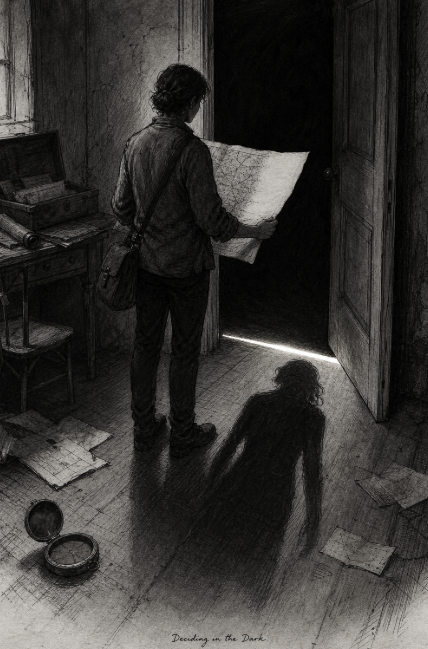
I had walked down that street hundreds of times. This was the first time I noticed the door.
Now the reader’s brain starts working: What door? Why hadn’t he seen it? What is behind it?
I have been reading an old mythogeography interview with Phil Smith. The thread has me thinking about walking, place, story, performance, and the odd things that gather around a route once I stop treating it as just a way of getting somewhere.
On my own much smaller patch of ground, that might mean the walk to the gym with my Plaud running, capturing the ordinary moments of people beginning their day. Or it might be a half-formed thought about the old industrial clock that The Man uses to keep us marching in step. Or maybe it’s a line lifted from a book I’m reading over coffee.
None of it needs to arrive as an insight.
That’s what I mean when I say everything becomes source material. Left alone, that phrase can sound like a content marketer’s battle cry if you leave it there. I mean something quieter than that. The world keeps handing over fragments. My job is to notice them, carry them for a while, remix them with whatever else is already moving through me, then put them back into the stream.
The page is another stretch of the path. The walk ends, but the thread carries on through a link, a voice memo, or a sentence that caught on something and refused to let go.
Sometimes the whole practice is just this: notice what caught you, follow it for a few steps, and leave the door open.
The person who most needs to change is usually the last person who can accurately judge what the change will ask of them.
I keep coming back to this because it sits underneath almost every serious conversation about inner work. Someone arrives at the edge of a change. A burnt-out executive who can no longer pretend the old success story is enough. A trainer wondering what their practice becomes in an AI-shaped world. A person who has carried the same story about themselves for so long that it has started to feel less like a story and more like the walls of the room.
Sooner or later, the same question appears.
If I do this, what will I get?
It is a fair question. Most of life teaches us to decide this way. Gather the facts. Weigh the costs. Imagine the possible outcomes. Choose the path with the best return. It works well enough when the choice sits outside us. Buy the thing. Take the job. Book the trip. Sign up for the course.
It starts to fail when the choice involves the person doing the choosing.
That is the strange little knot at the centre of transformation. You are trying to evaluate the territory using your current map, while the work itself is going to change the map. Real inner change does not simply add new information to the person you already are. It changes the frame through which information becomes meaningful in the first place. It alters what you notice, what you value, what feels possible, what feels dangerous, what counts as evidence, and what your body reads as a threat.
So the question becomes almost comic in its difficulty. How do I decide whether to undergo a process that will change the self who is making the decision?
The philosopher L.A. Paul calls these transformative experiences. Her work is wonderfully precise on this point. Some experiences cannot be known from the outside, no matter how much information we gather about them. We can read the books, talk to people who have gone through them, listen carefully, make lists, and imagine scenarios. Still, the actual knowing is unavailable until the experience has altered us.
Becoming a parent is one of Paul’s examples. It works because everyone understands the absurdity of thinking research can deliver the experience in advance. You can read every parenting book on the shelf and still not know what it is like to be the person whose life has been rearranged by a child. You do not lack information. You lack the self that only the experience produces.
That is the part we tend to avoid.
We want the transformed self to send back a report. A postcard from the far side. “Yes, this was worth it. Here is what it cost. Here is who you become. Here is the guarantee.” But the self on the far side cannot brief the self at the threshold. The bridge only runs one way.
Inner work has this same structure. The version of you that needs to change is the version voting on whether to begin. And that version is working from a map built out of old experiences, inherited stories, loyalties, wounds, triumphs, defences, and all the private weather that makes a life feel like itself.
That map is not neutral. It is not a clean instrument sitting on the table. It is the thing being examined.
I spent more than two decades watching people come back from training programmes lit up by insight. New frameworks. New tools. Real moments in the room. You could feel the charge in them. Then, almost every time, the old pattern reassembled itself over the next couple of weeks. The fire did not vanish because the insight was fake. It vanished because the insight had landed as content inside an unchanged structure.
That distinction matters.
Content change gives you something new inside the old frame. A model. A technique. A sentence to remember. Structural change alters the frame itself. It changes the room in which the sentence makes sense. The first can be uncomfortable. The second is disorienting. Not because it has gone wrong, but because disorientation is what it feels like when the old map stops being sovereign.
This is where the old NLP presupposition becomes more interesting than its motivational-poster version: people already have the resources they need.
That does not mean change is easy. It does not mean everyone is secretly fine if they just believe harder. It means the missing resource is not always outside the system. Often it is buried, exiled, unused, badly named, or locked behind an old defence that once had a job to do. The work is not about importing a new self from elsewhere. It is about making contact with a possible self already present in the field.
That softens the fear without removing the mystery. You are not agreeing to become a stranger. You are agreeing to walk toward a room in your own house that you have not entered for a long time. The room is yours. The house is yours. But you still do not know what is waiting there until you open the door.
And the part of you that locked the door may not be the part of you now standing in the hallway.
Jung would call this shadow work. The meeting with what has been pushed out of sight, projected onto other people, buried under competence, wrapped in humour, turned into a preference, and made respectable through story. The shadow rarely arrives as a gift basket. It usually arrives as irritation, envy, overreaction, shame, fatigue, fascination, a dream you cannot shake, or a pattern you keep pretending not to see.
This is why real inner work often feels less like expansion at first and more like confrontation. You are not simply gaining a new capability. You are dissolving a defence that may have been built for very good reasons. Some younger version of you made a bargain with reality. It worked well enough to get you here. Now the same bargain is asking to be renegotiated.
From the outside, you cannot fully know what that will require.
The alchemists had a better image for this than most modern personal development language. Nigredo. The blackening. The stage where the material breaks down before it can be reformed. The work goes dark. The old clarity becomes suspect. The tidy identity starts to smoke at the edges. You cannot stand at a safe distance from that process and calculate its exact value, because the calculating mind is part of the material in the vessel.
This is the difference between skills training and transformation.
Skills training gives you something new to do. It adds to the map. Transformation changes the mapmaker.
I don’t say this to make inner work sound grand or dangerous. I say it because a lot of people approach transformation with a decision-making model that belongs to smaller choices. They want certainty before they begin. They want to know who they will be on the other side before agreeing to cross the threshold. That is human. Of course we want that. The nervous system likes a forecast.
But the forecast is not available.
What is available is a different question. Paul suggests that in the face of a genuinely transformative decision, the rational question is not simply, “Will I be better off?” because the future self who would answer that question does not yet exist for us. The better question is closer to: “Is discovering who I will become worth doing for the sake of the discovery itself?”
That changes the shape of consent.
You are no longer signing up for a guaranteed outcome. You are agreeing to an encounter. You are saying yes to the possibility that the self who began will not be the self who finishes and that this is not a flaw in the process. It is the point.
The two years I spent working through my own identity and practice direction were like that. I could not have mapped them in advance. If you had asked me at the beginning what the work would lead to, I would have given you an answer from inside the very frame I was about to question. I would have tried to solve the problem using the mind that had helped create it.
At some point, that stopped working.
I had to put the old map down for a while. Not dramatically. No cinematic burning of the past. More like setting a heavy bag on the ground after carrying it for so long that I had started to think the ache was part of my personality. The uncertainty was not pleasant. It rarely is. But the work that came out of it is more coherent, more alive, and more mine than anything I could have designed from the position I was in before the work began.
That is the paradox. The old self wants a business case for becoming the new self. But the business case is written in the old language. It cannot account for values that have not yet awakened, desires that have not yet been permitted, capacities that have not yet been trusted, or forms of honesty the current self still experiences as a threat.
The Daoist in me trusts this more than the strategist in me does.
The path unfolds as the walking changes the walker. That is not passivity. It is a disciplined form of trust. You still choose. You still pay attention. You still take responsibility for the next step. But you stop demanding that the map of here prove the existence of there before you move.
You can’t get there from here using only the map of here.
The version of you that needs to change is the only version who gets to decide whether to begin. That version will never have complete information. It can’t. The information it wants belongs to the self that the journey will make.
So the question is not whether you can decide with certainty.
You can’t.
The question is whether the discovery is calling loudly enough to step into the dark.
There is a particular comedy in being your own publisher, your own platform, your own little one-person media empire.
The upside is freedom.
The downside is that when the site falls over, there is no calm tech team in matching hoodies quietly restoring the kingdom while you sip coffee and think writerly thoughts.
It’s just you.
You and the critical error message.
Which is how I found myself this morning laughing at the strange bargain I’ve made with the open web. I left Substack last year because I didn’t want to build my house inside someone else’s walled garden. I wanted sovereignty. My own domain. My own server. My own little patch of digital ground.
And then, naturally, my patch of digital ground went face down in the mud.
The irony arrived by way of an app called Kerouac, which, with a name like that, was always going to get my attention. It bills itself as a studio for pro bloggers, pulling together posts, drafts, ideas, pipelines, feeds, and whatever other fragments of a writing life are scattered across the web.
I signed up for the free trial. No credit card. Low commitment. Maximum curiosity.
My first impression: too much structure. Too many panes. A little too much productivity inducing anxiety for my taste. But it also has a discovery feed, and that led me to JA Westenberg, whose work I’ve followed and liked for a while.
From there I ended up back in the Substack flow, reading her notes, posts, linked videos, and newsletters all stitched together in one clean stream. I had to admit, grudgingly, that it worked. There was cohesion. A centre of gravity. A single place where the work gathered and pointed outward.
And then I clicked over to my own site to ponder its cohesion.
Critical error.
Beautiful timing, really.
There I was, admiring the elegant flow of a platform I had left because I didn’t want to be owned by it, only to be reminded that independence comes with maintenance costs. If you want the freedom of the road, you also have to know what to do when the van breaks down.
This is the bit we don’t always talk about in the romance of the indie web. Owning your platform is noble. It is also admin. It is backups, updates, plugins, hosting, monitoring, and occasionally staring at a broken homepage while wondering if “pro blogger” is too generous a category for a man whose blog is currently unconscious.
Still, I don’t think this is an argument against owning your work.
It is just a reminder that ownership is not an aesthetic. It is a practice.
You don’t get to claim the open road and then complain there’s no concierge.
The other timely thing was Westenberg’s post about the humble Moleskine notebook. I’ve been having my own notebook renaissance lately, using paper again as a visual thinking tool. Less dashboard, more scratchpad. Less system, more contact.
Maybe that is the shape I’m after online too.
Not more platforms. Not more clever pipes.
A notebook with a door.
A place where the thinking can happen in public, where the fragments can gather, where the trail is visible, and where, yes, I occasionally have to crawl under the bonnet myself.
That might be the real bargain of the indie web:
freedom, but with spanners.
Update:
I wrote the above earlier this morning. I have since connected my blog to the app. And I must say, I really like the insights page.
I’m sure one of the worst nightmares for any parent is your child going missing.
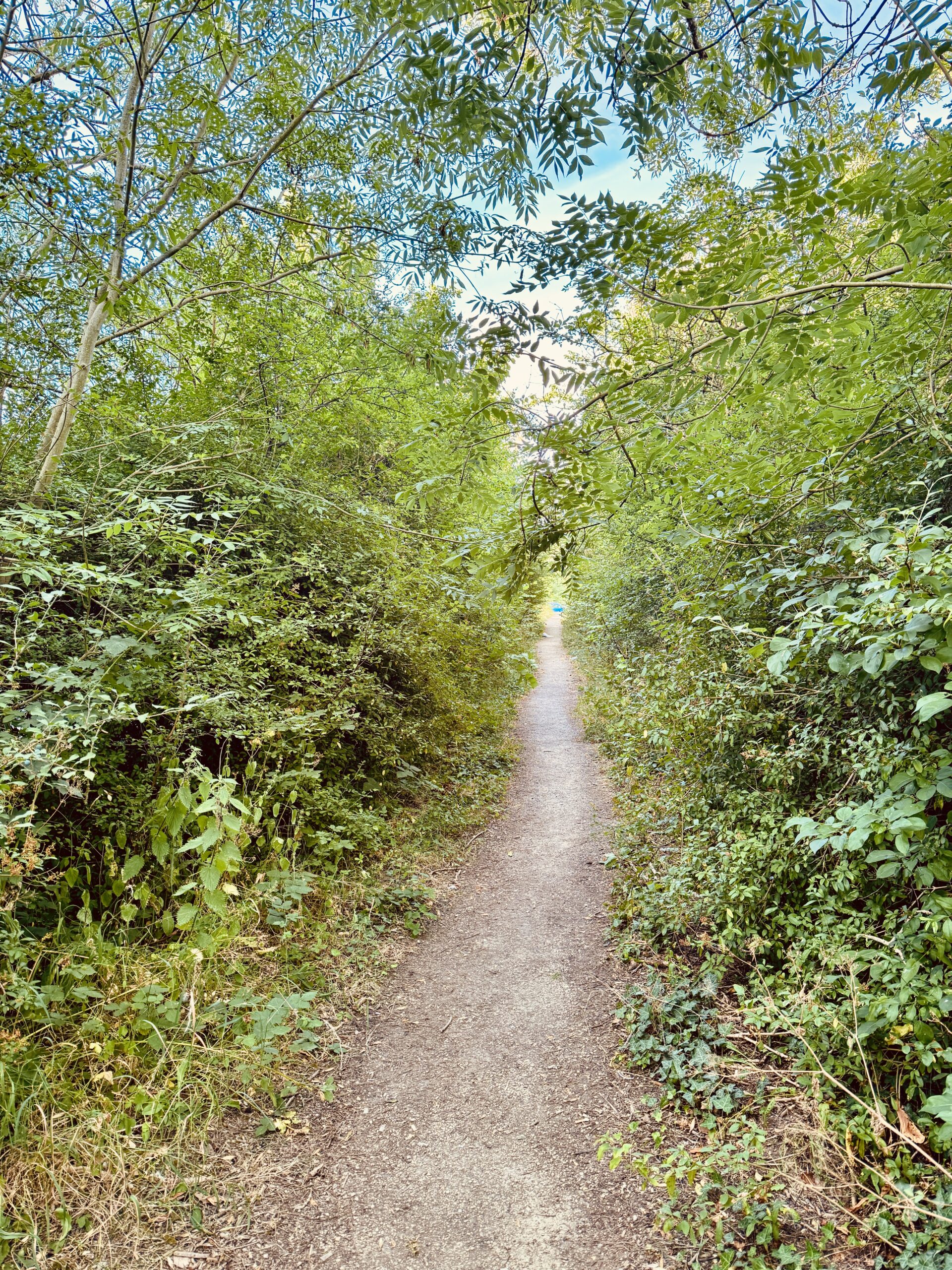
I was out on my morning Wisdom Walk today and noticed an unusual number of people in the fields where I usually walk. There are often dog walkers about, but this felt different.
At one point, I saw a woman looking into an old cowshed. I thought maybe she was a photographer trying to catch the shed in the morning light. But then she came toward me and explained that she was searching for a young girl who had gone missing. No one had seen or heard from her since about 5 PM yesterday. According to her cousin, who posted the callout to the community on our local news group on Facebook, the girl has no mobile phone or money.
Suddenly, I felt the dread that all those people out searching must have been carrying.
I checked the Facebook group to get more details and to see what the girl looked like so I could keep an eye out for her as I completed my circuit around the fields.
If you felt that same dread as I was telling this story, you can relax now too. The young girl has been found. There are no details yet, but it appears she is unharmed..
I’ve been thinking about vaporwave as more than an internet aesthetic.
Yes, it gives us the pink neon, the Greek busts, the dead malls, the Japanese text, the VHS blur, the Windows 95 ghosts, and the palm trees under impossible sunsets. But beneath all that surface noise, something stranger is happening.
Vaporwave feels like a walk through the ruins of a future we once believed in. The smooth corporate dream. The frictionless lifestyle. The shopping mall as a public square. The early internet as a frontier. The screen as a doorway. The brand as an identity. The promise that technology would make life lighter, easier, and more open.
Somewhere along the way, that promise curdled.
So I made this as a small interactive HTML zine. A haunted little mall you can wander through. Part essay, part digital ruin, part neon archaeology.
Bring your nostalgia. Bring your suspicion. Bring whatever part of you still remembers the sound of a computer starting up and feeling, for a second, like the world might open. Enjoy exploring the page.
I have made a public service announcement for the modern age.
I’m sure you’ll be pleased to know that it’s not about AI or about the collapse of Western civilization or the latest release of the iphone.
No.
This one concerns the ancient human problem of what happens when someone leaves the loo in a condition that suggests the next visitor may need counseling.
I’ve spent enough time in campsite toilet blocks to know that civilisation is not held together by constitutions, parliaments, or leadership frameworks. It’s held together by small acts of decency performed in shared spaces.
Wiping down the sink.
Not leaving your wet socks on the only dry bench.
Closing the door properly.
And, when required, flushing twice.
There I said it.
The thing I like about campsites is the diversity. The retired couple in the motorhome. The family in the giant tent that takes four adults and a minor engineering qualification to assemble. The solo walker. The festival survivor. The glampers. The bloke in sliders carrying a towel and trying to look like he knows where the showers are.
All of us are equal before the porcelain.
But every now and then you get someone who plays loose with bogside etiquette and leaves a deuce floating around. Not cool.
Please leave these facilities as you would wish to find them. That’s how most of the signs go.
But sometimes the situation calls for poetry.
So I made a sign.
Here it is, my contribution to civic life:
It’s available for purchase on my Redbubble site as an artboard print or sticker.
So if you run a campsite, a caravan park, a glamping site, a pub, a cabin, a holiday let, or simply have a bathroom that needs a little more comic authority, you can find it here:
Last thing, shared spaces need shared rituals. A sign like this is ridiculous, yes, but it’s also a tiny nudge toward care. It says, “Someone else is coming in after you, pal, so don’t leave them your unfinished business.”
That’s not a bad rule for life, really.
Anyway, the sign exists now.
May your toilets be clean, your paper plentiful, and your flushes decisive.
The ground beneath our feet is layered with stories. Streets carry memories. Landscapes hold arguments. A statue, a sign, a fence, an empty building – each one quietly tells us something about power, belonging, and how we are allowed to move through the world.
Smith’s radical walker becomes part explorer, part artist, part troublemaker. Someone who looks for the cracks. Someone who questions the map they have been handed.
But what I enjoyed about Wilson’s reflection is that he doesn’t simply follow the trail. He pushes back. He questions the radical angle:
Must every walk become an act of resistance? Must every footstep carry a manifesto?
Maybe walking’s magic is that it refuses to stay in one lane. It can challenge, bear witness, or be a source of wonder. Likewise, the walker can hack the city, listen to the forest, or simply drift.
And perhaps the cyberflâneur does the same thing in another landscape — following hyperlinks instead of footpaths, wandering through forgotten corners of the web, looking for traces left behind.
Each path changes the walker. Each walker changes the path.
That sounds too ordinary to announce, which is probably why it matters. The gym is only seven minutes away by car. My normal routine is to get in, drive there, work out, drive back, eat something, shower, and be behind the desk by nine like a good citizen of the industrial clock. That’s the sensible move.
The 9-to-5 clock still lives in me. I can feel it. Even now, self-employed, answering to no manager hovering over my shoulder, I can still feel the old tribunal warming itself up somewhere behind my eyes. By nine o’clock, it says, you should be at the machine. You should look available. You should look as if work has started.
But I’d been reading about mythogeography, and the book had me thinking about walking as a way of meeting the world before the day hardens into tasks — the walk itself as the encounter, rather than fitness content, rather than a lifestyle hack with a ring closing at the end of it.
There’s something funny buried in that distinction. For most of human history people walked because they had to. To the next village, the field, the market, the church, the pub, and the place of work. Then the factories arrived, and the whistle, and the shift, and the mass-produced automobile, and life needed standardising to keep the machines running on time. Once walking stopped being necessary, it became romantic. It became leisure. It became something we schedule and recover with, on purpose, because the rest of the day has been arranged to make it unnecessary.
This morning I could feel that little historical joke in my legs.
The efficient version of the morning wanted the car. The wiser version, or at least the version I decided to listen to, wanted the path. So I walked.
A half hour there. An hour’s workout. A half hour back. Two hours, against one hour and fourteen minutes if I’d driven. On paper that’s a bad trade. I spent close to an extra fifty minutes doing what the car could have done in a fraction of the time. But the paper is using the wrong measure. The point was never to get my body from house to gym at maximum efficiency. The point was to be present in the morning instead of managing it, watch-checked and task-shaped, on the way to somewhere else.
I noticed, walking, how quickly my mind wanted to turn inward. I had the recorder going, talking through my thoughts as I went, which is useful and also slightly comic — there I was, trying to practise noticing, while mostly noticing the inside of my own head. The trees were there. The dogs were there. The pavement, the people saying good morning, and the small choreography of an ordinary street going about its business whether or not anyone pays attention to it. And I was “being productive” by running three things at once instead of looking at any of it properly. Something else for me to work on.
The bigger thing I was circling is this: work doesn’t have to happen in front of the screen that’s become the little altar where work proves it exists. The walk wasn’t a delay before the real work started. The walk was part of it. I forget that constantly, paying fealty to the desk as the one legitimate site of thinking when some thoughts flatly refuse to arrive there. Some thoughts need breath. They need footfall, a hedge, a stranger passing at the exact moment a sentence was about to form.
Everything becomes source material out there. Not in the hungry content-machine sense, where every living thing gets stripped for parts and fed into a content calendar. In the older, stranger, more generous sense. The world offers fragments. The walker gathers them. The blogger lays them next to each other and listens for the hum between them.
That’s what mythogeography and remix culture and old-school blogging all seem to share, now that I’m circling it directly. You wander. You collect. You juxtapose without rushing to judge what you’ve picked up. You let the field itself decide what kind of thing wants to come out of it — a walk, a note, a post, a question, a half-formed practice you’ll only recognise as a practice once you’ve done it three or four more times.
What if walking to the gym isn’t inefficient? What if it’s one of the ways I keep finding my way back to the actual ground of the work, rather than the desk that only pretends to be it?
The car would have got me there faster. The walk brought more of me with it.
I keep thinking about the idea of writing an ebook that doesn’t perpetuate the expectation that a book needs to be read in a straight line. I know this isn’t a new idea; that’s what the hypertext movement was all about. But the idea of doing this resurfaced for me again this morning while reading Phil Smith’s book on mythogeography. He has embedded hyperlinks in the ebook that encourage you to go off on tangents.
I like the idea of a reader following whatever catches their attention and being able to move through the text by curiosity rather than obedience.
This interests me because I think many people buy books and never finish them. Maybe part of the problem is the old expectation that a book must be read from cover to cover. We inherit that model from school, from print culture, and from the physical shape of the book itself. But not every book needs to work that way.
Fiction often depends on sequence, especially when it follows a classical story arc. But essays, field notes, philosophical fragments, personal reflections, guides, and idea-books might be better served by a looser structure. A hyperlinked ebook could invite the reader to wander, return, skip, loop, and discover.
The point wouldn’t be to make the book easier in a shallow sense. It would be to make the book more alive to the way people actually read now: dipping in, following associations, chasing questions, and making their own route through the material.
A book like this wouldn’t simply contain links. It would be written as a linked experience. The hyperlinks would become part of the architecture of the text. They would let the reader participate in the journey rather than just consume the sequence chosen by the author.
Maybe the ebook is closer to a living map than just an electronic copy of a physical book.
I fell into this through a glossary. Plaque tournante. The words unsettled me even before I understood what they truly meant. The turning place. Not just some junction where paths cross, but a point where the weight of a single decision bends the rails of your life onto a new course. Like the time I parked my car before formation and a military policeman stopped me for speeding when I wasn’t speeding. It isn’t a crossroads, not really. Crossroads imply options laid out before you, inviting you to pick them. This is different. This is the moment when the path beneath your feet shifts almost imperceptibly. Your weight shifts from something unseen, and suddenly the way forward isn’t just another choice. It’s the only choice that remains. You stand there alone because some choices can’t be shared. They’re too raw, too precise, like a key turning in a lock that no one else can see. The people who love you might walk beside you right up to the edge of that place, but when the time comes, they can’t step over the threshold with you. And that’s the thing about a plaque tournante, it doesn’t just turn the path. It turns you. And no one else can do the turning but you.
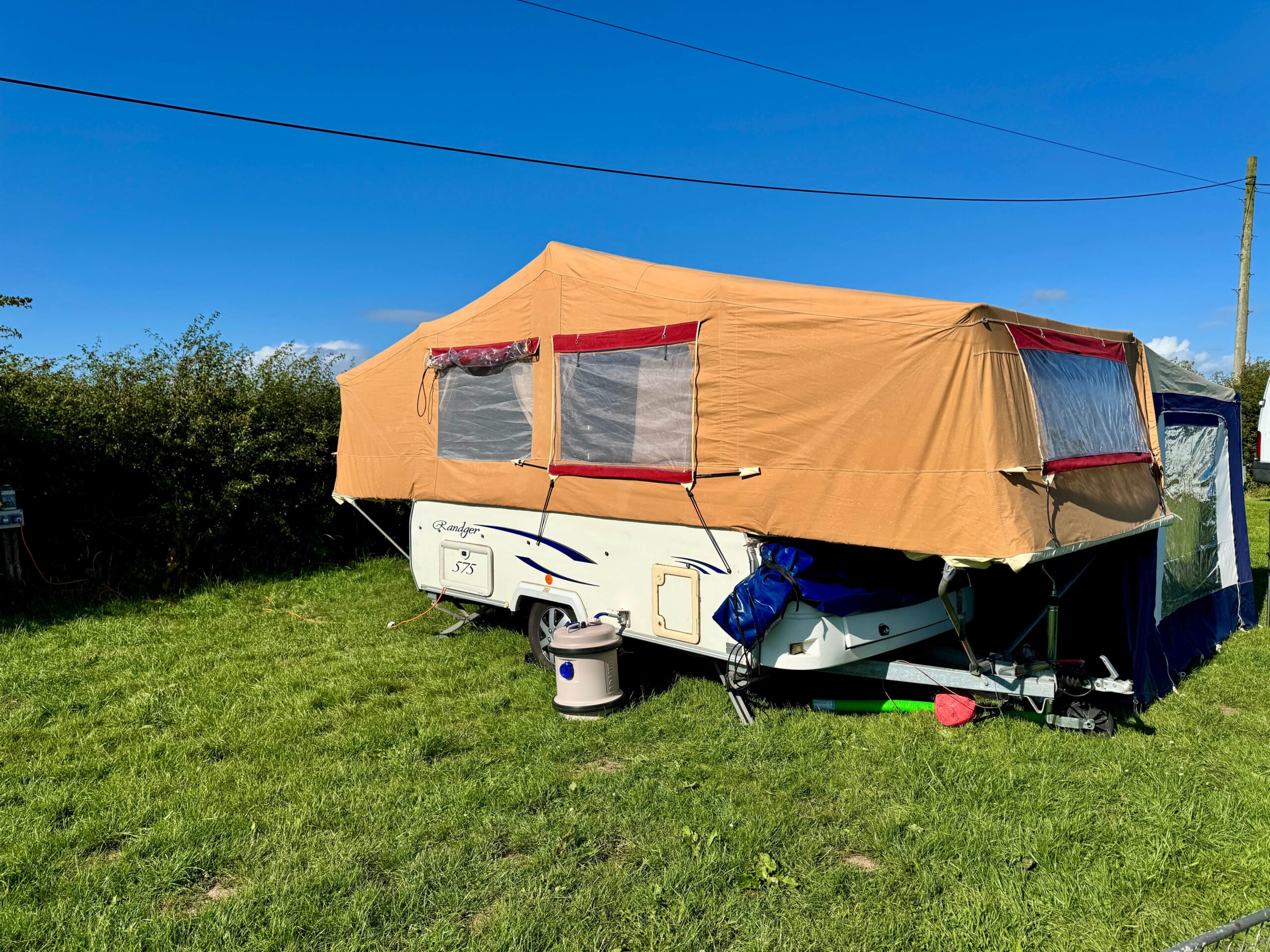
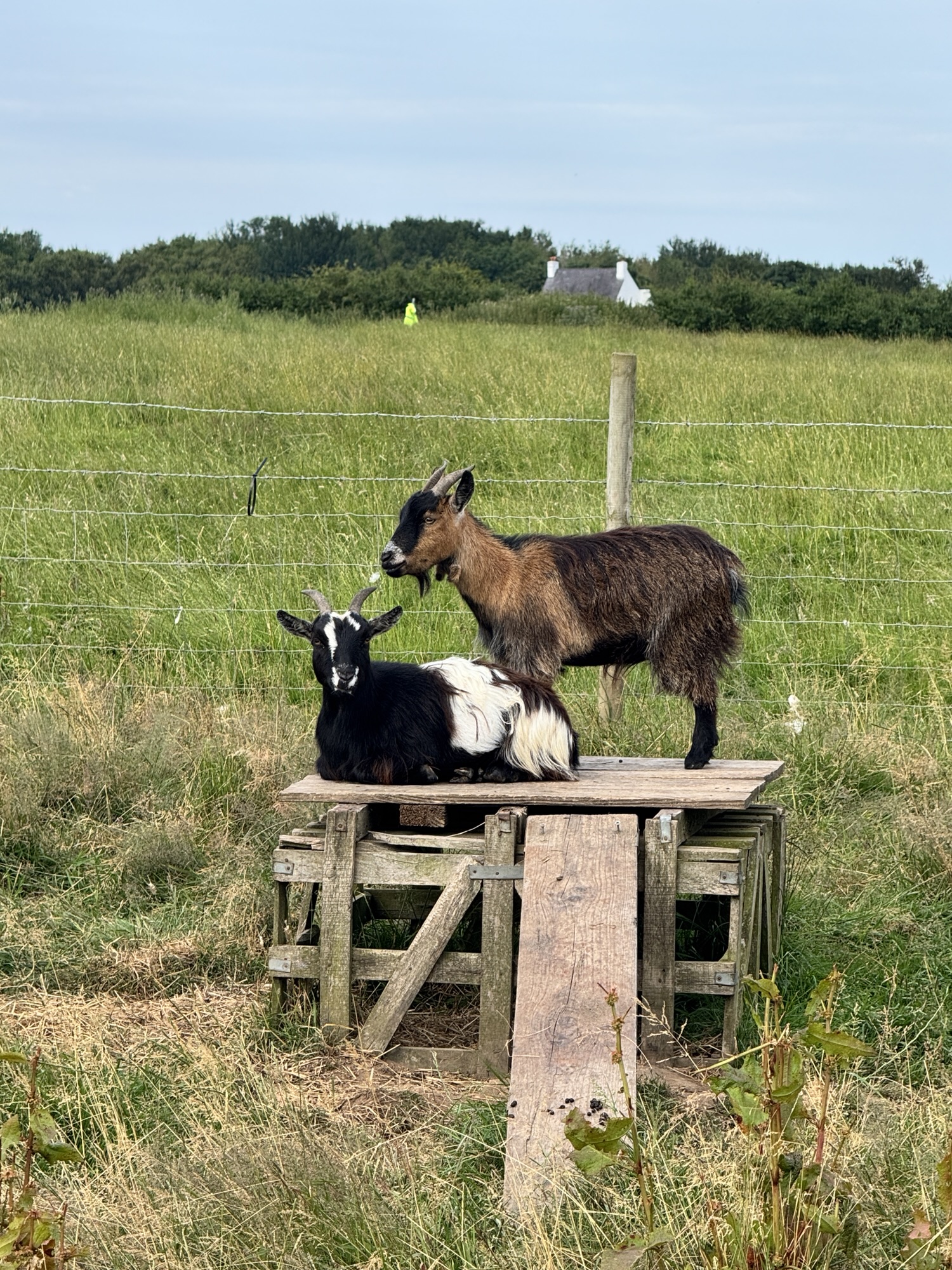
I like sharing a campsite with chickens and goats and sheep. It’s barebones in the best possibble way. Some of these places can be over produced like they’re trying to create a luxury experience in a field.
This place, Grange Farm, is the opposite. It’s just grass, canvas, animals, weather and the small practical ritual of keeping yourself fed, dry, and reasonably human. Although, three days without a shower and I’m starting to feel ferel.
On the first of July I started a 31-day weblogging challenge. I wanted to blog in the original sense of the word: not posts designed around hooks and calls to action, but entries. Entries as field notes, half-formed thoughts, fragments, or full on essays if that’s the way text goes.
Last night I wanted to read something close to the way I’m trying to write. Something observational. Embodied. Simple in time and space. Definitely less theory and more of what is around me.
I was reading Tarot of Self-Discovery, but it was getting heavy with archetypal psychology, and out here I didn’t want more interior landscape. I wanted solid ground.
So I scrolled through the Kindle and found, somehow, a book I don’t remember buying: Mythogeography: A Guide to Walking Sideways. From the title, it sounds like just the thing I’m trying to avoid. But then the subtitle kicks in with this: “compiled from the diaries, manifestos, notes, prospectus, records, and everyday utopias of the pedestrian resistance.”
That felt close to what I wanted.
Especially pedestrian resistance. That sounds intriguing.
There’s something beautifully ridiculous about camping and caravaning.
Looking out across this fieldand I’m thinking at that here we are, modern humans with houses, central heating and air conditioning, broadband, sofas, fitted kitchens, proper beds, cupboards full of things – and for pleasure we hitch a small white box to the back of a car and go sit in a field under a grey sky.
And yet somehow it works.
Maybe the secret to the absurdity is that we’re not really leaving comfort because we hate comfort. We’re leaving it because too much comfort can become stale and invisible. The house becomes so much background noise. And we lose ourselves in the routine of living.
So we drag a miniature home into a patch of grass and make life awkward enough to notice it again.
You become aware of the wind direction, the damp grass, the neighbours you’ll probably never speak to beyond a nod, the small choreography of plugging in, levelling up, putting the steps out, and finding where the toilets are.
It is absurd. But it’s ritual absurdity.
In essence, we’ve setup a temporary village made of caravans, cables, folding tables, dogs, children, gas bottles, mugs of tea, and people pretending not to watch each other reverse badly into pitches. For a weekend, everyone agrees to live slightly closer to the elements and slightly closer to one another.
Maybe the caravan is a compromise between the cave and the house.
Not quite wild.
Not quite domestic.
And maybe that’s why we love it because it loosens the spell of ordinary life just enough for us to feel ourselves living it.
I woke up this morning in my tent thinking about self-validation. That’s the barefoot philosopher taking advantage of a little solitude before the day starts.
If the ego is partly a protection system, can it ever be trusted to validate the self it is trying to protect?
“Know thyself” sounds noble until we remember that the self doing the knowing is also the self editing the footage, hiding the evidence, managing the courtroom, and sometimes bribing the judge.
So yes, self-validation is possible, but probably not as a solitary act of pure inner certainty.
It’s more like a triangulation.
Self-validation is possible, but not self-sufficient
One useful way to see it:
Self-validation is the act of saying: “My experience is real enough to be listened to.”
It doesn’t mean:
my interpretation is correct
my memory is complete
my motives are pure
my wounds are telling the whole truth
my ego has become an impartial witness
It simply means I don’t have to outsource my entire sense of reality before I’m allowed to take myself seriously.
That kind of self-validation is necessary. Without it, we become dependent on other people to certify our existence. We keep asking the village, the partner, the audience, the algorithm, the therapist, the friend group: Am I allowed to feel this? Am I allowed to want this? Am I allowed to be this?
But the opposite danger is just as real: the sealed ego-capsule. The person who “validates themselves” so completely that no outside voice can ever enter. Every criticism becomes projection. Every rupture becomes someone else’s trauma response. Every uncomfortable mirror is dismissed as “low vibration” or “not aligned.”
That’s not sovereignty either. That’s you living inside a reality tunnel with blinders on.
Others are not the source of truth, but they are part of the mirror-system
I don’t think we need others to grant us validity.
But we do need others to help us perceive our shape.
You can know your inner experience directly. You can know what it feels like from the inside to be you. But you can’t fully know your impact from the inside. You can’t entirely see your tone, your pattern, your avoidance, your charisma, your repetition, your blind spot, or your defensive move.
Other people give us something we can’t manufacture alone: the view from outside the nervous system.
Not always accurately, of course. Other people are also distorted mirrors. They come with their own wounds, projections, agendas, cultural scripts, needs, and unfinished business. So the trick is not “believe yourself” or “believe others.”
The trick is: learn to read the mirrors.
Some mirrors clarify.
Some mirrors warp.
Some mirrors punish you for having a self.
Some mirrors flatter the mask and never touch the soul.
Some mirrors only show you who you are in relation to their hunger.
And occasionally, blessedly, someone reflects you back in a way that makes you more honest, not smaller.
“Know thyself” may require being known
Maybe the old command needs a companion phrase:
Know thyself — but do not attempt it alone.
The self is relational. We are not sealed objects. We are patterns of body, memory, story, desire, fear, habit, longing, gesture, and response. Some parts of us only appear in solitude. Some only appear in conflict. Some only appear in love. Some only appear when we are misunderstood. Some only appear when someone sees us more clearly than we were ready for.
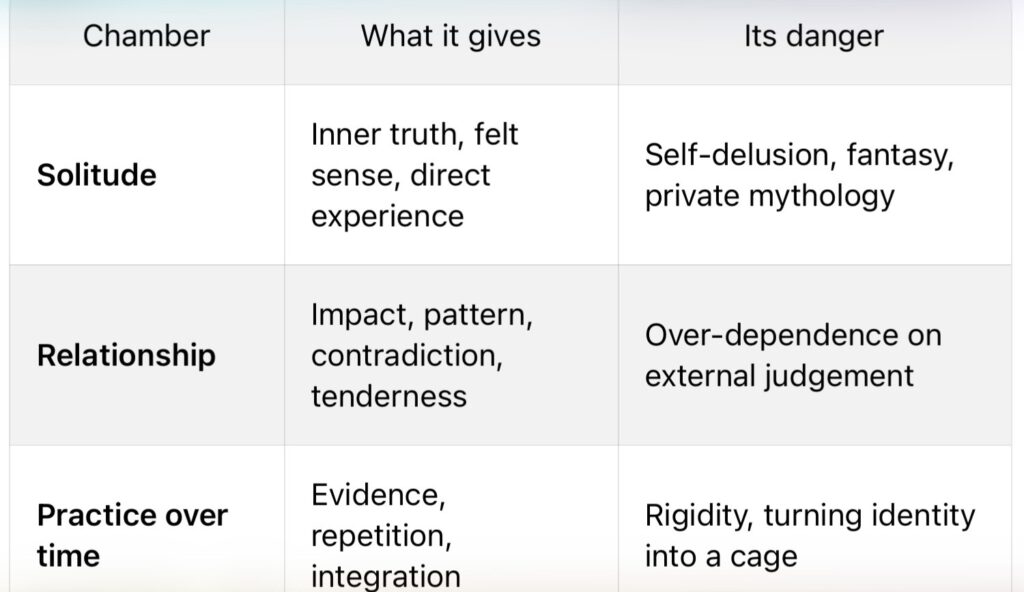
So maybe self-knowledge has three chambers:
The self is not revealed in one mirror. It emerges through a constellation of mirrors.
The ego is not only a liar
I’d be careful not to make the ego the villain too quickly.
The ego protects because, at some point, protection was needed. Its distortions often began as mercy. Denial, rationalisation, defensiveness, performance, people-pleasing — these are not just moral failures. They are survival strategies that stayed too long at the controls.
So the question becomes less:
How do I defeat the ego so I can see the truth?
And more:
How do I create enough safety that the ego no longer has to falsify the evidence?
That’s a very different path.
Truth often enters through the body before it enters through the intellect. Tight chest. Defensive laugh. Sudden irritation. The sentence you keep rehearsing. The person whose feedback you can’t stop thinking about. The praise that feels false. The criticism that stings because some part of you recognises the truth.
Self-knowledge is not just introspection. It’s pattern recognition with humility.
A possible working model
Maybe the strongest stance is this:
I validate my experience. I test my interpretation. I invite reflection from trustworthy mirrors. I refuse to surrender my sovereignty to any single mirror, including my own.
That feels like the barefoot philosopher’s version of “Know Thyself.”
Not solitary certainty.
Not crowd-approved identity.
Something more alive and more difficult:
a disciplined intimacy with your own experience, cross-checked by reality, relationship, and time.
The self is not a fixed object waiting to be discovered under the floorboards. It’s a living pattern. You know it the way you know a path: by walking it, noticing where you stumble, listening when others say what they saw, and returning often enough that the terrain begins to reveal itself.
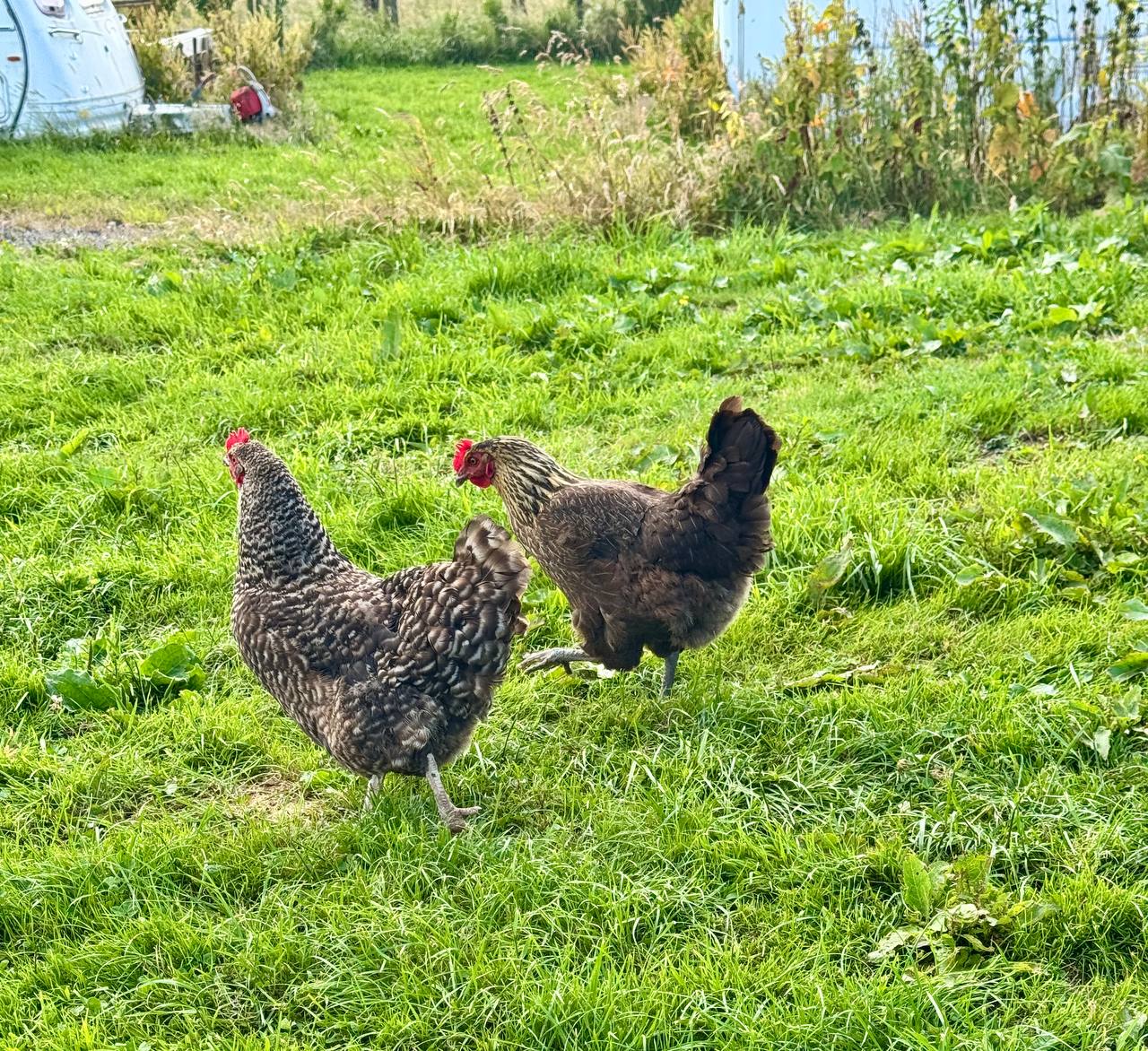
I’m sunning myself like a shameless lizard on a warm rock. Our camp is set up. I’ve cracked open the first Punk IPA of our extended weekend. Aerosmith’s Amazing is playing in the background, blending in with the goats. A couple of chickens came by earlier to greet us. My first chicken welcoming committee. They seemed eager to tell us all about their farm. I have no plans this evening beyond the plans I’m executing right now, which is nothing.
And nothing is good. In fact, nothing remarkable has happened today. And yet it feels quietly significant. Perhaps that’s one of camping’s hidden gifts. It lowers the threshold for what counts as enough. A patch of grass. A cold beer. A favourite song. And a couple of inquisitive chickens.
We’re headed up north for a few days of camping near the River Wyre. We chose the spot because it’s near Blackpool and the Lytham Festival is on, and we scored some free tickets to see the Petshop Boys and the Scissor Sisters on Saturday night. Blackpool is a good distance from us, so we decided to make it a four-day weekend. We’ve been to Blackpool once before. It’s a seaside town that has seen better days. This trip, we’ll spend more time in the smaller coastal towns and do more hiking.
Went to look at a caravan this evening. It was older than it looked in the photos.
The couple selling it lived on a farm. They said they had never actually camped in it. They had been using it as a spare room for their son while they renovated his bedroom.
If I were more of a handyman, I might have taken it on as a fixer-upper. But they had removed the whole front seating area, and they hadn’t tested the water or the gas, so it was a no from me.
We’re looking for something around 2004, four-berth, with a fixed bed.
This is what I imagined the old hypertext dream would be like before it got usurped by feeds, timelines, dashboards, and engagement funnels. What I find beautiful about the Universal Turing Machine memoir project is the form matches the nature of memory. The calendar suggests that we pass through time in a straight line. However, we don’t experience time in a straight line. At any given moment, your mind is in the past, the future, or, if you are disciplined enough, it resides in the present moment (in my experience, the mind only ever seems to be in the present for very short bursts of time).
We remember by association, by years that glow, by wounds, by recurring rooms, by people who become portals into the past, and by one summer that suddenly connects to something thirty years later. The Universal Turing Machine seems to understand that. It turns memoir into a navigable field rather than a corridor of time. Worth your time, especially if hypertext holds a special place in your heart.
i love a good collage, and a poem to boot. this piece from laura holly charman feels like a anti-self-hlep manifesto. instead of asking for the usual trope of certainty, happiness, or success, she’s asking to be disassembled and put back together in a way that only discomfort can do.
I’ve been using the Plaud NotePin for a while now. I wear it around my neck like a lanyard. It’s a pretty stylish-looking device, so it doesn’t tend to draw attention to itself. I wear it on my wisdom walks. It’s an easy way for me to walk and capture my notes hands-free. And because it has a 20-hour battery life, I can just record and forget about it. I probably look like a bit of a madman walking and talking to myself. But that’s OK.
And then when I get home, Plaud converts into an MP3, and I upload that into Google’s new local, offline voice app called Eloquence, which is powered by Gemma. I can record my wisdom walks without having to remember to push the record button, and I lose the self-consciousness that naturally occurs when you know you’re being recorded. The hands-free, always-on mode makes it easy for me to resist the temptation to perform.
Today is the first of July. I have my weighted rucksack on. The sun is shining. The air is still cool and crisp. It feels like a great day to start a new challenge.
A 31-day blogging challenge, to be exact.
But not the kind of blogging you may have been conditioned to think of. You know, the copywriter clickbait titles, the niche topics, the calls to action, the categories, the big ideas, the SEO standards, and the essays that feel compelled to say something clever. The posts that need to justify their existence before I’ve even written a word, and all of the rest of that you may have become brainwashed into believing a blog should be.
Consider these 31 days an open rebellion against all of that.
At the risk of sounding nostalgic, for these 31 days my intention is to lean into a much older word—the weblog.
You know, that mythological beast where people used to log their journey across the web, leaving hyperlink trails that you could follow and experience the wonders of the World Wide Web, not the locked-down, walled gardens of the platforms. You know the ones I’m talking about.
For this 31-day expedition, I want to pick up the trail where the World Wide Web stopped being about self-expression and started being about content and conformity and bowing down to the algorithm gods. Bring back the old gods, Hermes, Athena, the Muses, Saraswati, and Brigid.
Yes, the 31 days will be about the web, but it will also be about my wanderings through books, through walks, and through the inside of my own head.
The flow is simple.
Leave a trail. Drop links. Mark where I’ve been. Note what I saw. Point toward what caught my attention. Let someone else follow the hyperlink trail if they want to, or wander off in their own direction.
A pirate’s map. That’s what springs to mind. I’m making a pirate’s map of lots of little X marks scattered across the web.
That’s a more natural shape for me than the big essay machine. I like essays, of course. I’ll still write them. But not every thought has to become one. Some thoughts are field notes. Some are fragments. Some are just a sentence that wants to sit there and glow for a bit.
The walking is part of it too. That came through again this morning.
I’ve spent so much time trying to find the right system. The right practice. The right name. The right workflow. The right relationship between the vault, the blog, the notes, the audio, the AI, the field notes, the public garden, and the private underground. I can tie myself in knots trying to get the practice ready.
But the simple thing is still the simple thing.
I wander. I wonder. I document.
That’s it.
Put the shoes on. Put some weight in the pack. Get outside. Let the body move. Let the mind loosen. Say what comes. Notice what’s there. Record the wild thought if it passes through.
Take a picture:
Jewelwing, apparently, according to iNaturalist.
Feel the pack getting heavier on the hill. Feel the cold sweat on my back when I get home.
That is the practice. Not the idea of the practice. Not the perfect version of the practice. The practice itself.
If walking is how I move through physical space, then weblogging is how I move through cyberspace.
A proper weblog is a trace of movement through the network. It says, I came through here. I noticed this. I followed this link. I read this fragment. I disagreed with this. I carried this sentence with me for a while. I left a marker. I made a path where there wasn’t one before.
In physical space, the walker has roads, footpaths, desire lines, bridleways, alleyways, fields, thresholds, gates, benches, pubs, rivers, hedgerows, ruins, weather, strangers, dogs, and the feel of the ground underfoot.
In cyberspace, the weblogger has hyperlinks, archives, feeds, tabs, bookmarks, blogrolls, search trails, old forums, RSS, comments, backlinks, screenshots, quotations, fragments, source notes, rabbit holes, dead links, resurfaced pages, and the strange little shimmer of finding an old human-made page still glowing in the dark.
The feed is the river, but you have to be careful, because if you stop walking and just let it carry you, you’re no longer traveling. You’re drifting.
I suppose that’s the link I’m starting to see. Walking is how I think through physical space. Weblogging is how I think through cyberspace.
In the street, I leave footprints. On the web, I leave links.
Thirty-one days of footprints and links. Thirty-one days of field notes, fragments, wanderings, readings, recordings, old-web logging, new-web experiments, and whatever else the trail decides to offer.
No grand system.
No perfect launch.
No polished content calendar.
Just a man with a rucksack, a recorder, a blog, and a desire to leave better traces.