The Story That Wants You at Your Desk

The Matrix Late to Work Scene

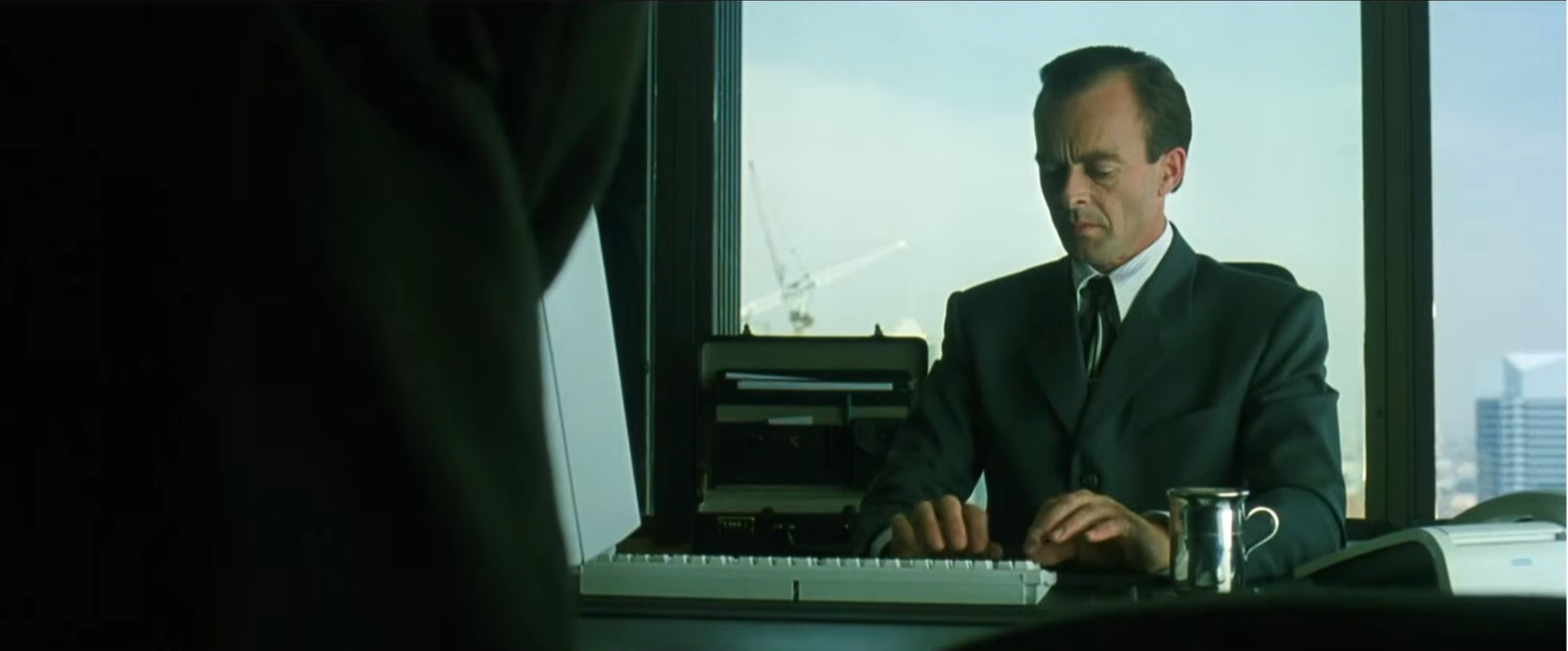
There is a short scene near the beginning of The Matrix that has stayed with me for years. Thomas Anderson is sitting in the office of his manager, Mr Reinhart. Anderson has arrived late again. He has a problem with authority, the manager tells him. He believes he is special, that somehow the rules do not apply to him.

Then comes the ultimatum. Anderson can choose to be at his desk on time from this day forward, or he can find himself another job.

It is a small scene, almost comic in its plainness. No agents. No green code running down a screen. No red pill. A bad meeting in a beige office, with one man explaining the terms of normality to another.

But the scene carries the whole film in miniature.

The manager presents obedience as the only adult position. The company is one of the best in the world, he says, because every employee understands that they are part of a whole. Individual trouble becomes company trouble. The good employee knows his place. He arrives on time. He accepts the story of what work is for, what authority is for, and what he is for inside both.

Anderson’s offence is not that he has broken the machinery. He is barely conscious that there is machinery. His offence is that some part of him has not settled into it. He has not quite agreed to become the person the system can easily recognise.

I do not mean that every job is a prison, or that every manager is an Agent Smith in a tie. That would be a lazy reading, and the world is more complicated than that. Work can give us companionship, skill, purpose, a way of serving others, and the money that keeps a roof over our heads. We need one another. We need institutions, agreements, and forms of cooperation.

The trouble begins when one available form of life starts passing itself off as the only legitimate one. When employment becomes not simply something you do, but the central measure of whether you count. When the story gets into the nervous system: be useful, be legible, be approved, and then, one day, you may have earned the right to live.

That is the story that wants you at your desk.

It does not usually arrive as a villain. It comes through school reports, family worries, careers advice, job titles, mortgages, performance reviews, the small flush of relief when someone in authority says you are doing well. It comes through the fear of being an outsider, of disappointing people, of having to explain why your life does not look like the approved diagram. By the time we are old enough to question it, much of the code is already running.

The stories that run beneath the story

I have spent a long time working with the idea that stories are code. I do not mean this as a cute metaphor for a slide deck. I mean that a story can organise perception, attention, feeling, and action. It can tell you which options you can see, which desires you are allowed to name, which risks feel foolish, and which forms of suffering feel normal.

A person who carries the story “I have to earn my worth” will make different choices from a person who carries the story “my worth is not under review.” A person who has learned that security comes from pleasing authority will hear a new opportunity differently from someone who has learned that authority is one voice among many. The world does not change merely because we acquire a better slogan. But the story changes what becomes thinkable, and what becomes thinkable changes the next move.

This is why Narrative Alchemy begins with attention to the script already in play. Most of us do not wake up one day and freely choose the central beliefs around which we organise a life. We inherit them. We absorb them from parents and classrooms, workplaces and television, old humiliations and rewards, the groups we want to belong to, the people we were afraid to disappoint. Some are useful. Some are cruel. Many were written for conditions that no longer exist.

The inherited script often feels like reality because it has been rehearsed for so long. “This is just how life works.” “People like us do not do that.” “You have to be sensible.” “You cannot make a living from that.” “Do not get too big for your boots.” “Be grateful for what you have.” Each sentence can contain a fragment of practical wisdom. Each can also become a locked door when it hardens into law.

The Matrix gives this condition a visual form. The people inside it are not fools. They are living in a constructed reality that has become more immediate to them than any alternative. The prison works because it feels ordinary. The office, the commute, the screen, the meeting, the polite threat: none of it looks like a prison until the story loosens enough for another possibility to appear.

That is why the Mr Anderson scene has more charge for me than some of the larger set pieces. It is close to the bone. Most of us know that room. We know the feeling of being told, directly or indirectly, that our restlessness is a problem to be corrected. We know the pressure to fit our oddness back inside the approved shape.

The false promise of future freedom

There is another story tangled up with this one, and it is one of the great promises of modern life.

Sell your time now, be a good employee, make sensible choices, accumulate enough money, and later you will be free. Freedom waits somewhere beyond the next promotion, the next salary band, the mortgage, the pension, the side hustle, the financial system that will finally allow you to stop worrying.

Money matters. To pretend otherwise would be romantic nonsense. Money can buy time, safety, medicine, space, choices, and a margin against panic. Lack of money closes doors with brutal efficiency.

But money can also become the story’s most effective postponement device. You keep agreeing to a life that does not fit because you are told the reward lies just ahead. The line keeps moving. There is always another threshold to clear before you can begin living on your own terms. You become an indentured servant to a future version of yourself who is supposed to arrive with enough money to release you from the bargain.

The contemporary feed has learned how deep that ache runs. Open YouTube, X, Instagram, or any corner of the internet where the adverts wear human faces, and you will find people offering a route out. Build this income stream. Copy this system. Learn this model. Escape the nine-to-five. Become the boss. Live the life of your dreams.

Some of these people are offering practical help. Some have built useful businesses. But the overall machine feeds on pain. It finds people who feel that their days do not belong to them and sells them an image of an exit. The strange cruelty is that the desire for freedom can become another market, another funnel, another way to spend your attention serving somebody else’s model of success.

The old office story says: obey now and one day you will be secure.

The online liberation story says: buy the right system now and one day you will be free.

Both can keep the real life deferred.

The question is not whether we should make money or seek more autonomy. Of course we should seek conditions that make life more liveable. The question is whether the pursuit of freedom has quietly become another programme running us. Are we choosing the work, the money, the aspiration, the system? Or has the story made the choice before we arrive?

Being special is not the same as being superior

Mr Reinhart makes Anderson’s problem sound narcissistic. You think you are special. You think the rules do not apply to you.

This is clever, because the language of specialness is easy to weaponise. Nobody wants to be the person who believes they are above other people. Nobody wants to turn ordinary responsibility into an insult. The desire to be different can become its own vanity trap, a performance of rebellion as predictable as conformity.

But there is another way to hear the word.

To believe that the rules do not fully contain you is not the same as believing you are better than everyone else. It is to refuse the idea that the institution gets the final word on what a human life can be. It is to recognise that you have particular gifts, particular hungers, particular obligations to the life that is trying to live through you. It is to take the risk of becoming distinct without making distinctness into a superiority contest.

That is closer to individuation than individualism. Individuation asks a difficult question: what is mine to become, and what have I accepted merely because it was handed to me? It does not mean cutting ourselves off from the world. It means entering relationship with the world without disappearing into its expectations.

The task is not to become the lone hero who has seen through everything while the herd sleepwalks around him. That is just another flattering story, and it can make a person isolated, brittle, and insufferable. The task is more modest and more demanding. Notice the scripts. Test them. Keep what serves life. Refuse what shrinks it. Build enough inner authority to hear your own voice among the louder ones.

Narrative Alchemy is not about writing yourself a fantasy in which every obstacle vanishes. It is about getting honest about the narrative through which you have been interpreting the obstacles. If you tell yourself that you are trapped, you need not pretend the constraints are imaginary. You may have bills, duties, dependants, a tired body, limited options, real fear. The alchemical move is not denial. It is asking where the story has added a second prison around the first.

What have you concluded about yourself because of the constraint? What possibility did you stop seeing? Whose voice has been speaking in your head with the force of a law? What would change if you treated that voice as a historical artifact rather than a command from reality?

Vigilance is an everyday practice

The word vigilance can sound grim. It conjures guards on a wall, watching for enemies in the dark. I do not mean we should live in a permanent state of suspicion, seeing manipulation in every conversation or conspiracy behind every workplace rule. That is another reality tunnel, and not a particularly free one.

I mean a quieter kind of vigilance: paying attention to the stories that are asking for residency in the mind.

The phone is one of the main delivery systems. So is the inbox. So is the infinite stream of videos that know exactly how to make an old anxiety feel urgent again. The story does not need to persuade you all at once. Repetition does much of the work. See enough people performing an identical version of success and it starts to feel like the only life that counts. Hear enough polished promises about wealth and freedom and your own slower, stranger work begins to look like failure.

This is why the first part of the day matters to me. Before the feed, before the messages, before the little theatre of comparison installs itself in the body, there is a brief chance to ask what world I am entering. A book, a notebook, a walk, a cup of coffee on the garden table: these are small things, but they can interrupt the automatic download.

They are not rituals of purity. They do not place you outside culture, money, technology, work, or obligation. They create a little room in which you can notice what is happening. That room is enough to begin with.

A useful practice is to name the story without immediately trying to replace it. “I am behind.” “I need permission.” “I must make this pay before I can take it seriously.” “If I do not perform well, I will lose belonging.” Write it down. Say where you first learned it. Notice the situations in which it takes over. Notice what it makes you do with your hands, your calendar, your attention.

Then ask a less dramatic question than “How do I escape the Matrix?” Ask: what story would give me five percent more room to move today?

The answer may be plain. I can take the walk before I open the feed. I can write the page before I decide whether it is marketable. I can make the phone wait while I listen to the person in front of me. I can stop asking the imagined audience to approve the work before I have done it. I can make a small choice that belongs to the person I want to become.

Small choices matter because stories become convincing through enactment. The old programme did not install in one dramatic moment. It got reinforced through hundreds of ordinary repetitions. A new relation to the story needs ordinary repetitions too.

The code is not the territory

Stories are code, but code is not fate.

It keeps the metaphor useful. We are not machines waiting for a clever hacker to type the right command. We have bodies, histories, relationships, economic conditions, losses, desires, and responsibilities that do not yield to a line of copy. No slogan will free someone from structural poverty, illness, grief, or a coercive situation. Narrative work is not a substitute for material change, political action, community, therapy, rest, or help.

But stories shape the field in which we meet those realities. They can make us collaborate with a limitation long after it has ceased to be necessary. They can make a social arrangement feel personal and inevitable. They can make a possibility feel shameful before we have even tested it.

The purpose of waking up to a story is not to become permanently suspicious of every story. We need stories. They give memory shape. They let us make promises, understand grief, recognise a calling, and share a world. The question is whether the story remains a companion or becomes a warden.

At the beginning of The Matrix, Thomas Anderson has no language for this. He only has the vague, inconvenient knowledge that the official story does not fit. That knowledge is enough to get him into trouble. It is also the beginning of his freedom.

The manager wants him at his desk. The culture wants a neat account of why he is there. The feed will happily supply a hundred new dreams for him to chase as long as he keeps consuming them.

The harder and more intimate work begins elsewhere: in the moment you hear a story making a claim on your life and pause before you obey.

You do not have to blow up the office. You do not have to abandon every responsibility. You do not have to become a hero in a leather coat.

But you do have to keep watch over the stories you are letting rewire your programming.

Because the most important choice rarely arrives with a red pill in your hand. More often it arrives as a sentence you have heard so often that it feels like your own voice.

And you get to decide whether it is.


If this post gave you something to carry into your day, consider supporting my work by buying me a coffee or making a monthly donation or subscribing (free) to the blog.

The Horizon

Golden wheat field stretching towards a tree-lined horizon under a pale cloudy sky

I’m standing in a field looking towards the horizon. It occurs to me that I’ve spent a lifetime doing this. Different fields. Different coastlines. Different countries. Different versions of myself, always finding a line where earth gives itself over to sky.

The horizon is a peculiar thing. It promises distance while refusing arrival. However far you walk, it quietly withdraws, asking nothing except that you keep going.

For reasons I can’t quite explain, the Oracle from The Matrix wanders into the field with me. Not the whole scene. Just one line.

I thought you’d have figured that out by now.

Only this time she isn’t speaking to Neo.

She’s speaking to me.

I laugh, because the question isn’t really what I should be doing. It never was. I’ve spent years treating life as though someone, somewhere, was withholding the final permission slip. As though there existed a committee of invisible adults who would eventually nod and say, Yes, Clay. Now you’re ready.

The field has no such committee.

The horizon doesn’t issue certificates.

The wind doesn’t care whether I’m qualified.

And perhaps that’s what horizons have been trying to teach me all these years. You stand before them expecting direction, but they offer something stranger: responsibility. They refuse to tell you which way to walk. They simply reveal that there is always another direction available.

No one is coming to rescue you from your own life. Not because the world is cruel, but because this part has always belonged to you. Choice isn’t a burden handed down by the universe. It’s the texture of being alive.

Then, as often happens on these walks, another voice enters the conversation.

Alice Cooper.

“I came into this life, looked all around…”

Memory is like that. One thought calls another, not by logic but by resonance. Philosophy opens the door and rock ‘n’ roll wanders in carrying the same truth in a different key. Nothing came easy. Nothing came free.

Standing there, looking towards another horizon that I will never quite reach, I wonder if that has been the lesson all along. We keep waiting for certainty to arrive from somewhere beyond ourselves, when perhaps certainty was never the gift.

Perhaps the gift was the horizon itself: forever out of reach, forever inviting the next step, still mine.

Reflections from Wonderland

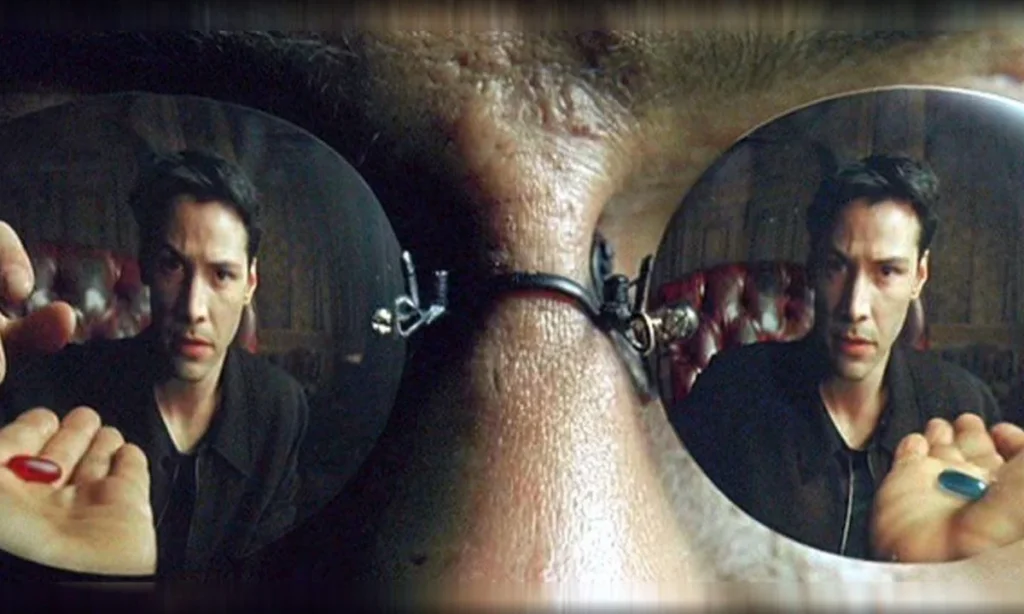
This image evokes one of the most iconic moments in modern cinematic history: Neo’s choice between the red pill and the blue pill in The Matrix. In this moment, Neo is offered a decision—whether to remain in the comfortable illusion of his existing world (the blue pill) or awaken to a harsher but more authentic reality (the red pill). This metaphorical choice has transcended pop culture and found its way into everyday life, resonating deeply with those who feel caught between the worlds of comfort and truth, illusion and enlightenment.

On the surface, it may seem like a straightforward decision—take the red pill, learn the truth, and live authentically. But let’s slow down. What does that really mean for someone in the here and now, navigating the maze of everyday life? It’s easy to romanticise the idea of radical awakening, but let’s not forget that stepping into a new reality is often disorienting, messy, and far from glamorous.

The Call to Awakening: Red Pill Realities

Much like Alice in Alice in Wonderland, choosing the red pill is akin to tumbling down the rabbit hole into an unknown world where the rules no longer apply. Everything you once thought to be solid and real begins to melt away, and in its place, you’re confronted with a deeper truth that challenges your entire worldview. This journey into the unknown is one many of us face when we choose to dive into the depths of our psyche, spirituality, or even our own personal histories.

It’s the moment you decide to stop ignoring the patterns in your life that no longer serve you—whether it’s in relationships, career, or personal growth. By choosing the red pill, you’re making a commitment to face the hard truths. You’re stepping into a space where certainty is replaced by curiosity, and the carefully constructed narrative of who you are begins to unravel.

In The Matrix, Neo’s journey is one of self-discovery, where each layer of illusion peeled back reveals a more complex and challenging truth. In real life, this could look like questioning societal norms, exploring your shadow through depth psychology, or even confronting childhood beliefs that have been holding you back. And much like Alice’s encounters in Wonderland, these truths might be surreal, dreamlike, and perhaps even frightening at times.

The Comfort of Illusion: Blue Pill Safety Nets

The blue pill, on the other hand, offers the safety of remaining in the known. It’s the choice to continue playing by the rules of a society that may be constraining but familiar. There’s no judgement here—after all, many of us take the blue pill daily without realising it. It’s the path of least resistance, where we tell ourselves, “It’s fine; this is just how things are.” The blue pill represents the comfort of denial, of keeping our heads above water without diving too deeply into the turbulent currents of life’s mysteries.

In a world where we’re constantly bombarded with information and choices, the blue pill can feel like a balm to the overstimulated mind. It’s the choice to keep scrolling through social media rather than sit in meditation, to stay in a job that drains you because it pays the bills, or to continue in relationships that offer familiarity even if they don’t nourish your soul. The blue pill is the decision to stay safe, to avoid the chaos that comes with upheaval.

The Rabbit Hole Awaits: Making the Choice

But what happens when we get that little nudge—the one that whispers, “There’s more to life than this”? Perhaps it’s a dream that won’t leave you alone, a synchronistic event, or even a conversation with a wise friend that sparks the need for deeper inquiry. This is where the red pill begins to call.

Choosing the red pill is choosing uncertainty, but it’s also choosing growth. Much like Alice, once you’ve tumbled down the rabbit hole, there’s no going back to the way things were. You might not know exactly what you’re looking for, but the act of choosing itself shifts your consciousness. You’ve entered a world where questions are more valuable than answers, where your identity becomes fluid, and where transformation is the name of the game.

If you’re at a crossroads in your life, feeling the weight of a choice before you, ask yourself: What is the red pill in this situation? What uncomfortable truth or deeper journey awaits if you dare to take it? And what does the blue pill represent? Where might you be clinging to comfort and illusion, preferring the known world even if it no longer serves your higher purpose?

Reflections from Wonderland

Taking the red pill is not a one-time event. It’s a practice, a continual choice to see life through the lens of curiosity and transformation rather than complacency. Sometimes, you may need to take the blue pill to rest, to recalibrate, and that’s okay too. But remember, the rabbit hole will always be there, waiting for you to dive deeper.

Ultimately, the choice is yours. Like Neo and Alice, you may not know where the path will take you, but you can trust that once you’ve taken the red pill, the world you thought you knew will never look the same again. And perhaps, just perhaps, that’s exactly what you’ve been searching for all along.

The downside of going out and doing everything

Here’s what I need to promise myself to do going forward from today and that is to re-engage with the world in a different way. Instead of trying to see it with new eyes, see it instead through older, wiser eyes.

I was having a conversation with a friend yesterday. She’s a young twenty-something (not you, other young twenty-something, you just need to focus on doing and not thinking so much). Ok back to the story, my friend (twenty-something ) has just come back from Mexico and is settling into the post-holiday blues of office life. She says every time she comes back from one of these trips she asks herself why? Why not just keep going? There’s so much she wants to see and do and sitting at a desk staring at a computer screen all day isn’t one of them.  Seems far from the good life.

Of course, I encourage her to go. She’s young. She has no ties. She has no weight on her shoulders. No ball and chain on her ankle. Go. Go then. Go! If only it were that easy right? Well, it is and it isn’t – depends on how much programming she’s had and how strong she is mentally, physically, and spiritually.  Does she have what it takes to unplug from The Matrix? Maybe Morpheus is right, you should never unplug a mind once it has reached a certain age (twenty-something , pay close attention to this video):

https://youtu.be/SF2iImTqaTs

I dropped into the conversation my observations about the downside of going out and doing everything while you’re young. I did it.  Now I’m suffering from ‘been there, done that, got the t-shirt.’  I’m facing the dark side of going out and doing everything when you’re young.  You get to a point, like where I’m at now, where it’s hard to get excited about anything because I’ve done everything. Ok so I haven’t literally done everything, but I’ve done enough to where everything seems like more of the same or a different version of the same theme. It’s like being a drug addict.  In order to get excited, I have to keep upping the level of extreme.  But what’s more extreme than being in situations where your life is on the line?  How do you top that?  Maybe I have to find the edge.

Then I remember what Hunter S. Thompson said about the edge:

“The Edge…There is no honest way to explain it because the only people who really know where it is are the ones who have gone over. The others-the living-are those who pushed their control as far as they felt they could handle it, and then pulled back, or slowed down, or did whatever they had to when it came time to choose between Now and Later. But the edge is still Out there.”

So excuse me if I go a little off the rails here for a while. I’m trying to find that elusive something – my white whale, my golden barge that remains perpetually just around the next bend as Jephraim Tallo discovered. My ass has definitely been dragging and I passed a gypsie wagon the other day. And you can forget about my heart, it turned to stone a long time ago.

It’s been a long day and my brain is fried. I’m not tired of waiting for tomorrow to come, at least not tonight. Hell, I’d be ok if tomorrow never came. It’s always a good day to die.  But enough about that.  I need to pour myself a whiskey and get to figuring out how I’m going to find this edge.

It’s helpful for all of us to feel a bit special

“As a specimen, yes, I’m intimidating!…As you see, I’ve got biceps to spare!…I’m especially good at expectorating!…And every last inch of me’s covered in hair.” – Gaston, Beauty and the Beast

Me, me, me – me too.

I’m trying to figure out where on the continuum between healthy ego to pathological grandiosity I sit. I’ve never thought of myself as being narcissistic, but you see the term batted about a bit on the Internet especially at us selfie* taking, 1st person blogger types. But true pathological narcissism is rare and apparently only affects about 1% of the population.

A quick Google search and I found this questionnaire.

You like to be the center of attention – sometimes
You have a habit of giving (unsolicited) advice – yep
You detest waiting in line – absolutely!
Your ambition knows no bounds – I’m a legend in my own mind (not really)
You know how to turn on the charm – oh yeah baby.
You are the competitive type – no
You’re famous for holding grudges – nope, most things fall off me like water off a duck’s back.
It’s never your fault – more than likely it is.
You take advantage of people – not my style.
You have an addiction – hmmm, possibly!

Looks like I’m batting about 50% on this survey.

Luckily the experts say a little narcissism is good for you.

Narcissism is a trait each of us exhibits to a greater or lesser degree. As it has become trait non grata, though, it’s become necessary to add the qualifier “healthy” to specify the socially acceptable type of narcissism. “It is the capacity to see ourselves and others through rose-colored glasses,” says psychologist Craig Malkin, a lecturer at Harvard Medical School and the author of Rethinking Narcissism. That can be beneficial, because it’s helpful for all of us to feel a bit special. It fuels the confidence that allows us to take risks, like seeking a promotion or asking out an attractive stranger. But feeling too special can cause problems. – The Real Narcissists

Well at least I’m no Narcissistic Cannibal:


*Can you believe it, I have 1,254 selfies on my phone!

Deeply possess your mind and other rules for improving your knowledge

So a billion years ago I set out on a mission to be the best version of myself by pursuing what the Greeks called arete which loosely translates to excellence in all things. Broadly speaking it’s being excellent in all the ways a person can be excellent mentally, physically, intellectually, spiritually and practically.

I have to confess though, I let the Matrix get the better of me. I plugged in, became one of “them” and lost sight of what I am about and what I want to achieve.

Luckily, Morpheus found me and I am unplugged again, but I’m going to have to rebuild the parts of my mind I haven’t used for a while.

Which brings me to Isaac Watts…

One of the most popular and prolific Christian hymn writers of all time — including Joy to the World — was a man named Isaac Watts, who lived in England in the late 17th and early 18th century. Watts was a well educated Nonconformist (in the religious sense, not the modern one) who, along with his hymn writing, published a number of books on logic, science, and the learning process, at a time when these concepts were only just starting to grab hold as a dominant ideology, replacing the central role of religious teaching.

Watts wrote a book called Improvement of the Mind. And in this book he shared a set of general rules for the improvement of knowledge. Although written in the 18th century, these rules can still be applied today.

So here are the rules:

Rule I. DEEPLY possess your mind with the vast importance of a good judgment, and the rich and inestimable advantage of right reasoning.

Rule II. Consider the weaknesses, frailties, and mistakes of human nature in general, which arise from the very constitution of a soul united to an animal body, and subjected to many inconveniences thereby.

Rule III. A slight view of things so momentous is not sufficient.

Rule IV. Presume not too much upon a bright genius, a ready wit, and good parts; for this, without labour and study, will never make a man of knowledge and wisdom.

Rule V. As you are not to fancy yourself a learned man because you are blessed with a ready wit; so neither must you imagine that large and laborious reading, and a strong memory, can denominate you truly wise.

Rule VI. Be not so weak as to imagine, that a life of learning is a life of laziness and ease;

Rule VII. Let the hope of new discoveries, as well as the satisfaction and pleasure of known trains, animate your daily industry.

Rule VIII. Do not hover always on the surface of things, nor take up suddenly with mere appearances; but penetrate into the depth of matters, as far as your time and circumstances allow, especially in those things which relate to your own profession.

Rule IX. Once a day, especially in the early years of life and study, call yourselves to an account what new ideas, what new proposition or truth you have gained, what further confirmation of known truths, and what advances you have made in any part of knowledge.

Rule X. Maintain a constant watch at all times against a dogmatical spirit.

Rule XI. Though caution and slow assent will guard you against frequent mistakes and retractions; yet you should get humility and courage enough to retract any mistake, and confess an error.

Rule XII. He that would raise his judgment above the vulgar rank of mankind, and learn to pass a just sentence on persons and things, must take heed of a fanciful temper of mind, and a humorous conduct in his affairs.

Rule XIII. For the same reason have a care of trifling with things important and momentous, or of sporting with things awful and sacred: do not indulge a spirit of ridicule, as some witty men do on all occasions and subjects.

Rule XIV. Ever maintain a virtuous and pious frame of spirit: for an indulgence of vicious inclinations debases the understanding, and perverts the judgment.

Rule XV. Watch against the pride of your own reason, and a vain conceit of your own intellectual powers, with the neglect of divine aid and blessing.

Rule XVI. Offer up therefore your daily requests to God, the father of lights, that he would bless all your attempts and labours in reading, study, and conversation.

You can read the full set of rules here.

Or you can buy a copy of Improvement of the Mind.