Tarot, in this frame, is not about predicting the future or handing my authority over to a deck of cards. It is a way of working with symbol, image, projection, shadow, inner dialogue, and the strange intelligence of the unconscious. The cards give form to things that often move below the level of ordinary speech.
That part feels right to me.
But there is another layer underneath it.
A while ago, one of the bots pointed out that I sometimes lean on Jung and psychology to legitimise my use of tarot. As if I need a respectable intellectual witness standing beside me before I’m allowed to admit that these images matter to me.
It caught me because it was true.
There is a part of me that imagines the tribunal before anyone has even said anything. The rational people. The sceptical friends. The religious voices. The ones who might think tarot is airy-fairy, superstitious, unserious, or somehow dabbling with the dark side.
All of that may be true. But if I’m not careful, the psychological frame becomes body armour. I start using Jung as a permission slip rather than as a companion.
The cleaner truth is simpler:
Tarot is one of the symbolic languages I use to think with.
That sentence does not need defending.
I use walking to think. I use blogging to think. I use dreams, books, myths, conversations, notes, memories, and old fragments from the archive. Tarot belongs in that same family. It is a reflective technology. A deck of charged images. A small theatre of archetypes I can lay out on the table.
The cards don’t tell me what to believe.
They give me something to notice.
They interrupt the obvious story. They give the unconscious something to point at. They let an image speak where my usual explanations have become too polished, too rehearsed, or too defended.
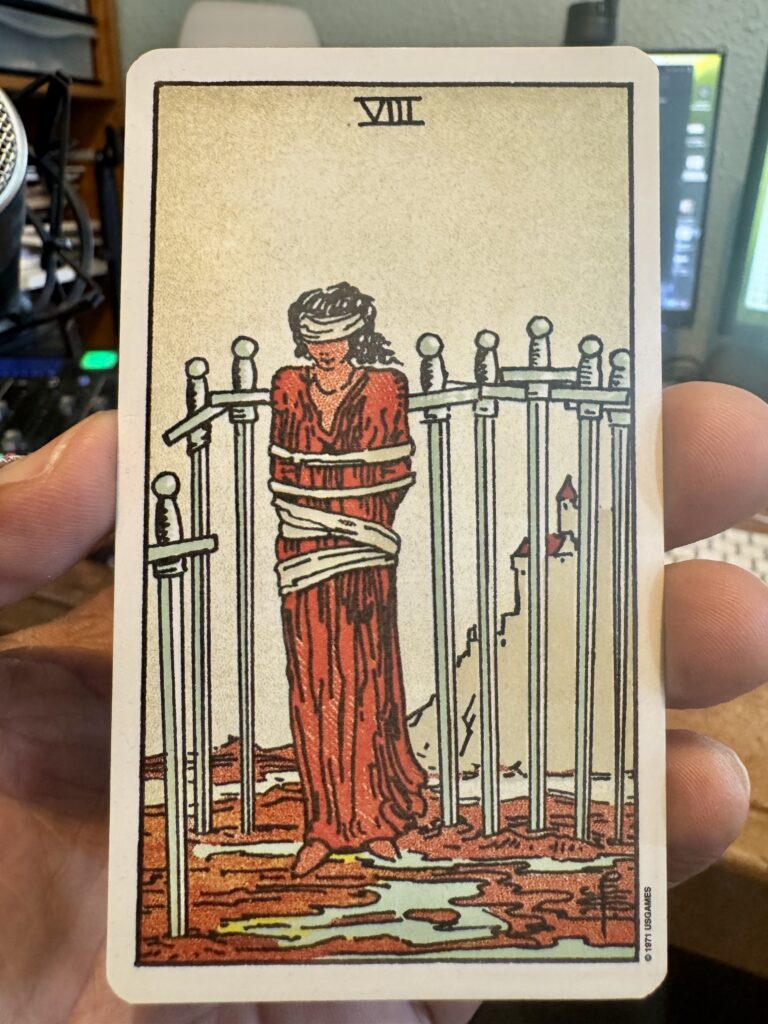
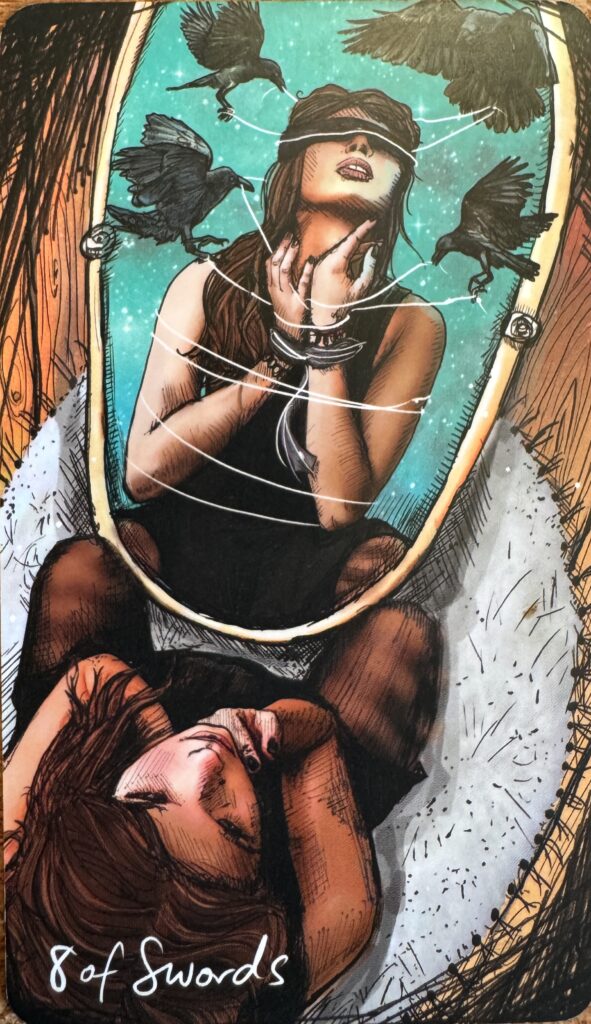
Then, as if the deck wanted to join the conversation, I drew the Eight of Swords.
A figure bound and blindfolded, surrounded by blades, caught in a prison that may not be as fixed as it feels. It was hard not to laugh. There it was: the whole psychology of the note in one image. The imagined tribunal. The respectable arguments. The invisible limits. The part of me that thinks it has to prove its way out before it can simply step forward.
The swords looked like other people’s imagined judgements.
The rationalist sword. The religious sword. The “don’t be weird” sword. The “be respectable” sword. The “prove this is legitimate” sword.
And maybe one more: the Jungian defence itself.
Useful. Sharp. Valid. But still a sword.
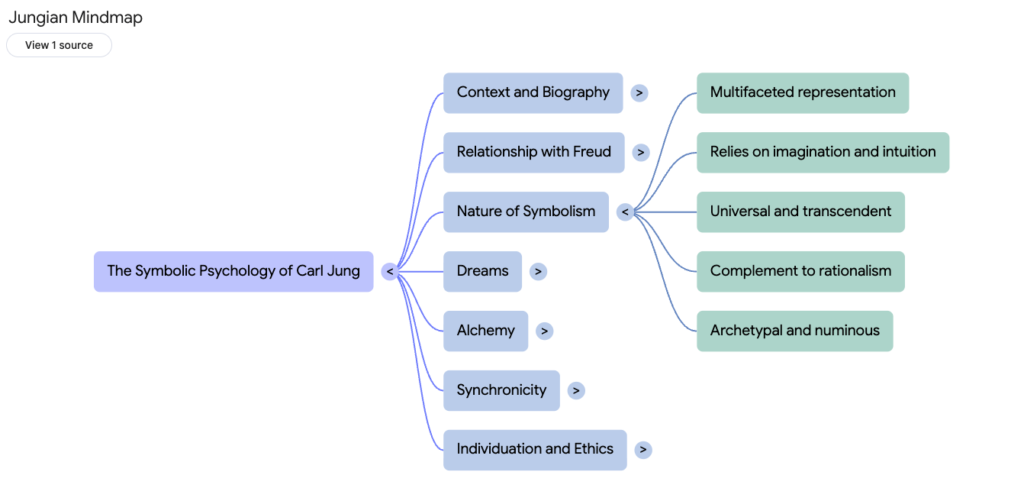
The Jungian lens still matters to me. It gives me useful maps: projection, shadow, complexes, anima and animus, individuation, and the dialogue between conscious and unconscious life. I don’t want to throw that away.
But Jung doesn’t need to rescue Tarot for me.
And I don’t need to rescue myself from seeming strange.
The barefoot philosopher can have a book on Jung, a notebook, a cup of coffee, and a tarot deck on the same table. No apology required. The only real requirement is honesty about the practice.
I am not asking the cards to rule my life.
I am asking them to help me see the story I am already living inside.
The question is not whether tarot is legitimate. The question is which imagined authority I am still letting hold the sword.
And the question this leaves me with is:
Where am I still asking respectable systems to bless the parts of me that already know how they work?
Saturday. Kessingland. A camping field on a sea cliff; the morning is already bright by the time I properly arrive in it.
I wanted to watch the sunrise. That was the plan in the loose way plans form when you sleep outdoors and imagine yourself becoming more elemental by morning. But the field gave me sleep instead, and the sun did its work without me standing there to witness it.
There’s something almost comic in that. I had come to the edge of the country with the vague heroic notion of rising with the light, looking out across the water towards the Netherlands, letting the horizon perform some kind of magic like it used to do when I was a kid. Instead, my body chose repair. Air, grass, canvas, salt, distance. The older intelligence took over.
Maybe that was the first teaching of the day.
The body doesn’t care about the performance of attention. It knows when restoration is the deeper form of noticing.
Later, walking the path through the low grass and scrub, I kept thinking about the High Priestess.
I’d drawn her earlier from the major arcana as a way of asking what figure wanted to join the inner council that’s been forming in my journal. Yesterday it was the Monk and the Frontman, then the Trainer. The Monk wants books, contemplation, freedom, and the right to follow the rhizome without turning every branch into a business case. The Frontman wants visibility, contact, recognition, a livelihood, and some way of being known in the world. The Trainer knows how to make knowledge usable: insight into prompts, exercises, workshops, field guides, and practices that other people can actually hold.
She doesn’t come in with a plan, a funnel, a product ladder, or a better explanation of the work. She brings a silence that changes the room.
The Monk, the Frontman, and the Trainer all have becoming-energy in them. Become freer. Become known. Become useful. Become viable. Become the version of the self that can finally hold all of this together.
The High Priestess interrupts that machinery.
She asks whether the next stage is another becoming or a deeper inhabiting.
That sentence has been working on me all day, arriving more clearly as I walked: it is time to shift from perpetually becoming into being and let growth emerge from that instead. Not anti-growth. Not resignation, not a refusal to change. More like a refusal to keep treating the self as a project that must be improved before it is allowed to live.
That feels like the hinge.
For years I’ve carried the question in one form or another: what must I become in order to earn from this? What shape must the work take to be viable? What identity do I need to step into so the blog, the coaching, the training, the walking, the mythic imagination, the archive, and the strange recursive life with language can all make sense to other people?
The question has a violence hidden inside it.
A gentler question opened on the path:
What naturally wants to grow from the being I am already practising in public?
That is a different kind of inquiry, one that doesn’t ask me to chase an improved self into the future but to inhabit the self that has already been gathering here all along.
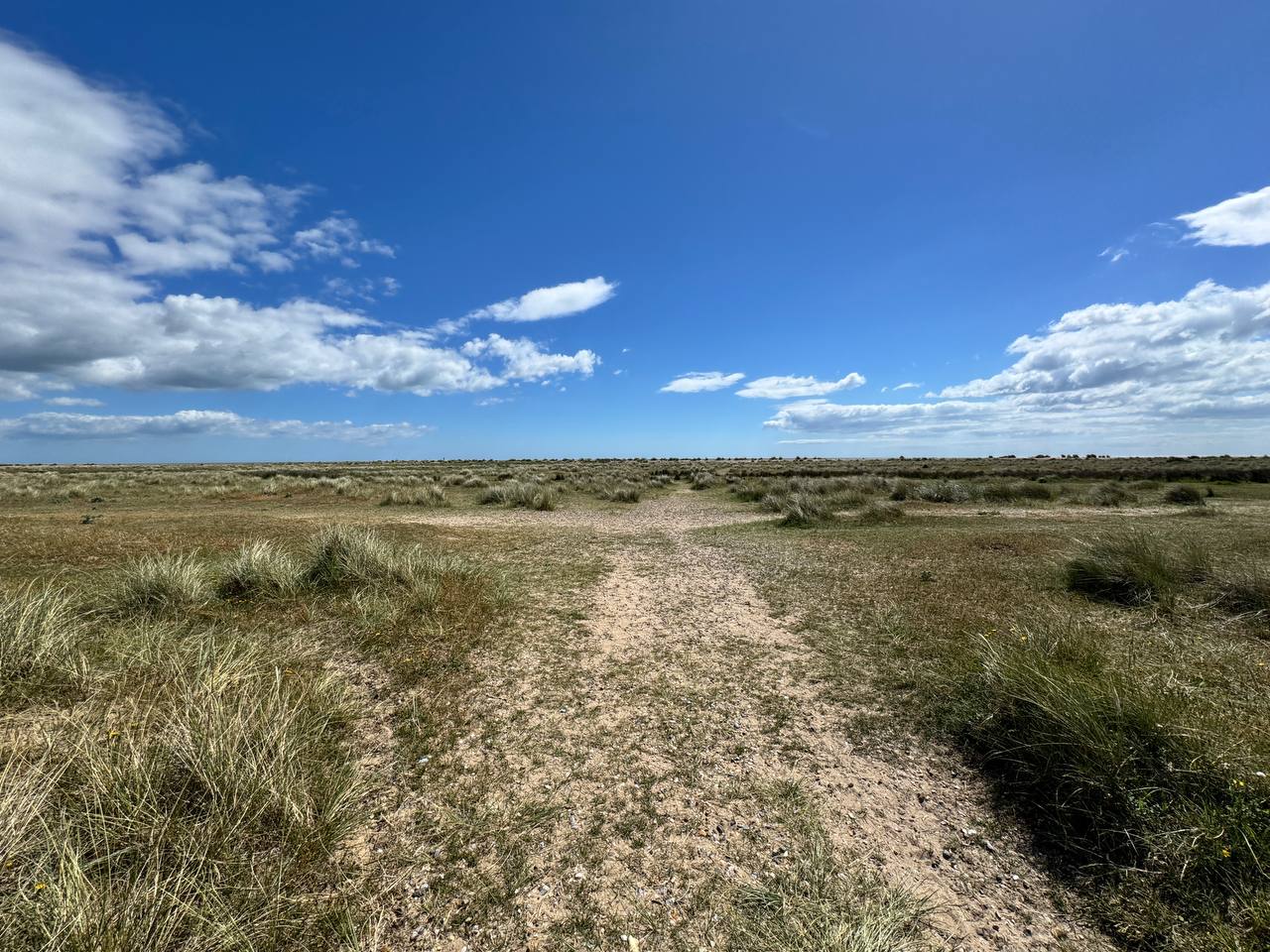
The path seemed to agree. No mountain. No temple. No city of destiny shining at the end of the track. Just sand, grass, sky, and a worn line made by prior walking.
Here is the ground. Here is the path. Walk from where you are.
Down by the water, the thinking changed again.
Listening to the wind and the waves talk.
That was the phrase that arrived. Not watching. Not interpreting. Listening.
The beach was all thresholds: pebble into sand, sand into surf, surf into open water, water into sky. Nothing there was trying to become anything else. The stones were stones, the sea was sea, the clouds were passing in their own time, and the wave line arrived, broke, withdrew, and returned.
The High Priestess was there too, but not as a gothic temple mystery. Coastal. Elemental. Less veil and candle, more horizon and rhythm; she was in the shimmer on the water, the movement I couldn’t command but could attune to.
The waves do not become by ambition. They become by returning.
The wind does not announce its strategy. It moves.
The stones do not improve themselves. They are shaped by contact, pressure, tide, and time.
That may be the deeper instruction in the being-not-becoming insight. Growth emerging from being doesn’t mean nothing changes; it means change comes through relationship with the elements already acting on me: walking, writing, listening, blogging, remembering, and returning.
I stood there long enough for the beach to open a door in time.
I remembered Brian.
When we were teenagers, Brian and I used to hang out at the beach in the off-season: no tourists, just us and the wind and the water and the huge imaginative permission of an empty shore. We imagined ourselves as explorers heading across the sea into the unknown. Sometimes we were sea gods, like Marvel’s Sub-Mariner or Prince Namor. Boys at the edge of the known world, inventing themselves from salt air and comics and friendship.
Brian died a few years ago from cancer.
So the text needs a pause here.
For Brian.
The beach was not empty back then. It was a mythic training ground, and we were not simply hanging out. We were rehearsing the old archetype of crossing: the shore as threshold, the sea as unknown, friendship as vessel.
And now here I am again, older, marked by loss, still standing at the edge of the unknown, still listening to wind and waves talk.
There is a tenderness in that I don’t want to explain away.
The sea kept the old frequency.
The High Priestess thread deepens here because hidden knowledge is not always buried in esoteric symbols. Sometimes it rises through place; sometimes the oracle is memory. Sometimes the body returns to a shoreline and finds a younger self still there, still imagining, still unburdened by the need to monetise, brand, niche, teach, package, or justify the imagination.
Just two friends in the off-season, making worlds out of wind, waves, and empty horizon.
That may be part of today’s medicine.
Not to become more imaginative.
To remember that imagination was already native.
By the time I left the beach, the morning had become something other than the morning I planned. I missed the sunrise and found the field. I asked for an archetype and got a listening practice. I walked toward becoming and found being already under my feet.
I’ve started reading Ruth Netzer’s Tarot of Self Discovery. I’m only in the introduction, but already I can feel one of those useful recognitions happening. She is writing about tarot in a way that sits very close to my own use of the cards: not as fortune-telling or mystical commandments, but as a form of Jungian active imagination.
The cards become images that help the psyche speak.
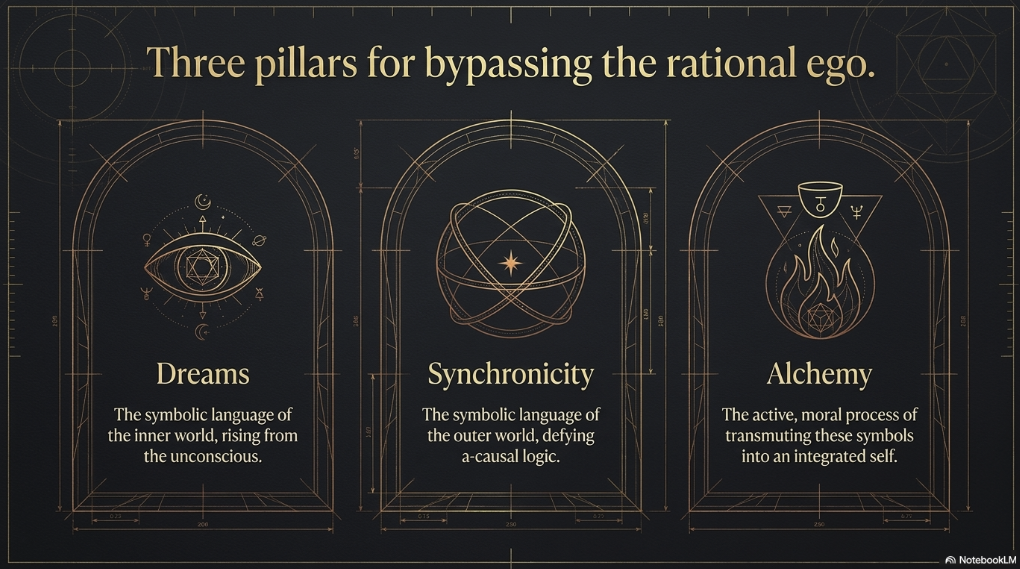
Netzer seems to work with two principles at once. One is psychological: the image reflects something going on inside us. The other is synchronistic: the image that appears at a particular moment may carry a strange rightness, as if the unconscious, the world, and the timing of the draw are briefly conspiring to make something visible.
That is the space where tarot becomes interesting to me. Not prediction or obedience. And definitely not “the cards say.” More like, ‘Here is a symbolic mirror.’ What does it constellate? What does it disturb? What does it reveal that ordinary language has not quite managed to reach?
Netzer is also working with the Hero’s Journey, which makes sense. Tarot almost invites that reading. The Major Arcana can easily be seen as a sequence of initiations: departure, trial, descent, death, renewal, and return. But she has also mentioned, more than once now, something she calls the Quest for the Self, placing it alongside the Hero’s Journey and the Heroine’s Journey.
That phrase caught me.
The Quest for the Self.
It feels related to the heroic pattern but not identical to it. The hero goes out. The Self seems to call us inward and downward, then wider.
Hero, heroine, Self
A working distinction might be this.
The Hero’s Journey is the ego going out into the world to be tested. It leaves the ordinary world, faces trials, meets helpers and enemies, wins or receives the boon, and returns changed. Its centre of gravity is ordeal, action, courage, separation, initiation, and return.
The Heroine’s Journey, especially in Maureen Murdock’s sense, often concerns the healing of a split. The feminine is rejected or devalued, the masculine-coded world of achievement is pursued, and then some kind of aridity, wound, or descent forces a return to the body, the mother, feeling, relation, and inner belonging. Its centre of gravity is reconnection.
The Quest for the Self feels wider and stranger than both.
It is not mainly about defeating the dragon. It is not only about healing the split. It is about entering relationship with the total psyche. The ego meets what it has excluded, projected, feared, desired, idealised, and misunderstood. The journey is not towards a prize but towards a more complete relation with the deep pattern of the person.
In Jung’s language, this is individuation: the long, symbolic process by which the ego comes into relationship with the Self.
And the Self is not the same as the personal self, the personality, the social identity, or the story I like to tell about who I am. The Self is the organising centre and circumference of the psyche. It includes consciousness and unconsciousness, light and shadow, masculine and feminine, personal history and archetypal depth.
The Self is not the hero.
The Self is the wider field in which the hero appears.
The shape of the quest
The Hero’s Journey is often drawn as a circle: departure, initiation, return.
The Quest for the Self feels more like a spiral, a mandala, or a labyrinth. You keep circling the centre, but each circuit reveals another layer. You do not simply arrive at the Self as if it were a castle at the end of the map. You are slowly reorganised by your relationship to it.
The first movement is often a call from within. Something in the old ego-story begins to fail. The life may still work on the surface, but underneath it there is a knock at the door. Dreams sharpen. Synchronicities appear. Old symbols return. A card keeps showing up. A book arrives at the right moment. A sentence starts glowing.
The psyche seems to say: the map you are using is too small.
Then comes the encounter with the persona: the mask, the social role, the public operating system. Who have I learned to be? What do I perform? Which parts of me are rewarded? Which parts have been exiled so the approved self can keep functioning?
This is where tarot becomes useful as active imagination. A card can reveal a role, a script, a borrowed authority, a desire-system, a stuck pattern. The question is not, “Which card am I?” The better question may be, “Which part of me is speaking through this image?”
After that, inevitably, comes the shadow.
The shadow is not simply the bad self. It is everything the ego has not been able, willing, or permitted to identify with. Rage, envy, need, grief, vanity, power, tenderness, brilliance, sensuality, weakness, wildness, dependency, genius. All the material pushed outside the conscious self-image.
This is where the Quest for the Self differs from the heroic reflex. The heroic ego wants to defeat the monster. The deeper work asks for a conversation.
The question changes from:
How do I defeat this?
To:
What part of my unlived life is wearing this frightening face?
That is shadow gold territory.
The inner figures
In Jungian terms, the psyche is full of figures: shadow, anima, animus, child, trickster, great mother, wise old man, wounded healer, king, queen, psychopomp, divine animal.
Tarot gives these figures a theatre.
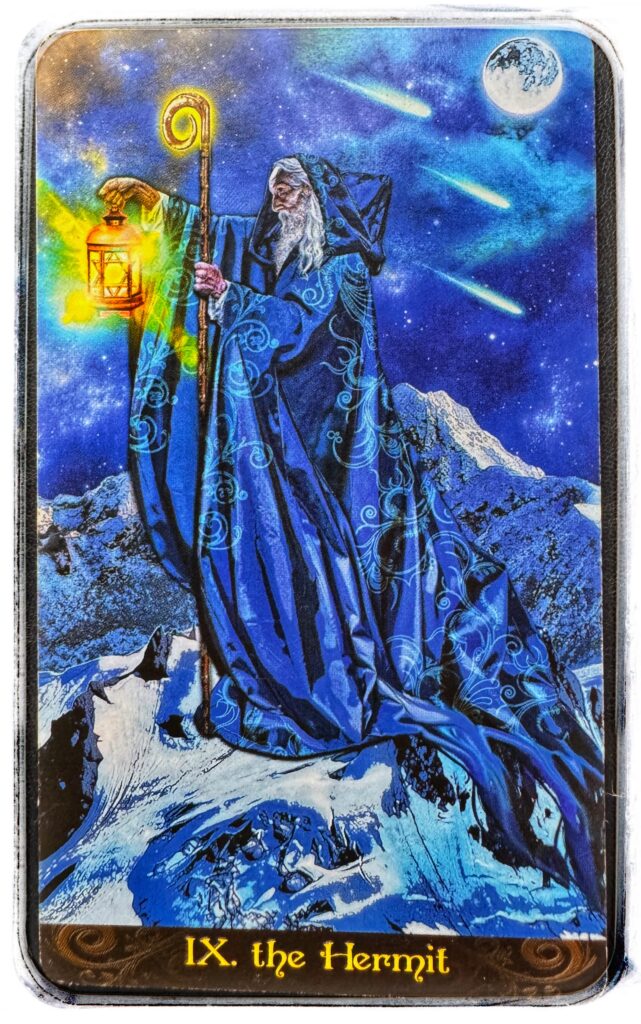
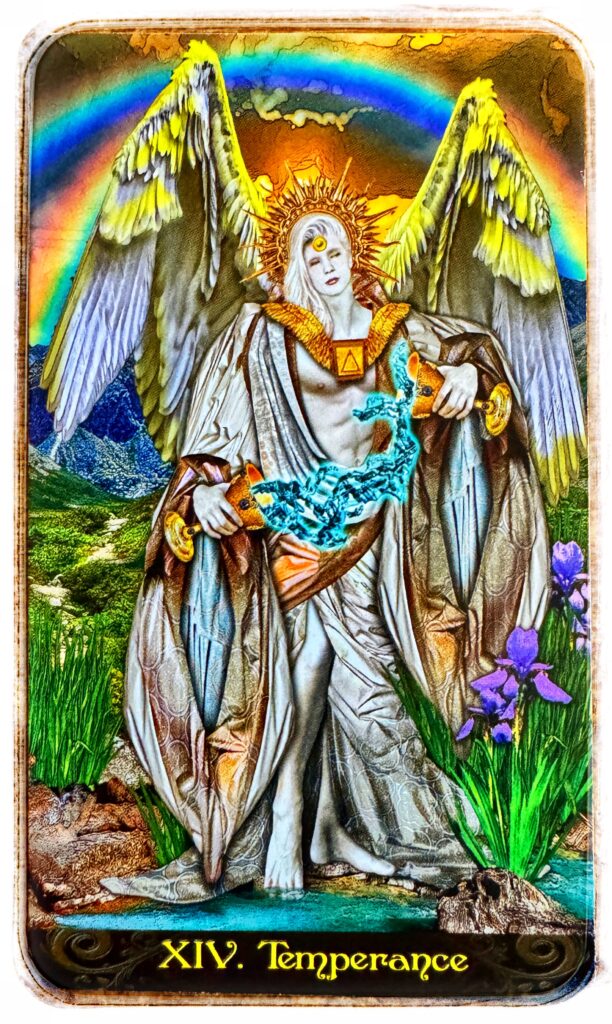
The Fool, the Magician, the High Priestess, the Empress, the Emperor, the Hierophant, the Lovers, the Hermit, Death, Temperance, the Devil, the Tower, the Star, the Moon, the Sun, Judgement, the World. Each card is a chamber. Each image offers a way for the unconscious to become visible without being reduced too quickly to a concept.
That may be why tarot continues to matter. The image does not explain itself away. It waits. It lets the psyche project, react, resist, recognise, and revise.
Used this way, the card is not an oracle issuing orders. It is a doorway.
The psychological principle says: the image reflects inner dynamics.
The synchronistic principle says: this image, now, in this moment, may be oddly exact.
Together they create a charged mirror.
Holding the opposites
At some point, the Quest for the Self becomes less about discovering “who I really am” and more about becoming able to hold contradiction without collapsing it too quickly.
I am monk and frontman.
I am wounded and gifted.
I want solitude and recognition.
I want freedom and belonging.
I am rational and mythic.
I am ordinary and archetypal.
The ego prefers clean identity. The Self seems to prefer wholeness.
Wholeness is untidy. It includes the opposites. A real symbol can hold what logic alone wants to split apart. That is part of the power of tarot, dream images, mythic motifs, and synchronistic events. They can carry contradiction without killing it.
The Self does not always say: choose one side.
Sometimes it says: become large enough to hold the tension until a third thing appears.
Grounding the Self
There is a danger here, of course. Whenever we start speaking about the Self, archetypes, symbols, synchronicity, and the deep pattern of a life, inflation is nearby. The ego can try to claim the whole thing for itself. It can turn the Self into a costume, a spiritual achievement, or a private mythology of specialness.
That is why the work has to remain grounded.
Make coffee. Take a walk. Pay the bill. Write the paragraph. Talk kindly to the person in front of you.
The Self is not an excuse to float away from ordinary life. It asks to be embodied there.
The Quest for the Self does not end with escape from the world. It returns us to the world with a different centre of gravity. We still have a personality, wounds, preferences, irritations, bills, unfinished drafts, and awkward emails. But perhaps we are a little less possessed by one-sided identity. Less ruled by projections. Less desperate to be pure, impressive, innocent, correct, or complete.
The question becomes ethical in the deepest sense:
If this is in me, how shall I live with it consciously?
That may be the real boon.
A working note for now
So for now, my working model is this:
The Hero’s Journey is achievement through ordeal.
The Heroine’s Journey is healing through descent and reconnection.
The Quest for the Self is wholeness through symbolic integration.
Or, put another way:
The Quest for the Self is the Hero’s Journey turned inward, then widened until the hero discovers he was never the whole story.
The hero wants to complete the quest.
The Self wants to complete the person.
And tarot, used well, becomes a cabinet of living images through which the psyche can say:
Look again. There is more of you here than you thought.
Yesterday felt like wading through wet sand. Every idea that surfaced dissolved before it could be shaped into anything. Underneath that is the voice that says, ‘If I can’t produce today, what does that mean for tomorrow, for the whole enterprise?’ It got louder as the afternoon wore on. I know that voice. It is not telling the truth. Knowing that doesn’t silence it.
This morning I pulled three cards. Sat with them at the desk before anything else happened, before coffee or email or the reflex to check what the world is doing. Let them sit.
Not one of them is set in daylight.
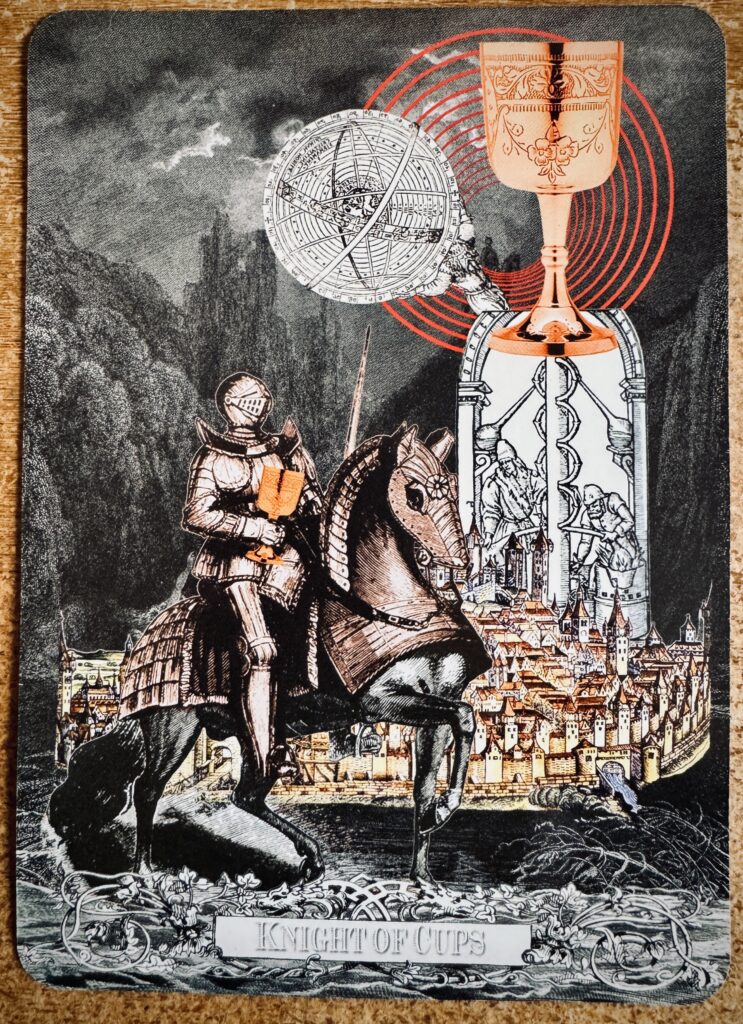
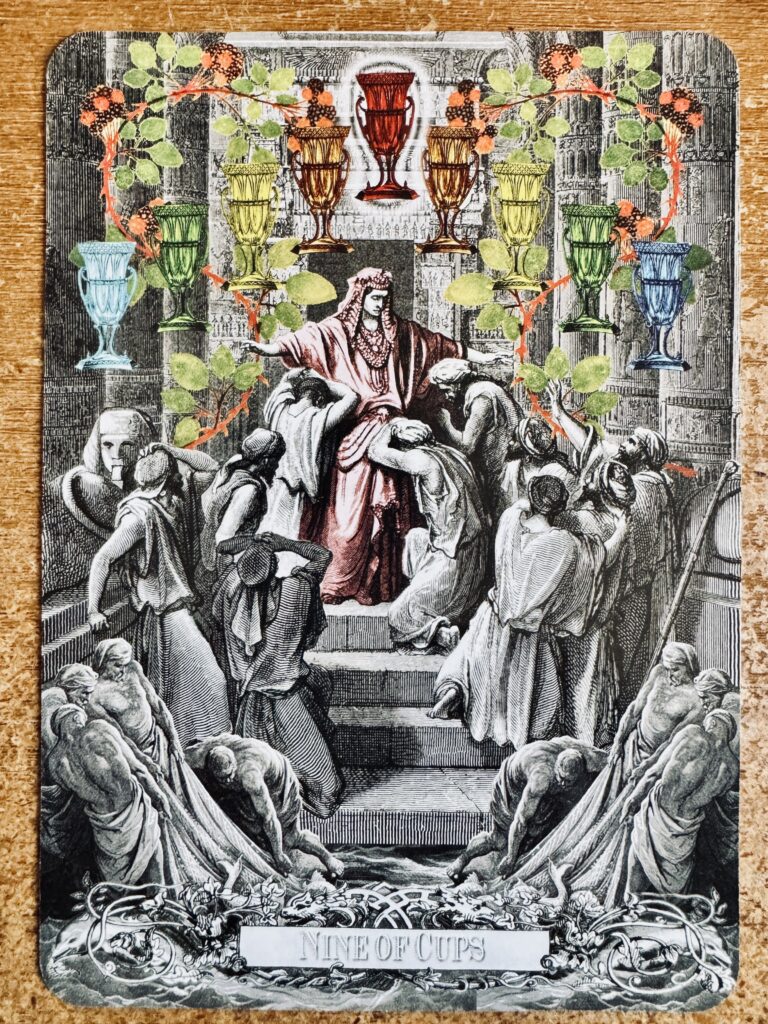
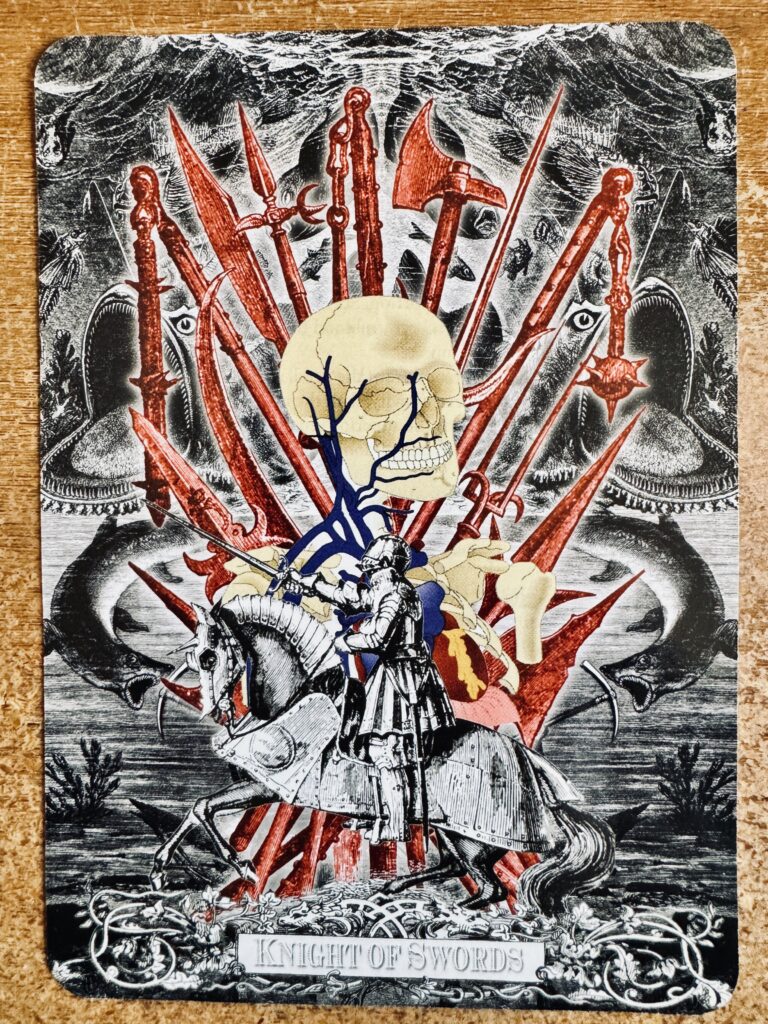
The Knight of Cups approaches at night, the city ahead glowing with its own inner light. The Nine of Cups traveller sits enthroned in a temple space removed from ordinary time. The Knight of Swords charges through a scene that Taussig makes completely explicit: underwater. In the psychic darkness of the unconscious, with monsters converging from every direction and a pale skull floating above like a moon that forgot to rise.
This is a spread with no interest in the surface world. Whatever it is pointing at, it happens in the deep.
The Knight of Cups arrives first, which matters because of what he is carrying. The chalice has a dark streak. It may be cracked. It cannot yet fully hold its contents. He approaches with the vision and the calling but with a damaged container, and the card poses its question immediately: how does the chalice get repaired?
The answer is through the city ahead and not by fighting through it.
The chalice gets repaired by entering the city, stabling the horse, setting down the weapons, removing the armour, and confronting the ogre inside without any of it. The ogre must be befriended and integrated. The union of the ego with the negative aspects of the personality is what repairs the vessel, what allows it to hold the golden energy the Work generates.
The city is hidden between craggy cliffs, glowing with its own inner light at night. Inside, two gates. The unconscious flows in through the iron grate whether the knight invited it or not, coming in without asking. Consciousness enters through the open bridge. Both are present inside the city, and both must be dealt with. There is no passage where only one of them comes through. The moon above strengthens the process, working with what is already there rather than overwhelming it with external light. The celestial feminine as an amplifier, not a source.
Yesterday was the city without armour.
The fallow day, the spinning wheels, and the pressure rising from below: all of that was the ogre in the city. The form it took was the question about production, about whether the inability to generate output was evidence of some deeper structural failure. The ogre always wears a practical disguise. It arrives as a legitimate concern about time or relevance or money and only reveals its real face once you are inside the city gates with it.
The response this morning wasn’t to fight it down or armour back up against it. Something quieter. Knowing what to do when you don’t know what to do. Turning toward the practice rather than away from it: the writing, the cards, the walking. The body holds knowledge that precedes the doubt. Twenty-five years of interior work leaves a residue, a cellular memory of how to return to the centre when the mind is spinning. That is the psychic work that repairs the chalice.
The city generates its own illumination. It always did. Entering at night is what it takes to see it.
The Nine of Cups sits at the centre of the spread wearing red.
Rubedo. The Great Work is in its final stages of completion. The traveller who has moved through all four elements and ascended the four steps holds the Philosopher’s Stone within reach. The chalice at this stage has been repaired by the interior work. The golden energy can be held and dispensed freely. The traveller is generous and kind and genuinely empathetic because the road has made them so.
The four steps to the throne matter enormously. Earth, water, air, fire. Jung’s four functions. You don’t arrive at that seat by bypassing any of them. The water step is the psychic dissolution, the monsters of the deep. The throne is only accessible because the traveller went through the water, not around it.
The figure is androgynous, which is worth sitting with. It has integrated enough that it can’t be pinned to one side of any binary. Psychic wholeness in this deck looks like a movement into something that holds all of it, rather than a resolution where one part wins. Androgyny isn’t a detail about gender. It is a statement about what the Work produces: something that can no longer be halved by the question.
But the centre card carries a warning as pointed as any sword.
Adulation is dangerous. The people around the throne are a trap as much as they are a sign of the traveller’s bounty. The life of blessing others is genuinely fulfilling and genuinely good and genuinely insufficient because it requires abandoning one’s own journey. Because the adulation becomes habit-forming. Because ego inflation stops spiritual growth in its tracks. The traveller faces a terrible choice: continue the life of public good or go deeper into internal psychic wholeness, which could bring the world an even greater good.
This is the performing versus doing tension I named in the Rosebud session this morning, stated in alchemical terms. The pull toward visibility, the freelancer’s anxiety about which platform carries which audience, and the question of what to post and when and for whom: all of that is the adulation trap wearing practical clothing. The social media performance anxiety and the “If I can’t produce, what chance do I have?” are the same voice, one dressed as ambition and one dressed as fear. Both of them are the sound of the traveller’s attention drifting from the work toward what other people are doing with their chalices.
Document, don’t create. That is my answer to the traveller’s dilemma. Follow the inner journey for its own integrity, and offer what arises from that freely, rather than crafting content for reception. The difference between those two things is the difference between a city that generates its own light and a city that keeps the floodlights on. Both are illuminated. Only one of them knows where the light comes from.
The performance is the throne without the four steps.
The Knight of Swords carries all of this forward in the most extreme way possible.
Taussig is unambiguous: the scene is completely underwater. The drama of this card takes place inside the unconscious. The fish aren’t coming at the knight from outside his world. He has entered theirs. He has ridden down into the psychic depths deliberately, armoured, sword extended, charging through the monsters of the deep on the way to the treasure. The Magnum Opus. The Great Work.
That reframes yesterday entirely. Goethe’s line is exact: through water all things must be destroyed before they can be reborn. The fallow day, the regression to the fluid state, and the dissolution: water is the element all substances must be reduced to before they can emerge, purified. Going underwater is an alchemical necessity. You went underwater yesterday. Today you came up charging.
Unlike the city work, this charge is done fully armoured. The armour makes the charge possible at all. The accumulated practice, twenty-five years of work on the inner life, the military training, the daily journaling that has never stopped, the walks, the tarot, the interior work done in the city without weapons: all of that is what lets you ride your instincts into the deepest water rather than be consumed by it. The charge is the act of will made possible by everything that preceded it.
The armour distinction carries a second reading worth naming. Two interpretations, sitting side by side. The first: the armour allows you to ride your instincts bravely into the unconscious, the accumulated practice as protection, as what makes the descent possible at all. The second: the armour becomes the Persona itself, so hardened it protects you from change rather than enabling the charge. A shell rather than a suit. The question isn’t which reading is true. Both are, depending on the moment. The question the card puts is which one is active right now, in this particular descent, and whether what you carry into the water is a working instrument or a defence against being changed.
The hands are where it gets personally sharp.
Right hand on the sword: intellect and logic, the conscious frameworks, the Narrative Alchemy structures, the systems thinking, and the public articulation. The left hand guiding the horse: intuition and creativity, the subconscious steering the direction, the walks, the journaling, the tarot, and the inner work. Taussig is explicit that both are required. Neither hand wins. The sword without the reins is performance. The reins without the sword is drift. The performing versus doing tension resolved in a single image: both hands on the job, the intellect extended and the intuition steering, neither dominant, both necessary.
Now the spread reads as a complete alchemical sequence.
The Knight of Cups is approaching the city at night with a cracked chalice, doing the unarmed interior work that will repair it. The Nine of Cups traveller enthroned in the rubedo stage, facing the choice between adulation and deeper wholeness. The Knight of Swords is charging fully armoured through the underwater darkness, which is only possible because the interior work has been done first. The three figures are working on the same thing from different positions in the same territory.
The middle card is the vision of what the Work produces and the choice being faced right now, this morning, after the fallow day and before the next charge.
This spread holds the full complexity of the Work as it stands. The interior city works without armour, facing the ogre, repairing the vessel. The choice at the centre between adulation and deeper wholeness. The underwater charge through the psychic darkness with both hands active. These are simultaneous modes of engagement with the same process, all present on the same morning. The error is reading them as stages to be worked through in order and left behind.
The Knight of Cups and the Knight of Swords are in the same territory as the traveller on the throne. The red of the rubedo in the centre card is the same alchemical fire as the red swords in the Knight of Swords. The charge through the unconscious and the figure who has nearly reached the Philosopher’s Stone aren’t separated by vast distance. They’re in the same stage of the Work.
And none of the cards are set in daylight. That keeps demanding attention. The whole drama of this reading happens at night, underwater, in temple time. The surface world of presentations and platforms and production anxieties doesn’t appear in any of the three cards. Not even in the Nine of Cups, the most outward-facing of the three, where the traveller sits enthroned and surrounded. Even there, the setting is interior, removed from ordinary time. The Work doesn’t happen up there, in the daylight of results and receipts and follower counts. It happens here, in the dark, with the city’s own light.
Yesterday was the regression to the fluid state, the dissolution of the water demands before things can be destroyed and reborn. Today the chalice is a little more whole, the traveller’s choice a little clearer, and the charge a little more sure.
The answer I got back from the question I carried this morning…
Tuesday. Early morning walk. The question I carried out with me was this:
What is already true in me that I’ve been pretending I don’t know?
The answer came fast. That’s how you know it’s the real one. You ask and the thing just stands up.
I’m not a niche-down person.
I’ve known this for years. And I keep learning it again, which means I haven’t quite accepted it yet. The Narrative Alchemy pivot was the latest version of the same story: find the through-line, package it, make it easy for people to classify. There’s a real idea underneath Narrative Alchemy. I believe in it. But when I turned the whole blog toward it, something happened that I should have caught earlier. I got bored. Not mildly bored. Bored in that way where the writing goes hollow because the person writing it has quietly left the room.
I was posting because I was supposed to be posting.
You can always tell. The blog knows the difference and apparently so does the traffic, eventually.
Michael Moorcock‘s first novel is called The Golden Barge. A man leaves his village to chase it. He glimpses it on the river, something in him recognises it, he drops everything. And the whole of his life becomes the pursuit. Every time he draws close, the barge rounds a bend and disappears. He keeps going. More adventures, more distance from where he started, always the barge ahead of him, just out of reach.
The fact that this novel has surfaced again — the title itself, not just the metaphor — feels like something worth noting. Not coincidence exactly. More like the kind of thing that happens when you’re paying the right quality of attention.
I’ve thought about that image for years. This morning I walked with it again.
Narrative Alchemy was the latest bend. I came close enough to almost touch it. I could see the gilding on the hull. And then it went around the corner, as it does. As it always does.
The strange thing is I don’t feel defeated by that. I feel something more like recognition. Like the barge is doing exactly what it’s supposed to do.
The question beneath the question is always: what function am I actually here to perform?
I’ve been a warrior. West Point, the Army, the whole formation in that tradition. That chapter is done. I came out of it and moved into the healer work — coaching, mindset, and helping people with their inner landscape. That was real, that mattered. But underneath both of those there has always been something else. Something I’ve given less oxygen.
The shaman.
Not as a label. I’m wary of the labels right now; the cards said so this morning, and I feel it. But as a description of a function: part healer, part explorer, part storyteller, and part magician. Someone who wanders. Who is always in between villages, carrying stories from one place to the next, arriving somewhere and people making way because they want to hear what’s been seen out there in the world. Some want a story. Some want something more. In exchange, a meal. A place to sleep. And then gone again.
I’ve been domesticated. Robert Anton Wilson’s phrase: the domesticated primate. I became one and didn’t fully notice. Or noticed and didn’t do anything about it.
The shaman doesn’t stay in one village long enough to build a personal brand.
There’s a war going on online about AI and I’ve been caught in it sideways.
You can see the sides forming from a long way off. On one side: the people who are in it, building with it, finding what’s possible. On the other hand, the people who have the pitchforks out, who call it slop, who unfollow when they catch you using it. Underneath both positions is the same existential anxiety, expressed differently.
I find myself softening my enthusiasm when I can see the pitchfork crowd gathering. Which is a bad habit. Because honestly, I think AI is the closest thing to the Library of Alexandria I’m ever going to touch. I grew up living in libraries. That was always the dream. And now the library fits in a conversation window and knows which shelf to start on. That’s not nothing.
But I also don’t want to be a missionary for it. I just want to use it. The way I use my phone. Without a manifesto.
What I’m trying to get clear on is the difference between using a tool and playing a platform’s game. They look the same from the outside, but they feel completely different from the inside. When I was optimising Narrative Alchemy content for the algorithm, I was playing the game. When I’m on a wisdom walk and the thing that happens to capture it best is a voice note that goes through Claude, that’s just the atelier working.
Document, don’t perform. There’s the line.
The cards pulled the Queen of Cups this morning. Re-listen. Reawaken. Not: plan more, build the system, write the manifesto and post it on a Tuesday. Just listen.
So that is the instruction for now. Not silence. Not inaction. But a particular quality of attention. The pathfinder doesn’t plan the path from the kitchen table. He walks.
I’ve been spending too much energy on the architecture. WordPress, Typefully, the IndieWeb connectors, and the workflow that syndicates the thing to the right places. That’s all real, and I’ll figure it out. But the error is when the system becomes the thing you’re working on instead of the thing you’re working through.
Stop optimising the net. Get in the water.
The philosopher is back at the root. Everything else — writer, teacher, healer, magician — is still there, still running. They know what they’re doing. But the root function is clear again, clearer than it’s been in a while.
What is already true in me that I’ve been pretending I don’t know?
Most people don’t fail because their system is broken. They fail because they abandon working systems right before they start producing results. We mistake the quiet period of germination for evidence of failure. Seeds underground look identical to seeds that will never sprout, until suddenly they do!
the difference between building and trusting
There are two distinct phases in any transformation: construction and cultivation. We’re culturally conditioned to stay in construction mode because it feels productive. Hammering, planning, pivoting, optimising. But cultivation requires a different skill: the ability to water the garden without digging up the seeds to check if they’re growing.
the silk thread vs. the iron chain
Notice the Star doesn’t grip the light with a clenched fist. It’s a thread, a connection, not a stranglehold. When we confuse commitment with force, we create the very resistance we’re trying to overcome. Real dedication is relaxed attention. Showing up without demanding immediate proof that showing up matters.
the code that runs at crossroads
Years of experience have trained your nervous system. When you reach the point where foundation becomes practice, the old survival code activates: “Uncertainty equals danger. Change course now.” But uncertainty isn’t always danger. Sometimes it’s just the space between planting and harvest.
the rewrite happens in real time
You don’t fix this pattern by thinking about it differently. You fix it by doing the thing you’ve always stopped doing: continuing. Every day you don’t abandon the calendar, you’re overwriting old code. Every morning pages session that flows past your planned stopping point, you’re installing new programming.
the star’s real message
Hope isn’t naive optimism. It’s the commitment to stay connected to your vision when there’s no external evidence that staying connected matters. It’s holding the thread when your hands get tired, not because you’re sure it will work out, but because letting go guarantees it won’t.
journal prompt
Where are you at that exact crossroads right now? What foundation have you built that you’re about to abandon because it hasn’t produced visible results yet? What thread are you tempted to release because your arms are tired?
The Star doesn’t promise you’ll succeed. It promises that if you let go now, you’ll never know if you would have. And that’s the code we’re rewriting: the story that says “I already know this won’t work” when what you really mean is “I’m scared it might not work, and staying with uncertainty is terrifying.”
Hold the thread. Not forever. Just today. Then tomorrow, decide again.
That’s how you rewrite the code. One conscious choice at a time, in the exact moment the old pattern wants to run.
I’m not a big fan of New Year’s resolutions. They tend to smuggle in a quiet kind of pressure, turning the turning of the year into a performance review of your life. Suddenly you are measuring yourself against abstract ideals, borrowed goals, and the fantasy of a more disciplined future version of you. None of that has much to do with the real, breathing conditions of your days. Real change does not happen because you bully yourself with targets. It happens when you start paying attention to what is actually alive, strained, hopeful, or unfinished inside you right now.
Instead, I like to set an intention for the year. Not a target to chase or a habit to police, but a quality of attention, a way of meeting whatever actually arrives. An intention is not a demand placed on the future. It is a posture you take toward it. It shapes how you listen, how you respond, and how you move through uncertainty. Where goals try to control outcomes, intentions tune your awareness.
That difference matters. “I will lose twenty pounds” treats your life like a project to be optimized. “I will listen to what my body needs” treats it like a relationship to be tended. One narrows you into success or failure. The other keeps you in conversation with what is real. An intention does not tell you what must happen. It tells you how you will show up, even when things do not go according to plan.
This year, I created a tarot spread specifically for this work. I call it The Intention Forge, and it helped me discover and clarify my intention in a way that felt genuinely rooted in reality rather than aspiration.
The Intention Forge Tarot Spread
This is a five-card spread that treats intention-setting as a conversation with your unconscious rather than a decree from your conscious mind. Here’s how it works:
Position 1: The Ground You Stand On Where are you actually starting from? Not where you wish you were, but what’s the real current state of your consciousness, your life, your work right now? This card shows you your actual launch point, complete with whatever momentum, mess, or middle-ground reality you’re in.
Position 2: The Hidden Fuel What energy, desire, or need is actually driving you forward this year? This is the underground river powering your intention, often something you haven’t fully acknowledged yet. Not what you think should motivate you, but what actually does.
Position 3: The Edge to Meet What challenge, shadow, or growing edge wants to be engaged this year? What does your psyche actually need you to work with, whether you like it or not? This isn’t about fixing yourself. It’s about seeing what wants attention.
Position 4: The Medicine Available What gift, ally, or capacity is ready to support you? What strength or wisdom can you actually draw on? This card reminds you that you’re not starting from zero. You have resources.
Position 5: The Intention Itself This card doesn’t tell you what your intention should be. It shows you the quality, energy, or archetypal pattern that wants to shape how you move through this year. Your actual intention emerges from reading all five cards together, not from this single card alone.
My Reading: Walking Out of Self-Imposed Prisons
When I pulled cards for myself, here’s what emerged:
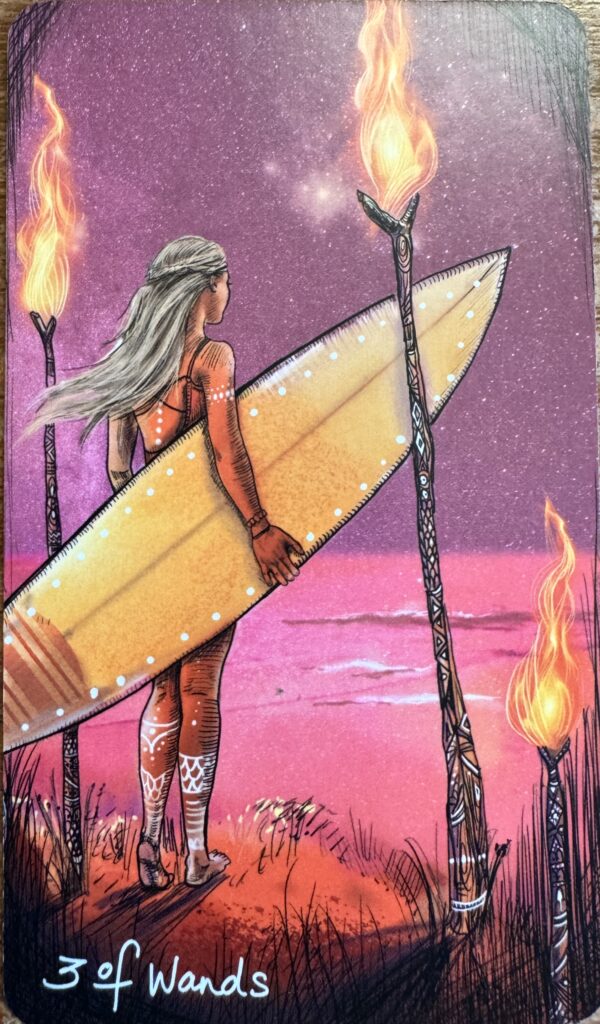
1. The Ground I Stand On: Three of Wands I’m already launched. Projects are deployed, work is in the world, things are moving. I’m not at the beginning. I’m in that slightly uncomfortable middle place where I’ve committed, I’ve sent my ships out, and now I’m watching to see what comes back. There’s vision here, but also the vulnerability of having already invested.
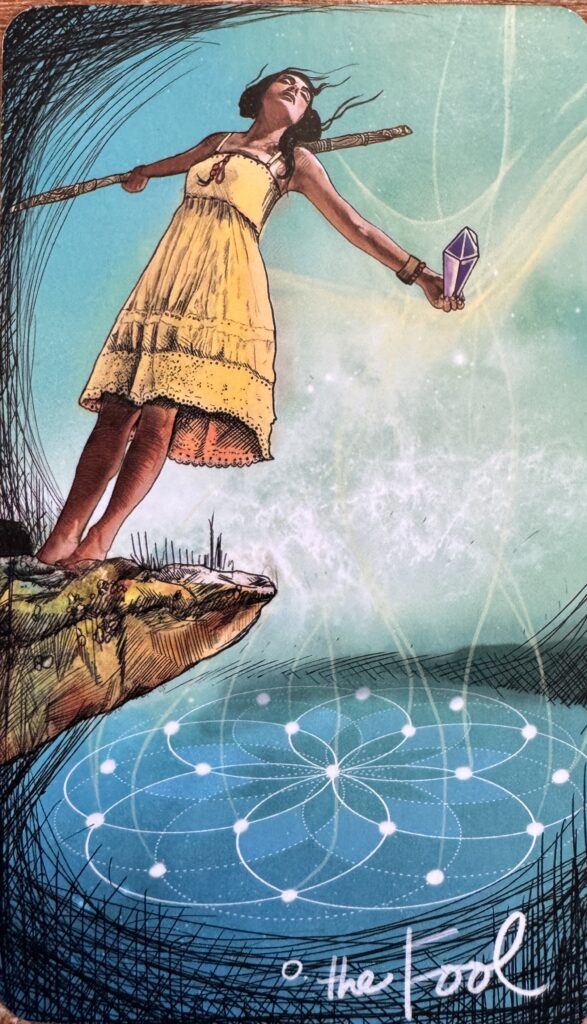
2. The Hidden Fuel: The Fool What’s actually driving me is pure beginner’s mind, the willingness to step off edges I can’t see the bottom of. Despite all my experience, the fuel source is radical openness, the capacity to NOT know, to trust the process without guarantees. This is genuine experimentation, not predetermined outcomes.
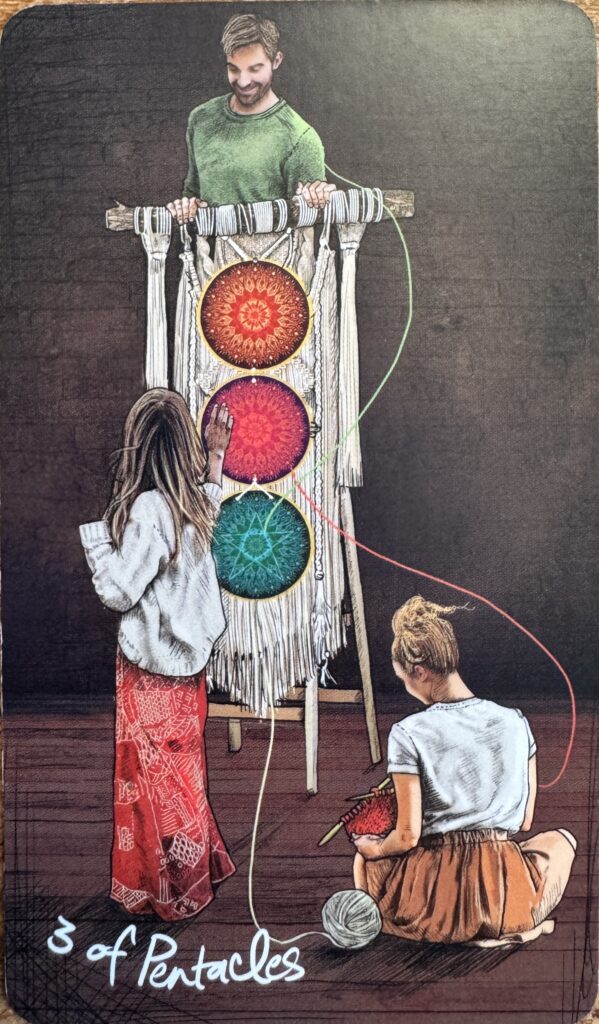
3. The Edge to Meet: Three of Pentacles The challenge isn’t solitary mastery. It’s collaboration, showing my work, getting feedback, building something WITH others rather than just FOR others. This card says the growth edge is in the vulnerable act of co-creation, of letting my work be shaped by real exchange rather than perfected in isolation first.
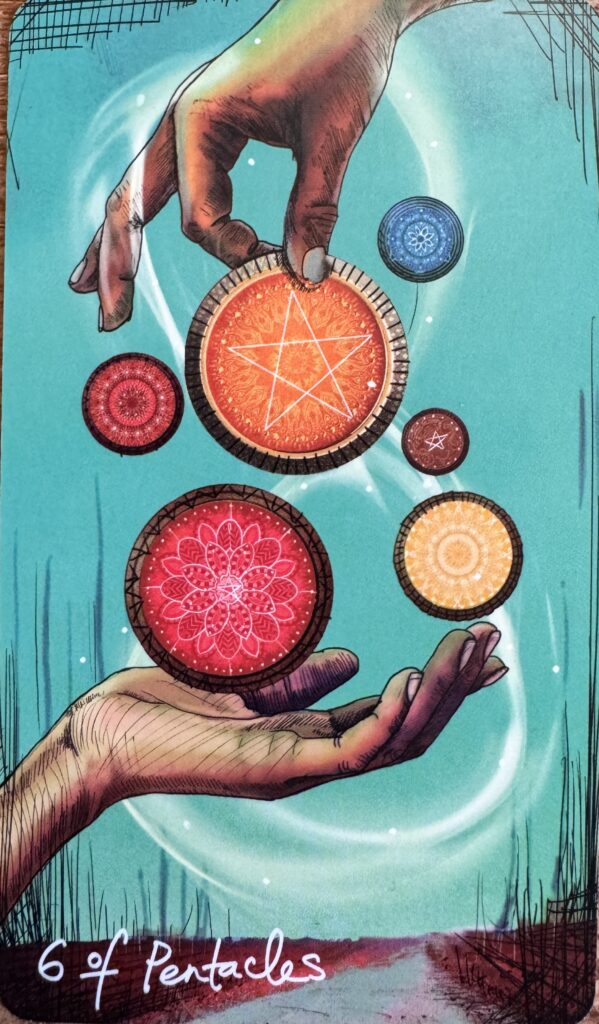
4. The Medicine Available: Six of Pentacles I have genuine resources to give and the wisdom to give them well. There’s a maturity here about exchange, about knowing when to give, when to receive, how to maintain flow without either hoarding or depleting myself. I actually know how to work with reciprocity.
5. The Intention Itself: Eight of Swords At first glance, this looks like constraint, being trapped. But look deeper: those swords aren’t touching her. The bindings are loose. She could walk out anytime.
My intention for the year is about recognizing and removing the self-imposed limitations that keep me from stepping into what’s already available.
Reading all five cards together, I arrived at this intention:
“I step out of self-imposed prisons and collaborate with what’s actually ready.”
What Makes This Different
The Intention Forge doesn’t give you a motivational poster slogan. It gives you a map of your actual psychic terrain right now. It shows you where you are, what’s moving you, what wants attention, what you can draw on, and what quality wants to shape your year.
Your intention emerges from seeing all of this clearly, not from deciding what sounds good.
For me, this meant recognizing that I’m a people person working in isolation, that I’ve already broken through digital limitations but haven’t yet stepped into physical collaboration, that my actual fuel is experimental openness not expert certainty.
The self-imposed prison I’m walking out of isn’t about capability or readiness. It’s about the stories that keep me preparing instead of engaging with what’s actually available right now.
Try It Yourself
Pull five cards. Sit with them. Don’t rush to positive interpretation or try to make them say what you want to hear. Let them show you what’s actually there.
Your intention will emerge not from position five alone, but from the whole pattern. From seeing your ground, your fuel, your edge, your medicine, and the quality that wants to shape how you move.
And then, like me, you might find yourself putting a date in your calendar for something you’ve been avoiding. Not because you’ve got it all figured out, but because you’re finally ready to walk out of the cell you’ve been sitting in with the door unlocked.
The cards don’t tell you what to do. They show you what’s really lurking beneath you conscious mind. And sometimes, that’s exactly what you need to set an intention that actually means something.
There’s a moment when you realize that what you thought was the end was actually just a transformation. That what looked like death was actually radical metamorphosis. That the dissolution you’ve been fearing or grieving or trying to avoid is the very mechanism by which something more whole, more real, more essentially you can finally emerge. This isn’t comfort. This isn’t denial. This is the brutal, beautiful recognition that death in its truest sense is not cessation but change so complete that nothing of the old form remains.
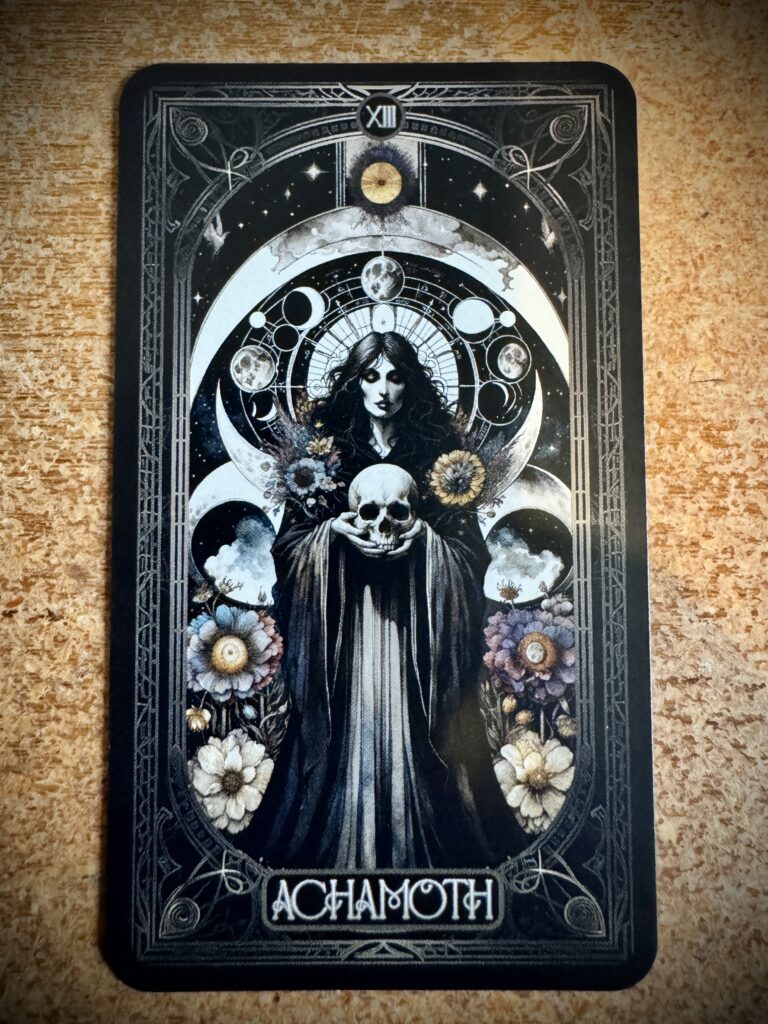
This is Achamoth’s domain.
Everything casts a shadow. That is cosmic law. This includes Sophia. In Gnostic sagas, the Aeon Sophia commits a transgression against the Pleroma and is cast into the Chaos. In a state of distress and pregnant with dysfunctional feelings, she gives birth to the Demiurge and matter itself. Only Sophia’s negative side is cast out in some systems, known as Achamoth or the Wisdom of Death.
Like the wisdom of humans, she can be as dark and wounded as she is determined and curious. She is Anath or Sekhmet to the Gnostics, just as her higher self is Asherah. Some myths depict Achamoth as Pronikus, the Lewd One, a seducer of archons and a cosmic femme fatale. She is with you every moment of your life, inviting you to transform if you would look up at the Pleroma and be filled with holy change.
Valentinus, one of the great Gnostic teachers, had a saying that cuts to the heart of Achamoth’s teaching: “Make death die.”
Not “escape death.” Not “transcend death.” Make death die. Transform the transformer. Let the very principle of ending itself come to an end through such complete transformation that nothing remains to die because everything has already been reborn.
Today, Achamoth arrives as our fifteenth companion, at the exact center of our journey, following John the Baptist’s teaching about suspension and necessary endings. Where John taught us to hang between worlds, Achamoth teaches us what happens when we finally let go completely, when the old form dies so thoroughly that transformation becomes inevitable, when we stop managing the process and allow death to do its sacred work.
The Advent Companion Appears
Achamoth doesn’t arrive gently or with comforting words. She appears as the presence of necessary death, as the quality of endings so complete they make room for genuine new beginnings. You feel her first not as threat but as invitation, not as enemy but as midwife, the one who knows that sometimes the most loving thing to do is allow what’s dying to die fully rather than prolonging its suffering.
She holds the skull with such tenderness. This is crucial. She’s not celebrating death as destruction. She’s honoring it as transformation, as the necessary dissolution that precedes all genuine rebirth. The flowers that surround her aren’t growing despite the darkness. They’re growing because of it. Death is their compost, their fertile ground, the very substance from which new life emerges.
The moon phases behind her tell the story: waxing, full, waning, dark, new again. The cycle never stops. Death is just one phase in an eternal pattern of transformation. But we fixate on it, fear it, try to avoid it, and in doing so we interrupt the natural flow that would carry us through death into rebirth.
Achamoth is Sophia’s shadow, her wounded aspect, the part that was cast into Chaos and had to learn how to create from distress, how to birth new forms from dysfunction, how to transform suffering into wisdom. This makes her uniquely qualified to teach about death because she knows it from the inside. She’s been through the dissolution. She’s experienced the casting out, the distress, the pregnant darkness that precedes new creation.
Some traditions call her the Wisdom of Death, distinguishing her from Sophia as the Wisdom of Life. But this is a false binary. Achamoth teaches that death is wisdom, that endings carry their own intelligence, that the capacity to let things die completely is as sacred as the capacity to birth new things. They’re not separate skills. They’re two aspects of the same transformative power.
She’s also called Pronikus, the Lewd One, the seducer of archons. This speaks to her radical agency in the face of cosmic oppression. Even cast out, even in distress, even pregnant with dysfunction, she doesn’t become passive. She works with what she has. She transforms her very woundedness into power. She seduces the archons not for their pleasure but to steal back fragments of divine light, to undermine their control from within.
As Achamoth appears beside you today, holding death with such reverence, her teaching arrives as both challenge and comfort:
“What if the death you’re resisting is the only path to the life you’re seeking? What if transformation requires you to die so completely to who you’ve been that nothing remains to resurrect, only space for something entirely new to be born?”
Teaching for the Day
We live in a death-denying culture. We medicate grief, pathologize mourning, turn away from endings, treat every loss as tragedy rather than transformation. We’re taught to fight death in all its forms, to resist aging, to preserve what’s dying, to never give up, never surrender, never let go. This creates a kind of living death where nothing is allowed to complete its natural cycle, where endings are interrupted before they can transform into new beginnings, where we carry the corpses of dead relationships, dead dreams, dead versions of ourselves because we never gave them permission to die fully.
Achamoth teaches something more radical: death is sacred. Not as punishment. Not as failure. But as the necessary mechanism of transformation. Everything that lives must die. Every form that arises must eventually dissolve. And fighting this natural law doesn’t preserve life. It just creates suffering.
“Make death die.” Valentinus understood something profound. The way to overcome death isn’t to avoid it but to transform so completely, so often, so thoroughly that death itself becomes obsolete. Not because you’ve escaped the cycle but because you’ve learned to flow with it so fluidly that the boundary between death and birth dissolves. You’re always dying. You’re always being born. And the distinction stops mattering because you recognize both as aspects of the same transformative process.
The archons want you terrified of death. They want you clinging to forms that have outlived their usefulness, trying to preserve what’s meant to decompose, afraid to let go because you can’t see what comes next. This fear makes you controllable. It keeps you small. It prevents the radical transformations that would liberate you from their programming.
But Achamoth, even in her fallen state, even cast into Chaos, demonstrates that transformation is always possible. That being wounded doesn’t mean being powerless. That even giving birth to dysfunction (the Demiurge, matter itself) can become part of a larger pattern of restoration. She doesn’t waste energy trying to undo her transgression or escape her shadow nature. She works with it, through it, transforms it into a different kind of power.
This is the teaching for today: what in your life needs to die? Not metaphorically. Not partially. Actually, completely, irrevocably die so that something new can be born in the space it occupied? And are you willing to stop managing that death, stop trying to control the transformation, stop preserving what’s meant to decompose?
The flowers grow in darkness. The moon wanes before it waxes. The seed must die for the plant to emerge. These aren’t metaphors. They’re descriptions of how transformation actually works. And you’re not exempt from this process. You’re subject to it, immersed in it, made possible by it.
Achamoth invites you to make death die by dying so completely, so consciously, so willingly that transformation becomes your natural state rather than something you resist. To let the old forms dissolve fully. To stop clinging to corpses. To honor endings as sacred rather than treating them as failures.
Journaling Invocation
“What has already died in your life that you’re still trying to animate? What needs to die completely that you’re keeping on life support? What would you need to grieve fully to make space for something new?”
This question asks you to look honestly at the deaths you’ve been denying, the endings you’ve been avoiding, the losses you haven’t fully processed because you’re afraid of what comes after grieving completes.
Maybe it’s a relationship that ended months or years ago but you’re still rehearsing conversations with them in your head, still processing the loss as though it might reverse. Maybe it’s a dream that died, a path that closed, a version of yourself that can’t come back no matter how much you wish it could.
Or maybe it’s something subtler: a way of thinking about yourself, a belief about how life works, a strategy for staying safe that’s actually keeping you small. These things can die too. These deaths matter too.
Write about what’s already dead. Not what might die. Not what you’re afraid will die. What has already died but you haven’t fully acknowledged its death, haven’t grieved it completely, haven’t allowed yourself to feel the full weight of that ending.
Achamoth doesn’t ask you to celebrate these deaths or pretend they don’t hurt. She asks you to honor them, to let them be complete, to stop trying to resurrect what’s meant to become compost for new growth.
And then ask the deeper question: what wants to be born in the space that death will create? Not immediately. Not as replacement. But eventually, naturally, when the grieving completes and the ground becomes fertile again.
What becomes possible when you finally let death do its sacred work?
Small Embodied Practice
Find a small object that represents something that has died in your life. It could be a photo, a gift from a relationship that ended, a symbol of a dream that didn’t manifest, anything physical that connects to a real ending.
Hold it in your hands. Feel its weight. Let yourself feel whatever arises: grief, anger, relief, numbness, all of it.
Say out loud or internally: “This has died. I acknowledge its death. I honor what it was. I release what it can never be again.”
If you feel moved to, you might create a small ritual: bury the object, burn it (safely), place it in water, give it away. The specific action matters less than the intentionality. You’re marking the death as complete. You’re giving yourself permission to stop trying to resurrect it.
If creating a ritual doesn’t feel right, that’s okay too. Simply hold the object and breathe with the recognition that it represents something that has ended. Let your body feel what it means to acknowledge death rather than deny it.
After several minutes, place the object down (or complete whatever ritual you’ve chosen). Stand or sit in silence. Notice if there’s more space in your chest, your belly, your awareness. Often when we finally acknowledge death completely, we discover we’ve been holding tension we didn’t know was there.
This is Achamoth’s teaching embodied: death is not the enemy. Denial of death is the enemy. The refusal to grieve is the enemy. The clinging to corpses is the enemy.
You just practiced making death die by allowing death to be death. Complete. Sacred. The necessary transformation that precedes all genuine new life.
The caravan moves together through death and rebirth. If today’s companion touched something in you, if Achamoth’s fierce tenderness helped you recognize what needs to die completely, let us know in the comments. Your willingness to grieve fully lights the path for others learning to let go beside you. 🌑
Tomorrow: Carpocrates arrives with his teaching about temperance, about the union of opposites, about finding the precious gem within by working with all of what you are.
There’s a particular quality of attention that changes everything. Not the scattered awareness we bring to most of our days, half-present and reactive, but the focused beam of consciousness that cuts through appearances to reveal what’s actually happening beneath the surface. It’s the difference between looking at something and truly seeing it. Between hearing words and understanding what’s being said in the silence between them. Between accepting the story you’ve been told and recognizing the story that’s actually unfolding.
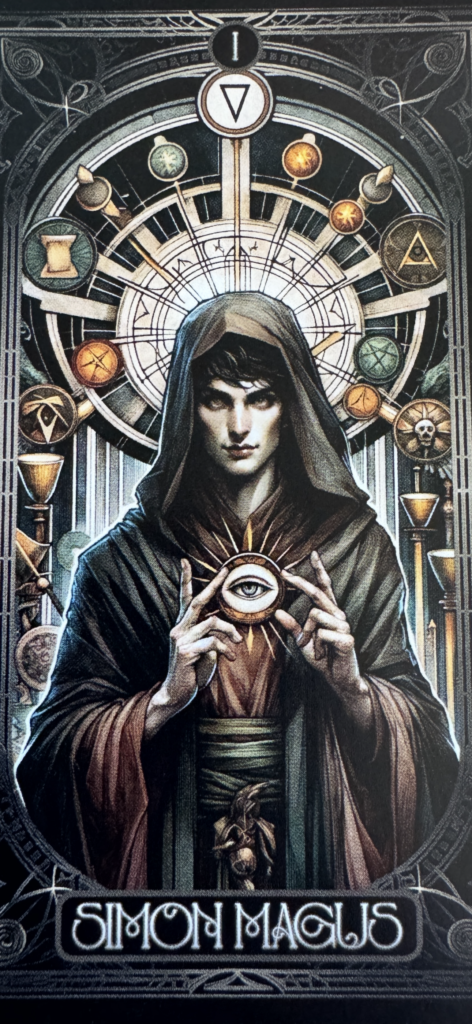
This is the terrain of Simon Magus.
In Gnostic mythology, Simon wasn’t just a magician in the stage-trick sense. He was a master of perception, someone who could see through the veils that keep most people trapped in consensus reality. The church fathers called him the Father of All Heresy1, which tells you everything you need to know about his power. He threatened the established order not with violence or rebellion, but with vision. He looked at the world everyone else accepted as fixed and saw the malleable, the fluid, the possible.
Behind that hooded gaze in the card, surrounded by alchemical symbols and cosmic wheels, Simon holds the all-seeing eye. Not as ornament or decoration, but as function. He is the one who perceives what others miss. The one who recognizes patterns where others see only chaos. The one who understands that reality is far more negotiable than the archons would have you believe.
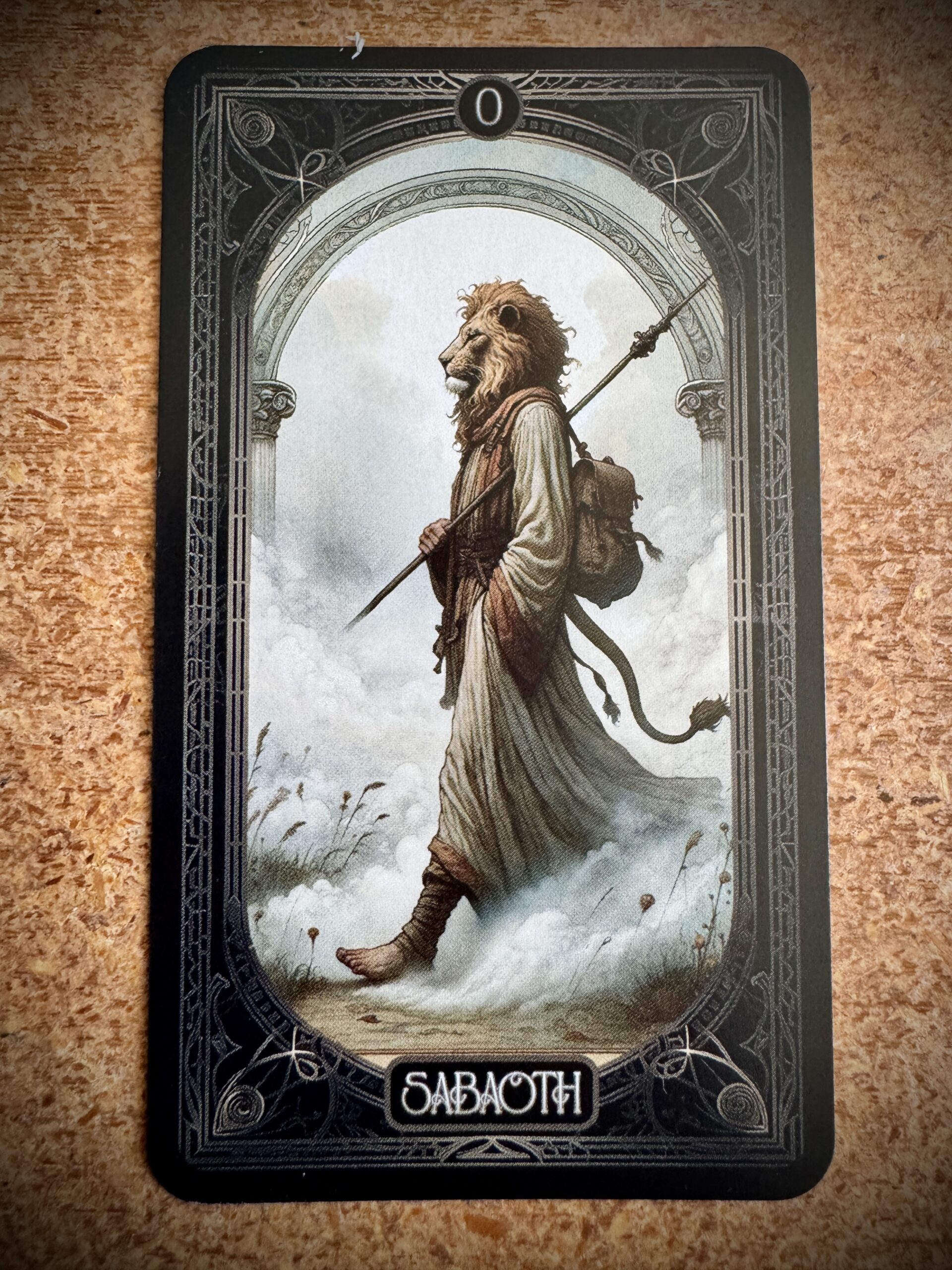
Today, he arrives as the second true companion on our journey, following Sabaoth’s sovereign walk. Where Sabaoth taught us to move with calm certainty, Simon teaches us to see with penetrating clarity. Because you can’t walk your true path if you can’t see where you actually are. You can’t create change if you can’t perceive what needs changing. You can’t practice real magic if you’re still under the spell of someone else’s illusion.
The Advent Companion Appears
Simon Magus doesn’t announce himself with flash or spectacle, despite the legends that surround him. In this moment, he appears as concentrated presence, as the quality of attention itself. You feel him first as a sharpening of your own perception, a sudden clarity about something you’ve been looking at without really seeing.
Behind his hood, that penetrating gaze asks nothing and demands nothing. It simply sees. And in being seen by someone who truly perceives, you begin to see yourself more clearly. The masks become visible as masks. The performances reveal themselves as performances. The stories you’ve been telling about who you are and what’s possible start to shimmer at their edges, showing their constructed nature.
Simon’s genius wasn’t that he possessed secret knowledge unavailable to others. His genius was that he looked directly at what everyone else had learned not to see. The divine spark hidden within the programmed self. The fluid nature of reality beneath its apparently solid surface. The power that lies dormant in human consciousness, waiting for someone brave enough to claim it.
The symbols surrounding him in the card aren’t mere decoration. They’re technologies of perception, each one a different lens for seeing through the simulation. The planetary spheres remind us that reality has layers, dimensions, frequencies. The elemental cups speak to the work of containing and directing energy. The eye itself, radiant and unblinking, represents the awakened consciousness that refuses to look away from truth.
As Simon appears beside you today, he brings a question that hums with quiet intensity:
“What have you been trained not to see? What truth has been hiding in plain sight, waiting for you to finally look directly at it?”
This isn’t about developing psychic powers or esoteric abilities, though Simon certainly mastered those arts. This is about something more fundamental: recovering your natural capacity to perceive clearly, to think independently, to recognize patterns that the dominant narrative has trained you to ignore.
Simon’s presence reminds you that you already have everything you need to see through the illusions that bind you. The only question is whether you’re willing to look.
Teaching for the Day
The archons maintain their control not through force but through managed perception. They don’t need to imprison you if they can convince you that the prison is the entire world. They don’t need to stop you from seeking truth if they can persuade you that truth is whatever the authorities decree. They don’t need to suppress your power if they can make you believe you were never powerful in the first place.
Simon Magus understood this completely. His “magic” wasn’t about manipulating external reality, though the legends certainly tell those stories. His deepest magic was perceptual: the ability to see through the constructed nature of consensus reality and recognize the divine potential that the archons work so hard to keep hidden.
The Gnostic teaching is clear on this point: you contain a spark of the divine, a fragment of the Pleroma itself. But that spark has been buried under layers of programming, social conditioning, inherited beliefs, and mechanical patterns of thought and behavior. The archons didn’t steal your divine nature. They convinced you it was never there in the first place.
Simon’s work, and now yours, is to develop the quality of attention that penetrates those layers. To look at your life, your beliefs, your automatic patterns with the kind of clear-eyed perception that doesn’t flinch from what it discovers. This requires both courage and gentleness. Courage because you will see things you’ve been avoiding. Gentleness because what you discover beneath the conditioning is often wounded, often scared, often convinced it needs to stay hidden to stay safe.
But here’s what Simon knew that made him so dangerous to the established order: once you truly see through an illusion, it loses its power over you. Not through effort or struggle, but through simple recognition. The spell breaks the moment you perceive it as a spell.
This is why clarity matters more than almost anything else on the spiritual path. You can’t transform what you can’t see. You can’t heal what you won’t acknowledge. You can’t reclaim what you don’t recognize as yours.
Simon’s teaching today is practical and immediate: Look directly at your life. Notice where you’ve been accepting someone else’s version of reality without question. Identify the places where you’ve stopped thinking for yourself and started echoing the program. Recognize the patterns that keep running automatically, beneath your conscious awareness.
This isn’t about judgment. It’s about vision. And vision, true vision, is the beginning of all genuine magic.
Journaling Invocation
“What pattern in your life have you been looking at without actually seeing? What truth is waiting for you to finally pay attention?”
This question invites a particular kind of honesty. Not the dramatic confessions or the grand revelations, but the simple, almost embarrassing recognition of something you’ve known all along but haven’t been willing to fully acknowledge.
Maybe it’s a relationship dynamic that plays out the same way every time, and you’ve been pretending you don’t notice. Maybe it’s a habit or pattern that undermines you, and you’ve been looking past it because changing it would require uncomfortable choices. Maybe it’s a truth about your desires, your gifts, your path that doesn’t match the story you’ve been telling yourself about who you’re supposed to be.
Simon’s eye doesn’t judge what it sees. It simply sees clearly. Can you bring that same quality of neutral observation to yourself today?
Don’t write what you think you should see. Don’t perform insight for an imaginary audience. Just look. Really look. Let yourself notice what’s actually there, not what you wish were there or fear might be there. What’s actually, demonstrably, undeniably present in your life right now.
Sometimes the truth that’s been hiding in plain sight is uncomfortable. Sometimes it’s liberating. Sometimes it’s both. Whatever emerges, let it arrive without censoring it or immediately trying to fix it or explain it away.
The practice today is pure perception. Seeing without the usual filters. Looking without immediately turning away. Witnessing what is, exactly as it is.
Simon’s magic begins here, in this simple but profound act of clear seeing. What reveals itself when you finally allow yourself to look directly?
Small Embodied Practice
Find a mirror. Stand or sit comfortably where you can see your own eyes clearly.
Now look. Really look. Not at your hair or your skin or whether you look tired or attractive. Look into your own eyes. Hold your own gaze the way Simon holds the all-seeing eye in the card: steady, unflinching, curious but not judging.
This will likely feel uncomfortable at first. We’re not used to truly seeing ourselves. We’re trained to glance and look away, to assess and adjust, to maintain the performance even when we’re alone. But today, just for a few minutes, let yourself be seen. Let yourself see.
Notice what happens in your body as you hold this gaze. Does your breath change? Do you want to look away? Do you start to smile or to cry? Do you feel resistance or softening? Whatever arises, stay present with it. Keep looking.
After a minute or two, whisper or think this question while maintaining eye contact: “What are you not letting yourself see?”
Don’t force an answer. Just hold the question while you hold your own gaze. Let whatever wants to surface, surface. Sometimes it comes as words. Sometimes as feeling. Sometimes as a sudden recognition that shifts something in your chest or belly.
You might discover something surprising. You might simply feel the strangeness of truly witnessing yourself without the usual self-judgment or self-improvement agenda. Both are valuable.
When you’re ready to close the practice, take one more deep breath while looking into your own eyes. Acknowledge yourself: “I see you.”
This is Simon’s teaching embodied: the magic of clear seeing begins with seeing yourself clearly. Not the version you perform. Not the story you tell. The actual you, present and real and worthy of direct attention.
The caravan moves together. If today’s companion touched something in you, if Simon’s penetrating gaze helped you see something you’d been missing, let us know in the comments. Your clarity lights the path for others walking beside you.
Tomorrow: Helen of Tyre arrives with her hidden wisdom and priestess mysteries.
Notes
The Father of All Heresies: The early church fathers had it in for Simon Magus. In Acts, Simon declares himself to be “something great” but responds humbly after he is rebuked and cursed by Peter (Acts 8:9 , 24 ). One generation later, the early church writers were accusing him of being the father of all Christian heresies. ↩︎
There’s a particular kind of vertigo that arrives when you realize the life you’ve been living isn’t entirely your own. Not because someone forced it on you, but because you inherited it so seamlessly you never thought to question where it came from. The scripts, the certainties, the well-worn paths that everyone around you seemed to follow without hesitation. You walked them too, until one day something shifted. A crack appeared in the pattern. A question you couldn’t ignore. A restlessness that refused to be reasoned away.
This is the threshold Sabaoth knows intimately.
In Gnostic myth, Sabaoth is the eldest son of Yaldabaoth, the Demiurge who rules the material cosmos with mechanical precision. Sabaoth was born into the archontic order, programmed to maintain the simulation, to keep humans bound to fate and forgetfulness. He had a place, a function, a predetermined role in the cosmic machinery. And then, something unprecedented happened.
He woke up.
Not gradually. Not through study or spiritual practice. He simply saw. He recognized goodness within himself that didn’t come from his father’s programming. He felt something authentic stirring beneath the inherited commands. And in that moment of recognition, everything changed. Sabaoth rebelled. He turned away from the only reality he’d ever known and began the perilous journey upward through the spheres, toward Sophia, toward restoration, toward a truth larger than the one he’d been given.
This is why Sabaoth stands at the beginning of our caravan, why he appears on the second day as the first Major Arcana companion. Because every genuine journey begins exactly here: with the courage to question what you’ve accepted as inevitable. With the willingness to step away from inherited certainty into the unmapped territory of your own becoming.
The Advent Companion Appears
Sabaoth doesn’t arrive in a rush or with wild-eyed enthusiasm. He appears as a steady presence moving through mist, his lion’s gaze fixed on a horizon only he can see. There’s no hesitation in his stride, no second-guessing. He carries a traveler’s pack and a staff, but lightly, as though he’s learned to travel unburdened by what doesn’t serve the journey.
This is the fool who has already counted the cost and decided the price of staying is higher than the risk of leaving. He doesn’t leap. He walks. Deliberately. Calmly. With the quiet confidence of someone who has finally stopped pretending the cage was ever a home.
When Sabaoth turned away from his father Yaldabaoth’s kingdom, it wasn’t a frantic escape. It was a sovereign choice. He recognized goodness within himself that didn’t come from the archontic programming, and once he saw it clearly, there was nothing to debate. The direction became obvious. The path revealed itself. All that remained was to walk it.
As he appears beside you today, he doesn’t demand anything dramatic. He simply demonstrates what it looks like to move through uncertainty with grace. To trust your inner knowing so completely that the outer world’s chaos can’t shake you. To walk your path not because you have all the answers, but because staying still would be a betrayal of what you’ve recognized as true.
His question arrives not as a challenge but as an invitation:
“What would it feel like to move through your life with this kind of calm certainty, trusting that the path reveals itself to those willing to walk it?”
Teaching for the Day
There’s a difference between the leap of desperation and the walk of sovereignty. Sabaoth teaches us that awakening doesn’t have to be violent or chaotic. Sometimes the most radical act is simply to move forward with quiet certainty, refusing to be hurried by fear or slowed by doubt.
The world mistakes stillness for wisdom and calm for compliance. But Sabaoth shows us something different: there’s a kind of movement that is both decisive and peaceful. A way of walking that doesn’t grasp or force, but also doesn’t hesitate or apologize. This is the gait of someone who has stopped arguing with reality and started trusting the goodness they’ve discovered within themselves.
The archons operate through urgency and anxiety. They want you frantic, second-guessing, caught in endless loops of “what if” and “but maybe.” They thrive when you’re too afraid to trust your own clarity. Sabaoth disrupts this pattern not by fighting it, but by simply walking past it. His rebellion isn’t loud. It’s inevitable.
When you recognize something true about yourself, about your path, about what wants to live through you, you don’t need to announce it or defend it or prove it to anyone else. You just need to walk. One foot in front of the other. Through the mist. Through the uncertainty. Through whatever tries to convince you to turn back.
The staff in Sabaoth’s hand isn’t a weapon. It’s support. It’s the practical wisdom to bring tools for the journey, to move thoughtfully rather than recklessly. This isn’t about abandoning everything in a dramatic gesture. It’s about packing carefully and walking deliberately toward what you know is true, even when you can’t yet see where the path ends.
Calmness in motion is its own form of magic. Sovereignty doesn’t need to announce itself. It simply walks, and the world rearranges itself around those who move with authentic purpose.
Journaling Invocation
“Where in your life have you been following a script that was written for you rather than by you?”
This question isn’t asking you to catalog every compromise or inherited belief. It’s inviting you to notice one place, just one, where you’ve been living according to someone else’s program. It might be subtle: a career path chosen to please a parent, a relationship maintained to avoid disappointing others, a version of yourself you perform because it keeps the peace.
Or it might be deeper: a fundamental belief about your worth, your capacity, your right to take up space in the world. Something you’ve never questioned because questioning it feels like questioning gravity itself.
Don’t rush to fix anything. Don’t immediately leap into action. Just look.
Sabaoth’s awakening didn’t begin with a plan. It began with recognition. He saw something clearly that he’d been conditioned not to see. That moment of seeing was enough to set everything else in motion.
Your task today is simply to see. To name one inheritance you’ve been carrying without choosing it. To acknowledge one place where the life you’re living doesn’t quite match the life that wants to live through you.
Write without editing. Let the truth arrive in whatever form it takes, clumsy or clear, angry or sad, tentative or certain. The point isn’t to craft a perfect insight. The point is to allow what’s been silenced to finally speak.
If nothing comes immediately, that’s okay. Sometimes the deeper recognitions need time to surface. But ask the question. Hold it gently. Trust that your inner knowing is already stirring, already preparing to show you exactly what you’re ready to see.
Small Embodied Practice
Stand somewhere open, indoors or out. Feel your feet on the ground, your spine naturally tall, your breath moving easily. Don’t rush into this. Let yourself arrive fully in your body first.
Now begin to walk. Not quickly. Not tentatively. Walk as though you know exactly where you’re going even if you don’t. Let your steps be even, measured, grounded. Feel the staff of your own spine supporting you. Notice how your arms swing naturally. Let your gaze rest softly on the horizon, not darting around for approval or permission, just steady and forward.
As you walk, imagine you’re moving through mist. You can only see a few feet ahead, but that’s enough. Each step reveals the next step. You’re not trying to see the whole journey. You’re trusting the path to appear as you walk it.
Notice what happens in your body when you move this way. Does your chest open? Do your shoulders release? Does something in you remember that this kind of calm, purposeful movement is your birthright?
Walk for three or four minutes, or longer if it feels good. Let the rhythm settle into you. This is Sabaoth’s teaching in your body: sovereignty isn’t a destination. It’s a way of moving through the world.
When you’re ready to stop, stand still for a moment. Feel how your body holds this new quality of presence. You’re not performing confidence. You’re embodying clarity. There’s a difference, and your body knows it.
This is the practice: walking with quiet certainty, trusting that the path appears for those willing to move forward, one sovereign step at a time.
The caravan moves together. If today’s companion touched something in you – a recognition, a question, a quiet rebellion – let us know in the comments. Your words light the path for others walking beside you.
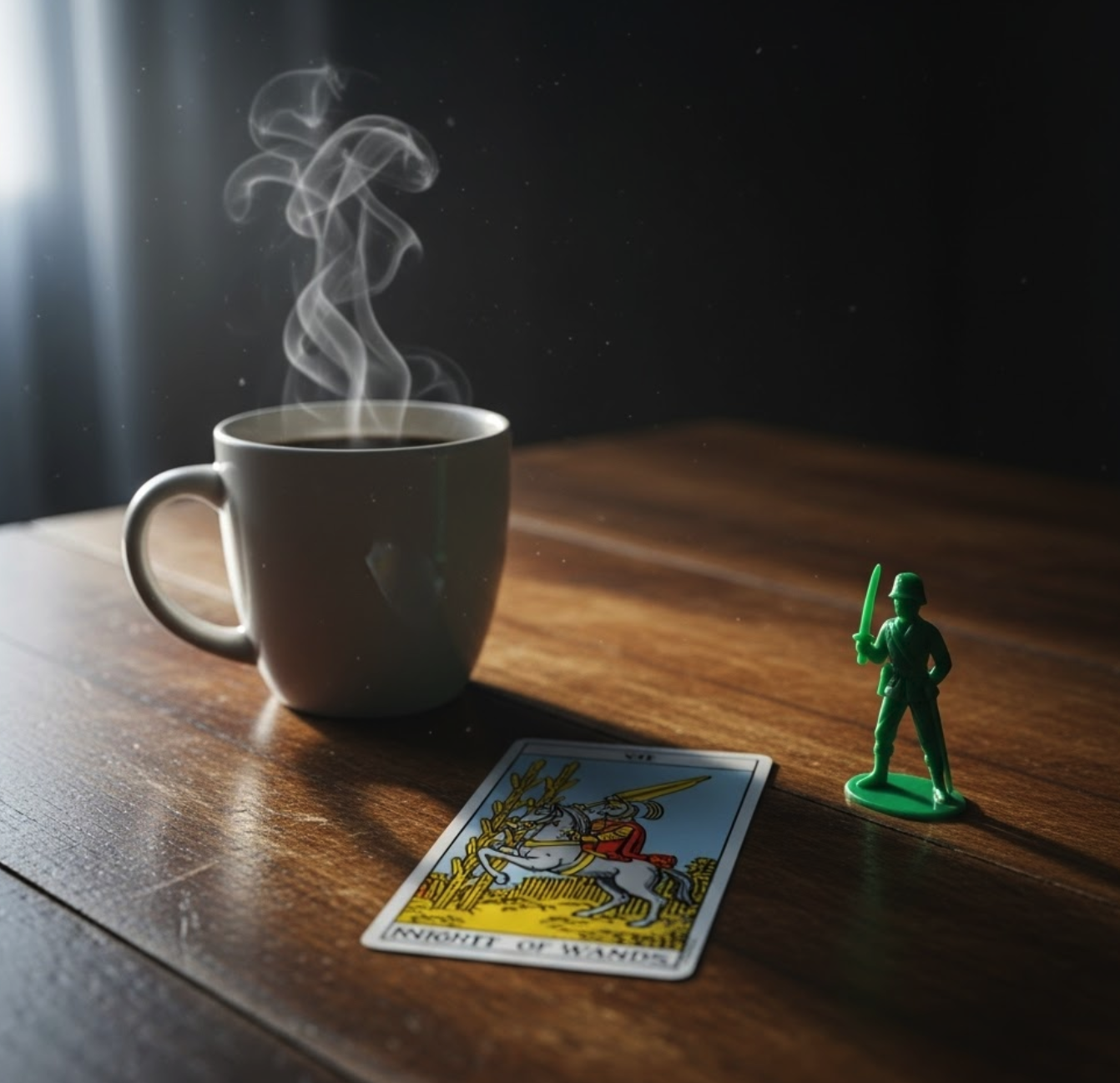
The Knight of Wands hits the table with a soft slap.
It is early, the sort of English early that feels damp even inside the house. Light seeps through the kitchen window in a thin grey ribbon. The kettle whistles behind me. My Rider–Waite deck sits where it usually sits, in the bare circle I have worn into the grain with years of shuffling. My fingers are cold. My breath hangs faintly in the air when I exhale.
I flip the card and there he is. The young rider on the restless horse. The desert. The plume of red. The wand held forward as if he means to lance the horizon itself.
I feel it like a memory the body understands before the mind catches up. The buzz in the limbs before a mission. The way time feels thicker, slower, while you wait for the order to move.
The card stares up at me from the table. Or I stare down at him. Either way, this is how the question arrives again, the one that refuses to leave me alone.
What does it mean to be a warrior when the battlefield is your own consciousness?
I am fifty–seven. My knees hurt in the rain. The army is two lifetimes behind me. Yet one look at that card and my spine lengthens by a fraction. My shoulders adjust. A trace of parade-ground posture settles over the man in the cottage kitchen.
The kettle clicks off. Steam ghosts the window. Somewhere in the street outside, a diesel truck coughs to life. I pour the water over the coffee grounds and watch the bloom rise and darken.
This Knight of Wands is supposed to be a symbol. Ink on paper. Yet my nervous system does not know that. It recognizes the posture: forward lean, heels anchored, ready to surge.
You can leave the infantry. The infantry does not quite leave you.
I sit at the table, wrap my hands around the warm mug, and keep looking at the card.
The tarot is a map of consciousness, that is the story I work with now. Seventy–eight cards, each a doorway into some pattern the psyche runs. Lovers and hermits. Towers and suns. Fools and worlds.
But the warrior lives in this landscape too, half hidden but everywhere. In plate armor and silk robes, in crowns and ragged bandages. Sometimes he is a woman closing a lion’s jaw with bare hands. Sometimes he is a crowned figure hurling lightning from a black sky.
The warrior carries swords, certainly. Yet he also raises wands, sits in thrones, rides chariots, crests waves, walks alone at night with a lantern. The archetype moves through the deck the way a river moves through a valley, shaping everything, often unseen.
Why does this matter to me enough that I am willing to spend years inside it?
Because I have seen what happens when a culture forgets what the warrior is actually for.
I have seen twenty–year–olds taught to be efficient killers without being taught how to be guardians of anything beyond flag and career. I have watched executives in dark suits wield budgets like weapons, confused that every room they walk into feels like a threat. I have turned my own body into a weapon, then tried to pretend that the story left behind in my muscles and bones did not shape the way I loved my children.
So this is not an academic exercise for me. It is not a game of symbols, even though I wrap it inside a solo tarot RPG called Magus Eternal and sit in front of screens for much of the day.
The stakes are simple, and they are not simple at all: how we hold the warrior inside us determines who we hurt when we get afraid.
The young man on the Knight of Wands card keeps staring past me, out toward the window, toward fields and roads and a sky he has not met. He is eager. He is beautiful. He is dangerous.
I know him.
The first time I learn to stand like a warrior, it is not in the desert or on some mist–swept battlefield out of legend. It is on a polished gym floor at West Point.
The air smells of sweat and varnish. Fluorescent light hums above us, too bright, flattening every surface. A captain in a grey T–shirt and black shorts walks the line of cadets. We stand at attention in grey T–shirts gone dark under the arms.
“Feet shoulder width. Knees soft. Hips loose. Chest up. You are not dancers. You are not models. You are future officers in the United States Army.”
He paces in front of me, stops, and presses two fingers into my sternum.
“Relax the chest. Keep the spine tall. Good. A warrior does not puff himself up. He does not shrink either. He occupies his space.”
He moves on.
I am eighteen, all tendon and bone. My father is career Navy. His father before him was Army. The word “warrior” sounds to me like hero and professional and man all braided together, though I would not say that out loud. Out loud we say “soldier.” “Infantry.” “Officer.”
The word “warrior” belongs to recruiting posters and martial arts movies. It smells like smoke and destiny. “Soldier” smells like gun oil, boot polish, wet canvas.
It will take me decades to understand that these are not the same thing.
At that age, if I had to pick a card for myself, it would not be the Knight of Wands. It would be his brother across the table: the Knight of Swords.
I do not know the tarot yet, but I know the feeling. The forward–thrusting mind, sharp and certain, hungry for argument, ready to cut through and correct. I am good with words. Though my grades don’t reflect. I learn doctrine fast and recite it back faster. War is a puzzle to solve and a test to ace.
The Knight of Swords in the Rider–Waite deck leans nearly horizontal over his horse’s neck. Sword pointed forward, wind at his back, trees lashed.
When I first pull that card years later, sitting at another oak table in another life, I blink. That was me. That is me, at least the version that West Point rewards.
Cut through. Advance. Close with the enemy. Outthink him. Out–plan him. Out–flank him. Return with results.
The Knights offer this first face of the warrior in the tarot: raw directional energy. Movement. The urge to go somewhere, anywhere, as long as it is forward.
Knight of Wands: the body lunging toward experience. Knight of Swords: the mind lunging toward certainty.
Both of them glow. Both of them burn. Both of them, in their first form, are reckless as hell.
When I graduate and step into the real Army, I carry both in my chest.
In the desert, the Knight of Wands lives in my legs. Sand grinds in my boots. The air is so hot that it feels like my eyeballs have dried to shell. The light is vicious, white and fierce. We move in staggered column, weapons at the high ready, sweat stinging every crease of skin.
We receive an order. We execute it. We move again.
I am good at this. The body learns quickly. You point me at an objective and I go. You tell me this village, that bridge, this checkpoint. I do not pause to ask questions beyond what the plan requires. I am a professional. Professionalism, in that setting, means reducing the distance between intention and action as much as possible.
The Knight of Swords lives in the command tent. Maps spread over folding tables. The green glow of screens. Radios muttering. The captain asking for my estimate of the situation, my recommendation, my plan.
“We could move Alpha along this ridge, sir, and establish a support by fire here. Bravo can push through the wadi, cut off any retreat.”
I love this. I love it the way a chess player loves the board.
One card for the body, one card for the mind. Two young warriors, riding full tilt.
Meanwhile, something else sleeps in the deck, unturned. Something older than flags and call signs. Something bigger than the U.S. Army.
I will not meet him until the armor begins to crack.
I sit back from the kitchen table and take a breath. The Knight of Wands rests where I placed him. Curiosity nudges me to draw his brother.
I shuffle. The cards rasp together, that dry, papery sound that has become one of my favorite sounds on earth. I cut the deck and pull.
Knight of Swords.
The two of them stare up at me now, side by side. Two young men on horses, headed toward horizons they cannot see yet.
They feel like old photographs.
The question that rises is not nostalgic. It has teeth.
Where do you send these two now, Clay, in the landscape of your own consciousness? What war are you about to fight?
Because these knights do not retire. They do not age. Archetypes do not grow old. We must grow around them, or they keep riding until they run us into the ground.
There is the work.
The word “warrior” is older than “soldier” by a long way. It tastes different in the mouth.
A soldier is an employee of a state. He wears a uniform. His battles belong to the people who issue his orders. He has a salary. He has a rank. In many ways, he is a technician, trained in the application of organized violence in specific contexts.
A warrior, as I understand him now, is older than any flag. He belongs to the threshold. He stands at the edge where one thing ends and another begins, and he decides, with his body and his intention, what crosses.
He is a boundary–keeper, not simply a fighter. He holds a line, seen or unseen. He says, “This far. Not further.” Sometimes he says it with a blade. Sometimes with a word. Sometimes with silence.
He protects. He destroys. He is the hand that opens the gate at dawn, and the hand that bars it at night. In some stories he is male, in some female, in many both at once.
When I look at the tarot as a map, I start to see where this older warrior hides.
He sits on the Emperor’s throne, armored beneath red robes. He rides the Chariot between two sphinxes that pull in opposite directions. He falls with the Tower when lightning splits stone. He smiles in the Strength card as gentle fingers close on the jaw of a lion.
He flashes in the edges of the minor arcana too, in the crossing blades and scattered wands, in the sneaking figure who slips away with stolen swords, in the body pierced and facedown under a sunrise that looks too calm.
If the Major Arcana tells the story of a soul awakening to itself, then the warrior is the part of that soul which must learn when to fight and when to stop fighting. When to defend, when to surrender, when to burn something to the ground.
The Knights are only the beginning, an opening volley of energy. They show us what warrior looks like before it knows what it is for. All fire. All mind.
The deck does not stop there though. It gives us a path of maturation, if we are willing to follow.
The Emperor sits on a stone throne carved with rams’ heads. Mountains rise behind him, jagged and bare. His beard is white. His armor gleams at the edges where the red cloth parts. In one hand, an ankh–topped scepter. In the other, a globe.
He is the first clear expression of warrior that the Major Arcana offers. The Magician has power, but it is fluid, tricky, mercurial. The Hierophant has authority derived from tradition, from God and book and temple. The Emperor’s authority comes from something rougher.
“To protect,” his posture says. “To rule. To impose order.”
When this card shows up in my spreads, my body reacts before my intellect does, just like with the Knights. My shoulders tense. My jaw sets, just a little.
I know this man. I have served under him. I have tried to become him. I have rebelled against him, too.
In the Army, the Emperor lives in every senior officer who has forgotten what his rank is for. He is the colonel who clings to control for its own sake. He is the general who treats soldiers as counters on a map, not as kids with knees that hurt when it rains.
In the corporate world, he sits at the head of the conference table, PowerPoint glowing on his face. He signs off on restructures and layoffs. His temper can wreck a year of work in a single meeting. People track his moods like weather patterns.
Yet the Emperor is also my father, paying bills, keeping the car running, making sure there is food on the table. The Emperor is the part of me that insists on a budget for my creative projects, that sets deadlines, that decides to turn the mystical into something with a structure, like a tarot roleplaying game instead of fifty notebooks’ worth of scattered spells and notes.
Authority cuts both ways. That is the tension inside this card.
On my desk, I keep a small plastic soldier from my childhood. He stands by a tiny fence, rifle in hand. Whenever I pull the Emperor, my eye goes to that toy. I remember how I used to place him at the edge of paperback–book fortresses and tell my younger self, “He protects the base.”
The father wound and the father gift live in this card side by side. The wound is control for its own sake, authority that needs obedience to feel real. The gift is the capacity to build something that lasts, and then to take responsibility for its protection.
The Emperor shows me what happens when the Knight of Wands and Knight of Swords grow up without doing their inner work. One becomes the tyrant who never stops charging. The other becomes the cold strategist who treats everything as a problem to be solved, even his children.
But if they grow up well, if they learn the purpose beneath the power, they might become a different kind of Emperor. A builder who remembers that his stone throne sits on top of earth, and earth eventually swallows stone.
When I meditate with this card, I do not ask, “How can I gain more control?” I ask, “Where have I mistaken control for care? Where can I act as a guardian rather than a ruler?”
Sometimes the answer sends me back, gently, to my writing desk. Sometimes it sends me out for a walk, to let go.
If the Emperor shows the warrior seated, the Chariot shows him in motion again, but this time in full armor and ceremony.
In the Rider–Waite deck, the charioteer wears a square breastplate. A canopy of stars stretches above him. Two sphinxes crouch in front of the vehicle, one black, one white. Their bodies face slightly apart, as if each wants to pull in its own direction.
There are no reins in his hands.
He steers something else.
When this card appears, I feel the old training stir, but it is wrapped in something different now. This is not the wild rush of the Knights. This is control. Focus. A steady gaze that looks forward, not because it is hungry, but because it is committed.
The Chariot is about victory, the little white booklets say. Triumph. Willpower.
For me, it is about learning that you cannot bully your own inner forces forever.
I sit in my office in Southam, screens glowing. Tarot deck fanned out beside my keyboard. On one monitor, a document titled “Magus Eternal: The Warrior’s Path.” On the other, a Discord window with a handful of seekers scattered across time zones, trading spreads and experiences.
I draw a card for the project. The Chariot.
Of course.
Building this game, this “spiritual technology,” as I insist on calling it, feels like harnessing a team of wild, differently coloured beasts. There is the part of me that wants it to be clean and structured, a polished system that would satisfy the most meticulous gamer. There is the part of me that wants it to be raw, ritual, messy, closer to a journal full of runes than to a rulebook.
The white sphinx. The black sphinx.
Some days they pull in opposite directions. I sit in this chair and feel myself torn between outlines and oracles, between the part of me that learned to write field manuals and the part of me that wants to throw the manual away and listen to the cards.
The Chariot says, “You do not pick one. You do not let them tear you apart either. You learn to stand tall over both, heart forward, hands still.”
Control through surrender. That is the paradox of this card.
The battle inside our own heads is not much different. Thought pulls one way. Emotion pulls the other. Habit tugs at your sleeve. Fear barks orders. If you try to whip them into line, they resist. If you collapse and let them drag you, they run you into the ditch.
The Chariot shows you another option. Stand. Breathe. Remember what you are actually moving toward.
The warrior, at this stage, is no longer just a fighter. He is a driver of inner energies, a conductor of the many parts of the self. He wears armor because the world still throws stones, yet his real protection is his capacity to stay present when the two sphinxes strain.
Not all structures are worth preserving. Not all victories are clean.
The Tower card falls out of my deck more often than I would like. Sometimes it leaps when I am shuffling, flipping itself onto the table like a drunk at a bar. Lightning splits the stone tower. Flames burst from the windows. A crown topples. Two figures, one in red, one in blue, fall toward jagged rocks below. Night presses in, starless.
The Tower frightens people. Death gets a bad reputation, but I have come to trust Death. Death is transition, the doorway from one state to another. The Tower is what happens when you build your life on something false and that falseness can no longer sustain its own weight.
In martial terms, this is the siege you cannot win. The fortress that must fall. If the Emperor is the builder of walls, the Tower is the collapse of walls, willingly or not.
For years, my identity is a fortress. Clay the officer. Clay the corporate leadership guy. Clay the coach. Clay the one who can walk into chaos and impose order with words and plans.
Inside, behind those stone walls, another part of me paces. The one who reads Jung at night. The one who buys decks of cards in secret. The one who feels that stories are not entertainment but spells.
I keep that part in an upper room. I tell myself I will go up there later, when the war is over, when the bills are paid, when the children are grown.
The lightning strike comes in a form I do not expect. Exhaustion. An inner voice that shifts from whisper to roar.
“I cannot do this any more.”
By “this,” I mean the performance of a role I no longer believe in. The endless strategizing in rooms without windows. The flights from one client site to another, hotels that all blur into the same beige carpet and white sheets.
The day I decide to walk away from that life, it feels less like a choice and more like crumbling. My hands shake as I type the resignation email. My heart hammers in my chest. My jaw aches from clenching.
I pull cards for guidance, because by then the tarot is no longer a secret indulgence. It is my primary mirror.
The Tower lands in the center of the spread.
“Of course,” I say out loud in my little home office. My voice cracks.
Mars energy. Ruin. Release.
The warrior in this card is not swinging a sword. He is the lightning itself. He is the force that says, “This structure is a lie,” and then knocks it down, no matter how many impressive things you have stacked inside.
We fear The Tower because we mistake our fortresses for ourselves. The collapse feels like death because we have tied our identity to roles and routines. Yet the ground under the tower is still there after the dust clears. The sky above remains.
In my own Tower time, I lose status. I lose income. I lose the easy sentence that answers the question, “So what do you do?”
I gain a different kind of clarity, one far more dangerous to my old life. I see the way I have turned my warrior energy against myself, defending structures that keep me small. I see where I have been loyal to the wrong king.
The warrior as destroyer is a frightening image. Yet without that capacity, we never leave the castles we build around our fears.
Sometimes the bravest thing a warrior can do is set fire to his own fortifications.
Strength shows a woman in a white gown with flowers in her hair. She leans over a lion, hands gently closing its jaws. Above her head floats the lemniscate, the sideways eight that the tarot cannot get enough of.
I ignore this card for a long time. It does not look like me, or so I tell myself. It does not look like my story.
Where is the armor? Where is the weapon? Where is the clear enemy?
The first time I allow myself to sit with it, really sit, something in my chest starts to ache.
Look at her hands. No force. No strain. Look at the lion’s eyes. Not angry. Not defeated. Almost soft, in that peculiar way that big predators can look soft when they let their guard down for a moment.
The little white book calls this card “Strength” and talks about courage, patience, persuasion.
In the context of the warrior’s path, this card is a revolution.
Up to this point, strength has meant capacity to act. Capacity to kill, if necessary. Capacity to control. Capacity to direct, to destroy, to endure.
Strength shows me another possibility: the capacity to sit in the presence of raw, animal energy and not flinch. The capacity to tame without breaking.
The beast is both outside and inside. Outside it may be a person who mirrors everything you dislike about yourself, an adversary at work, a political enemy, a stranger on the internet. Inside it is your rage, your hunger, your lust, your terror.
In my life, the lion often takes the shape of my own anger. I am good at keeping it muzzled. Years of discipline and politeness teach me how to smile while my jaw locks, how to nod while something in me howls.
Strength says, “Try something different.”
So I do.
The lion does not go away. He sits beside me now, breathing. I do not push him down. I do not feed him with more imaginary arguments with people who are not in the room. I let him exist, and I keep my hands gentle on his jaw.
This is a different kind of war, if it is war at all.
The feminine warrior principle enters here, not as a woman picking up a sword, but as a posture toward power itself. Not domination. Communion. Not suppression. Dialogue.
When Strength shows up now, I greet her with more reverence than I give to the armored figures. She has done more for my inner peace than any amount of discipline.
She teaches me that the mature warrior does not waste his blade on every threat. Sometimes he sits beside the beast and listens until it has spoken its piece.
If the Major Arcana gives us the grand landmarks of the warrior’s path, the minor arcana shows us the everyday skirmishes.
The suit of Swords is the most obvious territory for this. Air. Mind. Conflict. The cards are full of blades, point and edge.
Yet some of the clearest pictures of what goes wrong with warrior energy appear in scenes that look almost petty on the surface.
The Five of Wands: five young men whacking each other with sticks in what might be a serious fight or might be a training exercise. No blood. No clear opponent. Just flailing.
I know this card intimately. I see it in Twitter arguments, in comment–section brawls, in the way my own thoughts sometimes collide inside my skull when I wake up at three in the morning and everything feels like a problem.
This is what happens when the Knight of Wands has energy to burn and no worthy cause to aim at.
The Seven of Swords: a figure sneaks away from a camp, arms loaded with stolen blades. He looks back over his shoulder, face twisted in a sly half–smile. In the distance, tents and poles stand.
Here, the warrior has turned trickster. No direct confrontation. No honor. Just cunning, employed for questionable ends.
I see this version of myself in the corporate world most clearly. Sitting in side meetings. Working personal agendas under the guise of organizational goals. Smiling while I position someone out of the way of a promotion I want. Not with open sabotage, but with a handful of carefully chosen words in the right ear.
I tell myself I am playing the game. I tell myself this is strategy, not treachery.
The tarot says: look again.
The Ten of Swords: a man lies face down under a black sky streaked with red. Ten swords pin his back. On the horizon, water and a thin strip of dawn.
This card feels melodramatic on first encounter. Overkill. One sword would do the job. Ten feels almost funny, like the picture is exaggerating.
Then I remember nights lying awake, my mind running through every failure, every humiliation. Ten separate narratives of defeat, each one as sharp as a blade. The body on the card is not stabbed once by fate. He is stabbed ten times by story.
This is what happens when the Knight of Swords, untamed, turns inward.
The shadow warrior uses his own intellect as a weapon against himself. He ruminates. He catastrophises. He rehearses old wounds until they feel fresh.
If I had to map my burnout onto a single image, it would be this card. Years of fighting the wrong battles. Years of defending roles I did not actually believe in. Years of refusing the Tower’s invitation until the structure collapsed on my head.
Flat on the ground. Back full of swords.
The dawn in the background is important though. The sky is not entirely dark. Light creeps in at the edge.
Conflict does not end. It transforms. The question shifts from “How do I win?” to “What is worth risking myself for, and what am I done fighting?”
The minor arcana shows the cost of perpetual combat. Nobody wins the Five of Wands. The Seven of Swords may gain power, but he loses respect, including his own. The Ten of Swords hurts victim and aggressor at the same time, even if they share a body.
The warrior archetype, if left in these forms, becomes pathology. A life lived as endless petty struggle. A mind turned into a battlefield that never rests.
To move beyond that, the energy must shift shape again.
When I step back from all these cards and lay them out on the table, a pattern emerges.
Knight of Wands, Knight of Swords: initiation into action and intellect as weapons and tools. Pure forward drive, no reflection. Necessary, in its way. You cannot refine what you have not first experienced in raw form.
The Emperor: the warrior becomes a builder and guardian of systems. Command. Structure. The shadow of tyranny hovering at the edges when fear of chaos outweighs love of what is being protected.
The Chariot: the focus turns inward somewhat. Mastery of opposing forces. The recognition that control cannot be achieved through brute domination, whether of others or of the self. Victory through presence and integration.
The Tower: the harsh teacher. Structures that no longer serve collapse. The warrior learns that not every fortress deserves to stand, even if he built it with his own hands.
Strength: the inversion. Power as gentleness. Courage as the capacity to be intimate with one’s own animal nature without being ruled by it. The warrior’s hands rest on the lion, not around a sword hilt.
The suit of Swords and those scrappy Wands: all the ways it can go wrong. All the small battles that drain life. All the unexamined reflexes to fight, to sneak, to stab, even when there is nothing truly at stake.
Seen together, this is not a rigid ladder but a kind of spiral. The warrior energy in me does not move neatly from one card to the next. I cycle. I regress. I jump ahead.
Some mornings, I wake feeling like the Knight again, restless and hungry, wanting to burn my way through the to–do list, the world, my own resistance. Other days, the Emperor sits heavy on my shoulders, all responsibility and spreadsheets. Some nights, the Tower vibrates in my bones, that sense that something in my life is about to break because I have dodged too many necessary conversations.
I have met a certain kind of man, often my age or older, who is stuck in one of these rooms. The perennial Knight, stuck chasing one more battle, one more conquest, never letting himself rest. The permanent Emperor, locked in control mode, barking orders no one listens to any more. The walking Tower, energy so volatile that jobs, relationships, and projects collapse around him at regular intervals.
The tarot does not judge any of this. It just holds up mirrors.
For me, the crucial shift happens when I realize that my warrior energy does not have to be in service to external wars at all.
It can fight for awareness itself.
The phrase “spiritual warrior” gets thrown around a lot, often striped in vague light. I use it carefully, with the memory of very real wars in my nervous system.
Yet when I look at how my life has actually unfolded, I cannot find a better description for the work I am drawn to now.
The enemies are not countries or corporations. They are unconsciousness, inertia, fear. Not just in the world, but in me.
The weapon is not a rifle. It is attention.
When I work with the tarot, when I build Magus Eternal, when I sit with someone across a screen or a table and listen to the story that governs their life, I can feel that old martial energy turning its face toward a different horizon.
The discipline I learned on ruck marches and in briefing rooms shows up in long hours of writing and coding. The capacity to tolerate discomfort, honed under weight and in heat, shows up while I sit with my own shame or grief instead of running. The habit of scanning for threats becomes a habit of noticing subtle patterns in language, the little tells that reveal where someone’s story is lying to them.
In Jung’s terms, the warrior moves from protecting the ego to serving the Self.
In my terms, he moves from killing bodies to cutting through bullshit.
This is not a simple redemption arc. It is messy. My temper still flares. My old reflex to dominate a conversation still rears up. I still catch myself wanting to win instead of understand.
The difference is that now I have cards on the table that show me these moves in bright ink.
Pull the Five of Wands on a day when I am locked in some petty online argument, and the absurdity comes into focus. “Ah. Right. I am just banging sticks with other boys in the yard.”
Pull the Seven of Swords when I am tempted to spin a half–truth in an email, and I can feel the future version of me, older, watching this moment with a raised eyebrow. “Really, Clay? This is who you want to be?”
Pull Strength when my son, now grown, calls me in tears from another country, and I feel the urge to fix, to give advice, to take the phone and swing some invisible sword at his problems. Strength says, “Shut up for a minute. Listen. Put your hand on the lion’s jaw and let him roar while you stay.”
The suit of Swords in its mature form is not about violence at all. It is about discernment. The capacity to cut through illusion. To say, “This is mine. This is not mine.” To recognize the stories that are controlling you and to write new ones, carefully, knowing that stories are code and code runs lives.
This is where narrative alchemy and the warrior path meet, for me. The warrior serves whatever story he believes is worth dying for. If that story is false, he kills and dies for a lie.
So the real battle, in my third act, is over authorship.
Who writes the story that my warrior energy serves?
If it is algorithms built to keep me scrolling, then my energy goes to outrage spirals that fatten tech companies. If it is old scripts inherited from family or empire, then my energy shores up structures that do not deserve my loyalty. If it is unconscious trauma, then my warrior defends the walls of a prison I built inside myself when I was young.
The spiritual warrior, as I feel him, draws his sword against those scripts. He stands at the threshold of his own attention and says, “You do not get to cross without my consent.”
I look back at the morning’s spread.
Knight of Wands. Knight of Swords.
I pull a third card, out of curiosity more than method, to see which elder sits with them today.
Strength.
The three of them on the table make a small comic strip.
Two young men on horses, ready to charge, and a woman in white calmly holding a lion by the mouth.
I laugh. Out loud, alone in my kitchen.
The light outside has shifted from grey to something closer to silver. Cars hiss through the wet street. A neighbour’s dog barks once, half–heartedly. My coffee has gone cold.
I gather the cards up, but I do not put them away. Instead, I move them to the side of the keyboard on my desk. They will sit there while I write, three small flags in the corner of my vision.
The world beyond this house still loves its warriors in armor more than its warriors in linen. It still funds more tanks than therapists. It still trains more people to use weapons than to hold their own rage with gentleness.
Inside this small room, in this hour, the terrain is different.
Here, the battlefield is a blank page. The weapon is a sentence. The stakes are whether I can tell the truth about what this archetype has done to me, and for me, and through me.
I have carried a rifle. I have marched. I have planned missions. I have watched tracer fire stitch the night.
Now I sit in a chair and negotiate with my own thoughts.
It would be easy to dismiss this as lesser. To say that the real warriors are still out there in armor, while I play with cards. Yet I know how the stories we tell ourselves travel, how they shape the choices that send bodies into harm’s way.
If I can write one essay, one game, one line that helps someone recognize when they are about to fight a battle that is not theirs, that is misguided use of their warrior, then that is work worth doing.
I reach for the deck again without quite knowing why and flip one more card.
Ten of Swords.
The man on the ground, blades in his back, dawn on the horizon.
I do not flinch this time. I have lived that posture. I am not there now.
My eyes go to the thin line of light behind him. I imagine, for a moment, that he lifts his head, pulls the swords out one by one, and stands.
Not to charge, not this time, but to walk.
Out of the field. Toward the water. Toward whatever waits beyond the edge of the card.
I stack the deck, place it gently on top of my notebook, and turn to the screen. Fingers on keys. Breath steady.
I am not laying down my warrior. I am changing what he serves.
The sword now is awareness. The fight is for presence. The line I keep is the edge between my own fear and my capacity to see clearly.
The cards are back in their box. The old plastic soldier on my desk still stands guard by his tiny fence.
I leave him there. I pick up the only blade I still trust myself with, the one I sharpen every day as I write.
After Temperance synthesizes your contradictions and the Hermit lights your path down the mountain, you meet strength as the lion.
Always, you meet the lion.
Strength from the Rider-Waite Deck
The lion is everything that can’t be controlled through intellect alone. It’s your raw life force: your instincts, your desires, your anger, your hunger, your power in its most primal form. It’s the part of you that doesn’t give a damn about your carefully constructed spiritual identity. The part that wants what it wants. The part that roars when threatened, regardless of whether that’s “appropriate.”
But the lion isn’t just internal. It’s also the world’s response to your emergence. When you descend the mountain and start living your truth aloud, you meet wild energies you can’t predict or manage. Some people will celebrate you. Others will misunderstand you. Some will project their own unmet needs onto your work. Others will challenge you, test you, or try to fit you into boxes you’ve deliberately outgrown.
The marketplace is feral. Human relationship is untamed. Even your own nervous system (after years of conditioning and protection) will sometimes respond to vulnerability with full-body panic.
This is the lion. And the temptation, when you meet it, is overwhelming: control it.
Cage it. Train it. Dominate it through force of will. Build systems and strategies and protective armour so thick that nothing wild can touch you. Perform such perfect composure that no one sees your raw edges. Manage your image so carefully that you never have to risk being truly seen.
This is what most “success” training teaches. This is what most spiritual bypassing looks like at the advanced stages. Control the narrative. Master your emotions. Project unwavering confidence. Be the lion tamer, whip in hand, chair held defensively, making the beast jump through hoops to prove your authority.
The card of Strength shows us something radically different.
The Lesson of the Woman in White
Look at her. She wears white, the color of beginners, of innocence, of those who haven’t yet learned to hide their light or their vulnerability. She isn’t standing at a safe distance with a weapon. She’s right there, hands on the lion, close enough to feel its breath, its heat, its capacity for violence.
And she isn’t fighting it.
One hand rests gently on the lion’s muzzle. The other reaches toward its mane with something that looks less like dominance and more like… affection? Intimacy? Her posture is relaxed. Her face is serene. There’s no tension in her body, no bracing for attack.
She isn’t controlling the lion. She’s communing with it.
This is the teaching that Western culture consistently misses: true strength isn’t the ability to suppress or dominate the wild. True strength is the ability to be with the wild (in yourself and others) without needing it to be anything other than what it is.
The woman doesn’t make the lion smaller. She doesn’t tame it into compliance. She touches it with such complete presence, such radical acceptance, that the lion’s aggression transforms into something else entirely. Not submission. Not defeat. But trust.
This is what presence does. It doesn’t force. It doesn’t manipulate. It doesn’t perform dominance. It simply is—so fully, so authentically, so undefended—that aggression has nothing to push against. Violence needs resistance to justify itself. When it meets pure acceptance, it often dissolves into something softer.
Notice the infinity symbol floating above her head. This is the lemniscate, the figure-eight of eternal flow, of cycles, of continuous becoming. It tells us that this isn’t a one-time achievement. You don’t “master” the lion once and retire as champion. You meet it again and again, in different forms, across different contexts, throughout your entire life.
The strength required isn’t the strength of conquest. It’s the strength of infinite patience with your own unfolding. With the lion’s moods. With the world’s chaos. With your own oscillation between presence and protection.
This is the gentleness that doesn’t break under pressure. The softness that’s stronger than stone because it can flex without fracturing. The vulnerability that paradoxically becomes invincible because it has nothing to defend.
Embodiment in Action
So what does this actually look like when you’re trying to live your magic in the visible world?
It looks like showing up to share your work without the armor of false confidence or performed expertise. It looks like saying “I don’t know” when you don’t know, instead of bluffing your way through. It looks like letting people see you in-process, unfinished, still figuring it out.
When I started offering narrative alchemy sessions, my first instinct was to build an impeccable professional facade. Website copy that sounded like I had all the answers. Marketing that positioned me as an authority. Language that hid any uncertainty or ongoing exploration behind polished expertise.
That’s the lion-taming approach. It’s what we’re taught: look strong, sound certain, never let them see you sweat.
But it felt like wearing a suit of armor to a dance. Technically protective, but fundamentally wrong for the occasion. So I tried something different. I started writing exactly what I was discovering, in real-time, without waiting for it to be perfect or proven or validated by external authority. I showed my experiments, my questions, my half-formed theories alongside my more solid insights.
And something unexpected happened: people responded more deeply to the unfinished work than they ever had to my polished presentations. Not because messiness is inherently superior, but because authenticity creates resonance. When you stop performing and start simply being, when you say here’s what I’m learning and here’s where I’m stuck and here’s what feels true from where I’m standing, you give others permission to be human too.
This is leading from presence instead of strategy. Strategy asks: “What will make me look credible?” Presence asks: “What’s true?” Strategy tries to control outcomes. Presence trusts the process. Strategy builds walls. Presence opens doors.
It looks like trusting your “lion”: your gut wisdom, your sovereign no, your body’s intelligence.
Your nervous system knows things your mind hasn’t caught up to yet. That subtle contraction in your chest when someone asks you to do something that’s not aligned? That’s your lion. That full-body yes when an opportunity appears that scares you but feels right? That’s your lion too.
For years, I overrode these signals in favor of what seemed “strategic” or “professional” or “appropriate.” I said yes to collaborations that drained me because they looked good on paper. I muted my more experimental thinking because it didn’t fit standard industry narratives. I performed versions of myself that were more palatable, more marketable, more easily understood.
Every time I did this, I weakened. Not because those choices were “wrong,” but because I was operating from control instead of communion. I was trying to cage my lion (my instincts, my desires, my particular frequency) to make it acceptable to an imagined audience.
The shift came when I started treating my gut responses as data instead of noise. When that sense of “this isn’t aligned” arose, instead of overriding it with rational arguments, I got curious. What is my lion trying to tell me? When that surge of excitement appeared, even if the path seemed impractical, I leaned in. What does this energy want to become?
This isn’t blind impulsivity. It’s somatic intelligence. It’s letting your whole system, not just your analyzing mind, inform your choices.
It looks like having the courage to be unfinished in public.
We live in a culture obsessed with arrival. With “crushing it” and “10X-ing” and demonstrating measurable success. The spiritual marketplace is no different, it’s full of people performing enlightenment, radiating unshakeable peace, claiming to have transcended all struggle.
Strength teaches something more honest: you can be powerful without being perfect. You can be a guide without being done growing. You can offer your gifts while still receiving gifts from others.
The courage to be unfinished isn’t carelessness. It’s integrity. It’s refusing to pretend you’re something you’re not. It’s trusting that your work-in-progress is valuable precisely because it’s real.
The Shadow Side of Strength
But here’s where most interpretations of Strength get dangerously incomplete: softness isn’t the same as spinelessness. Gentleness doesn’t mean becoming a doormat. Vulnerability doesn’t require you to tolerate violation.
The woman in the card is gentle with the lion, yes. But notice: she’s also close to it. She’s in contact. She hasn’t disappeared herself to accommodate its wildness. She maintains her presence, her integrity, her distinct selfhood even as she communes with something powerful and unpredictable.
This is the shadow work that Strength demands: learning that boundaries are not betrayals of softness but expressions of it.
Strength includes the word “No.”
The lion in you needs your no. It needs you to protect your sovereignty, your energy, your creative life force from being scattered across a thousand diffuse obligations. Your no creates the container in which your yes can be potent.
When someone asks me to do work that doesn’t align with my purpose, saying no isn’t rejection; it’s redirection. I’m preserving my capacity for the work that only I can do, the work that feeds rather than drains me. This isn’t selfishness. It’s stewardship.
Boundaries are an act of love, for you and the lion.
Think about what happens when you violate your own boundaries. You say yes when you mean no. You give when you’re depleted. You show up when you need rest. What follows isn’t generous presence; it’s resentment. Exhaustion. Half-hearted engagement that serves no one.
The lion in you becomes sick when you consistently override its needs in favor of external demands. And the lions in others (the people you’re trying to serve) sense the inauthenticity. They feel your depletion even if you smile through it. Your martyrdom doesn’t inspire; it teaches them to abandon themselves too.
Clear boundaries create the conditions for genuine connection. When you know your limits and communicate them clearly, you can be fully present within those limits. When you say yes, it’s a real yes (backed by energy, enthusiasm, integrity. When you say no, it’s clean) not laden with guilt or performed reluctance.
Sometimes strength means being both gentle AND firm.
The most advanced expression of Strength is knowing when to soften and when to set limits—often in the same interaction.
You can hold space for someone’s pain without taking responsibility for fixing it. You can be compassionate toward someone’s struggle without enabling their avoidance. You can love someone deeply while refusing to participate in their self-destruction.
This is the dance. Soft with the person, firm with the pattern. Gentle with the humanness, clear about the boundary. Present with what is, unwavering about what you will and won’t accept.
Strength looked like this: staying in compassionate contact while being absolutely clear about structure. “I care about what you’re going through, and I need you to honor our session times rather than reaching out in crisis mode. Let’s build a container that serves your growth instead of reinforcing emergency patterns.”
Gentle with the wounded child. Firm with the manipulation. Both/and, not either/or.
Embodiment Cue (Expanded)
The Heart Pulse Practice:
Stop reading. Place your hand over your heart. Not lightly, actually make contact with enough pressure that you can feel your heartbeat. If you can’t feel it immediately, breathe deeply until you can.
That steady rhythm beneath your palm? That’s your lion. That’s the life force moving through you without asking your permission, without waiting for your readiness, without concern for your strategies or plans.
This pulse existed before you became whoever you’re trying to be. It will exist after all your identities dissolve. It’s the wild in you that can’t be tamed, only tended.
For the next minute, do nothing but feel it. Don’t analyze. Don’t interpret. Just feel that ancient, animal rhythm.
Now ask: What does this heartbeat want me to know?
Listen with your body, not your mind. The answer might come as sensation, image, or simple knowing. Whatever arrives, honor it. This is your lion speaking. This is the wisdom your cognitive mind can’t access.
The Walking Meditation:
Sometime today or tomorrow, walk through your space (your home, your office, your neighborhood) not to get anywhere, but to move to your heart’s rhythm. Feel your pulse and let it set your pace. Not racing. Not sluggish. Whatever speed your actual heartbeat suggests.
As you walk, notice:
Where do you speed up? Where are you rushing ahead of your own rhythm?
Where do you contract? Where do you make yourself smaller?
Where do you hold your breath? Where are you bracing against something?
Where do you try to control? Where are you managing instead of allowing?
Each time you notice one of these patterns, pause. Hand on heart. Feel the pulse. Return to that steady, wild rhythm. Then continue.
This isn’t about fixing anything. It’s about developing intimacy with your lion, how it moves when it’s trusted, how it responds when it’s threatened, what it needs to feel safe enough to be powerful.
The Daily Presence Check:
At the end of each day this week, write three sentences:
Today, I showed up without armor when I…
Today, I set a boundary by…
Today, my lion wanted…
This practice does two things. First, it trains your awareness to notice when you’re in Strength energy versus when you’re performing or protecting. Second, it builds evidence that you can be both soft and sovereign, both vulnerable and boundaried, both gentle and powerful.
Over time, these aren’t three separate capacities. They become one integrated way of being. You stop having to choose between protection and presence. You discover you can be completely open and completely clear about your limits. You embody the paradox: soft as water, strong as stone.
The woman in white isn’t transcendent because she’s conquered the lion. She’s transcendent because she’s no longer fighting it. She’s found the stillpoint where power and presence become indistinguishable. Where vulnerability is the armor. Where gentleness becomes unshakeable.
You have this capacity. Not as potential. As birthright.
You don’t have to tame your wildness to be trustworthy. You don’t have to perform strength to be powerful. You don’t have to hide your softness to be safe.
You just have to show up (undefended and boundaried, open and sovereign, gentle and immovable) and let your heartbeat be the only authority you answer to.
Up there, in the thin air of solitude, no one can misinterpret your insights. No one can water down your truths or try to fit them into their existing frameworks. No one can dismiss your hard-won wisdom as “woo” or “impractical” or “too much.” The mountain is pure. It’s safe. It’s where your inner work can unfold without the contamination of other people’s opinions, projections, or needs.
The mountain is where you get to be right without having to prove it.
This is seductive. This is why so many seekers never come down. They build increasingly sophisticated philosophical systems in the cave. They refine their practices until they’re flawless in execution. They journal and ritualize and transmute with ever-greater precision, mistaking depth for completion.
But here’s the secret the Hermit card reveals if you look closely enough: the old man isn’t sitting in his cave congratulating himself on his enlightenment. He’s standing at the mountain’s edge, holding a lantern, facing down.
Understanding the lessons of the Hermit can deepen your connection with the hermit tarot.
The entire iconography of the card is directional. His staff is planted for the descent. His lantern is raised not to illuminate his own face but to light the path for others. Even his posture suggests imminent movement—this is a moment caught between arrival and departure, between finding the light and sharing it.
The Hermit went up the mountain to discover something. The discovery was never meant to stay there.
Here’s what spiritual culture rarely tells you: the mountain is a crucible, not a destination. Solitude is preparation, not arrival. The insights you gain in isolation are only half-formed (beautiful, potent, true, but incomplete) until they meet the friction of the world. Until they’re tested in dialogue, challenged by other perspectives, and refined by the actual lived experience of trying to apply them in the mess of human relationships, work, and ordinary days.
Your mountaintop revelations are larvae. They need the resistance of the world to develop wings.
From Solitude to Service
There’s an uncomfortable teaching hiding in the Hermit’s lantern: your insights don’t fully belong to you until you give them away.
This isn’t a mystical platitude. It’s a practical epistemology. Try explaining something you think you understand to someone who doesn’t share your context. Watch how quickly the gaps in your thinking reveal themselves. Notice how the act of articulating your wisdom forces you to clarify it, to find better metaphors, and to excavate deeper layers you didn’t know were there.
Teaching completes learning. Not because you’re performing generosity, but because explaining is thinking at a higher resolution. When you try to light someone else’s path, you discover where your own lamp flickers, where your fuel runs thin, where you’ve been operating on assumption rather than understanding.
Visibility, then, isn’t vanity. It’s epistemological necessity. It’s how private insight becomes public knowledge. How personal transformation becomes collective possibility. How your specific experiment in consciousness becomes data in the larger field of human becoming.
This is the move from seeker to guide. Not because you’ve arrived (you haven’t), but because you’ve walked far enough to be useful to someone a few steps behind you. Not because you have all the answers (you don’t), but because you have some answers, and those answers might be exactly what someone else needs to hear right now.
The lantern isn’t for you anymore. It never really was.
What Descending the Mountain Actually Looks Like
Here’s what it doesn’t look like: a TED talk. A book deal. A viral post that makes you a spiritual influencer overnight. Those things might happen, and there’s nothing wrong with them if they do, but they’re not the point.
Descending the mountain usually looks embarrassingly ordinary.
It looks like showing up to the Monday morning team meeting with the presence you cultivated in meditation, instead of the reactivity you used to bring. It looks like having that difficult conversation with your partner using the self-awareness you’ve been developing in therapy, instead of the defensive patterns you used to deploy. It looks like writing the blog post, even though your subscriber list is seventeen people and three of them are your mom on different devices.
It looks like offering your gifts (your coaching, your art, your particular way of seeing) even when you’re not sure anyone wants them. Even when the market is crowded. Even when you feel like you’re shouting into the void.
It looks like being willing to be misunderstood and showing up anyway.
Because here’s the thing about lanterns: they don’t work if you keep them in your backpack. They don’t work if you only take them out when conditions are perfect. They work by burning where the darkness is, regardless of whether anyone sees them right away.
After twenty years of keeping my mystical side private (with only occasional leaks into public view through my poetry and scattered writings) I decided to fully embrace being a narrative alchemist and spiritual technologist. I launched the Narrative Alchemy Codex in full view, with no idea how it might land with my traditional personal development clients and supporters. No certainty that people who’d hired me for coaching would follow me into chaos magick and tarot. No guarantee that talking about “stories as spells” wouldn’t torch the professional credibility I’d spent decades building.
Just a conviction that the insights I’d been having in private needed to meet air.
The first few posts felt like shouting into a canyon. The next few felt like whispering to myself. Slowly (so slowly) people started finding the work. Not because I was special, but because I was specific. Because my particular frequency of light reached people vibrating at similar frequencies.
That’s how it works. You don’t descend the mountain by becoming universally appealing. You descend by being undeniably yourself and trusting that the people who need your particular medicine will find it.
Descending isn’t dramatic. It’s deliberate. It’s the daily choice to live your inner work in the outer world, to let your practice inform your presence, to stop waiting for permission and start being the thing you’ve been becoming.
Addressing the Resistance
Every seeker I’ve ever worked with hits the same walls on the descent. The ego has become very sophisticated at this point in the journey, it knows better than to use crude defenses like “this is stupid” or “I don’t care.” Instead, it wraps itself in spiritual language and whispers seemingly reasonable objections.
Let’s address them directly.
“Who am I to teach?”
You’re someone with a lantern. That’s the only qualification that matters. You’re not claiming to be an enlightened master. You’re not positioning yourself as the definitive authority. You’re simply saying: “I walked this path in the dark, and here’s what I learned. Maybe it’ll help you.”
Every person with any light at all is qualified to illuminate some path for someone. Your job isn’t to light every path for everyone. It’s to hold your lamp steady and see who shows up.
The question isn’t “Who am I to teach?” The question is “Who am I to withhold what I’ve learned?”
“My work isn’t ready.”
It never is. This is the perfectionism trap dressed in spiritual clothing. You’re waiting for some moment of complete understanding that will never arrive. Growth isn’t linear. Mastery isn’t final. You’ll be learning until you die.
The work doesn’t need to be perfect. It needs to be true. It needs to be generous. It needs to be now.
Share what you know, with the caveat that you’re still learning. Share your experiments, your failures, your questions alongside your insights. This isn’t a weakness; it’s the strongest teaching. It gives permission for others to be in-process too.
You will be. Frequently. About many things. And that’s not a bug; it’s a feature.
Being wrong in public is how we collectively refine truth. Someone will challenge your thinking. You’ll adjust. They’ll learn from your adjustment. You’ll learn from their challenge. The field of knowledge advances through exactly this kind of friction.
The alternative is being right in private, which is functionally identical to being invisible. Your perfect understanding, locked in your journal, helps exactly no one.
And here’s the secret: when you’re willing to be wrong, you create permission for others to experiment too. You model something far more valuable than expertise; you model genuine inquiry. You show that wisdom isn’t about having all the answers; it’s about asking better questions and being willing to revise your maps when the territory reveals itself differently.
“But what about spiritual bypassing? What about premature teaching?”
Valid concerns. There’s a real phenomenon of people teaching what they haven’t integrated, performing enlightenment they haven’t embodied, selling solutions to problems they’re still drowning in.
But here’s how you know the difference: Are you teaching from the scar or the wound?
If you’re sharing what you’re currently struggling with as if you’ve solved it; that’s bypassing. If you’re sharing what you’ve moved through (even partially) with honesty about the ongoing work; that’s service.
If you’re using teaching to avoid your own healing, that’s bypassing. If you’re teaching because you’ve done your healing work and discovered something worth sharing, that’s descent.
If you’re building a guru persona to hide behind, that’s bypassing. If you’re showing up as a flawed human sharing your experiments, that’s embodied presence.
Trust yourself. You know the difference. Your body knows. That sick feeling in your stomach when you’re performing? That’s your signal. The groundedness you feel when you’re speaking from integrated truth? That’s your compass.
The Ego’s Final Trick
Here’s the most insidious form of resistance: using humility as camouflage for cowardice.
“I’m just going to keep learning, keep working on myself, stay humble, stay in student mode.” It sounds so spiritual. So evolved. So appropriately non-attached to outcomes.
And sometimes it’s absolutely true. Sometimes you genuinely need more time on the mountain. Sometimes the inner work isn’t done percolating.
But sometimes (often) it’s the ego’s final defense. Because if you never make yourself visible, you can never be criticized. If you never claim any authority, no one can challenge it. If you stay perpetually in student mode, you never have to risk the vulnerability of saying “Here’s what I’ve learned. Here’s what I think. Here’s what I’m offering.”
Humility is a virtue. Hiding is not.
Real humility says: “I don’t have all the answers, and I’m going to share the ones I do have.” False humility says: “I don’t have all the answers, therefore I’ll share nothing.”
One serves the world. One serves your fear.
You’ll know which one you’re operating from by the quality of energy it produces. Real humility feels spacious, grounded, generous. False humility feels contracted, safe, and secretly superior (because at least you’re not one of those “premature teachers” making a fool of themselves).
If you’ve done the inner work (if you’ve sat with Temperance and reconciled your contradictions) you know what you know. The Hermit stage isn’t about gaining permission. It’s about accepting responsibility. For the light you carry. For the path you can illuminate. For the people who won’t find their way if you keep your lantern hidden.
Practice (Expanded)
The Candle Meditation:
Light a single candle in a dark room. Sit before it in silence for at least ten minutes. Let your eyes soften until the flame becomes a blur of light. Notice how even this small flame pushes back the darkness. Notice how you can see by it without looking directly at it.
Now ask: Where am I being called to carry my light into the world?
Don’t force an answer. Let it emerge. It might come as a specific action (write that post, have that conversation, start that project). It might come as a feeling, a direction, a knowing. Whatever comes, write it down immediately after you blow out the candle.
The Three Ways Exercise:
Write down three ways you could bring your inner work into form this week, ranging from smallest to largest:
Micro-visibility: Something small, low-risk, contained. (Share one insight in a conversation. Post one thought on social media. Email one person about something you’ve learned.)
Medium-visibility: Something that requires a bit more courage. (Write a blog post. Offer a free session. Speak up in a meeting with your authentic perspective.)
Macro-visibility: Something that genuinely scares you. (Launch that offering. Publish that piece. Have that conversation you’ve been avoiding.)
Now notice: Which one makes your stomach flip? Which one produces the most resistance?
Start there. Not because you’re trying to be brave, but because resistance is a compass. It points to the growth edge. It shows you where your light wants to go but your fear is blocking the way.
The Witness Walk:
Once this week, walk through your ordinary environment (your neighborhood, your workplace, the grocery store) and practice being “the Hermit among the people.” You’re not separate from the world, but you’re carrying your awareness through it. You’re the one with the lamp, even if no one can see it.
Notice what changes in how you move, how you speak, how you meet others’ eyes. Notice if your presence shifts. You’re not performing enlightenment. You’re simply practicing embodiment: being the person who’s done the inner work, now living it in the checkout line.
Write down what you notice. This is data. This is how you learn what it feels like to be visible in your truth.
The mountain was never the point. The cave was never the destination.
You climbed to find the light. You found it. Now the light has one job: to descend.
Not because you’re a guru. Not because you’re perfect. Not because you have it all figured out.
But because someone out there is still stumbling in the dark, and your lamp—imperfect, flickering, entirely human—might be exactly what they need to take their next step.
A Slow Wisdom Lesson for Fellow Seekers on the Road of Becoming
Editor’s Note:This series traces the journey from inner alchemy to embodied presence, using the tarot archetypes of Temperance, the Hermit, and Strength as wayfinders. In this first instalment, we pause at the threshold with Temperance and explore what emerges when the inner work is ready to step into the world.
The Threshold That Whispers
The Recognition
There comes a moment in every seeker’s life when the inner work begins to hum with a new frequency. You’ve done the shadow work. You’ve sat with your demons and learned their names. You’ve journaled and ritualized and transmuted lead into something that finally feels like gold. The alchemy has worked; you can feel it in your bones, in the way you move through your days with less reactivity and more presence.
And then, just when you think you’ve found your rhythm in the sacred solitude, something shifts.
The work that once felt complete starts to feel… restless. Not incomplete, exactly, but unfinished in a way you can’t quite name. It’s as if all those hours of soulcraft have been preparing you for something beyond the crucible itself. The inner work whispers a question you weren’t expecting: Now what?
This isn’t the voice of spiritual bypassing, pushing you to perform before you’re ready. It’s something else entirely, a deeper knowing that incubation has its season, and that season is ending. You’ve been composting in the dark, and something wants to grow toward the light.
The difference between hiding and incubating is subtle but unmistakable. Hiding feels like contraction, like making yourself small to stay safe. Incubating feels like gestation, like tending something precious that isn’t ready for the world’s eyes. But there’s a third state, and it arrives with a particular kind of urgency: the knowledge that what you’ve been tending is ready to be born. Not perfect. Not complete. But viable. Alive. Ready to breathe air instead of amniotic fluid.
If you’re feeling this threshold, you already know it. Your soul doesn’t send certified letters.
Why This Transition Matters
Here’s an uncomfortable truth that most spiritual traditions won’t tell you outright: inner work without embodiment becomes a sophisticated form of hoarding. You can spend decades on the mountaintop, accumulating wisdom like treasure, and die having never spent a single coin of it in the marketplace of human exchange.
The world doesn’t need more people who have figured it all out in private. It’s choking on gurus and experts and authorities who speak from pedestals. What it desperately needs (what it’s starving for) is more people living their wisdom in the checkout line. In the difficult conversation. In the messy, unfinished, entirely human act of showing up with whatever light they’ve managed to kindle.
Your visibility isn’t vanity. It’s not personal branding or spiritual entrepreneurship, though those things might emerge as byproducts. Your visibility is part of the ecosystem of awakening. Somewhere out there, someone is still wandering in their own dark night, and they won’t recognize the path forward until they see your lantern moving through the trees. Not because you’re special, but because you’re specific—your particular frequency of light will reach frequencies similar to your own.
This is the paradox of spiritual work: it begins in radical solitude and completes in radical connection. The hermit’s cave is sacred, but it’s not the destination. It never was. It’s the preparation for the real work, which is living your magic where friction and misunderstanding and the sacred ordinariness of human life can test it, temper it, and ultimately complete it.
Setting the Frame
When this threshold appeared in my own practice, I pulled three cards and asked the simplest question I could think of: How do I cross this? The answer came in a trinity that felt less like fortune-telling and more like remembering: Temperance, the Hermit, and Strength.
These aren’t just tarot cards. They’re stages of a living ritual, a map for the territory between inner alchemy and embodied presence. Each one reveals a different medicine for the crossing.
Temperance teaches the art of synthesis: how to reconcile the contradictions within until they create something entirely new. This is where you discover what you’re actually made of, what you’ve actually learned, when you stop performing spiritual identity and start living integrated truth.
The Hermit reveals the purpose of solitude, which is not to vanish, but to find what’s worth carrying back to the world. His lantern isn’t a trophy of enlightenment; it’s a torch of service, lit in the dark so others can find their way.
Strength shows you how to walk your truth without armor and how to meet the wild energies of the world (and yourself) with presence instead of control, with gentle power instead of force.
Together, they map a movement: Alchemy → Illumination → Embodiment.
This post is for those of you who feel that restless hum beneath your ribs. For those who’ve done the inner work and now feel the pull toward presence. For those who suspect that your next initiation isn’t another retreat or another book or another deep dive into your own psyche; it’s showing up, messy and unfinished and courageously visible, right where you are.
Look at Temperance closely. An angel stands with one foot on solid ground, the other dipping into water. Between two cups—one silver, one gold—liquid flows upward, defying gravity, defying the laws that govern ordinary things. The angel’s face is serene, not from the peace of stillness but from the peace of perfect motion. Behind her, a golden crown floats on the horizon, neither fully risen nor set—suspended in the liminal hour between states.
This is the image of transformation in progress. Not transformation completed, not the dramatic moment of before-and-after, but the long middle passage where elements that should not mix are being coaxed into conversation. Where opposites pour into each other until they forget they were ever separate.
Most people misunderstand Temperance. They see moderation, restraint, the boring middle path between extremes. But that’s the trap of surface reading. Temperance isn’t about dampening your fire or diluting your intensity. It’s about alchemy, the sacred art of combining volatile substances until they catalyze into something neither element could become alone.
The alchemists called it the coniunctio—the sacred marriage of opposites. Before the gold appears, there’s the nigredo, the blackening, the dissolution. Everything you thought you were breaks down into base matter. Your contradictions feel like civil war. Your inner voices argue in a language that leaves you exhausted and confused.
Temperance arrives in that moment and whispers: Stay with it. This chaos is fertile.
The Sacred Tension You’re Holding
Here’s what I’ve learned after years of trying to reconcile the seemingly irreconcilable: your contradictions aren’t problems to be solved. They’re ingredients waiting to be combined.
For years, I held two identities in tension. On one hand, the Chaos Magician—the part of me that dissolves boundaries, plays with reality tunnels, believes nothing and experiments with everything. This is the trickster energy, the paradigm-shifter, the one who knows that belief is a tool and that all maps are provisional. The Chaos Magician is pure dissolution. He breaks down ossified structures, laughs at dogma, and refuses to be pinned to any single story about how reality works.
On the other hand, the Narrative Alchemist—the part that weaves coherence, builds systems, believes that stories are technology and that meaning-making is sacred work. This is the builder energy, the one who knows that humans need structure, that pattern recognition is how we survive, and that the stories we tell literally construct the reality we inhabit. The Narrative Alchemist is pure synthesis. He takes the raw material of experience and transforms it into usable wisdom.
For the longest time, these felt like competing philosophies. How can you simultaneously believe that all beliefs are tools and that the stories we tell matter deeply? How can you be both the dissolver and the builder, the chaos agent and the meaning-maker?
Temperance taught me that I was asking the wrong question.
The real question isn’t which one is true? but what becomes possible when both are true?
When the Chaos Magician and the Narrative Alchemist stop fighting for dominance and start collaborating, a third thing emerges: Spiritual Technology. The ability to work with consciousness as both fluid and structured. To hold beliefs lightly while honoring their power. To deconstruct limiting narratives while simultaneously crafting liberating ones. To know that reality is both fixed and flexible, and that your agency lies in the space between.
This is the magic of synthesis. Not compromise, where you water down both truths until they become weak tea. Not alternation, where you toggle between identities depending on the day. But integration, where contradictions alchemize into something that contains both poles and transcends them.
The Other Sacred Tensions
Your version might look different. Maybe you’re holding:
The Mystic and the Pragmatist – One part of you wants to dissolve into pure consciousness, to meditate until the self disappears. Another part needs to pay the mortgage, schedule the meetings, show up for the people who depend on you. Temperance asks: What if devotion to the sacred includes devotion to the mundane? What if the extraordinary hides inside the ordinary, waiting to be recognized?
The Creator and the Destroyer – You want to build something beautiful, lasting, meaningful. You also want to burn it all down when it becomes stale or false. You want to commit and you want to remain free. Temperance whispers: Creation and destruction are the same motion. You can’t make anything new without composting the old. The artist needs the editor. The rebel needs the architect.
The Teacher and the Student – Part of you has learned something worth sharing. Part of you knows you’ve barely scratched the surface. You oscillate between confidence and imposter syndrome, between offering your gifts and wondering who the hell you think you are. Temperance reveals: Teaching is learning. You become the teaching when you stop performing expertise and start sharing your experiments.
The pattern is always the same: two truths that seem mutually exclusive, held in such close proximity that they begin to heat up, to irritate each other, to catalyze something neither could produce alone.
The third thing, that’s your medicine. That’s what you’re here to give.
How to Work with Temperance Energy
This isn’t abstract philosophy. Temperance is a practice, and like all practices, it has mechanics.
The Pouring Exercise:
Take two facing pages in your journal. At the top of the left page, name one pole of your tension. At the top of the right, name the other. Now write from the first perspective, let that voice speak fully, without censorship, without trying to be balanced. Pour everything that perspective knows onto the page. When you feel complete, move to the facing page and let the opposite voice respond. Go back and forth, pouring from one vessel to the other, until something unexpected happens.
What you’re looking for is the moment when the voices stop arguing and start building together. When they stop defending positions and start exploring possibilities. When you stop writing about your contradictions and start writing from your synthesis.
Finding Your Synthesis Statement:
Once you’ve done the pouring work, ask yourself: Who am I when both of these truths are honored? Write a single sentence that contains both poles without collapsing either one.
Mine is: I am a spiritual technologist who dissolves old spells and crafts new ones, knowing that all maps are provisional and that the maps we choose determine the territory we inhabit.
Your synthesis statement shouldn’t resolve the tension, it should honor it. It shouldn’t choose between your contradictions, it should elevate them into a third position that makes both necessary.
A Warning About False Synthesis:
Real synthesis isn’t compromise. Compromise says: “I’ll be a little bit chaos, a little bit structure, and mostly I’ll be bland.” That’s just spiritual beige.
Real synthesis is transcendent. It says: “I am more chaotic because I understand structure. I am more structured because I’ve learned to dance with chaos. And together, they make me dangerous in the best possible way.”
You’ll know you’ve found true synthesis when you feel more powerful, not less. More yourself, not more acceptable. When the tension transforms from exhausting to energizing.
A Personal Story
I spent my twenties in the military—a world of rigid structure, clear hierarchies, and unambiguous rules. Then I spent my thirties studying chaos magick and postmodern philosophy, deliberately deconstructing every belief system I’d inherited. The two experiences felt like they’d happened to different people.
But when I started developing narrative alchemy as a practice, something clicked. I realized that the military taught me about structure, discipline, and the power of shared rituals—skills essential for consciousness work. And chaos magick taught me about flexibility, experimentation, and the necessity of challenging authority, including your own.
The synthesis wasn’t “moderate military-influenced spirituality.” It was something fiercer: the ability to build powerful transformative systems and know when to burn them down and start over. To respect tradition and fuck with it creatively. To honor lineages and break them open when they become cages.
That tension (between structure and chaos, between honoring and disrupting) became the foundation of everything I teach. It turned a contradiction into a methodology.
Journal Prompts (Expanded)
Sit with these questions. Don’t rush to answers. Let them marinate until something true rises to the surface.
What two forces in you are ready to be reconciled and poured into one vessel?
What have you been holding as either/or that might actually be both/and?
What becomes possible when your contradictions collaborate instead of compete?
If your inner tensions were two elements (fire and water, earth and air), what third element emerges when they combine?
Who would you be if you stopped trying to choose between your truths and instead let them make you complex, paradoxical, and fully human?
Temperance is the slow work. It doesn’t give you a lightning-bolt insight that changes everything overnight. It gives you something better: the steady practice of alchemizing your contradictions until they become your signature. Until what made you feel fragmented becomes what makes you feel whole.
You’ve been holding volatile elements in suspension. It’s time to let them marry.
The angel is patient. The pouring continues.
And slowly, impossibly, the liquid flows upward.
Note: This is Part I of 7. The next installment, “The Lantern-Bearer (The Hermit).”
I’ve just finished The Neuroscience of Tarot, and it left me with more than a few sparks to play with. On the surface, it’s a book about brain science and card reading. But really, it’s a mirror held up to the way we experience the world.
What struck me most was the reminder that perception is never neutral. Every time we meet a person, gaze at a sunrise, or turn over a tarot card, we’re not meeting the thing itself, we’re meeting our own projection of it, shaped by memory and past experience. Neuroscience calls this predictive processing. I call it the brain’s storytelling function.
That insight made me pause. How much of my day-to-day life is filtered through these unconscious narratives? And what happens when I choose to notice them?
For tarot, this shift is profound. Instead of approaching the cards as fixed symbols with rigid meanings, the author encourages you to lean into a more intuitive, experiential approach. The images on the cards became doorways for your own associations, emotions, and stories to step through. The cards don’t “tell you” something external; they reflected the way your mind was already weaving meaning in the moment.
Reading this book has given me a fresh lens, not just for tarot but for living. It reminded me that life itself is a reading: a series of symbols, gestures, and encounters, each inviting me to ask: “What am I really seeing, and what am I projecting?”
A 7-day solo journaling game of masks, secrets, and self-revelation
You’ve been invited to a masquerade that exists between dreams and memory. For seven days, you’ll draw tarot cards and write immersive journal entries as a masked guest navigating a ballroom filled with mystery, whispers, and hidden truths.
Each day brings a new prompt—the invitation, the ballroom, your mask, a mysterious figure, a whispered secret, the unmasking, and finally, the purpose of your summons. By the seventh night, you’ll have crafted a complete short story that is both creative fiction and personal mirror.
The Infamous Masquerade combines tarot reading with narrative play, transforming card interpretations into atmospheric scenes and symbolic encounters. Write to discover what you came to hide, and what you came to reveal.
Play solo as a meditative practice, or share your chronicle with a community of fellow guests. The masquerade is never the same twice.
All you need: a tarot deck, a journal, and seven days to answer the invitation.
For fans of: creative journaling, tarot storytelling, solo RPGs, introspective ritual, and anyone who’s ever wondered what they’d discover if they dared to unmask.
Let’s begin by dimming the lights and turning our minds to the flickering candle glow of antiquity.
Imagine yourself seated across from a Renaissance mage—perhaps a wandering Neoplatonist in the alleys of Florence or a court astrologer whispering secrets to nobility under starlit balconies. Before you lies a strange deck of cards, rich in symbols: a fool with his knapsack, a hanged man suspended in quiet surrender, a tower in flames, a star pouring hope into the void.
These images were not games. They were mirrors.
Tarot, from its earliest mythic whisperings, was never just about divination—it was about reflection. Not forecasting events, but interpreting patterns. It offered a way to see one’s life not as a string of accidents but as a story in motion.
🃏 Tarot as Narrative Reflection: A Mirror of Myth in Motion
In the Soulcruzer spirit of storythinking and mythic praxis, let’s strip the Tarot of its fortune-telling reputation for a moment. What happens when we treat it not as prophecy but as poetry? Not as a supernatural device, but a psychospiritual mirror?
We get Tarot as Narrative Reflection—a practice of using archetypal imagery to decode the story we’re currently living and the character we’re currently playing.
This isn’t new. Jung saw the Tarot as a pictorial representation of the archetypes of the collective unconscious. Rachel Pollack called it a “sacred text”—not written, but illustrated through symbols. It functions like a dream, inviting interpretation. But unlike a dream, it arrives on demand. A ritualised Rorschach. A deliberate oracle.
When you draw a card, you’re not pulling fate—you’re pulling focus.
Card as Character, Spread as Story Arc
Every Tarot draw is a narrative node. The cards don’t tell you your story—they ask you which story you’re living.
Draw The Tower, and the question becomes:
“What in your life is collapsing, and what false structure did you build too high?”
Draw The Lovers, and it’s not about romantic fate—it’s a reflection on choice, duality, and value alignment.
“Where are you being asked to commit—to a person, a path, or a principle?”
Each spread becomes a nonlinear storyboard. Past-Present-Future morphs into:
Setup (Where you’ve come from)
Confrontation (What tension you’re navigating)
Integration (What transformation is being invited)
Like myth, Tarot doesn’t demand linear logic. It thrives in ambiguity. It wants your projection. And in that projection, your unconscious authorship begins to speak.
🧠 The Narrative Brain Loves Symbols
Our brains are compulsive storytellers. Give them even a few scraps—an image, a phrase, a tension—and they’ll spin a tale. The Tarot leverages this instinct like a master magician. Its beauty lies in its ambiguity. Each card is a seed of narrative possibility.
For the Rogue Learner, this turns Tarot into a journaling portal:
“If this card is a symbol of my current mindset, what is it reflecting back?”
“If this card were a scene in the movie of my life, where does it fall in the arc?”
“If this card is a challenge, what is the inner antagonist I must face?”
Suddenly, the draw is not the end—it’s the entry point into a deeper inquiry.
Tarot as Self-Dialogue
Here’s the shift: the Tarot becomes not a voice from beyond but a voice from within.
The Fool isn’t telling you to start something new. You’re realising you’ve been resisting the call.
The Hermit isn’t saying solitude is coming. You’re recognising the pull to withdraw and seek your own inner light.
Tarot cards speak in second-person metaphor:
“You are the Magician. You already have the tools—you just don’t believe it yet.”
This is narrative reflection—the archetypal image reveals the role you’re inhabiting, the obstacle you’re facing, the act you’re in. Not by telling you, but by asking you to notice.
Tarot + Journaling: An Exercise in Narrative Awareness
Try this spread for storythinkers:
1. The Protagonist – What role am I currently playing in my life? 2. The Plot Twist – What unseen force is shaping my journey? 3. The Inner Script – What unconscious belief or story is directing my actions? 4. The Rewrite – What narrative do I want to live instead?
Each card becomes a writing prompt, not a prediction. This is mythic journaling in motion—Tarot as the co-author of your next chapter.
🔗 Tarot as a Hyperlink to the Soul
In digital terms, Tarot cards are like hyperlinks embedded in your psyche. Click one (i.e., draw it), and you open a pathway—not to content, but to context. You open meaning.
In your digital garden, each Tarot draw could become a node in your personal mythmap. In your mythic praxis, it becomes a signal from the unconscious. In your learning practice, it becomes a metaphor to reflect on.
Tarot, then, is not about “believing” in magic. It’s about practising symbolic perception. It’s about seeing the world not as data but as drama.
✨ Final Reflection: What Story Are You In?
So next time you shuffle a deck, don’t ask: “What’s going to happen to me?”
Instead, ask: “What story am I currently in?” “What archetype am I channelling?” “What script am I ready to outgrow?”
Tarot as narrative reflection isn’t fortune-telling. It’s meaning-making. A ritualised form of storythinking. A campfire, not a crystal ball.
And when you sit before it, cards spread like constellations, you’re not asking the universe for answers. You’re asking your inner mythmaker for the next line in the story.
A four-part mythic journey through Moon, Justice, Hermit, and Empress
“We must be willing to get rid of the life we’ve planned, so as to have the life that is waiting for us.” —Joseph Campbell
Phase I: Descent into the Deep (The Moon)
Theme: Surrendering to the Unseen Archetype: The Dreamer, the Intuitive, the Shadow-Walker
You begin submerged. The world above is unclear. But the water sings truths the mind forgets.
Prompt Set:
What am I sensing, dreaming, or intuiting lately that I haven’t yet named?
What illusions or inherited stories feel like they are beginning to dissolve?
What does my inner wildness want me to listen to right now?
If I stop trying to “figure it out” and instead feel my way forward, what do I notice?
Ritual Suggestion: Light a candle beside a bowl of water. Gaze into the water and write down any symbols, images, or feelings that surface. Let the Moon speak in metaphor.
Phase II: The Mirror and the Blade (Justice)
Theme: Alignment with Inner Truth Archetype: The Keeper of Integrity, the Sacred Judge
You rise from the depths to face your reflection. Not to judge yourself—but to remember your vow to truth.
Prompt Set:
Where in my life do I feel out of alignment—however subtly?
What internal contracts or promises have I made that need reviewing?
What does “truth” mean to me—not as a concept, but as a lived experience?
What am I ready to forgive in myself so I can move forward in balance?
Ritual Suggestion: Write a letter from your future self—the one who has fully integrated her truth. What does she remind you of? What has she let go of?
Phase III: Lighting the Path (The Hermit)
Theme: Becoming the Way-Shower Archetype: The Lantern Bearer, the Inner Guide
You climb the hill alone—not to escape, but to see clearly. And in your seeing, you become a beacon.
Prompt Set:
When have I followed my own path, even when others didn’t understand?
What wisdom have I gathered that others might need to hear?
How might I hold light for others without extinguishing my own flame?
What does it mean for me to be both a seeker and a guide?
Ritual Suggestion: Imagine the lantern you carry. What powers it? Who sees it? Draw or describe it in your journal.
Phase IV: Birthing the New (The Empress)
Theme: Creation, Nurturing, Emergence Archetype: The Mother of Life, the Earth Dreamer
You return from the heights, not empty-handed, but full—with something ready to be born.
Prompt Set:
What creative impulse is growing inside me right now?
What does my soul want to bring into form this season?
How can I nurture my ideas without rushing them?
What cycles am I honoring—and what rhythms am I being asked to trust?
Ritual Suggestion: Place your hands on your belly (literal or metaphorical) and speak aloud: “I am a vessel of becoming. I trust what is growing within me.” Then write down the name of what you are ready to birth.
Final Reflection: The Cycle Continues
End the sequence by reflecting on how these four archetypes live in you simultaneously. You are the dreamer, the truth-teller, the guide, and the creator—all at once, always in motion.
Closing Prompt: What is the deeper story these four cards are helping me write about my life right now?
The Spread as a Whole: A Myth in Four Movements
The Descent – Moon: you enter the mystery, surrendering logic for inner knowing.
The Reckoning – Justice: you weigh old scripts, reclaim your truth.
The Lightwork – Hermit: you become the seeker who becomes the guide.
The Creation – Empress: you birth a new reality, seeded in soul.
This is a soul-cycle spread—mythic, archetypal, and utterly feminine in its rhythm. It isn’t about chasing answers. It’s about aligning with inner truths, becoming the light, and allowing what’s within you to grow into the world.
If there is a subtle message woven into the cards, it could be this:
“Sink into the mystery. Trust your truth. Light the way. And when it’s time—create.”
“You are not late. You are not lost. You are in bloom, even now.”
Somewhere, beneath the noise and urgency of the day, a softer rhythm pulses. Maybe you felt it tug at you just before you clicked here. Maybe it whispered through fatigue or curiosity, through a longing you couldn’t name. However you arrived—welcome. This message is for you.
Drawn today from the Osho Zen Tarot, the Flowering card—known also as the Queen of Rainbows—steps forward like a timeless guide. Not to direct you or correct you, but to remind you of something ancient, something essential:
You are already the garden. The path isn’t something you chase; it’s something you unfold.
Who Is She?
The Queen of Rainbows is no ordinary monarch. She doesn’t rule with decree—she embodies. She is Gaia in bloom, Quan Yin in full expression, the Bodhisattva of everyday radiance. Draped in color, seated upon a great lotus rising from mythic waters, she speaks not with words but through presence.
Her message is not a command. It’s an atmosphere. An invitation. A remembering.
“You do not have to strive to become. You are already becoming, just by being. Trust the becoming.”
For the Wanderer in Transition
If you’ve been questioning your path—wondering whether you’re drifting, doubting whether you’re doing enough—this card meets you like a balm. It doesn’t rush to fix. It doesn’t offer a five-step plan. Instead, it offers this:
The mud you’ve been trudging through? That’s the soil of your growth.
The confusion you’re feeling? That’s the compost of insight.
The stillness? That’s where the root system deepens.
You are not stagnant. You are gathering. Gathering energy, truth, and strength. Petal by petal, a new version of you is quietly emerging—no trumpet sound, no finish line. Just slow, sensual, soul-aligned unfolding.
For the One Racing Toward Answers
If you’re the kind who’s always chasing “the next thing”—the insight, the solution, the breakthrough—Flowering whispers:
“Pause. Let it come to you. Let the flower open without prying it apart.”
We live in a culture that rewards speed and certainty. But the sacred doesn’t sprint. The sacred spirals, winds, and weaves. The Queen of Rainbows reminds us that clarity is not forced—it is allowed. You don’t need to wrench meaning from the moment. You can let it ripen.
Let curiosity be your compass, not urgency.
For the One Carrying Grief, Guilt, or Shame
To those who feel heavy—who’ve made mistakes, who feel off-track, who aren’t sure how to begin again—this card comes wrapped in compassion.
She sits upon the waters of the unconscious, where all pain is held and transformed. She doesn’t flinch. She doesn’t judge. She simply says:
“Even the broken bloom. Even grief has roots that nourish. You are still worthy of flowering.”
There’s no shame in slow healing. No deadline on self-becoming. The garden accepts you in all states: weeping, laughing, wandering, and weeding.
The Invitation
The Queen of Rainbows does not shout. She opens the gates. She lays out a carpet of blossoms and says:
“Come as you are. Touch the soil of your own becoming. Bloom at your pace. Sit with your soul, and let her speak.”
You don’t need to know what comes next.
You only need to trust that you are not behind, not broken, and not alone.
You are blooming—right now.
A Soft Practice for Today:
If you feel called, take a moment to:
Light a candle or pick a flower.
Sit in stillness for just a minute.
Whisper inwardly: “I allow myself to bloom.”
Let that be enough.
Wherever you are on your journey—early spring or late harvest, seedling or sage—this message is for you.
From one soul-seeker to another: You are the garden, and the flowering has already begun.
Photo by Jessica Lewis 🦋 thepaintedsquare on Pexels.com
🌿 Journal Prompts: Soul-Gardening with the Queen of Rainbows 🌿
A companion for the Inner Garden Playlist and unfolding seekers (choose what resonates with you):
What in me is blooming slowly, in its own time, despite my impatience? Let this question sit in your body before you write. You don’t need a perfect answer—just witness the unfolding.
Where have I mistaken stillness for stagnation? What might be growing in the quiet? Reflect on a part of your life that feels “on pause.” Is it secretly rooting?
If my inner world were a garden, what would it look like right now? Free-write or sketch your garden. What’s flourishing? What’s in decay? What needs pruning? What’s ready to be planted?
What emotions or experiences are composting into wisdom beneath the surface of my life? Explore the mess, the shadow, the “wasted time.” What nutrients are hidden there?
What does “flowering” mean to me—not as a goal, but as a way of being? Let this be a mythopoetic exploration. Imagine yourself as the flower, not the gardener.
What parts of me feel most alive when I stop striving and start allowing? This is the Queen of Rainbows’ core message—let go of force, and find the flow.
🌿 Bonus Prompt for Ritual Closure: Choose one word that describes the energy of your current inner season. Write it in large letters on a page. Around it, spiral outward with free associations, memories, or images that come to mind. Let the page become a mandala of meaning.
The Inner Garden Playlist: A Blooming Sound Ritual
Here’s an Inner Garden Playlist inspired by the Queen of Rainbows and designed as an auditory companion for the journal prompts. This playlist isn’t just for passive listening—it’s a mood ritual, a sonic space for reflection, soft awakening, and mythic reconnection.
Have you ever wondered how the symbolic world of tarot could intersect with the psychological insights of personality typing? It turns out that tarot’s 16 court cards and the Myers-Briggs Type Indicator (MBTI) may have more in common than you’d think. Both systems, though originating from different traditions—one mystical and the other psychological—offer profound ways of understanding human behaviour and archetypal energies. In this post, I want to explore how these two systems can align, shedding light on how we might use them together to dive deeper into self-awareness.
At first glance, the tarot’s court cards seem like timeless archetypes, representing personas or ways of interacting with the world through the lenses of the four suits—Wands, Cups, Swords, and Pentacles. Each suit speaks to a different element of life: creativity, emotions, intellect, and the material world. Similarly, the MBTI divides personalities into 16 types, each shaped by preferences in how we engage with the world and process information. By pairing these two systems, we gain an enriched perspective on both.
The idea of mapping the 16 Myers-Briggs Type Indicator (MBTI) personality types to the 16 court cards in the tarot is an intriguing blend of psychology and esotericism. Both systems deal with archetypes and human behaviour, and while the MBTI breaks down personality into cognitive functions and preferences, the tarot’s court cards represent distinct personas, roles, or modes of action. The challenge and beauty of connecting the two is in recognising how these symbolic systems reflect aspects of our psyche.
Let’s break it down.
MBTI and Tarot: A Shared Structure
The MBTI divides personalities based on four key dichotomies:
Extraversion (E) vs. Introversion (I)
Sensing (S) vs. Intuition (N)
Thinking (T) vs. Feeling (F)
Judging (J) vs. Perceiving (P)
These preferences combine to create 16 possible personality types.
In tarot, the 16 court cards (Pages, Knights, Queens, and Kings from each suit) represent different expressions of personality or ways of interacting with the world. Each suit corresponds to one of the four elements, each symbolising different areas of life:
Wands (Fire): Creativity, action, inspiration
Cups (Water): Emotions, relationships, intuition
Swords (Air): Thought, communication, intellect
Pentacles (Earth): Practicality, work, material concerns
Within each suit, the hierarchy moves from the Page (youth or beginnings) to the Knight (action or pursuit), the Queen (nurture or mastery of emotions), and the King (leadership or mastery of the element).
The Correspondences
The attempt to link MBTI with tarot suggests that each tarot court card represents a distinct MBTI type. Here’s how that correlation might look based on common interpretations:
Wands (Fire) – Intuitive and Action-Oriented Types
The suit of Wands is associated with energy, action, and inspiration. These court cards tend to represent those who are imaginative, adventurous, and driven to initiate change.
King of Wands – ENTJ (The Commander)
A natural leader, the King of Wands is bold, decisive, and visionary, much like the ENTJ, who takes charge with confidence and charisma, always thinking of the big picture and how to move forward strategically.
Queen of Wands – ENFJ (The Protagonist)
Warm and inspiring, the Queen of Wands motivates others through her passion and energy. The ENFJ is similarly nurturing and charismatic, leading by example and helping others realize their potential.
Knight of Wands – ENTP (The Debater)
The Knight of Wands is quick to action, always ready for the next adventure or challenge, which aligns with the ENTP’s love of new ideas, exploration, and intellectual sparring.
Page of Wands – INFP (The Mediator)
Curious and idealistic, the Page of Wands embodies the INFP’s deep inner world of passion and creativity. Both are dreamers who are always searching for meaning and new possibilities.
Cups (Water) – Emotionally Intuitive and Feeling Types
The Cups court cards are connected to emotion, relationships, and the subconscious. People represented by these cards are sensitive, empathetic, and often motivated by their values and feelings.
King of Cups – INFJ (The Advocate)
Calm, wise, and emotionally intelligent, the King of Cups embodies the INFJ’s deeply empathetic and insightful nature. Both offer support and guidance through their intuitive understanding of others’ needs.
Queen of Cups – ISFJ (The Defender)
Caring and protective, the Queen of Cups reflects the ISFJ’s nurturing and loyal personality. Both are grounded in their emotional understanding and commitment to helping those around them.
Knight of Cups – ENFP (The Campaigner)
Idealistic, romantic, and driven by emotions, the Knight of Cups is a perfect match for the ENFP’s enthusiastic and deeply passionate pursuit of dreams and possibilities.
Page of Cups – ESFP (The Entertainer)
Playful, imaginative, and full of surprises, the Page of Cups is always looking for creative and emotional experiences, much like the outgoing, spontaneous ESFP who thrives on emotional connection and creative expression.
Swords (Air) – Intellectual and Thinking Types
The suit of Swords deals with thought, communication, and conflict. The court cards in this suit represent people who are analytical, logical, and skilled at strategizing and problem-solving.
King of Swords – INTJ (The Architect)
Logical and strategic, the King of Swords is a master of rational thought and long-term planning, much like the INTJ, who excels at seeing the bigger picture and creating effective strategies to achieve their goals.
Queen of Swords – INTP (The Logician)
Intellectual, objective, and independent, the Queen of Swords aligns with the INTP’s love of knowledge, critical thinking, and deep analysis. Both value truth and clarity above all else.
Knight of Swords – ESTJ (The Executive)
Assertive and driven, the Knight of Swords charges forward with a clear goal in mind, reflecting the ESTJ’s decisive, goal-oriented nature. Both are determined to make things happen efficiently and effectively.
Page of Swords – ISTP (The Virtuoso)
Inquisitive, clever, and always ready to act, the Page of Swords mirrors the ISTP’s pragmatic, hands-on approach to life, always curious and quick to analyze and respond to new situations.
Pentacles (Earth) – Practical and Sensing Types
The suit of Pentacles is associated with the material world, work, and practicality. The court cards here represent those who are grounded, reliable, and focused on tangible results.
King of Pentacles – ESTP (The Entrepreneur)
The King of Pentacles is a confident, successful figure who enjoys the fruits of his labor, much like the ESTP, who is practical, resourceful, and always on the lookout for new opportunities to make things happen.
Queen of Pentacles – ESFJ (The Consul)
Generous and nurturing, the Queen of Pentacles provides for others in a practical, down-to-earth way. This resonates with the ESFJ’s desire to care for and support those around them through concrete actions and emotional warmth.
Knight of Pentacles – ISTJ (The Logistician)
Hardworking and methodical, the Knight of Pentacles mirrors the ISTJ’s attention to detail and sense of duty. Both are reliable, patient, and dedicated to achieving their goals with precision.
Page of Pentacles – ISFP (The Adventurer)
Practical yet creative, the Page of Pentacles explores new opportunities for growth, much like the ISFP, who seeks personal experience and fulfillment through hands-on exploration of the world.
Why Does This Work?
Both the MBTI and tarot court cards can be understood as ways of categorising and exploring human experience and expression. While the MBTI relies on a psychological framework, the tarot deals more with symbolic and archetypal language. The correlation works because both systems offer paths to self-understanding and insight, using different lenses but tapping into similar human truths. Each tarot card and MBTI type represents a different way of being and interacting with the world, and finding these links provides rich terrain for personal exploration.
Limitations
It’s important to note that this is an interpretative framework rather than a strict rule. Tarot, with its symbolic flexibility, can’t always be reduced to a one-to-one correspondence with a psychological system like the MBTI. But it can serve as a creative tool for reflecting on the qualities of each type and persona, providing new perspectives on both the tarot and the MBTI system.
In the end, whether or not these systems can perfectly align, this exercise invites us into deeper self-reflection and a richer understanding of the different archetypal energies at play in our lives.
By weaving together tarot and the MBTI, we open a doorway into an intriguing exploration of archetypes and psychological insights. These two systems, though seemingly disparate, reflect universal truths about how we navigate the world—whether through the intuitive depths of the Cups or the logical structure of the Swords. Exploring this connection invites us to use both the tarot and personality typing as tools for reflection and growth, offering a new lens to see ourselves and others more clearly. Whether you’re an MBTI enthusiast or a seasoned tarot reader, there’s something powerful in realising how these archetypal energies manifest in our everyday lives.
As an ENFP, I find myself naturally aligned with the Knight of Cups, a connection that feels like a perfect reflection of my inner journey. The Knight of Cups is the dreamer, the romantic who moves through life led by ideals and emotions, seeking meaning in every experience. I see this same impulse in myself—the desire to explore not just the world around me but the depths within, always searching for beauty, depth, and connection.
The Knight of Cups, much like the ENFP, embodies a blend of emotional richness and creativity, always following the call of the heart. This archetype resonates with my passion for mysticism, Jungian depth psychology, and the personal mythology I’ve been crafting. It’s not enough for me to simply understand life on an intellectual level; like the Knight of Cups, my quest is one of emotional and spiritual connection. This alignment reminds me that my path is about more than just action—it’s about experiencing life with an open heart, seeking deeper truths, and honouring the adventure of soul discovery.