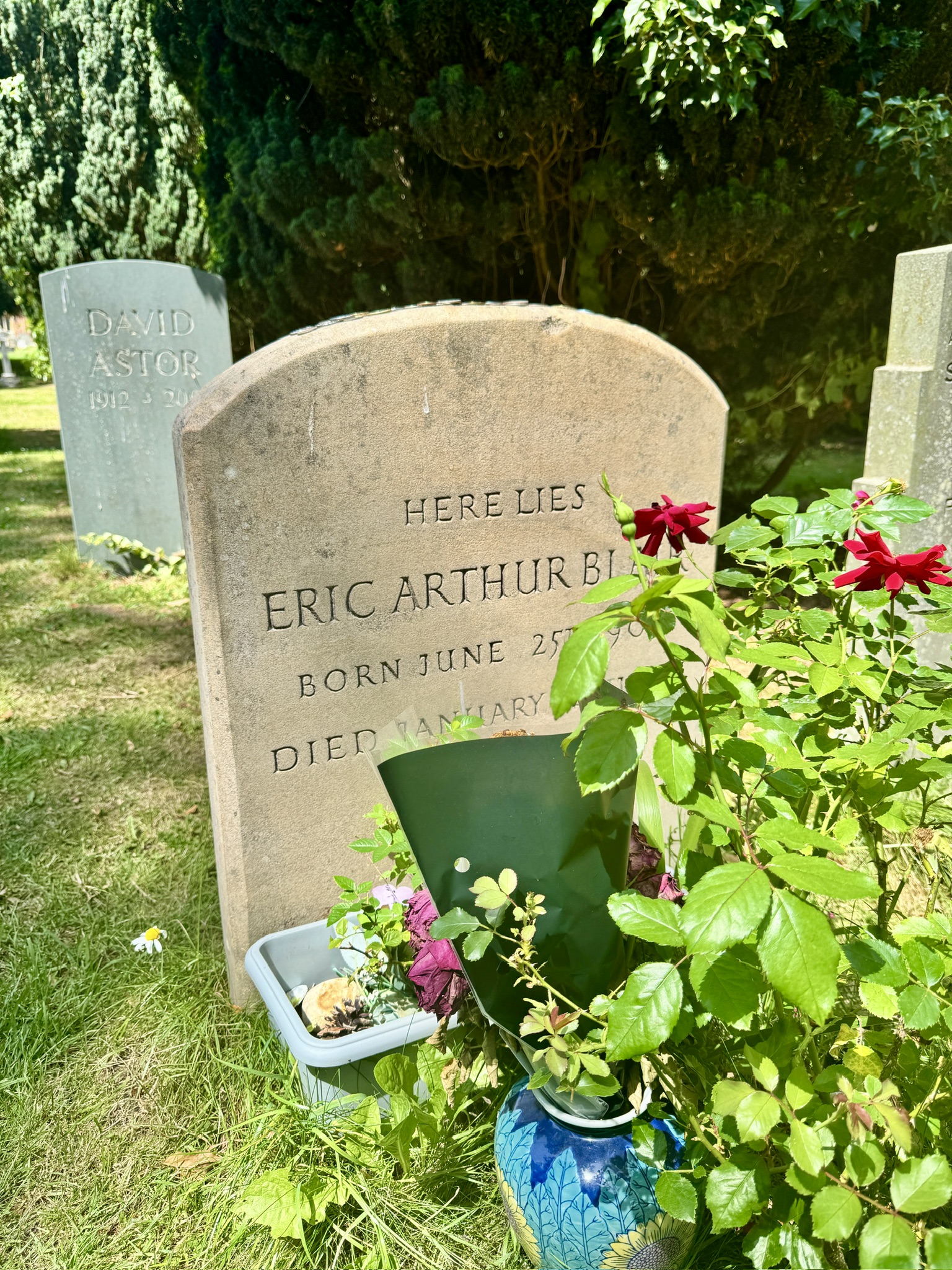
Today I went to the #1984Symposium, held beside George Orwell’s grave on what would have been his birthday.
Orwell, of course, was born Eric Arthur Blair on 25 June 1903. George Orwell was the name he wrote under, the name that now floats above him like a warning label attached to the twentieth century. But at the grave, it felt less like visiting “George Orwell the icon” and more like standing beside the resting place of a man whose questions are still walking around without him.
The gathering itself was wonderfully un-grand. No stage. No branding. No big institutional apparatus. Just people turning up beside a grave with food, drink, stories, old connections, half-remembered conversations, technical obsessions, political worries, and a shared sense that Orwell still gives us a useful lens for looking at the world we’re living in.
There was something fitting about that. Orwell was never just a man of abstractions. He noticed poverty, class, bad food, ugly language, political lies, bodies under pressure, the smell of ordinary life. So a picnic by his grave may be one of the more honest ways to honour him. Not by freezing him into literary marble, but by gathering in the heat, talking about the world, and refusing to stop paying attention.
The opening address named the simple continuity of the thing. Twenty years ago, a small group gathered beside Orwell’s grave with food, drink, stories, questions, and concerns about the world. They’ve done much the same every year since.
That line stayed with me: twenty years of gathering at the grave to keep asking the same questions.
When the symposium first began, social media was still young, smartphones weren’t quite the little surveillance slabs they are now, artificial intelligence belonged mostly to science fiction, and climate collapse had not yet become ordinary vocabulary. Now all of those things sit with us at the picnic. They are no longer speculative. They are the furniture of the present.
The old Orwellian questions remain:
Who watches the watchers?
Who holds power?
What happens when technology moves faster than accountability?
How do we preserve privacy, dignity, and freedom in systems that increasingly monitor, measure, and mediate our lives?
And perhaps most importantly: how do we remain human inside all of this?
That last question felt like the real centre of the day.
The gathering was not there because Orwell “predicted the future.” That’s too easy, and maybe too lazy. Orwell did not simply look into a crystal ball and foresee smartphones, AI, Kindle libraries, social media pile-ons, or algorithmic propaganda. What he did was more useful. He understood certain patterns of power. He understood that language could be used to hide the truth. He understood that surveillance changes behaviour. He understood that reality itself can become contested territory. He understood that ordinary people can be made to participate in systems that diminish them.
Standing at the grave, that felt less like literary analysis and more like civic hygiene.
The picnic itself became part of the argument. One of the strongest lines from the address was that this gathering is a political act, not because everyone agrees, but because people are still willing to gather, listen, think, and speak.
That feels important now. Maybe more important than any formal speech. In a world of feeds, platforms, factions, comment wars, and algorithmically sorted outrage, a small group of people talking in person beside a grave has its own quiet force.
Not spectacle. Not performance. Presence.
After the formal words, the conversation loosened into the good strange texture of real gatherings. People talked about heat, air conditioning, old cars, journeys, friends who hadn’t seen each other for ages, someone needing a cold drink, and the strange fact that English summers now carry temperatures that once felt foreign. Even the heat seemed to be part of the Orwellian conversation, not as metaphor but as lived fact. The changing world was not an abstract topic. It was there in people’s bodies, in the shade, in the need for cold drinks.
Then the talk moved, naturally, into technology.
AI came up early. Someone had posted an image of a typewriter with “Happy Birthday George Orwell” typed on it, and someone else thought it might be AI. That tiny moment captured something very current: the fact that we now instinctively doubt the provenance of images, words, and artefacts. The question “Is this real?” has become ordinary.
There was talk of AI creeping into phones, into search bars, into image descriptions, into interfaces that no longer feel optional. One person described the AI features on their phone as seriously intrusive. Another joked about whether it had solved world hunger. It hadn’t, of course. It had mostly made itself harder to avoid.
There was also an interesting tension around AI as useful aid versus AI as creeping mediation. Using AI to describe a photograph for accessibility or convenience is one thing. Having it inserted into every search, every device, every interaction is another. That feels like one of the central tensions of the moment: not whether the technology is good or bad in some simple way, but whether we still get to choose our relationship with it.
The conversation touched on AI-generated text as well. Browser plugins that blur AI-generated writing. LinkedIn becoming unreadable because so much of it feels machine-made. False positives where human writing gets flagged as AI. The strange feedback loop where AI trains on us, we begin to sound like AI, and then the detectors lose their minds trying to tell the difference.
That’s a properly Orwellian knot: not merely falsehood replacing truth, but the weakening of our confidence in recognition itself.
There was talk too of scams, Facebook moderation, and fake ads. A friend’s tarot deck being ripped off. Reports going nowhere because moderation is automated, business models reward the wrong thing, and platforms have little incentive to stop making money from the problem. That led to one of the day’s sharper observations: when you report scams to Facebook, you are basically asking it to stop earning money from them.
There’s a grim clarity in that.
Privacy came up through the ordinary irritations of modern life. Ordering something online, giving over a phone number because the company insists on it, then receiving WhatsApp messages as if the number had become an open channel into your life. Someone said the phone number is like a fingerprint, almost biometric in its function. That felt exact. In the old world, a phone number was a way to reach you. Now it is also a key, an identifier, a tracking thread, a little tag attached to your body as you move through systems.
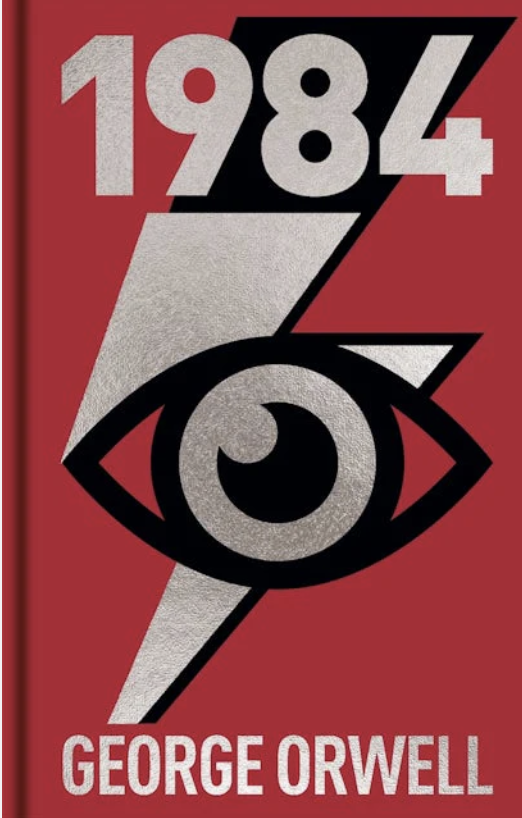
The most perfectly Orwellian anecdote, though, was the Kindle story: Amazon once remotely removed copies of 1984 from people’s Kindles because of a licensing issue. There it was, the memory hole in consumer electronics form. Not soldiers burning books in the square, but a corporation quietly reaching into the device you thought contained your library and making a book vanish.
The discussion turned into questions of ownership. If you buy a digital book and it can be taken back, did you really own it? If ownership becomes access, and access can be revoked, then the private library becomes a rented room with invisible locks.
That connected nicely with the talk of vinyl, hard drives, physical media, and the stubborn desire to hold things in a form that cannot be silently edited or withdrawn. Very Orwell. Very IndieWeb. Very much the archive fighting back against the feed.
Another thread that stood out was the loss of the old Twitter town square. Not nostalgia for everything Twitter became, but for the strange civic function it once had: the ability to complain publicly, summon attention, connect with strangers, shame companies into action, and participate in a shared conversational space. The current fractured landscape — X, Mastodon, Bluesky, Threads, WhatsApp, Signal, and all the rest — felt to some like a kind of Tower of Babel. Everyone dispersed. The public square shattered into smaller, less connected rooms.
That phrase has a charge: the Tower of Babel, but platformed.
There was also talk of alternative communication and resilience: radio, mesh networks, off-grid systems, little technical hobbies that suddenly feel less eccentric in a world of fragile infrastructures. Someone described using radio equipment to ping their location on the way to the grave, without initially relying on internet infrastructure. That felt like another quiet counter-current running through the day. If Orwell warns us about centralised power, then these odd little decentralised practices become more than hobbies. They become rehearsals in autonomy.
The human texture mattered as much as the politics. People arrived because they saw the event somewhere, maybe on a blog, maybe on Atlas Obscura. A journalist turned up while travelling. Someone mentioned Richard Blair, Orwell’s son. There was talk of the Orwell Society, of official versus unofficial forms of remembrance, of badges, old friends, missed connections, dyslexia, documentaries, roads, radios, trains, and whether England is starting to feel like a developing country.
This is what I liked most in the symposium: it was not a clean intellectual event. It was a living human tangle.
Which is probably the point.
Orwell’s work remains alive not because people can quote 1984 at each other but because his questions keep escaping the book and entering ordinary conversation. They show up in phones, apps, cameras, scams, fake images, platform moderation, disappearing digital books, AI summaries, search engines that no longer feel like search engines, social media that no longer feels social, and the creeping sense that our lives are being sorted, nudged, tracked, and mediated by systems we did not meaningfully consent to.
But the day did not feel hopeless.
If anything, the act of gathering beside the grave seemed to carry a modest defiance. People still came. They still talked. They still joked. They still questioned power. They still challenged language that obscures truth. They still shared food and drink. They still made room for curiosity.
Maybe that is the small counterspell.
Not certainty. Not purity. Not ideology.
Just attention, conversation, memory, and the stubborn refusal to let the machine have the whole field.
Happy birthday, Eric Arthur Blair.
Rest in peace, George Orwell.
The rest of us, apparently, still have some watching to do.
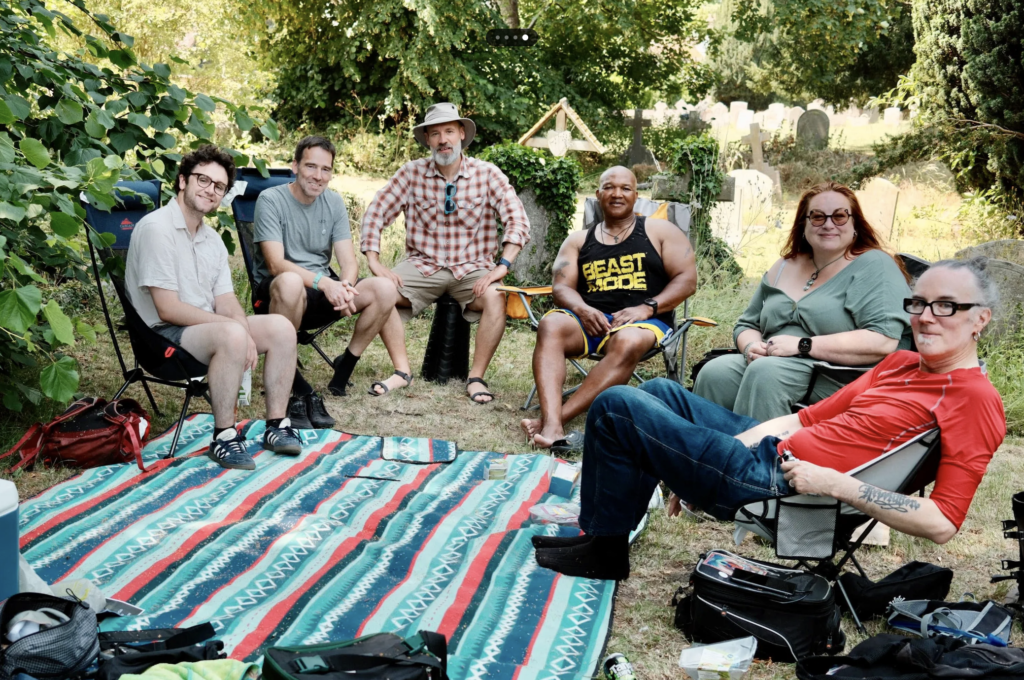
Photo by Christian Payne