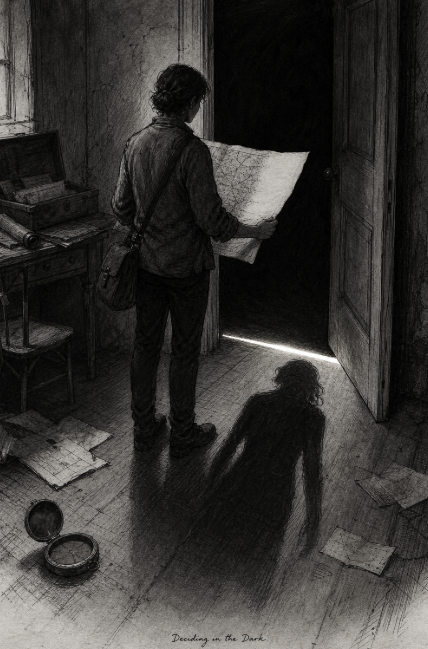
The person who most needs to change is usually the last person who can accurately judge what the change will ask of them.
I keep coming back to this because it sits underneath almost every serious conversation about inner work. Someone arrives at the edge of a change. A burnt-out executive who can no longer pretend the old success story is enough. A trainer wondering what their practice becomes in an AI-shaped world. A person who has carried the same story about themselves for so long that it has started to feel less like a story and more like the walls of the room.
Sooner or later, the same question appears.
If I do this, what will I get?
It is a fair question. Most of life teaches us to decide this way. Gather the facts. Weigh the costs. Imagine the possible outcomes. Choose the path with the best return. It works well enough when the choice sits outside us. Buy the thing. Take the job. Book the trip. Sign up for the course.
It starts to fail when the choice involves the person doing the choosing.
That is the strange little knot at the centre of transformation. You are trying to evaluate the territory using your current map, while the work itself is going to change the map. Real inner change does not simply add new information to the person you already are. It changes the frame through which information becomes meaningful in the first place. It alters what you notice, what you value, what feels possible, what feels dangerous, what counts as evidence, and what your body reads as a threat.
So the question becomes almost comic in its difficulty. How do I decide whether to undergo a process that will change the self who is making the decision?
The philosopher L.A. Paul calls these transformative experiences. Her work is wonderfully precise on this point. Some experiences cannot be known from the outside, no matter how much information we gather about them. We can read the books, talk to people who have gone through them, listen carefully, make lists, and imagine scenarios. Still, the actual knowing is unavailable until the experience has altered us.
Becoming a parent is one of Paul’s examples. It works because everyone understands the absurdity of thinking research can deliver the experience in advance. You can read every parenting book on the shelf and still not know what it is like to be the person whose life has been rearranged by a child. You do not lack information. You lack the self that only the experience produces.
That is the part we tend to avoid.
We want the transformed self to send back a report. A postcard from the far side. “Yes, this was worth it. Here is what it cost. Here is who you become. Here is the guarantee.” But the self on the far side cannot brief the self at the threshold. The bridge only runs one way.
Inner work has this same structure. The version of you that needs to change is the version voting on whether to begin. And that version is working from a map built out of old experiences, inherited stories, loyalties, wounds, triumphs, defences, and all the private weather that makes a life feel like itself.
That map is not neutral. It is not a clean instrument sitting on the table. It is the thing being examined.
I spent more than two decades watching people come back from training programmes lit up by insight. New frameworks. New tools. Real moments in the room. You could feel the charge in them. Then, almost every time, the old pattern reassembled itself over the next couple of weeks. The fire did not vanish because the insight was fake. It vanished because the insight had landed as content inside an unchanged structure.
That distinction matters.
Content change gives you something new inside the old frame. A model. A technique. A sentence to remember. Structural change alters the frame itself. It changes the room in which the sentence makes sense. The first can be uncomfortable. The second is disorienting. Not because it has gone wrong, but because disorientation is what it feels like when the old map stops being sovereign.
This is where the old NLP presupposition becomes more interesting than its motivational-poster version: people already have the resources they need.
That does not mean change is easy. It does not mean everyone is secretly fine if they just believe harder. It means the missing resource is not always outside the system. Often it is buried, exiled, unused, badly named, or locked behind an old defence that once had a job to do. The work is not about importing a new self from elsewhere. It is about making contact with a possible self already present in the field.
That softens the fear without removing the mystery. You are not agreeing to become a stranger. You are agreeing to walk toward a room in your own house that you have not entered for a long time. The room is yours. The house is yours. But you still do not know what is waiting there until you open the door.
And the part of you that locked the door may not be the part of you now standing in the hallway.
Jung would call this shadow work. The meeting with what has been pushed out of sight, projected onto other people, buried under competence, wrapped in humour, turned into a preference, and made respectable through story. The shadow rarely arrives as a gift basket. It usually arrives as irritation, envy, overreaction, shame, fatigue, fascination, a dream you cannot shake, or a pattern you keep pretending not to see.
This is why real inner work often feels less like expansion at first and more like confrontation. You are not simply gaining a new capability. You are dissolving a defence that may have been built for very good reasons. Some younger version of you made a bargain with reality. It worked well enough to get you here. Now the same bargain is asking to be renegotiated.
From the outside, you cannot fully know what that will require.
The alchemists had a better image for this than most modern personal development language. Nigredo. The blackening. The stage where the material breaks down before it can be reformed. The work goes dark. The old clarity becomes suspect. The tidy identity starts to smoke at the edges. You cannot stand at a safe distance from that process and calculate its exact value, because the calculating mind is part of the material in the vessel.
This is the difference between skills training and transformation.
Skills training gives you something new to do. It adds to the map. Transformation changes the mapmaker.
I don’t say this to make inner work sound grand or dangerous. I say it because a lot of people approach transformation with a decision-making model that belongs to smaller choices. They want certainty before they begin. They want to know who they will be on the other side before agreeing to cross the threshold. That is human. Of course we want that. The nervous system likes a forecast.
But the forecast is not available.
What is available is a different question. Paul suggests that in the face of a genuinely transformative decision, the rational question is not simply, “Will I be better off?” because the future self who would answer that question does not yet exist for us. The better question is closer to: “Is discovering who I will become worth doing for the sake of the discovery itself?”
That changes the shape of consent.
You are no longer signing up for a guaranteed outcome. You are agreeing to an encounter. You are saying yes to the possibility that the self who began will not be the self who finishes and that this is not a flaw in the process. It is the point.
The two years I spent working through my own identity and practice direction were like that. I could not have mapped them in advance. If you had asked me at the beginning what the work would lead to, I would have given you an answer from inside the very frame I was about to question. I would have tried to solve the problem using the mind that had helped create it.
At some point, that stopped working.
I had to put the old map down for a while. Not dramatically. No cinematic burning of the past. More like setting a heavy bag on the ground after carrying it for so long that I had started to think the ache was part of my personality. The uncertainty was not pleasant. It rarely is. But the work that came out of it is more coherent, more alive, and more mine than anything I could have designed from the position I was in before the work began.
That is the paradox. The old self wants a business case for becoming the new self. But the business case is written in the old language. It cannot account for values that have not yet awakened, desires that have not yet been permitted, capacities that have not yet been trusted, or forms of honesty the current self still experiences as a threat.
The Daoist in me trusts this more than the strategist in me does.
The path unfolds as the walking changes the walker. That is not passivity. It is a disciplined form of trust. You still choose. You still pay attention. You still take responsibility for the next step. But you stop demanding that the map of here prove the existence of there before you move.
You can’t get there from here using only the map of here.
The version of you that needs to change is the only version who gets to decide whether to begin. That version will never have complete information. It can’t. The information it wants belongs to the self that the journey will make.
So the question is not whether you can decide with certainty.
You can’t.
The question is whether the discovery is calling loudly enough to step into the dark.