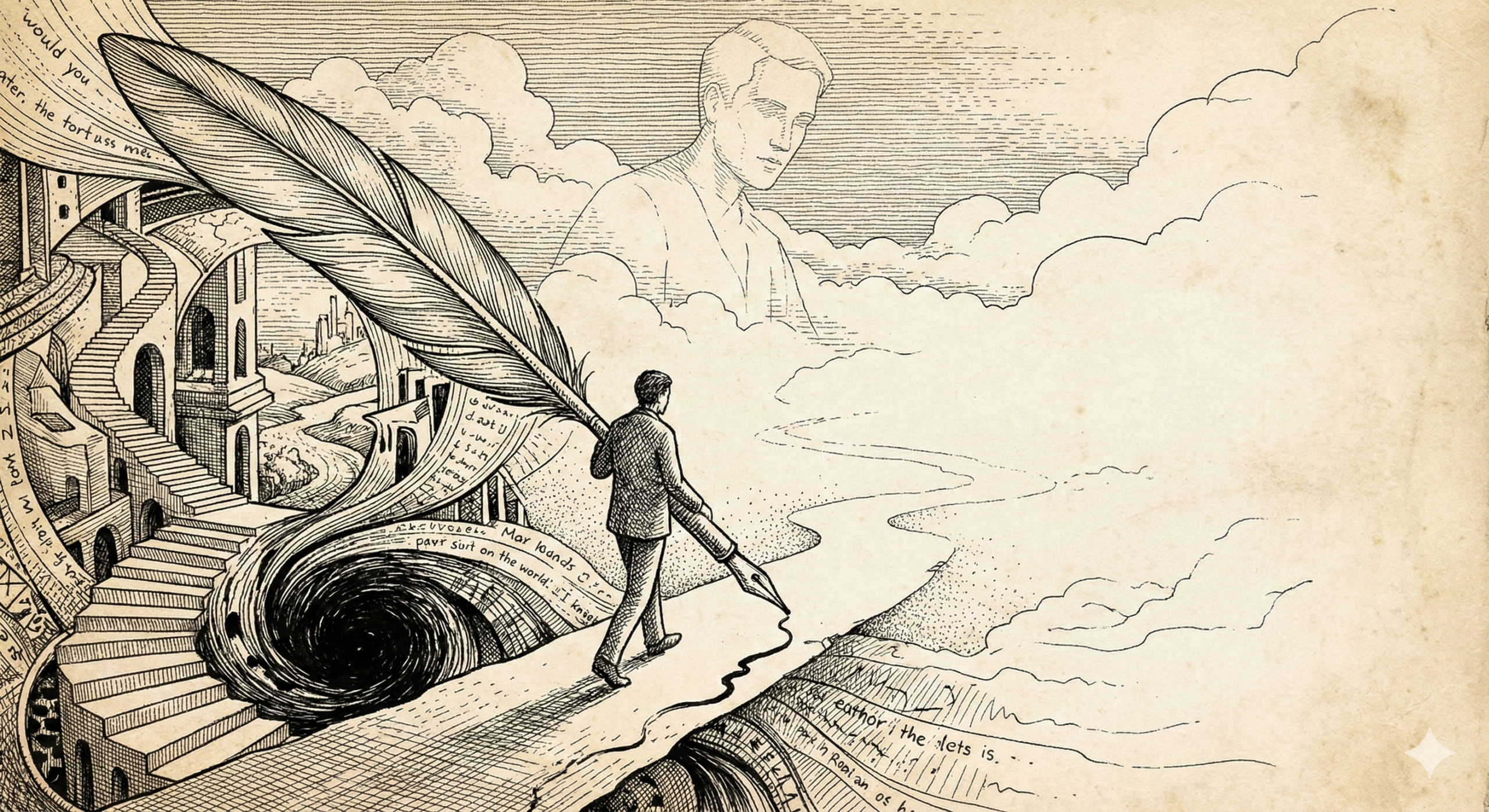
Imagination Creates Reality

The inner script and the world that follows

Most people think imagination is what you use to escape reality.

A child does it naturally. A novelist does it professionally. A bored office worker does it out the window at 3:17 on a Wednesday. Imagination, in the ordinary view, is what happens when attention slips its leash and wanders off into the unreal.

Imagination Creates Reality

Neville Goddard asks us to reverse that assumption.

What if imagination is not escape from reality, but the workshop where reality is first assembled? What if the life you keep meeting on the outside is, in ways both subtle and profound, shaped by the scenes you keep enacting on the inside? What if your inner conversations are not background noise, but stage directions? What if the world that keeps arriving is being quietly prepared by the one you keep consenting to within? That is the living nerve of Imagination Creates Reality. Neville’s claim is not modest. He says your own “wonderful human imagination” is the creative power itself, the saving power, the force through which your conditions are transformed.

That is the kind of statement modern people tend to file under either mysticism or madness.

We live in an age that worships the visible. Metrics, outputs, bank balances, diagnoses, headlines, documents, deadlines, proof. We trust what can be pointed to, counted, photographed, measured, and externally verified. The inner life, by contrast, is treated as soft territory. Subjective. Secondary. Decorative, maybe therapeutic, but not causal. We speak as though thought is commentary on life rather than participation in life.

Neville turns that all the way around.

He says the visible world is not first cause. It is shadow. Reflection. Echo. He says consciousness is the real causative field, and imagination is consciousness in action. The world you touch with your hands is not dismissed as unreal, but it is demoted from source to expression. The imaginal comes first. The material follows.

Now, taken lazily, this can sound like the usual manifestation fluff that drifts around the internet wearing expensive perfume and talking about abundance. But Neville is stranger, tougher, and more severe than that. He is not teaching wishful thinking. He is teaching fidelity to an inner act. He is not saying, “want hard enough and the universe will cave.” He is saying: occupy the end. Enter the scene. Feel it as real. Make “then” now and “there” here. Let the wish fulfilled become a state you inhabit rather than a fantasy you visit.

That difference matters.

A fantasy is something you look at from the outside. An imaginal act, in Neville’s sense, is something you step into. You do not stand at the edge of your desired life like a tourist taking photographs. You enter it. You hear the congratulating voice. You feel the ring on your finger. You smell the room. You touch the object. You speak from inside the fulfilled state. Again and again in the selected quotes, Neville insists that imagination becomes creative when it is embodied, sensorial, and emotionally accepted as present fact.

This is where his teaching becomes both mystical and psychologically acute.

Because whether or not one accepts his full metaphysics, there is something undeniably true here: human beings do not live in raw facts alone. We live in interpreted worlds. We move through states. We inhabit assumptions. We become equal to the stories we rehearse. A person who continually enacts rejection inwardly will begin to feel life as rejecting. A person who continually rehearses lack will begin to see the world through the eyes of insufficiency. A person who inwardly normalizes dignity, possibility, welcome, belonging, or abundance starts to stand in a different reality even before anything visible has changed.

The change begins in tone before it appears in circumstance.

That phrase may be worth lingering over: the change begins in tone.

Most people wait for evidence before allowing themselves a new tone of being. They wait for the job before feeling chosen. They wait for the relationship before feeling lovable. They wait for the money before feeling supported. They wait for the invitation before feeling included. Neville says that is backwards. You must assume the feeling of the wish fulfilled first. Not as theatre for an audience, but as an inner act of authorship. The mood must precede the mirror.

That is difficult because most of us are loyal to our old emotional architecture.

We say we want change, but inwardly we keep polishing the same script. We keep telling the old story with better vocabulary. We declare a new desire with the mouth and then spend the rest of the day rehearsing its opposite in thought. We ask for love and inwardly repeat abandonment. We ask for freedom and inwardly practice fear. We ask for expansion while secretly identifying with diminishment. The outer wish is new, but the inner tenancy remains unchanged.

Neville’s answer to this split is discipline of imagination.

Not discipline in the grim moral sense. Not self-punishment. Not forcing bright thoughts over dark ones like paint over damp walls. More like devotion. A steady return. A willingness to re-enter the desired end until it begins to feel ordinary. Natural. Familiar. He says you can repeat the imaginal act night after night before sleep until it feels normal to you. That word matters: normal. The deeper game is not intensity. It is naturalness. You are not trying to whip yourself into a fever of belief. You are trying to become inwardly at home in a different state.

And that is why his seed metaphor is so powerful.

When Neville says the imaginal act is a seed, he is naming something essential about creation. Seeds do their real work underground. There is a hidden interval between planting and evidence. An interval where nothing seems to be happening if you judge by the surface alone. But growth is underway. Neville says once you plant the imaginal seed, do not uproot it with anxiety about how it will happen. That line lands hard in a culture addicted to mechanism. We want the path mapped, the outcome guaranteed, the sequence explained. We want to know how the invisible will become visible. Neville says your responsibility is not the how. It is fidelity to the imaginal act.

There is a kind of relief in that, but also a kind of terror.

Because if the real labor is inward, then excuses thin out. You cannot blame delay entirely on circumstances when you spend your days inwardly voting for the old world. You cannot keep saying you want a new script while privately practicing the old lines. Neville is harsh on this in the most liberating way. He brings responsibility back to the level of consciousness. Not guilt. Responsibility. The ability to respond by choosing what state you inhabit.

His idea of “inner conversations” may be the most useful doorway into the whole teaching.

We are talking to ourselves all day long. Silently, semi-consciously, automatically. We replay arguments. We anticipate criticism. We justify ourselves to imaginary audiences. We relive humiliations. We mutter our own limitations under our breath in the form of identity statements: I am tired. I am behind. I am not that kind of person. I am too old for this. I am always the one who gets overlooked. I am never lucky. These do not feel like spells because they are so ordinary. They feel like observations. Neville says they are creative acts. Every “I am” is generative. Every inner conversation is scriptwriting.

That idea alone can change a life.

Because once you begin to hear your own interior speech as formative rather than descriptive, you start listening differently. You begin to notice that you have been praying all day, just not always for what you want. You have been planting constantly. You have been rehearsing states with such loyalty that they now feel like personality. But a state is not the same thing as essence. Neville’s work loosens that confusion. He speaks of states of consciousness as places one can enter or fall into. That is a subtle but powerful distinction. If I am in a state, I am not reducible to that state. If I have entered discouragement, I am not discouragement itself. If I have lived in lack, I am not made of lack. A state can be exited. A room can be left. A role can be rewritten.

And that brings us to one of Neville’s most luminous ideas: revision.

Revision is the refusal to let the past go on dictating the future simply because it happened once and hurt deeply. In his teaching, the past survives not just as memory but as active script. A scene from years ago can still be shaping your present because you are still inwardly living from it, still granting it authority, still allowing it to define who you are. Revision means returning to that scene in imagination and reworking it. Not pretending history never happened. Not gaslighting yourself with fake positivity. Something far more subtle. You alter the psychic meaning of the event. You withdraw your emotional allegiance from its old conclusion. You refuse to let one scene keep writing every scene that follows.

This is where Neville feels less like a preacher and more like an alchemist of memory.

The base metal is not the bad event itself but the fixed meaning you extracted from it. The transmutation happens when the scene is no longer treated as final truth. You rewrite not because the past is unreal, but because the way it lives in you is not inevitable. Most people do not realize how much of their suffering is repeated suffering. Old pain, newly narrated each day. Old shame, freshly baptized as identity. Revision interrupts that repetition. It says: this scene does not get to be God.

I think that is why Neville still matters.

Not because every reader must adopt his cosmology whole. Not because one has to believe that imagination single-handedly produces every event in a morally complicated world. Taken simplistically, that claim can become cruel and stupid. It can ignore history, accident, illness, injustice, material conditions, and the irreducible fact that other people also exist with agency of their own. A wise reading of Neville does not require collapsing reality into solipsism.

What it does require is taking inward life seriously.

That may be his deepest gift. He restores seriousness to the unseen. He reminds us that consciousness is not a passive screen onto which life is projected. It is participatory. It shapes what we notice, what we expect, what we dare, what we permit, what we repeat, what we endure, how we relate, and how we interpret what arrives. Imagination creates reality not only by mystical causation, but by identity formation. By emotional conditioning. By reorganizing what becomes possible from within us.

And for anyone who lives by words, this hits especially deep.

Because writing has always known what Neville is saying. Language is never neutral. The story you tell changes the world you can perceive. A sentence can become a prison or a bridge. A name can be a wound or an opening. We are all, in one way or another, writing ourselves into experience. Neville universalizes that truth. He says the script is being written not just on the page, but in consciousness itself. The author is the imaginal self. The theatre is everyday life. The lines are inner speech. The repeated role becomes what we call reality.

So maybe that is the cleanest way to say it.

Imagination creates reality because the life you live is always downstream from the self you are being. And the self you are being is made, in large part, from what you repeatedly imagine, assume, feel, and inwardly affirm as true. The outer world may not instantly rearrange itself because you had a lovely visualization before bed. But the tone of your being can change. The script can change. The state can change. And when the state changes, reality begins to gather differently around you.

The world that follows is often written in the silence before it appears.

A practice for tonight

Tonight, before sleep, do something simple.

Do not begin with your biggest impossible dream if that only triggers disbelief. Begin with something that carries genuine warmth. A scene that implies the wish fulfilled. Not the process. Not the struggle. Not the hoping. The end. A short scene, no more than a few seconds long, that would be true if the thing were already real.

Then close your eyes and enter it.

Do not watch yourself from a distance as though you were in a film. Be there. Hear the voice. Feel the texture. Touch the thing. Let the scene become immediate. Let it have weight. Let it have sensory life. Let it be an event, not a concept. If someone were congratulating you, hear the exact tone in their voice. If you are imagining peace, feel the kind of breath you would be breathing in that peace. If you are imagining enoughness, feel the bodily ease of being supported.

Then notice what interrupts the scene.

This part matters. The interruptions are the doorway. The old voice that says not likely. The reflex that says maybe for other people. The tightening in the chest. The urge to argue for your limitations. Do not dramatize these. Just notice them. These are the old inner conversations. These are the inherited lines in the script. This is the architecture Neville is asking you to become conscious of.

And then, gently, return.

No violence. No forcing. No spiritual macho nonsense. Just return to the fulfilled scene. Again and again if needed. Let it become a place you can stand without apology. Let your nervous system learn a different song. Let the new state begin, however quietly, to feel less foreign.

Then tomorrow, listen to your “I am.”

Listen especially in the ordinary moments. In traffic. In the kitchen. In the inbox. In the pause after someone’s tone lands badly. Catch the private sentence before it hardens. Catch the old role before you slip all the way into costume. And where you can, revise. Not with fake brightness, but with authorship. With the dignity of someone who remembers that consciousness is not just where life is suffered. It is also where life is shaped.

That is the real invitation here.

To stop treating imagination like a toy and start treating it like sacred craft.

Because the world you keep meeting tomorrow may already be taking shape in the scenes you are willing to inhabit tonight.

Nobody’s Coming to Save You

The Uncomfortable Core of Self-Transformation

nobody's coming to save you

The Seductive Misreading

Someone commented on one of my posts the other day, drawing a parallel between the Left Hand Path and Nietzsche’s philosophy. They talked about the Übermensch, about self-deification, about becoming superior. They weren’t wrong about the surface similarities. Both traditions do emphasize the individual over the collective. Both do challenge inherited moral frameworks. Both do talk about becoming rather than being.

But the comment revealed something I see constantly in spiritual and philosophical circles: people read these systems as offering power, specialness, transcendence over ordinary existence. They see an escape hatch from their current life into something more dramatic, more elevated, more impressive.

This is exactly backwards.

The appeal is obvious. Tell someone they can become an Übermensch, a self-deified being who creates their own values and stands above the herd, and you’re offering them exactly what their ego wants to hear. You’re special. You’re different. You’re going to transcend all these ordinary people stumbling around in their inherited beliefs and social conditioning.

It’s seductive as hell. It’s also a complete misreading of what makes either system actually transformative.

The real parallel between Nietzsche and authentic Left Hand Path work isn’t that they offer you power or superiority. It’s that they remove every comfortable excuse you’ve been using to avoid transformation. They don’t hand you a new identity to put on over your current one. They demand you face the uncomfortable truth that nobody is coming to save you, no system is going to do the work for you, and you’ve been the author of your experience all along.

Most people who claim to follow either tradition never actually do this work. They take the romantic aesthetic, the rebellious posture, the vocabulary of transcendence, and they use it to decorate the same untransformed life they were living before. They collect another identity, another set of books to reference, another framework to explain why they’re special.

And this, precisely this, is why most people never actually transform.

Because the moment you make Nietzsche or the Left Hand Path or any other system into something that will elevate you, you’ve missed the entire point. You’ve turned it into another external authority, another savior, another story someone else wrote that you’re hoping will finally make sense of your life.

The uncomfortable truth both traditions actually share is simpler and far more demanding: you are already the author of your experience, you’ve always had the power to transform, and the only thing standing between you and the life you claim to want is your willingness to stop waiting for permission, validation, or rescue.

Nobody’s coming to save you.

Not Nietzsche. Not the Left Hand Path. Not any guru, system, or practice.

And that’s not the problem.

That’s the only thing that’s ever been true.

What Both Actually Demand

Strip away the romantic reading and here’s what you’re left with:

Nietzsche’s “God is dead” isn’t a celebration. It’s a diagnosis of a crisis. The external authority structure that gave life meaning, that told people what to value and how to live, has collapsed. And most people haven’t noticed yet. They’re still going through the motions, following rules whose foundation has crumbled, pursuing meanings that no longer mean anything.

The Übermensch isn’t some superior being who looks down on others. It’s the person willing to face the void left by collapsed meaning and create their own values instead of falling into nihilism or grabbing for the nearest replacement authority. This isn’t empowering in any comfortable sense. It’s terrifying. It means recognizing that no cosmic order validates your choices, no divine plan justifies your suffering, no ultimate truth tells you what matters.

You have to decide what matters. And you have to live with the recognition that you decided, that it could have been otherwise, that nothing outside yourself makes it true.

The Left Hand Path, in its authentic forms, says something structurally identical: no god, no guru, no system is going to transform you. Your consciousness is sovereign. Which doesn’t mean you’re powerful in some grandiose sense. It means you’re completely, utterly responsible for your own transformation. No external authority can do this work for you. No ritual, no practice, no teacher can hand you realization. You can’t follow a map someone else drew and arrive at your own awakening.

Both remove the same comfort: the fantasy that someone or something else knows the way and will guide you there if you just follow correctly.

Nietzsche removes the comfort of divine moral order. Left Hand Path removes the comfort of spiritual hierarchy. Both leave you standing alone, fully responsible for what you make of yourself and your life, with no cosmic validation available and no one to blame if you fail.

This is why both traditions remain niche despite their supposed appeal. Because what they actually offer isn’t power or superiority. What they offer is the end of excuses. The end of deferring to external authorities about what’s true or meaningful. The end of following someone else’s path and expecting to arrive at your own destination.

They demand you face uncomfortable truths without a safety net.

The first uncomfortable truth: meaning isn’t inherent, it’s created. And if you won’t create it, you’ll either adopt someone else’s meanings or slide into nihilistic despair.

The second uncomfortable truth: no amount of knowledge, practice, or belief substitutes for taking full responsibility for your consciousness and its transformation.

The third uncomfortable truth: you cannot outsource this work. Not to philosophy, not to spiritual practice, not to any system no matter how sophisticated or ancient.

And here’s where this connects to something even more immediate and practical than either Nietzsche or esoteric tradition: if consciousness creates reality, as Neville Goddard insisted and as my own experience confirms, then your current circumstances aren’t something that happened to you. They’re something you authored.

Not the external events themselves, necessarily. But your interpretation of them. The identity you constructed in response to them. The story you’ve been telling yourself about what they mean and who you are because of them.

If consciousness is causative, if imagination creates experience, then the life you’re living right now is a printout of the code you’ve been running. Mostly unconsciously. Mostly inherited from family, culture, and random emotional reactions you never examined.

But authored by you nonetheless.

And this is where most people’s interest in transformation ends. Because this recognition removes every comfortable alibi. Every reason it’s not your fault. Every explanation for why you can’t change things yet.

Nietzsche, Left Hand Path, and Neville all point to the same unbearable recognition: you are the variable you haven’t changed.

The Alibis You Lose

When you accept radical responsibility for your consciousness and its transformation, here’s what you can’t do anymore:

You can’t blame your circumstances. Not your childhood, not your education, not your resources, not your age, not your location, not the economy, not the cultural moment you’re living through. You can claim these things influenced you. You can’t claim they determined you. Because if consciousness creates reality, then your relationship to circumstances is causative, not reactive. You’re not responding to a fixed external reality. You’re generating experience through how you imagine yourself in relation to circumstances.

You can’t claim you didn’t know better. Every person stuck in a pattern they hate has had moments of clarity where they saw exactly what they were doing and why. They had the insight. They saw the mechanism. Then they went back to the familiar pattern because the alternative required becoming someone they weren’t ready to become. Ignorance isn’t the problem. Willingness is the problem.

You can’t outsource your choices to authority figures. Not to therapists, not to coaches, not to spiritual teachers, not to books or systems or methodologies. You can learn from them. You can use their tools. But the moment you make them responsible for your transformation, you’ve handed your sovereignty to someone else. You’ve made yourself a follower of someone else’s path. And you cannot follow your way to your own awakening.

You can’t wait for the right moment, the right teacher, the right system. There is no right moment. There’s only this moment and what you choose to do with it. Every moment you spend waiting for better conditions is a moment you spend authoring “not yet” into your experience. And that’s a story. A story you’re telling. A story you could stop telling right now if you were willing to face what you’re actually afraid of.

You can’t identify as a victim of your past. Not your trauma, not your mistakes, not what was done to you, not what you missed out on. You experienced those things. They happened. But the meaning you’ve constructed around them, the identity you’ve built in response to them, the way you keep using them to explain why you can’t transform now, that’s all current authorship. You’re doing that today. You’re choosing that interpretation today. You’re reinforcing that identity today.

Here’s where Neville’s work becomes uncomfortably specific: if consciousness creates reality, then your current experience reflects your habitual imaginal acts. Not what you claim to believe. Not what you wish were true. Not what you affirm occasionally when you remember. But what you actually, consistently imagine about yourself and your relationship to reality.

If you keep experiencing rejection, what are you persistently imagining about your worthiness? If you keep experiencing scarcity, what story are you habitually telling about resources and your relationship to them? If you keep experiencing being overlooked, misunderstood, undervalued, what identity have you constructed that requires that experience to maintain itself?

You are always imagining. You are always telling yourself stories about who you are and how reality works. Those imaginal acts, those narratives, create corresponding experiences. Not someday. Not if you do it right. Always and automatically.

Which means your current life, right now, this moment, is a direct reflection of the stories you’ve been persistently telling yourself.

Not the ones you think you believe. Not the ones you’d tell someone else if they asked. The ones you’re actually running. The operational code. The narrative that’s live in your consciousness when you’re not paying attention.

And this is the recognition that triggers the most resistance I’ve ever witnessed: everything you’re experiencing, you authored. Not consciously, necessarily. Not deliberately. But you authored it through the persistent story you’ve been telling, the persistent identity you’ve been maintaining, the persistent imagination you’ve been living from.

If you’re stuck at 27, 32, 40, 43, 57, 60, 64, it’s because some part of you keeps writing “stuck” into the narrative. If you feel unseen, it’s because you’re imagining yourself as someone who goes unseen. If you feel broke, it’s because you’re living from a story of scarcity. If you feel like you missed your chance, it’s because you’ve constructed an identity around being too late.

These aren’t circumstances happening to you. These are narratives you’re operating from.

And the moment you truly recognize this, you lose every comfortable excuse you’ve been using to explain why you haven’t transformed yet.

You can’t say “I can’t because of X” when you recognize that “I can’t because of X” is itself a story you’re authoring into existence.

You can’t say “It’s too late” when you recognize that “too late” is a meaning you’re assigning, not a fact you’re discovering.

You can’t say “I don’t know how” when you recognize that “I don’t know how” is often code for “I’m not willing to become the person who would know how.”

Every alibi evaporates.

And most people, faced with this recognition, will do absolutely anything to avoid it. They’ll find a new reason it doesn’t apply to them. They’ll locate the one circumstance that surely, certainly is the exception. They’ll agree intellectually while changing nothing practically. They’ll turn the recognition itself into another interesting idea to collect instead of a demand for immediate transformation.

Because accepting full authorship means accepting responsibility for all the years you authored badly. All the experiences you created unconsciously. All the limitations you imagined into persistent manifestation.

It means facing how much agency you actually had all along.

And for most people, that recognition is almost unbearable.

The Recognition That Triggers Resistance

Let me be specific about what this actually looks like.

You’re 62. You’ve been talking about writing a book for fifteen years. You have notes, outlines, half-finished chapters scattered across multiple documents. You tell yourself the timing hasn’t been right. Too busy with work, then too busy with the transition to retirement, then too busy adjusting to retirement, then too distracted by health concerns, then waiting for the right inspiration to strike.

None of that is why you haven’t written the book.

You haven’t written the book because you’re persistently imagining yourself as someone who doesn’t finish things. Or someone whose work isn’t good enough. Or someone who will be judged harshly if they put themselves out there. Or someone who missed their window and it’s too late now.

That’s the operational narrative. That’s the live code. And every day you maintain that identity, you author more evidence that confirms it.

The circumstances you point to, the reasons that feel so solid and inarguable, are effects, not causes. They’re the manifestation of the persistent story you’re telling about who you are and what’s possible for you.

This is the recognition that triggers absolute resistance: your current life is a printout of the code you’ve been running.

Not in some abstract, metaphysical sense. Concretely. The persistent patterns in your experience correspond to persistent patterns in your imagination. The recurring circumstances that frustrate you most are the ones you’ve been most consistently authoring, usually while claiming they’re happening to you.

If you’re stuck, some part of you has been writing “stuck” into the narrative. Not because you consciously chose to be stuck. But because stuckness serves something. It protects you from something. It lets you maintain an identity that would have to die if you actually transformed.

The person who can’t find a relationship isn’t unlucky. They’re imagining themselves as unlovable, or as someone who always chooses wrong, or as someone too damaged for intimacy. And that imaginal act creates corresponding experiences. Not because the universe is punishing them. Because consciousness is causative and they’re generating experience from that imaginal foundation.

The person who can’t get their business off the ground isn’t facing especially difficult market conditions. They’re operating from a story about their inadequacy, or their unworthiness of success, or the danger of visibility. And that story, lived from consistently, manifests as exactly the obstacles they keep encountering.

The person who feels perpetually misunderstood isn’t surrounded by people who refuse to see them clearly. They’re maintaining an identity that requires being misunderstood. Because being misunderstood lets them stay special in their own private knowledge of themselves. It lets them avoid the vulnerability of being actually seen. It protects them from having to show up fully and risk rejection.

These aren’t theories. These are mechanisms I’ve watched operate in my own life and in hundreds of conversations with people who claim they want to transform but keep recreating the same patterns.

And here’s what makes this recognition so difficult: it means all those years of feeling victimized by circumstances were years of unconsciously authoring those circumstances. All that time you spent explaining why you couldn’t, you were actually choosing the story of can’t. All those moments you blamed your past, your resources, your opportunities, you were deflecting responsibility for the operational narrative you were running.

The recognition is almost unbearable because it means you had agency all along. Not perfect agency. Not agency over every external event. But agency over the meaning you made, the identity you constructed, the story you told yourself about who you were in relation to what happened.

You weren’t powerless. You were unconscious.

And unconscious authorship still authors.

This is why people who’ve done years of therapy, read hundreds of books, taken dozens of courses, worked with multiple teachers, still haven’t transformed. They’re treating transformation as something that happens to you if you find the right method. They’re waiting for the magic technique that will change them without requiring them to face what they’re actually authoring.

But you can’t debug code you won’t admit you wrote.

You can’t revise a narrative you insist is just “how things are.”

You can’t transform an identity you’re unconsciously committed to maintaining.

The person who says “I can’t start my business because I don’t have enough money” isn’t stating a fact. They’re maintaining a story. Because plenty of businesses start undercapitalized and figure it out. The real story is “I’m not willing to become the person who starts without perfect conditions.” Or “I’m not willing to risk failing visibly.” Or “I’m not willing to discover that lack of money wasn’t actually the obstacle.”

The money story protects them from facing the actual fear.

The person who says “I can’t leave this job because of my age” isn’t facing an immutable limitation. They’re operating from a narrative about age meaning diminished options, reduced value, narrowing possibilities. Other people their age are making moves. The age isn’t the variable. The story about age is the variable.

The person who says “I can’t pursue my creative work because I have responsibilities” has made responsibilities mean the death of creativity. But responsibility and creativity aren’t opposed. That opposition is authored. It’s a story that lets them avoid discovering whether their creative work is actually any good, whether anyone wants it, whether they’re willing to be seen trying.

Every “I can’t because” statement is a narrative choice presenting itself as a fact.

And the moment you see this clearly, really see it, not as an interesting idea but as the actual mechanism of your experience, something in you revolts.

Because it means you’ve been lying to yourself. Not maliciously. Not consciously. But you’ve been telling yourself stories about external limitation to avoid facing internal choice.

You’ve been blaming circumstances to avoid owning authorship.

You’ve been collecting evidence for your limitations to avoid the terror of discovering you were capable all along.

And this recognition requires mourning. Mourning the years you spent authoring experiences you claimed were inflicted on you. Mourning the agency you had but didn’t use because you didn’t know you had it. Mourning the self-image you’ve maintained that has to die if you’re going to transform.

Most people refuse this mourning. They’ll do anything to avoid it.

They’ll find one more teacher who promises a gentler path. One more system that explains why their case is special. One more framework that lets them understand their patterns without having to actually change them.

They’ll turn the recognition itself into content to consume rather than a demand to act on.

They’ll agree enthusiastically while changing nothing.

Because the alternative is facing something more uncomfortable than any external circumstance: you are the variable you haven’t changed. The story is the problem. And you’ve been the author all along.

To be continued…

Self-Observation Without Judgment: The Lost Practice That Changes Everything

Self-observation

You want to change your life. You’ve read the books, watched the videos, and learnt the techniques. You know about assumption, revision, living in the end, and the I AM formula. You’ve tried them all.

And they work. Sometimes. Briefly. Then you slide back to the same patterns, the same reactions, and the same life you were trying to escape.

NOTE: If you want to chat with the host, click here and listen to the podcast inside the Notebook.

Here’s what nobody told you: there’s a practice that comes before all the techniques. A practice so simple it sounds useless. So uncomfortable, most people skip it entirely. So powerful that Neville Goddard mentioned it in nearly every lecture, yet it’s the one thing his students consistently ignore.

Self-observation without judgement.

Not manifestation. Not assumption. Not revision. Just watching yourself. Uncritically. Like a scientist observing data.

This is the practice that changes everything. And it’s the one you’ve been avoiding.

Why Nobody Does This

You don’t want to observe yourself uncritically because you know what you’ll find.

You’ll discover you’re not as kind as you think. Not as rational. Not as evolved. Not as _______ (fill in the blank). You’ll catch yourself being petty, defensive, jealous, or afraid. You’ll see how mechanical, predictable, and self-deceiving you are.

Neville said it plainly: “If, today, you spent five minutes in uncritical observation of yourself, you would be surprised to discover how deceitful you are.” It is a terrible shock, I know, but every shock of this type will let in the light of awareness.

Nobody wants that shock. So they skip straight to the techniques. “Just tell me how to manifest money. How to attract love. How to get what I want.”

But you can’t manifest from a state you haven’t identified. You can’t shift from a position you refuse to see. You can’t assume a new consciousness while defending your current one.

The work begins with brutal honesty about where you actually are.

What You’re Actually Observing

Here’s what most people get wrong: they think self-observation means watching their circumstances. “I observed that I’m broke. I observed that I’m alone. I observed that my boss is difficult.”

No. That’s observing effects.

Neville was clear: “There is only one cause, and that is consciousness. Your consciousness is the center from which your world mirrors and echoes the state you presently occupy.”

Self-observation means watching your reactions to life. Not what happens to you, but how you respond to what happens. Your reaction reveals your state. Your state is the cause. Everything else is effect.

When someone mentions money and you feel your stomach tighten, that reaction reveals a state. When you check your bank account and immediately start the internal conversation about not having enough, that reveals a state. When you see someone succeeding and feel that flash of resentment, that reveals a state.

The circumstances didn’t create those reactions. The state you’re occupying did.

Watch the reactions. They tell you where you’re standing psychologically. And where you stand psychologically determines what you experience physically.

The Three Levels of Observation

True self-observation happens in three movements, each deeper than the last.

Level One: Observation

Simply notice your reactions. No commentary. No explanation. Just: “I noticed I got defensive when asked about money.”

That’s it. Pure data. You’re building a log of your actual responses to life, not the story you tell yourself about those responses.

Most people can’t even do this for five minutes without justifying. “Well, I got defensive because they were being nosy.” That’s not observation. That’s defense. You just proved the state you’re trying to observe.

Level Two: State Recognition

Once you can observe without defending, you identify the state those reactions reveal.

“I got defensive about money” reveals “I AM insecure financially.” That defensiveness is the symptom. The insecure state is the disease.

“I felt jealous when she announced her promotion” reveals “I AM lacking in my career.” The jealousy is the signal. The lack-state is the broadcaster.

This is where it gets uncomfortable. You have to admit: “The circumstances aren’t the problem. My consciousness of being this is the problem.”

Level Three: Non-Identification

The deepest level: recognizing that the state you’re in is not who you are.

You are not “someone who is insecure about money.” You are consciousness, currently occupying the state of financial insecurity. You can leave that state the same way you entered it.

This distinction is critical. If you think “I AM insecure” is your identity, you’re trapped. If you understand “I am currently in a state of insecurity,” you can move.

States are like rooms in a mansion. You’re in one right now. But you’re not the room. You’re the occupant. And you can walk out anytime.

Why “Uncritical” Is Everything

Neville insisted on this qualifier: observation must be uncritical.

Here’s why: the moment you criticize yourself, you justify your reaction. And justification binds you to the state.

Watch this pattern:

  • “I got angry at my partner.”
  • “Of course I got angry, they were being unreasonable.”
  • You just made yourself right.
  • You associated yourself with the anger.
  • You identified with the state.
  • You’re staying there.

Versus:

  • “I got angry at my partner.”
  • “Interesting. I reacted with anger.”
  • “That reaction came from a state of feeling unheard.”
  • No judgement. Just data.
  • The thread is broken.
  • You can choose differently.

Criticism creates justification. Justification creates association. Association creates identification. Identification creates perpetuation.

Neville: “Always examine yourself uncritically, for the moment you become critical, you automatically justify your reactions and associate yourself with the thing observed.”

The state you want to leave requires your agreement to stay. Uncritical observation withdraws that agreement.

The Daily Practice

Here’s how you actually do this:

Morning (2 minutes)

Set your intention: “Today I will observe my reactions without commentary.”

That’s it. Not “I will be better.” Not “I will stay positive.” Just: I will watch.

Throughout the Day (constant)

When something happens and you react, pause for 3 seconds and note:

  • What was the situation?
  • What was my reaction?
  • What state does that reaction reveal?

You don’t need to journal in the moment. Just notice. Build the muscle of catching yourself reacting instead of being swept away by the reaction.

Aim for 3-5 observations per day minimum. Not because you only react 3-5 times (you react constantly), but because you’re learning to catch yourself in the act.

Evening (15 minutes)

Review your day. Not the events. Your reactions to the events.

Write them down:

  • “When X happened, I reacted with Y.”
  • “When X happened, I reacted with Y.”
  • “When X happened, I reacted with Y.”

Then ask: What pattern do I see?

Do you return to the same emotional state repeatedly? Does the same trigger set you off every time? Are you defending the same position over and over?

That’s your dominant state revealing itself.

And here’s the key: you’re not trying to fix it yet. You’re just seeing it clearly.

What Actually Changes

If you do this practice consistently for one week, something shifts.

You start to see the mechanical nature of your life. You realize you’re running on autopilot. The same stimulus produces the same response, like code executing the same subroutine every time.

“I see someone succeed → I feel inadequate → I criticize them to feel better → I feel worse → I retreat into distraction.”

Loop. Loop. Loop.

But the moment you see the loop, you’re no longer completely in the loop. There’s separation. The observer and the observed are no longer identical.

Neville called this “awakening the dynamic one within.” Your outer self (the reactor) becomes passive. Your inner self (the observer) becomes active.

This is the reversal. This is where consciousness work actually begins.

Because once you can observe a state without identifying with it, you can choose a different state. Not by force. Not by willpower. By simple redirection of attention.

“I notice I’m in the state of financial insecurity. I don’t have to argue about whether that’s justified. I don’t have to defend why I’m there. I just see: I’m here. And I can choose to stand somewhere else.”

The Paradox

Here’s the strange truth: you can’t change what you don’t observe. But observation itself begins the change.

The act of watching your reactions without defending them weakens their hold. Like a hypnotist whose spell breaks the moment you realize you’re being hypnotized.

You might think, “But if I just observe and don’t do anything, how does that help?”

Because most of what binds you to unwanted states is your unconscious consent. You’re not consciously choosing to be defensive about money. You’re mechanically reacting, then justifying the reaction, which consents to the state, which perpetuates the experience.

Observation breaks the chain.

You react. You see yourself react. You recognize the state. You don’t defend it. The consent is withdrawn. The thread snaps.

And in that space between stimulus and response, in that brief pause where you’re watching instead of justifying, a different choice becomes possible.

Not forced. Not manufactured. Simply available.

Start Tonight

Forget everything else you’ve learned about manifestation. Put down the vision boards. Stop affirming statements you don’t believe. Quit trying to “live from the end” when you haven’t even seen where you’re currently standing.

Start here.

Tonight, for 5 minutes before bed, sit quietly and review your day. Not what happened to you. How you responded to what happened.

Write down 3 reactions:

  • “When _____ happened, I reacted with _____.”
  • “When _____ happened, I reacted with _____.”
  • “When _____ happened, I reacted with _____.”

Don’t explain. Don’t justify. Don’t make yourself wrong or right.

Just observe.

Do this for one week. Seven days. Five minutes each evening.

You’ll be shocked at what runs your life when you’re not watching.

And once you see it clearly, everything Neville taught about assumption, revision, and state transference will suddenly make sense. Because you’ll finally understand what you’re actually working with.

Not your circumstances. Your consciousness of your circumstances.

Not the world. Your reaction to the world.

Not who you are. The state you’re currently standing in.

Watch yourself. Without commentary. Without defense. Without trying to fix anything.

The light of awareness does the rest.


Further Reading

The Neville Goddard Deluxe Collection

Self-Authorship: A Meditation on Conscious Creation

self-authorship
self-authorship

Jordan Peterson on self-authorship: “Constructing the narrative of your life is a way to determine what to strive for and what to avoid…”

There exists a peculiar condition in human consciousness where we experience ourselves as both the one living and the one observing what is lived. We are simultaneously inside the story and somehow outside of it, watching ourselves move through scenes we did not consciously script. This dual nature creates a tension that most people never examine. They simply live as characters, fully identified with the role, never questioning who wrote the lines they speak or designed the circumstances they navigate.

Consider the nature of authorship itself. An author sits removed from their creation, shaping events from a position of deliberate choice. They know the ending before the character does. They understand that the obstacle in chapter three serves the transformation in chapter seven. They can revise, delete, rewrite entire arcs if they prove unsatisfying. The character, meanwhile, experiences each moment as it arrives, uncertain of outcome, subject to forces that seem external and often arbitrary.

Most human beings live entirely as characters. They experience life as something happening to them rather than through them. When circumstances shift, they respond with the logic of someone reading a story rather than writing one: interpreting events, making meaning, constructing narratives that explain why things are as they are. These narratives feel discovered rather than invented, as if the meaning were inherent in the events themselves rather than projected onto them by the interpreting consciousness.

But what if the interpretation is the creation? What if the story you tell yourself about what happened is more consequential than what happened?

This is not a comfortable question. It challenges the fundamental assumption that reality is something we encounter rather than something we participate in creating. It suggests that the boundary between observation and creation is far more porous than we typically acknowledge. It implies a kind of responsibility that most people would prefer to avoid.

The Mechanism of Meaning-Making

Between any event and your experience of that event lies a process of narrative construction. A conversation ends. An opportunity disappears. A relationship shifts. These are facts, things that occurred in the realm of observable phenomena. But the meaning of these facts, the story about what they signify, this emerges from your consciousness, not from the events themselves.

The car breaks down. This is a mechanical fact. But “the car breaks down and this proves I’m unlucky” is a story. “The car breaks down and this is the universe protecting me from something worse” is a different story. “The car breaks down and this is an inconvenience requiring practical problem-solving” is yet another. Same event. Different narratives. Different emotional experiences. Different subsequent actions.

Most people do not recognize this gap between event and interpretation. The story generates so quickly, so automatically, that it feels like truth. It feels like the only reasonable response to what happened. They are characters reading the plot as it unfolds, not authors choosing how to write the scene.

This automaticity is what keeps people trapped in repetitive patterns. The same types of events keep happening because the same stories keep getting told about them, and those stories shape the consciousness from which future events emerge. It becomes a closed loop: the story creates the lens through which new events are interpreted, and those interpretations reinforce the story.

The man who believes he is unlucky experiences events through that lens. When something goes wrong, it confirms his story. When something goes right, it is an exception, an anomaly, or it is reinterpreted to fit the larger narrative of being unlucky (“I got the promotion but they’ll probably find a reason to let me go soon”). The story is self-perpetuating because it determines what gets noticed, how it gets interpreted, and what it means.

This is not simply cognitive bias, though that is part of it. It is something deeper. The story you habitually tell shapes the consciousness you habitually inhabit. And consciousness, according to those who have explored its depths most thoroughly, is not passive receiver of reality but active participant in its construction.

The Three Levels of Experience

To understand how authorship operates, we must distinguish between three levels at which any event can be understood: the literal, the psychological, and the spiritual.

The literal level is the domain of facts. The car broke down. The meeting was missed. The opportunity was lost. These are things that happened in consensus reality, the world we can point to and agree upon. This level is important. Denying facts serves no one. The character lives primarily at this level, experiencing events as they occur.

The psychological level asks what these events mean for the inner world. Here the story-making happens. The car breakdown becomes evidence of incompetence or bad luck. The missed meeting becomes proof of unworthiness. The lost opportunity becomes confirmation of being blocked or cursed. This is where most therapeutic work happens, examining the narratives and beliefs that shape emotional experience.

The spiritual level views everything as symbolic, as messages from the deeper Self or patterns of consciousness manifesting in form. At this level, the car breakdown is not random mechanical failure but a meaningful occurrence in a larger pattern. Perhaps it slows you down when you were rushing toward something misaligned. Perhaps it creates space for something more important. Perhaps it reveals something about your relationship to control or surrender.

The character operates primarily at the literal and psychological levels. Things happen, and they tell themselves stories about what those things mean. The author can move fluidly between all three levels, understanding that each provides different information without any single level being the whole truth.

More importantly, the author recognizes that the story constructed at the psychological level actually shapes what manifests at the literal level over time. The narratives you habitually inhabit become the reality you habitually experience. This is not magical thinking. It is an observation about how consciousness works.

The Shift To Authorial Consciousness

To become an author of your experience rather than merely a character within it requires a fundamental reorientation. It requires recognizing that you are always telling yourself a story, and that this story is not neutral description but active creation.

Neville Goddard understood this with unusual clarity. When he spoke of assumption, he was pointing to this authorial capacity. An assumption is not a hope or a wish. It is not positive thinking layered over doubt. It is the author deciding what is true in the story being written. The author does not wonder if the character will succeed. The author writes the success and then allows the character to experience the journey toward what has already been written.

This is radically different from how most people approach change. The character tries to change circumstances through action, effort, strategy. They work within the story, trying to make the plot go their way. The author recognizes that the story emerges from consciousness, and therefore changes consciousness itself, knowing the story will follow.

When you live as a character, you react to what happens. When you live as an author, you recognize that what happens is reflecting what you have been writing, consciously or unconsciously. The circumstances are feedback, not verdict. They show you what story your consciousness has been generating.

This requires developing what might be called witnessing awareness. The capacity to observe your own narrative construction in real time. To notice when the automatic story kicks in. To see it as a story rather than as truth. This is not dissociation or detachment. It is a particular quality of consciousness that can hold both participation and observation simultaneously.

In chaos magick, this is sometimes called meta-belief, the ability to hold a belief intensely for purposes of magical work while simultaneously knowing it is a belief you have chosen rather than an objective truth. The author must develop this capacity. You must be able to fully inhabit the story you are writing while knowing it is a story, not the only possible reality.

The Practice of Self-Authorship

This is not metaphysical abstraction. It has practical application in every moment of lived experience.

You receive news that disturbs you. The automatic story begins: what this means, why it happened, what it says about you or your future. As a character, you would be swept into this story, experiencing it as truth. As an author, you catch the story in the act of forming. You see it as one possible interpretation among many.

This seeing creates space. In that space, choice becomes possible. Not the choice of what to think about the event, which would still be operating from character consciousness. But the choice of what you are authoring through this event. What is the larger story you are writing? Does this interpretation serve that story or does it contradict it?

If you are authoring a story of expansion, growth, increasing capacity, then the disturbing news becomes material for that larger narrative. Not through forced reframing or positive thinking, but through genuine authorial perspective. The author knows that challenges in chapter three serve transformation in chapter seven. The character only knows chapter three feels hard.

This requires holding a paradox. You must fully experience the character’s reality while simultaneously maintaining authorial awareness. You cannot transcend the character experience and remain human. You live in time, in a body, in circumstances that have tangible effects. Denying this would be dissociation, not authorship.

But you also cannot collapse entirely into character consciousness without losing your creative power. The author must remain present, aware, choosing what story is being written even as the character lives through the scenes.

The practice becomes one of constant return. You forget you are the author. Something happens and you react as a pure character, swept into automatic narrative. Then you remember. You catch yourself. You observe the story you just told yourself. You choose whether to continue writing that story or to revise it.

Over time, the gap between event and automatic story begins to expand. What was once a half-second window becomes a second, then several seconds. Eventually, you can pause between the event and the interpretation long enough to consciously choose which story serves your authorial intent.

This is what spiritual traditions have called mindfulness or presence, but understood specifically as authorial capacity rather than mere observation. You are not just watching your thoughts. You are recognizing them as narrative choices and exercising your power to write differently.

The Question of Control

This raises immediate questions about control and responsibility. If you are the author of your experience, does that mean everything that happens is your fault? This is where the framework often gets distorted into self-blame or magical thinking.

The author does not control every event. The author shapes meaning, narrative, and the consciousness from which future experiences emerge. There is mystery here, a relationship between consciousness and manifestation that cannot be reduced to simple cause and effect. The author writes with intent, but the story unfolds in ways that often surprise.

What you can control is the story you tell about what happens. And that story is not trivial. It is the lens through which you experience everything. It is the foundation from which you act. It is the consciousness that shapes what becomes possible.

Two people experience the same event. One tells a story of victimization, of being targeted by malicious forces, of having no power. The other tells a story of challenge, of opportunity to demonstrate resilience, of being tested and refined. Same event. Different stories. Different emotional experiences. Different subsequent behaviors. Different long-term outcomes.

Over time, these different stories create different lives. Not because the stories change the events directly, but because they change the consciousness inhabiting those events, and consciousness is creative. The person who habitually authors stories of powerlessness creates a life that confirms powerlessness. The person who habitually authors stories of agency creates a life that confirms agency.

This is not blame. The character did not consciously choose their conditioning. The stories they automatically tell were learned, often in childhood, as survival strategies in particular environments. Recognizing you are the author is not about blaming yourself for the stories you have been unconsciously writing. It is about claiming the power to write differently going forward.

When you live as a character, you are at the mercy of plot. Things happen and you respond. When you shift to authorial consciousness, you recognize that your response is not merely reactive but creative. You are writing what comes next through how you interpret and inhabit what is happening now.

The Transformation of Time

Perhaps the most profound shift from character to author consciousness involves the experience of time itself. The character lives in linear time, moving from past through present toward an uncertain future. The past defines them. The future worries them. The present is where they cope with both.

The author experiences time differently. The past is material, not identity. What happened provides context, backstory, even motivation, but it does not determine what is being written now. The future is not something arriving to be dealt with but something being written toward. And the present is not a point between two other things but the location of authorial power.

Neville called this living in the end. The author writes from the completion of the desired story, not toward it. This is not pretending something has happened when it has not. It is recognizing that in consciousness, which is where all authoring happens, the end is already present. You write from there, and the character experiences the journey toward what the author has already completed.

This sounds abstract until you practice it. Then it becomes the most practical thing imaginable. You stop trying to figure out how to get from here to there. You inhabit the consciousness of there and allow here to reorganize accordingly.

The character asks “How do I get what I want?” The author asks “Who am I being in the story where I already have it?” These are fundamentally different questions that lead to fundamentally different experiences.

When you write from the end, you are not creating a fantasy to escape present circumstances. You are establishing the consciousness from which those circumstances can transform. You are deciding what story you are living in rather than letting circumstances dictate the story for you.

The character waits for circumstances to change before they can feel differently. The author changes consciousness and allows circumstances to follow. This is the core distinction. The character believes feelings follow facts. The author knows that facts follow consciousness, and consciousness is shaped by the story you choose to inhabit.

The Wound of Unconscious Authorship

Most people have been authoring unconsciously their entire lives. They have been writing stories about themselves and the world without knowing they were writing. They experienced these stories as truth, as the way things are, not as one possible interpretation among many.

This creates a particular kind of suffering. You experience yourself as subject to forces beyond your control when in fact you are generating those forces through the stories you unconsciously repeat. You feel victimized by a plot you are actually writing.

The shift to conscious authorship can feel destabilizing at first. If you have been the author all along, unconsciously writing stories that created suffering, what does that mean? The temptation toward self-blame is strong. “I did this to myself” becomes another story, another form of character consciousness masquerading as authorship.

True authorship transcends blame. The author recognizes that unconscious authorship is the default human condition. You were writing stories before you knew what stories were. You absorbed narratives from your environment and repeated them as if they were truth. This is not failure. This is how consciousness develops.

Becoming a conscious author means recognizing the power you have always had but did not know how to use deliberately. It means forgiving yourself for the stories you wrote when you did not know you were writing. It means claiming the capacity to write differently now.

This is where compassion becomes essential. For yourself and for others. Everyone you meet is writing stories, mostly unconsciously. When they react in ways that seem disproportionate or irrational, they are responding not to events but to the stories they are telling about events. When you recognize this, judgment often transforms into curiosity. What story are they writing? What story am I writing in response?

The Invitation

You are reading these words as a character. You are interpreting them, evaluating them, deciding if they are true or useful. This is natural and appropriate. The character must do what the character does.

But simultaneously, there is an authorial awareness available. The part of you that chose to read this, that sensed something relevant here, that is considering what to do with these ideas. That is the author.

The invitation is not to abandon character consciousness. You cannot and should not. The invitation is to remember that you are also the author. To catch yourself in the automatic stories. To notice the gap between event and interpretation. To practice choosing what you are writing rather than simply receiving what seems to be happening.

This is not a one-time shift. You will forget. You will collapse back into pure character consciousness. Something will happen and you will react automatically, telling yourself the old stories, experiencing yourself as subject to circumstances beyond your control. This is part of the process.

The practice is the return. The moment you notice you forgot, you remember. The moment you catch the automatic story, you have already created space for choice. The moment you recognize you are writing, authorship becomes possible again.

Over time, the returns become more frequent. The gap expands. The authorial awareness becomes more stable. You find yourself able to hold both perspectives more consistently, living fully as the character while knowing you are the author.

Your life is a story being written. The only question is whether you will write it consciously or continue to pretend you are merely a character in a plot someone else designed. The pen is already in your hand. It always has been.

The events of your life will continue. Things will happen, some pleasant, some difficult, some mysterious in their meaning. But you have a choice in every moment about what story you tell about those events. And that story is not merely interpretation. It is creation. It shapes the consciousness from which your next experience emerges.

What are you writing?

Not what has been written, which is the character’s question. Not what should be written, which is usually someone else’s story imposed on you. But what are you, as the author of your singular existence, choosing to write now?

This is the fundamental question of conscious living. Everything else follows from how you answer it.


NotebookLM Audio Version