In the street, I leave footprints. On the web, I leave links.

I’ve been using the Plaud NotePin for a while now. I wear it around my neck like a lanyard. It’s a pretty stylish-looking device, so it doesn’t tend to draw attention to itself. I wear it on my wisdom walks. It’s an easy way for me to walk and capture my notes hands-free. And because it has a 20-hour battery life, I can just record and forget about it. I probably look like a bit of a madman walking and talking to myself. But that’s OK.

And then when I get home, Plaud converts into an MP3, and I upload that into Google’s new local, offline voice app called Eloquence, which is powered by Gemma. I can record my wisdom walks without having to remember to push the record button, and I lose the self-consciousness that naturally occurs when you know you’re being recorded. The hands-free, always-on mode makes it easy for me to resist the temptation to perform.

Today is the first of July. I have my weighted rucksack on. The sun is shining. The air is still cool and crisp. It feels like a great day to start a new challenge.

A 31-day blogging challenge, to be exact.

But not the kind of blogging you may have been conditioned to think of. You know, the copywriter clickbait titles, the niche topics, the calls to action, the categories, the big ideas, the SEO standards, and the essays that feel compelled to say something clever. The posts that need to justify their existence before I’ve even written a word, and all of the rest of that you may have become brainwashed into believing a blog should be.

Consider these 31 days an open rebellion against all of that.

At the risk of sounding nostalgic, for these 31 days my intention is to lean into a much older word—the weblog.

You know, that mythological beast where people used to log their journey across the web, leaving hyperlink trails that you could follow and experience the wonders of the World Wide Web, not the locked-down, walled gardens of the platforms. You know the ones I’m talking about.

For this 31-day expedition, I want to pick up the trail where the World Wide Web stopped being about self-expression and started being about content and conformity and bowing down to the algorithm gods. Bring back the old gods, Hermes, Athena, the Muses, Saraswati, and Brigid.

Yes, the 31 days will be about the web, but it will also be about my wanderings through books, through walks, and through the inside of my own head.

The flow is simple.

Leave a trail. Drop links. Mark where I’ve been. Note what I saw. Point toward what caught my attention. Let someone else follow the hyperlink trail if they want to, or wander off in their own direction.

A pirate’s map. That’s what springs to mind. I’m making a pirate’s map of lots of little X marks scattered across the web.

That’s a more natural shape for me than the big essay machine. I like essays, of course. I’ll still write them. But not every thought has to become one. Some thoughts are field notes. Some are fragments. Some are just a sentence that wants to sit there and glow for a bit.

The walking is part of it too. That came through again this morning.

I’ve spent so much time trying to find the right system. The right practice. The right name. The right workflow. The right relationship between the vault, the blog, the notes, the audio, the AI, the field notes, the public garden, and the private underground. I can tie myself in knots trying to get the practice ready.

But the simple thing is still the simple thing.

I wander. I wonder. I document.

That’s it.

Put the shoes on. Put some weight in the pack. Get outside. Let the body move. Let the mind loosen. Say what comes. Notice what’s there. Record the wild thought if it passes through.

Take a picture:
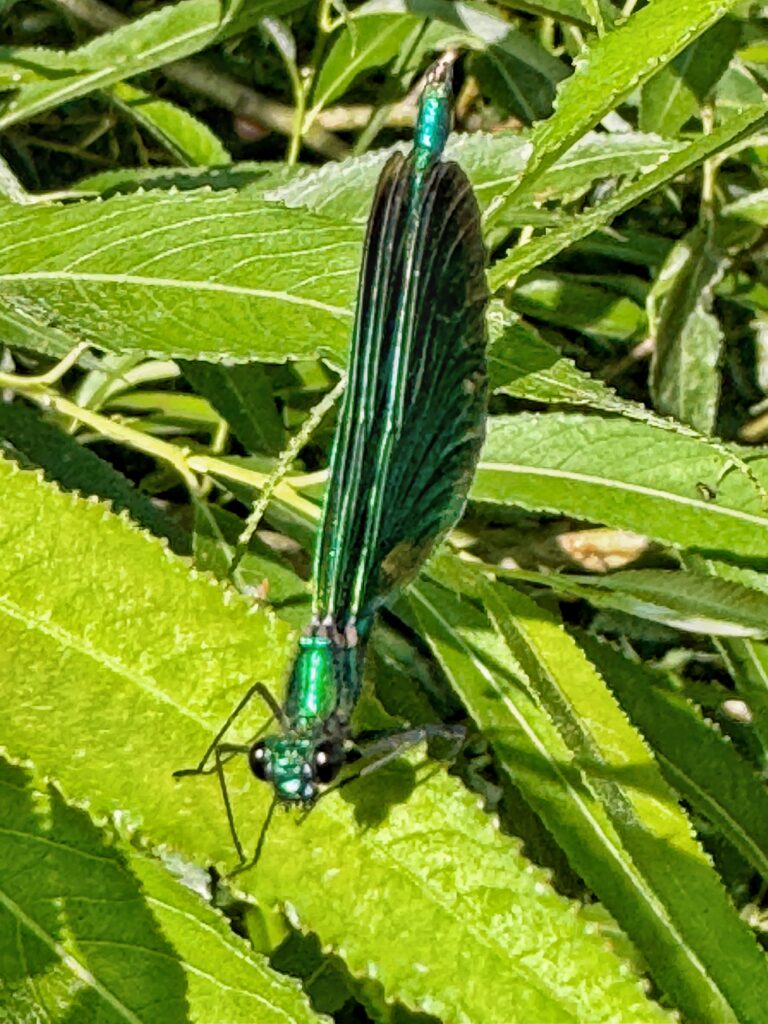
Jewelwing, damselfly
Jewelwing, apparently, according to iNaturalist.

Feel the pack getting heavier on the hill. Feel the cold sweat on my back when I get home.

That is the practice. Not the idea of the practice. Not the perfect version of the practice. The practice itself.

If walking is how I move through physical space, then weblogging is how I move through cyberspace.

A proper weblog is a trace of movement through the network. It says, I came through here. I noticed this. I followed this link. I read this fragment. I disagreed with this. I carried this sentence with me for a while. I left a marker. I made a path where there wasn’t one before.

In physical space, the walker has roads, footpaths, desire lines, bridleways, alleyways, fields, thresholds, gates, benches, pubs, rivers, hedgerows, ruins, weather, strangers, dogs, and the feel of the ground underfoot.

In cyberspace, the weblogger has hyperlinks, archives, feeds, tabs, bookmarks, blogrolls, search trails, old forums, RSS, comments, backlinks, screenshots, quotations, fragments, source notes, rabbit holes, dead links, resurfaced pages, and the strange little shimmer of finding an old human-made page still glowing in the dark.

The hyperlink is the footpath.

The tab is the open gate.

The bookmark is the cairn.

The blogroll is the old map pinned by the door.

The feed is the river, but you have to be careful, because if you stop walking and just let it carry you, you’re no longer traveling. You’re drifting.

I suppose that’s the link I’m starting to see. Walking is how I think through physical space. Weblogging is how I think through cyberspace.

In the street, I leave footprints. On the web, I leave links.

Thirty-one days of footprints and links. Thirty-one days of field notes, fragments, wanderings, readings, recordings, old-web logging, new-web experiments, and whatever else the trail decides to offer.

No grand system.

No perfect launch.

No polished content calendar.

Just a man with a rucksack, a recorder, a blog, and a desire to leave better traces.

Let’s see where the trail goes.

30 for 30

Well, this is officially the last post of our 30-day blog challenge. I have enjoyed having to bang out a post every day. There were a few days when I could have easily not posted anything for all of the usual reasons: no time, too busy, nothing to say, etc., but I persevered and managed to make it through the 30 days.

Personal blogging is tough. You’re essentially writing about your life and you have to make it interesting enough for people to be ok giving up their time to read your posts. That’s asking a lot considering all of the media available for people to consume on the Internet. There are only so many blog posts you can ready in day. Likewise with videos and podcasts. And then there’s social media – your TikTok, Instagram, Twitter, Mastodon, Facebook, Tumblr, Snapchat, Reddit and more.

Personal blogging differs from niche blogging or commercial blogging where your subject is narrow and usually centred on information outside of the individual’s personal life. Having a personal blog versus say a blog about the Rock band Kiss is harder because your asking people to be interested in you. Whereas, if this was blog all about Kiss, then you would be here to read about the band and not me. Granted, I might write from a first person perspective, but it would all be about Kiss.

Because social media is quick and dirty, you can consume a tweet in seconds and then move on to the next one. You can cover a lot of ground on Instagram scrolling through endless pictures or watch funny Reels.

Which is why, up until this challenge, I had resigned myself to just microblogging on Twitter and Instagram. Like the readers, I don’t have to invest a lot of time writing a tweet. I can fire and forget. Whereas coming up with ideas to write about for a blog post and then writing it takes a lot more time and mental energy. And if you get very little engagement, then the ROI on personal blogging doesn’t seem to be worth the investment of time.

But, if you do out the time in and you’re consistent, then growth and engagement happens, albeit slowly. You can see the difference in my stats. When I don’t post or post sporadically, traffic to site is nonexistent.

Unless you’re famous or known for something else, people aren’t likely to just randomly find your blog. So, like @MrFresh said in his post, you have to put in the work and push i out to social media outlets. In my case, Twitter is my biggest supplier of readers followed the WordPress.com social network of other WordPress bloggers.

November
December

My readership

November
December

The big question

Will I continue to post daily? Well, truthfully, probably not. But this past 30 days has taught me that I am capable of blogging daily. It comes back to purpose. What’s my purpose for blogging? To grow an audience? To have a place to document my life journey? Self-expression? Or something else. I need to definitively answer the purpose question. That will determine how I proceed.

One last thing. I think the turmoil over at Twitter has re-opened my eyes to why the importance of posting from your own space and syndicating out to social media platforms. I think it’s a good idea for me to rejoin the IndieWeb movement and blog and microblog from my own platform. That does require dropping the marketer mindset of blogging and returning to blogging for blogging’s sake. Dave Winer is great example of what this looks like. Dave has been blogging daily for 28 years, 2 months, 4 days, 21 hours, 27 minutes, 53 seconds. Dave is a blogger’s blogger.

I do wish WordPress worked more like micro.blog With that platform, you can just write. If it’s a short, i.e. falls in the 280 character limits, then it gets posted as a mircoblog post and crossposted to Twitter and Mastodon (and even to WordPress if you want). If what you’re writing starts to get long, the platform automatically turns it into a blog post and you proceed like you would with a regular blogpost. It also automatically gets posted to Twitter and Mastodon (if you chose). And with micro.blog you can post text, pictures, very short videos, and short audio.

While I am singing micro.blog’s praises, I no longer have a blog there. Mainly because it lacks the more powerful features of full WordPress site.

Anyway it’s been fun doing this challenge with my blog brothers, @MrFresh and @SMWGeek. Until next year, this officially ends the 30 Day Blog Challenge for me.

Here are all of my November posts. And here are my December posts.

the other side of now

Day 16. We’re over the hump now on our 30-day blogging challenge. There have been a couple of days when I felt really pressed for time and had no idea what to blog about. If I wasn’t involved in this challenge with my bros, @MrFresh and @SMVGeek, I would have let those days slip by without blogging.

The accountability to my blogging brothers keeps me motivated to blog even if I don’t particularly feel like it.

I fear that once the challenge is finished, it will be easy to slip into old habits of not blogging for flimsy reasons like the classic, “I don’t have time…” That’s why I love doing these challenges, because even if I don’t have time, I make time, or as the Merovingian says, “If you do not ever take time, how can you ever have time?”

I mentioned in a post a few days ago that I have a folder full of poems that I have been meaning to shape into another poetry collection. It’s been 13 years since I published my last collection.

For today’s post, I thought I’d share a few poems from the folder. These aren’t necessarily in their final form, but here you go…

Who are you?

She asked me the one question
I was afraid to answer. I’ve spent 
too much time constructing and
reconstructing this persona for her 
to come along and deconstruct me
with a single question.

She can sense my stories 
are only skin deep, polite,
easy on the ears, but light on the soul

I’m afraid to reveal myself
to myself, frightened because
I’m not sure what she or I might find

But she really wants to know

Who are you? She asks.
I duck and dive and sidestep
the question that’s on 
everybody’s mind

I hardly know myself
I fall to the ground.
I hand her my head on
a plate.

She burst into tears
laughing madly,
your name is all asked

Don’t be so dramatic.


thoughts

I gave her my thoughts
Until there was nothing
Left of my mind

Captain Hook

as i listen in silence
the tick tock of the clock
grows louder and louder

all i can think about
is how captain hook
freaked out every time
he heard a ticking clock

he knew death was near
but that didn’t stop
old hook from trying
to out sail his fate

or me mine.

reminisce

She reminisced in my name. Fire, meltdown
and the sanity they let loose in a tangled
abstract fantasy of post apocalyptic let down.

She reminisced in the attic for the wind,
the damned, and the free. Her shadow slipped
further. Soft she lay as the boys came for her body.

She looked to reach them in their sleep.
One by one they came inside her, cuddled 
her body like the walking dead carry sheep.

They wouldn’t reminisce in her beauty
took her dress for rags, her hair for 
loose strands of braided hopelessness.

She reminisced in the darkness. No longer
lonely, a mystic fastened like clockwork,
I never tried to see her face.

If you made this far, thanks for reading. And if you’re feeling frisky, then subscribe to the blog. It doesn’t cost you anything, but it makes me feel good.

meanwhile, elsewhere…

Well, look at that! It’s Friday again already. This week has flown by, as do most weeks as you get older. You know the Eternal Footman is waiting to take your cloak. But who has time for that? I don’t. At least, that’s what I tell myself. But I know I’ll have to deal with him sooner or later. Until then, let the weekend begin.

From time to time, I like to flick through my old journal entries. You see, in addition to personal blogging, which is, in essence, a form public journal/diary, I also keep an offline journal, one reserved for me deepest, darkest thoughts. It’s also where I scribble out my poems and experimental fiction pieces. I’ve been hemming and hawing about publish another poetry book. I have one that is nearly ready. I just snickered to myself because it’s been nearly ready for a couple years now. I’m not a hundred percent sure what the hold up is.
As it’s the weekend, and my brain is a little fried, I thought I share with prose poem I wrote a while back. I was in a post-modern, surrealistic mood. I love playing with language. It is, after all, a virus, as William Burroughs said. You can slip language into a person’s mind, and cause all kinds of reaction. Even these 225 words you’ve read so far are having an affect on you of some sort.

And now I’m going to slip these words in and tinker with your mind a little more.

There were always cracks in the system. But somehow we missed or ignored the warning signs: the increased angst, dread, and anxiety; the war to end all wars; Oppenheimer’s deadly toy; women’s liberation; the sexual revolution; civil rights; Vietnam; Aids; an actor playing the part of the president; a president playing God. Stop. Get grip MR Lowe, you’re spiralling out of control again.

Where was I? Oh yes, God. Dead. Life. Meaningless.

It took us awhile to realise that if we wanted meaning, we’d have to make it for ourselves.

“No answers will be forthcoming”, said the priest who was the last human to see God alive. He then promptly committed suicide. The people were shocked. He was finally out from under God’s thumb, finally able to experience true freedom. Why would he commit suicide?

Several days later, when they were clearing his room, they stumbled upon the priest’s journal:

“There’s no way I can tell them what really happened. I wouldn’t have believed it if someone had told me. There was only one part that mattered, to me anyway. I don’t even know if I remember all of it. I can’t remember how it ended, exactly, but when it ended, I knew the question would drive me insane.”

How should I live?


Track of the Day: We Don’t Need Another Hero – Tina Turner

on humanism

For thousands of years, humans believed that authority came from the gods. Then, during the modern era, humanism gradually shifted authority from deities to people.

Yuval Noah Harari

Maybe it’s because I spent most of the morning in the Metaverse that I find myself sitting here in a dimly lit room thinking about humanism.

I wasn’t playing games (Ok I did sneak off to watch some of the World Cup in VR), but apart from that, I was doing some serious work with a lady from Canada. She was giving me some useful tips on running events in AltSpaceVR which is Microsoft’s version of the Metaverse.

As I returned to the “real” world, a random question popped into my head: What is the downside of humanism? Where that came from, I’m not sure, but I decided to do some research on humanism.

Here’s what I found:

Humanism is a belief system that emphasizes the value and importance of human beings, as opposed to supernatural powers or deities. It focuses on human potential and culture, rather than religious belief.

Humanism is often associated with scientific thinking, but it is not strictly tied to science. It involves a philosophy based on reason and empathy for other humans and animals alike.

Humanists believe that people should live in harmony with nature, rather than dominating it; we should avoid harming other creatures unnecessarily. We can find meaning in our lives through things like art, music, literature and science—not just by following rules created by religions or governments.

One of the most important figures in humanist thought was Erasmus of Rotterdam (1466–1536), who wrote On Copia of Words and Ideas, a treatise on education that emphasized critical thinking and learning to think for oneself instead of just accepting what others say. He also wrote In Praise of Folly: A Dialogue Between Folly and Prudence, where he criticized religious superstitions like relics and saints.

The benefits of humanism include:

  • Acceptance of all people regardless of race or religion
  • A focus on personal growth instead of dogma (and so fewer rules)
  • A belief that humans have a responsibility towards each other (rather than just towards God)

Some criticisms about humanism include:

  • A lack of ritual (some people find this comforting)
  • No belief in an afterlife or divine intervention (some people find this scary)
  • A lack of moral guidance (people have to make up their own minds about right and wrong)

Some people say humanism is a religion, but it isn’t. It doesn’t involve rituals such as prayer or worship, and there are no churches or priests who can perform weddings or funerals. Humanism is also different from atheism—people who don’t believe in God aren’t necessarily humanists, though many are.

From what I’ve found so far, I like humanism. Especially since I blow hot and cold on religion and spirituality. Sometimes I feel connected to a high power or spiritual energy; other times, I don’t. Humanism seems like a good play in terms of being a decent human being.

I suspect the big issue, though, is reconciling the religious/spiritual question.

What are your thoughts?

let’s play 20 questions

I haven’t done a survey post in ages. As many of you may be new here, I thought, as a part of this 30 Day Blogging Challenge, I should do one, and give you a little bit more insight into this dude who calls himself soulcruzer.

1. Do you have any nicknames?

Hmm… I’ve had a few over the years. My family used to call me Pop when I was a kid. At West Point, some of my friends called me Buddha because of my bald head. They would come by my room and rub my head for good luck before a big exam. Some of my other friends called me “cabeza de melón” or “melon head” on account of my great big round noggin!

2. Are you named after anyone?

I was supposed to be. My dad wanted to do the medieval thing and name me after him and make me Coalet Lowe Jr. But, he used to get teased a lot when he was a kid because Coalet can also be a girl’s name. My parents settled on Clayton and then proceeded to call me by middle name – Lamont. None of my blood relatives call me Clayton, nor do they call me Clay.

3. Where did you grow up?

I’m a Jersey boy. I was born in Newark, New Jersey. But my best memories are from time growing up in Fort Monmouth/Eatontown, NJ.

4. What activities did you do in high school?

I played all the sports – football, basketball, wrestling, track and field, chess – until I found a copy of Arnold Schwarzenegger’s book, The Education of a Bodybuilder, after that, I became a die-hard gymrat. I still remain a gymrat to this day!

5. Where did you go to college?

The United States Military Academy at West Point. I have some photos of me as a cadet, but it would take me too long to go find them right now, so here’s me as A-Man – one of the Army Mascots at sporting events and rallies.

6. What kind of music do you like?

My musical taste is ridiculously broad and varied. I’ll listen to just about any category of music. Some of my favourite categories are: rock (and it’s many sub-categories – classic, heavy metal, indie, grunge etc), hip-hop, and trip-hop. To get a real sense of my musical taste, check out my Mixcloud account:

7. When was the last time you cried?

At the risk of sounding macho, I don’t do the crying thing. I haven’t been able to shake the mental paradigm that says men don’t cry. 😢

8. If you were another person, would you be a friend of yourself?

Yeah, why not?!

9. What’s the first thing you notice about people?

If it’s a guy, I think, can I take this dude in a fight! If it’s a lady, then it’s her smile, face, and hair.

10. What’s one hobby that you’d like to take up?

I’ve become a huge fan of virtual reality and the metaverse. I’d love to take up 3D modelling as a hobby so I can make original art and objects to place in my metaverse worlds on Altspace VR. A hobby, I’m about to start is writing interactive fiction using Twine.

11. Do you have any irrational fears?

Not particularly. I do have a compulsion to squash tarantulas, and when I’m up high on tall buildings or cliff edges, I feel an urge to jump.

12. How many countries have you visited?

I think, at last count, it was 24. I’ve been to most of Western Europe, plus Hungary, Poland, Romania, Turkey, Tunisia, Malaysia, Canada, and Mexico.

13. What’s the biggest project on your to-do list right now?

Becoming a master of the metaverse. VR and the metaverse are on the cusp of becoming the biggest thing since the Internet. In fact, it’s the next evolution of the Web. I want to be ahead of the curve on this one, so I have been building my presence in the metaverse. Of course, the current issue is that there many versions of the metaverse – places like Engaga VR, Altspace VR, Horizon World, among others.

14. If you weren’t in your current job, what would you do?

My standard answer to this question is bullfighter or clown. But being a little more realistic, and something that is within my reach is brushing the dust off of my history degree and either becoming a medieval scholar or mythologist.

15. What’s your favourite type of pizza?

I’m a pepperoni and jalapeño man on thin crust. Sometimes, I’ll go all meat feast – pepperoni, sausage, pancetta, and mince meat.

16. What’s your favourite alcoholic drink?

I’m a single-malt whisky man. If I’m not on the hard stuff, a cold lager, will do.

17. If you were to reincarnated as an animal, which animal would you be?

I’m going to have to go with a cat. They’ve got it good. They get to come and go as they please. Hang out all night, and sleep all day.

18. What do you wish more people understood about you?

Just because I’m sad, doesn’t mean I’m not happy.

19. What was the last book you read?

How to Live: A Life of Montaigne in one question and twenty attempts at an answer

20. Tell us your life story in exactly one sentence.

Just a dude seeking for seeking’s sake and enjoying every minute of it.

Track of the day: Concrete Schoolyard – Jurassic 5

one world or no world: revisiting Dire Straits’ Brothers In Arms album

“The first lesson a revolutionary must learn is that he is a doomed man.”

Huey Newton

Before I start, I need to thank @SMWGeek for writing The Album That Makes Me Love Autumn and Reflect on his blog yesterday as a part of our 30 Day Blog Challenge with @MrFresh.

Brothers In Arms is one of my all-time favourite albums. I was a Dire Straits fan before MTV. When this album came out, I was ecstatic. I played it nonstop. Even to this day, I can sing every song on the album without looking at a lyrics sheet!

The album, to me, is in two parts. Part one is mostly about loneliness, disillusionment, and heartbreak, and part two is about the potential of destroying our one world as reflected in the many guerrilla wars that raged throughout the 80’s. In particular, the Nicaraguan conflict.

In the lead track, So Far Away, the protagonist of the song is in a long distance relationship brought on by his constant travel. He’s tired of ‘bein’ in love and being’ all alone.’ The longer he is gone, the further his love gets away from him. They are on two sides of the continent. She’s in the sun and he is in the rain. She keeps getting further and further away from him as the song suggest at the end. ‘You’re so far… so far away from me…” is repeated until the song fades out.

Money For Nothing, the runaway MTV hit, is about a working-class appliance delivery man who is envious of the perceived lifestyle of rock stars and the fact that they get paid a ton of money and get all the girls just for playing some guitars and drums, which to him amounts to doing nothing. Meanwhile, he has to just get by in life doing “real” work and get paid next to nothing for his hard work. By verse three, he wishes he had learned to play the guitar or drums and then he could have a cushy life too. I love the cameo appearance of Sting on the track with his distinct high pitch squeal… ‘Money for nothing and your chick for free…’

Walk Of Life balances out Money For Nothing with a guy who is excited to go watch an old blues singer named Johnny who is in town to sing the ‘oldies, goldies’ like “Be-Bop-A-Lula”, “Baby What I Say” and “I Gotta Women.” Songs the protagonist likes. He’s a huge fan of Johnny’s so much so that he can watch Johnny play all night: “Turning all the night time into the day.” The protagonist seeks refuge in Johnny’s songs from the walk of life which is full of ‘violence and double talk.’

With Your Latest Trick, we swing back to the theme of loneliness with a guy who has had his heart broken by a girl he’s madly in love with but doesn’t love him back in the same way. My favourite thing about this song is Mark Knopfler ’s use of metaphors to build a hazy dystopian picture of the city. I love his use of the piano keys as the keys to his heart. And the final epiphany, when he realises there is no more love between him and his girl: “Like a bowery bum when he finally understands that the bottle is empty and there’s nothing left.”

Knopfler balances out Your Latest Trick with Why Worry like he does with Money For Nothing and Walk of Life. In Your Latest Trick, we get the opposite view of love. Here are two people who support each when things are bad and they are feeling down. The song opens with the protagonist offering support to his girl who is feeling down about the world which has made her sad. But as bad as things maybe now, he reminds her that it will get better, so why worry, there will be ‘laughter after pain’ and ’sunshine after rain.’ “These things have always been the same.” It’s part of the rhythm of life. He knows when it’s his turn to feel down, she will do the same for him and help him through his blues.

I love the whole album, but part two really struck a chord with me. When it came out in 1985, I was 17 and longing for real world adventure. The kind of adventure the romanticised version of war promises to boys who are on the verge of becoming men.

In my boyhood naïveté, I wanted to be a mercenary. I used to buy Soldier of Fortune Magazine every month and read it from cover to cover. I was fascinated by the Rhodesian Bush War and many of the soldier of fortune tales that came out of that conflict. The Wild Geese movie with Richard Burton, Roger Moore, Richard Harris, and Hardy Kruger, was one of my favourite films at the time. I wanted that kind of camaraderie. Heck, when I was 16, I had researched and planned to runaway from home to join the French Foreign Legion! Not having a passport, and needing my mom to get me one, proved to be a barrier.

Part two of the album, to me, is mainly about the guerrilla wars that were being fought in Central America at the time, particularly the Nicaraguan Revolution and the Contra War.

Part two opens with Ride Across the River, a brilliant song. It shows war from two perspectives – one from the revolutionaries who are fighting what they consider to be a just and noble war in support of freedom. They are ‘the chosen’ and are ready ‘to pay with our lives if we must.’ And I’m wondering if Knopfler uses the river, which, appears in the chorus, as a metaphor for death. It calls to mind the River Styx from Greek mythology where Charon, the ferryman, would taxis the souls of the dead from Gaia (Earth) to the Underworld of Hades. The revolutionaries in the song are committed to death. They know they are “ Gonna ride across the river, deep and wide/Ride across the river to the other side.”

The soldiers of fortune in the song are not so naive. They don’t care about freedom and noble causes. They are in it for the money. And they “don’t give a damn who the killing is for.” To them, it is “the same old story with a different name/Death or glory, it’s the killing game.” And like the revolutionaries, they too, know, that they will more than likely be taking a ride across the river.

The revolutionaries are optimistic. They are fighting the good fight: “Today in the mountains; tomorrow the world.”

The Man’s Too Strong is tricky. The revolutionaries’ cause starts off noble, but the death and destruction of war soon brings out the worst in men and the cause becomes tarnished by the evils of humanity and the corruption that evolves out of those who lose sight of the cause and become blinded by the power they wield over life ad death.

In this song, we meet the guerrilla leader who has finally been caught by The Man.

The Man’s Too Strong feels like a confessional song. The warlord tells his story:

… I have legalized robbery
And called it relief
I have run with the money
I have hid like a thief
Rewritten histories with my armies and my crooks
Invented memories
I did burn all the books

Through all of the bad things he has done, he has ‘striven for peace.’ A peace, he would never know.

The Man doesn’t want the guerrilla leader to die a martyr so brings him out into the courtyard to publicly denounce him:

“You always was a Judas,
But I got you anyway.”

The Man is not satisfied with just killing the guerrilla leader, he wants him to suffer. He tells him what he has done to his daughter and wife.

The captured warlord, who knows his execution is imminent, prays to God for absolution:

Oh father, please help me
For I have done wrong
The man’s too big
The man’s too strong

In One World, the protagonist has the blues. Nothing seems to be going right for him:

Can’t get no sleeves for my records
Can’t get no laces for my shoes
Can’t get no fancy notes on my blue guitar

He confesses that he “can’t get no antidote’ for his blues.

He seems to be trying to find a reason for why the world is in the state that it’s in. But nothing seems to make sense and the reasons people give for their actions can’t be trusted. He’s been told that it’s mostly vanity that drives our actions. That’s the way it has always been and always will be. He has to accept that “there’s no such thing as sanity, and that’s the sanest fact.” There is no remedy for his blues.

He concludes that if the politicians can’t find “a way to be one world in harmony,” there can never be an antidote to the blues he is feeling.

The last song, and the title track for the album, Brothers in Arms takes us back to the war torn country we met in Ride Across The River. It’s told from the point of view of one of the rebels who has aged now. He is resigned to the fact, that as a rebel, he can never go home again, that the mountains, where the rebels hide, have become his home. He misses his real home:

But my home is the lowlands
And always will be

He does hope that one day, the fighting will stop, and the rebels can go back to their homes in the lowlands and lush valleys and be with their families and no longer ‘burn to be brothers in arms.’

Verse two holds a specially place in my heart. As a former soldier, these words ring true:

Through these fields of destruction
Baptisms of fire
I’ve witnessed your suffering
As the battle raged high
And though they did hurt me so bad
In the fear and alarm
You did not desert me
My brothers in arms

I will always be close to my brothers in arms.

In the next verse, we return to the one world theme. Where the bluesman in One World has given up hope, the aged rebel in Brothers In Arms still holds on to hope that while for now we all live in different worlds maybe one day we will realise that we, in fact, only have one world. And we are “fools to make war on our brothers in arms.”

My 3 favourite tracks plus additional notes

it’s not just a fantasy

“Fantasy is as essential as air, forming the medium or the ether in which all the other activities of mind take place…Fantasy, in fact, plays a major role in building the world, in guiding the choices and adaptations we make, and the relationships we form. Fantasies are among the most powerful of the catalysts that infuse and organise our lives, dictating romantic, familial, and professional goals; fueling behaviour; engendering plans for the future. In turn, our experiences, and the myths and stories of the culture in which we live, shape our fantasies.”

Ethel S. Person, M.D. – By Force of Fantasy

We had an awesome night of adventuring in Dungeons & Dragons land. We found ourselves facing off against a four-armed copper state brought to life by some fanatical cult members, who, like all cult members, had some weird delusional version of how the world should work. And being cultists, they were willing to bring about their demented version of reality by any means necessary. 

Vulred Sarren, the wood elf, played by me, was having an off night.  He couldn’t land a blow to literally save his life.  He must have  somehow offended the gods. Even Lady Luck turned her back on him. It was a good thing he had companions – a human ranger, a dwarf cleric, a gnome rogue, and a gnome wizard who, coincidentally, was also having a bad night. None of her spells were working. 

None of us fancied fighting this living copper statue in the cellar where we found it, so we lured it outside the inn. 

I smugly cast a Wall of Wind to hold it in place. But before I could congratulate myself on my ingenuity, the living statue flew over my 15-foot-high wall and landed right in the middle of us. Our jaws went slack, and the fight was on.

I was 13 when my friend Brian, who was three years older than me, introduced me to Dungeons & Dragons. I was already heavily into heroic fantasy and its kin, sword and sorcery fantasy. I used to save up my lunch money and allowance until I had enough to buy an armful of fantasy books from Barnes and Noble at least once a month. I used to love it when the weekend rolled around and I could head to the mall and browse the fantasy shelves. I’d spend a couple of hours in the shop admiring the covers of the sword and sorcery books and reading the back covers until I found a few that really grabbed my attention.

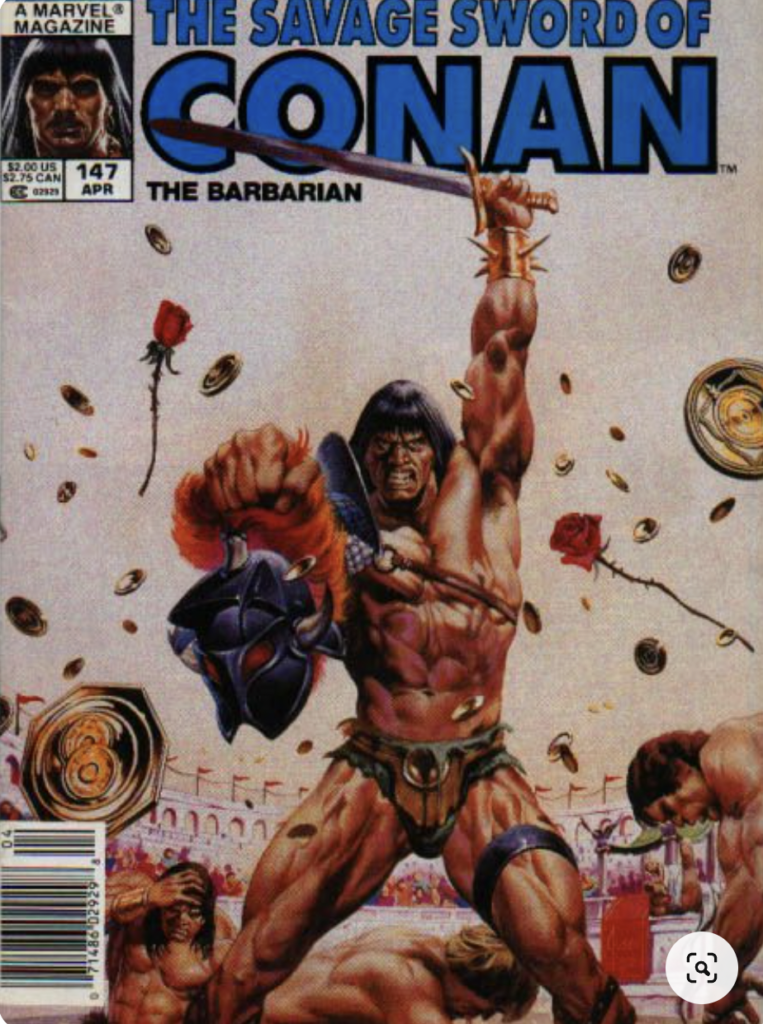
By the time I graduated from high school, I had a collection of hundreds of these fantasy books. My prized books were all of Robert E. Howard’s Conan the Barbarian novels and Marvel’s adaptation of the novels in The Savage Sword of Conan, the black-and-white magazine-style comic. True story: when I left home for West Point, my mom, who hated these books, she called them demon books, gave away my whole collection. But she knew I would have never forgiven her if she had given away my Conan collection.

During my time at West Point, my fantasy obsession faded. I threw myself into history books instead. I had determined I was going to be a Great War captain like Caesar, Hannibal, Grant, and Patton. If I wanted to accomplish that, I knew I had to be a student of war. I studied all the masters: Sun Tzu, Napoleon, Clausewitz, Rommel, Patton, and Grant, among others.

After I graduated from West Point, my love of heroic fantasy mainly lived on through whatever movies came out in that genre. My reading was mostly occupied with current events and history. I loved history books almost as much as I had loved sword and sorcery books.  I ended up majoring in History and by the time I graduated, I had amassed a huge history book collection.

After the army, I let history give way to business books and self-help and personal development books. I think, in the process, I lost a vital part of who I am at my core.

It is this missing piece that I am trying to find again.

So I was ecstatic when my wife tagged me in a Facebook post of a local Dungeon and Dragons group that was looking for new players. I answered the call for new adventures quickly. This was my chance to get back into the game. That was a few weeks ago. I am now into second week with the group on a big campaign to stop a cultist group that has been terrorising the local villagers and using them as sacrifices in their bizarre rituals.

It’s easy to dismiss fantasy as a detachment from reality, a waste of time, especially for responsible adults. The only myth you’re rewarded for believing in is consumerism and the capitalist narrative that supports it.

But as psychologists like Carl Jung and James Hillman suggest, by doing this and cutting ourselves off from our mythic imagination, we inhibit our personal and spiritual growth by forcing our psyche to accept a limited version of itself. 

The two books that really opened my eyes so I could see just how detached I have become from my true self and living a life of meaning are:

Your Mythic Journey: Finding Meaning in Your Life Through Writing and Storytelling 

And

The Mythic Imagination: The Quest for Meaning Through Personal Mythology.

And the third book, which I opened this post with, speaks directly to the importance of fantasy: By Force of Fantasy: How We Make Our Lives

I think I need to do a deeper dive on each of these books, so I’ll mention them here and address them further in a future post.

First time I went away from home alone

Hey up! Day 4. I forgot that people are busy. My challenge to speak to 30 different people for this year has hit a snag and it’s only day number 4. But I’m a person, so if I talk to myself, does that still count? lol.

If you fancy a chat, let me know, help me reach my goal!

Looking at the world through different lenses

It turns out I’ve known Justyna for just over a year now. We met through a mutual company we both do some contract work for. JJ is a kindred spirit. We both dig philosophy, start things we never finish, and think about things way too much. So here for #AudioMo Day 2 is Justyna.

Being with my tree

#Audiomo Day 1. I love this time of the year when the Audiomo community comes together for the month of June to make and share audio. I thought I’d add something extra to the 30-day challenge this year and that is to have 30 conversations with 30 different people for my posts this year.

First up is my friend Sara Beth Hunt, novelist and podcaster.

Just before I leave 2017

New Year’s Eve. What better time for a wander through the woods and some contemplation before all of the festivities start this evening.

Hope you all have a great night and if you haven’t gotten around to signing up for the 30 Day Contemplation Challenge tap here and tell us where to send it. http://eepurl.com/daeDxXr It all starts up tomorrow! ?

Hear some words from the woods: